Introduction
Behavioural dysfunction during childhood and adolescence can foreshadow the development of psychosis in adulthood. Several population-based prospective studies have documented social, behavioural and emotional antecedents in the childhood of those who later develop schizophrenia and related disorders (Done et al. Reference Done, Crow, Johnstone and Sacker1994; Jones et al. Reference Jones, Rodgers, Murray and Marmot1994; Crow et al. Reference Crow, Done and Sacker1995; Malmberg et al. Reference Malmberg, Lewis, David and Allebeck1998; Davidson et al. Reference Davidson, Reichenberg, Rabinowitz, Weiser, Kaplan and Mark1999; Bearden et al. Reference Bearden, Rosso, Hollister, Sanchez, Hadley and Cannon2000; Poulton et al. Reference Poulton, Caspi, Moffitt, Cannon, Murray and Harrington2000; Cannon et al. Reference Cannon, Caspi, Moffitt, Harrington, Taylor, Murray and Poulton2002). The exact nature of these findings varies between studies, in keeping with (a) the different predictor variables assessed in each cohort and (b) the various diagnostic criteria used as outcome measures in the different cohorts (which include schizophreniform psychosis, schizophrenia and a range of related non-affective psychoses). However, several key issues have emerged from this body of research. First, it is unclear whether behavioural problems associated with later non-affective psychoses differ between males and females. For example, although an early birth cohort study found few gender differences (Jones et al. Reference Jones, Rodgers, Murray and Marmot1994), studies on a later cohort (Done et al. Reference Done, Crow, Johnstone and Sacker1994; Crow et al. Reference Crow, Done and Sacker1995) identified differences in the nature and timing of behavioural antecedents (i.e. boys from age 7 showed ‘over-reactivity’ whereas girls became withdrawn by age 11). Second, the within-individual developmental continuity between early and late behaviour and subsequent non-affective psychosis is poorly characterized. Most studies have examined the antecedent variables of interest at one time-point only. Of the studies that have examined antecedents at multiple time-points, most have reported group means at different ages (e.g. Crow et al. Reference Crow, Done and Sacker1995). However, linking individuals across multiple time-points can provide additional information on individual developmental trajectories. For example, compared to their peers, some cohort members may show persistent psychopathology at two time-points prior to onset whereas others may show worsening psychopathology over time. Heterogeneity of individual developmental trajectories leading to non-affective psychosis may be hidden by relying on group mean-level data. A study that linked individual's scores at different ages found that cohort members with schizophrenia showed continuity between delayed neuromotor milestones in infancy and poor academic skills in adolescence (Isohanni et al. Reference Isohanni, Murray, Jokelainen, Croudace and Jones2004), but to our knowledge no previous studies have examined the ‘persistence’ of emotional and behavioural antecedents leading to non-affective psychosis.
The association between isolated psychotic symptoms and subsequent risk of a clinical psychotic disorder is an area of considerable interest in current research. Even for those who do not develop frank clinical psychosis, isolated psychotic symptoms are associated with a range of adverse mental health outcomes (Dhossche et al. Reference Dhossche, Ferdinand, Van der Ende, Hofstra and Verhulst2002) and appreciable disability (Rossler et al. Reference Rossler, Riecher-Rossler, Angst, Murray, Gamma, Eich, van Os and Gross2007). To date, only one birth cohort study has examined psychotic symptoms as antecedents of later non-affective psychosis (Poulton et al. Reference Poulton, Caspi, Moffitt, Cannon, Murray and Harrington2000). This study reported that psychotic symptoms at age 11 were associated with schizophreniform disorder in adulthood. Identifying early subclinical symptoms is important, as they suggest neurodevelopmental continuity (Cannon et al. Reference Cannon, Caspi, Moffitt, Harrington, Taylor, Murray and Poulton2002) and may interact with other risk factors (such as cannabis use) to synergistically increase the risk of later psychosis.
Another important issue that needs to be considered when comparing the antecedents of non-affective psychosis in different birth cohort studies relates to the method of case ascertainment. With the exception of the Dunedin study (Poulton et al. Reference Poulton, Caspi, Moffitt, Cannon, Murray and Harrington2000), birth cohort studies have relied on linkage to administrative registers to identify potential cases. These cases were then assessed by direct diagnostic interview or case-note review. Thus, apart from the Dunedin study, clinical outcomes have been based on treated or administrative samples rather than on more representative community-based samples.
We had the opportunity to address these issues by examining the behavioural and emotional antecedents of non-affective psychosis based on an Australian, population-based birth cohort. Behavioural information on the cohort was collected at years 5 and 14 follow-up using the Child Behavior Checklist (CBCL; Achenbach, Reference Achenbach1991a) and the Youth Self-Report (YSR; Achenbach, Reference Achenbach1991b), both of which have been used extensively in various educational and mental-health settings (Achenbach & Edelbrock, Reference Achenbach and Edelbrock1983).
Based on the previous literature, we predicted that non-affective psychosis in young adulthood would be associated with higher levels of emotional or behavioural problems, as measured by the total and subscores of the CBCL at 5- and 14-year follow-up and the YSR at 14-year follow-up. We predicted that cohort members with high scores on these scales at both years 5 and 14 would be at the highest risk of later non-affective psychosis compared to other patterns of within-individual patterns of behaviour. With respect to specific symptoms of psychosis, we predicted that endorsing psychotic items in adolescence would be associated with an increased risk of subsequent non-affective psychosis. We also predicted that the antecedents of schizophrenia would differ between males and females.
Method
Participants
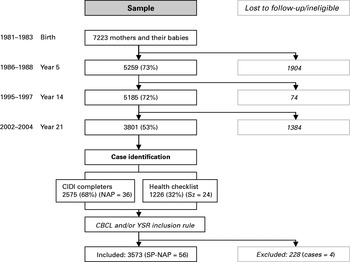
The Mater-University Study of Pregnancy and its outcomes (MUSP) is a prospective study of 7223 women and their offspring who received antenatal care at a major public hospital in Brisbane, Australia between 1981 and 1984. The cohort, which has been followed up at various ages, has been used to assess the precursors of a broad range of physical and mental health outcomes (Al Mamun et al. Reference Al Mamun, O'Callaghan, Alati, O'Callaghan, Najman, Williams and Bor2006; Alati et al. Reference Alati, Al Mamun, Williams, O'Callaghan, Najman and Bor2006; Lawlor et al. Reference Lawlor, Najman, Batty, O'Callaghan, Williams and Bor2006; Hayatbakhsh et al. Reference Hayatbakhsh, Alati, Hutchinson, Jamrozik, Najman, Mamun, O'Callaghan and Bor2007). Full details of the original MUSP study design, sampling strategy, attrition and follow-up sample characteristics are available elsewhere (Alati et al. Reference Alati, O'Callaghan, Najman, Williams, Bor and Lawlor2005; Najman et al. Reference Najman, Bor, O'Callaghan, Williams, Aird and Shuttlewood2005; Hayatbakhsh et al. Reference Hayatbakhsh, Alati, Hutchinson, Jamrozik, Najman, Mamun, O'Callaghan and Bor2007). Of the original sample of 7223 mothers and infants recruited between 1981 and 1983, follow-up responses were: 5259 mothers (73%) after 5 years; 5185 mothers (72%) and 5172 children (72%) after 14 years; and 3801 children (53%) after 21 years (Najman et al. Reference Najman, Bor, O'Callaghan, Williams, Aird and Shuttlewood2005) (see Fig. 1).
Sampling frame and follow-up Mater-University Study of Pregnancy (MUSP). CIDI, Composite International Diagnostic Interview; NAP, non-affective psychosis; Sz, schizophrenia; CBCL, Child Behavior Checklist; YSR, Youth Self-Report; SP-NAP, screen-positive non-affective psychosis.

Outcome variables
At the 21-year follow-up, 2575 of the child cohort members completed the lifetime version of the Composite International Diagnostic Interview (CIDI), computerized version (WHO, 1992). Insufficient funding (rather than participant refusal) prevented CIDI assessment of the entire cohort. However, additional information was available for 1226 cohort members who did not have a CIDI interview. These cohort members completed a health outcomes checklist that included the following item: ‘Have you ever been told by a doctor that you have schizophrenia?’ The Australian Survey of Low Prevalence (Psychotic) Disorders found that this item had good positive predictive value for psychosis in clinical settings (PPV=0.89) (Jablensky et al. Reference Jablensky, McGrath, Herrman, Castle, Gureje, Morgan and Korten1999). For the current study we defined ‘caseness’ as: (a) meeting the criteria for CIDI-generated DSM-IV schizophrenia, brief psychosis, delusional disorder, or schizophreniform disorder (APA, 1994); or (b) receiving a past medical diagnosis of schizophrenia as reported on the health outcomes checklist. Henceforth, we refer to this combined group as ‘Screen-Positive Non-affective Psychosis’ (SP-NAP).
Predictor variables
Behavioural information on the cohort was assessed at the 5-year follow-up (‘year 5’) using the short-form CBCL completed by mothers (Bor et al. Reference Bor, Najman, Andersen, O'Callaghan, Williams and Behrens1997). The full CBCL and YSR instruments were completed by the mothers and by the cohort members respectively at year 14. The use of the complementary CBCL and YSR at year 14 allows cross-informant comparisons (Achenbach & Dumenci, Reference Achenbach and Dumenci2001), whereas the comparable measures available from childhood to adolescence are well-suited for exploring within-individual developmental trajectories. These scales identify a wide range of behavioural and emotional problems (including psychotic symptoms). For example, the CBCL and YSR generate ‘Total’ scores and nine subscores: ‘Attention’, ‘Thought’, ‘Withdrawal’, ‘Delinquency’, ‘Aggression’, ‘Anxiety/depression’, ‘Social’, ‘Somatizing’ and ‘Other’. The ‘Thought’ subscore and its constituent items are of particular relevance to this study, as they cover psychosis-like symptoms such as hallucinatory experiences. Higher scores indicate greater levels of psychopathology. Following the guidelines of Achenbach (Reference Achenbach1991a), cohort members who had more than 20 missing items on the CBCL or the YSR were excluded from the relevant analysis.
Covariates
Univariate analyses were conducted on variables that might modify any association between childhood and adolescent behaviour and non-affective psychosis, such as cannabis use by year 14, various sociodemographic measures, and age at assessment (cohort births occurred over a 3-year period and follow-up assessments occurred at one time-point, thus actual ages at follow-up varied slightly). Only those significantly associated with SP-NAP were retained to use in further modelling.
Statistical analyses
We used maximum-likelihood logistic regression to examine the association between the CBCL and YSR scores and SP-NAP. The CBCL and YSR scores were divided into quartiles based on the non-cases for males and females separately (Q1 being the lowest quartile and Q4 the highest quartile). We examined a model adjusted for: (a) actual age at year 21 follow-up and (b) self-reported cannabis use by year 14 (adolescent cannabis use has been associated with behavioural problems; Fergusson et al. Reference Fergusson, Horwood and Lynskey1994). In addition, we tested the models for the presence of a linear trend across the quartiles. To examine sex differences, we (a) conducted analyses on the combined male and female sample to examine whether the association between the variables of interests was significantly modified by sex, and (b) presented the adjusted odds ratios for males and females separately. To examine whether the method of defining cases influenced the findings, we undertook planned sensitivity analyses by retesting associations between CBCL and YSR scales when SP-NAP cases were restricted to only those diagnosed by the CIDI.
To capture the within-individual continuity of psychopathology across childhood and adolescence, we linked comparable scores at years 5 and 14 (e.g. year 5 CBCL ‘Total’ was linked with year 14 YSR ‘Total’ for each cohort member). We dichotomized the cohort into those in the highest quartile (Q4) versus lower quartiles (Q1–3). Based on these scores, we created four discrete groups that chart the status of cohort members across the two time-points. Thus cohort members may (a) score consistently in the upper quartiles (year 5 Q4 and year 14 Q4); (b) score consistently in the lower quartiles (year 5 Q1–3 and year 14 Q1–3); (c) show a relative reduction in psychopathology (year 5 Q4 and year 14 Q1–3); or (d) show a relative worsening in psychopathology (year 5 Q1–3 and year 14 Q4). The association between this four-level longitudinal variable and later SP-NAP was examined. In addition, we looked for an interaction effect between scores from the two time-points with respect to later SP-NAP.
We were particularly interested in items that were directly related to the symptoms of psychosis. For these analyses, the individual CBCL or YSR items were dichotomized into ‘rarely/never’ versus ‘sometimes/often’. We also examined the PPV (and sensitivity and specificity) of the antecedent variables that were most strongly associated with later SP-NAP. Analyses were performed using the statistical package SAS (2002). Written informed consent was obtained from the mother at all data collection phases, and from the young adult at year 21. Ethical approval for this study was obtained from the University of Queensland Ethics Committee.
Results
A total of 3801 members [1806 (48%) males] of the MUSP birth cohort completed the year 21 follow-up. Of these, 2575 (68%) completed the CIDI; and of these, four were found to meet the DSM-IV criteria for schizophrenia, four for delusional disorder, 24 for brief psychotic disorder, and four for schizophreniform disorder, resulting in a total of 36 who screened positive for CIDI-based diagnosis of non-affective psychosis. Of the 1226 cohort members who did not complete the CIDI, 24 reported a past medical diagnosis of schizophrenia in the health outcomes checklist. These respondents together with the CIDI-diagnosed gave a total of 60 SP-NAP cohort members. After excluding those with missing CBCL or YSR data, the total available for analysis was 3573 (1701 males and 1872 females); of these, 56 (26 males and 30 females) were SP-NAP (see Fig. 1).
When we examined the potentially confounding variables, we found that 19 (32%) of SP-NAP cases compared with 437 (12%) of non-cases reported using cannabis by year 14 [(odds ratio (OR) 3.51, 95% confidence interval (CI) 2.01–6.11]. We also found that 10 (18%) of SP-NAP cases compared with 1072 (30%) of non-cases were less than 20 years of age at year 21 follow-up (OR 2.03, 95% CI 1.02–4.05). These variables were included in the statistical models as covariates. Other potentially confounding variables, such as sociodemographic background (parental income at birth, age and education of mother) and actual ages at follow-up at years 5 and 14, were not associated with SP-NAP at year 21 and were not included in the modelling.
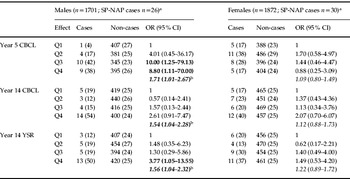
Table 1 presents the results of the logistic regression analyses for SP-NAP at year 21 and the CBCL at years 5 and 14, and the YSR at year 14. At year 5, higher ‘Total’ CBCL scores were significantly associated with SP-NAP for males (OR 8.57, 95% CI 1.08–68.24). Of the subscores, those for ‘Aggression’ (OR 8.35, 95% CI 1.05–66.60) and ‘Social, Attention and Thought’ (OR 11.19, 95% CI 1.42–88.15) in males were also significantly associated. There were no significant associations for females. Analyses on the combined sample (i.e. males and females) identified only the ‘Aggression’ subscore as having a significant interaction by sex.
Associations between Achenbach scores expressed as quartiles with SP-NAP by age 21 years and linear trend

Q, Quartile (Q1 is the lowest quartile); CBCL, Child Behaviour Checklist; YSR, Youth Self-Report; OR, odds ratio; CI, confidence interval.
Values are given as n (%).
ORs adjusted for age of assessment at year 21 follow-up and cannabis use by year 14 follow-up.
Significant findings are shown in bold.
a Total counts may differ between analyses due to missing data.
b OR (95% CI) in italics represent results of a test for linear trend.
At year 14, there were no significant associations between higher ‘Total’ CBCL scores and SP-NAP for either males or females. However, a significant linear trend emerged across this measure for males (OR 1.52, 95% CI 1.04–2.28). A high score on the CBCL ‘Social’ subscale (OR 4.79, 95% CI 1.03–22.37) was significantly associated with SP-NAP for males, but none of the other subscores (including the ‘Thought’ subscale) were significantly associated with SP-NAP. There were no significant associations for females, and analyses in the combined male and female sample did not detect a significant interaction for sex.
At year 14, there was a significant association between higher ‘Total’ YSR scores and SP-NAP for males only. For many YSR subscores, males who scored in the highest quartile were significantly more likely to develop SP-NAP. Significant associations were found for ‘Thought’ (OR 3.46, 95% CI 1.25–9.59), ‘Attention’ (OR 3.47, 95% CI 1.32–9.12), ‘Social’ (OR 3.91, 95% CI 1.08–14.12), ‘Aggression’ (OR 3.85, 95% CI 1.24–11.90) and ‘Anxiety/Depression’ (OR 3.40, 95% CI 1.22–9.43). Although there were no significant effects for females, analyses in the combined male and female sample did not detect any significant interaction for sex.
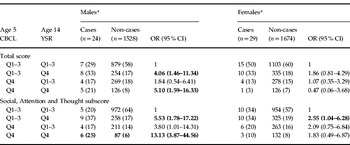
Table 2 presents the results of the within-individual continuity measure derived from linking the mother-rated CBCL at year 5 to the self-rated YSR at year 14. For males, SP-NAP at year 21 was associated with being in the top quartile for the ‘Total’ and ‘Social, Attention and Thought’ scores at both ages. High ‘Aggression’ subscores at both years 5 and 14 were also associated with SP-NAP for males (OR 6.77, 95% CI 1.92–17.26). Furthermore, worsening of psychopathology, moving into the top quartile for ‘Total’ and ‘Social, Attention and Thought’ by year 14, was significantly associated with caseness at year 21. For females, only one of the longitudinal categories (moving into the top quartile for the ‘Social, Attention and Thought’ subscale) was significantly associated with later SP-NAP. There were no significant interaction effects between comparable scores from the two time-points versus later SP-NAP. Post-hoc analyses for the combined male and female sample demonstrated significant interactions for sex for both the ‘Total’ score (p=0.04) and the ‘Social, Attention and Thought’ scale score (p<0.03). Continuity scores constructed from CBCL at year 5 and CBCL at year 14 were also examined; the results on this derived measure were in broad agreement with the results shown above.
Comparing continuity of cases and non-cases: CBCL quartiles at age 5 and YSR quartiles at age 14

CBCL, Child Behaviour Checklist; YSR, Youth Self-Report; OR, odds ratio; CI, confidence interval.
Values are given as n (%).
ORs adjusted for age of assessment at year 21 follow-up and cannabis use by year 14 follow-up.
Significant findings are shown in bold.
a Total counts may differ between analyses due to missing data.
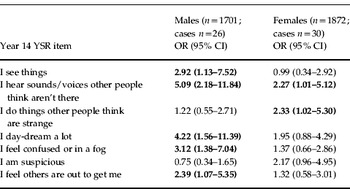
Table 3 presents selected YSR items at year 14. For hallucinatory experiences, males who reported hearing ‘sounds or voices’ had a >5-fold increased odds of being SP-NAP at year 21, whereas females had a >2-fold increase risk. Visual hallucinations were significant for males only. For the items ‘I do things other people think are strange’ and ‘I am suspicious’, the associations were significant for females only. For the males, the following items were also significantly associated with later SP-NAP: ‘I day-dream a lot’, ‘I feel confused or in a fog’, and ‘I feel that others are out to get me’. A post-hoc analysis indicated that male cases were also significantly more likely to report having deliberately tried to hurt or kill themselves (OR 5.10, 95% CI 1.63–15.98), or feeling worthless or inferior (OR 2.98, 95% CI 1.32–6.74).
Associations of selected psychosis items from YSR at age 14 follow-up with SP-NAP at age 21 follow-up

YSR, Youth Self-Report; SP-NAP, screen-positive non-affective psychosis; OR, odds ratio; CI, confidence interval.
OR of SP-NAP given as ‘sometimes/often’ compared with ‘rarely/never’.
ORs adjusted for age of assessment at year 21 follow-up and cannabis use by year 14 follow-up.
Significant findings are shown in bold.
When we restricted the cases to those with a CIDI-generated diagnoses only (n=36), the direction and magnitude of the point estimate for the ORs for the most informative scores changed little. However, because of the reduced sample size, the CIs became broader and some associations were no longer statistically significant. The PPV for the most informative scores was weak (3–4%; sensitivity 42–58%; specificity 72–80%).
Discussion
We report, for the first time, behavioural and emotional antecedents of SP-NAP using the CBCL and YSR. Although the CBCL has been used to examine psychosis in retrospective cross-sectional studies (Rossi et al. Reference Rossi, Pollice, Daneluzzo, Marinangeli and Stratta2000, Reference Rossi, Pollice, Stratta, Arduini, Marinangeli and Daneluzzo2002; Muratori et al. Reference Muratori, Salvadori, D'Arcangelo, Viglione and Picchi2005) and in the offspring of women with schizophrenia (Miller et al. Reference Miller, Byrne, Hodges, Lawrie and Johnstone2002), this is the first prospective population-based birth cohort study to report the association between the widely used Achenbach scales and later SP-NAP. We also report for the first time the within-individual behavioural trajectory from childhood to adolescence; a comparison of mother and child ratings in adolescence; and psychosis items from the YSR scale.
We found that maternal reports related to general psychopathology, social and attentional dysfunction, and aggression or delinquency at years 5 and 14 were significantly associated with SP-NAP in males by year 21. We also found that at year 14, male cohort members who were subsequently SP-NAP at year 21 rated themselves highly on many YSR-derived scores including thought and emotional dysfunction. At year 14, both males and females who were later SP-NAP endorsed self-report items related to psychotic symptoms. Importantly, the pattern of pre-morbid psychopathology in those who were SP-NAP at year 21 was more prominent in males than in females. Confirming that the antecedent of SP-NAP differs between males and females, our study found significant interactions for sex for (a) the ‘Aggression’ subscore of the CBCL at year 5 and (b) both the within-individual ‘Total’ and ‘Social, Attention and Thought’ continuity scores. In each instance, high scores on these measures were significantly associated with SP-NAP in males but not in females. Apart from these particular measures, the associations between the CBCL and YSR variables and later SP-NAP in females were often of comparable magnitude and direction to that found in males, but failed to reach statistical significance.
We found that adolescent self-report of auditory hallucinations was associated with SP-NAP, and that this association was identified in both males and females. Although the authors of the Dunedin cohort study did not report sex differences, they did find that psychotic symptoms at 11 years predicted schizophreniform disorder in adulthood (Poulton et al. Reference Poulton, Caspi, Moffitt, Cannon, Murray and Harrington2000). In our study, the auditory hallucination item was endorsed by nine (35%) cases and 165 (10%) non-cases at year 14. Thus, in keeping with other studies, the majority of subjects who reported auditory hallucinations at 14 years did not go on to develop SP-NAP. It is now recognized that isolated psychotic-like experiences are relatively common in the general population (Scott et al. Reference Scott, Chant, Andrews and McGrath2006; Laurens et al. Reference Laurens, Hodgins, Maughan, Murray, Rutter and Taylor2007). Of note, a longitudinal community survey of adolescents that also used the YSR found that visual and auditory hallucinations were predictive of an increased risk of later depression or substance abuse, but not for psychotic disorders (Dhossche et al. Reference Dhossche, Ferdinand, Van der Ende, Hofstra and Verhulst2002).
Apart from more obvious psychosis-like experiences, scores relating to attentional problems, anxiety and depression were associated with SP-NAP in males. These antecedents have been identified in other studies (Kugelmass et al. Reference Kugelmass, Faber, Ingraham, Frenkel, Nathan, Mirsky and Ben Shakhar1995; Miller et al. Reference Miller, Byrne, Hodges, Lawrie and Johnstone2002; Niemi et al. Reference Niemi, Suvisaari, Haukka and Lonnqvist2005). It has been proposed that such symptoms should be considered an inherent part of the pathophysiological processes leading to the development of psychosis (Erlenmeyer-Kimling et al. Reference Erlenmeyer-Kimling, Rock, Roberts, Janal, Kestenbaum, Cornblatt, Adamo and Gottesman2000; Cannon et al. Reference Cannon, Walsh, Hollis, Kargin, Taylor, Murray and Jones2001; Owens et al. Reference Owens, Miller, Lawrie and Johnstone2005). In addition to the psychosis-related items at year 14, those who were SP-NAP were also significantly more likely to endorse items related to suicidal ideation or self-harm, suspicion, strange behaviour, day-dreaming or have poor attention. These results, combined with the association between CBCL and YSR ‘Total’ scores and later SP-NAP in males, confirm that the antecedents of SP-NAP cover many behavioural and emotional domains (Davidson & Weiser, Reference Davidson and Weiser2000; Laurens et al. Reference Laurens, Hodgins, Maughan, Murray, Rutter and Taylor2007).
We found that, during adolescence, self-report was more informative than maternal report with respect to later SP-NAP. This may reflect the normal developmental process of individuation–separation between adolescents and their parents (Meeus et al. Reference Meeus, Iedema, Maassen and Engels2005), when the cohort members may have been less likely to share emotional experiences with their parents. Other studies have also noted that adolescents may not confide psychosis-like experiences to caregivers or to clinicians (Miller et al. Reference Miller, Byrne, Hodges, Lawrie and Johnstone2002; Laurens et al. Reference Laurens, Hodgins, Maughan, Murray, Rutter and Taylor2007). We also report, for the first time, the behavioural within-individual trajectories that predispose to SP-NAP. The linking of comparable scores at years 5 and 14 revealed two key points about the continuity of the antecedents of SP-NAP. First, males who were consistently in the highest quartiles for the continuity subscore that included items related to psychosis and attention had a remarkable 13-fold increased risk of SP-NAP by year 21. Second, on several of the scores, a worsening of psychopathology over time was associated with a significantly increased risk of SP-NAP by year 21. Thus, although some male cohort members who were SP-NAP at year 21 persistently scored in the top quartile on scales used in this study, others had a more progressive trajectory with symptoms becoming more prominent by adolescence. This progressive trajectory was also characteristic of ‘Social Attention and Thought’ subscores for females who were SP-NAP at year 21. As the clinical syndrome of non-affective psychosis is characterized by marked heterogeneity (symptom profile, course of illness, neurobiological correlates), we should not be surprised to discover that the developmental trajectory leading to SP-NAP is also characterized by heterogeneity (Isohanni et al. Reference Isohanni, Miettunen, Maki, Murray, Ridler, Lauronen, Moilanen, Alaraisanen, Haapea, Isohanni, Ivleva, Tamminga, McGrath and Koponen2006).
It is interesting to note that although self-reported cannabis use by year 14 was associated with SP-NAP, adolescent cannabis use had little impact on the association between the behavioural measures and SP-NAP, and thus appears to be an independent risk factor. The influence of substance use on risk of SP-NAP and other adverse mental health outcomes will be examined in detail in future studies.
The study has several important caveats. Similar to other longitudinal studies (Schiffman et al. Reference Schiffman, Walker, Ekstrom, Schulsinger, Sorensen and Mednick2004), our findings may be affected by sample attrition. Participants lost to follow-up compared to those who remained in the study were more likely to have been male, have younger mothers, come from families with lower income at baseline and have at least one parent who was a migrant (Najman et al. Reference Najman, Bor, O'Callaghan, Williams, Aird and Shuttlewood2005). If the associations we reported in this study were absent or in the opposite direction among those lost to follow-up, then this would limit the interpretation of the findings. Although we cannot directly assess this possibility, we feel that such a scenario is unlikely, and the more likely result of attrition in this sample would be to make any true association more difficult to detect. We also acknowledge that many statistical tests were undertaken in this study. Although we provided directional hypotheses where possible, some of the significant associations reported in this study may be chance findings. We also note that SP-NAP as an outcome variable was not a clinically validated diagnosis. Although the CIDI has good psychometric properties for identifying high prevalence disorders (such as depression and anxiety disorders), the lack of clinical validation of CIDI-generated diagnoses may lead to ‘false positives’ (Jablensky, Reference Jablensky2002) or ‘false negatives’ (Perala et al. Reference Perala, Suvisaari, Saarni, Kuoppasalmi, Isometsa, Pirkola, Partonen, Tuulio-Henriksson, Hintikka, Kieseppa, Harkanen, Koskinen and Lonnqvist2007) when diagnosing psychotic disorders. Several population-based studies report a relatively high prevalence of otherwise-well individuals who endorse items designed to identify psychotic disorders (van Os, Reference van Os2003; Scott et al. Reference Scott, Chant, Andrews and McGrath2006). Thus, SP-NAP cases may include individuals who score highly on screening items designed to identify psychosis but who do not meet full clinical diagnostic criteria. Regardless of where the phenotypic boundary is drawn, the inclusion of both those with a clinical diagnosis of psychosis and those with some but not all criteria for the disorder has utility when examining risk factors for psychosis (McGrath, Reference McGrath2007). In addition, given the young age of the cohort, many have not passed through the main period of risk for psychosis. Thus, future work, including follow-ups of this cohort, will examine closely issues of (a) diagnostic stability and validity, (b) the association between standard diagnostic classifications and continuous psychopathology measures (such as the Peters Delusional Inventory; Peters et al. Reference Peters, Joseph and Garety1999), and (c) diagnostic specificity; antecedents of schizophrenia are also associated with an increased risk of other psychiatric disorders such as affective psychosis (van Os et al. Reference van Os, Jones, Lewis, Wadsworth and Murray1997).
In conclusion, this study has enriched our understanding of the antecedents of non-affective psychosis. It was based on a large, prospective, general population birth cohort, and examined the association between widely used child behaviour rating scales and SP-NAP. The antecedents of SP-NAP differ between males and females for some, but not all, emotional and behavioural domains. Examining within-individual continuity measures has demonstrated that the trajectory leading to SP-NAP is heterogeneous: some males have persistently high pre-morbid psychopathology scores throughout childhood and adolescence whereas some males and females worsen over time. Understanding the factors that contribute to this altered developmental trajectory may provide important clues to the pathogenesis of schizophrenia.
Acknowledgements
Greg Shuttlewood, University of Queensland, helped with data management for the study, and Rosemary Aird was the project manager for the year 21 follow-up. The core study was funded by the National Health and Medical Research Council of Australia.
Declaration of Interest
None.