Introduction
For over a century, the goal of reducing class inequalities in educational attainment has been based, at least in part, on the belief that this would help to equalise life chances. The role of education in promoting a more equal and just society centres on the assumptions that education is instrumental to the acquisition of higher occupational positions and that the labour market works in a meritocratic fashion. In contrast to agriculture-based societies, where family and personal relationships were highly effective in determining future productive roles (Grusky, Reference Grusky1983), modern and industrialised societies rely heavily on a specialised and skilled workforce. According to modernisation theories (Kerr et al., Reference Kerr, Dunlop, Harbison and Myers1960/73; Treiman, Reference Treiman and Laumann1970; Parsons, Reference Parsons and Grusky1994), for the efficiency of industries workers cannot be chosen in relation to ascriptive factors, such as gender, social class and race, but they are allocated to jobs in relation to their competences and capacities. In this context, educational qualifications can be used by employers as screening factors for the selection of the most able and potentially most productive workers (Thurow, Reference Thurow1975). The increasing importance of schooling in the job allocation process has also been reinforced by bureaucratisation and welfare state expansion of the twentieth century, which demanded highly educated people (Esping-Andersen, Reference Esping-Andersen1990). Thus, education has started to be considered as a means of achieving social mobility rather than an instrument for the maintenance of status over generations (Treiman, Reference Treiman and Laumann1970).
Much research shows that nowadays poorly educated people face increasing difficulties in the labour market (Hannan et al., Reference Hannan, Hövels, Van Den Berg and White1995; Müller and Shavit, Reference Müller, Shavit, Shavit and Müller1998; McCoy, Reference McCoy2000; Howieson and Iannelli, Reference Howieson and Iannelli2008). From the individuals’ point of view, staying longer in education and gaining higher qualifications is associated with better job opportunities, higher earnings and lower risk of unemployment. This has led to a growing demand for education, which national governments have supported by increasing the provision of secondary and tertiary education.Footnote 1 The issue is whether, in practice, educational expansion has led to an equalisation of educational opportunities and promoted social mobility.
Empirical evidence on social inequalities
Despite the optimistic predictions of modernisation theories, the empirical evidence demonstrates that in many countries social inequalities still persist both in education (Shavit and Blossfeld, Reference Shavit and Blossfeld1993) and in the labour market (Shavit and Müller, Reference Shavit and Müller1998). How can we reconcile the expansion of education and the higher labour market rewards of highly qualified people with the persistence of inequalities?
There are at least two reasons why educational expansion has not achieved equality of educational outcomes. The first is that in many countries, including the UK, the expansion of education has only postponed the point of selection: while in the past social selection in education occurred early, at compulsory level, nowadays it occurs at upper-secondary and tertiary levels (Raftery and Hout, Reference Raftery and Hout1993; Shavit and Blossfeld, Reference Shavit and Blossfeld1993; Iannelli, Reference Iannelli2008). The second reason is linked to the institutional and curriculum differentiation of the education systems. The increasing number of people from lower social classes who stay on in education tend to be concentrated in less prestigious institutions, to study for sub-degree level programmes and to choose more vocational subjects (Shavit and Müller, Reference Shavit and Müller2000; Forsyth and Furlong, Reference Forsyth and Furlong2000; Iannelli, Reference Iannelli2007; Iannelli et al., Reference Iannelli, Gamoran and Paterson2008). This in turn may affect their ability to gain prestigious and well-paid jobs (Van de Werfhorst et al., Reference Van de Werfhorst, Sullivan and Cheung Sin2003). Thus, it has been found that social stratification reproduces itself not only through vertical differentiation (between levels) but also through horizontal differentiation (between types) of educational outcomes (Lucas, Reference Lucas2001).
On the labour market side, the persistence of social class inequalities demonstrates that the labour market does not work on a purely meritocratic basis. Employers use educational qualifications as a screening factor for job allocation, and the possession of high educational qualifications are important in the acquisition of top-level professions, but research has also found that the effect of social class origin on individuals’ labour market outcomes is still strong and only partly mediated by education (Breen, Reference Breen2004; Iannelli and Paterson, Reference Iannelli and Paterson2007). This means that children of middle-class families are more likely to achieve higher occupational outcomes than children of working-class families, irrespective of their educational qualifications. They have other resources (such as social networks) at their disposal that advantage them in the job competition. Another consideration to be made is that in a society where more and more people acquire higher levels of educational attainment (and education becomes a less discriminating factor), employers are likely to consider a wider range of criteria than just educational credentials when recruiting people for jobs. Employers may decide to recruit on the basis of workers’ characteristics such as inter-personal skills, communication ability or capacity to work in a team (Jackson et al., Reference Jackson, Goldthorpe and Mills2005), which are more likely to be acquired in a middle-class family than in less-advantaged families (Goldthorpe, Reference Goldthorpe1996).
This article reviews recent empirical evidence on trends in social class inequalities in education and in social mobility patterns in Scotland. The evidence presented draws from three ESRC-funded national projects in which the author was directly involved.Footnote 2 The results will show how, despite the expansion of education and the increase in the numbers of people from lower socio-economic backgrounds achieving post-secondary education, the chances of reaching top-level occupations (i.e. professional or managerial occupations) are still profoundly unequal. In the following section, the distinction between relative and absolute differences in education and social mobility patterns will be presented. It is a fundamental distinction which has led to disagreement and sometimes to ambiguity in the debates among academics and between academics and policy makers.
Relative and absolute differences
There is no consensus on how to measure trends in social class differences (and more generally differences across groups). The point of controversy is whether, in trying to assess the degree of inequalities present in our society and their changes over time, we should look at absolute differences or relative differences (Saunders, Reference Saunders1995; Breen and Goldthorpe, Reference Breen and Goldthorpe1999; Payne and Roberts, Reference Payne and Roberts2002). Absolute differences are usually measured as differences in percentage points. In education, they focus on the size of educational participation of different social groups. In social mobility studies, absolute differences focus on the extent of movements among social classes, i.e. how many people have moved away from their social class of origin and reached a different social class of destination.Footnote 3
The relative differences are usually measured by means of ratios, odds ratios and, using more advanced statistics, log-linear modelling. In education, the chances of reaching a particular educational level by people from one social class of origin are compared to the chances of people from other social classes of achieving the same level. In social mobility, the relative chances refer to the different chances that people from various social classes of origin have of gaining a different social class of destination.
Absolute differences tell us about the similarities of individuals’ experiences and more generally about the ‘openness’ of the society. Relative differences tell us about the terms of the ‘competition’ among members of the society (Heath and Clifford, Reference Heath and Clifford1990) to achieve certain outcomes, such as educational qualifications or labour market outcomes. This distinction is fundamental because changes in absolute rates do not automatically translate into changes in relative rates (Raftery and Hout, Reference Raftery and Hout1993; Heath, Reference Heath2000). The empirical evidence presented in the next sections will show exactly this: an increase in educational participation of working-class children has not automatically led to an equalisation of educational opportunities between the offspring of working-class and middle-class families. This is because middle-class children are still much more likely to achieve a post-secondary qualification than working-class children. At the same time, the increase in the number of people from working-class backgrounds recruited into non-manual occupations (including professional and managerial occupations) has not led to equalising the chances of entering these occupations. Once again, this is because middle-class people are very good at self-recruiting and they still occupy the majority of professional jobs.
The distinction between absolute and relative rates of inequalities is thus fundamental to clarifying the issue of equality at the centre of policy debates and policy reforms. When policy makers say that they want to achieve a ‘more inclusive education system’, a ‘more equal and fair society’ or ‘to promote social mobility’, what do they mean? Are they referring to a more open system where larger proportions (than in the past) of working-class children are encouraged to stay on in education, acquire higher educational qualifications and achieve a better job? Or are they referring to a reduction in the social class gap, i.e. the aim being to achieve equal chances for young people from working-class backgrounds as for young people from middle-class backgrounds?
Both aims are legitimate and I have no doubt that we should examine both absolute and relative differences. However, I believe that for analysing issues of social inequality and social justice we need to locate ‘relative differences’ at the centre of our investigation.
Educational policy
In many European countries and in North America, educational reforms have contributed little to reducing social inequalities in education (Halsey et al., Reference Halsey, Heath and Ridge1980; Gray et al., Reference Gray, McPherson and Raffe1983; Heath and Clifford, Reference Heath and Clifford1990; Blossfeld and Shavit, Reference Blossfeld, Shavit, Shavit and Blossfeld1993; Kerckhoff, Reference Kerckhoff1993; Cobalti and Schizzerotto, Reference Cobalti and Schizzerotto1994; Kerckhoff et al., Reference Kerckhoff, Fogelman, Crook and Reeder1996; Heath, Reference Heath2000). The only exception are the Scandinavian countries, where educational reforms led to a reduction of social inequalities, mostly because they have been accompanied by wider programs of social democratic reforms (Erikson and Jonsson, Reference Erikson and Jonsson1996). In the other countries, the major contribution of educational reforms has been the ‘massification’ of the education system, that is opening up access to the higher levels of education to a larger number of people than previously allowed. This occurred in many ways, two of which are increasing provision of secondary and post-secondary education and facilitating re-entry into education of ‘mature’ people through the promotion of lifelong and distance learning. Similar trends emerged in Scotland.
Even before devolution in 1999, educational policy in Scotland had been distinctive in many respects from educational policy in England. The two most relevant differences are the more comprehensive public secondary system since the 1970s (McPherson and Raab, Reference McPherson and Raab1988; Kerckhoff et al., Reference Kerckhoff, Fogelman, Crook and Reeder1996; Raffe et al., Reference Raffe, Brannen, Croxford and Martin1999; Smith and Gorard, Reference Smith and Gorard2002) and overall higher educational participation rates in Scotland (Paterson, Reference Paterson1997; Tinklin, Reference Tinklin2000; Croxford, Reference Croxford2001) than in England. Moreover, a larger sector of education provision was and remained selective in England even after the introduction of comprehensive education (from 1965 onwards). Thus, around one in ten state schools remained selective in England and higher proportions of pupils attended selective private schools in England than in Scotland (around a further one in ten in England compared to 4 per cent in Scotland) (Benn and Chitty, Reference Benn and Chitty1996: 88). Did these institutional differences lead education in Scotland to play a stronger and more significant role in promoting social mobility than in England?
Educational expansion and social inequalities
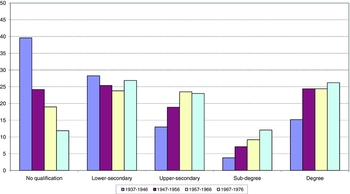
Our findings show that the main impact of these policies has been to raise average levels of attainment (Iannelli and Paterson, Reference Iannelli and Paterson2007; Paterson and Iannelli, Reference Paterson and Iannelli2007; Iannelli, Reference Iannelli2008). Figure 1 shows data from the 2001 Scottish Household Survey and for four birth-cohorts: people born in 1937–46, 1947–56, 1957–66 and 1967–76. The expansion of education is clearly illustrated by the remarkable decline in the percentage of people who did not acquire any qualifications (from 40 per cent in the oldest cohort to 12 per cent in the youngest cohort) and, on the other hand, by the equally remarkable increase in the percentages of people acquiring tertiary qualifications (from 4 per cent to 12 per cent for sub-degree level qualifications and from 15 per cent to 26 per cent for degrees, advanced degrees and professional qualifications).
Educational attainment by birth cohort.

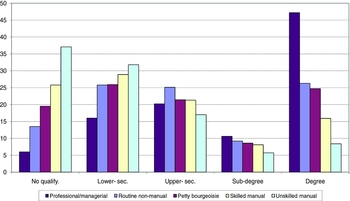
However, social class differences in educational attainment are striking (Figure 2). Among people from an unskilled manual background, 37 per cent of people aged 25–64 had no qualifications, compared to 8 per cent of those from a professional and managerial social class. On the other hand, almost half of the people with parents in professional and managerial occupations reached a degree compared to 6 per cent of people with parents in unskilled manual occupations.
Educational attainment by social class of origin (people aged 25–64).

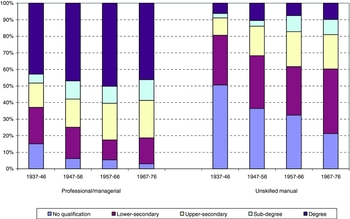
Over time, there has been an increase in the proportions of people from all social classes of origin who reached the highest educational qualifications (that is upper-secondary and tertiary education). Figure 3 compares changes in educational attainment rates of people who originated at the top and bottom social classes. The expansion of education has benefited both social classes, but class differences in educational attainment are still sharp.
Educational attainment by birth-cohort and social class of origin.

In absolute terms, the experience of gaining some qualification has become more similar between the two classes under investigation as testified by the decline in the absolute difference between the percentages of children from professional and managerial occupations and the percentages of children from the working classes who left with no qualification (from 36 per cent to 18 per cent). If the criterion of comparison among social classes is the acquisition of tertiary education, then the story is different. The absolute difference between these two social classes hardly changes from the oldest to the youngest cohort, showing a sharp contrast between these two social groups in the percentages of people who manage to achieve a sub-degree and in particular a degree level qualification. Acquiring a tertiary qualification is a common experience for people from the most advantaged social class, but it is still rather infrequent among working-class children.
As stressed in the previous section, social class inequalities are better measured by analysing ‘relative differences’. This is because ‘absolute differences’ in participation rates do not take into account the size of and changes in the distribution of education across social classes (Agresti, Reference Agresti1990; Heath and Clifford, Reference Heath and Clifford1990; Heath, Reference Heath2000). Measures of relative differences, such as ratios and odds ratios, have the advantage of providing a measure of social class inequalities that is not affected by the overall expansion of education.
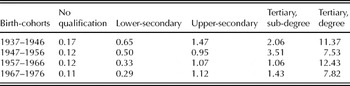
Table 1 presents the odds ratios of acquiring different levels of education for people from the service classes compared to people from the working classes. A value above 1 indicates that children from professional/managerial classes are more likely to achieve a certain educational level and to avoid lower levels than children from the unskilled manual social class. On the contrary, values lower than 1 mean that children from the unskilled manual social class are more likely than children from professional/managerial classes to achieve a certain educational level and to avoid lower levels. When the odds equal 1, it means that there are no social class differences, or, in other words, that the two social classes have equal chances of reaching a certain educational level.
Odds ratios of gaining different educational levels – professional/managerial classes versus unskilled manual classes

Source: 2001 Scottish Household Survey.
The data show that the offspring of the higher social classes were always more likely to achieve the highest educational levels (i.e. sub-degree and degree level qualifications). However, the gap between the children of professionals and the children of unskilled manual workers in the chances of gaining a degree has first reduced and then increased from the second to the third cohort and finally reduced again in the youngest cohort. We have explained this trend in relation to the different phases of expansion which characterised different tertiary institutions (Iannelli and Paterson, Reference Iannelli and Paterson2007).
Using three different data sources, the Scottish Household Survey (SHS) (Iannelli and Paterson, Reference Iannelli and Paterson2007), the British Household Panel Study (BHPS) (Paterson and Iannelli, Reference Paterson and Iannelli2007) and the Scottish School Leavers Survey (SSLS) (Iannelli, Reference Iannelli2008; Iannelli et al., Reference Iannelli, Gamoran and Paterson2008), we found that overall the relation between social class of origin and educational attainment has not significantly changed over time. This means that nowadays people from middle-class families are still significantly more likely to gain an upper-secondary qualification or a degree than people from working-class families. Educational expansion has benefited all social classes equally without reducing social inequalities. Only in the youngest cohort analysed, those born between 1967 and 1976 in the BHPS (Paterson and Iannelli, Reference Paterson and Iannelli2007) and those school leavers who entered tertiary education at the end of the 1990s in the SSLS (Iannelli, Reference Iannelli2007; Iannelli et al., Reference Iannelli, Gamoran and Paterson2008), does a reduction of inequalities seem to have occurred at the highest levels of education, i.e. tertiary education. We have commented that this reduction of inequalities may be due to a catching-up phenomenon. The results of our analyses show that the opening up of the education system has been characterised by two phases: in the first phase, the highest social-classes were more successful in taking advantage of the new opportunities, and inequalities grew as the education system expanded; in the second phase, which is represented by the experience of the youngest cohorts analysed, inequalities started to decline because professional/managerial classes had already reached very high levels of participation and the children of unskilled manual classes started to catch up by taking up the new places available. This is a positive outcome, which needs to be confirmed in the analyses of subsequent cohorts.
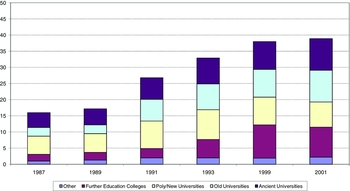
We need also to be aware of the fact that inequalities in education can be reproduced by other mechanisms, such as the type of tertiary level institution attended and the field of study (Lucas, Reference Lucas2001; Van de Werfhorst et al., Reference Van de Werfhorst, Sullivan and Cheung Sin2003). Iannelli et al. (Reference Iannelli, Gamoran and Paterson2008) show that social class differences emerge in relation to differentiated patterns of tertiary participation. The growth in participation in tertiary education occurred in all sectors in Scotland, with the steepest growth in the old universities (from 2.7 per cent of the cohort in 1987 to 8.1 per cent in 2001) and the further education colleges (from 2.1 per cent to 9.3 per cent over the same period) (Figure 4). However, the main sectors of expansion among the professional classes were the ancient and old universities, while the most prominent categories of expansion for the working classes were the new universities and further education colleges. Relative inequalities, measured by the ratio of participation rates for professional versus working class, show a consistent advantage of professional classes in enrolment in the ancient universities: this ratio was almost 10 to 1 in 1987, it increased to 20 to 1 in 1993 (the year of greater expansion in the data) and then declined at the end of the twentieth century to return to the original ratios. On the other hand, the ratio of participation rates for professional versus working-class enrolment in polytechnic colleges and further education colleges consistently reduced: in polytechnic colleges from almost 4 to 1 in 1987 to 2.2 to 1 in 2001, and in further education colleges from 2.2 to 1 to 1.1 to 1 in the same years (practically reaching equality of chances in these latter institutions). The picture which emerges from these data indicates that an equalisation process in tertiary education occurred only in the two lowest-ranked sectors, the new universities and the further education colleges, maintaining the highest-ranked sectors – the ancient and old universities – the privileged destinations of professional classes. This trend was confirmed in the statistical modelling which took into account the different educational attainment of people entering tertiary education, thus discounting the effect of differentiated educational attainment at entry of young people from different social classes (Table 7 in Iannelli et al., Reference Iannelli, Gamoran and Paterson2008). As highlighted above, the labour market returns to tertiary qualifications gained from different institutions may vary (Power and Whitty, Reference Power and Whitty2008), in this way reproducing social class inequalities among graduates.
Expansion of tertiary education by institution type.

The next sections will address the issue of social mobility and the role that education plays in the process of social mobility.
Social mobility patterns in Scotland
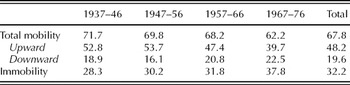
Social mobility patterns in Scotland are not different from the rest of Great Britain and more generally from many other European countries (Iannelli and Paterson, Reference Iannelli and Paterson2006). For at least the last 40 years absolute mobility rates have been high, meaning that a lot of people moved away from their social class of origin: in the 2001 SHS data, two thirds of people aged 25–64 were socially mobile (Table 2). Furthermore, a higher percentage of people were upward mobile (i.e. improved their social class position) than downward mobile. High levels of upward mobility can be explained by the structural changes in the labour market, which took place in the 1970s and 1980s. The unprecedented expansion of the professional jobs and the contraction of manual jobs enabled a large number of people from lower social classes to enter professional and managerial occupations. In this respect, we can speak about a trend towards a more ‘open’ society in which a larger portion of the population share the socio-economic well-being of the service-class position.
Absolute class mobility rates by birth-cohort

Source: 2001 Scottish Household Survey.
However, the results relating to absolute mobility do not tell us much about changes in social class inequalities, because relative differences may be preserved even though upward mobility is widespread. The results of relative mobility (using odds ratios and loglinear modelling) showed that the relative advantage of belonging to a middle-class family compared with a working-class family has not changed over time. Thus, changing patterns of social mobility do not reflect changing patterns of social inequalities in the chances of being mobile. This is because middle-class people are particularly successful at self-recruiting. They continue to be more likely to enter professional jobs than the other social classes. In addition, in the youngest generations the growth in absolute upward social mobility rates seems to have halted. There is little evidence that downward mobility is growing, but, for people born since the 1960s, there has been a clear rise in immobility. This can be explained by the fact that upward mobility has been a common trend for such a long time that the parents of people born since the 1960s have themselves benefited from it. As a consequence, there is less room for their children to move further up. Moreover, there is a slowing down of long-term occupational change, which is characterised by a reduction in the rate of increase in the proportion of jobs that are non-manual, and, within that, the proportion that are professional.
The intermediary role of education
There is little doubt that education plays an important role in promoting social mobility. The expansion of occupational opportunities, together with the expansion of educational participation, has enabled a large number of working-class children to enter professional and managerial occupations and facilitated upward mobility.
However, as highlighted in the previous sections, the acquisition of educational qualifications is still largely dependent on social class of origin and so also is the acquisition of different types of occupations. Similarly to Goldthorpe and Mills (Reference Goldthorpe, Mills and Breen2004), we found that the effect of individuals’ social class background on entry into the professional and managerial social classes is strong and significant (Iannelli and Paterson, Reference Iannelli and Paterson2006). Moreover, education does not account for most of the association between class of origin and class of destination (Iannelli and Paterson, Reference Iannelli and Paterson2007). The higher educational attainment of people originating from middle-class families only explains part, not all, of their advantage in entering highly prestigious occupations. This means that there is a strong direct effect of social class of origin on people's class of destination – even after taking educational attainment into account.
There are two other findings which are noteworthy. The first result casts doubt on the claim that British society has become more meritocratic (Saunders, Reference Saunders1995) In the Scottish data (as well as in the data used by Goldthorpe and Mills, Reference Goldthorpe, Mills and Breen2004) there is no statistical evidence that education matters more today than in the past for the acquisition of different social classes of destination and there is no statistical evidence that the mediating effect of education between social class of origin and destination has changed over time (Iannelli and Paterson, Reference Iannelli and Paterson2007). The second interesting finding is that the association between parental social class and class of destination is weaker for more highly educated people than for less educated people. This means that, once a person has reached an upper secondary or tertiary qualification, the effect of social class of origin is less important in determining their later social class than for a person who had no qualification or only compulsory education. This finding reinforces the importance of education for social mobility.
On the other hand, this result also suggests that if middle-class children do not reach the highest educational qualifications they have other family resources (for example, financial support or social networks) on which to rely that allow them to maintain their social class of origin. This is confirmed by analyses conducted on the data from the National Child Development Study. Among people in 1958, those from professional social classes of origin managed to enter professional and managerial classes in larger numbers than those from lower social classes, even when they did not have a tertiary qualification (Iannelli, Reference Iannelli2006). They also had more smoother and linear patterns of entry to these classes (either direct entry or upward mobility from routine non-manual occupations) than working-class people who had more varied experiences of social mobility.
Conclusions and policy implications
Scotland is similar to many developed countries. In the last 40 years, it has witnessed an unprecedented expansion of education and large amounts of upward social mobility. It would be a mistake to dismiss the positive outcomes which these processes have brought about. Scottish society has become more ‘open’ in the sense that more people from a working-class background are achieving higher levels of education and gaining access to top-level occupations. However, these changes have not broken down the entrenched advantages of the middle class. The increased ‘openness’ has been possible because the education system and the professional and managerial classes in the labour market expanded in an unprecedented way. People from lower social classes did not take up places in education and in the labour market occupied by people from middle-class origin. They took up new places and opportunities which previously were not available to them. However, all classes benefited from these new opportunities and this is why ‘equality’ of chances has not been achieved.
What was the role of educational reforms in these changes? The findings presented show that their role was mostly in supporting the expansion, but they had no effect in changing patterns of inequalities and of social mobility. In the long term, raising the overall level of educational participation and attainment may lead to a reduction in educational inequalities. However, even if the Scottish government sustains further expansion, as discussed in the paper, this may be counteracted by an increasing importance of the horizontal differentiation within the education system and by recruitment practices which may favour people who possess not only the qualification requested but other ‘middle-class’ characteristics.
The fact that patterns of social mobility in Scotland are similar to those of the rest of the UK (and of other countries) also testifies that educational reforms, such as the comprehensive reform in Scotland, are not powerful enough to eradicate social inequalities. Class mobility is mainly driven by the labour market structure and by the social class structure. Governmental policy can hardly influence the expansion or contraction of the service class, recruitment practices and more generally the way in which the middle class operate to advantage their offspring in the competition for the top-level occupations.
There are also difficult choices to be made in a changed economic context. The service class is not expanding as it did in the past and thus new opportunities for people from working-class background to climb the social class ladder can come only by displacing people from the middle class. As Goldthorpe and Jackson (Reference Goldthorpe and Jackson2007) clearly stated: ‘Promoting greater equality of opportunities in the future is likely to mean increasing downward mobility for the offspring of more privileged social strata.’
A serious commitment to promoting equality and social justice needs to recognise these limitations and dilemmas.