INTRODUCTION
Bryozoans are among the most common fouling organisms in coastal marine environments around the world. Many species have wide salinity tolerances, are fast growing, have a high reproductive potential and settle on a wide range of substrata (McCann, Reference McCann2007). Bryozoans are sessile, colonial animals with each colony comprising a series of inter-connected, genetically identical individuals called zooids (Taylor & Mawatari, Reference Taylor, Mawatari, Moyano, Cancino and Wyse Jackson2005). Although individual bryozoan zooids are microscopic, colonies can be relatively large, comprising several thousands of individuals (Winston, Reference Winston, Krupnik, Lang and Miller2009). The high degree of polymorphism, seen in representatives of the Cheilostomatida, with heterozooids specialized for reproduction, attachment, cleaning and defence (Sharp et al., Reference Sharp, Winson and Porter2007), may be the key factor to explaining the success of this group as fouling organisms (Lombardi et al., Reference Lombardi, Gambi, Vasapollo, Taylor and Cocito2011).
The genus Schizoporella has a broad latitudinal distribution, from polar to tropical regions (Hayward & Ryland, Reference Hayward and Ryland1995). The importance of the genus is emphasized by the fact that, as noted by Hayward & McKinney (Reference Hayward and McKinney2002), several species of Schizoporella have been used as model species in studies targeting larval settlement behaviours (McKinney & McKinney, Reference McKinney and McKinney2002), competition for substratum space (Sutherland, Reference Sutherland1978; Buss, Reference Buss1981) and environmentally mediated colony morphology (Cocito et al., Reference Cocito, Ferdeghini, Morri and Bianchi2000). Schizoporella is, moreover, a well-known invasive fouling genus and various species thrive in ports and on ships and harbour structures (Ryland, Reference Ryland1965; Relini et al., Reference Relini, Tixi, Relini and Torchia1998; Kocak, Reference Kocak2007).
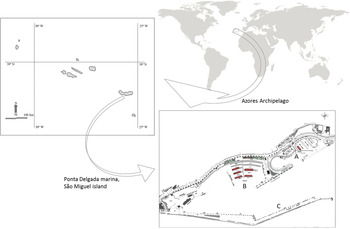
The Azores Archipelago consists of nine oceanic islands that originated from volcanic activity associated with the Mid-Atlantic Ridge. The islands are grouped into three clusters along a tectonic zone running west-northwest to east-southeast between latitudes 36°55′ and 39°43′N and longitudes 24°46′ and 31°16′W (Figure 1). The Archipelago is 800 km from Madeira, 1600 km from the European mainland and 1900 km from North America (França et al., Reference França, Cruz, Nunes and Forjaz2003).
Study location at Ponta Delgada, São Miguel, Azores Archipelago. A, Eastern marina; B, Western marina (new part); C, commercial port. In red are the areas where Schizoporella errata colonies were found. Marina map courtesy of the Direcção Geral dos Portos das Ilhas de São Miguel e Santa Maria.

Historical records of coastal bryozoans from the Azores date from the early 1900s with samples from the l'Hirondelle Scientific Expeditions (1886–1888) being identified by Jules Jullien and Louis Calvet (Jullien & Calvet, Reference Jullien and Calvet1903), followed by Calvet's work on samples obtained during the Prince Albert les de Monaco Expeditions (Calvet, Reference Calvet1911, Reference Calvet1931). The most recent work on Ctenostoma and Cheilostome from the Azores was by d'Hondt (Reference d'Hondt1975). The only record of a possible coastal Schizoporella from these studies is Schizoporella cucullata (Busk) 1853; var. labiosa, var. nov., singly collected from a beach in the Azores Archipelago in 1888 (Jullien & Calvet, Reference Jullien and Calvet1903) and which may now correspond to Schizoporella cucullata Canu & Bassler, 1929, although this is not identified as a synonym and there is no other available information beyond this single record.
The present study reports upon the first record of Schizoporella errata, a vigorously invasive species (Hayward & McKinney, Reference Hayward and McKinney2002) from Azorean waters.
MATERIALS AND METHODS
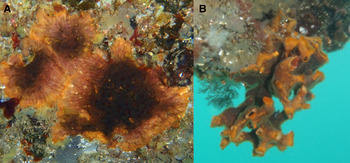
In 2008, the original marina of Ponta Delgada (São Miguel Island) (Figure 1A) was expanded, allowing for the simultaneous mooring of 600 recreational boats plus a transatlantic cruise pontoon (Figure 1B). After the initial detection of Schizoporella errata, a snorkelling survey was conducted in August 2013 off the floating sections of the marina (at the depth of 0 to 2 m). Each detected colony was counted and the numbers and depth distribution of S. errata recorded for each section of the marina (Figures 1 & 2).
Schizoporella errata in Ponta Delgada Marina, São Miguel. A, Encrusting colony, becoming multilaminar and three-dimensional; B, colony with tubular extensions (photographs by J. Micael).

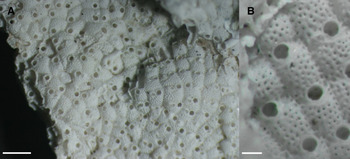
Samples of S. errata were also obtained for more accurate identification. Samples were initially stored in local seawater but upon arrival in the laboratory were preserved in 96% ethanol. Individual colonies were examined under a stereoscopic and binocular microscope (Figure 3). Voucher specimens have been deposited in the Bryozoa collection of the Museu Nacional de História Natural e da Ciência (MUNHC), Universidade de Lisboa, Portugal.
Schizoporella errata. A, Colony with a multilamellar growth; B, primary orifice, sinus with a U-shape. Scale bars: 1 mm (A); 300 µm (B).

RESULTS
SYSTEMATICS
MATERIAL EXAMINED
Voucher numbers: MB37-000042 to MB37-000049 (MUNHC, Lisboa).
DESCRIPTION
The identification of the collected specimens corresponds to the original description (Waters, Reference Waters1879) with later additions by Hayward & McKinney (Reference Hayward and McKinney2002), Taylor et al. (Reference Taylor, Schopf and Kudryavtsev2008), Tompsett et al. (Reference Tompsett, Porter and Taylor2009), Lombardi et al. (Reference Lombardi, Gambi, Vasapollo, Taylor and Cocito2011) and Ryland et al. (Reference Ryland, Holt, Loxton, Mes and Porter2014).
Briefly, Schizoporella errata colonies are typically purple-brown with orange growth margins (tips). The colonies are encrusting and either uni- or multi-lamellar. Colony size is variable, with an initial circular growth that develops in an irregular form. Encrustations 10 mm thick are common and sometimes the colonies develop erect tubes up to 15 cm high, growing as arborescent epibiota, with the structural form being determined by interactions with other organisms and hydrodynamic conditions. The thickness of the growth is dependent upon the age of the colony.
Autozooids are irregularly polygonal and extremely variable in both size and shape; basal autozooids usually have a slightly convex frontal shield, whereas frontally grown autozooids are less consistent in shape and more rounded. The zooids mainly comprise calcite (calcitic basal and vertical walls) and the frontal shield has inner calcitic and outer aragonitic layers.
Autozooids are regularly disposed in a basal layer of young colonies but irregularly disposed in older colonies with extensive frontal growth and are separated by furrows, more visible in young colonies. Pseudopores are present on the frontal shield of basal autozooids, with the exception of the area around the primary orifice, and are polygonal in early ontogeny and later reduced by secondary calcification, becoming occluded before frontal budding. The primary orifice is broadly D-shaped with a U-shaped sinus occupying about half the proximal width of the orifice.
Adventitious avicularia growing on the surfaces of autozooids are generally single, located proximo-lateral to the orifice and oriented disto-laterally from the mid-line. Beak-like avicularia are triangular with acute mandibles and are located (one per zooid) on either the right-hand or left-hand side of the apertural sinus. They occupy a large proportion of the frontal shield. Beak-like avicularia are typically larger than the regular adventitious avicularia.
ABUNDANCE
A total of 113 colonies of Schizoporella errata were recorded, three in the older section of the marina and 110 in the new one (Figure 1), which is made of polyester reinforced with fibreglass. The colonies were found growing underneath the floating marina fingers, suggesting that the species is well established in Ponta Delgada Harbour.
DISCUSSION
Geographical distribution
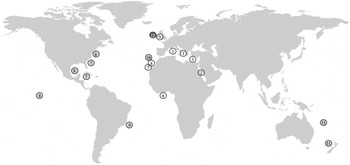
There has been much confusion worldwide concerning the identification of Schizoporella species. Tompsett et al. (Reference Tompsett, Porter and Taylor2009) argued that only 35% (out of 20 papers) contained the correct identifications of Schizoporella errata, based on published figures. Specimens collected from the Mediterranean Sea (Gautier, Reference Gautier1962; Ryland, Reference Ryland1965; Ferdeghini & Cocito, Reference Ferdeghini and Cocito1999; McKinney & McKinney, Reference McKinney and McKinney2002), the British Isles (Hastings, Reference Hastings1967; Hayward & Ryland, Reference Hayward, Ryland, Kermack and Barnes1979, Reference Hayward, Ryland, Barnes and Crothers1999) and Ghana, West Africa (Taylor et al., Reference Taylor, Schopf and Kudryavtsev2008) almost undoubtedly belong to Schizoporella errata (Figure 4). More recently, Ramalho et al. (Reference Ramalho, Muricy and Taylor2011) argued that some specimens from Rio de Janeiro (Brazil) are also in accordance with the description of Schizoporella errata, corresponding with the species-diagnostic characteristics referred to above. In addition, Winston (Reference Winston2004) hypothesized the likely existence of a Schizoporella errata species complex that would include errata-like material from the Caribbean and eastern Pacific, such as, for example, from Hawaii. Such specimens appear to be morphologically distinct, with the latter showing slight differences in avicularia and orifice characteristics, which would correspond to putative Schizoporella pugens Canu & Bassler, 1928. The Schizoporella errata complex would also include Schizoporella isabelleana d'Orbigny, 1842 from Rio de Janeiro. Tompsett et al. (Reference Tompsett, Porter and Taylor2009) also referred to slight differences in the shape of the sinus in specimens from New Zealand, questioning the local identity of these individuals. Schizoporella errata is a widely distributed and common fouling species (or complex of sibling species) throughout the Mediterranean Sea. The larva of Schizoporella errata (and of most ectoprocts) is short-lived, a fact that greatly reduces the range of natural dispersal (Gooch & Schopf, Reference Gooch and Schopf1971). Recently, Ryland et al. (Reference Ryland, Holt, Loxton, Mes and Porter2014) reported the first occurrence of Schizoporella japonica in Western Europe. This species can be distinguished from Schizoporella errata by the overall colony form and the number of sunken pseudopores in the frontal wall (Ryland et al., Reference Ryland, Holt, Loxton, Mes and Porter2014). The specimens analysed in this work therefore constitute the first confirmed record of Schizoporella errata in the Azorean islands.
Historical records of Schizoporella errata around the world. 1, Mediterranean ports and harbours (Gautier, Reference Gautier1962; Ryland, Reference Ryland1965; Ferdeghini & Cocito, Reference Ferdeghini and Cocito1999; McKinney & McKinney, Reference McKinney and McKinney2002; Kocak, Reference Kocak2007); originally described from Naples (Waters, Reference Waters1879). 2, Associated with the opening of the Suez Canal (1869) (Eitan, Reference Eitan1972). 3, British Isles ports and harbours (Hastings, Reference Hastings1967; Hayward & Ryland, Reference Hayward, Ryland, Barnes and Crothers1999). 4, Canary islands (Arístegui & Cruz, Reference Arístegui and Cruz1986). 5, West Africa, as ‘Schizoporella violacea’ (Canu & Bassler, Reference Canu and Bassler1930). 6, Ghana (Taylor et al., Reference Taylor, Schopf and Kudryavtsev2008); 7–11, Schizoporella errata species complex – includes Schizoporella errata (Waters, 1878), Schizoporella pungens Canu and Bassler, 1928, and Schizoporella isabelleana d'Orbigny, 1842. 7, North Carolina, Jamaica – fossil records (?) (Taylor & Foster, Reference Taylor and Foster1998). 8, Massachusetts, Caribbean, Hawaii (Buss, Reference Buss1981; Wintson, Reference Winston2004). 9, Brazil (Morgado & Tanaka, Reference Morgado and Tanaka2001; Gordon & Taylor, Reference Gordon, Taylor, Moyano, Cancino and Wyse-Jackson2005; Ramalho et al., Reference Ramalho, Muricy and Taylor2011). 10, Madeira (Canning-Clode et al., Reference Canning-Clode, Fofonoff, McCann, Carlton and Ruiz2013). 11, New Zealand and Australia (Gordon & Mawatari, Reference Gordon and Mawatari1992; Tilbrook et al., Reference Tilbrook, Hayward and Gordon2001; Piola & Johnston, Reference Piola and Johnston2006); based on the morphology, Tompsett et al. (Reference Tompsett, Porter and Taylor2009) argue that New Zealand and Australia specimens correspond to a different species. 12, Schizoporella japonica (Ryland et al., Reference Ryland, Holt, Loxton, Mes and Porter2014).

Habitat and ecology
Schizoporella errata is a shallow-water species frequently present in ports and harbours (Ryland, Reference Ryland1965) flourishing on man-made substrata as a persistent and often troublesome fouling organism (Hayward & Mckinney, Reference Hayward and McKinney2002). Due to the ability of S. errata to form a rigid framework overgrowing other organisms and thereby modifying habitat characteristics, the species is considered to be an ‘ecosystem engineer’ (Jones et al., Reference Jones, Lawton and Chachak1994; Cocito et al., Reference Cocito, Ferdeghini, Morri and Bianchi2000). Colonies grow on the stems of isolated erect organisms and form encrusting layers around them (Cocito et al., Reference Cocito, Ferdeghini, Morri and Bianchi2000) inhibiting, in turn, the growth of adjacent species (Sutherland & Karlson, Reference Sutherland and Karlson1977) and becoming highly invasive (Hayward & McKinney, Reference Hayward and McKinney2002). Nevertheless, in some areas, this same behaviour could potentially contribute to community productivity by providing new substrata (Morgado & Tanaka, Reference Morgado and Tanaka2001). In Ponta Delgada Marina, S. errata has been observed overgrowing some species such as Balanus amphitrite, Perforatus perforatus and tubicolous polychaetes.
Although the native area of S. errata is unknown, and it may have been overlooked until now in the archipelago of the Azores, the current finding indicates, with high probability, a recent introduction. The colonies are relatively conspicuous and no mention has ever been made before in any faunal surveys of the area or of the ancient harbour, in contrast to Madeira and the Canary islands (Arístegui & Cruz, Reference Arístegui and Cruz1986; Canning-Clode et al., Reference Canning-Clode, Fofonoff, McCann, Carlton and Ruiz2013). The construction of the new Ponta Delgada Marina dates back to 2008. Moreover, it has been observed by the authors on recreational boat hulls, but not outside the marina. Maritime traffic has been identified as the primary pathway for marine non-indigenous species introductions into ports around the world (Ruiz et al., Reference Ruiz, Fofonoff, Carlton, Wonham and Hines2000; Gollasch, Reference Gollasch2002; Ashton et al., Reference Ashton, Boos, Shucksmith and Cook2006). With the development of new technologies, the volume of shipping and the diversity of vessels have increased and, together with reduced transit times, the probability of species being transported to remote areas such as oceanic archipelagos has also increased, especially in recent years. Further studies on the population genetics of these individuals might provide information on the geographic origin of the Azorean founder population.
The introduction of a non-indigenous species into a new geographic area can affect local biodiversity by restructuring trophic webs (Vitousek, Reference Vitousek1990) as well as directly impacting society through causing damage to marine infrastructures, such as the fouling of pipes and other substrates, and by having negative effects on fisheries (Occhipinti-Ambrogi et al., Reference Occhipinti-Ambrogi, Marchini, Cantone, Castelli, Chimenz, Cormaci, Froglia, Furnari, Gambi, Giaccone, Giangrande, Gravili, Mastrototaro, Mazziotti, Orsi-Relini and Piraino2011). In the Azores Archipelago, future studies on this species should investigate the consequences of the within-archipelago spread of S. errata. The economic and technical problems that might arise from this fouling organism should be tackled through monitoring efforts aimed at maintaining underwater structures in a state of serviceability and efficiency. Moreover, the application of management measures to minimize the spread of such species should include the proposal to have standardized hull-cleaning requirements for recreational boats, given that the frequency of the fouling organism's removal and the use of antifouling coating paint is known to reduce the probability of the spread of alien plants and animals that pose a risk to marine biosecurity.
ACKNOWLEDGEMENTS
The authors are grateful to Professor Brian Morton for his suggestions regarding the early version of this manuscript. We thank Nuno Barata from the Portos dos Açores for allowing the development of the work within the Ponta Delgada Marina. This project was funded by the Direcção Regional de Ciência e Tecnologia (DRCT) – ‘Açores: Stopover for Marine Aliens Species?’ – ASMAS – M2.1.2/I/032/2011.