INTRODUCTION
The scalloped ribbon fish Zu cristatus (Bonelli, 1820) (Pisces: Trachipteridae) is a cosmopolitan mesobathypelagic species that occurs in tropical to temperate waters of the Atlantic and Indo-Pacific (Froese & Pauly, Reference Froese and Pauly2005). In the north-eastern Atlantic, it has been recorded from the Azores, Madeira and the Mediterranean Sea.
In the Mediterranean, the scalloped ribbonfish has been found sporadically throughout the entire basin (Fischer et al., Reference Fischer, Bauchot and Schneider1987; Papakonstantinou, Reference Papakonstantinou1988; Quignard & Tomasini, Reference Quignard and Tomasini2000; Golani et al., Reference Golani, Ozturk and Basusta2006). However, in the ichthyological literature, the occurrence of Z. cristatus has been confirmed and documented mainly in the Adriatic Sea, Ligurian Sea, Tyrrhenian Sea, off the coasts of Spain and Algeria and in the Gulf of Tunis (north of Tunisia).
It was reported occasionally in the Adriatic Sea where it is very rare (Jardas, Reference Jardas1996); with only 16 individuals (mostly juveniles) recorded in the northern and central Adriatic between 1846 and 1973 (Jardas, Reference Jardas1980). The species is also listed in the southern Adriatic off Albania (Dhora, Reference Dhora2010), and a spawning area of this species may occur in the eastern central Adriatic, where eggs and several juvenile stages were found (Dulčić, Reference Dulčić2002).
In Italian waters, Z. cristatus was principally known from the Ligurian Sea, where its presence was confirmed by specimens obtained from the Gulf of Genoa (Tortonese, Reference Tortonese1958; Gavagnin, Reference Gavagnin1976). Recently, Z. cristatus was recorded from the central Tyrrhenian Sea (Bianco et al., Reference Bianco, Zupo and Ketmaier2006; Psomadakis et al., Reference Psomadakis, Scacco and Vacchi2006) and two large specimens of Z. cristatus were also reported from the Gulf of Genoa (Psomadakis et al., Reference Psomadakis, Bottaro and Vacchi2007).
In Tunisian waters, a juvenile specimen measuring 285 mm total length (TL) was caught in December 1954 by a trammel net in the shallow water of Salammbô (Gulf of Tunis) (Postel, Reference Postel1955). The specimen was preserved in the ichthyological collection of the Museum of Salammbô. This species has also been captured many times in Algerian waters (Dieuzeide et al., Reference Dieuzeide, Novella and Roland1953).
In this note we confirm the occurrence of Z. cristatus in Tunisian waters and in the southern Mediterranean.
MATERIALS AND METHODS
The material examined included one museum specimen (285 mm TL) in the oceanographic museum of the Institut National des Sciences et Technologies de la Mer (Salammbô, Tunisia), caught in December 1954 in the Gulf of Tunis (north of Tunisia). A recent specimen was captured in shallow water near Mahdia (central Tunisia). The specimen was preserved in 5% buffered formalin in the Ichthyological Collection of the Institut National des Sciences et Technologies de la Mer (Sfax, Tunisia) with catalogue number INSTM/TRACHIP 02.
RESULTS AND DISCUSSION
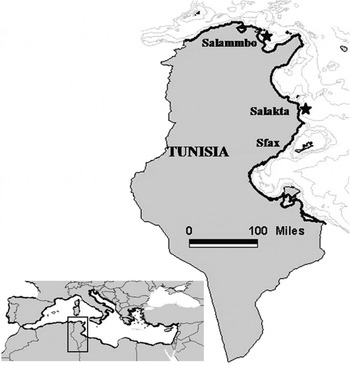
The present specimen was collected in a casting net at El Alia (Salakta), near Mahdia (Figure 1) in very shallow water (50–80 cm depth) on 28 October 2009. The casting net is generally used to capture small mullets (Mugilidae).
Map showing the localities of the catches of the two specimens of Zu cristatu (★) on the Tunisian coasts.

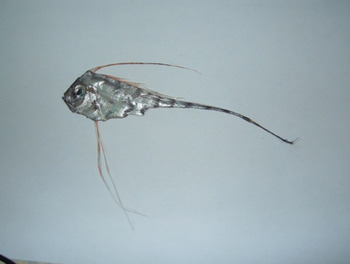
The specimen measured 170 mm TL, silvery in colour with 6 vertical bars on dorsal part of body and 4 on ventral part; tail with 6 complete black bars; caudal fin blackish, base of fin pale. Anterior dorsal fin rays and pelvic fins are very elongated, representing about 50% of the total length. The specimen has a ‘scalloped' ventral body margin (Figure 2). As in other trachipterids, Z. cristatus presents distinctive body changes throughout its life cycle, with major differences involving the loss of the elongated anterior dorsal fin rays and pelvic fins during the transition from prejuvenile to juvenile stages, which seems to occur in the 600–800 mm size-range (Heemstra & Kannemeyer, Reference Heemstra and Kannemeyer1984). Adults are silver grey in colour but paler ventrally; dorsal fin scarlet; caudal fin reddish black, darker distally.
Specimen of Zu cristatus (170 mm total length) captured in El Alia, Salekta (south of the Gulf of Hammamet).

As in other parts of the Mediterranean, the scalloped ribbonfish is rarely encountered in Tunisian waters, possibly as its mesopelagic habits are poorly sampled (Tortonese, Reference Tortonese1958). The new record of Z. cristatus is considered as the first one for the central coast of Tunisia and also confirms the occurrence of the species in Tunisian waters and the southern Mediterranean Sea since the earlier record of Postel (Reference Postel1955).
Large specimens, more than 800 mm TL, were caught mainly in summer and at depths ranging between 150 and 800 m (Tortonese, Reference Tortonese1958; Roig & Demestre, Reference Roig and Demestre1982; Psomadakis et al., Reference Psomadakis, Scacco and Vacchi2006, Reference Psomadakis, Bottaro and Vacchi2007). The period from May to August would appear to be the months of most active spawning of this species in the Strait of Messina (Sparta, Reference Sparta1956). Eggs of this species were taken in September–October in the North Atlantic (Olney & Naplin, Reference Olney and Naplin1980) and in September in the eastern central Adriatic (Dulčić, Reference Dulčić2002).
Young individuals have occasionally been observed free swimming in shallow waters or captured just a few metres from the shore (Costa, Reference Costa1842; Heemstra & Kannemeyer, Reference Heemstra and Kannemeyer1984; Bianco et al., Reference Bianco, Zupo and Ketmaier2006) and both Tunisian specimens were caught in depths of a few metres.
The capture of young Z. cristatus in Tunisia in October and December is in agreement with the proposed seasonal life cycle of the species in the Mediterranean Sea. Further records are needed to better understand the reproductive cycle and spawning areas in the Mediterranean.
ACKNOWLEDGEMENTS
We are grateful to Youssef Krichen and Mondher Nouir who made the specimen available to us. The authors thank two anonymous referees for helpful and useful comments that helped to improve our manuscript.