Introduction
With promising results already obtained with embryo vitrification, various protocols have been proposed that aimed at optimizing cell survival. Different devices have been developed to reduce vitrification solution volume and to speed the process. Among these, the open pulled straw (OPS) method (Vajta et al., Reference Vajta, Holm, Kuwayama, Booth, Jacobsen, Greve and Callesen1998) is the most widely used technique for bovine embryos (Siqueira Filho et al., Reference Siqueira Filho, Caixeta, Pribenszky, Molnar, Horvath, Harnos, Franco and Rumpf2011; Villamil et al., Reference Villamil, Lozano, Oviedo, Ongaratto and Bó2012; Do et al., Reference Do, Walton and Taylor-Robinson2014). In addition, the cryoprotectant solution usually contains two intracellular cryoprotectants, e.g. ethylene glycol (EG) and dimethylsulfoxide (DMSO), and make an effective mixture to penetrate cells and tissues having lower toxicity than other cryoprotectants such as glycerol or propylene glycol (Vajta et al., Reference Vajta, Holm, Greve and Callesen1996, Reference Vajta, Holm, Kuwayama, Booth, Jacobsen, Greve and Callesen1998; Yokota et al., Reference Yokota, Sato, Yokota, Ishikawa, Makita, Asada and Araki2000; Rodrigues et al., Reference Rodrigues, Amorim, Costa, Matos, Santos, Lucci, Báo, Ohashi and Figueiredo2004a,Reference Rodrigues, Amorim, Costa, Matos, Santos, Lucci, Báo, Ohashi and Figueiredob; Madeira et al., Reference Madeira, Mion, Silva, Pereira, Campos, Rincón, Viegas, Vieira, Pegoraro and Lucia2014). When exposing cells to high concentrations of cryoprotectants, the risk of cryodamage caused by large ice crystals is almost null, but osmotic shock can frequently occur (Kaidi et al., Reference Kaidi, Van Langendonckt, Massip, Dessy and Donnay1999, Reference Kaidi, Donnay, Lambert, Dessy and Massip2000; Lai et al., Reference Lai, Ding, Smith, Smith and Takayama2015). To avoid this event, extracellular cryoprotectants, usually sugars, are added to the vitrification solution. These sugars support embryo dehydration by stabilizing the cell plasma membrane (Kuleshova et al., Reference Kuleshova, MacFarlane, Trounson and Shaw1999; Turner et al., Reference Turner, Senaratna, Touchell, Bunn, Dixon and Tan2001). Another function of the use of sugars in vitrification solutions is to increase glassy state formation, thereby reducing the formation of ice crystals during the cooling and warming processes (Rall, Reference Rall1987; Shaw & Jones, Reference Shaw and Jones2003). Sucrose is the sugar most used for embryo vitrification (Morato & Mogas, Reference Morato and Mogas2014; Caamano et al., Reference Caamano, Gomez, Trigal, Munos, Carrocera, Martin and Diez2015; Lai et al., Reference Lai, Ding, Smith, Smith and Takayama2015) but there is a paucity of information regarding other sugars, like glucose. Glucose has been tested for vitrification of zebrafish embryos (Lahnsteiner, Reference Lahnsteiner2008), but no information is available on the procedure for bovine embryos.
Hence, in the present study, we aimed to evaluate the effects of embryo vitrification using three different vitrification solutions that contained variable concentrations of EG and DMSO (10, 20 or 25% each) and supplemented with either 1.0 M glucose or 1.0 M sucrose, on the rates of hatching and expansion of in vitro-produced bovine embryos.
Materials and methods
Two hundred ovaries were collected in a local slaughterhouse and transported to the laboratory during a maximum period of 2 h. During transport, ovaries were kept at 35°C in phosphate-buffered saline (PBS) supplemented with 0.5 mg/ml of gentamicin. In the laboratory, oocytes were aspirated from antral follicles (3 or 8 mm) using a 5 ml syringe with a 19G needle. Upon selection, oocytes were washed three times in TCM-199 (M199; Gibco BRL, Grand Island, NY, USA), supplemented with 10% fetal bovine serum (FBS; Gibco). After washing, oocytes were cultured in vitro (30 oocytes per 90 µl of maturation medium drops). Maturation medium consisted of TCM-199 Earle's salts supplemented with 26.2 mM NaHCO3, 25 mM HEPES, 0.2 mM sodium pyruvate, 0.01 IU FSH/ml, 0.5 µg/ml luteinizing hornone (LH) and 10% FBS, under mineral oil (Sigma, Chemical Co., St. Louis, MO, USA) for 24 h at 38.5°C in 5% CO2 humidified air. After in vitro maturation, oocytes were washed and submitted to in vitro fertilization (IVF) in a commercial medium (WTA Ltd, Cravinhos-SP, Brazil). For IVF, a semen straw was thawed for 30 s in a water bath at 35°C. After evaluating motility and vigour, selection of sperm cells was performed by centrifugation at 800 g for 6 min on a Percoll gradient (45/90%) (GE-Healthcare Bio-Sciences AB, Uppsala, Sweden) of Sperm-TALP medium (Sigma, Chemical Co., St. Louis, MO, USA) supplemented with 30 µg/ml of heparin, 0.72 µg/ml of penicillin, 0.26 µg/ml of hypotaurine and 0.04 µg/ml of epinephrine (Sigma). After centrifugation, fertilization was carried out in 50 µl IVF medium drops, containing approximately 1 × 10⁶ sperm/ml (for the 30 oocytes) over 22 h of incubation. After IVF, cumulus oophorus cells were removed by successive pipetting. The obtained denuded zygotes were washed a further three times in TCM-199 and transferred to a drop of 90 µl of culture medium (WTA Ltd, Cravinhos-SP, Brazil) under mineral oil.
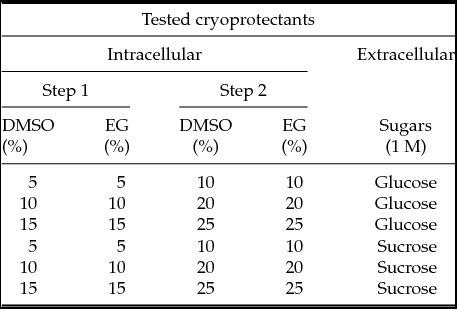
On the third day of embryonic culture, evaluation of segmentation (the number of structures with more than four cells) was recorded and the first medium refreshment was done; on the fifth day, the medium was refreshed for a second time. Embryo selection at blastocyst stage was done on the sixth day after fertilization and on the following day (7th day) morphological evaluation of expanded blastocysts was applied. From these cultures, embryos were immediately submitted to expansion and hatching without vitrification (control; n = 200 blastocysts), or vitrified (n = 100 blastocysts per treatment). All cryoprotectants used during the preparation of the solutions were purchased from Sigma. The blastocysts of the experimental groups were placed in 4-well dishes (Nunc, Roskilde, Denmark) containing TCM-199 medium supplemented with 10% FBS and 0.2 mM pyruvate (‘basic medium’, BM). All embryos were manipulated at 38.5°C and were immediately evaluated for expansion and hatching without vitrification (Control), or exposed in a two-step process (step 1 exposure took 1 min, while step 2 exposure took 4 min) to 800 µl vitrification solution (VS). Embryos were exposed to six different VS with different concentrations (10, 20 or 25%) of EG and DMSO, combined with 1.0 M sucrose or 1.0 M glucose, as follows:
-
• VS1 contained 5% of each DMSO and EG during step 1, followed by 10% DMSO and EG in step two, both added with 1.0 M glucose;
-
• VS2 contained 10% of each DMSO and EG during step 1, followed by 20% DMSO and EG in step two, both added with 1.0 M glucose;
-
• VS3 contained 15% of each DMSO and EG during step 1, followed by 25% DMSO and EG in step two, both added with 1.0 M glucose;
-
• VS4 contained 5% of each DMSO and EG during step 1, followed by 10% DMSO and EG in step two, both added with 1.0 M sucrose;
-
• VS5 contained 10% of each DMSO and EG during step 1, followed by 20% DMSO and EG in step two, both added with 1.0 M sucrose;
-
• VS6 contained 15% of each DMSO and EG during step 1, followed by 25% DMSO and EG in step two, both added with 1.0 M sucrose.
For details see Table 1.
Experimental protocol for the vitrification of bovine blastocysts

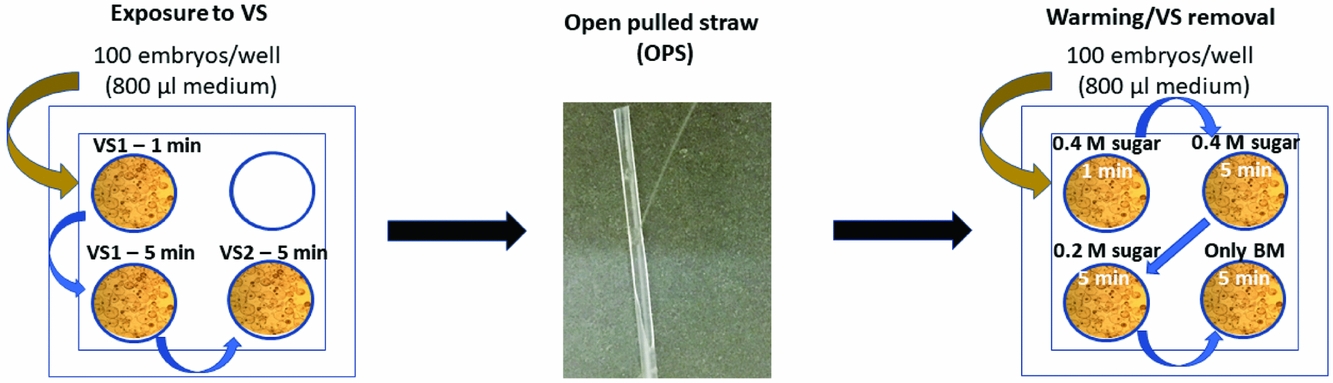
After exposure, embryos from each group were vitrified by applying the OPS method and immersed in liquid nitrogen at −196°C for at least 2 weeks (see protocol depicted in Fig. 1). After warming, cryoprotectant removal was performed in BM supplemented with the corresponding sugars at different concentrations in 4-well dishes with 800 µl medium each. For VS1, VS2 and VS3, cryoprotectant removal was performed in BM + 0.4 M glucose for 1 min, followed by BM + 0.4 M glucose for 5 min, 0.2 M glucose for 5 min, and BM only for 5 min. For VS4, VS5 and VS6 cryoprotectant removal was performed in BM + 0.4 M sucrose for 1 min, followed by BM + 0.4 M sucrose for 5 min, 0.2 M sucrose for 5 min, and BM only for 5 min. Thereafter, embryos were incubated at 38.5°C, in 5% CO2 in air in culture medium and re-expansion and hatching rates were determined, respectively, after 24 and 48 h. The rates of re-expansion and hatching among the different groups were analyzed as frequency dispersion by the chi-square test. The values were considered significant when P < 0.05; all data were analyzed using the statistical package SAS/STAT®.
Scheme of the applied vitrification protocol.

Results
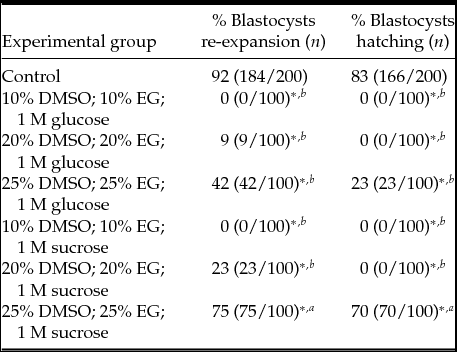
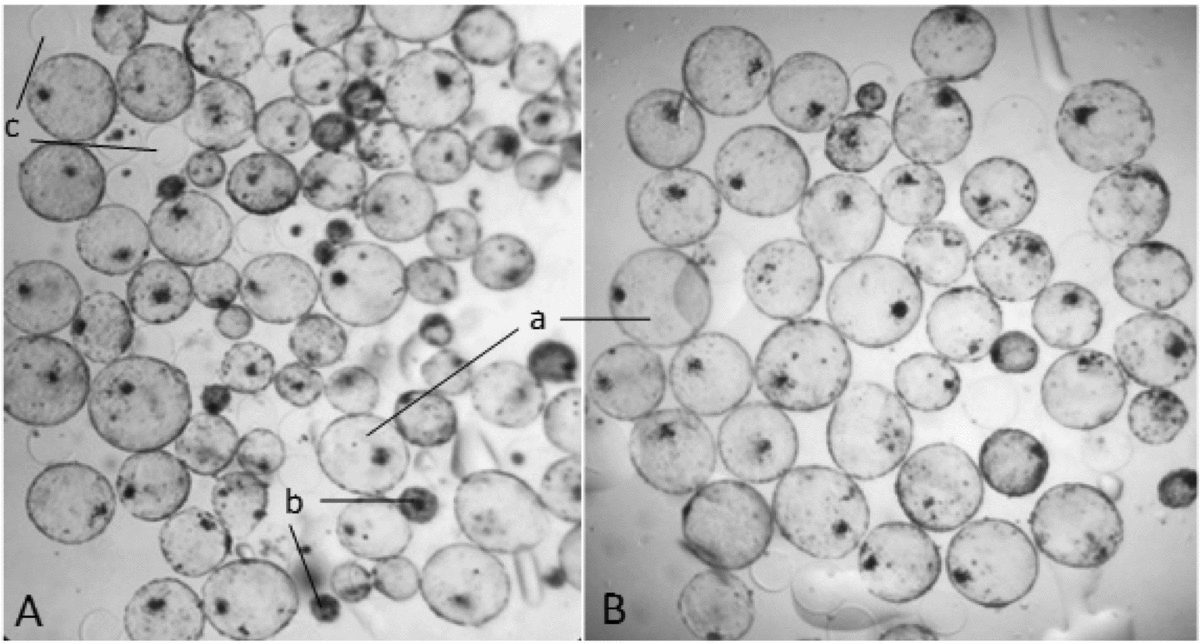
Table 2 shows the percentages of re-expanded and hatched embryos in the control group and after vitrification in the different tested solutions. Vitrification significantly decreased embryonic re-expansion and hatching rates independently of the tested solution when compared with control embryos. Independently of the sugar, vitrification with 25% EG + 25% DMSO resulted in the highest re-expansion (75%) and hatching (70%) rates. When use of glucose and sucrose was compared, independently on the concentration of the intracellular cryoprotectants, sucrose favoured significantly higher rates of re-expanded and hatched embryos. Figure 2 depicts representative images of re-expanded and hatched blastocysts after vitrification and warming processes using 25% EG + 25% DMSO + 1 M sucrose (Fig. 2 A) and control embryos (Fig. 2 B).
Re-expansion and hatching of fresh and vitrified bovine blastocysts

*Indicates significant difference between each treatment and control within the same column P < 0.05.
a,,b Superscripts with different lowercase letters indicates significant difference among the treatments within the same column P < 0.05.
Photography of re-expanded blastocysts of Control (A) and treatment for (B) groups after the vitrification and thawing processes. a, re-expanded and hatched blastocysts; b, degenerated blastocysts; c, pellucid zones released.

Discussion
Although vitrification still leads to embryo injury as observed in the present study, this effect can be minimized by an adequate combination of intracellular and extracellular cryoprotectants. The use of glucose (1.0 M) led to significantly low embryo re-expansion and hatching rates after vitrification irrespective of EG and DMSO concentrations, and confirmed that this sugar is inefficient in maintaining embryo integrity during cryopreservation. In amphibians, such as frogs, glucose plays an important role in animal survival to extremely low temperatures (Storey & Mommsen, Reference Storey and Mommsen1994). However, it seems that, in the present study, glucose was rapidly metabolized (Sugimachi et al., Reference Sugimachi, Roach, Rhoads, Tompkins and Toner2006) and, therefore, was not sufficiently accumulated to protect embryos against osmotic stress. Disaccharides, such as sucrose, do not cross the cell membrane (non-penetrating cryoprotectants) and act more outside the cell in which nucleating agents are more prevalent and ice crystals are more likely to be formed. As already shown by other research groups, sucrose acts by inducing cell dehydration (Kuleshova & Hutmacher, Reference Kuleshova, Hutmacher and Blitterswijk2008), and acting as an osmotic buffer (Liebermann et al., Reference Liebermann, Nawroth, Isachenko, Isachenko, Rahimi and Tucker2002). This factor explains the low hatching and re-expansion rates of glucose-treated embryos in relation to sucrose-treated ones. Increase in the amount of EG and DMSO from 10 to 25% each in the vitrification medium led to an increase in the hatching and re-expansion of embryos. Varago et al. (Reference Varago, Saliba, Alvim, Vasconcelos, Oliveira, Stahlberg and Albuquerque2006) obtained 23.5% hatching and 44.1% re-expansion when using 20% EG + 20% DMSO and 0.5 M sucrose. It is important to note that many papers published in the last decade (Liebermann & Tucker, Reference Liebermann and Tucker2006; Liebermann, Reference Liebermann2009, Reference Liebermann2011) have shown that the use of relatively high concentrations of cryoprotectants such as 15% (v/v) EG in equimolar mixture with DMSO had no negative effect on perinatal outcomes from vitrified blastocysts with fresh ones. Vajta et al. (Reference Vajta, Holm, Greve and Callesen1996) obtained almost similar results (83% and 63%, respectively, for re-expansion and hatching rates) with 12.5% followed by 25% (V1 and V2) of EG and DMSO in combination with 0.25 M sucrose. However, at different temperatures and times of exposure when compared with the present study, this study resulted in a 75% hatching rate and a 70% re-expansion rate. The former study of Vajta et al. (Reference Vajta, Holm, Greve and Callesen1996) and the present study showed that high concentrations of EG and DMSO combined with sucrose is more protective for embryos against injuries after vitrification than lower concentrations of intracellular cryoprotectants, and that glucose is not an efficient extracellular cryoprotectant for bovine embryos.
Competing interests
The authors declare that there is no conflict of interest that can be perceived as prejudicing the impartiality of the research reported.