INTRODUCTION
The promotion of democratic principles and institutions, popular participation and good governance is one of the objectives of the African Union (AU). On 30 January 2007, AU member states adopted the African Charter on Democracy, Elections and Governance (the Charter), which reaffirms and specifies the AU's adherence to the rule of law and to the principle of constitutionalism. In recent years, the AU has repeatedly condemned coups d'état and urged its member states to respect constitutional rule as a way of promoting security, stability and peace on the African continent. Originally inspired by the (limited) ambition to prevent coups in Africa, the AU has gradually developed a broader normative environment for African constitutions and, in particular, the orderly constitutional transfer of power. This article purports to shed light on the normative framework as well as on the practice of the AU, in particular its Peace and Security Council (PSC), in dealing with unconstitutional changes of government, with a focus on the PSC policy of calling for a return to constitutional order as a remedy for unconstitutional changes of government.
Against the background of this expressed AU belief in the value of constitutional rule, this article pays particular attention to the rise of power-sharing agreements on the African continent. Such negotiated settlements are frequently resorted to, with the support of the AU, as interim and/or longer term responses to situations of unconstitutional seizure of power, internal armed conflict and post-electoral violence. Power-sharing arrangements are, however, frequently at odds with prevailing constitutional norms about how political power is acceded to, transferred and/or maintained. They often necessitate short term constitutional rearrangements while also putting forward more long term constitutional reform processes.
This article addresses the tension between the AU's adherence to constitutional rule and its endorsement of power-sharing agreements as a major instrument of conflict settlement on the African continent. This perspective brings to light more fundamental questions about the AU's approach to constitutionalism and about the difficulty of combining policies that are inspired by short-term imperatives of peace, security and stabilityFootnote 1 with the promotion of longer term goals of democratic state building.Footnote 2 It adds to the debate about the degree of involvement at the regional, intergovernmental level in promoting and protecting constitutional rule at the national level. The article also highlights the challenge for the AU to refine its governance related benchmarks when legitimizing a member state's return to constitutional legality.
THE AU AND CONSTITUTIONAL RULE: THE NORMATIVE FRAMEWORK
After decades of strict adherence to the principle of non-interference in internal affairs, the Organization of African Unity (OAU) issued two decisions on unconstitutional transfers of power, following the May 1997 Harare summit (days after the coup d'état in Sierra Leone) and the July 1999 Algiers summit. This paved the way for the adoption, in July 2000 (not coincidentally at the very moment the OAU was transformed into the AU), of a more general policy declaration that continues to be referred to by AU organs today.
The Lomé Declaration on the Framework for an OAU Response to Unconstitutional Changes of Government
Between 1956 and 2001, sub-Saharan Africa experienced 80 successful and 108 failed coups d'état, with 30 states experiencing at least one successful coup during this period.Footnote 3 The Lomé DeclarationFootnote 4 was prompted by the desire of African leaders to find a response to the scourge of coups that marked the history of post-colonial Africa. Because military coups are not the only type of unconstitutional accession to power, the AU tried to expand its definition of norm violating behaviour requiring its attention, introducing the concept of unconstitutional change of government. However, as shown in this article, AU practice remains strongly focused on coups and the AU struggles with the exact scope of what constitutes an unacceptable transfer of power.
The Lomé Declaration puts forward a set of common values and principles for democratic governance. These include the adoption of and respect for a democratic constitution, separation of powers, political pluralism, protection of human rights and the organization of free and regular elections. While the declaration states that non-adherence to those common values and principles often causes a political and institutional crisis which then culminates in an unconstitutional change of government, the latter concept does not include all violations of those same values and principles. The Lomé Declaration limits the notion of an unconstitutional change of government to four types of situation: (i) a military coup d'état against a democratically elected government; (ii) an intervention by mercenaries to replace a democratically elected government; (iii) the replacement of a democratically elected government by armed dissident groups and rebel movements; and (iv) the refusal by an incumbent government to relinquish power to the winning party after free, fair and regular elections.Footnote 5
In the event of an unconstitutional change of government occurring in a member state, the Lomé Declaration requires the OAU to condemn that change and to urge for a speedy return to constitutional order.Footnote 6 A period of up to six months should be given to the perpetrators to restore constitutional order. During this period, the government concerned should be suspended from participating in the policy organs of the OAU. After the six month period, a range of limited and targeted sanctions should be imposed against a regime that refuses to restore constitutional order, including visa denials, trade restrictions and restrictions of intergovernmental contacts.Footnote 7 The Central Organ of the OAU Mechanism for Conflict Prevention, Management and Resolution, later replaced by the PSC, was charged with implementing the Lomé Declaration.
The AU Constitutive Act
While maintaining the principle of “non-interference by any member state in the internal affairs of another”Footnote 8 as a cornerstone of the functioning of the AU, the Constitutive Act of the AU (the Constitutive Act) combines this “tradition” of non-interference as a foundation for relations between equal and sovereign states with the “novelty” of non-indifference of the AU.Footnote 9 As one of the guiding principles for the functioning of the AU, the Constitutive Act puts forward “respect for democratic principles, human rights, the rule of law and good governance”.Footnote 10 Reflecting this policy of non-indifference, the act stipulates that the functioning of the AU shall be guided by the principle of “the condemnation and rejection of unconstitutional changes of government”.Footnote 11 Without an explicit limitation to the four types of unconstitutional changes mentioned in the Lomé Declaration, article 30 (suspension) of the Constitutive Act declares that governments coming to power through unconstitutional means shall not be allowed to participate in the activities of the AU.
The Optional Protocol of 9 July 2002 Relating to the Establishment of the Peace and Security Council of the AU (Optional Protocol)
The PSC was established in March 2004. It is the “standing decision-making organ for the prevention, management and resolution of conflict” and the “collective security and early-warning arrangement to facilitate timely and efficient response to conflict and crisis situations in Africa”.Footnote 12 The Optional Protocol puts forward respect for constitutional governance as one of the guiding principles for the election of PSC members. Under the protocol, the PSC, in conjunction with the chair of the AU Commission, shall “institute sanctions whenever an unconstitutional change of Government takes place in a Member State, as provided for in the Lomé Declaration”.Footnote 13
While the Lomé Declaration in itself of course remains a source of no more than “soft” law, this provision, given the binding legal nature of PSC decisions, clearly enhances its potential impact (including through the use of sanctions) on the states parties to the Optional Protocol. Before the Charter entered into force, the Lomé Declaration continued to be referred to as the main normative basis for AU policy vis à vis unconstitutional changes of government. This continues to apply to member states that have not yet ratified the Charter.
The African Charter on Democracy, Elections and Governance
The Charter was adopted as a legally binding instrument at the eighth ordinary session of the AU Assembly of Heads of State and Government (the AU Assembly) in Addis Ababa on 30 January 2007. It entered into force on 15 February 2012, 30 days after the requisite 15 states had deposited their instruments of ratification with the chair of the AU Commission.Footnote 14 Compared with the Lomé Declaration, the Charter is more ambitious in imposing standards about how political power is to be exercised (and not only about how political power is transferred). Also, the Charter expands the definition of an unconstitutional change of government as well as the range of sanctions that may apply to states as well as to individuals.
General principles of the Charter
The Charter sets a normative framework in order to promote a culture of democracy and peace, adherence to the principle of the rule of law and protection of human rights on the African continent. It also puts forward a number of principles intended to foster better political, economic and social governance. The Charter repeatedly expresses the adherence of the signatory parties to the value of constitutionalism. The preamble notes that unconstitutional changes of government are among the essential causes of insecurity, instability and violent conflict in Africa. Promoting adherence to the principle of the rule of law premised upon the request for, and the supremacy of, the constitution and constitutional order in the political arrangements of the states parties is one of the Charter's key objectives and is seen as a way of fostering stability, peace, security and development.Footnote 15 States parties commit themselves to take all appropriate measures to ensure constitutional rule and, in particular, constitutional transfers of power.Footnote 16 They shall entrench the principle of the supremacy of the constitution in the political organization of the state and ensure that the process of amending or revising their constitution reposes on national consensus, obtained if need be through a referendum.Footnote 17 The Charter also requires states parties to establish public institutions that promote democracy and constitutional order and to ensure that the independent autonomy of these institutions is guaranteed by the constitution.Footnote 18 Among these institutions, independent national electoral bodies and electoral observer missions are put forward as essential instruments to entrench a political culture of transfer of power, based on the holding of regular, free, fair and transparent elections.Footnote 19 In general terms, the Charter stipulates that, when a situation arises that may affect the democratic political institutional arrangements or the legitimate exercise of power in a state party, the PSC “shall exercise its responsibilities in order to maintain the constitutional order” in accordance with the relevant provisions of the Optional Protocol.Footnote 20
Unconstitutional changes of government: Definition and sanctions
The Charter defines which “illegal means of accessing or maintaining power” constitute an unconstitutional change of government. Four categories are almost identical to those listed in the Lomé Declaration and a fifth is added:
“
(1) Any putsch or coup d'étatFootnote 21 against a democratically elected government.
(2) Any intervention by mercenaries to replace a democratically elected government.
(3) Any replacement of a democratically elected government by armed dissidents or rebels.
(4) Any refusal by the incumbent government to relinquish power to the winning party or candidate after free, fair and regular elections.
(5) Any amendment or revision of the constitution or legal instruments which is an infringement on the principles of democratic change of government.
Importantly, the Charter stipulates that the five means mentioned in article 23 are examples, not an exhaustive list. While that is understandable in light of the problems to which the definition of the notion has given rise in actual practice (see below) and while it may provide the PSC with the necessary flexibility, this raises potentially serious concerns, in particular when combining the “open-ended” definition with the sanctions (including of a criminal nature) provided for in the Charter.
Article 25 of the Charter specifies the sanctions states and individuals may incur. When the PSC observes that an unconstitutional change of government has taken place and finds that diplomatic initiatives have failed, it shall “suspend the said State Party from the exercise of its right to participate in the activities of the Union”, in accordance with the provisions of article 30 of the Constitutive Act and article 7(g) of the Optional Protocol.Footnote 23 While this provision leaves some uncertainty as to its interpretation, the suspended state party must, in any case, continue to fulfil its obligations to the AUFootnote 24 and, notwithstanding the suspension, the AU shall maintain diplomatic contacts and take initiatives to restore democracy in the state party.Footnote 25 Sanctions shall also be imposed on AU member states that are proved to have instigated or supported unconstitutional change of government in another state.Footnote 26 Individual perpetrators of unconstitutional changes of government shall not be allowed to participate in elections held to restore the democratic order or to hold any position of responsibility in political institutions of their state;Footnote 27 they may also be tried before the competent court of the AU.Footnote 28 Furthermore, the AU Assembly may decide to apply other forms of sanctions, including punitive economic measuresFootnote 29 and states parties shall not harbour or give sanctuary to themFootnote 30 but rather bring them to justice or take necessary steps to extradite them.Footnote 31 Finally, the PSC shall lift sanctions once the situation that led to the suspension is resolved.Footnote 32 The text of the Charter is unclear as to what is required in terms of “resolving” the situation that led to the suspension. As detailed below, AU practice so far requires a return to constitutional order as a solution.
AU Assembly decision 269(XIV) of 2 February 2010
Alarmed by the resurgence of (attempted) coups d'état in Africa in 2008, the AU Assembly adopted a decisionFootnote 33 in February 2009 to support the activities undertaken by the PSC in view of an immediate return to constitutional order in the countries affected by a coup. The AU Assembly also urged member states to ratify the Charter. On 2 February 2010, the AU Assembly adopted a decisionFootnote 34 which clearly finds inspiration in the Charter in order to enhance the effectiveness of the AU response. In particular, it includes sanctions put forward in article 25(1), (4), (6) and 7 of the Charter. In addition, this decision adds an important diplomatic sanction, stating that “Member States should, upon the occurrence of an unconstitutional change of Government, not recognize the de facto authorities” and calling on all non-African international bodies including the United Nations “to refrain from granting accreditation to such authorities”.Footnote 35
RETURN TO CONSTITUTIONAL ORDER AS A REMEDY FOR UNCONSTITUTIONAL CHANGES OF GOVERNMENT: RECENT AU PRACTICE
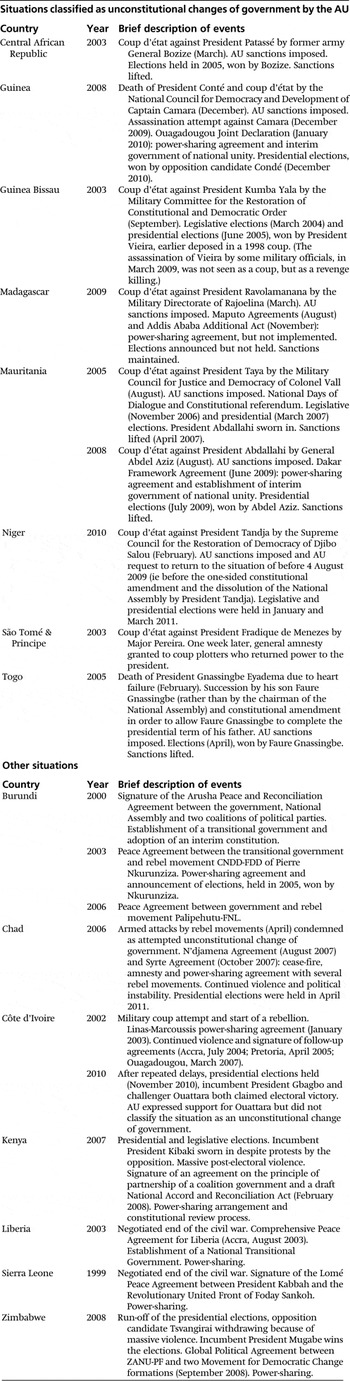
The normative framework, which developed remarkably fast over the past decade, has been actively applied by the AU, in particular through the decisions of the PSC. This section analyses AU practice in response to all the situations arising after the PSC was established in early 2004 and classified by the PSC as unconstitutional changes of government at the time. It also takes into account some situations that were not classified as an unconstitutional change of government. Should similar events occur after the entry into force of the Charter, they may well be classified as unconstitutional changes of government as defined by the Charter. Also, some of these situations have given rise, with AU support, to power-sharing arrangements with important constitutional implications (see below). A table with an overview of all the situations referred to is attached at Figure 1.Footnote 36

Source: Author's compilation
This section focuses on the reaction by the PSC, in particular how the required return to constitutional order, and constitutionalism more generally, shapes its remedial policy in response to unconstitutional changes of government. While AU policy is obviously inspired by the ambition to discourage such changes, the effectiveness or success of AU policy in preventing unconstitutional changes of government is not the subject of this analysis. It would also go beyond the scope of this article to analyse in more detail the procedural and institutional aspects of the range of diplomatic initiatives taken by the AU, very often in conjunction with regional actors like the Economic Community of West African States (ECOWAS).Footnote 37 These initiatives include the establishment of international contact groups, the sending of high level missions and assistance in mediation processes. As shown in the table, the AU has fairly systematically made use of the option of imposing sanctions on the state concerned.
The PSC generally addresses its calls for remedial measures to the parties or stakeholders concerned by the events (which, depending on the particular country situation, may be political parties, armed movements, the armed forces, etc). There is, however, some inconsistency in the terminology used to designate the entity responsible for the unconstitutional change of government. These entities have been referred to by the PSC as “the perpetrators of the coup” (Central African Republic (CAR)), “the authors of the coup d'état” (Mauritania 2009), the “illegal authorities emanating from the coup d'état” (Guinea), “the de facto authorities” (Madagascar, Niger, Togo) and “the new authorities” (Mauritania 2005).
The PSC systematically insists on the need for a return to constitutional order as the appropriate remedy. This return to constitutional order can consist of two types of measures.
A return to the constitutional status quo ante
In some situations, the requested return to constitutional order amounts to a return to the status quo ante [the re-establishment of the constitutional order as it existed before the unconstitutional change of government], which is a classical remedy for internationally wrongful behaviour. This remedial policy is adopted in situations in which the PSC calls for the reinstatement of the ousted authorities or for the application of the constitutional rules on succession of power.
In the case of the CAR, the AU demanded the reinstatement of the democratically elected government. With Togo, the PSC requested a return to constitutional legality through the resignation of Faure Gnassingbe and compliance with the provisions of the Togolese Constitution regarding the succession of power. In the case of São Tomé and Principe, the PSC welcomed the return of the elected president. With Madagascar, the PSC demanded that all parties comply with the constitutional provisions on interim arrangements in the event of the president's resignation. Regarding Guinea, the PSC initially called for the constitutional provisions relating to the succession of the head of state to be respected, but later amended its position (as explained below). In the case of Niger, following the coup of 18 February 2010, the PSC requested the restoration of constitutional order in the country as it existed before the referendum of 4 August 2009.Footnote 38 With Mauritania (2008), the PSC demanded the unconditional restoration of the elected president.Footnote 39
Elections, possibly preceded by temporary power-sharing, as a return to constitutional order
In other situations, the requested return to constitutional order amounts to the de facto authorities being replaced by a new, constitutionally established regime. The AU actively supports and legitimizes such an outcome insofar as it is done through a process of free and fair elections. This alternative remedial policy is particularly relevant when a return to the constitutional status quo ante has become legally or practically impossible, for instance in the case of a constitutional vacuum due to the assassination of the president and his constitutional interim successors. Depending on the particular situation, presidential and/or legislative elections have been put forward as the necessary – but, insofar as they are free and fair, also sufficient – condition for the “re-constitutionalization” of the political order, therefore also resulting in the lifting of AU sanctions. In theory, and in accordance with the time-frame put forward in the Lomé Declaration, the PSC calls for the return to constitutional order through the holding of elections within a period of up to six months. In several cases, however, the PSC has expressed support for the organization of electoral processes after the six month deadline, recognizing that the review of electoral legislation or the establishment of independent electoral commissions and other aspects of the organization of elections may inevitably require more time.
In the case of Mauritania (2005), the PSC dispatched a ministerial delegation to discuss the “modalities for a speedy restoration of constitutional order in the country”.Footnote 40 In the months following the coup, the PSC noted with satisfaction the commitments made and the steps taken “towards the swift restoration of constitutional order by a process which will culminate in the holding of free, fair and transparent elections”.Footnote 41 In Niger, where a return to the constitutional status quo ante had become legally impossible (given the unconstitutional rule by the ousted president), the PSC called for a transitional period not exceeding six months and ending with elections, leaving it to the de facto authorities to decide on the modalities of Niger's return to constitutional order. Revising its initial position on the situation of Guinea in light of the political reality on the ground, the PSC called for a rapid return to constitutional order, expressing its support for a temporary power-sharing arrangement, to be followed by legislative and presidential elections.
In some situations, the newly elected, constitutional regime has been made up of the de facto authorities born out of the coup d'état “legitimating” and “legalizing” themselves through elections. Faced with severe criticism of these situations of “democratically legitimated” electoral coups, the AU refined its policy. Even before the Charter entered into force, and with reference to the AU Assembly decision of 2 February 2010, the PSC recently rejected the participation of perpetrators of unconstitutional changes of government in elections held to restore constitutional order.
In the cases of CAR, Togo and Mauritania (2008), the PSC expressed satisfaction at the holding of elections and lifted AU sanctions, despite the fact that the elections paved the way for the de facto authorities (led by François Bozize, Faure Gnassingbe and Abdel Aziz respectively) to remain in power. More recently, regarding Niger, the PSC welcomed elections but excluded the participation of the authors of the unconstitutional change of government in the elections scheduled at the end of the period of transition. In the case of Guinea, the PSC repeatedly welcomed the announcement of elections as the decisive step towards the restoration of constitutional order, satisfied that those responsible for the unconstitutional change of government had agreed not to participate in the elections.
In some situations, the AU has actively supported the establishment of temporary transitional governments though interim political power-sharing arrangements, pending the holding of new elections. In the case of Mauritania (2008), the AU welcomed the signature of the Dakar Framework Agreement of June 2009, the establishment of the transitional government of national unity on that basis (including the participation of the movement responsible for the unconstitutional change of government), and the announcement of presidential elections. As a result, both the suspension measure against Mauritania and the sanctions imposed on individuals were lifted. In Madagascar, the AU actively supported negotiations that led to the Maputo Agreements of 8 and 9 August 2009 and the Addis Ababa Additional Act of 6 November 2009, which provided for the establishment of a transitional consensus government of national unity (including the participation of the movement responsible for the unconstitutional change of government), and the announcement of general elections. In the case of Guinea, the AU welcomed the Ouagadougou Joint Declaration of January 2010, which led to the establishment of a government of national unity, as an interim arrangement leading to presidential elections held in December 2010.
POWER-SHARING AND CONSTITUTIONALISM
Developments, both in terms of the normative framework and in actual practice, indicate the AU's interest in safeguarding constitutional rule in its member states, including in disruptive, revolutionary situations which were traditionally considered to be strictly internal affairs. Given the AU support for power-sharing agreements arising in the context of situations classified as unconstitutional changes of government (as well as in other situations), the constitutional implications of such agreements require attention. How can an AU policy which generally seems to favour the use of power-sharing be reconciled with its adherence to constitutionalism? Before addressing the constitutional implications of power-sharing agreements, this section briefly summarizes three types of situation in which the AU has actively supported the use of power-sharing agreements. It also introduces the two main types of power-sharing as far as their objectives are concerned.
Types of situations in which the AU supports power-sharing agreements
First, power-sharing agreements are sometimes resorted to as a temporary arrangement in the aftermath of an unconstitutional change of government. Here, power-sharing is advocated as an interim measure to enable a return to constitutional order through elections.
Secondly, and more frequently, power-sharing is a component of internationally mediated peace accords, which have become the dominant mode of ending internal armed conflicts. Power-sharing agreements, in this case, essentially amount to compromises which reflect the prevailing balance of (bargaining) power between the negotiating parties and which address their concerns and serve their interests. These power-sharing agreements generally include provisions on the exercise of political authority in one or more of four dimensions: political, economic, security and territorial power-sharing.Footnote 42 These dimensions are a backbone of all constitutional orders and it therefore comes as no surprise that power-sharing agreements may be at odds with the prevailing constitutional order.
Thirdly, “crisis” power-sharing agreements have been used in the context of post-electoral violence. Two well-known cases are the situations of Kenya and Zimbabwe (both in 2008) where, in the wake of “collapsed” electoral processes, a power-sharing agreement was resorted to in order to prevent a further escalation of political violence. It would be erroneous, however, to assume that this has now developed into a new norm. In the case of Côte d'Ivoire (2010), with two self-declared winners of the presidential elections, the theoretical option of negotiating a power-sharing deal was in reality never (at least publicly) put forward as a solution. Looking back at the experience in Kenya and Zimbabwe, the AU Commissioner for Political Affairs noted in September 2009 that a response to violent contestations of the outcome of electoral processes through power-sharing is problematic:
“In many instances, the response to the violence experienced has been to prescribe negotiated arrangements for stabilization purposes. Whilst such an approach is understandable, prescriptions of power sharing arrangements will have the consequence of weakening the momentum towards building the rules of competition that invariably embody winners and losers. Whilst a consensus government may be a good thing in itself, building this through rewarding the violence of losing parties makes a mockery of electoral competition.”Footnote 43
In its 2010 report on election related disputes and political violence, the AU Panel of the Wise equally observed that the use of post-electoral crisis power-sharing arrangements, if not well managed, “may spiral out of control and become a political tool, abused for purposes of manipulating the democratic process and annulling the people's vote”.Footnote 44
Types of power-sharing
Power-sharing arrangements can, so far as their objectives are concerned, be divided into two categories. First, as referred to above, power-sharing is mostly advocated as a short term, peace and security-oriented, “cake-sharing” arrangement. Its mere objective is to bring an end to hostilities by offering the carrot of political, economic, military and / or territorial power to elites. Secondly, power-sharing has been used as a longer term strategy of promoting representative and inclusive governance in deeply divided, in particular ethnically segmented, societies. While recognizing the difficulties of transplanting power-sharing mechanisms from well-established democracies to societies that are negotiating their exit from internal armed conflict, proponents have recommended the use of consociational and other accommodating power-sharing as a tool for post-conflict state (re-)construction, including regarding constitutional design.Footnote 45 The objectives are not mutually exclusive and peace accords may contain power-sharing agreements that are inspired by both. This is particularly relevant when the segmental cleavages in society are also reflected in the leadership of the armed opponents and when the armed struggle is, at least partly, motivated by collective grievances of one or more of the societal segments. In the case of Burundi, for instance, successive peace agreements have included both types of power-sharing.
Power-sharing and the constitutional order
Power-sharing agreements are not necessarily incompatible with the existing constitutional order. It may well be possible to attribute positions in the political, military or economic sphere in a way that is fully compatible with the constitutional order. In particular, this is the case when the power-sharing agreement does not involve the most senior positions.
In the 2006 power-sharing agreement between the government of Burundi and the rebel movement Palipehutu-National Forces of Liberation (FNL), a total of 33 posts (at the level of embassies, state owned enterprises, ministerial advisers, etc) were granted to the FNL in return for the latter's agreement to lay down arms. The agreement accorded fully with the constitution.
Generally much more problematic are situations in which strong executive power is shared. Particularly in Africa's strongly presidential systems, in which executive power is largely concentrated in the hands of the presidency, political power-sharing (mostly through the creation of positions of vice-president or prime minister with autonomous executive power) is difficult to organize without violating or amending the constitution. In practice, most power-sharing agreements are therefore clearly incompatible with the constitutional order. Most power-sharing agreements, whether or not part of a larger peace agreement, clearly reflect the “constitution-making” intentions of the parties. The “contract” signed between the parties often awards itself a quasi-constitutional status for the shorter term, includes a new and longer term constitutional blueprint and includes wording to ensure the incorporation of the power-sharing arrangement in the existing legal and constitutional order. In some situations, the text of the power-sharing agreement does not deal with its own legal status and simply fails to address its compatibility with the prevailing constitution.
In the case of Guinea, the Ouagadougou Joint Declaration of 2010 was signed by leading members of both the National Council for Democracy and Development (CNDD), the movement responsible for the coup d'état, and the international mediator. They agreed to establish a National Council of Transition composed of 101 members representing all sectors of society. The agreement confirmed the interim de facto presidency of Konate (CNDD) and provided for the appointment of a prime minister from the Forum des Forces Vives du Guinée opposition movement as the head of a government of national unity. The PSC repeatedly welcomed the Ouagadougou Joint Declaration which, undoubtedly, violated the constitution, but which was seen as a necessary interim agreement prior to the organization of elections.
Similarly, the N'Djamena August 2007 power-sharing agreement in Chad clearly violated the constitution on several points, for instance by extending indefinitely (“until the time of election of a new national assembly”) the legislature which, under the prevailing constitution, ended in 2007. While no explicit wording was included regarding its own legal or constitutional status, the agreement also stipulated that no laws adopted as a result of the power-sharing agreement could possibly be amended in a way that derailed them from their original objectives as put forward by the agreement.
In other situations, this incompatibility is explicitly acknowledged, but provisions are included which either rule out the possibility of challenging the constitutionality of the power-sharing agreement or award it supra-constitutional status.
Article 35 of the Comprehensive Peace Agreement for LiberiaFootnote 46 stipulates:
“In order to give effect to paragraph 8(i) of the Ceasefire Agreement of 17th June 2003 signed by the GOL [government of Liberia], the LURD [Liberians United for Reconciliation and Democracy] and the MODEL [Movement for Democracy in Liberia], for the formation of a Transitional Government, the Parties agree on the need for an extra-Constitutional arrangement that will facilitate its formation and take into account the establishment and proper functioning of the entire transitional arrangement”Footnote 47 and “[f]or the avoidance of doubt, relevant provisions of the constitution, statutes and other laws of Liberia which are inconsistent with the provision of this Agreement are also hereby suspended”,Footnote 48 while “[a]ll other provisions of the 1986 Constitution of the Republic of Liberia shall remain in force.”Footnote 49
Also, by suspending the Supreme Court, the agreement ruled out the possibility of Liberians challenging its constitutionality. In the case of Madagascar, the 2009 Maputo Charter of the Transition (Maputo Charter),Footnote 50 in addition to announcing that a new Constitutional order would be designed,Footnote 51 stipulated that the charter constituted the constitutional law of the transitionFootnote 52 and that all constitutional and legislative provisions that were not contrary to the charter remained in force,Footnote 53 clearly granting it supra-constitutional status. The PSC repeatedly expressed its support for the power-sharing agreement, urging the de facto authorities borne out of the unconstitutional change of government formally to accept the Maputo Charter and the Addis Ababa Additional Act of 6 November 2009 and “to revoke any domestic legal instrument which contains contrary stipulations”.Footnote 54
In the case of Burundi, the 2000 Arusha Peace and Reconciliation Agreement (the Arusha Agreement) provides for the establishment of transitional, power-sharing institutions for a period of up to three years, stipulating:
“The constitutional provisions governing the powers, duties and functioning of the transitional Executive, the transitional Legislature and the Judiciary, as well as the rights and duties of citizens and of political parties and associations, shall be as set forth hereunder and, where this text is silent, in the Constitution of the Republic of Burundi of 13 March 1992. When there is a conflict between the Constitution and the Agreement, the provisions of the Agreement shall prevail.”Footnote 55
Furthermore, the Arusha Agreement stipulates that, by its signature, “the National Assembly agrees, within four weeks, to (a) adopt the present protocol as the supreme law without any amendments to the substance of the Agreement”.Footnote 56 It was also agreed that a new constitution would be drafted during the period of transition and in conformity with the principles (including the consociational power-sharing rules) set forth in the Arusha Agreement. The Constitutional Court was charged with verifying the conformity of the post-transition constitution with the constitutional framework put forward by the Arusha Agreement. Although, in practice, this did not occur,Footnote 57 it clearly indicates the intention of the signatory parties to award supra-constitutional status to the agreement. The power-sharing provisions in the 2003 peace agreement between the transitional government, established in accordance with the Arusha Agreement, and the CNDD-FDD rebel movement, also award themselves supra-constitutional status, stating that “any constitutional, legislative or regulatory provisions which are inconsistent with this Agreement shall be amended as soon as possible in order to bring them into line with this Agreement”.Footnote 58
In some situations, constitutional “emergency” amendments or arrangements are called upon in order to keep up the appearance of constitutional continuity and conformity of the power-sharing agreement with the constitution. In Kenya, highly creative use was made of a (retroactive) “transitional constitution” arrangement. A power-sharing “Agreement on the principle of partnership of the coalition government” was signed on 28 February 2008, with a draft “National Accord and Reconciliation Act” as an integral part to it. The latter act was adopted in Parliament on 6 March 2008. The power-sharing agreement and the act provided for the creation of the position of a prime minister as head of the grand coalition government. The autonomous executive power granted (at the request of one of the negotiating parties) to the prime minister was clearly contrary to the prevailing constitution. The agreement stipulated that the act be entrenched in the constitution. The act stipulated that it would cease to apply upon dissolution of the tenth Parliament, if the coalition government was dissolved or a new constitution enacted. There was a clear intention to give quasi-constitutional status to the act. The act also stated that Parliament would convene at the earliest opportunity to enact these agreements, in the form of an act of Parliament and the necessary amendment to the constitution. Upon entry into force, on 17 April 2008, opposition leader Odinga took office as prime minister. At the same moment, a Constitution of Kenya Amendment Act and a Constitution of Kenya Review Act were adopted, in order to facilitate a comprehensive review of the constitution. A constitutional review committee was established, which submitted a draft constitution in November 2009. A new constitution was approved by referendum in 2010 (the 2010 Constitution), which, quite interestingly, no longer provides for the position of a prime minister. However, as part of its transitional arrangement, the 2010 Constitution itself stipulates that some of its provisions (including on the executive) will not apply, and that the power-sharing agreement and the National Accord and Reconciliation Act will continue to apply until the 2012 elections (which retroactively confirmed their quasi-constitutional or “transitional constitutional” status).
In the case of Sierra Leone, the power-sharing agreement did not elaborate on its constitutionality, but contained provisions to ensure that possible incompatibilities between the agreement and the existing constitution or other legislation were removed retroactively.
The 25 May 1999 Lomé Agreement for Sierra Leone stipulated:
“In order to ensure that the Constitution of Sierra Leone represents the needs and aspirations of the people of Sierra Leone and that no constitutional or any other legal provision prevents the implementation of the present Agreement, the Government of Sierra Leone shall take the necessary steps to establish a Constitutional Review Committee to review the provisions of the present Constitution, and where deemed appropriate, recommend revisions and amendments, in accordance with Part V, Section 108 of the Constitution of 1991.”Footnote 59
In Zimbabwe, the need to ensure conformity with the constitution through a constitutional amendment was explicitly recognized and an “urgency amendment” of the constitution was adopted when the power-sharing agreement entered into force. Article XX of the 2008 power-sharing agreement laid down the “[f]ramework for a New Government” and stipulated that the executive authority of the power-sharing government was to be vested in and shared among the president, prime minister and Cabinet. Further provisions, clearly contrary to the prevailing constitution, detailed the powers of these institutions. In accordance with article 20.1.6 of the power-sharing agreement, opposition leader Tsvangirai was sworn in as prime minister on 11 February 2009. Parliament adopted the Constitutional Amendment Act No 19 on the same day. This amendment was adopted in accordance with article XXIV (“interim constitutional amendments”) of the power-sharing agreement which provided: “[t]he constitutional amendments which are necessary for the implementation of this agreement shall be passed by Parliament and assented to by the president as the Constitution of Zimbabwe Amendment Act No 19. The Parties undertake to unconditionally support the enactment of the said Constitution of Zimbabwe Amendment No 19.” In addition to this “urgency amendment” of the constitution, article VI of the power-sharing agreement provided for a longer term constitutional review process.
In Côte d'Ivoire (2002), use was made of a “state of emergency” clause in the constitution itself to allow for the implementation of a power-sharing agreement provision which otherwise, ie without application of that clause, would have been unconstitutional. In order to implement a power-sharing agreement provision on the eligibility of presidential candidates, stating that it should suffice if the candidate is born of a father or (instead of and) a mother born Ivorian (which was contrary to the strict Ivoireté citizenship requirement laid down in article 35 of the constitution), incumbent President Gbagbo, under strong international pressure and despite his personal reluctance to do so (see below), used his powers under article 48 of the constitution. This “state of emergency” clause grants exceptional powers to the president to adopt measures needed to save the integrity of the country. On this basis, a presidential decree of 5 May 2005 was adopted to implement part of the power-sharing agreement, stipulating that, exceptionally and for the sole purpose of the presidential election of October 2005, candidates presented by the political party signatories to the Linas-Marcoussis Power-Sharing AgreementFootnote 60 were automatically eligible (contrary to other candidates who had to meet the constitutional requirement under article 35). This decision also prevented the Constitutional Council from verifying the eligibility of presidential candidates presented by the parties to the Linas-Marcoussis Agreement.Footnote 61
The case of Côte d'Ivoire also illustrates how the requirement for a power-sharing agreement to conform to the constitution lends itself to selective, political use when this serves the interest of one of the negotiating or signatory parties.
When the AU and the wider international community called for the implementation of the power-sharing agreement and, more specifically, the amendment of article 35 of the constitution, incumbent president Gbagbo argued that this required a two thirds majority in Parliament (in accordance with article 126 of the constitution) and that the amendment also needed to be passed by a referendum. He argued that, in line with article 127 (ruling out the possibility of a constitutional amendment when the integrity of the territory is under threat), this was not possible until rebel forces were disarmed. This resulted in stalemate. In the end, the compromise was found through the use of article 48 of the constitution.
The AU, power-sharing and constitutionalism: Some interim conclusions
This brief analysis of recent power-sharing agreement practice reveals, first of all, that most power-sharing agreements do not accord with the prevailing constitutional order, in which case the agreements are generally given supra-constitutional status. Secondly, power-sharing agreements often contain constitutional blueprints and/or give rise to far-reaching constitutional reform processes. Thirdly, creative strategies are used to harmonize power-sharing agreements with the requirements of constitutional continuity or, at the very least, to keep up appearances of constitutional continuity. At the same time, this concern for constitutional continuity offers an argument that can be strategically used by some of the negotiating parties when it serves their interests. In conclusion, with the active support of the AU, power-sharing agreements are used in order to re-design both the short term and the long term constitutional order in a way that is felt politically desirable by the negotiating parties (which essentially reflects their bargaining power around the negotiating table).
In most of the situations in which power-sharing deals have been negotiated, the agenda of the AU and other intergovernmental institutions is not, or rather is not primarily, driven by a concern for constitutional rigour (which, in the particular situation, may no longer be practically feasible anyway). Peace and security, short term stability as well as the need to limit human suffering appear to be overriding concerns. As a result, there is an undeniable tension between, on the one hand, AU support for power-sharing agreements and, on the other, the provision that “[g]overnments which shall come to power through unconstitutional means shall not be allowed to participate in the activities of the Union”,Footnote 62 as well as, more generally, the AU's adherence to the value of constitutional rule. This raises the question whether, for the AU, a return to constitutional rule after a coup, an armed conflict or failed elections must meet certain substantive criteria of legitimacy and accountability of governance.
LEGITIMIZING THE RETURN TO CONSTITUTIONAL LEGALITY: AU STANDARDS
Before the “third wave” of democratization hit the African continent, questions about the legality of the new constitutional order were hardly raised at the intergovernmental OAU level. At the national level, several coups d'état were even justified as necessary to restore constitutional order after periods of constitutional breakdown.Footnote 63 Domestic judiciaries often referred to Kelsen's theory of revolutionary legality to justify the start of a new constitutional order. Given its ambition to construct a more democratic, rule of law-abiding polity at the level of its member states, this “legalistic” approach to constitutionalism can no longer be applied by the AU today. As the main regional intergovernmental actor, the AU has become an important source of external legitimacy for African regimes. While the role of the OAU could be summarized as that of a registrar noting the existence of a new constitutional order, the AU has become more of a judge validating the constitutionality of a transfer of power. This begs the question which governance-related values inspire the AU policy on the legitimacy of a return to constitutional order. This section looks briefly at various factors and the extent to which they shape AU policy as it legitimizes a member state's return to constitutional rule: free and fair elections; accountability for past abuses; popular ownership and responses to conflict-related collective grievances. Attention is paid to recent practice, as well as to the prospects offered by the Charter.
Free and fair elections
In several respects, elections conducted in accordance with democratic standards of freedom and fairness are a legitimizing factor that shapes AU policy on constitutional rule. First, the definition of an unconstitutional change of government refers to activities undertaken against democratically elected governments and to incumbents refusing to relinquish power after free, fair and regular elections. Secondly, in the three types of situations referred to above, the AU welcomes “founding” free and fair elections held after a period of power-sharing as the starting point for a new constitutional order. The Charter adds further weight to the importance of elections as an element in AU policy on constitutional rule. Chapter 7 of the Charter deals with democratic elections and pays particular attention to advisory services offered by the AU Commission as well as to the deployment of electoral observer missions.
From a normative perspective, the case could be made that AU policy should more clearly reflect the fact that incumbent regimes are particularly good at consolidating their power, including through seemingly free and fair elections (and that the AU should therefore develop or refine its standards accordingly). One might also argue that incumbents remaining in office after fraudulent elections should be treated similarly to those responsible for an unconstitutional change of government as defined by the Charter. Furthermore, while some literature confirms the “self-reinforcing” power of elections as an instrument to promote a politically more liberal and competitive regime, it has become clear that elections are cleverly used by incumbent regimes to consolidate and “autocratize” their rule, while keeping up democratic appearances and organizing multi-party elections.Footnote 64 The case could also be made that, insofar as the AU wishes to promote alternation of powers as an indicator for democratization, it may insist on inserting presidential term limits in the new constitution. A draft of the Charter, prepared for the meeting of AU foreign affairs ministers in June 2006, referred to the need to prevent the manipulation of constitutions and legal instruments to prolong an incumbent regime's tenure of office. No such provision was included in the final version.
Accountability for past abuses
To what extent is accountability of those individuals responsible for the events leading to a violation of the constitutional order an element in the AU policy of legitimizing a return to constitutional rule? First, this question relates to vetting individuals from senior political office. Contrary to the Lomé Declaration, which remains silent on this issue, but in line with the Charter and the AU Assembly decision of February 2010, the PSC increasingly systematically requires that those responsible for an unconstitutional change of government do not participate in elections that should put the country back on track towards constitutional order. From the PSC decisions, it is not entirely clear what motivates this new policy. It might be inspired by reasons of legality: coups generally being contrary to domestic criminal law, those responsible must be banned from participating. This explanation is however contradicted by the fact that the PSC is generally supportive of amnesty legislation for coup plotters being included in a power-sharing agreement. A second possible, and more convincing, argument relates to the fact that, without excluding those individually responsible, the elections (and the AU support for them) end up legitimizing the de facto but illegal authorities who, because of their control over state resources, stand a good chance of winning the elections. Indeed, the AU was criticized for legitimizing an “electoral coup” in the cases of CAR, Togo and Mauritania (2008). From a normative perspective, it should be noted that vetting from political office obviously leaves open the possibility of a “real” commander hiding behind the back of the so-called coup leader. Also, vetting a leader from taking part in elections, may not prevent this person from taking a powerful position in the security forces.
Remarkably, AU policy is radically different in situations that, so far, have not been classified as unconstitutional changes of government by the PSC but in which power-sharing agreements are concluded that very often are contrary to the constitution. In such situations, the transformation of rebel movements into political parties and the participation of their leaders in elections is strongly encouraged. Levitt rejects “the ludicrous assumption” inherent in power-sharing practice “that warlords and rebels are intent on becoming practicing [sic] democrats”.Footnote 65 The contradiction is indeed striking. As a result, the PSC inevitably sends the message to potential rebels that political violence, not through a coup but through armed conflict and a negotiated settlement, is an accepted way of acceding to political power. This can lead to the remarkable situation (as in Chad and Burundi 2000) in which those responsible for a successful coup cannot participate in elections, whereas those responsible for a failed coup attempt, starting a civil war and negotiating a power-sharing deal are actively encouraged to participate.
There are at least two possible explanations for this apparent contradiction. First, the AU position may reflect its policy of sanctioning those responsible for reversing a democratic order, but not necessarily rejecting the possibility of insurgents waging war against non-elected authoritarian regimes. If correct, this explanation should require the AU to differentiate its policy depending on the kind of regime against which the insurgents wage war. Secondly, and more likely, in supporting power-sharing (and subsequent elections) with armed insurgents, the AU may well be inspired by a short-term peace and security agenda rather than by longer term objectives of state building and constitutionalism.
Does the AU require accountability, possibly through criminal prosecution, of those responsible for criminal offences under national law (insurrection, endangering the security of the state, etc) or acts amounting to crimes under international law (war crimes, crimes against humanity, torture)? In several power-sharing agreements (as in Mauritania in 2009) some kind of amnesty is included and therefore at least indirectly encouraged by the AU. From a normative perspective, the case could be made for AU guidelines, possibly along the lines of the UN mediation policy on this issue,Footnote 66 preventing the PSC from endorsing an amnesty for crimes under international law as part of a power-sharing agreement.
What prospects does the Charter offer on this point? As noted above, a vetting provision is included stipulating that “[t]he perpetrators of unconstitutional change of government shall not be allowed to participate in elections held to restore the democratic order or hold any position of responsibility in political institutions of their State”.Footnote 67 Paragraph 9 also includes an “extradite or prosecute” provision for perpetrators of unconstitutional changes of government.Footnote 68 No provisions are included in the Charter regarding accountability for human rights crimes under international law committed in the context of coups or other unconstitutional processes of acceding to power.
Popular ownership and responses to conflict-related collective grievances
What does the AU require concerning the social foundations of the new constitution, procedurally (in terms of participation in the constitution-making process) or substantively (should, for instance, the new constitution address the root causes of identity-based armed conflict in ethnically divided societies)?
In its recent practice, the PSC has expressed satisfaction at the fact that a referendum was held when a new constitution was adopted (such as in Kenya) or that power-sharing negotiations were not merely a matter of opaque elite deals but imply broader society representation (such as the process of national dialogue in Mauritania). However the AU does not seem to apply a more systematic policy on inclusiveness, participation and transparency of constitution-making processes. Article 10 of the Charter stipulates that “State Parties shall ensure that the process of amendment or revision of their constitution reposes on national consensus, obtained if need be, through referendum.” It will be hard to reconcile this provision with the kind of “emergency” constitutional amendments to which power-sharing agreements have given rise in recent practice. Also, in particular in ethnically divided societies, a referendum may have potentially divisive effects and should therefore be handled with great care during a constitution-making process.
Substantively, the case could be made that, in legitimizing a new constitution, the AU should require that underlying societal grievances that gave rise to the coup, contested elections or internal armed conflict must be addressed in the new constitutional order (and, as a result, in the electoral legislation). The AU Panel of the Wise noted in July 2010 that:
“While Africa's electoral systems should reflect regional, ethnic and demographic needs and variations, the pattern of high-stakes winner-takes-all electoral systems seems to be one of the major causes of violence and political instability. Africa should make deliberate efforts to progressively and creatively move towards electoral systems that broaden representation, recognize diversity, respect equity and respect majority rule while at the same time protecting minority rights.”Footnote 69
This could be read as encouraging African ethnically segmented societies to introduce consociational or other accommodating power-sharing elements in their constitutional design.
More generally, there seems to be a clear need for the AU to adopt a more norms based (in fact Charter based) approach as part of its mediation policy in order to restructure its remedial policy around a return (or transformation) to a democratic constitutional order.
CONCLUDING OBSERVATIONS
The adoption of the Charter reflects a remarkable trend in AU policy. While upholding the classical principles of respect for national sovereignty and non-interference in domestic affairs, the transformation of the OAU into the AU inaugurated a new policy of non-indifference and a commitment by AU member states to promote democracy, locally as well as across national borders. A tradition of automatic recognition of governments seizing power through military coups and of the domestic constitutional “revolution” associated with the coups has clearly come to an end. The rejection of unconstitutional changes of government by the AU, and its policy of advocating a return to constitutional order as the main remedy for such situations, is the most visible face of its more general commitment to the promotion of constitutional rule on the African continent. However, when analysing AU practice, in particular in combination with AU support for the use of power-sharing agreements, several problems can be identified. This article does not offer any final answers to those problems. It acknowledges the important constraints inevitably associated with putting into practice an ambitious policy of promoting constitutional rule on the African continent. It will hopefully lead to new streams of policy-oriented academic research around the questions highlighted by the analysis and summarized in these concluding observations.
A number of problems relate to the definition of the type of situations which the AU rejects as unconstitutional means of acceding to power. Understandably, given the re-emergence of coups on the African continent in the late 1990s, the AU has so far primarily focused on military coups d'état. Nevertheless, the notions of coup d'état and unconstitutional change of government only partly overlap. Not all coups are considered undesirable by the AU even though, in terms of the constitutional law of the country directly concerned by the events, all of them are, in all likelihood, unconstitutional. Coups are rejected only when perpetrated against a democratically elected government. Other types of unconstitutional accession to power have been included in the definition (in particular in the open ended list laid down in the Charter) but in actual practice (see Kenya, Côte d'Ivoire 2010) the AU has not classified them as unconstitutional changes of government. Other situations were classified as an unconstitutional change of government when that was not the case (for example, Niger). Some situations are, in all likelihood, blatantly unconstitutional but are not included in the definition, such as the situation of an incumbent government that stays in power by delaying elections indefinitely or after fraudulent elections. A critical challenge here is the situation in which incumbents amend the constitution in a way that is most likely to favour the continuation of their rule. More fundamentally, even for the AU peace and security policy, the analysis in this article shows that, while the AU rejects unconstitutional changes of government, power-sharing agreements (which in most cases amount to an unconstitutional means of acceding to power) are not considered problematic and, to the contrary, are actively encouraged by the AU. Considering AU practice in recent years, there are good reasons to believe that this inconsistency is due to the fact that, while orderly constitutional transfers of power and, more generally, constitutional rule are seen as indispensable for the long term promotion of sustainable peace and security on the African continent, power-sharing agreements are primarily used as instruments to respond to short term stability imperatives, most notably to obtain an immediate cessation of hostilities. While this may explain the inconsistency, the question remains whether it also justifies it, in particular because it seems to undermine the validity of the norm the AU has so ambitiously put forward. More generally, while a promising regulatory framework has been put in place to deal with coups and other selected types of unconstitutional changes of government, normative guidance for AU policy in the field of power-sharing is currently absent.
Other questions relate to the interplay between international and national norms and institutions. First, when rejecting unconstitutional changes of government, the AU applies an internationally defined concept which classifies certain types of situations as automatically amounting to a violation of the constitution of the country concerned. So far, the AU has not adopted a “territorial state” perspective, which would imply applying national law to decide whether or not a change of government (including a power-sharing agreement) is constitutional or not. The analysis also reveals tensions between the roles of national and international bodies, for instance in classifying a situation, identifying those responsible, defining domestic legal consequences of the unconstitutional accession to power, and defining criteria for what can be accepted as a legitimate return to constitutional order, etc. In general, the AU (rightly) seems to think that leaving it up to the national level of the various states parties to decide whether or not the constitution has been violated is, in all likelihood, a very poor and ineffective way of rejecting and sanctioning unconstitutional changes of government. As the situation in MadagascarFootnote 70 and other cases have shown, national bodies that might in theory have the legal authority to adjudicate on the constitutionality of changes of government, including through power-sharing agreements, are in practice rarely capable of doing so, mostly because they have themselves been deeply affected by events (for example, through having been deprived of their legal powers, been suspended or annulled, or through a lack of credibility and legitimacy).
AU policy is clearly inspired by a belief in the democratizing and stabilizing values of constitutional rule and elections. However, power may be acceded to and exercised in accordance with the constitution, but still not be democratic. Elections also do not necessarily entail democratization and, as practice has shown, may provide a thin veil for perpetrators of a coup or warlords to legitimize their take-over. Apart from its recent policy of vetting coup perpetrators from participating in elections, the AU has so far been rather flexible in legitimizing a return to constitutional order. Insofar as the AU wishes to nurture a culture of constitutionalism in its member states in a more consistent and sustainable manner, it might benefit from developing policy guidelines about how to enhance the legitimacy of a new constitutional order, and of the political regime exercising political authority, in the aftermath of a coup or a power-sharing agreement.