In this paper, we examine several important consequences of the nationalization of party systems. A party system is nationalized when the major political parties at the national level are locally competitive across a country’s constituencies and regions whereas, alternatively, a regionalized party system is one where parties gain a significant share of seats in the national legislature by running competitively in only a select few electoral constituencies and/or regions. In essence, the distinction between the two is the extent of cross-district coordination among politicians. In nationalized systems, politicians from diverse constituencies across the country have strong incentives to run for office under the same party label. As a consequence, parties are able to field candidates and run reasonably competitively across most of a country’s electoral constituencies. In regionalized systems, incentives for such cross-district coordination are weak and this gives rise to parties with geographically limited political support.Footnote 1 We propose that the degree to which party systems are nationalized affects the delivery of public services by governments. After offering an argument for why this should be the case, we show evidence that party system nationalization in fact covaries with the delivery of health benefits after controlling for other commonly studied factors.
Our research builds on an extensive literature on the causes and consequences of party system nationalization. An earlier generation of research focused attention on electoral system characteristics as the main drivers of the number of political parties (Duverger Reference Duverger1954; Rae Reference Rae1967; Taagepera and Shugart Reference Taagepera and Shugart1989; Lijphart Reference Lijphart1994; Cox Reference Cox1997; Morelli Reference Morelli2004). More recent empirical work has examined other factors (both national and local) that may hinder or facilitate nationalization.Footnote 2
In this paper, we shift the focus from the causes of party system nationalization, to the consequences. We want to know whether the degree of party system nationalization matters for important policy outcomes. Does a nationalized party system have distributive and redistributive consequences? Is it good or bad for the delivery of public benefits and services to the population? Given that we know a good deal about the causes of party system nationalization from previous work, if we learn that more or less party system nationalization has serious consequences for citizens’ well-being, then we can begin to make normative arguments about the kinds of institutions that are likely to promote (or discourage) nationalization, and hence promote or discourage the provision of certain kinds of policies.
A number of recent studies have explored the effect of party system nationalization on other political and policy outcomes. For example, Crisp, Olivella and Potter (Reference Crisp, Olivella and Potter2012) analyze data from 20 countries showing evidence that nationalized governing parties, when countries have electoral constituencies that are similar demographically, tend to adopt non-geographically targeted public policies when compared with regionalized government party coalitions. Similarly, Castañeda-Angarita (2013) uses data from seven Latin American countries to support the claim that nationalized party systems lead to more non-geographically targeted budget allocations by central government as compared with regionalized party systems.Footnote 3 Lago-Peñas and Lago-Peñas (Reference Lago-Peñas and Lago-Peñas2009) find that the degree of nationalization affects the ease of altering the composition of budgets.
A common approach in this growing literature is to focus on the budgetary consequences of party system nationalism: how does degree of nationalization affect budget allocation decisions? We build on this existing work and take it a step further. Specifically, our research focuses on whether party system differences translate into measurable end-of-line policy outcomes (health outcomes in our case). In other words, we investigate whether the degree of nationalization, which has been shown to affect budgeting, also affects human welfare. Our motivation stems from the plausible assumption that human welfare outcomes can depend on whether budgets are allocated in a geographically targeted way or in a more nationally comprehensive way. Consider a regionalized party system, where each party who happens to be in government targets central government spending to the particular regions of the country from which they tend to derive their political support. Ideally, if each party allocates that spending relatively efficiently and there is enough alternation in the incumbent party, over a long enough span of time human welfare outcomes will likely be similar to outcomes in nationalized party systems. We argue here, however, and show in our empirical analyses, that the ideal situation of efficiency and comprehensive distribution of public services is not typical in regionalized party systems. In fact, there are real human welfare implications to party system regionalization. Our argument proposes that geographically targeted spending tends to be easily reversed, inefficient, and typically fails to take advantage of important economies of scale. Over a long enough span of time, these problems cause human welfare outcomes to suffer appreciably. This complements nicely Crisp et al., and Castañeda-Angarita, whereas also providing a useful extension of those arguments. In addition, our study of the effects of nationalization draws from the largest sample of countries to date. Our results draw from samples between 43 and 57 countries, depending on the specific model specification. Thus, we can demonstrate that the degree of nationalization has an effect outside of developed democracies and Latin American—where most of the existing work has focused.
Our work is firmly embedded in a larger literature that links institutional variation to public goods outcomes. Existing work has focused on the role of regime type (Lake and Baum Reference Lake and Baum2001) and, among democracies, the number of actors or veto players in the policy process (e.g., Cox and McCubbins Reference Cox and McCubbins2001; Hallerberg 2002; MacIntyre Reference MacIntyre2002; Tsebelis Reference Tsebelis2002; Keefer and Stasavage Reference Kenny2003), features of the electoral system (e.g., Milesi-Ferretti, Perotti and Rostagno Reference Milesi-Ferretti, Perotti and Rostagno2002; Persson and Tabellini Reference Persson and Tabellini2003; Chang and Golden Reference Chang and Golden2007; Hicken and Simmons Reference Jones and Mainwaring2008); and the nature of the relationship between the national and sub-national governments (Burki, Perry and Dillinger Reference Burki, Perry and Dillinger1999; Robalino Picazo and Voetberg Reference Robalino, Picazo and Voetberg2001; Gimpelson and Treisman 2002; Enikolopov and Zhuravskaya Reference Enikolopov and Zhuravskaya2003; Samuels Reference Samuels2003; Khaleghian Reference Keefer and Stasavage2004), among other institutional differences. Perhaps closest to the logic of our argument is the growing literature on how the nature of politicians’ constituencies shapes their incentives to provide broad public goods. Specifically, this line of work demonstrates the intuitive result that the broader the constituency to which decision makers are accountable, the stronger the incentives to provide services to a large, national population. Alternatively, where decision makers have very narrow constituencies, they prefer goods and services that can be targeted to smaller groups (e.g., Olson Reference Olson2000; Cox and McCubbins Reference Cox and McCubbins2001; Lake and Baum Reference Lake and Baum2001; Bueno de Mesquita et al. Reference Bueno de Mesquita, Smith, Siverson and Morrow2004; Franzese, Jusko and Nooruddin 2007; Stasavage Reference Stasavage2005; Hicken and Simmons Reference Jones and Mainwaring2008). Our argument is that the degree of party system nationalization is one key determinant to the breadth of politician’s constituency.
To summarize our findings, we show compelling evidence that party system nationalization facilitates the distribution of public services to broader constituencies. Controlling for various economic and political factors, the governments of countries with nationalized party systems are more likely to distribute public resources in ways that do a better job of improving public health outcomes. Put simply, public health improvements are more pronounced in those countries with more party system nationalization.
Why this pattern? Our interpretation of these results is that party systems that are geographically more regionalized (or localized) can be barriers to the types of public service provision that benefits much if not all of the population. We contend that when party systems are nationalized, political conflict can occur over issues that unite interests across geographic boundaries, and political cleavages are more likely to fall along functional, ideological, or class lines, rather than along lines that correlate with geography, which in many countries means along tribal, ethnic, religious, or linguistic lines. Compared with non-nationalized systems, nationalized political conflict is more likely to produce nationalized, comprehensive policy programs and less likely to produce particularistic programs implemented for political purposes. In contrast, regionalized/sub-national party systems will tend to lead to policy implementation driven by more particularistic, political purposes, and less efficient, less geographically comprehensive, and/or more easily reversible. We probe deeper into this argument later; in the next section we describe our measurement of party system nationalization.
The Measurement of Party System Nationalization
Recall our earlier definition of nationalization: the major political parties at the national level are locally competitive across a country’s constituencies and regions. By locally competitive we mean the same political parties compete, and their shares of the vote are approximately the same, in most localities nationwide (focusing here on competition for seats in the national parliament). Given this conceptualization, two comments are in order. First, similarity can be a matter of degree, and our measurement reflects this. Second, the level of vote aggregation used to compare the local to the national level can affect the degree of similarity according to our measure. For instance, if we were measuring the degree of nationalization of the US party system, and we compared precincts with the national level, this would give us a different measure than if we compared states with the national level. States, because they are larger units of aggregation, would tend to look more similar to national-level electoral data. We have chosen to use electoral constituencies—the smallest unit for which there is representation to the national parliament—as our units of comparison with the national level. This offers a relatively straightforward way to compare across countries, and has the advantage of being consistent with much previous work in this area (see Cox Reference Cox1997; Caramani 2004; Chhibber and Kollman Reference Chhibber and Kollman2004).
In our measure of nationalization, we compare the effective number of parties in the national party (ENPnat) with the average effective number of parties across the electoral districts (ENPavg). The difference between the two is a measure of the extent of party system nationalization. Next, following Cox (Reference Cox1999, 17), we compute a measure F=(ENPnat−ENPavg)/ENPnat, which tells us what portion of the size of the national party system is owing to poor nationalization, and what percentage reflects the extent of coordination within districts.Footnote 4 If F is 0.10, this suggests that 10 percent of the size of the national party system can be attributed to different parties garnering votes in different parts of the country (poor nationalization), with the other 90 percent ascribable to the average number of parties at the district level. The larger the F, the lower (higher) the level of nationalization (regionalization).Footnote 5
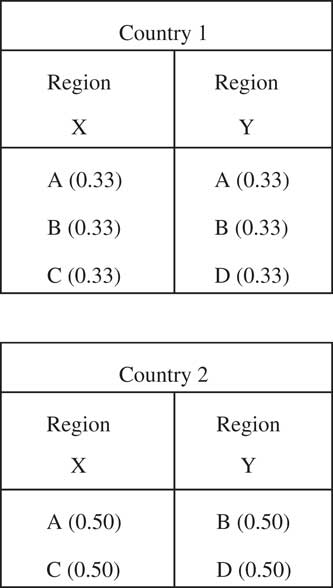
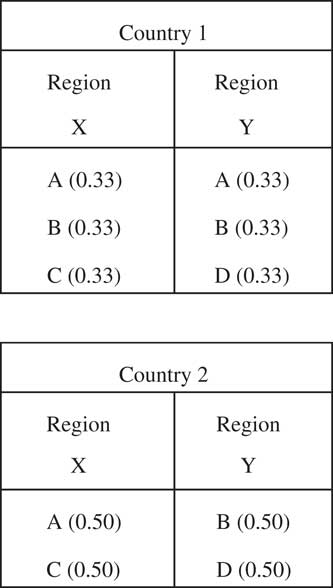
The intuition for the measure we use can be simply demonstrated. Imagine two countries—1 and 2 (see Figure 1). In each country, there are two regions (X and Y), each of which is also an electoral district for the purposes of electing the national legislature. In each country, there are four parties that compete in national elections, A, B, C, and D. Let the distribution of those parties across districts vary between Countries 1 and 2. In Country 1, parties A and B compete for votes nationally—campaigning and winning votes in both region X and Y. C and D by contrast compete only in one region, C in X and D in Y. In Country 2, none of the parties are national parties—each competes in only a single region. Assuming the parties in each region split the votes evenly, the F score for Country 1 is 0.17 and for Country 2 is 0.5—reflecting the fact that Country 1 has a more nationalized/less regionalized party system than Country 2.
Nationalized and Fragmented Party Systems
There are two concerns with this particular measure of party system nationalization (Bochsler Reference Bochsler2010). First, the measure does not take into account cross-national variation in the number of districts across countries (having only a few districts might overstate the degree of nationalization in a country). Second, averaging the effective number of parties across the districts might conceal more than it reveals about the degree of nationalization.Footnote 6 To account for these concerns Bochsler (Reference Bochsler2010) develops a Gini-type measure of party nationalization, where values closer to one indicate a more nationalized system, which controls for the number of units (constituencies, regions, provinces, for example). We use this alternative measure in robustness checks and show that using either measure the data support our hypothesis.
Effects of Party System Nationalization on Public Services
The first part of our argument is the commonsense assertion that the degree of party system nationalization affects the breadth and nature of the constituency to which political parties respond. Whether in or out of government political parties choose or advocate for policies that are designed to appeal to their supporters. Suppose a party system is composed of parties with national constituencies—examples might include the two American parties, the Congress and BJP in India, and the major center-left and center-right parties in Western Europe. Supporters of the national parties will expect those parties to devote some attention to national-level policies while in power, and to advocate for such policies while in opposition. The representatives within those national parties will have incentives to respond to those expectations. Bargains between supporters across regions are embedded within each party and in the decisions by voters to support the party. In effect, voters know they are delegating negotiating rights to a party representative—geographic representation is subsumed within and secondary to party representation. The key here is the breadth of the constituency to which a given collection of politicians under a party label respond (and the constituency to which voters believe politicians should be responding). Nationalized parties have already managed to accommodate regional demands into the process of forming the party, running candidates, and developing a list of policy programs. Parties have already internalized the geographic bargaining and so have incentives to go into the national government, or campaign for the national governing power, with proposals for broad public benefits that cut across geographic lines.Footnote 7 Consequently, policy outcomes will reflect a desire by politicians to please a national constituency and to be evaluated according to national criteria. This compels politicians to distribute services, or propose distributing services, that are broadly accessible and that have economies of scale in their supply—namely, public services with very broad if not universal scope.
For a system that is not nationalized, we refer again to the simple example shown in Figure 1. Supporters of the regional parties (C and D in Country 1, and all of the parties in Country 2), will consider geographic and partisan representatives to be one and the same. Voters are sending a representative for whom a major task will be to represent a particular geographic region, either in the government or in opposition.
We can divide the effect of the representation of regionalized parties into three general categories. Consider first a situation where a set of parties from the same region (e.g., A and C in Country 2) can control the government. We would expect government goods and services to flow disproportionately to the supporters in that region, as the incumbents derive no electoral benefit from providing support to voters in the other region. Such targeted policy provision obviously leaves certain segments of the population underserved. In addition, because policy that is directed to a narrow constituency is particularly vulnerable to reversals (Author (n.d.)), if a government of AC is replaced by BD in Country 2, we might expect BD to scrap many of the X region-centric policies adopted by the previous government and pursue instead a pro-Y region agenda, at some cost to efficiency and effectiveness. Note, however, that the incentives of regional parties do not change if they are in the opposition—we would still expect them to propose policies aimed at benefitting their region in an effort to mobilize enough support to govern. The critical point is that, under this scenario where governing coalitions come from regionally biased groups of parties, the regionalization of the party system drives a less comprehensive government policy regardless of which coalition is in power.
Now consider, second, the situation where the possible governing coalitions include parties from different regions (e.g., A and B in Country 2). Geographic logrolls become possible. Under this scenario each region gets some share of national resources, but this could come in one of two forms. The set of governing parties could provide nationally targeted policies that benefit voters in each region. However, given that such policies, by definition, are not targetable, it is difficult for A or B credibly to claim primary credit for providing such policies to voters in their region, leaving them more vulnerable to a challenge from other regional competitors. A politically valuable strategy is to provide resources to their supporters in the form of regional particularism that can be directly credited to the party, and ward off challengers (e.g., party C as a challenger to party A). The competition for support by the regional parties, given overall budget constraints, leads to undersupplied nationally comprehensive policies because of the pressure to supply some geographically targeted goods. The government, to the extent that resources are drawn away to those geographically targeted goods, also loses any economies of scale that might arise when goods or services are provided through nationally planned and nationally implemented policies that have been turned over for implementation to technicians and experts.
Third, consider a country composed of a mix of nationalized and regionalized political parties. If power alternates between national parties and coalitions of regional parties, we expect to see more nationally focused policies under national parties, and more regionally focused policies under regional parties. Where national and regional parties are in coalition together, we would expect regional parties to extract some regionally targeted policy concessions from the national party during the formation of policies. In either scenario, given budget constraints, policies will, on average, be less universal than they would otherwise be in a more fully nationalized party system.
To summarize the possible consequences of regionalized parties in the party system (either in government or in opposition):
-
∙ policy outcomes can be universally but inefficiently supplied because of the need for the parties to gain credit locally; that is, voters need to know that their regional parties are working for them locally; or
-
∙ policy outcomes can be unequally provided across regions because of differences in representation by regional parties.
Note that the second kind of policy outcomes can persist over time and thus some regions are perpetually underserved by particularistic policies. This is surely the case in the Chunla region in South Korea, for example, or in the Northeast of Thailand. Or regional parties can come in and out of government and thus policy benefits can be intermittently supplied to specific regions based on political outcomes. This latter can lead to inefficient provision of public services.
Thus, the patterns of party politics in geographic space will have consequences for policy-making processes and outcomes. More specifically, the degree of party system nationalization should shape the incentives of policymakers and thus affect policy outcomes.Footnote 8 Our hypothesis is straightforward. For countries with nationalized parties primarily, public services will be consistently provided to larger swaths of the population, whereas for countries with regionalized parties playing prominent roles in government or obtain substantial votes in opposition, public services will be less effectively and efficiently supplied, ceteris paribus.
Alternative and Additional Causes
We acknowledge that institutional factors besides nationalization might matter in determining public services provision. Some scholars, for example, have compared the provision of public goods in proportional representation systems versus plurality systems, and argue that the former provide more (e.g., Lizzeri and Persico 2001).Footnote 9 Others have drawn a link between fiscal federalism—the degree of autonomy given to sub-national governments to tax and spend—and overall public goods production by the national government, arguing that fiscal decentralization induces more overall government spending on education and health (but not necessarily at the national level) (Arze, Martinez-Vazquez and McNab Reference Arze del Granado, Martinez-Vazquez and McNab2005). Moreover, some (as we previously discussed) have focused on the same independent variable we have, arguing, for example, that party nationalization affects the structure of spending in countries (Lago-Peñas and Lago-Peñas Reference Lago-Peñas and Lago-Peñas2009; Crisp, Olivella and Potter Reference Crisp, Olivella and Potter2012; Castañeda-Angarita Reference Castaneda-AngaritaForthcoming). We control for these factors in our analysis (described below) and show that even when doing so party system nationalization remains a key factor explaining variance in public services provision.
Note that we do not argue here that nationalized party systems will lead to centralized political and economic systems, or that regionalized party systems will lead to decentralized or devolved political and economic systems. This is an interesting proposition and is essentially the reverse of the Chhibber and Kollman (Reference Chhibber and Kollman2004) thesis (see also Filippov, Ordeshook and Shvetsova Reference Filippov, Ordershook and Shvetsova2004). However, centralization and decentralization is about authority across levels of governments, whereas our interest here is in the mix of national policies versus sub-national pork/logrolls, holding fixed the level of (de)centralization. One implication of our argument is that, regardless of the level of national government spending relative to sub-national units, the distribution of that spending should vary across countries according to their level of nationalization.
Research Design
We use indicators of the provision of health services to assess the arguments made above. To start we use the two immunization variables. In addition, we estimate a model using the infant mortality rate, as that variable is closely associated with a host of public spending programs, including improvements in the quality of drinking water and sewage treatment, epidemic control, and the delivery of antibiotics and basic health that, per our argument, are expected to correlate with the degree of party system nationalization.Footnote 10 To make consistent the interpretation of the coefficient estimates reported below, we convert the two immunization variables into the percentage of the under 12-month population that is not immunized. Thus, for all three variables higher values correspond with worse health outcomes. Our key independent variable is the extent of party system nationalization, which we measure using the regionalization score (F) discussed earlier.Footnote 11 Note that our study is global and includes many developed and developing countries together, relying on the largest number of countries and cases to date for such an analysis. Previous results linking nationalization to policy-making focused specifically on Latin America (Catañeda-Angarita 2013), Europe (Lago-Peñas and Lago-Peñas Reference Lago-Peñas and Lago-Peñas2009), or developed democracies (Crisp, Olivella and Potter Reference Crisp, Olivella and Potter2012).
Estimation
To begin testing our hypotheses, it is worth pointing out that globally, there is a clear trend of improving public health (Ross 2006). Furthermore, public health outcomes exhibit convergence, whereby the worst performers at some period of time improve more rapidly in subsequent years than the best performers (Kenny Reference Khaleghian2005). It should not be surprising that countries that have high immunization and low infant mortality rates experience comparatively small improvements as these countries simply have less room to improve. For their part, the countries with the worst levels show faster improvement because they are targets of foreign aid organizations seeking to improve health outcomes. In addition, we might expect that public health resources may have larger marginal effects on outcomes in developing countries as many of the causes of poor public health are readily solved with existing relatively inexpensive technologies.Footnote 12 Accordingly, the poorest performers should exhibit faster improvement than the best performers.
At issue is how we test our argument in light of the convergence process. Ross (2006) warns that failing to account for global health trends can lead to biased estimates and erroneous conclusions. Our strategy draws from growth economics. In that discipline, investigating whether poor countries grow faster than rich ones do typically proceeds with a model that regresses countries’ average growth rates on their income levels at the beginning of the period or some earlier point in time:
 $$\Delta Y_{{i,a}} =\alpha {\plus}\beta _{1} Y_{{i,t1}} {\plus}{\varepsilon}_{{i,a}} ,$$
where ∆Y i,a is the Country i’s average growth rate and Y i,t1 the Country i’s income at the start of that period.Footnote 13 If convergence is occurring β 1 will be negative and statistically significant. We use a modification of Equation 1 to test our argument. As in Equation 1, we estimate models that take the average of the dependent variable over some period of time and include the lagged level of the dependent variable on the right-hand side. However, in light of the convincing evidence that health outcomes are converging (Kenny Reference Khaleghian2005), rather than asking whether health outcomes are converging, we estimate the pace at which they are doing so. One implication of our argument is that even as countries are converging to the same health outcomes (i.e., full immunization or zero infant mortality) the rates at which they do so will depend on the degree of party system nationalization. If, as we have argued, nationalized party systems lead to more public services being provided, then we expect that the factors that make the worst performers show faster improvements in subsequent periods will have different effects in regionalized versus nationalized systems. Namely, they will have a less substantial impact in the latter. Consider a country that is the recipient of public health-related foreign aid. A highly regionalized party system in the recipient country will reduce the effectiveness of that aid, by allocating the donated resources inefficiently, say, choosing to prioritize disproportionately the regions from which the governing party draws its electoral support. A nationalized system will supply more public services and will do so more efficiently to appeal to as broad a constituency as possible, thus generating more return for each aid dollar.
This logic implies that changes in health outcomes are the joint function of a country’s starting level of the health statistic in question and party nationalization/regionalization. As such, we estimate
 $$\Delta Health_{{i,a}} =\alpha {\plus}\beta _{1} Health_{{i,t1}} {\plus}\beta _{2} Nat_{{i,a}} {\plus}\beta _{3} (Health_{{i,t1}} {\times}Nat_{{i,a}} ){\rm }{\plus}\beta \rsquo X{\plus}{\varepsilon}_{{i,a}} ,$$
where Health refers to one of the three dependent variables discussed above, Nat the measure of party nationalization/regionalism (F), and X a set of control variables. The dependent variable, Nat, and the control variables are averaged over the years 1990–2000 and Health i,t1 is the value in 1990 or the first year in the period 1990–2000 that the country enters the sample.
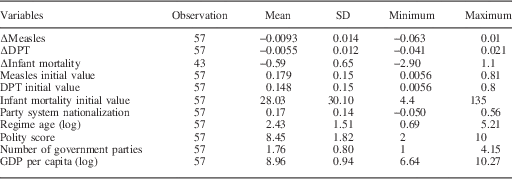
Our estimations include a set of economic and political control variables. We include per capita GDP to account for the correlation between per capita income and health statistics. In addition, per capita GDP proxies for state capacity, which we also expect correlates with health outcomes.Footnote 14 Although our sample only includes countries that have minimally democratic elections—those that average a Polity score >0 on the −10 to 10 scale—we want to control for any differences that may exist between marginally democratic countries and those with fully democratic elections and so we control for a country’s Polity score. We also control for the age of the regime to capture any difference between new and well-institutionalized democracies. Next, because there is good reason to believe that party system regionalization is correlated with coalition governments, we control for the effective number of government parties to weed out the correlation between multiparty governments and spending priorities. We include a full set of regional controls (with the industrialized democracy “region” being the excluded category) to account for regional trends in the data. Per capita GDP and the age of the regime enter the model as natural logarithms. Table 1 provides summary statistics for all variables that we include in the model.
Summary Statistics
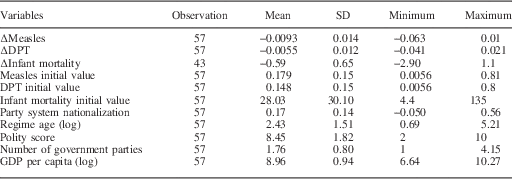
If our arguments are right, β 1 should have a negative coefficient. This would tell us that when the party system is very nationalized (more exactly, when F=0), poor performers exhibit more rapid improvements in infant mortality and the percent of the population unimmunized than better performers do. β 3, however, should be positive. As the party system becomes increasingly regionalized, politicians provide fewer national public services and focus their attention on specific geographic constituencies, with the consequence being slower health improvements in the population as a whole.
Results
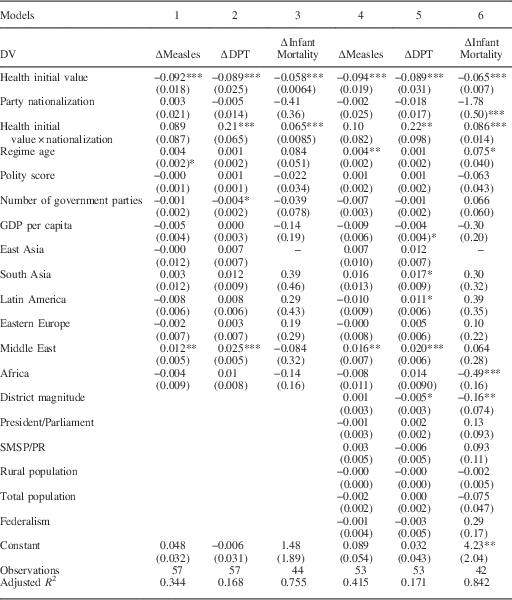
Models 1–3 in Table 2 present our main results. Altogether, they provide strong support for our arguments. Consider Model 1, which uses the average change in the percent of the population not immunized for measles as the dependent variable. The coefficient on the lagged level of immunization is negative and statistically significant, telling us that in highly nationalized systems (more exactly, when Nat=0) the countries with the worse immunization levels show faster improvement in subsequent years than countries with lower levels to start. Notice, however, that the interaction term has a positive and significant coefficient. This is evidence of the negative consequences of regionalization. The interaction term reveals that as regionalism increases, the pace of convergence beings to slow—the marginal effect of the lagged level tends toward 0. Indeed, at very high levels of party regionalism, the marginal effect of the lagged level is almost precisely zero. These coefficient patterns are consistent with our arguments. Regionalism in the party system undermines the efficacious provision of public services and slows improvements in health outcomes.
Party System Nationalization and Health Outcomes
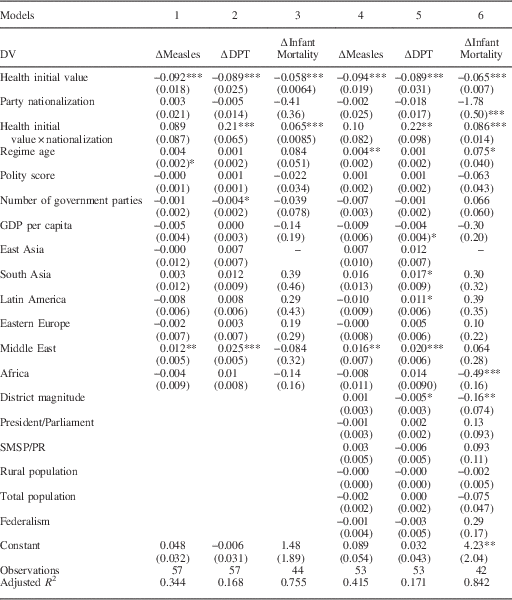
Note: standard errors in parentheses. The ‘−’ denotes the fact that, because of missing data, there are no countries in the East Asian region for this model.
*p<0.1, **p<0.05, ***p<0.01.
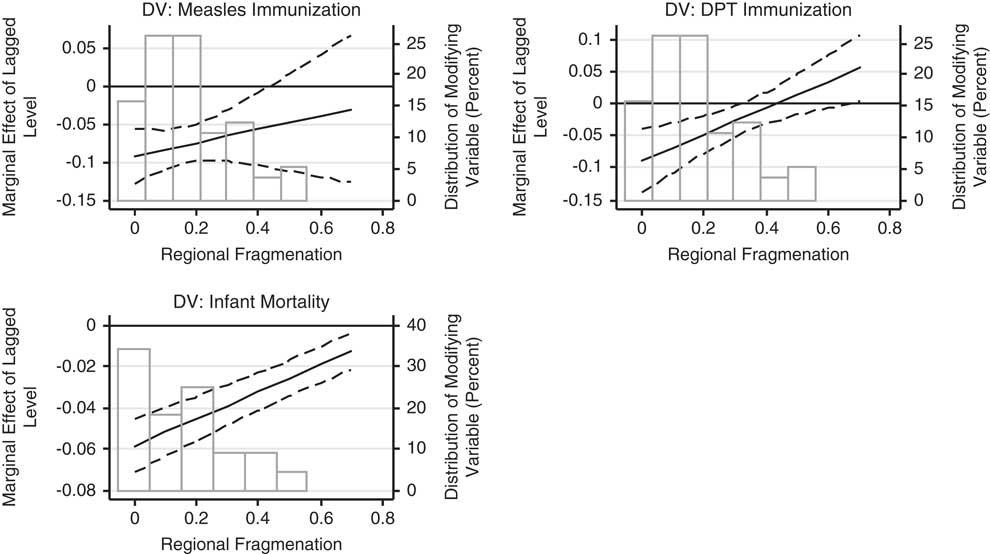
The top left panel in Figure 2 plots these effects to facilitate interpretation. The solid line is the marginal effect of the lagged immunization level. It is plotted for the range of party regionalism in the sample. The dashed lines are 90 percent confidence intervals around the marginal effect. The histogram shows the distribution of cases with respect to party regionalism and should be evaluated using the right-hand side y-axis. The results are striking. Although the marginal effect line is negative for the entire range of cases, it is significantly so only at low values of regionalization. As regionalization increases, the marginal effect slopes upward and becomes statistically insignificant. Regionalism, it seems, undermines health improvements, consistent with our argument.
Marginal effect of lagged level as regionalization changes (1990–2000)
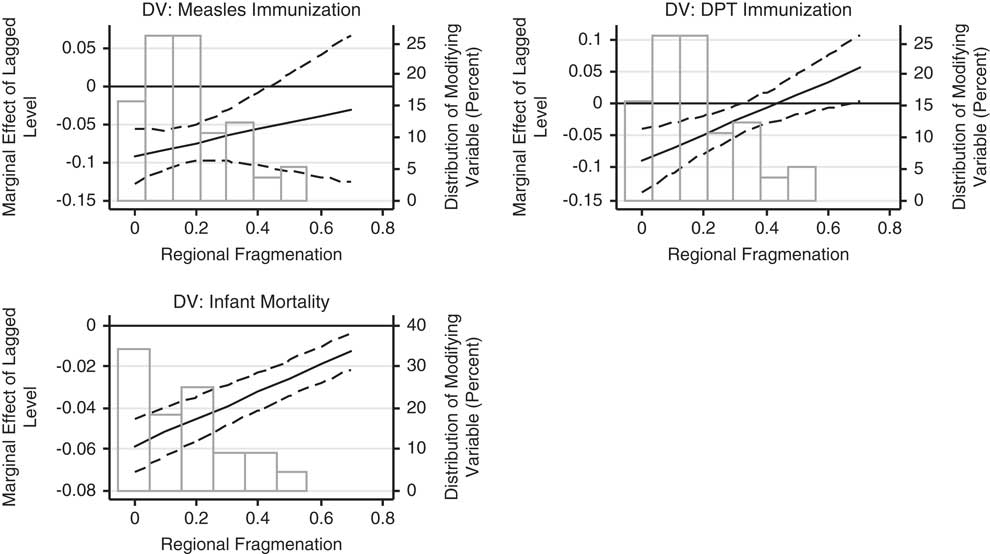
Substantively, the joint effects of the lagged level and the degree of party system nationalization can be appreciable. In an extremely nationalized party system (i.e., where F=0), a 1 percentage point increase in the initial level of unimmunized individuals in the population corresponds with a subsequent decrease in the percent unimmunized by about 0.09 percentage points, per year on average. Over the course of a decade, this would mean the population of unimmunized individuals would fall about a percentage point. To put that in context, it is a larger effect than a similarly proportioned increase in GDP or increase in the degree of democracy. However, this convergence slows as regionalism in the party system increases. In an extremely regionalized system, for example, say a value of 0.4 (the sample’s 95th percentile), a higher level of unimmunized individuals at the start of the period leads to only a 0.04 percentage point decline on average per year, or less than half of a percentage point reduction over the course a decade. Both of these effects are statistically significant; the pace of convergence has real consequences and depends on the degree of party system nationalization/regionalism precisely as we predict.
Turning back to Table 2, Models 2 and 3 lend further support to our arguments. In both cases, the coefficient on the lagged level is significantly negative, whereas the interaction term is positive. The two remaining graphs in Figure 2 show the relevant graphs. In each, we see that convergence is faster in nationalized systems and slows as party regionalism increases. Moreover, again the substantive effects are important. Higher initial levels of individuals unimmunized from DPT leads to a subsequent reduction of 0.09 percentage points on average per year when the party system if very nationalized, but only a 0.02 percentage point reduction at nationalization scores of 0.3 (the sample’s 80th) percentile, and there is no convergence at all at nationalization scores at 0.4 and greater. The infant mortality results are similar. States with higher initial levels of infant mortality see subsequent declines on the order of 0.05 fewer deaths per year on average in very nationalized systems, but reductions of only 0.03/year on average at nationalizations scores around 0.4. Again, convergence to better human welfare outcomes is occurring, but the pace of convergence depends on the condition of the party system.
Robustness and Sensitivity
We assess the robustness of these results in three ways. First, we include an additional set of control variables to account for additional potential confounds. Models 4–6 in Table 2 control for district magnitude, whether a country is parliamentary, assembly-elected presidential, or directly elected presidential, whether a country uses plurality or proportional representation electoral rules, the percent of the population living in rural areas, the total population, and whether a country is federal.Footnote 15 The population variables partially control for the demand for health services, whereas the institutional controls are variables that might plausibly shape the nature of policymakers constituency and their incentives to provide different types of goods and services (e.g., Cox and McCubbins Reference Cox and McCubbins2001; Persson and Tabellin Reference Persson and Tabellini2003; Morelli Reference Morelli2004). The federalism control is particularly important as a number of scholars have investigated the link between decentralization and public goods outcomes, with a particular focus on heath care (e.g., Burki, Perry and Dillinger Reference Burki, Perry and Dillinger1999; Enikolopov and Zhuravskaya Reference Enikolopov and Zhuravskaya2003; Khaleghian Reference Keefer and Stasavage2004; Treisman Reference Treisman2007).Footnote 16 The results of these latter studies are decidedly mixed, depending very much of the sample used, (developing versus developed, democracies versus all countries, etc.) and the way in which decentralization in operationalized. Even so, we find it plausible to expect an effect of decentralization on spending. In addition, decentralization is hypothesized to affect nationalization (Chhibber and Kollman Reference Chhibber and Kollman1998; Chhibber and Kollman Reference Chhibber and Kollman2004) and so the exclusion of it from the model may expose the results to omitted variable bias. The attribute of decentralization most likely to confound our empirical specification is the share of total public health spending for which sub-national units account. Unfortunately, we have reliable data for this variable for only a handful of countries and including this variable reduces substantially the size of our already small sample. As an alternative, we include the federalism indicator from Henisz (Reference Hicken2000), in which an observation is coded as “1” if sub-national entities possess constraints on national fiscal policy.
The main results hold in every case. In each case the coefficient on the lagged health outcome in question is negative, whereas the interaction term is positive, indicating that by and large convergence is occurring as Kenny (Reference Khaleghian2005) points out, but that the pace of convergence depends on the level of party system nationalization/regionalization.Footnote 17 It does not appear then that the results of our baseline models are due simply to the set of control variables in those specifications.Footnote 18
The second test of robustness is to expand the time period covered in our models. Although the results in Table 2 are supportive, one might wonder if the time period covered—1990 to 2000—is long enough to accurately observe the kind of effects about which we hypothesize. One might also wonder whether significant improvement was possible for industrialized countries for this period regardless of whether the party system was nationalized, given that they already had good performance on health outcomes by this time. To explore these possibilities, we extend the years covered in our sample. For immunization, we look at 1980–2000 (the data are not available before 1980). For infant mortality, we looked at changes over the period 1960–2000. For these time periods, a country enters the sample if its average Polity score over the entire period is >0 and the country has a democratic episode in each decade of the time period in question. The dependent variable, as before, is the average annual difference in the public health outcome.
As we extend the starting date backward in this manner, we lose some cases. When we extend back to 1960, for example, the sample is largely industrialized democracies. That said, using the longer time sweep allows us to see more dramatic changes in the dependent variables and should persuade that there is room for substantial improvement in health outcomes, even for the Organisation for European Economic Co-operation set of countries. As of the loss of cases, we estimate a more parsimonious model. Specifically, we exclude the regional indicators as our samples are comprised mainly of industrialized democracies.
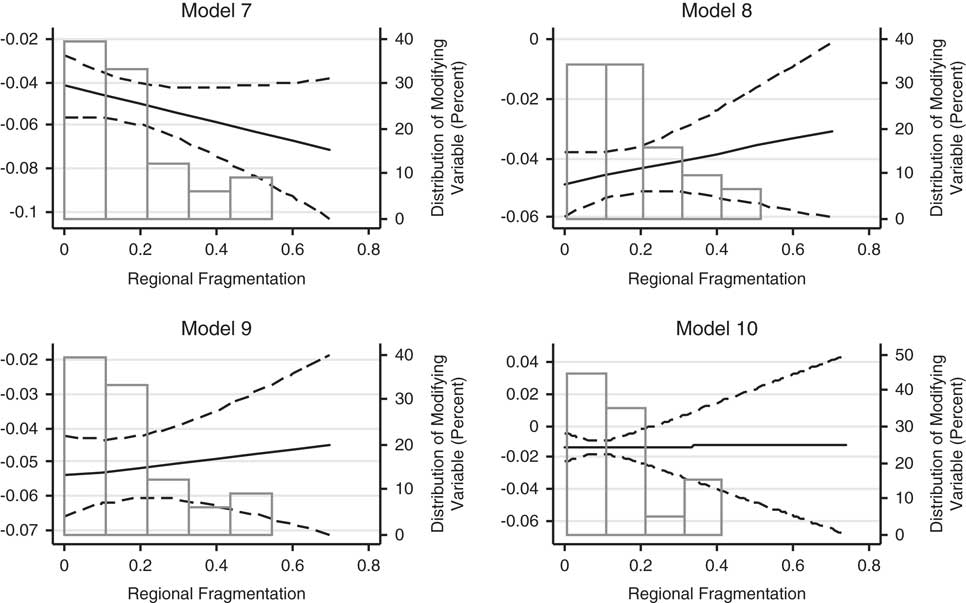
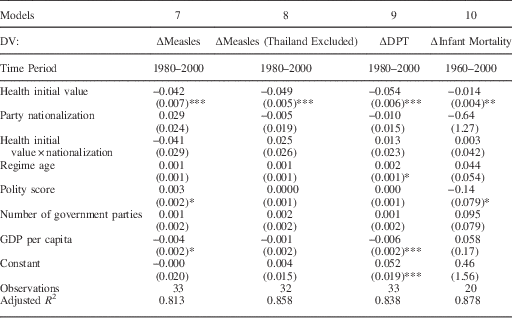
The results for all dependent variables can be found in Table 3. Model 7 uses the measles immunization variable between 1980 and 2000 as the dependent variable. At first glance, the results do not appear to support our story. Although the coefficient on the lagged level has the appropriate sign, that on the interaction term does not. Diagnostics show, however, that this result is owing to the presence of an influential outlier. Thailand has Cook’s Distance and DFITS scores well above standard thresholds. When that case is dropped from the equation, as it is in Model 8, the results once again confirm our hypotheses. Models 9 and 10 also reaffirm our hypotheses. The four graphs illustrating the results are displayed in Figure 3.Footnote 19
Marginal effect for extended time periods
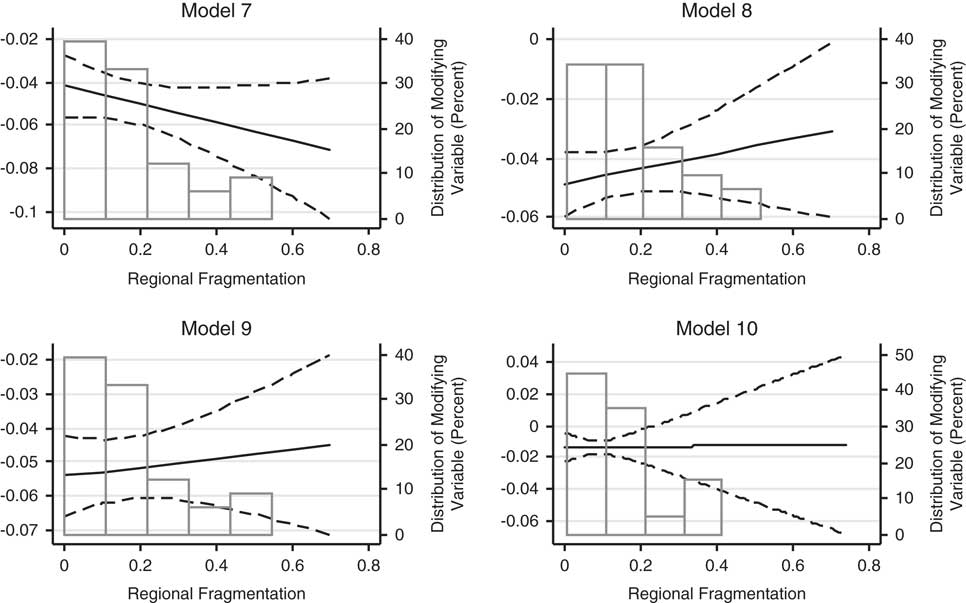
Testing the Model in Extended Time Periods
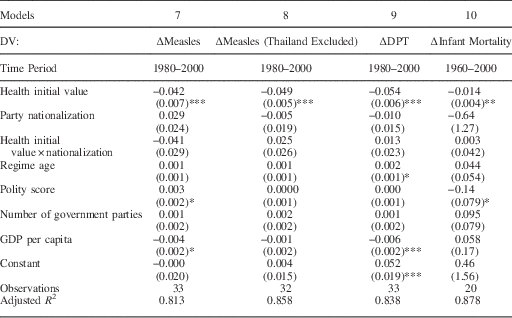
Note: standard errors in parentheses.
*p<0.1, **p<0.05, ***p<0.01.
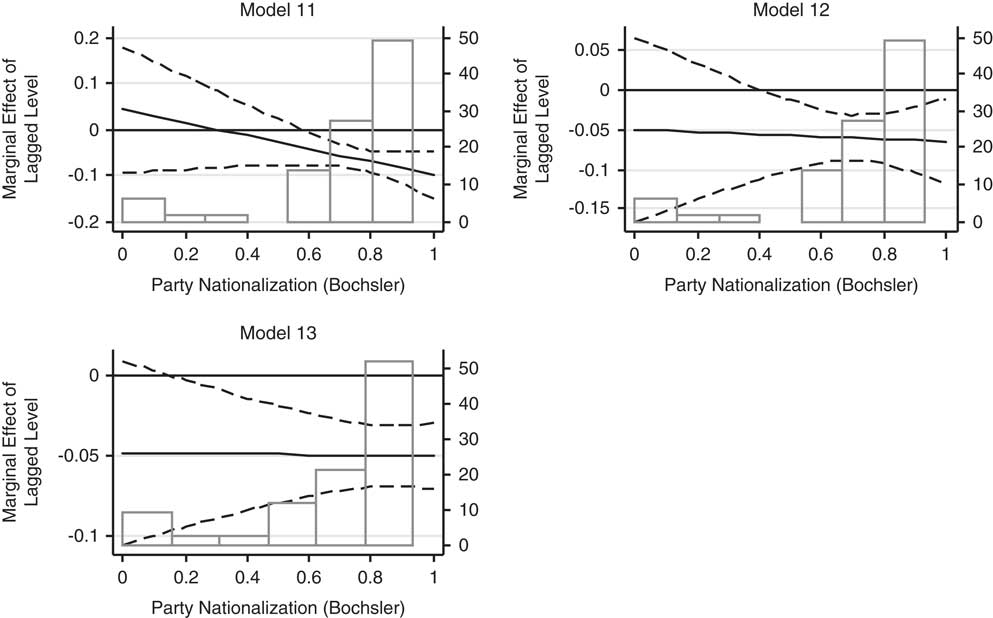
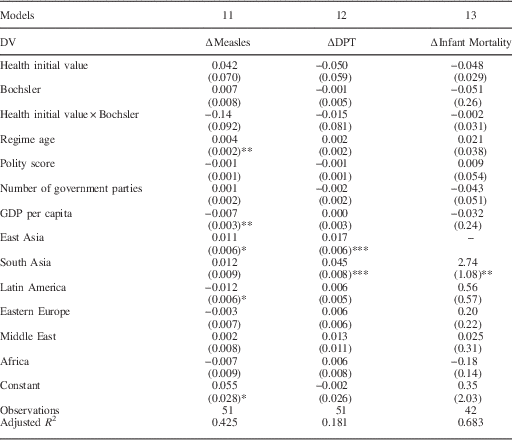
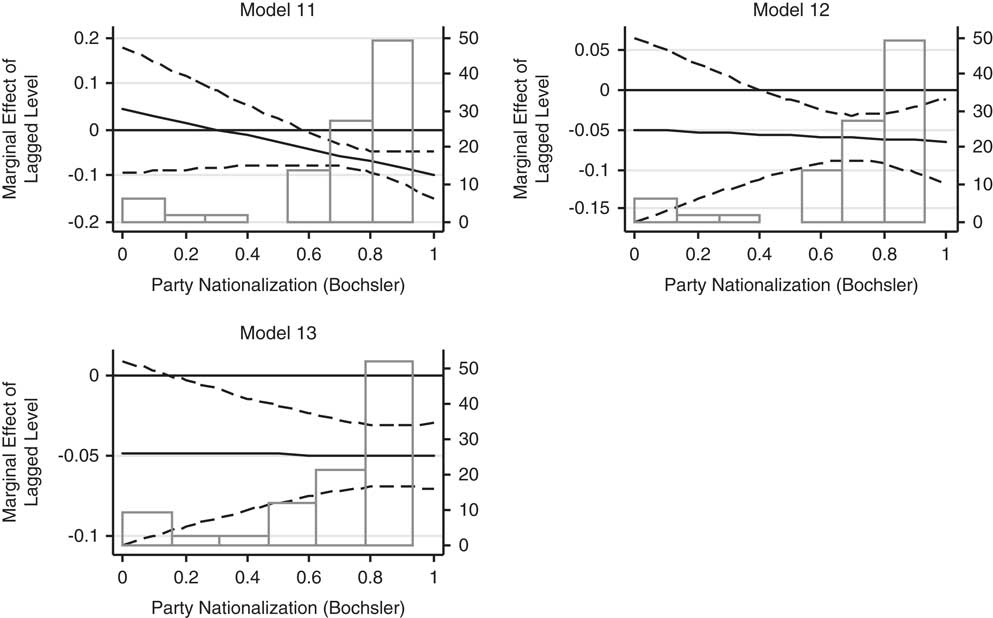
Table 4 presents our last robustness check. Bochsler (Reference Bochsler2010) critiques measures of party system nationalization/regionalization like ours because they do not take into account cross-national variation in the number of districts used to compare against the effective number of parties at the national level (having only a few districts might overstate the degree of nationalization in a country) and because averaging the effective number of parties across the districts might conceal more than it reveals about the degree of nationalization. To account for these concerns, Bochsler (Reference Bochsler2010) develops a Gini-type measure of party nationalization where values closer to one indicate a more nationalized system.Footnote 20 We test robustness of our baseline result by substituting Bochsler’s measure for our own. Note that because an increase in Bochsler’s measure indicates a more nationalized party system, we expect a negative coefficient on the interaction term instead of a positive one as before.Footnote 21 The coefficient estimates are presented in Models 11–13 in Table 4, but we focus our attention here on the marginal effect graphs in Figure 4. Model 11 shows that at low levels of Bochsler’s measure, that is, in highly regionalized party systems, the marginal effect of the lagged level of measles immunization has no statistically significant effect on the change in immunization in future periods. That is to say that in highly regionalized party systems, there is no convergence in immunization levels. That said, the marginal effect lines slopes downward and becomes statistically significant as nationalization increases, indicating that convergence happens and does so at an increasingly rapid pace in countries characterized by highly nationalized parties. This is consistent with our baseline results. Models 12 and 13 show similar patterns and further confirm our hypothesis.Footnote 22
Baseline results using Bochsler’s measure of nationalization/regionalization
Testing the Model Using Bochsler’s Measure of Nationalization/Regionalization
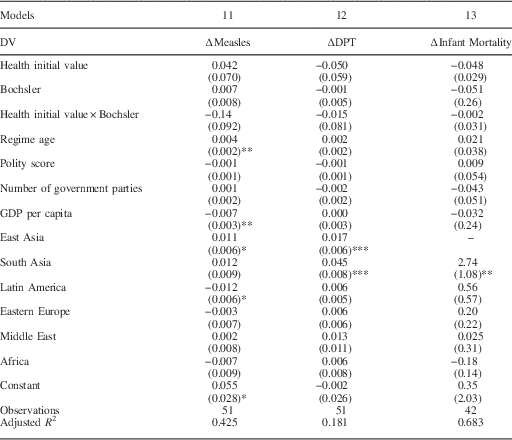
Note: standard errors in parentheses. The ‘−’ denotes the fact that, because of missing data, there are no countries in the East Asian region for this model.
*p<0.1, **p<0.05, ***p<0.01.
Summary and Possible Extensions
Our results complement recent research that reveals empirical links between party system nationalization and government spending (Lagos-Peñas and Lagos Peñas Reference Lago-Peñas and Lago-Peñas2009; Crisp, Olivella and Potter Reference Crisp, Olivella and Potter2012; Cataneda-Angarita Reference Castaneda-Angaritaforthcoming). Some of these previous research findings rely on attention to interactions with institutional and demographic factors. Although it is beyond the scope of this paper to examine the many possible interactions as part of this analysis, our results are consistent with these overall findings from others. Party system nationalization affects government policy. We take it one step further, showing that party system regionalization can be a barrier to improved health-care provision and outcomes, especially in areas with direct policy-outcome connections such as immunizations. By using health-care measures, we intend to capture the degree to which governments are committed to and deliver broad public services to the population in contrast to governments that have problems in the delivery of those public services because of the payoffs that need to be made to sub-national groups.
In the future, one could combine the data presented here with data on spending by the national government on these health programs. This would give an estimate of the efficiency of that spending, and should shed further light on the way in which party regionalization affects the provision of public services. For example, data showing high levels of government spending on specific government projects in specific geographic areas without accompanying national benefits for the population (especially where combined with evidence of corruption in government) provides evidence that the government is not prioritizing broad public services.
We could also add more nuance to our measurement of outcomes from public services. There is no perfect summary measure of policy performance, but we could explore several possibilities in order to create useful and comparable measures. For one thing, future research could add educational outcomes to this analysis. Other possibilities include using measures of governmental commitment to World Health Organization and World Bank programs in health and education and measures of portions of government budgets that are universalistic versus narrowly focused.
Moreover, to understand better the geographic affects of public policies and how those might relate to party nationalization, something difficult to quantify in a consistent manner across many countries given available data, it would be ideal to conduct in-depth analysis of government budgets and sub-national outcomes on a small number of cases in order to trace out causal effects.
Appendix
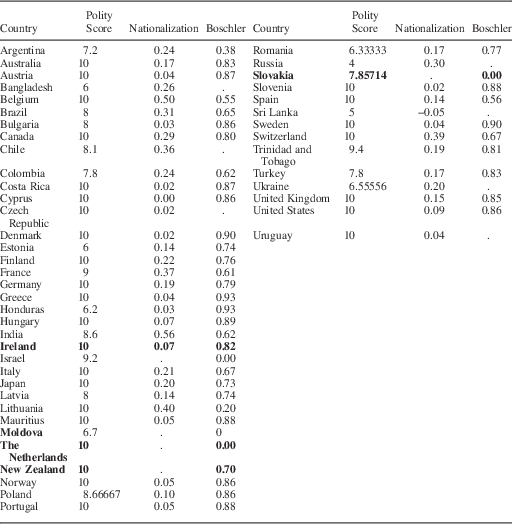
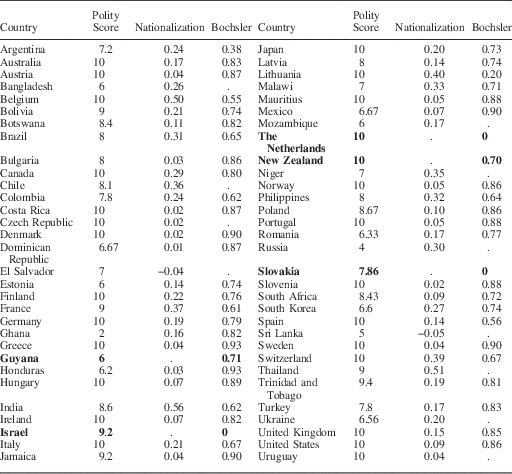
List of Countries in Measles and DPT Regressions
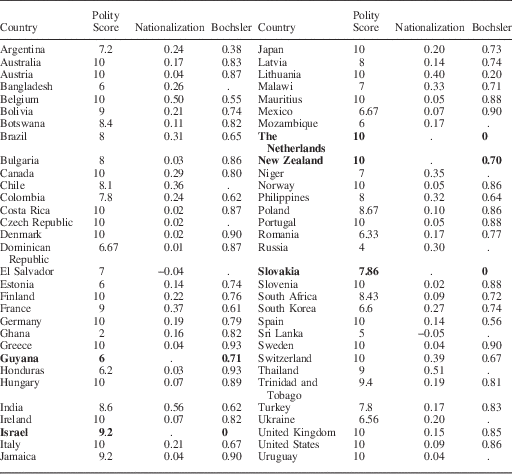
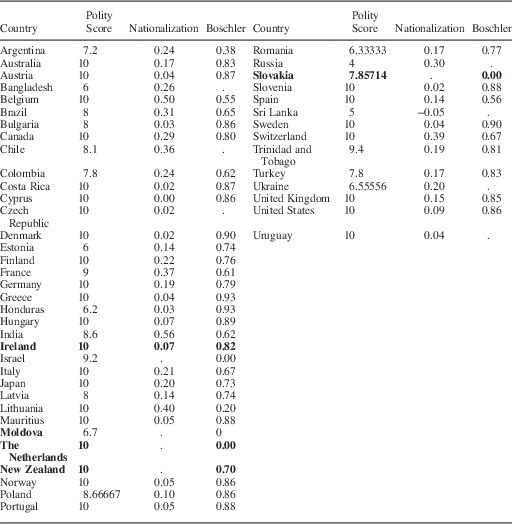
List of Countries in Infant Mortality Regressions