Clostridioides difficile is the most common cause of healthcare-associated infection in the United States.Reference McDonald, Gerding and Johnson1,Reference Magill, Edwards and Bamberg2 Infection control policies designate significant resources to reduce the medical and economic impact of this infection. Several risk factors for C. difficile infection (CDI) have been identified recently including antibiotic use, gastric acid suppression, length of hospital stay, and increasing age.Reference Loo, Bourgault and Poirier3,Reference Thomas, Stevenson and Riley4 Developing knowledge of the risk factors and pathophysiology of CDI has led to a decrease in the national burden of healthcare-associated C. difficile infection.Reference Guh, Mu and Winston5 Although this trend is encouraging, further advances are needed to continue to reduce the total burden. One area of increasing interest is the role of asymptomatic carriers in the transmission of CDI.
Asymptomatic carriage of C. difficile occurs in ~10% of hospitalized adults and is associated with an almost 6-fold higher risk of conversion to infection.Reference Zacharioudakis, Zervou, Pliakos, Ziakas and Mylonakis6 C. difficile carriers may also increase infection rates in hospitals by serving as a reservoir for environmental contamination through shedding spores.Reference Blixt, Gradel and Homann7,Reference Curry, Muto and Schlackman8 Identifying patients at high risk of asymptomatic colonization may provide an additional target for infection prevention strategies to reduce hospital transmission.Reference Furuya-Kanamori, Marquess and Yakob9 In contrast to the discrete risk factors associated with CDI in adults, the risk factors for C. difficile colonization are less defined. Studies have detected varying associations between colonization and gastric acid suppression, antibiotic use, and previous hospitalization.Reference Bruns, Oosterheert and Kuijper10–Reference Furuya-Kanamori, Clements and Foster12 Closer examination of these risk factors is necessary to elucidate the true relationships. The purpose of this meta-analysis and systematic review is to evaluate the relationship between previously identified risk factors for C. difficile colonization in hospitalized adults.
Methods
We conducted this meta-analysis and systematic review in accordance with the Preferred Reporting Items for Systematic Reviews and Meta-Analyses (PRIMSA) guideline (Supplementary Fig. 1 online),Reference Moher, Liberati, Tetzlaff and Altman13 as well as the recently released Conducting Systematic Reviews and Meta-Analyses of Observational Studies of Etiology (COSMOS-E) guideline.Reference Dekkers, Vandenbroucke, Cevallos, Renehan, Altman and Egger14
Data sources and searches
Two investigators (S.A. and Z.H.) independently performed systematic searches of the literature published between January 1975 and February 15, 2020. They queried the following databases : MEDLINE (PubMed), Web of Science, EMBASE, and Scopus. The following search terms were used: Clostridium difficile, Clostridioides difficile, colonization, colonisation, carrier, asymptomatic, risk factor, predictor, and marker. Detailed search procedures for each database can be found in the supplementary materials (online). Studies published in languages other than English were translated to English and were included in the review process.
Study selection and data extraction
We compiled a list containing all articles using Endnote Web software (Clarivate Analytics, Philadelphia PA). Duplicates articles were removed automatically using this software; remaining duplicates were manually removed. Studies were included if they (1) were case-control, cohort, cross-sectional, or randomized control trials, and (2) studied adult (≥18 years) inpatients admitted to a hospital. Studies were excluded if they (1) included <10 cases of asymptomatic C. difficile colonization, (2) evaluated ≤1 risk factor for C. difficile colonization, (3) contained only univariate risk factor analysis, (4) exclusively studied outpatients or patients at long-term care facilities, and (5) considered both asymptomatic and symptomatic (≥3 unformed stools in 24 hours) patients to be colonized. Study abstracts and full texts were independently screened by 2 investigators (S.A. and A.B.) to determine inclusion eligibility. For studies meeting inclusion criteria, we reviewed the full texts to assess for exclusion. Any disagreements were resolved by consensus with a third investigator (A.D.). Authors for included articles were contacted by e-mail if relevant data (eg, risk ratios) were not available in the original publication. For the final list of studies determined to be eligible for qualitative synthesis, we extracted pertinent data including study design, study population, patient demographics, clinical characteristics, and risk factors for C. difficile colonization. Cohen’s interrater κ statistic for inclusion agreement and data extraction were 0.81 and 0.86, respectively, indicating strong interrater agreement.
Risk of bias in individual studies
Two investigators (S.A. and Z.H.) independently performed assessment of risk of bias in individual studies using the Risk Of Bias In Non-randomized Studies of Interventions (ROBINS-I) tool.Reference Sterne, Hernán and Reeves15 The ROBINS-I tool allows for the assessment of bias in 7 different domains. For each study, risk of bias was rated as no information, low risk, moderate risk, serious risk, or critical risk for each domain individually and across all domains overall. Any disagreements or discrepancies during bias assessment were resolved by consensus with a third investigator (A.D.).
Data synthesis and analysis
We decided a priori that all risk factors reported in ≥3 studies would be eligible for inclusion in the meta-analysis. All other risk factors were aggregated as part of the systematic review (Supplementary Table 2 online).
For all studies, we extracted only the adjusted odds ratios. For studies that reported odds ratios of separate subgroups of the overall study population but not the overall odds ratio of the study population, the odds ratios of each subgroup were included in the meta-analysis. Specifically, both Linsenmeyer et alReference Linsenmeyer, O’Brien and Brecher16 and Furuya-Kanamori et alReference Furuya-Kanamori, Clements and Foster12 reported separate odds ratios for patients colonized by toxigenic and nontoxigenic C. difficile strains, but not the combined odds ratio for the 2 groups.Reference Furuya-Kanamori, Clements and Foster12,Reference Linsenmeyer, O’Brien and Brecher16 Similarly, Muñoz-Price, et alReference Muñoz-Price, Hanson and Singh17 reported separate odds ratios for patients from hematology-oncology wards and non–hematology-oncology wards. In these cases, odds ratios for each separate group within the same study were included in the same meta-analysis for the corresponding risk factors.
Meta-analyses were performed using the inverse variance method to obtain pooled odds ratios and 95% confidence intervals. DerSimonian and Laird random-effects models were used for all meta-analyses.Reference DerSimonian and Laird18 Given the low frequency and prevalence of C. difficile colonization in the study population, we assumed other relative measures of risk, including relative risk or rate ratios, to approximately equal the odds ratio to facilitate pooling of extracted data. We used the IReference Magill, Edwards and Bamberg2 statistic to evaluate the statistical heterogeneity of studies. Heterogeneity was classified as significant (IReference Magill, Edwards and Bamberg2 > 66%), moderate (33% ≤ IReference Magill, Edwards and Bamberg2 ≤ 66%), or low (IReference Magill, Edwards and Bamberg2 < 33%).
Assessment of publication bias
We generated funnel plots for meta-analyses of clinically significant risk factors, including risk factors examined by <10 studies. We utilized the Egger regression asymmetry test to assess publication bias for all meta-analyses. Asymmetry by the Egger test was defined as P value < .10.Reference Egger, Smith, Schneider and Minder19 Wherever asymmetry was detected, we assessed the potential impact of the publication bias using the Duval and Tweedie nonparametric “trim-and-fill” method.Reference Duval and Tweedie20
We used Review Manager (RevMan version 5.3 software, Oxford UK; The Cochrane Collaboration, 2014) to perform all meta-analysis procedures. The Egger regression test and the Duval and Tweedie “trim-and-fill” method were performed using the ‘meta’ package in R: A Language and Environment for Statistical Computing, version 3.5.1 software (R Foundation for Statistical Computing, Vienna, Austria).
Results
Study characteristics
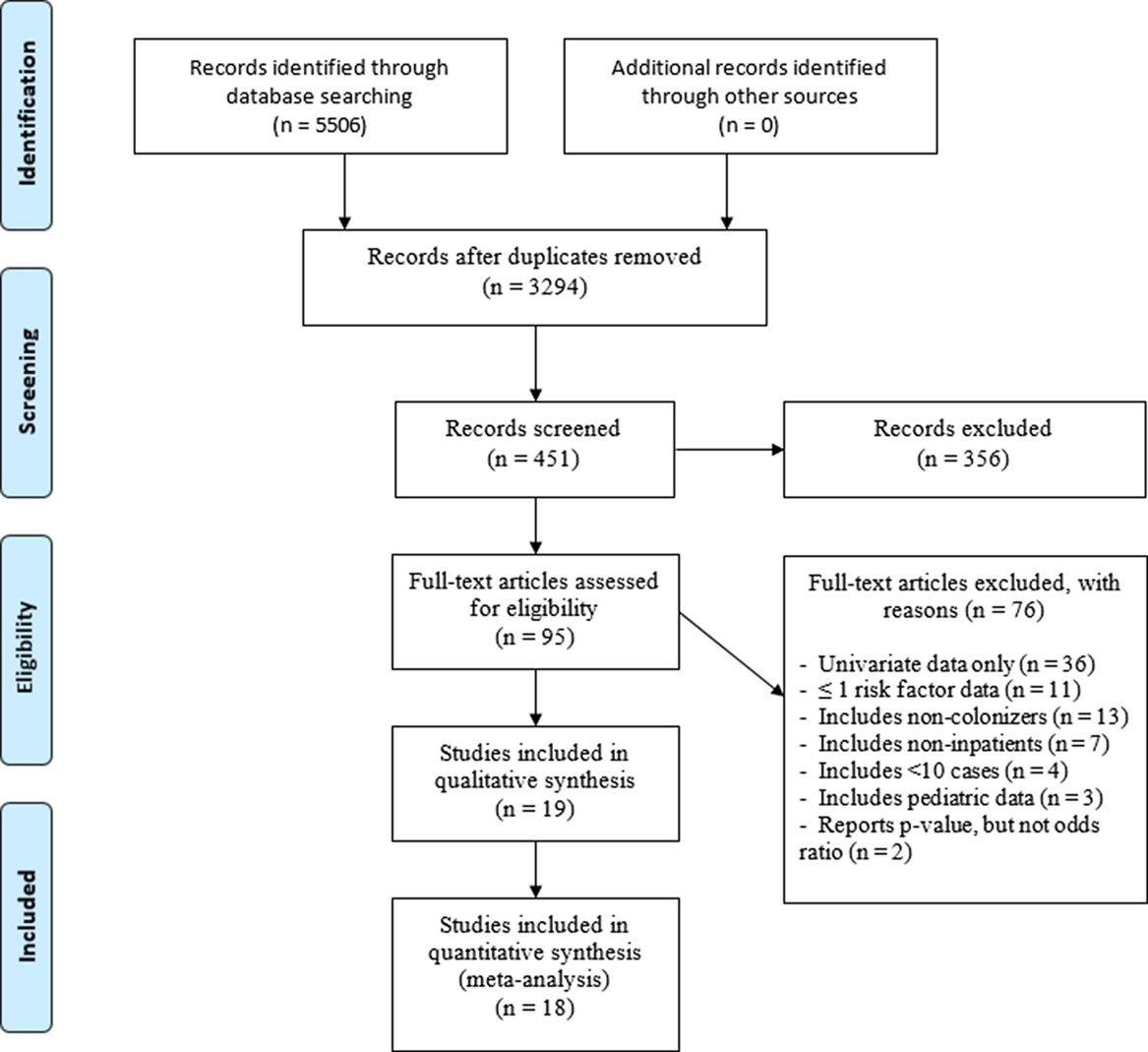
The preliminary literature search identified 5,506 articles (Fig. 1). Following the removal of duplicates and screening of titles, 451 articles were considered appropriate for further review. Evaluation of abstracts resulted in 95 articles being selected for full-text review. Ultimately, 19 articles were deemed eligible for systematic review; data from 18 articles were included in the meta-analysis. A list of reasons for excluding the remaining 76 articles is provided in Figure 1.
PRIMSA flowchart for inclusion into the meta-analysis and systematic review.

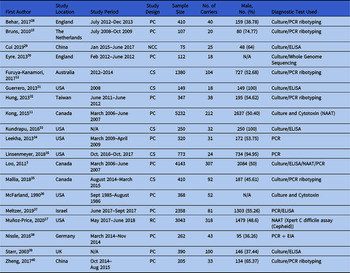
Characteristics of the included studies are summarized in Table 1. The overall study population comprised 20,334 adult inpatients, of whom 1,588 were identified as colonized with C. difficile. Of the 19 articles included in the systematic review, 13 were cohort studies, 5 were cross-sectional studies, and 1 study was a nested case-control study. Of the 19 studies, 17 were published after 2010 and 9 originated from North America, with the remaining studies originating from Europe, Asia, and Australia. C. difficile colonization testing methodology varied across studies, with most studies opting for C. difficile toxin B polymerase chain reaction (PCR) with or without C. difficile bacterial culture. Several studies also employed C. difficile toxin enzyme immunoassays in addition to PCR or culture. All articles reported data adjusted using multivariable logistic regression.
Characteristics of Included Studies

Note. N/A, not available; PC, prospective cohort; RC, retrospective cohort; NCC, nested case-control; CS, cross-sectional; PCR, polymerase chain reaction; ELISA, enzyme-linked immunosorbent assay; NAAT, nucleic acid amplification test.
Assessment of risk of bias in individual studies
All included studies were identified as having either moderate or serious risk of overall bias using the ROBINS-I tool (Supplementary Table 1 online). The bias domain of deviation from interventions was not applicable and was therefore not assessed in this study. Of the 11 studies with a serious overall risk of bias, only 3 have a serious risk of bias in >1 bias domain. Most of the concern for serious risk of bias resides in the bias domains of confounding and selection of participants.
Meta-analyses of risk factors
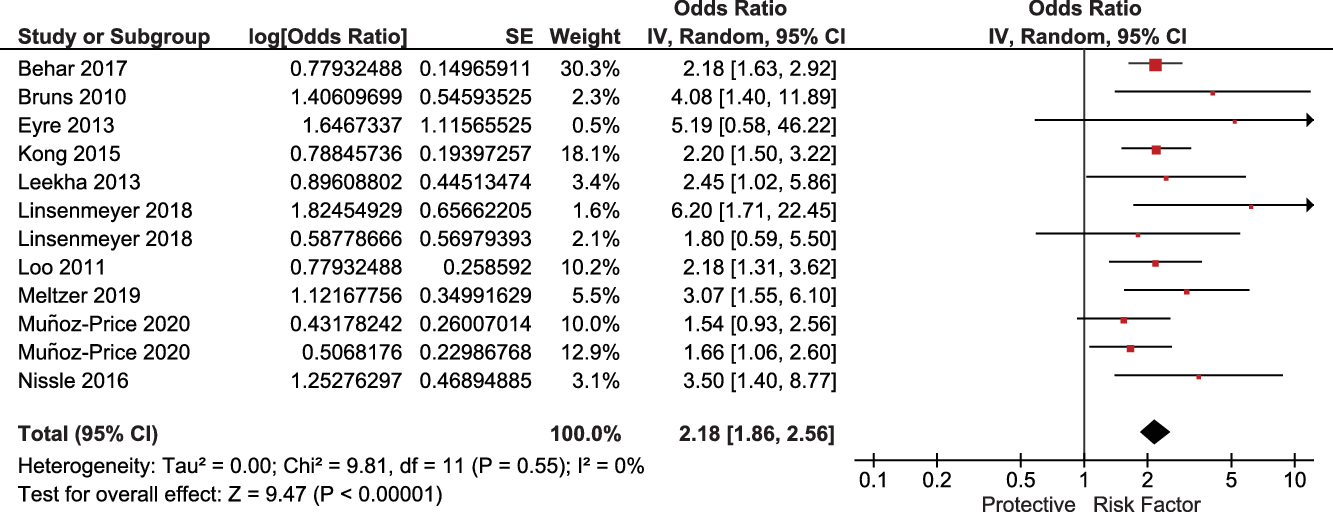
Overall, 10 studies reported data on the association between hospitalization in the previous 6 months and C. difficile colonization. As described in the methods section, 4 different ORs from 2 different studies were included for a total of 12 different effect sizes to be pooled. Meta-analysis of the 12 effect sizes showed a significant association between hospitalization in the previous 6 months and C. difficile colonization (OR, 2.18; 95% CI, 1.86–2.56; P < .00001) (Fig. 2). There was minimal heterogeneity among these studies (I2 = 0%).
Forest plot of the association between hospitalization in the previous 6 months and C. difficile colonization. The vertical line corresponds to no difference point between the 2 groups. Squares correspond to odds ratios. Horizontal lines represent the 95% confidence intervals. The diamond indicates the pooled relative risk ratios. Note. df, degrees of freedom.

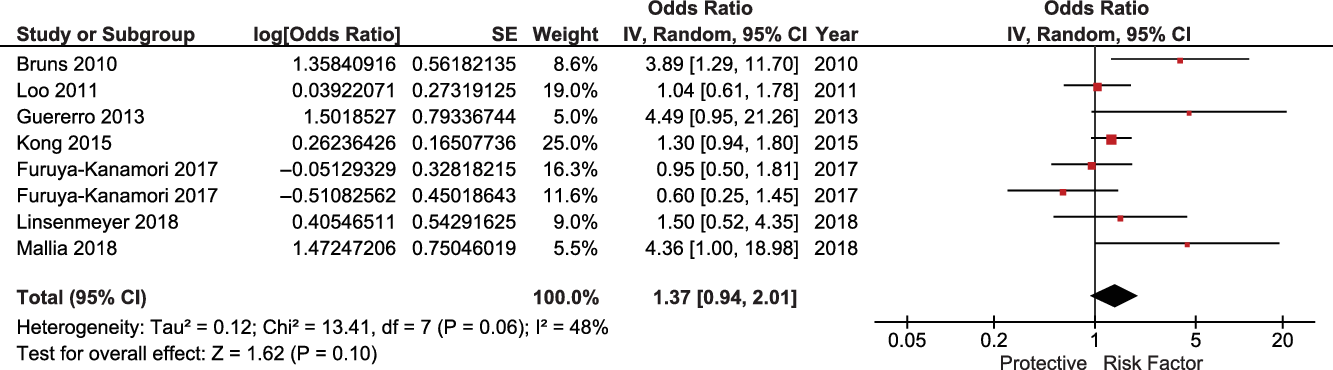
We identified 7 studies reporting 8 total effect sizes that provided data on the association between antibiotic use in the previous 3 months and C. difficile colonization. Meta-analysis of the studies showed positive association between antibiotic use in the previous 3 months and C. difficile colonization, though that association was not statistically significant (OR, 1.37; 95% CI, 0.94–2.01; P = .10) (Fig. 3). Heterogeneity was moderate among these studies (I2 = 48%).
Forest plot of the association between antibiotic use in the previous 3 months and C. difficile colonization. The vertical line corresponds to no difference point between the 2 groups. Squares correspond to odds ratios. Horizontal lines represent the 95% confidence intervals. The diamond indicates the pooled relative risk ratios. Note. df, degrees of freedom.

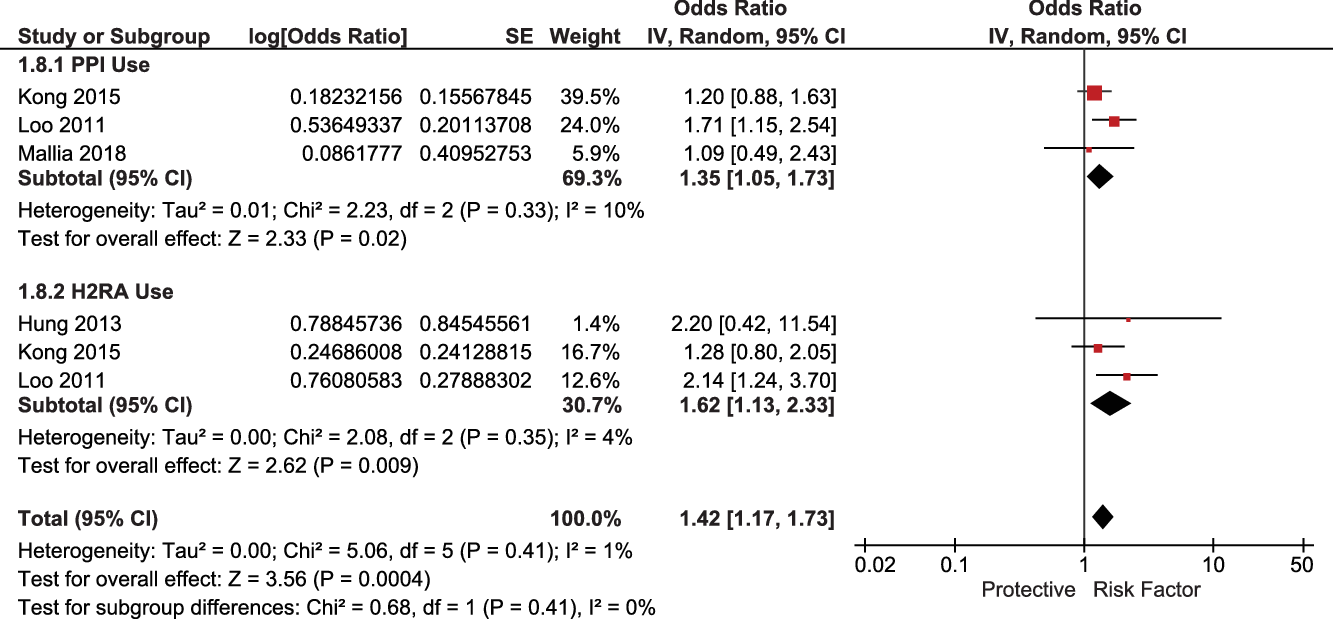
In addition, 4 studies reported 6 total effect sizes that provided data on the association between gastric acid suppression and C. difficile colonization. Gastric acid suppression was significantly associated with C. difficile colonization (OR, 1.42; 95% CI, 1.17–1.73; P = .0004) (Fig. 4). Heterogeneity was low among these studies (I2 = 1%). We further assessed the association between the subgroups of proton-pump inhibitor (PPI) use and H2 receptor blocker (H2RA) use and C. difficile colonization. PPI use (OR, 1.35; 95% CI, 1.05–1.73; P = .02) and H2RA use (OR, 1.62; 95% CI, 1.13–2.33; P = .009) were both significantly associated with C. difficile colonization. Heterogeneity was low among the studies included in these analyses as well (PPI use, I2 = 10%) (H2RA use, I2 = 4%).
Forest plot of the association between gastric acid suppression (PPI use, H2RA use, and combined) and C. difficile colonization. The vertical line corresponds to no difference point between the 2 groups. Squares correspond to odds ratios. Horizontal lines represent the 95% confidence intervals. The diamond indicates the pooled relative risk ratios. Note. df, degrees of freedom.

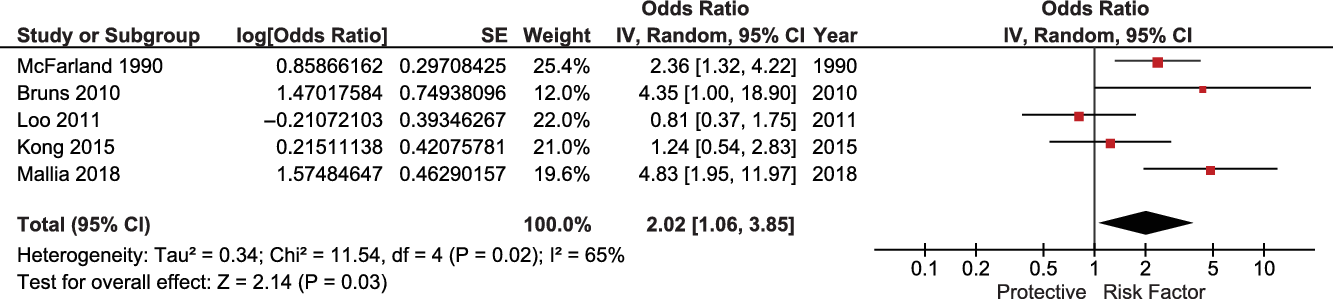
Five studies reported data on the association between tube feeding and C. difficile colonization. Meta-analysis of these studies revealed a statistically significant association between tube feeding and C. difficile colonization (OR, 2.02; 95% CI, 1.06–3.85; P = .03) (Fig. 5). Heterogeneity was moderate among these studies (IReference Magill, Edwards and Bamberg2 = 65%).
Forest plot of the association between tube feeding and C. difficile colonization. Vertical line corresponds to no difference point between the 2 groups. Squares correspond to odds ratios. Horizontal lines represent the 95% confidence intervals. The diamond indicates the pooled relative risk ratios. Note. df, degrees of freedom.

We further examined the associations between several other risk factors and C. difficile colonization. We found a significant association between history of previous CDI and C. difficile colonization (OR, 4.83; 95% CI, 3.18–7.33; P < .00001), as well as between corticosteroid use in the previous 8 weeks and C. difficile colonization (OR, 1.58; 95% CI, 1.14–2.17; P = .006) (Supplementary Fig. 2 online). Other risk factors including gender, use of nonsteroidal anti-inflammatory drugs in the previous 8 weeks, immunosuppression or chemotherapy, length of stay, and cephalosporin use were not significantly associated with C. difficile colonization (Supplementary Fig. 2 online). Notably, history of CDI appears to have the strongest association with C. difficile colonization of all risk factors examined.
Publication bias
We assessed publication bias by examining symmetry of funnel plots for the following risk factors: previous hospitalization, antibiotic use, gastric acid suppression, and tube feeding (Supplementary Fig. 3 online). Among these analyses, previous hospitalization in the previous 6 months appeared to be positive for asymmetry by visual inspection. The Egger regression test for previous hospitalization revealed the possible presence of publication bias (intercept, 1.113; P = .0498). We then performed the Duval and Tweedie “trim and fill” method for previous hospitalization, which estimated the number of missing studies to be 4. A funnel plot of the original studies with the “filled” missing studies can be found in the supplementary materials (online). After adjusting for the missing studies, the association between previous hospitalization and C. difficile colonization decreased in magnitude but continued to be significant (OR, 2.06; 95% CI, 1.73–2.45; P < .0001), demonstrating a limited effect of publication bias on the pooled effect size of the meta-analysis if it was indeed present. Notably, the Egger test did not demonstrate significant asymmetry in the meta-analyses of other risk factors.
Discussion
Asymptomatic C. difficile colonization has become an increasingly important topic as its association with hospital transmission of CDI becomes clearer. Asymptomatic carriers potentially contaminate the hospital environment through spore shedding and spreading of the pathogen to other patients who may become infected and symptomatic. We identified 19 articles with data from multivariable models of risk factors for C. difficile colonization. Meta-analysis of these data identified hospitalization in the previous 6 months, gastric acid suppression, tube feeding, corticosteroids in the previous 8 weeks, and previous CDI as statistically significant risk factors for C. difficile colonization. Risk factors whose association did not meet statistical significance included antibiotic use in the previous 3 months, gender, use of nonsteroidal anti-inflammatory drugs in the previous 8 weeks, immunosuppression or chemotherapy, length of stay, and cephalosporin use.
The risk factor with the largest selection of data able to be pooled was hospitalization within the previous 6 months. Recent hospitalization was associated with more than twice the risk of colonization than those without this risk factor. C. difficile is highly prevalent in healthcare settings, and this increased risk may simply reflect an increased exposure to C. difficile and subsequent higher probability of persistent colonization.Reference Gilboa, Houri-Levi and Cohen21 Alternatively, recent hospitalization may reflect the underlying conditions of the individuals who had been hospitalized. The underlying conditions that make patients more likely to have been hospitalized in the preceding 6 months may also confer and increased risk for C. difficile colonization. Though some studies controlled for several underlying conditions in their models, most were limited from being comprehensive in this adjustment by their available sample size. The true mechanism underlying this risk factor is likely a multifactorial combination of factors. Regardless, underlying conditions remain an important and consistently identified risk factor for C. difficile colonization among patients in the hospital.
The lack of statistically significant increased risk among those with recent antibiotic usage is another interesting point of discussion. Recent antibiotic use is a well-studied risk factor for CDI, particularly the use of fluoroquinolones, clindamycin, cephalosporins, and broad-spectrum penicillins.Reference Pépin, Saheb and Coulombe22,Reference Deshpande, Pasupuleti and Thota23 Mechanistically, antibiotics create a niche for C. difficile to thrive by disrupting the barrier function of healthy bacterial microbiota and altering normal carbohydrate, amino acid, and bile acid metabolism.Reference Theriot and Young24,Reference Zhang, Dong, Jiang, Li, Wang and Peng25 Similar alterations in colonic microbial diversity have been demonstrated during C. difficile colonization, with some important differences.Reference Zhang, Dong, Jiang, Li, Wang and Peng25 With this in mind, it is interesting to observe that antibiotic use in the previous 3 months was not a significant risk factor in our study. Possibly, when all antibiotic classes are pooled, the overall risk is not increased. However, given what we know about the underlying mechanisms, it remains likely that specific antibiotic classes confer a significant risk for colonization. For example, studies evaluating CDI have demonstrated the variable effects of different antibiotic classes, including those that may be protective (eg, tetracycline),Reference Tariq, Cho and Kapoor26 those that are low risk, and those that are high risk.Reference Deshpande, Pasupuleti and Thota23 Further research is needed to determine the class specific effect of antibiotic use on the risk of C. difficile colonization.
Our study has several important limitations. First, the definition of “asymptomatic” carrier may not have been consistent across all included studies. Not all studies included a formal definition for the timing and frequency of loose stool that was considered to be diarrhea. Among studies that did report this information there was no consensus with regard to the number of loose stools per day that constituted diarrhea. A spectrum of clinical symptoms of CDI may exist that can make it difficult to distinguish from truly asymptomatic colonization. A more clear distinction between them could aid in separating out risk factors for the development of each respectively. Second, the population selected for our analysis was patients tested while hospitalized regardless of whether testing was done at admission or later in the hospitalization. Notably, even studies evaluating patients at admission had variable definitions for how long after admission patients could be enrolled in the study. Combining studies of risk factors at admission and during admission may obscure the distinction between community-onset C. difficile colonization and healthcare-associated C. difficile colonization, but we felt that the limited number of available studies justified combining these groups to allow for preliminary investigation of these risk factors. Finally, we were only able to identify a limited number of studies for inclusion in our quantitative meta-analysis. Some of our analyses, particularly those with only 3 studies included (use of NSAIDs, immunosuppression or chemotherapy, and cephalosporin use), should be interpreted with caution. We attempted to mitigate this limitation by including broad search parameters and searching 4 separate databases. Unfortunately, C. difficile colonization is still under investigation, and evidence remains limited. Continued research efforts in this area will yield additional insights in the future.
Early identification of asymptomatic carriers will help clinicians to monitor these patients carefully for development of CDI. Currently, routine screening and treatment of asymptomatic carriers of C. difficile is not recommended by either the Infectious Disease Society of AmericaReference McDonald, Gerding and Johnson1 or the European Society of Clinical Microbiology and Infectious Diseases.Reference Crobach, Planche and Eckert27 However, the risk factors identified in this study may enable the identification of individuals with an elevated risk of asymptomatic carriage of C. difficile. In turn, selective screening of patients at high risk for C. difficile colonization may enable preventive measures to be taken for patients who test positive, such as avoidance of high-risk antibiotics for CDI, close monitoring for development of diarrhea, and lower threshold for initiating contact isolation. Hospitals developing infection control policies should consider the potential benefit of such a screening program, weighed against the challenges of additional screening.
In conclusion, we found that hospitalization in the previous 6 months, tube feeding, previous CDI, corticosteroid use in the previous 8 weeks, and gastric acid suppression are significant risk factors for C. difficile colonization in adults admitted to the hospital. With the current evidence available, we found no association between C. difficile colonization and antibiotic use in the previous 3 months. Further work is needed to understand the impact of individual antibiotic classes. Hospitals can potentially utilize these risk factors to identify individuals at high risk of C. difficile colonization as they develop infection control policies and work to limit the spread of C. difficile.
Supplementary material
To view supplementary material for this article, please visit https://doi.org/10.1017/ice.2020.1236
Acknowledgments
Financial support
No financial support was provided relevant to this article.
Conflicts of interest
A.D. has received research support from Clorox not related to this study, is on the advisory board for Ferring Pharmaceuticals, and is a consultant for Merck. C.J.D. has received research support from The Clorox Company, PDI Healthcare, and Pfizer not related to this study. All other authors report no conflicts of interest relevant to this article.