Blood cultures are an important clinical diagnostic test used to identify bacteremia and guide treatment decisions. Reference Miller, Binnicker and Campbell1 However, inappropriate blood-culture collection techniques and overtesting can cause harm and excess use of healthcare resources and may result in misdiagnosis. For example, blood-culture contamination events lead to prolonged hospitalization, excess use of laboratory resources, misdiagnosis of central-line–associated bacteremia (CLABSI), and empiric use of high-risk antibiotics such as vancomycin Reference Fabre, Carroll and Cosgrove2 Historically, determining which patients are at high risk for developing bacteremia has been difficult, and clinicians generally have a low threshold for ordering blood cultures as part of routine care, particularly since the Centers for Medicare and Medicaid SEP-1 Core Measure was put into practice. Reference Fabre, Sharara, Salinas, Carroll, Desai and Cosgrove3–5 Optimizing the use of blood cultures is crucial for the detection of bacteremia while reducing overuse of antibiotic therapy or other potential harms. Reference Fabre, Carroll and Cosgrove2 Few studies have quantified utilization rates and, of those that have, many are limited to a specific patient population. Reference Miller, Binnicker and Campbell1,Reference Fabre, Klein and Salinas6–Reference Bates, Cook, Goldman and Lee9 Additionally, existing expert consensus recommendations do not include recommendations for when blood cultures should be obtained nor are they widely used or based on strong evidence. As a result, few hospitals routinely analyze blood-culturing practices as an area for improvement. Reference Baron, Weinstein, Dunne, Yagupsky, Welch and Wilso8 In this study, we aimed (1) to pilot test different blood-culture utilization metrics to identify opportunities for diagnostic stewardship among 6 hospitals and (2) to provide hospital comparisons that could contribute to hypothesis generation in future targeted studies.
Methods
Study population
We performed a multicenter retrospective analysis of blood-culture utilization in a limited data set previously collected for a clinical trial at 6 hospitals in the southeastern United States. 10 Study sites included 1 large, academic, medical center (hospital A) and 5 community hospitals (B–F) from May 2019 to April 2020. Analyses included unique sets of blood cultures drawn during inpatient or emergency department (ED) encounters as designated by National Healthcare Safety Network (NHSN) unit mapping. 11 Only the academic medical center reported blood cultures from pediatric patients, the majority of which were single cultures, in contrast with paired culturing practice in adults (Supplementary Fig. 1 online). As a result, we excluded patients <18 years of age from hospital-level analyses. This exclusion affected 11% of total blood-culture events (range, 0%–19% per hospital). We excluded cultures drawn in procedural or outpatient areas as well as those with unmapped collection locations.
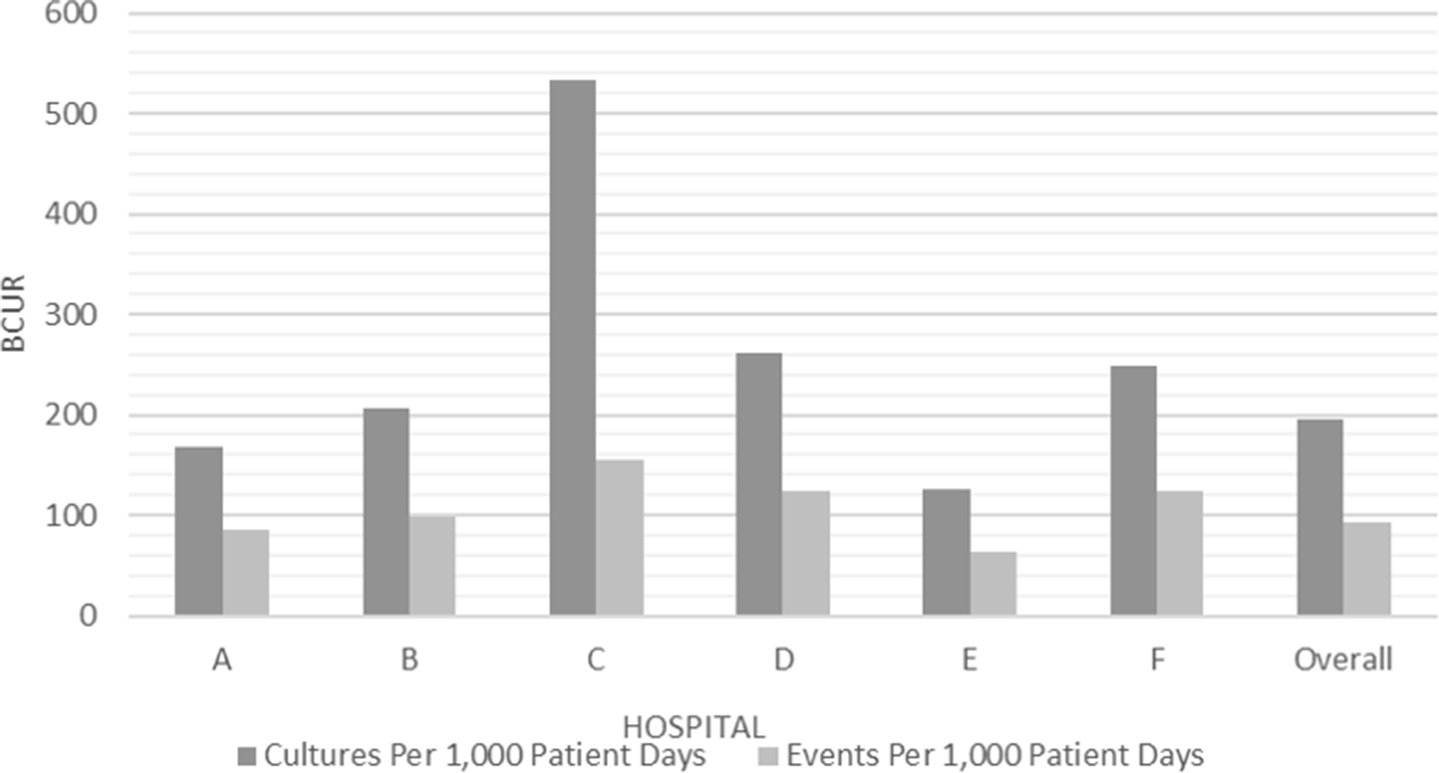
Blood-culture utilization rate by hospital.

Outcomes
We investigated 2 measures of blood-culture utilization. First, the hospital-level blood-culture utilization rate (BCUR) was defined as the total number of blood-culture sets per 1,000 patient days (BCX), a previously recommended metric. Reference Fabre, Carroll and Cosgrove2,4–Reference Fabre, Klein and Salinas6 We defined a BCX by unique laboratory accession number, which we interpreted as a set of at least 1 anaerobic and 1–2 aerobic bottles procured through a single venipuncture or during 1 catheter draw.
Second, we developed and evaluated a new metric of BCUR defined as blood-culture events per 1,000 patient days (BCE). We aimed to better differentiate single-culture events (in which only a single blood-culture set was drawn), which is discouraged as a practice due to reduced yield as well as difficulty in interpretation of contaminants. We defined a blood-culture event as an initial blood-culture set and all subsequent blood-culture sets drawn within 12 hours of the initial collection time. We included patients with an inpatient or ED encounter.
Both metrics were used to describe utilization by unit, day of the week, month, and age group. We measured blood-culture events per admission, blood-culture events with only a single culture set, the percentage of blood-culture events that began in the ED, and the proportion of inpatient admissions with a blood-culture event. At the blood-culture set level, we measured the number of blood cultures collected after the initiation of antibiotics, the number of follow-up blood-culture sets collected after the initiation of antibiotics, and the percentage of blood-culture sets that were positive or contaminated with common skin commensals.
Definitions
We defined patient days, inpatient locations, and unit-type per NHSN methods. 12 We limited hospital-level utilization estimates to exclude procedural, operating, and perioperative, behavioral, rehabilitation, and psychiatric units. Inpatient admission was defined as a distinct encounter that included at least 1 calendar day on an inpatient unit. Blood-culture sets were defined by a unique laboratory accession number. Guidelines for paired blood-culture sets were defined as blood-culture sets taken within 1 hour of another blood culture set based on date and time of collection. Single-culture sets were blood-culture sets taken without another blood-culture set within a 12-hour period. Positive blood-culture sets were defined as blood-culture sets reported as (1) positive for an organism considered to be a pathogen or (2) positive for a common skin commensal in 1 of 1 (or more) blood-culture sets collected on separate date and time occasions using the NHSN common commensals list. 13 Contaminated blood cultures were defined as only 1 of 2, 3, or more blood culture sets collected in the same calendar day positive for a common skin commensal; they were not identified from a second (or more) blood-culture set on separate date and time occasions.
Statistical approach
Comparisons included χ2 for categorical variables and t tests for continuous (if normal) variables and Wilcoxon for continuous (nonnormal) variables. A P value of <.05 was considered significant, all statistical tests were 2-tailed, and all testing was completed using SAS version 9.4 software (SAS Institute, Cary, NC). The study was reviewed and approved by the Duke University institutional review board.
Results
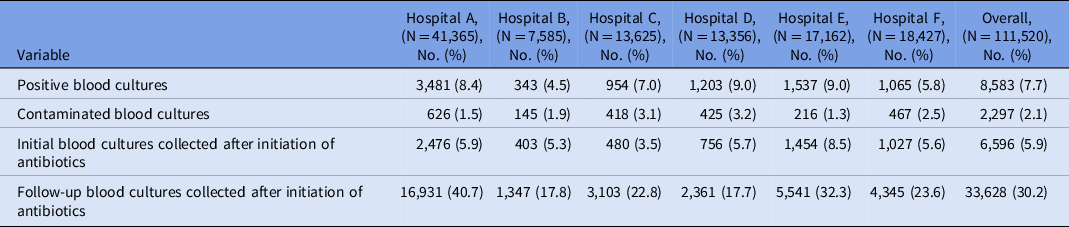
Hospital size ranged from 247 to 977 beds. All hospitals were in the southeastern United States; 4 hospitals were classified as urban and 2 as rural (Supplementary Table 1 online). Also, 3 hospitals had oncology units and 2 had bone-marrow transplant units. The median hospital length of stay was 2 days (IQR, 1–4). In total, 111,520 blood-culture sets, 52,550 blood-culture events, 165,456 inpatient admissions, and 568,928 patient days were analyzed. Overall, the BCUR for all hospitals was 196.0 blood-culture sets per 1,000 patient days using the BCX definition, and 92.4 blood culture events per 1,000 patient days using the BCE definition (Fig. 1). The median number of blood-culture events per encounter was 1 (range, 1–31); 7% were single-culture events; 55% began in the ED; and 77% occurred in the first 3 hospital days (Table 1). At the blood-culture set level, 7.7% of blood-culture sets were positive; 2.1% were likely contaminated; 5.9% of first blood-culture sets were collected after the initiation of antibiotics with a median of 7 hours (IQR, 1–42); and 30.2% of cultures were follow-up cultures after a prior blood culture and initiation of antibiotics (Table 2). Of all positive blood-culture sets, 31.6% were positive for Staphylococcus aureus; 18.6% were positive for Escherichia coli; 7.8% were positive for Klebsiella pneumoniae; 5.6% were positive for Enterococcus faecalis; 4.4% were positive for Pseudomonas aeruginosa; and 31.9% were positive for other species.
Blood Culture Event Data by Hospital

Blood Culture Data by Hospital

Hospital-level analyses
The BCUR using the BCX definition varied between hospitals; the lowest occurred in hospital E and the highest in hospital C. Less extreme variation was seen using the BCE definition (Fig. 1). Most patients had a single blood-culture event per admission, which was similar between hospitals though there was a long outlier at hospital A (31 cultures in a single admission). The percentage of single-culture sets varied by hospital (range, 2%–12%). Notably, the high outlier hospital in BCUR (C) also had the lowest rate of single blood-culture sets. More than 50% of blood-culture events began in the ED in all but hospitals A and E (Table 1). Blood-culture positivity rates varied among study hospitals (range, 4.5%–9.0%) as well as the rate of contaminated cultures (range, 1.3%–3.2%). At the hospital level, the proportions of the 5 species most frequently identified in positive blood-culture sets were similar to those of the overall results (in descending order): S. aureus, E. coli, K. pneumoniae, E. faecalis, and P. aeruginosa. However, at hospital C, E. coli ranked number 1 followed by S. aureus. The proportion of first blood-culture sets ordered after the initiation of antibiotics was similar between hospitals (range, 3.5%–8.5%) except for a relatively high value at hospital E. The percentage of follow-up blood-culture sets collected after the initiation of antibiotics varied greatly between hospitals (range, 17.8%–40.7%) (Table 2).
Unit-level analyses
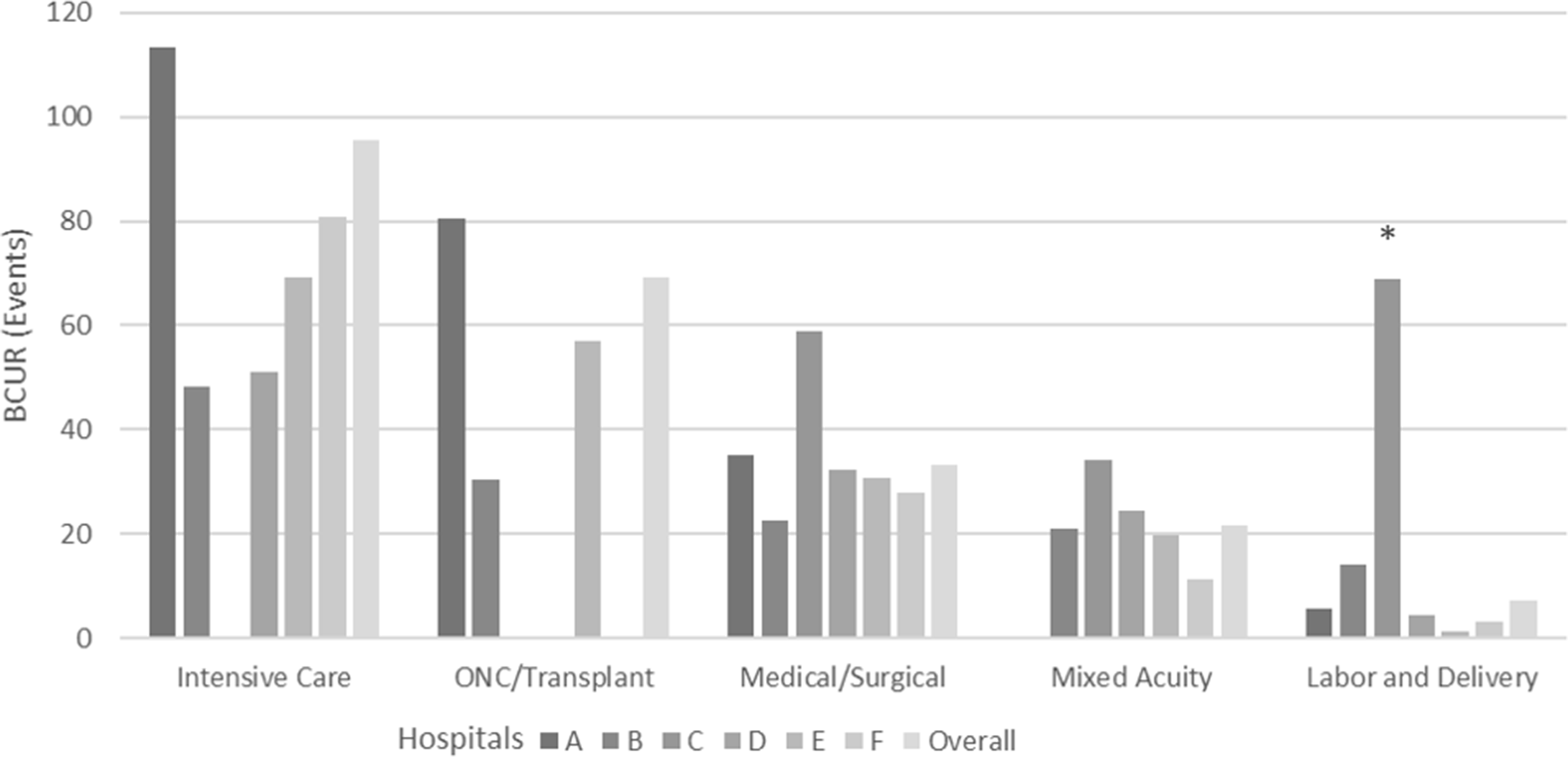
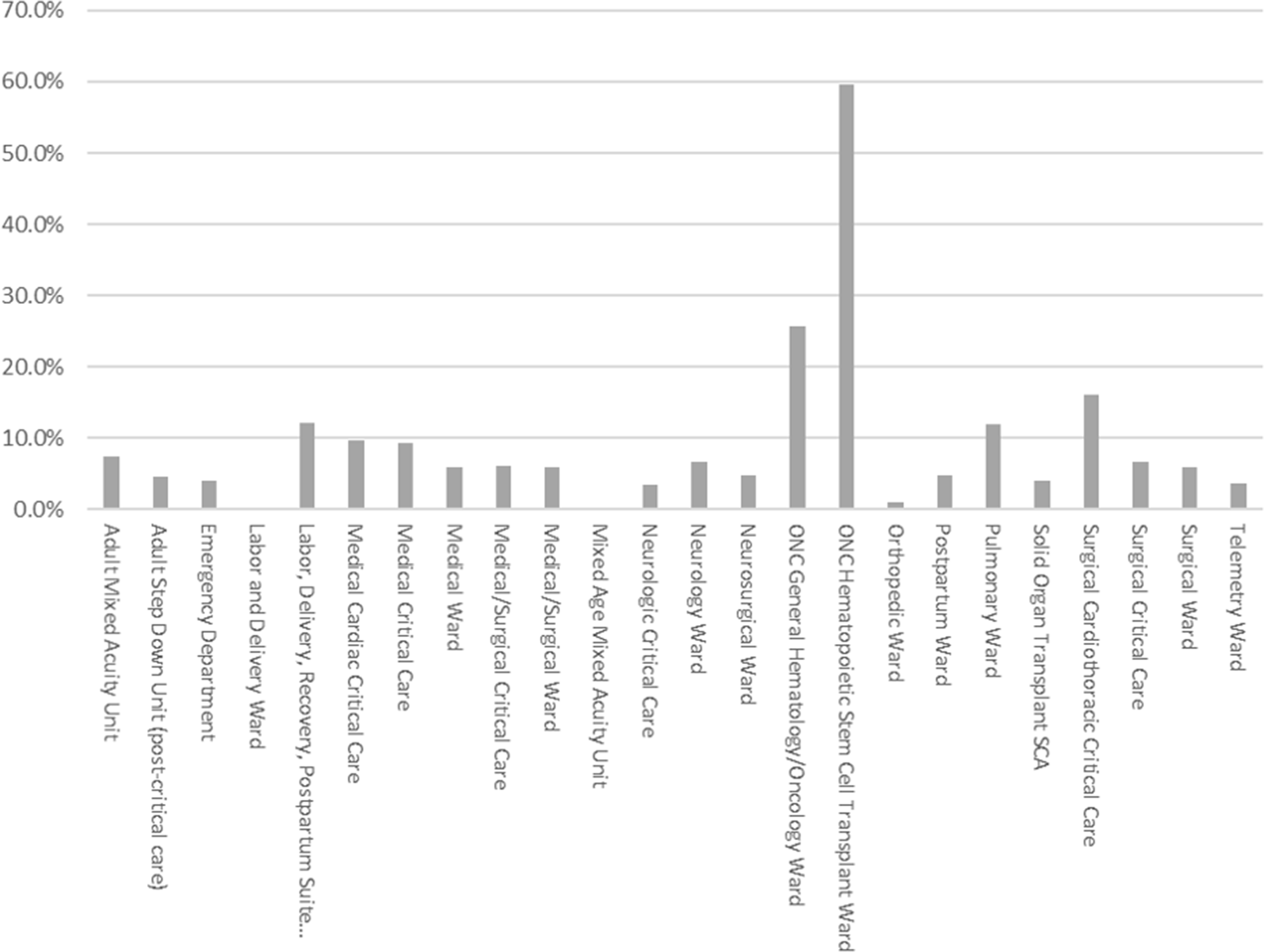
The highest BCURs occurred in intensive care units followed by oncology and transplant units, medical and surgical units, mixed acuity units, and labor and delivery units (Figs. 2 and 3). This remained consistent overall. At hospital C, a high BCUR was noted in the labor and delivery unit, which upon investigation was a mislabeled medical-surgical unit (Fig. 2). The percentage of contaminated blood-culture sets among all blood cultures was the highest in the ED (2.8%), followed by intensive care units (1.5%), medical-surgical units (1.1%), oncology and transplant units (1.1%), mixed acuity units (1.1%), and labor and delivery units (0.6%). Among contamination events, most occurred in the ED (77%), followed by medical-surgical units (10%), intensive care units (9%), oncology and transplant units (3%), mixed acuity units (1%), and labor and delivery units (0.7%). The percentage of single culture-blood culture events was high in general oncology and hematology units (24%) and very high in stem-cell transplant units (60%) (Fig. 3).
Blood-culture utilization rate by hospital and unit type. Note. NHSN units were condensed into 5 general labels for ease of visualization. *Indicates the mislabeled unit at hospital C as labor and delivery, which was actually being used for surgery overflow.

Proportion of single culture-blood culture events by unit type.

Time-based analyses
Overall, a higher number of BCEs occurred on Mondays and a lower number on weekends (Supplementary Fig. 2 online). However, when stratified, this pattern remained for ED blood cultures but not for non-ED units where blood cultures remained stable between days of the week. When observing BCURs by month, no seasonal patterns were observed (Supplementary Fig. 3).
Discussion
In this study, we evaluated the pattern of blood-culture utilization using multiple metrics among a cohort of 6 hospitals to identify potential opportunities for diagnostic stewardship and to provide hospital comparisons that could contribute to hypothesis generation in future studies. Our analyses revealed distinct patterns that may highlight specific practice areas in which individual hospitals might focus improvement efforts toward optimizing when and how to obtain blood cultures. For example, the frequency of single blood-culture events was relatively high at 3 of 6 study hospitals, and especially in oncology and stem-cell units at hospital A. At hospital E, a larger proportion of blood cultures were ordered after antibiotic therapy initiation compared to other hospitals, which is known to reduce culture sensitivity. Reference Cheng, Stenstrom, Paquette, Yansouni and Sweet14 For some hospitals, most blood-culture events occurred in their higher-volume EDs, and these hospitals also had higher overall contamination rates. These findings demonstrate that hospital-level comparisons are helpful for identifying high-yield diagnostic stewardship targets and that the Eds may be a particular area for improvement.
Our results differed from the analysis by Chen et al Reference Chen, Bilker, Hamilton, O’Donnell and Nachamkin15 of blood-culture utilization at an academic medical center. Using the BCX metrics, their study determined an overall BCUR of 307.7 sets per 1,000 patient days compared to our findings of 196.0 blood cultures per 1,000 patient days. This difference is likely due to the data of Chen et al including a much higher proportion of blood cultures taken from the oncology unit (25.9%) compared to our study (5.9%). Reference Chen, Bilker, Hamilton, O’Donnell and Nachamkin15 This difference emphasizes the need to compare BCURs between hospitals to identify unique patterns targetable for antimicrobial stewardship or otherwise. However, our results were similar to the findings of Willems et al Reference Willems, Smismans and Cartuyvels7 of 103–188 per 1,000 patient days at 5 Belgian hospitals. Reference Willems, Smismans and Cartuyvels7
Additionally, our positivity and contamination rates, overall and at the hospital level, are similar to those of several previous studies, and they fell within expected ranges of 7%–9% and 2%–3%, respectively. Reference Miller, Binnicker and Campbell1,Reference Fabre, Sharara, Salinas, Carroll, Desai and Cosgrove3,Reference Baron, Weinstein, Dunne, Yagupsky, Welch and Wilso8,Reference Bates, Cook, Goldman and Lee9,Reference Chen, Bilker, Hamilton, O’Donnell and Nachamkin15 Overall and at the hospital level, the proportions of species identified in positive blood-culture sets were similar to those reported in a previous study. Reference Diekema, Hsueh and Mendes16 Several metrics used in this study, such as BCE and BCUR by month, are novel. Also, descriptive data regarding monthly BCURs have been limited to pediatrics in prior literature. Reference Liu, Herzig and Dick17,Reference Woods-Hill, Fackler and McMillan18 To our knowledge, this study is the first descriptive, multicenter study to include analyses at the hospital level with comparisons that revealed practice patterns. We proposed a novel blood-culture utilization metric using blood-culture events instead of raw blood-culture sets to better differentiate single-culture events, which is discouraged as a practice due to reduced yield as well as difficulty in interpreting contaminants. For example, using both metrics allowed us to identify hospital C, which consistently used paired culture practices while having relatively high utilization rates.
Our study had several limitations. These analyses were completed on an existing data set from a previous study of antibiotic de-escalation and included 6 hospitals from the southeastern United States, which may not be generalizable to other practice settings. Also, we included ED blood cultures in the numerator without a corresponding patient day in the denominator, which made it more difficult to directly compare to previous studies and consensus statements. However, our data suggest that more opportunities for optimization of blood-culture use occurred in the ED, so excluding this practice area from analyses would limit the ability to evaluate the highest volume area of blood-culture use in the hospital. If not included in hospital-level rates, then ED-specific metrics (eg, BCXs per ED visit) and comparisons may provide an alternative method of evaluating this important practice area. Like any hospital comparisons, many potential factors (eg, case mix, specialty care) can influence blood-culture metrics, and we did not comprehensively investigate such factors because the aim of this pilot study was largely descriptive and our data set was not large enough. Additionally, we were unable to assess whether cultures were drawn from catheters or peripherally. Lastly, pediatric patients were excluded from our analyses due to limited pediatric data in our cohort. We believe that dedicated study of pediatric blood-culture utilization and hospital comparisons would be necessary because blood-culture ordering practices and standards differ considerably from adults.
In conclusion, blood-culture utilization varied by hospital and unit and was heavily influenced by ED culture volumes and practices. Comparisons among hospitals may assist in identifying opportunities to optimize blood-culture ordering and collection practices as well as targets for stewardship teams. Additionally, hospital comparisons allow stewards to acknowledge differences in blood-culture utilization targets due to disparate patient populations and hospital characteristics. Once opportunities are identified, stewards can then act based on previous recommendations (eg, reducing single blood cultures and determining true positives vs contamination). Reference Lamy, Dargère, Arendrup, Parienti and Tattevin19,Reference von Doern, Carroll and Diekema20 These comparisons also highlight variation in blood-culture order practices, which has implications for clinical surveillance methods that rely on blood-culture orders as an objective marker of suspected infection. Our study also successfully provided hospital comparisons that did and will continue to lead to hypothesis generation for future studies. Future studies should prioritize larger, multicenter comparisons and should work toward better understanding how comparative blood-culture utilization data may be useful for identifying and tracking practice improvements.
Supplementary material
To view supplementary material for this article, please visit https://doi.org/10.1017/ice.2022.191
Acknowledgments
Financial support
This work was funded by the Centers for Disease Control and Prevention: Duke–UNC Prevention Epicenter Program for Prevention of Healthcare-Associated Infections (grant no. 1U54-CK000483).
Conflicts of interest
All authors report no conflicts of interest relevant to this article.