Introduction
Physic nut (Jatropha curcas L.) is considered promising for cultivation under arid or semi-arid tropical regions (Singh et al., Reference Singh, Singh, Verma and Patra2014). It is even called a ‘miracle tree’ (Islam et al., Reference Islam, Yaakob and Anuar2011) due to its drought tolerance and because the fruit is rich in lipids (up to 60% in seeds; Singh et al. (Reference Singh, Ranjan, Verma, Pathre and Shirke2013) and references therein), which can be processed to produce biofuel and other products (Contran et al., Reference Contran, Chessa, Lubino, Bellavite, Roggero and Enne2013). Its tolerance to dehydration appears to have a genetic (Zhang et al., Reference Zhang, Zhang, Zhang, Zhu, Wu, Chen, Li, Jiang and Wu2015) and a photosynthetic component (Sapeta et al., Reference Sapeta, Costa, Lourenço, Maroco and van der Linde2013), and its water consumption has been inferred to be similar to other oil producing plants (e.g. soybean, African palm), as also shown for other species of Jatropha (Guotai, Reference Goutai2002).
The natural distribution of J. curcas is the tropical savannas and steppes of Central America, which are not particularly dry (Maes et al., Reference Maes, Trabucco, Achten and Muys2009). Moreover, certain varieties of the plant itself provide a plethora of additional products, including human and animal food from the roasted seeds (Makkar et al., Reference Makkar, Becker and Schmook1998), ecosystem services (Heller, Reference Heller1996), fertilizer (Traore et al., Reference Traore, Bismarck Nacro, Tabo, Nikiema and Ousmane2012) and medicines (Thomas et al., Reference Thomas, Sah and Sharma2008). The toxicity of J. curcas has earned it a reputation for pest resistance, some claiming that its association with endophytic fungi makes it resistant to plant pathogenic fungi (Kumar and Kaushik, Reference Kumar and Kaushik2013). Moreover, its residual pesticide potential is widely documented (Ratnadass and Wink, Reference Ratnadass and Wink2012). However, Jatropha is far from pest free, as numerous species of insects and mites are known to have a serious impact on its performance in Africa (Anitha and Varaprasad, Reference Anitha, Varaprasad, Carels, Sujatha and Bahadur2012; Terren et al., Reference Terren, Mignon, De Clerck, Jijakli, Savery, de Haveskercke, Winandy and Mergeai2012; Datinon et al., Reference Datinon, Glitho, Tamò, Amevoin, Goergen and Douro Kpindou2013; Habou et al., Reference Habou, Haubruge, Adam and Verheggen2013, Reference Habou, Adam, Haubruge, Mergeai and Verheggen2014; Lama et al., Reference Lama, Vuorisalo and Niemelä2014; Djimmy and Nacro, Reference Djimmy and Nacro2015a ,Reference Djimmy and Nacro b ; Minengu et al., Reference Minengu, Verheggen and Mergeai2015; Sawadogo et al., Reference Sawadogo, Nagolo, Nacro, Rouamba and Kenis2015). Jatropha is commonly used as a living fence or as border plants, providing potential income for people living on marginal lands (IFAD-FAO, 2010). However, its status as a ‘miracle tree’ (Islam et al., Reference Islam, Yaakob and Anuar2011) has been scrutinized by several authors and its performance varies widely with environmental factors and crop management practices (Sop et al., Reference Sop, Kagambèga, Bellefontaine, Schmiedel and Thiombiano2012; Evaristo et al., Reference Evaristo, Venzon, Matos, de Freitas, Kuki and dos Santos Dias2013; Minengu et al., Reference Minengu, Mobambo and Mergeai2014, Reference Minengu, Verheggen and Mergeai2015).
The aim of this study was to investigate the effect of irrigation on seedling growth and relate that to levels of herbivory on J. curcas in the Sahelian Niger based on the changing paradigm that J. curcas is pest resistant as well as the direct correspondence between water consumption and insect pest pressure (Maxmen, Reference Maxmen2013). We thus formed the following hypotheses: (1) plants given water (1.5 litres/day and 1.5 litres/week, respectively) will set more leaves and grow taller than plants without irrigation, and (2) plants under drought stress will be more susceptible to defoliation and pest attacks than irrigated plants (Jactel et al., Reference Jactel, Petit, Desprez-Loustau, Delzon, Piou, Battisti and Koricheva2012).
Materials and methods
The study was conducted at the International Crops Research Institute for the Semi-Arid Tropics’ (ICRISAT) research facilities in Sadoré, Niger (13°14’N, 2°17’E) in the period between July 2009 and April 2010. Luvic Arenosol and Psammentic Paleustalf form the sandy soils at the station area (West et al., Reference West, Wilding, Landeck and Calhoun1984) with water pH at 5.3±0.03, per cent organic C at 0.3±0.00, total N at 256.0±1.13 mg N/kg, Bray-P1 at 20.7±0.62 mg P/kg, and effective cation exchange capacity (ECEC) at 1.2±0.10 cmol+/kg (Alain Ratnadass, unpublished data). The initial trial period coincided with the least dry time of the year (July–October), with total rainfall during the period of 434.4 mm and with an average rainfall per month of 43.4 mm (Traore et al., Reference Traore, Bismarck Nacro, Tabo, Nikiema and Ousmane2012). There was no rain at all from October through March as this period falls into the dry season. The Sahelian climate at Sadoré varies from 37 to 43°C in April to May (warmest period) and between 18 to 27°C in December to January (coolest period) (Traore et al., Reference Traore, Bismarck Nacro, Tabo, Nikiema and Ousmane2012). The Jatropha seed was sourced from Bobo Dioulasso in Burkina Faso (11°12’N, 4°18’W) and grown in the station's nursery.
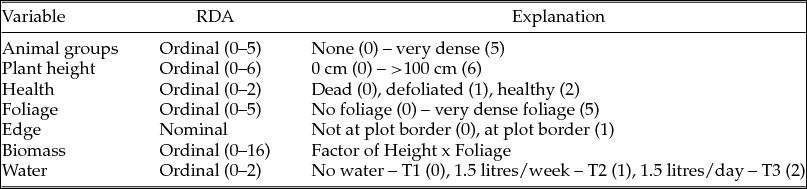
Altogether, 384 seedlings were planted and spaced by 2 x 4 m as a 12 x 8 randomized complete block design experiment and with four replications. No soil treatments were performed prior to planting and no crop management practices were applied during the experiment. Drip irrigation treatments were carried out using perforated plastic bottles with the following quantities: no water (T1), 1.5 litres per week (T2) and 1.5 litres per day (T3). Each plant was photographed at the end of the experiment and insect voucher specimens were collected or photographed when present. Damage was quantified and assigned to the respective types: leaf mining, defoliation, sap-sucking and termite damage. For each category of insect pest, damage was scored on a scale ranging from 0 to 5, where 0 = no sign of damage at all, 1 = one or two leaves, 2 = less than half of the leaves, 3 = approximately half of the leaves, 4 = a major portion but not every leaf and 5 = all leaves have signs of damage but the plant is not completely defoliated. Plant health (dead = 0, defoliated = 1, alive = 2) was recorded and plant heights were measured as 0 = plant lost, 1 = 1–10 cm, 2 = 11–25 cm, 3 = 26–50 cm, 4 = 51–75 cm, 5 = 76–100 cm and 6 = plant higher than 100 cm. Leaf biomass was categorized based on ranked measures of plant height and leaf cover, where the leaf cover (foliage) was scored as 0 = no foliage, 1 = one to three leaves remain or only new shoots were present, 2 = up to 25% foliage present, 3 = 25–50% foliage present, 4 = 25–75% foliage present and 5 = foliage close to or full crown cover. Finally, to examine possible edge effects, plants on the edges of the experimental plots were recorded. A summary of the input data can be seen in Table 1.
Types of input data to the statistical analyses

Measured data were ranked and grouped (RDA column) according to the description (Explanation column). Further details are given in the text.
We ran Redundancy Analysis (RDA) with CANOCO© version 4.5 (Ter Braak and Smilauer, Reference Ter Braak and Šmilauer2009); a direct gradient analysis relating a group of species (herbivores) to a set of environmental parameters by assuming a linear response (i.e. data sampled over short environmental gradients). Forward selection and subsequent deletion of weighted, highly correlated environmental variables with highest explanatory power was carried out in order to avoid erroneous intercorrelated results. Significances of RDA analyses were tested with Monte Carlo permutation test with 999 randomizations. Moreover, differences of means between the four blocks and the measured parameters were tested using ANOVA. Finally, Pearson correlation coefficients, stratified to correct for any differences among the blocks, were calculated to detect correlations among variables. Both these analyses were carried out using XLSTAT© version 2013.5.03 (Addinsoft, 2013). Termites were not included in any analyses due to very few observations, and all analyses were carried out on untransformed homoscedatic data.
Results and Discussion
Only 16 out of 384 plants (4.2%) died during the experiment. Of these, nine were controls, i.e. no irrigation. This corroborates the sturdiness of J. curcas L. in semi-arid conditions (Sop et al., Reference Sop, Kagambèga, Bellefontaine, Schmiedel and Thiombiano2012). Jatropha and other members of the Euphorbiaceae are known to produce a cocktail of anti-stress agents under extreme conditions (Qin et al., Reference Qin, Zheng, Huang, Lii, Shao, Xu and Chen2014), but standing or induced response to herbivory in Jatropha has yet to be resolved. Another contributing factor to the low death rate is probably that planting and first growth took place during the rainy season, which is the norm to minimize seedling dieback.
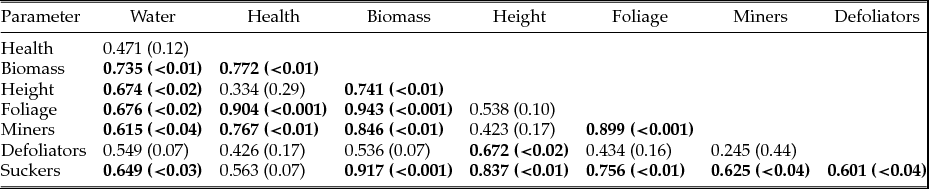
The amount of water was significantly and positively correlated with all parameters except for health (dead/defoliated/live plants) (R = 0.471, P = 0.12) and defoliators (R = 0.549, P = 0.07), as more water resulted in more biomass being produced (Table 2). However, more water also resulted in significantly more damage on the plants by suckers and miners. Similarly, the damage caused by suckers was significantly and positively correlated with all the other parameters except for health, while the magnitude of defoliation was only correlated with plant height (Table 2). Moreover, most parameters related to plant vitality were for the most part highly significant and positively correlated (Table 2).
Block-wise stratified Pearson correlation matrix of all studied variables

Significant correlations P<0.05 in parentheses shown in bold.
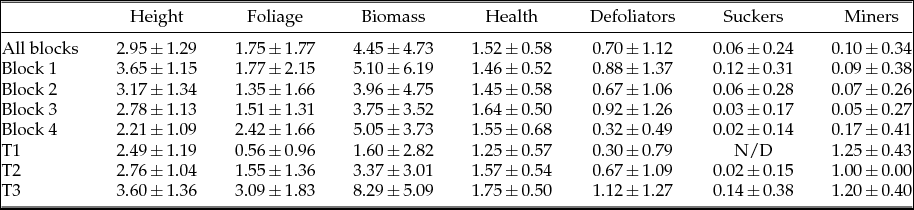
The empirical effect of the water also becomes evident by examining the simple averages of the ranked values (Table 3), where the biomass (and its correlates) as well as the health values increase with more water. Also, the damage made by defoliators and suckers increase with added water while damage from miners appears unaffected (Table 3). More water logically results in more leaves being produced and taller plants, while the increased amount of biomass represents a more attractive habitat for herbivores. The ANOVA analysis showed significant treatment differences between blocks only for plant height (SS = 5.23, MS = 1.05, F = 14.42, P < 0.004). This site difference had no impact on the patterns of damage made by the insects as the ANOVA results did not find the individual blocks statistically different with respect to any of the categories of insect pests (defoliators, suckers or miners), suggesting that the insect pests counteract the positive effect of water.
Average values (±SD) of input data to the statistical analyses for each replication (Block) and water treatment (T1, T2, T3)

N/D: no data.
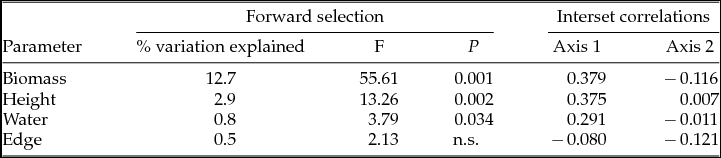
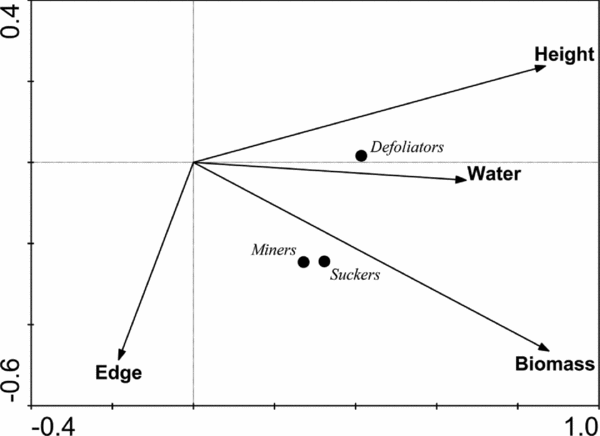
Foliage and health were intercorrelated with other environmental data and were thus removed from the RDA analyses. Biomass and plant height were the two environmental variables explaining most of the variation in herbivore damage with 12.7% and 2.9% respectively (Table 4). These variables were also strongly correlated with RDA axis 1 (RDA-1), meaning that biomass and height are the two most important explanatory environmental variables represented by RDA-1. This axis alone explained 16.4% (F = 74.345, P = 0.001) of the overall explained variation of 16.9% (F = 19.331, P = 0.001). RDA-2 contributed negligibly to the overall variation. Low explanatory power of the first axis in direct multivariate analyses is common in zoological studies (Jongman et al., 1995) and this tells us simply that the most important variables have not been recorded as part of the study. In this experiment, such variables may be related to soil chemical properties; climatic factors such as temperature, air humidity, wind and light; geographical factors like topography and latitude; or agricultural factors such as soil preparation, provenance and thinning. The ordination diagram in Fig. 1 shows the distribution of the herbivores and the environmental variables. Based on signs of damage, suckers (species of Thysanoptera and Hemiptera) were present in higher abundance in plants with greater biomass, while defoliators like beetles in the genus Aphthona, unidentified acridid grasshoppers and species of unidentified Curculionidae as well as the Lepidoptera (e.g. pyralids such as Morosaphycita (=Pempelia) cf. morosalis (Saalmüller) and other Phycitinae, Stomphastis cf. thraustica Meyrick (Gracillariidae), and Achaea sp. (Noctuidae)) were more abundant in taller plants. The presence of these species on Jatropha in West Africa is well documented (Terren et al., Reference Terren, Mignon, De Clerck, Jijakli, Savery, de Haveskercke, Winandy and Mergeai2012; Biondi et al., Reference Biondi, Urbani and D'Alessandro2013; Datinon et al., Reference Datinon, Glitho, Tamò, Amevoin, Goergen and Douro Kpindou2013; Minengu et al., Reference Minengu, Mobambo and Mergeai2014; Habou et al., Reference Habou, Adam, Haubruge, Mergeai and Verheggen2014; Lama et al., Reference Lama, Vuorisalo and Niemelä2014; Sawadogo et al., Reference Sawadogo, Nagolo, Nacro, Rouamba and Kenis2015). Many of them are native to America and have probably been introduced to Africa with imported plant material (Lama et al., Reference Lama, Vuorisalo and Niemelä2014). Biomass and height were also more intercorrelated with RDA-1 than water (0.379 and 0.375 vs. 0.291) and defoliators had the highest fit to RDA-1: 0.172 versus 0.104 and 0.074 for suckers and miners (S. cf. thraustica), respectively. This suggests that suckers are more strongly associated with irrigation than defoliators, despite the observation that the normal projection of defoliators on the water vector showed a stronger association with water than the projection of suckers (Fig. 1), which leaves this result similar to the Pearson correlation analyses (Table 2).
Forward selection of environmental variables that were not strongly intercorrelated and interset correlations of the remaining variables with RDA axes 1 and 2

RDA ordination diagram of pest categories (dots) with non-intercorrelated parameters (Height, Biomass, Edge) and water treatments (Water) along the environmental gradients represented by the axes. Eigenvalue 1 = 0.164, Eigenvalue 2 = 0.005. Axis values in standard deviations.

Conclusion
Jatropha curcas is no ‘miracle tree’, but equal to any plant in that more water facilitates growth, even under semi-arid conditions, giving support to our hypothesis 1. Moreover, with better water conditions it produces more leaves (biomass) and insect damage can be substantial as it does not appear to be particularly pest resistant per se but defences may play a role in counteracting dieback due to environmental stress. Thus, our second hypothesis, that plants under drought stress will be more susceptible to defoliation and pest attacks than irrigated plants, is not supported.
Acknowledgements
We are indebted to the ICRISAT for providing research facilities, field plots and Jatropha plants. We would also like to thank Mari M. Tollefsrud and Carl G. Fossdal for commenting upon the manuscript and to Leif Aarvik for help with identification of Lepidoptera. Two anonymous referees and Hugh Cross generously improved the overall quality and shape of the manuscript. Finally, the study was financed by the Norwegian Research Council, grant number 193791 under the NORGLOBAL program.