1. Introduction
A number of philosophers of science have argued based on case studies from various areas of biology that mechanisms are essential for understanding biological phenomena, and description of mechanisms underlying phenomena adequately accounts for the explanatory practice of scientists (Glennan Reference Glennan1996, Reference Glennan2002, Reference Glennan2005; Machamer, Darden, and Craver Reference Machamer, Darden and Craver2000; Bechtel and Abrahamsen Reference Bechtel and Abrahamsen2005; Bechtel Reference Bechtel2006). This view has been called the new mechanistic philosophy (NMP hereafter; Skipper and Millstein Reference Skipper and Millstein2005). James Woodward (Reference Woodward2003), on the other hand, argues that an explanation uncovers patterns of systematic counterfactual dependence. On the same basis, he (Woodward Reference Woodward2002) also formulates a counterfactual account of mechanisms. Ecology offers cases that show that although Woodward's conditions for explanation and mechanism are satisfied, they do not fully capture what ecologists regard as explanatory. Instead, they seek to explain how dependencies arise. Utilizing the resources of NMP, I show in what respect explanation in ecology consists in outlining the mechanism underlying counterfactual dependencies. Additionally, I argue that Woodward's view offers a simple way to account for overall relationship between components of a mechanism and its output. In light of this analysis and based on his notions of invariance and insensitivity of causal relationships, I suggest that we should use a mixed approach to account for explanation in ecology. Explanation in this field involves revealing invariant and insensitive causal relationships, and specifications of these relations require descriptions of the entities involved, their properties, and functions.
2. Woodward on Explanation
Woodward offers a causal conception of explanation conceived along manipulationist and counterfactual lines. A causal explanation shows how an outcome hinges upon other variables, such that if we could intervene and manipulate the value of one or more variables, then we could change the value of the phenomenon under scrutiny. Explanatory information is relevant to both cases of actual and potential manipulation and answers what-if-things-had-been-different questions. Woodward argues that the minimal condition of scientific explanation should be understood thus:
(EXP) Suppose that M is an explanandum consisting in the statement that some variable Y takes the particular value y. Then an explanans Exps
Footnote 1 for M will consist of (a) a generalization G relating changes in the value(s) of a variable X (where X may itself be a vector or n-tuple of variables X
i
) and changes in Y, and (b) a statement (of initial or boundary conditions) that the variable X takes the particular value x. A necessary and sufficient condition for Exps to be (minimally) explanatory with respect to M is that (i) Exps and M be true or approximately so; (ii) according to G, Y takes the value y under an intervention in which X takes the value x; (iii) there is some intervention that changes the value of X from x to  $x^{\prime }$ where
 $x\neq x^{\prime }$, with G correctly describing the value
 $y^{\prime }$ that Y would assume under this intervention, where
 $y^{\prime }\neq y$. (Reference Woodward2003, 203)
As an illustration of EXP, consider the case of an explanation using Coulomb's law of the magnitude of the electric intensity at a certain distance from a wire. The term M is the statement that the magnitude of electric intensity at a particular distance r from a long wire has a particular value  $y^{\prime }$. The explanans Exps for M consists of (a) the generalization G

that relates changes in the value(s) of variable X, that is  $( 1/ 2\pi \epsilon _{0}) ( \lambda / r) $, and changes in E, which corresponds to Y in EXP, and (b) a statement that, say, λ
i
(charge per unit length along the wire) takes a particular value λ
i+1. As for the necessary and sufficient conditions for Exps to be minimally explanatory, (i) measurements show that Exps and M are true; (ii) the value of E changes due to an intervention that modifies the value of λ; (iii) there was an intervention that changed the value of λ from λ
i
to λ
i+1 and G accurately describes the value of E that changes from E
i
to E
i+1 due to this intervention on the value of λ. Similar considerations apply to other components of the right-hand-side part of (1), which allows one to see how changes in the values of r modify the intensity of the field E (Woodward Reference Woodward2003).
In the next section, I examine the case of ecological research on the relationship between biodiversity and ecosystem functioning (hereafter the biodiversity case) and show that the way ecologists approach it satisfies Woodward's account of explanation. Despite that, I argue that ecologists accept patterns of systematic dependence as mere descriptions, but not as explanatory relations. Instead, what they take to be explanatory is a description of the mechanism that produces patterns of dependence.
3. The Biodiversity–Ecosystem Functioning Case
In the 1990s, ecologists conducted a series of experiments aimed at testing hypotheses that changes in biodiversity affect ecosystem functioning. The term “biodiversity” has broad scope, refers to genetic, organismal, and ecological diversity over spatial and temporal scales, and is not limited to the number of species present in a certain area (Harper and Hawksworth Reference Harper and Hawksworth1994). Given that “biodiversity” has a wide scope, and hypotheses regarding this set of issues are characterized more specifically, a few terminological clarifications are required. Functional traits are characteristics of a species that are relevant to its response to the environment (e.g., shade-tolerant and shade-intolerant species, seed size, and dispersal mode) and/or to its effects on ecosystem functioning, which is the flow of energy and materials through biotic and abiotic components of an ecosystem and encompasses ecosystem processes, such as primary production, trophic transfer from plants to animals, nutrient cycling, water dynamics, and heat transfer (Díaz and Cabido Reference Díaz and Cabido2001, 654). Diversity of these functional traits makes up functional diversity. Species that share the same functional traits form a functional group, such that functional diversity is also defined as diversity of functional groups. As for ecosystem functioning, it comprises the processes of energy and materials flow through the biotic and abiotic components of an ecosystem, like trophic transfer from plants to animals and nutrient cycling (Díaz and Cabido Reference Díaz and Cabido2001). In the experimental studies on biodiversity, ecosystem productivity conceived as biomass production is an instance of ecosystem functioning that is commonly monitored.
The experimental studies and their findings that I am considering are part of a growing consensus that it is the functional traits of species and their interactions rather than species numbers per se that are a greater determinant of ecosystem processes (Díaz and Cabido Reference Díaz and Cabido2001; Hooper et al. Reference Hooper, Chapin, Ewel, Hector, Inchausti, Lavorel, Lawton, Lodge, Loreu, Naeem, Schmid, Setälä, Symstad, Vandermeer and Wardle2005). The often-examined hypothesis is that decrease in functional diversity negatively affects ecosystem functioning, for example, ecosystem productivity. Tilman, Knops, et al. (Reference Tilman, Knops, Wedin, Reich, Ritchie and Siemann1997) performed a series of field experiments that show how ecosystem functioning responds to varying functional diversity. In one of them, they planted 289 plots with 0, 1, 2, 4, 8, 16, or 32 savanna-grassland species representing 0, 1, 2, 3, 4, or 5 plant functional groups (Tilman, Knops, et al. Reference Tilman, Knops, Wedin, Reich, Ritchie and Siemann1997). Plants were assigned to functional groups based on intrinsic physiological and morphological differences that influence their resource requirements, seasonality of growth, and life history. The response variables monitored were plant productivity, plant total N, soil NO3, soil NH4, plant percent N, and light penetration. Statistical analysis of the experimental results established that functional diversity was a significant determinant of response variables, but the numbers of species were not. Tilman et al. concluded from this that functional diversity is a greater determinant of ecosystem processes than species diversity. Statistical analysis of the effects of functional composition (conceived of as which functional groups were added to plots) nested within functional diversity revealed that functional diversity and composition together explained 37% of the variance in response variables, while species and functional diversity together explained 8%, indicating that composition is the greater determinant of ecosystem processes.
The finding of Tilman et al. satisfies the conditions of explanations stipulated by Woodward in EXP. The explanandum M consists in the statement that the variable Y—one of the ecosystem processes measured, say, ecosystem productivity—changes its value from low to high. The explanans Exps for M is the generalization G, “Increased functional diversity increases productivity,” and the statement “The value of the variable X, functional diversity, increases.” The explanans satisfies the necessary and sufficient conditions to be minimally explanatory with respect to M: (i) Exps and M are true; they have been confirmed experimentally; (ii) there is a generalization G according to which productivity increases under an intervention on functional diversity that increases the number of functional groups; (iii) there is also an intervention that changes the value of functional diversity from low to high and G correctly describes the resulting change in productivity from low to high.
Despite the satisfaction of Woodward's conditions for explanation, Tilman, Knops, et al. (Reference Tilman, Knops, Wedin, Reich, Ritchie and Siemann1997) do not consider dependence relations to be explanatory. Instead, they suggest that mechanisms of niche differentiation and coexistence are able to explain the increase in productivity with diversity. In a more theoretical article devoted to their experimental findings, they offer three models “that provide simple mechanisms that explain how such dependencies arise and help resolve the controversy over the importance for ecosystem functioning of species identity versus species diversity” (my emphasis; Tilman, Lehman, and Thomson Reference Tilman, Lehman and Thomson1997, 1857). Tilman et al. expressed a similar dissatisfaction with the dependence relationships being explanatory in an earlier article in which they reported the results of a field experiment that manipulated the numbers of species per plot. One hundred and forty-seven plots were planted with either 1, 2, 4, 6, 8, 12, or 24 species randomly drawn from a pool of 24 North American prairie species. The experiment demonstrated that the ecosystem processes of plant productivity and resource utilization were significantly greater in plots with higher plant diversity. However, they seem not to regard this finding as explanatorily sufficient, since they conclude: “Further work is needed to determine how interspecific morphological and physiological differences influence the dependence of ecosystem functioning on biodiversity in this and other ecosystems” (Tilman, Wedin, and Knops Reference Tilman, Wedin and Knops1996, 720). Shaheed Naeem, who carried out laboratory experiments on the biodiversity–ecosystem processes relationship, arrived at a similar conclusion. He argued that dependence relations guide us toward identifying the underlying mechanisms, which are the research goals (Naeem Reference Naeem2002). Thus Woodward's account of explanation does not capture what ecologists regard as explanatory. Their work shows that an explanation rather consists in articulating the mechanism that produces the phenomenon to be explained. The next step of this paper is to examine ecologists’ view on the mechanisms underlying the biodiversity–ecosystem functioning relationship, since they emphasize the explanatory role of mechanisms.
4. An Ecological Mechanism Underlying the Biodiversity–Ecosystem Functioning Relationship
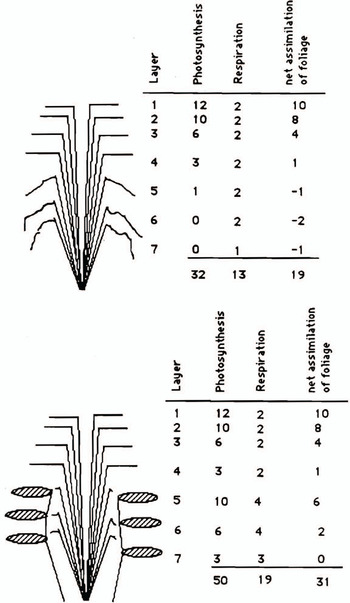
Niche complementarity is one of the mechanisms articulated to account for the dependence of ecosystem functioning on biodiversity. This mechanism is based on species differences and their interactions (Tilman, Knops, et al. Reference Tilman, Knops, Wedin, Reich, Ritchie and Siemann1997; Díaz and Cabido Reference Díaz and Cabido2001). The simplest case of niche complementarity is when two species of plants have different requirements for a limiting resource, say, light. In this case, niche complementarity occurs when there is a shade-intolerant species and a shade-tolerant species. This combination is also called an intercrop, and the combination of such complementary species, intercropping (Vandermeer Reference Vandermeer1989). Figure 1 illustrates the positioning of the shade-intolerant and shade-tolerant species.
Niche complementarity. The top of the figure represents a shade-intolerant species; the bottom shows an intercrop of shade-intolerant and shade-tolerant species. Shaded ellipses below the leaves of the shade-intolerant species represent the shade-tolerant species. Figure from Vandermeer Reference Vandermeer1989, 73. Reprinted with permission.

Each leaf layer consists of leaves that photosynthesize at a rate corresponding to the light conditions of that layer and respire at a rate of a unit per leaf. Net assimilation is positive for the first four levels but turns negative for layers 5, 6, and 7. At this level of light, the shade-intolerant species does not find adequate conditions. By contrast, the shade-tolerant species is able to develop well. Thus, layers 5, 6, and 7 represent a different niche that is suitable for the shade-tolerant species but not for the shade-intolerant species, which finds its adequate conditions in the niche represented by levels 1–4. Data from tables accompanying the figure show that when both species occupy their niches—which amounts to niche complementarity—solar radiation is utilized more efficiently such that photosynthesis, respiration, and net assimilation rates are increased for both species. And this translates into higher biomass production and higher ecosystem productivity. This happens, however, only when the shade-tolerant species is present, not if the shade-intolerant species grows more leaves. The shade-tolerant species positively affects the shadeintolerant species by preventing the leaves of the lower leaf layer from being a respiratory drainage on the shade-intolerant species. Plant morphology is a further determinant of this interspecific interaction and of how efficiently available solar radiation is utilized. In particular, different leaf morphologies and the number of leaves on each level determine differentially the percentage of the occupied leaf area at that level. If the total percentage across all levels is higher, then the total light assimilation and, ipso facto, biomass production is higher.
In sum, niche complemetarity involves that organisms of different species are different in their functional traits, which determine species’ differential use of resources and nutrient use efficiency. Furthermore, a composition of species with different functional traits that allows them to more efficiently use a greater amount of resources from different ranges increases ecosystem productivity. Hence the greater the number of functional groups, the greater the overall ecosystem productivity is. Organisms of different functional groups occupy distinct niches and can exploit their resources differently. That increases their body mass and, consequently, the overall productivity of the ecosystem is greater. In the next section, I will consider Woodward's view on mechanisms and confront it with ecologists’ perspective on the niche complementarity mechanism.
5. Woodward on Mechanisms
Woodward developed the underlying idea of his conception on explanation into a view on mechanisms. In his 2002 article, he promises to offer a characterization of the notion “mechanism” that would be more general and less discipline specific. The characterization, however, is rather of models of mechanisms than of mechanisms themselves. According to Woodward:
(MECH) a necessary condition for a representation to be an acceptable model of a mechanism is that the representation (i) describe an organized or structured set of parts or components, where (ii) the behavior of each component is described by a generalization that is invariant under interventions, and where (iii) the generalizations governing each component are also independently changeable, and where (iv) the representation allows us to see how, in virtue of (i), (ii) and (iii), the overall output of the mechanism will vary under manipulation of the input to each component and changes in the components themselves. (Reference Woodward2002, S375)
A block sliding down an inclined plane is Woodward's simple example that illustrates features that even more complex mechanisms possess. The behavior of the block is determined by two forces—a force due to friction directed against the motion of the block and a gravitational force due to the weight of the block. The frictional force is given by the relationship (1)  $F_{k}=\mu _{k}N$, while the net force exerted on the block along the plane obeys the relationship (2)
 $F_{\mathrm{net}\,}=mg\mathrm{sin}\,\mbox{\o} -mg\mathrm{cos}\,\mbox{\o} $ (Reference Woodward2002, S367). Woodward underscores two aspects of mechanisms understood counterfactually. First, he understands the productive behavior of parts of a mechanism in the general terms of causal relationships, which are invariant and can be used for manipulation and control. This idea is expressed in MECH by (ii). Consider relationship (1)
 $F_{k}=\mu _{k}N$. The behavior of N is productive relative to F
k
in the sense that changes to the value of N bring about changes in the value of F
k
, and the relationship
 $F_{k}=\mu _{k}N$ is invariant under at least a certain range of interventions that modify the value of N. And we can control and manipulate the value of F
k
by controlling and manipulating the value of N. The second aspect is that mechanisms are modular. This facet is expressed in MECH by (ii). A mechanism is modular in the sense that it is possible to intervene to manipulate a component without affecting the behavior of other components. With respect to the sliding block example, this means that we can modify the component due to gravitational force and its generalization, without changing the component due to frictional force and its generalization. One can change F
k
of (1) by modifying the characteristics of the surface of the plane, which affects μ
k
, but this will not affect the generalization regarding the gravitational component. And one can change the gravitational force by modifying the value of g, say, by moving the plane to a weaker gravitational field, but this will not change the relationship governing the frictional force component.
I consider next how Woodward's account of mechanisms fares when confronted with the niche complementarity mechanism. Applied to this case, the counterfactual view on mechanisms would tell us that an acceptable model of the mechanism of niche complementarity shows how the mechanism output, biomass production, will vary under manipulation of the input to its components. MECH (i) requires that to be acceptable, a model of this mechanism needs to describe an organized or structured set of parts or components. Ecologists’ description presents the shade-tolerant, the shade-intolerant species, and the sunlight as the components of niche complementarity. Given MECH (ii), the generalizations invariant under interventions that describe the behavior of the components would be those that would refer to the photosynthetic behavior of plants and sunlight. Thus, (a) ‘ST is a species able to carry out photosynthesis within a certain range of low light intensity’ would describe the behavior of the shade-tolerant species, while (b) ‘SI is a species able to carry out photosynthesis within a certain range of high light intensity’ would describe the behavior of the shade-intolerant species. Presumably, a generalization about sunlight would be this: (c) ‘Light diminishes as it passes through the canopy’. These statements would remain invariant under a certain range of interventions on the genotype of these species that modify their light tolerance limits and photosynthetic capacities, or on the amount of light emitted by the sun. Additionally, the niche complementarity model implies generalizations that link the presence of species to biomass production, as well as generalizations describing the relationships between various species in a community. These generalizations, which are likewise invariant under a range of interventions, could be formulated thus: (d) ‘An increase in the number of species in a habitat increases biomass production’; (e) ‘A shade-tolerant species is present in a habitat if a shade-intolerant species is present.’ MECH (iii) demands that these generalizations be independently changeable. Niche complementarity seems to satisfy this condition. That a species is shade-tolerant is independent of the other species being shade-intolerant, and the generalizations that reflect this are independently changeable as well. One can intervene and modify, for instance by genetically engineering the shade-tolerant species so that it becomes less shade tolerant, or by simply removing it. Yet this will not change the shade-intolerant species. Likewise, one can change the light source, but this will not modify the plant species. Thus, the niche complementarity mechanism is modular. According to MECH (iv), the model of the niche complementarity should allow us to see how productivity varies under manipulation of the components. Given generalizations a, b, and c, and generalization d, one could infer that adding new species to the habitat would increase the productivity of the system. Additionally, considering generalization e, it could be expected that an intervention that removes the shade-intolerant species will affect the shade-tolerant species and biomass production.
Woodward's approach suggests that mechanisms are networks of invariant causal relationships. A correct representation of this mechanism would show what would happen in various hypothetical experiments to the output of the mechanism if various interventions on the components would be performed. The key goal of this representation is to capture dependency relationships between the values of variables that can be elicited through interventions on the mechanisms under scrutiny. His notion of mechanisms captures only the overall relationship of dependence of the mechanism product on its components, but it does not show how that relationship arises. The preceding discussion of the biodiversity case showed that the explanatory goal of ecologists goes beyond documenting the counterfactual dependencies. Rather, they seek to uncover how stable, dependency relationships between relata arise. Consequently, when compared with the interests of aforementioned ecologists, Woodward's account of mechanisms turns out not to capture all the meanings of their concept of ecological mechanism and explanatory standards. David Tilman is one of the leading researchers on the problem of the relationship biodiversity–ecosystem functioning. Discussing the standards of mechanistic approach to competition, which is one of the factors that underlies niche complementarity, he raises this expectation about good ecological explanations: “I define the study of competition as mechanistic if it includes both the direct processes by which competition occurs and information on physiology, morphology, and/or behavior of individual species or functional groups relevant to that direct process. … A major goal of the mechanistic approach is to use information on the physiology, morphology, and/or behavior of individual species to predict the outcome of pairwise or multispecies interactions” (Reference Tilman1987, 771).
Ecologists’ approach to niche complementarity satisfies this expectation. They offer information on the physiology and morphology of plants, as well as physical processes that underlie the relationship biodiversity-productivity. More specifically, this is information on photosynthetic rates and capacities, rates of light assimilation, rates of respiration, plants’ tolerance to different intensities of sunlight, shape of leaves, their numbers and location on each layer, as well as changes in the amount of sunlight as it passes through the canopy and as it changes during the day. Thus, this relatively simple case shows that ecological explanations require more than just specification of invariant generalizations about the behavior of components and how the overall output of the mechanism varies under interventions on the input to each component.
The limitations of Woodward's view on mechanisms do not justify abandoning his proposal, though. A significant part of research on biodiversity aims to establish how biomass production, or other ecosystem processes, varies given variations in functional groups, functional composition, and species numbers. Ecologists also look to reveal how the presence of one species is responsible for the presence of a different species or a cohort of species. That is, part of the work of ecologists is to establish causal relationships, and Woodward's perspective on explanation and mechanisms accounts for this facet of ecological research.
Woodward discusses only a necessary condition for a representation to be an acceptable model of a mechanism so that limitations are to be expected. I turn now to views that aim to give complete accounts of mechanisms.
6. The New Mechanistic Philosophy and the Mechanism of Niche Complementarity
Tilman's specification of what counts as an acceptable and mechanistic explanation in ecology, on the one hand, and the illustration of the niche complementarity, on the other hand, suggest that NMP would be a better view to deal with explanations in ecology and ecological mechanisms. There are important differences between the conceptions of philosophers that support NMP. I will focus, however, on what unites them. Glennan, Machamer et al., and Bechtel are committed to the following theses:Footnote 2
1. Mechanisms produce phenomena. The working of a mechanism as a whole performs certain behaviors. For example, a mousetrap traps mice. A consequence of this thesis is that describing the mechanism responsible for the phenomenon under scrutiny amounts to an explanation of that phenomenon.
2. Mechanisms are compositional. Mechanisms have working parts. The parts are relevant to the working of a mechanism in virtue of some of their properties but not all of them. The rigidity of the bar and the tension of the spring are central for the mousetrap to catch mice, but not the color of the platform. Glennan calls the parts objects, which are relatively highly robust and stable in the absence of interventions. Machamer et al. take both entities and their activities to be the components. By “entities” Machamer et al. mean things. Bechtel makes a point similar to that of Machamer et al., because he speaks in his characterization of mechanisms about component parts and component operations.
3. Causal relations constitute mechanisms. The components of a mechanism act and interact and in this way they are able to produce a behavior. The goal of a mechanistic explanation is to specify the relevant causal relations among the components in terms that offer more appropriate accounts of causing exhibited in the particular cases under scrutiny (Craver and Bechtel Reference Craver, Bechtel, Sarkar and Pfeifer2006, 470). Glennan thinks in terms of interactions between parts of the mechanism. Machamer et al. conceive of them in terms of activities of parts, indicated by verbs and verbal forms, while Bechtel prefers operations of parts.
4. Components of mechanisms must be organized. To produce a phenomenon, the components and their causal relations must be organized spatially and temporally. Spatial organization includes location, shape, size, orientation, connection, and boundaries of components. Temporal organization comprises order, rate, duration, and frequencies of activities. For example, the trigger bar restrains the impact bar because it is stuck in the catch. As for temporal organization, a mousetrap must work quickly, and there should not be delays between the steps of the working. The new mechanistic philosophers focus on these mechanisms that have a rather stable organization: toilet; electric switch; the heart; and the mechanism of action potential, of DNA transcription, and of protein synthesis.
The theses of NMP capture some important facets of ecological mechanisms. (1) Ecologists see mechanisms as being responsible for a certain output. In this respect, Tilman, Lehman, and Thomson (Reference Tilman, Lehman and Thomson1997) claim that the niche complementarity mechanism may explain why productivity increases with diversity. (2) From the viewpoint of NMP, the components of the niche differentiation mechanism would be the individual organisms and sunlight. This focus on the individual level is consistent with the claim of ecologists that certain mechanisms—for instance the mechanism of competition—operate at the individual level (Tilman Reference Tilman, Grace and Tilman1990). If photosynthesis or respiration are the relevant activities, then relating them to the individual level is supported by the fact that these activities require certain physiological systems and these are to be found at the level of organisms. Yet ecologists extrapolate from the individual level to the population level and often speak about species, or functional groups, as being the relevant components. However, the species as a cohort of individuals does not have the proper physiological system able to produce photosynthesis or respiration. (3) Respiration, photosynthesis, assimilation are activities, or operations whose specification is key to articulating an explanation of the interaction between organisms of two species. (4) Organization of components is central in ecologists’ discussion of niche differentiation. The shade-tolerant plant has to be in close proximity to the shade-intolerant plant so that it can be protected from excess of sunlight. Thus, the plants have to be spatially organized. Duration and variation of sunlight during the day as well as the rates of respiration, of photosynthesis, and of assimilation are instances of temporal organization, and, in addition, they are measured at each layer, which is a facet of spatial organization. Geometry of leaves is considered as well. Their shape and size are decisive for the ability of plants to interact in a manner that creates niche complementarity.
NMP successfully captures the aforementioned aspects of the mechanism of niche complementarity, but it encounters difficulties when it tries to account for what is remarkable about mechanisms—namely, that they, to paraphrase Machamer et al., work always, or for the most part, in the same way under different conditions. Niche complementarity functions despite various changes in its components and background conditions. For example, organisms of various shade-tolerant species can play the role of the shade-tolerant plant. Moreover, the relationship between biodiversity and ecosystem processes holds despite variations in the number of species involved, their identity, the number of functional groups, and variations in the environment. This compositional variation implies variations in the organization of the mechanism, and in the activities/operations and interactions of its components, yet ecologists think that it is the same mechanism. This aspect of the mechanism is harder to capture with the resources of NMP because of its merit: formulation of a more specific account of the causation exhibited in the particular case under scrutiny. Recall that to fulfill this desideratum, NMP requires that we be specific about the activities, operations, or interactions that take place. This obscures, however, that there is an overall causal relationship between biodiversity and ecosystem functioning that is not affected by various changes. My positive proposal addresses this issue and builds on the contributions of Woodward and NMP.
7. Mechanisms and Networks of Causal Relationships
A solution to the problem of mechanisms working in the same way under different conditions could be obtained by rehabilitating the causal relations that the abstract terms “cause” and “causal” refer to. To this end, I rely on Thagard's (Reference Thagard1998) proposal to conceive of mechanisms in terms of causal networks and Woodward's suggestion to use the notions of invariance and insensitivity to think about mechanisms.Footnote 3 A distinctive feature of causal relationships is that they are invariant, that is, they remain stable across various changes in the values of variables of the causal relationship X-Y. Causal relationships are also insensitive, meaning that they are not affected by modifications in the background conditions of variables X and Y or by changes in the actual circumstances of the relationship. For example, the X-Y causal relationship is insensitive if it holds despite modifications in the Dow-Jones Index or regardless of changes in how specifically X affects Y (Woodward Reference Woodward2003, Reference Woodward2006).
Invariance characterizes the niche complementarity mechanism in several respects. The overall relationship between biodiversity occupying complementary niches and ecosystem processes is invariant within a certain range to changes in the number of species, identities of species, and number of functional groups involved. Productivity will vary under interventions that change the number of species, the number of functional groups in a community, or the identity of species in functional groups, yet the overall causal relationship between these factors and productivity will hold. An increase in biodiversity in complementary niches increases productivity both in prairies and in forests, lakes, and rivers. The activities of organisms involved could be photosynthesis, nutrient uptake, or foraging. Niche complementarity would still occur among these organisms, and it would be invariant to these changes. Furthermore, one can change the number of individual organisms of a species, and, ipso facto, of a functional group, and this will affect the productivity, but the overall causal relationship will not be broken. Tilman's experiments on the biodiversity–ecosystem processes involved various treatments with nitrogen and nutrients. The experiment was long term, and it underwent a significant drought, which amounted to an experimental intervention that changed the levels of limiting resources and factors. The biodiversity-productivity relationship turned out to be insensitive to these changes in the background, indicating that more diverse ecosystems withstand environmental stresses and are still able to support ecosystem processes.
The same reasoning applies to variations in all other abiotic factors. The biodiversity-productivity relationship would occur and be insensitive despite variations—within a range of tolerance of organisms—in temperature, sunlight, or chemical composition of the air. The limiting resource could be sunlight, or water, nitrogen or calcium, or other nutrients. The biodiversity–ecosystem processes relationship is insensitive to this, since species will have to be organized in complementary niches to better use these resources. The causal relationships would occur even if the landscape changes in different ways. The shade-intolerant and the shade-tolerant plants would interact regardless of whether the landscape is a hill or a valley, and regardless of location and time. Biodiversity can increase productivity through complementarity both in Europe and in America. And this series of possible changes in background conditions could continue, depending on the actual or possible availability of factors that can directly or indirectly affect any of the components that constitute the causal relations in this ecological mechanism.
The causal structure of the foregoing case of niche complementarity involving plants of shade-tolerant and shade-intolerant species could be represented as in Figure 2. To articulate this representation, I borrow Levins's method of loop analysis (Reference Levins1974; Puccia and Levins Reference Puccia and Levins1985).
The causal structure of the shade-tolerant–shade-intolerant niche complementarity mechanism. SINT = shade-intolerant, ST = shade tolerant.

The solid dot lines represent negative causal relations, and the arrow lines show positive causal relations. A causal relation is negative if it negatively affects a causal factor, for example, a plant diminishes a resource, say, light. A causal relation is positive if it positively affects a causal factor. In this case, light positively affects plants by being a source of their energy, and plants of both species facilitate the growth of each other. These causal relations, and the entire structure, are invariant and insensitive in the senses explored above. To this I would add that the structure is also invariant in the sense that its components could be populations as well as individuals. At the population level, this structure is invariant to changes in the numbers of individuals of the two species involved. The population of shade-intolerant species could be more or less numerous, but the causal relationship between this species and the shade-tolerant, on the one hand, and between this species and ecosystem functioning, on the other hand, would still obtain. At the individual level, the structure is invariant to changes in the size of individual organisms involved.
The specification of the causal structure, as illustrated above, identifies the components involved, but it satisfies only partially the requirement of mechanistic study. To fully satisfy the requirement, it has to be accompanied by a description of the relevant properties of the components, of their organization, and of their functions in the particular context. Determining the causal structure between the components of a mechanism helps show how the details of the description are part of a broader causal structure. The structure itself is rather impoverished, and Machamer et al. rightly notice that the abstract causing needs to be specified. However, there is a hazard in concentrating on specific kinds of causes. Too narrow of a focus might result in a failure to recognize the overall causal structure.
8. Conclusion
In light of the foregoing examination, I suggest that an account of explanation in ecology would benefit by integrating the contribution of NMP and Woodward's notions of invariant and insensitive causal relationships. Ecological explanations aim to reveal the invariant and insensitive causal structure of a phenomenon under examination and to show, in light of the properties of components, their causal roles, and organization, how this structure is possible. These aspects are complementary, and specifying only one of them does not do justice to the explanatory expectations of ecologists. Specifying only the causal structures without the mechanistic details offers a general model with wide applicability but sacrifices its realism. By contrast, describing all the mechanistic details would yield a realistic model, yet with very limited applicability. As the presentation of the biodiversity–ecosystem productivity showed, ecologists are interested in both general and realistic models.