Introduction
Congenital middle-ear cholesteatoma was initially described by Derlacki and ClemisReference Derlacki and Clemis1 in 1965 and Levenson et al.Reference Levenson, Parisier, Chute, Wenig and Juarbe2 in 1986. According to the literature,Reference Koltai, Nelson, Castellon, Garabedian, Triglia and Roman3 cholesteatoma usually grows posteriorly along the medial side of ossicles to the posterosuperior part of the mesotympanum. In the early stage, cholesteatoma mostly destroys the incudostapedial joint and stapes superstructure, manifesting as conductive hearing loss with an intact tympanic membrane.
The present study describes 10 cases of congenital middle-ear cholesteatoma with ossicular chain deformities in patients who were admitted to our hospital from August 2011 to February 2019. All cases were diagnosed pre-operatively via application of post-processing technologies, namely high-resolution computed tomography (CT), multi-plane reformation and volume-rendered computed tomography. Each diagnosis was confirmed intra-operatively, and all 10 cases were in the early stage of congenital middle-ear cholesteatoma according to the European Academy of Otology and Neurotology and the Japanese Otological Society.Reference Yung, Tono, Olszewska, Yamamoto, Sudhoff and Sakagami4 From the perspective of the aetiology and location of the cholesteatoma, as well as the embryonic development of the ossicles, we also explored the aetiology of congenital middle-ear cholesteatoma associated with ossicular chain defects.
Materials and methods
This study retrospectively analysed the clinical data of patients with congenital middle-ear cholesteatoma associated with ossicular chain defects, each of whom were diagnosed pre-operatively. These patients were diagnosed via pre-operative high-resolution CT, multi-plane reformation and volume-rendered computed tomography, and diagnoses were subsequently confirmed during surgery at our hospital, from August 2011 to February 2019. Among the 10 patients, there were 5 males and 5 females with a mean age of 17.7 years (range, 6–44 years).
Audiological examinations of the patients showed conductive deafness. There were nine cases with a type-A tympanogram curve and one case with a type-B tympanogram curve. Clinical examination showed that all patients had normal external auditory canals and intact tympanic membranes. Otosclerosis, tympanosclerosis and congenital outer ear deformities were ruled out by the above examinations and CT.
A 256-slice helical CT scan was performed with a Philips Brilliance iCT system (Cleveland, USA), with the thickness of each reconstruction layer being 0.625 mm. The scanned data were transferred to a post-processing workstation to obtain conventional high-resolution CT plain films of the axial and coronal positions while performing multi-plane reformation and volume-rendered computed tomography reconstructions. Precise pathological features of the malleus, incus, stapes and facial nerves were obtained from the above imaging technologies.
All operations on the included patients were performed by the corresponding author via general anaesthesia and conventional post-auricular incisions. One surgical approach involved a tympanotomy through the external auditory canal in order to locate the cholesteatoma, evaluate ossicular chain defects and perform hearing reconstruction. Another surgical scheme, used in children, was based on whether the lesion was present in the mastoid and how narrow the external auditory canal was. In this situation, we decided to perform an intact canal wall mastoidectomy, enter the posterior tympanum through the facial recess, remove the lesions in the posterior tympanum and perform hearing reconstruction, thereby maintaining the integrity of the external auditory canal. The ossicular chain was reconstructed using a total ossicular replacement prosthesis or partial ossicular replacement prosthesis implantation based on the conditions of the ossicular chain defects. Procedures for recording patients’ hearing were in accordance with the standard of the American Academy of Ophthalmology and Otolaryngology. The pre-operative air–bone gap, post-operative air–bone gap, and differences between the pre-operative and post-operative air–bone gaps at 0.5, 1.0 and 2.0 kHz language frequencies were used as the standards for records of hearing improvement.
Results
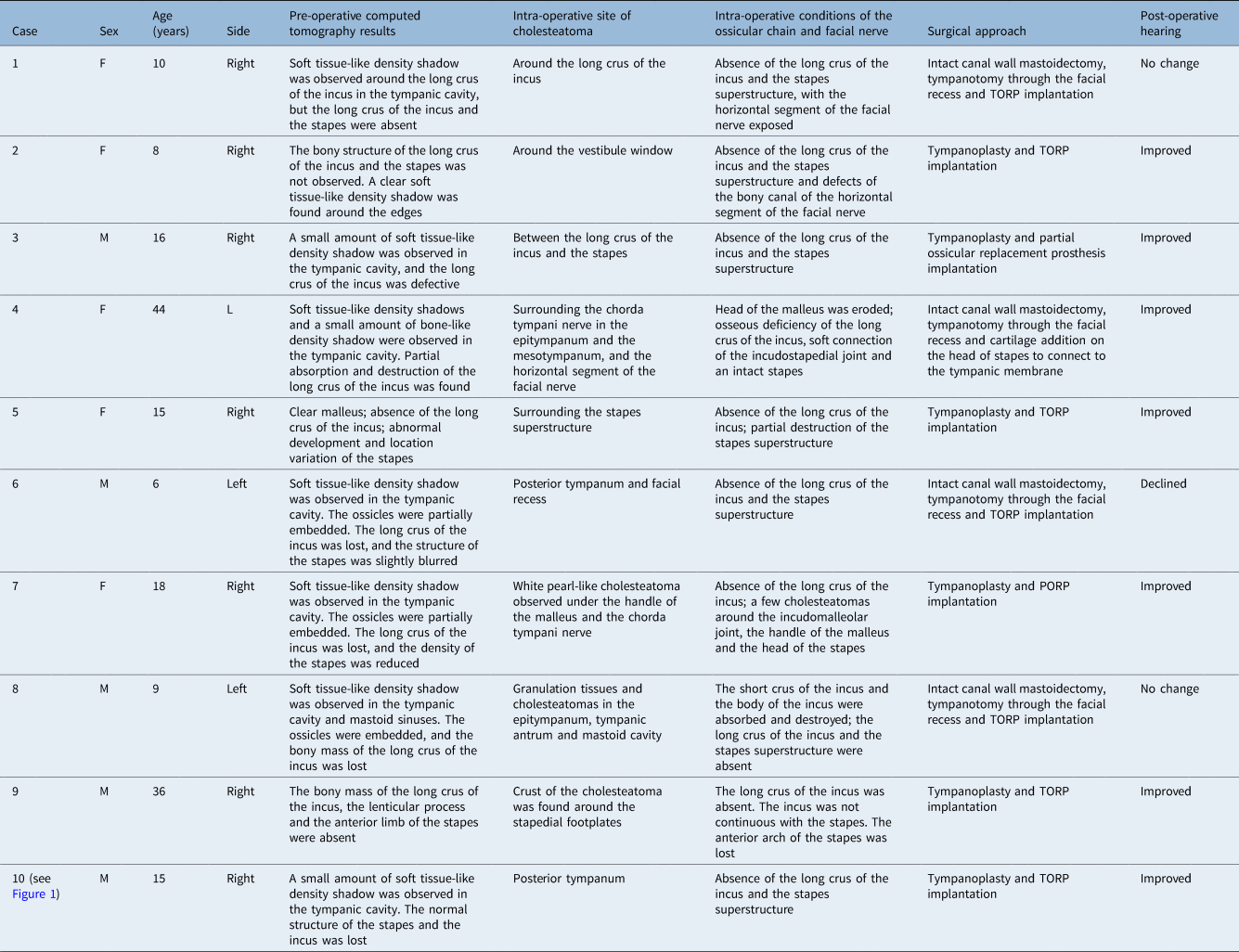
Table 1 shows the general conditions, pre-operative CT results, intra-operative observations and management, and hearing conditions of the 10 patients in the present study. The 10 cases, as shown in Table 1, were all surgically confirmed to have early-stage monofocal cholesteatoma originating from the tympanum. One case (case 8) had a lesion protruding through the tympanic antrum into the mastoid, but the remaining nine cases had lesions confined to the vestibular window and the stapes region and had no contact with the long crus of the incus or with the stapes. All 10 cases were associated with an absence of the long crus of the incus or absence of the stapes superstructure. However, the stapedial footplates were intact and mobile. All cases underwent surgical treatments and were followed up after the surgery by our out-patient clinic and via telephone until December 2019.
Detailed clinical information of the 10 patients

F = female; M = male; TORP = total ossicular replacement prosthesis
Case 10. This was a 15-year-old male with conductive deafness that had been present since childhood. During pre-operative examinations, his tympanogram exhibited type A curves and intact tympanic membranes. (a) The multi-plane reformation image of the malleus and the incus. (b) Three-dimensional volume-rendered computed tomography image from the front view of the tympanic membrane. (c and d) Intra-operative observations and ossicular reconstruction. The imaging results showed an absence of the long crus of the incus and the stapes superstructure. This area had cholesteatoma tissue, suggesting that the absence of the ossicular chain coexisted with congenital cholesteatoma in this patient. The ossicular chain was reconstructed with total ossicular replacement prosthesis made of titanium. The pre-operative air–bone gap of the patient was 30 dB, and the post-operative air–bone gap of the patient was 10 dB. Thus, the air–bone gap was closed by 25 dB, indicating improved hearing. R = label from the original scan, indicating the right incudostapedial joint; 1 = isolated low-density shadow; 2 = the tympanic segment of the facial nerve; 3 = the vestibular window; 4 = round window niche; 5 = cochleariform process; 6 = chorda tympani nerve; 7 = localised cholesteatoma; 8 = the posterosuperior bone mass of the osseous tympanic bone; 9 = the cartilage film between the total ossicular replacement prosthesis top plate and the handle of the malleus; and 10 = stapedial footplates

Importantly, since our study focused on exploring the aetiology of the disease, quantitative statistics of post-operative hearing improvements are not discussed in detail here. A brief record of post-operative hearing based on each patient's qualitative description is shown in Table 1. There were seven cases with improved hearing after the surgery, two cases with no change in hearing after the surgery (the reason being post-operative displacement of the artificial ossicle for case 1 and an unknown reason for case 8) and one case (case 6) with air conduction hearing that declined by 10 dB despite no change in bone conduction hearing after the surgery. No cases had any recurrence of cholesteatoma after the surgery.
All 10 cases were surgically confirmed to have early-stage monofocal cholesteatoma originating from the tympanum. Case 8 had a lesion protruding through the tympanic antrum into the mastoid, but the remaining nine cases had lesions confined to the vestibular window and the stapes region and had no contact with the long crus of the incus or with the stapes. All 10 cases were associated with an absence of the long crus of the incus or absence of the stapes superstructure.
Discussion
In 1986, Michaels first discovered the accidental keratinisation of squamous epithelial cells remaining in the mucosa of the anterosuperior quadrant of the lateral wall of the embryonic tympanic cavity and named it an epidermoid-like formation.Reference Michaels5 Wang et al. also found this epidermoid-like formation and named it Michaels’ structure or Michaels’ utricle.Reference Wang, Hawke and Kwok6 This structure originates from the ectoderm of the first pharyngeal groove, appears as early as week 10 of pregnancy and lasts until week 33 of pregnancy to guide the development of the tympanic membrane and middle ear. However, if the Michaels’ utricle continues growing and does not subside, it may cause the formation of congenital cholesteatoma because of residual epithelial cells from the embryonic stage.Reference Michaels7 Many scholars have confirmed that keratinisation of the epidermis occurs in the mucosa of the anterosuperior quadrant of the tympanic cavity lateral wall in infants at several months old and in children with bilateral congenital cholesteatoma.Reference Koltai, Nelson, Castellon, Garabedian, Triglia and Roman3 The epidermoid-like formation site is located in the histological transition zone of the anterior superior lateral quadrant of the tympanic cavity. This site is also the most common site of congenital middle-ear cholesteatoma, demonstrating a direct relationship between congenital middle-ear cholesteatoma and epidermoid-like formations.Reference Levenson, Michaels and Parisier8 This epithelial residual theory has been widely accepted. We also speculate that this theory may represent a possible mechanism for the residual epithelial tissue from the ectoderm in the middle-ear cavity to form a cholesteatoma.
There have been two theories on the embryonic developmental origin of ossicles in the past 60 years. The first of these, the classical theory,Reference Hough9 proposes that the incus and malleus are derived from the Meckel's cartilage of the first pharyngeal arch and that the stapes is derived from the Reichert's cartilage of the second pharyngeal arch. The alternative theory is that the Meckel's cartilage develops into the short crus of the incus, the body of the incus (corpus incudes) and the head of the malleus, in the epitympanum, while the Reichert's cartilage develops into the handle of the malleus, the long crus of the incus and the stapes superstructure, in the mesotympanum. The alternative theory is supported by most scholars and is included in textbooks.Reference Snow and Wackym10 Around weeks 5–6 of pregnancy, the Meckel's cartilage-derived head and neck of the malleus and the short crus of the incus form an ossicle block, and the Reichert's cartilage-derived stapes superstructure, the handle of the malleus and the long crus of the incus form another ossicle block. At week 9 of pregnancy, the incus and malleus are still fused but begin to differentiate into individual structures. By weeks 12–15 of pregnancy, the ossicles are further differentiated and are approaching the size of adult ossicles. Subsequently, ossification begins to spread radically from the ossification centre. By week 16 of pregnancy, the ossicles reach the adult size. The ossicular remodelling is an adaptive process and continues throughout gestation and shortly after birth for the malleus and incus, while the growth and ossification of the stapes is completed in the third trimester. As the ossicular chain develops, the tympanic cavity continues to expand laterally and upwardly.Reference Snow and Wackym10 In this process, the deformity caused by dysplasia of the Reichert's cartilage is mainly manifested by the absence of the long crus of the incus and the absence of the stapes superstructure. In addition to developmental malformations, causes of the absence of the long crus of the incus include ischemic necrosis caused by otitis mediaReference Hough9 and osteolysis caused by cholesteatoma.
The percentages of an absence of the incus, stapes and malleus in children with congenital cholesteatoma have been reported to be 61.7 per cent (21 of 31), 51.6 per cent (16 of 31) and 35.7 per cent (11 of 31), respectivelyReference Sade and Fuchs11; larger cholesteatomas are associated with a longer disease course, while more invasive cholesteatomas are associated with more severe ossicle damage.Reference Albera, Canale, Piumetto, Lacilla and Dagna12 It is generally believed that a cholesteatoma on the medial side of the handle of the malleus expands to the incudostapedial joint and the stapes superstructure, reaches the incudomalleolar joint and enters the epitympanic recess along the incus.Reference Koltai, Nelson, Castellon, Garabedian, Triglia and Roman3 Once it extends to the incudostapedial joint, a progressive ossicular destruction will occur, manifesting as osteolysis of the long crus of the incus and the head of the stapes. Even though the wrapped ossicles are sometimes not damaged, the long crus of the incus and the arch of the stapes are often absent to varying degrees, while the stapedial footplate is still uninvaded. Further posterior growth of the cholesteatoma will invade the facial nerve recess and tympanic antrum, resulting in the growth of the cholesteatoma attaching to the complex structure of this area. Cholesteatomas in the posterosuperior quadrant are usually relatively large at diagnosis, and they usually reabsorb the long crus of incus and stapes and enter the epitympanic recess through the tympanic isthmus.Reference Tos13 Fortunately, the post-processing technologies of pre-operative high-resolution CT, multi-plane reformation and volume-rendered computed tomography can be used for early detection of hidden microlesions.
In the present study, case 8 had a cholesteatoma protruding through the tympanic antrum and entering the mastoid, but the remaining nine cases had their corresponding lesions confined to the vestibular window and the stapes region. In these nine cases, no erosion of the bones by inflammatory tissues was observed around the cholesteatoma, but an absence of the long crus of the incus and an absence or defect of the stapes superstructure occurred. Since the cholesteatoma was located where the ossicles were missing with no erosion of the ossicles being observed and no contact osteolysis was observed, it was unclear how the ossicle was missing. Is it plausible to speculate that the residual epithelium coexists with the ossicular malformation? From the perspective of embryology, is it possible that the epithelial residue-derived cholesteatoma hinders ossicular development?
• This study included 10 patients with early-stage congenital middle-ear cholesteatoma
• Monofocal cholesteatoma was located in the anterosuperior quadrant in three cases and in the posterosuperior quadrant in seven cases
• All 10 cases showed an absence of the long crus of the incus, while 8 cases showed a complete or partial absence of the stapes superstructure
• Lesions were confined to the vestibular window and stapes region and had no contact with the long crus of the incus or the stapes in nine cases
• Residual epithelium of the cholesteatoma may coexist with ossicular malformations
• The aetiology of clinical characteristics in these patients may derive from residual epithelial hinderance of ossicle development
To date, only few cases of congenital cholesteatoma associated with hypoplasia of the long crus of the incus or stapes superstructure have been reported. HuangReference Huang14 reported a case of double-isolated congenital cholesteatomas in the mastoid and petrous pyramid combined with an absence of the long crus of the incus and stapes superstructure. Suetake et al. also reported a case of bilateral tympanic congenital cholesteatomas associated with bilateral hypoplasia or defects of the bilateral stapes superstructure and the long crus of the incus. The cholesteatomas had no direct contact with the ossicles, suggesting that the ossicular deformity was caused by the abnormal fusion of the first and second pharyngeal arches.Reference Suetake, Kobayashi and Takasaka15 In addition, Suetake et al. also showed that Japanese researchers reported cases of congenital cholesteatoma associated with hypoplasia of the long crus of the incus or the bilateral stapes superstructure. Combining the epithelial residual theory of cholesteatoma and the developmental origin of the ossicles, and based on our clinical observations, we speculate that the epithelial tissues of an embryonic Michaels’ utricle may remain in the medial side of the ossicles, which may hinder the formation of the long crus of the incus and stapes superstructure derived from the Reichert's cartilage. Consequently, as the epithelial residues form congenital cholesteatoma, ossicular chain malformation simultaneously occurs. Importantly, this hypothesis has not previously been reported in the clinical literature and, consequently, needs to be validated by more clinical cases and embryological and anatomical research.
Competing interests
None declared