INTRODUCTION
The system of rice intensification (SRI) has evoked considerable interest among agronomists over the past few years, and posed interesting research questions in plant physiology. The SRI essentially comprises the following methodological components (McDonald et al., Reference McDonald, Hobbs and Riha2008; Stoop et al., Reference Stoop, Uphoff and Kassam2002; Uphoff, Reference Uphoff2003):
1. Shallow (1–2 cm) transplanting of young (< 16-day-old, or before the fourth phyllochron) seedlings without delay into a moist but not flooded seedbed.
2. Transplanting of single seedlings at wide (25 cm × 25 cm to 30 cm × 30 cm) spacing (with plant density not exceeding 16 m−2)
3. Alternation of wetting and drying of the field during vegetative growth.
4. Low nutrient input in an organic form (e.g. compost).
This technique drastically reduces seed and water requirements but increases the growth of weeds, which need frequent removal. Nevertheless, SRI seems to have several advantages for farm economies in terms of substantial saving on the expenditure of seeds, nutrient inputs and water (Uphoff, Reference Uphoff2003; Uphoff et al., Reference Uphoff, Fernandes, Yuan, Peng, Rafaralahy and Rabenandrasana2002), and is thus considered to be superior in resource-poor farms to the conventional practice (Dobermann, Reference Dobermann2004). The higher labour cost for weed control is reported to be more than offset by significantly greater grain output (Nissanka and Bandara, Reference Nissanka and Bandara2004; Uphoff, Reference Uphoff2003).
Although claims of miraculous yields (e.g. 15–23 t ha−1 by Rafaralahy, Reference Rafaralahy, Uphoff, Fernandes, Yuan, Peng, Rafaralahy and Rabenandrasana2002) have been critiqued (Dobermann, Reference Dobermann2004; Horie et al., Reference Horie, Shiraiwa, Homma, Katsura, Maeda and Yoshida2005; Sheehy et al., Reference Sheehy, Peng, Dobermann, Mitchell, Ferrer, Yang, Zou, Zhong and Huang2004), the overall effect of SRI on grain output, reported from over 20 countries – from Cuba to China and from Gambia to South Asia – is impressive (Stoop et al., Reference Stoop, Uphoff and Kassam2002; Uphoff, Reference Uphoff2003; Uphoff et al., Reference Uphoff, Kassam and Stoop2008). Most studies report profuse emergence of tillers from each seedling after transplanting, and a remarkable increase in grain yield, which constitutes a ‘standard claim’ of SRI proponents. However, in recent years, substantial skepticism about the standard claim has surfaced among crop scientists. A few researchers have found no significant difference in rice yield between SRI and conventional best practices (McDonald et al., Reference McDonald, Hobbs and Riha2006, Reference McDonald, Hobbs and Riha2008; Sheehy et al., Reference Sheehy, Peng, Dobermann, Mitchell, Ferrer, Yang, Zou, Zhong and Huang2004; Sinclair and Cassman, Reference Sinclair and Cassman2004), and assigned the reports of high grain output from SRI to ‘unconfirmed field observations’ (UFOs) (Sinclair and Cassman, Reference Sinclair and Cassman2004) and/or measurement error (Sheehy et al., Reference Sheehy, Peng, Dobermann, Mitchell, Ferrer, Yang, Zou, Zhong and Huang2004, Reference Sheehy, Sinclair and Cassman2005). Although this critique has been contested on methodological and empirical grounds (Thakur et al., Reference Thakur, Rath, Roychowdhury and Uphoff2010b; Uphoff et al., Reference Uphoff, Kassam and Stoop2008), it seems that different standards of experiments adopted by different researchers pose a formidable methodological debacle to establishing conclusive evidence in favour of an SRI advantage. Furthermore, some of the studies examining SRI effects on rice yield did not strictly follow SRI methodologies, as their SRI treatments included transplanting of two seedlings per hill (Latif et al., Reference Latif, Islam, Ali and Saleque2005); higher seedling density (≥25 m−2) at transplanting (Pasuquin et al., Reference Pasuquin, Lafarge and Tubana2008; Senthilkumar et al., Reference Senthilkumar, Bindraban, Thiyagarajan, de Ridder and Giller2008; Thakur et al., Reference Thakur, Uphoff and Antony2010a) and use of synthetic fertilisers without compost (Mahender Kumar et al., Reference Mahender Kumar, Surekha, Padmavathi, Subba Rao, Latha, Prasad, Babu, Ramprasad, Rupela, Goud, Raman, Somashekar, Ravichandran, Singh and Viraktamath2010; Pasuquin et al., Reference Pasuquin, Lafarge and Tubana2008; Senthilkumar et al., Reference Senthilkumar, Bindraban, Thiyagarajan, de Ridder and Giller2008; Sinha and Talati, Reference Sinha and Talati2007) or with compost (Menete et al., Reference Menete, van Es, Brito, DeGloria and Famba2008; Thakur et al., Reference Thakur, Uphoff and Antony2010a). Overall, the published studies do not seem to tease out the different plausible factors contributing to grain yield increase, and raise several methodological questions that still remain inadequately answered:
1. Does single seedling transplanting (SST) alone, regardless of or in combination with young ages of seedlings, have any significant effect on the proportion of productive (panicle-bearing) tillers?
2. What is the optimum seedling age at transplanting to achieve the best grain yield?
3. Which type of rice genotype is the most likely to significantly improve yield under SRI?
The first question arises because no controlled experiment has established the effect of single-seedling transplanting (SST – an essential component of SRI) vs. conventional multiple-seedling transplanting (MST) on yield components for a specific type of rice cultivar. Regarding the second question, most researchers have conducted experiments with an arbitrarily selected seedling age at transplanting between 8 days and 16 days. For example, in Sumatra, McHugh (Reference McHugh2002) recorded the highest yields from 10-day-old transplants, while Makarim et al. (Reference Makarim, Balasubramanian, Zaini, Syamsiah, Diratmadja, Handoko, Wardana, Gani, Bouman, Hengsdijk, Hardy, Bindraban, Tuong and Ladha2002) reported that 15-day-old transplants out-yielded 21-day-old transplants. Krishna and Biradarpatil (Reference Krishna and Biradarpatil2009) observed higher grain yields with 12-day-old transplants than 8-, 16- and 25-day-old transplants. In Thailand, 12-day-old transplants consistently out-yielded 30-day-old transplants (Mishra and Salokhe, Reference Mishra and Salokhe2008). In India, both Mahender Kumar et al. (Reference Mahender Kumar, Surekha, Padmavathi, Subba Rao, Latha, Prasad, Babu, Ramprasad, Rupela, Goud, Raman, Somashekar, Ravichandran, Singh and Viraktamath2010) and Thakur et al. (Reference Thakur, Rath, Roychowdhury and Uphoff2010b) recorded higher yields from SRI plots planted to 12-day-old seedlings compared with 25-day-old transplants. Thus, taken together, it is hardly possible to ascertain whether transplanting at a particular seedling age (say 12 days) is likely to increase either productive tillers or grain yields compared with another seedling age (say 10 or 16 days) in all countries.
The third point at issue is that different investigators in different countries have employed different rice varieties; neither the critical evaluations of SRI (e.g. Sheehy et al., Reference Sheehy, Peng, Dobermann, Mitchell, Ferrer, Yang, Zou, Zhong and Huang2004) use the same cultivars as those used in the studies they contest nor do they compare yield performances of different cultivars under the same experimental conditions. Published studies have almost always examined photoperiod-insensitive cultivars, and all of these are modern hybrid or elite ‘high-yielding’ varieties grown on irrigated farms. The only exception we found is a study by Tsujimoto et al. (Reference Tsujimoto, Horie, Randriamihary, Shiraiwa and Homma2009), where local and locally improved varieties were used, but their comparison with the SRI and conventional farming systems involved different varieties on different study sites. Thus, such studies fail to make it clear whether the rice yield increase or decrease was influenced by the selected rice genotype compared with others.
The selection of the cultivar is also important in SRI testing because different rice varieties have different degrees of tolerance to water stress. Upland-adapted local landraces tend to be more water-stress-tolerant than modern hybrids and the landraces adapted to flooded soils (Atlin, Reference Atlin, Lafitte, Tao, Laza, Amante and Courtois2006; Deb, Reference Deb2005). Indeed, moderately drought-tolerant cultivars are known to be appropriate for aerobic rice cultivation in Asia (Atlin et al., Reference Atlin, Lafitte, Tao, Laza, Amante and Courtois2006; Farooq et al., Reference Farooq, Kobayashi, Wahid, Ito and Basra2009). It is therefore not clear whether the less water demand of rice plants reported in the SRI literature is a consequence of the selection of cultivars that are adapted to water stress.
Thus, amidst the wide range of experimental materials and standards employed in the SRI research in different countries (McDonald et al., Reference McDonald, Hobbs and Riha2008; Stoop et al., Reference Stoop, Adam and Kassam2009), there is no published literature to enable one to compare grain yields between different rice genotypes and ages of seedling on SRI farms. With an aim to bridge this gap of understanding, we undertook the present study over a period of five years using two different rice landraces and different seedling ages at transplanting. We compare the effects of seedling age at transplanting on tillering abilities, number of grains per panicle (panicle density), grain counts per hill and yield per unit of land area for two landraces in rain-fed condition.
MATERIALS AND METHODS
Study site and plot management
Experiments were conducted from 2005 to 2009 on 1.2 acre of Basudha farm (www.cintdis.org/basudha), located in the district of Bankura, West Bengal, India (23° 12′ 25.6′′ N, 8723° 12′ 25.6′′ N, 16′ 54.3′′ E). The area is characterised by undulated lateritic terrain with contiguous dry upland and lowland paddy fields.
Basudha farm's topsoil is sandy clay (44% sand, 52% clay, 4% silt) on oxisol substrate. Soil samples were collected at the end of the 1994–1995 cropping cycle, and tested using standard methods cited by the Government of India (2011). The farm soil has a mean pH of 6.1, and electrical conductivity (EC) = 0.16 ms cm−1. The organic matter content (Walkley–Black) of the soil was 3.3%, available nitrogen 226 kg ha−1, exchangeable potassium (NH4O-acetate) 94 kg ha−1 and available phosphorus (Olsen) was 3.8 mg kg−1.
The farm received no synthetic agrochemicals for the past 15 years. At the onset of each cropping cycle, all plots and nursery beds were treated with composted cattle manure (equivalent nitrogen content was 12 g m−2) at 400 g m−2, 80 g m−2 of green manure and 20 g m−2 of rock phosphate (20% P2O5), inoculated with phosphorus solubilising bacteria (Pseudomonas spp.). Weeds were manually removed thrice a year (mid-July, early August and mid-September) from all beds.
Season of cultivation and selection of cultivars
In eastern India and Bangladesh, the principal season for the cultivation of rice is the monsoon season (June –October), and most rice farms in the region are rain-fed (Government of West Bengal, 2009; Pandey and Pal, Reference Pandey and Pal2007). Since the introduction of the Green Revolution in the late 1960s, cultivation of semi-dwarf boro (summer) rice with high harvest index has intensified rice production in irrigated farms (Fujita, Reference Fujita2010). The semi-dwarf, photoperiod-insensitive, high input-responsive Green Revolution varieties are cultivated in both wet and dry seasons (International Food Policy Research Institute (IFPRI), 2002; Mishra, Reference Mishra and Nguen2002). Nevertheless, aman (winter-harvest) rice, grown in the period June–December, contributes to a major portion of rice production in the region (Fujita, Reference Fujita2010; Government of West Bengal, 2009). Most traditional aman varieties are photoperiod-sensitive tall landraces, cultivated on both lowland (bunded paddy) and upland (rain-fed dryland) farms. Our use of the terms ‘upland’ and ‘lowland’, in conformity with the standard description of Asian rice production ecosystems, refer to the poor and high water holding capacity of paddy farms, respectively, and ‘have no relation with the elevation or topography where the rice is grown’ (Linquist et al., Reference Linquist, Keoboualapha, Sipaseuth, Inthapanya, Schiller, Chanphengxay, Linquist and Appa Rao2006: 29).
Basudha farm is a mosaic of rain-fed upland and lowland fields. For rain-fed upland plots, we chose Tulsa, a short duration (98 days) landrace. Shiuli, a medium duration (130 days) landrace, was selected for rain-fed lowland plots. Agronomic and morphological characteristics of both these varieties are described in Deb (Reference Deb2005)Footnote 1. Contingent on the arrival of the monsoon rain, rice seeds were sown in the first week of July in 2005, and a week later in subsequent years. Young seedlings of different ages (6–28 days after germination) were transplanted in discrete batches to the experimental plots adjacent to the nursery.
Design of the study
Seeds of both varieties were directly sown on puddled seedbeds, and the age of seedlings was counted from the day of their germination. Thus, all transplant ages expressed here in number of days denote days after establishment of germinated seedlings in nursery beds. In the first year of the experiment (2005), three replicated plots of Shiuli (adapted to rain-fed lowland) and three replicated plots of Tulsa (adapted to rain-fed upland) were randomly selected on Basudha's organic farm. For each cultivar, three replications of eight beds, each bed of 2 m × 2 m size, were planted to 6-, 8-, 10-, 12-, 14-, 16-, 18-, and 28-day old seedlings. The rationale for our inclusion of the 28-day transplants is that transplanting of seedlings of ≥28 days is the long-standing practice throughout eastern India (Fujita, Reference Fujita2010; Pandey and Pal, Reference Pandey and Pal2007). On each plot of our experiment, all seedlings were planted singly, at 25 cm × 25 cm spacing (16 hills/m2). Our experimental design was in full conformity with the SRI protocol as stipulated in Stoop et al. (Reference Stoop, Uphoff and Kassam2002) and Uphoff (Reference Uphoff2003), and included different seedling ages at transplanting for comparison. From each bed, 24 hills (three random hills from each row) were semi-randomly selected for harvest. All panicles from the selected hills were examined for enumeration of mean number of grains per panicle (panicle density), total grain count per hill (TG) and yield (total grain weight per unit area).
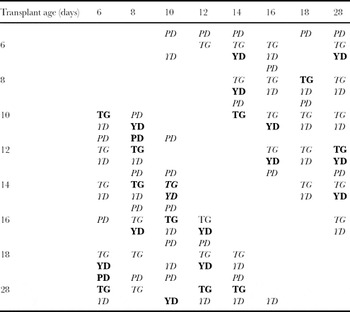
The data of the first year (2005) were analysed to detect the difference between the means of productive tillers per hill (PT), number of grains per panicle (or panicle density, PD), TG and yield among different seedling ages for each rice variety. A homogeneity χ2 test (χ2 = 25.8, df = 23) confirmed homogeneity of data from the replicated beds planted to the eight seedling ages at transplanting from both varieties. Results of sequential pairwise t-tests between the means of PD, TG and yield (g m−2) of all seedling ages at transplanting are given in Table 1, which indicates the following:
1. There was no significant difference (p > 0.1) in PD and TG when compared between their means for transplant ages ∈ (6 and 8 days), (10 and 12 days), (14 and 16 days), (16 and 18 days) and (18 and 28 days) for both the varieties.
2. Significant differences existed between means of TG and yield for transplant age (6, 8, 10, 12, 14 days) and for the age of 28 days.
3. The Means of PT varied between different seedling ages and between the rice varieties. The variability of the tiller numbers was too large for any seedling age to discern any definite trend.
4. The Means of grain yield (in weight per unit area) for transplant ages ∈ (6, 8, 10, 12, 14, 16 days), compared to that for 28 days was significantly different for both varieties.
Matrix of difference between means of panicle density (PD), total grain count per hill (TG) and yield (YD) for the lowland variety Shiuli (upper diagonal) and the upland variety Tulsa (lower diagonal) for the first year of study (2005).

Note: Letters in italics denote significance of difference (two-tailed test) at p < 0.05. Letters in boldface at p < 0.01. Blank spaces in cells indicate no difference.
Guided by these preliminary findings, 8-, 12- and 16-day old transplants were not repeated in the next phase of our study. In the subsequent four crop cycles, from 2006 to 2009, Tulsa and Shiuli rice seedlings were transplanted separately in four plots (with three replications), with each plot assigned to a discrete seedling age – 6-, 10-, 14- and 28-day-old seedlings for Tulsa, and 10-, 14-, 18- and 28-day-old seedlings for Shiuli. Following the SST technique of the SRI, seedlings of all ages were transplanted with single seedlings per hill. In addition, a plot for MST for 28-day-old transplants, with three replications, was also maintained for each variety. The 28-day MST plots, planted with three to four seedlings per hill, represent the conventional rice farming practice of eastern India. Each plot measured 2 m × 2 m, planted to 64 hills in eight rows and eight columns at 25 cm × 25 cm spacing. Thus, the planting density was the same (16 hills m−2) for all seedling ages in all years and for both SST and MST.
A structured random sample of 11 hills (comprising two randomly chosen hills from either the first or second row, and three randomly chosen hills from each of three alternate rows) was selected and marked, and the number of PT of each selected hill was counted after flowering. At maturity, all (primary, secondary and tertiary) panicles from each selected hill were harvested for enumeration of grains. Thus, the total number of panicles that were sampled and counted over the four years of study was as follows: [2 (cultivars) × {(4 (seedling ages SST) + 1 (28-day MST)} × 11 (hills) × n (panicles/hill) × 3 (replications) × 4 years] = 1320 n, where n represents the mean number of panicles per hill, ranging between 7 and 12, varying with year and treatment. Mean PD and mean TG were estimated from manual counting of grains of all sampled panicles from each plot. From each of the 1320 hills, a sample of 100 grains was weighed on a digital balance, and the mean 100-grain weight (MGW) was determined for each treatment from 100-grain weights from three replicate plots. Yield from each plot was calculated as the product of hill density (No. m−2), mean TG (No. hill−1) and MGW (g):

All sampled panicles are preserved in our laboratory for re-examination/verification by SRI researchers.
Statistical analyses
Statistical comparisons between treatment beds (among all seedling ages) were based on PT, TG and PD and yield data, obtained from three spatial replicates of each experimental treatment in respect of rice variety and seedling age.
After 2005, all experimental treatments, farm plot locations and the farm conditions were identical in the subsequent four years (from 2006 to 2009). The experiments over the four years may therefore be considered as four temporal replications of the experiment. These experiments were repeated each year afresh with the same design and protocol with replicated plots so that each experimental unit sampled independently in successive years constitutes a genuine temporal replication and not pseudoreplication (Hargrove and Pickering, Reference Hargrove and Pickering1992; Underwood, Reference Underwood1997). Accordingly, all PT, PD, TG and yield data from spatial replicates collected over four years were aggregated and subjected to a Student–Newmann–Keuls test for normality of distribution. The aggregate data showed that their distribution was not normal, and therefore Student's t-test was obviated. Instead, a Mann–Whitney U test was performed, with 95% confidence interval (CI). All PT, TG, PD and yield data for each treatment shown here are the mean values over all spatial and temporal replicates over four years.
RESULTS
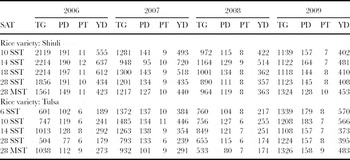
A summary of the mean number of panicles per hill (or PT), PD, TG and grain yield (g m−2) from all replications for each year are given in Table 2, and discussed under separate rubrics.
Year-wise comparison of total grain count per hill (TG), panicle density (PD), number of productive tillers (PT) and grain yield (YD) for different seedling ages at transplanting.

Note: SAT = seedling age (days) at transplanting. Values are rounded up for brevity.
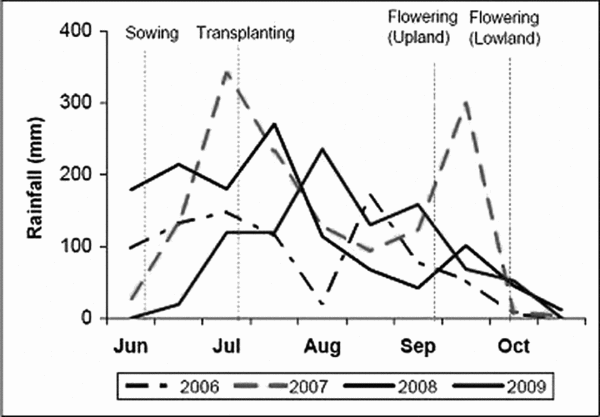
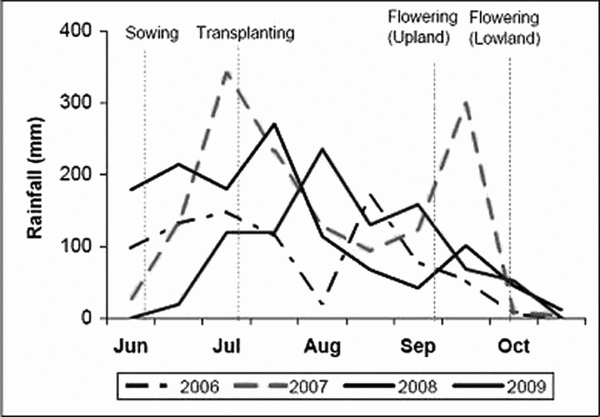
Overall, the PD, TG and yield figures are considerably less for the short-duration upland rice variety Tulsa than for the medium duration lowland variety Shiuli. However, the mean PT for young seedlings was consistently lower for all SST treatments of all seedling ages than for the conventional 28-day MST (henceforth shorthanded as ‘the MST’). The yearly fluctuations in PD, TG and yield in both rice cultivars seem to be influenced by variations in monsoon precipitation (Figure 1), but examination of this relationship is beyond the scope of this study.
Variation over the period from 2006 to 2009 in the amount of precipitation on Basudha farm.
Yield characteristics in the rain-fed upland variety Tulsa
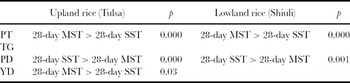
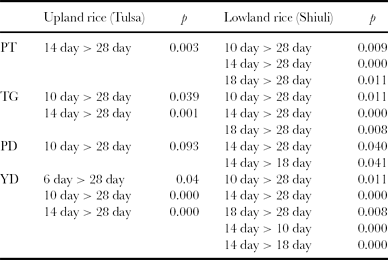
(1) The mean panicle density of SST 28-day transplants was significantly greater than that of the MST transplants (Table 3).
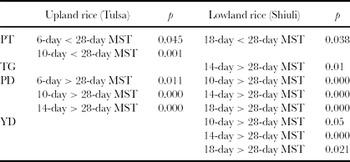
(2) There was no difference in TG between transplants of age 6 days and 28 days, but the TG for 10- and 14-day transplants were significantly greater than 28-day transplants (Table 4).
(3) None of the SST plots were any different from the MST plots in TG counts (Tables 3 and 5).
(4) There was no difference in PT between 6-day and 10-day transplants, but PT of 14-day transplants were significantly more numerous than that of 28-day transplants (Table 4). However, the MST produced significantly more PT than 6-, 10- (Table 5) and 28-day transplants (Table 3).
(5) Grain yield (g m−2) for 6-, 10- and 14-transplants was significantly higher than 28-day transplants (Table 4), but the yields from these SST plots were statistically no different from the conventional MST (Table 5). The yield of 28-day SST was significantly less than that of the MST (Table 3).
The effect of transplanting method (SST vs. MST) with 28-day-old rice plants on the number of productive tillers per hill (PT), total grain count per hill (TG), panicle density (PD) and grain yield (YD). Relationships that are statistically not significant (p > 0.05) are not shown.

Comparison of effects of seedling age on the number of productive tillers per hill (PT), total grain count per hill (TG), panicle density (PD) and grain yield (YD) for all SST treatments. Relationships that are statistically not significant (p > 0.05) are not shown.
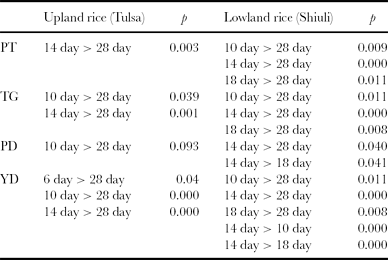
The effect of seedling age with SST on the number of productive tillers per hill (PT), total grain counts per hill (TG), panicle density (PD) and grain yield (YD) compared with conventional MST of 28-day-old seedlings. Relationships that are statistically not significant are not shown.

Yield characteristics in lowland variety Shiuli
(1) The mean panicle density from 28-day SST was significantly greater than that from the MST plots (Table 3). However, TG and yield of the MST were no different from 28-day SST (Table 3), indicating that the absolute number of grains per hill for older (>20 days) seedlings is unlikely to be influenced by the method of transplanting (SST or MST).
(2) The mean panicle density did not show any significant difference between 10-day and 14-day plots, but was significantly greater for 14-day than for 18- and 28-day transplants (Table 4).
(3) The number of productive tillers was significantly less for 28-day transplants than for all younger transplants (Table 4), and also less than the MST (Table 3).
(4) The total grain count per hill showed no significant difference among 10-, 14- and 18-day transplants, all of which were significantly greater than TG for 28-day (Table 3). TG for 14-d transplants was significantly different from the MST (Table 5).
(5) Plots with 10-, 14- and 18-day transplants produced significantly more PT, TG and yield than SST 28-day transplants (Table 4).
(6) Grain yield for 14-day transplants was greater than 10-, 18- and 28-day transplants (Tables 4 and 5).
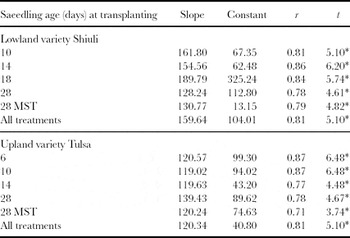
The only yield component that was significantly better in the conventional (28-day MST) plots than in SST plots with both young and old transplants of the upland variety Tulsa is the mean number of PT (Tables 3 and 5). MST 28-day transplants produced significantly more tillers than 18-day-old Shiuli transplants (Table 5). In contrast, SRI plots with young transplants of Shiuli produced significantly more tillers than SST 28-day plots (Table 4). A strong positive relationship holds between PT and TG across all seedling ages and within the two 28-day groups (SST and MST). The effect seems to be consistent in both the cultivars under study (Table 6).
Regression of total grain count per hill (TG) on productive tillers (PT).

* p < 0.01.
DISCUSSION
This study examines, for the first time, the effect of SRI practice on yield characteristics of two traditional photoperiod-sensitive landraces, repeated over four seasons. We examine here the standard SRI claims of increased number of PT and grain yields under separate rubrics. We then critically discuss the effects of various components of the SRI methodology – (a) single transplanting of (b) young seedlings, and posit our study in the light of previous experimental findings.
Productive tiller numbers
The panicle density, conjointly with PT determines the absolute grain yield on any farm. Thus, high yields are associated with large numbers of spikelets per unit area (De Datta, Reference De Datta1981), which rice scientists and farmers seek to achieve by using high plant densities (directly seeded or transplanted in clumps). However, stresses occurring during the later growth stages cause 2 to 50% tiller mortality, and unfilled spikelets, which normally are about 15% at harvest (Kropff et al., Reference Kropff, Cassman, Peng, Matthews, Setter and Cassman1994). The SRI practices may preclude such stresses by early transplanting of seedlings before the onset of the tillering process (Stoop et al., Reference Stoop, Uphoff and Kassam2002), leading to a positive correlation between PT and TG. In our study, the correlation of TG with PT is uniformly strong in all treatments with young seedlings as well as with conventional transplantation of 28-day-old seedlings (Table 6), indicating that PT does not significantly depend on seedling age at transplanting.
Profuse tillering (>50 hill−1) is often reported from SRI farms (de Laulaníe, Reference de Laulaníe1993; Stoop et al., Reference Stoop, Uphoff and Kassam2002; Uphoff, Reference Uphoff2003). Profuse tillering may be detrimental to grain production if the proportion of non-productive tillers is also high. A greater proportion of non-productive tillers may result in grain yield reduction, owing to high respiration cost and dry matter loss (Horie et al., Reference Horie, Shiraiwa, Homma, Katsura, Maeda and Yoshida2005; Schnier et al., Reference Schnier, Dingkuhn, De Datta, Mengel and Faronilo1990). However, SRI seems to reverse this relationship, and most of SRI studies report greater frequency of PT associated with greater grain yield. Stoop et al. (Reference Stoop, Uphoff and Kassam2002) report that with 25 cm × 25 cm or wider spacing of transplants, ‘farmers in Madagascar using SRI methods most skillfully can produce plants with more than 100 fertile tillers; the highest number reported is 140’. More modest means of 17.9 and 18.8 per hill, respectively, were reported by Thakur et al. (Reference Thakur, Uphoff and Antony2010a) and Thakur et al. (Reference Thakur, Rath, Roychowdhury and Uphoff2010b) at 25 cm × 25 cm spacing on their modified SRI plots. At the same spacing, rice plants on our SRI plots generated an overall mean of 9.7 PT per hill for Shiuli, and 7.7 PT per hill for Tulsa, both in rain-fed condition. The highest mean PT was 10.9 for Shiuli in 2006, and 9.1 for Tulsa in 2007.
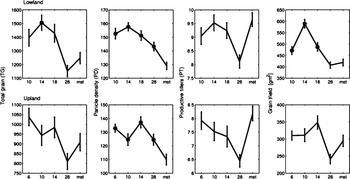
Our data thus do not conform to the standard report (de Laulaníe, Reference de Laulaníe1993; Gani et al., Reference Gani, Rahman, Dahono, Hengsdijk, Bouman, Hengsdijk, Hardy, Bindraban, Tuong and Ladha2002; Thakur et al., Reference Thakur, Uphoff and Antony2010a, Reference Thakur, Rath, Roychowdhury and Uphoffb; Uphoff, Reference Uphoff2003) of an enhanced tillering effect in SRI. On the contrary, PT is significantly greater on the MST plots than the SRI plots planted with 6- and 10-day-old seedlings of Tulsa, and 18-day-old seedlings of Shiuli (Table 5 and Figure 2), indicating that SRI does not seem to have any favourable effect on PT, for at least the rice varieties under study. The reason for this non-conformity to the previously reported SRI results is that the landraces, Shiuli and Tulsa, used in our study were not traditionally selected or bred for high tillering ability. As the tillering ability differs between rice varieties, ‘those varieties which have high tillering ability perform better as compared to the shy tillering ones’ under SRI method (Mahender Kumar et al., Reference Mahender Kumar, Surekha, Padmavathi, Subba Rao, Latha, Prasad, Babu, Ramprasad, Rupela, Goud, Raman, Somashekar, Ravichandran, Singh and Viraktamath2010: 64). The SRI method would not significantly enhance the tillering ability of Shiuli, Tulsa and many other inbred varieties that are not selected for this characteristic. Rather, SST would tend to reduce the number of PT per hill in the landraces examined.
Mean grain numbers per hill (TG), panicle density (PD), productive tillers (PT) and grain yield (g m−2) for traditional rice varieties adapted to rain-fed lowland (top) and upland (bottom) farms. Abscissae show seedling ages (in days), with MST denoting multiple transplants of 28-day-old seedlings. Vertical bars represent standard errors. Values that are significantly different from that of MST are marked with an asterisk.

Grain yield
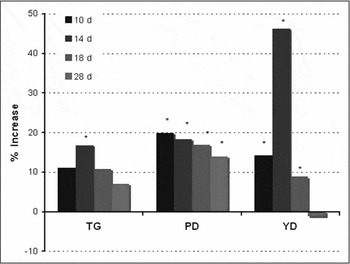
Our study seems to corroborate the standard claim of significant yield increase with early transplantation (Pasuquin et al., Reference Pasuquin, Lafarge and Tubana2008; Stoop et al., Reference Stoop, Uphoff and Kassam2002; Uphoff, Reference Uphoff2003; Uphoff et al., Reference Uphoff, Kassam and Stoop2008), but does not corroborate any miraculous yield improvement. As Figure 3 shows, transplanting of 10-, 14- and 18-day-old seedlings of the lowland variety Shiuli had a significantly positive effect on both PD and yield compared with conventional MST 28-day transplants. However, the effect disappeared in the upland variety Tulsa, whose younger transplants showed no difference from the MST in both TG and yield (Table 5 and Figure 2).
The effect of single-seedling transplanting of the lowland variety Shiuli with different transplant ages on grain numbers per hill (TG), panicle density (PD) and grain yield (g m−2) compared with the conventional MST. Each column shows the median value of all spatio-temporal replicates for a transplant age. An asterisk indicates significant difference from MST.

The standard recommendation in the SRI literature (e.g. de Laulaníe, Reference de Laulaníe1993; Stoop et al., Reference Stoop, Uphoff and Kassam2002; Uphoff, Reference Uphoff2003) is to transplant seedlings between 8 and 16 days, implying absence or uncertainty of the effect of transplants younger than 8 days. However, Gani et al. (Reference Gani, Rahman, Dahono, Hengsdijk, Bouman, Hengsdijk, Hardy, Bindraban, Tuong and Ladha2002) and Pasuquin et al. (Reference Pasuquin, Lafarge and Tubana2008) found that 7day-old transplants also produced early tillering and higher yield than 21-day-old transplants. Our study shows that for the upland variety Tulsa, grain yields of younger transplants of ages between 6 and 14 days are no better than that of the MST, while young transplants of Shiuli yield better than both MST and SST 28-day-old transplants (Tables 4 and 5). It seems likely that the extent of the effect of seedling age at transplanting on yield differs with varietal genotypes (Pasuquin et al., Reference Pasuquin, Lafarge and Tubana2008), which might explain the variability of effects of transplant age of <8 days.
The effect of SST on yield components
Transplantation of single seedlings with wide spacing is an essential component in SRI, and is thought to be a significant determining factor for tillering and grain yield improvement, even for conventional seedling age of >26 d (Horie et al., Reference Horie, Shiraiwa, Homma, Katsura, Maeda and Yoshida2005; San-Oh et al., Reference San-Oh, Mano, Ookawa and Hirasawa2004). Our study, however, shows that with 28-day-old seedlings, SST seems to be of no advantage over MST in terms of PT, TG, PD and yield for the upland variety Tulsa (Figure 2). Rather, the yield of MST was greater than SST for 28-day transplants of Tulsa (Table 3). Furthermore, PT of MST plots was significantly greater than that of most SST plots for both varieties in this study (Tables 3 and 5). However, PD and yield of the lowland variety Shiuli was significantly greater for all young transplants under SRI than that of the MST (Figure 3).
In this study, all SRI plots with SST produced significantly greater PD than the MST plots for both upland and lowland varieties (Tables 3 and 5). Conversely, SST plots with 28-day-old seedlings produced significantly less PT than MST plots (Table 3), indicating that SST may suppress tillering, possibly resulting in a yield drag, in old transplants. Furthermore, 28-day SST and MST plots showed no difference in TG counts for both rice varieties (Table 3). This finding is consonant with the findings of Oziegbe and Faluyi (Reference Oziegbe and Faluyi2007) with 21-day-old seedlings, and of Miah et al. (Reference Miah, Talukder, Sarkar and Ansari2004) with 26-day-old seedlings, planted at the same spacing. Moreover, yield decline was also reported for SST of 26-day-old (Prasad and Sheer, Reference Prasad and Sheer1992) and 30-day-old (Rahman et al., Reference Rahman, Khatun, Mamun, Islam and Islam2007) seedlings of different rice cultivars in spite of adequate nitrogen availability in soil.
The effect of early transplantation
Some early experiments in Japan recorded a positive effect of early (≥10 days) transplanting on grain yield, although these studies did not consider other components of SRI (Horie et al., Reference Horie, Shiraiwa, Homma, Katsura, Maeda and Yoshida2005). Our results (Table 4 and 5) show that the early age of seedlings at transplantation seems to be consistently conducive to grain yield enhancement.
However, when the TG and PD data are examined separately for years, the effect of early age of seedlings is not prominent, especially in the years of late monsoon arrival (2006 and 2009). For photoperiod-sensitive rice varieties, the younger the seedlings at transplanting, the longer the time to heading and maturity. Therefore, in places where growth duration is affected by temperature and/or availability of water, ‘young seedlings do not have enough time to express their potential’ (Horie et al., Reference Horie, Shiraiwa, Homma, Katsura, Maeda and Yoshida2005: 267). Nevertheless, Tables 4 and 5 show a consistent advantage of early transplanting in TG and grain yield over 28-day-old transplants on SST plots. In contrast, conventional transplantation of multiple old seedlings tends to engender significantly more PT than SRI transplants, especially the 6- and 10-day-old transplants of Tulsa (Table 5). For Shiuli, none of the SST plots produced more productive tillers than the MST (Table 3 and 5), but within the SRI plots, the mean PT of younger transplants was significantly greater than that of 28-day-old transplants (Table 4).
The role of water management
Scanty rainfall in low-rainfall districts and the late arrival of the monsoon rain constitute water stress for the rice plant, affecting its yield characteristics (Sarvestani et al., Reference Sarvestani, Pirdashti, Sanavi and Balouchi2008). It is plausible that fluctuations in rainwater availability around vegetative and panicle initiation stages of the rice plants (Figure 1) might have influenced the observed variability of grain outputs on both the SRI and MST plots in our study. However, our study was not designed to ascertain the effect of water availability on SRI, nor would the comparable datasets for only four years of our study period allow us to infer any relationship.
The role of soil nutrients
Soil nutrient level is an important factor for high yielding response of rice (Rahman et al., Reference Rahman, Khatun, Mamun, Islam and Islam2007). Proponents of SRI have attributed the reported yield increment from SRI to a greater number of PT, and more efficient resource capture and apportionment of nutrients for grain production (Nissanka and Bandara, Reference Nissanka and Bandara2004; Stoop et al., Reference Stoop, Uphoff and Kassam2002). Successful yield enhancement under SRI is reported only from farm plots with high nitrogen supplying ability of the soil and accumulated organic carbon from surface to deep soil, attributable to the long-term practices of extensive organic applications and deep plowing; so the high yield from these SRI farms was mainly due to high soil fertility, especially ‘the great nitrogen-supplying ability of the soil, rather than “synergetic effects” (sic) of SRI components’ (Tsujimoto et al., Reference Tsujimoto, Horie, Randriamihary, Shiraiwa and Homma2009: 70). The low nitrogen and potassium levels in the soil of Basudha farm thus may account in this study for overall low grain yields.
The role of transplant density and spacing
Spacing of rice hills at 25 cm × 25 cm (up to 16 transplants m−2) is considered to be most conducive for a combination of yield characteristics in the SRI plots (Stoop et al., Reference Stoop, Uphoff and Kassam2002; Thakur et al., Reference Thakur, Rath, Roychowdhury and Uphoff2010b), and we have strictly followed this stipulated spacing on all SRI and conventional plots. Our experiments therefore cannot tell if the results are likely to change with closer spacings or greater transplant densities. Some experiments (Latif et al., Reference Latif, Islam, Ali and Saleque2005; Menete et al., Reference Menete, van Es, Brito, DeGloria and Famba2008; Sheehy et al., Reference Sheehy, Peng, Dobermann, Mitchell, Ferrer, Yang, Zou, Zhong and Huang2004), however, found the use of wider spacing of rice plants in SRI to have resulted in lesser yield per unit area than conventional rice farming practices. In these studies, SRI failed to achieve the desired yield enhancement plausibly because the growth of seedlings transplanted at wide spacing ‘exceeded the [nutrient] capacity of those soils’ (Thakur et al., Reference Thakur, Rath, Roychowdhury and Uphoff2010b: 156).
The role of genotypes
Yield enhancement was observed in certain studies, even where SRI was not strictly followed (Senthilkumar et al., Reference Senthilkumar, Bindraban, Thiyagarajan, de Ridder and Giller2008; Thakur et al., Reference Thakur, Rath, Roychowdhury and Uphoff2010b). Conversely, SRI failed to elicit yield improvement in some studies (McDonald et al., Reference McDonald, Hobbs and Riha2006, Reference McDonald, Hobbs and Riha2008). Both types of evidence indicate that rice yield components are flexible, responding to different field management regimes depending on the cultivar genotype. Some cultivars may not be suitable for SRI conditions (e.g. low transplant densities, limited water supply).
Most rice breeding programs employ selection criteria with respect to tillering (only three to four tillers/plant), optimum plant densities and response to chemical fertilisers, all of which differ fundamentally from what would be desirable for the SRI-adapted cultivars (Stoop et al., Reference Stoop, Uphoff and Kassam2002). All the yield components – tillering ability, panicle density and grain weight – depend on the cultivar genotype, albeit greatly influenced by environmental conditions and field management practices (De Datta, Reference De Datta1981). Extensive interactions between genotypes and environment result in adaptation of different varieties to specific environmental conditions (Xing and Zhang, Reference Xing and Zhang2010). For a reliable prediction of the yield response to SRI, it is necessary to identify the ‘cultivars that have been proven to be optimally adapted to a particular system’ (Stoop et al., Reference Stoop, Adam and Kassam2009). The cultivars used in our study were shy tillering landraces, and therefore showed no definitive change in PT in the SRI conditions. However, the grain yield components of the lowland variety Shiuli under SRI conditions showed significant improvement compared with the MST treatment, indicating its responsiveness to SST and younger seedling age at transplanting.
LIMITATIONS OF THE STUDY AND THE NEED FOR FURTHER RESEARCH
Most of the studies that have reported spectacular effects of SRI used only a few rice varieties, most of which are modern cultivars, grown in irrigated lowland conditions. Consequently, their practical agronomic relevance to rain-fed local rice varieties in much of South Asia remains limited. Also, the evidence in literature of adverse or no effect of SRI is based on short-term, simple assessments through field experiments conducted in a single season (e.g. Sheehy et al., Reference Sheehy, Peng, Dobermann, Mitchell, Ferrer, Yang, Zou, Zhong and Huang2004) or confined to a single rice genotype (e.g. Latif et al., Reference Latif, Ali, Islam, Badshah and Hasan2009; Senthilkumar et al., Reference Senthilkumar, Bindraban, Thiyagarajan, de Ridder and Giller2008).
We have not used any modern rice varieties in our study because they are usually bred to optimise production under favourable soil and water conditions (Pandey and Pal, Reference Pandey and Pal2007; Stoop et al., Reference Stoop, Adam and Kassam2009). Instead, we have used two traditional rice landraces, which are tolerant of various local environmental stresses (such as low soil fertility). However, not all traditional varieties can outperform modern varieties in marginal environments. The yield performance of the traditional variety, Basmati, for example, is marginally better under SRI than under conventional transplanting practice, but its grain yield is considerably poorer than most hybrid rice varieties under the same management regime (Mahender Kumar et al., Reference Mahender Kumar, Surekha, Padmavathi, Subba Rao, Latha, Prasad, Babu, Ramprasad, Rupela, Goud, Raman, Somashekar, Ravichandran, Singh and Viraktamath2010). Thus, a comparison of yield performances between modern elite varieties and local landraces under SRI conditions would be spurious. Our study has precluded this bias, and compared two low-yield traditional rice varieties that are grown on rain-fed upland and lowland farms.
Clearly, two local varieties are not adequate to find the degree of genotypic sensitivity of rice varieties to SRI conditions. However, experimental studies with local landraces are hard to come by. In view of the wide genetic diversity of rice, with thousands of extant varieties, each adapted to a specific edapho-climatic condition (Deb, Reference Deb2005; Oupkaew et al., Reference Oupkaew, Pusadee, Sirabanchongkran, Rerkasem, Jamjod and Rerkasem2011), it may take an indefinite period of time for researchers to ascertain the precise relationship between the genotypes grown in different environmental conditions and respective grain yield-related characteristics.
CONCLUSIONS
Rice grain yield is a quantitative trait and characterised by low heritability and a high genotype × environment (G × E) interaction (Farooq et al., Reference Farooq, Kobayashi, Wahid, Ito and Basra2009). To determine the effect of a cultivation technique on yield, it is important to consider the cultivar genotype adapted to specific land type and local environmental conditions, including soil nutrient levels and seasons of cultivation (e.g. winter vs. summer). Therefore, the complex task of assessing the specific merits of the various rice cultivars and production systems is ‘compounded further by the numerous location-specific natural and socio-economic factors that are encountered in any farming environment’ (Stoop et al., Reference Stoop, Adam and Kassam2009: 1499).
Our study contradicts the inference of McDonald et al. (Reference McDonald, Hobbs and Riha2008) that there is no prima facie evidence of significant yield increase from SRI in wet paddy cultivation in ‘countries outside Madagaskar’, as the mean yield from young transplants of Shiuli was significantly greater than conventional MST (Figure 3). However, the effect is evident only for the lowland variety Shiuli (Table 5 and Figure 2). For both rice varieties tested in our experiment, the TG and PD fluctuated with years, a likely response to the amount of rainfall, but the mean PD in both the varieties was greater in young transplants. This is in agreement with the SRI results from Mali: Although experimental land was not optimally levelled and the irrigation schedule was the same as for the non-SRI irrigation scheme, yield components significantly improved in SRI plots (Africare, 2008; Styger et al., Reference Styger, Aboubacrine, Attaher and Uphoff2011). Nevertheless, the extent of yield improvement in our study is far from spectacular (Figure 3). It remains to be examined if the yield-enhancing effect of SRI in Madagascar, Mali and in our study (with Shiuli) is a result of the selection of appropriate rice cultivars, which have not been used in other experiments in other countries. Because many farmer landraces are characterised by different farmer-selected properties not related to yield components, it seems plausible that the yield of those rice genotypes (e.g. Tulsa) may not respond well to the SRI conditions, while others would.
The results of our study show that SRI tends to improve TG for Tulsa with transplant age of 10 and 14 days, and for Shiuli with transplant age of 10, 14 and 18 days, compared with SST plots with 28-day-old transplants (Table 4). For Shiuli, the only seedling age at transplanting that was associated with considerable TG enhancement was 14 days, compared with MST (Table 5 and Figure 3). Yield was also significantly greater in young Shiuli transplants than the MST (Table 5 and Figure 3). This apparent yield advantage of SRI over conventional MST disappeared in the upland rice Tulsa. Conversely, SRI was clearly a disadvantage for PT compared with the conventional MST (Table 5 and Figure 2), indicating that SRI may not be particularly economical for rain-fed upland varieties in spite of the fact that many upland varieties, including Tulsa, are moderately drought-tolerant.
The controlled water regime of alternate drying and flooding of SRI may not always improve yield in lowland varieties, as indicated by Satyanaraya et al. (Reference Satyanarayana, Thiyagarajan and Uphoff2007). In our study, rice yield improvement in SRI plots was absent in the upland variety Tulsa. Although the yield from SRI was significantly greater compared with the conventional MST plots in the lowland variety Shiuli, the extent of improvement was restrained by water stress from scanty or delayed rains in some years. Given the fact that resource-poor farmers do not have access to irrigation in their upland farms and must rely on precipitation, SRI may not be of any practical benefit to rain-fed upland farms – unless the production system is coupled with some reliable water management system, such as stored rainwater for intermittent irrigation during periods of dry spells. It would therefore be safe to recommend SRI specifically for certain lowland rice varieties rather than a blanket prescription for any and all varieties.
Acknowledgements
We are grateful to Debdulal Bhattacharjee, Bhairab Saini, Haru Roy, Shanti Roy and other volunteers at the Basudha Research Farm for field assistance and counting of the thousands of rice panicles and spikelets; S. Karmakar and A. Paul of the Department of Agriculture, West Bengal for their kind help with meteorological and soil chemistry data; and two anonymous reviewers for their perceptive critiques and suggestions on the earlier drafts of the manuscript.