Implications
Foot disorders in current dairy farming cause high economic losses and are the most important health problem in terms of animal welfare. In order to improve dairy cow foot health, farmers need to take measures on their farm. This study supports the decision making of farmers when choosing between different intervention measures. Insight into the costs and benefits of different intervention measures are provided, making it possible to rank intervention measures on cost-effectiveness and welfare benefits.
Introduction
Dairy farming in western countries in its current form with cubicle housing and mainly concrete flooring is an efficient way of dairy farming in terms of labor and space requirements. A disadvantage is the high prevalence and incidence of foot disorders (clinical and subclinical; Hedges et al., Reference Hedges, Blowey, Packington, O'Callaghan and Green2001; Somers et al., Reference Somers, Frankena, Noordhuizen-Stassen and Metz2003), which cause high economic losses (Bruijnis et al., Reference Bruijnis, Hogeveen and Stassen2010; Ettema et al., Reference Ettema, Østergaard and Kristensen2010) and also seriously impair the welfare of dairy cattle (Bruijnis et al., Reference Bruijnis, Beerda, Hogeveen and Stassen2012). The different foot disorders are present in varying severities and have multifactorial risk factors, making it a difficult health problem to combat (Ward, Reference Ward2009). Another difficulty is the commitment of dairy farmers. Research has shown that farmers underestimate the scale of the problem and the effects on animal welfare (Leach et al., Reference Leach, Whay, Maggs, Barker, Paul, Bell and Main2010). In order to improve dairy cow foot health, clear and unambiguous advice has to be given to the farmer. To point out the importance of reducing the presence and severity of foot disorders, advice should include information about the scale of the problem and the consequences in terms of economics and animal welfare. Different intervention measures can be taken to improve dairy cow foot health, such as improvement of the flooring (Vanegas et al., Reference Vanegas, Overton, Berry and Sischo2006), lying surface (Cook and Nordlund, Reference Cook and Nordlund2009) and hygiene (Somers et al., Reference Somers, Frankena, Noordhuizen-Stassen and Metz2005b), but also regular checking and trimming (Pavlenko et al., Reference Pavlenko, Bergsten, Ekesbo, Kaart, Aland and Lidfors2011). Each measure has its own effect on foot disorders. Different measures also require a different investment in terms of money and labor of the farmer. To provide support in making decisions on implementing intervention measures on dairy farms with cubicle housing, insight into costs and benefits of different measures should be available. Besides financial benefits of the measures, other benefits should be included as well because farmers are not only motivated by money, but also by a good health and welfare of the animals (Valeeva et al., Reference Valeeva, Lam and Hogeveen2007). The objective of this study, therefore, is to provide more insight into the costs and benefits for farmer and cow, of different intervention measures to improve dairy cow foot health in a cubicle housing system.
Material and methods
To estimate the costs and benefits of different intervention measures, different steps have been taken in this research. The first step was a literature study to select the measures to be studied, including an estimation of the effect of these measures on the presence of the different foot disorders. The second step included the modeling of foot disorder dynamics and the effects of intervention measures on them, using a dynamic Monte Carlo simulation model. This was followed by a calculation of the benefits following from these effects. The costs of investing in intervention measures were calculated, to finally calculate the net costs of the intervention measures. A sensitivity analysis was performed to study the importance of the different parameters.
Selection of intervention measures
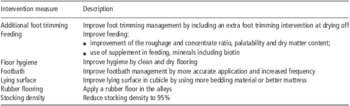
The literature study was aimed at seven important foot disorders as identified in our previous work (e.g. Bruijnis et al., Reference Bruijnis, Hogeveen and Stassen2010): interdigital phlegmon (IP), interdigital dermatitis and heel horn erosion (IDHE), digital dermatitis (DD), sole hemmorhages (SoH), white line disease (WLD), sole ulcer (SUL) and interdigital hyperplasia (HYP). Literature was searched for papers about lameness, foot, claw or hoof disorders in dairy cattle and intervention measures. Papers were judged on relevancy based on type of study, research design (number of farms, animals), type of data (possibility to calculate efficacy of measures), country, experimental circumstances (e.g. housing, breed, climate). The different intervention measures found in the literature were listed and subsequently the measures were evaluated on their applicability on a dairy farm with cubicle housing. Only those intervention measures applicable without a large renovation of the farm were included. The default dairy farm resembled a common Dutch dairy farm with cubicle housing, a concrete (slatted) floor, mainly Holstein Friesian dairy cows, pasturing during summer and two foot trimming interventions per year. Other common farm characteristics are an average milk production of 8500 kg, adjusted to production level, stage of lactation and parity, based on Dutch data (see Bruijnis et al., Reference Bruijnis, Hogeveen and Stassen2010). Further assumptions are: no overstocking (cubicle–cow ratio at least 1 : 1), standard dry cow management, milking and housing circumstances. The following measures were included: performing additional foot trimming, improve feeding management by improvement of structure and concentrate/roughage ratio and adding feed supplements, improve floor hygiene, improve the management of foot bathing (frequency, concentration, etc.), improve the lying surface (grip, softness, etc.), apply rubber flooring in the alleys and reduce stocking density (Table 1).
Selected intervention measures based on the applicability of the measure in a dairy farm with cubicle housing

Estimating effects of intervention measures
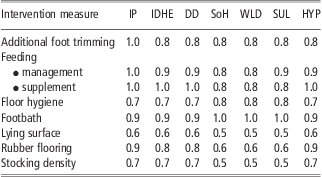
The simulation model as used (see next paragraph) uses probabilities to simulate the chance that a cow gets a foot disorder. The chances depend on season and cow characteristics like parity and production level. The effect of intervention measures was modeled using an adjustment factor, representing the reduced probability to get a foot disorder by application of that measure. The adjustment factors were estimated using the available information from the literature and authors’ expertise (Table 2). In case the literature did not provide quantitative information, qualitative information was used to estimate the direction and magnitude of the effect of a measure. If only the effects on one or a few of the distinguished foot disorders could be specified based on the literature, the effects were extrapolated to other foot disorders, using the available knowledge on the foot disorders and their etiology. The reasoning for this included the knowledge that the infectious foot disorders IDHE and DD were assumed to be influenced comparably by the intervention strategies because these foot disorders have some causative bacteria in common. For example, Somers et al. (Reference Somers, Frankena, Noordhuizen-Stassen and Metz2005a and Reference Somers, Frankena, Noordhuizen-Stassen and Metz2005b) found that risk factors had an effect on these foot disorders in a comparable way. IP is an infectious foot disorder as well; however, information on the effect of interventions on IP is very scarce. The best described risk factors are cow-related factors such as stage of lactation (Alban et al., Reference Alban, Lawson and Agger1995). The logic about this foot disorder is mainly based on the fact that age and stage of lactation are important cow factors and that improvement in health status of other foot disorders is associated with improvement in IP (Alban et al., Reference Alban, Lawson and Agger1995). Furthermore, information about risks of infection about DD and IDHE has been extrapolated to IP in case the measure was likely to have an effect on the etiology of IP. SoH and WLD are both claw horn lesions (CHL) resulting from mechanical or physical damage and also influenced by feeding ration (Webster, Reference Webster2001). The effect of interventions on these foot disorders was assumed to be equal. SUL is a secondary foot disorder and associations between this foot disorder and SoH and IDHE have been found (Manske et al., Reference Manske, Hultgren and Bergsten2002a; Amstel and Shearer, Reference Amstel van and Shearer2006a; author expertise). In case intervention measures affected these foot disorders, it has been assumed that SUL decreased similarly. HYP is also a secondary foot disorder and mainly follows after severe infections (Amstel and Shearer, Reference Amstel van and Shearer2006b; Watson, Reference Watson2007). Therefore, it has been assumed that interventions reducing severe DD and IDHE also will reduce HYP. The adjustment factors for each intervention measure are given in Table 2 and are explained below.
Estimated effects of the different intervention measures given as adjustment factor for the probability of getting a foot disorder compared with the default situation

IP = interdigital phlegmon; IDHE = interdigital dermatitis and heel erosion; DD = digital dermatitis; SoH = sole hemorrhage; WLD = white line disease; SUL = sole ulcer; HYP = interdigital hyperplasia.
The estimations are derived from available literature and existing knowledge, gray cells indicate that the estimation is based directly on numbers found in literature as well.
Additional foot trimming
Application of extra foot trimming in a correct way and paying extra attention to foot health at certain periods of the lactation influences foot health positively (e.g. Manske et al., Reference Manske, Hultgren and Bergsten2002b). Combined with the finding that foot trimming at drying off can result in a significant improvement (Hernandez et al., Reference Hernandez, Garbarino, Shearer, Risco and Thatcher2007; Garcia-Bracho et al., Reference Garcia-Bracho, Hahn, Pino, Vivas, Leal and Clerc2009), the factor for the improvement due to additional foot trimming was estimated.
Feeding
A better feeding management by improving the ratio between concentrates and roughage and feed with more gradual transitions can improve claw health (Manson and Leaver, Reference Manson and Leaver1988; Somers et al., Reference Somers, Frankena, Noordhuizen-Stassen and Metz2003). Studies on the effects of feed on lameness vary a lot, but it can be concluded that feeding primarily affects CHL (SoH, WLD; e.g. Leach et al., Reference Leach, Offer, Svoboda and Logue2005). A more gradual step-up in concentrates had a positive effect on IDHE and DD (Somers et al., Reference Somers, Frankena, Noordhuizen-Stassen and Metz2005a and Reference Somers, Frankena, Noordhuizen-Stassen and Metz2005b) and a high concentrate diet has been found to have a negative effect on DD (Olmos et al., Reference Olmos, Boyle, Horan, Berry, O'Connor, Mee and Hanlon2009) and locomotion score (Onyiro et al., Reference Onyiro, Offer and Brotherstone2008). Sufficient levels of minerals in the feed are known to be essential in improving hoof quality. Studies on biotin did find no effects on IDHE but did find effects on SoH and WLD (Hedges et al., Reference Hedges, Blowey, Packington, O'Callaghan and Green2001; Bergsten et al., Reference Bergsten, Greenough, Gay, Seymour and Gay2003).
Floor hygiene
Studies give varying results on the use of manure scrapers, possible due to varying circumstances in stocking density and speed and frequency of the scraper. However, different studies have shown positive effects of hygienic, dry flooring on the occurrence of foot disorders (Somers et al., Reference Somers, Frankena, Noordhuizen-Stassen and Metz2005a and Reference Somers, Frankena, Noordhuizen-Stassen and Metz2005b), which can be achieved by the use of a scraper or manure robot.Footnote 1
Footbath
Most studies aimed at agents that are allowed in The Netherlands do not find significant effects of footbath management (Holzhauer et al., Reference Holzhauer, Döpfer, De Boer and Van Schaik2008; Thomsen et al., Reference Thomsen, Sørensen and Ersbøll2008). The effect on the foot disorders for which this measure is executed most, that is DD and IDHE, is therefore estimated to be small.
Lying surface
In general the possibility to lay down, lie and stand up comfortably are associated with a reduction in lame cows (Cook and Nordlund, Reference Cook and Nordlund2009). Different studies provided numbers on reduction of foot disorders by improving design and bedding of cubicles (e.g. Philipot et al., Reference Philipot, Pluvinage, Cimarosti, Sulpice and Bugnard1994; Barker et al., Reference Barker, Amory, Wright, Mason, Blowey and Green2009).
Rubber flooring
A reduction in the incidence or prevalence of foot disorders as a result of rubber flooring is found by Ouweltjes et al. (Reference Ouweltjes, Holzhauer, Van der Tol and Van der Werf2009) and Vanegas et al. (Reference Vanegas, Overton, Berry and Sischo2006). Combined with the findings that rubber increases comfort (Platz et al., Reference Platz, Ahrens, Bendel, Meyer and Erhard2008), it is reasoned that by providing more grip and reducing slips, injuries and damage to the feet (SoH, WLD and SUL) are prevented better than infectious foot disorders (like DD), which are more associated to hygienic circumstances.
Stocking density
Direct effects of stocking density on foot health are not found in literature. It is known that overstocking leads to reduced lying and increased standing (Fregonesi et al., Reference Fregonesi, Tucker and Weary2007), which is a risk factor for foot disorders (Leonard et al., Reference Leonard, O'Connell and O'Farrell1996). As stocking density influences lying and standing time and social behavior, the effect is estimated to be in the range of flooring (walking, slips and resulting damages, etc.) and lying surface (lying time).
Modeling dynamics of foot disorders
The stochastic dynamic simulation model simulating economic consequences and welfare impact of different foot disorders, used in our previous studies (Bruijnis et al., Reference Bruijnis, Hogeveen and Stassen2010 and Reference Bruijnis, Beerda, Hogeveen and Stassen2012), has been used for the current study. The default situation represents a common dairy farm in The Netherlands. The model simulates the presence of foot disorders per cow per year, depending on parity, stage of lactation and milk production level. Each run of the simulation model represents a cow. The foot disorders are simulated in time-steps of one month. For IP, in the welfare calculation, a correction is made to account for the fact that this foot disorder normally is cured within a week (after treatment with antibiotics). In the model, there are three different states possible for foot health of a dairy cow: having no foot disorder, a subclinical foot disorder or a clinical foot disorder. A cow that has no foot disorder has a probability of getting one in the next month, depending on cow characteristics like the parity and milk production level. The modeled foot disorders, except IP and SUL, first occur subclinically. When a subclinical foot disorder is present, the foot disorder has a probability to cure (in case of a foot trimming intervention), to remain the same or to progress to a clinical foot disorder in the next month. A clinical foot disorder has a probability to cure, depending on the probability of treatment and the cure rate after treatment. Furthermore, the model includes the possibility that a cow with a clinical foot disorder is culled. The simulation model generates outcomes on the duration and the incidence of the different foot disorders, specified for subclinical and clinical stages, for each cow independently. Summing up the individual cow data gives the herd level results for presence of foot disorders. Subsequently, these outcomes are used to calculate the economic consequences and welfare impact of the dairy cow foot health status on the farm. The modeling of cow characteristics, foot disorder dynamics and economic consequences has been described in detail by Bruijnis et al. (Reference Bruijnis, Hogeveen and Stassen2010) and the modeling of welfare has been described in detail by Bruijnis et al. (Reference Bruijnis, Beerda, Hogeveen and Stassen2012). In short, the economic consequences distinguished are milk production losses (8% for clinical and 3% for subclinical foot disorders), prolonged calving interval (chance of 60% for clinical and 20% for subclinical foot disorders for an increase of 21 days), costs for labor of the farmer, foot trimmer and veterinarian, cost for treatment (e.g. antibiotics) and discarded milk. The welfare impact is estimated using the estimated pain of the clinical and subclinical occurrences of the foot disorders as a basis.
Calculating benefits of intervention measures
The probabilities for getting a foot disorder in the default situation were adjusted for the different intervention measures based on the estimated adjustment factors (Table 2), giving the economic losses and welfare impact of the foot disorders in the situations with the different intervention measures. Benefits of the intervention measures were calculated by taking the difference between the default situation and the situation where the intervention measure is applied, both for economics and welfare impact (where maximum welfare impact is 60).
Calculating costs of intervention measures
Costs of housing adjustments were calculated by using the prices of the investments, costs of installation, maintenance costs, depreciation and an interest rate of 5%. It was assumed that investments were made according to the operating instructions and implemented on a dairy farm with cubicle housing. Price information about investments and purchases was requested from at least two different companies, which supply the materials using the current prices. Rubber flooring consists of covering the floor of the alleys with rubber. Improvement of lying surface consists of providing softer rubber mattress providing grip or providing more bedding. Floor hygiene measures relate to the investment of a manure scraper or manure robot to improve cleanliness of the flooring – assuming that no negative side effects can occur due to overstocking or due to speedy or too frequent use of the scraper – or increased manual cleaning of the alleys. Improving footbath management is aimed at executing the measure in the most appropriate way. Because a specific advice for agent, frequency of treatment, etcetera is not available (Laven and Logue, Reference Laven and Logue2006), the measure includes that the footbath be applied in a suitable frequency, that the claws be cleaned before foot bathing, that a suitable disinfectant in the right concentration be used and that the number of cow passages per bath be limited and feet dry before going into the barn again (Nuss, Reference Nuss2006). Costs for an improved footbath management therefore include costs of a new footbath, extra costs for the agent and labor due to extra treatments and pre-cleaning of the hooves. Additional foot trimming includes extra foot trimming at drying off, performed by a foot trimmer. There are two different measures relating to feeding. An improved feeding management includes costs for better roughage and concentrates. Feeding supplement includes costs for supplemental minerals. Costs for labor are calculated for the measures that need extra labor, like provide more bedding.
Net costs of intervention measures
The net costs of the intervention measures were calculated by calculating the difference between the economic benefits, as estimated from the model simulations, and the calculated costs of the measures. This could be positive, meaning a cost, or negative, meaning a benefit (i.e. a cost-effective measure). Moreover, a net cost–welfare benefit ratio was calculated by dividing the net costs by the welfare benefit. The net cost–welfare benefit ratio gives the net costs per point of welfare improvement.
Sensitivity analysis
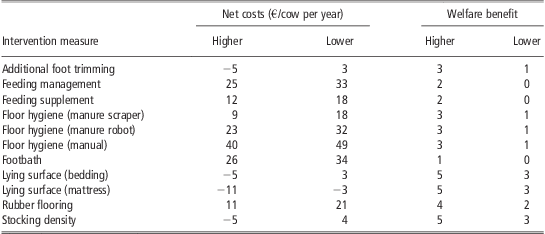
A sensitivity analysis was performed to obtain insight into the sensitivity of the estimated effects of the measures. For this purpose all adjustment factors (see Table 2) were increased and decreased with 0.1, giving insight into the effect of the efficacy of the measures.
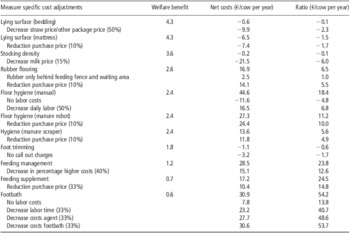
Furthermore, the effect of different estimates of costs were made giving insight into the importance of different cost aspects of intervention measures.
Results
Costs and benefits of different intervention measures
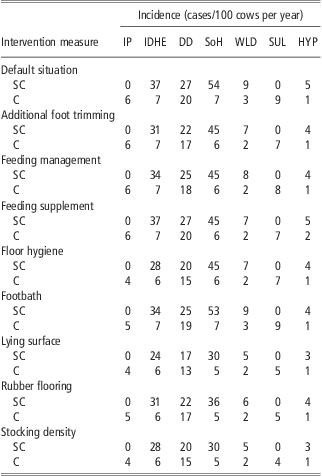
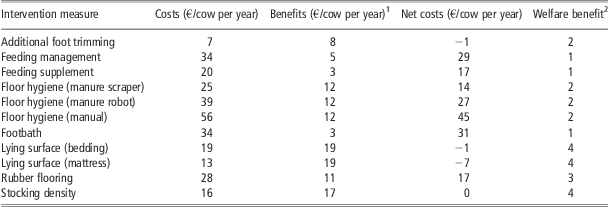
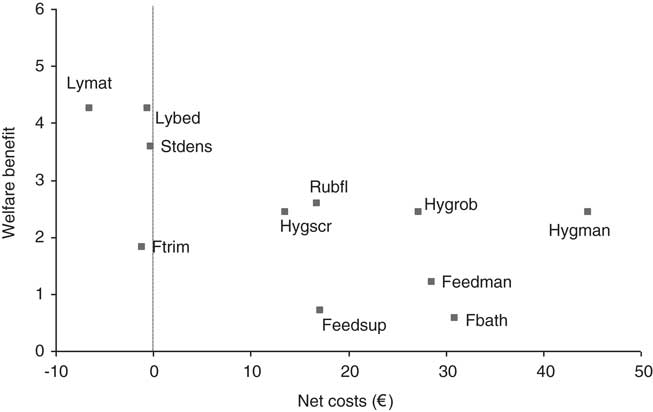
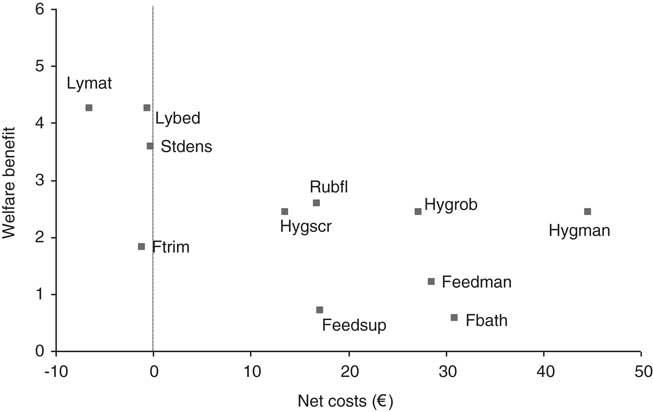
The literature provided a very limited number of peer-reviewed articles providing quantitative data useful to estimate the efficacy of intervention measures. Adjustments of the probabilities for getting foot disorders were based on the current knowledge available (including personal communication and non-peer-reviewed sources next to the peer-reviewed papers), resulting in the incidence as presented in Table 3. In the default situation, the economic losses are €53/cow per year and the average negative welfare impact per cow per year is 12 (where 60 is the maximum). The calculated costs for the different interventions vary between €7/cow per year for additional foot trimming and €56/cow per year for manual cleaning of the alleys. The benefits have a smaller range: economic benefits vary between €1 and €19 and animal welfare benefits between 0 and 4/cow per year. Improving feeding and footbath management have low values for economic and welfare benefits with relatively high net costs. Lying surface has the highest benefits and is a cost-effective measure (Table 4). The following intervention measures are cost-effective measures in terms of economics; lying surface (mattress and bedding, €7 and €1/cow per year, respectively), stocking density (break even) and foot trimming (€1/cow per year). Figure 1 shows the relation between welfare improvement and the net effect in economic terms. Costly measures like manually cleaning the floor or foot bathing do not gain much in terms of welfare. Measures needing some investment and not being cost-effective can, however, result in substantial welfare benefit, like the application of a rubber floor or a manure scraper.
Incidence of the different foot disorders, SC and C, by execution of the different intervention measures

SC = subclinical; C = clinical; IP = interdigital phlegmon; IDHE = interdigital dermatitis and heel erosion; DD = digital dermatitis; SoH = sole hemorrhage; WLD = white line disease; SUL = sole ulcer; HYP = interdigital hyperplasia.
Calculated costs and benefits for the different intervention measures
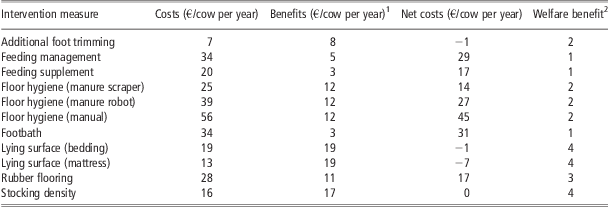
1In the default situation, foot disorders cause an economic loss of €53/cow per year (Bruijnis et al., Reference Bruijnis, Hogeveen and Stassen2010).
2In the default situation, foot disorders cause on average a negative welfare impact of 12/cow per year (Bruijnis et al., Reference Bruijnis, Beerda, Hogeveen and Stassen2012).
Effect of intervention measures on welfare benefits and net costs. Rubfl = rubber flooring; Stdens = stocking density; Lymat and Lybed = lying surface, mattress or bedding, respectively; Hygscr, Hygrob and Hygman = floor hygiene by scraper, robot or manual cleaning, respectively; Fbath = footbath; Ftrim = foot trimming; Feedm = feeding management; Feedsup = feeding supplement.
Sensitivity analysis
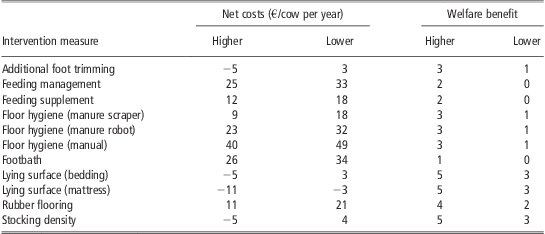
The results for the adjusted probabilities for getting a foot disorder show that with the adjustment of 0.1 the cost-effectiveness of the measures does not change substantially (Table 5). The sensitivity of the costs for executing the measures shows that assumptions and specific circumstances can influence the results considerably. For example, excluding the costs for labor makes some measures much more interesting from cost-effectiveness point of view, as is the case for manual cleaning of the floor or foot bathing (Table 6). Moreover, the way a measure is executed can influence the cost-effectiveness considerably, for example, when only putting rubber behind the feeding fence and waiting area, the measure almost becomes cost-effective. In addition, when less labor is needed to execute a measure, the measure becomes much more interesting, like foot bathing. A decrease in milk price will make it more attractive for farmers to reduce the number of cows, as positive effect on costs will increase considerably (>100% increase by decrease in milk price of 15%; Table 6).
Sensitivity analysis; effects of intervention measures with higher or lower adjustment factors (±0.1, respectively) for the probability of getting a foot disorder, showing the effects on net costs and welfare benefit
Sensitivity analysis; the effect of adjustments in the costs of intervention measures on the net cost−welfare benefit ratio

Discussion
The presented results give insight into the costs and benefits of different intervention measures to improve dairy cow foot health. The study aimed at intervention measures, which are applicable on a dairy farm with cubicle housing. Measures were included when a reasonable estimation could be made, based on literature and expert knowledge, about the effects on dairy cow foot health. For different measures the amount of information was insufficient to model the effects, for example improved heifer management as mentioned by Rouha-Mülleder et al. (Reference Rouha-Mülleder, Iben, Wagner, Laaha, Troxler and Waiblinger2009), where a good description of the measure and the expected effects are lacking. A very important intervention measure is management improvement by the farmer; ‘stockmanship’. Hanna et al. (Reference Hanna, Sneddon and Beattie2009) suggested that stockperson attitude may be important in relation to dairy cow welfare, and different studies show that knowledge and awareness and an active attitude result in fewer foot disorders and lameness (Mill and Ward, Reference Mill and Ward1994; Barker et al., Reference Barker, Leach, Whay and Bell NJl Main2010). The efficacy depends on the degree of effort, knowledge and awareness of the farmer. Improvement can be achieved by a shorter duration or less severe cases because of quicker treatment or because of preventing new cases better. An informed estimate for these effects is hardly possible. The degree of knowledge and the willingness and effort to change are hard to estimate and very complicated to model. Assuming that the number of cases of foot disorders will decrease with 50%, results in a reduction of costs of €26 and will need an investment of €19/cow per year (data not shown). This results in a benefit of €7/cow per year, but requires labor effort and attitude change of the farmer. Although modeling stockmanship is very tricky, this example shows there is a lot to gain by improving the knowledge and efforts of the farmer. Other possible fruitful measures that we did not include in the model were adjusted breeding and putting dry cows in a straw yard. Both have potential to improve dairy cow foot health. Selection for better foot health using breeding values is possible, where selection only on legs is expected to have a positive effect on improving foot health (R. van der Linde (CRV), personal communication; Olmos et al., Reference Olmos, Boyle, Horan, Berry, O'Connor, Mee and Hanlon2009; CRV, 2010) or by crossbreeding with other breeds. This type of intervention is a long-term intervention and the effects on foot health and economics depend strongly on the choices made. This influenced, for example, the extent of reduced progress of other characteristics. These difficulties in estimating the effects make it hard to quantify the effects. Keeping dry cows in straw yards is also a good measure to reduce the incidence of foot disorders, where the effect on CHL (like SoH and WLD) is found to be much higher than for the infectious foot disorders (Somers et al., Reference Somers, Frankena, Noordhuizen-Stassen and Metz2005a; Rouha-Mülleder et al., Reference Rouha-Mülleder, Iben, Wagner, Laaha, Troxler and Waiblinger2009). However, the extent of effect and the way to execute the measure vary a lot and were therefore not modeled.
The literature study showed variable information about the effects of measures to improve dairy cow foot health. First, this is illustrated by the scarce amount of data, which could be derived from literature. As is shown in Table 2, only for a few foot disorders quantitative information is available on the effects of intervention measures. Furthermore, different studies gave ambiguous information about the effects of the measures, for example foot trimming. Some studies show that foot trimming can be a fruitful measure in preventing foot disorders (Ando et al., Reference Ando, Annaka, Ohtsuka, Kohiruimaki, Hayashi, Hasegava and Watanabe2008), whereas others show that foot trimming can be a risk factor (e.g. Amory et al., Reference Amory, Kloosterman, Barker, Wright, Blowey and Green2006). The latter can be explained by the fact that foot trimming can be applied when there are problems with foot health already. Farmers experience this diversity of reported effects in different, and sometimes contradicting, advices. This does not support the farmers in taking real action and to implement the measures properly.
From the selected measures only a few were cost-effective in the default calculation: improving lying surface with a mattress (€7/cow per year) or bedding (€1/cow per year), foot trimming (€1/cow per year) or reduce stocking density (€0/cow per year). Furthermore, the range of costs to implement the measures was large: €7/cow per year for additional foot trimming and €56/cow per year for manual cleaning of the floor. The benefits contrasting these costs vary as well. Some rather costly measures, like improved feeding, have low benefits, making the measure less interesting compared with, for example, rubber flooring where the investment is compensated by relative high economic and welfare benefit. An argument that makes the measures of feed improvement more interesting is the fact that these measures are easy to implement without a big investment, labor effort or routine adjustment. Because such factors are important when choosing between possible intervention measures (Huijps et al., Reference Huijps, Hogeveen, Lam and Huirne2009), improving feed composition still can be an interesting measure for certain farmers.
The sensitivity analysis showed the variability of the effects as estimated in the default calculation. The adjustments of the probabilities to get a foot disorder can make a difference for being cost-effective or not, as is the case for stocking density or the use of bedding. The model used in this study is adjustable and can be used to model new findings, ideas or developments. For example, the effects of including a ‘comfort-effect’ of intervention measures can be evaluated. Some measures do not only increase welfare by preventing new foot disorders, but also by reducing impact severity (without necessarily reducing the occurrence of foot disorders), because of a higher comfort of the cows. Including this ‘comfort-effect’, the pain severity and the percentage of milk production losses can be adjusted to values that reflect the reduced impact of foot disorders. Improved cow comfort could, for example, be achieved by the use of rubber on the floor (Kremer et al., Reference Kremer, Nueske, Scholz and Foerster2007; Platz et al., Reference Platz, Ahrens, Bendel, Meyer and Erhard2008). Including the comfort-effect for the measures having a comfort increasing effect can change the ranking of the measures. For example, rubber flooring, which is preferred by dairy cows (Telezhenko et al., Reference Telezhenko, Lidfors and Bergsten2007), costs only €1 for each point of welfare benefit when including a comfort-effect compared with €6.5 in the default situation and a comparable effect is visible for an increased floor hygiene. The use of other measures, like a straw yard for dry cows, become more interesting when including the effect of more comfort (data not shown). The measures still might not be cost-effective, though, it becomes more interesting to improve foot health because animal health and welfare are valued as important by farmers as well (Valeeva et al., Reference Valeeva, Meuwissen, Oude Lansink and Huirne2005). Moreover, when the improvement of welfare is valued as relatively important compared with the net costs, it might change the preference for some of the measures considerably. Furthermore, this can be a trigger for the sector to invest in such measures or for a government to subsidize the implementation of a comfort measure, such as rubber flooring, especially when the demand from society for animal welfare-friendly produced food grows.
Labor requirements and daily routine of the farmer do play a role as well for the preference of executing measures. A measure requiring a lot of labor of the dairy farmer is likely to be less preferred than a measure which doesn't need labor effort (Huijps et al., Reference Huijps, Hogeveen, Lam and Huirne2009). Labor costs are important for the cost-effectiveness of certain measures, like manual floor scraping or foot bathing. Development of technical applications, like a manure scraper or robot or an automatic footbath may be a solution to overcome these labor costs (partly), especially because the type of labor is tedious. Foot bathing has another disadvantage next to the labor requirements; the action of putting the cows through the bath is stressful and sometimes even painful for the cow. Therefore, a discomfort effect could be added for this measure when choosing between different measures.
This study focuses only on the modeling of one measure at a time while foot disorders have multifactorial causes. The effect of one measure can be disappointing when other factors still are unfavorable; it would be valuable to model the combined effect of measures because this can give a more accurate estimation of the effects of measures. Moreover, the modeling of interaction between foot disorders would add much value, however, to be able to do this more knowledge is needed. This study is limited to providing insight in the effects of measures applicable on a standard dairy farm with cubicles. Each farm, with specific housing circumstances and management decisions by the farmer, will give varying results because of varying risk levels (Ettema et al., Reference Ettema, Østergaard and Kristensen2009); however, we have gained insight into the most likely effects of specific measures that can be executed in a cubicle housing system, represented by our default situation. A very important possibility to improve dairy cow foot health, and with that the welfare of dairy cows, is the use of other types of housing systems, like the use of a straw yard, or new types of free stalls like a compost barn where there are no cubicles but a light and spacious barn with compost as bedding. Transition from a cubicle housing to such a system needs a large renovation or asks for the building of a new barn and is therefore not included in this study. However, when a farmer is planning to rebuild or build a new barn, this option is worth considering. Though, there might be a disadvantage for the farmer (e.g. labor efficiency), by taking into account the positive effects (e.g. a reduced prevalence, reduced failure costs and improved cow comfort), this option might be very interesting.
Conclusion
Present study gives insight into the costs and benefits of different intervention measures to improve dairy cow foot health. The following intervention measures are cost-effective in our default calculation: improve lying surface (mattress and bedding, €7 and €1/cow per year, respectively), reduce stocking density (break even) and performing additional foot trimming (€1/cow per year). These measures have a relative high welfare benefit as well. The priority setting can be different for specific circumstances (e.g. a different default situation with overstocking and/or no foot trimming at all). The prioritization can also change due to different assumptions about the measures or by different ways of executing a measure. The cost-effectiveness of labor-intensive measures, for example, is affected by the amount of labor and the value given to labor.