Introduction
Young adolescents diagnosed with a first-episode psychosis (FEP) often have an insidious onset of symptoms (Joa et al. Reference Joa, Johannessen, Langeveld, Friis, Melle, Opjordsmoen, Simonsen, Vaglum, McGlashan and Larsen2009) and frequently suffer from a long period of untreated psychosis (Joa et al. Reference Joa, Johannessen, Langeveld, Friis, Melle, Opjordsmoen, Simonsen, Vaglum, McGlashan and Larsen2009; Dominguez et al. Reference Dominguez, Fisher, Major, Chisholm, Rahaman, Joyce, Woolley, Lawrence, Hinton, Marlowe, Aitchison, Johnson and Hodes2013; Addington et al. Reference Addington, Heinssen, Robinson, Schooler, Marcy, Brunette, Correll, Estroff, Mueser, Penn, Robinson, Rosenheck, Azrin, Goldstein, Severe and Kane2015). Although the incidence of early onset schizophrenia (EOS: onset of schizophrenia before the age of 18 years) is low (Okkels et al. Reference Okkels, Vernal, Jensen, McGrath and Nielsen2013), more than 12% of all individuals who develop the illness experience onset in childhood or adolescence (Krausz & Muller-Thomsen, Reference Krausz and Muller-Thomsen1993; Pedersen et al. Reference Pedersen, Mors, Bertelsen, Waltoft, Agerbo, McGrath, Mortensen and Eaton2014). EOS is phenotypically and neurobiologically similar to adult-onset schizophrenia (AOS) but is often associated with a more severe course of illness and a poorer outcome (Hollis, Reference Hollis2000; Driver et al. Reference Driver, Gogtay and Rapoport2013). These characteristics of EOS call for strategies that will improve early identification and treatment of psychosis in young adolescents. Mismatch negativity (MMN) has been proposed as a biomarker candidate for both psychosis and schizophrenia (Light & Naatanen, Reference Light and Naatanen2013; Nagai et al. Reference Nagai, Tada, Kirihara, Araki, Jinde and Kasai2013; Perez et al. Reference Perez, Swerdlow, Braff, Naatanen and Light2014a ) and may therefore be useful in forwarding early intervention not only for patients with AOS but also for patients with early onset psychosis (EOP: onset of psychosis before the age of 18 years).
MMN is a fronto-temporal negative deflection in an individual's electroencephalogram (EEG) that usually peaks between 100–200 ms following a mismatching (deviant) stimulus among a number of identical (standard) stimuli (Naatanen, Reference Naatanen1995). MMN reflects pre-attentive detection and a subsequent shift in attention to a stimulus change (Naatanen & Kahkonen, Reference Naatanen and Kahkonen2009) and is not subjective to conscious control (Naatanen, Reference Naatanen1995); hence it may be thought of as an automatic orienting reflex. MMN is followed by a positive event-related potential (ERP), the P3a amplitude, which occurs 250–300 ms after a deviant stimulus. Presumably, the P3a represents an evaluative and conscious aspect of the orienting reflex (Friedman et al. Reference Friedman, Cycowicz and Gaeta2001).
MMN abnormalities have been studied in schizophrenia since the early nineties (Shelley et al. Reference Shelley, Ward, Catts, Michie, Andrews and McConaghy1991; Umbricht & Krljes, Reference Umbricht and Krljes2005) with a large number of studies reporting reduced MMN amplitude not only in patients with schizophrenia (Umbricht & Krljes, Reference Umbricht and Krljes2005; Nagai et al. Reference Nagai, Tada, Kirihara, Araki, Jinde and Kasai2013) but also in individuals at clinical high-risk for developing schizophrenia (Atkinson et al. Reference Atkinson, Michie and Schall2012; Jahshan et al. Reference Jahshan, Cadenhead, Rissling, Kirihara, Braff and Light2012; Perez et al. Reference Perez, Woods, Roach, Ford, McGlashan, Srihari and Mathalon2014b ). However, not all studies have shown a significant abnormal MMN in adult prodromal patients (Brockhaus-Dumke et al. Reference Brockhaus-Dumke, Tendolkar, Pukrop, Schultze-Lutter, Klosterkotter and Ruhrmann2005) or first-episode schizophrenia patients (Umbricht et al. Reference Umbricht, Bates, Lieberman, Kane and Javitt2006; Magno et al. Reference Magno, Yeap, Thakore, Garavan, De and Foxe2008). While thoroughly studied in AOS there is less literature on MMN and P3a amplitude in EOP. Most of the studies investigating MMN in EOP have done so in combination with AOS covering a wide age span while Oades et al. (Reference Oades, Wild-Wall, Juran, Sachsse, Oknina and Ropcke2006) assessed MMN in a distinct group of adolescents. In general these studies report similar MMN and P3a deficits in adolescents as in adults with psychosis or schizophrenia (Oades et al. Reference Oades, Dittmann-Balcar, Zerbin and Grzella1997, Reference Oades, Wild-Wall, Juran, Sachsse, Oknina and Ropcke2006; Oknina et al. Reference Oknina, Wild-Wall, Oades, Juran, Ropcke, Pfueller, Weisbrod, Chan and Chen2005; Jahshan et al. Reference Jahshan, Cadenhead, Rissling, Kirihara, Braff and Light2012). A few studies have assessed MMN in children and adolescents at-risk of psychosis without finding significant amplitude reductions (Schreiber et al. Reference Schreiber, Stolz-Born, Kornhuber and Born1992; Bruggemann et al. Reference Bruggemann, Stockill, Lenroot and Laurens2013) while one report found significantly reduced MMN in a community sample of young adolescents aged 11–13 years who reported psychotic symptoms (Murphy et al. Reference Murphy, Rawdon, Kelleher, Twomey, Markey, Cannon and Roche2013).
One interesting consideration is to what extent MMN deficits are specific to psychosis compared to another neuropsychiatric disorder, e.g. attention deficit hyperactivity disorder (ADHD). ADHD is a highly prevalent child and adolescent psychiatric disorder, characterized by features of inattention, impulsivity and/or hyperactivity (APA, 2013). Although symptoms of ADHD differ in many ways from those found in schizophrenia, there are shared characteristics. Both patients with schizophrenia and ADHD show neurodevelopmental abnormalities and from a neurochemical perspective, both conditions are associated with prefrontal dopaminergic hypoactivity (Arnsten, Reference Arnsten2009; Howes & Kapur, Reference Howes and Kapur2009). Furthermore, individuals who develop schizophrenia often have a history of ADHD (Kim-Cohen et al. Reference Kim-Cohen, Caspi, Moffitt, Harrington, Milne and Poulton2003), while conversely ADHD is frequently found in offspring of schizophrenia patients (Keshavan et al. Reference Keshavan, Montrose, Rajarethinam, Diwadkar, Prasad and Sweeney2008). Finally, ADHD is one of the most common co-morbid disorders in childhood schizophrenia (Ross et al. Reference Ross, Heinlein and Tregellas2006). The overlapping features of the two conditions bring about the question whether a MMN deficit is a specific or common trait marker for psychosis and schizophrenia compared to ADHD. Up until now, studies on MMN in children with ADHD have generated mixed results: While most studies have not detected deficits in patients with ADHD compared to healthy controls (HC) (Winsberg et al. Reference Winsberg, Javitt and Silipo1997; Rothenberger et al. Reference Rothenberger, Banaschewski, Heinrich, Moll, Schmidt and van't2000; Huttunen et al. Reference Huttunen, Halonen, Kaartinen and Lyytinen2007; Gomes et al. Reference Gomes, Duff, Flores and Halperin2013) a few studies found marginally smaller MMN or other paradigm related abnormalities (Kemner et al. Reference Kemner, Verbaten, Koelega, Buitelaar, van der Gaag, Camfferman and van1996; Oades et al. Reference Oades, Dittmann-Balcar, Schepker, Eggers and Zerbin1996; Huttunen-Scott et al. Reference Huttunen-Scott, Kaartinen, Tolvanen and Lyytinen2008).
To our knowledge no studies have yet directly compared MMN and P3a amplitudes between adolescents with psychosis and ADHD. Therefore, the present study explored the discriminative power of MMN and P3a amplitudes in young adolescents with either non-affective, FEP or ADHD. Based on the literature, we hypothesized that patients with psychosis would show deficient MMN and P3a amplitude compared to patients with ADHD and HC.
Method
Participants
The study was approved by the Ethical Committee of the Capital Region of Denmark (H-C-2008-076) and informed consent was obtained from legal holders of custody and participants. Twenty-seven adolescents with FEP (13 with schizophrenia, six with schizoaffective disorder, eight with psychotic disorder not otherwise specified), 28 adolescents diagnosed with ADHD (23 with combined type, five with inattentive type) and 43 HC were included in the analyses of the study. All participants were aged 12–17 years at inclusion and were recruited from in- and out-patient units at the Child and Adolescent Mental Health Center in the Capital Region of Denmark (Copenhagen). Eleven FEP and one ADHD patients were hospitalized, while 16 FEP and 27 ADHD patients were outpatients. Healthy adolescents were recruited from the local community of Copenhagen. Diagnoses were assessed according to DSM-IV-TR and ICD-10 criteria by means of the Kiddie-Schedule for Affective Disorders and Schizophrenia, Present and Lifetime Version (K-SADS-PL; Kaufman et al. Reference Kaufman, Birmaher, Brent, Rao, Flynn, Moreci, Williamson and Ryan1997), supplemented with information from medical records if needed. The same interview was used to screen HC for psychopathology. A maximum of 12 months of cumulative treatment with psychopharmacological compounds in patients with psychosis were permitted. Eighteen patients with psychosis were treated with atypical antipsychotics, three were not presently treated with, but had been taking antipsychotics within the last month before assessment, six were antipsychotic-naive, 11 were treated with antidepressants (SSRIs) and five were psychotropic medication-naive. None of the ADHD patients used any kind of psychotropic medication at the time of testing, more specifically: 25 of the ADHD patients were never treated before with psychostimulants, while three were at an earlier point, however not within 3 months prior to inclusion. Symptoms of psychotic patients were rated with the Positive and Negative Syndrome Scale (PANSS; Kay et al. Reference Kay, Fiszbein and Opler1987) with a minimal required inclusion score of 3 on two, or 4 on one, of the following items: delusions (P1), conceptual disorganization (P2), hallucinations (P3), grandiosity (P5), suspiciousness/persecution (P6) and unusual thought content (G9). To characterize differences in psychotic psychopathology, patients with ADHD and HC were also assessed with the PANSS. Parents were asked to complete the Danish version of the ADHD Rating Scale (ADHD-RS; DuPaul et al. Reference DuPaul, Anastopoulos, Power, Reid, Ikeda and McGoey1998) providing scores on symptoms of inattention, hyperactivity and impulsivity in the previous 6 months. Children's Global Assessment Scale (CGAS; Shaffer et al. Reference Shaffer, Gould, Brasic, Ambrosini, Fisher, Bird and Aluwahlia1983) and Hamilton Rating Scale for Depression (HAMD-17; Hamilton, Reference Hamilton1960) and (HAMD-6; Bech et al. Reference Bech, Gram, Dein, Jacobsen, Vitger and Bolwig1975) were assessed in all participants. Participants were physically examined to rule out somatic illness causing psychiatric symptoms. Individuals with a history of neurological disorders or head injury followed by more than 5 min of unconsciousness and candidates with a disorder of alcohol or substance dependence according to the DSM-IV-TR/ICD-10 criteria were excluded. Abuse of alcohol and/or drugs were carefully assessed and recent use of addictive drugs was screened in a urine sample. Duration of illness (DOI) and duration of untreated psychosis (DUP) were calculated as the time from the estimated beginning of the psychotic illness to the first day of testing in the present study, respectively the first day of antipsychotic treatment. All diagnostic and psychopathological assessments were performed by a child and adolescent psychiatrist (J.R.) or a child neuropsychologist (J.R.M.J) and were based on consensus ratings. In addition to the patients mentioned above, six more patients (FEP, 3; ADHD, 3) and two HC were recruited to the study. However no EEG data were available from these eight: three had dropped out before psychophysiological assessments were performed and from five cases the EEG could not be analyzed due to hardware failure.
Experimental design
MMN was recorded in a fixed order as part of the Copenhagen Psychophysiological Test Battery (CPTB; Oranje et al. Reference Oranje, Jensen, Wienberg and Glenthoj2008; Wienberg et al. Reference Wienberg, Glenthoj, Jensen and Oranje2010) which also includes assessment of prepulse inhibition of the startle reflex, P50 suppression and selective attention. In order to avoid acute effects of medication, whenever possible, patients were requested to stop intake of psychotropic medication from 24:00 hours before the day of the psychophysiological testing until the test battery was completed. Similarly, patients and controls were asked to abstain from smoking and drinking caffeinated beverages 1 and 2 h prior to testing, respectively. MMN was assessed with participants seated in a comfortable armchair in a sound-shielded cabin. Participants were requested to ignore all stimuli, and were therefore presented a muted nature documentary.
Paradigm
Stimulus presentation
Stimuli consisted of auditory tones generated by a computer running Presentation software (Neurobehavioral Systems Inc., USA; Soundcard: Creative soundblaster 5.1, 2008 Creative Technology Ltd, Singapore) and were presented binaurally with insert earplugs (Eartone ABR, 1996–2008 Interacoustics A/S, Denmark, C and H Distributors Inc., Milwaukee, USA). Calibration of soft- and hardware settings was carried out by means of an artificial ear (Brüel and Kjær, type 2133, Odin Metrology Inc., USA).
MMN paradigm
The paradigm included 1800 tones presented at an intensity of 75 dBa sound pressure level. Standard tones and three types of deviant tones were presented: standard tones had a frequency of 1000 Hz and duration of 50 ms (83%) while deviant tones had a frequency and duration of either 1200 Hz/50 ms (6%), 1000 Hz/100 ms (6%) or 1200 Hz/100 ms (6%). The inter-stimuli intervals were randomized between 300 and 500 ms. All stimuli were presented in one run with a total duration of 12 min.
Signal recording and processing
EEG was acquired with BioSemi® hardware (The Netherlands) and obtained from the scalp using a cap with 64 active electrodes. MMN and P3a amplitudes were assessed from the midline electrodes Fz, FCz and Cz for further analysis. The processing of data was performed with BESA software (version 5.2.4, MEGSIS Software GmbH, Germany) in the following way: (1) resampling of data from 4 kHz to 250 Hz, (2) correction of data for eye artifacts by use of the adaptive method of BESA, (3) epoching of data from 100 ms prestimulus to 900 ms post-stimulus, (4) removal of paradigm unrelated artifacts by excluding the epochs containing amplitude differences of 75 µV between 0 and 500 ms post-stimulus, (5) filtering of data between 0.5 and 40 Hz, (6) construction of the three MMN waves by subtracting the (average) standard ERP from each of the three (average) deviant types per individual, (7) individual scoring of maximum MMN amplitudes between 50 and 275 ms (this window covered all three types of MMN) and of maximum P3a amplitude between 175 and 375 ms. The MMN and P3a amplitude measurements were obtained through computer algorithms and were therefore blind to clinical group.
Statistical analysis
Data were analyzed with SPSS v. 20 (IBM Corp., USA). Group differences in gender and age were tested with a χ2 test and one-way analyses of variance (ANOVA). Normal distributions of MMN and P3a amplitude were confirmed with Kolmogorov–Smirnov tests. Maximum amplitude across groups and deviant types were most often reached at electrodes Fz for MMN and FCz for P3a amplitude. Repeated-measures ANOVA with within factors ‘electrodes’ (amplitudes assessed at Fz, FCz or Cz) and ‘deviant types’ (frequency, duration or frequency + duration) and between factor ‘group’ (ADHD, FEP or HC), followed by repeated-measures ANOVA for each deviant with factors electrodes and group were performed to test for group differences in MMN respectively P3a amplitude. Since previous studies have indicated effects of lateralization (Sumich et al. Reference Sumich, Kumari, Dodd, Ettinger, Hughes, Zachariah and Sharma2008, Reference Sumich, Castro, Anilkumar, Zachariah and Kumari2013), additional analyses were performed on MMN and P3a amplitude at electrodes situated left and right from the midline (electrodes F3 and F4, C3 and C4, P3 and P4) with within factor ‘hemispheres’. To avoid alpha inflation, pairwise comparisons were only performed if the ANOVAs indicated appropriate significant or trend results. Whenever sphericity was compromised, Greenhouse–Geisser results are reported. Use of antidepressants and number of chlorpromazine equivalents (Gardner et al. Reference Gardner, Murphy, O'Donnell, Centorrino and Baldessarini2010) were included as covariates in subgroup comparisons of FEP. However, if not statistically significant covariates were removed from the analyses. Associations between MMN or P3a amplitude and clinical measures were investigated by means of Spearman's (interval scale measures or not normally distributed) or Pearson's (ratio scale measures and normally distributed) correlation tests. To avoid alpha inflation, only data from those electrodes where maximum MMN or P3a amplitudes were generally observed (electrodes Fz and FCz, respectively) were included in the correlation analyses.
Results
General
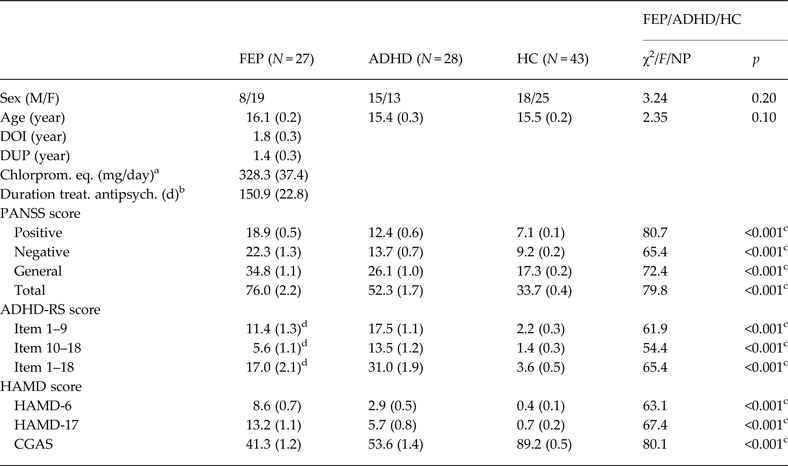
There were no significant differences in gender or age between the three groups (FEP, ADHD, HC). Scores on PANSS, ADHD-RS, HAMD and CGAS differed significantly between groups. Information on demographics, psychopathology, DOI, DUP and use of medication is provided in Table 1. In six patients (FEP, 4; ADHD, 2) and one HC a urine sample test and/or interview based information indicated recent use of cannabis. Four female participants refused to provide a urine sample. None of the participants reported frequent use of cannabis or met criteria for substance dependence.
Patients’ demographic and psychopathological data

FEP, First-episode psychosis patients; ADHD, attention deficit hyperactivity disorder patients; HC, healthy controls; NP, non-parametric test; DOI, duration of illness; DUP, duration of untreated psychosis; PANSS, Positive and Negative Syndrome Scale; ADHD-RS, Attention Deficit Hyperactivity Disorder Rating Scale; CGAS, Children's Global Assessment Scale; HAMD-6/HAMD-17, Hamilton Rating Scale for Depression versions 6 and 17.
Sex is given in numbers, all other values are mean (s.e.m.). Statistics χ2 (sex), ANOVA (age) or non-parametric test (psychopathological and functional scores).
a N = 18 patients presently treated with antipsychotics.
b N = 21 patients ever treated with antipsychotics.
c All pairwise comparisons p < 0.001.
d Information on 24 FEP patients.
MMN amplitude
Midline electrodes
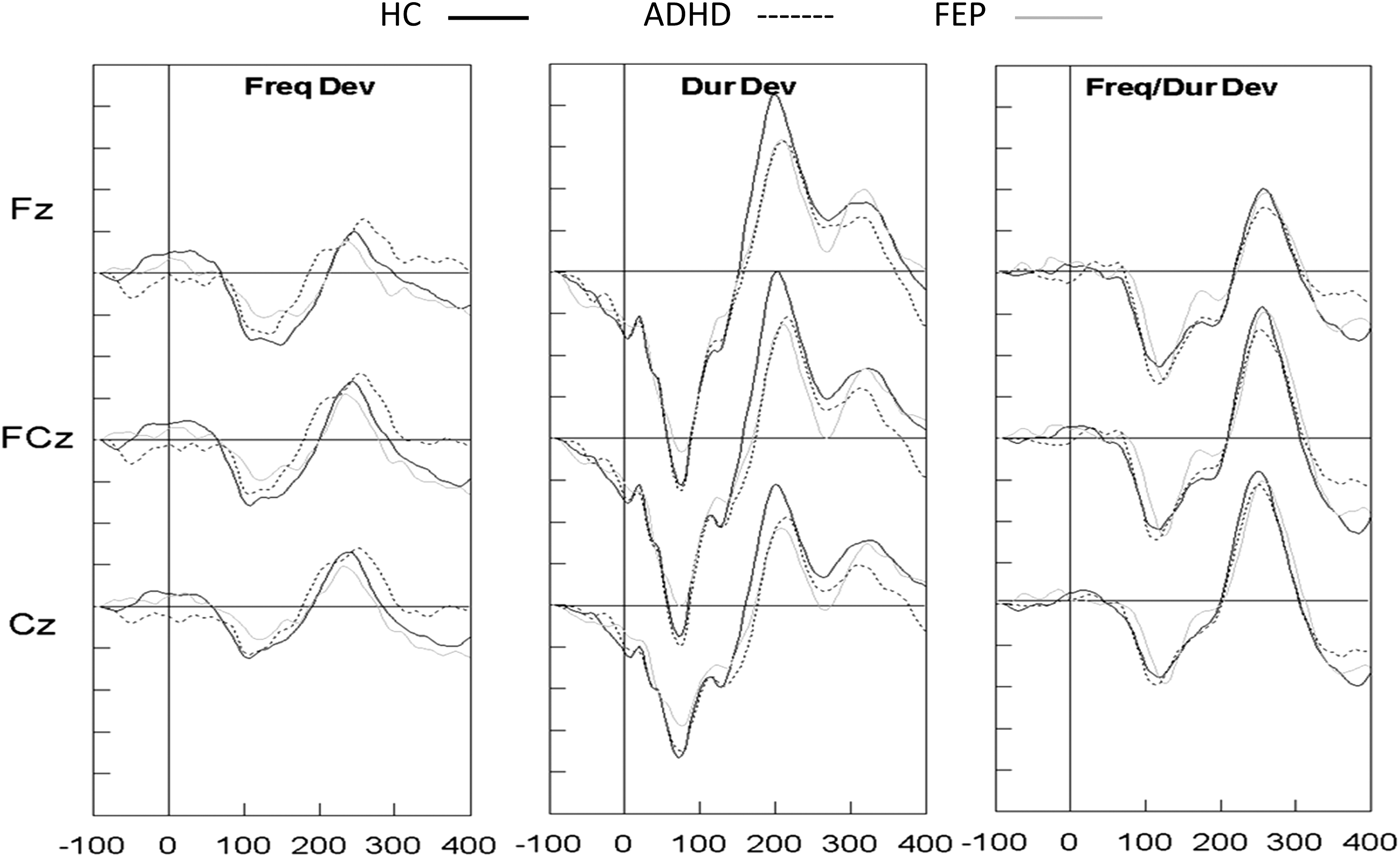
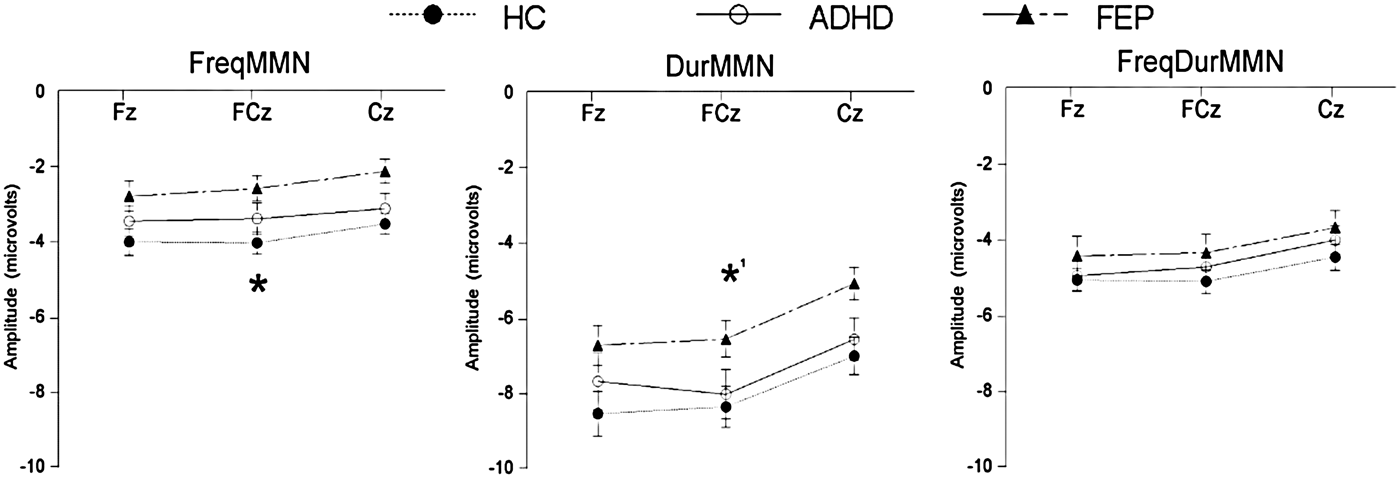
Repeated-measures ANOVA demonstrated significant main effects of group (F 2,95 = 4.32, p = 0.016, η 2 = 0.083), electrodes (F 2,94 = 151.18, p < 0.001, η 2 = 0.76) and deviant types (F 2,94 = 73.09, p < 0.001, η 2 = 0.61). Splitting on deviant types showed a significant main effect of group on frequency-based MMN (freqMMN) (F 2,95 = 4.01, p = 0.021, η 2 = 0.078), a trend level group-main effect on duration-based MMN (durMMN) (F 2,95 = 2.77, p = 0.068, η 2 = 0.055) and no significant group effect on frequency- and duration-based MMN (freqdurMMN) (F 2,95 = 0.99, p = 0.38, η 2 = 0.020). Pairwise comparisons of groups in repeated-measures ANOVA revealed a significant difference between FEP and HC on freqMMN (F 1,68 = 8.51, p = 0.005, η 2 = 0.11) and on durMMN (F 1,68 = 5.80, p = 0.019, η 2 = 0.079]. Although on average the ADHD patients showed less MMN amplitude for all three deviant types than HC and more MMN than FEP patients, this did not reach statistical significance (p > 0.11, η 2 < 0.048). Post-hoc we divided the FEP sample in patients with (N = 13) and without (N = 14) schizophrenia; subsequent sensitivity analyses showed that the significantly reduced freqMMN and durMMN in the FEP sample compared to the HC sample were both primarily based on the subcategory of schizophrenia patients (p = 0.011, η 2 = 0.12 and p = 0.041, η 2 = 0.075, respectively) and more weakly on the patients without schizophrenia (p > 0.065, η 2 < 0.061). No significant MMN differences were found in the two subgroups of FEP themselves (p = 0.34, η 2 = 0.036). Figs 1 and 2 present the MMN data for midline electrodes.
Grand average waveforms displayed for all three diagnostic groups and for all three deviant types at electrodes Fz, FCz and Cz. FEP, First-episode psychosis; ADHD, attention deficit hyperactivity disorder; HC, healthy controls.

MMN amplitude for all three diagnostic groups and for all three deviant types at electrodes Fz, FCz and Cz, showing significantly reduced freqMMN (*p = 0.005) and durMMN (*1 p = 0.019) in FEP v. HC. FEP, First-episode psychosis; ADHD, attention deficit hyperactivity disorder; HC, healthy controls.

Electrodes left right hemisphere
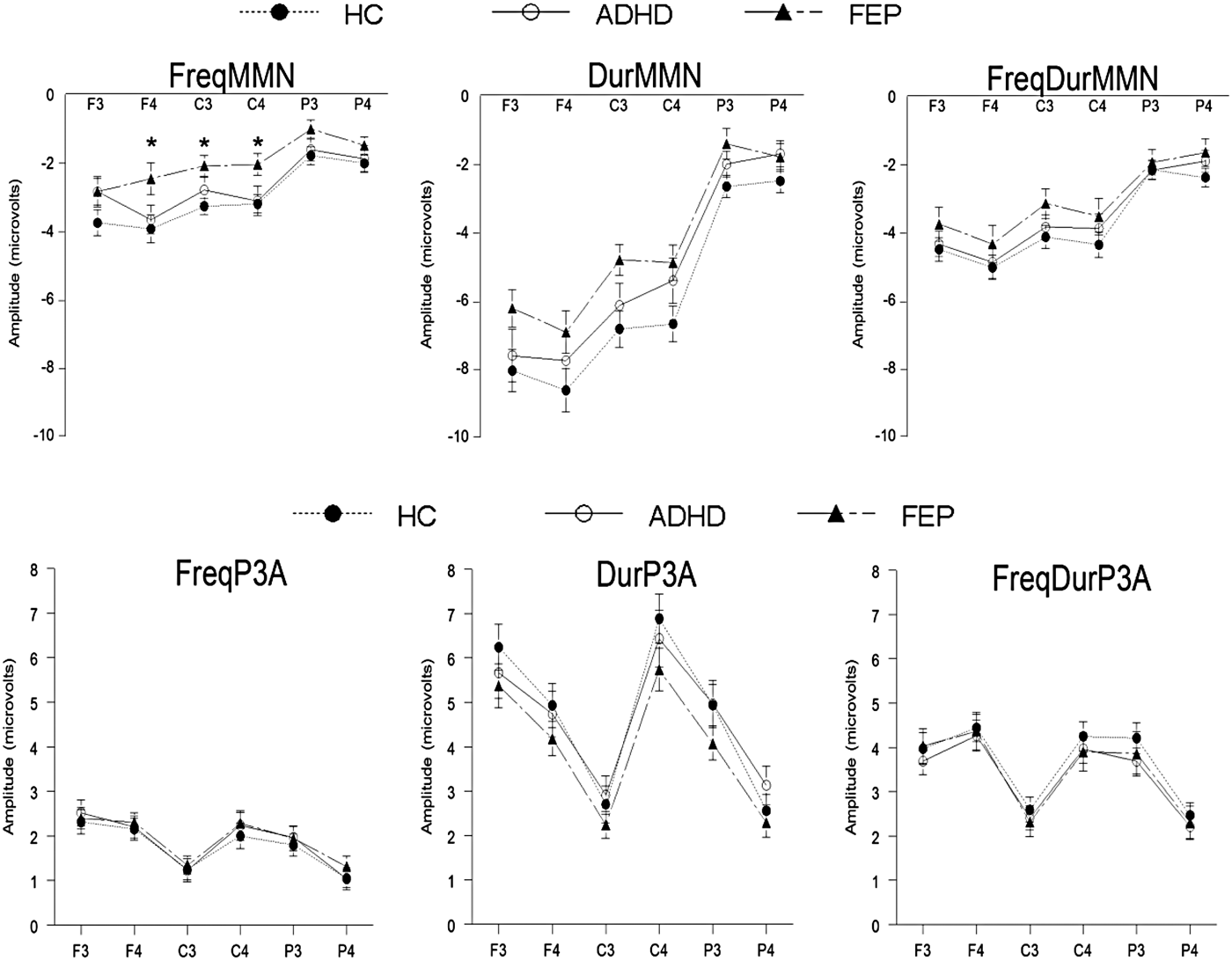
As expected, repeated-measures ANOVA of the MMN data of the electrodes placed right and left of the midlines showed similar results as the MMN data of the midlines: main effects of group, electrodes and deviant types (p < 0.027, η 2 > 0.073); in addition several significant higher order interaction effects were found, of which two were of interest for the focus of this paper, because they included the factor diagnose, i.e. deviant × electrode × group (F 4,190 = 3.10, p = 0.017, η 2 = 0.061) and deviant × electrode × hemisphere × group (F 4,190 = 3.10, p = 0.017, η 2 = 0.061). Further analyses of these significant results revealed that FEP patients scored significantly lower freqMMN on electrodes F4, C3 and C4 (p < 0.024, η > 0.073) compared to the HC sample while no other significant group-related results were found, see also Fig. 4.
P3a amplitude
Midline electrodes
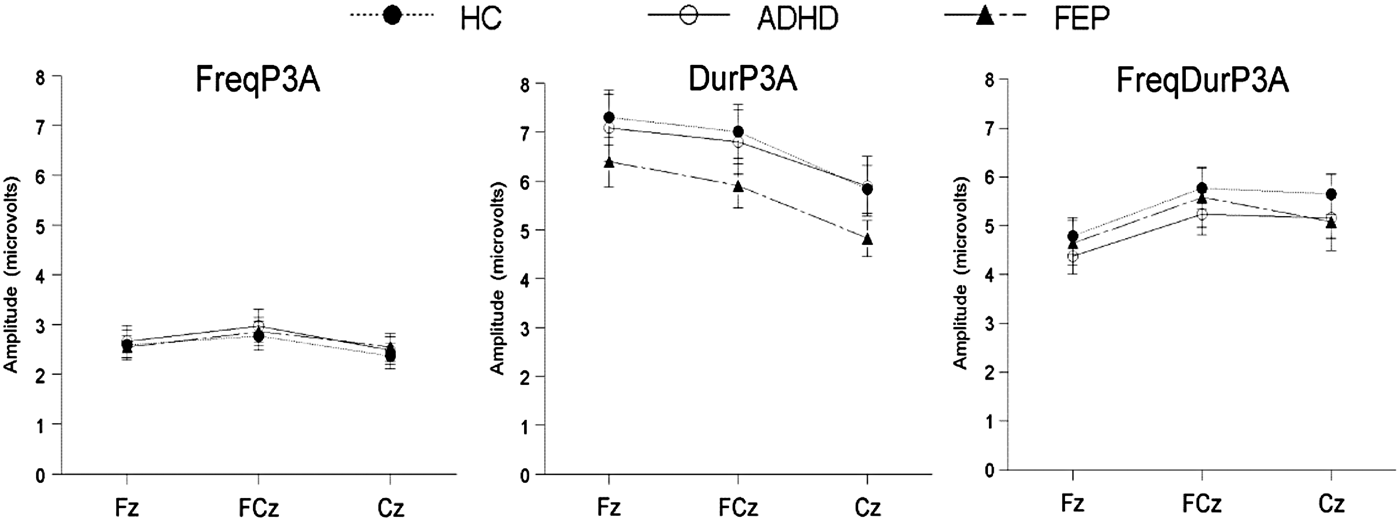
Repeated-measures ANOVA showed no significant main effect of group (F 2,95 = 0.41, p = 0.66, η 2 = 0.009) but significant main effects of electrodes (F 2,94 = 88.35, p < 0.001, η 2 = 0.65) and deviant types (F 2,94 = 90.78, p < 0.001, η 2 = 0.66). Splitting on the three deviant types did not reveal any significant group differences (p > 0.39, η 2 < 0.020). P3a amplitude did not differ significantly among the two subgroups of the FEP sample (p = 0.77, η 2 = 0.003). Fig. 3 presents the P3a amplitude data for midline electrodes.
P3a amplitude for all three diagnostic groups and for all three deviant types at electrodes Fz, FCz and Cz, showing no significant differences between the groups. FEP, First-episode psychosis; ADHD, attention deficit hyperactivity disorder; HC, healthy controls.

Electrodes left right hemisphere
Repeated-measures ANOVA showed no significant main effect of group (F 2,95 = 0.28, p = 0.75, η 2 = 0.006) but significant main effects of electrodes (F 2,94 = 83.63, p < 0.001, η 2 = 0.64) and deviant types (F 2,94 = 61.90, p < 0.001, η 2 = 0.57) were found. Splitting on the three deviant types did not reveal any significant group differences (p > 0.47, η 2 < 0.016), see also Fig. 4.
MMN and P3a amplitude for all three diagnostic groups and for all three deviant types at electrodes F3, F4 , C3, C4, P3 and P4 showing significantly reduced freqMMN at F4, C3 and C4 (*p = 0.024) in FEP v. HC. FEP, First-episode psychosis; ADHD, attention deficit hyperactivity disorder; HC, healthy controls.

Correlations
In FEP, the amplitudes of all three MMN deviant types correlated negatively with PANSS positive score (freqMMN: r s = −0.47, p = 0.012; durMMN: r s = −0.48, p = 0.011; freqdurMMN: r s = −0.48, p = 0.011). In ADHD, freqP3a correlated positively with the total score on the ADHD rating scale (ADHD-RS 1–18) (r s = 0.39, p = 0.043), specifically with symptoms of hyperactivity and impulsivity (ADHD-RS 10–18) (r s = 0.49, p = 0.009), and negatively with CGAS (r s = −0.38, p = 0.044).
No other correlations were found between MMN or P3a amplitude and scores of psychopathology, function, DOI, DUP, age of onset of psychosis, chlorpromazine equivalents or duration of ongoing antipsychotic treatment.
Medication
Comparison between FEP patients with (N = 11) and without (N = 16) present antidepressant treatment showed a trend-level main effect of group (F 1,25 = 3.70, p = 0.066, η 2 = 0.13), possibly reflecting increased MMN in FEP patients treated with antidepressants; however, this reached statistical significance only for durMMN (F 1,25 = 4.38, p = 0.047, η 2 = 0.15). No other differences in MMN or P3a amplitude were found between FEP patients with and without present use of antidepressants (p > 0.17, η 2 < 0.072) or between FEP patients who presently (N = 18), or never before (N = 6), have been treated with antipsychotics (p > 0.26, η 2 < 0.056).
Discussion
This study compared MMN and P3a amplitude between young adolescents with a first-episode non-affective psychosis or ADHD and healthy matched controls. The main purpose of this study was to investigate whether MMN or P3a amplitude could discriminate between the three groups. Our findings showed that FEP patients exhibited significantly less MMN amplitude than HC, although this appeared based on frequency deviants and duration deviants, not on their combination. MMN amplitudes in ADHD patients were intermediate to those of HC and FEP patients, showing no significant differences with either group. Post-hoc analyses showed that only the subgroup of schizophrenia patients showed significantly less MMN than HC, which may point towards a higher specificity of MMN deficits for schizophrenia than for schizoaffective disorder and psychosis not otherwise specified. However, although not statistically significant, these remaining FEP patients on average showed less freqMMN and durMMN than HC; this most likely reflects that some of these patients may eventually develop schizophrenia later in life, while others will not.
Our findings of deficient durMMN in the FEP group are consistent with the majority of previous studies reporting decreased durMMN in patients with FEP and FES (Nagai et al. Reference Nagai, Tada, Kirihara, Araki, Jinde and Kasai2013) or recent onset schizophrenia (Todd et al. Reference Todd, Michie, Schall, Karayanidis, Yabe and Naatanen2008; Jahshan et al. Reference Jahshan, Cadenhead, Rissling, Kirihara, Braff and Light2012) although not all studies reported these impairments in FES (Umbricht et al. Reference Umbricht, Bates, Lieberman, Kane and Javitt2006; Magno et al. Reference Magno, Yeap, Thakore, Garavan, De and Foxe2008). Markedly, our FEP patients exhibited reduced freqMMN which in most studies was found to be associated with later (Umbricht et al. Reference Umbricht, Bates, Lieberman, Kane and Javitt2006) or chronic (Salisbury et al. Reference Salisbury, Shenton, Griggs, Bonner-Jackson and McCarley2002; Umbricht et al. Reference Umbricht, Bates, Lieberman, Kane and Javitt2006; Todd et al. Reference Todd, Michie, Schall, Karayanidis, Yabe and Naatanen2008) stages of schizophrenia, and is therefore usually thought to reflect disease progress (Salisbury et al. Reference Salisbury, Kuroki, Kasai, Shenton and McCarley2007; Naatanen & Kahkonen, Reference Naatanen and Kahkonen2009). In fact, freqMMN appeared to be more impaired than durMMN in our FEP patients.
This discrepancy between our results and those of other studies might have been caused by the fact that we only included FEP patients in which the psychosis was already apparent at an early age (12–17). Compared to the participants in other studies, in which the psychosis became only apparent at later ages, our patients may have been more severely ill.
The fact that we did not find significant differences between groups on the combined freq + dur deviant type may reflect that this deviant type is so easy to detect in the sequence of standard stimuli that it evoked a similar MMN response in all participants.
The absence of significant MMN differences between ADHD and FEP may reveal a lack of specificity to psychosis in relation to ADHD; it may explain why both groups of subjects have a heightened risk for developing schizophrenia over time. This absence illustrates a cross-diagnostic overlap which parallels aberrant neuropsychological similarities (e.g. working memory) reported in comparable studies between the two disorders (Groom et al. Reference Groom, Jackson, Calton, Andrews, Bates, Liddle and Hollis2008; Brodsky et al. Reference Brodsky, Willcutt, Davalos and Ross2014). The cross-diagnostic overlap could in theory reflect the shared prefrontal hypoactivity between the disorders, as mentioned above. While shift in attention has been associated with generators in prefrontal cortex and is affected in both disorders, the deficits in pre-perceptual change detection are thought to be associated with generators in temporal cortex (Giard et al. Reference Giard, Perrin, Pernier and Bouchet1990; Naatanen & Kahkonen, Reference Naatanen and Kahkonen2009), and may likely be more present in psychosis. Stone et al. (Reference Stone, Bramin, Pauls, Sumich and McGuire2010) found that abnormal frontal MMN amplitude was related to reduced levels of thalamic glutamate and glutamine in individuals prodromal for psychosis, while recent reports (Chang et al. Reference Chang, Lane and Tsai2014) also suggest dysfunction of N-methyl-d-aspartate glutamate receptors in the pathophysiology of ADHD, indicating another possible link between the two disorders.
We found no significant differences in P3a amplitude between the three diagnostic groups, although our FEP patients on average scored lower P3a amplitudes than HC and ADHD. Other studies reported reduced P3a amplitude in young, mainly adult patients with FEP or recent onset schizophrenia (Atkinson et al. Reference Atkinson, Michie and Schall2012; Jahshan et al. Reference Jahshan, Cadenhead, Rissling, Kirihara, Braff and Light2012) but not in young adolescents with psychotic symptoms (Murphy et al. Reference Murphy, Rawdon, Kelleher, Twomey, Markey, Cannon and Roche2013) suggesting that P3a deficits may primarily appear in adulthood in these patients or that our data were underpowered for this particular ERP.
Unexpectedly, we found negative correlations between MMN triggered by all three deviant types and severity of psychotic symptoms (PANSS positive score) in our FEP patients. This differs from a number of studies in which no correlations between MMN and clinical symptomatology were found (Umbricht & Krljes, Reference Umbricht and Krljes2005;Atkinson et al. Reference Atkinson, Michie and Schall2012; Perez et al. Reference Perez, Woods, Roach, Ford, McGlashan, Srihari and Mathalon2014b ). It also differs from studies reporting positive correlations between MMN and negative symptoms (Oades et al. Reference Oades, Wild-Wall, Juran, Sachsse, Oknina and Ropcke2006; Umbricht et al. Reference Umbricht, Bates, Lieberman, Kane and Javitt2006) or positive symptoms (Todd et al. Reference Todd, Michie, Schall, Karayanidis, Yabe and Naatanen2008). However, our data do correspond to those of (Salisbury et al. Reference Salisbury, Shenton, Griggs, Bonner-Jackson and McCarley2002), who reported negative correlations between MMN and a number of clinical scales, e.g. total Brief Psychiatric Rating Scale (BPRS) scores, in FES patients. As suggested by these authors, the correlation may reflect the presence of volatile and unstable symptoms in a turbulent phase of illness.
We did not find correlations between MMN and functional status (CGAS) in any of the groups. Although other studies do report associations between MMN and measures of functional outcome (Light & Braff, Reference Light and Braff2005; Wynn et al. Reference Wynn, Sugar, Horan, Kern and Green2010) these relations were mainly found in chronic schizophrenia patients, and not in recent onset patients (Jahshan et al. Reference Jahshan, Cadenhead, Rissling, Kirihara, Braff and Light2012).
P3a amplitude appeared to be (negatively) correlated with the CGAS in the ADHD population only. In addition, P3a was (positively) correlated to symptoms of hyperactivity and impulsivity in this group of patients. This last association likely reflects that ADHD patients with symptoms of hyperactivity and impulsivity are alert to all stimuli in their direct environment, resulting in higher P3a amplitudes while these symptoms impede their global function.
We did not find differences in MMN between patients treated with or without antipsychotic medication. However, our study had a cross-sectional design which is not suitable for examining causal effects. Although patients were requested to avoid use of psychotropic medication from the night before the EEG testing until after it was completed this only diminished acute pharmacological effects, not the longer lasting effects such as altered numbers of receptors, meaning that there may have been confounding effects of medication on EEG. Nevertheless, the majority of previous studies investigating the effects of antipsychotics on MMN amplitude have not demonstrated any clear effects (Catts et al. Reference Catts, Shelley, Ward, Liebert, McConaghy, Andrews and Michie1995; Rissling et al. Reference Rissling, Braff, Swerdlow, Hellemann, Rassovsky, Sprock, Pela and Light2012) and one recent study reported increased MMN amplitudes following treatment with aripiprazole (Zhou et al. Reference Zhou, Zhu and Chen2013) (equal to the choice of treatment for six of the FEP patients in our study) which suggests that the deficits currently found in our FEP patients in fact may have been mitigated by this treatment.
Similarly, the difference in durMMN between FEP patients who were and those who were not treated with antidepressants could possibly reflect an ameliorating effect of SSRIs on deficient MMN. Indeed, previous studies from our lab have shown that SSRIs increase MMN in healthy volunteers (Oranje et al. Reference Oranje, Jensen, Wienberg and Glenthoj2008; Wienberg et al. Reference Wienberg, Glenthoj, Jensen and Oranje2010). However, our current findings on the effect of antidepressants were based on a small group of patients of whom nearly all were additionally using antipsychotics; thus these results must be interpreted with caution and need to be confirmed in studies specifically designed to investigate psychotropic effects. A major strength of the current study is the inclusion of both a healthy and a clinical control group, enhancing the possibility of evaluating diagnostic specificity of pre-attentive deficits in early manifestations of neuropsychiatric illness. Moreover the FEP group size was rather large given that these patients are rare and difficult to recruit. It is a limitation that most of the included FEP patients were pharmacologically treated, although on average they were treated with antipsychotics less than half a year. Nevertheless, while our data did not demonstrate an effect of antipsychotic treatment, antidepressants may possibly have increased MMN amplitude. Last the patients with schizophrenia, who appeared to be the most impaired in MMN amplitude, formed only half of the total FEP population, which most likely has weakened the group differences. Even though this may be a limitation we also consider it a strength of the study that patients with schizophrenia-related psychotic disorders, who make out a substantial part of patients with psychosis in adolescent psychiatric practice, were included.
In conclusion, our results demonstrate significant MMN deficits in young adolescents with FEP compared to HC, while adolescents with ADHD showed intermediate levels of MMN, not significantly different from either population. This finding suggests that young FEP patients already exhibit deficits that are characteristic of schizophrenia. Furthermore, our study indicates that pre-attentive deficits such as MMN may be shared neurobiological markers of neuropsychiatric disorders such as psychosis and ADHD, which are expressed on a continuum and most strongly in fulminant schizophrenia. Future studies are warranted to clarify whether MMN deficits are already present in the early prodrome of psychosis in children and young adolescents and whether MMN deficits can be utilized to advance early recognition of psychosis in young psychiatric patients.
Acknowledgements
The authors thank research assistants Gitte Saltoft Andersen (CRN), Mikkel Erlang Sørensen (MSc) and Katharina Alfsen (CRN) and students Rókur av Fløtum Jespersen and Nanna Pagsberg from the Center for Neuropsychiatric Schizophrenia Research (CNSR) for assistance with neurophysiological assessments and registration of data.
This work was supported by a PhD scholarship from the Research Foundation of Mental Health Services in the Capital Region of Denmark; Lundbeck Foundation Center for Clinical Intervention and Neuropsychiatric Research (CINS) (R25-A2701); Læge Gerhard Linds legat; Fru C. Hermansens legat; Slagtermester Wörzners og Hustru Inger Wörzners mindelegat and Psykiatrisk Forskningsfond af 1967.
Declaration of Interest
None.