Political scientists have spent decades discussing which factors are more or less important in determining voter turnout. This article focuses on two influences: the first is mobilization, which has long been viewed as valuable to the electoral process. Whether one reads the seminal pieces by Gosnell (Reference Gosnell1927), Gerber and Green (Reference Gerber and Green2000), or any article written between, over the years the scholarly community has proven that mobilization matters and that some techniques work more effectively than others. The second, about which much less has been written, is the role of weather. The media often suggests that weather plays a determining role in an election by influencing turnout. Although some qualitative evidence supports this (Gomez, Hansford, and Krause Reference Gomez, Hansford and Krause2007), very little empirical work has been done. Further, no research addresses the role that weather plays in influencing the success of a mobilization drive on turnout odds. Put another way, we know that contact works. However, we do not know the extent to which contact effectiveness might be weather-dependent.
This article addresses this question using a panel of 39,769 individuals mobilized during five election cycles spanning 14 months in South Los Angeles, California. The effects of variations in temperature, seasonableness, and precipitation during contact on turnout are tested while controlling for several known determinants of voting behavior. Literature on effects of weather on mood and productivity is used to form hypotheses. The sample is also subdivided by contact type (personal visits and live phone calls) to assess whether the relationship between weather during mobilization and turnout depends on contact type.
WEATHER EFFECTS ON MOOD AND PRODUCTIVITY
Imagine that you are asked to walk door-to-door with the goal of contacting a number of potential voters for an upcoming election. You look at the forecast for the day and see that the experts are predicting that the weather will be unseasonably hot, with a high chance of afternoon rain. As soon as you begin walking around the assigned neighborhood, you start sweating profusely from the temperature; the weather makes you uncomfortable and irritated. The first individual you contact has been sitting in a stuffy house all day and has very little interest in talking about politics. Before you move on to the next person on your list of voters, you look at the sheet of names and realize that you have more than 100 contacts left to make. The temperature rises again; your mood worsens.
As you continue walking around the neighborhood, you notice your feet dragging, your pace slowing, and your exhaustion growing. You find it difficult to concentrate on convincing your list of voters about the value of political participation. Worse, a rainstorm is on the way. As the clouds gather, you rush through the remainder of your contact list as quickly as you can in ever-poorer conditions. By the time you have finished for the day, you are hot, wet, and exhausted. You have contacted all the names on your list, yet you know that you could have been more convincing in your efforts, and perhaps more effective, had the weather been better.
This hypothetical scenario is grounded in a considerable amount of literature on the effects of weather on mood, productivity, and fatigue. Empirical research finds that variations in weather, particularly heat (as well as humidity),Footnote 1 can affect mood broadly (Howarth and Hoffman Reference Howarth and Hoffman1984; Sanders and Brizzolara Reference Sanders and Brizzolara1982). Studies have demonstrated that during unusual temperatures people tend to be more aggressive (Baron Reference Baron1972; Boyanowsky et al. Reference Boyanowsky, Calvert, Young and Brideau1981). It has been postulated that this aggression is connected with stress brought about by extremes in temperature (Cohn Reference Cohn1990); this may be particularly true during hot weather (Anderson Reference Anderson1987; Rotton and Cohn Reference Rotton and Cohn2004). Literature on weather and crime also supports the notion that people tend to be more aggressive when the weather is hot (Hipp et al. Reference Hipp, Bauer, Curran and Bollen2004; Quetelet Reference Quetelet1842). Barnston (Reference Barnston1988) studies the weather-productivity link and finds, to a small extent, that “human moods and productivity appear to be affected by weather” (1988, 142). Nybo (Reference Nybo2008) finds that prolonged exercise in the heat, including working, can cause high fatigue. Other scientific studies (cf. Drust et al. Reference Drust, Rasmussen, Mohr, Nielsen and Nybo2005) support the physiological connection between heat and fatigue during work.
HYPOTHESES
In a mobilizing environment, one can assume that the effects of weather will be shared by both potential voters and mobilizers; that is, both parties may be more aggressive and irritable and in worse moods under certain weather conditions. However, as evidenced by the hypothetical scenario described earlier, an assumption in this article is that the mobilizer, particularly when asked to walk door-to-door over the course of a day, is likely to be most strongly affected by meteorological variation, which may influence the persuasiveness of the contact and thus lower overall vote likelihoods of individuals contacted on these days.
The first hypothesis is that mobilized voters would be less heavily influenced by contact (and therefore less likely to vote) as the average temperature on the day of contact increases. Further, mobilizers exert more energy in walking door to door than those performing phone calls and are likely more aggressive or irritable in hotter weather, whereas mobilizers staffing phone banks are often subject to climate-controlled conditions. As such, it is expected that turnout rates of those contacted by personal visits will be more strongly affected by temperature increases than turnout rates for those mobilized via phone calls.
Temperature increase alone may not tell the full story, however. It may not be the absolute temperature outside that matters, but rather whether the weather is unseasonably hot or cold. This might be particularly true in a city like Los Angeles, where only small variations in absolute temperature occur, so that effects may appear more robust when comparing actual versus expected temperatures; this might be termed seasonableness. As the level of seasonableness becomes more extreme, turnout likelihood of contacted voters should fall. Given the setting, where colder-than-normal days are not often particularly cold, it is more likely that the degree of seasonableness has less influence when the effect is negative (that is, the day is colder than expected) than when the effect is positive (that is, the day is hotter than expected). Finally, as daily precipitation amounts increase, it is expected that turnout levels for mobilized voters are likely to drop; these negative effects should be strongest for personal visits.
DATA AND MODELS
Between November 2002 and March 2004, an alliance of labor unions and community groups contacted a panel of potential voters in Los Angeles. Their goal was to raise turnout in a series of five elections, including three local races, a national election, and a statewide special election. The groups harbored ostensibly identical characteristics, ambitions, and training and used personal visits or live phone calls (see Lamare Reference Lamare2010a, 2010b for more details regarding the efforts of these groups, including full information on the sample and contactors).
Mobilizers procured a list of all the registered voters (188,551 individuals) in South Los Angeles.Footnote 2 This list provided demographic information about the registered voters, including every individual's age, ethnicity, gender, and party affiliation. The list also provided turnout histories of each voter from as early as March 2000 (five elections prior to the first mobilization effort), in addition to the individual's address and the City Council district in which each was eligible to vote. When individuals on this list were contacted, the mobilizers recorded the date the type of contact used. When individuals were contacted by personal visits in any one election, it does not appear that they were contacted by phone, or vice versa.
Several filters were applied to create an effective sample. Anyone who was not registered to vote as of March 2000 is excluded to allow for an accurate recording of prior vote history. In addition, all noncontacted individuals are removed. Excluding the noncontacted individuals addresses the concern that the selection of potential voters for contact was shaped by unobserved characteristics that would influence turnout relative to the noncontacted group. Any characteristic that may have caused an individual to be given the contact treatment is fixed across the entire sample.Footnote 3 After applying filters, 39,769 contacted individuals remain. This list has been matched with archival information on the weather in South Los Angeles for every day that contact occurred (a total of 114 unique days spanning all four seasons). At each contact date, records are provided for the actual mean, minimum, and maximum temperature; historical average mean temperature; and precipitation level.
To further ensure that other known determinants of voting behavior are considered, all regressions include the individual's age, ethnicity, party affiliation, socioeconomic status (based on whether the individual rented an apartment or owned a home), and prior voting behavior over the past five elections. Each individual election is also used as a control, which helps to account for the possibility that turnout depended on election-specific factors, such as the closeness of each race or the weather on the day of the election. Also included is a variable that accounts for the difference between the date of contact and the date of election and a control for the geographic location of each voter. In addition, the information on contact type is used to subdivide the sample into those mobilized by personal visits and those contacted by phone calls.Footnote 4
ANALYSIS
The data are analyzed using generalized estimating equations with a binary logistic dependent variable (turnout). Temperature, rainfall, seasonableness, age, vote history, and the number of days between contact and election are continuous variables; the remainder is categorical. Seasonableness is measured by subtracting the actual temperature from the historical average temperature to create a continuous scale, from unusually cold to unusually hot. The absolute value of this number measures the effects of extremes, irrespective of direction.
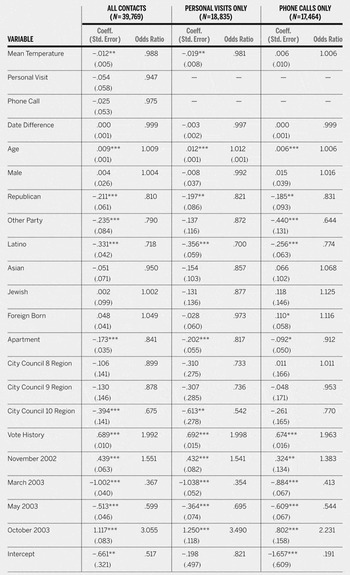
The first logistic regression analyzes the effects on turnout of contacted voters as daily temperatures increase. The results (found in table 1) suggest that mean temperature on the day of contact does influence a mobilized individual's likelihood to vote. Controlling for other factors, for each degree the daily temperature rises, the likelihood of turnout by contacted voters declines by a factor of .012 (p < .05). Subdividing contact by type reveals the fullest extent to which temperature influences turnout. Analyzing personal visits only, the negative effects of temperature on the day of contact on turnout increase to a factor of .019 (p < .05). However, when looking at phone calls alone, mean temperatures do not influence turnout of contacted voters.
GEE Logistic Regressions (Mean Temperature)

*** = Significant at the .01 level;
** = Significant at the .05 level;
* = Significant at the .10 level
Reference categories: female gender, Democratic Party, generic ethnicity, U.S. birthplace, live in home, City Council 15 region, March 2004 election.
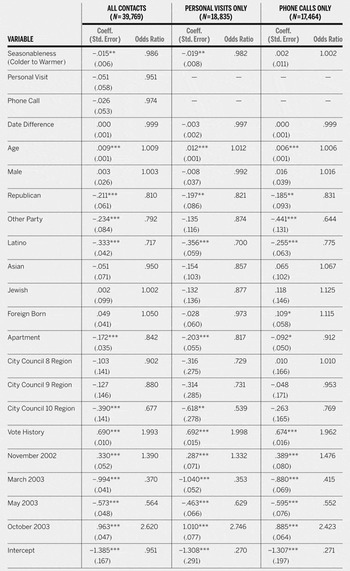
The second and third logistic regressions measure changes in seasonableness during contact on turnout odds. Table 2 provides the regression outcomes when seasonableness rises from colder-than-usual to warmer-than-usual days. Similar to the results for absolute temperature, moving from colder-than-usual to warmer-than-usual weather during contact does affect turnout; as weather at the time of contact becomes warmer than expected, the likelihood of turnout for contacted voters declines (p < .05). As with temperature, the magnitude of the effect grows larger among those contacted by personal visits but disappears when assessing phone calls.
GEE Logistic Regressions (Colder to Warmer Seasonableness)

*** = Significant at the .01 level;
** = Significant at the .05 level;
* = Significant at the .10 level
Reference categories: female gender, Democratic Party, generic ethnicity, U.S. birthplace, live in home, City Council 15 region, March 2004 election.
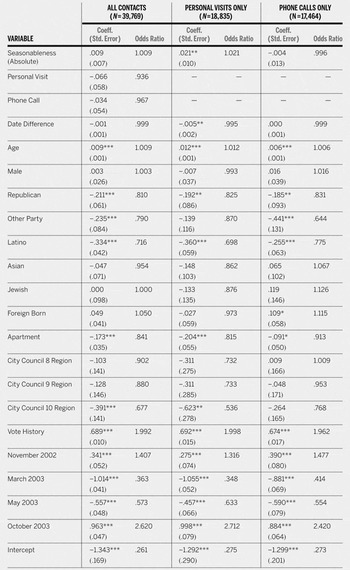
Table 3 details the effects on turnout of moving from seasonable to unseasonable temperatures without considering whether the shift is toward hotter or colder weather. The results suggest no effect of absolute seasonableness on turnout when all contacts are included. However, when subdividing by type, a significant and positive relationship between absolute seasonableness and turnout is found (p < .05) among those contacted on foot.
GEE Logistic Regressions (Absolute Seasonableness)

*** = Significant at the .01 level;
** = Significant at the .05 level;
* = Significant at the .10 level
Reference categories: female gender, Democratic Party, generic ethnicity, U.S. birthplace, live in home, City Council 15 region, March 2004 election.
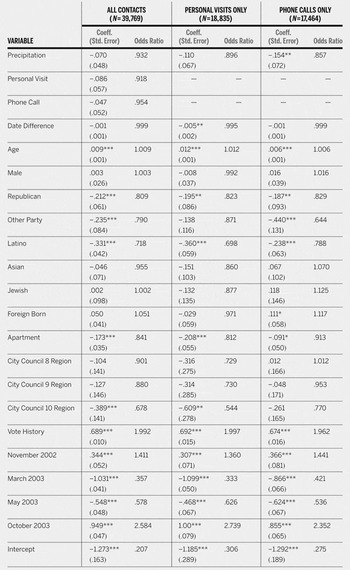
Table 4 demonstrates that across all contacts and personal visits, precipitation on the day of contact does not significantly affect turnout rates. However, when looking at phone calls only, a significant and negative relationship between precipitation and turnout is observed. As precipitation increases, individuals are less likely to vote by a factor of .143 (p < .05).
GEE Logistic Regressions (Precipitation)

*** = Significant at the .01 level;
** = Significant at the .05 level;
* = Significant at the .10 level
Reference categories: female gender, Democratic Party, generic ethnicity, U.S. birthplace, live in home, City Council 15 region, March 2004 election.
DISCUSSION
An interpretation of the findings is that the negative effects of higher temperatures during contact are felt more heavily by mobilizers than by potential voters. If higher temperatures negatively affect potential voters as well as mobilizers, lower turnout would be seen during phone calls occurring on hotter days. However, this is not the case—temperature matters only when individuals are knocking on doors. The effects of moving from unseasonably cool to unseasonably warm weather are also felt by mobilizers rather than voters. Further, as weather becomes more seasonable, irrespective of direction, the results indicate that the benefits are enjoyed by mobilizers, whereas targeted voters remain unaffected by these changes.
Interpreting the results for precipitation becomes more complex. The negative effects of higher amounts of precipitation are stronger for those contacted over the phone than for those contacted in person. One possible explanation is that an empathy effect occurs for in-person contact during rainy days; if targeted voter sees a mobilizer soaked with rain knocking on the door, the potential voter may feel inclined to be swayed by what the mobilizer has to say, perhaps due to the implication that the mobilizer must be extremely committed to his or her cause to be walking door-to-door in the rain. This reaction would help offset the negative effects of the rain on turnout odds. However, those contacted over the phone would feel no empathy for the mobilizers, and thus would have nothing to counterbalance their higher irritability and worse moods on rainy days. An alternative explanation may be that the labor-community alliance chose to send only its best and most-convincing mobilizers door-to-door during rainy weather; unfortunately, the data cannot easily account for this possibility.Footnote 5
CONCLUSION
Can meteorological conditions really affect the success levels of mobilization campaigns? While conceding that there are several limitations regarding the setting and methodology, the answer may be yes, at least in Los Angeles. To put the results in perspective, a one-degree change in temperature at the time of contact is a stronger influence on turnout than a one-year change in age, a more important factor than gender, and a better predictor of turnout than the time between mobilization and the election date. As such, what might initially appear an unusual consideration should not necessarily be dismissed.
If one is willing to accept that weather at the time of contact may be meaningful, this begs this question: what can mobilizers do? At the strategic level, the results suggest that contactors will be more successful if they perform personal visits on cooler and more seasonable days. Equally, mobilizing groups might think twice about relying heavily on phone banks during periods of precipitation. Admittedly, resource scarceness and the pressure to simply contact as many people as possible may overrule these recommendations. That said, campaigns and other interested entities typically have a fine strategic interest in planning their mobilization efforts, and at least considering predicted meteorological conditions might indeed be practical.