In the first half of the twentieth century, Japan rapidly absorbed industrial technologies from the West, while other Asian countries such as China and India lagged behind. In textiles, British managers and investors established plants in India, but productivity in these firms stagnated during the first half of the twentieth century, and many of these firms became unprofitable in the face of cheap imports from Japan. A key question in understanding twentieth century development is why Japanese firms were able to transform productivity levels in their economy, while other developing country firms, some run by experienced Western managers, failed. To understand this puzzle, I investigate attempts of British and Japanese firms to transfer textile technology to China during the 1920s and 1930s. The analysis reveals some of the pitfalls which developed country firms face when they transfer technologies to countries with unfamiliar institutions, and explains why transfers may occur more readily across countries sharing similar backgrounds.
The process of technology transfer is often seen in deceptively simple terms: firms in developing countries learning what firms in developed countries already know. In the popular knowledge-capital model of James Markusen (2004), for example, multinationals deliver knowledge of “best practices” to foreign affiliates. Whether universal “best practices” exist is questionable. Some knowledge is specific to characteristics—such as factor endowments, institutions, and culture—which vary across time and place. To illustrate this, I study transfers of managerial knowledge. Barriers to the spread of managerial knowledge help explain why low productivity persists in developing countries, even in foreign multinationals.
If institutions and culture influence the effectiveness of management practices, one would expect firms in different locations to adopt different forms of organization. Nicholas Bloom, Raffaella Sadun, and John Van Reenan (2009) observe that institutional and cultural differences across countries influence the propensity of firms to centralize management. They find that decentralized firms have higher productivity and that developing country firms tend to be very centralized. Accordingly, Bloom, Sadun, and Van Reenan argue that developing country firms could improve their performance through decentralization. However, the development of effective managerial strategies may be more complex than this argument suggests. Centralization does not break down cleanly by developmental level. For example, firms in Japan are well-known for innovative management practice, but are among the world's most centralized. When firms set up affiliates in foreign countries, Bloom, Sadun, and Van Reenan find that they tend to be organized more like their parent firm than like local competitors. How foreign affiliates perform vis-à-vis local firms depends on whether the practices they import meet local needs. In some cases, the transfer of inappropriate practices could put developed country multinationals at a disadvantage.
I analyze transfers of managerial practices to China during the 1920s and 1930s. I focus on Japanese and British investments in Chinese textiles because their competition raises interesting questions for the theory of foreign direct investment. At this time, Japan was a relatively poor developing country and still relied on imported British textile technology. Productivity in Japan's domestic textile sector lagged behind that in Britain. Nonetheless, Japanese firms were able to dominate British competitors in China. Between 1918 and 1936 the Japanese share of the capital stock in the Chinese spinning industry grew from 21 to 42 percent, while the British share declined from 35 to 6 percent.
Japanese success poses a puzzle: how can a difference in firm location allow a laggard multinational to leapfrog over a technological leader? I argue that institutional features of China favored the use of Japanese management techniques. A key feature of the Chinese economic environment was pervasive corruption. The Japanese management system was highly centralized and monitoring intensive. By contrast, the British system was decentralized and relied on pecuniary incentives rather than intense monitoring. Decentralization worked well in Britain, but in China it facilitated corruption within lower levels of the managerial hierarchy. By contrast, centralized Japanese firms restricted decision making by lower-level agents, curtailing their corrupt behavior.
This article analyzes productivity, institutions, and management practices in the Chinese textile industry. In the first two sections, I use annual production statistics compiled by the Chinese Cotton Mill Owners Association and supplementary statistics describing product quality to compare total factor productivity levels in Japanese-, British-, and Chinese-owned textile mills. The results indicate that Japanese-owned firms were the most productive and British-owned firms were among the least. The next section examines the effects of China's institutional context on the operation of British-, Chinese-, and Japanese-owned mills. Drawing on the work of Sherman Cochran (2000) and Tetsuya Kuwahara (1986, 1991), I explain how local employment institutions caused problems at British- and Chinese-owned organizations and why Japanese-owned organizations were more successful at resolving these problems. The success of Japanese mill organizations inspired attempts at imitation among local competitors. In the penultimate section, I use a case study of reforms at the largest Chinese-owned firm to show that adoption of Japanese-style practices was associated with productivity growth. Finally, I draw out the implications of context-specific knowledge assets for international flows of investment and ideas.
PRODUCTIVITY IN COTTON SPINNING
This study adds to the burgeoning literature on productivity in cotton spinning by estimating total factor productivity at Japanese-, Chinese- and British-owned spinning mills in China.Footnote 1 Historical cotton spinning statistics typically report output in weight units, aggregated across yarns of different quality levels. Properly measuring productivity requires adjustment for quality variation, especially for yarn fineness or count (Leunig 2003). Pound for pound, high count yarn is more costly to produce than low count yarn. Chinese sources for mill-level data typically report information on yarn output in weight units, but not on yarn count. Information on count is available in aggregate statistics, which show the distribution of yarn counts spun in the Japanese-, Chinese-, and British-owned sectors. These data indicate that Japanese-owned mills spun significantly higher counts than other mills. Since value-added per pound increases with count, weight-based output measures understate the relative productivity of Japanese-owned mills.Footnote 2
I adjust productivity for count differences using three types of statistical data on the Chinese spinning industry. The first type provides raw averages of labor and capital productivity in the Japanese-, Chinese-, and British-owned sectors. These sector-level averages reflect differences in both count and productivity. The second provides the distribution of counts produced in the Japanese-, Chinese-, and British-owned sectors. The third provides mill-level information on labor productivity, capital productivity, and count. I use these mill-level data to estimate elasticities of labor and capital productivity with respect to count. These elasticities allow me to correct capital and labor productivity figures for known differences in count. I combine sector-level raw averages of capital and labor productivity, my elasticity estimates, and the sector-level count distributions to calculate quality-adjusted averages of capital and labor productivity for each sector. I confirm that my quality-adjusted averages are consistent with anecdotal reports of productivity at Japanese-, Chinese-, and British-owned mills spinning specific counts. Finally, I compute total factor productivity estimates for each sector as weighted averages of quality-adjusted capital and labor productivity.
Data on raw productivity levels come from annual statistics collected by the Chinese Cotton Mill Owners Association (CCMOA) for 1924/25 and 1927–1936 (Shanghai City Textile Industry Association, 1950). The data record the number of workers, spindles, and looms at each mill, and the number of bales of yarn and bolts of cloth produced, together with the weight of cotton consumed. The CCMOA data suffer from a number of minor flaws. The data on yarn production sometimes exclude yarn woven into cloth. Since cotton consumption statistics do not have this problem, I use cotton consumption data to measure yarn output.
Another problem is that the CCMOA data record the total number of workers at each plant, but do not indicate how workers were divided between spinning and weaving in vertically integrated mills. To deal with this problem, I use a monthly plant-level data from the 1947 Textile Survey, which provides explicit data on the number of spinning workers and weaving workers at 38 integrated mills located in Shanghai, Jiangsu, Zhejiang, and Anhui.Footnote 3 I estimate that, on average, operation of one loom required 40.5 times as much labor as operation of one spindle. Based on this proportion, I infer the percentage of workers in the spinning and weaving department at each mill from spindle to loom ratios reported in the CCMOA data.
Count differences greatly affect productivity comparisons across sectors and require thorough analysis. Aggregated statistics from tax records indicate the distribution of yarn counts produced in each sector for 1929, 1932, 1933, 1934, and 1935 (Zhao and Chen, 1997; Yan, 1965). For other years, I need to make assumptions to deal with the absence of explicit count data. My choice of assumptions may have a significant effect on productivity estimates for years prior to 1929, but is not likely to affect productivity estimates for years from 1929 and onwards. For 1924 I assume that all three sectors produced the same distribution of counts as the Chinese-owned sector in 1929. I make this assumption based on mill-level lists of counts marketed in 1920 which are reported in Jiangsu Employment Office Third Department (1920). Circa 1920 firms in all three sectors sold a narrow range of counts similar to the count range spun in the Chinese-owned sector circa 1929. For 1936 I assume that the distributions of counts produced in each sector were identical to the distributions produced in 1935. For 1925–1928 and 1930/31 I use linear interpolation to fill in the count distributions.
The next step is to estimate elasticities that specify how capital and labor productivity varied as a function of count. I use two basic estimating equations. Equation 1 specifies log labor productivity as a function of log count, plant fixed effects, and time dummies. Equation 2 specifies log capital productivity as a function of the same variables. Rather than utilize a production function, I estimate the two equations separately because available data do not allow for simultaneous observation of capital and labor productivity.


In the two equations, i indexes firms, j indexes product types, and t indexes time; is labor productivity at mill i in product type j at time t, measured in either pounds of yarn per worker-day or pounds of yarn per unit of wage expenditure; kijt is capital productivity measured in pounds per spindle-day at mill i in product type j at time t; Cijt is the count of product type j at mill i at time t;  are plant fixed effects;
 are time dummies; and
 are error terms. The coefficients of interest are εl,c and εk,c, are the elasticities of capital and labor productivity with respect to count. These elasticities indicate how much additional capital and labor is required to achieve an increase in count while holding the weight of output fixed.
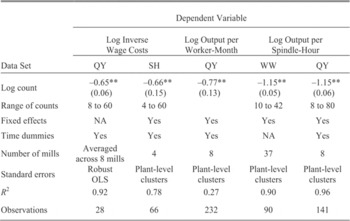
I estimate equations 1 and 2 using three Chinese data sets. The first data set, the Wang and Wang (1935) data, is a cross-section of production statistics from Chinese- and British-owned mills operating between 1932 and 1933. It contains 90 observations of output per spindle-hour by product type from 37 plants. The second source, the Shenxin data, is a panel of inverse unit wage costs by product type for four Chinese-owned plants controlled by the Shenxin Company and operating between 1934 and 1936.Footnote 4 It contains 66 observations. Assuming that workers spinning different counts receive similar daily wages, inverse unit wage costs are equivalent to measures of output per worker-day. The third source, the Qingdao Yearbook data, is a panel of monthly production statistics from eight government-owned mills operating between 1946 and 1948 and located in Qingdao.Footnote 5 The Qingdao mills had been owned by the Japanese prior to 1945. Under government management, the mills retained some Japanese engineers and managerial staff. Production conditions and productivity in these mills likely remained similar to that in Japanese-owned mills during the 1930s (Jin 2006). The Qingdao Yearbook data report monthly firm-level observations of unit wage costs by product type, yearly plant-level observations of output per spindle by product type, and monthly plant-level observations of yarn output per worker and average yarn count.
ELASTICITY OF CAPITAL AND LABOR REQUIREMENTS WITH RESPECT TO COUNT

* 5 percent significance.
** 1 percent significance.
Note:
Standard errors in parentheses, clustered errors are bootstrapped.
Sources:
Table 1 presents estimates of the elasticity of labor and capital productivity with respect to count based on longitudinal production statistics in China Textile Construction Company Qingdao Branch (1949) and Qingdao Textile Factory Statistical Office (n.d.), Shanghai Municipal Archives, Shenxin Company Records (1932–1952), and Wang and Wang (1935) data. The three data sets are identified in the table as QY, SH, and WW, respectively.
Estimates of the elasticities of labor and capital productivity with respect to count are reported in Table 1. The Wang and Wang data and the Qingdao Yearbook data yield identical estimates of the capital productivity elasticity, −1.15. This value is similar to that implied by capital productivity-count conversion tables used by mills in Japan (Seki, 1956). The Shenxin wage data and the Qingdao Yearbook wage data yield almost identical estimates of the elasticity of labor productivity, −0.66 and −0.65, respectively. The Qingdao Yearbook output per worker data yields a slightly larger estimate, −0.77. I use elasticity estimates of −1.15 for capital productivity and −0.65 for labor productivity because they yield the most conservative estimates of Japanese-owned mills’ productivity advantage.
I combine the raw capital and labor productivity levels from the CCMOA data, the known count distributions, and the elasticity estimates to compute quality-adjusted productivity levels for each sector. I convert raw productivity levels into productivity levels in terms of 20-count equivalents. These are predictions of what capital and labor productivity levels would be if the sector produced only 20-count yarn. For each sector, the count data indicate aggregate output by weight within seven count ranges. I impute an approximate average count for each of the seven count ranges. Computation of quality-adjusted productivity levels is shown in Equations 3 and 4, where h{Japanese, British, Chinese} indexes the sector, L h and K h are labor and capital productivity in sector h in terms of 20-count equivalents, l h and k h are unadjusted levels of labor and capital productivity in sector h, ɛl,c and ɛk,c are the elasticities of labor and capital productivity with respect to count, and  is the fraction of yarn count c produced in sector h, where c is one of seven possible yarn counts: 9.5, 12, 15.6, 20, 32, 42, or 60.
![\[
\begin{array}
L^h = l^h \left[{\sum\nolimits_c { = 9.5,12,15.6,20,32,42,60{\rm{f}}_c^h \left({\frac{{20}}{c}} \right)^{\varepsilon _{l,c} } } } \right
\end{array}
\](https://static.cambridge.org/binary/version/id/urn:cambridge.org:id:binary:85071:20160629041142101-0619:S0022050713000041_eqn3.gif?pub-status=live)
![\[
\begin{array}
K^h = k^h \left[{\sum\nolimits_c { = 9.5,12,15.6,20,32,42,60{\rm{f}}_c^h \left({\frac{{20}}{c}} \right)^{\varepsilon _{k,c} } } } \right]
\end{array}
\](https://static.cambridge.org/binary/version/id/urn:cambridge.org:id:binary:91801:20160629041142101-0619:S0022050713000041_eqn4.gif?pub-status=live)
The raw levels of labor and capital productivity, lh and kh, are not comparable across sectors because each sector produces a different set of products,  . I use observations of
 and estimates of the elasticities ɛl,c and ɛk,c to convert lh and kh into levels of capital and labor productivity in terms of a single product, 20-count yarn. The resulting values, Lh and Kh, are invariant to the product set produced, allowing comparisons across sectors spinning different counts.
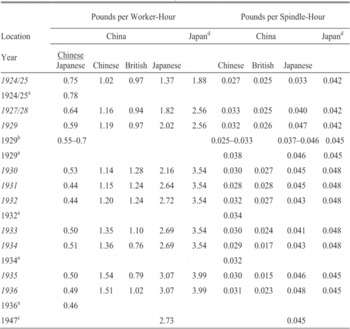
Evaluation of equations 3 and 4 generates capital and labor productivity series for the Chinese-, Japanese-, and British-owned sectors in terms of 20-count equivalents. The initial capital and labor productivity series are in units of bales per worker-year and bales per spindle-year. To facilitate international comparison, I convert these series to pounds per spindle-hour and pounds per worker-hour based on an assumed 320 day work-year, a two shift workday in all mills, 24-hour operation in Chinese- and British-owned mills, 22-hour operation in Japanese-owned mills, and the conversion factor of 420 pounds per bale. As Table 2 shows, my estimates of the productivity gap between Japanese- and Chinese-owned mills are corroborated by small samples of data reported in Gang Zhao and Zhongyi Chen (1997) and Peter Duus (1989). Table 2 also reports productivity statistics for Qingdao mills in 1947 based on data in the Qingdao Yearbooks, which provide full information on the counts produced the division of workers across spinning and weaving, operating hours, and the number of days worked. Assuming that productivity did not change significantly during World War II, the Qingdao Yearbooks figures for 1947 should give estimates of capital and labor productivity in Japanese-owned mills similar to those in mid-1930s, and this is what the data show.
CAPITAL AND LABOR PRODUCTIVITY IN CHINESE-, JAPANESE-, AND BRITISH-OWNED MILLS IN CHINA, AND IN MILLS IN JAPAN

Sources:
a Zhao and Chen (1997).
b Duus (1989).
c China Textile Construction Company Qingdao Branch (1949) and Qingdao Textile Factory Statistical Office (n.d.).
d Wolcott and Clark (1999).
Notes:
Table 2 compares estimates of labor and capital productivity based on CCMOA data (bolded) to estimates reported by other sources (indicated below). The figures refer to either 20 counts or 20-count equivalents.
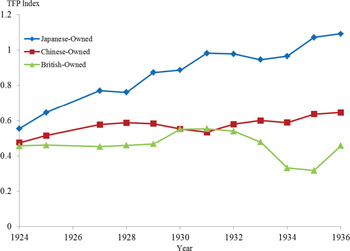
Using these adjusted labor and capital productivity figures, it is straightforward to produce a TFP index comparing the performance of the Japanese-, Chinese-, and British-owned sectors in spinning. Arno Pearse (1929) reports estimates of Chinese spindle costs, labor costs, interest rates, and depreciation allowances that suggest equal spindle and labor cost shares in 20-count spinning. Accordingly, I calculate total factor productivity as the exponent of the average of quality-adjusted log spindle and log labor productivity. To put Chinese spinning productivity levels in international perspective, I report spinning productivity levels for each sector as a percentage of productivity levels in Japan circa 1930–1934.Footnote 6 The results are shown in Figure 1. During the 1930s average productivity levels in the Japanese-, Chinese-, and British-owned sectors were 0.99, 0.59, and 0.46, respectively. Clearly, the Japanese-owned sector enjoyed a substantial productivity advantage within China. In spinning, Japanese-owned plants in China were just as productive as those in Japan.
To understand China's international competitiveness, it is useful to estimate production costs and compare them with those of Japan, a leading textile exporter. I formulate a production cost index for 1930–1936 by adjusting the TFP index for wage differences.Footnote 7 The results indicate that Japanese-owned firms in China were exceptionally competitive internationally. Normalizing unit costs in Japan at 1, I estimate production costs for the Japanese-, Chinese-, and British-owned sectors as 0.79, 1.21, and 1.58, respectively.
Evidence corroborating high productivity and low production costs among Japanese-owned mills in China comes from a 1939 Manchurian Railway Company survey of Japanese mills in Qingdao (Yoshida and Wada, 1940). This survey reports that, circa 1940, average output per work hour at Japanese-owned spinning mills in Qingdao was 90 percent of the average output per work hour for spinning mills in Japan. Simultaneously, wages at Qingdao mills were only 49 percent of the Japanese average. Thus, labor costs in Qingdao spinning were only 55 percent of those in Japan.
PRODUCTIVITY LEVELS IN SPINNING

These cost levels are consistent with the Japanese-owned sector's export performance. While Chinese-owned firms focused on supplying low-count yarns to domestic consumers, Japanese-owned firms in China exported increasing quantities of yarn to Japan, India, and Southeast Asia. In fact, starting in 1928 and continuing until at least 1932, China exported twice as much yarn as Japan annually. Japanese-owned firms in China were responsible for the vast majority of these exports (Pearse, 1929; Moser, 1930).
PRODUCTIVITY IN WEAVING
I now estimate total factor productivity at Japanese-, Chinese-, and British-owned weaving mills. The primary dimension of differentiation in weaving is the fineness of the cloth woven. Fine cloth is woven from high-count yarn, whereas coarse cloth is woven from low-count yarn. However, unlike in spinning, raw sector-level measures of weaving productivity are not greatly affected by differences in cloth quality. First, there were no marked differences in sector-level weaving specialization. In all three sectors, mills wove primarily coarse cloth. Second, differences in capital and labor requirements between coarse and fine weaving are much smaller than those in spinning.Footnote 8 Accordingly, I use unadjusted units reported in the CCMOA data to measure weaving output.
The availability of a meaningful mill-level measure of output allows weaving productivity to be assessed in a simple Cobb-Douglas framework. I estimate capital and labor coefficients using a Cobb-Douglas production function and compute annual sector-level total factor productivity levels from the CCMOA data based on these shares. To estimate the production function, I combine the 1947 Textile Survey data with the Qingdao Yearbook data. The combined data set is a monthly panel of 46 plants covering the period from January 1947 to June 1947. Twenty of these plants were Japanese-owned during the 1930s and transferred to national ownership in 1945. The remaining 26 plants were under private Chinese ownership. The data contain plant-level observations of spinning employment; weaving employment; bolts of cloth produced; weight of cotton consumed; operating shifts per month; and numbers of spindles, automatic looms, and plain looms.
Unlike in spinning, weaving machinery varied across sectors and this could have affected productivity. During the 1930s Japanese-owned firms installed Toyota automatic looms, while Chinese- and British-owned firms continued to use plain looms (Pearse, 1929; Wang, 2004). Among firms in the combined 1947 sample, the share of automatic looms was 88 percent on average among formerly Japanese-owned firms, but only 28 percent among private Chinese-owned firms. To assess whether this difference affected productivity, I include the share of automatic looms in each plant's loom stock as a control variable in production functions.
The regression specification is shown in equation 5, where yit is log bolts of cloth output per weaving shift in mill i at time t; lit is log weaving employment; kit is log looms; sit is the automatic loom share; Zit is a vector of additional controls for mill-level productivity differences; γt is a set of month dummies; and ɛit is an error term.

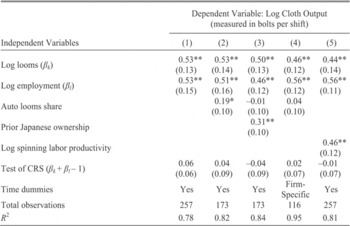
Results from specifications of equation 5, reported in Table 3, suggest that weaving production exhibited constant returns to scale with approximately equal factor shares. Specifications 1 and 2 are OLS estimations of equation 5. Specification 1 omits the automatic loom share variable and is run on the full sample. Specification 2 includes the automatic loom share and is run on the observations with information on loom type. In specification 2, the estimated coefficient on the automatic looms share is positive and significant, suggesting that the use of automatics increased productivity. However, since formerly Japanese-owned mills used automatics more intensively, this result may be due to spurious correlation. Specification 3 includes a dummy variable to control for productivity differences associated with past Japanese ownership. The ownership dummy is positive and significant, and indicates that circa 1947 average TFP in formerly Japanese-owned mills was 31 log percentage points higher than that in other Chinese-owned firms. The coefficient on the automatic looms share is very near zero, suggesting that the use of automatic looms did not significantly affect productivity. In specification 4, I use within-firm variation to try to identify the productivity effects associated with automatic looms. I control for firm-wide productivity levels using firm-specific time dummies and identify regression coefficients using within-firm variation in multi-plant firms. The assumption here is that most productivity variation occurs across firms, and therefore that control for ownership reduces bias in coefficient estimates. In specification 4, the coefficient on the automatic looms share is positive, but very small in magnitude and not statistically significant. Based on the results of specifications 3 and 4, I conclude that any productivity advantage enjoyed by Japanese-owned firms was not due to their more widespread use of automatic looms.
COBB-DOUGLAS PRODUCTION FUNCTION FOR WEAVING

* 5 percent significance.
** 1 percent significance.
Notes:
Standard errors are adjusted for plant-level clustering and are reported in parentheses. Table 3 reports the estimations of Cobb-Douglass production functions for weaving. The results suggest constant returns to scale, capital and labor shares of around 0.45 and 0.55, and that the use of automatic looms did not significantly affect productivity. Specification 3 indicates that formerly Japanese-owned firms continued to enjoy a productivity advantage under government management.
A final concern, addressed in specification 5, is the potential for unobserved productivity differences to bias estimates of the capital and labor coefficients. Because productivity change in textiles during this period was labor-saving, productivity heterogeneity could bias estimates of the labor coefficient downwards and the capital coefficient upwards. In specification 5, I include log labor productivity in each plant's spinning section as a proxy for productivity in its weaving section. Comparing specification 5 to specification 1, inclusion of the control increases the labor coefficient and decreases the capital coefficient.
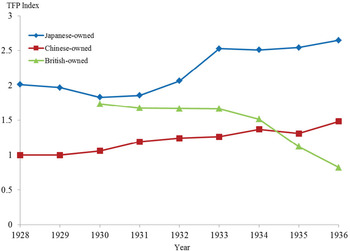
I use the CCMOA statistics to estimate sector-level total factor productivity, computed as residuals of a sector-level constant returns to scale Cobb-Douglas production function, with a labor share of 0.55 and a loom share of 0.45. The results shown in Figure 2, which plots aggregate TFP estimates for Japanese-, British-, and Chinese-owned plants, indicate that Japanese-owned firms enjoyed a large productivity average in weaving. From 1930–1936 Japanese-owned plants’ TFP in weaving exceeded that of Chinese-owned plants by 79 percent on average, and that of British-owned plants by 72 percent. Productivity among British-owned plants collapses from 1934 to 1936, reflecting reductions in operating hours at British-owned firms (Wu, 1935). In computing productivity measures, I exclude mills that shut down completely, but cannot observe the timing and extent of reductions in operating hours. Accordingly, hours reductions appear as drastic productivity declines.
PRODUCTIVITY LEVELS IN WEAVING

EXPLAINING THE CROSS-SECTOR PRODUCTIVITY GAP
Why were Japanese-owned mills so much more productive than their competitors in spinning and weaving? Commonly cited reasons for productivity differences, such as political institutions, differences in laborers’ educational attainment and experience, and capital quality, cannot explain the performance gap because the mills operated in the same cities, using similar labor sources and machines. Workers in Japanese- and Chinese-owned mills had similar tenure, so that differences in worker experience do not explain the productivity gap either (Fong, 1932; Pearse, 1929). Finally, the legal and political environment could not explain performance differences between British and Japanese firms; most of these firms were located in Shanghai's International Settlement, where they benefited from Western legal protections (Ma, 2006). Moreover, if the political environment had any effect, Chinese boycotts of Japanese products during the 1920s and 1930s and Britain's dominant role in Shanghai's governance should have disadvantaged Japanese-owned firms.
A difference which might explain poor performance in the Chinese- and British-owned sectors was their use of a form of subcontracting known as the foreperson system. Under this system, managers ceded control over labor recruitment, training, and organization to forepersons (Honig, 1986). The structure of this system was quite similar to that used throughout British manufacturing. In Britain, subcontracting remained the predominant mode of manufacturing organization until well after World War II (Tolliday and Zeitlin, 1991). Among textile firms in Britain, forepersons were given the authority to hire their own assistants, set their wages, and make production decisions (Jewkes and Gray, 1935).
Even though British firms used a similar management system both in China and at home, consequences of the system were different in the two locales. William Lazonick (1981) argued that subcontracting in British textiles encouraged forepersons to cooperate with management to raise productivity. Under subcontracting, British textile firms were able to produce at or near the global productivity frontier (Leunig, 2003). On the other hand, a similar system of labor arrangements in China led to frequent conflict between forepersons and management and prevented managers from making efficient staffing decisions (Cochran, 2000).
The inconsistency of the results obtained under the British management system reflected differences in the British and Chinese institutional environments. In early twentieth century textiles, productivity improvement was linked with the intensity of labor. More productive workers tended more machines simultaneously, meaning that efficient firms had lower staffing levels. In Britain, industry-wide collective bargaining set stable piece-rates for forepersons, guaranteeing that they could earn rents if they reduced staffing levels while maintaining output. In China, labor recruitment institutions established perverse incentives that encouraged forepersons to hire unnecessary workers.
In the Chinese labor market, bribery or “squeeze” had a central role in job search. Workers obtained positions by offering forepersons sums equivalent to two weeks’ pay, and maintained employment through regular gifts. Since adding new workers increased forepersons’ income, forepersons preferred to hire more labor than tasks demanded. Overstaffing led to considerable idleness within mills. Supernumerary workers found time to loiter, sleep, and even absented themselves from the mill entirely (Lee, 1925). Clearly, to the extent that forepersons could bring idle workers into the mills, they reduced labor productivity. Obstruction of managerial attempts to reform this system limited productivity growth as well.
The ability of forepersons to force firms to hire more workers than necessary reflects the influence of the Green Gang, a powerful criminal organization. Most mill labor brokers, forepersons, and guards belonged to the gang, and membership helped them to negotiate with mill managers over hiring practices (Smith, 2002). In textiles, the gang sold labor, property protection, and strike prevention services, but was simultaneously active in vandalism and strike instigation (Honig, 1983, 1986; Frazier, 1994). Acting both as an informal union for supervisory workers and as a labor broker for unskilled workers, the gang protested changes which disadvantaged its constituents. These disputes were typically related to staffing levels and personnel changes (Barker and Barker, 1934).
Progress in the textile industry depended upon reforming hiring practices to curtail bribery. However, foreperson opposition made these reforms difficult. When mills dismissed forepersons, the forepersons drew on Gang connections to mobilize worker resistance. Since workers invested in their relationships with forepersons through bribery and risked blacklisting if they abandoned the relationship, managers could not easily dismiss forepersons while retaining the workers under them (Honig, 1983 and 1986). Similarly, management attempts to curtail forepersons’ right to select their own assistants brought on violent strikes. Given the high costs of opposition, managers usually ceded to forepersons’ demands (Lee, 1925).
Japanese-owned mills operated under a management structure which absorbed many of forepersons’ functions into specialized bureaucratic agencies. Personnel offices controlled hiring and the assignment of employees to tasks. Instructors trained workers in classrooms and workshops on specially designated equipment. Production decisions came under the control of trained technicians. Forepersons were essential to fewer operations, used in smaller numbers (Jiangsu Employment Office Third Department, 1920), and at least during the mid-1920s were paid less than forepersons in Chinese-owned mills (Frazier, 1994). Importantly, absence of authority over hiring, firing, and compensation decisions prevented forepersons from extracting bribes from the workforce (Lee, 1925).
Japanese firms’ development of centralized management structures reflected a response to labor management problems in Japan. Firms in Japan engaged foremen (oyakata), who controlled labor gangs, and mediated the supply, training, and management of labor. Japanese foremen mobilized patronage relationships with workers and informal networks to influence managerial decisions (Levine, 1965). Japanese firms responded by replacing subcontractors with hierarchies that emphasized centralization, promotion-based incentives, and formal training (Jacoby, 1979; Moriguchi, 2003). In Japan, problems with foremen mainly occurred in mining and heavy industry, but organizational responses had a broader influence on all forms of large-scale manufacturing.
Recruitment problems were another important impetus to centralization in the Japanese textile industry. In the early twentieth century, mills in Japan relied on networks of rural recruiters to supply their labor needs. Recruiters often exploited deception to arrange placements, and as a result many workers quit shortly after their arrival. Since recruitment fees were a significant component of total labor costs, turnover rates directly affected profitability. To reduce turnover, Japanese textile firms established internal recruitment offices that enhanced company control over employment contracts and worker selection.
In China, Japanese-owned firms encountered profound foreperson resistance in establishing a managerial system that marginalized forepersons’ authority. Labor disputes occurred much more frequently at Japanese-owned mills than British- or Chinese-owned mills. Mark Frazier (1994) argues that frequent strikes reflected a response to Japanese attempts to control hiring and shop floor practices. In these labor disputes, Japanese managers were not uniformly successful. From 1925 to 1927 a series of particularly violent and disruptive strikes occurred at Japanese-owned mills. The Green Gang appears to have played a central role in fomenting these disputes. Strike negotiations led to some management changes that benefited Green Gang interests. Compensation for forepersons at Japanese-owned mills was increased dramatically, while that for ordinary shop floor workers barely changed. At the same time, Japanese-owned mills made accommodations with gang interests by agreeing to source most of their workers from gang-controlled recruitment networks (Frazier 1994, 2002). However, within mills, Japanese-owned firms continued to maintain much stricter control over staffing levels, job allocation, and work practices than Chinese- and British-owned competitors (Cochran, 2000). This outcome can be interpreted as an efficient solution to a dispute over the allocation of the rents associated with the Japanese management system. By offering concessions to the Green Gang in the form of higher foreperson wages and greater reliance on the gang's recruitment networks, Japanese-owned mills were able to retain a system of strict shop floor discipline that boosted productivity.
ORGANIZATIONAL REFORM UNDER OPPOSITION
Though the productivity gap between Japanese- and Chinese-owned mills was large on average, some Chinese-owned mills made significant advances in productivity through organizational reforms. In other cases, attempts to modify mill organization led to strikes and riots, compelling would-be-reformers to roll back changes. Successful reform generally involved significant investments, including the development of in-house training for Chinese engineers and technicians, changes in management structure that allowed technicians to directly control production, and the design of employment systems that benefited workers and reduced foreperson control. Many mills, however, adopted a more piecemeal approach, attempting only to intensify monitoring without reorganizing power structures. In these mills, forepersons used strikes and violence to derail the reform agenda.
The Shenxin Company, the largest Chinese-owned textile firm, provides an excellent case study of the reform process. Cochran (2000) has studied Shenxin in detail. I expand on Cochran's qualitative study by using production statistics from the CCMOA data to show that reforms at Shenxin plants conducted during the late 1920s and early 1930s significantly improved productivity. Though one company does not comprise an industry, Shenxin was at the vanguard of the Chinese-owned sector, and changes within the firm were closely watched.
The first period of reform relied heavily on labor markets as a source of new talent. In 1924 and 1925 Shenxin assigned shop floor positions to technicians recruited from Japanese-owned firms. Reform began with an experiment at Shenxin's Wuxi plant: managers assigned older, poorly performing American spindles to the new technicians, while forepersons retained control of newer British machines (Zhang, 2003). Technicians quickly exceeded the performance levels attained by the forepersons, convincing Shenxin's plant manager of the need for full-scale reorganization. Performance benefits were only transient, however. After several months, Shenxin's forepersons organized a workplace riot, expelling technicians from the mill. Following negotiations, managers dismissed the technicians and reinstituted the prior governance system (Shanghai Academy of Social Sciences Economics Research Institute 1962).
Shenxin's second period of reforms focused on educating and training technicians internally. Initial efforts centered on the company director's extended family, many of whom were sent to textile schools abroad. Simultaneously, Shenxin founded a company professional school, the Shenxin Managerial Training Institute. Students attending the institute's yearlong courses engaged in classroom learning under foreign-educated instructors and concurrently practiced their knowledge in the institute's simulated factory. Shenxin's approach resembled training routines in Japanese-owned mills. Centralized training at Shenxin provided a framework for the introduction of managerial innovations across multiple plants, including accounting techniques which allowed inter-plant comparisons of unit costs.
In-house training provided the company with the capacity to reform itself. By 1933, 81 graduates had matriculated from the institute, providing Shenxin with the nucleus of talent in middle management necessary to mount a successful reform of its plant in Wuxi. This time, Shenxin's management co-opted workers through the provision of a range of benefits, including improved housing, dining, recreation, and religious facilities, and greater voice in company governance. The company's Wuxi campus, renamed, “The Community of Self-Governing Workers” because of the use of worker-elected judges to resolve labor disputes, created an autonomous social system which encouraged workers to identify their interests with those of management. Once the new system of management-labor relations had taken hold, forepersons were dismissed from the mill and replaced with technical staff. The new staff rationalized work procedures, laying off supernumerary workers and nearly doubling the machine-tending demands for those who remained. Following reforms in Wuxi, Shenxin also introduced successful reforms at its plant in Hankou.
The success of reforms in Wuxi and Hankou may have been related to their location outside of Shanghai. The Green Gang operated throughout China, but was most powerful in Shanghai. Starting in 1931 Shenxin undertook reforms at Shanghai mills, but with only limited success. Problems reforming mills in Shanghai were related to strong opposition from the Green Gang (Cochran 2000 and Frazier 1994).
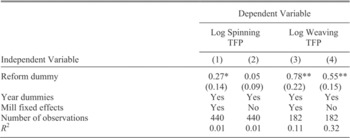
Based on reform dates for nine Shenxin plants provided in Cochran (2000), I test whether reform improved spinning and weaving productivity as measured using the CCMOA data. For spinning, I estimate plant-level TFP as the residual of a constant returns to scale Cobb-Douglas production function with equal factor shares. I regress spinning TFP on year dummies, plant-level fixed effects, and a reform dummy variable which is equal to one in the years following reform and equal to zero in the year of reform and all preceding years.
PRODUCTIVITY EFFECTS OF REFORMS AT THE SHENXIN COMPANY

* 5 percent significance.
** 1 percent significance.
Notes:
Standard errors clustered at the plant-level are reported in parentheses. Table 4 presents OLS estimates of the productivity effects of managerial reforms at Shenxin. The regression sample is restricted to Chinese-owned mills operating between 1929 and 1936. Production statistics are taken from the CCMOA data and organizational reforms are dated according to Cochran (2000). In both spinning and weaving, I measure plant-level log total factor productivity as the residual of a Cobb-Douglas production function. The capital and labor shares for spinning are 0.5 and 0.5, and for weaving 0.45 and 0.55. The coefficient on the reform dummy in specification 2 is biased downwards because Shenxin spun higher counts than the Chinese-owned average. Specification 1 partially corrects for this problem using fixed effects, but estimates may still be biased downwards because the counts spun at Shenxin increased over time.
This productivity measure is not count-adjusted, and OLS estimates of reform coefficient are biased downwards because Shenxin spun higher yarn counts than the Chinese-owned average. I try to control for this problem using plant fixed effects. However, the coefficient is still likely biased downwards since average counts at Shenxin increased during the mid-1930s (Wu, 1935). Measurement of weaving productivity is less problematic because changes in cloth type have less dramatic effects on output. For weaving, I compute plant-level TFP as the residual of a Cobb-Douglas production function, using 0.45 and 0.55 as the capital and labor shares. Estimates, reported in Table 4, indicate that reform dramatically improved company performance. Focusing on the fixed effects estimates reported in specifications 1 and 3, reform increased spinning TFP by an average of 27 log percentage points, and weaving TFP by 78 log percentage points.
CONCLUSION
The Chinese experience with the absorption of textile technology reveals several points of interest to students of technology transfer, foreign investment, and development. The organization of textile production in China was heavily influenced by the local institutional environment. Difficulty in negotiating local institutions caused British-owned textile firms to perform worse than Chinese-owned firms, even though they, like all firms in the industry, were operating with primarily British machines. For firms with the appropriate knowledge of how to organize Chinese labor, good results could be obtained. Japanese-owned firms, equipped with locally appropriate managerial techniques, were able to achieve productivity levels which approached those in Japan.
The experience of Japanese- and British-owned firms in China shows that context affects the success of technology transfer. A managerial system may be best practice in one context, but perform poorly in a different institutional and cultural environment. The implication is that knowledge may only be useful within a certain scope, defined by input characteristics. Transfers of knowledge to regions with dissimilar inputs may fail to improve productivity.
One interesting implication of the theory is that foreign direct investment follows a matching process; investors match differentiated firm-level knowledge stocks to differentiated input sources, and obtain a productivity level which reflects goodness of fit. Based on this theory, one would expect countries with similar input characteristics, for instance those sharing common cultures, to have unusually strong investment relationships. Between World War I and World War II, this appears to have been true of Japan and China. For example, between 1914 and 1923, Japanese-owned firms grew from 19 percent to 62 percent of the total number of foreign firms registered in Shanghai, China's premier industrial center (Reynolds, 1975).
Naomi Lamoreaux provided invaluable guidance throughout the project which is based on my doctoral dissertation completed at UCLA. I received particularly useful comments and suggestions from Daniel Ackerberg, Leah Boustan, Gregory Clark, Dora Costa, Xiaocai Feng, Richard Von Glahn, Edward Leamer, Aldo Musacchio, Jean-Laurent Rosenthal, Susan Wolcott, R. Bin Wong, and participants at the Shanghai Economic Forum (2008), the All-UC Graduate Student Workshop (2009), and the All-UC CEGE Conference (2011). This research was supported by a UCLA Economic History Travel Grant, National Science Foundation Doctoral Dissertation Improvement [grant number 0820584], and an Institute of International Education Fulbright fellowship (2008–2009).


 (National Textile Factory Survey.) Shanghai, China,