“Hitler is my best friend; he shakes the tree and I collect the apples.”
Walter Cook, Chair, Art History Department, New York University, 1930sFootnote 1In 1932, the artist George Grosz offered an optimistic account of his arrival to the United States:
It was really quite a change from Germany at that time, when you saw so few happy faces and heard so much complaining and quarreling. You had the impression that Americans of all races, classes, and occupations were satisfied with the world, and actually, in spite of the Depression, their American world was still much more colorful and richer than the German.Footnote 2
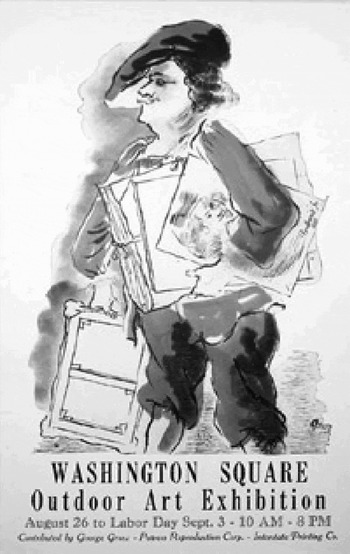
Grosz also observed the hopes and fears of his fellow émigrés as they began to arrive after Hitler's appointment as chancellor in 1933Footnote 3 (Fig. 1). The possibilities of return dimmed with each year that Hitler remained in power and ended completely once Hitler declared war on the U.S. in 1941. Even though Grosz was forty years old when he landed in New York, he “did not want to be like some of my compatriots who were almost proud of their inability to adjust.”Footnote 4
George Grosz, Poster for Washington Square Outdoor Art Exhibition, New York, 1933.

Each biography of the exile's experience in the U.S. is unique, and recent accounts rightly reveal a complicated picture of cultural and political emigration. This essay will review a small portion of the incredibly massive literature of the last twenty-five years that describes the migration of artists, art historians, art dealers, and museum curators at a time when German-American relations reached their nadir of mutual suspicion, tense diplomatic encounters, and finally, war. Not all the newer literature entirely alters older narratives. For example, C.-D. Krohn wrote in the late 1980s, echoing earlier accounts by American contemporaries, “If the westward flight of the Greeks could be regarded as the starting point of the Renaissance and of Humanism, the expulsion of German intellectuals after 1933 seemed like the transfer of an entire culture, primarily to the United States.”Footnote 5 Additionally, as Martin Jay observed, “The lion's share of scholarly research has focused on elite intellectuals, whose often poignant stories have special resonance for historians, who can so easily identify with them.”Footnote 6 Entire yearbooks and journals are currently devoted to exile studies in which culture and the arts figure prominently.Footnote 7 The exile experience and its impact on American culture continues to fascinate, and in the last few years, a significant number of major studies have been published that reveal the transnational relationship of German and American art, art history, and museum practice.
***
There have been a number of approaches taken in reviewing German-American cultural contacts and emigration during the 1930s. One approach has been to evaluate the high politics of cultural diplomacy. What were the German and the American governmental efforts at promoting national culture through officially sanctioned exchanges by artists, writers, museum exhibitions, concert tours, and related activities?Footnote 8 The U.S. government's attempts to influence Germans and others abroad gained momentum in the late 1930s, particularly after Germany sought to undermine long-standing U.S. hegemony in Latin America, even though the State Department traditionally had viewed cultural matters as quite distinct from official governmental and diplomatic policies.Footnote 9
Another research strategy has been to examine more generally the effects of the refugee migrations that have been such a critical feature of the twentieth century. The decades between World War I and the 1950s witnessed population transfers numbering in the millions. Some of the literature that focuses on cultural refugees has given attention to the legal conundrums of migration during the 1930s. Given the enormous and intractable refugee problems occasioned by the rise of European fascism in the 1930s, worldwide economic depression, postwar Cold-War confrontations in Europe, decolonization, and recent religious and ethnic conflicts in Asia, Africa, southeast Europe, and the Middle East, refugee studies has become a major subspecialty, particularly in areas of conflict resolution, ethnic studies, sociology, and political science. A key founder of the legal underpinnings of refugee status was an Austrian refugee, Paul Weis (1907–1991), imprisoned by the Germans in Dachau from 1938 until 1939 when he left for the United Kingdom. He is credited as the “father of international protection” for his work on the 1951 United Nations Convention Relating to the Status of Refugees. Weis, who had trained in England as a lawyer, served as a legal advisor and later as Chief of the Legal Department of the Office of the United Nations High Commissioner for Refugees.Footnote 10 Some of the literature that deals with exile experience has been enriched with materials that incorporate the latest legal research on refugee status during the twentieth century and detail the difficulties faced on an almost daily basis by refugees to the United States.
Rather than describing the high politics of cultural diplomacy or legal definitions of refugee status as they applied to cultural emigration, I will concentrate on areas of recent scholarly interest that examine culture at levels below official exchanges, acknowledging specific areas of cultural transfer. These newer accounts center on biographical discussions of individual artists, art historians, and architects, as well as institutional histories of art museums and art schools. Several works describe the transnational nature of cultural transfer before 1933, chronologically beginning their accounts in the 1920s and carrying the story into the Cold-War era. Second, the specific roles of individual artists, architects, art historians, museum curators, and art dealers in facilitating this cultural transfer as well as the artistic milieu in Germany at the time of artists' and art professionals' departure has been an integral part of this research. Thus the clearly demarcated divisions with the German and American art worlds in the interwar decades have given way to analyses of both in relationship to one another. Third, scholars have discussed the critical importance of several U.S. institutions in the dissemination of modernism, among them the Museum of Modern Art in New York, the New School for Social Research, the School of Fine Arts of New York University, the new Bauhaus in Chicago, the Detroit Institute of Arts, and Black Mountain College in North Carolina.Footnote 11 Recent art exhibitions have provided more detailed information about art schools' and museums' importance in constructing narratives of modernism for the American wartime and post-war generation.Footnote 12 Finally, the trope of a New World “paradise” has been a feature of the scholarly discussion of the German cultural diaspora.Footnote 13 A fair number of works employ the notion of a benevolent West Coast to explain how, by the mid-1950s, “California cool” absorbed and transformed exile European modernism.Footnote 14 Most accounts simultaneously note the disjuncture between the improbable geographical location and climate of Southern California and the difficulties of central Europeans' cultural integration into that environment.Footnote 15 The positive side of exile experience has been given more emphasis in the newer literature.
Did the aesthetic that the Nazis abhorred imply that the cultural refugees were democrats who rejected authoritarianism in politics and transported artistic, literary, cinematic, and musical modernism to the United States? Several newer narratives have painted a more complicated picture, without necessarily totally reconfiguring the main contours of that story.Footnote 16 Sabine Eckmann recently suggested:
For Germany, the exile artists not only function as evidence of the victimization of Germany by Hitler but also give reason to mourn that past from the perspective of the victim. By contrast, in the United States Hitler exiles most often are seen to underscore a homogenous conception of the United States as a democratic haven for all victims of dictatorships. In both cases, exile artists are used to institutionalize hegemonic cultural positions.Footnote 17
Early Studies of Cultural Exile and Later Foundational Questions
Before discussing accounts of artistic exile and its American impact published in the last quarter-century, I will briefly summarize earlier research. Two major monographs about émigrés served as the basis for later studies by determining the number of artists arriving in the United States during the 1930s and exploring the degrees of assimilation by occupation, age, and region. In 1947 Maurice Davie published Refugees in America: Report of the Committee for the Study of Recent Immigration from Europe. In it, he listed 717 artists and sculptors who emigrated from Europe between 1933 and 1944.Footnote 18 His work was followed by Donald Peterson Fleming's account of refugee intellectuals and their impact in the United States, which focused on German and Austrian émigrés, published in 1953. According to statistics that Fleming derived from the U.S. Immigration and Naturalization Service, 104,098 German and Austrian immigrants arrived between 1933 and 1941. Of those, 7,622 were classified as professionals and 296 individuals listed their profession as “art.”Footnote 19 His sociological study centered on the level of assimilation into American society. Among his conclusions, he noted that:
Previous occupational training is significant, since all skills are not equally transferable. Those occupations having a body of knowledge internationally known and applicable … or those arts having a medium of expression universally accepted, like music or painting, fare best in the transplanting.Footnote 20
Yet almost thirty years after these first statistical surveys, researchers still were attempting to arrive at exact figures for German emigration. In 1980, a comprehensive German-English reference, Handbuch der deutschsprachigen Emigration nach 1933, published biographical information on more than 8,600 prominent émigrés in politics, science, the humanities, and the arts.Footnote 21 This encyclopedic compendium also has served as an important reference for the later, more focused studies of particular occupational groups of émigrés. Figures for Austria included approximately 100 artists out of 150,000 émigrés leaving the country, the vast majority departing after the Anschluss in 1938.Footnote 22 According to a more recent survey, only 369 German artists emigrated, and of these, 72 emigrated to the United States.Footnote 23 The disparity in the figures is affected by the categories chosen to group occupations. Some authors group all writers, musicians, painters, and architects as “artists.” Others break down these divisions into separate categories. Cultural émigrés generally could include writers, journalists, academics, musicians, and artists, though there were some émigrés whose professions were difficult to ascertain and are so noted by the literature.Footnote 24 A biographical reference of exiled art historians and museum personnel published in the late 1990s lists 215 individuals who emigrated (to the U.S. as well as other countries).Footnote 25
Two synthetic English language accounts published in the late 1960s described the intellectual and cultural contributions of scientists, artists, and academics to interwar America. Laura Fermi's affectionate account of her physicist husband's colleagues in Illustrious Immigrants described the contributions of artists and architects in addition to scientists.Footnote 26 An edited work by Harvard historians Donald Fleming and Bernard Bailyn, Intellectual Migration, asked émigrés themselves to recount their experiences and those of their compatriots, casting a wide net over the most important intellectuals, artists, and professionals who landed in the United States during the 1930s. Several chapters in Intellectual Migration continue to be standard work, often referred to by later scholars. The art historian Colin Eisler, himself a young émigré (age ten) when he arrived in the United States in 1941, described in great detail not only the contributions to art history by well-known art historians, most famously Erwin Panofsky and H. W. Janson, but also the comparative development of the art historical profession in the U.S. and Germany before 1933, thereby contextualizing practices before Hitler's ascent to power.Footnote 27 An important feature of Eisler's descriptions, often punctuated with personal opinions about his protagonists, is the fact that he invited many of them to submit answers to a long questionnaire that detailed their experiences. Since most of the art historians, art dealers, and museum officials he discusses are no longer alive, his rich account remains a vital source. It is textured with a real sense of the art historical profession, the museum world, and the world of the art dealer in the United States and Germany both before 1933 and after the influx of émigrés arrived in the New World.
Since these publications by Fermi, Fleming, and Bailyn more than a generation ago, scholars have paid more attention to the exile experience within the fine arts community. Two volumes that describe the emigration of art historians to the United States have added to the understanding of the depth and breadth of their contributions to scholarship in the United States. Ulrike Wendland's two-volume reference work from 1998 provides basic biographical information and includes lists of the émigré art historians' publications as well as reviews and contemporary opinions that evaluate their legacies for the profession. Karen Michels's 1999 monograph, based on her Hamburg University Habilitation, details the organizations that helped émigré art historians settle in the U.S. She describes the crucial efforts of U.S. universities, particularly New York University's Institute for Fine Arts and the New School for Social Research, that housed the scholars, sometimes temporarily through supplemental funding and occasionally through permanent positions. Michels also pays great attention to the teaching and research styles of individual professors and the critical impact that their mentorship and scholarship had on subsequent generations of American art historians.Footnote 28
A critically important English language volume on art and exile is the catalog that accompanied a comprehensive art exhibition mounted more than a decade ago at the Los Angeles County Museum of Art: Exiles+Émigrés: The Flight of European Artists from Hitler.Footnote 29 Curated by Stephanie Barron, the exhibit formed part of Barron's ongoing project to reconstruct German art history and its international influences from the 1920s to the present.Footnote 30 The Los Angeles County Museum, with its rich Gore Rifkind collection of German expressionist graphic art, has been prompted in this ongoing effort by the fact that Los Angeles housed so many prominent émigré writers, musicians, and other creative individuals. Exiles+Émigrés serves as a formidable reference work, detailing the artistic lives of painters, architects, and designers. It features significant articles on art historians and dealers, some based on interviews and some of the material building beyond Colin Eisler's article in Intellectual Migration. The volume also includes the less studied topic of European émigrés from Paris (such as the artists Marc Chagall and Piet Mondrian) and their relationship to the German cultural exiles.Footnote 31
Additionally, the greater frequency of such art exhibitions has importantly revealed a shift in the scholarly profession since the 1970s—a closer collaboration among historians, art historians, and museum curators.Footnote 32 Indeed, this type of collaboration has given much more prominence to aesthetic factors in German and American political and social history. For the past generation, historians increasingly have begun to explore the visual, and not simply as illustrative of other issues. Debate continues, however, about the degree to which historians have adopted the “visual turn.”Footnote 33 For the last thirty years, art historians, especially for the early modern period but also for nineteenth-century France, have investigated in greater depth the social and political contexts within which art was made and displayed. Social art historians, rejecting though not ignoring the heretofore dominant “formalist” approach to art history, seek to situate artists within a larger terrain in order to understand individual artists' development, their stylistic changes, and the social transformations within which art was produced, displayed, bought, and sold.
Increasingly curators organized exhibitions that included more historical artifacts to contextualize the art along with including historical essays in exhibition catalogs. While many may applaud this direction in cultural history, art history, and museum exhibition practice and collaboration, this direction has not been without controversy. Some curators dismiss contextualization as unnecessarily removing the art from art history. One museum curator, when queried about the relationship between art exhibitions and art scholarship, responded by accusing academic art historians of ignoring art: “… so much art history seems to me quite divorced from the real subject of art and has become an unsatisfactory ersatz vehicle for sociology, history, psychology, and God knows what else.”Footnote 34 Nonetheless, closer collaboration between the museum world, the visual turn in history, and the contextual turn in art history has borne fruit as recent exhibitions have shown. In addition to the journal and monographic literature, the art exhibitions and catalogs that highlight the German-American cultural interaction have been instrumental in reconstructing the aesthetic milieu.Footnote 35 These developments are part of a larger frame of reference that seeks to demonstrate the transnational interactions among cultures and geographies throughout key periods of history, one of which was the critical decade before the Second World War.Footnote 36 Finally, in the wake of transnational examinations of cultural transfer, scholars are asking new questions about marginality and interactions between and among artists across borders.
The recent literature, therefore, seeks to interrogate and more precisely define terms such as cultural migration, exchange, and cultural transfer. Discussing cultural transfer in early modern European history, Bernd Roeck wrote:
One can say that the genesis and structure of every cultural epoch must be understood as a result of complex horizontal and vertical processes of cultural transfer … At the same time, cultural transfers often had a social and political dimension giving them the characteristics of a force imposed from outside.Footnote 37
Roeck further discussed the phenomenon of alterity, by which he suggested that one culture's confrontation with “the other” can stimulate forms of nationalism but also allow the received culture to examine and construct meaning of its own culture in a dialectic that émigrés themselves observed in exile.Footnote 38 Relating this to German and Austrian émigrés in the 1930s, Roeck says “Creative success and the accompanying cultural impact were stronger in those cases where the professional standards were not too far from each other and where the contribution of Europeans was therefore immediately seen and appreciated as a potential enrichment and enhancement of American standards (cases in point are architecture, physics, the social sciences, and art history).”Footnote 39 And in a recent volume that discusses the role played by journals in the transmission of ideas and in creating networks of knowledge at the turn of the century, Michel Espagne urged historians to move beyond the national boundaries of cultural history and to investigate “cultural transfer as part of a transnational perspective” and offer a “new way to present transnational history.”Footnote 40
Employing the term “networks” has been another useful way to understand the interactions between émigrés and Americans, as well as to comprehend that while émigrés in the United States were absorbed by attempts to create a productive and supportive environment for themselves, their families, and colleagues, they continued to connect with colleagues abroad—even in Germany until the declaration of war disrupted communication. Throughout the war, art historians, art dealers, and artists corresponded with colleagues and friends in areas abroad that took in German refugees. Keith Holz describes the various art organizations founded by exiles in Europe to publicize and exhibit exiles' art. He notes that artists organized art groups in Paris, Prague, and London that mirrored those that had existed in Imperial and Weimar Germany, seeking to “assist persecuted exiled German visual artists and to cultivate work opportunities for them.”Footnote 41 These cultural networks served to maintain émigrés psychologically and financially during very precarious economic times. Émigrés founded equivalent organizations in the U.S. at this time as well.Footnote 42 Artists, art dealers, art historians, and museum personnel who emigrated to the United States kept in contact with their compatriots who emigrated to other European countries or remained in Germany until the outbreak of war. These networks served the important function of internationalizing knowledge in an era of hyper-nationalism. While the natural and physical sciences have traditionally encouraged international exchange through conferences, symposia, collective research in laboratories and institutes, until recently less work discussed the international networks of artists, exhibitors, dealers, museum curators, and art historians. The creation of international exile organizations for academics, writers, and artists such as the German Academy of Arts and Sciences in Exile highlighted the international nature of the diaspora.Footnote 43
***
In addition to explorations of transnational cultural contacts during the 1930s, scholars have revisited the complicated topic of the relationship between politics and modernism in the arts.Footnote 44 A narrative of modernism developed during the 1930s and particularly through the Cold-War era that equated repressive totalitarian policies, of either Communist or Fascist variety, with a retrograde socialist or social realism. In contrast, this narrative labeled those “modernisms” condemned by the Nazis, such as expressionism, abstraction, or Bauhaus architecture, progressive and enlightened. Recent studies suggest that conservative antipathy in Germany toward artistic modernism preceded the Nazis' assumption of power, in fact, having a long history that stretches back to the turn of the twentieth century.Footnote 45 The literature on artists who remained in Germany attempts to distinguish between those forced into “inner exile,” namely refraining from exhibiting in state-sponsored exhibitions or teaching at art academies, and other artists who, with varying degrees of enthusiasm, supported the Nazi regime. Biographies of artists who remained in Germany during the 1930s paint an increasingly complex picture of inner exile. In addition, examinations of Nazi cultural policies have also complicated the once dominant position of unilateral and consistent anti-modernism. Finally, the literature of American reception of German modernism in the late 1920s and early 1930s displays a critical ambivalence, particularly toward expressionism. Thus, scholars interrogate the perception of an unproblematic and progressive modernism, one that Americans readily embraced.
For example, Alfred Barr, Jr., the first director of the Museum of Modern Art (MOMA) who had close connections with German museum officials, artists, and architects in the 1920s and 1930s, observed that “those who are devoted to contemporary French painting or its American imitation will feel their prejudice against German painting by the work of Otto Dix. It seems so coarse and ruthless.”Footnote 46 Reviewing a major MOMA survey exhibition of modern German art organized by Alfred Barr in 1931, German Painting and Sculpture, one contemporary critic noted, “It is all very virile, this German modernism, rather obviously on parade, and with a certain strutting forwardness not a little suggestive of the famous goose-step of yesteryear.”Footnote 47 Ironically, when the Nazis actually goose-stepped to power two years later, attitudes toward German modernism began to shift, though most Americans continued to regard expressionism skeptically. National Socialism's totalitarian cultural policies, however, ultimately resulted in a more favorable reception of German modernism in the U.S. This was especially the case because a number of German painters whom Barr had highlighted in the 1931 German Painting and Sculpture show lost their teaching positions in Germany, among them Max Beckmann, Otto Dix, Karl Hofer, Paul Klee, and Max Pechstein. Barr's exhibition thus paved the way to a greater acceptance of modern German art, for it had attracted favorable reviews and large numbers of visitors.Footnote 48 In addition, before 1933 an important cohort of New York-based politically engaged American painters, such as Stuart Davis, Ben Shahn, and William Gropper followed events in Europe with alarm. Their activities centered in two organizations, the John Reed Clubs and the American Artists' Congress, and they endeavored to alert their colleagues of fascism and Nazism's danger to artistic freedom.Footnote 49
By 1934, the Nazi assault on avant-garde art began in earnest with the first of several exhibitions that denounced impressionism, expressionism, dada, surrealism, and abstraction. Nazi art administrators also removed modern art from museum walls. Numerous articles in U.S. magazines and newspapers regularly noted the repressive anti-modernist policies of the Nazis, especially after the infamous 1937 Munich “Degenerate Art” exhibition, together with the auction and sale of 125 works from the show, some of which entered American collections.Footnote 50 According to Holz, “Only after … 1937 … did modern art as a category unto itself become affirmatively associated with democracy and hence construed as anti-totalitarian or anti-fascist simply on formal-visual grounds. For this reason, it is possible to say that the Nazi government's belated anti-modernist turn in their domestic art policy effected a favorable sea change abroad for the reception of modern German art, including that of exiled German artists.”Footnote 51 Modernism included a wide range of styles discredited by the Nazis, ranging from impressionism to abstraction. The trauma of exile rather than aesthetic style bound the artists to a modernist framework, affirmatively answering Sybil Milton's famous query made almost twenty years ago, “Is there an Exile Art or Only Exile Artists?”Footnote 52
The powerful story of progressive modernism remained in place for decades, even after the fall of the Berlin Wall in 1989; however, recent accounts acknowledge that the U.S. reception of European modernism during the 1930s is a more complicated and ambiguous story for several reasons. First, repressive regimes as well as liberal governments incorporated modernist styles into their aesthetic vocabulary. Scholarship has pointed out that one could not necessarily differentiate between “good” and “bad” modernism, depending on the particular political regime—whether the New Deal of Franklin Roosevelt, the Nazi regime of Adolf Hitler, or the Communist state of Joseph Stalin.Footnote 53 Second, before emigration the cultural exiles themselves often had been powerful critics of Weimar culture, however much these later narratives cast them as representing that culture. One need think only of Theodor Adorno's prescient critiques of modern society as well as moderately liberal and more radical politically engaged artists who regularly questioned Germany's politics, and its cultural and social transformations during the 1920s.Footnote 54 Weimar culture was often compartmentalized into cliques and groups, artistic, political, theatrical, and otherwise. Third, Nazi cultural policies did not immediately foretell an anti-modernist stance, though many of the most prominent avant-garde painters affiliated with art schools and academies were quickly dismissed from their positions. Yet a more nuanced examination of the 1930s has not devolved into moral relativism. Accounts still portray the National Socialist regime as fundamentally genocidal, its cultural policies fatally politicized, forcing a small but influential segment of its population to leave Germany and creating an actual cultural vacuum that took decades to overcome.
Yet the literature simultaneously notes that the Nazis did not entirely discard aesthetic modernism nor did all modernist artists necessarily suffer occupationally as a result of their work.Footnote 55 For artists who remained in Germany rather than emigrate, the picture is increasingly complex. Just as the literature does not automatically equate exiles stylistically with modernism that the Nazis condemned, so, too, it does not reflexively suggest that artists who remained in National Socialist Germany unreflectively supported or complied with anti-modernist Nazi aesthetic policies.Footnote 56 Just as there were “gray zones” of complicity among many professional groups, so, too, artists were not immune from the seductions of opportunity in the Third Reich, in which careers hinged on overt or tacit accommodation. This could be seen among several of Weimar's avant-garde artists who remained in Nazi Germany as well as some younger modernist artists beginning their careers but who had studied with discredited painters. Art historians have dismissed those artists who enthusiastically embraced Nazi ideology for works that appeared to be derivative of nineteenth-century realism or whose styles seemed to conform to Nazi strictures about acceptable art.Footnote 57 The new literature on the art of the Third Reich rejects the binary divisions between traditionalists and discredited modernists—whether in inner or outer exile.Footnote 58 For example, the expressionist Emil Nolde, whose Nazi sympathies historians noted many years ago, viewed his art as the sincere embodiment of National Socialist ideology, even if the government saw his oeuvre quite differently.Footnote 59 In architecture, Barbara Miller Lane long ago examined the Nazi policy of selective anti-modernism—government cultural officials picking, choosing, and defining what was or was not acceptable and often implementing contradictory policies as a result.Footnote 60 Recent scholarship on tolerated modernism in Nazi Germany builds upon earlier accounts and continues to evaluate the levels of complicity or resistance among artists who remained in Germany, the aesthetics of those who fled Germany, and the artistic transformations of exiled artists once in the United States.
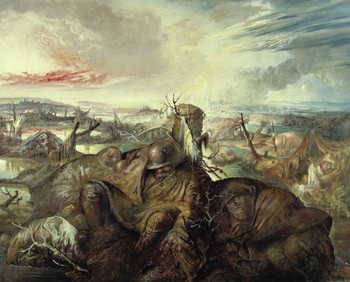
Hence, debates about “inner exile” continue unabated. Because the dismissal of avant-garde artists from teaching positions at art academies, the confiscation of modernist art from museums, and the prohibition to paint and exhibit evolved over several years, artists reacted in a wide variety of ways to the changed cultural climate after 1933. More than ten years ago, Exilforschung devoted an entire issue to the topic of inner emigration, though most of its articles centered on writers rather than painters.Footnote 61 Otto Dix, the quintessential Weimar artist whose images of decadence symbolize the popular art scene of 1920s Berlin, famously remarked about his remaining in Germany, “I painted landscapes. That was indeed emigration.”Footnote 62 While this dismissive remark may suggest that Dix's works of the mid-1930s appeared innocuous, several of his paintings and graphic works of the mid-1930s have definite political and anti-regime subtexts, particularly Flandern (1934–1936) (Fig. 2) and Judenfriedhof (1935). Dix's depiction of dead soldiers together with the blood-flecked sky suggesting humanity's loss through military conflict unmistakably contradicted Nazi positive paeans to war.
Otto Dix, Flandern, 1934–1936. ©2008 Artists Rights Society (ARS), New York NG Bild-Kunst, Bonn.

Otto Dix was summarily dismissed from the Dresden Kunstakademie, forced to withdraw his membership in the Prussian Academy of Art, and had his works confiscated and on display at several Degenerate Art exhibitions. But he remained in Germany throughout the 1930s and 1940s.Footnote 63 Art historians have attempted to reevaluate the art, the artists, and their themes, techniques, and exhibition strategies in new and more nuanced ways, both for artists who remained in Germany as well as those in exile. Scholars have pointed out that it is a mistake to equate automatically the artists whom the Nazis maligned with those who chose exile. Only around twenty percent of the artists banned actually left Germany, even when the National Socialist government prohibited them from painting or exhibiting their work. The flight of exile artists, art historians, and museum curators took place over a period of several years in the 1930s and 1940s; some, such as George Grosz, Hans Hoffmann, and Erwin Panofsky, arrived before the Nazis came to power. Several, notably those on the political left, such as George Grosz, saw the imminent danger in an increasingly conservative Germany by the early 1930s. Others left Germany toward the end of the decade or first settled in other parts of Europe before coming to the U.S.Footnote 64 As Keith Holz astutely phrases it:
… throughout the postwar period something resembling amnesia has plagued both scholars and art audiences concerned with the public identity of the modern artist's ability to trade on his (and occasionally her) status as victim. So often forgotten is how it was only after the Degenerate Art exhibition campaign … that victimhood became a viable public stance for all artists exiled from Germany… . It was as if modern art was revalued at that point to serve as relics of democracy and individualism, available for worship in Western galleries and museums.Footnote 65
Émigré Art Historians, Artists, Art Dealers, and U.S. Art Institutions
The recent literature that describes the arrival of cultural exiles centers on how contacts among U.S. and German artists, museum personnel, and art historians before 1933 aided in the accommodation and reception of refugees after Hitler's assumption of power. As early as the 1920s American journals and textbooks detailed the elements of Bauhaus architecture and theory, laying the foundations for the generally positive American reception to architectural modernism in the 1930s. “The key to understand the success and American reception of Bauhaus is not through émigrés’ success stories or the [Museum of Modern Art] Bauhaus show of 1938, but rather the early contacts with Bauhaus.”Footnote 66 For example, Walter Gropius entered a competition for the Chicago Tribune Building in 1922. He did not win the competition but architectural journals described and discussed his entry. Several important architectural textbooks published in the 1920s featured the “new pioneers” of modernism. In particular the influential Henry Russell Hitchcock text Modern Architecture (1929) favorably described the work of Le Corbusier, Gropius, and Mies.Footnote 67 These early contacts also included a very small but nonetheless important group of Americans who admired European progressive art and either through patronage or exhibition brought this art or attention to it to the United States in the 1920s and 1930s. Among those responsible for bringing Bauhaus members to America were the architect Philip Johnson and the Museum of Modern Art's director, Alfred Barr, Jr., along with former American Bauhaus students.Footnote 68
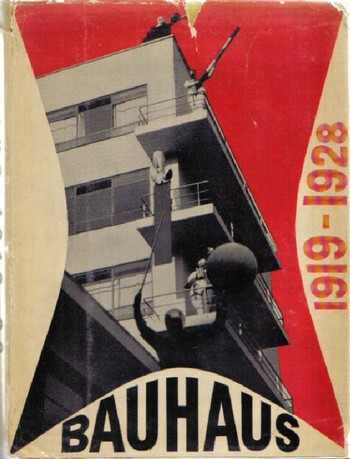
Influential museum directors such as Barr had already viewed works by the modernist artists and architects when visiting Berlin in the Weimar period. Barr was familiar with expressionist and new realist (Neue Sachlichkeit) artists on display at the Kronprinzenpalais. The director of Berlin's National Gallery, Ludwig Justi, conceived of housing the latest trends in modern art in a building separate from the old National Gallery.Footnote 69 Germany's defeat in 1918 and the abdication of the royal family made the Crown Prince's palace available to the republican government which converted it into a museum. Alfred Barr visited the museum, and its exhibition concept inspired him to plan the Museum of Modern Art in New York along the same lines. Impressed with the latest developments in German architecture and design, Barr also organized several shows of German modernism in the 1930s, one of the most important being the architecture and art show in 1938, The Bauhaus, 1919–1928 (Fig. 3).
Cover for Museum of Modern Art Bauhaus Exhibition, 1938.

Barr's travels to Germany and championing modern art during the 1920s and the 1930s inspired private collectors and museums to purchase art later labeled “degenerate” by the Nazis. One important example of an artist who did not emigrate to the U.S. but whose work Barr passionately advocated was Paul Klee. Barr mounted a major Klee show at the Museum of Modern Art in 1930. After Hitler's appointment as chancellor, Barr immediately sensed the danger that awaited modern artists and proved instrumental in requesting private collectors and major museums throughout the U.S. to acquire Klee's art.Footnote 70
Katherine Dreier (whose family helped to organize Black Mountain College in North Carolina, where many émigré artists located) together with the French dada artist, Marcel Duchamp, founded the Societé Anonyme exhibitions in the 1920s, introducing avant-garde artists such as Piet Mondrian and Joan Miro to American audiences.Footnote 71 The range of modernist art on display in New York prepared American audiences for the second wave of emigrants who fled fascism during the 1930s. And after 1945, the postwar generation of American abstract expressionists, such as Jackson Pollock and Mark Rothko, had been exposed to abstraction during the 1920s and the 1930s through the Societé Anonyme exhibitions, through MOMA shows, and through émigré art teachers, such as Albers, Grosz, Hoffmann, and Moholy Nagy. American architects in mid-century had several decades of exposure to German and Austrian modernism, and recent literature highlights these modernist links between Germany and the U.S. that reach back before 1933 and extend well beyond 1945. The literature emphasizes the role of key teachers, whether art historians, artists, or architects, noting that their influence is evident to the present day.Footnote 72
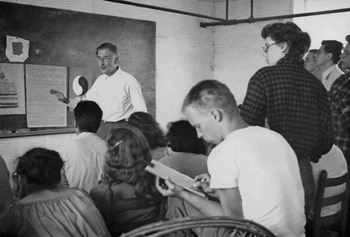
A recent exhibition notes the impact of Black Mountain College as an incubator of modern art and U.S. arts pedagogy: “The growth of the visual arts between the Great Depression and the beginning of the 1950s is an astonishing story, and Black Mountain College is one of many brilliant strands in the tale.”Footnote 73 Black Mountain College, founded in 1933 and located in the Blue Ridge Mountains of rural North Carolina has often been acknowledged as a center of transplanted German modernism. An in-depth study published in the late 1980s, detailing its history, faculty, and influence even after its doors closed in 1957, revealed its importance to U.S. modernism.Footnote 74 Most commentators have described Black Mountain College as a utopian and rather quixotic experiment in the arts and liberal education, funded on a shoestring and intimately tied to German exiles because of its faculty, both permanent and visiting. The central artist in the narrative of Black Mountain College has been and continues to be Josef Albers, who, together with his wife, Anni, on the recommendation of Philip Johnson, was chosen to teach art and designFootnote 75 (Fig. 4).
Hazel Larsen Archer, Josef Albers Teaching at Black Mountain College, ca. late 1940s, Courtesy of the Estate of Hazel Larsen Archer and the Black Mountain College Museum+Arts Center.

Along with another key art pedagogue and painter, Hans Hoffmann, who lived in New York and who, like George Grosz, had arrived in the U.S. a year before the Nazis assumed power, Albers inspired two generations of American painters.Footnote 76 More than twenty years after Albers left Black Mountain College for Yale University, the African-American painter, Jacob Lawrence recalled, “[Albers] invited me down to Black Mountain College for the summer as a guest instructor … here I had the experience of coming into contact with I think one of the great teachers of our time … I would say that much of my teaching is based on the teaching of the Bauhaus and Josef Albers.”Footnote 77 Another prominent post-war American artist reflected that “There were very significant turning points at BMC. Things that happened to you were so enlightening … that they'd change you forever. They did me.”Footnote 78
The uniqueness of the college was its isolation, its experimentation, its very small size, and its ability to attract from among the most illuminating and inspiring teachers, many of whom barely spoke English. In fact, unlike other, more established universities and art institutes, Black Mountain College welcomed central European refugees, literally providing life-saving visas for central European scholars and intellectuals.Footnote 79 Located far from any metropolis, its very isolation created a hot-house atmosphere wherein students lived, studied, and worked with faculty, virtually twenty-four hours a day. Only 22 students enrolled when the college opened in 1933, and the school never had more than 180 students in the 1930s. By 1940, 16 had graduated. A total of about 1,200 students attended during its quarter-century existence. As its foremost historian noted, the college was “an idealistic, fragile, modest adventure in American education—a house built on a foundation of sand … It at times resembled a summer camp, a retreat for believers, a small village, and a work-study college.”Footnote 80 Its summer institutes, however, achieved national renown, with visitors such as Erwin Panofsky, Marcel Breuer, Walter Gropius, and others teaching or lecturing. After the war, the stars of American avant-garde art, dance, music, and arts criticism all attended or participated in the summer institutes, such as the composer John Cage, the architect Buckminister Fuller, the critic Clement Greenberg, and the painters Robert Rauschenberg, Cy Twombly, Willem de Kooning, and Kenneth Noland. What attracted scholars, artists, and students to this unlikely place was the notion of “experiment.” Albers promoted the idea of “opposing disorder and accident,” which on one level appeared to be antithetical to the notion of Black Mountain College itself. He also fostered the idea that “learning is better than teaching because it is more intense. The more is being taught, the less can be learned.”Footnote 81 To describe Albers's relationship with the American avant-garde during his years at Black Mountain
is to say that he was both behind the times and ahead of the times. By the 1940s, when his step-by-step pedagogical method was becoming widely known, America's avant-garde had largely thrown in its lot with the surrealists' romance of magic and mystery and inspiration… . It was only when New York began to weary of the mystique of painterly painting that Albers's emphasis on primary artistic principles came to the fore, emboldening experiments in assemblage and alternative media as well as a resurgence of cooler, more geometric types of painting. By the 1960s, when Albers had finished more than a decade of teaching at Yale, [beginning in 1949] his impact could seem ubiquitous.Footnote 82
***
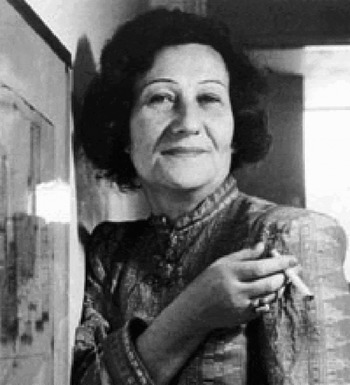
Historians have noted that the increasingly political conservative climate within late Weimar Germany, coupled with post World War I economic uncertainties and the subsequent global economic depression, compelled some artists and dealers to leave established positions. In some important cases, these artists, architects, and dealers emigrated before 1933, arriving in the U.S. as early as the 1920s.Footnote 83 Several biographical sketches of central European artists, architects, art dealers, and curators highlight the theme of cultural transmission to the U.S. prior to 1933. For example, the art dealer, Emmy “Galka” Scheyer, born in Braunschweig, emigrated to the United States in 1924 and served as the sole American-based art dealer promoting the works of the painters Alexei Jawlensky, Wassily Kandinsky, Lyonel Feininger, and Paul Klee—whom she named the “Blue Four,” reminiscent of their group's name: Blaue Reiter (Fig. 5).Footnote 84 She tirelessly espoused these artists' works throughout California and organized exhibitions in the 1920s and 1930s after she moved to Los Angeles, associating with the growing émigré intellectuals settling in Southern California by the mid-1930s. Her home served as a West-Coast salon for the exchange of modernist ideas, and she introduced Kandinsky's art to the Mexican painter Diego Rivera.Footnote 85
Alexander Hammid, American (1908-), Galka Scheyer, c. 1940, Gelatin-silver print, 9-5/8×5-1/2 in. (24.5×14 cm), Norton Simon Museum, The Blue Four Galka Scheyer Collection Archives, P.GS.PHOTO.GS.13.

Two other central Europeans who emigrated before the rise of the Nazis, modernist architects Rudolph Schindler and Richard Neutra, settled in Los Angeles in 1919 and 1924 respectively. The two had met in Vienna, and had studied and were inspired by the turn-of-the-twentieth-century Viennese architectural modernism of Adolf Loos and Otto Wagner. By the late 1920s, Schindler and Neutra established reputations as prominent architects after designing several Los Angeles residences. Neutra designed a home for the émigré actor Josef von Sternberg (1935) while Schindler, espousing the idiom of international modernism, received several commissions from the 1920s through the 1940s for hillside residences.Footnote 86 In recent times, the reputation of these two architects has grown with an appreciation of how they adapted Viennese modernism into a specific California vernacular.
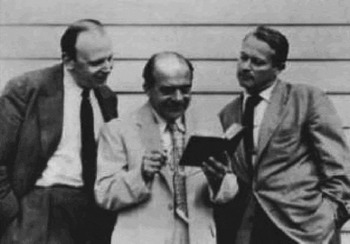
American academics were also familiar with the discipline of art history in Germany well before the Nazis came to power as first described by Eisler and later elaborated upon by Michels and Parker.Footnote 87 While there were socio-economic differences among exiles, the refugee art historian or artist often came from middle-class backgrounds and positions “fairly high on the status level where they had lived in relative comfort and were accustomed to receiving a certain deference and respect.”Footnote 88 A number of prominent emigrating artists, despite difficulties, found work—either teaching in art schools or exhibiting and selling their work often enough to earn a living. Among art historians, the careers of Erwin Panofsky and H. W. Janson, along with Richard Krautheimer and Rudolf Wittkower, have been carefully studied (Fig. 6). While the total number of Jewish emigrants from Germany and Austria was substantial, relatively few Jews were painters or graphic artists.
Horst Janson, Erwin Panofsky, and William S. Heckscher.

A fair proportion of art dealers, museum personnel, art historians, and critics belonged to the Jewish diaspora, however.Footnote 89 According to Michels, about twenty-five percent of German and Austrian art historians in 1930 were Jewish, all of whom were forced to leave once Hitler came to power. Michels also noted that within art history, German-Jewish scholars tended to specialize in the Renaissance field, but they also wrote more broadly as scholars of culture, incorporating archeology, philology, philosophy, and history into their discipline.Footnote 90 The research fields of émigré art historians, while seemingly far removed from contemporary politics, together with their condition of exile, affected their practice of art history: “steer[ing] art history in an even more austere and ideologically chaste direction, [taking] extreme care to winnow out any ideological inflection from their work.”Footnote 91 And as Michels observed in her analysis of German-Jewish art historians, they “did not respond to the German policy of genocide with a new group identity based on their common interests or common origins. Instead, these émigrés concentrated on joining the American professional associations and on trying to adjust to the American way of life.”Footnote 92 American art historians, particularly those who studied with German émigrés, absorbed and adopted this methodology. It dominated the art historical field for more than forty years.
New York University invited Panofsky to teach in 1931, and he commuted across the Atlantic for two years. Dismissed from Hamburg in 1933, Panofsky secured a prestigious position at the newly founded Institute for Advanced Study in Princeton, where he remained his entire career. He has been considered the most important German émigré art historian. He had been affiliated with Aby Warburg's famed Schule der Kunstwissenschaft in Hamburg, known for its close study of iconography and iconology and interdisciplinary methods of art history. Several generations of American scholars appropriated these methods of analysis.Footnote 93 Panofsky represented “‘distinterestedness’ [that he employed in his art historical studies] to divert attention away from politics and from questions of difference, including the one raised by the impossibility of reconciling the circumstances of … exile with … confidence in humanistic ideals.”Footnote 94
While Erwin Panofsky represented the most prominent art historian exile to the U.S., most of the émigré artists and art historians arriving in the United States were relatively obscure and most had not taught at German universities before their arrival. Approximately 130 art historians or professionals associated with museums emigrated to the United States. Most arrived with a visa that allowed college faculty unrestricted emigration. Their obscurity stemmed from several reasons. Very few German painters were known to American collectors. American collectors had privileged nineteenth- and twentieth-century French academic and avant-garde art after the Civil War, and the souring of German-American relations in the wake of World War I further diminished opportunities for German painters to interest American buyers. In the case of art historians arriving in the 1930s, some arrived at a relatively young age or had not taught in German universities because some German universities restricted hiring Jewish academics, even during the more liberal Weimar years. Many Jewish academics faced similar obstacles after arriving in the United States. Their lack of experience often hindered their opportunities for employment, even for temporary positions. Religious prejudice limited employment at the Ivy League institutions in the U.S. Well-connected American art historians, such as Walter Cook, head of the art-history department at NYU, or prominent museum officials, such as the Museum of Modern Art's Alfred Barr, frequently provided references for German émigrés, allowing them to find work. Aid agencies, such as the Emergency Committee for Displaced Foreign Scholars, required a minimum of three years' teaching experience before considering art historians for university posts.Footnote 95
A complicating factor in the art historians' and artists' American exile experience is the fact that some had been displaced multiple times. After 1933, numerous artists first migrated to Czechoslovakia or France. The United States appeared a chimera located very distantly, in both geographic and cultural terms. Furthermore, the state of particular professions already established in the U.S. affected the usefulness of the expertise, creativity, and knowledge possessed by a particular exile. American regional orchestras eagerly sought the highly skilled orchestral musicians and music teachers who arrived in the 1930s. Language proved to be a less formidable barrier to occupational advancement in music than in other, more literary professions.Footnote 96 Creative artists, such as painters, could have a difficult or relatively easy time. While painting is a visual rather than a verbal profession, painters needed and depended upon networks such as artists' associations, dealers, and galleries to show and sell their work.
Those artists, art historians, architects, curators, and dealers who emigrated settled at institutions ranging from NYU's Institute of Fine Arts, Harvard University, the Museum of Fine Arts in Boston, Wayne State University, and the University of Louisville to Black Mountain College and Mills College. They included art historians Erwin Panofsky, Richard Krautheimer, H. W. Janson, and Karl Lehmann; artists Grosz and Albers; curators Georg Swarzenski and Alexander Dorner; and art dealers Curt Valentin and the Austrian Otto Kallir.Footnote 97 Several art dealers established galleries, primarily in New York, and advocated for German modernism. Others received positions, occasionally temporarily, as curators in regional museums. Art historians had varied opportunities when arriving in the U.S. Well before the rise of National Socialism, American art historians were familiar with the art historical scholarship, and indeed, often studied art history in Germany, beginning in the late nineteenth century since art history's “native tongue [was] German.”Footnote 98
To cite one additional example of a young art historian who established himself as an academic star: many university students to this day taking an introductory art history course may use a textbook by H. W. Janson that has been in print since 1962, The History of Art. It is considered to be a best seller among art history surveys since it has been translated into fourteen languages and has sold more than four million copies since its initial publication. Janson studied with Erwin Panofsky in Hamburg and migrated to the U.S. in protest of Nazi policies, receiving a Ph.D. from Harvard University in art history in 1941 or 1942. During the 1940s, Janson served as curator of Washington University's Gallery of Art and assistant professor at Washington University in St. Louis. In his capacity as museum curator, he claimed that he built the “finest collection of contemporary art assembled on any American campus.”Footnote 99 Janson championed exiled surrealists, such as Max Ernst and Yves Tanguey, and the works of Paul Klee and Picasso. An equally important contribution was his staunch support of modern art in the mid-western city which led, until the present day, to the development of one of the strongest collections of central European modernism in the country. He also encouraged donors to take an interest in German painting, leading to important donations of art to the city's museum as well as to the university. Janson recalled, “Those were the times when the battle for modernism was still being fought.”Footnote 100
Another critical area of cultural transfer described in exhibition catalogs and monographs has been the role of German-Jewish art dealers, working with émigrés and American museum curators to advocate for German modernism. Dealers and collectors, such as Curt Valentin, J. B. Neumann, and Galka Scheyer, helped to disseminate German expressionism that saw its appearance in U.S. museum exhibits as well as in individual art collections of enthusiastic patrons.Footnote 101 Here, too, a few individuals who had already arrived in the U.S. before the 1930s paved the way for later émigrés. J. B. Neumann, one of the most prominent art dealers, who had established a reputation for his knowledge of expressionism through his gallery in Berlin, had come to New York in 1923 at the urging of Katherine Dreier, an enthusiast for central European art and artists, and another compatriot, Wilhelm Valentiner, director of Detroit's Institute of Art.Footnote 102 Other Berlin dealers followed, especially after 1933. Neumann's colleagues, Kurt Nierendorf arrived in 1936 and Curt Valentin in 1937.
“Partly out of sympathy for the plight of modern German artists, which [by World War II] had been internationally recognized, and partly because the prices of their paintings had become so low, American museums began to purchase these works, thus encouraging exhibitions around them.”Footnote 103 One could acquire German expressionist prints for prices ranging from $15 to $65 in the 1930s and 1940s.Footnote 104 Art dealers did not immediately sense the danger that slowly engulfed the fate of modern art and artists from early in the Nazi regime. Curt Valentin, who organized and worked at the Galerie Flechtheim in Berlin, was forced to leave the gallery after its closure in 1934. He then worked at the book store, Buchholz, and ran an art gallery from within its premises until 1936, when the Nazis put additional restrictions on dealers and the artists whom they represented. Valentin then emigrated to New York, opening the Buchholz Gallery, which moved in 1939 to modest accommodations on 57th Street. Through his connections with the Museum of Modern Art and patronage of wealthy clients, Valentin established a reputation for promoting artists discredited by the Nazis, such as Max Beckmann (at the time in exile in Amsterdam), Lyonel Feininger, Paul Klee, and Ludwig Kirchner. Many credit his enthusiasm for German twentieth-century painting and graphics and the well-received exhibitions he organized as helping to introduce curators, other dealers, and collectors to German modernism.Footnote 105
The Museum of Modern Art's 1938 exhibition, The Bauhaus, 1919–1928, curated by the key figures of the architectural school, Walter Gropius and Herbert Bayer, and aided by Gropius's wife, Ise Gropius, is another telling example of cultural transmission.Footnote 106 The importance of Bauhaus artists and architects for American modernism has been one of the key master narratives of the exile literature. And in that narrative of modernism, the exhibition plays a formidable role. Yet, according to a recent reexamination, it deliberately distorted the image it presented of the Bauhaus School for political reasons caused by the difficulties of German-American relations in the 1930s.Footnote 107 For example, the exhibition catalog and the press releases issued prior to the show's opening hardly mentioned the revolutionary political upheavals that forced the school to move several times within Germany (from Weimar to Dessau and finally to Berlin before being closed by the Nazis). Second, several former Bauhaus members in exile feared for colleagues who remained in Germany when the show opened in 1938. These former Bauhaus teachers also worried about American reaction to the show. And while we normally link growing fears of anti-communism, anti-foreigner sentiment, and xenophobia on the part of conservative U.S. congressional members to the post-war U.S.-Soviet Union rivalries, it is important to recall various committees to monitor foreigners, communists, and fascists already existed in the 1930s. Bauhaus artists and architects wisely agonized about their status once in the United States. In the late 1930s and early 1940s, before Germany declared war on the United States, the FBI had already created files on Gropius and Mies van der Rohe and during the war on Moholy-Nagy. The FBI's Gropius files contained an anonymous letter that stated, “Have you ever had the occasion to look up Mr. and Mrs. Walter Gropius? … Both are native Germans and leaders in a set of doubtful sympathies. They may be alright, but I don't trust them around the corner.”Footnote 108 After continued surveillance and additional anonymous letters to the FBI and to local Boston police, the Bureau concluded that suspicious attitudes toward Gropius were “probably explained by the fact that they had little to do with other people, … did not participate in the town's social life and were responsible for the building of modern houses in an old town that clung to tradition and a simpler life.”Footnote 109 This notion of exclusivity on the part of the Germans mirrors the sentiments of those who observed the artists and intellectuals in southern California as well. Insularity among German émigrés coupled with suspicions of foreigners generally led to a climate of distrust during the 1930s, exacerbated by the economic uncertainties of the global Depression.
Thus when the 1938 Bauhaus exhibition took place, one year after the notorious Degenerate Art show in Munich, the latter highlighting and disparaging a good number of Bauhaus artists, the exiles were careful to depoliticize the show. As the press release for the exhibit stated, “Under existing conditions in Germany, it was not possible to bring more actual objects to this country for this exhibition.”Footnote 110 The 1938 show was large and comprehensive nonetheless, with approximately seven hundred items on exhibit. Because many objects were unobtainable from Germany or scattered in the diaspora of emigration, the show displayed a number of items as photographs rather than the actual objects. Seventeen thousand people viewed the show in New York, and parts of the show traveled around the country.Footnote 111 The common view of the Bauhaus as representing depoliticized international modernism derives in part from this exhibition, which was conceived as a somewhat vague “idea” rather than born out of war and revolution in early Weimar Germany. According to Koehler, “After leaving Germany, Gropius always avoided specifics and speculated about what architecture would be like in the future; he never publicly discussed the controversial history of the Bauhaus or the political realities of his own exile.”Footnote 112
International modernism exemplified by the Bauhaus architects appeared then and now in multiple perspectives: as part of a politically neutral style of international modern architecture characterized by flat roofs, white walls, glass “curtain windows,” lack of superfluous ornamentation, and functionality. But some Americans viewed the style as a dangerous import from a politically charged central Europe, brought over by leftist foreigners and possibly Jews. Barr's Museum of Modern Art Bauhaus exhibition attempted to emphasize the former image and it is the one that has, by and large, endured in the literature. What recent studies have added to this interpretation has been an awareness of the greater continuity of interaction between German and American museum officials and architects before 1933, constructing a longer interconnection between European and American modernism between the Weimar period after World War I and the period of forced emigration by modern artists in the 1930s.
Many sociological, ideological, economic and cultural variables affected émigrés' acculturation to America. Conversely, depending upon the regions in which Germans settled, Americans' view of the 1930s emigration varied considerably. Most scholars have concentrated on the exile cultural experience in New York, Chicago, Los Angeles, the San Francisco Bay area, and the anomalous location in North Carolina's Blue Ridge Mountains, with fewer recent studies detailing exile life elsewhere. In general, clusters of émigré artists and architects settled in urban areas such as New York or Chicago where opportunities and professional networks created possibilities for work.Footnote 113
***
On the whole, the position of refugee artists in this country has been a tough one, and the complaints that have occasionally been leveled at them by American painters and others should be considered with that fact in mind … If they have shown a certain condescension at times toward American art, it should be acknowledged that, in a historical sense at least, that attitude was justified.Footnote 114
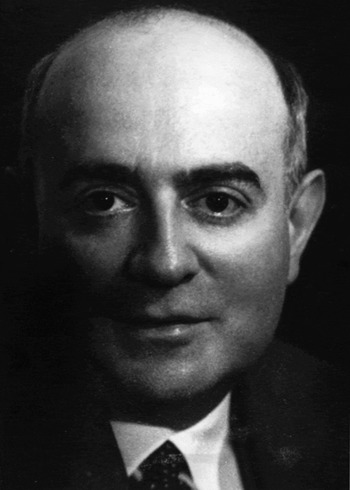
A fair number of artists struggled to establish themselves professionally and personally, encountering profound difficulties in translating their central European sensibilities into an American idiom. Most famously, Theodor Adorno claimed that an exile's wronged life could not be lived rightly, and he appeared to represent the cultural chasm that Germans faced when arriving in the new worldFootnote 115 (Fig. 7).
Adorno, Theodor Wiesengrund, Philosopher and sociologist, music theorist and composer, Frankfurt a.M. 11.9.1903 - Visp (canton Valais) 6.8.1969. Portrait, c. 1953.

Paradoxically, the newest literature details intellectual and material gains and losses the exiles experienced following their emigration to the U.S. and analyzes how European aesthetic modernism found its way to and was transformed in America. In the introduction to Caught by Politics: Hitler Exiles and American Culture (2007), the editors propose that “the exile's damaged life, far from burying the very prospect of modernist aesthetic practice, provided all kinds of resources … to rethink, to recalibrate, or to rediscover the diverse paths of European modernism.”Footnote 116 In a similar vein, Ehrhard Bahr's Weimar on the Pacific: German Exile Culture in Los Angeles and the Crisis of Modernism (2007) discusses the range of accomplishments, as well as the cultural and aesthetic transformations in Southern California by writers Thomas Mann and Theodor Adorno, architects Richard Neutra and Rudolf Schindler, and composers including Arnold Schoenberg. Bahr's goal was archeological: he wished to excavate the remnants of exile culture still extant in Los Angeles by revisiting the various locales where the exile community lived and worked. But he also wanted to rethink how these intellectuals' Southern California experiences both changed them and affected the culture of California long after their return to Europe or their deaths. As he explains, he desired to:
Focus on [their] works as examples of the crisis of modernism and the creative solutions offered by a loosely assembled group of exiles that settled in Los Angeles during the 1940s. They constituted modernism in such a way that they were able, on the one hand, to maintain its experimental structure and to present a vision of modern life with universal reach, and on the other hand, to add new aspects to modernism that reflected political and historical changes.Footnote 117
Bahr's study is the latest in the massive literature on the California component to the exile experience and relates to the ongoing question posed by much of the literature outlined here. How can one describe and evaluate the cultural dialectic between the émigré cultural communities and their reception? Some have stressed the “deprovincialization” of American culture through Americans' interactions with refugee artists and intellectuals. Others have seen “marginality” as a factor in the impact on American scholarship and the arts, by “throwing a novel and more searching light on American society than was usually the case with those born and bred in the pieties of their tradition.”Footnote 118 In Jean-Michel Palmier's recently translated encyclopedic depiction of the exile community in Europe and the United States, he concluded that, “On the whole, the émigrés remained complete strangers to American culture; made little effort to understand it; and found it hard to abandon a real contempt towards it; a European inheritance, and an abyss that no bridge could cross in the course of their exile.”Footnote 119 He further noted that scholars of the literary exiles are as divided over the objects of study as the exiles were themselves. Should aesthetic worth and contributions made during exile be the sole criteria for examination? Or, because of the exiles' unusual experiences of displacement and disruption, should historians foreground context over image and text?Footnote 120
Palmier's examination of the exile experience suggests a rather grim destiny for the intellectual and artistic migrants, echoing Adorno's lament of an exile's wronged life. Yet one can counter by observing that the picture is heterogeneous and not as negative as Palmier would suggest: In some communities, émigrés, indeed, formed a tightly knit group of exiles who spoke, interacted, and wrote for one another, hardly affecting or being affected by the surrounding environment. In other locales, however, émigrés almost immediately integrated into the larger milieu, through work and friendships and in some cases a common political goal of fighting fascism. Many key artists, architects, and art historians influenced several generations of Americans in their disciplines. By examining the rich memoir literature, the sociological studies by Americans in the 1930s and 1940s, as well as the secondary literature that has blossomed in the last two decades, we have a more complex sense of the émigrés' contributions and American reactions to their presence. What we have noted is that the literature has viewed the exiles not only as modernist heroes fleeing a hostile regime and enriching American culture, but also as embedded in continuities that predate the caesura of 1933 and extend well beyond mid-century. The scholarship has also revealed the complicated relationship between art and politics, between émigrés and modernist artists who remained in Nazi Germany, and between the exile community of artists and others in the arts community in the U.S. Obviously, by describing a small subset of émigrés in the fields of art, art history, and museum curatorial expertise one cannot necessarily generalize about the larger exile experience. Yet most émigrés contended with the mysteries of American life, as they attempted to adjust to new lives with families and colleagues and to arrange for jobs to ensure financial security during a bleak economic decade with war looming on the horizon. This held true of cultural émigrés as well as other refugees from Hitler's Germany, regardless of profession. The literature of the last decades suggests new ways of understanding the older but not entirely discarded narrative of heroic artists, architects, art historians, and art dealers fleeing a land that rejected the modernism and internationalism they represented. The literature has also enlarged our understanding of the complicated ways Americans both questioned and embraced the exiles and their culture.