Introduction
The digestive tract of lizards is parasitized by a large number of nematode species (Goldberg & Bursey, Reference Goldberg and Bursey1992a). These parasites infect the host through items of the diet, coprophagy and geophagy, as well as actively by penetrating the skin (Goldberg et al., Reference Goldberg, Bursey and Cheam1995; Ribas et al., Reference Ribas, Rocha, Teixeira-Filho and Vicente1995; Sanchis et al., Reference Sanchis, Roig, Carretero, Roca and Llorente2000; Criscione & Font, Reference Criscione and Font2001; Fontes et al., Reference Fontes, Vicente, Kiefer and Van Sluys2003). Thus, the structure of helminth communities may be influenced by both the ecosystem and attributes of the host, such as diet, foraging strategy, behaviour, immunocompetence, sex, age and body size (Schoener, Reference Schoener1971; Bundy et al., Reference Bundy, Vogel and Harris1987; Vogel & Bundy, Reference Vogel and Bundy1987; Aho, Reference Aho, Eesch, Bush and Aho1990; Goldberg & Bursey, Reference Goldberg and Bursey1992b; Goldberg et al., Reference Goldberg, Bursey and Tawil1993; Roberts et al., Reference Roberts, Buchanan and Evans2004; Amo et al., Reference Amo, Fargallo, Martínez-Padilla, Millán and López2005).
The success of parasitic infection and development in a host depends largely on ecological and phylogenetic factors (Janovy et al., Reference Janovy, Clopton and Percival1992; Poulin, Reference Poulin2006), such as the probability of the parasite encountering the host and the capacity of the host to provide an appropriate environment for parasite development (Janovy et al., Reference Janovy, Clopton and Percival1992; Poulin, Reference Poulin2006). Moreover, a number of authors consider environmental attributes to be key factors to the success of nematode infection, overshadowing phylogenetic, ecological and morphological attributes (Bundy et al., Reference Vogel and Bundy1987).
The recruitment of several parasite species depends on the feeding habits of the host (Bush, Reference Bush, Eesch, Bush and Aho1990). Various diet items consumed by a definitive host are used by heteroxenous helminths as intermediate hosts (Anderson, Reference Anderson2000). The relationship between helminth community structure and the consumption of plant matter by lizards has been the focus of a number of studies (Roca & Hornero, Reference Roca and Hornero1991; Roca, Reference Roca1996, Reference Roca1999; Martin et al., Reference Martin, Llorente, Roca, Carretero, Montori, Santos and Romeu2005). Moreover, the consumption of different types of plant matter (e.g. seeds, pollen, leaves or fibre) may be associated with distinct helminth fauna (Roca, Reference Roca1996). Thus, parasites may be important indicators of host diet and trophic relations in food webs (Marcogliese, Reference Marcogliese2004, Reference Marcogliese2005; Lafferty et al., Reference Lafferty, Dobson and Kuris2006).
The lizard Tropidurus torquatus (Wied 1820) is widely distributed in Brazil (Rodrigues, Reference Rodrigues1987). This diurnal species is active throughout the year and exhibits sexual dimorphism, with males larger than females (Rodrigues, Reference Rodrigues1987; Bergallo & Rocha, Reference Bergallo and Rocha1993). The diet is basically composed of arthropods, although larger lizards can ingest considerable amounts of plant matter (Bergallo & Rocha, Reference Bergallo and Rocha1994; Teixeira & Giovanelli, Reference Teixeira and Giovanelli1999; Fialho et al., Reference Fialho, Rocha and Vrcibradic2000). Ontogeny and seasonality are important factors in the diet composition of T. torquatus (Fialho, Reference Fialho1990; Araújo, Reference Araújo1991; Fialho et al., Reference Fialho, Rocha and Vrcibradic2000). However, few studies on this species have been undertaken.
The aim of the present study was to investigate the relationship between nematode infection and the ontogeny and diet of T. torquatus from a rocky outcrop habitat in the Atlantic Rainforest biome in Brazil.
Materials and methods
Collection and examination of lizards
Field work was carried out from March 2005 to July 2007 in a rocky outcrop habitat located in the district of Toledos (21°48′27.5″S; 43°35′31.7″W; c. 700 m), municipality of Juiz de Fora, state of Minas Gerais, south-eastern Brazil. This area belongs to the Atlantic Rainforest biome and is characterized by rocky soil, shrubby vegetation and small, sparse trees. The rainy season extends from October to April and the dry season extends from May to September, with a mean annual temperature ( ± standard deviation) of 19.3 ( ± 0.4°C) and an annual rainfall of 1529 ( ± 155 mm) (PJF/SPDE/Anuário, 2010).
Lizards were collected monthly using glue traps (Victor Mouse™ glue traps; Victor® Woodstream Coorporation, Lititz, Pennsylvania, USA) and noosing techniques, always during the day, and were killed immediately after capture with sodium pentobarbital. Gonads were extracted and fixed in Bouin's fluid for subsequent histological analysis under a light microscope. The specimens were kept in thermal boxes filled with ice prior to being transported to the laboratory. Snout–vent length (SVL) was measured to the nearest 0.01 mm using a calliper. The lizards were divided into juveniles and adults based on SVL and aspects of the reproductive system. Male lizards were classified as adults by the presence of mature gametes in the testes, using histological sections, and female lizards were classified as adults by the aspect of the oviduct and the presence of developed vitellogenic follicles. The specimens were submitted to necropsy, with a longitudinal incision from vent to throat. The digestive tract was removed and separated into oesophagus, stomach, large intestine and small intestine for analysis under a stereomicroscope.
Prey items were quantified using frequency of occurrence (number of stomachs containing a prey item category/total number of stomachs) and numerical frequency (number of individuals belonging to a prey item category/total number of individual prey items). Only identified prey and vegetal material were quantified and measured (total length and width in millimetres) with a calliper (to the nearest 0.01 mm) for the estimation of stomach content volume (in mm3) using the ellipsoid formula (Vitt et al., Reference Vitt, Zani and Caldwell1996):
 $$\begin{eqnarray} v = ( \pi w ^{2} l )/6, \end{eqnarray}$$
in which v= prey volume, w= prey width and l= prey length. Prey items were identified using keys provided in Borror & DeLong (Reference Borror and DeLong1988) and Buzzi (Reference Buzzi2002). Plant matter was identified based on Barbosa (Reference Barbosa1975).
Parasites were fixed in AFA (70% ethanol (93 parts), 40% formalin (2 parts) and glacial acetic acid (5 parts)) and stored in 70% ethanol. The specimens were cleared in lactophenol, mounted on glass slides and examined via light microscopy for identification.
Host specimens were deposited in the Coleção Herpetológica do Departamento de Zoologia da Universidade Federal de Juiz de Fora (CHUFJF) (accession numbers: 315 – 375; 683 – 733). Parasite specimens were deposited in the Muséum National d'Histoire Naturelle de Paris (MNHN) (Physaloptera lutzi accession numbers: 103 YU; 104 YU; Parapharyngodon bainae accession number: 171 YU).
Data analysis
The Shapiro–Wilk test was used to determine whether parasite abundance data followed a normal distribution pattern. The Mann–Whitney U-test was used to determine differences in parasite abundance between juveniles and adults (Zar, Reference Zar1999). A Poisson regression model was used to evaluate the relationship between helminth abundance and lizard body size (SVL) (Dohoo et al., Reference Dohoo, Martin and Stryhn2003). Odds ratios (OR) of the Poisson model were calculated to determine the relationship between variables: OR < 1 indicates a negative relationship (protection factor); OR = 1 indicates a lack of relationship; and OR > 1 indicates a positive relationship (risk factor), followed by a 95% confidence interval (CI) (Dohoo et al., Reference Dohoo, Martin and Stryhn2003).
For the analysis of diet, stomach contents were separated into animal and plant matter. Due to the sample size, only the most abundant prey items in adult lizards were considered in these analyses. The relationship between parasite abundance and volume of plant matter ingested was evaluated using the Poisson regression model, with the calculation of OR and 95% CI (Dohoo et al., Reference Dohoo, Martin and Stryhn2003). The same model was used to determine a possible association between the abundance of heteroxenous parasites and the number of the most abundant animal prey items (Dohoo et al., Reference Dohoo, Martin and Stryhn2003). The Mann–Whitney U-test and a logistic linear model (with OR and 95% CI) were used to determine differences in the abundance of heteroxenous parasites between hosts that consumed each type of the most abundant animal prey and those that did not (Zar, Reference Zar1999; Dohoo et al., Reference Dohoo, Martin and Stryhn2003). The same test and logistic model were also used to determine differences in parasite abundance between hosts that consumed plant matter and those that did not (Zar, Reference Zar1999; Dohoo et al., Reference Dohoo, Martin and Stryhn2003).
All mean values are followed by 1 standard deviation ( ± SD). Statistical tests were performed using the program R with the vegan package included (Oksanen et al., Reference Oksanen, Kindt, Legendre, O'Hara and Stevens2007) and a significance level of P< 0.05. The parasitological terminology used throughout follows that of Bush et al. (Reference Bush, Lafferty, Lotz and Shostak1997).
Results
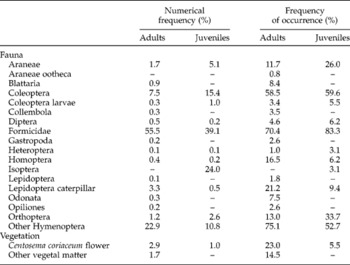
A total of 110 lizards were collected: 29 adult males (SVL 98.6 ± 14.2 mm; range 74.0–127.2 mm), 56 adult females (SVL 81.0 ± 8.4 mm; range 69.5–101.3 mm) and 25 juveniles (SVL 57.9 ± 8.0 mm; range 42.1–71.8 mm). The diet of T. torquatus was composed mainly of arthropods, which represented 57.9% of the total volume, and plant matter, representing 42.1%. The most frequent prey items were ants (Formicidae), beetles (Coleoptera) and other Hymenoptera. The most frequent plant matter was flowers of Centrosema coriaceum Bentham, 1837 (Fabaceae) (table 1).
Diet composition of 85 adult and 25 juvenile Tropidurus torquatus collected from a rocky outcrop in an Atlantic Rainforest biome, Minas Gerais, Brazil.

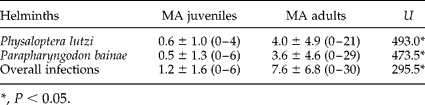
Two nematode species were found: Physaloptera lutzi Cristofaro, Guimaraes & Rodrigues, 1976 (Physalopteridae) in the stomach and Parapharyngodon bainae Pereira, Sousa & Souza Lima, 2011 (Praryngodondae) in the small and large intestine. The overall prevalence of infection was 81.9%, with P. lutzi and P. bainae exhibiting prevalence values of 67.3 and 60.0% and mean abundance values of 3.3 ± 4.5 (0–21) and 2.9 ± 4.2 (0–29), respectively.
The Shapiro–Wilk test indicated that parasite abundance data were not normally distributed (P. lutzi: W= 0.71, P< 0.001; P. bainae: W= 0.69, P< 0.001; overall: W= 0.77, P< 0.001). Adult lizards had higher parasite abundance values than juveniles (table 2). SVL correlated positively with the abundance of P. lutzi (P< 0.001; OR = 1.03; CI = 1.02–1.03) and P. bainae (P< 0.001; OR = 1.02; CI = 1.02–1.03) as well as overall abundance (P< 0.001; OR = 1.03; CI = 1.02–1.03).
Mean abundance (MA), followed by standard deviation of worm range of P. lutzi and P. bainae in 85 adult and 25 juvenile Tropidurus torquatus from a rocky outcrop in an Atlantic Rainforest biome, in Minas Gerais, Brazil.
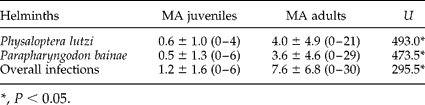
U= Mann–Whitney test coefficient.
*, P< 0.05.
Considering the ingestion of C. coriaceum flowers by the lizards, the volume of this item had a negative effect on the abundance of P. lutzi (P< 0.001; OR = 0.99; CI = 0.98–0.99) and P. bainae (P= 0.001; OR = 0.98; CI = 0.97–0.99) as well as overall abundance (P= 0.02, OR = 0.98; CI = 0.96–98). The logistic model also indicated that the presence of flowers represented a protection factor (OR < 1) against infection by P. lutzi (P= 0.01; OR = 0.95; CI = 0.94–0.97) and P. bainae (P= 0.01; OR = 0.68; CI = 0.65–0.70) as well as overall infection (P= 0.01; OR = 0.83; CI = 0.79–0.85). The results of the Mann–Whitney test support the findings of the logistic model, as hosts that consumed C. coriaceum flowers had lower parasite abundance (P. lutzi: U= 124, P= 0.01; P. bainae: U= 184, P= 0.02; overall abundance: U= 121.3, P < 0.001). These results indicate a negative correlation between flower consumption and parasite abundance. Prey items and P. lutzi abundance were not statistically related. The Poisson model indicated no relationship between the abundance of this parasite and number of Formicidae (P= 0.07), other Hymenoptera (P= 0.09) or Coleoptera (P= 0.8) ingested. Similarly, the logistic model indicated no difference in P. lutzi abundance between hosts that consumed or did not consume Formicidae (P= 0.1), other Hymenoptera (P= 0.3) or Coleoptera (P= 0.5). These results were confirmed by the Mann–Whitney test (Formicidae: P= 0.2; other Hymenoptera: P= 0.9; Coleoptera: P= 0.8).
Discussion
The diet composition of T. torquatus in the present study is similar to that reported by other authors who have classified this lizard as omnivorous (Fialho et al., Reference Fialho, Rocha and Vrcibradic2000; Carvalho et al., Reference Carvalho, Silva, Araújo, Alves-Silva and Silva-Leite2007). Plant matter is considered an important component of the diet of adults in a certain period of the year, whereas juveniles ingest a comparatively low amount (Fialho et al., Reference Fialho, Rocha and Vrcibradic2000; Carvalho et al., Reference Carvalho, Silva, Araújo, Alves-Silva and Silva-Leite2007). The presence of plant matter in the diet of T. torquatus seems to be common and not accidental (Bergallo & Rocha, Reference Bergallo and Rocha1994; Teixeira & Giovanelli, Reference Teixeira and Giovanelli1999). Ants, beetles and other hymenopterans are also common prey items (Carvalho et al., Reference Carvalho, Silva, Araújo, Alves-Silva and Silva-Leite2007).
The two nematode species found in this study exhibit distinct infection strategies. Physaloptera lutzi is a heteroxenous parasite that uses arthropods as intermediate hosts (Goldberg & Bursey, Reference Goldberg and Bursey1989, Reference Goldberg and Bursey1992a; Anderson, Reference Anderson2000). On the other hand, P. bainae, like other oxyurids, has a monoxenous life cycle (Anderson, Reference Anderson2000). The likely route of infection used by P. bainae is related to foraging activity, when the lizard ingests eggs present in the environment together with its prey, as well as via geophagy (Pereira et al., Reference Pereira, Sousa and Souza Lima2012).
The high prevalence of P. lutzi and P. bainae suggests that these parasites are well established in the host population (Bush & Holmes, Reference Bush and Holmes1986a, Reference Bush and Holmesb; Bush et al., Reference Bush, Aho and Kennedy1990). These elevated prevalence values are in contrast to the low mean abundance and low parasite richness, which is a common pattern in helminth component communities of tropidurid lizards (Van Sluys et al., Reference Van Sluys, Rocha, Bergallo, Vrcibradic and Ribas1997; Ribas et al., Reference Ribas, Rocha, Texeira-Filho and Vicente1998; Vrcibradic et al., Reference Vrcibradic, Cunha-Barros, Vicente, Galdino, Van Sluys and Rocha2000; Fontes et al., Reference Fontes, Vicente, Kiefer and Van Sluys2003) and other reptile hosts (Aho, Reference Aho, Eesch, Bush and Aho1990).
Host ontogeny may influence the structure of the helminth community of lizards, mainly due to shifts in habitat exploration, behaviour, body size and diet (Aho, Reference Aho, Eesch, Bush and Aho1990). An evident difference between adults and juveniles in terms of parasite abundance was found in the present study, with adults more heavily parasitized. The juvenile phase of T. torquatus is relatively brief, lasting less than 6 months (Pinto, Reference Pinto1999), and sexual maturity is generally reached early (Wiederhecker et al., Reference Wiederhecker, Pinto and Colli2002; Kiefer et al., Reference Kiefer, Van Sluys and Rocha2008). These characteristics may reduce the time juveniles are exposed to parasite infection, whereas older individuals have a greater likelihood of being infected (Aho, Reference Aho, Eesch, Bush and Aho1990; Martin et al., Reference Martin, Llorente, Roca, Carretero, Montori, Santos and Romeu2005). Furthermore, ontogenetic development is related to an increase in body size. Older individuals are normally larger and provide more space (and resources) for parasite colonization and establishment, which is analogous to the theory of island biogeography (Aho, Reference Aho, Eesch, Bush and Aho1990; MacArthur & Wilson, Reference MacArthur and Wilson2001; Martin et al., Reference Martin, Llorente, Roca, Carretero, Montori, Santos and Romeu2005). This explains the positive relationship between parasite abundance and lizard SVL that is commonly discussed in the related literature (Van Sluys et al., Reference Van Sluys, Rocha and Ribas1994, Reference Van Sluys, Rocha, Bergallo, Vrcibradic and Ribas1997; Ribas et al., Reference Ribas, Rocha, Texeira-Filho and Vicente1998; Vrcibradic et al., Reference Vrcibradic, Cunha-Barros, Vicente, Galdino, Van Sluys and Rocha2000; Fontes et al., Reference Fontes, Vicente, Kiefer and Van Sluys2003).
Flowers of C. coriaceum were the main type of plant food ingested by T. torquatus. The volume and presence of this dietary component exerted a negative influence over parasite abundance for both nematode species, as well as for overall infection. This conclusion is based on a series of robust statistical analyses. The odds ratios derived from the Poisson model revealed that the volume of C. coriaceum had less influence over parasite abundance than the presence or absence of flowers. As the volume of each flower is very similar, the fact that lizards generally consume only one flower at a time may explain the effect observed.
The genus Centrosema is phylogenetically closely related to Clitoria (Kajita et al., Reference Kajita, Ohashi, Tateishi, Bailey and Doyle2001), both belonging to the Clitoriinae subtribe. The main biochemical components produced by plants of this subtribe are flavonoids, saponins, tannins and steroids (Devi et al., Reference Devi, Boominathan and Mandal2003), representing a defensive strategy, as these components have anthelmintic properties (Bate-Smith, Reference Bate-Smith1973; Handayani & Gatenby, Reference Handayani and Gatenby1988; Silva et al., Reference Silva, Carvalho, Borba and Silva2008). These characteristics may explain the lower parasite abundance in hosts that had consumed flowers, indicating a possible anthelmintic effect of C. coriaceum. As with similar flowers, C. coriaceum flowers also have various bristles that readily release these biochemical components (Barbosa, Reference Barbosa1975). Thus, the flowers need not necessarily be in an advanced stage of the digestive process to release a considerable amount of possibly anthelmintic substances. It is important to note that the digestion of flowers is slow due their vegetal tissue, large size and volume. Thus, flowers may remain in the digestive tract, releasing substances, for several days. Moreover, lizards that did not exhibit flowers in the stomach contents may still have consumed this item in the past. However, it is unlikely that the substances released by flowers remain in the host for a long time after the total digestion process. Thus, a parasite infracommunity influenced by the presence of flowers in the past may be quickly restored due to the high parasite infection rates registered in the present study.
The presence of C. coriaceum in the lizard digestive tract had more of an effect on parasitism by P. bainae than that by P. lutzi (as evidenced by the odds ratio from the logistic model). Physaloptera lutzi infects the stomach and P. bainae infects the intestine. Flowers encountered in the stomach were practically intact, whereas flowers found in the intestine were in a more advanced stage of digestion. It may be that advanced digestion helps release anthelmintic substances into the intestine more efficiently, thereby influencing the establishment of P. bainae. Pereira et al. (Reference Pereira, Sousa and Souza Lima2012) also suggest a probable anthelmintic effect of C. coriaceum flowers in a seasonal survey of parasites in a population of T. torquatus on rocky outcrops in the state of Minas Gerais, Brazil.
There was no significant relationship between the abundance of P. lutzi and the presence of prey items. The presence of prey items and nematodes within the digestive tract does not necessarily mean that the nematodes were acquired during the ingestion of prey. Furthermore, adult nematodes could have been living inside the host for a considerable amount of time, whereas the prey items may have been ingested only a few days before the analysis was undertaken. Data on heteroxenous parasite life cycles would be more successfully tested through experimental laboratory or field surveys that quantify parasites both in the definitive and intermediate hosts. The high consumption of ants, beetles and other hymenopterans suggests that these organisms are likely important intermediate hosts for P. lutzi. It must also be emphasized that plant items in the diet, such as C. coriaceum, appear to exhibit anthelmintic properties and therefore this and other plants belonging to the family Leguminosae (Fabaceae) warrant further biochemical investigation.
Acknowledgements
The present work was developed in accordance with the principles adopted by COBEA (Brazilian College of Animal Experiments) and approved by the Comitê de Ética na Experimentação Animal da Pró-Reitoria de Pesquisa/ UFJF (Ethics Committee on Animal Experimentation of the Dean's Office for Research / UFJF-Protocol number 010/2005-CEA) and under IBAMA license (Process 02015.010,660/ 05-88 license number 261/05-NUFAS/MG). We thank the biologist Filipe Soares de Souza for botanical support. We also thank the financial support given by PIBIC (Programa Institucional de Bolsas de Iniciação Científica) / CNPq (Conselho Nacionalde Pesquisa e Desenvolvimento Tecnológico, Brazil)/UFJF (Universidade Federal de Juiz de Fora), BIC (Bolsas de Iniciação Científica)/ UFJF and CAPES (Coordenação de Aperfeiçoamento de Pessoal de Nível Superior). J.L.L. and B.M.S. were supported by a Research fellowship from CNPq.