



INTRODUCTION
In this article, I will argue that there is one issue that has been neglected as something that people can do to reduce their carbon emissions – and that is to have children later. Most discussions of population control focus on how many children people should have, but ignore issues to do with the timing, so there is little discussion of the value of delaying childbearing.
This also has implications for the debate on egg freezing.
Once we recognize that delaying childbearing can have a significant impact on the size of the population, and, therefore, on CO2eFootnote 1 emissions, our perspective on egg freezing changes significantly. In this article, I argue that, if we focus on future generations in general, rather than focusing only on the children who would be conceived using frozen eggs, policies permitting or encouraging the freezing of eggs reduce, not increase, potential harms to future generations.
FREEZING EGGS AND WEIGHING RISKS
Karey Harwood states that: ‘To date, opposition to frozen eggs has centred mostly on concerns about potential harm to the resulting children.’Footnote 2
First, there are concerns about whether it is in the child's interest to have older parents. Second, there are concerns about whether there are increased risks as a result of the procedures. According to Goold and Savulescu, the main risks are associated with the IVF rather than with the egg freezing. They state: ‘associations between IVF and increased incidences of congenital defects have been demonstrated’, but ‘experience so far with children from frozen embryos suggests that there is no increased risk of malignancy’ and that ‘new vitrification techniques appear not to damage genetic material.’Footnote 3
Responding to those who are argue against egg freezing by appealing to the additional likelihood of birth defects, Goold and Savulescu write: ‘At present, risks to children from IVF are not deemed sufficient to prohibit the use of it in the treatment of infertility. It is hard then to see how social IVF could be judged as “too dangerous”.’Footnote 4
It is not clear to me why this is hard to see. They are different cases, so that leaves open the possibility that we can reach different conclusions. Risks come in degrees, and when we ask if a particular risk is acceptable, the question is: acceptable for what?
I acknowledge that Goold and Savulescu do, indeed, offer arguments in favour of social IVF/egg-freezing. However, in presenting the argument, they do not explicitly acknowledge the importance of a direct comparison with medical IVF/egg freezing.
The arguments in this article can be presented in two ways. First, following Goold and Savulescu, and appealing to consistency, the arguments could be presented as grounds for thinking that (combined with the social benefits that Goold and Savulescu highlight) the reasons for allowing social IVF (with frozen eggs) are as weighty as the reasons in favour of medical IVF, such that we can argue that if we allow the latter, we should also allow the former (despite the risks).
Second, we can ignore medical IVF and focus on the impact on future generations, arguing that – considering future generations as a whole – policies permitting or encouraging the freezing of eggs reduce potential harms to future generations, compared to policies that prohibit egg freezing.
IGNORING THE NON-IDENTITY PROBLEM
In addition, Goold and Savulescu also respond to possible concerns about the interests of the child by appealing to Derek Parfit's non-identity problem.Footnote 5 In contrast, I will not appeal to the non-identity problem, for three reasons.
First, even if we agree with the claim that a child cannot be harmed by the decision that results in that child's existence, not everyone agrees that this should be decisive.Footnote 6
Second, not everyone accepts Parfit's claim that, in these cases, the individual cannot be harmed. Elizabeth Harman, for example, rejects the claim that ‘An action harms a person only if it makes the person worse off than she would otherwise have been if the action had not been performed’Footnote 7 and defends the following sufficient condition for harm: ‘An action harms a person if the action causes pain, early death, bodily damage, or deformity to her, even if she would not have existed if the action had not been performed.’Footnote 8
Finally, the arguments in this article will be more significant if I can show that my arguments are effective, even if we ignore the non-identity problem, or if we assume that Harman's position (rather than Parfit’s) is correct, and if we, therefore, assume that it is possible for individuals to be harmed by being conceived with frozen eggs, and IVF.
For the sake of argument, therefore, I will assume that Harman's account is correct.
REDUCING POPULATION SIZE BY DELAYING CHILDBEARING
From the arguments presented above, it seems clear that natural conception involves less risk, for the individual conceived, than conception using frozen eggs involves for that (different) individual. It is natural, therefore, to think the important question concerns whether it might be permissible to allow women to freeze their eggs, in order to conceive later, despite the fact that this does involve greater risks to the children, and also means that the children will have older mothers. For example, Harwood states, ‘if harm to off-spring is demonstrated at some point, I believe this would constitute a reason to limit or even prohibit egg freezing.’Footnote 9
I will argue that, if we think about these issues in relation to climate change and population control, however, there is a twist that has significant implications for the conclusions we reach about the interests of future generations.
In ‘The Tragedy of the Commons’, Garrett Hardin argues that we need to accept that, in a world with finite resources, we need to reduce the size of the world's population:
in terms of the practical problems that we must face in the next few generations with the foreseeable technology, it is clear that we will greatly increase human misery if we do not, during the immediate future, assume that the world available to the terrestrial human population is finite . . . A finite world can support only a finite population.Footnote 10
More recently, the concern about the size of the world's population has been linked to concerns about climate change: while we can each try to reduce our carbon footprint, another option is to reduce the number of feet in the world.
Typically, discussions of population control have focused on family size, focusing on the number of children couples have. Of course, China has its famous (or infamous) one-child policy. Similarly, in fiction, Anthony Burgess imagines a one-child policy in the dystopian future depicted in The Wanting Seed.
In philosophy, Tim Mulgan considers population control in his book Future People. Mulgan doesn't only consider the one-child policy, but also considers a range of other possible principles or policies, considering reproductive freedom, coercion and incentives. However, he too focuses on the number of children that a couple have, rather than when they have children.
Ultimately, there is a clear conflict which is at the heart of this debate. On the one hand, most people have a strong intuition that restricting reproductive freedom is (at least pro tanto) wrong. Mulgan, for example, comments that ‘one striking feature of commonsense morality’, in the area of obligations to future generations, is ‘a widespread commitment to reproductive freedom’.Footnote 11 On the other hand, if we consider the impact that humans (and our CO2e emissions in particular) are having on the planet, and if we consider the impact this will have on future generations, it is hard to resist the conclusion that we may need to control the size of the population (either now or at some time in the future, if conditions change). Mulgan presents arguments supporting the claim that reproductive freedom leads to maximum human welfare, but then qualifies this, writing:
But, once we factor in climate change, the maximum long-term sustainable population may be much smaller. We can thus have much less confidence that reproductive freedom will lead to maximum human welfare. Instead, there is a significant risk that reproductive freedom will lead to an unsustainably large global population, and thus to great human misery.Footnote 12
Tim Mulgan discusses various rules that could lead to what he calls the replacement rate, leading to a stable population. At its most simplistic, Mulgan assumes that the answer would be for each couple (or each individual woman) to have two children, but Mulgan points out that some people will be unable to have children, and not all children will live long enough to reproduce themselves.Footnote 13 Therefore, Mulgan considers alternatives to compensate for these cases. However, Mulgan is mistaken here. Even if no one was infertile etc. and every woman did have two children, this would not necessarily result in a stable population, as will be demonstrated below. Also, even if it did result in a stable population, the size of that population would depend on when they had their children. To put the same point another way, we can increase or decrease the size of a population by changing when people have children.
In order to demonstrate the potential impact of focusing on when people have children, imagine the following simplified case.
Ten couples find themselves on an island with limited resources which they need to preserve for future generations. The resources are self-replicating, and therefore sustainable, but only if they are not over used.Footnote 14 The couples decide, therefore, that they have to ensure that their population does not grow too large, to ensure that their life on the island is sustainable.
(To make the maths as simple as possible, imagine that all of the original twenty people are the same age (born on the same day), and everyone lives (exactly) to the age of 80 – so they all die on their 80th birthday. They are all nineteen when they arrive on the island. Also, to keep the maths simple, all ten of the women are pregnant, and they all give birth to twins shortly after arriving, on their twentieth birthday. Finally, I will stipulate that there is always the same number of males and females, no one remains single, and everyone marries someone else of the opposite sex, and every couple will have two children, and (again, for the sake of simplicity), I will stipulate that all children are born on the same day, so everyone in each generation is the same age (which, obviously, implies that everyone is having twins). Of course, these stipulations make the case unrealistic. However, it is not clear that these simplifications have any significant implications – except to simplify the maths. The simplifications do not interfere with the aim, which is to demonstrate the impact of changing when people reproduce.)
Imagine two possible futures for this community.
The island – scenario 1
Every couple has two children at the age of 20. This means that there is a new generation every twenty years, and also that each generation brings an additional twenty people.
Starting on the day the first new generation is born:

As such, considering the outcome over 200 years, we end up with the population balancing out at 80 people.
The island – scenario 2
Alternatively, without making any changes to the number of children that each couple has, imagine that the couples have their children at the age of 40, rather than 20 (though remember that the first couple has already had children at the age of 20).

In this case, the population settles at 40. The population is halved without restricting the number of children any couple has – just changing when they have children.
The island – scenario 3
Furthermore, consider a situation in which the first couples have children at the age of 20, but then, after eighty years they realize that they need to reduce the size of the population if they are to avoid using up all the resources.

Thus, we can see that keeping the population low in scenario 2 was not reliant on keeping the population at forty from the start. Even if it rose to eighty, originally, it was still possible to bring it back down to forty later, without anyone reducing the number of children that they have. This demonstrates that Mulgan's assumption that, if each couple has two children, this would lead to a stable population size, is not necessarily true.
Alternatively, we can consider a (slightly) more realistic setting, but on a smaller scale, by considering what happens if one person, and her descendants, all have a child at the age of 40, rather than 20.
I will call the two individuals Anne and Amanda. Anne has her child at 20, as does her daughter and granddaughter, etc. In contrast, Amanda and her descendants all have children at the age of 40. In both cases, each individual has only one child, and they always have daughters.
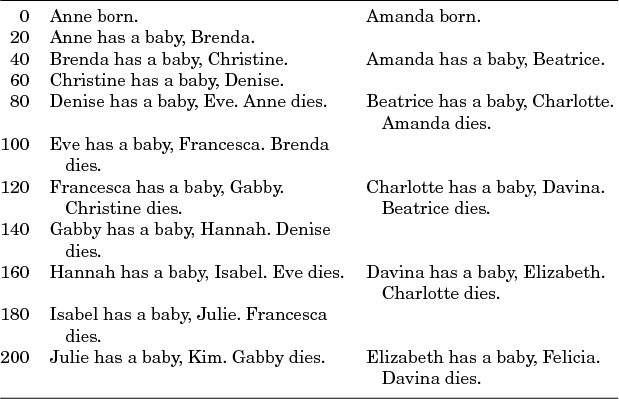
At the end of 200 years, then, in the first case, four individuals are alive, while in the second case, only two are alive. However, the number of people alive at the end isn't the important issue. It is not just the number of people alive in the world at any particular time that matters, as far as climate change is concerned. It is the total number of people who exist over a period of time. Beatrice, Charlotte and Davina are not alive at the beginning or the end, but they all contribute to the CO2e emissions, just as much as Elizabeth or Felicia.
Consider Anne and her descendants. Suppose that the CO2e emissions for each individual, over a lifetime, are 373 tonnes CO2e.Footnote 15 Also, suppose that there is no difference between the individual contributions of each individual in each case. Also, just to make the maths easier, and to give us a clear end point, I will stipulate that no more children are born after the 200th year.
In the first case, over the 280 years, Anne and her descendants are responsible for 4,103Footnote 16 tonnes of CO2e emissions. In contrast, in the second case, Amanda and her descendants are responsible for only 2,238Footnote 17 tonnes of CO2e. Again, the CO2e emissions resulting from population size are almost halved without changing the number of children each person has, just by changing when people have children.
Of course, having a child at the age of 20 or at the age of 40 are not the only options. I chose these ages primarily to keep the maths as simple as possible, and also to make the difference in ages, and therefore in outcome, significant.
If an individual decides to have a child five years later (e.g. at 35, rather than 30) the impact will – obviously – not be as great as the difference between having a child at 40, instead of 20. However, the difference would be far from insignificant, and if there was a widespread social trend to have children later the difference could be very significant.
To compare one woman having a child naturally at the age of 30, and another woman having a child, using frozen eggs, at the age of 35, compare a woman and her descendants each having a child at 30, with another woman, and her descendants, having a child at 35.

If we consider the cost and the CO2e emissions over 200 years, for those having children at 30 and those having children at 35, we get the following results:
 \begin{equation*}
{\rm (4 + 50/80 + 20/80) } \times {\rm 373} = {\rm 1818}{\rm .375 tonnes CO}_{\rm 2} {\rm e}\vspace*{-18pt}
\end{equation*}
 \begin{equation*}
{\rm (3 + 60/80 + 25/80)} \times {\rm 373} = {\rm 1515}{\rm .3125 tonnes CO}_{\rm 2} {\rm e}^{18}
\end{equation*}
So that is a saving of 303.0625 tonnes of CO2e over 200 years. Remember that the estimated CO2e for an affluent person, over a lifetime, was 373 tonnes CO2e. Therefore, one individual and her descendants each having a child 5 years later (at 35 rather than 30), over 200 years, results in a reduction of CO2e equivalent to almost one person's lifetime emissions.
Given the nature of the issue, and that women are not guaranteed to choose to conceive at the same age their mothers did, it is not clear how we should calculate the difference that is made by just one woman's deciding to delay having a child.
Without giving an exact figure, however, my suggestion in this article is that, when we are considering whether or not to object to egg freezing, based on the impact on the well-being of the child, we need to consider the well-being of other (potential) children, and not just the well-being of the child (potentially) conceived with frozen eggs. We need to consider the well-being of future generations more broadly, such that we should not ignore the impact on CO2e emissions as a result of having children earlier or later.
FREEZING EGGS IN A WARMING WORLD
My claim is that, if we reflect on the impact of freezing one's eggs, and on the impact on CO2e emissions if women delay childbearing, we can challenge the common argument that we should not allow egg freezing based on considerations of the well-being of the child.
If having children earlier increases the size of the population, and if this results in an increase in CO2e emissions and this then increases the rate of climate change, it may turn out that – all things considered – egg freezing is actually in the interests of future generations (considered as a whole, rather than focusing only on those individual children conceived by using frozen eggs).
On this view, before we can conclude that people in future generations would be better off if new generations are conceived naturally, we would need to compare the harms associated with egg freezing/IVF with the harms that are likely to result from climate change, based on the higher level of CO2e emissions that result from reproducing earlier, and we would need to consider whether a policy of allowing (or encouraging) women to freeze their eggs, and to conceive later in life, would make a significant contribution to our attempt to reduce climate change.
Hansen et al. pooled the results from a number of studies, in order to consider risks involved with assisted reproductive technology (ART), looking at the increased risk of birth defects.
They wrote:
Our results suggest there is a statistically significant increased risk of birth defects in infants conceived using assisted reproductive technologies of the order of 30–40%. Two thirds of the studies reviewed suggest an increased risk of birth defects of at least 25%.Footnote 19
They go on to say that it has been argued that ‘the results of epidemiological studies need to be expressed in comprehensible terms if they are to be of practical use to clinicians and policy makers.’Footnote 20
Thus, they presented their results in terms of the number needed to harm (NNTH).
In the context of this study, the NNTH relates to the number of children that would need to be conceived by ART for one additional child to be born with a birth defect.Footnote 21
Hansen et al. note that the NNTH varies depending on what we take to be the baseline prevalence of birth defects in births not involving ART, and therefore they give a range of answers: ‘the NNTH ranges from 250 if the baseline prevalence of birth defects is 1% to 62 if the baseline prevalence is 4%.’Footnote 22
In summary, they state:
For the purposes of counselling their patients, clinicians should calculate the NNTH based on a 30–40% increased risk of birth defects compared to the baseline birth defect prevalence for their population. Our pooled odds ratio from reviewer-selected studies suggested a NNTH of between 250 and 62, allowing for an underlying prevalence of birth defects between 1% and 4%.Footnote 23
Alternatively, this could be presented in terms of percentages, informing people that the risks of a child conceived with IVF being born with a birth defect would be 1.4%, compared to 1% for a child conceived naturally.Footnote 24
It is not entirely clear how this should be compared to the risks involved with climate change. I don't want to comment on this in detail, and I should acknowledge that I present it somewhat tentatively, as I am not sure that I have a sufficient understanding of the science, the statistics, or the types of birth defects involved. I do, however, want to make two tentative points.
First, on the assumption that ‘an average person from a rich country born in around 1950 will emit around 800Footnote 25 tonnes’, John Broome writes that: ‘it can be estimated very roughly that your lifetime emissions will wipe out more than 6 months of healthy human life.’Footnote 26 Therefore, if we can reduce the number of people in the world by encouraging people to have children later in their lives – as I have argued – this could have a substantial impact on the lives of future generations.
Second, the estimates above seem to be based on what is likely, but John Broome also emphasizes that we should not focus only on what is likely. He states that: ‘the most important aspect of a choice is not necessarily what is likely to happen. It may be something that is very unlikely to happen, if it is extremely bad.’Footnote 27
Relating this to climate change, Broome writes:
This is an elementary point, and the scientists of the Intergovernmental Panel on Climate Change (IPCC) surely know it very well. But you would not think so to read the IPCC's Fourth Assessment Report (IPCC 2007a–c). The uncertainty in the IPCC's report is presented almost entirely in terms of likelihood.
While we should not ignore what is most likely, we also need to pay more attention to the possibilities that are much less likely.
To some, this may sound counter-intuitive. If an outcome is unlikely, why should we consider that, rather than focusing on what is most likely? As Broome highlights, however, we realize that this is not odd at all once we think about a concrete example. To illustrate this, Broome gives the examples of a pill that has a 95% chance of curing a cold. Imagine that you have a cold, and someone offers you this pill. However, they also tell you that, if it doesn't cure you, it will kill you. If you focus only on what is likely, you would of course take the pill. Considering this example, however, it is clear that this would be foolish.Footnote 28
Broome, however, didn't choose the figures of 95% and 5% by accident. He goes on to consider the risk of climate change resulting in temperatures much higher than those usually considered likely. He states that the Fourth Assessment Report is ‘cautious about assigning probabilities to very high temperatures, but studies referred to in the report suggest that there is as much as a 5 per cent probability of warming greater than about 8°C, and perhaps a 1–2 per cent probability of warming greater than 10°C’.Footnote 29
Considering the consequences of this level of warming, Broome writes:
One thing is sure: if there is extreme warming, the earth will not be able to sustain anything approaching our present population. Our population would have to shrink by millions. We cannot even be confident that humanity will survive at all. Lots of species are already becoming extinct, and we cannot assume ours will not follow them . . . the collapse or extinction that climate change may cause will be brutal and violent. It will involve killing many people.Footnote 30
Earlier, I complained about Goold and Savulescu arguing that, if IVF is permissible in the treatment of infertility, then it is hard to see how ‘social IVF could be judged as “too dangerous”’. I argued that this argument required an additional step – they need to argue that the benefits of social IVF are as significant as the benefits of IVF for infertility. If this is established, however, their argument is much more persuasive.Footnote 31
Now, given the details presented above, there is scope to argue that doing what we can to reduce the global population, and to reduce CO2e emissions in order to do what we can to avoid the likely effects of climate change, and/or to avoid the catastrophic results considered above, is at least as important as helping those who are infertile. Therefore, if IVF is permissible in the treatment of the infertile, and if allowing women to freeze their eggs in order to have children later in life could play a part in reducing the world's CO2e emissions, then (unless there are other reasons to object to egg freezingFootnote 32) egg freezing should be permitted as part of a policy to allow (or even encourage) women to have children later in life.
CONSEQUENTIALISM, DEONTOLOGY AND DISTRIBUTIVE JUSTICE
Given that I am ignoring the non-identity effect, some might worry that this looks like a case of harming one's own child (imposing additional harm) in order to benefit other children. If you agree with David Ross – or with common-sense morality – and believe that the duty of non-maleficence is more stringent than the duty of beneficence,Footnote 33 it would be natural to conclude that this is impermissible.
However, I will argue that, on reflection, this would not be a case of impermissibly imposing harm on some in order to benefit others. Consider the following analogy.
My choice of vehicle
I am looking to buy a new vehicle, which I will use primarily to transport my children. I can either buy a large tank-like sports utility vehicle (SUV) or I can buy a G-wiz, a small (and flimsy) electric car. Being environmentally conscious I am tempted by the G-wiz.Footnote 34 However, I have concerns about safety, and feel that the SUV will be much safer. Of course, when I say that the SUV would be safer, I mean that it would be safer for me and my children inside it, not for anyone else. Of course, the roads would be safer if everyone drove a G-wiz than if everyone drove an SUV, but I am focusing on my own individual choice, and – for the purposes of this example – I am primarily concerned about my family's safety, and my own.
If I buy an SUV, this reduces the risk, to my child, of being harmed (if we crash), but it also increases the risk to everyone else (both in terms of crushing them, and in terms of the greater CO2e emissions). Likewise, if I choose to buy the G-wiz instead, I increase the risk to my own child, but reduce the risk that I impose on everyone else.
The example of the SUV demonstrates that there is a conflict between individual rationality and group rationality, similar to the cases Hardin considers in ‘The Tragedy of the Commons’.
Rather than concluding that it is impermissible to drive a G-wiz, exposing your children to a greater risk, we should be worrying more about whether it is permissible to impose greater risks on others in order to reduce the risks to my family. This also looks particularly problematic if my family already enjoys a much better quality of life (including a significantly reduced exposure to risks) than the people on whom I am imposing further risks.
Also, again, it makes a difference whether we consider this at the level of the individual, or at the level of policy, and the context also makes a difference. At the individual level, if everyone else is driving SUVs, it may be unreasonable to expect me to drive a G-wiz and risk being crushed by one of the many SUVs. In contrast, if everyone else is driving a G-wiz or cycling, it would be unreasonably selfish of me to insist that I must drive a tank-like SUV to ensure my own safety, towering over all the other vehicles on the road. At the policy level, assuming that we have a way to coordinate people, it would make everyone safer if we could persuade all drivers to choose a G-wiz rather than an SUV. Failing that though, if some individuals did want to choose a G-wiz for self-interested reasons, perhaps because of the lower running costs, and if governments permitted and encouraged people to choose a G-wiz, because of the lower CO2e emissions, it would not be reasonable to characterize this as an objectionable example of violating the duty of non-maleficence in order to maximize overall well-being.
Whether we consider this at the individual level, or at the level of policy, if I voluntarily choose to buy a G-wiz for my family, or if the government forces me to buy a G-wiz, this is not a case of harming my child to help others.
Egg freezing
How does egg freezing compare?
Individually, it makes sense for each of us to conceive naturally, in order to reduce the risk of my child being born with a birth defect. If we assume that my decision doesn't affect anyone else's decision, the effect on climate change that results from my having a child earlier is going to be much less significant for my child than the risks involved in having IVF.
However, considering this in terms of group rationality, if everyone reasons in this way, and chooses to conceive naturally rather than using egg freezing in order to delay having a child, the effect could plausibly be that, for all of our descendants, the outcome is worse.
In addition to this conflict between individual and group rationality, there are also ethical considerations relating to the fact that the impact of climate change is likely to be greater in some countries than others, and each individual in some countries is likely to contribute to climate change more than each individual in other countries.
For example, summing up a number of predictions, Broome writes:
A significant feature of all these predictions is that climate change will harm the world's poor much more than it harms the rich. Its harms will fall particularly in the tropics and in Africa, where many poor people live. Moreover, the poor lack the means to adapt to climate change. Rich countries can afford to build sea walls, vaccinate their populations, plant drought-resistant crops, and install air conditioning; poor countries cannot.Footnote 35
I do not want to argue that egg freezing should be required, or to argue that no one should be permitted to have children under the age of 40.Footnote 36 However, owing to the considerations discussed here, I do believe that we should resist the conclusion that egg freezing is impermissible, based on the interests of the child. At an individual level, it seems that we should not claim that a woman acts impermissibly or irresponsibly if she chooses to freeze her eggs, and then conceives at the age of 40, rather than 20 or 30. At the level of policy, the considerations I have discussed in this article suggest that – at least if we focus only on the interests of future generations – we should not be preventing or discouraging women from freezing their eggs in order to have children later in their lives.
THE BACKFIRE ARGUMENT
Finally, there could be a concern that a policy of providing egg freezing to women, in the hope that they will delay having children, might backfire. There are two versions of this argument.
The first concern is that, instead of encouraging women to delay having children, it could just allow people to keep having children longer, allowing them to have even bigger families than they would otherwise.
As far as I am aware, there is no empirical evidence to support the claim that women would be likely to use egg freezing to allow them to have even bigger families than they could if they limited themselves to natural conception. Indeed, the empirical evidence suggests that most women interested in freezing their eggs do not have any children. Ian Sample, writing in The Guardian, quotes Dr Gillian Lockwood, medical director at Midland Fertility Services in Aldridge, commenting on the many women she sees, in their mid to late thirties, who want to freeze their eggs for social reasons:
[T]heir stories are very similar. They have been in the same relationship since their late 20s, early 30s, with a man they thought was going to be the father of their child.
The woman gets to 36 or 37 and says ‘I think it's about time we had a child’ and he says he's not ready to settle down yet.Footnote 37
Nevertheless, some may be concerned that women using egg freezing to have bigger families might still be a possibility. If people are tempted to support egg freezing in the hope that this will help to slow population growth, it would be a concern if this could backfire, instead helping people to have even larger families.
If it was thought that this was a concern that needed to be addressed, one option could be to give women the opportunity to freeze their eggs, but make it clear that those eggs will only be made available for conception at a later date if the woman doesn't already have children.Footnote 38 Or the option to freeze their eggs could be given only at a certain age, for example 32,Footnote 39 and only to those who don't already have children (or to those who only have one).Footnote 40
This may look too similar to a one child policy, and some may consider this an unacceptable infringement on people's reproductive freedom. I have a number of responses to this objection. First, a right to reproductive freedom needn't entail a right to reproductive assistance. Second, offering egg freezing, but with these conditions attached, still gives women more reproductive opportunities than if egg freezing was not made available at all for social reasons.
The second version of the backfire argument emphasizes the obvious fact that one child is more than no children. If a woman has failed to have children naturally – perhaps because she failed to find the right partner – helping her to have a child using frozen eggs is helping to produce another child, which is increasing the population, not reducing it.
On the individual level, this will undoubtedly be true in some cases. There will be some women who have not been able to find the right partner, and therefore have not been able to reproduce naturally at a younger age, and so, now, they wish to have a child using frozen eggs. If we help these women, it seems that we have not helped to reduce the population, we have increased it. I have three responses to this argument.
First, it is not obvious that a woman will either freeze her eggs, and have children later, or not have any children at all. Rather, it is likely – in many cases – that, if she does not have the opportunity to freeze her eggs in order to have a child later (when she has found a partner, for example) she may choose to get pregnant earlier (despite, for example, not having a stable partner, or despite having to give up a promising career).
Second, and related to the previous point, this issue needs to be considered at the level of society, not the individual, considering the overall impact, not just the impact of a particular choice for a particular individual. Therefore, we should not focus on individual cases. The key question is whether it would be possible to contribute to a reduction in the population size by offering the option (and the security) of egg freezing (possibly as part of a broader package of policies) to allow (or even encourage) women to have children later than they would otherwise.Footnote 41
Finally, while it is true that we could help to reduce the population by refusing to help women in this situation, it is also true that we could help to keep the size of the population down by refusing to provide any treatment to those who are infertile. If the need to reduce the size of the population was extremely urgent, it may be reasonable to insist that, given the urgency of the situation, we would not provide fertility treatment for anyone. Except in an emergency situation, however, a policy should not rely on taking advantage of people's misfortune.
CLARIFICATIONS
Finally, in this section, I acknowledge two omissions in the article. To provide more substantial answers to fill these gaps would require argument and empirical evidence that go beyond the scope of this article, and, indeed, go beyond the scope of philosophy. In the next two subsections, however, I provide tentative answers to fill these gaps temporarily.
Reducing population
My argument is based on the assumption that we should be trying to reduce the size of the global population, or at least aiming to limit the speed of population growth, aiming for a more stable population. Although I have not argued for this claim, it is an essential premise in my argument. Therefore, if this claim is not true, my argument will not be sound.
Given the concerns about climate change, it seems unlikely that we should be aiming to increase the size of the global population. Nevertheless, Tim Mulgan does comment that, while ‘Many countries in the developing world face the threat of overpopulation’,
Some countries in the developed world seem to face the opposite problem. Reproductive freedom, combined with increasing employment opportunities and education for women, threatens to bring the birth rate unsubstainably low.Footnote 42
However, Mulgan does not seem to be writing this with climate change in mind. He is thinking about more immediate social problems. Later, when he does explicitly address climate change, he writes (as quoted above), ‘once we factor in climate change, the maximum long-term sustainable population may be much smaller.’Footnote 43
If we consider the immediate social problems in a particular country that wants to increase its population, but consider this problem alongside the problems of climate change, a natural conclusion would be that this country should try to increase its population without increasing the global population, e.g. through immigration.Footnote 44
Science and numbers
The arguments above rely on a comparison between the risk to individuals conceived using frozen eggs and the risks to future generations more generally, as a result of climate change. I acknowledge, of course, that this comparison is far from straightforward. It is unclear exactly how these risks should be compared, and even if we opt for the most straightforward aggregation of the risks, calculations are far from straightforward. In addition, of course, there is a significant amount of uncertainty about how great the risks are, particularly in relation to climate change. Furthermore, any attempts to answer the question of whether policies allowing (or encouraging) egg freezing would lead to an increase or a decrease in the population are, by necessity, going to be speculative.
As a result, my conclusion in this article is somewhat tentative. Perhaps this article will prompt others, more mathematically minded, to attempt a more sophisticated calculation of the different risks involved, to consider whether this calculation counts for or against egg freezing. Until more thorough work is done, however, there is good reason to believe that concerns about climate change (whether focusing on what is likely or what is unlikely but potentially catastrophic) are sufficient to support Goold and Savulescu's claim that, if we permit the use of egg freezing for medical reasons (for example, where medical treatment will leave a woman infertile), we should also permit egg freezing for social reasons, if this will help us to reduce CO2e emissions.
CONCLUSION
In this article, I have argued that, if we consider the interests of future generations as a whole, rather than focusing only on those conceived using IVF, and if we consider the importance of reducing CO2e emissions, we should conclude that we should not be discouraging women from conceiving at an older age, using frozen eggs.
However, this argument only addresses the interests of the child. Before we can conclude that we should allow, or even encourage, egg freezing, we would need to consider the wider context, and – in particular – ethical issues relating to the interests of the women who may potentially freeze their eggs.Footnote 45


