1 Introduction
This article investigates the prosodic differences between English information-seeking questions on the one hand and surface-syntactically identical rhetorical questions on the other. We study both wh-questions (1) and polar questions (2).
(1) Wh-question
Who likes roses?
(2) Polar question
Does anyone like roses?
Prototypical questions perform the directive speech act of requesting information. Here we refer to questions that perform this act as information-seeking questions (henceforth ISQs).Footnote 2 Polar questions ‘request an answer that specifies whether the proposition expressed by their sentence radical holds or does not hold’ (Krifka Reference Krifka, Heusinger, Maienborn and Portner2011: 1747), i.e. the expected answer may be ‘yes’ or ‘no’ (Karttunen Reference Karttunen1977; Groenendijk & Stokhof Reference Groenendijk and Stokhof1984). Semantically, polar questions hence denote the set of possible answers (or resolutions) {p, ¬p}; but see Biezma & Rawlins (Reference Biezma and Rawlins2012). Wh-questions, on the other hand, ‘create an open proposition by leaving parts of the description of the proposition unspecified’ (Krifka Reference Krifka, Heusinger, Maienborn and Portner2011: 1744); in English, the open parameter is represented by the wh-pronoun. The expected answer is one that provides information about the open parameter. Semantically, a wh-question is represented either as a set of propositions that would constitute felicitous answers (Hamblin Reference Hamblin1973; Karttunen Reference Karttunen1977; Groenendijk & Stokhof Reference Groenendijk and Stokhof1984) or as an incomplete expression (e.g. Hausser & Zaefferer Reference Hausser, Zaefferer, Guenthner and Schmidt1979; von Stechow & Zimmermann Reference Von Stechow and Zimmermann1984).
Rhetorical questions (henceforth RQs) are formally (i.e. surface-syntactically) interrogatives, but differ from ISQs in discourse function. In particular, according to Biezma & Rawlins (Reference Biezma, Rawlins, Burgdorf, Collard, Maspong and Stefánsdóttir2017) and based on much previous literature, they have the following three characteristics: (i) RQs do not expect an answer (Hudson Reference Hudson1975; Quirk et al. Reference Quirk, Greenbaum, Leech and Svartvik1985; Wilson & Sperber Reference Wilson, Sperber, Jonathan Dancy, Moravcsik and Taylor1988; Ilie Reference Ilie and van Eemeren1995; Banuazizi & Cresswell Reference Banuazizi, Cresswell, Billings, Boyle and Griffith1999); (ii) RQs have the feel of an assertion (Sadock Reference Sadock1971; Quirk et al. Reference Quirk, Greenbaum, Leech and Svartvik1985; Gutiérrez Rexach Reference Gutiérrez Rexach1998; Han Reference Han2002; Rohde Reference Rohde2006); and (iii) RQs do not have to but can optionally be answered (Rohde Reference Rohde2006; Caponigro & Sprouse Reference Caponigro, Sprouse and Waldmüller2007). These characteristics are related: if RQs have the force (or the feel) of assertions, then the speaker does not request an answer; however, since RQs are formally questions, an answer is still possible. In a corpus study, Rohde (Reference Rohde2006) finds that answers to RQs are overwhelmingly confirmations and backchannels, while answers to ISQs are predominantly yes/no-responses (to polar questions) or statements (to wh-questions), suggesting that RQs ‘do not function … like regular questions but instead express an opinion’ to which the addressee may react (Rohde Reference Rohde2006: 143). This fits in with Biezma & Rawlins’ (Reference Biezma, Rawlins, Burgdorf, Collard, Maspong and Stefánsdóttir2017) observation that RQs are often used to ‘extract a commitment to the rhetorical point’ from an interlocutor. Also, while for ISQs there is a high degree of uncertainty as to the answer on the part of the speaker, for RQs there is no uncertainty. Instead, the answer is in the common ground and obvious to all interlocutors (Rohde Reference Rohde2006; Caponigro & Sprouse Reference Caponigro, Sprouse and Waldmüller2007; Biezma & Rawlins Reference Biezma, Rawlins, Burgdorf, Collard, Maspong and Stefánsdóttir2017) or is intended to be added to the common ground (Biezma & Rawlins Reference Biezma, Rawlins, Burgdorf, Collard, Maspong and Stefánsdóttir2017). Biezma & Rawlins (Reference Biezma, Rawlins, Burgdorf, Collard, Maspong and Stefánsdóttir2017) further argue that for a question to be interpreted as an RQ, it ‘must conventionally indicate the speaker's attitude … that the question they are asking is non-inquisitive in context’.
It is a common assumption that in cases of identical surface syntax of ISQs and RQs, prosodic parameters help cue their interpretation (Gutiérrez Rexach Reference Gutiérrez Rexach1998; Biezma & Rawlins Reference Biezma, Rawlins, Burgdorf, Collard, Maspong and Stefánsdóttir2017). However, the exact difference in the prosody of ISQs vs RQs often remains unspecified, prosodic parameters have been said to be ‘hard to pin down’ (Biezma & Rawlins Reference Biezma, Rawlins, Burgdorf, Collard, Maspong and Stefánsdóttir2017: 306, 313) and the prosody of RQs has not been studied to the same extent as the prosody of ISQs. The goal of the present article is to fill this gap, i.e. to establish the prosodic realisation of RQs in production and compare it to the prosody of ISQs. The article thus makes a substantial contribution to our knowledge of the meaning of interrogative utterances and their prosodic realisation, and thus our knowledge about exact prosodic means to convey illocution type. In the remainder of the introduction, we will outline relevant previous claims and findings in the literature on the prosodic realisation of questions in English, divided by question type (wh vs polar), starting with wh-questions. Based mainly on findings for other illocution types and for the prosody of RQs in German, we then briefly discuss possible differences in phonetic realisation between RQs and ISQs. Our hypotheses will be based on these previous findings.
1.1 Phonology
In the relevant semantic and phonological literature on question intonation, different phonological frameworks are used to describe intonational patterns. Some authors use the terminology of the British framework, such as fall–rise, high rise, fall (e.g. Schubiger Reference Schubiger1958; Quirk et al. Reference Quirk, Greenbaum, Leech and Svartvik1985; Banuazizi & Creswell Reference Banuazizi, Cresswell, Billings, Boyle and Griffith1999; Han Reference Han2002), others use symbols from the ToBI annotation system couched in Autosegmental-Metrical Phonology, such as H*, H-, L% and combinations thereof (e.g. Pierrehumbert & Hirschberg Reference Pierrehumbert, Hirschberg, Cohen, Morgan and Pollack1990; Bartels Reference Bartels1999), others use both (e.g. Hedberg & Sosa Reference Hedberg and Sosa2002; Hedberg et al. Reference Hedberg, Sosa, Fadden, Bel and Marlien2004; Hedberg et al. Reference Hedberg, Sosa, Gürgülü, Mameni and Heijl2010; Hedberg et al. Reference Hedberg, Sosa and Görgülü2017). The primitives in the British School can to some extent be translated into combinations of pitch accents, phrase accents and boundary tones (e.g. a fall–rise corresponds to H* L-H% or H*+L H-H%, a fall to H* L-L%, a rise–fall to L + H* L-L% or L*+H L-L%, etc.; see Ladd Reference Ladd2008: 91 for a table and critical discussion, as well as Gussenhoven Reference Gussenhoven2016 for a critical discussion of ToBI in comparison with alternative systems). However, the literature varies on the use of these correspondences. For example, a fall is often equated with just the combination of phrase accent and boundary tone (L-L%) or even just the phrase accent (L-, H-) or the boundary tone L%. In what follows, we stick to ToBI for Mainstream American English (henceforth MAE_ToBI; Silverman et al. Reference Silverman, Beckman, Pitrelli, Ostendorf, Wrightman, Price, Pierrehumbert and Hirschberg1992; Beckman & Ayers Reference Beckman and Ayers1997; Beckman et al. Reference Beckman, Hirschberg, Shattuck-Hufnagel and Jun2005) in the annotation of our data and use descriptive terminology borrowed from the British framework where appropriate (e.g. where referring to relevant literature that uses it or to allow for cross-linguistic comparison). At the right edge of the utterance, we refer to L- and H- as phrase accents, to just L% and H% as boundary tone, and to the combinations of phrase accent and boundary tone as edge tones. Three of four possible edge tones occurred in the data: a final fall to a low point in the speaker's range (L-L%), a final rise (H-H%), where H% is upstepped by H-, i.e. higher compared to the preceding H- phrase accent, and a final mid-level plateau (H-L%), where L% is upstepped by the preceding H- phrase accent, i.e. where L% does not represent a low point in the speaker's f0 range.Footnote 3 We use the term (overall) tune associated with an utterance for the sequence of all tonal events in one utterance, i.e. prenuclear accent, nuclear accent and edge tone. This is different from nuclear tune, which would only comprise the nuclear accent and edge tone.
1.1.1 Wh-questions
Information-seeking wh-questions in English are generally assumed to be realised with a nuclear high fall (Schubiger Reference Schubiger1958; Pierrehumbert & Hirschberg Reference Pierrehumbert, Hirschberg, Cohen, Morgan and Pollack1990; Bartels Reference Bartels1999; Hedberg & Sosa Reference Hedberg and Sosa2002; Hedberg et al. Reference Hedberg, Sosa, Gürgülü, Mameni and Heijl2010), i.e. H* L-L% in autosegmental-metrical phonology. Note that this holds for read as well as spontaneous speech, as shown by Hedberg & Sosa's (Reference Hedberg and Sosa2002) corpus data from natural discourse. Hedberg & Sosa (Reference Hedberg and Sosa2002) also find that the wh-word almost always has a prenuclear accent, which in their data is typically L*+H.
Rhetorical wh-RQs, on the other hand, are claimed to be realised with a rise–fall, ‘less commonly a simple falling tone’ (Quirk et al. Reference Quirk, Greenbaum, Leech and Svartvik1985: 826). In her theoretical study, Han (Reference Han2002) assumes for wh-questions ‘that the intonational contour serves as a cue that a wh-question is a rhetorical question that expresses an assertion’ (Han Reference Han2002: 217). Since Han also assumes that ‘a declarative sentence expressing an assertion’ has ‘a falling intonation’ (Han Reference Han2002: 215), we may safely infer that she assumes wh-RQs to have falling intonation, too. However, since wh-ISQs are also falling, this would not distinguish ISQs from RQs. So while Han seems to advocate an intonational distinction between (assertive) RQs and (non-assertive) ISQ, for wh-questions it is not clear what this difference would be. According to Bartels (Reference Bartels1999: ch. 8.2), wh-RQs, like polar RQs, may have either rising or falling intonation, but the reasoning is different for the two question types. For wh-questions, she argues, non-tonal cues (e.g. the context) are responsible for interrogative utterances to be interpreted as questions or statements, i.e. in wh-questions (unlike in polar questions, see below) ‘L- does not necessarily indicate non-questionhood’ (Bartels Reference Bartels1999: 257; italics in original). Factors affecting the intonation of wh-questions according to Bartels include politeness strategies (see also Banuazizi & Cresswell Reference Banuazizi, Cresswell, Billings, Boyle and Griffith1999) and didactic stratagems.
1.1.2 Polar questions
According to previous studies, English polar ISQs are phonologically predominantly realised with a low rise (Schubiger Reference Schubiger1958; Pierrehumbert & Hirschberg Reference Pierrehumbert, Hirschberg, Cohen, Morgan and Pollack1990; Bartels Reference Bartels1999; Hedberg et al. Reference Hedberg, Sosa, Gürgülü, Mameni and Heijl2010; Hedberg & Sosa Reference Hedberg and Sosa2002), L* H-H%. Moreover, the high rise (H* H-H%) can frequently be found with polar ISQs in English (e.g. Bartels Reference Bartels1999; Hedberg et al. Reference Hedberg, Sosa and Görgülü2017). It is worth mentioning that in their analysis of spontaneous speech based on data from two spoken language corpora of North American English, Hedberg et al. (Reference Hedberg, Sosa and Görgülü2017) found 90.1 per cent rises (N = 373, total: N = 410); of these, a total of N = 327 (80 per cent) were low rises, N = 44 (11 per cent) were high rises, and N = 2 (0.5 per cent) were fall–rises. We refer the reader to Hedberg et al. (Reference Hedberg, Sosa and Görgülü2017) for a discussion of the meaning of these and the remaining contours.
The prosodic realisation is less clear for polar RQs. In their standard English grammar, Quirk et al. (Reference Quirk, Greenbaum, Leech and Svartvik1985: 826) maintain that polar RQs ‘have the normal rising intonation of a yes-no question, and are distinguished chiefly by the range of pitch movement’, although they do not base their claim on actual prosodic data or in fact say whether RQs have a wider or narrower pitch range than ISQs. Based on her assumption that RQs have the illocutionary force of an assertion, and likewise without providing empirical evidence, Han (Reference Han2002) assumes the opposite. Specifically, she maintains that polar RQs have the intonational contour of an assertion, and are thus realised with falling intonation, like declaratives expressing assertions, but unlike polar ISQs. Banuazizi & Cresswell (Reference Banuazizi, Cresswell, Billings, Boyle and Griffith1999) investigate the intonation of polar questions based on data taken from the Switchboard corpus of telephone conversations. Initially, they extracted 3789 utterances of the syntactic type polar question from the Switchboard corpus. They analysed a total of 102 polar RQs and 2106 polar ISQs. Of the 102 RQs, 45 (44.1 per cent) were falls and 57 (55.9 per cent) were rises, compared with 89.7 per cent of rises for polar ISQs. Banuazizi & Cresswell (Reference Banuazizi, Cresswell, Billings, Boyle and Griffith1999) link the default intonational rise in ‘genuine’ polar questions to the sincerity conditions that they must meet. RQs, they argue, violate these conditions. In particular, in the speaker's mind, the answer to an RQ is ‘either perfectly obvious or perfectly obviously knowable’. An answer is therefore not required or expected to an RQ, and there is therefore no need for an intonational rise. This explains the higher frequency of final falls with polar RQs than with polar ISQs in their corpus data (44.1 vs 10.3 per cent), but it does not explain the high percentage of rises with RQs (55.9 per cent). According to Bartels (Reference Bartels1999: ch. 8.2), whose study is mostly based on fictive data, polar RQs may be rising or falling, depending on polarity (positive vs negative sentence radical) and speaker commitment to the proposition.Footnote 4 Specifically, in her examples, H-H% cues the ‘speaker's commitment to the polar opposite of [the surface] proposition’, whereas L-L% cues assertiveness (Bartels Reference Bartels1999: 252f.).
In sum, the assumption that the difference between English ISQs and RQs that are string-identical at the surface is cued by intonation seems uncontroversial. In the semantic literature (e.g. Han Reference Han2002), the focus is generally on the intonational realisation of the final part of the utterance, i.e. (rise to) high (H-, H%, H-H%) vs (fall to) low (L-, L%, L-L%), but assumptions diverge as to the exact realisation of the terminus. At the same time, we know from experimental prosodic literature that utterance-final intonation is not the only phonological cue signaling the speech act conveyed by an utterance. Most importantly, recent work on the prosody of RQs in German (Braun et al. Reference Braun, Dehé, Neitsch, Wochner and Zahner2018) has shown that along with edge tones, pitch accents signal the difference between RQs and ISQs. Irrespective of question type, RQs were mainly realised with an L*+H nuclear accent, while polar ISQs were mostly realised with L* and wh-ISQs with L + H*. In addition, while prenuclear accents were not very frequent in Braun et al.’s data, if present, they contributed to the distinction between illocution types. Against this background, we hypothesise that edge tones, nuclear and prenuclear accents all contribute to the phonological distinction between ISQs and RQs in English.
1.2 Phonetic parameters
There is ample evidence in the literature that along with phonological cues, phonetic parameters may contribute to the disambiguation between illocution types. For example, the literature on the prosodic realisation of different speech acts suggests that phonetic parameters such as voice quality, duration and pitch height/scaling may play a role. Based on the analysis of a number of typologically diverse languages (ǂĀkhoe Hai||om, Danish, Dutch, North American English, Italian, Japanese, Korean, Lao, Tzeltal, Yélî-Dnye), Sicoli et al. (Reference Sicoli, Stivers, Enfield and Levinson2015) show that in ‘questions designed to solicit agreement with an evaluation rather than information, pitch was divergent from a speaker's median predictably in the top 10% of a speaker's range’ (Sicoli et al. Reference Sicoli, Stivers, Enfield and Levinson2015: 204). It is worth mentioning that according to Sicoli et al. (Reference Sicoli, Stivers, Enfield and Levinson2015), evaluative questions include syntactically interrogative assessments along with RQs. Higher initial pitch in special questions ties in with findings by Heuven et al. (Reference Heuven, Haan and Kirsner1999), which show that Dutch declarative questions start with a higher prenuclear pitch than string-identical declarative statements (cf. Petrone & Niebuhr Reference Petrone and Niebuhr2014 for similar results in German). However, in a direct comparison between ISQs and RQs, Braun et al. (Reference Braun, Dehé, Neitsch, Wochner and Zahner2018) did not find differences with regard to initial pitch for either wh- or polar questions. Instead, differences were found between question types (wh vs polar). Other researchers have argued that duration signals illocution type, for example the difference between declarative questions and declaratives. Specifically, questions are produced with a faster speaking rate than statements in German, Manado Malay, Orkney English and Dutch (e.g. Heuven & Zanten Reference Heuven and van Zanten2005; Niebuhr et al. Reference Niebuhr, Bergherr, Huth, Lill and Neuschulz2010; Niebuhr Reference Niebuhr, Asu-Garcia and Lippus2013). If this is the case, then it is conceivable that duration also contributes to the prosodic profile of RQs. RQs, unlike ISQs, have been argued to have assertive force, thus we expect ISQs to be produced with faster speaking rate (shorter durations) than RQs. Longer constituent durations in RQs than in ISQs have indeed been reported for German (Braun et al. Reference Braun, Dehé, Neitsch, Wochner and Zahner2018) and for Icelandic (Dehé et al. Reference Dehé, Braun and Wochner2018).
Along with duration, voice quality seems to differ for declarative questions and declarative statements, at least in German. For instance, Niebuhr et al. (Reference Niebuhr, Bergherr, Huth, Lill and Neuschulz2010) report breathier voice quality for declarative questions compared to declarative statements in German. Breathiness has also been associated with questionhood in a number of African languages (Rialland Reference Rialland2009). On the other hand, Braun et al. (Reference Braun, Dehé, Neitsch, Wochner and Zahner2018) report breathier voice quality for RQs than for ISQs in German. Schourup (Reference Schourup1985) shows for English that exasperated attitude is sometimes expressed by means of breathy voice quality. The contexts used in our production experiment that are set up to trigger rhetorical question readings establish a certain fact as self-evident. These contexts may hence also result in an exasperated attitude and thus trigger breathy voice. Against this background, we hypothesise that the phonetic parameters of initial pitch, duration and voice quality contribute to the distinction between RQs and ISQs in English.
1.3 Hypotheses
What is missing in the literature on English is a systematic prosodic (phonological and phonetic) comparison between string-identical ISQs and RQs. One aim of this article is to fill this gap, i.e. to thoroughly investigate the prosodic realisation of English RQs in direct comparison to ISQs and enhance our knowledge about the exact prosodic means to convey illocution type in English. To this end, a production experiment was carried out, which is reported on in section 2. For this purpose, and based on the literature surveyed above, we set up the hypotheses given in (3). It is another aim to relate the results to previous theoretical claims in the literature (see the discussion in section 3). Our results will thus make an important contribution to the discussion of the semantic/pragmatic differences between the two illocution types and the relationship between prosody and meaning.
(3) Hypotheses
H: ISQs and RQs differ in their prosodic realisation.
H1: In phonology, all tonal parameters, i.e. edge tones as well as nuclear and prenuclear pitch accents, contribute to the distinction between ISQs and RQs.
H2: In phonetics, duration, voice quality and initial pitch contribute to the distinction between ISQs and RQs.
2 Production experiment
2.1 Methods
2.1.1 Materials
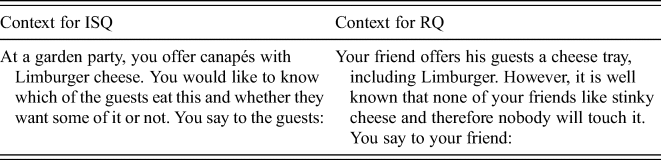
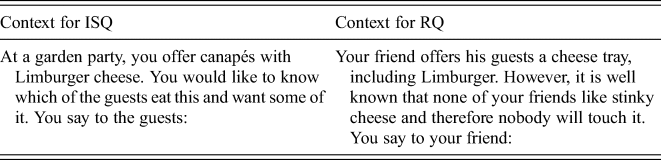
We constructed 21 pairs of wh- and polar questions (e.g. Who eats Limburger? Does anyone eat Limburger?), as well as accompanying contexts (one context triggering an information-seeking, one a rhetorical interpretation, for each question pair), similar to the German context-question pairs used in Braun et al. (Reference Braun, Dehé, Neitsch, Wochner and Zahner2018).Footnote 5 Each question was felicitous in both an information-seeking context and a rhetorical one, resulting in 21 quadruples, such as the one exemplified in tables 1 and 2. Contexts were created based on the literature about the function of and the answers to regular vs rhetorical questions (Rohde Reference Rohde2006; Caponigro & Sprouse Reference Caponigro, Sprouse and Waldmüller2007; Biezma & Rawlins Reference Biezma, Rawlins, Burgdorf, Collard, Maspong and Stefánsdóttir2017 in particular). Specifically, in ISQ contexts, the answer is obviously not known to the speaker and would therefore be highly informative. The short introductory description of the context situation was therefore followed by a sentence starting You would like to know or similar; see tables 1 and 2, left-hand columns). In RQ contexts, on the other hand, there is no uncertainty about the answer. On the contrary, the answer to the RQ is obvious from the given context, i.e. common ground in the imaginary situation. The contexts in the right-hand columns in tables 1 and 2 therefore include a sentence starting However, it is well known that. A possible answer to the polar ISQ Does anyone eat Limburger? would be ‘yes’ or ‘no’, with optional additional information in case of a positive answer; for the polar RQ, the obvious answer would be the assertion of the opposite of the proposition of the question, i.e. No (nobody does). Similarly, a possible answer to the wh-ISQ Who eats Limburger? would fill the position opened by Who in the question, while the obvious answer to the same questions as wh-RQ would be Nobody (does).
Contexts and target polar interrogatives

Target Q: Does anyone eat Limburger?
Contexts and target wh-interrogatives

Target Q: Who eats Limburger?
The syntactic object of all target questions (e.g. Limburger in tables 1 and 2) was lexically given in all contexts to avoid effects of information structure on the prosodic realisation. All wh-questions started with the wh-word who, all polar questions included the indefinite subject pronoun anyone. All questions were constructed with positive polarity in the sentence radical.
In addition to the target items, 28 fillers were created. They were 11 wh-exclamatives (e.g. How crazy he is!), 11 verb-first exclamatives (e.g. Has Benni grown!), three polar questions (e.g. Does he have a PhD?), two declarative sentences with exclamation mark (e.g. The farmer just hit his donkey!), and one declarative without exclamation mark (Clara is chasing the teenager with the camera.). As for the target items, contexts were created for all filler items.
2.1.2 Procedure
Two basic experimental lists were constructed. Each list contained both polar and wh-questions, and both illocution types. The members of the quadruplets were distributed across the two lists such that one list contained eleven polar and ten wh-questions, the other one 10 polar and 11 wh-questions. Illocution type was thus manipulated within-subjects. The same polar or wh-question occurred twice in each list, one in an ISQ context, the other in a RQ context. For example, the items in table 1 were members of List 1, the items in table 2 appeared in List 2. The 28 filler items were added to each list. The experimental lists were randomised for each participant separately with the constraint that two readings of a question were separated by at least four other trials. Each experiment started with four familiarisation trials to familiarise participants with the task. There was a short break after the four familiarisation trials, during which participants were allowed to ask questions, if anything was unclear. The experiment was controlled using the software Presentation (Neurobehavioral-Systems 2000). The experiment was self-paced. Each trial started with the visual display of the context, which the participant had to read silently. After a button press, the question appeared on the screen. It had to be produced aloud. The recording started simultaneously with the appearance of the question on screen. Participants pressed a button to proceed to the next trial. The recording was stopped at this point. Participants were allowed to repeat the question in case of mistakes. The whole experiment lasted about 25 to 30 minutes. The participants were asked to produce the questions in such a way that they were suitable in the given context. No feedback was provided during the actual experiment. Productions were recorded using a head-mounted unidirectional dynamic Shure SM10A microphone with an audio interface audient iD14. They were digitised directly onto a PC (44.1 kHz, 16Bit, stereo). Acoustic measurements were performed with Praat (Boersma & Weenink Reference Boersma and Weenink2018).
2.1.3 Participants
The experiment was carried out at the University of Alberta, Canada. Twenty-one native speakers of English participated for a small fee (7 male, 14 female, average age = 22.5 years). The participants were unaware of the purpose of the experiment. Among the participants were 18 speakers of Western Canadian, one speaker of Eastern Canadian, one of Ontario English, and one of Standard American. The participants were tested in a sound-attenuated room at the university. They were assigned to one of the lists.
2.1.4 Data treatment
The data were first coded on the word level; hesitations and pauses were marked separately (P). Productions containing slips of the tongue and errors were removed from the analysis (33 wh-questions, 18 ISQs, 17 RQs, and 23 polar questions, 13 ISQs, 10 RQs). This left 429 wh-questions (213 ISQs and 216 RQs, 92.9 per cent of the total data) and 433 polar questions (218 ISQs and 215 RQs, 93.4 per cent of the total data) for analysis.
For the phonological analysis, pitch accents and edge tones were annotated by the first author following MAE_ToBI (Silverman et al. Reference Silverman, Beckman, Pitrelli, Ostendorf, Wrightman, Price, Pierrehumbert and Hirschberg1992; Beckman & Ayers Reference Beckman and Ayers1997; Beckman et al. Reference Beckman, Hirschberg, Shattuck-Hufnagel and Jun2005). A random selection of 15 per cent of the recordings was also annotated by the second author. Agreement was 84 per cent, Cohen's kappa 0.82, which is interpreted as almost perfect agreement (Landis & Koch Reference Landis and Koch1977). All questions that entered the analysis were produced in one Intonational Phrase, which was expected given their length and syntactic structure.Footnote 6
For the phonetic analyses, initial pitch was operationalised as in Sicoli et al. (Reference Sicoli, Stivers, Enfield and Levinson2015). First, the f0-value at the point of maximum intensity in the first accented syllable was extracted (this was typically the wh-word in wh-questions, and the subject anyone in polar questions; see below). Next, we extracted the speaker's median pitch for each utterance, and the 90 per cent quantile and classified the data as high initial pitch if the extracted initial f0-value lay in the top 10 per cent of the speaker's pitch range. Furthermore, as suggested by an anonymous reviewer, we also extracted the average f0 of the first word (the auxiliary in polar questions and the wh-word in wh-questions). The duration of the subject (anyone) in polar questions and the wh-word in wh-questions, as well as the syntactic object, was automatically extracted from the annotation. As an acoustic measure for voice quality, we extracted H1*-A3* at the midpoints of stressed vowels (the difference in dB between the amplitude of the first harmonic, f0, and the third formant, corrected for the frequency of the formants, cf. Mooshammer Reference Mooshammer2010). Higher values of H1*-A3* mean a steeper slope and thus less energy in the region of the third formant, which is characteristic for breathy voice (see DiCanio Reference DiCanio2009 for different spectral tilt measures and their relation to glottal activity). A student assistant trained in phonetic annotation labeled the mid of the modally voiced part of the vowel in the stressed syllable of the object as well as the subject (in polar questions) and the wh-word (in wh-questions), using the waveform and a broadband spectrogram. In cases where the modally voiced part was shorter than 40 ms the item was excluded from this part of the analysis.
For the statistical analyses of accent types and edge tones, we coded one of the observed accent types (or edge tones) as 1 and the others as 0 and calculated logistic multilevel regression models with participants and items as crossed random factors (using the R-function glmer()) and illocution type as fixed factor. The initial models included random intercepts for participants and items only; these were compared to models with a more complex random-effects structure (with random slopes for illocution for participants and items). The model with the best fit to the data (as operationalised by LogLikelihood comparisons in the R-function anova()) is reported. The same procedure was performed for the binary variable high initial pitch (in the top 10 per cent of the speaker's range or not). For the statistical analysis of the continuous phonetic variables, we calculated linear-mixed effects regression models with participants and items as crossed random factors (using the R-function lmer() and the package lmerTest) and illocution type as fixed factor. The model fitting procedure was the same as for the categorical analyses. In case the distribution of prosodic parameters across illocution type was different for the three speakers of varieties other than Western Canadian (it turned out that this was the case only for accent types in wh-questions), we also analysed the subset of the eighteen Western Canadian speakers with the same model fitting as described above (it turned out that the findings remained the same as in the entire data set). To account for the fact that multiple variables were tested we adjusted the p-values using the Benjamini-Hochberg correction (Benjamini & Hochberg Reference Benjamini and Hochberg1995) within question types. We only report the adjusted values.
2.2 Results
We start with a presentation of the results for wh-questions and then turn to polar questions. In each subsection we first report the results for edge tones, nuclear and prenuclear pitch accent types, followed by the prototypical tunes produced in RQ and ISQ contexts. Then we present systematic phonetic differences.
2.2.1 Wh-questions
All numbers relate to a total of 429 wh-questions which entered the analysis (213 ISQs, 216 RQs).
Edge tone
The most frequent edge tone for both ISQs (N = 189; 89 per cent) and RQs (N = 187; 87 per cent) was L-L%. There is no effect of illocution type on edge tone in wh-questions (p = 0.7).
Accent on the object noun
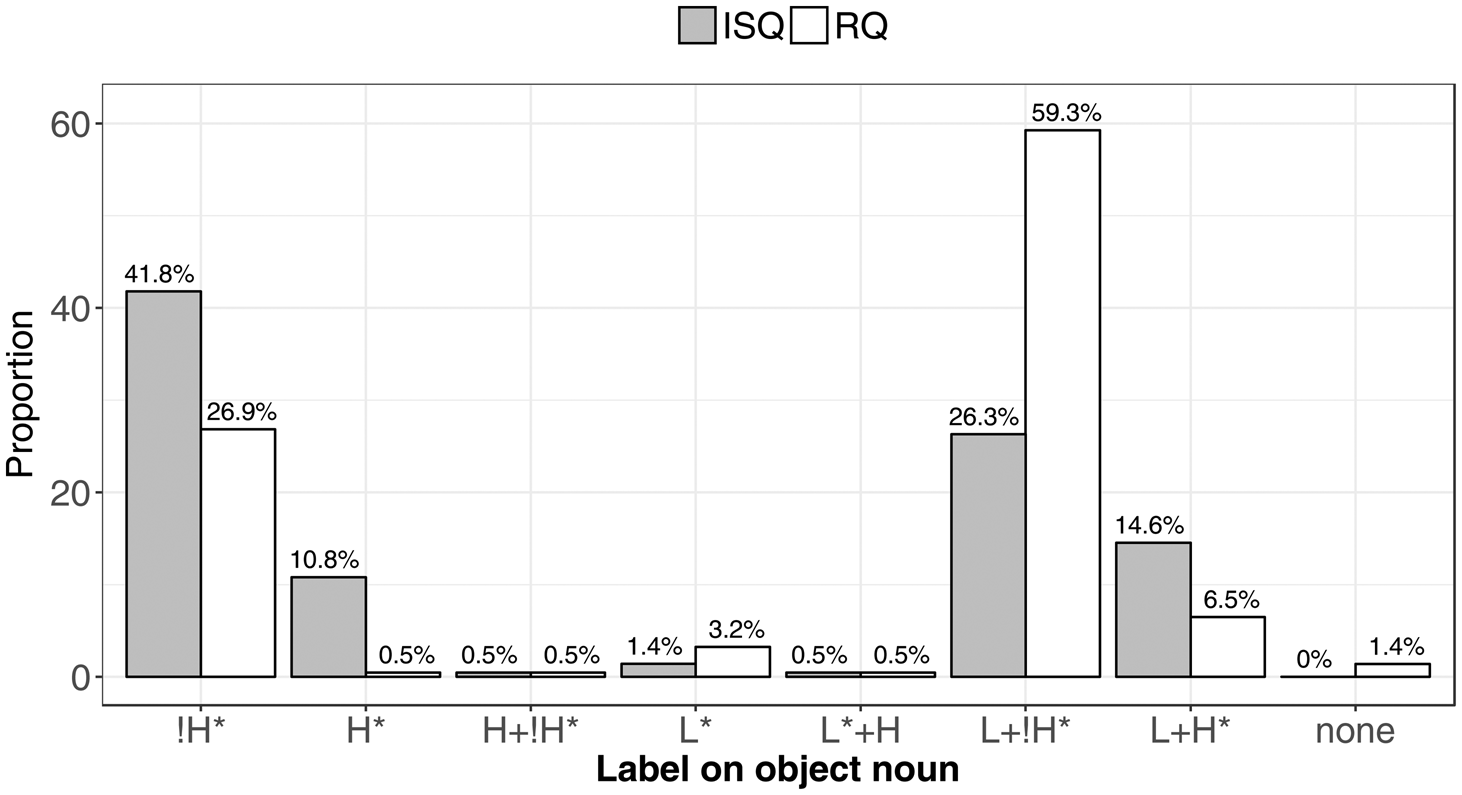
As illustrated in figure 1, which includes all observed accent types, the distribution of accents on the object was different for RQs and ISQs. Specifically, results showed significantly more nuclear L+!H* accents in RQs than in ISQs (ß = 2.3, SE = 0.5, z = 4.6, p = 0.002). In ISQs, on the other hand, the nuclear accent on the noun is more often realised with monotonal !H* than in RQs, a difference that approached significance (ß = 0.7, SE = 0.4, z = 1.9, p = 0.07), and significantly more often with monotonal H* (ß = 3.7, SE = 1.1, z = 3.5, p = 0.002).Footnote 7
Proportion of accent types on the object across illocution types in wh-questions

Accents on the wh-word and verb
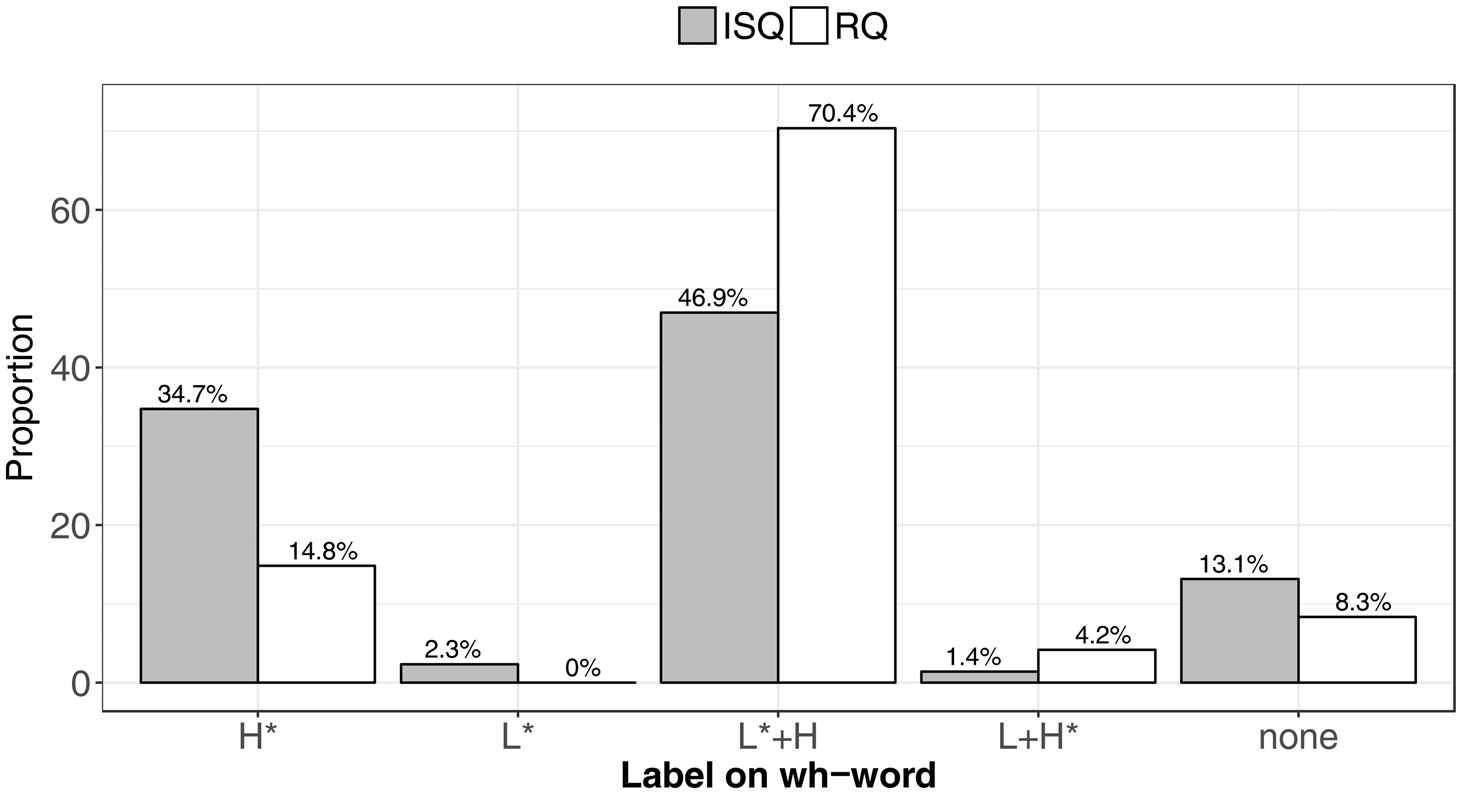
There is no difference in frequency of prenuclear accent placement on the wh-word between ISQs and RQs (p > 0.9), however, there is a difference in accent type. If accented, the wh-word who was more often accented with an L*+H accent in RQs than in ISQs (ß = 1.3, SE = 0.2, z = 5.4, p = 0.0005). Conversely, there were significantly more H* accents in ISQs compared to RQs (ß = 1.4, SE = 0.27, z = 5.1, p = 0.0005); see figure 2.
Proportion of pitch accents on the wh-word across illocution types

The verb was unaccented in more than 80 per cent in both illocution types (ISQ: N = 181, 85 per cent, RQ: N = 178, 82 per cent); there was no effect of illocution type (p = 0.9). For both the wh-word and the verb, there were no differences in the distribution of accent types between Western Canadian speakers and non-Western Canadian speakers.
Overall tunes
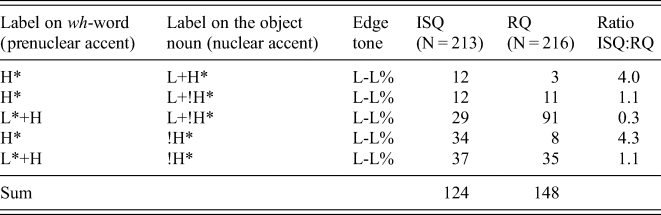
Combining prenuclear and nuclear accents with edge tone, we observe a number of tunes occurring frequently in ISQs and RQs. Those that occurred more than 10 times in either or both of the illocution types are given in table 3. The verb as accent position is omitted here due to the lack of significant differences between illocution types.
Overview of the tunes that occurred at least 10 times in either or both of the illocution types, sorted by the label on the object

Three tunes were particularly frequent with ISQs, adding up to 100 occurrences (47 per cent):
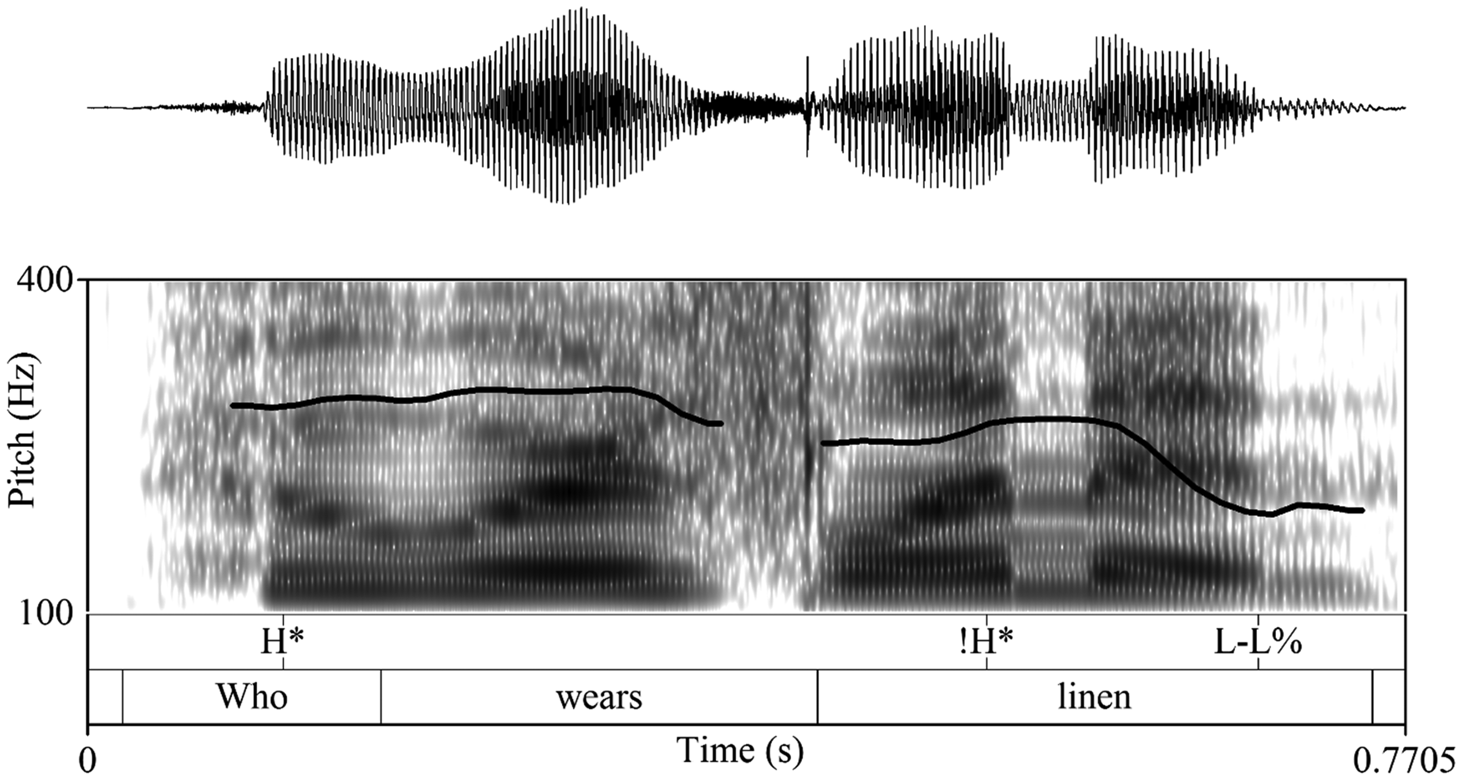
• H* !H* L-L%; with 34 occurrences (16 per cent) in ISQs vs only 8 occurrences (3.7 per cent) in RQs this tune can be seen as a specific tune for ISQs; see figure 3 for an example
• L*+H !H* L-L%; with 37 (ISQ, 17.4 per cent) vs 35 (RQ, 16.2 per cent) occurrences this tune is the most frequent one for ISQs, but it is unspecific with regard to illocution type, because it occurs in RQs with similar frequency
• L*+H L+!H* L-L%; with 29 (ISQ, 13.6 per cent) vs 91 (RQ, 42.1 per cent) occurrences this tune is frequent for ISQs, but it is much more frequent – and thus very specific – for RQs; see below.
There are a number of other overall tunes, which are very specific for ISQs (in that they are only or mostly used in ISQ contexts), but which are overall very rare. These include H* L+H* L-L% (N = 12 in ISQ, N = 3 in RQ contexts), L*+H H* L-L% (N = 8 in ISQ, N = 0 in RQ contexts) and no accent on the wh-word, H* L-L% (N = 6 in ISQ, N = 1 in RQ contexts).
Example of a frequent prosodic realisation of a wh-ISQ (vp16, female)

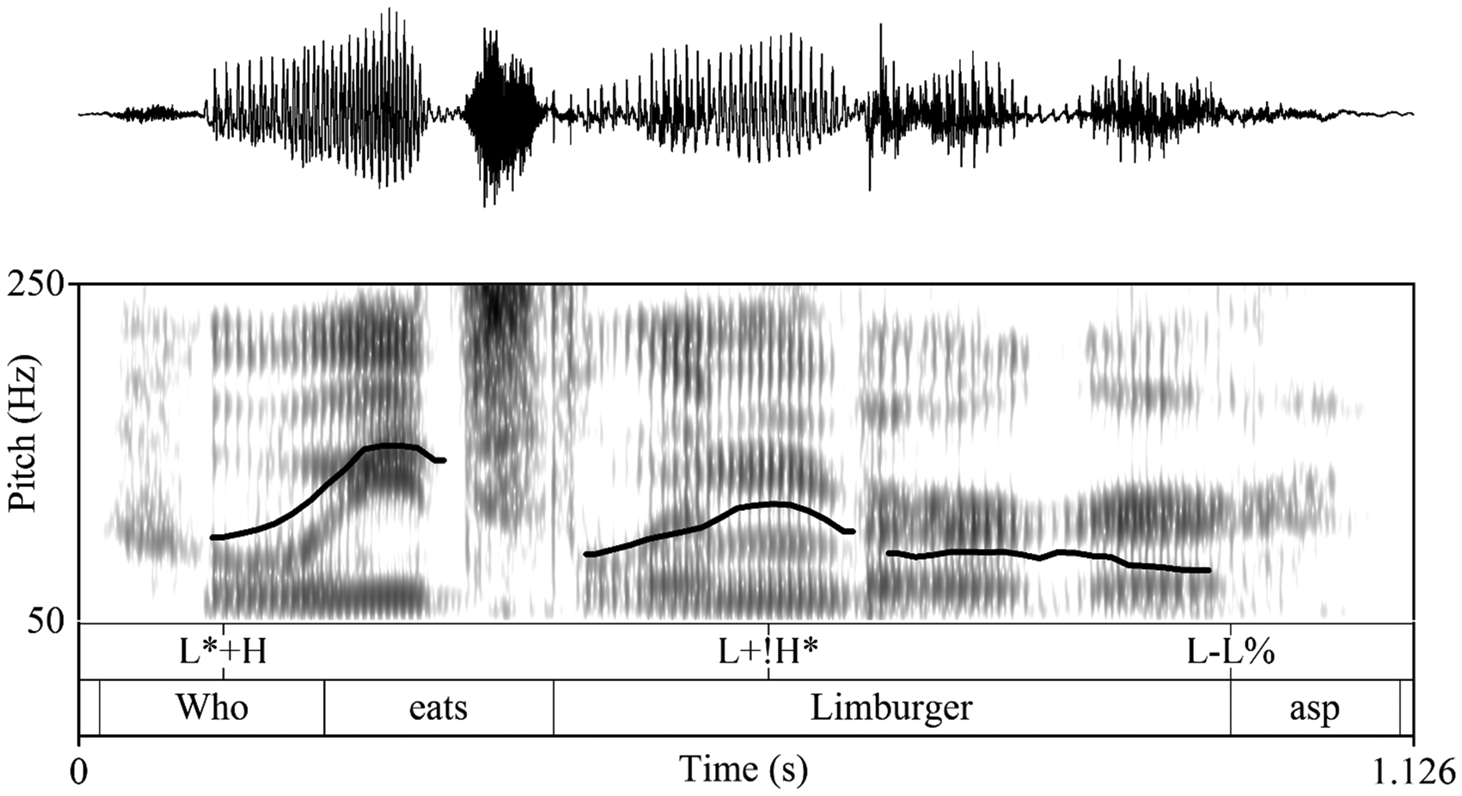
The most frequent and at the same time very specific contour for RQs had an L*+H accent on the wh-word and an L+!H* on the object noun, followed by a low edge tone L-L% (N = 91, 42 per cent in RQs vs N = 29, 14 per cent ISQs); see figure 4. Note that this contour accounted for 42 per cent of the RQ realisations.
Example of a frequent prosodic realisation of a wh-RQ (vp02, male)

Phonetic analyses: initial pitch, duration and voice quality
For the categorical variable high initial pitch, twelve utterances had to be discarded because no f0-value could be extracted in the wh-word (< 3 per cent of the wh-questions). Results showed that in 31 utterances, initial pitch lay in the top 10 per cent of the speaker's pitch range (20 for ISQs, 11 for RQs). A generalised linear mixed effects regression model showed that this difference was not significant (p > 0.9). The average f0 in the wh-word was higher in ISQs than in RQs (245.9 Hz in ISQs vs 232.7 Hz in RQs), but this difference was not significant, either (p > 0.1).
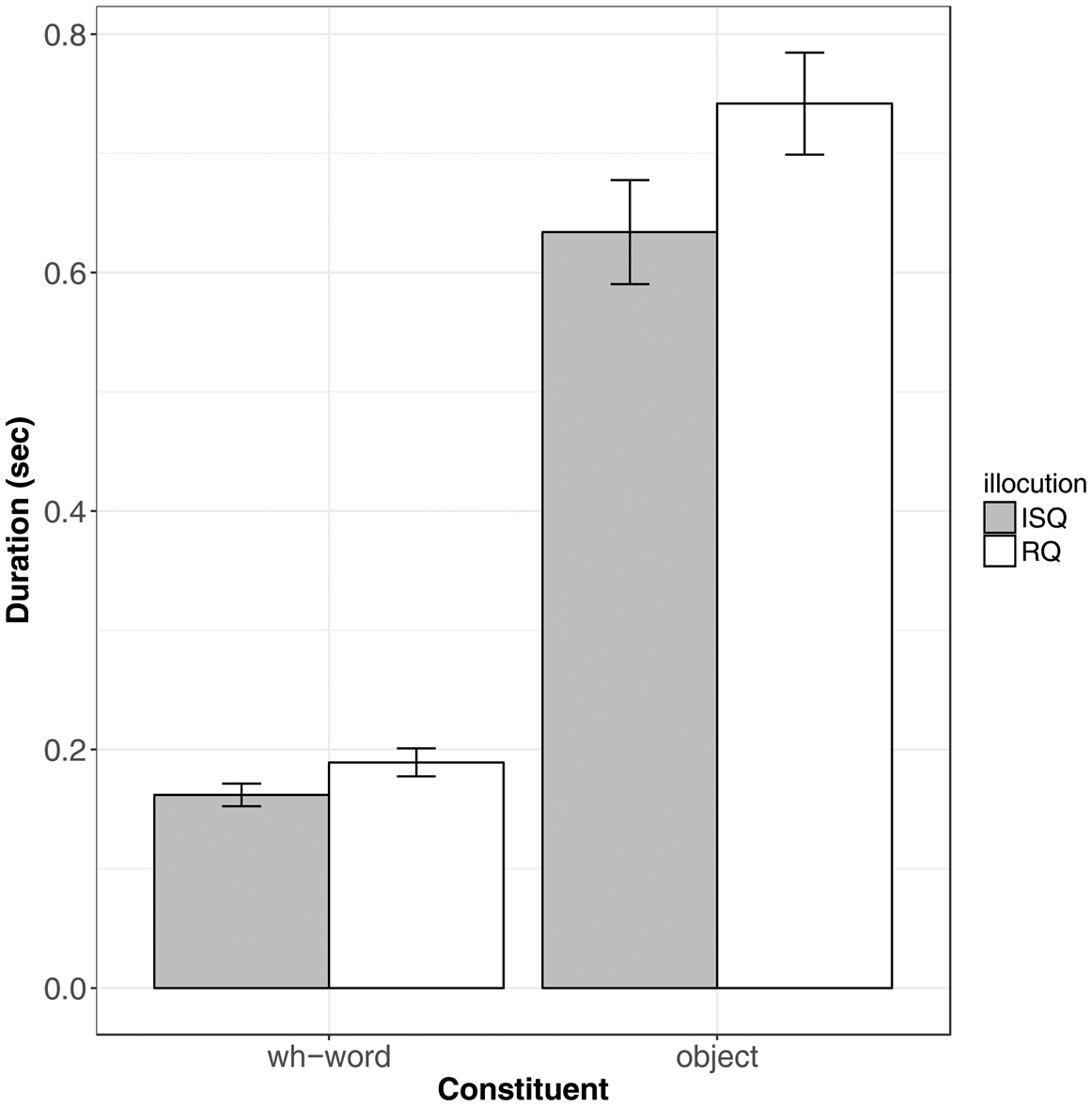
The duration measures showed longer absolute durations of the wh-word and the object in RQs compared to ISQs; see figure 5. The wh-word was on average 28 ms longer in RQs than in ISQs (ß = 28.4, SE = 6.8, t = 20.9, p = 0.007). The duration of the syntactic object was 104 ms longer in RQs than in ISQs (ß = 104.2, SE = 12.7, t = 8.2, p = 0.002). Note that adding the accent type realised on the syntactic object or the edge tone did not improve the fit of the model (x2(11) = 17.1, p > 0.1, x2(5) = 1.7, p > 0.8, respectively).
Average duration of the object and the wh-word across illocution types (whiskers indicate standard errors)

H1*-A3* were extracted at the middle of the wh-word who and the middle of the stressed vowel of the object noun. Items in which the object noun was not stressed consistently by all participants (pasta bolognese, mayonnaise, brussels sprouts, codliver oil) and one instance in which the stress was on the wrong syllable (lambada) were not included in the analysis (excluding 93 items). Furthermore, 15 ISQs (4 in wh-word and 11 in object noun) and 23 RQs (3 in wh-word and 20 in object noun) were excluded due to strong glottalisation, which made f0-extraction (and hence H1 extraction) impossible. This left 425 items for the H1*-A3* analysis of the wh-word and 307 items for the H1*-A3 analysis of the object noun. Results of linear-mixed effects regression models showed that the wh-word was produced with higher H1*-A3* values in RQs than in ISQs (31.4 vs 27.2, ß = 4.3, SE = 0.6, df = 20.5, t = 6.7, p = 0.002), indicating a softer, breathier voice quality for RQs. There was no effect of illocution type on the H1*-A3* values extracted from the noun (p > 0.9).
2.2.2 Polar questions
All numbers relate to a total of 433 polar questions that entered the analysis (218 ISQs, 215 RQs).
Edge tones
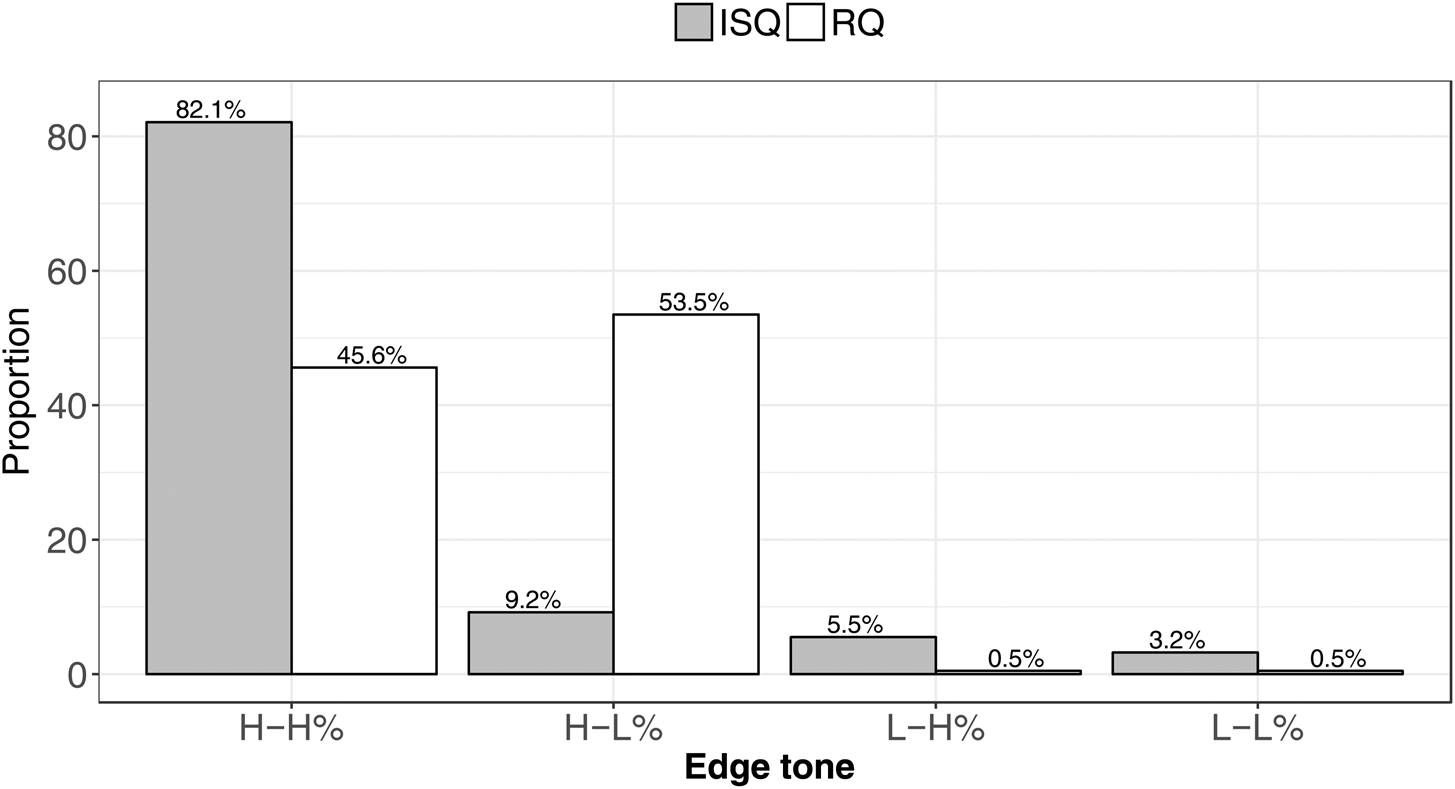
Unlike in wh-questions, there was an effect of illocution type on edge tone; see figure 6. Although H-H% was overall very frequent in both ISQs and RQs, there were significantly more H-H% in ISQs (N = 179, 82 per cent) than in RQs (N = 98, 46 per cent); ß = 2.7, SE = 0.8. z = 3.4, p < 0.0006. At the same time, RQs were comparatively more often realised with H-L% (N = 115, 53 per cent) than ISQs (N = 20, 9 per cent), ß = 5.0, SE = 2.0, z = 2.4, p < 0.02. This means that RQs did not have as many steep rises as ISQs; instead, they had comparatively more rises ending in mid-level plateaus. To corroborate the manual labelling of the two types of final rises (steep rise H-H% vs plateau H-L%) and thus validate the difference, we compared the mean f0-excursion for H-H% vs H-L% edge tones in the sentence-final object. The results showed a larger f0-excursion for boundaries labelled as H-H% (10.2 st) compared to boundaries labelled as H-L% (5.0 st), a difference that was statistically significant (β = 5.2, SE = 0.7, df = 250, t = 7.2, p < 0.0001). There was no effect of illocution type and no interaction between illocution type and boundary tone (both p > 0.15). The distributions of edge tones across illocution types was nearly identical for the Western Canadian and the non-Western Canadian participants.
Proportion of edge tones across illocution types in polar questions

Accent on the object noun
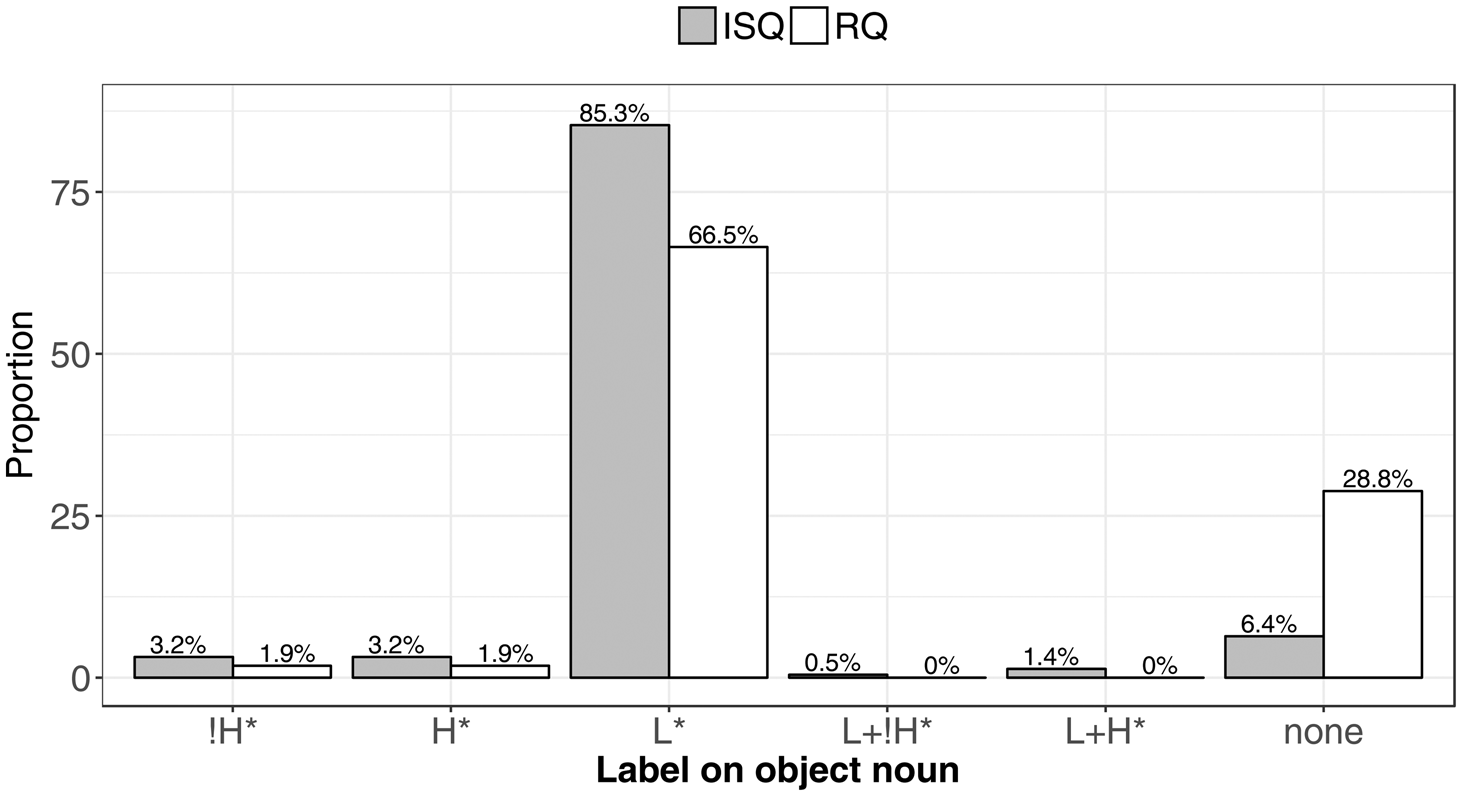
Although the nuclear accent was most often realised on the object noun in both ISQs and RQs (ISQs: N = 204, 93.6 per cent; RQs: N = 153, 71.2 per cent), there were more cases of unaccented objects in RQs (N = 62, 28.8 per cent) than in ISQs (N = 14, 6.4 per cent); see ‘none’ in figure 7. This difference was significant (ß = −8.0, SE= 2.8, z = 2.8, p = 0.04). When the object was unaccented, the nuclear accent was realised on the subject (anyone). The most frequent accent type on the object was L*, but there were significantly more L* accents in ISQs than in RQs (186 vs 143, ß = 2.8, SE = 1.0, z = 2.8, p = 0.02). Western Canadian and non-Western Canadian speakers behaved the same.
Proportion of accents on the object noun across illocution types in polar questions

Accents on the auxiliary, the verb and the subject
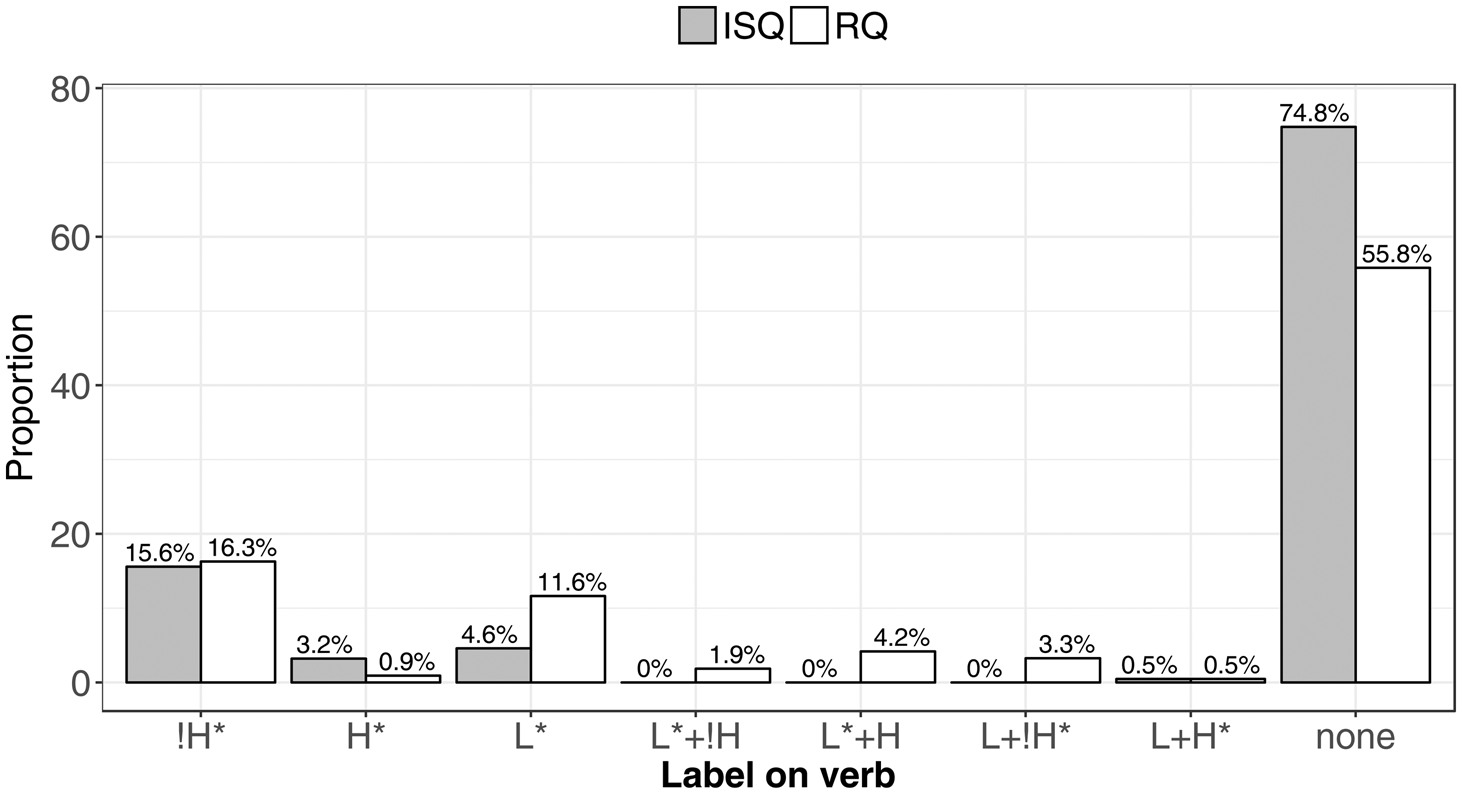
The sentence-initial auxiliary (does) was typically unaccented (N = 215, 98.2 per cent in ISQs; N = 214, 99.3 per cent in RQs), with no difference between illocution types (p > 0.9). The lexical verb was mostly unaccented, but there were more unaccented verbs in ISQs than in RQs (N = 163, 74.8 per cent in ISQs; N = 120, 55.8 per cent in RQs, ß = 9.0, SE = 3.4, z = 2.6, p = 0.02); see figure 8.
Proportion of accents on the verb across illocution types in polar questions

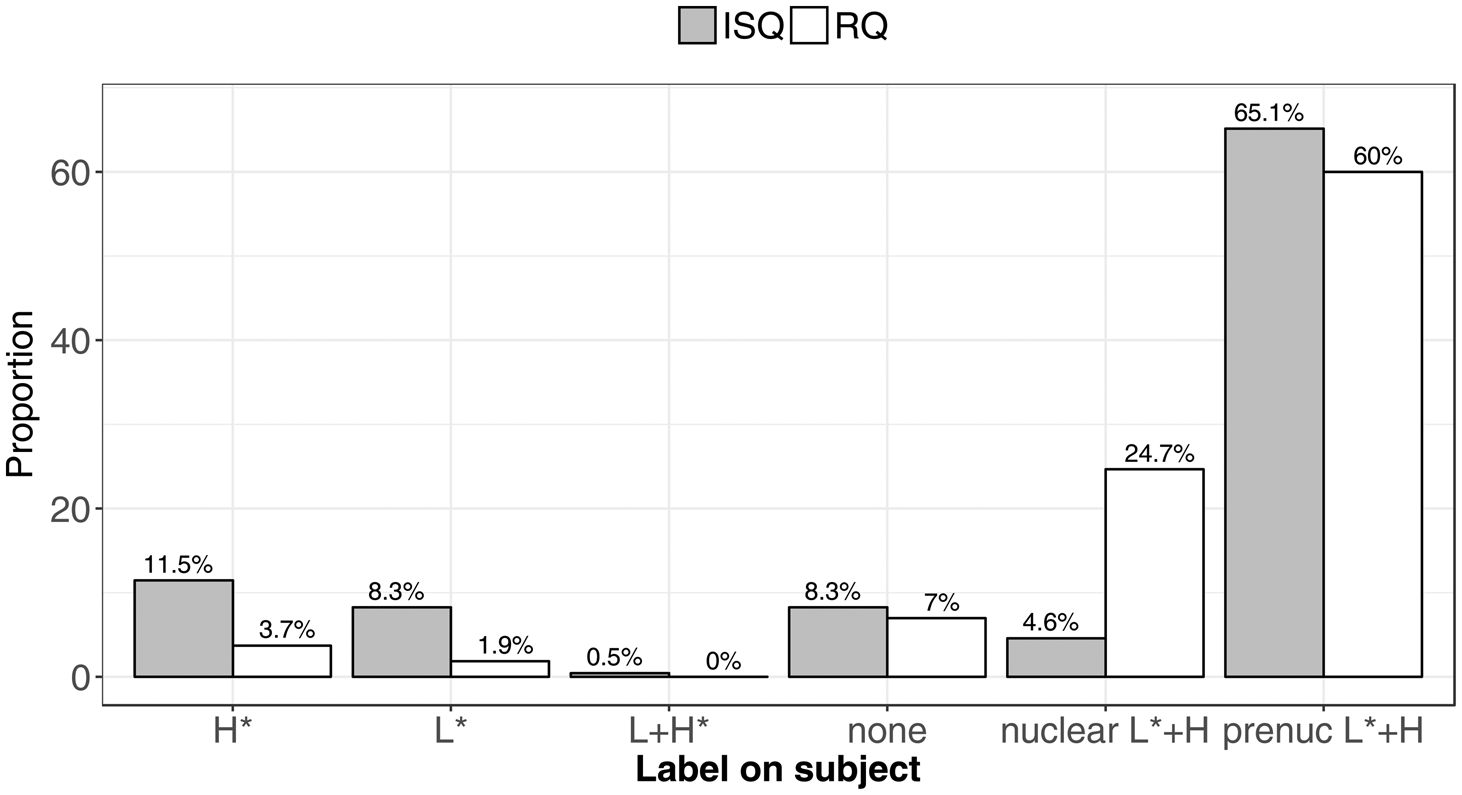
There were significantly more nuclear L*+H accents on the subject anyone in RQs than in ISQs (N = 54 vs 10, 28.7 vs 4.6 per cent; ß = 5.6, SE = 2.6, z = 2.2, p = 0.04); see figure 9. For accents on the auxiliary, the verb and the subject, there were no differences between Western Canadian and non-Western Canadian speakers.
Proportion of accents on the subject anyone across illocution types in polar questions

Overall tunes
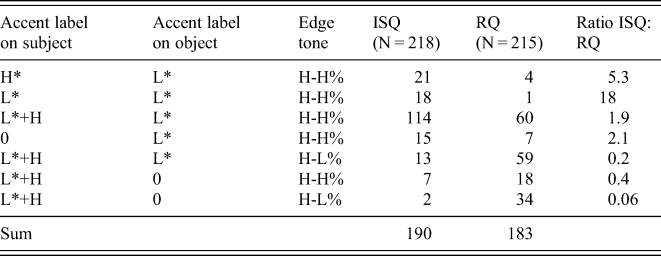
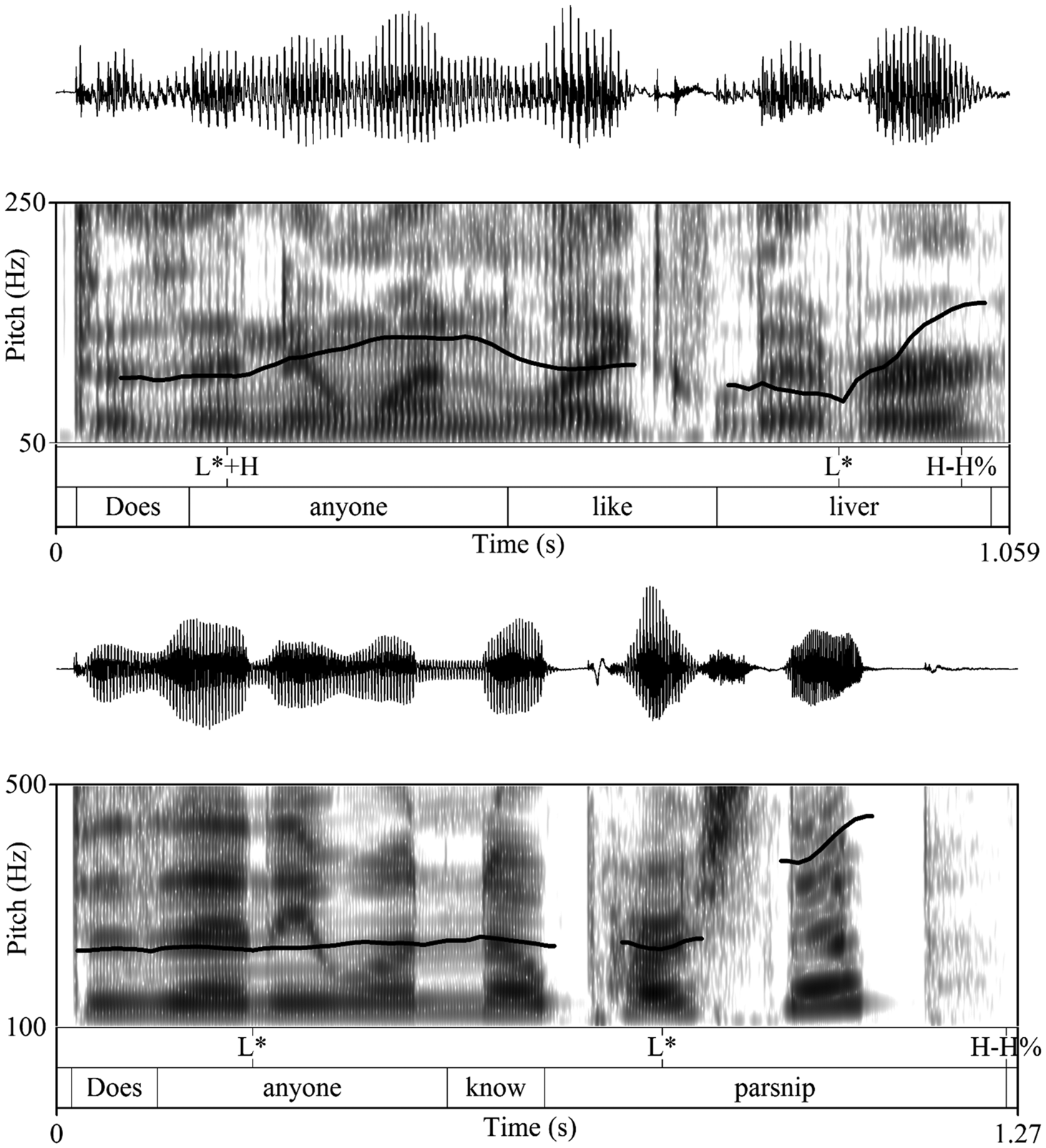
By far the most frequent contour for ISQs (N = 114, 52 per cent; see table 4) had a prenuclear L*+H accent on the subject, followed by a low (L*) nuclear accent on the object and a rise to a high boundary (H-H%). This contour, illustrated in the upper panel of figure 10, occurred nearly twice as often in ISQs than in RQs (N = 114 vs 60; 52 vs 28 per cent). The remaining three contours that were more frequent in ISQs than in RQs also had an L* nuclear accent on the object, followed by an H-H% edge tone (see bottom panel of figure 10 for an example). Taken together, the four rising nuclear contours (L* H-H%) made up 77 per cent of ISQ contours (N = 168).
Overview of the tunes that occurred at least 10 times (>5 per cent) in either or both of the illocution types in polar questions, sorted by the label on the object. Note that the first five tunes have the nuclear accent on the object, and the last two contours on the subject anyone

Frequent realisations of a polar question in an information-seeking context (top panel: vp12, male; bottom panel: vp07, female)

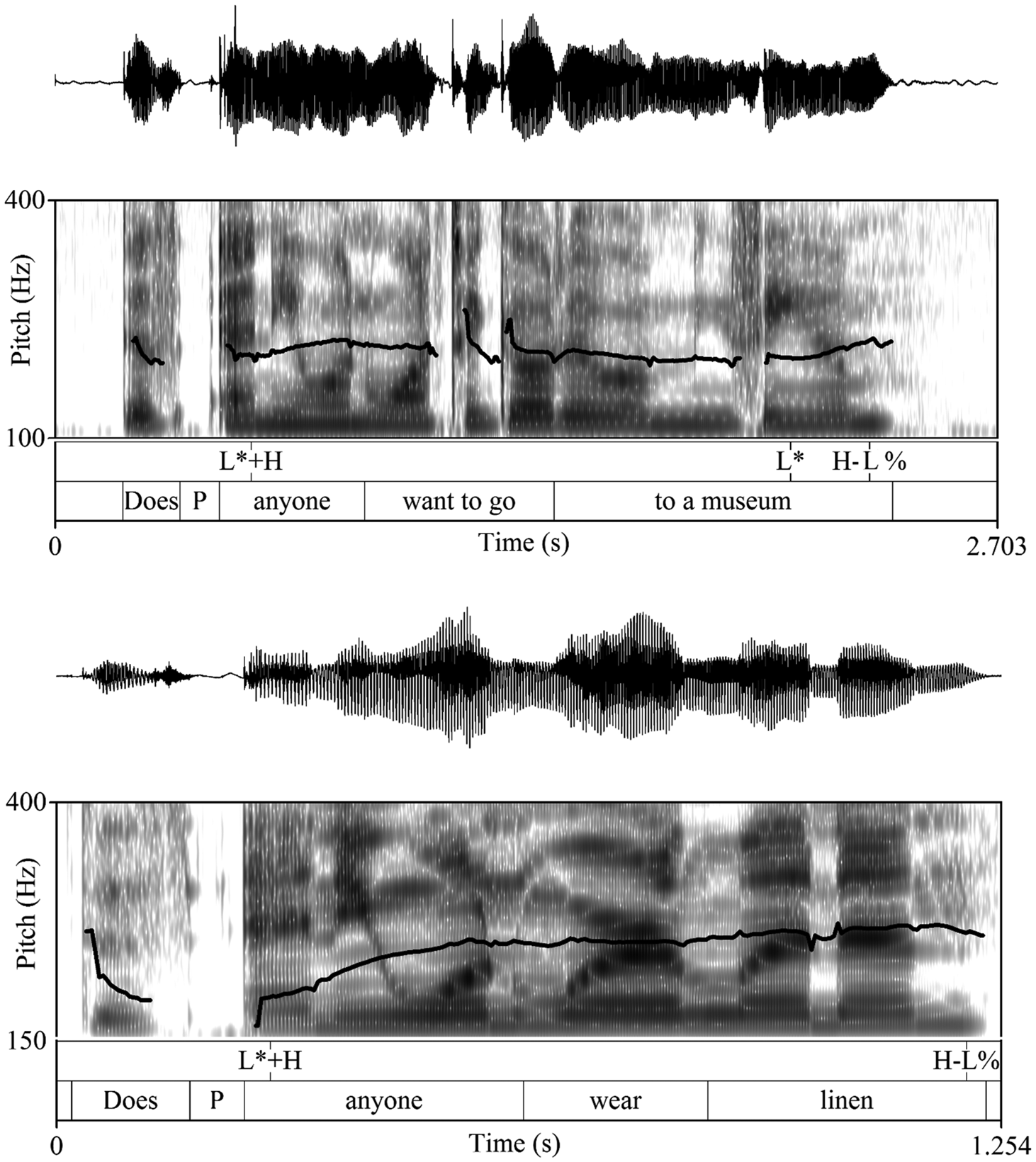
The most frequent contour for RQs (N = 60, 28 per cent) was the one that occurred even more frequently in ISQs (L*+H on the subject, nuclear L* on the object, followed by an H-H% edge tone). The next frequent contour in RQs (N = 59, 27 per cent) was similar to the former contour except that the final boundary was H-L%, and hence did not rise as high but ended in a plateau (see top panel of figure 11). Finally, contours in which the nuclear accent was realised on the subject were rather frequent in RQs (N = 52 in total, 24 per cent) and did not occur often in ISQs (N = 9, 4 per cent); see bottom panel of figure 11 for illustration. Note that a nuclear accent on the subject was also frequently followed by a plateau edge tone H-L% (N = 34, 16 per cent).
Frequent realisation of a polar question in a rhetorical context (top panel: vp08, female; bottom panel: vp29, female)

Phonetic analyses
Initial pitch was extracted from the subject anyone as described before. Six utterances were excluded because no f0-value could be extracted (< 2 per cent of the polar questions). Forty-four utterances started with an f0 value in the top 10 per cent of the speaker's pitch range. These were 35 RQs and 9 ISQs, a difference between illocution types that was significant (ß = 1.5, SE = 0.4, z = 3.9, p < 0.0007). This effect does not occur when comparing mean f0 in the auxiliary (ISQ: 195.3 Hz, RQ: 189.2 Hz, p > 0.3).
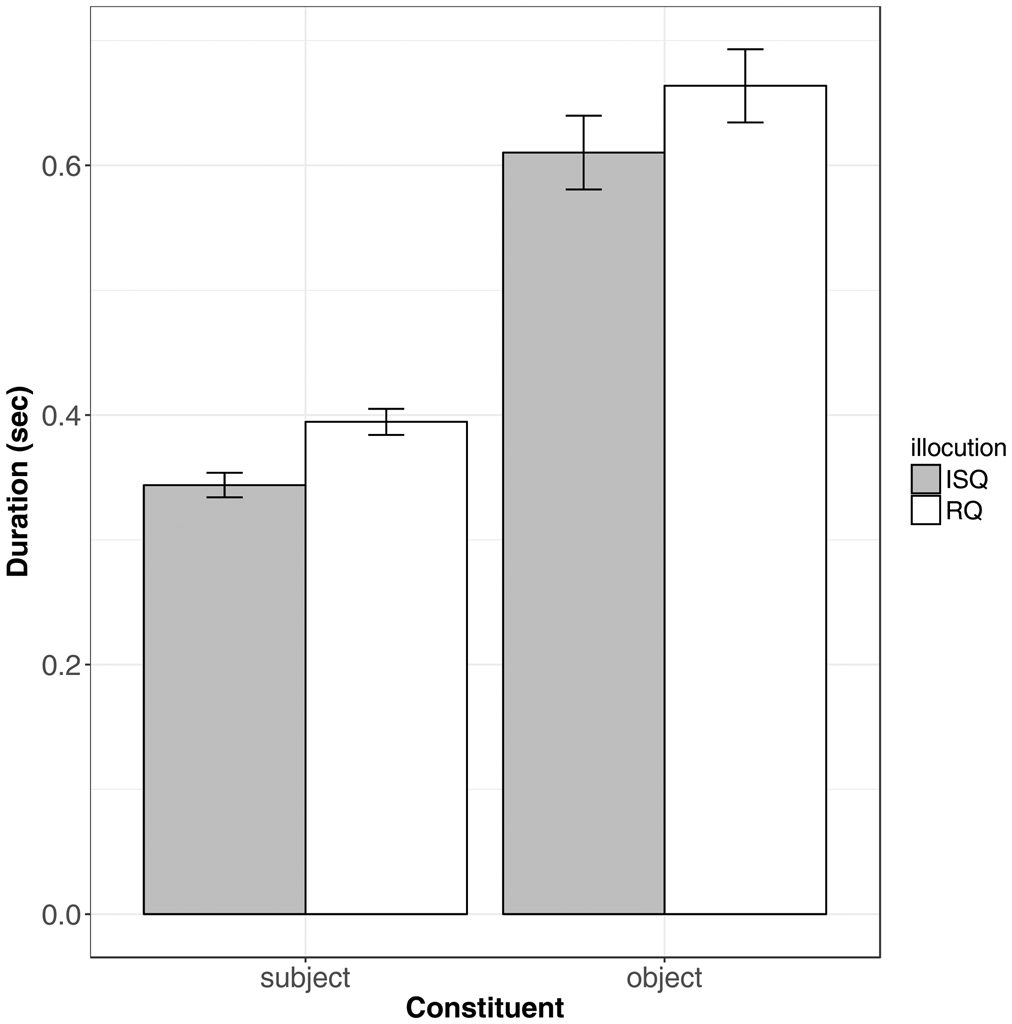
In terms of duration (see figure 12), the subject (anyone) was on average 50 ms longer in RQs than in ISQs (ß = 50.0, SE = 8.1, t = 21.0, p < 0.02). Likewise, the object was 57 ms longer in RQs than in ISQs (ß = 56.9, SE = 9.3, t = 20.6, p < 0.03).
Average duration of the subject (anyone) and the object across illocution types in polar questions

H1*-A3* was extracted from the subject anyone and the object noun. In RQs, 45 items had to be discarded from the analysis of the subject due to creaky voice (26 cases in ISQs). For the remaining 357 cases, there was no difference in H1*-A3* of the stressed syllable of the subject (p = 0.9). For the object, 37 items had to be excluded because of glottalisation (17 in ISQ and 20 in RQ contexts), four cases with whispered voice (1 in ISQ and 3 in RQ contexts), as well as 71 cases with variable stress (mayonnaise, Brussels sprouts, pasta bolognese, codliver oil). For the remaining 323 cases, there was no difference of illocution type (p = 0.9).
3 Discussion
In what follows, we relate our findings to the hypotheses put forward in (3) above, repeated in (4) for convenience, as well as to the literature surveyed in the introductory sections.
(4) Hypotheses
H: ISQs and RQs differ in their prosodic realisation.
H1: In phonology, all tonal parameters, i.e. edge tones as well as nuclear and prenuclear pitch accents, contribute to the distinction between ISQs and RQs.
H2: In phonetics, duration, voice quality and initial pitch contribute to the distinction between ISQs and RQs.
To begin with, our study confirms the general hypothesis H. Our results clearly show that despite some overlap in the use of intonational categories, ISQs and RQs differ substantially in their prosodic realisation. Crucially, while previous literature typically focuses on phonological differences, we show that cues to ISQ vs RQ interpretation are both phonological and phonetic in nature.
Our results confirm hypothesis H1, which maintains that all tonal parameters contribute to the distinction between RQs and ISQs. As outlined in the introduction, a lot of the semantic literature focuses on the terminus of the intonation contour, i.e. whether ISQs and RQs are realised with an utterance-final fall or a rise, and how the phrase accent and/or boundary tone is related to question meaning and speech acts. Our study shows that edge tones (and boundary tones) are distinctive only for polar questions, but not for wh-questions. Wh-questions are overwhelmingly falling to L-L% across illocution types. This is compatible with Bartels (Reference Bartels1999), who argues that for wh-questions, non-tonal rather than tonal cues – i.e. non-tonal cues rather than high vs low edge tones – are responsible for their interpretation. According to Bartels (Reference Bartels1999: 257), L would ‘highlight the assertive thrust of a [wh-] rhetorical interrogative' and ‘serves as a cue to the ulterior statementhood of the utterance’ (p. 259), i.e. the speaker will use it in order to avoid misunderstanding of an RQ as a genuine question on the part of the hearer.
Polar questions on the other hand are overwhelmingly rising, but while ISQs rise continuously to a high level in the speaker's range (H-H%), RQs more frequently rise only to a mid-level, resulting in a plateau (H-L%); see figure 6. Crucially, a distinction between rising and falling intonation is therefore insufficient also for polar questions. While it would be possible to model the contrast between polar ISQs and RQs on the basis of the phonological boundary tone alone (H% for ISQs vs L% for RQs), or on the basis of the edge tone (H-H% for ISQs vs H-L% for RQs), it is not possible to do so on the basis of the phrase accent alone (H- in both ISQs and RQs). If we complete the picture including assertions or statements, which have been argued to be semantically different from RQs (Caponigro & Sprouse Reference Caponigro, Sprouse and Waldmüller2007; Biezma & Rawlins Reference Biezma, Rawlins, Burgdorf, Collard, Maspong and Stefánsdóttir2017) and typically end in L-L%, the edge tone (i.e., the combination of phrase accent and boundary tone) is essential. Hence, the distinction should be threefold: rise to a high level in the speaker's range (H-H%), rise to a mid-level plateau (H-L%), and fall to a low level (L-L%). Crucially in polar questions, L% typically occurred in the combination H-L%. In this sequence in English, L% is not to be understood as the same low target as L% in L-L%. Due to the presence of H-, it is an upstepped L% (see section 1.1 above). It is lower ‘than that of the upstepped H% boundary tone’ in H-H% (Beckman & Ayers Reference Beckman and Ayers1997: 18), thus it is a mild rise or pitch plateau rather than a final fall. In terms of pitch height, H-L% is between L-L% and H-H%. It almost seems as if H-L% is ideal to end an utterance that is interrogative in syntactic form (verb-first polar question), but whose answer is obvious and already part of the common ground (RQ). In other words, within polar questions, it is the upstepped rise vs the mid-level plateau, which distinguishes between ISQs and RQs. Crucially, this is very different from simply distinguishing between phrase-final rising and falling intonation.
Our results for edge tones go against Han (Reference Han2002), who maintains that polar RQs are realised with a final fall due to their semantic similarity to assertions, as well as against Banuazizi & Cresswell (Reference Banuazizi, Cresswell, Billings, Boyle and Griffith1999), who suggest more falls for RQs due to the presence of obvious answers. Our generalisation is compatible with Pierrehumbert & Hirschberg's (Reference Pierrehumbert, Hirschberg, Cohen, Morgan and Pollack1990: 306) assumption that H% in polar questions conveys cross-speaker ‘forward reference’, i.e. the speaker expects the interlocutor to take over the turn. Utterances ending in L%, on the other hand, do not convey this forward reference. Hedberg & Sosa (Reference Hedberg and Sosa2011) reserve H% in polar questions for ‘inquisitive’ meaning, i.e. for utterances, for which ‘the proposition it expresses allows for more than one way to update the common ground’ (2011: 9). This is the case for regular ISQs, which, in our data, are overwhelmingly rising to H-H%, but it is not true for RQs, all in line with Hedberg & Sosa (Reference Hedberg and Sosa2011). As Rohde (Reference Rohde2006: 163) puts it, ‘participants in a discourse understand rhetorical questions when they share sufficiently obvious and similar answers’. If this is the case, then the question is not inquisitive, thus does not demand H%. That the contour still does not fall to L-L% adds to the differences between RQs and statements, which also include their syntactic form, as well as the fact that RQs do, but statements do not allow for an answer, or at least not in the same way (Caponigro & Sprouse Reference Caponigro, Sprouse and Waldmüller2007). This distinction is also in line with Biezma & Rawlins (Reference Biezma, Rawlins, Burgdorf, Collard, Maspong and Stefánsdóttir2017), who suggest that RQs and assertions differ such that ‘[w]here assertions are characteristically used to introduce a new commitment, RhQs are very well-suited for extracting commitments’ (Reference Biezma, Rawlins, Burgdorf, Collard, Maspong and Stefánsdóttir2017: 319). This threefold semantic distinction is reflected very well in the edge tone: inquisitive ISQs typically end in H-H%, RQs seeking to extract commitments typically end in H-L% (i.e. a plateau), and assertions, which introduce new commitments, end in L-L%.
Another important phonological cue to the difference between ISQs and RQs is the nuclear accent, still in line with hypothesis H1. While in wh-questions, it is the type of the nuclear accent on the object noun that plays a role (more L+!H* in RQs than in ISQs, more H* and !H* in ISQs than in RQs), in polar questions it is more the position of the nuclear accent.Footnote 8 About a quarter of RQs had a nuclear L*+H accent on the subject anyone and no accent on the syntactic object, a pattern that was rare (< 5 per cent) in ISQs, which typically had a nuclear accent on the object noun. So even if the nuclear accent placed on the subject in RQs cannot be called typical given that it only occurs in about a quarter of the cases, when it does occur, it is a safe indicator of rhetoricity, unless, of course, it is due to information structure (i.e. subject focus). Information structure, crucially, is a factor not relevant here because it was controlled for across the board. Regarding nuclear accent types, the differences between RQs and ISQs are less obvious in polar questions than in wh-questions. Across illocution types, the nuclear accent, if realised on the object noun, was typically L*. We assume that due to the role of the edge tone, which marks the difference between ISQs and RQs in polar questions but not in wh-questions, the role of the pitch accent is less crucial in polar questions than in wh-questions. However, in polar questions, nuclear accent position and edge tone may serve the function of conveying rhetorical meaning together. In particular, if the nuclear accent occurs early (i.e. on the subject anyone) and combines with the H-L% edge tone, the duration of the tonal plateau increases, which may then strengthen its function.
In the prenuclear region, the results were not so striking, except that in polar questions we observed more unaccented verbs in ISQs than in RQs (although in general, the verb was mostly unaccented), and in wh-questions, the wh-pronoun typically received a bitonal L*+H pitch accent in RQs compared with a typical monotonal H* accent in ISQs (but there is no difference in frequency of accenting the wh-word). Even if the results are not as striking as for edge tones and nuclear accents, the fact that differences can be found between illocution types ties in with previous work on the role of the prenuclear region. In the present context, the wh-word in wh-ISQs represents the unspecified part of the proposition, i.e. the speaker requests information to fill the open slot and s/he therefore marks the wh-word with H*. In RQs, on the other hand, the wh-word corresponds to the obvious answer, rather than the unknown one. The speakers prefer prenuclear L*+H in this case. Remember from section 1.1.1 Hedberg & Sosa's (Reference Hedberg and Sosa2002) finding that the prenuclear accent on the wh-word is, in their data, typically L*+H. In our data, L*+H occurs in both ISQs and RQs, but it is more frequent in RQs, with more monotonal H* accents in ISQs.
Evaluating hypothesis H2, we find that RQs and ISQs indeed differ in the realisation of the phonetic parameters. The most robust parameter is duration: we found longer durations in RQs than in ISQs in both question types. Specifically, this generally concerns the object as well as the wh-words in wh-questions and subject nouns in polar questions. These findings are in line with work on German RQs (Braun et al. Reference Braun, Dehé, Neitsch, Wochner and Zahner2018), which found longer constituent durations in RQs than in ISQs, and more generally with findings that questions are produced with shorter durations (faster speaking rate) than declaratives (Niebuhr et al. Reference Niebuhr, Bergherr, Huth, Lill and Neuschulz2010; Heuven & Zanten Reference Heuven and van Zanten2005). Assuming that RQs have an assertive feel rather than inquisitive semantics, and given that declaratives also exhibit longer durations than genuine questions, our duration results for RQs vs ISQs are exactly what would be predicted.
Differences in voice quality were found only for the wh-word in wh-questions, but not for polar questions. The wh-word was breathier in RQs than in ISQs. This is reminiscent of the results of Braun et al. (Reference Braun, Dehé, Neitsch, Wochner and Zahner2018) for German RQs, which show that a higher proportion of words were realised with breathy voice in RQs than in ISQs. Note that this result goes against Niebuhr et al.’s (Reference Niebuhr, Bergherr, Huth, Lill and Neuschulz2010) findings for declarative questions and declarative statements in German, where questions were realised with breathier voice quality than statements.
Regarding initial pitch, in wh-questions there was no difference between illocution types in the number of utterances that started with high initial pitch (in the top 10 per cent of the speakers pitch range) and no difference in the mean f0 of the first word. This goes against the generalisation by Sicoli et al. (Reference Sicoli, Stivers, Enfield and Levinson2015), who report higher initial pitch in evaluative questions (including RQs). In polar questions, there were indeed significantly more RQs than ISQs with high initial pitch on the subject anyone. However, this effect disappeared in the analysis of the mean f0 of the first word. The partial overlap and differences in comparison with Sicoli et al.’s data suggest that other factors besides speaker attitude and illocution type may play a role (e.g. syntactic structure, turn position, and utterance length, which were not controlled for in Sicoli et al. Reference Sicoli, Stivers, Enfield and Levinson2015). Furthermore, the measure they used for initial pitch is naturally strongly affected by accent type. This latter point also holds for our analysis of initial pitch. Remember that in wh-questions, the prenuclear accent on who distinguishes between illocution types (monotonal H* in ISQs vs rising L*+H in RQs), thus the mean pitch will naturally differ between the two.
In sum, our results clearly show that in production, the meaning differences between ISQs and RQs are reflected in the prosodic realisation chosen by the speaker. The speaker situates the question in the given situational context and produces it with corresponding prosody. We have thus confirmed the assumption made in the literature that prosody can be (and is) used to signal illocutionary force. However, while some of the literature is speculative (e.g. Han's Reference Han2002 claim that polar RQs must be realised with a final fall) or vague (e.g. Biezma & Rawlins’ Reference Biezma, Rawlins, Burgdorf, Collard, Maspong and Stefánsdóttir2017: 306, 313 statement that the prosodic characteristics of RQs are ‘hard to pin down’), we identify specific phonological and phonetic cues, which predict with some certainty whether a syntactically ambiguous interrogative utterance is intended as an ISQ or RQ.
Given our results, we would like to emphasise the following points. First, when modelling the interface between prosody and meaning, it is essential to consider not just the boundary tone or edge tone, but pitch accents and their distribution, too. In previous literature, especially in theoretical literature and work using introspective data (Bartels Reference Bartels1999; Han Reference Han2002), the focus has been on the terminus. The way this has been done – concentrating on the difference between falls and rises – is insufficient for at least two reasons. One is that the edge tone is not always distinctive. The present study has shown that wh-questions end in L-L% regardless of illocution type. Another reason is that an intonational terminus can be shaped in more than just two ways (rise, fall). In particular, the present study has shown that we need a third category (the plateau) to fully capture the differences between illocution types.
The second point we would like to emphasise is that it is important not just to consider intonation. Our results, as well as previous results on different utterance types in the literature (see section 1.2 above), show that phonetic parameters contribute to the distinction between illocution types. Most strongly, this has been shown for duration, at least in production. Future experiments will have to deal with cue weighting: which is the strongest cue? For example, does phonology (e.g. pitch accent types) outweigh duration, or is it the other way around? If duration were manipulated to signal the contrast between illocution types, would that be enough? How strong is prosody in comparison to the context, or, to put it differently, if the context demands a rhetorical interpretation of an interrogative, will prosody be able to override this? These questions cannot be pursued in the present article. The merits of the present article are at least twofold: first, to the best of our knowledge it is the first study that systematically compares the prosody of English string-identical ISQs and RQs in production, using a controlled production experiment. Second, we demonstrate that to provide a complete picture of the prosody of illocution types it is not enough to consider a single parameter or even phonology only. Moreover, we identify the phonological and phonetic parameters that do play a role. As a result, the prosodic parameters which distinguish between RQs and ISQs are not ‘hard to pin down’ (Biezma & Rawlins Reference Biezma, Rawlins, Burgdorf, Collard, Maspong and Stefánsdóttir2017: 306, 313) anymore.