

Introduction
The traditional Westphalian notion of sovereignty emphasized the principle of non-intervention in domestic affairs and, closely related to this, the consensus principle. While major powers have never fully respected sovereignty (see Krasner Reference Krasner1999), the principle has been widely considered to be central in international politics. It involves three norms: first, that the ruler of a state exercises sole authority over the territory of that state; second, that all states are judicially equal; and third, that state parties are not subject to any law to which they do not consent. On this view, international institutions are considered to be instruments of the territorial state.
The time since the Second World War, especially spanning the last two to three decades, has brought changes that have undermined Westphalian sovereignty (e.g. Grande and Pauly Reference Grande and Pauly2005). In addition to violations by major powers, international institutions have developed procedures that contradict the consensus principle and the principle of non-intervention. Some international norms and rules compel national governments to take measures even when they have not agreed to do so. In some cases, decisions made by international institutions even affect individuals directly, like those taken by the United Nations Security Council Al-Qaida and Taliban Sanctions Committee or by transitional administrations. Both types of activities – those that bind states thus affecting private actors only indirectly and those that affect individuals directly – are indications that international institutions have public authority (Bogdandy, Dann, and Goldmann Reference Bogdandy, Dann and Goldmann2010). In general, international institutions have authority when the addressees of their policies recognize that these institutions can make competent judgments and binding decisions (see also Cooper et al. Reference Cooper, Hawkins, Jacoby and Nielson2008). International institutions exercise authority in that they successfully claim the right to perform regulatory functions like the formulation of rules and rule monitoring or enforcement.
The claim of this article is that the rise of political authority beyond the nation state requires legitimation and leads to politicization. We expect growing resistance against international institutions to the extent that international institutions exercise authority but cannot build on sufficient stocks of legitimacy. The procedures for obtaining results in international political processes, the content of these processes, and above all the concomitant subsystemic assignment of powers require justification. The ‘right to justification’ (cf. Forst Reference Forst2007) is now demanded of international institutions, as well. It is called for by numerous so-called anti-globalization groups such as Attac, acting on the transnational level, as well as by resisters at the national level who seek to prevent the undermining of democratic sovereignty, for example, via referendums on European integration. The right to justification is also put forward by some formerly less-powerful states against the dominance of strong Western states in international institutions. The days of permissive consensus for executive multilateralism are over.
At the same time, we also expect a growing utilization of international institutions to the extent that they exercise authority. Only part of the current politicization of international institutions comes in the form of resistance. Many transnational non-governmental organizations (NGOs) and social movements publicly address international institutions in a positive way, for instance, by calling for drastic intensification of climate policy measures at the international level. Similarly, there have been numerous recent demands for much stronger interventions by the International Monetary Fund (IMF) and multilateral development banks as a response to the financial crisis. At the same time, various groups seek permanent access to international institutions in order to facilitate their influence on internal agendas and policy formulation, as well as to hold these institutions accountable in the phases of policy implementation (Tallberg and Jönsson Reference Tallberg and Jönsson2010).
Public resistance to international institutions and their more intensive utilization are both expressions of a process that we refer to as politicization. We define politicization of international institutions operationally as growing public awareness of international institutions and increased public mobilization of competing political preferences regarding institutions’ policies or procedures. We claim that the politicization of international institutions is a consequence of their new authority. The more political authority international institutions exercise or are expected to exercise, the more they attract public attention and demands. In this way, they become publicly contested.
This claim runs counter to a number of relevant strands of theorizing about international and transnational relations. First of all, major theories of international relations (IR) and international institutions question the claim that international institutions possess authority in their own right. Neorealism explicitly considers international institutions as an epiphenomenon of the distribution of power in the international system (Mearsheimer Reference Mearsheimer1994). Even rationalist theories of intergovernmental cooperation do not see international institutions as exercising authority. While international institutions are assigned a causal role (Keohane Reference Keohane1984), they are still conceptualized as instruments of the state, without possessing authority in their own right (Kahler Reference Kahler2004). Second, international relations is widely seen as a social realm dominated by executives and technocrats, even when power and authority are exercised. Kissinger (Reference Kissinger1957) sees the withdrawal of foreign policy and international negotiations from public debate as a defining and desirable element of IR. In this line of thinking, Moravcsik (Reference Moravcsik2006), while accepting that the European Union (EU) exercises authority in some areas, maintains that this takes place only in policy fields that are not of interest for the people and therefore do not require democratic legitimacy. In general, international institutions, even when they exercise authority, are seen as sites of executive and technocratic governance protected from public and societal pressures.
A third strand of literature about transnational and international relations needs to be mentioned in order to additionally highlight that authority and politicization are not simply co-constitutive. The whole notion of political opportunity structures suggests that the exercise of power, rule, and authority, even if considered as unfair, does not automatically translate into protest. For the transnational level, Tarrow (Reference Tarrow2005) and della Porta (Reference della Porta2007) have shown this convincingly. An analysis of the EU also demonstrates that the permissive consensus faltered only three decades after EU institutions exercised significant authority; this means that specific opportunity structures must be given before authority translates into politicization (de Wilde and Zürn Reference de Wilde and Zürn.2012; Rauh Reference Rauh2011). The claim therefore needs to be qualified by the ceteris paribus clause; it does not suffice to explain cases of politicization completely. Finally, the claim that authority produces politicization decouples the concepts of authority and legitimacy to some extent. The hypothesis that high levels of political authority may lead to strong contestation about the legitimacy runs also counter to a conceptualization of authority as recognized legitimacy (Hurd Reference Hurd2007). In sum, the claim that international authority leads to politicization challenges traditional perspectives of IR. It opens up a new perspective according to which it is no longer negotiations behind closed doors but open societal struggles that determine the content of international institutions and thus important outcomes of international relations.
Our contribution adds to the analysis of the consequences of international institutions starting from institutionalist theory in IR. In contrast to work analyzing the effectiveness of international institutions (e.g. Haas, Keohane, and Levy Reference Haas, Keohane and Levy1993; Miles et al. Reference Miles, Underdal, Andresen, Wettestad, Skjaerseth and Carlin2002), compliance with international institutions (e.g. Chayes and Chayes Reference Chayes and Chayes1995; Downs, Rocke, and Barsoom Reference Downs, Rocke and Barsoom1996; Tallberg Reference Tallberg2002), or the distributive effects of international regimes (Krasner Reference Krasner1991; Helleiner Reference Helleiner1994), we ask about the broader, so to speak, societal and constitutional effects of international institutions. We move beyond issue area-specific impacts of international institutions and ask further how these institutions affect the rise of a global order. Our argument builds in part on early neofunctionalist reasoning about the impacts of European integration and on some recent studies about the growing relevance of denationalized governance for the structuring of domestic political space in European states (Schmitter Reference Schmitter1969; Hooghe and Marks Reference Hooghe and Marks2008; Kriesi et al. Reference Kriesi, Grande, Lachat, Dolezal, Bornschier and Frey2008). We argue that internationalized governance has reached a reflexive stage in which progressively more societal actors pay attention to and reflect on political order beyond national borders (Zürn Reference Zürn2004, 151). On this view, politicization is not just another variable to be explained: it is a concept that tries to grasp the institutional dynamics that could lead to fundamental changes in world politics. Detailed analysis of the politicization of international institutions is thus not an end in itself.
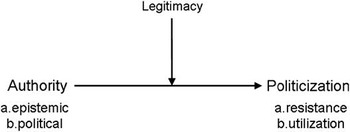
In this contribution, we explore the drivers of politicization. Our theoretical argument builds on the concept of international authority and integrates three alternative accounts of the politicization of international institutions, that is, the national backlash perspective, the resistance to neoliberal dominance perspective, and the capacity perspective. We argue that all of these competing explanations presuppose the existence and recognition of international authority, but that none of them conceptualizes it sufficiently. Accordingly, politicization of international institutions occurs to the extent that those institutions exercise or are expected to exercise political authority. To the extent that international authority cannot build on sufficient stocks of legitimacy, politicization will come primarily in the form of resistance. If international authority is sufficiently legitimated, politicization will come primarily in the form of increased utilization of international institutions.
In developing these arguments, we proceed in four steps. First, we define politicization and show a general trend toward the increasing politicization of international institutions. Second, we discuss different explanations of politicization and develop our own account. Third, we illustrate our theoretical argument. We provide initial evidence showing that international institutions exercise authority across a wide range of governance functions and that, as a general trend, this authority seems most likely to become the target of politicization. Fourth, we explore promising avenues for future research by developing conjectures that further elaborate the authority–politicization nexus.
Politicization of international institutions
Politicization in general terms means the demand for, or the act of, transporting an issue into the field of politics, making previously unpolitical matters political (Schmidt Reference Schmidt2004). The core of the political sphere is characterized by public communication about and contestation over collectively binding decisions concerning the common good.Footnote 1 Conversely, collectively binding decisions made in a technocratic mode behind closed doors are depoliticized. Therefore, political decisions (in the sense of the term as collectively binding regulations) become politicized when they are drawn into the public light. Alternatively (Hay Reference Hay2007, 79), one can speak of politicization ‘a’ when matters are moved from the realm of necessity or the private sphere to the public sphere, and of politicization ‘b’ when matters are moved from the public sphere to the governmental sphere. We focus on politicization ‘a’ in this piece. In brief, then, politicization means making collectively binding decisions a matter or an object of public discussion.
The politicization of international institutions thus involves a ‘widening of the audience or clientele interested and active’ (Schmitter Reference Schmitter1969, 166) in their policies and procedures. We speak of politicization, then, to the extent that two operational criteria are met: first, widespread societal awareness of international institutions, including the formation of diverging demands and the expression of various concerns regarding these institutions; second, the public mobilization of these demands and concerns, that is, the contestation of international institutional policies or procedures by actors, in virtue of competing preferences uttered in the public realm.
The politicization of international institutions may refer to existing as well as to projected international institutions and their policies. While we focus our discussion by and large on the politicization of established institutions, the politicization of international institutions often entails an anticipatory element. The International Criminal Court (ICC), for instance, was widely discussed in the US media as was the Maastricht Treaty long before either institution came into being. Typically, then, actors put pressure on governments during negotiations over new institutions, in order to influence or shape their future design, mandate, or jurisdiction. In this sense, existing institutions as well as international institutions under negotiation can be politicized.
The politicization of foreign policy has a long history. The public debates preceding each of the two World Wars, the Vietnam War, and the German Ostpolitik are all cases in point: these are instances in which foreign policy strategy and decisions gravitated to the center of political debate. What we consider as a relatively new development, however, is the politicization of international institutions. Although historians have pointed out that the League of Nations already faced the ‘glare of publicity and pressure of mobilized publics’ (Pedersen Reference Pedersen2007, 1110) and that this had a decisive impact on internal negotiations and external operations, such politicization was driven by only a few individuals and voluntary organizations seeking to push specific issues on the League's agenda. Similarly, the anti-apartheid and Third World movements in the 1970s can be considered predecessors to current developments; but, again, the broad politicization of international institutional policies and procedures was largely lacking at that time. We contend that a process is underway through which widening arrays of actors, like individual citizens, NGOs, parties, lobby groups, and governments, are (re)oriented toward international institutions; this implies far-reaching politicization of governance beyond the nation state. We currently observe substantial public awareness of international institutions and public mobilization of competing political preferences vis-à-vis institutional policies or procedures. Although we admit that more systematic research is needed, this and subsequent sections provide some evidence for a substantial and presumably growing politicization of international institutions.
Public awareness and interest formation
In terms of our first operational criterion – widespread societal awareness of international institutions including the formation of diverging demands and concerns regarding these institutions – data on individual attitudes at country level and cross-country comparison support our claim that major international institutions are politicized substantially.
Single-country evidence from Germany (we do not know of similar data for other countries) indicates that German citizens are strongly aware of international institutions. Data presented by Mau (Reference Mau2007, 190) suggests that about 55 percent of the German population assigns key importance to international institutions for managing globalized political problems while only 11 percent do so to the German federal government. Similar results presented by Ecker-Ehrhardt (Reference Ecker-Ehrhardt2011) show that the wider German citizens perceive the geographical scope of problems to be, the more they expect international institutions to be able to solve them. According to the same data, between 56 and 73 percent of the German population consider major international organizations like the EU, the World Bank, the IMF, the World Trade Organization (WTO), the G8, and the United Nations (UN) to be very influential on what happens in the world, compared with only 40 percent who see a similarly strong influence by the German federal government (Ecker-Ehrhardt and Weßels forthcoming). In other words, German citizens not only believe that solving globalization-induced problems by international institutions is desirable, they also credit these institutions with having substantial influence in world politics.
While we lack similar data for other countries, various global surveys suggest that single-country evidence might tap into a substantial global awareness of international institutions.Footnote 2 Several studies using data from the World Value Survey have shown that the attitudes of a majority of the world's population toward the UN are measurable and consistently structured (Norris Reference Norris2000; Furia Reference Furia2005). The most recent data gathered by Gallup in 126 countries – representative for about 95 percent of the world's population – suggests that about two-thirds of the survey respondents (Gravelle Reference Gravelle2011, 8) hold measurable attitudes. Thus we have at least some indication for global awareness of one core institution of global governance, the UN.
Regarding contestation – that is, the forming of diverging demands and concerns – evidence from Germany again suggests that its citizens have formed conflicting attitudes to major international institutions (Ecker-Ehrhardt and Weßels forthcoming). There is also strong empirical evidence for a causal link between the perceived influence of international institutions by the German public and its increased criticism of the non-transparency, exclusiveness, and selectiveness of these institutions, coupled with a propensity to protest actively against them. Even though various global surveys have shown that a majority of the world population has a positive attitude toward the UN (Furia Reference Furia2005; Kohut et al. Reference Kohut, Wike, Carriere-Kretschmer, Holzwart and Poushter2009), all of these studies also consistently point to a significant amount of negative evaluation. For example Gallup results suggest, that about 28 percent of those who hold any attitude at all toward the UN disapprove of its leadership (Gravelle and Ray Reference Gravelle and Ray2011). This polarization provides strong evidence for there being widespread politicization in terms of conflicting preferences.
In general, then, survey evidence on politicization is unsatisfactory in many ways, including a lamentable lack of comparative data of a truly global scope that allow in-depth analysis of attitudes toward a representative set of international institutions over time. However, given what we do have, the evidence strongly supports our main conjecture that at least the most prominent international institutions have established themselves as important addressees for demands and that they are under critical scrutiny by broad sections of the population. This can be taken as an initial indication of the politicization of international institutions.
Public mobilization of demands and concerns
Public awareness and the formation of popular demands and concerns are used by many groups to contest international institutions – that is, their policies and procedures – in the public realm. What first comes to mind are the activities of the anti-globalization movement – a hybrid mix of local action groups, trade unions, political parties, church groups, and NGOs. Their particularly effective mode of expression is transnational protest such as those events that have taken place on the fringes of major government conferences. The growth of these and similar protest events has been impressive. Whereas in the early 1990s fewer than five occurred per year, by 2005 the number had risen to about 25 (Pianta and Zola Reference Pianta and Zola2005). Attendance per event, however, has not shown a similarly linear development. The estimated number of participants at World Social Forums, for example, varied from 20,000 in Porto Alegre in January 2001 to 155,000 in the same city in January 2005. Some 115,000 people attended the summit in Belém in January 2009 (Rucht forthcoming). There have been similar fluctuations in the number of protesters during G8 summits from Birmingham (1998) to Heiligendamm (2007; cf. Gronau et al. Reference Gronau, Nonhoff, Schneider and Nullmeier2009, 124).
But the politicization of international institutions cannot be reduced to the criticism of globalization. Also included must be the activities of NGOs in the environmental, human rights, and development policy fields, who confront changes in international governance with a mixture of information campaigns, direct persuasion, and media exposure. The success of NGOs as ‘norm entrepreneurs’ (cf. Finnemore and Sikkink Reference Finnemore and Sikkink1998; Liese Reference Liese2006) lies not least in the politicization of the object of decision making, arousing broad public interest in the demands addressed to institutions. Examples are the security policy campaigns against the production and spread of landmines or small arms, or for the establishment of an ICC. Some campaigns in the human rights and environmental fields have also sought to generate public pressure against national and international institutions. The total number of transnational NGOs, which has risen dramatically over the past decades (from about 1000 in 1995 to more than 3500 today), indicates a significant growth in such activities, even though many of these organizations are concerned with implementation and monitoring.Footnote 3
Also indicative for the politicization of international institutions is the increased presence of, and activities by, traditional interest groups and associations. The growing numbers of representatives from such organizations in governance centers beyond the nation state, like Brussels, Geneva, or New York, can be taken as evidence for the stronger orientation of these groups toward international institutions. Data presented by Weßels (Reference Weßels2004) and Tallberg et al. (Reference Tallberg, Beach, Naurin and Tiilikainen2011) suggests that the number of interest organizations active on the European level has grown steadily over recent decades (see also Aspinwall Reference Aspinwall1998). Case study evidence from a variety of OECD countries also indicates that Western pressure groups react to a variety of denationalized problems by directing their attention increasingly to international institutions (Zürn and Walter Reference Zürn and Walter2005; Nölke forthcoming).
Several Studies (e.g. Kriesi et al. Reference Kriesi, Grande, Lachat, Dolezal, Bornschier and Frey2008) show that national parties, too, contribute to the politicization of international institutions. The handling of international affairs has come to shape the structure of party landscapes in Western European democracies (e.g. Marks and Steenbergen Reference Marks and Steenbergen2004; Hooghe and Marks Reference Hooghe and Marks2008). The conflict between those in favor of ‘integration’ (i.e. the opening of national societies, economies, and politics to global contexts), and those who seek ‘demarcation’ (i.e. the national isolation in immigration and trade matters or political integration issues) has become a crucial aspect of party politics (Kriesi et al. Reference Kriesi, Grande, Lachat, Dolezal, Bornschier and Frey2008). Right-wing populist parties have proved to be the most vehement defenders of national identity against incursions by international institutions, the challenges of globalization, and cosmopolitan thinking; but they share this position with others. The politicization of originally international affairs thus finds expression in the party systems of Western European democracies and even beyond (Ecker-Ehrhardt Reference Ecker-Ehrhardt2010a).
Even governments contest international institutions in the public realm. Regarding European integration, for instance, governments regularly seek to shift the blame for inaction or bad policy to the supranational level, while claiming the policy successes for themselves (Gerhards, Roose, and Offerhaus forthcoming). We increasingly observe that Third World countries ally themselves with societal critics of international institutional policies and procedures. The world trade regime is a prominent example of such an attempt to foster popular politicization: governments of the global South have publicly contested this regime since the 1960s (Hudec Reference Hudec1987; Stiglitz and Charlton Reference Stiglitz and Charlton.2005).Footnote 4 At the 2003 Ministerial Conference of the WTO in Cancún, governments of the developing countries formed a coalition, the G20 on agriculture, and they successfully campaigned in public against further liberalization of international trade in the absence of improved access to agricultural markets in developed countries (Narlikar Reference Narlikar2006). Likewise, governmental actors are vocal critics of the UN Security Council. The end of the Security Council's Cold War paralysis and its subsequent increased interventionism have raised questions about its legitimacy. In UN General Assembly debates, states publicly point to the lack of participatory and transparent procedures, the unfairness of the Permanent Members’ veto power, and the Council's insufficient performance (Binder and Heupel Reference Binder and Heupel2011).
In sum, the extent of politicization of international institutions is considerable; its growth is apparent in both individual attitudes and public mobilization. In effect, we are witnessing a new level of public contestation of international institutions. Although political debate over the mandates of, and decisions by, international institutions is not omnipresent, it is becoming increasingly broad. Politicizers range from local action groups and a multiplicity of civil society organizations, companies, and associations to parties and governments; they politicize in the media (cf. Statham Reference Statham2010) and in the streets (cf. Imig Reference Imig2002).
Why are international institutions politicized?
Thus far, we have presented empirical evidence that suggests a broad trend toward the politicization of existing and projected international institutions. But what accounts for this general development that has taken place in recent decades? In this section, we identify the drivers of this politicization. We first consider existing alternative accounts for it and then we develop our own explanation and argument.
The state of current theorizing
Politicization of international institutions is not an established concept. Therefore, there is not a fixed set of competing theories to explain it. Nevertheless, there are different accounts that focus on social processes that are similar to or constitute some part of what we have conceptualized as politicization. These accounts offer different explanations for this phenomenon (see also Rixen and Zangl Reference Rixen and Zangl.2010; Schmidtke Reference Schmidtke2011). First, national backlash emphasizes identity and national opportunity structures; second, resistance to neoliberal dominance points to neoliberalism and injustice as core explanations; and, third, capacity refers to the diffusion of instrumental knowledge and values akin to the Western model, and stresses international opportunity structures as well.
The national backlash view points to resistance to international institutions and the creation of a new societal cleavage between cosmopolitism and anti-cosmopolitism, which is seen to be triggered by increased migration, the weakening of the welfare state, and limits to self-determination (e.g. Kriesi et al. Reference Kriesi, Grande, Lachat, Dolezal, Bornschier and Frey2008). This perspective focuses mainly on the social costs of growing economic and cultural interdependence for at least some groups in established welfare states, and their resort to borders as means of protection (Zürn Reference Zürn1998, chap. 9). Globalization, it is argued, has had far-reaching repercussions for mass politics by producing conflicts between the ‘winners’ and the ‘losers’ on a highly competitive world market, resulting from intensified exchange relations between societies. Even though strong welfare institutions may have eased tensions to some extent, national backlash is assumed to be the driving force behind this process (Burgoon Reference Burgoon2009). Accordingly, growing insecurities lead to negative attitudes toward globalization and a shift to protectionism (Scheve and Slaughter Reference Scheve and Slaughter2004; Mayda and Rodrik Reference Mayda and Rodrik.2005). And scholars of domestic politics now converge on Rogowski's (Reference Rogowski1989) seminal claim that economic interdependence has had a significant impact on the structure of domestic conflicts.
Negative attitudes toward international institutions are seen to be part and parcel of a more complex syndrome of exclusive nationalist backlash, which includes economic protectionism, xenophobic reactions to immigrants, and a strong aversion to international institutions. Evidence presented by Burgoon (Reference Burgoon2009) support the notion that higher rates of migration have a significant impact on preferences for what he calls ‘nationalist autarky’. Kriesi et al. (Reference Kriesi, Grande, Lachat, Dolezal, Bornschier and Frey2008) explain in much the same way the reconfiguration of European domestic cleavage structures by using a three-dimensional concept, in which economic and cultural demarcation go together with a rejection of European institutions. The rise of right-wing populism in most European party systems is the most visible expression of this development. The growing unwillingness of national parliaments and the general public to subscribe to limitations to national sovereignty and thus to the circumvention of national political processes is another indicator (Hooghe and Marks Reference Hooghe and Marks2008).
National backlash is an only partial expression of what we describe as politicization, but it is an important one. By stressing the negative repercussions of globalization, national backlash could explain a considerable part of politicization. However, what this perspective overlooks is the extent to which international institutions are accepted as necessary and desirable, as reflected in the attitudes of, and practices by, broad and growing segments of the European population. National backlash as an explanation cannot account for the fact that there is growing resistance to, but increasing support for and political use of international institutions; and this view ignores transnational-level mobilization for and against international institutions.
A second important argument emphasizes rising resistance to neoliberal policies and Western dominance in international institutions (Armstrong, Farrell, and Maiguashca Reference Armstrong, Farrell and Maiguashca2003). Like national backlash, this view also focuses on the neoliberal content of many international institutional policies. Unlike national backlash, however, the anti-neoliberalism argument concentrates on a different set of actors, namely, the so-called anti-globalist protesters who respond to a perceived imposition of policies whose distributional effects are highly unequal and favor a new transnational capitalist class (della Porta Reference della Porta2007). At the same time, as growing resistance to Western dominance in international institutions emerges, it becomes particularly visible in the case of some of the rising powers (Zürn and Stephen Reference Zürn and Stephen2010). Broadly speaking, the Global Justice Movement and the Rising Powers are the most prominent actors politicizing international institutions, and they represent quite a different political camp than do their right-wing extremist counterparts in Europe. Unlike nationalistic right-wingers, proponents of anti-neoliberalism/anti-Western dominance propose global re-regulation of neoliberal capitalism and more equitable global representation to eliminate Western hegemony (Rajagopal Reference Rajagopal2003).
By stressing neoliberalism and injustice as drivers of anti-globalization protests, the anti-Western dominance view also accounts for a considerable part of what we describe as politicization. But this explanation, too, has serious shortcomings. It overlooks the fact that, at the same time, there is broad recognition of international institutions and that there has been successful use of international authority on the side of emancipatory forces in issue areas like the environment and human rights. Sometimes these efforts have even pushed through international regulation against some Western interests. We argue, however, that resistance to international institutions and utilization of them are two sides of the same coin. The new cleavages produced by international institutions often run counter to more simplified depictions like ‘the West versus the so-called Third World’ or ‘the transnational capitalist class versus the rest’.
A third perspective points to a dramatic change of cognitive, cultural, and technological conditions as an explanation for politicization. This capacities perspective adds a more modernization-theoretical aspect to our understanding of politicization. Thus, international institutions encounter changing cognitive capacity and normative sensitivity for defining various facets of globalization as problematic or as global political issues. Most notable among the proponents of this view is James Rosenau who emphasized an ongoing ‘skill revolution’, which he plausibly expects to expand ‘people's horizons on a global scale’ (Rosenau Reference Rosenau2003, 52, 232 ff) in terms of cognitive capacities to understand global complexities. Similarly, Hainmueller and Hiscox (Reference Hainmueller and Hiscox2006) have argued that higher-level education in most OECD countries implies an exposure to intellectual discourses, which may add to such skills by constructing the social realm as a globalized and complex entity. In any case, empirical research has demonstrated that more educated individuals tend to identify more transnationally (Jung Reference Jung2008) and to expect more from international institutions in terms of solving important problems (Mau Reference Mau2007), although differences between the more and the less educated have been shown to be surprisingly small (Furia Reference Furia2005; Ecker-Ehrhardt Reference Ecker-Ehrhardt2011).
While the skill revolution has presumably fostered the emergence of ‘transpatriates’ (Koehn and Rosenau Reference Koehn and Rosenau2002), modern communication technologies have dramatically changed the possibility to sustain activist networks (Rucht Reference Rucht2004). Moreover, the transnationalization of media systems has created new opportunities to mobilize societal demands directed to the international level of politics (Wessler et al. Reference Wessler, Peters, Brüggemann, Kleinen-von Königslöw and Sifft2008).
Such cognitive mobilization involves the diffusion of ways of thinking in society, that is, substantive orientations toward certain attitudinal patterns and world-order models. In terms of broader analytical understanding, these substantive orientations are important in a world that is increasingly seen as a largely integrated universe of action where all observations and information are organized accordingly. These substantive orientations are grounded in normative ideas – more precisely, in universalistic notions of humanity with mutual rights and responsibilities (Lu Reference Lu2000). Consider, for instance, the campaigns conducted by human rights activists. Thus, the rise of global activism has been attributed convincingly in part to the growing cultural and technological capacity to organize a transnational civil society and to mediate and synchronize heterogeneous demands and expectations across borders, supported the political opportunity structure provided by international institutions (Tarrow Reference Tarrow2005).
Again, the capacity perspective provides only a partial account for politicization. It overlooks the fact that not just civil society, but also traditional interest groups ‘go global’, both targeting the same political actors but often with different political goals. The role of national resistance to international institutions falls outside of the scope of this explanation. Not only do more people demand more international regulation; at the same time, more people reject international institutions.
In sum, by pointing to national backlash, anti-globalization protests, and transnational mobilization, the three perspectives presented above grasp important parts of what we call politicization, but each offers a different explanation. Importantly, these accounts fail to consider the underlying premise common to all three perspectives, namely, that international authority exists. This implicit assumption needs to be explicitly conceptualized in order to devise a single explanation that incorporates the insights of all three perspectives.
An authority-based explanation
We argue that international institutions that exercise or are expected to exercise international authority are politicized. Moreover, we claim that the intensity and type of politicization depends on the legitimacy of the affected international institutions. In making this argument, we point to an intimate link between authority and legitimacy; we see them as two interrelated concepts, but not as two sides of the same coin, as the folk definition in IR would have it. In Ruggie's words, for instance, authority ‘represents the fusion of power with legitimate purpose’ (Ruggie Reference Ruggie1982, 382). Hurd (Reference Hurd2007, 60–61) even argues that an institution has authority when an actor ‘perceives the institution to be legitimate’. The problem with these accounts is that they invariably tend to equate authority with legitimacy, making both notions indistinguishable – indeed Hurd argues that ‘the phrase ‘legitimate authority’ is redundant’ (Hurd Reference Hurd2007, 61, footnote 116). If an international institution has authority, it is said, either it must be legitimate, or it is not an authority.
The argument that increased authority produces politicization and thus the likelihood of resistance would be nonsensical if we follow the folk definition according to which more authority means more legitimacy. Therefore, we do not think that the folk definition is useful when we attempt to account for the relationship between authority, on the one hand, and awareness, mobilization, and contestation on the other. The folk definition implies two statements that are counterintuitive; so we consider some re-conceptualization as necessary. The first counterintuitive implication of the folk theorem, is that the more authority an institution has the more legitimate it must be. If, for instance, the European Central Bank is assigned the competence to reject national budgets in addition to setting interest rates, it certainly has more authority; but would that mean that Bank activities are seen as more legitimate by all relevant actors? Probably not, so there is no need to believe that a widened or deepened assignment of recognized competences is the same as the legitimate exercise of these competences. Another implication of the folk definition – that there is no illegitimate authority – is troubling for both normative and conceptual reasons.
Our conceptual distinction between authority and legitimacy rests on the notion that legitimate authority ideally implies two layers of recognition. The first layer is the recognition that an authority is considered per se functionally necessary in order to achieve certain common goods. Therefore, an authority is granted the competence to make certain decisions and judgments, that is, institutions have authority when the addressees of their policies recognize that these institutions can make competent judgments and binding decisions.Footnote 5 This is different from the second layer of recognition referring to legitimacy, which is the acknowledgement of the rightful exercise of authority in the context of a given stock of normative beliefs in a community. According to this view, political authority and rule are legitimate when the norms, rules, and judgments produced are based on shared beliefs about the common good and procedural fairness. To put it differently, ‘a given power relationship is not legitimate because people believe in its legitimacy, but because it can be justified in terms of their beliefs’ (Beetham Reference Beetham1991, 11). Different sources of legitimacy such as transparency, accountability, expertise, participation, etc. are therefore available.
The first layer, that is, authority, already implies an element of recognition, which may be contested. A significant element of nationalist resistance to European institutions, for example, is directed against this first layer of recognition. Generally, however, the degree of recognition is usually higher for the first layer than for the second. While many people in the world do not consider the exercise of authority and rule of their state as legitimate, only anarchists would deny the functionality of the state for a consolidated political community and challenge it as such. This implies that the state, while considered necessary in principle (layer 1), may nevertheless be perceived as illegitimate with respect to the way it exercises its authority (layer 2). In this sense, authority (recognition of layer 1) can exist independently of legitimacy (recognition of layer 2).Footnote 6 However, an authority is unlikely to persist if its decision-making procedures and decisions are seen to be regularly and permanently unrightful. But the recognition of a political authority can endure for some time, even when actors do not see their normative demands for the rightful exercise of authority fully realized. As Haas (Reference Haas1990, 87) pointed out, ‘authority is different from legitimacy. States may grudgingly meet the organization's expectations without at the same time appreciating or valuing them’.Footnote 7
The theoretical separation of authority and legitimacy also makes it easier to conceptualize different distributions of recognition. It is probably safe to assume that absolute consensus by a community of actors vis-à-vis recognition of an authority's legitimacy is highly unlikely, and that such recognition, if it can be observed at all, would happen only very rarely. We are typically left with situations in which the conduct of an authority is seen as legitimate by some and rejected by others at the same time to varying degrees. Even in cases in which the principal recognition of the need for an authority is more or less uncontested, the exercise of authority can be seen by some as unrightful – in other words, the recognition of authority-exercising institutions can vary with respect to both layers.Footnote 8
When the recognition refers only to layer 1 but not to layer 2, one would speak of a legitimacy deficit – something that could not happen if authority were tied directly to legitimacy. When even layer 1 recognition is strongly contested, we would speak of an authority crisis. In short, then, we suggest decoupling (at least partially) these concepts and we argue that an authority may be legitimate to varying degrees. The recognition of the authority of an international institution can thus persist for some time, even when its legitimation is weak. We expect that the degree of legitimacy of an authority affects the level and type of politicization.
What then is the meaning of authority given this distinction and what types of authority can be distinguished? Authority is a central though contested concept both in political philosophy and in empirical social science (Friedman Reference Friedman1990, 56). It has been defined in many ways (Day Reference Day1963; Weber Reference Weber1968; Flathman Reference Flathman1980), often as a hierarchical relationship between a superior and a subordinate. The concept has received increased attention in more recent IR literature (e.g. Cutler, Haufler, and Porter Reference Cutler, Haufler and Porter1999; Hurd Reference Hurd1999; Biersteker and Hall Reference Biersteker and Hall2002; Rittberger and Nettesheim Reference Rittberger and Nettesheim2008). According to Lake (Reference Lake2003, 304; Lake Reference Lake2010), for example, authority is ‘characterized by commands issued by one actor that are expected to be obeyed by a second’. Such accounts contain a significant shift away from traditional IR theory, because they consider hierarchy as a relevant component of international relations and thus go beyond the anarchy paradigm. We share this perspective.
Following a more sociological understanding of the concept (e.g. Parsons and Shils Reference Parsons and Shils1951; Blau Reference Blau1963; Habermas Reference Habermas1981), we define authority broader than just commands expected to be obeyed. According to the seminal treatment by Raz (Reference Raz1990, 2), having authority can mean having permission to do something as well as having the right to grant such permission. But it also signifies an expertise that is considered trustworthy. All of these types of authority can be exercised by international institutions (see e.g. Barnett and Finnemore Reference Barnett and Finnemore2004) and they are therefore relevant for our discussion. A peace-building mission may be authorized to imprison people who carry weapons and the UN Security Council has the right to authorize such a mission. At the same time, expertise provided by the OECD, for instance, in the area of education, is considered as authoritative as well. In this case, authority is based on special knowledge; in other instances it is moral standing that gives international institutions an authoritative quality, as in the case of the United Nations Children's Fund or the UN Secretary General (Ecker-Ehrhardt Reference Ecker-Ehrhardt2010b). Many international institutions (as well as NGOs) therefore exercise authority in the international realm in a way that goes beyond commands.
All of these instances of authority have something in common: those who recognize authority defer their own judgment or choice without being necessarily forced or persuaded to do so. It is not the appeal of what is substantively argued or the force behind a command, but the recognition of the one making the argument or giving the command as a trusted source of orientation, which produces adherence. Authority is an important source of power but one that is marked by ‘unquestioning recognition by those who are asked to obey; neither coercion nor persuasion is needed’ (Arendt Reference Arendt1970, 45). Such deference to authority without being forced or persuaded does not necessarily imply mindlessly surrendering judgment and blindly following orders. What is suspended when deferring to an authority is a careful elaboration or test of the claims made by that authority.
Defining authority broadly as deference of one's own judgment and choice to a recognized authority without being necessarily forced or persuaded to do so, means that it is necessary to distinguish between at least two types of authority (Friedman Reference Friedman1990), for they are based on different logics of legitimation. We want to label the first type epistemic authority. Epistemic authority is based on having special knowledge or moral expertise. It implies that the views expressed by an individual or an institution are recognized as trustworthy (an authority). Epistemic authority rests on the assumption that knowledge and expertise are unequally distributed, but that there is a common epistemological framework that allows us to judge this inequality. An epistemic authority does not need to persuade people in all instances. It is not the quality of the argument, but the quality or reputation of the person or institution, which is decisive.
In terms of legitimation, epistemic authority is not very demanding. In modern times, epistemic authorities always compete with one another. The subjects who defer to epistemic communities are essentially free to decide whom they consider an authority, that is, whom to believe. In the case of pure epistemic authority, layers 1 and 2 collapse and, in this case, authority and legitimacy would go hand in hand. This changes to some extent if epistemic authority interacts closely with political authority, that is, when an international institution is assigned the task of authoritative interpretation of facts and norms. In this sense, for example, Greenpeace's emergent authority in environmental matters requires much less legitimation than, say, the politically assigned authority of the Intergovernmental Panel on Climate Change (IPCC).Footnote 9
This leads us to our second type of authority, namely, political authority. In this case, prescriptions, rules, and orders are recognized as collectively binding. Political authority is usually exercised by individuals who act in the name of an institution (in authority). Political authority rests on the assumption that someone should be entitled to make authoritative decisions in order to advance the common good and to avoid chaos. Political authorities are not bound to the Pareto criterion. They are entitled to make decisions, which may go against the (short-term) interest(s) of some community members. Political authority therefore depends on a common normative framework that provides a shared understanding of what the common good really is. A political authority may have both persuasive and coercive powers, but its power extends beyond the use of coercion and the need to be convincing in every instance.
Regarding the relationship between force and political authority, one may distinguish between two subtypes of political authority based on levels of recognition. The fact that x obeys y at the first level means that x accepts y's right to make collectively binding decisions. This is first level political authority. On the second level, x even accepts the right of y to enforce collectively binding decisions if they are not complied with. This difference mirrors the distinction between a state's jurisdiction to prescribe rules and its jurisdiction to enforce them, as used in international law. International institutions exercise almost exclusively level-1 political authority – the United Nations Security Council is the major exception. In most of the other cases, there may be pressure to comply with the demands of the political authority (horizontal sanctioning, shaming, fines), but no real enforcement. In other words, international institutions often exercise authority, but mainly the soft version of it.
Since political authority implies the right to make collectively binding decisions, the legitimation of the exercise of this authority is much more demanding than in the case of epistemic authority. This is even more so the case if political authority includes recognition by the subjects of the power to enforce these decisions. In both cases, political authority is embedded in beliefs about how institutions exercising political authority must behave in order to advance the common good without compromising the freedom of the subjects unnecessarily. In return, subjects recognize in principle or in practice the right of the political authority to make decisions, even when these decisions are sometimes inconvenient or uncomfortable.
To sum up this conceptual discussion and return to the international level, an international institution has authority when the direct and indirect addressees recognize in principal or in practice that that institution can make competent judgments and binding decisions (see also Cooper et al. Reference Cooper, Hawkins, Jacoby and Nielson2008, 505). Authority beyond the nation state does not necessarily require autonomous international organizations. International institutions to which member states delegate autonomous decision-making power (e.g. the ICC), and international institutions without such formal delegation of power (e.g. the Council of the EU) can both possess authority in the defined sense.Footnote 10 If an executive agreement or practice gives a majority of states the right to act in the name of common norms, we consider this as international authority as well.Footnote 11
Most importantly, we insist that the legitimacy of international authority can vary in terms of degree and in terms of the necessary legitimating sources. Different types of authority require different forms of legitimation. Accordingly, political authority in general is more challenging than epistemic authority. More specifically, political authority that includes the right to enforce binding decisions is the most demanding (rule) and epistemic authority that is not politically delegated is the least demanding (credibility). Legitimacy-deficient international authorities can be expected to encounter high levels of resistance; legitimate international authorities, on the other hand, can be expected primarily to be used to achieve certain policy goals. We illustrate some of these hypotheses in the following section, before we articulate in more detail several propositions that link the occurrence of politicization to different types of authority and their legitimacy in the concluding part of this article.
Evidence in support of the authority-based explanation
In this section, we provide some initial empirical evidence to illustrate our argument. Recent studies in the fields of public communication and social movements indeed point to a systematic link between the rise of political authority beyond the nation state and increased societal attention given to this authority as well as increased resistance to it. Statham (Reference Statham2010, 295) summarizes the results of a study about the making of a European public sphere as follows: ‘We find that the more decision-making power shifts to the European level for a policy field, or over time, the more attention for and criticism of the European Union rise’. Sidney Tarrow explains the new transnationalism – that is ‘the outpouring of contention across borders in the past decade’ (Tarrow Reference Tarrow2005, 7) – similarly, as a consequence of internationalism that he terms ‘a dense, triangular structure of relations among states, nonstate actors, and international institutions’ (2005, 27). Nullmeier et al. (Reference Nullmeier, Bigeon, Nonhoff, Schmidtke and Schneider2010) have shown that international institutions like the EU or the UN are regular targets of legitimacy demands and evaluations.
While the results of these studies are fully compatible with our explanation, we go beyond them by specifying the regulatory functions and the kind of authority involved, and by showing that the shift is not only a result of changed opportunity structures, but also due to changes in expectations about legitimacy and the appropriate level of governance. We first show that international institutions exercise authority to a significant degree. They do so across a wide range of governance functions including rule formulation and decision making (Section 4.1), monitoring and verification of rule implementation (Section 4.2), interpretation of rules (Section 4.3), rule enforcement in the case of non-compliance (Section 4.4), and direct implementation by international agencies (Section 4.5).Footnote 12 In this sense, international institutions exercise authority in that they successfully claim the right to perform these functions and in that member states recognize – at least to some extent – the right of international institutions to do so. We then go on to provide some preliminary evidence that this shift has prompted politicization in terms of enhanced societal awareness as well as political mobilization. We therefore discuss both paths to politicization that our hypotheses identify: the rise of transnational political utilization of international institutions in order to achieve specific policy goals and the general questioning of international institutions’ authority in terms of legitimacy. We put stronger emphasis on the latter phenomenon, because we assume the former to be less contested.
Rule setting and majority decision making
International institutions that set rules via majority decision-making exercise political authority. Depending on the degree of legitimacy that an international institution has, one may expect it to be either utilized extensively or highly resisted if its legitimacy is contested. Majority decision making increases the ability of international institutions to act by nullifying the vetoes of individual states and overcoming blockades. Majority decision making is not a practice limited to just a handful of well-known organizations like the EU, the UN Security Council and General Assembly, or the World Bank. Today, roughly two-thirds of all international organizations with at least one participating great power have the possibility to decide by majority (see Blake and Payton Reference Blake and Payton2008). Even if decision by majority is actually used far less often than it is formally available (Breitmeier, Young, and Zürn Reference Breitmeier, Young and Zürn2006, 125), its availability nevertheless exerts pressure on veto players, increasing their readiness to seek compromise. The result of majority voting, therefore, is that the probability increases that individual states will implement measures, even when doing so runs counter to those states’ original will or intent.
To the extent that the authority of international institutions rests on majoritarian decision making, the transparency and fairness of the decision-making process become prime concerns of societal actors and minority states. Since the expansion of qualified majority voting in the European Council of Ministers, for instance, societal criticism has targeted the confidentiality of preparatory papers and proceedings as well as the opacity and disproportionate access of lobbying groups to Council negotiations (e.g. Ucarer Reference Ucarer2009). The European Transparency Initiative was launched explicitly to tackle such legitimacy concerns, although the Council has proven to be more reluctant to respond than others (the European Commission, for example).
Information disclosure has also been a priority of transnational advocacy addressing the World Bank. Receiving states, NGOs, and parts of the Global Justice Movement (della Porta and Tarrow Reference della Porta and Tarrow2005) justify their demands not only by alluding to the enormous impact of the World Bank's projects and policies on local communities, but also by drawing attention to voting power inequalities between members and pointing to the Bank's substantial leverage over loan recipients – in particular, those of Multilateral Development Bank loans (Nelson Reference Nelson2009). Past and current criticism of international authority goes well beyond issues of lacking transparency; however, it repeatedly insists upon fairness in terms of equal inclusion in the negotiation process of those affected by the decisions of such an authority. The lack of representativity on the United Nations’ Security Council, which is further intensified by the veto power of the permanent members, is particularly blatant and has been condemned by societal actors and governments (Binder forthcoming). The exclusion of entire regions from the crucial processes of preliminary and parallel negotiations in the WTO's Green Room has also triggered frequent calls for more representative decision procedures (cf. O'Brian et al. Reference O'Brian, Goetz, Scholte and Williams2000; Krajewski Reference Krajewski2002).
Monitoring and verification
Monitoring and verification often involve epistemic authorities. We expect that such institutions will be less politicized than rule-setting institutions. Therefore, it can come as no surprise that monitoring and verification as well as the related possibility of discovering instances of non-compliance with rules are increasingly carried out by agencies that are not directly under the control of states. In general, the need for monitoring is greater if international norms no longer just apply to the borders between countries but, instead, begin to regulate activities within the boundaries of sovereign territories. Whenever such behind-the-border (Kahler Reference Kahler1995) issues are at stake, mutual observation by the states party to an agreement is often not sufficient to guarantee compliance. Thus, the need for independent actors who process and make available information on treaty compliance is growing steadily. Such information is increasingly provided by the international secretariats of treaty systems (Siebenhüner and Biermann Reference Siebenhüner and Biermann2009) and autonomous organizations such as the World Health Organization (WHO) or the International Atomic Energy Agency (IAEA), to name just two prominent examples (Dai Reference Dai2007, 50–53). These are cases of politically delegated epistemic authority. NGOs may also function, more or less informally, as monitoring agencies. Amnesty International and Human Rights Watch, for instance, are important actors for monitoring compliance with human rights standards. In general, Jonas Tallberg and colleagues have shown that, since the 1980s, the access of NGOs to international policy processes has increased significantly (Tallberg, Sommerer, and Squatrito Reference Tallberg, Sommerer and Squatrito2011).
But has this trend in increased monitoring led to the politicization of such agencies? A number of remarkable instances of politicization suggest that the authority to monitor and verify international rule implementation is tightly coupled to growing societal expectations that lead to public criticism whenever these expectations are not met. But the overall level of politicization has remained limited.
The IAEA is widely acknowledged for its expertise in monitoring the peaceful use of nuclear energy, not least in accordance with the Nuclear Non-Proliferation Treaty (NPT). The Nobel Prize Committee honored this organization in 2005, confirming societal expectations that the IAEA could ‘prevent nuclear energy from being used for military purposes’ and could ‘ensure that nuclear energy for peaceful purposes is used in the safest possible way’. But despite its sterling reputation, the IAEA has been criticized repeatedly. In 2006, after worldwide public attention was drawn to several reports on the health impacts and environmental consequences of the Chernobyl accident in 1986, a campaign led by Greenpeace and several anti-nuclear NGOs attacked the IAEA for ‘whitewashing the impacts of the most serious nuclear accident in human history’ (Greenpeace International 2006), and called for more effective monitoring. In the aftermath of the earthquake and tsunami that struck Japan in March 2011, culminating in the disastrous Fukushima nuclear accident, the IAEA has once again come under fire for downplaying the effects of that catastrophe.
Western publics recognize some UN agencies and actors, like the UN Secretary General, the UN Office of the High Commissioner of Human Rights (UNHCR), or the World Food Programme, as among the most credible sources of information on humanitarian crises. This recognition has been highly influential on how Western publics make up their minds over complex issues such as the Darfur conflict (Ecker-Ehrhardt Reference Ecker-Ehrhardt2010b). At the same time, these agencies have been criticized repeatedly for alerting the world to some crises (e.g. Somalia or Kosovo), but failing to do so with others (e.g. Rwanda or Myanmar). Similarly, the United Nations Commission on Human Rights and its successor, the Human Rights Council, have been regularly criticized for applying double standards and addressing human rights violations selectively – for example, focusing on Israel but ignoring the Palestinians (cf. Terlingen Reference Terlingen2007), or catering to great power interests by refraining from addressing human rights abuse by Russia, China, or the United States. Such instances of public criticism of international authority are necessarily selective in themselves, but they support our basic claim: namely, that widespread recognition of monitoring authority is a necessary factor for politicization because societal actors explicitly call upon this authority when they demand more effective and less selective monitoring.
Rule interpretation
Regarding rule interpretation, we find a significant increase in the number of international judicial bodies dealing with collisions between international and national law, and between conflicting international regulations. In 1960, there were only 27 quasi-judicial bodies worldwide; by 2004, this number had grown to 97. If we narrow the definition and include only those bodies that meet all of the prerequisites for formal judicial proceedings, then only five such bodies existed worldwide in 1960, their number climbing to 28 by 2004Footnote 13 (see also Alter Reference Alter2009). For example, the World Trade Organization's Dispute Settlement Body (WTO-DSB) decides in matters of controversy over the application of rules in international trade, while the ICC has jurisdiction over genocide, war crimes, and crimes against humanity. These institutions produce legally binding decisions that cannot be easily revised by their members. In this sense, they exercise a form of political authority that claims to be epistemic authority.
In line with our general argument, it can be shown that societal actors politicize judicial authority as well, and that the level of politicization is expected to lie in between that of political authorities and that of purely epistemic authorities. Even though civil society has been one of the driving forces behind the institutionalization of the ICC, and even though the legal authority of the Court has been in general positively received, the ICC has met with stern criticism vis-à-vis a number of its investigations – among them Uganda, the Central African Republic, and Namibia (e.g. Baines Reference Baines2007; Glasius Reference Glasius2008) – whereby the Court was accused of being selective by focusing on ‘the losers side’ of civil war. Civil war victims have also criticized the court harshly, maintaining that their expectations of receiving justice were disappointed by the ICC's focus on higher ranking individuals accused of war crimes, by its lack of outreach, and by the protracted pace of investigation (e.g. Clarke Reference Clarke2007). Ad hoc tribunals like the International Criminal Tribunal for the Former Yugoslavia and the International Criminal Tribunal for Rwanda have been similarly criticized (see e.g. Spoerri and Freyberg-Inan Reference Spoerri and Freyberg-Inan2008). The same holds for the WTO-DSB. Civil society actors have greatly exploited the opportunity to attend selected panel meetings or to file amicus curiae briefs with that body; this is a strong sign of public awareness and mobilization (e.g. Eckersley Reference Eckersley2007). In the meantime, however, evidence suggests that civil society actors’ inclinations to take part in WTO-DSB proceedings have subsided. This is because civil society access to the DSB proved to be less effective than these actors had initially anticipated, for having their own expertise heard during proceedings, especially toward later stages of the process involving the WTO's Appellate Body (e.g. Van den Bossche Reference Van den Bossche2008). In sum, we observe that increased authority in rule interpretation also comes with increased politicization in terms of substantial public awareness and contestation on normative grounds.
Rule enforcement vis-à-vis states
Only a few international institutions have the capacity to enforce their own decisions, thus exercising the strongest form of political authority. Nevertheless, we can observe that the practice of levying material sanctions against violators has increased. For example, jus cogens (independent and binding international law not requiring the consent of states) in the meantime reaches beyond the prohibition of wars of aggression to include inter alia the prohibition of crimes against humanity, genocide, and apartheid. In the same vein, under Chapter VII authority, the Security Council makes use of coercive measures against the will of affected governments or parties to a conflict (Philpott Reference Philpott1999, 586), including military humanitarian intervention, economic sanctions, or ‘robust’ peacekeeping operations (Binder Reference Binder2009). From 1946 to 1989 only 3.4 percent of Council resolutions were adopted under Chapter VII of the UN Charter. This number rose to roughly 38 percent between 1990 and 2008. By 2008, about 62 percent of all Security Council resolutions were adopted under Chapter VII authority (Johansson Reference Johansson2009).
But developments of this sort are not just limited to the area of security policy. For instance, the Treaty of Maastricht provides for the possibility to impose fines on states that infringe EU directives or violate regulations. Similarly, the WTO dispute settlement system provides for compensatory tariffs in cases of non-compliance. And, since a good two decades, the World Bank has increasingly employed conditional loans – that is, loans that are tied to the recipient state's fulfilling certain conditions, like carrying out specific economic or political reforms (Mosley, Harrigan, and Toye Reference Mosley, Harrigan and Toye1995).Footnote 14
There is considerable evidence that the acquisition of enforcement authority by international institutions has led to a very high level of politicization. Regarding the UN Security Council's willingness to legitimize the use of force, societal actors have repeatedly campaigned against UN non-action in cases like Myanmar or Darfur as instances of inappropriate selectivity (Binder forthcoming). The same holds for the conditionality built into the World Bank's or the IMF's structural adjustment programs, which have served as focal points for NGO campaigns and global justice activism ever since (Park Reference Park2010).
Implementation
The implementation of international regulations is frequently left to member states. Nevertheless, some institutions such as the World Bank or the WHO implement their policies directly (Abbott and Snidal Reference Abbott and Snidal1998, 12–13) and therefore exercise a strong form of political authority. Likewise, UN agencies in the field of humanitarian assistance or development aid have gained significant implementation authority. Transitional administrations that were set up after the end of the Cold War in Eastern Slavonia, Kosovo, or East Timor, for example, represent a special type of implementation authority; to establish them, UN took on far-reaching executive, legislative, and judicial powers (Caplan Reference Caplan2004). In these cases, we also would expect high levels of politicization, even though input opportunities for those directly affected by UN authorities have been relatively few.
Societal actors have indeed repeatedly contested implementing authorities, stressing legitimacy concerns as well. Consider, for example, the Sudanese refugees’ three-month-long protests at the UNHCR's Cairo office in late 2005 (Moulin and Nyers Reference Moulin and Nyers2007). Refugees not only demanded aid and official recognition of their status as refugees according to the Geneva convention, they also insisted upon inclusion in the UNHCR decisions affecting them.
In much the same way, transitional administrations have been contested by subjected citizenries forced to accede to post-conflict rule by international actors. Prime examples in the literature include Timorese frustration with United Nations Transitional Administration in East Timor, who were accused of failing to involve and integrate the local population sufficiently in the reconstruction of government structures. Similarly, local communities and international advocates alike contested United Nations Interim Administration Mission in Kosovo , pointing to questions of inclusion and accountability (e.g. Chesterman Reference Chesterman2004; Ford and Oppenheim Reference Ford and Oppenheim2008).
Regarding the World Bank, NGOs have successfully mobilized for more openness and accountability since the early 1980s, culminating in the ‘50 Years is Enough’ campaign in 1994. Politicization led various member states – including the United States – to pressure for institutional reform of the Bank's internal policies regarding the disclosure of information and the inclusion of civil society actors in project planning and implementation (e.g. Park Reference Park2010).
Conclusions
We have conceptualized the two-fold phenomenon of growing protest against and resistance to international institutions, on the one side, and the more intensive utilization of these institutions by civil society, on the other, as a general process of the politicization of international institutions with possibly far-reaching consequences for the constitution of world politics. We see politicization as a consequence of reaching a reflexive stage in global governance, in which progressively more societal actors pay attention to and reflect on political order beyond national borders. This argument builds primarily on authority and secondarily on legitimacy as explanatory variables, and integrates alternative accounts of the politicization of international institutions. The rise of international institutions has produced national backlash that resists the circumvention of national sovereignty by international political forces. It has also produced resistance by transnational movements and governments outside of the Western hemisphere against neoliberal dominance. Moreover, a revolution in terms of capacity in the age of globalization has provided civil society with new skills and technologies in order to ‘go global’ as a means of achieving universalist goals. All of these mechanisms leading to the politicization of international institutions and affairs presuppose the existence and recognition of international authority. We have argued, therefore, that the politicization of international institutions occurs most strongly when they exercise political authority but cannot build on sufficient stocks of legitimacy.
This explanation integrates different accounts of politicization by showing that the growing resistance to international institutions and the more intensive use of them are just two sides of the same coin: both rest on the assumption that international institutions can at least potentially exercise authority. On this view, the correlation between international political authority and politicization goes beyond the notion of a political opportunity structure. It is not the case that international institutions serve only as opportunity structures, which transcend political borders and encounter like minds. An authority-based explanation rests on a cognitive notion about the potentialities of a political order beyond the nation state, and this makes the demand for international institutions, their function and use as addressees of societal demands and the resistance to them in domestic political spaces possible in the first place.
Empirically, we have shown, first of all, that this expectation is supported by a more or less parallel increase in international authority along with the politicization of international institutions. We observe a macro-correlation between the two variables explored here. Second, we went on to illustrate that those international institutions that exercise authority to a significant extent show relatively strong signs of politicization and are confronted with demands related not only to the quality of the targeted policy, but also to legitimacy concerns about the international institutions that stand behind these policies. Whereas the empirical illustrations offered here cannot replace rigorous testing of our theory of politicization, they do suggest that the pursuit of such a path is likely to bear fruit.
The next step in researching the politicization of international institutions must therefore go from identifying trends to explaining variation. To this end we need more reliable data on the dependent variable that is politicization. Case studies have added greatly to our understanding of politicization (e.g. Binder forthcoming; Viola forthcoming). However, we currently lack comparative evidence of different levels of politicization over time and institutions with different designs. As noted above, existing surveys do not sufficiently measure public awareness or contestation of international institutions. Projects that have measured politicization in terms of salience and contestation in the public sphere have largely focused on the European situation (Koopmans and Statham Reference Koopmans and Statham2010) and a few global institutions (Nullmeier et al. Reference Nullmeier, Bigeon, Nonhoff, Schmidtke and Schneider2010). Much more has to be done to allow rigorous testing of the competing explanations laid out above.
Based on the conceptualization developed in this study, we formulate a number of conjectures, which link politicization to authority, with legitimacy as the intervening variable (Figure 1).
Political authority and its politicization.

First, we expect that the extent of politicization depends on the level and type of an international institution's authority. We argue that international institutions that exercise primarily epistemic authority will be (or become) less politicized than those that exercise political authority. More specifically, ‘purely’ epistemic authority (e.g. Greenpeace, epistemic communities) is anticipated to generate less politicization than epistemic authority that closely interacts with political authority, for instance, when an international institution is tasked with the authoritative interpretation of fact and norms (e.g. IPCC, IAEA).
Concerning political authority, we expect the level of politicization of an international institution to correspond directly to its enforcement and implementation capacities. International institutions that involve both layers of political authority (authority to prescribe and authority to enforce) should produce more politicization than institutions whose functions remain confined to rule-setting. Therefore, we expect that international authorities that are more intrusive or affect individuals directly should be more politicized. An interesting angle to this would be to determine whether delegated authority produces more politicization than pooled authority, or vice versa.
The role of the intervening variable, legitimacy, leads us to a second set of conjectures. The degree to which international institutions with authority become politicized also depends on the degree to which they adhere to widely shared standards of transparency, inclusiveness, fairness, and other sources of legitimacy (e.g. Franck Reference Franck1990). We contend that authoritative international institutions that constantly violate such norms will be considered illegitimate and generate predominantly polity politicization, that is, direct resistance to the offending international institution. At the same time, we hypothesize that international institutions that are considered to be legitimate will experience predominantly policy politicization, that is, political mobilization of civil society actors in order to use the authority of international institutions to achieve their own policy goals.
Our third set of conjectures concerns the type of politicization and whether it is a function of international authority in the process of being negotiated (anticipated or projected authority) or authority that is actually exercised by an international institution. In the first case, we expect politicization to be in the form of demands for more intensive use of international institutions. Mass demands for the creation of stronger institutions to address climate change or to manage the financial crisis fall into this category. In the latter case – exercise of authority by existing institutions – we anticipate that politicization will occur in the form of resistance.
Our fourth set of conjectures concerns the type of issue area at hand and its role in explaining variance in politicization. Issue areas involving global goods and universalist values in conjunction with existing international institutions, which produce only weak regulation are most likely to induce strong politicization expressed as a perceived but as yet unsatisfied need for regulation. The environmental sphere is a good example of an issue area evoking such a response vis-à-vis existing international institutions. At the same time, very strong international institutions are likely to generate resistance and demands for legitimate procedures. A good example of such an issue area and strong institutions is the economic sphere.
Explaining variance in the politicization of international institutions is not the only avenue for future research. As stated in the introduction, politicization is a concept that tries to grasp those institutional dynamics that could induce fundamental changes in world politics. It must also be shown that the politicization of international affairs is a consequential development. For instance, we expect that the responsiveness of international institutions to societal demands increases as these institutions become more politicized. We contend that, although the concrete successes gained through the politicization of regulatory deficits may be deficient in normative terms, they are nevertheless significant in terms of behavioral change.
Another conjecture that we advance on the consequences of politicization is that the discourse on international affairs has changed. Accordingly, instrumental questions about problem solving and effectiveness have become infused with procedural issues like legitimacy and normative aspects such as fairness and equity. Thus, international institutions can hardly return to a functionalistic understanding of permissive consensus without suffering harm. According to this expectation, the process and results of international negotiation are increasingly subject to monitoring by transnational and national publics. On the one hand, this will multiply resistance to international cooperation; on the other – since today almost all issues in international politics (as is the case for domestic matters) can become the subjects of public scrutiny – the nature of decision making in international institutions will change. What we expect, therefore, is that decisions will have to be made in such a way that the reputation of the decision makers will not be damaged if an international institution and/or its policies become politicized. Decisions will have to be defensible and decision makers and institutions will have to be able to fend off possible challenges. The use of international institutions to manipulate domestic issues (see Wolf Reference Wolf1999) would thus rendered more difficult. It would be less likely, for instance, that interdependence problems would be resolved purely technocratically, taking no account of distributional questions and symbolism. In any case, we expect politicization to be consequential for the future of global order.
Acknowledgements
For very helpful comments on this article at various stages, our sincere thanks to the editors, Felix Berenskötter, Andrew Moravcsik, Katrin Radtke, Berthold Rittberger, Jonas Tallberg, and three anonymous reviewers. Earlier versions benefited from feedback at the 2011 International Studies Association Annual Convention, the International Relations Faculty Colloquium at Princeton University, the Center for European Studies at Harvard University, the Transnational Conflicts and International Institutions Colloquium at the Social Science Research Center Berlin (WZB), the 2011 meeting of the International Politics Section of the German Association of Political Science, and the Max Planck Institute for the Study of Societies, Cologne. Mary Kelly-Bibra provided language assistance.