One particular characteristic of milk production of dairy ewes in many countries is that milk yield is defined by the production in the milking period only after 1–3 months of suckling, depending on whether the breed is raised in intensive or extensive conditions (Othmane et al. Reference Othmane, Carriedo, De la Fuente and San Primitivo2002a, Reference Othmane, Carriedo, San Primitivo and De La Fuenteb, Reference Othmane, De la Fuente, Carriedo and San Primitivoc). Consequently, only the decreasing part of the lactation curve is recorded. Throughout the world, twice daily milking is the most frequent milking schedule of dairy ewes and milk production is recorded approximately once every 30 d (Barillet et al. Reference Barillet, Boichard, Bouloc, Gabiña, Piacere, Roussely and Sigwald1987). Estimation of daily milk yield as a basis for flock management decisions and estimation of lactation yield for use in ewe and ram evaluation are both objectives of milk recording. However, costs of supervised recording of the two daily milkings are especially high in dairy ewes compared with other dairy species. For this very reason and according to a recent report on milk recording of sheep (Astruc et al. Reference Astruc, Barillet, Fioretti, Gabiña, Gootwine, Mavrogenis, Romberg, Sanna and Stefanake2005), simplification of milk yield recording has spread widely among ICAR countries; 10 out of 15 reported countries were using alternate testing (AT) or corrected monthly test for evening/morning differences taking into account the total volume of milk produced by the whole flock over the two milkings concerned (AC) methods.
Interest in supervised recording of either a.m. or p.m. milk yield lies in reducing costs of milk recording. Potential benefits of simplified plans relative to standard twice-a-day monthly recording plan (A4) are numerous: less disruption in milking routine caused by the supervisor's visit, less supervisor time leading to lowered cost for the dairy producer and a greater number of dairy producers served by one supervisor (Hargrove & Gilbert, Reference Hargrove and Gilbert1984), less travel per day serviced, and more flexibility of scheduling the supervisor's working week. However, such clear advantages have to be balanced against any losses of precision associated with simplified testing schemes, which are usually subject to some degree of sampling error. Research on this topic has examined various milk recording plans based on recording only one milking a day, their evaluation being usually carried out on the basis of twice-a-day monthly measures and under an intensive production system (three lambing times in 2 years). There are few reported studies using more informative data sets (with reduced recording intervals), as a more accurate comparative basis for milk yield (Gonzalo et al. Reference Gonzalo, Othmane, Fuertes, De La Fuente and San Primitivo2003) or milk composition (Othmane et al. Reference Othmane, Fuertes, Gonzalo, De La Fuente and San Primitivo2006a). Both studies reported high errors when comparing yields from simplified monthly plans with yield based on records collected weekly (A1). However, the interest in such a comparison was just to know the magnitude of associated losses of precision, weekly recording plans being very difficult to implement in practice, even on experimental farms. On the other hand, alternate a.m.–p.m. testing systems are in use in several countries as a simplified milk recording method for dairy ewes, but the same weight is accorded to a.m. and p.m. milkings when estimating daily milk production from one milking.
This study simulates various strategies of simplifying milk recording, compares estimates from the simplified monthly and twice monthly plans with estimates from the A4 standard plan and twice-a-day twice monthly recording plan (A2), respectively, and assesses the possibilities of their use for dairy ewes under a low input production system. New factors for predicting daily milk yield from either a.m. or p.m. milkings for the alternate testing method are also tried and evaluated according to their accuracy.
Materials and Methods
Data
Data for milk yield were obtained from the Sicilo-Sarde dairy flock of the Tunisian National Institute of Agricultural Research (INRAT) during one decade, between December 1995 and June 2004. For experimental purposes according to the institute policy in milk recording, all ewes were on the A2 plan of testing, with the first test-day beginning at week 7 post partum and the subsequent records obtained at 2-weekly intervals thereafter. All ewes were hand milked twice a day at 8.00 and 16.00. From the experimental unit data, other information included date of milk recording, lactation number, date of birth of ewe, lambing date, and lambing type (simple or multiple born lambs). All the rest of recorded flocks in the Sicilo-Sarde population are on the standard A4 plan of testing, and all ewes are milked twice daily. Daily milk production in the entire population, including the studied flock, ranges from 0·6 to 0·8 l, lactation length being recently standardized to 120 d (Othmane et al. Reference Othmane, Trabelsi and Aloulou2006b).
A total of 4755 test-day observations of individual ewe production were obtained from 458 lactations during the milking period, after weaning of lambs. A test-day observation consisted of two milk yields from a.m. and p.m. milkings. The mean number of test-days per lactation was 10·38, and each ewe averaged 1·6 lactations.
Variables
Milk yield per lactation, adjusted to 120 d between days in milk (DIM) 60 and 180 according to the Sicilo-Sarde lactation length (Othmane et al. Reference Othmane, Trabelsi and Aloulou2006b), was calculated from the available data for the bimonthly (A2) and monthly (A4) milk recording systems. Both observed traits were taken as reference measurements. Ten estimated traits were then calculated from the corresponding data set for each design, A2i and A4i respectively, where i ranged from 1 to 10 and represented one of the simulated simplified recording designs described below ([i]).
Data processing
Different testing designs were simulated from the available individual data sets and categorized as follows:
1. Bimonthly (A2) and monthly (A4) recording of the two daily milkings. Individual daily milk yield (Y) was calculated from the associated a.m. production (Ia.m.) and p.m. production (Ip.m.) as A2 and A4; Y=Ia.m.+Ip.m.
No references are to be made to A2 or to A4 in the following ten simplified designs, the corresponding formulae being quite the same for both of them:
2. Recording of one fixed milking a day (AF), adjusted for the entire flock's production (AFAp) or for the interval preceding the current milking (AFAi), depending on whether the milking is a.m. or p.m.. Individual daily milk yields were estimated from measurements on one milking as:
([1]) ([2])([3])([4])where F is the flock's production at the corresponding milking, F′ is the day's total flock production, and 16 and 8 are the p.m.–a.m. and a.m.–p.m. intervals in hours, respectively.
3. Alternate recording without adjustment (AT), beginning with either the a.m. (ATa.m.) or the p.m. milking (AT p.m.). Individual daily milk yields were estimated from measurements on one milking as:
([5])([6])4. Alternate recording adjusted for the flock's production (ATAp) or for the interval preceding the current milking (ATAi), beginning with either the a.m. milking (ATAp a.m. and ATAia.m.) or the p.m. milking (ATApp.m. and ATAip.m.). Individual daily milk yields were estimated from measurements on one milking as:
([7])([8])([9])([10])where F is the flock's production at the corresponding milking, F′ is the day's total flock production, and 16 and 8 are the p.m.–a.m. and a.m.–p.m. intervals in hours, respectively. For this study, values of F′ were computed as the sum of the individual milk productions for the entire flock (all ewes in lactation).










For the alternate recording designs without adjustment (AT), estimation of individual daily milk yields was also computed by changing the multiplication factors currently used (2, 2) in [5] and [6] with the following pairs of factors (1·9, 2·1), (1·8, 2·2), (1·7, 2·3) and (1·6, 2·4) for a.m. and p.m. milkings. The objective was to look for the pair giving the best precision, since the preceding interval in hours is not the same for a.m. and p.m. milkings.
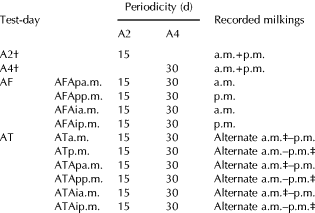
The various designs of milk recording are summarized in Table 1. In such simulations, the first test-day corresponded to week 7 post partum. This week was chosen as being the central point of the designated period, under Sicilo-Sarde breed conditions, within which to carry out the first test-day, between days 31 and 75 post partum. Milk yields per lactation were estimated and adjusted to 120-d standard period (L60–180) using the Fleischmann method (Othmane et al. Reference Othmane, Carriedo, San Primitivo and De La Fuente2002b) for both A2 and A4, according to the following formula:
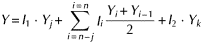
where Y is the lactation milk yield; I 1 is the interval in days between DIM 60 and next test-day j; Y j is the milk yield of first test-day if j=1, otherwise is the average milk yield of test-days j−1 and j; n is the number of test-days between DIM 60 and DIM 180; Y i is the milk yield of test-day i; I i is the interval in days between test-days i−1 and i; I 2 is the interval in days between DIM 180 and previous test-day; and Y k is the milk yield of test-day n if this latter is the last one, otherwise is the average milk yield of test-days n and n+1.
Test-day recording plans: reference and simplified designs (see text for details of the various recording schemes)
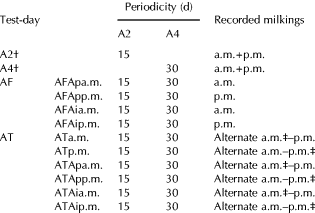
† Reference methods (see text for further details)
‡ milking the test-day started with
Data analysis
For data analysis and prior to lactation yield computation, test-day milk records (yij) were adjusted for variation factors with significant effect using a linear test-day model including the identified fixed effects (F: test-day date, stage of lactation, lambing type, lambing-first test-day interval, age at lambing) and the ewe and the residual (e) as random effects:

Lactation yields (L60–180) estimated for simplified designs (X), from the adjusted test-day records, were compared with those from the A2 and A4 reference options (Y) by means of linear regression between Y and X according to the model:

where a=intercept; b=slope or coefficient of regression; and E=associated random error.
Loss of precision of each simplified method was estimated as 1−R 2 and expressed as a percentage. Analyses were carried out by the Statistical Analysis System program SAS (1992) using GLM and REG procedures.
Results and Discussion
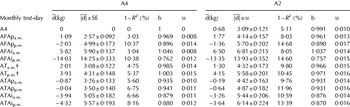
Bias (observed−estimated) for total milk yield together with losses of precision and some regression parameters resulting from the comparison between monthly simplified designs and the A4 and A2 designs used as a reference, are in Table 2. As a whole, satisfactory accuracy was observed when simplified designs were compared with standard A4 plan. Losses of precision ranged from 3·03 to 10·38% with high coefficients of regression. Such losses of precision obtained in the Sicilo-Sarde breed raised under a low input production system (one lambing season a year) were lower than those reported in our previous study (Gonzalo et al. Reference Gonzalo, Othmane, Fuertes, De La Fuente and San Primitivo2003) in the Spanish Churra breed with more intensive production system (3 lambing times in 2 years) and higher milk production level. However, losses of precision were higher than those reported in dairy cattle using monthly intervals (A4) (Bouloc et al. Reference Bouloc, Barillet, Boichard, Sigwald and Bridoux1991; Fuertes, Reference Fuertes1997). The number of test-days per lactation in dairy ewes (4–5 visits v. 9–10 visits in dairy cattle) may contribute to the loss of precision.
Bias (d=Y−X) of lactation milk yields, losses of precision (1−R 2), coefficients of regression (b) and se for the simplified monthly test-day designs with regard to the A2 and the A4 options (see text for details of the various recording schemes)

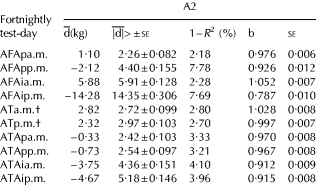
Deviations between estimated and observed measures could have a positive or negative sign (Table 2), which indicated that lactation yields may be underestimated or overestimated depending on the recording plan used. Absolute differences averaged 1·3% (0·9 kg) over 120 DIM. Milk production was overestimated with simplified designs based on evening milking as fixed milking (AFApp.m. and AFAip.m.) and all adjusted alternate designs (ATApa.m., ATApp.m., ATAia.m. and ATAip.m.), and overestimated with the other simplified methods. These latter showed the lowest losses of precision (<5·5%) and the highest coefficients of regression (the nearest to unity). Values of se were low (⩽0·015) for all proposed designs. Such a tendency is maintained for all simplified designs independently of both the recording frequency (monthly or twice monthly) and the comparison basis (A4 or A2) (Tables 2 and 3).
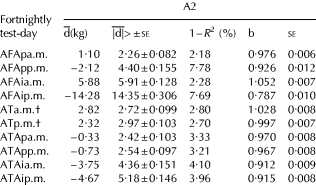
Bias (d=Y−X) of lactation milk yields, losses of precision (1−R 2), coefficients of regression (b) and standard errors (se) for the simplified twice monthly test-day designs with regard to the A2 option (see text for details of the various sampling schemes)
Information based on 2-weekly recording was also used as a more accurate reference to compare the monthly designs (Table 2). As expected, low precision was observed when results from monthly designs were compared with those of the twice monthly recording of both milkings (A2). Excepting the standard A4 method, losses of precision ranged from 8·03 to 14·68% for the other monthly designs. It can be pointed out that the use of standard A2 plan is usually limited to experimental flocks, for research purposes. In such cases and because of the heavy investment in terms of time and capital associated with reduced recording frequencies, total milk production could be estimated using the standard A4 method with acceptable precision (95%).
The ten simplified designs proposed were also tested with increased frequency (2 weeks) mainly to check whether their classification is maintained or not, in others words, to consolidate the choice of the suitable design. As mentioned above and shown in Table 3, classification of the methods based on single milking recording is identical and the same tendency was observed. Comparison of all simplified twice monthly designs with A2 standard method where information from the two daily milkings was available showed lower losses of precision than those for the comparison on the basis of A4 recording. The corresponding coefficients of regression were then closer to unity. Losses of precision ranged from 2·18 to 7·78%, with eight of them being <5%. Increased recording frequency contributed obviously to reducing the bias. However, the costs associated with the number of visits to be made with twice monthly designs prevent them from being feasible in practice on a large enough scale to be implemented within official milk recording schemes, especially in dairy ewes. In this way, Gabiña et al. (Reference Gabiña, Urarte and Arranz1986) reported that additional costs (derived from wages, social security and travelling expenses) reached two-thirds of milk recording expenses in the Latxa breed.
For all the reasons explained above, the simplified monthly test-day options are the most practical and should be further elaborated upon. Even if all results seemed generally acceptable (Table 2), some simplified plans predicted milk yield better than others. As previously observed for either milk yield (Gonzalo et al. Reference Gonzalo, Othmane, Fuertes, De La Fuente and San Primitivo2003) or milk components (Othmane et al. Reference Othmane, Fuertes, Gonzalo, De La Fuente and San Primitivo2006a) in the Churra breed, estimation from only one fixed milking information (AFa.m. or AFp.m.) was more accurate when the a.m. milking was considered. Losses of precision were 3-times larger for AFp.m. methods (AFApp.m. and AFAip.m.) than AFa.m. methods (Table 2). Another indication of the improved accuracy when information from a.m. milking was used was the higher coefficients of regression. Analysis of se showed also slightly larger errors when estimating milk yield from milkings with short preceding intervals. These results seem to be attributable to the lack of the information ensured by the omitted milking, because of the different a.m.–p.m. and p.m.–a.m. milking intervals. In fact, with a short preceding interval, a larger portion of daily milk is estimated. When the a.m.–p.m. interval was shorter than the p.m.–a.m. interval, prediction was better from the a.m. milking than from p.m. milking as shown in Table 2. These results accord with the highest monthly within-lactation correlations found for a.m. milkings (0·54) v. p.m. milkings (0·43) in Churra ewes (Fuertes et al. Reference Fuertes, Gonzalo, Carriedo and San Primitivo1998) for an interval between milkings similar to that in our study. Similar results were reported elsewhere for dairy ewes (Gonzalo et al. Reference Gonzalo, Othmane, Fuertes, De La Fuente and San Primitivo2003; Othmane et al. Reference Othmane, Fuertes, Gonzalo, De La Fuente and San Primitivo2006a) and others dairy species (Schaeffer & Rennie, Reference Schaeffer and Rennie1976; Smith & Pearson, Reference Smith and Pearson1981; Lee & Wardrop, Reference Lee and Wardrop1984; Bouloc et al. Reference Bouloc, Barillet, Boichard, Sigwald and Bridoux1991). All of them found larger errors for estimating daily yield from p.m. milkings. This would be expected because all p.m. milkings in these studies were preceded by intervals <12 h. Estimation of milk yield by adjusting for the milking interval was as accurate as by adjusting for the production level.
The same occurred when alternate recordings were used, although with less pronounced differences. In fact, when the two daily milkings are alternated, variation in a.m.–p.m. production would be compensated from one test-day to another, provided the number of test-days is sufficient. Plans beginning with a.m. milking also allowed better prediction than those beginning with p.m. (Table 2). However, adjustment for the preceding interval (ATAi) or milk production level (ATAp) did not improve sampling accuracy. Adjusted methods allowed poor accuracy when compared with alternate methods without adjustment (ATa.m. and ATp.m.). Even with methods without adjustment, loss of precision was still lower when the method began with a.m. milking, perhaps because in some lactations the number of punctual a.m. milkings from which milk production had to be estimated was higher than p.m. ones. In this way, and given the importance of the first test-day in dairy ewes, Gabiña et al. (Reference Gabiña, Urarte and Arranz1986) proposed supervising the two daily milkings in the first visit before adopting an alternate recording plan in the following visits, which reduced by 3–4 times the committed error. The same authors revealed that such an error was even reduced by 19–54% when both milkings were also recorded in the second test-day.
Analysis of global results indicated greater accuracy when simplified recording plans began with, or were based exclusively on, the a.m. milking. Losses of precision hardly go over 6% for monthly designs. The difficulty associated with computing a flock's daily milk yield as well as single milking yields for the adjusted methods prevents them from being considered in practice. We know that problems in determining amounts of milk discarded for drug residues, fed to lambs etc. are frequent in practice (Othmane Reference Othmane2000; Othmane et al. Reference Othmane, Fuertes, Gonzalo, De La Fuente and San Primitivo2006a). Furthermore, for practical reasons, it is difficult to begin recording a.m. milking in all ewes, since the period established for the first test-day recording is 31–75 d post partum (ICAR standard) and the lambing period usually exceeds 1 month. Consequently, the alternate method without adjustment, based on recording only a.m. or p.m. milking, seems to be the most plausible. If we take into account that in Sicilo-Sarde ewe flocks the interval between milkings is similar to that in our study, then the errors we found with monthly recordings will be closer to actual fact. Errors of around 5% must be then assumed when only 5 out of 10 milkings are recorded throughout lactation. Furthermore, such an alternate strategy should reduce the expense of testing and allow more flocks to be enrolled in official recording programmes.
From a genetic point of view, it is assumed that the eventual repercussion of simplified recording plans on precision of genetic estimates is considered to be low and it may be easily countered by increasing the number of daughters per male (Poly & Poutous, Reference Poly and Poutous1968). The required increase of daughters, so as to maintain the same genetic gain, was estimated as 0·6–3% (0·1–0·5 daughters per ram) in ewes (Gabiña et al. Reference Gabiña, Urarte and Arranz1986) and 2·7% (1–2 daughters per buck) in goats (Bouloc et al. Reference Bouloc, Barillet, Boichard, Sigwald and Bridoux1991).
Finally, when alternate method without adjustment ([5] and [6]) was adopted, identical factors, (2, 2), were usually used to estimate individual daily milk production from either a.m. or p.m. milking but there was no available information on their accuracy allowing them to be judged as the most suitable. In our study, the best prediction corresponded to the pair of factors (1·7, 2·3) for either monthly or twice monthly recordings (Table 4). Losses of precision were reduced by 13·9% and 15·9% for monthly ATa.m. and ATp.m., respectively. This would be expected because daily milk production is more represented by production from a.m. milking than from p.m. milking. Consequently, the new pair of factors should be recommended for the Sicilo-Sarde breed. It must, however, be investigated for other breeds whenever the preceding interval is not the same for both daily milkings. It could be also pointed out that all pairs of factors tried in this study, even if they were arbitrarily chosen, allowed more accurate estimations with regard to factors in use (2, 2). In this way, testing conversion factors calculated from another data set from the same population could be projected for future studies on this topic.

In conclusion, all simplified recording systems resulted in good prediction of actual milk production when applied to data sets from monthly or twice monthly recordings. However, some designs allowed better accuracy than others with the same ranking maintained in all comparisons. For experimental flocks using the standard A2 plan, recording of the two daily milkings at monthly intervals (standard A4 method) could be implemented with 95% precision. For commercial flocks, the monthly alternate plan without adjustment is preferable for practical and economic reasons. Investigation after implementation of new factors for the recommended alternate plan indicated that lack of fit present with old factors was removed by more than 13%. The pair of factors (1·7, 2·3) was the most accurate and should be then used in the Sicilo-Sarde population. These results concern flocks raised in extensive system under low-input production conditions, with a long lactation period. Under different conditions, the adequate factors must be investigated.
This research was supported by the Tunisian Ministry of Scientific Research and Technology (Tunis, Tunisia). Cooperation of the staff of Lafareg Experimental Unit in collecting and verifying the data for this study is also gratefully acknowledged.