Introduction
The study of feasting from both an archaeological and anthropological perspective has evolved gradually over the past century, and the last two decades have seen an advance in the models used to explain these practices (Hayden & Villeneuve Reference Hayden and Villeneuve2011). Feasting is recognised as critical in reaffirming notions of power and identity, and it has a central role in sustaining social systems and inter-community relationships (Dietler & Hayden Reference Dietler, Hayden, Dietler and Hayden2001). Anthropological research has demonstrated common features in ceremonial food sharing, with prescribed behaviours relating to consumption, movement or action (Twiss Reference Twiss2008). Many systematised feasting practices cannot be reconstructed archaeologically and, consequently, the identification of feasting is often based on criteria such as large quantities of remains, low-level processing (such as no marrow extraction) and a dominance of meat-bearing elements (e.g. Mercer Reference Mercer1985; Kelly Reference Kelly, Dietler and Hayden2001; Twiss Reference Hayden2012). It is, therefore, rare that precise social practices of prehistoric feasting can be reconstructed in greater detail (Dietler & Hayden Reference Dietler, Hayden, Dietler and Hayden2001: 5).
Studies on feasting in a British prehistoric context have invariably focused on single sites, with, perhaps, the most comprehensive studies on late Neolithic Durrington Walls demonstrating vast feasts that drew people, and their animals, from afar (Albarella & Serjeantson Reference Albarella, Serjeantson, Miracle and Milner2002; Viner et al. Reference Viner, Evans, Albarella and Parker Pearson2010). Outside of Durrington Walls, the best evidence for feasting in British prehistory comes from Late Bronze Age/Early Iron Age middens, which are vast accumulations of cultural debris concentrated in southern Britain (see Needham & Spence Reference Needham and Spence1996; Lawson Reference Lawson2000; McOmish et al. Reference McOmish, Field and Brown2010). The recently excavated midden at Llanmaes in the Vale of Glamorgan, South Wales, provides an almost unrivalled opportunity to reconstruct feasting practices in detail. This stems from a vast, meticulously excavated faunal assemblage, which provides clear evidence for structured modes of processing, consumption and deposition. Combining zooarchaeological research with isotope datasets has facilitated greater insight into feasting practices and their social role in this transitional phase of British prehistory.
Middens in Bronze Age/Iron Age southern Britain
During the Bronze Age–Iron Age transition (c. 900–600 BC), accumulations of cultural debris—frequently termed middens—became common across southern Britain. These sites comprise a wealth of material culture, principally ceramic and animal bone fragments, but also metalwork, worked objects (bone, shale and flint) and disarticulated human bone. The monumental scale of deposition is unparalleled in a British prehistoric context and represents a fundamental reorientation in the ‘taskscapes’ of later prehistoric peoples. The phenomenon of midden accumulation signals a range of societal changes: increased settlement monumentality (Waddington & Sharples Reference Waddington and Sharples2011); intensified animal husbandry (Serjeantson Reference Serjeantson, Haselgrove and Pope2007); and a greater degree of intra- or inter-community interaction, certainly at a local or regional level. These new practices coincide with periods of social upheaval and may be linked to the breakdown of long-distance exchange networks based on the trade of bronze artefacts (Needham Reference Needham2007).
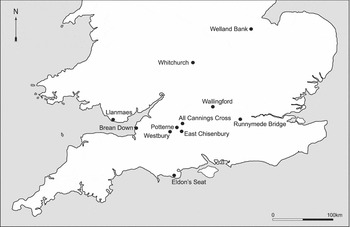
The sites are principally limited to southern Britain (Figure 1) with the greatest concentration, and the two richest examples (Potterne and East Chisenbury), both comprising millions of bone fragments, located in the Vale of Pewsey, Wiltshire (Lawson Reference Lawson2000; McOmish et al. Reference McOmish, Field and Brown2010). Substantial advances in artefact and landscape studies have helped characterise midden sites (Waddington Reference Hayden2009; Madgwick Reference Madgwick2011; Tubb Reference Tubb2011). They vary markedly in their composition and nature of accumulation, while having similarities in site morphology and broader social practice. Larger sites unquestionably provide evidence for communal consumption on a scale scarcely seen in British prehistory. Accumulations represent more than the haphazard deposition of feasting debris. The quantity and diversity of artefacts, together with the deposition of human bone, indicate that midden material is not purely waste. These sites are likely to represent ceremonial centres that drew people from the small disparate settlements, located throughout the landscape, to engage in performative consumption and deposition on a grand scale.
Key sites identified as comprising Late Bronze Age/Early Iron Age midden deposits (modified from Waddington Reference Waddington, Davis, Sharples and Waddington2008).

Concepts of fertility and life cycles have been cited as important in structuring practice at middens (Needham & Spence Reference Hayden1997: 85; Waddington & Sharples Reference Waddington and Sharples2011), and it is widely recognised that there is likely to have been a performative element to consumption and deposition (Needham & Spence Reference Hayden1997; Waddington Reference Hayden2009; McOmish et al. Reference McOmish, Field and Brown2010). Reconstructing precise social practices surrounding feasting has, however, proved elusive, until now.
Llanmaes
The discovery of the site at Llanmaes by metal-detectorists was reported to the Portable Antiquities Scheme and was followed by seasonal excavation and survey (2003–2010). The project, led by Adam Gwilt and Mark Lodwick, and funded by Amgueddfa Cymru—National Museum Wales, revealed a complex, long-lived landscape. Late prehistoric settlement commenced with Middle Bronze Age roundhouses and included the startling find of a curated great white shark tooth that had been deposited in a posthole (Gwilt & Lodwick Reference Gwilt and Lodwick2009). Settlement activity continued through the Late Bronze to the Earliest Iron Ages (1150–600 BC; see Needham Reference Needham2007), with the formation of the midden beginning during this latter period. In addition, a univallate Late Iron Age/Romano-British enclosure and several Early Bronze Age round barrows are located within 500m (Gwilt et al. Reference Gwilt, Lodwick and Deacon2006; Lodwick & Gwilt Reference Hayden2011).
The midden is situated on productive agricultural land with underlying limestone geology and lies approximately 2.5km from the Severn Estuary, thereby potentially benefitting from good maritime/riverine transport links. The midden covers around 0.25ha, of which over 50% was excavated. Deposits were shallower than most contemporaneous examples, attaining a depth of c. 30cm, which was partially due to later disturbance, trampling and truncation by ploughing (Lodwick & Gwilt Reference Lodwick and Gwilt2004). Stratigraphy was obscured within a humic black earth matrix; the midden was therefore excavated in 100cm squares and 5cm spits, an approach that ensured excellent hand-retrieval of remains. As at other midden sites, evidence for a small open settlement was unearthed beneath the midden deposits. In this case, two roundhouses of Late Bronze to Earliest Iron Age date were identified, yet there were too few to account for the volume of material.
The peak period of midden accumulation was during the Earliest Iron Age to the Early Iron Age (750–400 BC), as indicated by the ceramic assemblage and 14C dates, although additions were made during the Middle to Late Iron Ages (Gwilt et al. Reference Gwilt, Lodwick and Deacon2006: 46). The recovered artefacts are generally typical for middens and included a large ceramic assemblage (3000+ sherds). The assemblage also comprised more substantial quantities of metalwork than is common; this included the remains of at least thirteen bronze vessels (and hundreds of sheet fragments), probably deliberately destroyed, along with Sompting and imported Armorican socketed axes and a ladle (Gwilt & Lodwick Reference Gwilt and Lodwick2009). But by far the most abundant finds category was animal bone—the vast majority of which was feasting waste. As will be shown below, the quantity of faunal remains and the character of the artefactual assemblage suggest large feasts, but these signatures are in stark contrast to other middens. In fact, the exceptional patterns indicate practices of selection, processing and deposition that are unrivalled, not only in prehistoric Britain but in any faunal assemblage known to the authors.
The faunal assemblage
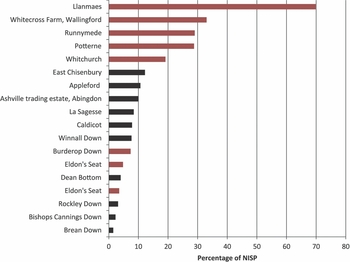
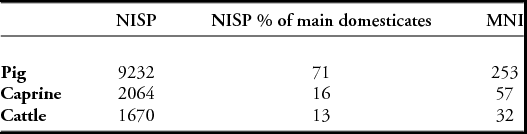
A total of 73 501 fragments (of which 16 786 were identifiable) were recovered during excavation: the largest prehistoric faunal assemblage from Wales. While middens frequently have a considerably greater proportion of pigs than other contemporaneous sites, none rival Llanmaes (Figure 2). Here, pigs accounted for 71% of specimens from the main domesticates (Table 1) and comprised individuals of a wide age range.
Percentage of the number of identified specimens (NISP) accounted for by pigs of the assemblage of the main three domesticates (pig, sheep and cattle) at Late Bronze Age/Early Iron Age middens (red bars) and contemporaneous non-midden sites (black bars). References in Madgwick et al. (Reference Madgwick, Mulville and Stevens2012a).

Number of identified specimens (NISP) and minimum number of individuals (MNI) for the main domesticates.

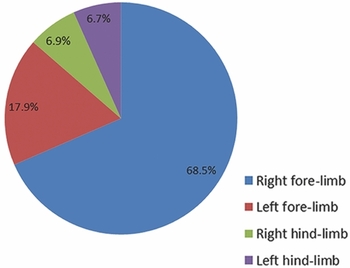
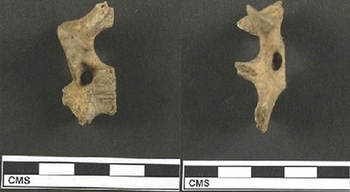
More strikingly, in the pig assemblage clear patterns in the representation of different body parts and elements sides (i.e. right vs left) were observed. Overall, almost three quarters of sided limb bones were derived from the right fore-quarter, meaning the remainder of the carcass accounted for approximately a quarter of the pig bones (Figure 3). The inclusion of the skull in this analysis produces even stronger patterning. The vast majority (88%) of limb elements derive from the fore-limb, and just under three quarters of all elements are right sided (71%): a pattern that permeates medium mammal ribs (86%) and skull specimens (mandibles and crania) (69%), but not hind-limbs (51%). None of these selection practices were evident for other species and no such composition has been identified at other midden sites. Butchery evidence also showed clear patterns, with carcasses split down the central vertebral line, demonstrating great care to divide right and left sides equally. Two thirds of all butchered fragments, from a total of 635, were sagitally cleaved medium mammal vertebrae (Figure 4), with mainly right-sided specimens present (79%). This overwhelming dominance of pig right fore-quarters—a pattern that would certainly be stronger were it not for the disturbance that the midden has suffered (Madgwick in press)—is a genuinely unprecedented signature in an assemblage of this size. This provides irrefutable evidence for highly formalised, socially circumscribed practices relating to the selection, processing and deposition of animals at Llanmaes, the likes of which are unique.
Percentage of the number of identified specimens (NISP) of pig limb bones (including scapulae and pelves) from each quarter of the carcass.

Sagitally cleaved vertebrae (photograph: Richard Madgwick).

Reconstructing social practice
Evidence suggests that the midden resulted from large-scale feasting on pigs. It is plausible that the remains represent sacrificed offerings rather than waste from consumption, as butchery evidence overwhelmingly focuses on the right/left division of the carcass (see below) and burning evidence was also rare (constituting only 0.5% of remains). The very low incidence of fine knife cuts may relate to the poor preservation of the assemblage, as cut marks may have been overprinted by later modification. In addition, the presence of many bronze vessel fragments suggests roasting (which leaves burning evidence) was not the principal mode of preparation. Further, if the right side was offered as a sacrifice, the remains would be expected to retain greater integrity, but all deposits were highly fragmented and articulations were exceptionally rare. Overall, large-scale pig feasting seemed most likely.
It is worth considering how the challenges and practicalities of raising large numbers of pigs may have been met. The animals may have been husbanded by specialist producers specifically for the feast—perhaps by the site's small permanent community. Given the evidence for structured processing and consumption, it is also plausible that pigs were raised and foddered in a prescribed manner, as has been described in ethnographic research on pig feasts (Hayden Reference Hayden1990). Alternatively, pigs could have been raised at a household level, by those attending the feast, and thus fed on a wide-range of resources. Neither explanation, however, provides a good fit for prehistoric husbandry. Raising large numbers of pigs would have been challenging, particularly in the largely deforested landscape of South Wales (Caseldine Reference Caseldine1990: 55), as woodland was of great importance for past pig husbandry (Ten Cate Reference Ten Cate1972). Specialist production of large herds would have required a substantial investment of effort. Pigs are, however, thought to be unsuited for movement over distance and therefore it is improbable that large numbers of pigs would have been brought to Llanmaes from a wide area.
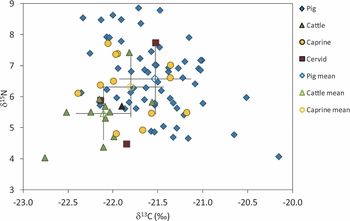
In order to clarify husbandry regimes, a programme of carbon (δ13C) and nitrogen (δ15N) isotope analysis was undertaken. This approach is useful for reconstructing diet in past populations, in terms of animal, plant and marine contributions in feeding. It is particularly useful in omnivorous species such as pigs, as they can be raised on a broad range of resources, with distinct isotopic signatures. Full results and methods are published in Madgwick et al. (Reference Madgwick, Mulville and Stevens2012a). The programme of analysis included 60 pigs and 27 samples from other species from Llanmaes. The wide-ranging results for all fauna, but particularly pigs (Figure 5), provide convincing evidence that they were not raised by specialist producers, and there is certainly no evidence for formalised foddering. The heterogeneity of the isotope values suggests that pigs were raised by various social units, in different areas, using wide-ranging resources. While this is the most likely scenario, confident interpretation is hindered by a lack of large comparative pig datasets from British prehistoric sites. The high δ15N values in the Llanmaes pigs indicates some reliance on animal protein in feeding, and this is consistent with household waste, including food scraps and even human faeces, having been used as fodder.
Results from carbon (δ13C) and nitrogen (δ15N) isotope analysis of Llanmaes fauna (Madgwick et al. Reference Madgwick, Mulville and Stevens2012a: 135).

It is also critical to resolve the origins of the people and animals at Llanmaes. Few contemporary sites have been identified and excavated in South Wales. As pigs are unsuited to droving, it was initially hypothesised that the human population and their animals derived from as yet undiscovered settlements located in relatively close proximity to Llanmaes. A programme of strontium (87Sr/86Sr) isotope analysis was carried out to shed light on this issue. This mode of analysis is frequently used to reconstruct patterns of human mobility, but our programme focused on pigs because few human bones (mainly disarticulated postcranial remains) were recovered from Llanmaes.
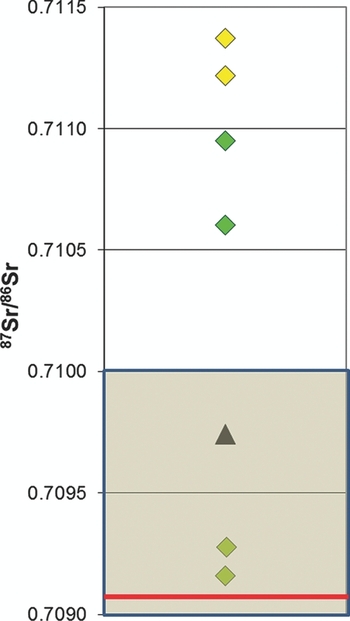
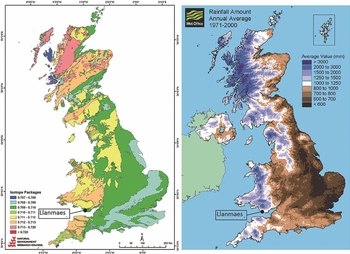
Strontium isotope analysis formed part of a wider research programme to prove the validity of the method for pig provenancing (Madgwick et al. Reference Madgwick, Mulville and Evans2012b). Five samples are published as deriving from Llanmaes. The sixth specimen (0.71093), presented in this paper, is a mean value of five samples taken from a relatively homogenous single tooth from the part 1 experiment on diagenesis (Madgwick et al. Reference Madgwick, Mulville and Evans2012b). Strontium isotope analysis provides a locational signature for an individual's childhood origins, as biosphere strontium from the soil and underlying rock is transferred up the food chain with very little fractionation and locked in dental enamel during development. This analysis therefore has the potential to establish whether pigs, and by inference the accompanying human population, were raised locally at Llanmaes. Results were compared with local biosphere (Figures 6 & 7: shaded area/triangle) and rainfall values (Figures 6 & 7: red line), as the high rainfall in Wales affects biogenic signatures. Results from two pigs are consistent with local origins, lying between biosphere and rainfall values; the other four plot outside this range and were not raised at Llanmaes, with at least two non-local biosphere regions likely to be represented. Due to the complexity of Welsh geology and high rainfall, which shifts life signatures towards the value of 0.70918 (see Evans et al. Reference Evans, Montgomery, Wildman and Boulton2010), it is very difficult to ascertain where the pigs were raised. Nonetheless, it is likely that multiple regions are represented in this small sample, and the pigs must have been derived from a substantial distance away (>20km) to attain these more radiogenic values, which are well beyond the expected range for the vicinity of Llanmaes.
Strontium (87Sr/86Sr) values for six pigs from Llanmaes; the horizontal red line indicates the strontium value of seawater/rainfall (0.70918); the black triangle represents a local value (from dentine) and the shaded box indicates an estimation of the local range based on data from Evans et al. (Reference Evans, Montgomery, Wildman and Boulton2010); each pig sample is shaded according to biosphere zone (Figure 7).

Strontium biosphere map (left) and rainfall map (right) for Great Britain (modified from Evans et al. Reference Evans, Montgomery, Wildman and Boulton2010).

Isotope results provide convincing evidence that people were converging on Llanmaes, bringing their locally raised animals with them, to engage in feasting events. Yet the greatest enigma posed by Llanmaes is the dominance of right fore-quarter elements. Although live pigs are notoriously difficult to move, traversing the landscape with a pre-butchered pork quarter would also provide substantial challenges—in terms of being an awkward, heavy load and the meat spoiling.
Three lines of evidence indicate that the animals most likely arrived on the hoof. Firstly, the presence of numerous skull fragments (>200 lower jaws). Heads are heavy and unwieldy body parts of relatively little dietary value; it is expected that these would be removed as primary butchery waste, prior to transport (Binford Reference Binford1981: 185; Dobney et al. Reference Dobney, Jacques and Irving1996). Secondly, highly formalised butchery practices suggest that specialists undertook carcass processing, on site, as part of the formalised aspects of practice, preceding the feasts. Eighty per cent of all pig and medium-mammal vertebrae were chopped in a very similar manner, with the right and left sides accurately divided: a practice unlikely to have been so closely adhered to if butchery took place at a household level. The third piece of evidence relates to the dark humic deposits at Llanmaes, which have been shown to be formed of slurry (Gwilt et al. Reference Gwilt, Lodwick and Deacon2006). This demonstrates that live animals were present during midden accumulation and modification.
This raises the problematic question of the location of the other carcass parts. It is plausible that the remaining elements were preserved through smoking or drying and returned to their respective settlements. If travelling to Llanmaes carrying a quarter of a pig is considered impractical, returning with three quarters is even more unlikely. Such exceptional patterns mean that functionalist explanations are a poor fit for the data. It is considered more probable that carcass division, exchange and circulation occurred, with remains being re-distributed across sites situated close to Llanmaes and perhaps beyond. This practice would, however, be difficult to identify in domestic faunal assemblages, as occasional (perhaps annual or even less frequent) additions of elements of certain carcass components would have very little impact on domestic faunal assemblages (for comparable medieval examples, see Sykes Reference Sykes and Pluskowski2007: 150–51).
Alternatively, it is possible that all parts of the pigs were consumed at Llanmaes, but that the midden was reserved for the deposition of certain elements. The midden could be seen as a ritually significant structure, exclusively constructed from symbolically loaded elements. It is even plausible, though unlikely, that parts of the midden were reserved for right fore-quarter elements and that the unexcavated portion, or nearby undiscovered deposits, may yield a wealth of other pig remains. Pig right fore-quarters obviously had special importance, although it is more difficult to explain the smaller quantities of sheep/goat and cattle bones. Perhaps a more convincing interpretation of the composition is that prescribed cuts, consumed at the feast, were combined with the piecemeal deposition of ‘standard’ waste, by the small resident population, outside feasting periods.
A further possibility is that the selection of right fore-quarters was one component of a complementary ritualised practice, involving a partner site where the remaining quarters were deposited. Remarkably, the Late Iron Age hoard site at Hallaton, Leicestershire, provides supporting evidence for this. The site yielded a substantial assemblage of almost 7000 identifiable bones, overwhelmingly dominated by 97% pig (Browning Reference Browning and Score2011). In contrast to Llanmaes, the pig assemblage showed a notable absence of right fore-quarter elements, particularly from the lower fore-limb (radius, ulna and carpals). Right-sided lower fore-limb bones accounted for only approximately one sixth of the number of comparable left-sided elements. This is not to say that there is a direct link between the sites; Hallaton is 300km from Llanmaes and contemporary with only the final phases of the midden. It does, however, raise the possibility that the selection of specific quarters may have been a more widespread practice in later prehistory, with similar patterns noted in smaller feasting and ceremonial assemblages from Ferry Fryston, Yorkshire (Orton Reference Orton, Croxford, Ray, Roth and White2007), Dun Vulan, Scotland (Mulville Reference Mulville, Parker Pearson and Sharples1999), Trim, Ireland (Beglane Reference Beglane, Potterton and Seaver2009), and Ouessant and Gournay-sur-Aronde, France (Méniel Reference Méniel1992). It is possible that a local complementary site to Llanmaes is yet to be discovered.
Integrating isotope research with fine-grained zooarchaeological analysis has provided an increased understanding of social practices. It is clear that people were converging on Llanmaes from different areas of the surrounding landscape and beyond, bringing their own animals, probably on the hoof, as contributions to the feast. The formalised contribution of a right fore-quarter would emphasise the social importance of the feast. Perhaps each household (or whichever unit was prescribed to contribute) would have to slaughter an individual pig in honour of the feast, rather than sacrificing one pig between four families and contributing a quarter each. These actions suggest non-hierarchical practice, as each unit would provide the same cuts of meat, and by bringing live animals to site, the health and quality of the offering could be assured.
The socio-economic role of the feast
Feasting is now recognised as a critical practice through which social, economic and political relations are articulated, and wide-ranging explanations have been put forward to explain feasting behaviours (Hayden & Villeneuve Reference Hayden and Villeneuve2011).
The Llanmaes assemblage can be considered in the light of common explanations of competitive feasting as a drive for prestige, status and power. Such feasts involve grand displays of wealth and conspicuous consumption led by ambitious individuals—so-called ‘aggrandisers’ (Gould Reference Gould, Williams and Hunn1982) or ‘accumulators’ (Hayden & Gargett Reference Hayden and Gargett1990). Rival events are then hosted in an attempt to supersede the previous feast. These shows of wealth elevate the host's status and, through competition, generate reciprocal gifting between elites. It seems likely that the great middens of the Bronze Age–Iron Age transition represent sites of competitive feasting, with ever-grander events resulting in vast accumulations.
Llanmaes can be assessed against Hayden's (Reference Hayden, Wiessner and Schiefenhövel1996: 137) six criteria for identifying competitive feasting from archaeological deposits. Llanmaes easily meets four of these criteria: showing abundant resource use; special foods (right pig fore-quarters); special vessels (cauldrons); and prestige items (imported metalwork). Two criteria are more difficult to identify: special structures relating to feasting and high-status participants, although the latter is very hard to discern owing to the scarcity of settlement and funerary evidence. Nonetheless, using Hayden's criteria, Llanmaes could be considered as most likely to be a site of competitive feasting. The prevalence of pigs supports this, as they are suited to competitive production and consumption. They have large litters (potentially multiple litters annually), are omnivorous, gain weight rapidly (Pimentel & Pimentel Reference Pimentel and Pimentel1979) and are not required to sustain secondary product economies. Certain characteristics of the Llanmaes assemblage are considered inconsistent with competitive feasting. The most striking feature amongst the faunal remains is the overwhelming dominance of right fore-quarters. If competing for ever-more lavish shows of conspicuous consumption, it is unlikely that only right fore-quarter elements would be consumed, and there is no evidence that the remaining meat was wasted as a ‘costly signalling behaviour’ (Bleige-Bird & Smith Reference Bleige-Bird and Smith2005).
The prevalence of right fore-quarter elements from animals deriving from a variety of locations is more consistent with what Hayden (Reference Hayden, Dietler and Hayden2001: 58) terms a tribute feast: a large inclusive event, where tribute is bestowed upon the host. Perhaps Llanmaes was a site where pigs were brought and offered as tribute, slaughtered, processed and the right fore-quarter consumed during feasting. The absent three quarters will always problematise interpretation, but it is likely that they were preserved by smoking or salting, and then redistributed across the network that was sustained by these events. It may be no coincidence that fore-quarter feasts coincide with the rapid increase in salt production in Britain (see Needham Reference Needham2007: 57). Resource redistribution as a function of feasting has received less attention (Hayden & Villeneuve Reference Hayden and Villeneuve2011: 442) but could have been critical to maintaining social and economic bonds at the onset of the Iron Age. The acquirers of the tribute may have been individuals of higher social standing but not necessarily entrepreneurial aggrandisers. They would have orchestrated the redistribution network rather than amassing surplus for elite control. Hayden (Reference Hayden, Wiessner and Schiefenhövel1996: 129) emphasises the potency of redistribution in feasts for mobilising labour, and this may indeed have been important at a time when increased agricultural productivity was vital (Needham Reference Needham2007: 58).
In the context of the Bronze Age–Iron Age transition in Britain, this interpretation makes good sense. This period is widely considered a time of substantial social and economic upheaval. Needham (Reference Needham2007), amongst others, has argued that the ‘social value system’ based on bronze broke down, becoming devalued and leading to new systems of socio-economic interaction, although this has been contested by Roberts et al. (in press). Sharples (Reference Sharples, Haselgrove and Pope2007) views this shift as signalling a disintegration of networks based on elite gift exchange. The role of bronze clearly changes and it undergoes large-scale deposition, but it was not undermined by iron, which was in relatively shortly supply in the Early Iron Age (Haselgrove & Pope Reference Haselgrove, Pope, Haselgrove and Pope2007). Needham (Reference Needham2007: 55–58) has contended that ceramics and agricultural produce were the foundation of new exchange networks: the former increasing in stylistic complexity, the latter increasing in quantity through intensified animal husbandry. Feasting plays a crucial role at times of social change, negotiating social and political relations and reaffirming group identity (Dietler Reference Dietler, Dietler and Hayden2001). With the devaluation of bronze and the increased importance of agricultural production, feasting at middens would have provided the nodal arena where community networks were maintained through shared experience and wealth redistribution.
The importance of feasting for reinforcing group solidarity and social identity in prehistoric populations has been recognised since the 1920s (see Kaulicke Reference Kaulicke2005) and continues to play a prominent explanatory role (Hayden & Villeneuve Reference Hayden and Villeneuve2011: 442). This role has been emphasised by Dietler (Reference Dietler, Dietler and Hayden2001: 88), who states that feasts generally define social boundaries, while creating a sense of community and establishing relationships that transcend status distinctions. Dietler sees feasts as generating ‘symbolic capital’, which elevates the host's status and legitimises their position in the social hierarchy. At Llanmaes, this symbolic capital could have been invested in strengthening community identity. This view resonates with elements of diacritical feasting, which is highly symbolic and marks out the elite as different, imbuing them with symbolic capital through the exclusivity of their cuisine and style of consumption (Dietler Reference Dietler, Dietler and Hayden2001: 85). Symbolism and style were clearly important at Llanmaes, with modes of behaviour highly structured. There is, however, no evidence for the exclusion of a non-elite and therefore this symbolic capital may have been invested in emphasising community solidarity through shared, choreographed experience, marking participants as united and different from other groups who were not part of the feast. Choreographed experience may have had a wider role in negotiating social relations across other contemporaneous middens (McOmish et al. Reference McOmish, Field and Brown2010), but the evidence is particularly clear at Llanmaes.
People periodically congregated in one place over a long period, providing a symbolic powerbase in the landscape, at which the midden would have been the material embodiment of wealth and surplus. All participants would have been involved in the ritual of travelling to Llanmaes with pigs in tow, slaughtering, processing, consuming, destroying, depositing and redistributing in a socially circumscribed manner. The division of pigs from across the landscape and their redistribution to different areas would have provided a strong symbol of community unity, and, along with the shared experience of the feast, would have been a potent force in generating a collective consciousness in a disparate populous. Therefore, it is the participant groups that benefit from social capital and the communities’ social bonds, rather than the status of the elite, in which it is invested.
Conclusion
Faunal and isotope research at Llanmaes has demonstrated the occurrence of socially circumscribed feasts, drawing people and their animals from the surrounding landscape and beyond to engage in conspicuous consumption and deposition on a grand scale. Evidence suggests that formalised contributions of a right pig fore-quarter were required as tribute for the feast. These prescribed modes of practice permeated the treatment of animals and probably extended to a range of activities surrounding midden accumulation, reflecting the norms, values and structuring principles in action at these locales. Participants would be subject to an elaborate, shared experience, serving to consolidate group identity and reaffirm inter-community relations at a time when they were faltering due to the breakdown in the bronze exchange network. Wiltshire middens, such as Potterne, may have been sites of competitive feasting, with the ever-increasing scale of deposition (see Madgwick & Mulville Reference Madgwick and Mulville2015) suggesting competition and the presence of chalk platforms, perhaps for ceremonial use, adhering to Hayden's (Reference Hayden, Wiessner and Schiefenhövel1996) criteria. Yet based on the faunal evidence we believe that the driving force behind feasts at Llanmaes was different, with resource redistribution and identity reaffirmation most important. This might be viewed as a regionally distinct response in the less populous landscape of South Wales, where the strengthening of social bonds in a disparate population was of paramount importance, rather than competitive control over agricultural productivity.
This paper signals progress in the exploration of midden accumulation, the societal changes within which it was embedded and the degree of regional variation in practices and social forms. Forthcoming integrated studies on the archaeological evidence and material culture recovered from Llanmaes have the potential to enhance the resolution with which feasting practices can be reconstructed. It is only with detailed intra-site research that comprehensive and meaningful inter-site comparisons can be made, particularly at a time when increased regional variation in community structure and material culture is evident (Needham Reference Needham2007).
Acknowledgements
Faunal analysis was undertaken by Richard Madgwick during a professional placement coordinated by the Chartered Institute for Archaeologists and an AHRC-funded PhD. The authors particularly acknowledge the sustained fieldwork and ongoing research efforts of Adam Gwilt, Mark Lodwick and Jody Deacon in investigating the Llanmaes midden, and appreciate their continued support throughout this faunal research project. Both authors are also grateful to Jane Evans and Rhiannon Stevens for their role in isotope research (and to Jane for permitting the reproduction of Figure 7), Ben Roberts for discussions relating to this paper and Kate Waddington and two reviewers for commenting on earlier drafts. Strontium (87Sr/86Sr) isotope analysis was funded by a NERC Isotope Geosciences Facility Steering Committee grant, and carbon (δ13C) and nitrogen (δ15N) isotope analysis was funded by research grants from the Prehistoric Society and the Cambrian Archaeological Association.