Introduction
K.8755 belongs to a handful of cuneiform tablets of Old Babylonian date that found their way into the British Museum's Kuyunjik Collection.Footnote 1 As internal evidence shows, they do not originate from Nineveh but from other sites: some of them can be connected with archival documents from Ur and from Kutalla, and therefore with the corresponding excavations of J. G. Taylor and W. K. Loftus (respectively); others point to the city of Uruk as a possible place of origin.Footnote 2 One can therefore assume that K.8755 originates from one of these southern Babylonian sites and was entered as a “Kuyunjik” tablet by mistake.Footnote 3
The fragment was described in C. Bezold's (Reference Bezold1893: 958) catalogue in the following words:
“Fragment of the lower portion of one side, 3in. by 2½in.; 14 + ………. lines; archaic Babylonian; not from Kouyunjik (?). Part of a religious(?) text similar to that of K. 6697; see above, p. 803. Cf. also infra, pp. 962, 983, etc., K. 8795, K. 9076, K. 9599, K. 9771, etc.”Footnote 4
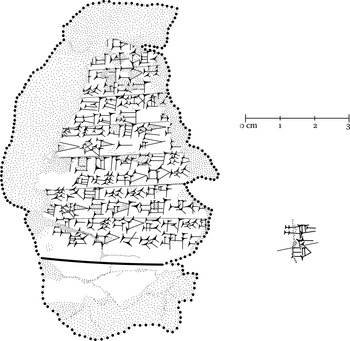
Only a part of one side and very little of an edge of K.8755 are preserved. The piece measures 7.3 cm (length) × 6.6 cm (width) × 3.7 cm (thickness). The space before the beginning of ll. 5’ and 6’ suggests that the preserved column cannot be the first column of the tablet, consequently the original tablet must have been a collective tablet with multiple columns and probably containing several compositions.Footnote 5 Contrary to Bezold's (Reference Bezold1893: 983) assumption, K.9076 does not seem to belong to the same tablet.Footnote 6
The fragment preserves a section of the Sumerian letter-prayer commonly known as the “Letter from Sîn-šamuḫ to the god Enki” (ETCSL 3.3.19). The following short paper provides score transliteration of the lines attested on K.8755 together with a translation and commentary.
The aforementioned composition was attested so far on three manuscripts,Footnote 7 to which the fourth is now added (see Table 1); a further unpublished one is said to be among the tablets excavated at Mē-Turan (Tell Haddad).Footnote 8 Its incipit is occasionally quoted in other texts.Footnote 9
The manuscripts of the “Letter from Sîn-šamuḫ to the god Enki”

A composite transliteration of mss. A–C together with a translation is provided by Hallo (Reference Hallo1968: 82–88). Parts of a composite transliteration based on the Yale mss. together with translations of the excerpts are published by Böck (Reference Böck1996: 12–20). Further translations are Kramer and Maier Reference Kramer and Maier1989: 95–98 (with notes on pp. 238–239); Hallo Reference Hallo and Sasson1995: 1876; Espak Reference Espak2007: 69–73; Böck Reference Böck, Janowski and Schwemer2013. Based on ms. A, a section of the text was recently translated by B. R. Foster (apud Polinger Foster Reference Polinger Foster2020: 75–76). Various aspects of the text have been studied in the unpublished PhD thesis of K. Takai (Reference Takai2009).
Our transliteration of the corresponding section of mss. A–B is based on the hand copies in YOS 22 (= Hallo Reference Hallo2018) and on the available photographs.
Score transliteration


Translation
(8)“This is what Sîn-šamuḫ, the scribe, the son of Ur-Ninsikila(?)?, (9)your servant says: (10)‘Since the day you created me, and turned into a human, (11)I have not neglected to call your name, I have not? …… like an old man, (12)I have never kept away from your festivals and offerings; I attended them regularly. (13)But now, whatever I have done, the case of my offense ……. (14)The day? of determining my fate has arrived, (but) I am detained in the place of uncertainty, no omen has been found for me yet. (15)A hostile god inflicted punishment on me. Cannot its gravity be lessened (lit.: Cannot its extent be reduced)?”
Commentary
8: The uḫ sign in ms. B looks like as if the scribe started it as uḫ but finished as uḫ2.
To judge from the traces in mss. A and D, dnin-s[ikil-la] is the most likely restoration, but dnin-t[u-ra] and dnin-ĝ[ir2-su] cannot be excluded either. For Ur-Ninsikila as a PN in a text from Ur see UET 5, 153: 18.
9: The scribe of ms. D probably merged this short line with l. 8 and wrote it on the right edge of the tablet (see the note on l. 14 below). Otherwise, one has to assume an omission.
10: Kramer and Maier (1989: 238 n. 37) restore the second verbal form as mu-e-ni-[ku4-re-en]. Attinger (Reference Attinger2019: 200) suggests mu-e-ni-k[u4?-x(-x)]. Böck (Reference Böck1996: 14) restores it as mu.e-ni-i[n-bulug3]. The remnants of the sign before the break would allow both in and kur9 both in mss. A and D. The writing mu-e-ni- and the context, however, indicate a 2nd ps. sg. preterite verbal form, so it is more likely that the verb to be restored is kur9 “to enter, to enter into a state, to become something”.Footnote 10 This verb governs a terminative instead of the expected locative (whose prefix is nevertheless preserved in the prefix-chain) very often in the OB period on the influence of Akkadian.Footnote 11
Apparently only ms. B uses the ablative case after the first subordinate finite verb in the line. Without knowing how the second finite verb ends, it is difficult to determine whether the difference is due to the frequently attested interchangeability in the use of the Sumerian case-markers in Old Babylonian texts (see Zólyomi Reference Zólyomi, Neumann, Dittmann, Paulus, Neumann and Schuster-Brandis2014), or perhaps the other mss. use the ablative only after the second (probably subordinate) finite verb.
11: The writing en3-šub for the usual im-šub may either indicate a reading im-šub for the word (pace Attinger Reference Attinger2005: 231, who considers the reading ni2-šub more likely), or be the result of a copying error: the scribe anticipated the li sign following the ru sign. Note also the omission of the sign še3 after zu.
12: For lul-aš, cf. Lämmerhirt Reference Lämmerhirt2010: 253 n. 2 (read there as lul.aš) and Kleinerman Reference Kleinerman2011: 157.
For the translation of the idiom ŋiri3 – kud in the meaning “to refrain from doing something”, cf. CAD P, p. 169 (parāsu 1 i 4’).
In ms. A, the sign uš is written over a deleted sign.
13: Hallo (Reference Hallo1968: 82) transliterates the end of the line on ms. A as nu-[til?]. His copy of ms. A in YOS 22 does not show a nu sign, and the photo reveals that the tablet is broken after the sign mu. Hallo may have taken the nu sign from ms. B, without mentioning it: the first obscure sign after mu in rev. 5 may resemble a nu; while the nu in obv. 1 of the same ms. is very different, another nu in obv. 3 looks quite similar. Another possibility to is to read the sign as kud (expected also by the context), in obv. 3 of the ms., there is a tar that may fit the traces of this sign. Alas, the identification of this sign has to remain undecided.
The distinction between the ga and the bi signs also remains a problem in the available mss. On ms. A the more complex form of the sign ga appears to be written with horizontal wedges in the first part of the sign (cf. obv. 10: mu-e-dug4-ga); while bi is written with vertical wedges (cf. obv. 15: zag-be2). In obv. 13 the copy shows no wedges written in the first part of the sign, and the photo is unclear, but one may detect horizontal wedges.
Ms. B features a cursive, simple sign in rev. 1 (= l. 10). In rev. 7 (= l. 15), the sign after zag is like the one in rev. 1, and Hallo's copy shows a horizontal in the first part of the sign which is difficult to verify on the photo.
Ms. D uses two different ga signs. In l. i’ 7’ (= l. 15), the sign used in nam-tag-ga is the cursive form, with two verticals; while in ll. i’ 2’ (= l. 10) and 5’ (= l. 13) the ms. uses the complex form without wedges in the first part of the signs. The first, boxy part of these signs is squarer than that of the bi sign in l. i’ 7’ (= l. 15); the boxy part of the sign used in zag-be2 appears to be narrower.
14: The line ends with the very beginning of a sign which was probably giškim. This sign is located just above the un sign of the next physical line (first part of D i’ 7’). So, one wonders how and where the four or five signs which may have followed giškim were accommodated. The only possible place is the right edge (see the note on l. 9 above), which may indicate that the preserved column of K.8755 was either the last one on the obverse or the first one on the reverse side.
Hallo (Reference Hallo1968: 83) transliterates the second part of the line as ki-lul-la ìl-la-en, but both his copy (YOS 22, 38) and the available photo show clearly ki-lul-la al-gul-en on ms. A. The new manuscript confirms this reading.
Pace Attinger (Reference Attinger2019: 200), one has to read in this line ki-lul-la despite the fact the first sign in mss. A and B contains only two small verticals. For the difficult expression ki-lul-la, see, e.g., the discussions by Lämmerhirt (Reference Lämmerhirt2010: 276) and Gadotti (Reference Gadotti2014: 480).
For another co-occurrence of the words ki-lul-la and gul, see Inana B (ETCSL 4.07.2) l. 101: ki-lul-la ḫe2-eb-gul-gul-en “In the ‘place of uncertainty’ I have been detained”.Footnote 12 In both compositions someone is waiting for a divine decision to be made. If the expression ki-lul-la refers to the place where the spirit of a dead person dwells until his judgement is made by Utu (as suggested by Flückiger-Hawker Reference Flückiger-Hawker1999: 169), then here and in Inana B the line may be understood as a poetic reference to a liminal state: one is tormented by the feeling of not knowing what his fate will be.
Accordingly, the expression ki-lul-la may refer in this context to a place which is deceitful > uncertain in the sense that no one may be sure what his judgement will be like.
The construction di nam-tag-ga-ŋu10 instead of an expected di nam-tag-ga-ŋa2 (namtaga=ŋu=ak) is an Old Babylonian Akkadism.Footnote 13
15: Attinger (Reference Attinger2019: 200) reads here za3-ga? in mss. A and B; see, however, the notes to l. 13 above.
The end of the line clearly has -da-la2 in ms. A; the published autograph merges la2 with the upper part of the next line's final ga sign (see the collation in fig. 1).
Left: Ms. D (K.8755). Right: The end of ll. 14–16 on ms. A.

Acknowledgements
Zs. Földi's study of K.8755 was conducted in the framework of the Electronic Babylonian Literature project led by E. Jiménez (LMU München). The authors gratefully acknowledge the permission of the Trustees of the British Museum to study and publish K.8755. Furthermore, they are indebted to K. Wagensonner for providing photographs of the Yale manuscripts (meanwhile available in the Yale Peabody Museum of Natural History's online database: https://collections.peabody.yale.edu/search/, accessed 28.05.2022) and to the anonymous reviewer for some useful suggestions.