




No CrossRef data available.
Article contents
Dative prepositions in children with specific language impairment
Published online by Cambridge University Press: 01 October 2004
Abstract
The purpose of this study was to evaluate children with specific language impairment (SLI) and their proficiency with the use of prepositions. Ten children with SLI were compared to 10 younger, normally developing children matched for mean length of utterance and 10 children matched for age. Each child was asked to produce 24 sentences containing locative (in, on) and dative (to) prepositions. Responses were coded for omission or word selection errors for the target prepositions. It was hypothesized that children with SLI would make more errors than the typically developing children. Omission errors would support a difficulty with syntax because of the role prepositions play in case marking. Word selection errors would support a deficit in the area of semantics. The results confirmed that children with SLI made more errors than the control group. The children with SLI made more errors in the selection of dative prepositions, indicating a difficulty linking the semantics of prepositions and verbs.
Information
- Type
- Articles
- Information
- Copyright
- © 2004 Cambridge University Press
Specific language impairment (SLI) is a term that has been used to describe children who demonstrate difficulties with language acquisition. These language deficits are observed despite normal nonverbal abilities, normal hearing, no evidence of neurological impairment, and no social or emotional concerns. At present, there is no known cause for their language problems (e.g., Leonard, 1998; Rice, Wexler, & Cleave, 1995). Grammatical errors are abundant in children with SLI. In particular, they tend to have difficulty with the acquisition and use of closed-class grammatical morphemes (e.g., Eyer & Leonard, 1995; Leonard, 1998; Leonard, Eyer, Bedore, & Grela, 1997; Rice & Wexler, 1996; Schuele & Nicholls, 2001; Schuele & Tolbert, 2001). Closed-class morphemes are considered to be a limited set of words that exist within specified syntactic categories. Words such as pronouns and articles are included in this closed set because they are small in number, and new words are rarely added to the word classes (Crystal, 1991).
Another set of words included in this closed category is prepositions. As with other word classes, prepositions serve a number of semantic and syntactic functions. The semantic function of prepositions is to represent spatial and temporal relationships such as direction, location, or place (e.g., Napoli, 1993; Tomasello, 1987; Wanska, 1984; Washington & Naremore, 1978; Weist, 2002). Their syntactic functions are to assign oblique case to noun phrases and to link elements within sentences (e.g., Napoli, 1993; Radford, 1997). The interaction between semantic and syntactic functions is critical in the selection of appropriate prepositions. In particular, verbs requiring an oblique argument (e.g., ditransitive verbs) have an influence on the type of preposition that is used (Tomasello, 1987). For example, a verb such as put encodes an action indicating a change of location, and the use of a locative preposition is required (e.g., He is putting the ball in the box). The use of a directional or dative preposition would be ungrammatical or awkward (e.g., *He is putting the ball to the box). In comparison, a verb such as give encodes an action of transfer and requires a dative preposition (e.g., He is giving the ball to Sally). An ungrammatical sentence would result if a preposition other than a dative were used (e.g., *He is giving the ball on the girl). Therefore, children must understand the relationship between verbs and the type of preposition that is used in the oblique argument.
Studies examining prepositions in children have shown that this class of words is acquired relatively late in comparison to nouns or verbs (Tomasello, 1987). Further, there appears to be a developmental sequence for the acquisition of prepositions. Generally, prepositions encoding location (e.g., on, in, under) appear early in children's vocabularies (e.g., Tomasello, 1987; Wanska, 1984; Washington & Naremore, 1978; Weist, 2002). In comparison, prepositions encoding dative (to), benefactive (for), instrumental (with), and genetive (of) relationships are acquired relatively late. Reasons for this developmental sequence have ranged from cognitive/perceptual abilities such as understanding the relationship between objects (e.g., Landua, 1994; Wanska, 1984; Washington & Naremore, 1978; Weist, 2002) to semantic complexity such as their relationship to other word categories (e.g., Bloom, Tackeff, & Lahey, 1984; Le Normand & Chevrie–Muller, 1991; Tomasello, 1987). However, it is generally agreed that children begin using spatial prepositions at around 2 years of age but continue to acquire prepositions through the latter part of the preschool years (e.g., Rice, 1999; Wanska, 1984).
Few studies have examined the use of prepositions in children with SLI (Watkins & Rice, 1991). In their study, Watkins and Rice compared the production of verb particles (e.g., kick over the table) and prepositions (e.g., jump over the table) in a group of children with language impairment with a group of younger, typically developing children matched for language development. They found that children with language impairments made more errors during the production of verb particles than for prepositions. No differences were found for the typically developing peers. Watkins and Rice proposed that children with language problems have difficulty understanding how particles are directly influenced by the verb used in a sentence. Therefore, children must understand the semantic–syntactic relationship of verbs and prepositions in order to use verb particles appropriately. Combining these two word classes to create a verb particle changes the meaning of the root verb, requiring some knowledge of linguistic sophistication or complexity on the part of the speaker.
Children with SLI tend to follow a normal developmental pattern in the acquisition of closed-class grammatical morphemes. However, this pattern is delayed in comparison to typically developing children of the same chronological age (e.g., Leonard, 1998; Leonard et al., 1997; Rice et al., 1995). The purpose of the present study was to compare the use of early developing, locational prepositions (in, on) with a later developing, dative preposition (to) in children with SLI and their typically developing peers. Specifically, we were interested in determining if there would be a difference in the use of prepositions for verbs requiring different oblique arguments (e.g., put and give). A verb such as put requires a locational preposition in the oblique argument, whereas a verb such as give only allows a dative preposition. Therefore, the earlier developing locational prepositions should be produced more consistently than the later developing dative preposition for both groups of children. In addition, we were interested in determining whether children with SLI would make more errors than their typically developing peers. If children with SLI have difficulty with the syntactic function of prepositions (e.g., case marking), there should be a greater number of omissions of the preposition or omissions of the oblique argument. On the other hand, if children with SLI understand the syntactic function of prepositions, but are uncertain of the semantic relationship between the verb and the oblique argument, then more substitution errors should be seen. Therefore, the children would know that a preposition is required but would not understand which preposition describes the relationship between the verb and the oblique argument.
METHODOLOGY
Participants
A total of 30 children who were monolingual speakers of mainstream American English participated in this study. All children were Caucasian and were recruited from rural communities in Connecticut and Indiana. Ten of the children had been diagnosed with SLI (3 girls, 7 boys). Two of the children were from working class homes, and the remaining 8 children with SLI were from middle class homes. They ranged in age from 4 years, 0 months (4;0) to 7;3 (M=5;8, SD=1;0). Their mean length of utterance (MLU) in words based on a 100 utterance language sample ranged from 3.28 to 4.68 (M=4.07, SD=.47). All children met the exclusionary criteria for SLI (Stark & Tallal, 1981) and had been receiving speech and language services through their local schools at the time of participation in the study. All of the children with SLI obtained a standard score below 85 on the verbal comprehension portion and/or the language production portion of the Reynell Developmental Language Scales (RDLS; Reynell & Gruber, 1990). The RDLS is standardized on children from birth to 6;11. Two of the children were older than 6;11, however, when the norms were used for children at the upper end of the RDLS, their standard scores were still below 85. Therefore, it was assumed that their language skills were greater than 1.5 SD below those of children of the same chronological age. All the children's scores on the Columbia Mental Maturity Scale (CMMS, Burgemeister, Blum, & Lorge, 1972) were above 85. In addition, these children passed a hearing screening at 25 dB (HL) for each ear at 500, 1000, 2000, and 4000 Hz and demonstrated adequate oral structure and function as determined by the Oral Speech Mechanism Screening Evaluation—Revised (St. Louis & Ruscello, 1981). According to parental reports, none of the children with SLI had a history of neurological dysfunction. Although phonological abilities were not tested as part of the qualification criteria for this study, 5 of the children were receiving phonological intervention as part of their school programming. A summary of the qualification criteria for the participants in this study can be found in Table 1.

Ten normally developing children (4 girls, 6 boys) were matched with the children with SLI according to MLU. These participants were recruited from a population of typically developing children between the ages of 3;0 and 6;0 years. All children were from middle-class families or had parents who were attending graduate school. The MLU for each of these children was within 20 morphemes of one of the participants with SLI. As expected, these children were younger than the children with SLI, with ages ranging from 3;3 to 5;11 (M=4;2, SD=0;9). Their MLU ranged from 3.37 to 4.88 (M=4.13, SD=.42) as calculated from 100 utterance speech samples. Their MLU was not significantly different from that of the children with SLI, t(18)=.13, p>.05. All of the children matched for MLU obtained scores above 85 on the expressive portion of the RDLS and above 85 on either the receptive portion of the RDLS or the Test for Auditory Comprehension of Language—Revised (Carrow–Woolfolk, 1985). Similarly, all children in this group passed a hearing and oral-motor screening and scored above 85 on the CMMS or (for children under 3;6) the Leiter International Performance Scale (Levine, 1982). The remaining 10 normally developing children (4 girls, 6 boys) served as age controls. These children ranged in age from 4;1 to 6;8 (M=5;3, SD=1;0). Their ages did not differ significantly from the children with SLI, t(18)=.54, p>.05. They also scored within normal limits on all standardized tests and screenings for hearing and oral motor abilities. As seen in the MLU controls, these children were from middle class families or were children of graduate students.
Procedure
The children were asked to describe actions performed by plastic figures of people and animals that were manipulated by the experimenter. A total of 24 scenarios depicting the actions of put and give were shown to the children. The target sentences contained verbs that represented either the transfer of an object (e.g., The horse is giving the block to the cow) or placement of an object in or on another object (e.g., The dog is putting the bone on the plate). For half the scenarios the action of put was depicted and for the other half give was depicted. For the actions involving put, six sentences depicted a scenario in which an object was placed in a container (e.g., a box) and six sentences depicted a scenario in which an object was placed on another object (e.g., a chair). The children were required to produce prepositional phrases—or the oblique argument—to specify where the object was transferred or placed. The children's responses were coded for omission of a preposition or selection of a preposition that incorrectly described the transfer or placement of an object (e.g., *The boy is putting the ball the chair or *The boy is giving the ball at the dog).
For each scenario, the experimenter had one of the figures place an item in or on another object (e.g., chair, cup) or transfer an object to another figure. The experimenter primed the target verb by saying “This is putting” or “This is giving” just before performing the action. The experimenter prompted the child to describe the action by saying “Tell me what's happening.” If needed, the experimenter performed the action one or two more times before the child described the action. If the child produced something other than the target sentence, the experimenter reminded the child to use the appropriate verb by saying “Remember, this is putting/giving.” For example, in a story where a clown was giving a cup to a girl, the experimenter would say “This is giving.” This reminder was typically needed only once.
The children were given six practice trials at the beginning of the experiment to introduce and familiarize them with the task. Different stimuli were used in the practice trials. To ensure that the children understood the required task, they were given corrective feedback about their performance on the practice items. No corrective feedback was given during the experimental trials. However, the children were given verbal encouragement for attempting a target sentence.
Each child participated in a total of two to three experimental sessions. The first session took approximately 1 hr and the subsequent sessions lasted approximately 20 min. The purpose of the first session was to collect a representative sample of the child's production of spontaneous speech and to complete all the standardized testing. During the subsequent sessions, all target sentences were elicited from the children. The scenarios were presented in a random order to each child. Experimental sessions took place in a quiet testing room at the child's school or home. When the experiment was conducted in the child's home, all distracting noises (e.g., television, radio), animals, and toys were removed from the room during the experiment. All the sessions were recorded using a Marantz PMD 430 recorder and a Crown PZM 180 microphone. The children's responses were scored and coded from the audio recordings of the experimental sessions by the experimenter. The target sentences were scored for the presence or absence of the prepositions. On occasion the children produced a dative alternation (e.g., The cat gave the dog the bone). This occurred an average of 2.7 (SD=2.2) times for the children with SLI and 1.0 (SD=1.0) times for the MLU controls. These differences were not statistically significant. The age controls produced no dative alternations. These utterances were excluded from the analysis because there was no obligatory context for a preposition in the double dative constructions. In addition, utterances were excluded if a child did not produce the oblique argument (e.g., The dog put the ball). The children with SLI omitted the oblique argument an average of 1.3 (SD=1.6) times and the MLU controls an average of 1.0 (SD=1.7) times. The age controls produced all obligatory arguments. Again, these differences were not statistically significant. A summary of the number of utterances containing an obligatory context for a preposition can be found in Table 2. For each child, the total number of preposition omissions or substitutions was then determined from each target sentence. A percentage of error was calculated for each child. This was determined by dividing the number of errors by the total number of attempts at producing an oblique argument with a prepositional phrase.

To evaluate interexaminer reliability, an independent judge listened to the audio recordings of two children with SLI and two children matched for MLU and transcribed their productions. The transcriptions were compared to the transcriptions of the first author. Percentage of agreement was calculated by comparing the two sets of transcriptions. Interjudge reliability for the production, omission, or substitution of the prepositions was 99%.
RESULTS
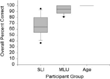
The age controls were excluded from the analysis because they made no errors during the experimental task (see Figure 1). Therefore, only the children with SLI and the MLU controls were compared. Two separate analyses were completed with .05 set as the level of significance for all statistical measures. The first analysis examined the percent of errors per verb and the second analysis compared the types of errors produced by the children.

The overall percentage of prepositions produced correctly by participant group.
Percentage of errors
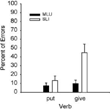
A repeated-measures mixed model analysis of variance (ANOVA) was employed to examine the percentage of errors produced by both groups of children. In this analysis, participant group served as a between subjects variable and the percentage of errors per verb served as a within subjects variable. Errors were defined as an omission of a preposition heading the oblique argument or use of a preposition that incorrectly described the spatial relationship of the action. Arcsine transformations of the percentages were run for the analysis. The results of the ANOVA revealed a significant main effect for group, F (1, 18)=7.91, p<.05; η2=.31, a main effect for verb, F (1, 18)=14.3, p<.01; η2=.44, and a Group × Verb interaction, F (1, 18)=10.8, p<.01; η2=.38. Post hoc least significant difference (LSD) comparisons revealed that the children with SLI made more errors in their use of prepositions than the MLU controls. In addition, more errors were made during the production of give than for put verbs. However, a post hoc t test for dependent samples showed that this difference was driven by the children with SLI who made more errors when producing give in comparison to put sentences, t (9)=−3.69, p<.05. A summary of these results can be seen in Figure 2.

The percentage of preposition errors (substitutions or omissions) for the verbs put and give.
Type of errors
Because the MLU controls made relatively few errors (<10%), only the data from the children with SLI were included in this analysis. A one-way ANOVA with the number of errors per verb by error type (omission or substitution) was performed. The children produced a preposition for all the put sentences, so these sentences were not included in this analysis. The items for comparison were omission of prepositions in give sentences and selection errors for put and give sentences. The ANOVA revealed a significant difference between Verb×Error Type, F (2,27)=5.80, p<.01. A summary of the average number of error types per child can be seen in Table 3. Post hoc LSD comparisons were used to examine for differences between items. Selection errors for give were significantly more frequent than selection errors for put and omission errors for give (give substitution>put substitution=give omission). In summary, the children with SLI were more likely to select an inappropriate preposition to head the prepositional phrase in the oblique arguments required by the verb give. To learn more about these substitution errors, the type of preposition replacing the target form was examined. The type and number of substitution errors produced by the children with SLI can be found in Table 4. The target items for the verb put were either in or on. The children with SLI replaced these locative prepositions with another locative preposition (up, at, to) or replaced in for on and vice versa. The head of the prepositional phrase for give was the dative preposition to. The most frequent substitution error was the locative preposition at. However, two children also used a comitative preposition (with) and one child used a benefative preposition (for).


Because the children with SLI made more substitution than omission errors, this suggested that they understood the role of prepositions as a case marker. In order to determine their knowledge of case marking, the language samples collected from the children were examined for case errors. On average, the children with SLI produced case errors 9.6% (SD=21) of the time, whereas the MLU controls produced case errors 1% (SD=1.1) of the time. A t test for independent samples revealed no significant difference between these two groups. The low number of case errors produced by both groups suggested that these children understood the function of case in English.
In summary, the children with SLI made more errors with prepositions than children matched for MLU. More specifically, the children with SLI were likelier to make these errors when producing sentences with the verb give. Furthermore, these children made more substitution than omission errors. An examination of the children's spontaneous speech revealed that both groups of children infrequently made case errors, suggesting they understood the assignment of case in English.
DISCUSSION
This study examined children with SLI and normally developing children's proficiency with the use of prepositions that head oblique arguments in two ditransitive verbs. The results provide evidence that the relationship between some verbs and their prepositions may not be well understood by children with SLI. In particular, these children made more errors during the production of give sentences. Errors took the form of substitutions rather than omissions. Therefore, there is some support to suggest that children with SLI understand the syntactic function of prepositions but may be unsure of the semantics of these words. In comparison, the children matched for age produced adultlike sentences whereas the children matched for MLU made few errors (<10%) during the production of the oblique argument for ditransitive verbs. These findings will be discussed in the following sections.
The findings of this study are inconsistent with those of Watkins and Rice (1991), who found no differences for preposition use between the children with language problems and children matched for language development but found a difference between verb particle use. However, there is at least one critical difference between the current study and that of Watkins and Rice. Watkins and Rice examined prepositional phrases that functioned independently of a set of intransitive verbs (e.g., walk over the chair, jump off the chair) and particles that were dependent on the selected verb (e.g., knock over the chair, kick off the shoe). In other words, the prepositional phrases functioned as adjuncts and were not required by the verb. These adjuncts were different from particles in that particles actually changed the meaning of the verb. The present study examined prepositional phrases that were dependent on the ditransitive verbs (e.g., put the ball on the chair, give the ball to the dog). Therefore, they are obligatory arguments of the verb. Since particles are dependent on verbs and modify their meaning, Watkins and Rice hypothesized that lexical limitations accounted for the findings of the children with language impairments. They concluded that their children did not understand the semantics of verb particles and were likelier to omit the particle or substitute a nontarget item that was more familiar to them (e.g., knock down the chair). It appears that the findings of the present study are more consistent with the verb particle use of the children with language impairments in the Watkins and Rice experiment. The selection of the preposition in the oblique argument is dependent on the verb used. The verb put requires a locational preposition, whereas give requires a dative preposition when a dative alternation is not produced. If children with SLI have difficulty understanding the relationship between verbs and prepositions, then we would expect to see errors during the production of oblique arguments. This appears to be the case for children with SLI in the present study in which the children sometimes omitted the preposition but were more likely to substitute a nontarget item, especially when a later developing dative preposition was required. Therefore, the results appear to support a problem with the relational semantics of the verbs and prepositions in the target sentences.
By examining the types of error made by the children with SLI, we might be able to determine the factors contributing to their difficulty with the use of prepositions. Prepositions function to provide case for the oblique argument of ditransitive verbs. An examination of the children's spontaneous speech revealed a low percentage of case errors. This suggests that the children who participated in this study understood the function of case. Thus, a preposition was required to mark case for the oblique argument of the ditransitive verbs. Prepositions also serve to link the direct object with the indirect object, as specified by the verb. Because the children with SLI made more substitution than omission errors, this provides further support that they understand the syntactic function of prepositions. If the children had difficulty with the syntactic rules associated with the prepositions, more omission errors may have been found. In addition, the entire prepositional phrase may have been omitted. This did occur infrequently in the children's productions. Because more substitution errors were produced by the children with SLI, this suggests that these children had more difficulty understanding which preposition was required by the verb. This is especially true for the verb give than for the verb put. There are several potential reasons for these differences.
Locative prepositions are acquired earlier than dative prepositions (Tomasello, 1987; Wanska, 1984; Washington & Naremore, 1978; Weist, 2002). It is likely that these spatial relationships are more concrete and easier for children to learn. As a result, children become more proficient with them at an early age (Rice, 1999). This may account for the lack of difference found in the Watkins and Rice (1991) study in which only locative prepositions were targeted. It is possible that if they had required the children to produce later developing prepositions such as datives or benefactives, they may have found significant differences between the children with language impairments and the normal controls. It is possible that the dative prepositions were more problematic for the children with SLI in the current study because they are more abstract. Therefore, the children may be less likely to learn the association between the verb and the dative.
Another potential factor accounting for this difference is that prepositional phrases are optional in give sentence constructions. Double dative or dative alternations are possible in the production of give sentences. Therefore, one could say, The girl is giving the ball to the dog or The girl is giving the dog the ball. In the first sentence, the prepositional phrase is produced when the object being transferred (the ball) is emphasized. However, a dative alternation is produced when the recipient is emphasized (the dog). Because both a prepositional phrase and a double dative are grammatically acceptable, it is probable that the frequency with which the prepositional phrase is heard is lessened. As a result, because children with SLI hear the prepositional phrase constructions less frequently, it may take them longer to build the semantic paradigm linking the verb give with the preposition to. This finding was supported in a study of normally developing children whose caregivers used spatial prepositions 8.5% of the time and dative prepositions only 4% of the time (Rice, 1999). Thus, children were exposed to dative prepositions half the amount of time they were exposed to spatial prepositions. Thus, children with SLI may need to hear the dative with prepositional phrase constructions more frequently and be given time to process this information before the correct association between the verb and the preposition are made. In addition, children will hear spatial prepositions used consistently with a verb such as put. Because put is always used with a preposition (e.g., put the ball on the chair) or with a particle (e.g., put your hat on), it is less likely that children will make grammatical errors such as omission on these constructions. There is a greater possibility that they will hear give formed with a dative alternation where a preposition is not required. Thus, the lack of consistency with which a preposition is used in these sentences could also explain children's difficulty with dative prepositions.
A final factor that may account for these differences is that the dative preposition to can bear a number of meanings and perform a number of grammatical functions (Rice, 1999). For example, children will hear the morpheme, pronounced as /tu/, in many linguistic domains, such as directional (e.g., She walked to town), number (She had two dollars), cognitive (e.g., I thought to myself), and the homophonous adjective and adverbial too. In addition, to is used as a preposition to assign case (e.g., Send the letter to me) and as part of an infinitive (e.g., I want you to get me a drink). Because children will hear this morpheme used in a variety of semantic and syntactic contexts, it may take them longer to learn how to use the dative in appropriate contexts.
An examination of the substitution errors revealed that the children with SLI most frequently substituted a locative preposition (at) for the dative preposition (e.g., The girl is giving the ball at the witch). This finding is consistent with the results of Rice (1999), who studied the language transcripts of normally developing children between the ages of 1;6 and 3;6. She found the error rate of preposition use to be low, except in contexts where to was required. In these situations, the children were likely to produce at and for rather than to. It seems that young, normally developing children and children with SLI are likely to substitute an earlier developing locative preposition for a dative. This may be because they understand that a preposition is required for case assignment and linking of arguments, but they are unsure which preposition is required by the verb. Therefore, they default to an earlier developing preposition such as a locative.
Although these findings are interesting, there are several reasons for interpreting these results with caution. First, one of the weaknesses associated with this study is the demographics of the participants. The children were selected from a variety of geographical locations, ages, language experiences, and possible dialectal variations. This heterogeneous sample of participants may have had an impact on the results in several ways. It is possible that dialects associated with the northeastern states may be slightly different than those of the Midwest. This could account for variability found within participant groups. Second, the children with SLI comprised a wide age range (4;0–7;3). The older children would have had more experience with language or had a more severe problem with language because they continued to receive language intervention services. This variation within groups can diminish differences that would be found between children from a more homogeneous population. Third, even though there were no statistical differences between groups for the number of dative alternations or oblique arguments omitted, there was a trend for the children with SLI to produce fewer target items than either control group. This may have had an impact on the statistical power of the experiment. Future studies of prepositions involving ditransitive verbs should include either more experimental items or larger numbers of homogeneous participants to increase power.
CONCLUSIONS
This study provides new information about the semantic abilities of children with SLI and may have important theoretical implications. Previous studies have shown that children with language problems have difficulty with the acquisition of verbs and verb argument structure (e.g., Grela, 2003; Grela & Leonard, 1997; Rice & Bode, 1993). It is also possible that they have difficulty understanding the relationship between some verbs and the prepositions used to head obligatory arguments. Furthermore, it also provides information about implications for intervention in this population of children. Clinicians should be aware that children with SLI may continue to experience difficulty with the acquisition and use of abstract prepositions such as datives. Clinicians may need to focus on children's awareness of the semantic relationship between verbs and obligatory arguments headed by prepositions. It is possible that children will continue to have difficulty with the use of some prepositions even into the early elementary school years. These children may need to hear these prepositions used frequently and in contexts where the prepositions can be processed more efficiently. This could be accomplished by providing children with specific contrastive information regarding the target preposition and the substitution error produced, perhaps through activities directed at highlighting and contrasting the obligatory contexts for the use of the prepositions to, for, and at, which develop at later stages in typically developing children. This would allow children to learn the association between prepositions and other lexical items in a sentence.
In summary, the findings of this study demonstrated that children with SLI continue to have difficulty with the use of some prepositions. It is likely that these children understand the syntactic function of prepositions but continue to have difficulty with the semantics of these words. One of the weaknesses of this project is that a small number of children participated in the study. Future studies should examine larger numbers of children in order to increase statistical power. Furthermore, comparisons could be made to other later developing prepositions such as comitative or benefactive categories to see if similar errors are found.
References
Bloom L.,
Tackeff J., &
Lahey M.
1984.
Learning to in complement constructions.
Journal of Child Language,
11,
391–
406.Google Scholar
Burgemeister B. B.,
Blum L. H., &
Lorge I.
1972.
Columbia Assessment of Nonverbal Abilities
(3rd ed.).
New York:
Psychological Corporation.
Carrow–Woolfolk E.
1985.
Test for Auditory Comprehension of Language.
Austin, TX:
Pro-Ed.
Crystal D.
1991.
A dictionary of linguistics and phonetics
(3rd ed.).
Cambridge, MA:
Blackwell.
Eyer J., &
Leonard L. B.
1995.
Functional categories and specific language impairment: A case study.
Language Acquisition,
4,
177–
203.Google Scholar
Grela B. G.
2003.
The omission of subject arguments in children with specific language impairment.
Clinical Linguistics and Phonetics,
17,
153–
169.Google Scholar
Grela B. G., &
Leonard L. B.
1997.
The use of subject arguments by children with specific language impairment.
Clinical Linguistics and Phonetics,
11,
443–
453.Google Scholar
Landua B. (Ed.).
1994.
Where's what and what's where: The language of objects in space.
Cambridge:
MIT Press.
Le Normand M. T., &
Chevrie–Muller C.
1991.
Individual differences in the production of word classes in eight specific language-impaired preschoolers.
Journal of Communication Disorders,
24,
331–
351.Google Scholar
Leonard L. B.
1998.
Children with specific language impairment.
Cambridge, MA:
MIT Press.
Leonard L. B.,
Eyer J. A.,
Bedore L. M., &
Grela B. G.
1997.
Three accounts of the grammatical morpheme difficulties of English-speaking children with specific language impairment.
Journal of Speech, Language, and Hearing Research,
40,
741–
753.Google Scholar
Levine M. N.
1982.
Leiter International Performance Scale.
Los Angeles:
Western Psychological Services.
Napoli D. J.
1993.
Syntax: Theory and problems.
New York:
Oxford University Press.
Radford A.
1997.
Syntactic theory and the structure of English: A minimalist approach.
Cambridge:
Cambridge University Press.
Reynell J. K., &
Gruber C. P.
1990.
Reynell Developmental Language Scales.
Los Angeles:
Western Psychological Service.
Rice M. L., &
Bode J. V.
1993.
Gaps in the verb lexicons of children with specific language impairment.
First Language,
13,
113–
131.Google Scholar
Rice M. L., &
Wexler K.
1996.
Toward tense as a clinical marker of specific language impairment in English-speaking children.
Journal of Speech and Hearing Research,
39,
1239–
1257.Google Scholar
Rice M. L.,
Wexler K., &
Cleave P. L.
1995.
Specific language impairment as a period of extended optional infinitive.
Journal of Speech and Hearing Research,
38,
850–
863.Google Scholar
Rice S.
1999.
Patterns of acquisition in the emerging mental lexicon: The case of to and for in English.
Brain and Language,
68,
268–
276.Google Scholar
Schuele C. M., &
Nicholls L. M.
2001.
Relative clauses: Evidence of continued linguistic vulnerability in children with specific language impairment.
Clinical Linguistics and Phonetics,
14,
563–
585.Google Scholar
Schuele C. M., &
Tolbert L.
2001.
Omission of obligatory relative markers in children with specific language impairment.
Clinical Linguistics and Phonetics,
15,
257–
274.Google Scholar
Stark R., &
Tallal P.
1981.
Selection of children with specific language deficits.
Journal of Speech and Hearing Disorders,
46,
114–
122.Google Scholar
St. Louis K. O., &
Ruscello D. M.
1981.
Oral Speech Mechanism Screening Evaluation—R.
Austin, TX:
Pro-Ed.
Tomasello M.
1987.
Learning to use prepositions: A case study.
Journal of Child Language,
14,
79–
98.Google Scholar
Wanska S.
1984.
The relationship of spatial concept development to the acquisition of locative understanding.
The Journal of Genetic Psychology,
145,
11–
21.Google Scholar
Washington D. S., &
Naremore R. C.
1978.
Children's use of spatial prepositions in two- and three-dimentional tasks.
Journal of Speech and Hearing Research,
21,
151–
165.Google Scholar
Watkins R. V., &
Rice M. L.
1991.
Verb particle and preposition acquisition in language-impaired preschoolers.
Journal of Speech and Hearing Research,
34,
1130–
1141.Google Scholar
Weist R. M.
2002.
Temporal and spatial concepts in child language: Conventional and configurational.
Journal of Psycholinguistic Research,
31,
195–
210.Google Scholar
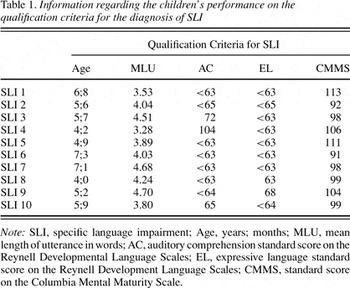
Information regarding the children's performance on the qualification criteria for the diagnosis of SLI
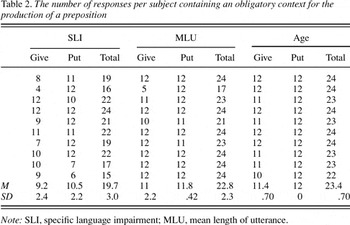
The number of responses per subject containing an obligatory context for the production of a preposition
The overall percentage of prepositions produced correctly by participant group.
The percentage of preposition errors (substitutions or omissions) for the verbs put and give.
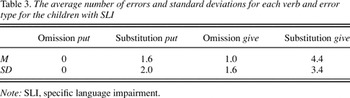
The average number of errors and standard deviations for each verb and error type for the children with SLI
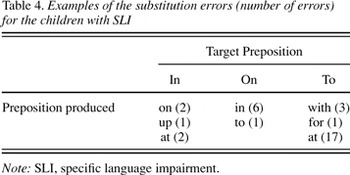
Examples of the substitution errors (number of errors) for the children with SLI
 You have
Access
- 29
- Cited by