The possible etymology of Isimu(d)
What we know about this God are basically three things: He is the servant of the much more important God Enki. Other great Gods have such servants as well, sometimes described by modern authors as “messenger”, “vizier” or even “secretary”. On some Sargonic seals like the seal of the scribe Adda, a God with water streams with fishes arising from his shoulders is accompanied by a God with two faces in a serving position.Footnote 1 The God with water streams is generally identified as Ea/Enki and the God with two faces is likely Isimu. From a much younger commentary we know that his Akkadian equivalent Usmû had two faces.Footnote 2 The third thing we know about him is his name Isimu, with the longer form Isimud. Enki says to Isimu in Innana and Enki (passim): sugal7 disimu-ĝu10 mu du10 an-na-ĝu10 “my vizier Isimu, my good name of heaven”,Footnote 3 but this is not an analysis of his name.
The original writing is dPA4.SIG7.NUN.ME = disimu4(-d). In this NUN.ME is a semantic marker, which had no consequences for the pronunciation. The lexical data are collected below:
See Ea (MSL 14, 190, 272): i-si-ma/mu PA4.SIG7 = šá d<PA4>.SIG7 us-mu-u; An Anum II 298f. dŠA(a-ra), dPA4.SIG7(i-si-mu).NUN.ME = sukkal-maḫ den-ki-ga-ke4 “Grand vizier of Enki”. Compare Ea IV 196f. i-si-im U.AD = per'u, riqqu and [i]-si-mu ĝešU.AD.SAR = per'u OB Diri 224 and OB Diri iii 16 (cf. the reading mú of SAR). Beside this ĝešGUL and ĝešGUL.SAR are explained as per'u MSL 12, 140 (Lú ša), MSL 5, 114 (Hh III), Civil 2010, 104. See further GULi-si-muSAR = ziqpu Antagal D 69, MSL 17, 204.
The lexical lists do not confuse U.AD and GUL, which look very similar, but they are probably only graphic variants of the same sign. Like modern languages Sumerian and Akkadian use words for plants or parts of them also when describing family relations. The word per'u means “shoot, offshoot, loaf” and “offspring, descendants”, while ziqpu stands in this connection for “shoot, sapling” and riqqu is an aromatic plant, normally written Sumerographically (ĝeš)ŠEM. We can assume /isim/ as shortened /isimu/ or “growing offshoot” with mú “to grow”. A relation to isin(PA.ŠE) = išinnu “stalk (of grain)” (other readings isina, iši/en) seems probable.
The name of the God may thus have been “growing shoot” or “who lets the shoot(s) grow”. But there is a problem at the end. disimu ends with d before a vowel.Footnote 4 But mú “to grow” ends with a vowel and has a ḫamṭu participle in the name of the goddess d(nin-)a-zi-mú-a, dá-zi-da-mú-a. There are not many examples for divine names with a marû participle with -e(d). The author could only find dnin-u4-zal-le TCL 15, 10, 70; An Anum I 239 and dur-bàd-da-gub-gub-bu An Anum I 143. A serious problem is that mú is reduplication class: é ḫur-saĝ-gen7 im-mú-mú-ne “they let the temple grow high like the mountains” Gudea Cyl. A xxi 19; mú-mú-dè Lamentation over Sumer and Ur 10; 11; 38 passim.
An old name may deviate from the regular form, but this is a weak argument. It seems better to assume, that the verb mud is involved. Outside personal names mud is very rare and even in personal names it is not used in the Ur III period or later. Names with mud were investigated by Manfred Krebernik.Footnote 5 He shows that in many cases names with mud have parallels with è “to come out, to bring out”. With a cautious expression he concludes: “Man könnte vermuten, daß mud einst ein mit è in etwa synonymes Verbum mit der allgemeinen Bedeutung ,hervorkommen (lassen)‘ war, das sekundär auf das in dem Begriff enthaltene ,Gebären‘ eingeengt wurde” (Krebernik Reference Krebernik, Streck and Weninger2002: 46). He observes that many of the names with mud include a word related to water. Just these words are not used with è, among them Enki's cosmic dwelling place and temple name abzu.
There is a divine name dnin-ti-mud “the lady who brings life forth” and much more important the epithet of Enki dnu-dím-mud “who makes (and) creates”. Compare Enki and Ninmaḫ 12: ĝeštú daĝal mud diĝir šár-šár ĝál-ĝál “the one who is bringing forth wide understanding, who brought into existence the countless gods”Footnote 6 and the late interpretation: dnu-dím-mud : dé-a : ša nabnīte “related to the created beings”.Footnote 7 dnu-dím-mud is not an epithet of Enki like others. It is old,Footnote 8 it is created in a very specific manner with the prefix nu-, normally used to create names for professions. It combines two verbs, which are very specific for Enki and it has a counterpart in the epithet dnu-nam-nir of the most important god Enlil, but no other god has an epithet like these two.
Since his master has such a strong relation to the verb mud, it seems likely that the name Isimu(d) is to be interpreted as “isim mud” “who brings the shoots forth” or the like. There is no big semantic difference to an interpretation that uses mú.Footnote 9 That Sumerian words can develop shortened forms can be demonstrated with several examples like zì/zíd = qēmu “flour”, but ZÍD-munu4 > isimmānu “a malt preparation”, akán, kan4, ká “gate”.Footnote 10 A reduction of mm to m is much harder to prove since si-mu can spell /simmu/ and /simu/. But it wouldn't be a surprise if such a reduction sometimes happened as well.
There is still a problem with the d, since it seems stable in mud but not in Isimu(d). But mud was not visible in writing and for a long time a rare expression, while isim-mú seems the interpretation of the lexical lists mentioned above.
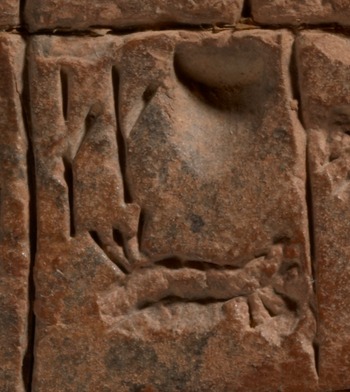
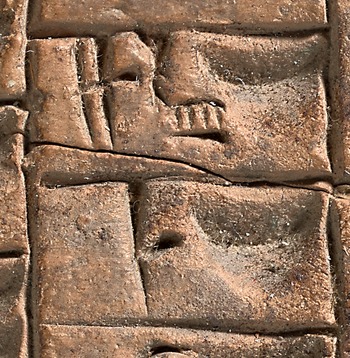
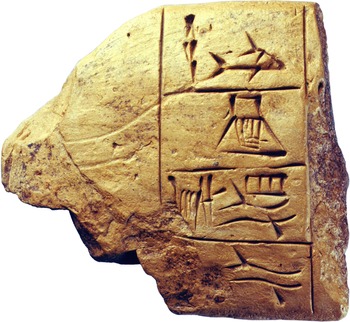
It seems that the sign PA with the reading pa = ḫaṭṭu “staff, stick, branch, twig” (from which gidruPA = ḫaṭṭu “sceptre” is of course derived), artu “foliage”, larû “branch, fork”, aru “frond, leaf of the date palm” is derived from PA4. VAT 15003 (Uruk IV Archaic Lú A, P000006, here fig. 1) writes PA as PA4.PA4 three times (like in Uruk IV P001031, P001213 passim). The graphic is clear and cannot be interpreted as one trunk with two twigs, since the twigs are not on different sides. For PA = PA4.PA4 in Uruk III compare for example AOST 109 (006438, here fig. 3), CUSAS 1, 48 R; 49 R; 51 R iii, passim. In an abbreviated graphic the twigs can be made in one stroke (for example W 22102,3 = P004525, and here fig. 2). If not carefully written it may look like PA4.AŠ and by changing the angle it takes the form of later PA. Both graphics can be used on the same tablet (MSVO 4, 62). Beside this there is another graphic for which the author could not find any example earlier than Uruk III. Perhaps influenced by RAD the twigs are on different sides and form right angles with the trunks.Footnote 11 This graphic could be seen as one trunk with two twigs or branches on different sides. But it is much more likely that this form developed from PA4.PA4 than the other way round.
PA.RAD Uruk IV (Archaic Lú A) VAT 15003, detail. Photo: Staatliche Museen Berlin - Vorderasiatisches Museum / Olaf M. Teßmer

PA.EN / PA4 Uruk III, VAT 16758. Photo: Staatliche Museen Berlin - Vorderasiatisches Museum / Olaf M. Teßmer.

AOST 109, Uruk III, obverse. The third box from left to right: ŠU.PA.RAD.GÁNA. It shows how PA4.PA4 is merging in one graphic for PA. AOST 109 is a permanent loan of the University Foundation, donation Dr. C. Pelling and Dr. M. L. Zarnitz. Photo by H. Jensen, University of Tübingen. AOST means Altorientalische Sammlungen Tübingen. By courtesy of Wiebke Meinhold, thanks to Konrad Volk.

PA4 is the picture of a trunk with a branch, twig or foliage, but this meaning went to the sign PA developed from PA4.PA4.Footnote 12 That a new sign is formed by the reduplication of another sign is not unique. Compare for example NUN.NUN = NIR, MU.MU = DAḪ. In the case of PA4 we assume that since twigs are normally seen in greater numbers this meaning was expressed by PA4.PA4, while PA4 remained for the derived meaning pa4/pab “elder brother” or the like.
Another example may be AN, the picture of a star used for an “sky, heaven”, the god An and diĝir “god”. But “star” mul is AN.AN.AN. That three stars are used may be due to the fact that AN.AN = NAB came in between.Footnote 13 The sign MUL is used in Uruk III in the names for an aquatic animal MULku6 (“starfish”?) and a cow áb-bar-MUL.Footnote 14 The meaning “star” is without doubt attested in Tell Fāra.Footnote 15
From the picture as from the relation with PA, we may conclude that PA4 could have the meaning “twig” and PA4.SIG7 “green twig” = “shoot” or “growing shoot”. There is a problem with this reasoning. If we assume that PA was created for the meaning “twig”, “branch” already in Uruk III, then PA4 like AN had another meaning as already stated. Perhaps in combination with SIG7 the doubling of PA4 was not seen as necessary since the combination was clear enough.
Isimu in the Early Dynastic period
PA4.SIG7.NUN.ME is not attested in the completely reconstructed list Archaic Lú A, from Uruk III.Footnote 16 The combination appears for the first time in ED I/II Ur:
Uruk III UET II 300 iii SF 33 v 7-9 (ED IIIa, Tell Fāra)
DU.EZEN ˹DU˺.E[ZEN] DU.EZEN
GAL.ZÀ SIG7.P[A4].N[UN.ME] SIG7.PA4.NUN.ME
NESÁĜ.ZÀ GAL.N[AR] GAL.NAR
The rest of UET II 300 is broken, but it can be seen, that it followed the version of ED Lú A where between DU.EZEN and GAL.ZÀ SIG7.PA4.NUN.ME, GAL.NAR, GAL.BALAĜ and GAL.KA׊U are added. This makes our restoration of the second line very probable.
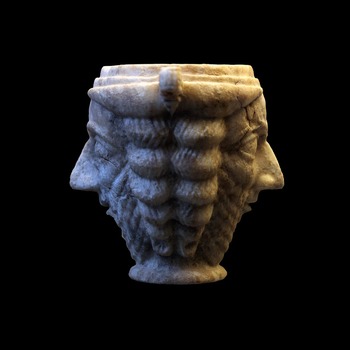
Peter Calmeyer dated a copper vessel and a similar alabaster vessel (fig. 4) with two bearded faces looking in the opposite direction as from the earliest phase of the ED style.Footnote 17 Calmeyer cautiously identifies the figure as Isimu.
In Tell Fāra his relation to Enki becomes clear by SF 40 viii 4: den-ki SIG7.PA4.NUN.ME gù dé “Enki called Isimu”.Footnote 18 A long counsel-speech of Enki begins with dumu-ĝu10 “my son” or lú-tur-ĝu10 “my little one”.Footnote 19 But even if “my son” is correct, the later tradition speaks against the possibility that Isimu was once seen as a son of Enki. In Tell Abū Ṣalābīḫ Isimu is mentioned in IAS 133. Someone - most probably Enki - is speaking to him and Isimu is answering. Some lines in between are not clear to me:Footnote 20 d(U4)en(G[AL])-[ki(UNU)] kaš mu(NUN)-naĝ kaš mu(NUN)-dù isimu4 enim mu(NUN)-na5-du11 isimu4(PA4.SIG7.NUN.M[E]) “Enki was drinking the beer, he liked (dù for du10?)Footnote 21 the beer. He spoke to Isimu: ‘Isimu…’” IAS 133 ii 2’-6’. isimu4([SIG7.P]A4.NUN.M[E]) enim <mu(NUN)?>-gi lugal(PA.NUN)-ĝu10 “Isimu answered: ‘My lord…’” IAS 133 ii 10’. He appears at least once again at the broken end of a column where a boat-ride of dasar and Enki (U4.GAL.UNU) is mentioned: isimu4 enim na5-mu(NUN)-na5-du11 [SI]G7.PA4.NU[N.ME …] “He (Enki) truly spoke a word to Isimu: ‘Isimu…’” IAS 133 v 8’f. In both texts we see Isimu in his typical role listening to the commands of his master Enki. In Ašnan and her Children Isimu speaks to his master called nun “prince” (IAS 283 v, 288 iii’). The context is again not clear.
The SIG7.PA4.NUN.ME in ED Lú A may stand for a human “priest”. But the author knows no text outside Lú A where such a priest is mentioned. It is not certain that all entries in this list mean human beings or their offices. Compare Archaic Lú A 99 = ED Lú 97: UŠUMGAL most probably the dragon-like mythical monster ušumgal. That is why the SIG7.PA4.NUN.ME in ED Lú A may indeed be the mythical servant of Enki. Even if it is a priest, this priest is very likely related to the mythical being. We can conclude that Isimu is attested roughly from the beginning of the ED time. But we have no proof for his existence in Uruk III.
The reviewer of this article doubted the expression “priest” since the name came after EZEN.DU perhaps “who stands/serves in the feast” and is followed by musicians GAL.NAR, GAL.BALAĜ. The objection is justified. Isimu is inserted in the list after three expressions with the sign EZEN: GAL.EZEN, MÙŠ.EZEN, DU.EZEN together with the two musicians and the GAL.KA׊U. If we see Isimu as the mythical servant of the god Enki, his connection with a feast is understandable. Enki likes beer, first attested in the passage from IAS 133 quoted above. The brewing goddess Ninkasi is his daughter.Footnote 22
Louvre vase AO 29723. Author: Rama, https://commons.wikimedia.org/wiki/File:Vase-AO_29723-IMG_1028-black.jpg, license: https://creativecommons.org/licenses/by-sa/3.0/fr/deed.en. Photo re-sized.

The two vessels published by Calmeyer come to mind. They have roughly the conical form of early dynastic cups. Calmeyer (Reference Calmeyer, Finkbeiner, Dittmann and Hauptmann1995: 49 n. 5) mentions for the copper vessel only the height 14.8 cm and the diameter at the bottom as 5.55 cm since he thinks that the vessel was distorted. For the other vessel, which is in the Louvre (AO 29723), the website of the museum gives the height 18.8 cm, width 17.8 cm, length 19.7 cm. Calmeyer Reference Calmeyer, Finkbeiner, Dittmann and Hauptmann1995: 50 n. 11: “H = 18,6 cm; max. Breite (mit Henkeln) = 19,7 cm; max. Öffnung 11,2 cm, Dicke des Randes 0,9 cm; Höhe des Gefäßinnenraumes 16; Öffnung der Henkelösen ca. 0,8 cm.” It is not possible to calculate exactly the volume. A cylinder with a diameter of 11.2 cm and a height of 16 cm would have a volume of 1.58 litres. Since the diameter gets smaller towards the bottom we may expect a volume of roughly 1 litre or a little more. This is a possible volume for a small soup tureen, but big for a cup. But with their extraordinary décor the two vessels may be for the ceremonial use of a god like Enki.
Enki and the sign NUN
The second part of PA4.SIG7.NUN.ME is a semantic marker. NUN.ME has the reading abgal, a sort of priest or magician associated with Enki.Footnote 23 NUN.ME is also part of the following complex writings:
EN.(PA4.)SIG7.NUN.ME.EZEN×KASKAL = enkum
NIN.(PA4.)SIG7.NUN.ME.EZEN×KASKAL = ninkum.Footnote 24
The enkum and ninkum belong to the staff of Enki's temple. In the composition Innana and Enki they are among the mythical beings of Enki which attack the boat of Innana in vain from the water.Footnote 25
The sign NUN is not exclusively but often associated with Enki. His cult place Eridu is written NUNki.Footnote 26 Compare en-líl/Éki for Nippur the cult place of Enlil, UTU.ÈŠ = Larsa,Footnote 27 SES.ÈŠ = Ur (cf. SESna = NANNA), perhaps [IN]NANA.ÈŠ = Zabalam,Footnote 28 INNANA.ŠÉŠ (INNANAšéš?) = Susa (Archaic Cities 30). Later IM(iškur)ki = karkaraki may be identical with Archaic Cites 26 IM×A = NÍ, which later merged with IM (Krebernik and Lisman Reference Krebernik and Lisman2020: 114 n. 352). From this it may be that Iškur was written NÍ in Uruk III. Archaic Cities 32f. NE.GI / KU7/AB.SU is rendered as dNE.GI / dKU7 in Tell Fāra.Footnote 29 Compare also later NISABAki = éreški, SÙDki = šuruppakki. The goddess ddam-gal-nun-na “great wife of the ‘nun’”, mentioned in connection with Eridu for the first time in the Zame-Hymns and probably mentioned in SF 1 from Tell Fāra,Footnote 30 is Enki's wife. The list SF 7 begins with den-líl(É),Footnote 31 en-líl, dinnana, dinnana, nun, nun, dsùd, dsùd, dGIBIL6,Footnote 32 dGIBIL6. SF 7 is not a god list, but mainly a list of signs in various combinations (Biggs Reference Biggs1974: 36). But the beginning is strikingly parallel to real god lists, with one exception. Compare den-líl, den-ki, dGIBIL6 at the beginning of SF 5 and 6; an, den-líl, dinnana, den-ki SF 1 i 1–4. These and other texts show that in SF 7 nun is written for Enki, while other gods are not represented by an epithet.
That the god we know from later texts as Enki was known in Uruk III is probable from the fact that the text Archaic Cities mentions two times SU.AB, probably abzu, the name for temples of Enki and for his cosmic dwelling place beneath the earth.Footnote 33 The notion of the Abzu and the relationship of Enki with the Abzu are very special concepts. It seems improbable that Enki has inherited the Abzu from another god. He is clearly mentioned for the first time in CUSAS 17, 104 a stone inscription from the beginning of the ED period. There he is mentioned several times and once between Enlil and Innana, which underlines that he was already a very important god.
Probably NUN was written for Enki in Uruk III. Whether nun was his old name or NUN could be read enkix is not certain. Normally Sumerian gods have specific names not just “Lord”, “Lady”, “God” or the like. That is why it is less likely that “Prince” was written as a name.
ME can be read išib “purification priest” and is part of another sign for a priest: gudu4.Footnote 34 Standing alone NUN.ME can be read abgal. The word means a profession and can be used to designate a class of mythical beings. The abgals are often connected with Enki, Eridu, Enki's son Asarluḫi and are mentioned beside the enkum and ninkum.Footnote 35 It is tempting to analyse the writing NUN.ME for abgal as a reference to the god Enki and the profession “priest” or better a professional for rituals concerning a deity. In this case it is not excluded that the profession can as well be performed in the realm of myths.
NUN.ME has its own line in Archaic Lú A and is used together with other signs four times. The sequence is very stable. There is no *ME.NUN and another sign is almost never inserted between the two.Footnote 36
As a hypothesis we can explain combinations of NUN or ME with other signs in the same way in which we tried to explain NUN.ME. Compare Archaic Lú A 11 ÈŠ.ME, 58: MÙŠ.ME and 77: NUN.SAĜĜA where ÈŠ is probably a shrine or sanctuary,Footnote 37 MÙŠ may stand for Innana or her temple and SAĜĜA for a high official, since at least later saĝĝa means the chief administrator of a temple. If we are right in comparing lines 58, 77 with NUN.ME, NUN seems to be interchangeable with a god or temple, ME with a sort of priest or a person with duties in a temple. If we compare EN.ME of line 63f. (engiz, endib) we have EN instead of NUN, which stands probably for a person of high rank, be he human or divine, perhaps Enlil. But since en/nin are separating enkum and ninkum another analysis seems more likely: enengizx(ME.GI), enendibx(ME.MU). Since GI may be a phonetic markerFootnote 38 and MU = muḫaldim “cook” a semantic marker, ME remains as a marker for “priest” or “personal of a temple”. That ME and NUN.ME are often used in Archaic Lú AFootnote 39 points to a specific function as marker and in accordance with what we can say about nun and ME and about abgal, enkum, ninkum from later texts this may well be ME as a marker for a profession with connection to the divine or supernatural sphere and NUN as a marker for a relation to the more specific sphere of Enki. The only combination in which NUN is used without ME in Archaic Lú A is the mentioned NUN.SAĜĜA.
The chthonic character of Enki and Ea
But how can we connect the God Enki and his servant with two faces to someone “who is bringing the shoots forth”?
There is a god with a similar name: Pabilsaĝa < pa(4) (gi)bil saĝ-a(k) “first new twig”? He is the son of Enlil who was married – officially or not – to goddesses who had a connection with birth and fertility or with grain: Ninḫursaĝa/Nintur, Ninlil, daughter of Nunbaršegunu, Sud, daughter of Nisaba. From the Old Babylonian period onwards Pabilsaĝa merged with Ninurta, another son of Enlil who had a strong relation to agriculture.Footnote 40
Isimu never developed a personality as a god independent from his master. That is why his characteristic and his name should be connected with Enki. That a god who is connected with knowledge, knowing everything has a servant who can look into two directions at the same time, is no surprise.Footnote 41 This fits Enki's character as the wise and tricky god. On the other hand we may also connect the two faces with the enigmatic god Enki whose character and intentions aren't always clear. A third explanation will be mentioned later.
In Innana and Enki the servants and monsters of Enki cannot attack the boat of Innana since Innana has advised her vizier Ninšubur to avoid contact with water. This and other texts show Enki as the god of water. But this is not precisely correct. He never brings the rain or commands the waves of the sea. He is connected with water on earth, in the earth and coming from the earth like the water coming out of his shoulders on some Sargonic seals. His Eridu was situated in the very south of Mesopotamia within the marshes where land and water are intertwined.
His name den-ki-(k/g) means “lord of the earth”.Footnote 42 This was obscured to modern scholars by the development /ki + ak/ > /kik/ > /kig/, which led to the idea that a word ki(-g) must be involved or that the name may not be Sumerian, since k of the genitive normally resists the development k > g in final position. But /kik/ must be an exception from this rule (which is itself an exception from k > g). This can be demonstrated with the example of the god dnin-MARki(-k/g). As shown long ago the ki is not a determinative, but must be a phonetic indicator (Attinger Reference Attinger1995). There is no place-name MARki attestedFootnote 43 and a determinative ki is normally dropped if a place name is used in the name of a god. Compare dnin-ĝír-su, dnin-ì-si(-in)-na. One exception is dnin-ša!-bu-nunki only mentioned once in IAS 83 iv 2’. In the following line the scribe wrote dnin-MARgi4 as did his colleague in IAS 84 ii’ 1’. IAS 83 and 84 are the only texts where the name is written with gi4 and most probably this was intentional done to avoid confusion with the determinative ki.
A god who is providing water is of course also sustaining plants. On some seals this aspect is visualized by plants coming out from the water running from Enkis shoulders.Footnote 44 But water is not the only element connecting Enki with the growth of plants. The other element is earth.
In Ur-Nanše 49 Enki provides a hole in the earth for the root of the reed.Footnote 45 In Enki and the World Order the god is planting a tree in the Abzu.Footnote 46 Enki also had a connection with burials. Irikagena describes the costs for a normal burial and a burial “in the reed of Enki” (gi den-ki-ka-ka).Footnote 47 In Ebla den-ki is mentioned next to the chthonic god Rasap and a tradition sees even Nergal associated with Enki and Abzu.Footnote 48 At least in texts about the local cult in Ebla the name stands probably for Ḥajju(m)/Ḥajja.Footnote 49 The tertium comparationis between Enki and Ḥajju(m)/Ḥajja/Ea is very probably the chthonic character of the god combined with his general importance. The name comes from the Semitic root ḥjj “to live”.Footnote 50 There is no verb at least with the meaning “to live” from this root in Akkadian,Footnote 51 but most probably the word ejum/eûm “grain”, “barley” has this root.Footnote 52 But the god made it as Ea to Mesopotamia. His partial identification with the great Sumerian god Enki may have helped him. He was also borrowed into the Sumerian pantheon as ḪajaFootnote 53 and married with Nisaba, whose name was analysed as nin še-ba(-k) “lady of the grain allotments” (Selz Reference Selz, Behrens, Loding and Roth1989).
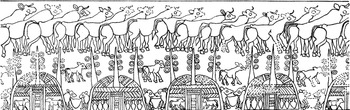
Ashmolean Cylinder Seal 1964.744, drawn by Diane Gurney, reproduced by editor (mw) from R.W. Hamilton, “A Sumerian Cylinder Seal with a Handle in the Ashmolean Museum”, Iraq 29/1 (1967) p. 35 fig. 1.

The sign NUN is the picture of a twig with fruits. A bowl from Ur,Footnote 54 a trough and several seals from ḪafāǧīFootnote 55 show a reed hut from which calves are emerging decorated with the sign NUN (compare fig. 5). All these artifacts are dated to Uruk III.Footnote 56 The reed hut with NUN but without the calves is most probably the origin of the sign TÙR with the meaning tarbaṣu “cow pen”. It also found its way into the combination šà-tùr = šassūru “womb”. A similar sign, in which the NUN-emblem is replaced by something which might reflect an ear of corn TUb and TUc, was later used for writing the verb dú(-d) “to give birth”. The sign TU was also used in the name of the mother goddess but with the reading tur5 as dnin-tur5.Footnote 57
In connection with the “birth-hut” NUN seems to be a symbol for fertility which is adding the fertility of plants to the fertility of animals. A possible assumption is that the word nun was already a common epithet of Enki or a forerunner of this god when writing was invented and that Enki was connected with growing plants and that this was the reason why a twig with fruits was chosen to write the word nun.Footnote 58
Fertility means life but is connected with the earth where the dead are buried. In Greek mythology Demeter, Persephone, Hades and Gaia were connected with fertility and with the netherworld. In Mesopotamia a god may have had these two very different aspects as well. A clear example is dnin-ĝeš-zi-da “lord of the true tree”. He has to travel to the netherworld, that is to say he was not always there. But he is the son of the god of the netherworld Ninazu and takes the role of the (ĝeš)gu-za-lá kur-ra “chamberlain of the netherworld” and is associated with snakes and dragons. His wife in the Gudea tradition is dĝeštin-an-na “grapevine of heaven”, the sister of Dumuzi, who like Ninĝešzida is living in the two worlds.Footnote 59 The name of his other wife is d(nin-)á-zi-mú-a translated by Jacobsen as “Branch grown out straight”.Footnote 60 Sumerian á has the meaning “arm”, “wing”, “horn” etc. But the combination á-an(-na) (zú-lum-ma) means the branches of the date palm and brooms made from it.Footnote 61 She became the dub-sar-maḫ a-ra-li “chief scribe of the netherworld”Footnote 62 and the same is said of Ĝeštinana.Footnote 63 The zi(-d) in the name may stand for “true”, “just”.
No text shows Enki dwelling among the dead in the netherworld and if he helps Innana and Enkidu to escape from the netherworld he does it from outside. But for the chthonic part of his character Enki does not have to go to the netherworld. He lives in his Abzu in the underground water.
For a god that helps the plants to grow a servant named “who brings shoots forth” is a good choice. Enki is connected with life and plants and that means with food. But his earth is as well the place where the dead are buried. This may explain the plot of the Adapa-Myth.Footnote 64 Enki helps his servant Adapa, but he prevents him from consuming the heavenly food and water of life, so that Adapa doesn't achieve eternal life like the gods, but remains in the sphere of Enki: An explanation of why human beings are mortal.Footnote 65 Seen in this way Enki is on both sides in the most important conflict with which mankind is confronted: life and death. And this may be another explanation why his servant has two faces.
Isimu and the Enkum, Ninkum were seen as somehow related at least from an Old Babylonian perspective. The writing of the Enkum, Ninkum take the PA4 from Isimu and EZEN×KASKAL is added from their writing to Isimu while in ED Lú A the different writings stand side by side. In ED Lú A the writings have two elements in common the NUN.ME probably a general marker of a priest or a priest of Enki and SIG7.
Above we have discussed the possibility that PA4 stands for “twig”. But there seems to be a striking parallel, the name Papsukkal the vizier of Zababa (later of Ištar), which is obviously a combination of pab “oldest brother” and sukkal (Old Babylonian Sumerian more likely sugal7) “vizier”, “messenger”. Papsukkal is the servant of a god, like Isimu. Isimu seems to be the most important of Enki's servants, the one next to his chief, and pab could express just this. But “who brings the shoots forth” has the stronger evidence on its side, since it explains not only the writing but the spelling of the name as well and can be connected with the chthonic character of Enki.
There remains one unexplained element in the writing of the name Isimu: SIG7, which is used in the writing of enkum, ninkum as well. There is a profession SIG7 probably “plucker”,Footnote 66 but this does not help.
Just before the entry enkum ED Lú A has NIĜIR.SIG7.Footnote 67 It may be read niĝir-úgur “field herald”. It may be the older title of the niĝir-MAR.TU “the herald of the nomads” contrasted by niĝir-sila “herald of the streets”.Footnote 68 The Ebla Sign-list (Archi Reference Archi1987) gives the sign name of SIG7 as ù-ga-lum. In Ebla [l] may be used instead of [r] and with later readings úgur, ukur5 we come to ugarx as already proposed by Archi.Footnote 69 The Ebla Sign-list takes the signs from ED Lú A but the entries are not meant as commentaries explaining ED Lú A. There are no translations and the readings are with Semitic suffixes as it is the common praxis for the names of simple signs from Old Babylonian onwards.Footnote 70 Combinations of signs which are essential for the understanding of ED Lú A are normally not explained and it is doubtful if the scribes of Ebla understood a list with Sumerian terms most of them not used in Ebla and many even out of use in contemporary Sumer. From the composite writing for enkum and ninkum (= EN/NIN.SIG7.NUN.ME.EZEN×KASKAL) the sign EZEN is rendered as ì-zi-núm and NIN as ù-ru-šúm according the reading ereš/urus in the Ebla Sign-list. This does not help the understanding of the combination, even if we suggest that the later interpretation as ninkum is wrong.Footnote 71 In the case of NIĜIR.SIG7 the sign name from Ebla could deliver the right reading and understanding of the second sign. Compare a-gàrLAGAB×SIG7 = ugāru “field” Ea I 76; Aa I/2, 252 (MSL 14, 180; 215).
A “field herald” may be deduced from a confusing entry in the canonical Lú Ša: niĝir-a-šà-g[a], niĝír-si = susapinnu “paranymph” (MSL 12, 126, 66f.). The paranymph is written niĝir-si already on the Ušumgal Stela (ED IIIa or older).Footnote 72 The first entry may be the result of some confusion of SIG7 = si12, úgur and NIĜIR.SIG7 and niĝir-si (niĝír instead of niĝir is not problematic).
But a better solution exists. There is a god dniĝir-sig7 mentioned as captain (énsi) of Enki's boat in Enki and the World Order 113; 184. There is a big gap of time between Archaic Ur ED Lú AFootnote 73 and Old Babylonian EWO. But the field herald is not attested beyond doubt and NIĜIR.SIG7 is mentioned in Archaic Cities and ED Cities,Footnote 74 where some deities are mentioned and ED Lú A mentions after NIĜIR.SIG7 two priests, both later connected with Enki and all three have the sign SIG7 as does from ED I/II onwards Isimu. There is no other explanation for the unique name dniĝir-sig7 in EWO. Even if we deny a relation with NIĜIR.SIG7 in Lú A, the name of Enki's captain strengthens the hypothesis that the sign SIG7 can express something related to Enki.
The sign SIG7 = IGI-gunû is derived from igi “eye”. Like its Akkadian equivalent warqu(m) it can mean the colour of things which we would describe as blue, green or yellow. The colour green is in the middle. Green is often the colour of eyes and of course the colour of green fields and of new shoots.
Richter (Reference Richter2004: 94f.) discusses some divine names with the sign SIG7 connected with Enki, including dnin-sig7 used for Ea/Enki himself.Footnote 75 We may also allude to: nam-ĝešĝešpa galam-ma-na den-ki-ke4 é-e ul ba-ni-in-sig7-ga “Enki has let blossoms blossom at the temple by his cunning spell”Footnote 76 Ur-Namma B 19; en sig7-ga den-ki “the lord who lets blossom, Enki” Hymn for Šu-Suen 25. This shows that sig7 can be used as a causative or factitive respectively “to let become green”, “causing to thrive/blossom”. And the acting god is Enki. Therefor SIG7 can be linked to the meaning of the name Isimu. And we may assume that the enkum and ninkum are meant as other servants of Enki connected with plants. There seemed to be a festival EZENb SIG7 NUN mentioned in two texts.Footnote 77 It is tempting to see it as a festival of Enki like Innana had her festivals. But the evidence currently still seems insufficient for a conclusion like this.
EZEN×KASKAL is the better documented but probably younger writing for EZEN+ŠE.Footnote 78 The same sign EZENb, looks like a knotFootnote 79 or one pearl on a string and stands for “(religious) festival” (Englund Reference Englund, Bauer, Englund and Krebernik1998, 127). EZENb is also used in the three entries after which at the beginning of the ED period Isimu and the two musicians were inserted (see above), which strengthens the argument for the meaning festival or feast. Festival + grain and the supposed later meaning of enkum as “treasurer of a temple”, may lead to the idea that they gave something out during or for the festival, but there is nothing in the economic texts that could prove such an idea. Starting in some Old Babylonian texts EZEN×KASKAL was added to the name Isimu probably taken from enkum, ninkum. There are a lot of variants like BÀD “wall” instead of EZEN×KASKALFootnote 80 showing that many if not all scribes did not understand the reasons behind the complex writings, but were only confused.
Enki appears depicted together with Isimu for the first time on Sargonic seals. While Enki is sometimes depicted with plants growing from his water streams, Isimu shows no affiliation with plants. The only other attendants of Enki depicted there are the Laḫama of the Abzu holding screen posts.Footnote 81
Isimu and Ara and the divine status of Isimu
According to An Anum (cited above) there is another vizier or another name of the vizier of Enki: dara(ŠA). He is first mentioned in Proto-Lú as the last one in a row of priests connected with Enki and written with NUN.ME etc.: enkum, ninkum, abgal, ábabrig(NUN.ME.DU), ara˹us-mu˺, MUNUS ara, sáĝĝa, sáĝĝa-maḫ Proto-Lu 245–52 (MSL 12, 41f.). But ara is written without divine determinative and not among gods and there is a female ara.Footnote 82 Both are mentioned in the much later canonical Lú Ša IV 114f. d a.raŠA, MUNUS dŠA = us-mu-u, us-mi-tu (MSL 12, 132), after u6-di(-gal) and before maḫḫû “ecstatic”. Before u6-di, which may mean something like “seer”, mēzû a rare expression for “brewer” is mentioned. We may cautiously conclude that u6-di is one who makes prophecies after drinking alcohol or taking other drugs and that the male and female Ara are depicted with a second face since they can see hidden things or things in the future. But the association must not be very close, it could be triggered by the equation “4 eyes = good sight” without a more specific relation between u6-di and Ara. Isimu is not mentioned in Proto-Lú and Lú Ša. It seems that Ara is not just another name of Isimu but designated another group of persons or supernatural beings at one point associated with Enki and Isimu. There is no clear solution which could explain the name Ara and its writing.Footnote 83
The word usmû is probably a loan from Isimu. There is a god dus-mu-u (Litke Reference Litke1998: 102) and a nisba with -ī, fem. -īt: usmû/usumû, usmītu “someone who has two faces”. That the final d is not preserved in Usmû, is no surprise since it is also missing in glosses to the Sumerian name. One can compare anzu(d) > anzû, ddumu-zi(d) > Tammūz. Vowel harmony is more common in Sumerian than in Akkadian and a change from isimu to *usumu may have taken place in spoken Sumerian. If a series of three syllables begins with two short syllables the reduction of the middle vowel is with some exceptions normal in Akkadian.Footnote 84
The names of Sumerian as of Semitic gods in Akkadian contexts are normally attested in the absolute state. There are a few exceptions like Anum, Antum, Nabû, but normally a case ending means that this being isn't seen as a god or seen as a god of very low status. The god Usmû is not found in the absolutive. Compare [a-n]a dus-mi-i Enūma eliš V 83. The heads on the above-mentioned ED I/II vessels probably showing Isimu or Ara do not wear the horned crown of the gods, but the horned crown was possibly developed later (Calmeyer Reference Calmeyer, Finkbeiner, Dittmann and Hauptmann1995: 51). When mentioned in ED I/II, IIIa and in ED Lú A from Ebla (ED IIIb) he is written without the divine determinative. On Sargonic seals and on the fragment of a stela of the time of Gudea he wears the horned crown of the gods.Footnote 85 In texts he appears again in the Old Babylonian period and is from that time onwards written with the divine determinative. But he isn't mentioned in any real god list earlier than An Anum, where his name is found among more than two thousand names. No priest or temple of his is known, his name is not attested as theophoric element in personal names in MesopotamiaFootnote 86 and no family relation with any other god or goddess is mentioned. With his two faces he is not fully anthropomorphic and his physical appearance evokes his role in the service of Enki/Ea. This may have contributed to his low status, while the vizier of Enlil, Nuska, and the vizier of Innana, Ninšubur, had a higher rank. Thus it is no surprise that even his name reflects only something he may do on command of his chthonic master, i.e. allowing the growth of green shoots, and not an individual quality peculiar to him.
Acknowledgements
An older form of this article was carefully read and criticized by an anonymous peer reviewer. I owe him or her many insights and corrections. I mention only some of them in the text. The author is of course responsible for all remaining mistakes or gaps.