While social movement research has taken a strong interest in disruptive and violent protest tactics, so far it has played a marginal role in the growing body of literature on the fair trade movement. This article takes up Frank Trentmann's suggestion of ‘widening the historical frame’ in which we analyse the fair trade movement.Footnote 1 As Trentmann's thought provoking analysis of moral food economies in the modern world has shown, ethical consumerism was not only used to improve the working and living conditions of plantation workers and other producers in the Global South but also to promote imperial goods in interwar Britain.Footnote 2 This article uses a similarly broad approach to analyse the role of violence in solidarity movements and its effects on producers in the Global South. More specifically, it explores the entangled history of violent and peaceful tactics in two transnational solidarity campaigns in 1980s West Germany.
Although there have always been debates about the ways in which business can or should contribute to the rest of society, these discussions have reached a new level of intensity in response to rapid economic globalisation in the 1980s. According to Michael Blowfield and Alan Murrey, this period saw the rise of corporate responsibility as a means for addressing the ‘unprecedented private sector wealth, power and impact’ on a global scale.Footnote 3 There are many different definitions of corporate responsibility, but most emphasise that companies need to take responsibility for their social and environmental impact even if they are not legally obliged to do so.Footnote 4 Media reports and first-hand testimonies about the abuse of workers in global supply chains in the 1970s and 1980s sparked protest movements in Western Europe that sought to improve the living and working conditions of producers in the Global South. While the strategies employed by these movements included initiatives to help marginalised small producers in the Global South by selling their produce in fair trade shops in Europe, there were also radical and violent protest activities that is rarely mentioned in the literature on consumer activism.Footnote 5
A growing body of research at the nexus of organisational theory and social movement studies examines how protest movements have tried to challenge companies and their trade practices and how organisations have responded to this challenge.Footnote 6 While the use of corporate boycotts and other extra-institutional tactics in campaignsFootnote 7 for social justice and better working conditions have been studied in a range of political contexts, the role of violent tactics in such campaigns and the ways in which the targeted companies have responded to violent protest have so far attracted relatively little attention.Footnote 8 Based on two case studies, this article explores the following questions: (1) how are violent protest tactics discussed in transnational solidarity campaigns for workers in the Global South? (2) Can they contribute towards achieving the objectives of such campaigns? Although the two campaigns cannot provide clear-cut answers to these questions, they can offer critical insights into the economic and political impact of violent protest.
The two protest movements discussed in this article are the German anti-Apartheid campaign, which was part of a worldwide protest movement against the South African Apartheid regime, and a solidarity campaign with South Korean women workers, who were producing clothes for the German clothing chain Adler. Both campaigns took place in the 1980s and aimed to challenge corporate practices and to improve the working and living conditions of producers in the Global South. While this aim was shared by activists in the growing fair trade movement, the two protest movements discussed here focused on products that were not available in the 200 fair trade shops (Eine Welt Läden) in West Germany (for example, oranges, everyday clothing and cars).Footnote 9 Both campaigns mobilised a range of groups including Christian organisations, trade unions, feminists, Third World activistsFootnote 10 and radical leftist groups. Lastly, and perhaps most importantly, the protest tactics employed in both campaigns ranged from posters, flyers, boycotts and demonstrations to bombings and other attacks against the property of the alleged profiteers of the exploitation of workers in the Global South.
It is important to highlight that there was no consensus on the use of violent protest tactics in either of the two campaigns. In both cases, bombings, arson attacks and other acts of property damage were carried out by relatively small groups of people who did not seek the approval of other activists, and they were met with strong opposition in parts of the solidarity campaigns.
Although ‘there has been considerable disagreement over whether disruptive or violent movements are more successful than those that are less contentious’, recent research in organisational theory suggests that companies feel compelled to respond to protest movements if they consider these campaigns pose a substantial threat to their reputation and/or business interests.Footnote 11 According to Joseph Luders, firms weigh the effects of accepting or resisting change demanded by protesters based on an assessment of disruption and concession costs. In this context, disruption costs refer to the losses ‘resulting directly and indirectly from movement actions’, including as the result of demonstrations, boycotts and negative publicity, while concession costs occur because of measures to meet the demands of protest movements.Footnote 12 Luders’ economic opportunity structure suggests that companies are likely to accept change if they consider the disruption costs high and the concession costs low, but it is considerably less likely that they respond in this way if the concession costs seem high. If confronted with high concession costs, firms tend to respond with minor concessions. If the disruption costs seem high, they tend to engage in protracted negotiations. Faced with low disruption costs companies usually ‘offer durable opposition’ to the protest movements.Footnote 13 This article will use Luders's model to analyse the ways in which corporations have responded to violent protest. Having invested large sums of money in lucrative production sites in South Africa and South Korea, the German companies targeted by the two protest movements faced high concession costs and were reluctant to concede to movement demands. As the article shows, their responses to the two campaigns depended not only on the protest tactics employed but also on media coverage and the broader political context.
A Transnational Campaign Against Trade with the South African Apartheid Regime
As a heavily export oriented economy, the South African Apartheid regime had a keen interest in trade relations with West Germany and other countries in the Global North. As early as 1959 the prominent South African teacher, spokesperson of the ‘African National Congress’ (ANC), anti-Apartheid activist, and future Nobel Prize winner Albert Lutuli called for a worldwide boycott of South African goods. In the same year activists in Britain responded to this call with the formation of the ‘Boycott Movement’, which was renamed the ‘Anti-Apartheid Movement’ [AAM] one year later.Footnote 14 Calls for a cultural boycott of South Africa can be traced back even further in history. In 1956 Equity, the trade union for creative practitioners, called for a boycott of all South African theatres that were adhering to the government's racial segregation policy.Footnote 15 Soon, many musicians and writers in the United Kingdom joined the cultural boycott, and prominent musicians like the Beatles and the Rolling Stones refused to perform in South Africa.Footnote 16 Although the public interest in the situation in South Africa waned in the United Kingdom over the course of the 1960s, South African activist Peter Hain's successful ‘Stop the Seventy Tour’ campaign against a South African cricket tour brought it back into the spotlight.Footnote 17 The AAM was never able to persuade governments to demand mandatory economic sanctions, but there can be no doubt that the boycotts helped to keep the Apartheid issue on the political agenda in the United Kingdom and many other countries.Footnote 18
Like in the United Kingdom, where ‘opposing apartheid meant very different things for different people and served very different purposes’, the West German anti-Apartheid movement was extremely diverse and involved Church groups, humanitarian organisations and anti-imperialist groups.Footnote 19 Among the first to mobilise against the Apartheid regime were Black South African students in West Germany and Protestant ministers and other Church members from Germany, who had first-hand experience of the situation in South Africa. Quinn Slobodian has traced expressions of solidarity with activists from the Global South in the German student movement back to the early 1960s.Footnote 20 In 1963 the South African academic and anti-Apartheid activist Neville Alexander was arrested after returning from a research stay in West Germany. In response to his arrest, exiled South African students and German activists raised 40,000 Deutschmark (DM) for his legal defence and called for an end of political ties and business relations with the Apartheid regime.Footnote 21 In 1964 Latin American, Haitian and Ethiopian students in West Germany set up an ‘international working group’ with German student activists in which they discussed anti-colonial struggles and revolutionary theories from the Global South.Footnote 22
Despite this and other campaigns in the 1960s, South African exiles found that most West German University students had little or no knowledge of the political situation in South Africa and many other countries in the Global South. When the artist Gavin Jantjes came to Hamburg on a German scholarship in 1970 he found his fellow students ‘pretty dull’. In an interview from 2016 Jantjes recalled that the young people he met ‘didn't know anything about the world. This was a time of political protest against the Vietnam War and I mentioned South Africa and Apartheid they didn't even know where South Africa was’.Footnote 23 While Jantjes's fellow students tried to enthuse him for the work of Karl Marx, Herbert Marcuse and other revolutionary thinkers, he used his art to raise awareness for the situation of Black and Coloured South Africans and tried to mobilise fellow students and other people in West Germany against the Apartheid regime.
When collecting material for his screenprint series South African Colouring Book in the early 1970s, Jantjes established contact with ANC members in East Berlin and promised them to do what he could to support their struggle.Footnote 24 Unlike in East Germany, the ANC was a banned organisation in West Germany, and the activities of Jantjes and other South African exiles with links to the ANC were monitored closely by German and South African security services. Nevertheless, Jantjes joined forces with other dissidents and looked at the possibility of starting a West German anti-Apartheid group. Soon after being granted political asylum in West Germany in 1973, he joined the Anti-Apartheid Movement (Anti Apartheid Bewegung; AAB) in Germany.
Founded in April 1974 by the progressive Christian group Mainz Working Group Southern Africa (Mainzer Arbeitskreis Südliches Afrika) and representatives from a range of organisations, including the ANC and anti-Apartheid groups in the United Kingdom and in the Netherlands, the AAB had one single objective: to end of all forms of collaboration between West Germany and the racist regime in South Africa.Footnote 25 The AAB was campaigning for the release of political prisoners and called for an immediate end to South African state visits to Germany, as well as military cooperation and other forms of collaboration with the Apartheid regime. The group's activities ranged from petitions, public letters and lawsuits against alleged profiteers from trade with the Apartheid regime to creative protest actions and boycott campaigns. Whilst working with the ANC and other militant groups in Southern Africa, the AAB limited itself to peaceful and constitutional means of protest. The members of the organisation were divided on the question of how the AAB should relate to armed liberation struggles in Southern Africa. In the mid-1970s Jantjes, the only Black South African board member of the AAB, urged the organisation to show solidarity with armed ANC rebels. Other members, however, rejected this stance as ‘anti-imperialist dogma’.Footnote 26 The use of violence by South African anti-Apartheid activists continued to be a matter of controversy into the 1980s.
The first major boycott campaign against South African produce in West Germany was inspired by a successful example from the Netherlands. In 1972 and 1973 a group of Dutch anti-Apartheid activists had organised an educational campaign about a large-scale boycott against South African Outspan oranges. In 1972 the group released a booklet with the title Outspan: Building Bricks for Apartheid (Outspan: Bouwstenen voor apartheid). As former group member Essau du PlessisFootnote 27 explains, the title referred to the South African Prime Minister Balthazar Johannes Vorster's statement that ‘every time a South African product is bought, it is another brick in the wall of our continued existence’.Footnote 28
In the early 1970s the South African authorities had initiated a carefully planned promotion campaign to boost sales of South African citrus fruit in Western Europe: they sent a group of white South African ‘Outspan Girls’ on a tour through European supermarkets to attract new customers in this key market area. In the Netherlands, an ethnically diverse group of activists who called themselves ‘Inspan Girls’ (Harness Girls) followed the Outspan Girls on their tour through supermarkets and sales fairs. Together with other opponents of Apartheid, the Inspan Girls tried to educate consumers about the political situation in South Africa and promoted a boycott of Outspan oranges and other South African produce.
At its peak, the Dutch ‘Boycott Outspan Action’ (BOA) was supported by hundreds of anti-Apartheid and Third World groups, radical Churches and political organisations in the Netherlands, as well as by a number of journalists, artists and other public figures. To expand its reach beyond politically involved student circles, BOA activists disseminated information material through the growing network of ‘Third World Shops’. According to du Plessis, Third World Shops worked closely with local anti-Apartheid groups.Footnote 29 The fact that some shops sold fairly traded coffee from Guatemala and supported a boycott of South African produce shows that Dutch activists drew on a wide range of tactics to campaign for greater equity in international trade.
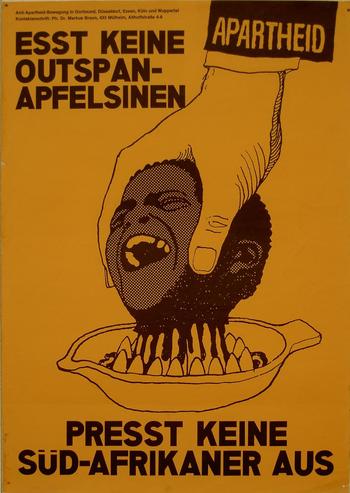
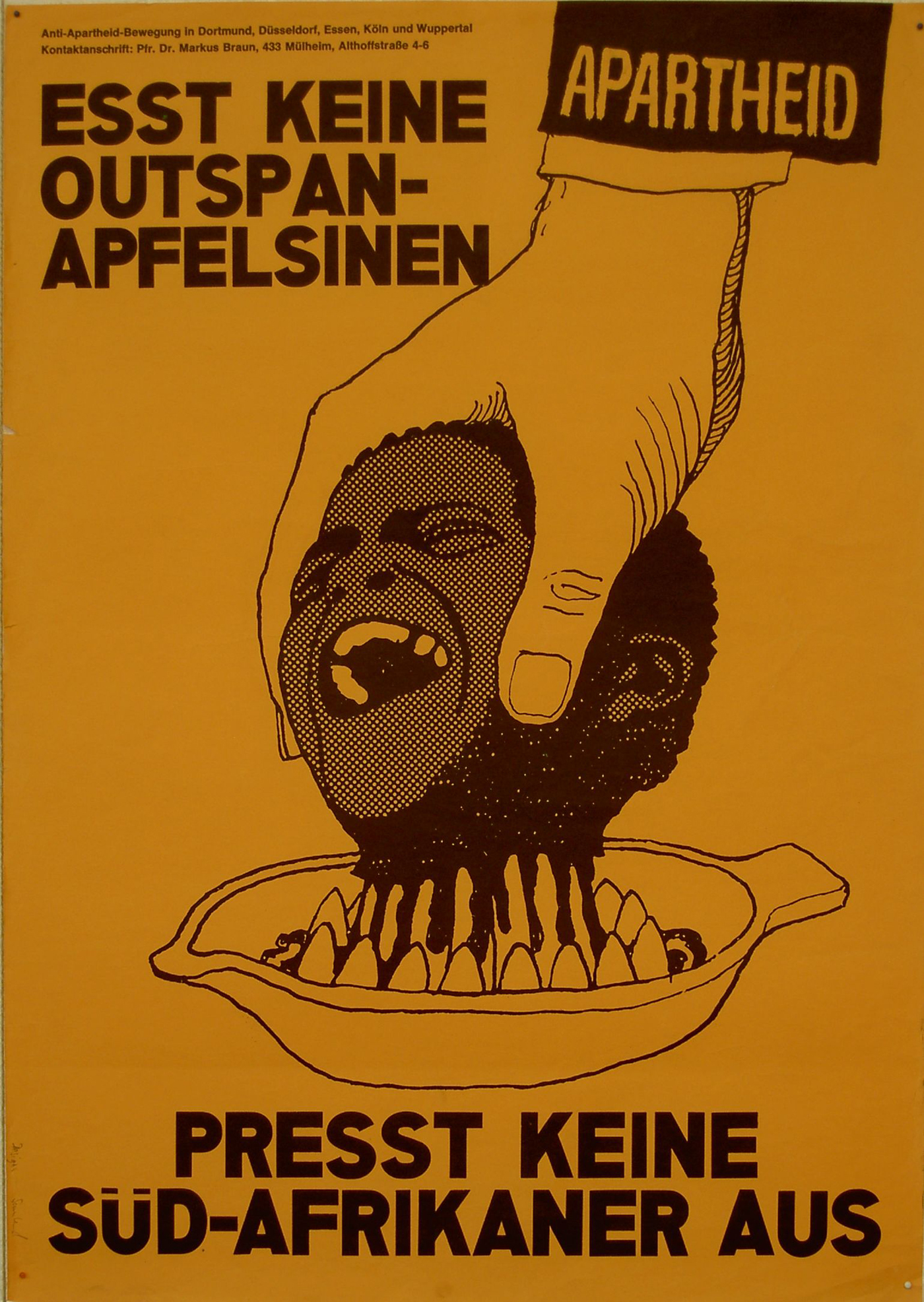
The first coordinated protests by anti-Apartheid activists in West Germany took place in autumn 1974. Like their Dutch colleagues, members of the AAB responded to the Outspan Girls tour in their country with a series of protests, which evolved into a broader boycott movement against all fruit and vegetables from South Africa. After a long discussion, the AAB decided to use a controversial BOA poster, which had led to a legal dispute in the Netherlands (see figure 1).Footnote 30 The image of a white hand squeezing the head of a Black South African boy like an orange implies a clear distinction between white perpetrators of violence and Black victims. The armed struggle of the ANC and the ‘Pan Africanist Congress’ (PAC) did not fit into this picture and was not mentioned.
‘Don't Eat Outspan Oranges/Don't Squeeze South-Africans’
In the Protestant Women's Work in Germany (Evangelische Frauenarbeit in Deutschland), the AAB managed to find an important ally in 1977. Soon there were groups across the country who handed out flyers, put up information stalls, provided information about alternative consumer choices and wrote letters and petitions. The protest activities organised by the members of Protestant Women's Work, which met with considerable resistance in Christian circles, are now considered the most successful anti-Apartheid campaign in West Germany.Footnote 31 Although it did not stop German supermarkets from importing fruit and other products from South Africa, the fact that South African companies responded to these activities with labelling systems that obfuscated the origin of their produce was interpreted as an indicator of the success of the campaign.Footnote 32
The actual magnitude of the economic threat that the boycott campaign posed to South African companies and their West German trading partners is difficult to assess. After a decline in the early 1980s, citrus fruit exports from South Africa ‘grew impressively by 5.3 per cent per annum’ in the second half of the decade,Footnote 33 and West Germany was one of the biggest importers of South African citrus fruit.Footnote 34 Rather than making the substantial concessions that activists in South Africa and West Germany demanded, South African companies responded with creative measures designed to hide the origin of their agricultural produce. Asparagus from South Africa was rebranded as ‘Bethlehem Export’, and South African orange jam was vaguely labelled ‘foreign produce’.Footnote 35 According to Luders, the targeted companies can be classified as ‘vacillators’. ‘Without the choice of low-cost compromise, but desiring a means to end disruptions’, vacillators ‘lack an optimal response’.Footnote 36 As a result, companies wavered between repression and nominal confessions, engaged in dilatory tactics or tried to outmanoeuvre their opponents and other stake holders. By obfuscating the origin of produce that were the subject of boycotts, South African agricultural producers and their German trading partners pursued the latter strategy.
In the light of these developments, some protesters promoted a more confrontational approach. On 31 October 1987 members of the armed leftist network Revolutionary Cells (Revolutionäre Zellen; RC)Footnote 37 carried out an arson attack against a branch of the German food store chain REWE in Wesel, which destroyed seven road trains causing substantial property damage. According to the RC, the fruit and vegetables from South Africa sold at REWE and other supermarkets were the products of capitalist, racist and sexist oppression in the South African Apartheid regime.Footnote 38 The group claimed that ‘half-hearted sanctions’ and ‘powerfully eloquent speeches’ were not enough to challenge the Apartheid regime and called for more solidarity with the armed struggles against racist oppression in Southern Africa.Footnote 39 The attack against REWE received surprisingly little media attention. One of the few articles where it is mentioned argued ‘this attack by fanatics’ had done more harm than good to the anti-Apartheid movement.Footnote 40
Radical and violent protest against trading relations with the South African Apartheid movement was not limited to boycott campaigns against Outspan oranges and other agricultural products. In November 1983 the militant feminist group Red ZoraFootnote 41 carried out attacks against two branches of the German technology company Siemens in Witten and Braunschweig. The group accused Siemens of being a corrupt war profiteer that supported the South African Apartheid regime with military equipment and surveillance systems. Moreover, Red Zora claimed that Siemens strategically chose production sites in South Africa and other ‘fascist dictatorships’ because it could get away with paying female workers starvation wages.Footnote 42
In 1985 and 1986 the Dutch group ‘Revolutionary Antiracist Action (RaRa) carried out a series of arson attacks against stores of the chain Makro and Shell petrol stations.Footnote 43 RaRa accused both companies of trading with the Apartheid regime and of benefiting from slave labour in South Africa.Footnote 44 The following years saw repeated attacks against Shell petrol stations by militant anti-Apartheid groups in the Netherlands, Scandinavia and West Germany.Footnote 45 Soon after the first RaRa attack against a Makro store in September 1985, members of the RC carried out a series of similar attacks in West Germany. During the night of 13–14 October 1985, the group tried to blow up a power transmission tower at the industrial plant Zahnradfabrik Friedrichshafen AG and planted a bomb at a Daimler Benz factory in Schwäbisch-Gmünd. The RC claimed that the two companies were selling utility vehicles to the South African military and benefited from the exploitation of Black South African workers in a production site in Pretoria. In their claim of responsibility, the group declared that the support of ‘British, American and West German imperialists’ were responsible for ‘the crimes of the Pretorian racists’.Footnote 46 Although the international protest campaign against Shell was discussed at a AAB members’ meeting in November 1987, the minutes suggest that the RC attacks were not mentioned at this gathering, and there was no public debate on the use of violent tactics in the West German anti-Apartheid movement.Footnote 47
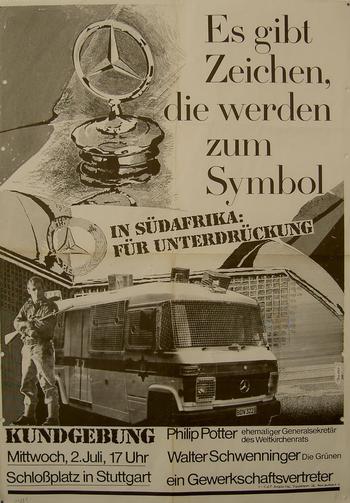
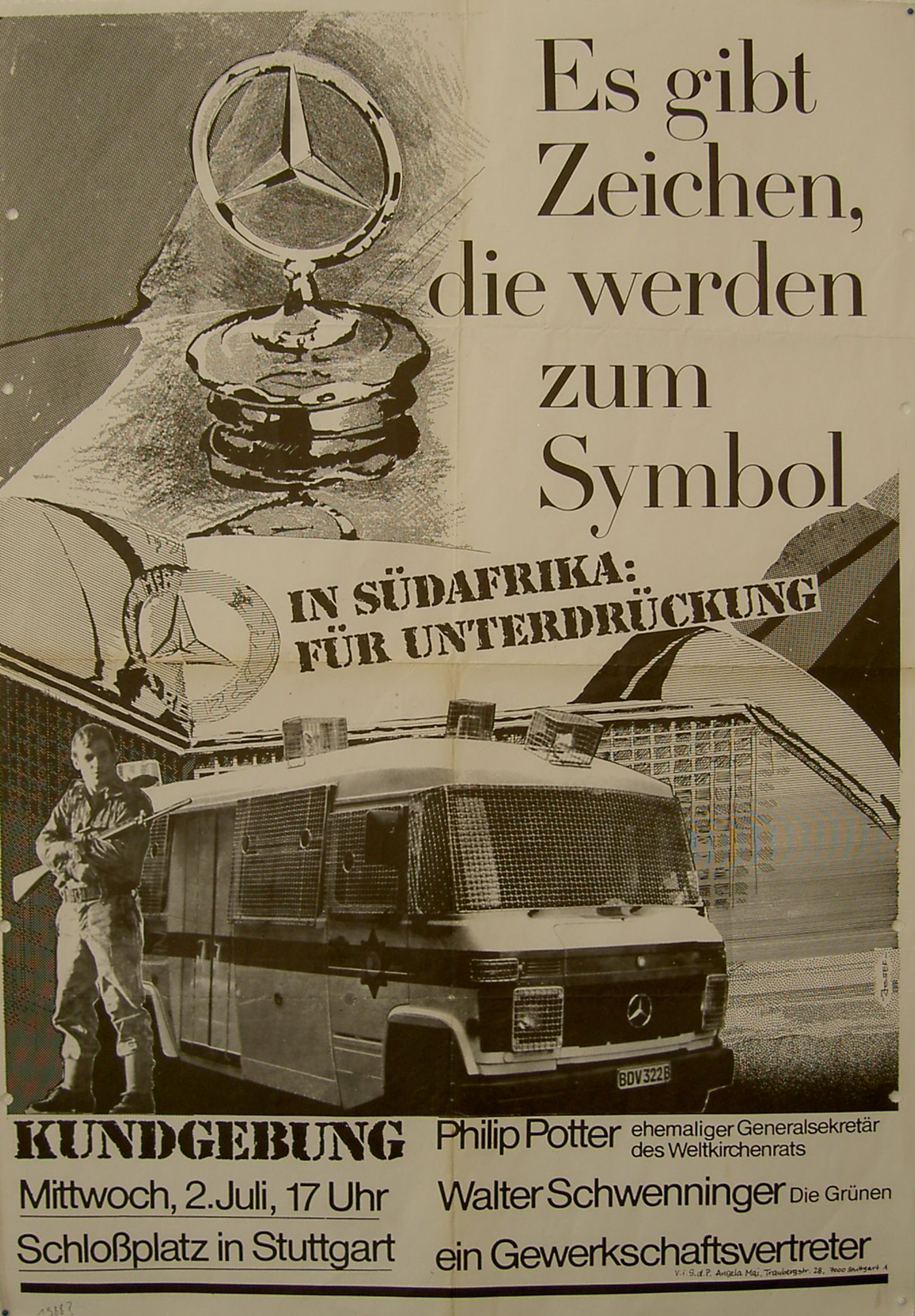
Although Daimler Benz was not the only German car manufacturer with a large production site in South Africa, it became a key target for the West German anti-Apartheid movement in the mid-1980s.Footnote 48 At that point many foreign companies had left South Africa due to the growing international pressure, but Daimler Benz was expanding its business operations. Since the car make was extremely popular among wealthy white South Africans,Footnote 49 and the company supplied the South African police and military forces with vehicles, activists in West Germany argued that the iconic Mercedes star had become ‘a symbol of oppression’ (see figure 2).
‘There Are Signs That Become Symbols. In South Africa: For Oppression’
Less than two months after the attack against the Daimler Benz factory in Schwäbisch-Gmünd the RC struck again. This time, the group attacked the companies Mercedes Lueg in Bochum-Wattenscheidt and Brüggemann und Brandt in Wengern, because anti-Apartheid activists had revealed that both sold military equipment to the South African Army. While the members of the RC acknowledged that Church groups had been successful in making racism in South Africa a political issue, the group criticised that their actions lacked a radical perspective. In their view, expressions of solidarity had to go beyond kind words and calls for higher moral standards in trade relations between South Africa and West Germany. The RC dismissed calls for ‘fair trading policies’ and claimed that it was necessary to attack ‘imperialist structures of oppression’ in South Africa and in West Germany.Footnote 50 In January 1986 the group carried out another attack against Daimler Benz, this time against a branch in Wuppertal, and repeated its criticism of the company's investment in and trade with South Africa.
In the same year the production sites of Mercedes Benz South Africa were affected by mass strikes. In the period from January to August 1986 alone, the Mercedes car factory in East London lost fifty-three work days due to industrial action.Footnote 51 A strike for a higher minimum hourly rate in 1987, to which Daimler Benz had responded with mass dismissals and other repressive measures, resulted in 270 Million DM loss for the company and was described as the most expensive strike in the South African history.Footnote 52
Due to the combined effect of physical attacks against company branches in Germany, the mass strikes at South African production sites, the growing reputational threat and a recession in the mid-1980s, Daimler Benz, Siemens and other German companies with trading links to the Apartheid regime were under intense pressure. However, rather than making the costly concessions that activists demanded from them, the targeted companies responded to this pressure with ‘prosocial claims’. Mary-Hunter Mc Donnell and Brayden King define prosocial claims as ‘public claims of corporate social actions’ that ‘extend beyond the mere transactional interests of the firm to provide social benefits to a firm's constituents or to address general social problems’.Footnote 53 In a joint declaration, leading German companies with business links to South Africa emphasised that they were playing an important role in the ‘peaceful struggle’ against the Apartheid regime by investing in the future of South Africa and by helping to improve the working and living conditions of the Black population.Footnote 54 Daimler Benz was particularly keen to stress its commitment to peaceful political change in South Africa. A number of public statements from the late 1980s emphasised the company's commitment to racial equality and its exemplary and successful effort to train and support Black employees.Footnote 55 The Mercedes-Benz South Africa group prided itself on being a ‘responsible corporate citizen of the South African automotive industry’.Footnote 56 Although the violent anti-Apartheid protest in West Germany caused substantial property damage, it received so little media attention that the targeted companies did not feel compelled to comment on the attacks in public and tried to neutralise the reputational threat with prosocial claims. As the case of the German clothing chain Adler shows, this is not an option for companies if radical and violent protest activities receive a great deal of media attention.
A Feminist Solidarity Campaign for Women Workers in South Korea
On 4 May 1986 the Korean Women's Group in West Berlin received a letter that caused great concern among its members. It included a report in which trade unionists described the poor working conditions in the garment factory Flair Fashion, in Iri, South Korea (a Free Trade Zone 250 kilometres from Seoul).Footnote 57 The factory produced clothes that the German company Adler sold at cheap prices to customers in West Germany and other European countries. Founded in 1959, Adler had initially produced its entire stock in Germany but then outsourced a growing part of its production to Asia. In 1978 Adler opened a garment factory in Iri to benefit from the relatively low labour costs and the financial benefits of the South Korean Free Trade Zone. By 1986, 60 to 80 per cent of the clothes that Adler sold in its European stores were ‘made in Korea’.Footnote 58 Adler defended its substantial investment in South Korea with prosocial claims. According to the German management, Flair Fashion was a ‘model factory’.Footnote 59 They claimed that wages were 10 to 15 per cent higher than in Japanese and American owned factories in the Free Trade Zone and that Flair Fashion provided free accommodation to 300 employees, plus a tennis court and a range of other facilities.Footnote 60 Trade unionists, however, criticised the working conditions at Flair Fashion as ‘inhumane’.
In their letter to the Korean Women's Group in Berlin, workers reported that they were expected to do at least one hour of overtime per day whilst receiving salaries below the minimum wage.Footnote 61 The management constantly monitored the employees and punished them for mistakes. According to the authors of the letter, many workers could meet the required output only by foregoing breaks and exhausting themselves beyond their limits. They added that the German management at Flair Fashion treated the Korean workers with disrespect.Footnote 62
The authors of the letter were particularly concerned about the situation of female employees at Flair Fashion. Since the 1960s women's involvement in the South Korean labour market had grown constantly. By the late 1980s it had come close to 50 per cent.Footnote 63 For the most part, women worked as unskilled labourers in low paid occupations. In 1987 ‘the majority of women workers (56.1 per cent) were employed in only three out of twenty-seven manufacturing industries [wearing apparel, textiles and electronics], all key export industries’.Footnote 64 Women constituted more than 70 per cent of the workers at South Korean clothing manufacturers.Footnote 65 At Flair Fashion, the ratio of female employees was even higher than in other garment factories in South Korea. For the most part, female employees were unskilled workers of seventeen to twenty-five years of age. As in other garment factories, women's wages at Flair Fashion were considerably lower than those of their male colleagues. On average, female workers earned 40 to 50 per cent less than men in the same positions.Footnote 66 And, unlike male employees, not all women workers were insured against industrial accidents: female employees could claim compensation from the Korean insurance system only if they were under twenty-five. At this age, they were expected to leave the workforce to dedicate themselves fully to marriage and motherhood.Footnote 67
According to Jai Sin Pak, a member of the Korean Women's Group in Berlin, Confucian gender norms imposed a strongly subordinate position on women in Korea under which girls and unmarried women were under the authority of male relatives, while married women had to submit to their husbands.Footnote 68 The increasing participation of women in the Korean labour market did not, at least initially, challenge traditional gender norms. In fact, Adler and other foreign investors benefited from the low wages and docile demeanour of female workers. Fürchtegott Adler, the head of Flair Fashion, openly admitted this fact in an internal publication in 1984: ‘the rapid rise of the ADLER company’, declared Adler, ‘was possible only because of the black-haired, almond-eyed Korean women’. He added that, to his regret, he lost most of his employees at the age of twenty-five, because the Flair Fashion ‘girls’ wanted to ‘spoil their men and dedicate themselves fully to family and household’.Footnote 69
Compounding the discrimination experienced by female employees at Flair Fashion as women in the South Korean labour market, trade unionists claimed that sexual assault by the management was commonplace at the factory. The letter writers did not refer to concrete cases, but they left no doubt that a sexual relationship with a German manager was the only way for women to be promoted to overseer or shift leader.Footnote 70 The workers saw no way to solve their problems internally, as the German management prohibited general assemblies and refused to discuss employment issues with democratically elected trade union activists. In view of these circumstances, a group of unionists decided to go public. In their letter to the Korean Women's Group in West Berlin, the women described the problems at Flair Fashion and appealed for ‘sisterly help’ from Germany.Footnote 71
The plea for help from South Korea sparked a thriving solidarity campaign in West Germany that involved groups across the political spectrum. The Korean Women's Group in Berlin and Land of Women (Terre des Femmes; TdF)Footnote 72 activists were the first to respond, with a public relations campaign that mobilised a range of other groups including feminist groups, Christian organisations, radical leftist groups, trade unions and Third World activists. According to the union activist Esther Dischereit, the motives and political backgrounds of the actors involved varied considerably, but the decentralised and non-hierarchical nature of the campaign allowed all groups to express solidarity with the Korean workers in their own ways.Footnote 73 While TdF activists sought dialogue with the Adler management and tried to gather and publicise information about the situation on the ground, other groups staged sit-in blockades and other protests at local Adler branches. With a few exceptions, the groups involved drew on explicitly non-violent means to campaign for better working conditions at Flair Fashion.
On 21 June members of the militant feminist group Red Zora planted a bomb at the Adler headquarters in Haibach, which failed to explode. In their claim of responsibility, the group declared that it had carried out the attack to support the South Korean Adler employees in their struggle for better working conditions. The group acknowledged that Adler's favourable prices allowed even people on benefits to feel part of consumer society, but they warned that consumption and other privileges ‘are based on the exploitation and destruction of the people in the Third World’. The failed bombing marked the beginning of a series of attacks against Adler premises in Germany. In August the RZ claimed responsibility for nine arson attacks against Adler stores in the Northwest of the country (making ten attacks in total). According to one former member, the Red Zora understood the attacks against Adler as a form of ‘armed propaganda’ for the cause of the South Korean workers, acts with which the group hoped would spark a discussion in Germany and intensify the dialogue between women in Germany and in South Korea.Footnote 74 The fires and the sprinkler systems that they activated caused substantial property damage. According to Adler management, the loss to the company amounted to 30–35 million DM.Footnote 75 In September 1987 the ‘Amazons’, a militant feminist group from West Berlin, carried out an eleventh attack against Adler. The leftist newspaper Die Tageszeitung reported that, a few weeks later, a twelfth attack was thwarted by pure chance.Footnote 76
Prior to the series of attacks against its premises, Adler had responded to the protest movement in a very similar manner to Daimler Benz and other vacillators discussed in the first case study: with a mix of prosocial claims, protracted negotiations, repression and minor concessions. The attacks against the Adler premises in West Germany, however, had caused substantial economic damage and attracted so much media attention that it was difficult for the company to ignore them. Against this background, the Adler management made a surprising turnaround. A representative of the company declared that Adler had decided to accept the wage increase, to reemploy the dismissed union activists and to meet other demands of their South Korean employees in order to prevent further attacks.Footnote 77 This unexpected decision provoked a range of responses in the solidarity campaign, from celebratory enthusiasm to grave concern. TdF welcomed the concessions from Adler, but at the same time published an open letter criticising the company for making the right decision for the wrong reasons.Footnote 78
An article by feminist activist and scholar Christa Wichterich argued that the militant protest against Adler imperilled the success of the broader solidarity campaign. While endorsing tactical diversity, she criticised ‘voluntaristic actions that jeopardise other forms of resistance’.Footnote 79 According to her, notwithstanding the apparent victory, the arson attacks by the Red Zora and the Amazons posed a risk to the broader aims of the solidarity campaign. ‘This firework’, claimed Wichterich, ‘was a disservice to the attempt to use a single protest campaign to create a triangle of solidarity between workers in the Third World and consumers and workers here’.Footnote 80 Other activists criticised this position as ‘naïve’ and divisive. A feminist group from Reutlingen argued that the Red Zora had made an important contribution to the campaign's overall success. In their view, the arson attacks had caused significant economic harm to Adler and thereby helped to increase the pressure on the company. The group claimed: ‘radical resistance on all levels is necessary if we want to put our ideas of a non-hierarchical, non-sexist, non-racist society into practice’.Footnote 81 Other activists shared the enthusiasm about Adler's climbdown and congratulated the ‘Red Zora and her sisters’ for ‘the brilliant action’.Footnote 82
Less than a year after improving the working conditions of its South Korean employees, German newspapers reported that Adler was planning to relocate its production to other low-wage countries.Footnote 83 There were also reports that Adler tried to prevent industrial disputes at a production site in Sri Lanka by hiring security staff who could handle guns.Footnote 84 The company did not comment on these reports. According to Luders, Adler can be classified as a ‘mobile vacillator’, that is a company that can ‘pursue exit as an option by relocating their business operations’.Footnote 85 Given the public interest in the situation of the Flair Fashion workers, it is remarkable that Adler managed to relocate its business operations without attracting major media attention. Although the working conditions in the Adler factory in Sri Lanka might have been as poor as in the production site in South Korea, there were no further major protests against Adler. As a result, the company was able to continue its rapid expansion course in Western Europe by selling clothes that were produced in the Global South – even if they were no longer made in Korea.Footnote 86
Against this background, it is interesting that in 2010 Adler became the first retail store in Germany to sell fair trade clothes on a continuous basis.Footnote 87 Adler now releases an annual sustainability report in which it presents itself as a champion of the interests of suppliers, consumers and other stakeholders. Similar to Daimler Benz, Adler emphasises its continuous commitment to humane working conditions and community engagement in the Global South. Adler's social engagement activities focus on ‘Bangladesh and India, where it produces the majority of its merchandise’, and include the support of a Catholic school in Dhaka, Bangladesh, and of the development organisation Meena.Footnote 88 Like Mercedes Benz South Africa, Adler presents corporate social responsibility as a red thread running through its corporate history, omitting information regarding industrial disputes at production sites, transnational protest movements and violent attacks against company premises.
Conclusions
In the 1980s the fair trade movement in West Germany gathered momentum and offered consumers the possibility to buy ethically produced and traded produce like coffee, chocolate, tea and spices. However, in this period ethical consumerism was only one of many strategies to fight for better working and living conditions for workers in the Global South. Taking up Frank Trentmann's suggestion of widening the historical frame in which we analyse the fair trade movement, this article has examined the role of violent tactics in two transnational solidarity campaigns in the 1980s: a campaign for the anti-Apartheid movement and women workers in a South Korean garment factory. Both campaigns were characterised by a complex interplay of peaceful and militant tactics ranging from information stalls and boycott calls to arson attacks. Previous research suggests that the ways in which companies respond to protest movements ‘depends to a large degree on the extent to which activists are able to mobilise the media’.Footnote 89 While Bradley King has shown that boycotts are more likely to exert influence when they attract a great deal of media attention,Footnote 90 the role of violent protest in this context has to date had little investigation.
As the case of the protest campaign against the German clothing chain Adler illustrates, the use of violent tactics can increase the economic pressure on a company and has the potential to attract considerable media attention. However, it also demonstrates that it can give targeted companies the option to present concessions as a response to the threat of violence rather than as necessary adjustments of their corporate practice. For this and other reasons, the arson attacks by the militant feminist group Red Zora met with strong criticism among activists in the solidarity campaign even though it is likely that they have contributed to achieving the campaign's aims. The fact that there was open support for the attacks against Adler in some parts of the movement shows that there was no consensus when it comes to the question of legitimate and necessary protest tactics in the struggle for better working and living conditions in the Global South.
Although violent protest in the West German anti-Apartheid movement involved similar tactics (arson attacks, bombings and other attacks against property) as in the campaign against Adler, it had a different impact. The series of attacks against REWE, Daimler Benz and other German companies with trading links to South Africa by the militant leftist network Revolutionary Cells received hardly any media attention, and there were no public comments on the attacks by members of the German anti-Apartheid movement or representatives of the targeted companies. Since the AAB's formation in 1974 there had been different opinions on the use of violent protest tactics in the anti-Apartheid struggle in South Africa. Even though some AAB members were working closely with members of the ANC and other organisations who supported an armed struggle against the Apartheid regime, the AAB campaigns reinforced a clear, dichotomous distinction between white perpetrators and black victims.
Daimler Benz chose not to comment on the attacks against its premises, even though they probably caused substantial economic damage. Unlike Adler, Daimler was no mobile vacillator. In 1985 Daimler-Benz AG had acquired 50.1 per cent of the shares in United Car and Diesel Distributors in South Africa and had changed the company's name to Mercedes Benz of South Africa.Footnote 91 A relocation of its business operations shortly after this acquisition would have involved major economic losses and could have resulted in severe reputational damage for the company. To avoid this scenario, Daimler Benz responded with a mix of repressive measures, minor concessions and prosocial claims.
The attacks against its premises in Germany did not change the fact that Daimler Benz was able to portray itself as a force for good in South Africa in the public. The company benefitted not only from the lack of media interest in militant protest against its corporate practices but also from the anti-communist and business friendly attitude of political leaders in West Germany. The coalition government led by the conservative Chancellor Helmut Kohl did not want to threaten the business links with South Africa and promoted a ‘critical dialogue’ with the Apartheid regime.Footnote 92 While some diplomats and politicians made careful attempts to create a dialogue with union representatives, civic organisations and civil rights groups in South Africa, others regarded the ANC as a socialist threat to the political stability in South Africa. The Minister President of Bavaria Franz Josef Strauss openly supported the Apartheid regime and dismissed its opponents as a bunch of ‘bomb planters and terrorists’.Footnote 93 Against this background, it is hardly surprising that the AAB failed to achieve its aim to end of all forms of collaboration between Germany and the racist regime in South Africa. Although more research on the role and impact of violent protest in solidarity campaigns with workers in the Global South is needed, the case studies discussed in this article suggest that the use of violent protest tactics can contribute towards achieving the aims of such campaigns if, and only if, it attracts considerable media attention, the cumulative disruption costs clearly exceed the concession costs and the targeted companies face significant social and political pressure.