There is a general consensus among leaders in higher education that a college experience ought to provide students with opportunities for personal growth and development, in addition to a set of marketable skills. Often, the concept of personal growth involves some degree of “values clarification” and a sense of social responsibility. The American Association of Colleges and Universities, for example, recently initiated the Core Commitments program, which “asserts that ethical, civic and moral development should not be addressed separately from students' basic responsibilities as learners.”Footnote 1 The goal of producing ethical, moral graduates raises legitimate questions about the role of college professors in defining morality and in shaping students' values. Political scientists, who cannot avoid discussions of moral controversies in their classrooms, often disagree about whether this education should involve political advocacy (see, for example, the exchange between Gardner [Reference Gardner1998], Weaver [Reference Weaver1998], West [Reference West1998], and Myers and Tronto [Reference Myers and Tronto1998]).
In recent years, anyone who has raised a legitimate question about the interplay between professors' own values and their instruction of students has run the risk of being associated with activist David Horowitz. Following his rather aggressive public assault on the university, academics have responded by circling the wagons. Having easily dismissed the anecdotal evidence of professional misconduct cited by Horowitz and his supporters, defenders of the university deem all questions about professorial influence to be equally as dubious. As social scientists, we ought not conclude that the average college professor attempts to politically indoctrinate students, based on a few isolated incidents; but nor should we dismiss all concerns about political bias in the classroom merely because we have concluded that a few extreme accounts are not representative of political science education as a whole. Even if we assume that the vast majority of college professors are responsible professionals who attempt to present balanced material, it is still possible that their views influence students in subtle ways.
In fact, when the question of influence is framed in positive terms, researchers find evidence of success. Lottes and Kuriloff (Reference Lottes and Kuriloff1994, 33) conclude that the social science literature demonstrates “that during college, attitudes and values tend to become more open, humanitarian, altruistic, tolerant, and liberal.” The authors conduct their own study of students at one prestigious university and find that students score higher on measures of liberalism, social conscience, and feminist attitudes after four years of college. While the gains in overall liberalism were relatively small, students show greater gains in specific areas, such as a 25% increase in tolerance for homosexuality. Lottes and Kuriloff attribute the change to positive growth, stating that “students become more humanitarian and skilled in their application of principled reasoning to judge issues … better educated people tend to be personally more secure and therefore better able to tolerate diversity” (Reference Lottes and Kuriloff1994, 51).
Others attribute change toward more liberal views as a positive and direct benefit of specific courses. For example, Bryant (Reference Bryant2003) uses data from the Higher Education Research Institute (HERI) to demonstrate that college tends to “liberalize” students' gender-role attitudes, with students enrolled in humanities courses and/or women's studies making greater gains than others. While gender equality may be an almost-universal value, it is important to note that the study finds students entering college with a high commitment to gender egalitarianism. The fact that their views become even more progressive may indicate that they have moved closer to what some may consider a radical position.
Some research demonstrates that attitude change may occur as the result of a single course experience. Whaples (Reference Whaples1995) finds that students who complete an introductory economics course are more likely to regard the price-setting mechanisms of a free market as fair. Wylie and Parcell (Reference Wylie and Parcell1982) find that students are significantly more liberal after completing an introductory sociology course. The authors argue that this attitude change is desirable in sociology, as students are required to adopt a “universalistic perspective,” which assumes social problems are the result of unjust, inequitable social arrangements rather than individual choice. According to the authors: “As instructors we can and should monitor our progress and effectiveness in achieving the attitudinal objectives of our courses … Our commitment to social justice and social change dictates that we earnestly strive to “liberalize” our students” (Wylie and Parcell Reference Wylie and Parcell1982, 419).
The authors also make several arguments that are eerily familiar to those engaged in the current Horowitz-evoked debate. They argue that students in social science disciplines are more likely to experience a liberalizing effect and hypothesize that this is because faculty in the social sciences are more liberal than other faculty.
Despite some evidence of change on specific attitudinal scales, there is significant debate over whether the college experience changes people's general ideology or partisanship. Given the general consensus that college professors tend towards the left of the ideological spectrum and affiliate most frequently with the Democratic Party (Cardiff and Klein Reference Cardiff and Klein2005; Rothman, Lichter, and Nevitte Reference Rothman, Lichter and Nevitte2005; Princeton Survey Research Associates 2001), we might expect students to shift their own identifications accordingly. Yet, a recent study suggests that, over the course of four years, students' political orientations do not change dramatically (Mariani and Hewitt Reference Mariani and Hewitt2008). The researchers do observe some movement among students, with an 8-percentage-point gain on the left side of the scale, but they conclude that this shift is not dramatic enough to justify claims of widespread indoctrination. While this seems to be a reasonable conclusion, the authors are examining aggregate trends over four years. It is possible that the little movement the authors do observe is concentrated among certain groups of students. For example, political science students may, as a result of having frequent political discussions with their professors, be more susceptible to influence, whereas accounting students may be completely immune from such influence. Examined more precisely, we might see evidence of significant movement in certain disciplines. It is important to note that the Mariani and Hewett study uses the same data as the Bryant (Reference Bryant2003) article, which finds significant liberalization of gender attitudes among students in the humanities. We believe that, if professors' politics do influence students' political positions more generally, it is most likely to occur in those settings where political issues are frequently discussed. Thus, our analysis examines shifts in individual students' partisan leanings over the course of one semester, during which they are enrolled in a political science course. Our analysis adds to the Mariani and Hewitt study in that it allows us to look beyond aggregate trends and examine the impact of individual student-faculty relationships.
We constructed a survey of political science students and their professors, in the hopes of answering two important questions. The first question centers on the extent to which political science professors maintain a position of neutrality in the classroom. We hypothesize that political scientists attempt to present multiple perspectives and avoid discussion of their own political views. Yet, even if this is the case, we do not know to what extent students pick up cues that reveal their professors' true political orientations. If students cannot ascertain the political leanings of their professors, then we might conclude that political science professors are capable of maintaining professional neutrality, despite the contentious subjects dealt with in their classroom discussions.
The second question centers on whether shifts in a student's partisan affiliation correlate with the professor's admitted political orientation. We discussed some evidence that women's studies courses produce support for feminism and that sociology courses produce support for a “universalistic perspective” on social problems. These attitude changes are directly linked to the content of these courses. But political science courses routinely deal with a wide range of social problems, requiring students to explore multiple dimensions of their political ideology. We might expect that a liberalizing effect in political science would be more general and result in a change in students' political self-identification.
RESEARCH DESIGN
In the summer of 2006 we distributed letters to 200 professors selected randomly from the directory of the American Political Science Association, asking them to take part in a study by completing a survey and distributing a questionnaire to students in their undergraduate courses. More than 60 instructors responded to our initial request. Of those, 26 indicated that they could not participate because they were not teaching undergraduates and 15 respondents declined to participate. Altogether, 24 political science professors from 17 public and 7 private institutions, located in 13 states, took part in the study.Footnote 2 Under the Carnegie classifications, five of the professors came from baccalaureate colleges, six of the professors came from masters colleges and universities, and 13 came from universities classified as research institutions. Surveys were distributed to a total of 69 upper- and lower-division courses with the average class returning 23 valid surveys.
The brief professorial survey asked faculty participants to rate both their partisan and ideological leanings, as well as their attitudes concerning the appropriateness of discussing their personal views with students. The more extensive student surveys asked students to rate their own politics, the politics of their professor, and several measures of political interest. Furthermore, whereas the main faculty survey measures the professors' views at one point in time, we distributed student surveys at the beginning and at the end of the academic semester, allowing us to track changes in students' affiliations over time.
In order to facilitate the merger of early- and late-semester surveys while maintaining subject anonymity, we built a series of innocuous questions into each of the surveys that, when taken together, create a unique demographic fingerprint. These questions included sex, birth month, college standing, number of brothers, number of sisters, birth order, and the first letter of their mother's maiden name. When answered honestly, there remained only a remote probability that, within a given class, two students would record the same combination of responses. Both waves of the survey also included three open-ended questions that gave the researchers additional points of comparison (including a small handwriting sample) that we used to help confirm the pairing of surveys.Footnote 3 Over the course of two semesters (fall 2006 and spring 2007), we collected a total of 1,982 end-of-semester surveys, 1,603 of which we definitively matched to an early semester survey, giving the blind matching an 81% success rate.
OVERVIEW OF THE FACULTY PARTICIPANTS
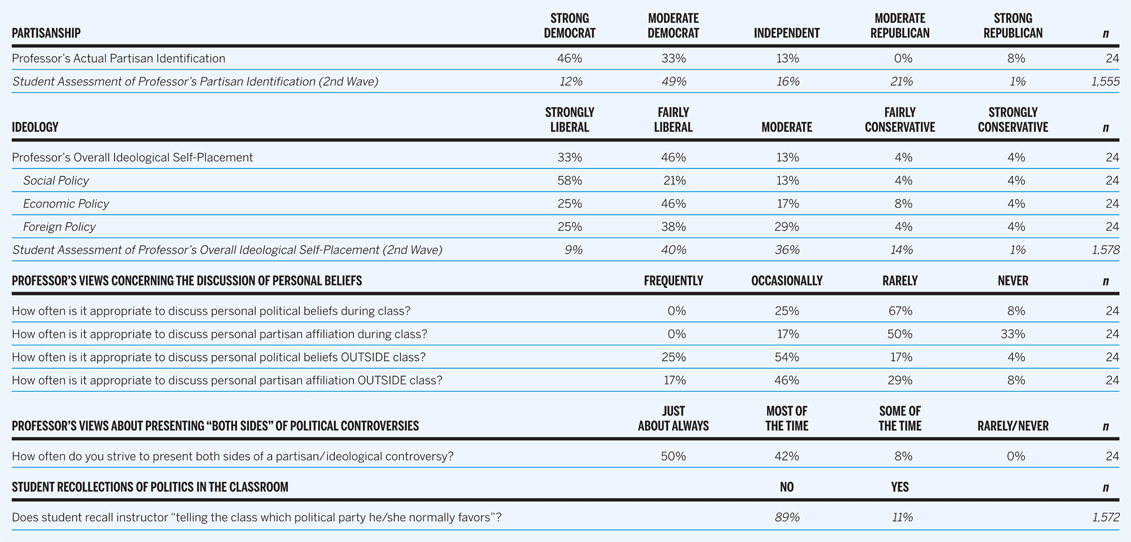
Because faculty members self-selected into our survey, we had initial concerns about the political distribution of faculty in the sample. Table 1 provides a breakdown of the faculty participants' self-identified political affiliations. The vast majority of faculty participants (79%) described themselves as Democrats, with nearly half indicating their identification as a “strong Democrat.” Three faculty participants (12%) indicated that they are “Independents,” while two volunteers (8%) identified themselves as “strong Republicans.” The limited number of Republicans in our sample is consistent with large voter registration studies of college faculty. For example, Cardiff and Klein (Reference Cardiff and Klein2005) report that 19 of 225 political scientists in their sample, or 8%, were registered Republicans. Ideologically, the participating professors in our study tend to lean left, with 79% of respondents identifying themselves as “liberal” and 8% describing themselves as “conservative.” This ideological distribution is also consistent with a national survey of college faculty, in which 81% of political science professors define themselves as liberal (Rothman, Lichter, and Nevitte Reference Rothman, Lichter and Nevitte2005).
Overview of Survey Results

Faculty participants in our survey indicated a strong reluctance to express their political views in class, with 75% of respondents indicating that they think it is “rarely” or “never” appropriate to discuss their personal political beliefs and 83% indicating that they believe it is “rarely” or “never” appropriate to discuss their partisan affiliation. Outside of the classroom, attitudes toward expressing personal political views are markedly different. Among faculty respondents, 79% indicated that they “frequently” or “occasionally” discuss their personal political views outside of class, while 63% “frequently” or “occasionally” talk about their partisan affiliation. Finally, notwithstanding their strong partisan views, a vast majority of faculty (92%) indicated that they “just about always” or “most of the time” strive to “present both sides of a partisan/ideological controversy.”
It is possible that the professors in our survey are sensitive to claims of political bias in the academy and are exaggerating their neutrality. However, student survey responses lend some credibility to professors' claims about the inappropriateness of discussing partisan leanings in the classroom. When asked on the late-semester survey whether their professors discussed their political views, 89% of the student-respondents indicated that they had no recollection of the instructor ever telling the class “which political party he/she normally favors.”
ASSESSING FACULTY POLITICS
We found in previous studies that students' experiences in the classroom were related to the degree of political conflict they perceived between themselves and their professor (Kelly-Woessner and Woessner Reference Kelly-Woessner and Woessner2006; Reference Kelly-Woessner and Woessner2008). Students who believe they are at political odds with the professor are more critical of the course and report that they learn less than their peers. We argue that perception of conflict is important but we were not able to directly test whether students' perceptions of faculty politics are accurate. The professors in this survey appear to strive for objectivity in the classroom, indicating that they discuss both sides of an issue and that they believe it is not appropriate to discuss their personal beliefs. In this environment, we might expect students' assessments of their professors' politics to be somewhat limited.
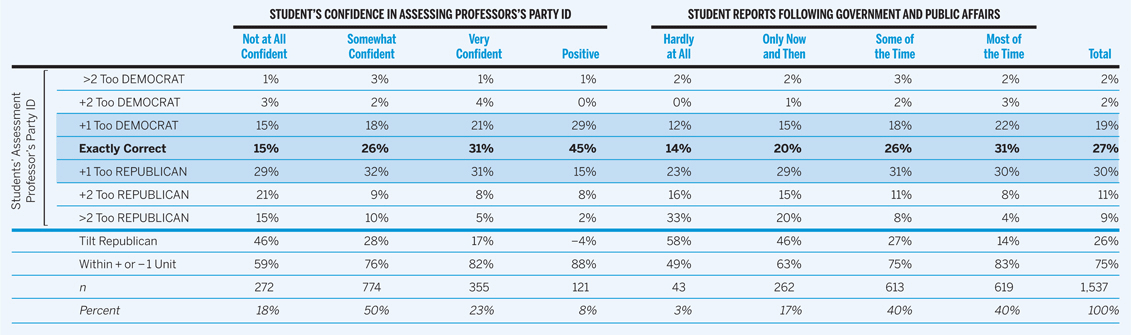
The results in Table 2 appear to lend credence to the notion that students are not completely in the dark about their professors' political views. Among the students in our sample, 27% precisely identified their professors' partisan orientation when measured on a five-point scale. However, three-quarters of the students were able to guess their professor's partisanship within one unit of their actual rating, for example guessing a moderate Republican when the professor is actually a strong Republican. The majority of students identified their professor's party, but underestimated the strength of their professor's loyalties, rating them as moderate partisans more often than is warranted (see Table 1).
Students' Assessment of Professor's Party Identification

It does appear that students' judgments are based on some assessment of the facts, as students who are confident in their ability to rate the professor do predict better than the students who lack confidence. Of those who indicated that they were “not at all confident,” only 15% precisely identify their professor's political views, whereas those who indicated they were “positive” are exactly right 45% of the time and within one point of the professor 88% of the time. The vast majority of students have some degree of confidence in their assessment of the professor. Given that students don't recall specific mention of the professor's partisanship, they appear to be successfully picking up on other cues. We might expect that students who are most politically aware are better able to detect subtle displays of partisanship. This appears to be the case. Students who are most likely to follow politics are also best able to successfully identify their professors' political leanings. Students who follow public affairs “most of the time” were able to pinpoint the exact position of their professor 31% of the time and fell within one point of their professor's self-rating 83% of the time.
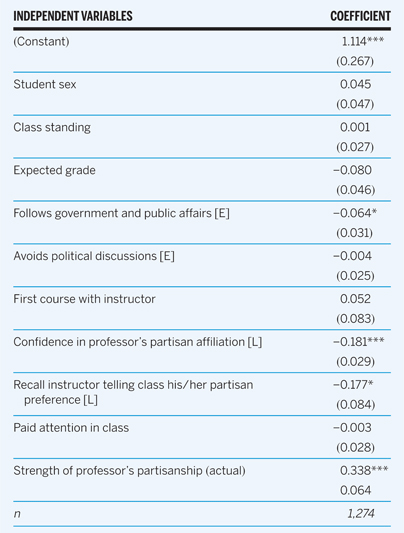
When placed side by side in a mixed model with a number of other controls, both the students' confidence in their assessments and the extent to which they follow public affairs stand out as statistically significant predictors of assessment error. Perhaps, not surprisingly, those few students who seem to have remembered the instructors mentioning their partisan affiliations did predict better than those who do not. Looking to Table 3, the best predictor of assessment error is the strength of the professor's partisanship. Students tended to be further off the mark in assessing their professor's politics when the professor identified as a strong partisan. Looking back to Table 1, we see that students' rankings tended to underestimate their professors' partisan affiliations. Whereas the majority of professors in the sample identified as strong partisans, the majority of students rated their instructors as moderates. This may mean that professors are somewhat successful in their attempts to conceal their own beliefs. However, we conclude that students are able to sniff out their professors' general affiliations but merely underestimate the strength of those affiliations.Footnote 4
Mixed Model* Predicting Error in the Assessment of Professor's Partisanship [Late Semester]

* Classroom variations set as the basis for the “random effects” in the mixed model. [E] = Early-semester survey; [L] = Late-semester survey.
Standard errors listed in (parenthesizes) were *p < 0.05, **p < 0.01, ***p < 0.001
Finally, it is worth noting that, from the first wave of the study (typically administered in the second week of the semester) to the final wave of the study (usually distributed in the last two weeks of class), we see a relatively modest increase in the accuracy of student assessments. When asked to judge their professor's partisanship in the second week of class, 23% of students were exactly right, while 69% were correct within one unit. More than 10 weeks later, the accuracy improves to 27% for perfect guesses and 75% for near-perfect guesses. Similarly, early semester assessments of the professor's partisanship were only somewhat better among students who reported having had the professor in a prior semester. This result seems to indicate that, while students' assessments do improve over time, these somewhat accurate assessments of the professor's politics are made rather quickly. This is especially noteworthy, given the obvious attempts at neutrality among the professors in the sample.
POLITICAL PERSUASION IN THE CLASSROOM
The fact that most students in the study seem roughly aware of their professor's political leanings raises interesting questions about whether that knowledge has any substantive impact upon their own beliefs. Professors are authority figures and sometimes role models for young people. At the formative stages of their political development, might the ideological preferences of the professor have a measurable impact upon the students' views?
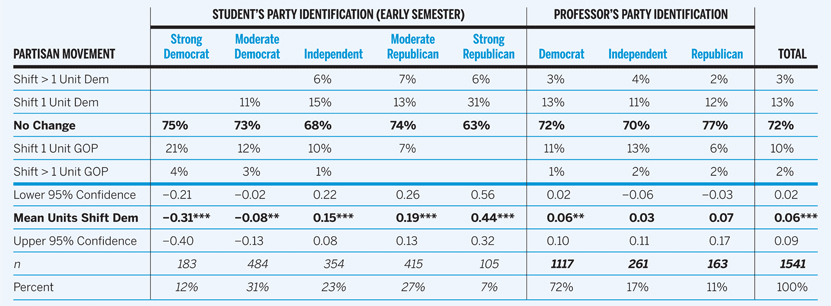
Table 4 provides a breakdown of partisan shifts among students from the early-semester survey to the late-semester survey, completed approximately 10 weeks later. In such a relatively short period of time, one might not expect to see a remarkable shift in partisan affiliations. Yet, overall, some 28% of students provided a different answer to the second-wave survey than they offered in the first. Except for strong Republicans, who tended to change their responses 37% of the time, other partisans tended to stand by their original assessment at a rate of four to one. As there is nowhere else to go, those who initially identified themselves as strong partisans either maintained initial self-assessment or drifted toward the political center. Moderate partisans on both ends of the spectrum also tended to move toward the middle. Students who originally indicated an independent position were the most likely to move, with twice as many moving towards the Democrats as compared to the Republicans.
Shifts in Student Party Identification from Early to Late Semester

* p < 0.05, **p < 0.01, ***p < 0.001
Of 1,541 respondents captured in Table 1, there is a modest, but statistically significant, drift toward the Democrats. Indeed, both strong Democrats and moderate Democrats tended to drift toward the GOP, an average of 0.31 units and 0.08 units respectively. However, the leftward movement of both independents and Republicans offset the Democrats' movement to the right. On average, independents moved 0.15 units toward the Democrats, while moderate Republicans moved 0.19 units in the direction of the Democrats. The most dramatic shift occurred among strong Republicans, who moved nearly a one-half unit in the direction on the Democrats (0.44 units overall).
It is important to note that a trend toward the Democratic Party hardly constitutes evidence of political persuasion, unless it can be shown that this movement is somehow correlated with the views of the faculty participants. This is especially true given the political environment in which the study was conducted. By the estimates of the Gallup organization, over the eight months of the study, President's Bush's overall job approval numbers had fallen from 39% (September 7, 2006) to 33% (May 10, 2007). The breakdown of student partisan change by professors' partisan identification suggests that student partisan change had little to do with the professor's politics. Whereas the average direction of political movement varies systematically by the student's initial partisan designation, with an overall tendency towards regression to the mean, there is virtually no difference in student movement based on the professor's partisan identification. Among the 1,117 students whose professors identify as either moderate Democrats or strong Democrats, there is a shift of 0.06 units ± 0.04 units away from the GOP. Among the 261 students whose instructors identified themselves as independents, there is a statistically insignificant change of 0.03 units ± 0.08 units away from the GOP. For the 163 students whose professors identified themselves as Republicans,Footnote 5 there is a statistically insignificant change of 0.07 units ± 0.10 units away from the GOP.
Indeed, the shift toward the Democrats and away from the GOP is statistically significant under the Democratic professors, where it is not under either the independent or Republican professors. However, this is largely a function of the sample size rather than due to the magnitude of the effect. Naturally, in a profession where Democratic faculty greatly outnumber independents or Republicans, there are more students in the study who were taught by Democratic professors. This substantially larger sample size permits a more precise estimation of the partisan shift. Given the enormous overlap in the confidence bands among the three groups, a simple one-way ANOVA reveals that there is no statistical difference in the partisan movement among the three groups of students (F = 1.358, p = 0.237).
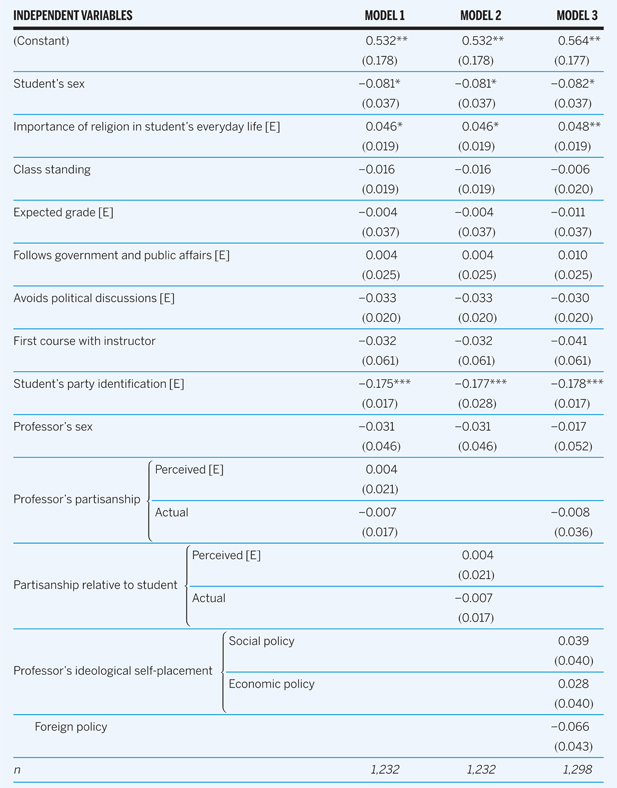
When placed in a statistical model along with a series of other controls, the results look much the same. Table 5 shows three mixed models in which the classroom variations are set as the basis for the “random effects.” In addition to different measures of the professor's partisanship, the models include controls for the students' sex, religiosity, class standing, and expected grade, as well as the extent to which they follow “government and public affairs,” whether they tend to avoid political discussion out of a dislike for conflict, whether this was the first course with the instructor, their initial partisan identification, and the professor's sex.
Mixed Model* Predicting Direction of Student's Partisan Shift

* Classroom variations set as the basis for the “random effects” in the mixed model. [E] = Early Semester Survey
Standard errors listed in (parentheses) were *p < 0.05, **p < 0.01, ***p < 0.001
Each of the models is an effort to capture potentially different conceptualizations of political influence. Model 1 assumes that students would be driven toward the Democratic Party by professors who identify as Democrats. As such, it predicts the student's partisan movement using absolute measures of the professor's partisan identification, as well as the student's perception of the professor's partisan leanings. In this instance, if the student thought the professor was a moderate Democrat, the variable labeled “perceived” would simply be scored as a 2. Model 2 assumes that a student would only move toward the Democratic Party if the professor is more closely aligned with the party than is the student. Accordingly, model 2 measures perceived and actual partisanship relative to the student's views. In this example, if the student felt that the professor was a moderate Democrat, while the student was a strong Democrat, it would be scored as a +1 (i.e., one unit more Republican). If the student felt that the professor was a moderate Democrat, while the student was a moderate Republican, it would be scored as a −2 (i.e., two units more Democrat). Model 3 sets aside measures of perceived partisanship and instead uses four measures of the professor's political beliefs from the faculty survey. These include party affiliation and ideological placement on three distinct policy dimensions.
Aside from the constant, there are three statistically significant predictors in the models. Women tend to move toward the Democrats more so than men. More religious students tend to move toward the Republicans more so than the less religious. As noted in Table 4, party affiliation is negatively correlated with movement. The more Republican a student, the higher the probability the student will move toward the Democratic Party, and vice versa. Whereas sex and religiosity are modest predictors of partisan movement, the student's original partisan position accounts for virtually all of the model's explanatory power.
It is worth noting that, in each of the models, the various measures of professors' politics fail to predict changes in students' political affiliations. This holds for perceived partisanship, actual partisanship, relative measures of partisanship, and the three measures of ideology. Students may be drifting toward the Democrats but, based on the results of these regression models, there is no evidence that this movement is correlated with (let alone caused by) the views of their political science instructors. This finding is further reinforced by the lack of variation in political drift illustrated in Table 4.
CONCLUSION AND DISCUSSION
Prior research into the political dynamics of the classroom finds credible links between perceptions of a professor and overall satisfaction with the course (Kelly-Woessner and Woessner Reference Kelly-Woessner and Woessner2006). However, previous studies say little about students' ability to identify their professors' political views, let alone how those views may influence students' political beliefs. The present study provides evidence that students' assessments of their professors' politics, while imperfect, roughly correspond to the instructors' actual beliefs. Overall, students who pay more attention to politics tend to make fewer mistakes in their assessment of their professors. Students are pretty good at assessing the accuracy of their estimations. One of the more surprising discoveries is that, within our sample, strongly partisan professors were the hardest to identify. Students consistently underestimated the political convictions of their instructors when the professors identified as strong Republicans or strong Democrats.
The students in this study did exhibit a small, statistically significant shift toward the Democratic Party over the course of the semester. However, this shift does not appear to correlate either with the student's assessment of the instructor or with the professor's actual beliefs, thus undermining the notion that the change was brought about (intentionally or unintentionally) by the professors in the study.
While these results tend to run counter to claims of academic indoctrination, the findings do not constitute definitive proof that a predominantly left-leaning professoriate plays no role in students' political socialization. Indeed, the study design is subject to limitations that suggest potentially important avenues for future research. First, the 24 professors who took part in this study indicated that, within the classroom, they generally try to shield their own political beliefs from students. Although they seemed much more open to discussing their personal political views outside of the classroom, this kind of self-restraint probably minimized professors' political influence. It is conceivable that professors who tend to engage in political evangelism would opt not to participate in a study of classroom politics, either because they recognize the social pressure not to politicize their classrooms, or because they feel the study would not apply to someone who advertises their political affiliation. To be certain that these findings apply broadly to professors throughout the discipline of political science, it would be useful to conduct a large-scale survey measuring, among other things, professors' propensities to withhold personal opinion. If the results indicate that most professors tend to exercise restraint with respect to discussing their own political views, these results can be more widely applied. Even if future studies reveal that a sizable percentage of college professors regularly engage in partisan advocacy, these findings still provide evidence that, among those who trying to maintain a nonpartisan atmosphere, it is possible to educate students without inadvertently shaping their partisan preferences.
If political science professors do endeavor to set aside their political views, there is little reason to believe that the typical student would be meaningfully influenced by the dominance of left-leaning faculty within the profession. This does not mean that politics does not affect the classroom however, as we (Kelly-Woessner and Woessner Reference Kelly-Woessner and Woessner2006; Reference Kelly-Woessner and Woessner2008) demonstrate that perceptions of disagreement between students and professors have a negative impact on students' experiences and learning. Our current study demonstrates that those perceptions of disagreement are accurate and not simply the result of students assigning contrary positions to professors they dislike. Given the overrepresentation of Democrats among college faculty, this means that Republican students are more likely to experience the negative effects of conflict in the classroom.
Second, this study looked specifically at political views among students in political science courses, largely on the assumption that if political views do change over the course of a semester, it would most likely occur in the context of a class on government. However, there is a counter hypothesis that deserves some consideration. Political scientists are accustomed to dealing with diverse viewpoints and political controversy. Although the discipline surely includes some openly partisan instructors, when compared to the humanities (e.g., English, history, ethnic studies, gender studies, etc.) its practitioners may be better equipped to teach political controversies without resorting to brazen advocacy (see Ceaser and Maranto Reference Ceaser, Maranto, Maranto, Redding and Hess2008). The dualistic nature of political controversies makes it relatively easy to identify and present “both sides” of the argument. Having failed to find evidence of persuasion among political science professors, it might be useful to examine the impact of professors' political orientations on students in other academic disciplines.
Third, it is possible that student partisanship is rather inflexible. Students acquire partisan attachments through their parents or early socialization and may have emotional attachments to a party that are not rational. Students may also not be aware of conflict between their party identification and their positions on various issues. Thus, we might find that political science professors have some influence over students on specific policy issues, similar to what other researchers have found to occur in the humanities and sociology courses.
Fourth, we recognize that political bias in the classroom could manifest as something other than overt advocacy on the part of the professor. While almost 90% of student-respondents have no memory of the professor discussing personal partisan affiliation, political preferences may indeed be communicated in more subtle ways. For example, professors may (consciously or unconsciously) assign reading material with an ideological slant that, over time, might subtly influence students' overall political views. However, since we assume that Republican professors are less likely to choose left-leaning texts, the fact that their students also seemed to drift toward the Democratic Party undermines the likely importance of assigned reading materials. Yet, whether or not the professor discusses personal politics in the classroom, the independent impact of reading materials is probably minimized by a harsh reality of undergraduate education; students cannot be influenced by texts they refuse to read.
Ironically, these findings seem to provide ammunition for individuals on both sides of the “politics in the classroom” controversy. Students in our sample do move to the left, with independents being twice as likely to move towards the Democrats as towards the Republicans. Although the movement is small, it is over the course of a single semester and we might expect greater movement over the course of four years. For those concerned about the impact of an ideologically homogeneous professoriate, the fact that students can readily identify their professors' leanings suggests that, even with the best of intentions, political science education may have an ideological slant. Republican students would be well aware that the faculty does not represent their viewpoints. Yet, notwithstanding the cues that students apparently use to assess their professor's ideological leanings, there is no evidence that an instructor's views instigate political change among students. The professor's politics does not correlate with either the direction or magnitude of the students' partisan movement. Instead, we found very complex shifts in political affiliation, with partisans tending to regress toward the political center and independents moving in both directions, albeit more often trending towards the Democrats.
As the instructors in this study appear to exert no real influence on students' party loyalties, it is unclear whether efforts to diversify the field by hiring more Republican professors would actually reduce the liberalizing effects of higher education. Such efforts to diversify political science instruction might fall short of expectations if the newly hired conservative instructors express the same commitment to neutrality within the classroom as the professors in our sample.
Our results suggest that researchers should consider how collegiate experiences, other than classroom instruction, might influence students' ideological development. If these findings hold outside of political science, there may yet be subtle influences exerted by peer groups, college-life offices, and campus culture, which shape the political socialization of college students. Whether a student's leftward movement is a function of college life or classroom instruction, academia's liberalizing influence may have important societal implications. Robert Maranto (Reference Maranto2007), for example, argues that ideology impacts academics' research agendas. As a consequence, a lack of ideological diversity makes universities “intellectually dull places imbued with careerism rather than the energy of contending ideas.”
Although it may not be a revelation to political science educators, it does seem that students are fairly clever in that they can roughly identify their professor's politics without necessarily adopting those views as their own. While professors may find complete neutrality in the classroom to be unattainable, it appears that a fair-minded political science education is not synonymous with political indoctrination.
APPENDIX: Coding for Mixed-Model Variables