INTRODUCTION
As a key archive of paleoenvironment research, lake sediment has the merits of wide spatial distribution and different sediment time span (covering multi-decadal, centennial and millennial scale), which provides valuable information for continental paleoenvironment reconstruction (Ramsey et al. Reference Ramsey, Staff, Bryant, Brock, Kitagawa, van der Plicht, Schlolaut, Marshall, Brauer and Lamb2012; Chen et al. Reference Chen, Wu, Chen, Zhou, Yu, Chen, Wang and Huang2016; Zhang et al. Reference Zhang, Xu, Turner, Zhou, Gao, Lu and Nesje2017; Lan et al. Reference Lan, Wang, Chawchai, Cheng and Xu2020). In recent decades, lacustrine sediments in different climatic regions of China have facilitated great progress in the study of the evolution of the mid-latitude westerly jet and the East Asian monsoon system (An et al. Reference An, Porter, Kutzbach, Wu, Wang, Liu, Li and Zhou2000, Reference An, Clemens, Shen, Qiang, Jin, Sun, Prell, Luo, Wang and Xu2011, Reference An, Colman, Zhou, Li, Brown, Jull, Cai, Huang, Lu and Chang2012; Chen et al. Reference Chen, Chen, Huang, Chen, Huang, Jin, Jia, Zhang, An and Zhang2019, Reference Chen, Zhang, Liu, Cao and Yang2020). Radiocarbon (14C) dating is currently the most common method in dating lacustrine sediments, which covers up to 50 ka (Hajdas et al. Reference Hajdas, Ivy, Beer, Bonani and Suter1993). However, two types of 14C reservoir effects should be considered in lacustrine 14C chronological research. The first was discovered by Deevey et al. (Reference Deevey, Gross, Hutchinson and Kraybill1954) that the 14C-deplected dissolved inorganic carbon affects the lake carbon pool and causes considerable uncertainty in the dating of fresh water (Godwin Reference Godwin1951; Broecker et al. Reference Broecker and Walton1959), the other is that lake carbon pool affected by old organic carbon revealed in recent studies (Nelson et al. Reference Nelson, Carter and Robinson1988; Benson Reference Benson1993; Moreton et al. Reference Moreton, Rosqvist, Davies and Bentley2004). The first phenomenon is called the “hard water effect” and the second, the “radiocarbon reservoir effect,” although the second term is often use for both in the literature. Due to the influence of these phenomena, 14C dating results of lake sediment may significantly differ from the actual age of sediments (Jull et al. Reference Jull, Burr, Zhou, Cheng, Song, Leonard, Cheng and An2016; Olsson Reference Olsson2016), which hinders the interpretation and comparison of different lake-core records (Colman et al. Reference Colman, Jones, Rubin, King and Orem1996; Björck and Wohlfarth Reference Björck and Wohlfarth2002). Hou et al. (Reference Hou, D’Andrea and Liu2012) noted that the 14C reservoir effect in lakes from the Qinghai-Tibet Plateau may be thousands of 14C years. Thus, the reconstruction of major climate events, such as the timing of the Last Glacial Maximum, and the spatial-temporal distribution of the Holocene Optimum on the Qinghai-Tibet Plateau, may incur large uncertainties. Moreover, a large number of studies have shown that the lake 14C reservoir effect can significantly fluctuate with time (Olsson et al. Reference Olsson, El-Gammal and Göksu1969; Geyh et al. Reference Geyh, Schotterer and Grosjean1998; Soulet et al. Reference Soulet, Ménot, Garreta, Rostek, Zaragosi, Lericolais and Bard2011; Keaveney and Reimer Reference Keaveney and Reimer2012; Philippsen and Heinemeier Reference Philippsen and Heinemeier2013; Yu et al. Reference Yu, Chen, Cheng, Chen and Hou2017). Age uncertainties have often been cited as potential causes of discrepancies between findings in paleoclimate-environmental research in China (Jin et al. Reference Jin, Yu, Chen, Wu, Wang and Chen2007; Dong et al. Reference Dong, Shen, Kong, Wang and Jiang2015; Liu et al. Reference Liu, Chen, Zhang, Li, Rao and Chen2015).
Therefore, there is a pressing need to constrain and reduce age uncertainties associated with the 14C reservoir effect. To achieve this goal, we review lacustrine records based on 14C dates of 81 Chinese modern lakes (distinguished from ancient lakes) published in the past 20 years to make a clear understanding of the spatial distribution of lacustrine reservoir effects. The 14C reservoir correction approaches used in these studies are summarized, and the effect of environmental changes on 14C ages is also addressed.
SPATIAL DISTRIBUTION OF LAKE 14C RESERVOIR EFFECTS IN CHINA
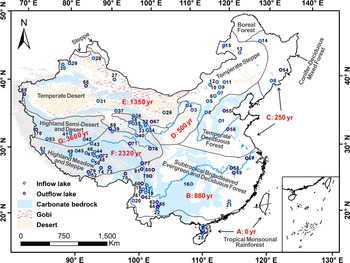
With more than 2759 natural lakes that exceed 1 km2 (Wang et al. Reference Wang, Dou and Chen1998), lakes are widely distributed in China. Here, we divide them into seven regions (Figure 1) according to the vegetation divisions of Zhao et al. (Reference Zhao, Yu, Chen, Zhang and Yang2009) and Zhou and Yu (Reference Zhao and Yu2012). Qinling Mountain–Huaihe River separates North China and South China, the boundary between temperate grassland and temperate desert separates Northwest China and North China, and the 3000-m contour separates the Qinghai-Tibet Plateau, South China, and Northwest China (Chen et al. Reference Chen, Xu, Chen, Birks, Liu, Zhang, Jin, An, Telford and Cao2015), as shown in Figure S1.
Spatial distribution of lake 14C reservoir effect in different vegetation and bedrock zones in China. Blue circles and purple circles represent the location of inflow and outflow lakes, respectively. Lake numbers are shown here 1 and also in supplementary Table S1. A–G present different climate and vegetation zones (modified from Zhao et al. Reference Zhao, Yu, Chen, Zhang and Yang2009). Average reservoir ages are in red.

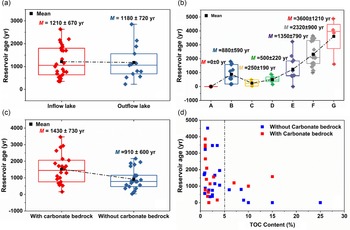
In Figure 1 and Table S1, the 14C reservoir ages of 81 lakes in China are reviewed based on published research from the past 20 years. The 14C reservoir effect of lakes in China shows significant spatial variability, ranging from 0 14C year in Shuangchi Maar Lake (Dodson et al. Reference Dodson, Li, Lu, Zhang, Yan and Cao2019) in Hainan province to 23,585 14C years in Lake Qiangyong Co (Zhang et al. Reference Zhang, Xu, Turner, Zhou, Gao, Lu and Nesje2017) on the Qinghai-Tibet Plateau. On a large geographic scale (see Figure S1), the average 14C reservoir effect in north China and south China is around 450 ± 260 (n = 10) and 640 ± 410 (n = 10) 14C years, respectively, whereas lakes on the Qinghai-Tibet Plateau have the highest 14C reservoir ages with an average reservoir age of 2370 ± 1240 (n = 48) 14C years. 14C reservoir ages in Northwest China fall between South China and the Qinghai-Tibet Plateau with an average reservoir age of 1420 ± 890 (n = 6) 14C years. Regionally, the spatial distribution of the 14C reservoir effect is Qinghai-Tibet Plateau > Northwest China > North China > South China (Table S1 and Figure S1). In addition, the average reservoir age of outflow lakes (1180 ± 720 (n = 13) 14C years) is almost the same as for inflow lakes (1210 ± 670 (n = 26) 14C years), indicating that the closure condition of lakes is not the dominant factor affecting the 14C reservoir effects (see Figure 2a).
Statistical graph of lake reservoir effect in China: (a) box-plot of 14C reservoir age in outflow and inflow lakes; (b) box-plot of lake 14C reservoir age under different vegetation types (A–G, please also see Figure 1); (c) box-plot of lake 14C reservoir ages in regions with carbonate and without carbonate bedrocks; (d) relationship of reservoir age verses TOC content in lake sediments. Top/bottom of boxes (a)–(c) denote upper/lower quartiles; upper/lower horizontal lines denote maximum/minimum; inner lines denote median; black squares denote arithmetic mean.

In terms of vegetation types, it appears that the average 14C reservoir age increases from tropical monsoonal rainforest (average 0 year) to temperate steppe (average 500 ± 220 (n = 7) 14C years) and then to highland meadow and steppe (average 2320 ± 900 (n = 21) 14C years) (Figure 2b). As for the subtropical broad-leaved evergreen and deciduous forest, this region has higher vegetation cover but older average lake reservoir ages (average 880 ± 590 (n = 11) 14C years) than temperate steppe and temperate deciduous forest with conifer-deciduous mixed forest (average 250 ± 190 (n = 3, due to the limited amount of lake research, the statistic is for reference only) 14C years). According to previous studies, widely distributed carbonate bedrock significantly affects the 14C content in dissolved inorganic carbon (DIC) of lake water (Liu et al. Reference Liu, Zhou, Cheng and Burr2017), the existence of carbonate bedrock around the lake will contribute to large 14C reservoir effects (Hendy et al. Reference Hendy, Hall and Letters2006). So, the older reservoir ages of the subtropical broadleaved evergreen and deciduous forest probably can be attributed to the influence of karstification in the Yunnan-Guizhou Plateau. Furthermore, our statistics also reflect the fact that lakes around carbonate bedrock have higher 14C reservoir ages, as shown in Figure 2c, where lake 14C reservoir ages could on average reach 1430 ± 730 (n = 22) 14C years in those basins with carbonate bedrock, which is about 520 14C years older than those basins without carbonate bedrock.
On the other hand, the content of total organic carbon (TOC) in sediment seems to have a possible relationship with the reservoir age. As shown in Figure 2d, when the TOC content in the sediments is high (greater than 5%), the reservoir age of the lake is not higher than 2000 years, especially less than 1000 years in non-carbonate areas. The TOC content in sediments of all lakes with 14C reservoir age over 2000 years is less than 5%, and the 14C reservoir effect fluctuates greatly within the content range of 0–5%. Thus, it seems that lakes with denser vegetation and/or higher lake productivity will have lower reservoir ages, both vegetation type and basin bedrock around the lake are jointly affecting the lake 14C reservoir effect.
In summary, specifically in eastern China, given the well-developed vegetation, higher lake productivity and less carbonate bedrock, the lake 14C reservoir effect is relatively small. However, in northwest China and the Qinghai-Tibet Plateau, sparse vegetation and widespread carbonate bedrock may lead to the significant regional lake 14C reservoir effects. Therefore, we assume that the relationship between vegetation cover along with bedrock types around the lake is responsible for the observed differences in the 14C reservoir effect in lakes of China. Follow-up research is required to verify the specific relationship.
CORRECTION OF LAKE 14C RESERVOIR EFFECTS IN CHINA
14C Reservoir Effect Correction Using Modern Samples
In this study, the 14C age of modern samples (DOC: dissolved organic carbon, DIC: dissolved inorganic carbon, living aquatic plants, living animals, and surface sediments) were used to determine 14C reservoir ages in lakes. For example, by measuring modern shells and submerged plants, Xu et al. (Reference Xu, Zhou, Lan, Liu, Sheng, Yu, Cheng, Wu, Hong, Yeager and Xu2015) determined that the 14C reservoir age in Lake Erhai was between 523 and 610 14C years; Mischke et al. (Reference Mischke, Herzschuh, Zhang, Bloemendal and Riedel2005) assumed currently surface living Pisidium shell ages as the present-day 14C reservoir age of Lake Luanhaizi. However, Yang and Chen (Reference Yang and Chen2014) compared the 14C ages of aquatic plants (Potamogeton malaianus) with lake water DIC and surface sediment in Dongping Lake and found that organisms may be affected by nuclear explosion events and appear to be younger, which implied that the 14C reservoir age determined by post-bomb aquatic organisms may be underestimated (Philippsen Reference Philippsen2013). Only by subtracting the effects of nuclear 14C, can we obtain a reliable value of the modern 14C reservoir age.
On the other hand, Peak 137Cs and 210Pb values in lake sediments, induced by global anthropogenic sources (nuclear tests) in the last century, can also serve as a time marker, which can be used as a standard for 14C reservoir age correction by comparing the 14C ages of the same sediment layers (Lan et al. Reference Lan, Wang, Chawchai, Cheng and Xu2020). For example, based on 14C ages of bulk organic matter from the 137Cs and 210Pb peaks in 1963 CE, Kasper et al. (Reference Kasper, Haberzettl, Doberschuetz, Daut, Wang, Zhu, Nowaczyk and Maeusbacher2012) obtained a contemporary 14C reservoir age of 1420 ± 40 14C years for Lake Nam Co, and excluded some anomalous 14C data at the surface layer. Based on 137Cs and 210Pb data, Tang et al. (Reference Tang, Wang, Zhang, Chu, Chen, Pei, Sheng and Yang2015) and Sun et al. (Reference Sun, Chu, Xie, Zhu, Su and Wang2018) confirmed that the 14C reservoir effect in the sediments of Lake Xiari Nuur is insignificant (Xu et al. Reference Xu, Wang, Gu, Hao, Wang, Chu, Jiang, Liu and Qin2018).
14C Reservoir Correction of Lake Sediment Sample
As lake sediments deposited over a long time, sedimentation rate and 14C reservoir age can be expected to change with variations of lake hydrological conditions (Brown et al. Reference Brown, Bierman, Lini and Southon2000; Soulet et al. Reference Soulet, Ménot, Garreta, Rostek, Zaragosi, Lericolais and Bard2011). If the sedimentation rate is constant, the 14C age in sediments should be linearly correlated with depth. The intercept of a linear regression equation can be taken as 14C reservoir age for the whole stratum. However, the chronological framework established by this method may incur large uncertainties when the sedimentation rate is not constant. In view of this, Zhou et al. (Reference Zhou, Cheng, Jull, Lu, An, Wang, Zhu and Wu2014, Reference Zhou, Liu, Wang, An, Cheng, Zhu and Burr2016) applied a method to determine the 14C reservoir age of Lake Qinghai for the past 40 ka. Considering the change of sedimentation rate, average 14C ages in different lithologic sections should be calculated by means of different linear regressions. The regression Eq. (1)
 $${y_e}{\rm{\;}} = {\rm{\;}}a{x_d} + b{\rm{\;}} = {\rm{\;}}y\left( {{x_d}} \right) + b\left( {\overline {DCF} } \right) \;\rm(DCF:dead\ carbon\ fraction) $$
is obtained by regression calculation between the 14C age (y) measured by AMS (accelerator mass spectrometry) and depth data points (
 $${x_d}$$
). The estimated value (
 $${y_e}$$
) is the sum of both the contribution of natural decay with depth (
 $${x_d}$$
) and a constant radiocarbon reservoir effect (
 $$\overline {DCF} $$
) which is implied in the intercept b of the regression equation. At the surface of the sedimentary profile, where
 $${x_d}{\rm{\;}} = {\rm{\;}}0$$
, the contribution provided by natural decay should be 0, and only a constant contribution provided by the average old carbon effect (
 $${y_e}{\rm{\;}} = {\rm{\;}}b\left( {\overline {DCF} } \right)$$
). Finally, it is concluded that the average reservoir age
 $$y(\overline {DCF)} $$
is the intercept (b) of the regression equation for the case where the regression equation is suitable to the sediment surface.
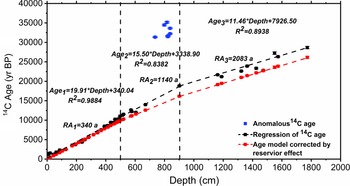
In the Lake Qinghai case, the lithology of 1F core is chosen for this study, the section contains clay from 0–499 cm, silty sand from 499–901 cm, and fine sand after 901–1861 cm (Zhou et al. Reference Zhou, Cheng, Jull, Lu, An, Wang, Zhu and Wu2014), therefore we should consider the different sedimentation rate for establishing a reliable chronology (see Figure 3). As mentioned above, we calculate the average 14C reservoir age of Lake Qinghai above 499 cm (during the Holocene) to be 340 14C years, the rest portions at 499–901 cm and 901–1861 cm to be 1140 and 2083 14C years, respectively. Li et al. (Reference Li, Wang, Zhang, Lei and Hou2017) also applied this method to the 14C reservoir correction of Aweng Co. According to different sedimentation rates, the average 14C reservoir age of the upper and lower sections of the Aweng Co core are 4066 and 3227 14C years, respectively.
Age-depth model of Lake Qinghai 1F core. 14C reservoir age obtained by piecewise linear regression using 14C ages based on different sedimentation rate (clay from 0–499 cm, silty sand from 499–901 cm, fine sand from 901–1861 cm). RA denotes average 14C reservoir age.

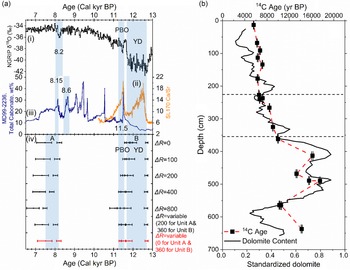
In addition, Ming et al. (Reference Ming, Zhou, Wang, Cheng, Shu, Xian and Fu2020) discussed the influence of reservoir age uncertainties on climate reconstructions from Lake Bayan Nuur sediments in Inner Mongolia and put forward a paleoclimatic method to determine the 14C reservoir age. They generated different Bayesian age models based on the Bacon program, varying only the 14C reservoir age from its possible range (0–800 cal years), then evaluated its rationality by stratigraphic alignment. This technique allowed them to constrain the uncertainties caused by the 14C reservoir age effect. The beginning and ending ages of sand layers in Lake Bayan Nuur sediments were found to be in good agreement with the timing of corresponding North Atlantic cold events (see Figure 4a).
(a) Carbon reservoir age compared with climatic abrupt events (after Ming et al. Reference Ming, Zhou, Wang, Cheng, Shu, Xian and Fu2020), from top to bottom: (i) NGRIP δ18O record (Rasmussen et al. Reference Rasmussen, Bigler, Blockley, Blunier, Buchardt, Clausen, Cvijanovic, Dahl-Jensen, Johnsen and Fischer2014); (ii) Ca/Sr ratios for core SL 170 in central Baffin Bay, North Atlantic (Jackson et al. Reference Jackson, Carlson, Hillaire-Marcel, Wacker, Vogt and Kucera2017); (iii) detrital carbonate events recorded in MD99-2236 core, North Atlantic (Jennings et al. Reference Jennings, Andrews, Pearce, Wilson and Olfasdotttir2015); (iv) modeled ages for the onset and end of sand layers for the YD (Younger Dryas), PBO (pre-Boreal oscillation) and 8.2 ka events in Lake Bayan Nuur sediments. Modeled ages using different reservoir values (ΔR) are shown with calculated uncertainties; the shaded area indicates the timing of dry/cold intervals for each record; (b) standardized XRD results of allochthonous dolomite input (black line) compared with the 14C ages (red dashed line) (after Lockot et al. Reference Lockot, Ramisch, Wunnemann, Hartmann, Haberzettl, Chen and Diekmann2015).

Other Methods
Independent dating methods, such as uranium-series dating, varve counting, OSL (optically stimulated luminescence) dating and the age of terrestrial plant residues from the sediments, can also be used as reference for 14C reservoir age corrections. For example, based on the results of 12 OSL and 14C dating ages in Lake Zhuyeze sediments, Long et al. (Reference Long, Lai, Wang and Li2017) confirmed that the 14C reservoir age in lake Zhuyeze was insignificant. However, Yu et al. (Reference Yu, Cheng and Hou2014) compared the OSL and 14C ages on bulk organic carbon and considered the 14C ages appear to be anomalously old (>9000 BP). Due to the input of pre-aged carbon to the lake, they consider the reservoir age could be as old as 20,000 years. Zhang et al. (Reference Zhang, Liu, Wu, Liu and Zhou2012) found complex changes of the 14C reservoir effect in Lake Lop Nuur through a comparison of OSL and 14C dates on lake sediments. Zhou et al. (Reference Zhou, Chen, Wang, Yang, Qiang and Zhang2009) revealed that the 14C reservoir in Lake Sugan changed from 2590 to 4340 14C years through the chronology of lake varve. By comparing the age of TOC and plant residues in the same layer of Lake Bosten, Huang et al. (Reference Huang, Chen, Fan and Yang2009) found that the 14C reservoir age was 1140 14C years age, relatively stable for Lake Bosten. By comparing the age difference of TOC and terrestrial wood fragments on the same horizon, Li et al. (Reference Li, Yang, Yao, Chen and Liu2016) proposed that the average 14C reservoir age of Lake Poyang was 560 14C years. In addition, considering the existence of a large number of plant macrofossils the difference between the age of TOC and plant macrofossils in the same borehole reveals that the fluctuations of lake 14C reservoir age are about 8000 14C years in Lake Chenghai (Xiao et al. Reference Xiao, Haberle, Li, Liu, Shen, Zhang, Yin and Wang2018) and 960–2200 14C years in Lake Xingyun (Zhou et al. Reference Zhou, He, Wu, Zhang, Zhang, Liu and Yu2015). In summary, the 14C reservoir age is difference of 14C time rather than calendar time, thus it is required to convert the calendar ages from other method (such as OSL) into atmospheric-derived 14C age using the atmospheric calibration curve (Soulet Reference Soulet2015) before reservoir age calculation, referred to “decalibration” or “uncalibration” (Soulet Reference Soulet2015; Reimer and Reimer Reference Reimer and Reimer2017).
Finally, for lakes with clear input and output end-members, the carbon budget can be simulated based on model calculations. The influences of each end-member and its influence on the 14C reservoir effect can be evaluated in theory. For example, employing a two-box simulation model based on the principle of 14C mass balance, Yu et al. (Reference Yu, Shen and Colman2007) estimated a calculated 14C reservoir age value of about 1500 14C years for Lake Qinghai. However, the model approach requires detailed meteorological and hydrological data in the lake basin and its surroundings region, which limits its application.
Re-Analysis of Anomalous 14C Data of Lake Sediments
When we date samples and find ages that do not correspond to their stratigraphic order, these anomalous data are often rejected in view of their implied stratigraphic inversion. However, these anomalous data may be related to changes in climate and the environment in a lake basin and should be scrutinized in this light.
For example, based on the 14C ages of 1F and 2C cores in Lake Qinghai (An et al. Reference An, Colman, Zhou, Li, Brown, Jull, Cai, Huang, Lu and Chang2012; Zhou et al. Reference Zhou, Cheng, Jull, Lu, An, Wang, Zhu and Wu2014, Reference Zhou, Liu, Wang, An, Cheng, Zhu and Burr2016), three striking anomalous ages periods were found. During the three warming intervals at 35, 19, and 14 ka BP, stalagmite records indicated that the temperature and precipitation in the monsoon region increased (Dykoski et al. Reference Dykoski, Edwards, Cheng, Yuan, Cai, Zhang, Lin, Qing, An and Revenaugh2005), which may have led to the retreat of glaciers around Lake Qinghai. Since a large quantity of meltwater flowed into the lake, a commensurate amount of old carbon would also be expected, providing a possible mechanism to explain the anomalous 14C age results.
Lockot et al. (Reference Lockot, Ramisch, Wunnemann, Hartmann, Haberzettl, Chen and Diekmann2015) found that 14C age fluctuations of aquatic plants in the drilling core of Lake Heihai were highly correlated with dolomite content (see Figure 4b). During the last deglaciation period/early Holocene, the temperature gradually increased, and a large quantity of dolomite was carried into the lake by meltwater, where it dissolved into inorganic carbon (Abbott and Stafford Reference Abbott and Stafford1995) and resulted in older 14C ages. In the middle Holocene, 14C dating results no longer fluctuated with the change of depth, resulting from climate and hydrological conditions generally remain stable. As for the late Holocene, the climate around lake basins experienced drought and cold temperatures. With the decrease of lake water level, old lacustrine sediments were exposed to the surface and redeposited into the lake. The 14C age of sediments in this section is basically constant. From this perspective, 14C dating results of sediments in Lake Heihai serve as indicators of regional climate change.
Zhang et al. (Reference Zhang, Xu, Turner, Zhou, Gao, Lu and Nesje2017) conducted a comparative study on 14C dating of plant residues and pollen concentrates in sediments of Lake Qiangyong Co in Qinghai-Tibet Plateau. It was found that 14C dating ages of Cyperaceae plant residues can represent true sediment ages, while 14C dating results of pollen concentrates in the same strata are greater than those of sediments from 0 to 5080 14C years. This phenomenon is called the old pollen effect (OPE). The three high OPE stages in Lake Qiangyong Co sediment correspond to the Current Warm Period, the Medieval Warm Period, and the Iron/Roman Age Optimum warm period, while the low OPE stage corresponds to the Little Ice Age, Dark Ages, and Iron Age Cold epoch. The OPE-derived cold periods are consistent with the regional glaciation processes revealed by 10Be dated moraine records. Therefore, the OPE of Lake Qiangyong Co based on 14C dating ages anomaly serve as a proxy for regional glacial activity.
CONCLUSION
The 14C reservoir effect is widespread in lakes but varies in different regions in China. Here, we summarized and reviewed the 14C reservoir effect of 81 lakes in China published in the last recent 20 years and have provided a spatial distribution of lake 14C reservoir effect in China, which displays obvious regional characteristics. These characteristics indicate that bedrock types in lake basins are a significant factor controlling the value of lake 14C reservoir ages. However, considering the surrounding environment and climatic conditions, such as vegetation and rainfall, cannot be avoided. In addition, traditional methods such as modern 14C reservoir age and linear regression are appropriate for lakes with small 14C reservoir effect fluctuations with time. For lakes with significant changes in sedimentary facies and sedimentation rate, a piecewise linear regression method should be considered. It is worth mentioning that, when using other dating rather than 14C for reservoir age correction, it requires the “decalibration” of calendar ages to obtain the corresponding atomsphere-drived 14C age. In practice, some anomalous age data are rejected with good reason. However, we hold that these anomalous age data may provide valuable information about the hydrological conditions of the lake and serve as an indicator of regional environmental change. These conclusions will provide reference for correcting 14C reservoir effect in future lake research.
ACKNOWLEDGMENTS
The authors would like to express sincere thanks to the staff of the Xi’an AMS Center for their support. Special thanks go to Prof G. S. Burr for English improvement and his valuable suggestions on the previous drafts of this manuscript. This research was jointly supported by the Strategic Priority Research Program of Chinese Academy of Sciences (XDB40000000); National Natural Science Foundation of China (41730108, 41930321); the Open-end Fund Program of State Key Laboratory of Loess and Quaternary Geology, Institute of Earth Environment, Chinese Academy of Sciences; the Inter-discipline Research Funds of Beijing Normal University (2017NJCB03); the Key research and development plan of Ministry of Science and Technology in China (2019YFC1509100). Chinese Academy of Sciences (QYZDY-SSW-DQC010); and the International Partnership Program of Chinese Academy of Sciences (132B61KYSB20170005).
Supplementary material
To view supplementary material for this article, please visit https://doi.org/10.1017/RDC.2021.92