Advances in diagnosis and treatment for congenital disease have resulted in improved outcomes in children born with cardiac malformations. Although the majority of these children seem to be functioning at a normal level,1 as a group they are at risk of developing educational, behavioural, and emotional problems.2–5 Problems mostly appear at school age, when children have to meet specific cognitive and social demands. The cardiac disease, and its treatment, may cause absence from school, thereby putting school performance at risk, and limiting social interactions and contacts with peers. Moreover, the illness may cause the parents to be anxious and overprotective towards the child, which may influence the subsequent development.6
In addition to the problems reported at school age, problems have been reported in adulthood. Research, however, has yielded contradictory results. Van Rijen et al.7 reported lower levels of education in patients compared with a healthy population, whereas Nieminen et al.8 found similar educational levels. Ternestedt et al.9 showed even higher educational levels in adults with a congenital cardiac malformation compared with healthy controls. With regard to quality of life, Kamphuis et al.10 found that patients with a complex malformation functioned less well compared with the general population, whereas Fekkes et al.,11 and Moons et al.,12 reported the same or even better functioning in patients compared with healthy controls. Regarding aspects of emotional and social functioning in adults, studies have mainly shown favourable outcomes.7, 13, 14
Thus, both favourable and unfavourable outcomes have been shown in patients with congenital cardiac disease. The discrepancies in the outcomes may be related to the heterogeneity of the populations studied, and the diversity of variables in the research design. Our study focuses on the outcome of patients with congenital cardiac malformations undergoing surgical correction during school age. Although nowadays many patients with a congenital cardiac malformation have undergone one or more operations prior to beginning schooling, cardiac surgery at school age may have a considerable impact on development, in part because of the surgical procedure used, but also because of factors such as absence from school, being different from peers, and parental emotional reactions. To examine the impact of cardiac surgery at school age, we designed a study consisting of two parts. The first part is a longitudinal prospective study aimed at neurocognitive functioning in such patients before their surgery, at discharge from hospital, and one year after surgery. The design allows the establishment of causal relations between the specific surgical procedure undergone and the neurocognitive outcome. Moreover, the design controls for medical history, because the patients function as their own controls.
As the neurocognitive effects of open-heart surgery may result in educational problems and behavioural and emotional problems,3–5 we wanted to add information about the long-term functioning of the patients studied having undergone open-heart surgery at school age. We designed, therefore, the second part of the study, which we present in this manuscript. The objective was to explore the general long-term physical, educational, behavioural, and emotional outcome of congenital cardiac disease treated by cardiac surgery at school age. In addition to exploring the general outcome, we specifically related the outcome to comorbidity, age and sex, and the level of complexity of the cardiac surgery.
Methods
Patients and procedure
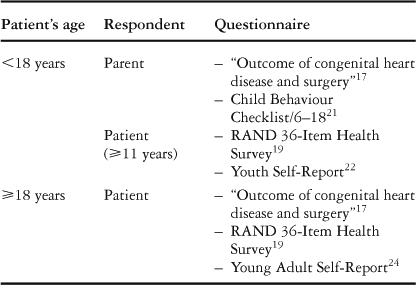
All patients who underwent their latest open-heart operation for congenital cardiac disease at our medical centre over the years 1992 up to and including 2000, and who were aged from 6 to 16 at the time of the surgery, were eligible to participate. To have a sample representative of the total population of patients with a congenital cardiac malformation, we included patients with comorbidity. Of the 152 eligible patients, 4 had died, while 7 were excluded because their current address could not be obtained. The remaining 141 patients, and/or their parents, received a letter requesting informed consent accompanied by a set of questionnaires. Table 1 shows the sets of questionnaires used and the responses required. Patients and parents were asked to return the completed questionnaires within four weeks. In addition to the data provided by the patients and the parents, all medical files were searched for age, sex, comorbidity, type of congenital cardiac disease, and type of cardiac surgery. The study was approved by the Institutional Review Board.
Table 1. Sets of questionnaires depending on patient's age.

To enable comparisons with the associated study, in which causal relations may be established between the outcome and the surgical procedure undergone, we chose to grade the level of complexity of the surgery rather than the lesion. For all patients, the surgical procedure was classified into one of four groups according to the Aristotle™ classification.15 We preferred the Aristotle approach15 over the RACHS system16 because we wanted to indicate the complexity of the surgical procedure and its associated morbidity rather than the risk of death associated with the surgical procedure. In addition, the nomenclature used in our centre corresponds with the nomenclature of the Aristotle approach, which enables reliable translations of surgical procedures into the level of complexity suggested by the Aristotelian approach.
Patient characteristics
Of the 141 sets of questionnaires sent, 101 were returned (71.6%). Information was obtained about 55 male and 46 female patients, the overall group having a mean age of 18.1 years, with a range from 9.3 to 27.4 years. Of the patients, 7 were younger than 11 years, 46 patients were aged 11 to 18 years, and 48 patients were aged 18 years and older. Patients in the group responding did not differ from those not responding regarding their demographic and medical data (χ2 tests and t tests, p more than 0.05).
Just over one-quarter (25.7%) of the patients had comorbidity. Of these, 11 patients had chromosomal or syndromal anomalies, 1 patient had haemophilia, 1 patient had hypercholesterolaemia, 4 patients had defects of the central nervous system, 2 patients had respiratory tract disease, 2 patients had scoliosis, 1 patient had undergone nephrectomy, 1 patient had lost a limb, 1 patient had had cancer, and 2 patients had multiple anomalies. In addition, 9 of the patients with comorbidity were cognitively impaired.
Outcome measures
The questionnaire “Outcome of congenital heart disease and surgery”17 was designed specifically for the purpose of this study. It focused on the current state of the patient, and measured current physical and educational states.
The Dutch version of the RAND 36-Item Health Survey18, 19 measures the subjective health state by means of eight health concepts. The Dutch version of the Child Behaviour Checklist20, 21 contains questions about behavioural and emotional functioning during the preceding six months as reported by the parents. The answers are transformed into eight syndrome scales. The patients themselves completed self-reports comparable to the Child Behaviour Checklist using the Dutch Youth Self-Report20, 22 and the Dutch Young Adult Self-Report.23, 24
Statistical analyses
To enable clear interpretation of the outcome being the result of only congenital cardiac disease and cardiac surgery at school age, the results of patients without comorbidity were separated from the results of patients with any type of comorbidity. The results of patients without comorbidity were compared with healthy peers, and with the results of patients with comorbidity. In addition, comparisons were made between patients younger than 18 years and patients older than 18 years, male patients and female patients, and the four groups according to the level of complexity of the surgical procedures. Age, sex, comorbidity, and complexity were not confounded.
The questionnaire “Outcome of congenital heart disease and surgery” was analysed in an explorative manner by means of descriptive statistics. The outcome was examined for all patients together, irrespective of respondent. Binomial tests were used to compare the educational data with data from the general Dutch population.25, 26 Chi-square tests, independent t tests, and analyses of variance were used to compare the results of the different groups.
Results on the RAND 36-Item Health Survey, Child Behaviour Checklist, Youth Self-Report, and Young Adult Self-Report were compared with reference data20, 27 by means of binomial tests. Chi-square tests were used to compare the results of the different patient groups.
On the RAND 36-Item Health Survey, the Youth Self-Report, and the Young Adult Self-Report, some of the patients were not able to complete the questionnaires themselves because of cognitive impairment. Self-reports completed by parents instead of patients were excluded, this being required for 4 patients younger than 18 years, and 5 patients older than 18 years.
All statistical analyses were carried out using a two-tailed probability level of 0.05 using the Statistical Package for the Social Sciences version 11.0 for Windows.
Results
Current physical state
General outcome.
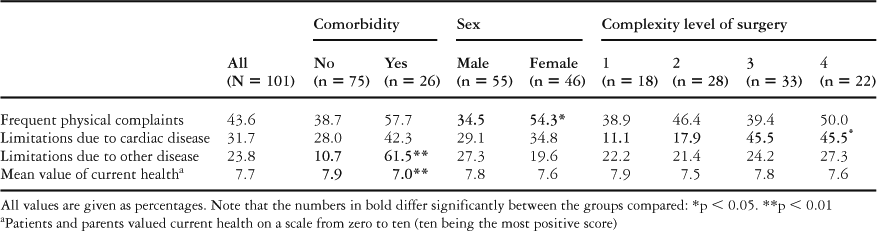
As shown in Table 2, 43.6% of all patients reported physical complaints. Almost one third experienced limitations due to the cardiac disease, and nearly one quarter experienced limitations due to another disease. Nevertheless, the value of their current health was 7.7 on a scale from zero to ten.
Table 2. Current physical state of patients.

Comorbidity.
Even when patients with comorbidity were excluded, 38.7% of the patients reported physical complaints. Of the patients without comorbidity, 28% reported limitations due to the cardiac disease (Table 2). As might be expected, a higher proportion of patients with comorbidity experienced limitations due to another disease than patients without comorbidity (χ2 equal to 27.58; p less than 0.01). In accordance, patients with comorbidity valued their health as poorer than the other patients (t equal to 3.82; p less than 0.01).
Age and sex.
Age was not related to physical complaints or limitations (data not shown). Female patients experienced more physical complaints than male patients (χ2 equal to 4.00; p less than 0.05).
Level of complexity of the cardiac surgery.
More patients who had undergone surgical procedures graded at levels 3 and 4 reported limitations due to the cardiac disease than those undergoing procedures graded at levels 1 and 2 (χ2 equal to 10.81; p less than 0.05).
Subjective health state
General outcome.
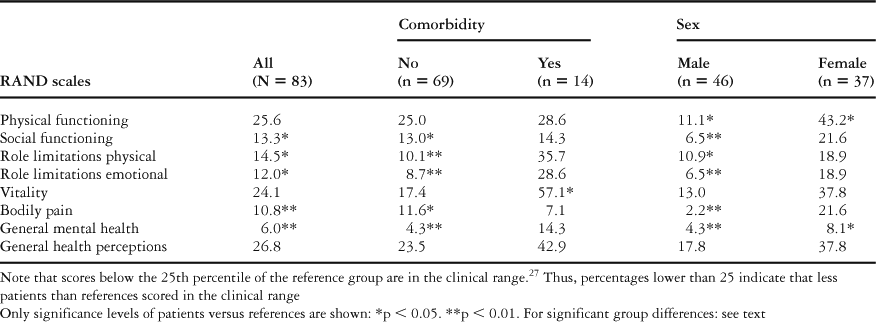
In contrast to the amount of physical complaints and limitations reported, patients reported better functioning than healthy peers on 5 of the 8 subscales of the RAND 36-Item Health Survey (Table 3). Regarding the other three subscales, specifically “Physical functioning”, “Vitality”, and “General health perceptions”, the patients and their healthy peers were comparable.
Table 3. Subjective health state: proportions (%) of scores in the clinically significant range.

Comorbidity.
After exclusion of patients with comorbidity, the results practically remained the same as for the total group (Table 3). Patients with comorbidity scored in the clinical range more often than patients without comorbidity on the scales “Role limitations due to physical health problems” (χ2 equal to 6.15; p less than 0.05) and “Vitality” (χ2 equal to 10.06; p less than 0.01).
Age and sex.
The effects of age and sex were in accordance with the current physical state reported: Age was not related to subjective health state (data not shown). Female patients reported significantly poorer “Physical functioning” than healthy peers (Table 3). In contrast, male patients showed a better subjective health state than healthy peers on 6 of the 8 subscales. Thus, female patients reported more clinically significant problems than male patients on the subscales “Physical functioning” (χ2 equal to 11.00; p less than 0.01), “Vitality” (χ2 equal to 6.89; p less than 0.01), “Bodily pain” (χ2 equal to 8.02; p less than 0.01), and “General health perceptions” (χ2 equal to 4.16; p less than 0.05).
Level of complexity of the cardiac surgery.
The level of complexity of the surgery (data not shown) did not have any effect on the subjective state of health.
Educational state
General outcome.
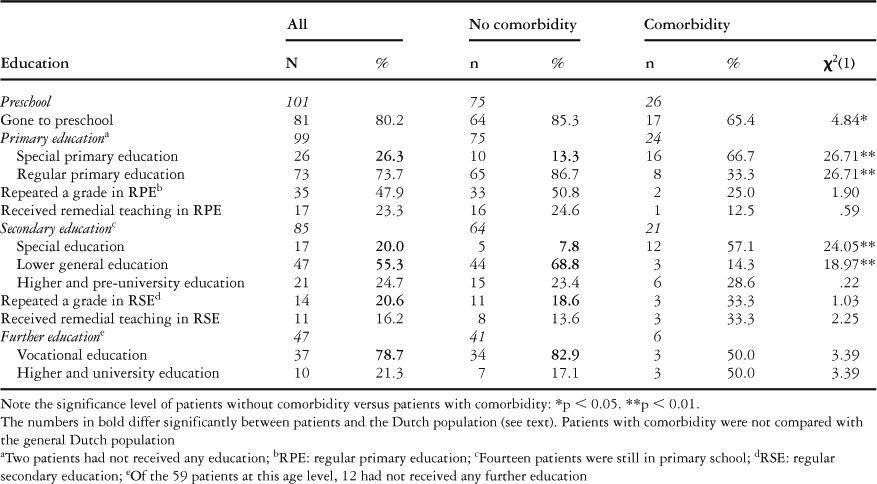
A considerable proportion of the patients showed poor educational attainments (Table 4). Just over one-quarter (26%) had received special primary education, which was almost 8 times the proportion found in the general Dutch population26 (binomial test 26.3% versus 3.3%; p less than 0.01). In addition, patients had received lower secondary education, including special secondary education, more often than the reference group (binomial test 75.3% versus 62.5%; p less than 0.05). Accordingly, more patients had followed further education at the vocational level than the reference group (binomial test 78.7% versus 55.6%; p less than 0.01). Finally, more patients than healthy peers25 had repeated a grade in secondary education (binomial test 20.6% versus 5.0%; p less than 0.01).
Table 4. Educational state of patients.

Comorbidity.
When patients with comorbidity were excluded, we still found a high incidence of special education in patients compared with healthy peers (binomial test 13.3% versus 3.3%; p less than 0.01). Also the level of secondary and further education remained significantly lower than in the reference group (binomial test 76.6% versus 62.5%; p less than 0.05, binomial test 82.9% versus 55.6%; p less than 0.01). In addition, the incidence of repeating a grade in secondary education (18.6%) was still significantly higher than the 5% in the general Dutch population25 (p less than 0.01).
Age, sex, and level of complexity of the surgery were not associated with educational state.
Behavioural and emotional functioning
General outcome.
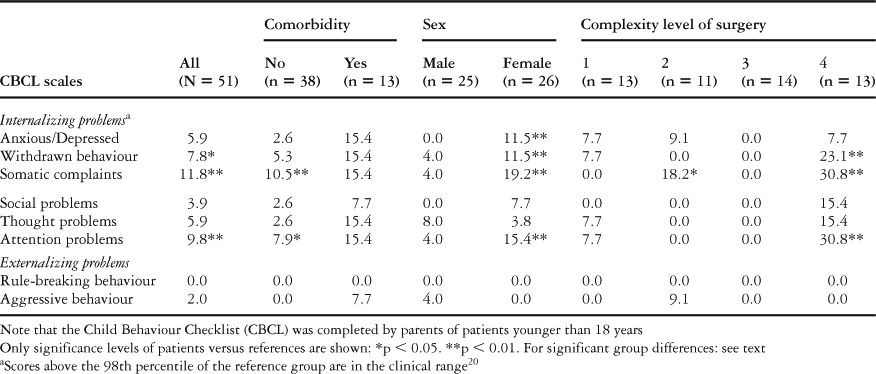
Table 5 shows behavioural and emotional problems according to the parents of patients younger than 18 years (Child Behaviour Checklist). The patients showed more “Withdrawn Behaviour”, more “Somatic Complaints”, and more “Attention Problems” than healthy peers. The results of the self-reports (Youth Self-Report, 11–18 years; Young Adult Self-Report, older than 18 years) are not shown, because the patients themselves did not report any significant problems compared with healthy peers.
Table 5. Behavioural and emotional functioning: proportions (%) of scores in the clinically significant range.

Comorbidity.
After exclusion of the patients with comorbidity, the parents of patients without comorbidity still reported many “Somatic Complaints” and “Attention Problems” on the Child Behaviour Checklist (Table 5). No significant differences were found between patients with comorbidity and patients without comorbidity for the reports of both parents (Child Behaviour Checklist) and those self-reported (Youth Self-Report and Young Adult Self-Report).
Age and sex.
According to the parents, female patients in particular showed more clinically significant problems than healthy peers on several scales of the Child Behaviour Checklist (Table 5). The female patients themselves, however, reported no clinically significant problems (Youth Self-Report and Young Adult Self-Report, data not shown). No significant differences were found between male and female patients on the Child Behaviour Checklist, the Youth Self-Report, and the Young Adult Self-Report.
Level of complexity of the cardiac surgery.
As shown in Table 5, parents of patients undergoing procedures graded at level 4 reported most problems in the clinical range. Again, the patients themselves reported no clinically significant problems (data not shown).
Discussion
General outcome
As congenital cardiac disease and cardiac surgery may have a considerable impact on the development of afflicted patients, especially at school age, we designed the present study to explore the long-term physical, educational, behavioural, and emotional outcome. Despite reporting physical complaints and limitations due to the cardiac malformation, the patients rated their subjective health state, as measured by the RAND 36-Item Health Survey, as the same or even better than their healthy peers. This result reveals an intriguing issue with respect to appraisal of chronic conditions. Patients seem to acknowledge the presence of physical complaints and limitations, but do not negatively appraise them to the extent that they consider their subjective state of health to be affected.
In line with the findings on subjective state of health, the patients tended to answer positively when asked about their appraisal of certain behaviours. They did not report any clinically significant problems on the Youth Self-Report and the Young Adult Self-Report. Problems may, nevertheless, have been present, because the parents reported significant problems on their children on several subscales of the Child Behaviour Checklist. Differences between the presence of problems and their appraisal have also been shown in other chronically ill patients. It seems that, in the majority of patients, a process of psychological adjustment occurs, strengthened by having survived serious threats due to the illness. Most patients, therefore, successfully adapt to the illness and may even report a psychological well-being comparable to that of healthy persons.28–30
In addition to the physical, behavioural, and emotional outcome, we explored the educational outcome of the patients. Our findings pointed to more academic difficulties for patients compared with their healthy peers. Even of the patients without comorbidity, a relatively high proportion, about one-sixth, had needed special education. Moreover, a considerable number of patients had repeated a grade or had received remedial teaching. As a result, their educational level was lower than that of the Dutch population.
Previous studies on educational levels in patients with surgically corrected congenital cardiac disease have yielded contradictory results.7–9 This may be due to the fact that school systems differ between countries, which makes studies difficult to compare, and explains why the results of the present study are only in accordance with the Dutch study by Van Rijen et al.7 Studies converge, however, with respect to the overall relation between neurocognitive impairment after open heart surgery and educational problems.2, 5 The high incidence of “Attention Problems” on the Child Behaviour Checklist observed in our study also subscribes to this.
Effect of comorbidity, age and sex, and level of complexity of the cardiac surgery
In addition to exploring the general outcome of patients undergoing surgical correction of their cardiac malformation at school age, we explored the effect of comorbidity, age and sex, and the level of complexity of the surgical procedures.
Comorbidity.
One-quarter of the patients had comorbidity. But even after exclusion of patients with comorbidity, the results remained stable. The general outcome, therefore, was indeed the result of surgical correction of the malformation at school age, and not an effect of comorbidity. Nevertheless, the presence of comorbidity, including cognitive impairment, added to the problems already present: Patients with comorbidity had more limitations due to another disease, valued their current health as worse, reported a poorer subjective health state, and received special education more frequently than patients without comorbidity. No differences were found between patients with and without comorbidity on the Child Behaviour Checklist, Youth Self-Report, and Young Adult Self-Report. These findings are in accordance with research by Fortin et al.,31 who showed that patients with comorbidity generally report a poorer quality of life related to the physical domains, but not on the social and psychological domains.
Age and sex.
None of the outcome variables were associated with age. The results for male and female patients mainly differed with regard to physical functioning. Female patients experienced more physical complaints than male patients. Accordingly, female patients showed a poorer subjective health state on the physical domains than male patients. These findings are in accordance with previous research.7, 14 Although speculations have been made, no clear explanation for this difference has been given.
Level of complexity of the surgical procedures.
The type of surgery the patients had undergone was classified into four levels of complexity.15 The level was not related to the subsequent educational state of the patients. Patients who had undergone surgical procedures graded at levels 3 and 4 reported more limitations due to the cardiac disease, but their subjective health state was unaffected. Parents of patients undergoing a procedure graded at level 4 reported most behavioural and emotional problems. The patients themselves, however, reported no behavioural and emotional problems.
A discrepancy between the reports of patients and their parents was also shown by Krol et al.32 and Van Rijen.33 As suggested earlier, a possible explanation of the difference between the presence of problems as reported by the parents, and their appraisal as reported by the patients, may be the adjustment by the patients to their illness. On the other hand, the perceptions of the parents may have influenced the results. Parents of patients who underwent more complex surgery may have been more anxious and protective, thus reporting more behavioural and emotional problems. Other research has shown that maternal perceptions may indeed influence adjustment of the child.6 Regardless of the possible explanations, those undergoing the most complex procedures merit especial attention regarding physical limitations and behavioural and emotional problems.
Limitations
We acknowledge some limitations of our present study. The small size of our sample, especially when analysing subgroups, prohibited further classification of the patients into more than two age groups, thereby leaving only a split of above and below 18 years. Meaningful effects of age may have been masked. In addition, the overall group was too small and too diverse to investigate the influence of medical history. We are aware that variables like the number of earlier operations, and the age during earlier operations, may have influenced the outcome, and the perceptions of the illness made by the parents. The main purpose of our study, nonetheless, was to explore the general outcome of surgical correction of congenital cardiac disease at school age, regardless of medical history.
Other limitations are the possible confounding of age and respondent on the one hand, and severity of lesion and complexity of surgery on the other hand. Patients were classified according to the level of complexity of their latest surgical procedure. Patients with very complex lesions whose latest surgery was relatively simple, therefore, may have been graded at lower levels than patients with less severe lesions whose latest surgery was more complex. Although such a categorisation may have masked effects of the level of complexity of the surgery, the differences found between the levels of complexity were in accordance with other research.10
Conclusions
Our study has demonstrated that, despite physical complaints and limitations, patients with congenital cardiac disease generally report a good subjective state of health and report no behavioural and emotional problems. Clinicians should be aware, however, that even though patients do not explicitly report them, problems may be present. The explicitness of a question may make a difference. Questions about concrete physical complaints, limitations, and behaviours may reveal problems, whereas questions that ask for subjective interpretation may mask problems.
Another relevant finding for clinicians is that patients seem to have more academic difficulties than their healthy controls. As a consequence, patients are at risk for limitations in their academic and vocational careers. Clinicians should inform themselves about the performance of their patient at school to enable early interventions when problems are reported. Assessment of neurocognitive functioning in children with congenital cardiac disease is needed to determine a profile of strengths and difficulties that will enable adequate interventions. Prospective longitudinal studies are recommended to monitor the effects of medical interventions on neurocognitive development.