Introduction
Schoolchildren face health problems such as malnutrition, anaemia and parasitic infections that compromise their physical development, school attendance and ability to learn (Bundy & Guyatt, Reference Bundy and Guyatt1996). Anaemia affects 20–50% of the world's population and it is common among children (Saloojee & Pettifor, Reference Saloojee and Pettifor2001). In general, the prevalence of anaemia in developing countries is higher than that in developed countries (Bruner et al., Reference Bruner, Joffe, Duggan, Casella and Brandt1996; WHO, 2001). Anaemic children are more prone to have poor mental and educational performance (Saloojee & Pettifor, Reference Saloojee and Pettifor2001). In the tropics, parasitic infections such as hookworm infection, schistosomiasis and malaria are predictors for anaemia (Stoltzfus et al., Reference Stoltzfus, Chwaya, Tielsch, Schulze, Albonico and Savioli1997; Adam et al., Reference Adam, Khamis and Elbashir2005). Although many studies have concluded that the main cause of anaemia is the low dietary intake, several studies have shown a clear correlation between anaemia and a series of determinants, such as age and gender (Mai et al., Reference Mai, Hung, Kawakami, Kawase and Chuyen2003; Foo et al., Reference Foo, Khor and Tee2004).
Identifying the magnitude of anaemia and its determinants in schoolchildren is essential for evidence-based intervention modalities, particularly in developing countries where awareness is lacking and resources are scarce. Although much data are available concerning anaemia among schoolchildren in other African countries (Geissler et al., Reference Geissler, Mwaniki, Thiong'o, Michaelsen and Friis1998; Koukounari et al., Reference Koukounari, Estambale, Njagi, Cundill, Ajanga, Crudder, Otido, Jukes, Clarke and Brooker2008), no published data exist concerning anaemia and its determinants among schoolchildren in Sudan, the largest African country. Thus, studies investigating anaemia and its risk factors may be of great interest, so as to provide health planners and caregivers with fundamental guidelines for the implementation of preventive measures. Investigating this issue is particularly relevant for the design of integrated control strategies aimed at reducing anaemia, including anthelmintic treatment programmes, through school health programmes. In particular, the selection of intervention options will need to be guided by an informed understanding of the epidemiology of parasite-related anaemia. Therefore, the aim of this study was to investigate the prevalence and the possible risk factors for anaemia among schoolchildren of eastern Sudan.
Materials and methods
A cross-sectional study was conducted in New Halfa in eastern Sudan during the period of September–October 2008. The study was based in Alhara Alula elementary schools (for boys and girls). Permission was obtained from the Education and Health Vice Chancellor and the village head (sheikh) in the area, then the school authorities and parents/guardians of children were approached for participation in the study. The principal and headmasters then briefed their students and pupils, who thereafter obtained the consent of their parents to be part of the study. Socio-demographic data were collected using pre-tested questionnaires. Haemoglobin (Hb) level was measured using HemoCue haemoglobinometer (HemoCue AB, Angelhom, Sweden) and all children were screened for malaria and intestinal parasitic infections. including schistosomiasis.
Blood films were prepared, stained with Giemsa and 100 × oil immersion fields were examined. All the slides were double-checked blindly and only considered negative if no parasites were detected in 100 oil immersion field.
The overall intestinal helminth status of participants, including S. mansoni infection, was determined based on the combination of results from the formol–ether concentration and Kato–Katz techniques in order to improve sensitivity and, hence, accuracy of diagnosis. For the formol–ether concentration method, about 1 g of each specimen collected on the first day was preserved in a tube containing 10% formalin (Cheesbrough, Reference Cheesbrough1998). Well-qualified laboratory scientists performed microscopic examination of the stool specimens in order to detect S. mansoni, hookworm, Trichuris trichiura and Ascaris lumbricoides eggs. For the quantitative Kato–Katz technique (Teesdale & Amin, Reference Teesdale and Amin1976), two stool samples were collected on different days, with no more than a 5-day interval. Thick stool smears prepared using plastic templates were examined within 30–60 min using a light microscope. The smears were left to clear for at least 24 h and were re-examined to detect S. mansoni eggs. The numbers of eggs detected from each Kato–Katz thick smear were counted in order to express infection intensities as the number of eggs per gram of stool. Children with Hb levels lower than 12 g/dl were considered as anaemic and those with Hb < 8 g/dl were considered to have severe anaemia (WHO, 2001).
The study received ethical clearance from the Research Board at the Faculty of Medicine, University of Khartoum.
Data analyses
Data were entered in a computer using SPSS for windows (SPPS Inc., Chicago, Illinois, USA) and double checked before analyses. Continuous data (age, haemoglobin) were found to be normally distributed and hence presented as mean (SD). Means, frequencies, odd ratios and 95% confidence intervals were calculated. Means and proportions were compared by Student's t-test and χ2 test, respectively. Univariate and multivariate analyses were performed with severe anaemia as the dependent variable, while age, sex, schistosomiasis, and H. nana parasitic infection were the independent variables. P < 0.05 was considered significant.
Results
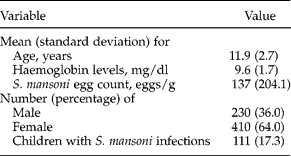
During the study period, 640 children were enrolled to the study and have complete data (230 boys and 410 girls). Their age ranged between 8 and 18 years. The mean (SD) of haemoglobin was 9.6 (1.7) mg/dl (table 1).
Characteristics of the 640 schoolchildren in eastern Sudan.
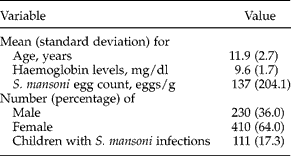
Five hundred and eighty (90.6%) of these 640 school children had anaemia, 103 (16.0%) of them had severe anaemia. Only one child was infected with P. falciparum malaria. One hundred and eleven (17.3%) and 33 (5.2%) children had S. mansoni infections and H. nana infections, respectively. Four of them had S. mansoni and H. nana co-infections. Children with S. mansoni infections had significantly higher age than non-infected children, 12.0 (1.9) vs. 11.9 (2.2); P = 0.01. Boys had a significantly higher prevalence of S. mansoni infections than girls: 79/230 (34.3%) vs. 37/410 (9.0%); P < 0.001. The mean (SD) of the egg count in children was 137 (204.1) eggs/g.
Predictors for severe anaemia
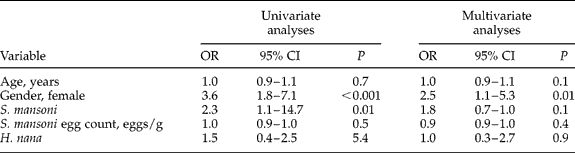
Girls (OR = 2.5, 95% CI = 1.1–5.3; P = 0.01) were at higher risk for severe anaemia using univariate and multivariate analyses. Schistosoma mansoni infections were associated with severe anaemia in univariate analyses only (table 2).
Predictors for severe anaemia among schoolchildren in eastern Sudan using univariate and multivariate analyses.
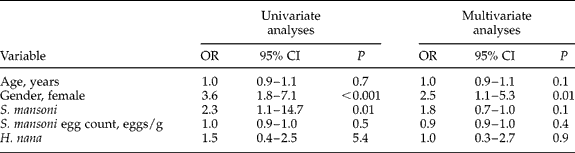
OR, odds ratio; CI, confidence interval.
Discussion
To our knowledge, this is the first published data concerning prevalence and risk factors for anaemia among schoolchildren in Sudan. The prevalence of anaemia (90.4%) and severe anaemia (16.0%) among these children was higher than the prevalence of anaemia reported in other African countries (Jinabhai et al., Reference Jinabhai, Taylor, Coutsoudis, Coovadia, Tomkins and Sullivan2001; Koukounari et al., Reference Koukounari, Estambale, Njagi, Cundill, Ajanga, Crudder, Otido, Jukes, Clarke and Brooker2008). WHO (2001) has suggested the following classification of populations with respect to the level of public health significance of anaemia: a prevalence of < 19.9% is ‘low’, 20–39.9% is ‘moderate’ and ≥ 40% is ‘severe’. Thus, in the setting reported here, anaemia is severe according to the WHO classification of populations.
In the current study, only female gender was significantly associated with anaemia, and not schistosomiasis, or any other variable already excluded in the univariate analyses. This means, in fact, that there was no association between schistomiasis and anaemia in this particular population, and that female gender is a (hidden) confounding factor in the association of schistosomiasis and anaemia in the univariate analysis. The fact that, in this study population, boys were significantly more frequently infected with schistosomiasis explains to a large extent the lack of association of schistosomiasis and anaemia in these schoolchildren as a group. Similar observations have been reported in recent studies among schoolchildren in Kenya (Koukounari et al., Reference Koukounari, Estambale, Njagi, Cundill, Ajanga, Crudder, Otido, Jukes, Clarke and Brooker2008). A possible explanation of female susceptibility to severe anaemia is the onset of menses. Unfortunately, we did not gather information concerning menarche status of girls during the study. An alternative explanation is that the growth spurt among girls places a high demand on nutrients, since growth is an expensive process.
There was a low prevalence of schistosomiasis and an absence of soil-transmitted helminthes in the current study. This could be explained by a reasonable level of accommodation, water and sanitation. In neighbouring Kenya, children heavily infected with S. mansoni were at higher risk of anaemia compared with uninfected children (Koukounari et al., Reference Koukounari, Estambale, Njagi, Cundill, Ajanga, Crudder, Otido, Jukes, Clarke and Brooker2008). The effect of hookworm infection on haemoglobin levels is also well documented, with risk of anaemia correlated with intensity of infection (Olsen et al., Reference Olsen, Magnussen, Ouma, Andreassen and Friis1998; Brooker et al., Reference Brooker, Peshu, Warn, Mosobo, Guyatt, Marsh and Snow1999). Potential mechanisms through which S. mansoni may contribute to anaemia include: blood loss caused by the rupture of blood vessels surrounding the intestine by the spined schistosome eggs; splenic sequestration; autoimmune haemolysis; and anaemia of inflammation induced by pro-inflammatory cytokines (Friedman et al., Reference Friedman, Kanzaria and Mcgarvey2005).
There was only one case of P. falciparum malaria infection in this study. The area is characterized by unstable malaria transmission, hence patients would be symptomatic and perhaps absent from the school during the surveys (Himeidan et al., Reference Himeidan, Elbashir, Elrayah and Adam2005). We previously observed that P. falciparum infection was the risk factor for severe anaemia among pregnant women in eastern and central Sudan (Adam et al., Reference Adam, Mirghani, Saed, Ahmed, Mohamadani, Ahmed, Mackenzie, Homeida and Elbashir2004, Reference Adam, Khamis and Elbashir2005). Recent meta-analyses of malaria intervention trials among African children, for example, provided compelling evidence that malaria (symptomatic and non-symptomatic) contributed to anaemia (Geerligs et al., Reference Geerligs, Brabin and Eggelte2003; Korenromp et al., Reference Korenromp, Armstrong-Schellenberg, Williams, Nahlen and Snow2004).
Following our previous observations in the area, where pica was widely practised by pregnant women and associated with anaemia (Adam et al., Reference Adam, Khamis and Elbashir2005), we initially included an enquiry concerning pica in this study. But the children did not want to report this habit. In neighbouring Kenya, 73.1% of schoolchildren reported eating soil daily and geophagy was associated with anaemia (Geissler et al., Reference Geissler, Mwaniki, Thiong'o, Michaelsen and Friis1998). Thus, the association between anaemia and pica needs to be investigated among children in this setting. Other parasitic infections, iron deficiency, other micronutrient deficiencies, haemoglobinopathy and other factors in anaemia were not investigated in this study; they need to be investigated in the future.
In summary, in spite of a low prevalence of S. mansoni infections, there was a high prevalence of anaemia among these children. This needs to be investigated in more detail in the future, and more attention should be paid to the health of adolescent girls.
Acknowledgements
We are very grateful to the children who participated in the study and the local heath authority in New Halfa, Kassala State, Sudan. We thank Mr Abdalla Hafazalla for his excellent technical assistance. I.A. was supported by the Sheikan Insurance Company, Khartoum.