


Within the past few years, terrorism has become a widespread phenomenon affecting numerous countries of the world. In this short period of time, we have gained a significant understanding of some of the causes and forms of terrorism (Berrebi Reference Berrebi2007; Bueno de Mesquita Reference Bueno de Mesquita2005b; Krueger and Laitin Reference Krueger, Laitin, Keefer and Loayza2008; Krueger and Malečková Reference Krueger and Malečková2003), as well as the strategies used by terror organizations in the pursuit of their goals (Benmelech and Berrebi Reference Benmelech and Berrebi2007; Berman and Laitin Reference Berman and Laitin2005). However, we have, as of yet, but little knowledge regarding the consequences of terrorism. Clearly, a rigorous analysis of the effects of terrorism on the targeted populations is vital to reach a comprehensive understanding of political violence. Moreover, it has important implications for the design of efficient policies aimed not only at curbing terrorism, but also at insulating the targeted population from heretofore unknown harmful side effects.
The lack of a solid understanding based on sound empirical evidence is particularly acute regarding the political effects of terrorism on the targeted society. Although there is a wide consensus that terrorism is mostly used to coerce governments to grant policy concessions, scholars disagree on its effectiveness. On the one hand, several studies claim that terrorism is rising around the world simply because it works (Pape Reference Pape2003, Reference Pape2005). Other studies, on the contrary, argue that this claim does not have substantial empirical support (Abrahms Reference Abrahms2006). Most of the arguments put forward by scholars who claim that terrorism is effective implicitly assume that the electorate shows a highly sensitive reaction to terrorism. Because in democracies the electorate may have the ability to influence policy, the voters' sensitivity to terrorism is the underlying mechanism that supposedly induces their leaders to grant concessions to terror factions.Footnote 1 Although the assumption that voters' preferences are significantly affected by terrorism is of crucial importance to assess the effectiveness of terror campaigns, it has yet to be clearly established and quantified.Footnote 2
This study develops a specially designed econometric framework combined with a unique data set to carefully estimate the magnitude of the impact of terrorism on the electorate's preferences. We focus on the Israeli-Palestinian conflict and use the variation of terror attacks across time and space as an instrument to identify the causal effects of terrorism on the voters' political preferences. This approach helps us determine whether the sensitivity of the electorate to terrorism (i.e., the mechanism underlying the claim that terrorism is effective) is supported by the empirical evidence.
A fundamental problem that arises in any attempt to quantify the effect of terrorism on the electorate's preferences is that the estimates obtained may be biased due to a plausible interaction between the two variables: terror attacks may influence the electorate's preferences, but terrorism may also be a reaction to those preferences. This interaction precludes researchers from identifying the impact of terrorism from other shocks to the voters' preferences when using only the variation across time. That is, an observed temporal correlation between terrorism and the electorate's preferences cannot be interpreted as a measure of the magnitude of the electoral effects of terrorism. Adding to the analysis the variation across space allows us to overcome the intrinsic difficulty of the task at hand. Note, however, that the variation across space would not be an appropriate instrument if terrorists condition the location of their attacks on the political preferences of the locality suffering the attack. Such a strategy would imply that the causal relation is in the opposite direction. We use a falsification approach to dismiss this possibility.
The results consistently document, across different empirical specifications, that terrorism causes an increase on the relative support for the right bloc of parties. Beyond establishing this fact, we provide a deeper analysis of the overall electoral effects of terrorism. We examine whether terrorism affects the mobilization of the electorate and differentiate between two prominent theories of voting behavior that are consistent with the observed electoral effect of terrorism: policy voting (Kiewiet Reference Kiewiet1981) and partisan voting (Powell and Whitten Reference Powell and Whitten1993). In addition, this article uses the same empirical strategy to analyze whether terrorism brings about the ideological polarization of the electorate into two distinct political blocs. Our results suggest that terrorism causes an increase in the support for the right bloc in all the localities with right-leaning preferences and a decrease in the support for the right bloc in most localities with left-leaning preferences. Thus, by causing the polarization of the electorate, terrorism may not only affect the voters' preferences, but also appears to have other important structural effects on the political and social institutions of a targeted country.
EMPIRICAL STRATEGY
This section describes our main empirical strategy used to identify the causal effects of terrorism on voters' political preferences. This strategy is based on a difference-in-differences approach that uses the variation of terror fatalities across time and space in order to control for possible time- or location-specific effects. Specifically, this methodology allows us to estimate the causal effects of terrorism by comparing changes in consecutive electoral results of localities that suffered terror attacks (treated group) vis-à-vis changes in electoral results of localities that did not suffer from terror attacks (control group). The key identifying assumption of this approach is that, in the absence of terrorism, the trends of the electoral preferences of treated and control localities would be the same.Footnote 3
Formally, the model we propose for the identification of the effect of terrorism on electoral outcomes can be specified as a fixed-effect linear regression model:
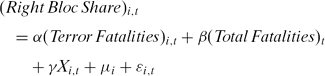
where (Right Bloc Share)i,t is the right-bloc share of the two-blocs vote in locality i in elections t, (Terror Fatalities)i,t is the number of fatalities in locality i before the elections in t, (Total Fatalities)t is the total number of terror fatalities in Israel before elections t. Xi,t is a vector of political, socio-economic, and demographic control variables that vary across localities and time. Finally, μi is a fixed effect unique to locality i.
Note that the chosen econometric specification includes several variables that control for each locality's characteristics as well as a locality fixed effect. This is crucial because some of the locality's characteristics may be correlated simultaneously with higher terror fatalities and higher support for the right bloc. Thus, omitting them could lead to spurious statistical correlations.Footnote 4
The proposed econometric specification is intended to identify the value of α, the estimate of the local effect of terror fatalities on the voters' preferences. Because the model controls for the countrywide effect of terror fatalities, the parameter α captures only the effect of terror fatalities in locality i on the preferences of voters living in this locality. For example, if the number of terror fatalities in locality i increases by one, the share of the right bloc from the two-party vote in this locality changes by α.
We expect α to be positive according to some anecdotal evidence (Yediot Aharonot 2003) and a related theoretical analysis (Berrebi and Klor Reference Berrebi and Klor2006). We believe that we may observe a local effect of terror fatalities for a variety of reasons. First, a terror attack triggers residents of a locality to alter their daily routine as a consequence of a change in their perceived personal security, affecting their attitude toward peace (Gordon and Arian Reference Gordon and Arian2001). Terror attacks may also impact the locality's economy and its residents' expected future income. These two effects may strongly antagonize the locality's residents and predispose them against any type of concessions to the Palestinian Authority. Second, the occurrence of a terror attack directly affects the salience of the conflict in the targeted locality, and may affect the probability that its residents attach to a peaceful solution to the conflict differently than in the other localities. This effect is amplified by the coverage of the local media (Sheafer, Dvir, and Poran Reference Sheafer, Dvir and Poran2007).Footnote 5 If, however, the estimate of the local effect of terror fatalities on the voters' preferences is negative, this would provide direct empirical evidence in support of Pape's conclusions, even in the very short run. That is, a negative estimate for α implies that terror attacks drive an immediate shift of the electorate in favor of granting concessions.
Another coefficient of interest is the one that measures the local electoral impact of terror attacks committed in other localities. The sign of this coefficient is a priori undetermined. If β is positive, it might be because the policies proposed by parties in the right bloc won it new supporters after terror attacks. If this coefficient is negative, we might conclude that national casualties from terrorism and voter disapproval of the chosen policy proposed by the right bloc led to an erosion of its support.
Model (1) is flexible enough to allow us to address other interesting questions regarding the electoral effect of terrorism. In particular, we examine the effects of terrorism on the mobilization of the electorate, how the impact of terror fatalities varies according to the ideology of the political party holding office, and whether terrorism polarizes the electorate.
DATA
To implement our empirical framework, we combined the necessary data on electoral outcomes and terror fatalities with data on demographic, economic, and geographic indicators that are available at the locality level in Israel.
Data on Electoral Outcomes
Our main variable of interest is the vote share for the different political parties during the last five national parliamentary elections in Israel. The available electoral data, provided by the Central Bureau of Statistics (CBS), include the total number of eligible voters, voter turnout, and support for each political party in the parliamentary elections of 1988, 1992, 1996, 1999, and 2003. This information is available at the level of the polling station, thus providing us with a very detailed ecological data set.
We follow the division of the country defined by the CBS to aggregate the electoral data according to the municipal status of each geographic area. For the most part, each geographic area is defined by the presence of a single major city that holds administrative sway over the space of this area. These are classified as either municipalities or local councils. In other cases, several smaller villages are grouped together according to their location into a contiguous area called a regional council. Our unit of interest consists of municipalities, local councils, and regional councils. The areas spanned by these three disjoint geographic units completely cover the Israeli territory, including localities in the West Bank and Gaza Strip.
The number of observations changes over time, together with changes in the number of municipalities, local councils, and regional councils. There were 953 disjoint geographic areas in 1988. Sixty-four of them were defined as municipalities, 106 were defined as local councils, and the rest were grouped into 54 regional councils—this gives us 224 observations for the 1988 elections. In 2003, there were 1,160 geographic areas divided into 70 municipalities, 117 local councils, and 55 regional councils—that is, 242 localities.
To measure the political preferences of each locality's electorate, we divide the political parties with representatives in the parliament into right-left bloc vote following closely the division set forth by Shamir and Arian (Reference Shamir and Arian1999). Accordingly, the left bloc includes the Arab parties, Meretz, Labor, and Am Echad. The right bloc includes Likud, the religious parties, the nationalist parties (Tzomet, Moledet, National Union), and parties identified with Russian immigrants. The centrist parties (the Center Party, the Third Way, and Shinui) were not included in any of the blocs.
We choose to divide the parliament into right and left blocs to neutralize the effects that the different electoral systems in place may have had on the voters' strategies. Contrary to the other elections, the parliamentary elections of 1996 and 1999 allowed for split-ticket voting, whereby each voter cast a ballot in support of a political party for the parliamentary elections and a different ballot for the elections for prime minister. This different system may have had an effect on the relative support obtained by the different parties. Consequently, the results of these elections may not be directly comparable at the party level to the results of the parliamentary elections of 1988, 1992, and 2003. These concerns are no longer relevant when we divide the parliament into two main blocs. The correlation between the relative support for the right bloc out of the two blocs and the relative support for the Likud candidate for prime minister out of the two candidates is more then 99% for the elections of 1996 and almost 96% for the elections of 1999.Footnote 6
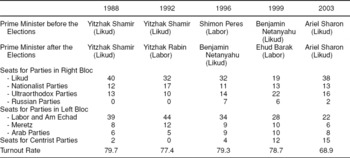
Table 1 displays the distribution of seats of the Israeli parliament, as well as the identity and political affiliation of the prime minister before and after the elections. The table depicts the close parity between the two blocs during the period at issue, to the point that the political affiliation of the prime minister seems to sway from right bloc to left bloc and back whenever this office is up for grabs. This parity is magnified by the fact that the ultraorthodox Jewish parties and the parties identified with Russian immigrants were not only active members of every right wing government during the studied time period, but they were also members of the leftist governments of Yitzhak Rabin and Ehud Barak.
Distribution of Seats in the Israeli Parliament between Right and Left Blocs

Note: The Israeli parliament has 120 seats. For the elections of 1988, 1992, and 2003, the party with a plurality in the parliament elected the prime minister. For the elections of 1996 and 1999, the prime minister was directly elected by the electorate.
Source: The official website of the Israeli parliament (www.knesset.gov.il).
Data on Terror Fatalities
We measure the level of terrorism using data on the number of noncombatant Israeli fatalities from terror attacks assembled in 2004 by Berrebi (Reference Berrebi2007) and updated by Berrebi and Klor (Reference Berrebi and Klor2008). This data set contains daily information on every terror attack that caused the death of at least one Israeli noncombatant that occurred on Israeli soil between July 13, 1984, the day of the elections for the 11th Israeli parliament, and June 30, 2004. The main sources of the data are the Israeli Foreign Ministry, the National Insurance Institute, the Israeli Defense Forces, and the archives of two newspapers (Ma'ariv and Ha'aretz).
We assign each attack in the database to one of the localities, according to the geographic location of the attack, using geographic information system.Footnote 7 To the best of our knowledge, the combination of the political data set with the data set used by Berrebi and Lakdawalla (Reference Berrebi and Lakdawalla2007) comprises the most accurate and comprehensive unclassified data set that exists on fatal terror attacks against noncombatants on Israeli soil since 1984.Footnote 8
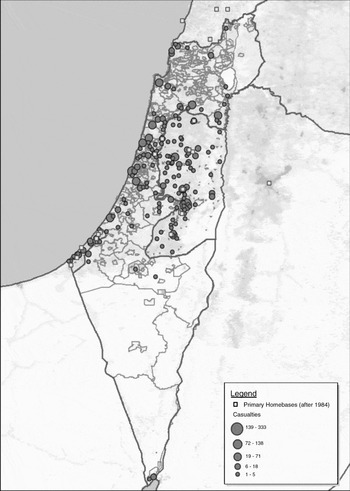
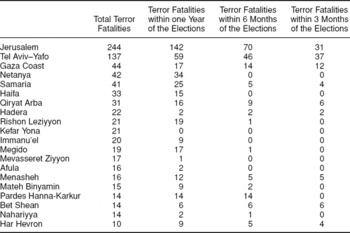
The geographic distribution of terror fatalities during the time period of interest appears in Figure 1 and Table 2. The figure also provides the partition of Israel into localities in effect in 2004. The figure and the table show that several localities suffered a high number of terror fatalities during the period at issue. Although there is an evident higher concentration of fatalities in Jerusalem and Tel Aviv–Yafo, there is still enough geographic variability across localities to conduct a meaningful econometric estimation.
Geographic Location of Terror Fatalities and of Terror Factions' Home Bases

Localities with Highest Number of Terror Fatalities between 1988 and 2003

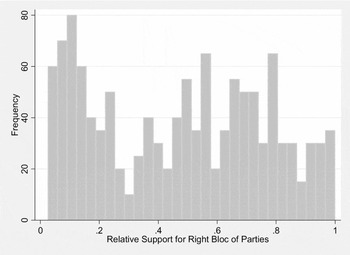
We calculate for each locality its mean relative support for the right bloc of parties over the five parliamentary elections at issue. This statistic provides a glimpse of the preferences of the localities' electorate. Figure 2 depicts the distribution of the localities' mean relative support for the right bloc. An interesting pattern that emerges from this figure is the extant heterogeneity of the localities' preferences. Besides an apparent bunching of localities with a low relative support for the right bloc, the rest of the range shows a distribution close to uniform, with localities spanning the entire range.
Distribution of Localities' Mean Relative Support for the Right Bloc

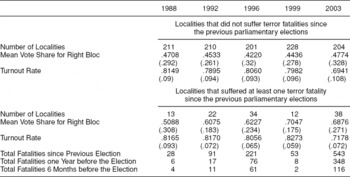
Table 3 presents summary statistics for the previous variables. The table distinguishes between localities that suffered at least one terror fatality between two consecutive elections and the rest.
Summary Statistics

Note: Entries in the table represent the means of the relevant variable. Standard deviations are in parentheses.
This table exhibits some extent of a patterned difference in terms of the support for the right bloc of parties between localities that were attacked and the rest. Namely, localities that suffered at least one terror fatality before the elections show a larger support for the right bloc than the rest of the localities. The difference in the mean share of the vote for the right bloc varies from almost four percentage points in the elections of 1988 (before terrorism became a major issue dimension for Israeli voters) to more than 26 percentage points in the elections of 1999. These patterns of support do not change qualitatively when we restrict our attention to localities that were not occupied by Israel in 1967. Notably, we do not observe a clear difference in the average turnout rate of the two sets of localities.
Regarding the frequency of terror fatalities, the table illustrates the great variation observed on the level of terrorism over time. Although terrorism is not a new phenomenon in Israel, the number of terror fatalities was relatively low before the elections of 1988. There is an important increase in the frequency of terror fatalities up to the elections of 1996, and a step decrease afterward until the eruption of the second Palestinian uprising in September 2000. The significant increase in the number of terror fatalities before the elections of 2003 reflects the widespread use of terrorism by several Palestinian factions during the first three years of the second uprising.
The marked fluctuations in the number of terror fatalities for the entire period between every two consecutive elections pale, percentagewise, compared to the fluctuations in the number of terror fatalities during shorter periods preceding the elections. For example, a comparison for the elections of 1996 to the elections of 1992 reveals that the number of fatalities in the year leading up to the elections increased by almost 450% whereas the number of fatalities for the entire period increased by less than 250%. The same pattern holds for the rest of the elections. It is worth noting that, comparing the elections of 1999 and 2003, the number of fatalities for the entire period increased 10 fold, whereas the number of fatalities during the year that preceded the elections increased by more than 40 times.
An analysis of the severity of the terror campaign before the elections has to take into account some particularities of the Israeli electoral system. The Israeli system is based on a parliamentary democracy with elections that are supposed to take place every four years. The parliament, however, may decide by an ordinary majority to dissolve itself and call for unscheduled early elections.Footnote 9 This means that the timing of elections is endogenous to the political environment. In fact, except for the elections of 1988, all other Knesset elections during the period at issue preceded their original scheduled dates. In 1992, 1996, and 1999, the parliament called for early elections. The elections for the Sixteenth Knesset in 2003 were brought forward at the initiative of the prime minister.
Because the timing of the elections in Israel is not entirely predetermined, the terror campaign may not be geared to affect the political preferences of the electorate but a consequence thereof. Simply put, terrorists may use terror attacks to topple an unstable government they dislike. Alternatively, they may refrain from attacks to help a government of their liking to remain in power. As a consequence, we cannot conclude that there is a causal relation between terrorism and political preferences solely on the basis of the extant correlation between these two variables over time. It is crucial for identification purposes to add to the analysis the spatial variation of these two variables.
Other Variables of Interest
To estimate the model as specified previously, we incorporate into the analysis additional political, socio-economic, and demographic variables.
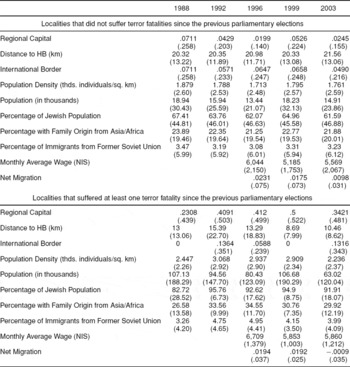
The analysis includes each locality's size, its distance to the closest terrorist home base (see Figure 1 for the location of home bases during the period at issue), and dummy variables for localities that serve as regional capitals and localities that have an international border. These variables, constant over time, were obtained from Berrebi and Lackdawalla (Reference Berrebi and Lakdawalla2007) and were measured in 2004.Footnote 10 We also use as covariates the locality's population, percentage of Jewish population, percentage of immigrants from the former Soviet Union, and the population's ethnic background as measured by the percentage of individuals born (or whose father was born, for individuals born in Israel) in Asia or Africa. These variables are reported by the CBS in the Census of Population and Housing of 1995. In addition, we collected data from the CBS on the yearly average wage and net migration for each locality. These variables are only available for the years 1995 onward. For the purpose of this study, we focus on these variables during the year prior to the elections, that is, 1995, 1998, and 2002. We normalize the average wage using the consumer price index with 2002 as the base year.Footnote 11 Net migration is defined as the total number of citizens that moved into a locality (including new immigrants) minus the total number of citizens that left the locality in a given year. We normalize this variable by the locality's total population. Summary statistics describing these variables appear in Table 4.
Summary Statistics of Additional Covariates

Note: Entries in the table represent the means of the relevant variable. Standard deviations are in parentheses. The localities' monthly average wage and net migration correspond to the year that preceded the elections, that is, 1995, 1998, and 2002, respectively. The monthly average wage is normalized using the consumer price index with 2002 serving as the base year. Net migration is presented as a share of each locality's population.
Table 4 presents an intuitive picture concerning the correlation between terror fatalities and the control variables of interest. As expected, we observe that, on average, terror attacks occur in localities that are closer to the terror factions' home bases, more established localities (in the sense that they function as regional capitals, are more populated, and absorb more immigrants), localities with a higher percentage of Jewish population (also reflected in the higher percentages of families with Asian/African background), and wealthier localities. There seems to be no clear correlation between having an international border and terror fatalities. In addition, citizens do not overwhelmingly move away from localities that tend to suffer from terrorism.
THE EFFECT OF TERROR FATALITIES ON THE PREFERENCES OF THE ELECTORATE
Benchmark Specification
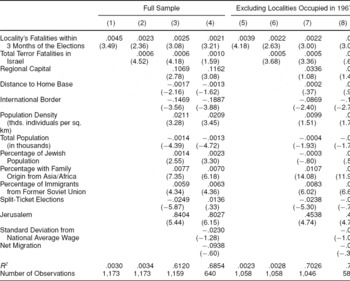
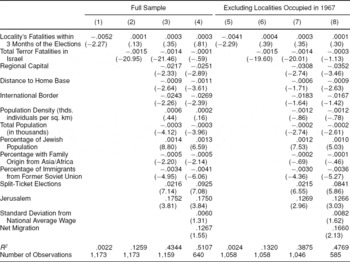
Table 5 displays the estimation of the effects of terror fatalities on the preferences of the electorate as specified in model (1). Column 1 reports the results of a specification using the whole sample and including no covariates except for localities' fixed effects. We find that the occurrence of a terror fatality within three months of the elections is associated with a .45 percentage point increase in the locality's relative electoral support for the right bloc of political parties. This effect is not only highly statistically significant but is also of significant political magnitude. A terror attack causes, on average, almost three fatalities during the time period at issue. Thus, one terror attack causes roughly an increase of 1.35 percentage points in the relative support for the right bloc. Given that the localities' average relative support for the right bloc in the elections during the time period at issue is 47%, an increase by three on the average number of attacks is enough to decide the elections in favor of the right bloc of political parties in an average locality.
Effect of Terror Fatalities on Preferences of the Israeli Electorate

Note: Each column reports the estimated coefficients of a separate ordinary least squares panel regression model in which the dependent variable is the relative support for the right bloc of parties. Robust t-statistics (adjusted for clustering at the locality level) are in parentheses. The regressions in columns (1), (2), (5), and (6) include locality fixed effects.
A terror fatality has important electorate effects beyond the locality where it is perpetrated. Column 2 examines the full effect of a terror fatality, both in the locality where the attack was perpetrated and its repercussions in the other localities. Once we control for the effect of the fatality on other localities, the local effect is .23 percentage points. On top of that effect, a terror fatality within three months of the elections causes a .06 percentage point increase in the relative support for the right bloc in each of the rest of the localities. Although we may expect a stronger local effect of terrorism in a large country like the United States, the magnitude of the impact of an attack shows an important difference between the targeted locality and the rest of the localities, even in a small country like Israel. It appears, therefore, that the consequences of terrorism are mostly felt and manifested at the local level.
One concern is that there may be characteristics of a locality that vary across time and space that are correlated with the occurrence of a terror attack and the support for the right bloc.Footnote 12 For example, it could be that the distance of a locality to the home base of a terrorist faction, the importance of the locality, or the locality's ethnic characteristics may determine the political preferences of its inhabitants and the likelihood of a terrorist attack. Therefore, in Columns 3 and 4, we directly control for a number of observed characteristics of the localities.Footnote 13
Column 3 presents our preferred specification of the regression model. The inclusion of the localities' characteristics significantly improves the goodness of fit of the model relative to the models of Columns 1 and 2. Moreover, unlike the specification in Column 4, the specification in Column 3 retains the rich spatial and temporal variability of the previous columns. The specification in Column 4, in contrast, ignores much of the existing information because the necessary data for the added covariates are unavailable for the elections of 1988 and 1992. Given that we cannot reject the hypothesis that the additional covariates included in Column 4 are jointly or separately different from zero, we believe that specification of Column 3 is more accurate.Footnote 14
The estimation in Column 3 shows that the magnitude of the effect of a terror fatality does not decrease when the localities' characteristics are taken into account. Regarding the added covariates, we observe that the electoral support for the right bloc decreases with the distance of the locality to the home base of a terror faction, in localities with an international border and with the locality's population. On the contrary, the support for the right bloc increases in regional capitals, population density, the locality's percentage of Jews, the percentage of individuals with an Asian/African background, and percentage of immigrants from the former Soviet Union.
In addition to the covariates used in Column 3, the specification in Column 4 includes each locality's standard deviation from the national average wage (measured separately for every year considered in the analysis) and each locality's net migration share of its total population.Footnote 15 Because these two variables are available at the locality level only from 1995 onward, we restrict our estimation to the elections of 1996, 1999, and 2003, when they are included as covariates. The inclusion of the average wage at the locality level helps us control for possible effects of economic conditions on the relative support for the right wing party, as predicted by the economic voter hypothesis. [See Lewis-Beck and Stegmaier (Reference Lewis-Beck and Stegmaier2000) for a thorough review of this literature.] The inclusion of the net migration share of the population is meant to control for Tiebout's (Reference Tiebout1956) hypothesis. According to this hypothesis, voters sort themselves out between the different localities according to their preferences. That is, our results could be a consequence of left wing voters migrating from localities that tend to suffer from terrorism to localities that tend not to be stricken by terror attacks, without any voter actually changing his or her preferences. Adding the net migration share of each locality's population as a covariate allows us to differentiate migration of left wing voters to localities that do not suffer terror attacks from the hypothesis stating that voters change their preferences.
The results show that the average wage's standard deviation does not have a statistically significant impact on the electorate's preferences. This result supports the prevailing view that the security-peace dimension is by far the most influential dimension for Israeli voters (Shamir and Arian Reference Shamir and Arian1999; Sheafer Reference Sheafer2004). Similarly to average wage, net migration does not significantly affect the preferences of the electorate or the electoral impact of terror fatalities. This establishes that the local electoral effect of terror fatalities is not driven by voters changing their locality of residence. Rather, it is caused by voters changing their preferences. Regarding the estimates of the effect of terrorism, this specification yields coefficients of lower magnitude for the effects of local and total terror fatalities. Whereas the estimate for local terror fatalities remains highly statistically significant, the estimate for total terror fatalities is only marginally significant (at the 11.2% level) because this specification ignores much of the available temporal variability existent in the data.
Columns 5 to 8 in the table repeat the same empirical exercise, excluding from the data sample the set of localities in territories that Israel occupied following the war in 1967. This is an important robustness test because the territories occupied in 1967 are characterized by higher levels of terror fatalities and an electorate that shows a higher support for the right bloc.Footnote 16 Therefore, their inclusion may lead us to observe a confounding correlation between the two variables of interest.
Columns 5 to 8 make it evident that restricting the sample does not qualitatively affect the results. Although we observe a slight decrease in the political effects of terror fatalities, both locally and nationally, this decrease is not of a significant magnitude. That is, the positive effect of terror fatalities on the relative support for the right bloc of parties is maintained in this restricted sample of localities.
Contrary to the effects of terror fatalities, the effect of several covariates is significantly affected by the exclusion of localities occupied in 1967. Most notably, the effect of the distance to the terrorist factions' home bases changes from significantly negative to positive in the restricted sample. Naturally, localities in territories occupied in 1967 are closer to terrorists' home bases (which are located either in limiting countries or in these territories). In these particular localities, we observe a relatively higher support for the right bloc of parties, and thus the negative correlation between these two variables. The fact that this correlation becomes positive in the restricted sample shows that the connection between the relative support for the right bloc of parties and the distance to home bases is not causal in nature.Footnote 17
Does Terrorism Have a Mobilization Effect on the Electorate?
The regression analyses presented in Table 5 suggest that terror fatalities have a significant effect on the preferences of the electorate. The same evidence, however, lends itself to an alternative interpretation whereby terror fatalities selectively affect the turnout of part of the electorate without changing its preferences. For example, the effect documented in Table 5 is consistent with an increase in the local turnout rate of right wing voters or a decrease of the local turnout rate of left wing voters (or both) in the aftermath of terror attacks.
Table 6 analyzes the possibility that terror fatalities affect the localities' turnout rate. This table presents the effects of the same explanatory variables used in Table 5 on the localities' turnout rate. The results show that local terror fatalities do not affect the turnout rate of the locality's electorate. Our preferred specifications in Columns 3 and 7 suggest that total terror fatalities may even demobilize the electorate.
Effect of Terror Fatalities on Turnout Rate of the Israeli Electorate

Note: Each column reports the estimated coefficients of a separate ordinary least squares panel regression model in which the dependent variable is the turnout rate. Robust t-statistics (adjusted for clustering at the locality level) are in parentheses. The regressions in columns (1), (2), (5), and (6) include locality fixed effects.
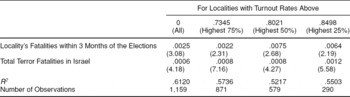
The analyses in Table 6 do not rule out the possibility that terror fatalities simultaneously mobilize right wing voters and demobilize left wing voters without affecting turnout. Table 7 addresses this possibility by studying the impact of terror fatalities on the relative support for the right bloc of parties in localities with high average levels of turnout. Simply put, in localities with average turnout rates of more than 85%, almost everybody votes. Therefore, any influence of terrorism on the relative support for the right bloc must be a consequence of voters changing their preferences and not their turnout decisions.Footnote 18
Effect of Terror Fatalities on Preferences of the Israeli Electorate According to Localities' Turnout Rate

Note: Each column reports the estimated coefficients of a separate ordinary least squares panel regression model in which the dependent variable is the relative support for the right bloc of parties. Each regression includes the same covariates presented in Column 3 of Table 5. Robust t-statistics (adjusted for clustering at the locality level) are in parentheses.
The evidence presented in Table 7 strongly supports the hypothesis that terror fatalities affect the electorate's preferences. The coefficients on local terror fatalities and total terror fatalities in localities with high levels of turnout are not only highly statistically significant, but they also increase in magnitude as we focus on localities with particularly high levels of turnout. Given that Arab citizens have lower levels of turnout than Jewish citizens in parliamentary elections (see, e.g., Al-Haj Reference Al-Haj, Arian and Shamir1995; Ben Bassat and Dahan Reference Ben Bassat and Dahan2007; Ghanem and Ozacky-Lazar Reference Ghanem, Ozacky-Lazar, Arian and Shamir2002), restricting the sample to localities with high levels of turnout implicitly excludes from the analysis localities with a high percentage of Arab population. Arab localities are less likely to increase their support for the right bloc of parties in the aftermath of a terror attack; thus, excluding them from the sample causes an increase in the magnitude of the coefficient.
An Analysis of Policy versus Partisan Voting
Our econometric estimation, so far, implicitly assumed that the political effect of a terror fatality is the same for all prime ministers holding office during the period at issue. This view is in accordance with the policy voting hypothesis. Accordingly, parties benefit from the salience of issues to which they are generally viewed as attaching highest priority (Kiewiet Reference Kiewiet1981). This hypothesis implies that the Israeli electorate increases its support for the right bloc of political parties after a terror attack because this bloc is identified with a higher emphasis on terrorism deterrence. In other words, because the right bloc has a policy that places more weight on security-related issues, terror attacks during the tenure of a prime minister from the right bloc may be perceived as inevitable, whereas terror attacks during the tenure of a prime minister from the left bloc may be perceived as preventable by using stronger deterrence policies.
In contrast, the partisan theory of voting predicts the opposite effect. Accordingly, parties are evaluated most heavily in terms of their performance on the issues to which they attach a high priority (Powell and Whitten Reference Powell and Whitten1993). Therefore, repeated terror attacks may cause a decrease in the support for the right bloc under a rightist incumbent, and may not have a significant effect on the electorate's preferences under a leftist incumbent. The partisan theory of voting provides, therefore, a refinement of the retrospective theory of voting proposed by Fiorina (Reference Fiorina1981). Whether voters are purely retrospective or use their perceived performance of the incumbent government to estimate its future performance, the partisan theory of voting posits that voters are especially prone to hold an incumbent government from the right bloc to a higher standard in policy areas related to terrorism because this bloc is perceived to place greater ideological emphasis on the security dimension.
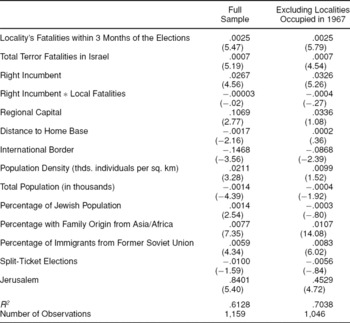
Table 8 tests the alternative approaches by looking at the interaction between local terror fatalities and the party affiliation of the incumbent prime minister.Footnote 19
Testing for Theory of Policy Voting versus Theory of Partisan Voting

Note: Each column reports the estimated coefficients of a separate ordinary Least Squares panel regression model in which the dependent variable is the relative support for the right bloc of political parties. Robust t-statistics (adjusted for clustering at the locality level) are in parentheses.
As shown in the table for the full and restricted samples, respectively, the electoral effect of a terror fatality is not affected by the identity of the party holding office. There is strong evidence of a significant incumbency effect, as the relative support for the right bloc increases by 2.67 percentage points in the full sample and by 3.26 percentage points in the restricted sample when the incumbent prime minister belongs to this bloc.Footnote 20 The coefficient on the interaction between local fatalities and a rightist incumbent prime minister, however, is not statistically significant. In other words, the electoral impact of local terror fatalities does not depend on whether the prime minister at the time of the attacks belongs to the right bloc. Hence, the empirical evidence supports the policy voting hypothesis, whereby terrorism causes an increase in the support for the right bloc regardless of the political affiliation of the incumbent prime minister. Although we are not able to systematically assess the validity of this claim for localities that do not suffer from terror fatalities, the evidence according to local terror fatalities is consistent with the results of Berrebi and Klor (Reference Berrebi and Klor2006) based on the time series variation of public opinion polls at the national level.
Does Terrorism Polarize the Electorate?
This subsection focuses on subsamples of localities, grouped according to their political preferences, to analyze the extent to which left- and right-leaning localities exhibit a similar reaction to terrorism.
To the best of our knowledge, there is not a clear theoretical prediction regarding the effects of terrorism on the ideological polarization of the electorate. It is nevertheless important to empirically explore this issue given the vast ramifications that polarization has on a country's political system. As argued in Sartori's (Reference Sartori1976) seminal work, polarization causes centrifugal pressure that shifts away the support for centrist parties and inhibits the formation of stable parliamentary majorities. This directly leads to fragmentation and destabilization of democratic regimes. In addition, the polarization of the population is likely to cause both social conflict and marked fluctuations of public policies, thus undermining the country's political and economic performance. Consequently, if indeed terrorism causes the polarization of the population, it follows that terrorism does not simply bring an overall increase in the support for the right bloc but, in fact, has additional important structural political, social, and economic effects.
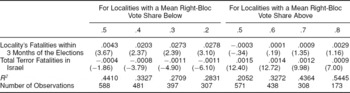
To test whether terrorism polarizes the electorate, we take advantage of the heterogeneity of the localities' preferences shown in Figure 2, and estimate the regression model that appears in Column 3 of Table 5 for subsamples of the localities. These subsamples are determined according to the localities' mean relative support for the right bloc over the elections during the time period at issue. The results of the estimations appear in Table 9.
Effect of Terror Fatalities on Localities According to Their Electoral Preferences

Note: Each column reports the estimated coefficients of a separate ordinary least squares panel regression model in which the dependent variable is the relative support for the right bloc of parties. Each regression includes the same covariates presented in Column 3 of Table 5. Robust t-statistics (adjusted for clustering at the locality level) are in parentheses.
To analyze the results of Table 9, let us focus first on left-leaning localities. Interestingly, local terror fatalities do not move left-leaning localities further to the left. Rather, the effect of local terror fatalities on the relative support for the right bloc gradually increases the more left-leaning the localities are. Whereas the local effect of terror fatalities in localities with a mean support for the right bloc below .5 is almost double the one observed for all localities, this effect increases more than 10-fold in localities with a mean support for the right bloc of parties below .2. The positive effect of terrorism is thus in accordance with the hypothesis delineated in the Empirical Strategy Section. Simply put, terror attacks significantly affect the well-being of the residents of these localities, increase the salience of the conflict, and predispose voters to support parties identified with a higher emphasis on a strong deterrence policy.
Contrary to local terror fatalities, total terror fatalities (i.e., attacks outside the voters' localities) cause a significant decrease in the support for the right bloc of parties in left-leaning localities. That is, terror fatalities elsewhere appear to reinforce preexisting views of the electorate, leading residents of left-leaning localities to emphasize nonviolent solutions to the conflict (e.g., territorial concessions), instead of an increase in security and deterrence.
The overall effect of terrorism in left-leaning localities is not straightforward because total and local terror fatalities have opposite effects on the electorate's preferences. Among these localities, only those that suffer a high number of local terror fatalities vis-à-vis total terror fatalities increase their support for the right bloc of parties, whereas the rest of the localities decrease their support for that bloc. To be precise, for a left-leaning locality to increase its support for the right bloc of parties, its ratio of total to local fatalities has to be lower than the ratio of the coefficient on local to total fatalities. Based on the estimated coefficients, to increase its support for the right bloc the ratio of total to local fatalities has to be below 10.75 (that is, .0043 divided by .0004) for a locality whose mean right-bloc vote share is between .4 and .5. The cutoff ratio for localities whose mean right-bloc vote share is below .4 is approximately 25.
According to the actual distribution of local and total terror fatalities, the ratio of total to local fatalities is below the threshold for only three left-leaning localities.Footnote 21 These localities (Tel Aviv–Yafo, Qiryat Tivon, and Menasheh) are thus the only left-leaning localities that increase their support for the right bloc of parties in an election during the time period at issue. Weighting the localities according to their population, this implies that only one-fourth of the left-leaning population resides in localities that increase their support for the right bloc. The rest of this population resides in localities that increase their support for the left bloc of parties.
The analysis for right-leaning localities is simpler. Whereas local terror fatalities do not significantly affect the preferences of the electorate on these localities, total terror fatalities cause a significant increase in the support for the right bloc of parties. Therefore, terrorism has an unambiguous impact on the preference of these localities' electorate.
Summarizing, the empirical evidence shows that terrorism increases the support for the right bloc among all localities whose population leans toward the right, and it decreases the support for the right bloc among the vast majority of localities whose population leans toward the left bloc. Hence, we conclude that terrorism causes the ideological polarization of the electorate. We obtain the same qualitative conclusions when we exclude from our sample localities in territories occupied in 1967.
Robustness Tests
This subsection presents several robustness tests performed to the main results presented in Table 5. These tests show that the effect of terrorism on the voters' preferences documented in Table 5 is robust to alternative specifications of the main variables used in the analysis, as well as to excluding outlier observations from the data sample.Footnote 22
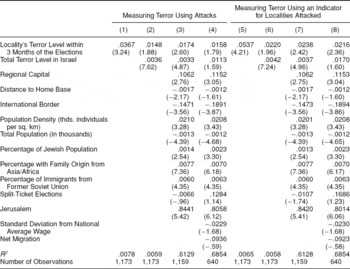
Table 10 repeats the estimations of Table 5 for alternative proxies used to measure the severity of terrorism. The first panel of the table simply uses terror attacks instead of terror fatalities as a proxy for the level of terrorism. The second panel measures terrorism through a dummy variable that equals one in localities that suffered a terror attack within 3 months of the elections (regardless of the number of attacks) and zero otherwise. Although the measure used in Table 5 is more precise than the ones proposed in Table 10, when we combine it with our empirical specification it carries the implicit assumption that the effect of terrorism is linear on the number of fatalities. This implicit assumption is not present in the alternative specifications of Table 10, especially the one in the second panel of the table.
Effect of Terrorism on Preferences of the Israeli Electorate

Note: Each column reports the estimated coefficients of a separate ordinary least squares panel regression model in which the dependent variable is the relative support for the right bloc of parties. Robust t-statistics (adjusted for clustering at the locality level) are in parentheses. The regressions in columns (1), (2), (5), and (6) include locality fixed effects.
The table shows that the impact of terrorism on the preferences of the electorate is robust to the alternative measuring methods. The magnitude of the coefficients is higher compared to the ones estimated in Table 5, even after taking into account that an attack causes, on average, almost three fatalities. This implies that the marginal effect of a terror fatality on the preferences of the electorate is decreasing. This hypothesis receives additional support from a comparison of the two panels of Table 10. The coefficients estimated for the local effect of terrorism when using an indicator for the severity of terrorism are at least 1.35 times greater than the respective coefficients estimated using terror attacks, even though localities that suffered at least one terror attack suffered on average 1.2 attacks.
We present the results of the previous two specifications because the magnitude of their coefficients is directly comparable to the coefficients estimated in Table 5. The positive effect of local terror attacks on the support for the right bloc of parties is robust to other sensible specifications. For example, when we normalize local fatalities by the size of the localities' populations, the estimated local effect is positive and highly statistically significant as well (the actual coefficient is .00074 with t-statistic equal to 2.15). We also estimated the same specification of Table 5 but excluding from the sample Jerusalem and Tel Aviv–Yafo. We performed this test because, as shown in Table 2, these two cities are clear outliers with respect to the number of terror fatalities they suffered. The estimation revealed that, for our preferred specification, the effect of local fatalities increases to .0064 and remains highly statistically significant. Notably, the increase in the magnitude of the coefficient after removing from the sample the two most stricken cities provides additional evidence of a decreasing marginal effect of terror fatalities on the preferences of the electorate.Footnote 23
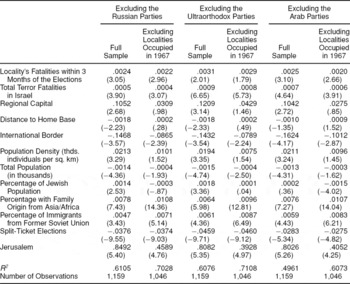
Table 11 studies the effects of terrorism on three different definitions of the relative support for the right bloc of parties. These definitions alternatively exclude the parties that represent Russian immigrants and ultraorthodox Jews from the right bloc of parties, and the Arab parties from the left bloc of parties. We test the exclusion of Russian and ultraorthodox parties from the right bloc because these parties at times joined coalitional governments led by the Labor Party. We exclude in the last two columns the Arab parties from the left bloc because, arguably, terrorism affects the support for Arab parties differently than it affects the support for the rest of the parties.
Effect of Terror Fatalities on Preferences of the Israeli Electorate for Alternative Definitions of Relative Right-Bloc Vote Share

Note: Each column reports the estimated coefficients of a separate ordinary least squares panel regression model. In the first two columns, the dependent variable is the relative support for the right bloc of parties excluding the Russian party. In the two middle columns the dependent variable is the relative support for the right bloc of parties excluding the ultraorthodox parties. In the last two columns, the dependent variable is the relative support for the right bloc of parties excluding the Arab parties. Robust t-statistics (adjusted for clustering at the locality level) are in parentheses.
The table shows that the results are robust to these alternative definitions. In fact, we observe an important increase in the local effect of terror fatalities when we exclude the ultraorthodox parties from the analysis (although the significance level decreases from 1% to 10% in the restricted sample). To understand this increase, note that supporters of the ultraorthodox parties are extremely unlikely to vote for a different party. Hence, excluding these voters from the analysis simply increases the sensitivity of the effect of terrorism, as we focus now only on voters that are more likely to shift alliances between the two blocs.Footnote 24
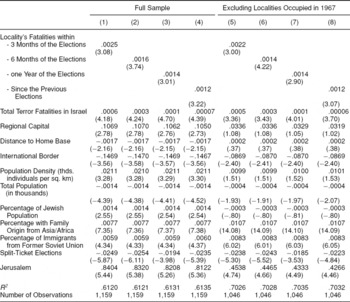
Our last robustness test uses different time spans to measure terror fatalities. The estimations so far only took into account terror fatalities within three months of the elections. This choice seems arbitrary and leaves important information out of the analysis. Table 12 extends the analysis to alternative time spans. That is, the different estimations presented in this table study the effect of the timing of terror fatalities on the preferences of the electorate. The first column shows the effects of terror fatalities that occurred within three months of the elections, and every subsequent column includes into the analysis terror fatalities that occurred farther away from the elections.Footnote 25
Effect of Terror Fatalities on Electoral Preferences Using Different Time Spans To Measure Terror Fatalities

Note: Each column reports the estimated coefficients of a separate ordinary least squares panel regression model in which the dependent variable is the relative support for the right bloc of parties. Robust t-statistics (adjusted for clustering at the locality level) are in parentheses.
The results of this exercise are conclusive: the electoral impact of terror fatalities does not qualitatively change for the different time spans used to measure terror fatalities. Quantitatively, there is a decrease in the electoral impact of terrorism the farther away the fatality occurs from the elections. The gradual decrease of the effect occurs at both the local and the national level. At the local level, we observe that a terror fatality more than a year before the elections loses more than half of its electoral impact on the electorate's preferences. Interestingly, the decrease is more pronounced at the national level, where the terror attack is not as salient for the voters. For example, a terror fatality over a year before the elections loses more than 85% of its impact on an average locality that was not the direct target of the attack. Similar conclusions are reached in Columns 5 to 8 with a restricted sample that excludes localities occupied in 1967.
These results are consistent with several theoretical models that posit that not only terror fatalities convey messages that may affect the preferences of the electorate, but also that the lack of terror attacks should, in principle, have an effect on the voters' beliefs and preferences (Berrebi and Klor Reference Berrebi and Klor2006; Bueno de Mesquita Reference Bueno de Mesquita2005a; Kydd and Walter Reference Kydd and Walter2002). Accordingly, we should expect that terror fatalities have a stronger electoral impact the closer to the elections they occur. Unfortunately, we are not able to directly test this hypothesis because terror fatalities at the locality level are strongly correlated over time. Therefore, it is not possible to separate the individual effects of terror fatalities measured over different time spans when included on the same regression model.
TESTING FOR REVERSE CAUSALITY: DO POLITICAL PREFERENCES INFLUENCE THE LOCATION OF TERROR ATTACKS?
A major methodological concern regarding our identification strategy is that terrorists may choose the location of their attacks strategically, and that this choice may not be orthogonal to the political preferences of the localities' electorate. To dissipate this concern, we need to establish that, even if the political preferences of the Israeli electorate may affect the terror organizations' decision as to whether to perpetrate an attack, the location of the attack is not chosen as a reaction to the political views of any particular locality's electorate. This section uses a falsification exercise to provide evidence in support of the assumption behind our identification strategy.
Our analysis adds to Berrebi and Lakdawalla (Reference Berrebi and Lakdawalla2007) the political preferences of the Israeli electorate at the locality level. Berrebi and Lakdawalla study the determinants of terrorism's risk in Israel. They assess the success of different factors in explaining the location of terror attacks using data on the location and the timing of terror attacks in Israel from 1949 to the present. Their econometric analysis focuses on six covariates, all measured in 2004: the locality's population, size, percentage of Jewish population, distance to the closest terrorist home base, whether the locality serves as a regional capital, and whether it has an international border. They also add a Jerusalem dummy to account for the unique position of this city as an attractive and accessible target of terrorism.
This section replicates their econometric estimation using the same data set but including the vote share for the right bloc of parties as an additional covariate. Formally, the adopted econometric specification is

where (Terror Fatalities)i is the number of fatalities in locality i between every two successive elections, (Right Bloc Share)i denotes the share of the two-bloc vote in support of the right bloc in locality i, and Xi is the vector of covariates used by Berrebi and Lakdawalla (Reference Berrebi and Lakdawalla2007). Namely, Xi includes locality's i population; its size (in square kilometers); the percentage of Jews in the local population; the distance between locality i and the closest terrorist home base; and three dummy variables: one for Jerusalem, the second one for localities that have an international border and the last one for localities that serve as regional capitals. Note that if β is consistently positive and significant, this may imply that terror factions especially target localities that support the right bloc of parties. This would mean that the electorate's preferences affect the location of terror attacks (and not the other way around) invalidating, therefore, our identification strategy.Footnote 26
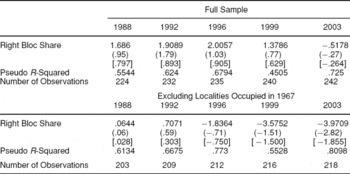
We estimate Equation (2) for every election during the time period at issue. Table 13 displays the results of the estimation.Footnote 27 Each column in this table presents the estimated coefficients from a separate Poisson regression for each election. For example, the column entitled 1988 presents the results of the previous regression based on terror fatalities between the parliamentary elections on November 1, 1988, and the parliamentary elections on June 23, 1992, combined with the electoral results of the 1988 elections.Footnote 28 The respective cells of the table contain the estimated coefficients with their corresponding robust t-statistics (in parenthesis) and elasticities calculated around the means of the independent variables (in brackets).
Testing for Reverse Causality

Note: Each column presents the coefficients from separate Poisson regressions where the dependent variable is the number of terror fatalities between two successive national parliamentary elections starting on the date of the election indicated in the column's title, and the independent variables are as specified in model (2). Robust t-statistics are in parentheses. Elasticities evaluated at the means appear in brackets.
The results show that there is not a significant relationship between a locality's terror fatalities after an election and the locality's share of the vote for the right bloc. For the regressions in the top panel of the table, the absolute value of the t-statistics are well below 2, indicating that essentially we cannot statistically reject the hypothesis that there is no correlation between these two variables. These results are consistent with the main logic behind the Israeli electoral system. This system is characterized by nationwide proportional representation. That is, every vote has the same electoral power, regardless of the voters' location or the preferences of the localities' electorate. Consequently, except for the message that terror attacks may potentially send to the electorate, there is not an electoral incentive to choose the location of the attacks based on the localities' preferences.
The lower panel of Table 13 presents the results of the same estimation but excluding from our data sample localities in territories occupied by Israel in 1967. As expected, the results are even more conclusive than the ones observed using the full sample. Not only are most of the coefficients for the share of the vote for the right bloc statistically insignificant, but also a majority of these coefficients are even negative.
The other covariates included in the regressions are consistent with the results of Berrebi and Lakdawalla (Reference Berrebi and Lakdawalla2007). The main determinants of the location of a terror attack are whether the locality serves as a regional capital, the locality's population, and its percentage of Jews.
One final comment is due on the effect of the distance to terror factions' home bases on the number of terror fatalities. Whereas this covariate has a significant negative effect on the number of terror fatalities for the elections of 1988, 1992, and 1999, its effect for the elections of 2003 is not only positive, but also highly statistically significant.Footnote 29 We conjecture that the striking change on the effect of this covariate is due partly to the construction of the separation fence between several localities under the rule of the Palestinian Authority and localities in Israel. In its first phase, the fence was built around Palestinian localities housing home bases of terror factions. We believe that as a consequence of this additional obstacle, terror factions began to send their operatives into Israeli localities to commit attacks not directly from their home bases, but from more accessible locations. Thus, not only did the strong positive connection between a locality's closeness to a terror home base and terror fatalities ceased to exist, but it even became negative as the fence shifted terror attacks to localities further away from these home bases.Footnote 30
To sum up, the results of this section confirm the crucial assumption of the proposed identification strategy. Namely, the political preferences of a locality's electorate does not seem to affect the number of terror fatalities suffered by this locality once we control for other factors that influence the location of a terror attack.
CONCLUDING REMARKS
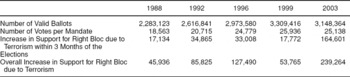
This study provided strong empirical support for the hypothesis that the electorate is highly sensitive to terror fatalities. Notably, it presented solid evidence that terrorism causes an important increase in the support for the right bloc of political parties. This effect is of a significant political magnitude, to the extent that the occurrence of a terror attack before an election (or the lack thereof) can clearly determine the electoral outcome. Table 14 presents a calibration of the impact of terrorism on the distribution of seats of the Israeli parliament. This table simply multiplies the estimated effects of terrorism by each locality's valid ballots and the actual distribution of terror attacks to calculate the number of voters that switched alliances between blocs. The table also exhibits the official number of valid ballots and votes per mandate.Footnote 31
Calibration of Impact of Terrorism on the Israeli Parliamentary Elections

Note: The number of valid ballots and number of votes per mandate were obtained from the official statistics published at the official website of the Israeli parliament (www.knesset.gov.il). The magnitudes in Rows 3 and 4 were calibrated using the estimated coefficients on the effects of terrorism on the support for the right bloc of parties weighted by each locality's population.
The results of this calibration are remarkable. They suggest that terrorism not only affected the composition of every Israeli parliament during the time period at issue, but also may have very well determined which party obtained a plurality in two of the elections analyzed. This appears to be the case for the elections of 1988 (where, as shown in Table 1, Likud defeated Labor by one mandate) and the elections of 1996 (where Netanyahu defeated Peres by less than 30,000 votes). Moreover, note that an additional terror attack within three months of the 1992 elections could have shifted the majority of the parliament from the left to the right bloc of parties (as detailed in Table 1, the actual difference between the two blocs was 61 to 59 parliament members in favor of the left bloc).
At first glance, these results seem paradoxical: terror fatalities cause an increase in the electorate's support for the bloc of parties that is associated with a more intransigent position toward terrorism and territorial concessions. In other words, terrorism supposedly undermines the terror faction's goal. Some scholars may interpret this as further evidence that terror attacks against civilians do not help terror organizations achieve their stated goals (Abrahms Reference Abrahms2006). Other scholars place more emphasis on the complex structure of terror factions, which tend to have a number of objectives (Kydd and Walter Reference Kydd and Walter2006). Under some circumstances, these organizations face trade-offs between their main objectives, and a chosen strategy in pursuit of some of them may undermine the likelihood of achieving others.
There exist a number of alternative rational explanations behind terror campaigns. An interesting approach focuses on the impact of internal political considerations. For example, Bloom (Reference Bloom2004, Reference Bloom2005) posits that terror attacks are a consequence of the internal political competition between Palestinian factions. This approach is consistent with the empirical evidence presented by Jaeger and Paserman (Reference Jaeger and Paserman2006) showing that terror factions indeed react to each other. Furthermore, extremists may perpetrate terror attacks with the goal to provoke the Israeli government into a forceful response against the Palestinian population. Accordingly, terrorists expect that a forceful Israeli retaliation radicalizes the population and increases the overall support for extremist factions (Bueno de Mesquita and Dickson Reference Bueno de Mesquita and Dickson2006; Jaeger and Paserman Reference Jaeger and Paserman2007; Siqueira and Sandler Reference Siqueira and Sandler2006).
Other approaches focus more closely on the interaction between terrorism and political processes. Kydd and Walter (Reference Kydd and Walter2002) argue that terror attacks are a consequence of extremist factions trying to sabotage peace processes. Alternatively Bueno de Mesquita (Reference Bueno de Mesquita2005a) claims that terrorism increases after peace agreements because only moderate militants accept those agreements, leaving extremist militants in full charge of the terror campaign. Finally, Berrebi and Klor (Reference Berrebi and Klor2006) argue that terrorism is intended to impose a cost for the occupation on the Israeli voters and induce them to support territorial concessions. According to Berrebi and Klor's approach, it is possible that, even if the electorate's support for the right bloc increases as a consequence of terror attacks, the political position of the right bloc (although still more hawkish than that of the left bloc) may be affected as well, and become less intransigent over time.
The theories just presented rationalize the behavior not only of terrorist factions, but also of the Israeli electorate (or Israeli government). Basically, these theories posit that the Israeli electorate does not perfectly know the actual division of power between the moderate and extremist factions. In this setup, a terror attack provides new information to the electorate. That is, terrorism tends to persuade the Israeli electorate that the moderate faction is unwilling or unable to stop terrorism and hence cannot be trusted. This rationalizes the overall increase in support for the right bloc after terror attacks.Footnote 32
We focused on the Israeli-Palestinian conflict as the case study of interest for several reasons. First, terrorism is one of Israel's most salient issues. More than five hundred terror attacks resulted in more than a thousand and two hundred Israeli fatalities since July 1984, the date of the elections for the 11th Israeli Parliament. This provided us with enough observations to be able to conduct a rigorous empirical analysis. Furthermore, the political positions of the Israeli political parties regarding terrorism and the occupation are fairly well known to voters and terrorists alike, allowing us to provide a clear interpretation of our results.
The particularities of the Israeli case notwithstanding, the revealed empirical evidence on the consequences of terror fatalities may describe similar patterns elsewhere. This case study may teach us general lessons based on more than 50 years of dealing with terrorism. These lessons show that terror attacks affect the electorate, substantiating the hypothesis that democracies are especially susceptible to being targeted by terror organizations. Democratic governments should take note of the political implications of terrorism that we uncovered when they devise counterterrorism policies. In general, the implementation of counterterrorism policies is accompanied by an increase of the salience of terrorism, due partly to public statements made by policy makers. Our results imply that an increase of the salience of terrorism as an important issue dimension has a negative effect that may encourage terrorists to intensify their campaign. Policies that diminish the electorate's sensitivity to terrorism, on the contrary, may also be very efficient in lowering its threat.



Comments
No Comments have been published for this article.