Introduction
Oil palm breeding researchers recognize that there is a narrow genetic base in the existing cultivars planted around the world (Corley and Tinker, Reference Corley and Tinker2003). This circumstance has prompted oil palm breeders to give increased importance to the study of genetic resources of the species Elaeis guineensis to increase the genetic variability of base populations through crosses with populations having a wide range of origins. This breeding procedure would allow for a rapid selection process, exploiting the additive variance to the fullest extent and, therefore, enabling significant genetic progress towards increased productive potential. Wild populations of oil palm are found in Central and West tropical Africa. Two of the world's most important ex situ collections are found at the Malaysian Palm Oil Board and the Nigerian Institute for Oil Palm Research, with populations of oil palm from more than 12 African countries (Corley and Tinker, Reference Corley and Tinker2003). By mid-2007, with the scientific cooperation of the Institute for Agricultural Research and Development (IARD) of Cameroon and the Ministry of Agriculture and Rural Development, Cenipalma carried out prospecting and collection of 74 families of oil palm in six geographical regions of Cameroon. Seeds were sampled in selected areas identified according to the distributions of localized spontaneous populations for which isolation from other palms was ≥ 100 m. Each local population collected was defined as a family; palms from these seeds were sown in the Palmar de la Vizcaína experimental field to establish its ex situ collections (Arias et al., Reference Arias, Daza, Montoya and Romero2011). In the past, genetic diversity was identified based on crosses between potential parents. The degree of relationship between the parents and the presence of favourable traits could be determined based on the descendants of these crosses. In the case of oil palm, this process could take from 8 to 10 years. However, this time period has been substantially reduced with the use of biotechnology tools, which, once the population is obtained, make it possible to know the diversity of a specific germplasm. Currently, molecular markers are used to evaluate genetic resources. The genetic diversity of E. guineensis has been studied using a variety of molecular markers, such as isozymes (Hayati et al., Reference Hayati, Wickneswari, Maizura and Rajanaidu2004), restricted fragment length polymorphisms (RFLP) (Maizura et al., Reference Maizura, Rajanaidu, Zakri and Cheah2006), amplified fragment length polymorphisms (AFLP) and RFLP (Kularatne et al., Reference Kularatne, Shah and Rajanaidu2001; Barcelos et al., Reference Barcelos, Amblard, Berthaud and Seguin2002) and microsatellites (Billotte et al., Reference Billotte, Risterucci, Barcelos, Noyer, Amblard and Baurens2001; Montoya et al., Reference Montoya, Arias, Rey and Rocha2005; Bakoumé, Reference Bakoumé, Wickneswari, Raijanaidu, Kushairi, Amblard and Billotte2007; Singh et al., Reference Singh, Mohd, Ting, Rosli, Tan, Leslie, Ithnin and Cheah2008; Cochard et al., Reference Cochard, Adon, Rekima, Billotte, Desmier de Chenon, Koutou, Nouy, Omoré, Purba, Glazsmann and Noyer2009). Microsatellites have advantages because of their high polymorphic information content (PIC), their availability to be analysed in various tissues and at different developmental stages of the plant, and their independence of environmental conditions (Kalia et al., Reference Kalia, Rai, Kalia, Singh and Dhawan2011). The purpose of this study was to conduct a molecular characterization of the ex situ collection of oil palm E. guineensis from Cameroon using microsatellite markers. This information will be useful to create a core collection to ensure the greatest concentration of genetic variability in a few accessions, significantly reducing future assessment and characterization costs.
Materials and methods
Plant material
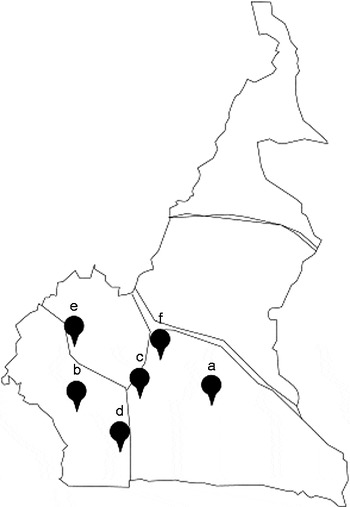
The plant material used in this study is part of the ex situ collection of Cenipalma located in the Palmar de la Vizcaina Experimental Field (Barrancabermeja, Santander, Colombia). These palms derive from seeds that were collected in the Republic of Cameroon in six geographical areas distributed in three contrasting agro-ecological zones (Fig. 1) and are representative of the oil palm E. guineensis (Arias et al., Reference Arias, Daza, Montoya and Romero2011), which are described below.
Map of the Republic of Cameroon showing locations of the six geographical regions where the oil palm seeds were collected. (a) Abong-Mbang, (b) Edea, (c) Obala, (d) Ebolowa, (e) Bafang and (f) Mankim.

Abong-Mbang
Located on the plateau of Southern Cameroon, at approximately 700 m above sea level, this region belongs to agro-ecological zone V, which is characterized by having a moderate annual rainfall and a moderate dry season. The average annual rainfall is 1600 mm. The region has a Guinea-type equatorial climate. The average temperature is 24°C with a temperature range from 19 to 31°C. Alfisol and ultisol soils predominate in this area.
Edea
Located on the banks of the Sanaga River, this region belongs to agro-ecological zone IV, which is characterized by having an average annual rainfall of 3000 mm and a short dry season. The region has a coastal monsoon-type equatorial climate. The average temperature is 20°C with a temperature range from 20 to 30°C. Andisol and ultisol soils predominate in this region.
Obala
A city in the central area of the Province of Cameroon, 45 km north of Yaoundé, Obala is the capital of Cameroon. This region belongs to agro-ecological zone V, whose characteristics are described above.
Ebolowa
This city is the capital of the province of Southern Cameroon. It is a colonial city and an important agricultural centre. This region belongs to agro-ecological zone IV, whose characteristics are described above.
Bafang
This region is a city and commune in Cameroon located in the Haut-Nkam Division of the West Province. This region belongs to agro-ecological zone III, which is characterized by having two main seasons: a long 9-month rainy season and a short 3-month dry season. Bafang has a monsoon-type equatorial climate. The average annual rainfall ranges from 1000 to 2000 mm. The average temperature is 21°C with a temperature range from 15 to 30°C. Andisol and ultisol soils predominate in this region.
Mankim
This city is in the central area of Cameroon. This region belongs to agro-ecological zone V, whose characteristics are described above.
DNA extraction and quantification
Young palm leaflets (nursery plants) were used for DNA extraction. Each leaflet sample was macerated with liquid nitrogen, and DNA was isolated using the Qiagen extraction kit (ref: 69 106) following the manufacturer's instructions. DNA quality was analysed using a 0.8% agarose gel and quantified by spectrophotometry. The DNA of each sample was diluted to a concentration of 5 ng/μl for use in the amplification of each microsatellite.
Amplification of microsatellite markers
For microsatellite amplifications, 31 microsatellite markers developed by Billotte et al. (Reference Billotte, Risterucci, Barcelos, Noyer, Amblard and Baurens2001), Billotte et al. (Reference Billotte, Marseillac, Risterucci, Adon, Brottier, Baurens, Singh, Herrán, Asmady, Billot, Amblard, Durand-Gasselin, Courtois, Asmono, Cheah, Rohde, Ritter and Charrier2005) and Singh et al. (Reference Singh, Mohd, Ting, Rosli, Tan, Leslie, Ithnin and Cheah2008) were used. Amplification conditions for each marker are in accordance with those reported by the authors. A denaturing gel of 6% polyacrylamide and 5 M urea was employed, with silver nitrate staining, for visualization of the amplification products. Alleles were identified using a 10 bp molecular marker that determined fragments in a range from 10 to 330 bp, which encompassed the range of all of the amplified fragments.
Data analysis
Allelic frequencies, total number of alleles, average PIC and allelic richness (Ra) were calculated for each locus using the algorithms included in FSTAT software (Goudet, 2002). Classification of the alleles according to their allelic frequencies was conducted according to two approaches: the first, proposed by Buchert et al. (Reference Buchert, Rajora, Hood and Dancik1997), defines four classes – high (P< 0.75), intermediate (0.75>P>0.25), low (0.25>P>0.01) and rare (P< 0.01) – and the second, proposed by Marshall and Brown (Reference Marshall, Brown, Franked and Hawkes1975), defines two types of alleles – common (P>0.05) and rare (P< 0.05). To estimate the genetic diversity within each geographical region and each family, the following parameters were taken into account: allelic frequency (f); average number of alleles per locus (A); number of effective alleles per locus (A e); observed heterozygosity (H o); expected heterozygosity (H e) (Nei, Reference Nei1978); percentage of polymorphic loci (P) (criterion 95%). The genetic diversities were calculated using the algorithms included in GENALEX software (Peakall and Smouse, Reference Peakall and Smouse2006). Nei's (Reference Nei1987) genetic diversity and differentiation coefficients and Wright's (Reference Wright1965) statistical coefficient F, calculated between groups (geographical regions and families), were calculated using FSTAT (Goudet, 2002) and Arlequin (Excoffier, Reference Excoffier and Heckel2006). Genetic flow (N m) was estimated indirectly from F ST (Wright, Reference Wright1965) using GENALEX software (Peakall and Smouse, Reference Peakall and Smouse2006). Considering the hierarchical structure with which the collection was carried out, an analysis of molecular variance (AMOVA) was conducted with the following sources of variation using Arlequin (Excoffier, Reference Excoffier and Heckel2006): among geographical regions; among families within geographical regions; among individuals within families and among individuals. The degree of correspondence between the linearized F ST matrix and the geographical distance matrix was analysed using the Mantel test (Reference Mantel1967). The estimation of the correlation coefficient and its statistical significance (999 permutations for α = 0.05) was carried out using GENALEX software (Peakall and Smouse, Reference Peakall and Smouse2006). A dissimilarity matrix was calculated using simple concordance. For the reconstruction of topologies, the neighbour-joining clustering method was used with 1000 bootstrap replicates using DARwin5 software (Perrier and Jacquemoud-Collet, 2006). Clustering tendency was also characterized through multiple correspondence analysis (MCA) using SAS software (SAS, 1995).
Results
Allelic diversity
All 31 simple sequence repeats (SSR) were polymorphic, with a total of 223 alleles. The number of alleles per locus ranged from 2 to 16 (Supplementary Table S1, available online only at http://journals.cambridge.org) with an average of 7.5. The percentage of missing data was 1.0%. The mEgCIR0046 marker showed the highest percentage of missing data. For this reason, it was not included in the data analysis. The PIC analysis showed a maximum value of 0.871 for the mEgCIR3362 locus, which also exhibited a high allelic richness value suggesting that this locus is highly informative. Locus sEg00127 was the least informative (PIC = 0.161). Based on this information, at least 18 loci with the highest PIC values may be selected for further genetic diversity study of the oil palm E. guineensis.
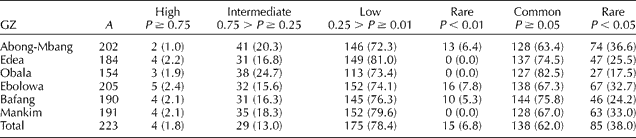
Allele frequencies classified according to the system of Buchert et al. (Reference Buchert, Rajora, Hood and Dancik1997) showed that the majority of alleles were low in frequency (78.4%; Table 1), a tendency reflected in all of the geographical regions, particularly in Edea. In addition, 13% of the alleles had intermediate frequencies, among which Obala recorded the highest percentage. The regions of Abong-Mbang, Ebolowa and Bafang had rare alleles (P< 0.01) and only 1.8% of the alleles found were at high frequencies. It is important to note that, according to the classification system of Marshall and Brown (Reference Marshall, Brown, Franked and Hawkes1975), 38% of the alleles were classified as rare, with the Abong-Mbang and Mankim areas having the highest percentages of rare alleles.
Allele classification according to allelic frequencies based on the approach of Buchert et al. (Reference Buchert, Rajora, Hood and Dancik1997) (high, intermediate, low and rare) and Marshall and Brown (Reference Marshall, Brown, Franked and Hawkes1975) (common and rare)
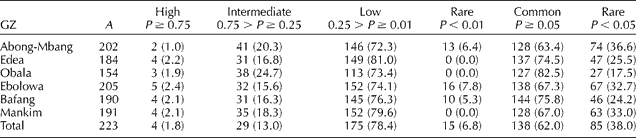
GZ, geographical zone; A, number of alleles per geographical zone.
Genetic diversity and differentiation among groups
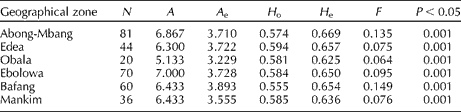
The parameters of genetic diversity within each geographical area are presented in Table 2. The wide difference found in the average number of alleles per locus (A= 6.361) and the number of effective alleles per locus (A e= 3.648) is relevant because they confirm that the evaluated geographical regions have rare alleles (Laurentin, Reference Laurentin2009). The percentage of polymorphic loci (P) for all the geographical regions was 100%. The expected heterozygosity throughout the geographical regions varied within a very narrow range from H e= 0.625 to 0.669. These values show that the magnitude of the genetic diversity across the six geographical regions varied within a very narrow range and was relatively high.
Genetic diversity parameters for each studied geographical regions
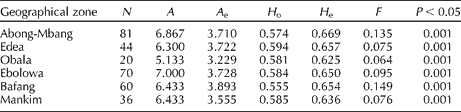
N, number of palms evaluated per geographical region; A, average number of alleles per geographical region; A e, effective number of alleles; H o, observed heterozygosity; H e, Nei's (Reference Nei1978) expected heterozygosity; F, fixation index F IS; P< 0.05, statistically significant value for the F index.
The estimation of genetic diversity within families is important because it can be used to identify families with relatively high genetic diversity to design and maintain improvement strategies. The genetic diversity observed across the 61 families assessed varied within a range from H e= 0.341 to 0.687, within which the accession EF51 showed the lowest value and the accession AF15 showed the highest value. According to the calculated Nei's genetic diversity parameters, the genetic diversity within the families was lower than that within the geographical regions, and the total genetic diversity was relatively high (H T= 0.673). The average genetic diversity among subgroups (D ST) showed a value of 0.110 among the families and 0.015 among the geographical regions, reflecting lower variability among the geographical regions and greater diversity among the families.
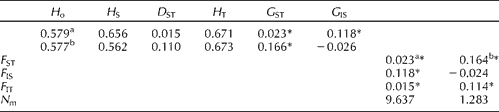
The genetic differentiation coefficient G ST= 0.023 and the F ST= 0.023 statistic (Table 3) were equal, suggesting that there was no population genetic structure among the six geographical regions evaluated and that all the sampled individuals form a single population. This result demonstrates that there was genetic recombination among them, associated with a high number of migrants between the regions, with N m= 9.637. This conclusion was consistent with the AMOVA results, as only 1% of the variation was between the regions and 80% of the variation was distributed within the individuals.
Nei's coefficients of genetic diversity and differentiation and F statistical coefficients
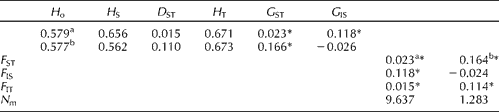
H o, average of observed genetic diversity; H S, average of genetic diversity within groups; D ST, average of genetic diversity among subgroups; H T, total genetic diversity; G ST, coefficient of genetic differentiation; G IS, inbreeding coefficient.
* Statistically significant values (P= 0.001).
a Values obtained from grouped geographical regions.
b Values obtained from grouped families.
It is important to note that there was high genetic differentiation (G ST= 0.164; F ST= 0.166) among the 61 assessed families, with a low number of migrants N m= 1.260, in which 15% of the total variance was distributed among the families within the geographical regions. The fixation index values F IS and G IS were positive and significant, indicating a deficit of heterozygotes among the six geographical regions or the presence of null alleles in the population that could not be detected. In contrast, these values were negative for grouped families, signifying an excess of heterozygotes; however, these values are not statistically significant. According to Wright (Reference Wright1951), subpopulation divergence increases with geographical distance. Therefore, the possible influence of isolation by distance was evaluated using the Mantel coefficient to prove the null hypothesis of no relationship between genetic divergence and geographical distance. Linearized F ST and F ST matrices (Slatkin, Reference Slatkin1995) were used to measure genetic divergence between the pairs of geographical regions and a geographical distance matrix, in km, for the six collection places. The Mantel test showed no statistically significant correlation (Z= 72,985; r= − 0.182; R 2= 0.0332, P= 0.305) between genetic distance and geographical distance in this study. Therefore, the hypothesis of an isolation-by-distance process between the geographical regions evaluated was discarded.
Genetic relationships
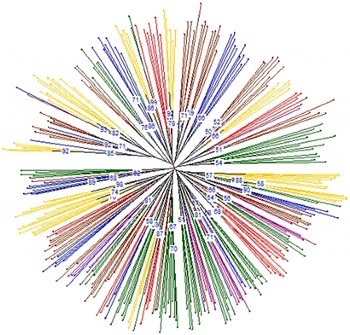
The clustering topology obtained by applying the neighbour-joining algorithm (Fig. 2) and taking individuals as the unit of analysis allowed groups with statistical support to be identified based on bootstrap values greater than 50. The groups are made up of palms from single families, thus demonstrating, again, the genetic differentiation among them. Clearly, there are no clusters that parallel the sampled geographical regions. Using the dendrogram generated by NTSYS (Rohlf, Reference Rohlf1998) based on the coefficient of genetic similarity of Nei and Li (Reference Nei and Li1979) and the unweighted pair group method with arithmetic mean (UPGMA) clustering method, no clear relationship was found between the geographical origin and the resulting groups, with similarity indices ranging from 0.40 to 0.80, reflecting high variability among the 311 evaluated samples (data not shown).
(colour online) Unrooted neighbour-joining tree realized from the dissimilarity matrix. The tree shows 311 E. guineensis oil palms from Cameroon that are not separated according to their collection site, but instead can be seen as a set of heterogeneous individuals. Genotypes are identified by different lines coloured according to the geographical area of origin (Abong-Mbang: green; Edea: blue; Obala: pink; Ebolowa: brown; Bafang: yellow; Mankin: red).

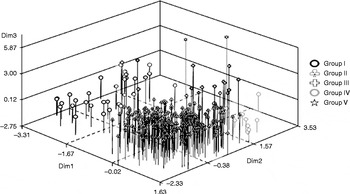
To identify better-defined groups, a MCA was carried out. This is one of the most widely used methods for molecular data because it is sensitive to similarity patterns based on rare alleles shared by some genotypes (Laurentin, Reference Laurentin2009). Based on the MCA, five groups were observed (Fig. 3). Group I was made up of 32 individuals distributed as follows: 15 palms from three families collected in the Bafang region; 12 palms from two families collected in the Ebolowa region; four palms from the Edea region; one palm from the Abong-Mbang region. Group II was made up of 248 palms from all of the six geographical regions. Group III was made up of 16 individuals distributed as follows: five palms from one family collected in the Bafang region; five palms from one family collected in the Edea region; four palms from the Ebolowa region; one palm from the Abong-Mbang region; one palm from the Mankim region. Group IV was made up of 13 palms mostly from the Bafang region. Group V was made up of two palms from the Edea and Mankim regions.
MCA of the 311 genotypes of oil palm E. guineensis in the first three dimensions. It shows the conformation of the five groups, each identified by a symbol.

Discussion
The allelic frequencies reported in this study showed that there are no fixed alleles and no alleles characteristic of any geographical region. However, a considerable percentage (38%) of rare alleles (P< 0.05) was found distributed across all the six geographical regions, with rare alleles particularly shared between Abong-Mbang and Mankim, which have similar agro-ecological conditions, suggesting that natural selection had a greater impact than genetic drift on the pattern of genetic variation. Several studies have shown that the growth and development of oil palm responds naturally to different environments (Forero et al., Reference Forero, Hormaza and Romero2012). According to Rajora et al. (Reference Rajora, Rahman, Buchert and Dancik2000), rare alleles may be related to plant adaptation to abiotic and biotic stress. Similarly, theoretical evidence shows the importance of maintaining genetic variability, particularly because it increases the likelihood of adaptive responses (Maxted et al., Reference Maxted, Scholten, Codd and Ford Lloyd2007). In contrast, the presence of rare alleles may be because the genotypes of these geographical regions have been enriched with germplasm having different origins and/or countries. It is important to note that there are many factors or biological phenomena that may cause changes in allele frequencies, which determine the genetic evolution of a population. However, alleles at low frequencies as well as the presence of rare alleles could represent a long-term benefit in terms of resistance to future pests and response to potential climate changes (Maxted et al., Reference Maxted, Ford Lloyd, Jury, Kell and Scholten2006). Similarly, the lack of these alleles could indicate a potential loss of the loci that determine short-term adaptability or economically important traits not considered in a particular planting programme. This fact makes this population a potential reservoir of genes related to new traits which could contribute to increasing the productivity of oil palm in Colombia.
The SSR were highly informative, suggesting a high value for genetic diversity (H T= 0.673) among the accessions evaluated, which confirms that the Republic of Cameroon may be a centre of origin and diversity for E. guineensis (Corley and Tinker, Reference Corley and Tinker2003). According to Maxted et al. (Reference Maxted, Scholten, Codd and Ford Lloyd2007), the genetic diversity of natural populations of plants decreases according to the geographical distance from their place of origin. This effect has been observed in the oil palm, where the highest percentage of polymorphism is found in Nigeria and Cameroon, countries referred to as the centres of origin of the species (Maizura et al., Reference Maizura, Rajanaidu, Zakri and Cheah2006). The clustering pattern of the populations does not correlate with the geographical locations of the collections, which may be due to the high number of migrants (N m= 9.637) found between the regions, acting to homogenize the genetic variation among the groups, exceeding the effects of drift and preventing local differentiation (Hedrick, Reference Hedrick2005). This finding is corroborated by Epperson (Reference Epperson2003) who indicated that the genetic structure can be difficult to identify when the genetic diversity is high, but more evident when it is low. Furthermore, the genetic flow and seed dispersal ability may have an effect on the spatial distribution of genes (Luna et al., Reference Luna, Epperson and Oyama2005). Some milestone dates and facts show that Cameroon has been an important point of the arrival of various migrations since ancient times. This suggests an active dispersion of seeds among regions, mainly due to the multiple uses that local populations make of this plant, many of them firmly rooted in their cultural traditions. Other oil palm seed dispersers are animals and water; the latter with a major role in the dispersal and migration of oil palm through African rivers and streams (Corley and Tinker, Reference Corley and Tinker2003; Hayati et al., Reference Hayati, Wickneswari, Maizura and Rajanaidu2004; Maizura et al., Reference Maizura, Rajanaidu, Zakri and Cheah2006). The results of this study are consistent with those by Billotte et al. (Reference Billotte, Risterucci, Barcelos, Noyer, Amblard and Baurens2001) who reported that the samples they analysed have no genetic structure. These results have been confirmed by Barcelos et al. (Reference Barcelos, Amblard, Berthaud and Seguin2002) who used RFLP analysis of 38 populations of E. guineensis and AFLP analysis of 22 oil palm populations, and reported a low level of genetic structure within all the evaluated regions, which was attributed to the dispersal of populations without geographical barriers over the African continent. Maizura et al. (Reference Maizura, Rajanaidu, Zakri and Cheah2006) used RFLP analysis of 359 oil palm populations from 11 African countries and found that populations included in the study could have experienced gene flow between populations causing a high level of heterozygosity, which was attributed to seed dispersal by rivers. With regard to genetic structure, the results obtained by Hayati et al. (Reference Hayati, Wickneswari, Maizura and Rajanaidu2004) contradicted the other reported results, indicating that the gene flow obtained was low (N m= 0.56), suggesting that in the 26 regions of the ten countries sampled, the genetic differentiation among the populations of oil palm decreased along a line towards East Africa, which indicates that the populations of West and Central Africa are more similar to each other than to populations from East Africa. However, it is important to note that the study included oil palm populations from the island of Madagascar, which could have affected the gene flow estimation and, therefore, the genetic differentiation.
Migration involves not only the movement of individuals but also the incorporation of their genes into the new populations. For this reason, it is likely that the observed reduction of heterosis is the result of the mixture of different allele frequencies among the six geographical regions that over time have produced a mixed population with a heterozygous genotype deficiency when compared with the frequency expected according to the Hardy–Weinberg equilibrium for average allele frequencies. It is important to consider that this reduction has no effect on the survival and fertility of the individuals of the population and, in general, there is a breeding and genetic diversity distribution pattern that does not significantly differ from that which would be expected under a random pollination model.
The range of diversity (H e=0.341–0.687) and the genetic differentiation (G ST= 0.166) found in the 61 families assessed in this study represent a useful genetic resource to increase the genetic base of oil palm breeding populations. This aim could be achieved through the approach of Corley and Tinker (Reference Corley and Tinker2003), which proposes to make crosses between plants with different origins, introducing new germplasm sources, followed by the selection of families and individuals to avoid inbreeding and placing emphasis on the general combining ability. However, we could not generalize that genetic differentiation among families occurred in situ (Cameroon), as this may be related to the criteria established for the collection. According to the procedures used, each collected local group was classified as a family if it was verified that there were no other palms within at least a 100 m radius; additionally, samples were taken according to the availability of mature seed bunches at the time of sampling (Arias et al., Reference Arias, Daza, Montoya and Romero2011). This procedure could have restricted the apparent gene flow between some families. It is known that the gene flow process in oil palm is driven by the natural dispersal of pollen by the entomophilous and anemophilous effect. A study of wild populations of oil palm in Cameroon showed that pollen dispersal by the wind was very inefficient and occurred at short distances, especially in the rainy season (Syed, Reference Syed1979). Similarly, a study of pollinating insect species of the genus Elaeidobius showed that the species E. subvitatus had a maximum range of 100 m to female inflorescences, followed by E. kamerunicus, and that the size of the populations of these insects decreased during the rainy season, affecting the rates of cross-pollination (Syed, Reference Syed1979). This could be due to the phenotypic differences found among families, especially in the components of oil yield (Arias et al., Reference Arias, Daza, Montoya and Romero2011), which could enable further progress in the exploitation of hybrid vigour in the oil palm.
One of the important objectives of this study was the effective creation of a core collection without losing genetic diversity. The molecular data generated indicate that the genetic diversity in the genotypes evaluated from the Republic of Cameroon is mainly distributed within the regions, suggesting that there is no isolation by geographical distance, showing that all the sampled individuals form a single, highly diverse population. Therefore, the selection of palms that will make up a core collection could be based on the groups obtained using the MCA. Brown (Reference Brown1989) suggested that a sample of 10% of a base collection would preserve 70% of its total diversity. In that sense, 120 accessions including at least one representative of each family will allow the effective and almost complete collection of the genetic diversity of Cameroon, which will be a point of reference for assessment work, so studies conducted using this collection will provide an overview of the characteristics of the full collection. This will no doubt allow the efficient use of genetic resources and, at the same time, a reduction in evaluation and characterization costs.
In summary, this study identified a high level of genetic diversity in the genotypes of oil palms from Cameroon. The clustering pattern identified at molecular levels had no correlation with the geographical regions where the collections took place, indicating a high rate of genetic exchange that was attributed mainly to the dispersal of seeds. The information generated from this study indicates that oil palm materials from Cameroon represent a useful genetic resource for expanding the genetic base of the currently planted oil palm varieties and a way to find sources of resistance to biotic and abiotic factors to develop new varieties with competitive advantages for the sector.
Acknowledgements
The authors wish to thank the Administrative Department of Science, Technology and Innovation, Colciencias, for its financial support in conducting this work under contract no. 626-2009 and the IARD of Cameroon for its collaboration and permission to collect the oil palm material. Thanks to Claude Bakoumé and Leonardo Rey who collected the oil palm material in Cameroon. Thanks also to Myriam Cristina Duke, researcher at the International Center for Tropical Agriculture, and to Eloina Mesa for her assistance in the data analysis. Cenipalma research is funded by the Oil Palm Development Fund (FFP) managed by Fedepalma.