INTRODUCTION
The subfamily Parotoplaninae, to which the new species Philosyrtis aegusae is attributed, belongs to the family Otoplanidae (Plathelminthes: Rhabdithopora), which represents a cosmopolitan, marine, interstitial group of the ‘Otoplanen-Zone’ of Remane (Reference Remane1933).
The new species P. aegusae presents the peculiar features of the subfamily, i.e. a partially ciliate body, a ciliate creeping sole and a transversally located short collar-shaped pharynx.
The first description of the post-embryonal development of otoplanids has been given in Parotoplana rosignana (Lanfranchi & Melai, Reference Lanfranchi and Melai2008) and it appears of proterogynic type, but the maturation of the female and male gametes in the adult is contemporaneous.
MATERIALS AND METHODS
The specimens were collected, by scooping up the superficial layer of sediment, in March 2007 at Lido Burrone (Favignana, Egadi Islands, Trapani), 37°55′N 12°19′E (locus typicus), where the sandy-breaker zone is characterized by very fine sand. The meteorological conditions were optimal with a temperature of 20–23°C, a calm sea and a light breeze. All samples collected were transported to the laboratory in plastic containers. Each organism was first anaesthetized with a solution of 1/3 of MgCl2 21% and 2/3 tap water. Subsequently, the specimens were studied in vivo by slight squeezing under the coverslip, in order to draw the habitus with the aid of the camera lucida. Finally, by compressing the coverslip more forcefully, the sclerotic apparatus spines were examined. For histological procedures, the specimens were fixed in Stieve solution. The sections were stained with Heidenhain's haematoxylin, using eosin as counterstain. A graphical elaboration was used to support the microscopic study.
TYPE MATERIAL
At least 10 specimens were studied in vivo; supporting drawings and photographs were elaborated. Five specimens were fixed and sectioned. Holotype: one sagittally-sectioned specimen is deposited in the Electron Microscopy Laboratory Collection of the Dipartimento di Biologia, Unità di Etologia (Università di Pisa).
DIAGNOSIS
The new species P. aegusae is attributed to the genus Philosyrtis on the basis of the general arrangement of pharynx, testes and germo-vitellaria, and of the sclerotic apparatus.
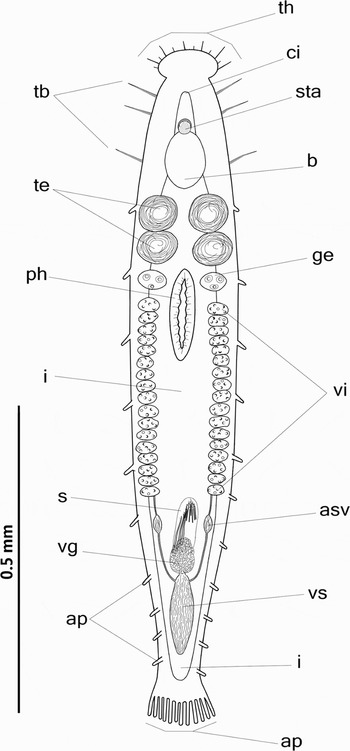
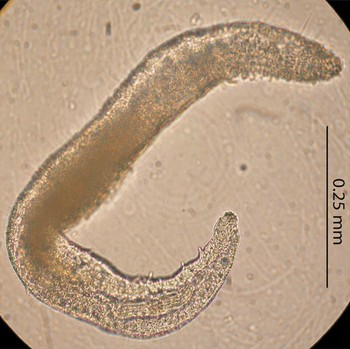
The body length of sexually mature organisms varies from 0.9 to 1.1 mm. The animals appear fusiform, dorsally convex, ventrally flat, colourless and transparent (Figures 1 & 2). The anterior end is characterized by a button swelling (Köpfchen), with numerous tactile hairs (th) and followed by three robust lateral tactile bristles (Tastborsten) (tb) retractable into the respective wide pockets.
Habitus and organization of Philosyrtis aegusae sp. nov.: ap, adhesive papillae; asv, accessory seminal vesicle; b, brain; ci, cephalic intestine; ge, germaries; i, intestine; ph, pharynx; s, sclerotic apparatus; sta, statocyst; tb, Tastborsten or tactile bristles; te, testes; th, tactile hairs; vg, vesiculagranulorum; vi, vitellaries; vs, vesicula seminalis.

Photography of Philosyrtis aegusae sp. nov. in vivo.

The cephalic intestine (ci) and in succession the statocyst (sta) and the ovoidal brain (b) are behind the Köpfchen.
The testes (te), located anteriorly to the pharynx, consist of two series of large follicles, two on each side. Two germaries (ge), at some distance from each other, are present laterally to the pharynx beginning and posteriorly to the last testis follicles. They are globoid and contain numerous egg cells.
Behind the ovaries two laterally placed single rows of vitellaries (vi) reach the opening of the penis papilla. The pharynx (ph), perpendicularly situated between the first and second thirds of the body, shows the so-called collar-shaped organization (kragenförmig) typical of the genus.
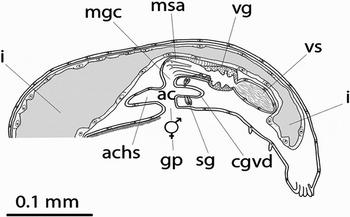
The last body third is characterized by a large lengthened vesicula seminalis preceded by a clearly distinguishable vesicula granulorum and two accessory seminal vesicles (Figures 1, 2, 6 & 7). In the sagittal sections (Figure 6), the seminal vesicle (vs) presents a thin inner epithelium without an evident musculature, the prostatic vesicle (vg) appears globose with an epithelium containing granulated secretions, the atrium commune (ac) is provided with an hernial sac and the final part of the common germo-vitello-duct is surrounded by shell glands.
The caudal end has a narrow fan-shaped plate, with numerous digitiform adhesive papillae (ap), also present singularly in ventral and ventrolateral rows.
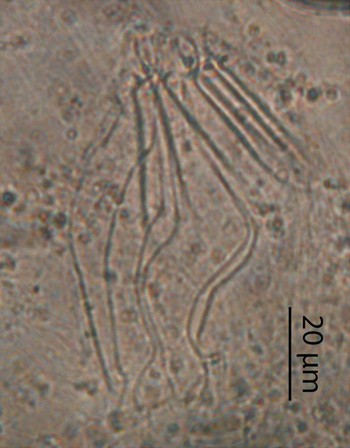
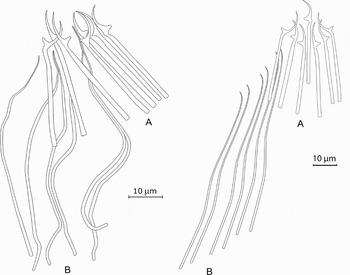
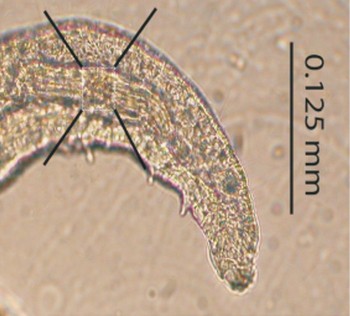
The male copulatory organ presents a sclerotic apparatus (Figure 1, s) with two groups of spines differing considerably in shape and length and distributed as follows (Figures 3, 4, 5 & 6):
Photography of the spines of male sclerotic apparatus of Philosyrtis aegusae sp. nov.

Drawing with camera lucida (4) and spatial distribution (5) of the spines of the male sclerotic apparatus of Philosyrtis aegusae sp. nov.: (A) dorsal group; (B) ventro-lateral group.

Sagittal reconstruction of the atrial organs of Philosyrtis aegusae sp. nov.: ac, atrium commune; achs, atrium commune hernial sac; cgvd, common germo-vitello-duct; gp, genital pore; i, intestine; mgc, male genital canal; msa, male sclerotic apparatus; sg, shell glands; vg, vesicula granulorum; vs, vesicula seminalis.

Photograph of vesicula granulorum detail in the penis papilla of Philosyrtis aegusae sp. nov.

Group A: 7–8 spines (33–40 mm long), situated like a crown dorsally to the sclerotic complex characterized by bent distal tips and a well-developed sub-terminal cuneiform prominence.
Group B: 6 or more rather thin spines (70–80 mm long), with pointed tips bent outwards, arranged externally and ventro-laterally to group A.
CONCLUDING REMARKS
With the description of the new species P. aegusae, the valid species of the taxon Philosyrtis now known are eleven altogether: P. monotoides Giard, Reference Giard1904 from Ambleteuse (Pas de Calais, Francia), P. eumeca Marcus, Reference Marcus1950 from the Brazilian coast, P. fennica Ax, Reference Ax1954 from Lappvik, P. sanjuanensis Ax & Ax, Reference Ax and Ax1967 from San Juan Island (Pacific coast of the State of Washington), P. rotundicephala Sopott, Reference Sopott1972 from Sylt, P. santacruzensis Ax & Ax, Reference Ax and Ax1974 from Santa Cruz Island (Galapagos Islands), P. rutilata Sopott-Ehlers, Reference Sopott-Ehlers1976 from the Atlantic coast, P. coomansi Martens & Shockaert, Reference Martens and Schockaert1981 from Eastern–Western Scheldt (Netherlands Delta area), P. armoricae Sopott-Ehlers, Reference Sopott-Ehlers1985 from Brittany (French Atlantic coast) and P. rauli Noreña et al. Reference Noreña, Damborenea and Brusa2005 from Uruguay River (Uruguay). The new species P. aegusae appears particularly similar to P. armoricae in the characteristics of the testes, the germaries and the vitellaries. The sclerotic apparatus, subdivided into a dorsal and a ventral group of spines, also displays an organization like that of P. armoricae. Nevertheless, the dorsal group presents a non-hooked sub-terminal cuneiform prominence, and the total bristle length is shorter. The ventral group in P. aegusae is constituted by a higher number of spines, only of the kind with pointed and curved distal end.
The separation of the vesicula granulorum from the sclerotic apparatus testifies that the plesiomorphous condition of the subdivision of the male copulatory organ into three parts—vesicula seminalis, vesicula granulorum, sclerotic apparatus—is still present in the genus Philosyrtis, and particularly in the new species P. aegusae.
The other ten species of Philosyrtis have nowadays achieved the apomorphous feature characterized by the fusion of the vesicula granulorum and the sclerotic apparatus into a single element.
On the basis of the data presented, P. aegusae differs from P. armoricae in its body dimensions and the characteristics of the sclerotic apparatus, and furthermore for the well-outlined vesicula granulorum.