1. INTRODUCTION
Unlike Swedish and Norwegian, Icelandic does not have lexical tones (Thráinsson Reference Thráinsson, König and van der Auwera1994). More specifically, there is no equivalent to the binary tone contrast on the syllable bearing primary stress that has been observed for Swedish and Norwegian (see e.g. Gårding Reference Gårding, Hirst and Christo1998 for Swedish, Kristoffersen Reference Kristoffersen2000 for Norwegian, and Gussenhoven Reference Gussenhoven2004:209–223 for a recent overview and further references). As in English, the Icelandic lexicon does not specify the shape of the pitch accent realized on a lexical item, it does, however, specify the potential locus of the pitch accent, which falls onto the stressed syllable. As a rule, word stress falls on the first syllable of a word (Einarsson Reference Einarsson1973; Árnason Reference Árnason1985, Reference Árnason, Gregersen and Basbøll1987, Reference Árnason and Werner1998; Thráinsson Reference Thráinsson, König and van der Auwera1994); see (1). Icelandic shares this property with a number of other languages, among them Bengali (see Hayes & Lahiri Reference Hayes and Lahiri1991:55, and references given there) and Finnish (Iivonen Reference Iivonen, Hirst and Cristo1998:315).
(1) Icelandic word stress
Stress the initial syllable of a word.
Moreover, there is ‘a tendency for the third syllable to have secondary stress’, illustrated in (2) (Árnason Reference Árnason1985:94, referring to Jóhannson Reference Jóhannsson1924). This also holds for compounds, both if the first component is monosyllabic as in (3a) and if the first part is bisyllabic as in (3b). The typical Icelandic word rhythm is thus Swsw (with S = main/primary stress, w = weak, s = secondary stress). There are, however, exceptions to this rule. In certain compounds, notably if the first part of the compound is trisyllabic and the second component can occur as a separate word, two weak syllables occur between two strong ones, yielding a Swws rhythm (Árnason Reference Árnason1985, Reference Árnason, Gregersen and Basbøll1987; see (4)). However, the rule stating that lexical items are prosodically left-headed holds across the board. The examples in (2)–(4) and the stress patterns given there are taken from Árnason (Reference Árnason1985:94).
(2)

(3)
(4)

In Icelandic, pitch accents are intonational and focus-marking. The accent type realized on the stressed syllable depends on linguistic and paralinguistic context and speaker, rather than on phonological and morphological rules. In contrast to the left-headedness of lexical items, normal sentence stress is rightmost, i.e. under normal stress, prominence falls onto the ‘last main constituent of an utterance’ (Árnason Reference Árnason1985:93, Reference Árnason and Werner1998; see (5a)). The rule is illustrated in (6a), where prominence falls on the head noun of the sentence-final NP. Rightmost sentence stress holds unless otherwise required by the focus structure of the sentence. Árnason (Reference Árnason1985:93) notes that contrastive stress ‘can be assigned to almost any part of the utterance’. In general, focused constituents are marked by pitch accents anywhere in the sentence (see (5b) and (6b)). However, we know from Nolan & Jónsdottir (Reference Nolan, Jónsdóttir, van Dommelen and Fretheim2001) that given information does not have to be deaccented (see section 3.3 below). In an utterance with narrow focus, we may thus find retained prominence on non-focused constituents (see section 3.2 below). Note that in (6), the word that carries main prominence is capitalized.
(5) Icelandic sentence stress
a. Under neutral focus, the rightmost constituent is the most prominent one.
b. Focused constituents are prominent.
(6)
According to Árnason's (Reference Árnason and Werner1998) pioneering work, the basic tone system of Icelandic has two bitonal pitch accents. In general, bitonal pitch accents consist of a starred tone T* that is phonologically linked to the strong syllable, and an unstarred tone which precedes (leading tone) or follows (trailing tone) the starred tone ‘at some given space in time’ (Beckman & Pierrehumbert Reference Beckman and Pierrehumbert1986:257). In Icelandic, the most frequent pitch accent is H*L, i.e. a peak on the stressed syllable with a subsequent fall (a low trailing tone). This is illustrated in (7a), where H* falls on the first syllable of Dísa, followed by a fall on the adjacent syllable. Along with H*L we find L*H, i.e. a low extreme on the stressed syllable with a subsequent rise (a high trailing tone), illustrated in (7b). The syllables which bear the given pitch accent are capitalized.
(7)
Árnason (Reference Árnason and Werner1998:53f.) discusses the question of whether the two pitch accents he identifies should be seen as bitonal or should rather be analysed as, for example, monotonal pitch accents with a following phrase accent. His main argument is that in Icelandic, for both H*L and L*H it holds that the trailing tone has to immediately follow the starred tone, i.e. it occurs on the same or on the adjacent syllable. For the downward movement in an H*L combination, Árnason observes that it is completed by the time the next vowel is reached (see his example given in (7a) above): the fall is completed on -sa). It seems therefore that the limit of the ‘given space in time’, as Beckman & Pierrehumbert put it, can be defined for Icelandic as the end of the syllable immediately following the one associated with the starred tone.
Along with the two bitonal pitch accents, Árnason (Reference Árnason and Werner1998) identifies two boundary tones for Icelandic: H% and L%. In intonational phonology, edge tones are tones that are associated with the edges of phrasal prosodic constituents. In the relevant literature, two kinds of edge tones have been assumed: boundary tones and phrase accents (e.g. Pierrehumbert Reference Pierrehumbert1980, Beckman & Pierrehumbert Reference Beckman and Pierrehumbert1986). The domain of a complete intonational contour is the Intonational Phrase (IP). A boundary tone (T%) is aligned with the edge of IP. Each IP is made up of one or more Intermediate Phrases (ip), which are terminated by phrase accents (T-). In Pierrehumbert (Reference Pierrehumbert1980), the assumption of the phrase accent T- was mainly motivated by the observation that two tonal targets can be identified after the nuclear pitch accent, i.e. that there is a tone after the last pitch accent but before the phrase boundary. In Beckman & Pierrehumbert (Reference Beckman and Pierrehumbert1986:256) the phrase accent in English is defined as ‘a tone that fills the space after the last pitch accent in a phrase’. It ‘controls the f0 between the last pitch accent of the intermediate phrase and the beginning of the next intermediate phrase – or the end of the utterance’ (Pierrehumbert & Hirschberg Reference Pierrehumbert, Hirschberg, Cohen, Morgan and Pollack1990:277). Unlike the unstarred tone in a bitonal pitch accent, the position of the phrase accent is therefore defined relative to the phrase edge. Since phrase accents terminate the Intermediate Phrase while boundary tones terminate the Intonational Phrase, Beckman & Pierrehumbert (Reference Beckman and Pierrehumbert1986) argue that T- should be able to occur not only in combination with T%, but also medially, at the edge of an Intermediate Phrase followed by another Intermediate Phrase in the same Intonational Phrase.
In more recent work, the phrase accent has been associated with a stressed syllable following the nucleus. Evidence for the existence of the phrase accent is given in Grice, Ladd & Arvaniti (Reference Grice Martine, Ladd and Arvaniti2000) across a range of languages. They argue that phrase accents are edge tones primarily, but that they may have ‘an additional or alternative tendency to co-occur with a stressed syllable or some other designated tone-bearing unit’ (Grice et al. Reference Grice, Baumann and Benzmüller2000:144). Grice & Baumann (Reference Grice and Baumann2002:280, 295) maintain for German specifically that the anchor point of a phrase accent is often a post-nuclear, lexically stressed syllable. From this point in the contour, the phrase accent stretches to the beginning of the final syllable of the phrase (Grice & Baumann Reference Grice and Baumann2002:280).
While evidence for the existence of phrase accents in Icelandic has not previously been found, it has been argued that both high (H%) and low (L%) boundary tones occur. All possible combinations of the two bitonal pitch accents and the two boundary tones have been attested: H*L L%, H*L H%, L*H L% and L*H H% (Árnason Reference Árnason and Werner1998). According to Árnason (Reference Árnason and Werner1998), L% is used to mark finality, i.e. it is primarily used at the end of utterances (in both statements and simple yes/no-questions, see (7) above), while H% signals non-finality. Accordingly, Árnason (Reference Árnason and Werner1998:53–56) describes H*L L% as a typical sequence at the end of declarative utterances (see (7a)), while L*H H% and H*L H% occur utterance-internally, i.e. at the end of an Intonational Phrase preceding another Intonational Phrase in the same Utterance (see (8)). L*H L% and L*H H% are used in yes/no-questions (see (9)).Footnote 1
(8)
(9)
It is evident from the example in (9b) that H% is not only used to indicate non-finality. Rather, it is also possible for H% to occur utterance-finally, here at the end of a yes/no-question.
Across Intonational Phrases, downstep has been described, such that later pitch peaks are lower than earlier ones (Árnason Reference Árnason and Werner1998; Dehé Reference Dehé, Bruce and Horne2006). This holds in sequences of L*H as well as sequences of H*L accents, and also in combinations of the two.
The aim of the present paper is to shed new light on the Icelandic tone inventory and tonal contours. It will be shown that along with the two bitonal pitch accents already observed in the literature, Icelandic has two monotonal pitch accents (H* and L*). The evidence is based mainly on the timing of the pitch movement after the starred tone, which occurs on the immediately adjacent syllable in bitonal, but not in monotonal accent types. Evidence will further be provided for two phrase accents (L- and H-), along with the two boundary tones. Phrase accents may be associated with secondarily stressed syllables. Finally, it will be shown that along with downstep, Icelandic also has upstep across Intonational Phrases. Upstep may occur in neutral declaratives and in utterances with final narrow focus.
The remainder of the article is organized as follows. Section 2 provides information on the sources and treatment of the data the analysis is based on. The data analysis in section 3 starts with a description of the patterns observed in neutral declaratives (section 3.1). Section 3.2 looks at declarative utterances with narrow focus. Section 3.3 addresses deaccenting and given information. Section 3.4 focuses on the discussion of phrase accents and provides evidence for the existence of H- and L-. Section 3.5 deals with downstep and upstep in Icelandic. Question intonation is addressed in section 3.6. A final discussion and summary are offered in section 4.
2. DATA
The present study is based on data from three sources, two of which are experimental reading studies.
2.1 The reading studies: materials
For the purpose of the first reading study (Study 1), question–answer pairs were designed such that the question established the context for the answer sentence. The answer sentences exhibited either broad focus (neutral declaratives) or narrow focus on one of the following constituents: direct object (DO), indirect object (IO) or verb phrase (VP) consisting of a verb and at least one object. In addition, three listings as exemplified in (10e) were part of the materials. Overall, the list of items contained 27 target items: 5 neutral declaratives, 10 DO focus, 7 IO focus, and 5 VP focus, and the three listings. Examples are given in (10).
(10)
The materials of the second reading study (Study 2) were similar to the materials of the first study except that neutral declaratives were not preceded by questions (see (11a)), and there were no VP-focus sentences or listings. Instead, a number of target items exhibited subject focus or verb focus (see (11b, c)). Overall, the data set consisted of 66 target items: 30 neutral declaratives, 16 DO focus, 8 subject focus, 8 IO focus, and 4 verb focus.
(11)
2.2 The reading studies: participants, apparatus and procedure
The first reading study was carried out in the spring of 2004 in the anechoic chamber at University College London, Department of Phonetics and Linguistics, with five female native speakers (S101–S105) of Icelandic. The materials of the second study were recorded in June 2004 in a quiet, closed room at the University of Iceland in Reykjavík with 12 native speakers of Icelandic (3 male, 9 female; S201–S212). All speakers were naïve as to the aim of the study. Their participation was voluntary. The target items were presented to the participants individually on a computer screen using Microsoft PowerPoint. They appeared on mouse-click, with the question in question–answer pairs preceding the answer. The participants were instructed to familiarize themselves with the items before reading them out loud, and to produce each sentence as naturally as possible at a normal speech rate. For question–answer pairs, both questions and answer sentences were read by the participants. The list of target items was preceded by four practice items in Study 1 and five practice items in Study 2. The practice items were similar in make-up to the target items. In Study 1, all practice items were question–answer pairs, while in Study 2, two of the five practice items were question–answer pairs. The target list was pseudo-randomized such that one focus type did not occur more than two times in an uninterrupted sequence. All utterances were recorded and later digitized into individual sound files using Audacity 1.1.3 and Cool EditTM96 software. Overall, 150 items were produced by the five participants of reading Study 1, and 792 items were produced by the twelve speakers in reading Study 2.
2.3 The children's story Siggi og Stína
The third data source, which complemented the experimental materials, was the Icelandic children's story Siggi og Stína, read and recorded by a trained female speaker (S301) in a colloquial way. It was originally tape-recorded for use as a comprehension exercise in language teaching. At the time of the recording, the speaker did not know that it would be used for any other purpose than her intended one. The recording was provided on tape by the speaker and was digitized into individual sound files for the purpose of linguistic analysis.
2.4 Data treatment
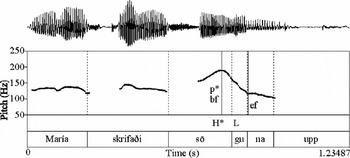
All target items underwent an auditory and an instrumental analysis. The auditory analysis helped to identify location and type of perceived pitch accents. The instrumental analysis was done in Praat (Boersma Reference Boersma2001; Boersma & Weenink Reference Boersma and Weenink2008). In order to specify the pitch accent type, the following measurements were taken:
- (12)
p* F0 peak location in the accented syllable for H*(L) pitch accents
v* F0 valley location in the accented syllable for L*(H) pitch accents
bf beginning of F0 fall after H*
ef end of F0 fall after H*
br beginning of F0 rise after L*
er end of F0 rise after L*
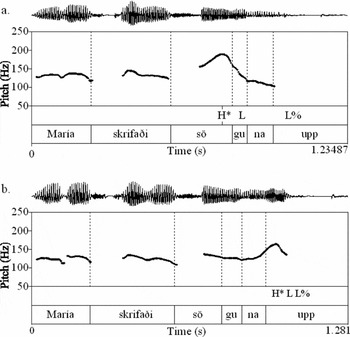
An example is given in figure 1. The first uninterrupted vertical line is marked p* and relates to the F0 peak in the accented syllable sö-. This is also where the F0 fall begins. The second uninterrupted vertical line marks the end of the F0 fall after H*, i.e. a change in pitch direction. The lower tier and the dashed vertical lines provide the segmental annotation. The pitch accent in this particular example is analysed as H*L. The trailing tone, i.e. the fall after H*, is completed on the syllable -gu-, which immediately follows the prominent one.
Target H*L: F0 peak location in the accented syllable sö-, end of F0 fall after H*. Lower tier: segmental annotation; speaker S203, male; María skrifaði söguna upp ‘María wrote the story up’.

3. ANALYSIS
3.1 Neutral declarativesFootnote 2
As mentioned above, normal sentence stress is rightmost (see (5a)). In the examples in (13) prominence falls on appelsínu and bók, respectively. Due to the word stress rule in (1), the pitch accent falls on the first syllable (a-) of appelsínu in (13a) and on monosyllabic bók in (13b).
(13)
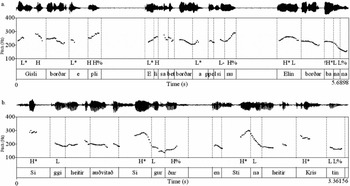
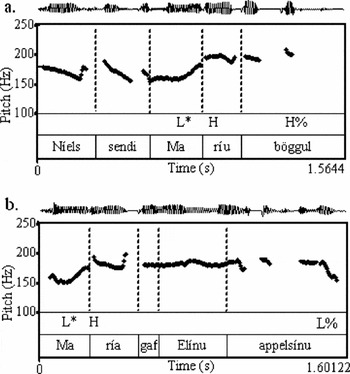
Árnason's (Reference Árnason and Werner1998) observations that (i) H% marks continuation while L% marks finality, and that (ii) both L*H H% and H*L H% occur utterance-internally to mark prominence followed by an IP-boundary are readily confirmed in the present data. This is illustrated by the listing example in (14a) and by the coordination example from Siggi og Stína in (14b), plotted in figure 2a and figure 2b, respectively. The three listed clauses in (14a), figure 2a are each in a separate IP. The first IP (Gísli borðar epli) has a nuclear L*H, where L* falls on the stressed first syllable of epli and the trailing tone continues on the second syllable of epli. The H% terminating this IP indicates continuation. The second IP (Elísabet borðar appelsínu) also ends in H% indicating continuation.Footnote 3 The third/last IP (Elín borðar banana) has a nuclear H*L, where the first syllable of banana carries H* and the L trailing tone is completed on the second syllable of banana. This IP is terminated by L% indicating finality. The coordinated utterance in figure 2b is made up of two IPs, the first of which ends in H*L H% where H% indicates continuation, while the second IP terminates in H*L L% with L% indicating finality.Footnote 4
(14)
Tonal contours in declaratives: L*H H% and H*L H% marking continuation, H*L L% marking finality. Panel a: speaker S101, female; panel b: from Siggi og Stína; speaker S301, female.

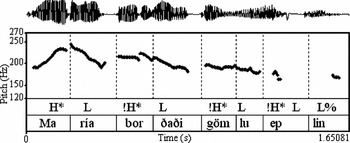
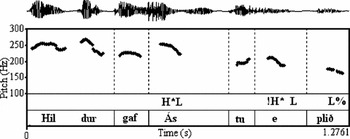
Short utterances are typically produced with a sequence of downstepped H*L pitch accents (see (15a) and figure 3), or with one or more L*H pitch accents followed by one or more H*L accents (see (15b)), the final pitch accent being the most prominent one (see also Árnason Reference Árnason and Werner1998). Note that monosyllabic verbs were not prominent except when narrowly focused.
(15)
Downstep in neutral declarative; speaker S205, female.

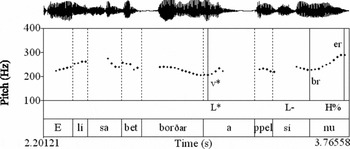
Example (14a) also provides phonetic evidence in favour of a monotonal L* as part of the Icelandic tonal inventory beside L*H. Instead of L*H, we find L* on appelsínu in the second conjunct. The crucial difference between bitonal and monotonal pitch accents in the Icelandic grammar, and thus substantial evidence for the presence of monotonal pitch accents, lies in the presence vs. absence of the trailing tone as realized on the starred syllable or on the syllable immediately following it. Specifically, this is the (timing of the) rise after L* and the fall after H*. Recall that in Icelandic, a trailing tone belonging to a bitonal pitch accent must be realized on the same syllable that bears the stressed tone or on the syllable adjacent to it. Figure 4 zooms in onto the second conjunct of example (14a)/figure 2a. The first syllable of appelsínu bears an L* pitch accent, but there is no immediate pitch rise on the same or adjacent syllable that would serve as evidence for a bitonal pitch accent. The final F0 rise on appelsínu starts at the beginning of the unstressed final syllable -nu and is towards the high boundary tone at the end of the IP.Footnote 5 (The L- phrase accent indicated in figure 4 will be discussed in section 3.4 below.)
Monotonal pitch accent L*: Elísabet borðar appelsínu (second part of listing in (14a)/figure 2a); speaker S101, female.

A similar case can be made for H*L vs. H*. For example, under neutral focus and final narrow focus, the sentence María gaf Elínu appelsínu ‘María gave Elín an orange’ occurs most frequently with a sentence-final, nuclear H*L pitch accent. H* associates to the first, lexically stressed syllable a- of appelsínu, followed by a low trailing tone completed on the second syllable of appelsínu. L% terminates the IP. In some cases, however, there is no immediate pitch fall from the F0 peak on the same or immediately following syllable that would serve as evidence for a bitonal H*L pitch accent. The pitch is sustained on a high level and the fall delayed until the very last syllable, -nu, where it is towards the IP-final L% (see the discussion of (19) and note 8 in section 3.4 below).
Neither of the two monotonal pitch accent types is particularly frequent in the data, but both types can be observed in neutral declaratives (as illustrated in figure 4 for L*) as well as in declaratives with narrow focus and in questions. Note once again that the assumption of the two monotonal pitch accents is based on phonetic evidence. Whether or not a phonological contrast between bitonal and monotonal accents can be established remains an important topic for future research.
3.2 Declaratives with narrow focus
Like many other languages, Icelandic makes use of pitch accents to mark the focus of the utterance (Árnason Reference Árnason1985, Reference Árnason and Werner1998; Dehé Reference Dehé, Bruce and Horne2006); see (5) above. Some of the materials the present work is based on were specifically designed to address research questions related to focus structures in Icelandic (see section 2.1 above). In the data used here, a focused constituent is one that corresponds to a wh-constituent in a given question. The examples discussed in this section are given in (16).
(16)
The examples in (16c, d) are compared in figure 5. The locus of the nuclear pitch accent H*L shifts according to the position of the focus. In (16c), represented in figure 5a, it falls on the focused direct object söguna. (16d), represented in figure 5b, is an example of verb focus. Since the verb consists of the verb skrifaði and the verbal particle upp following the object söguna, the final particle functions as the focus exponent, hence it carries the main pitch accent.
Narrow focus marked by H*L pitch accent. Panel a: direct object focus (söguna); panel b: verb focus (skrifaði upp); speaker S203, male; examples (16c) and (16d), respectively.

L*H, too, is used to mark narrow focus. This is illustrated in figure 6, representing narrow focus on the indirect object Maríu in panel a (example (16b)), and on the subject María in panel b (example (16a)).
Narrow focus marked by L*H pitch accent. Panel a: indirect object focus (Maríu, example (16b)); panel b: subject focus (María, example (16a)); speaker S209, female.

It is worth noting that both accent types occur in all focus positions. They seem to be equally felicitous to mark a focused constituent. In addition to the fact that both accent types occur quite frequently across the focus data, this claim is based on the intuition of one of my informants. He was given the context question, then presented with a pair of lexically and syntactically identical sentences, one containing L*H associated with the focus constituent, the other one, H*L. No difference in interpretation was felt. Rather, both types were equally acceptable to convey the same message. Moreover, along with the two bitonal pitch accents, both monotonal pitch accents, H* and L*, are attested as markers of narrow focus in the data. What is clearly obvious from the data is that (5b) holds, i.e. that focus is prominent. Narrow focus has a nuclear pitch accent across the data studied here. Future research will have to show in what way the different pitch accent types are related to different shades of intonational meaning.
Since all four pitch accent types occur to mark narrow focus, a unique focus-marking sequence (such as the L*H- sequence in Bengali, see Hayes & Lahiri Reference Hayes and Lahiri1991) cannot be identified at this stage of research. However, what is striking is that focus-marking L*H accents, in particular early on in an utterance, have a preference to co-occur with following high tones (both later pitch accents and edge tones), and that these utterances are exempted from downstep. In other words, after an L*H focus accent, regardless of its position, the pitch often forms a high plateau on post-nuclear material until the end of the utterance is reached. This can be seen in figure 6. In panel a, showing focus on the indirect object Maríu, the pitch contour stays at the high level reached on the focused constituent and ends in H%. In panel b, we have a nuclear rise on the focused subject María, and the contour stays at this high level until the very last syllable, where the contour falls towards L%.
The pitch patterns in declarative sentences and in utterances containing narrow focus and the resulting differences can be summarized as follows. Declaratives are typically realized with a sequence of downstepped H*L pitch accents, or a sequence of one or more L*H pitch accents followed by one or more H*L accents. According to (5), the final pitch accent is the most prominent one. Narrow focus is marked by pitch accents, most frequently a bitonal one. In contrast to neutral declaratives, pitch peaks in focus-marking pitch accents may be exempted from downstep (see section 3.5 below). A non-final L*H focus accent is preferably followed by a stretch of high pitch. The difference between neutral declaratives with initial L*H pitch accent(s) (such as (15b)) and utterances with non-final narrow focus marked L*H (e.g. figure 6) thus lies in the pitch pattern after the L*H pitch accent. While pre-nuclear L*H in neutral declaratives triggers downstep and is typically followed by one or more H*L pitch accents, L*H marking non-final narrow focus is followed by a high pitch plateau stretching to the end of the utterance.
Before moving on to edge tones, I address the prosodic marking of given information in Icelandic in the next section.
3.3 Deaccenting and given information
It is generally assumed that in West Germanic languages, given or predictable information is deaccented, i.e. a word that might be expected to be accented fails to be accented in a context where the information that it conveys has already been mentioned before (see e.g. Ladd Reference Ladd1980, Reference Ladd1996; Cruttenden Reference Cruttenden1993). However, while prosodic attenuation has been linked to givenness (or activeness of the discourse referent; e.g. Lambrecht Reference Lambrecht1994:97), it is not necessary: given information may indeed be accented. A number of authors have thus distinguished between different degrees of givenness and the corresponding prosodic realization. For example, in work on English, Allerton (Reference Allerton1978) distinguishes between ‘unknown’ (morphologically indefinite) and ‘known’ (morphologically definite) discourse referents. In terms of degrees of givenness and prosodic realization, this dichotomy translates into a four-way system of ‘new’ (‘unknown’), ‘semi-new’, ‘semi-given’ and ‘given’ (all ‘known’) referents. New and semi-new information is associated with a nuclear fall, while semi-given information has a nuclear rise and given information is non-nuclear. More recently, Baumann & Grice (Reference Baumann and Grice2006) argue for German that degrees of ‘given’ or ‘accessible’ are reflected in the prosodic marking of the relevant constituent.
For Icelandic, Nolan & Jónsdóttir (Reference Nolan, Jónsdóttir, van Dommelen and Fretheim2001) carried out an experimental study using materials along the lines of (17). The target noun is in sentence-final position, i.e. the position that attracts neutral sentence stress (see (5a) above).
(17)
The target noun epli in Type I (see (17a)) is repeated from the first clause, thus textually given (see Allerton Reference Allerton1978 among many others). In Type II (see (17b)), the target noun ávexti is a hypernym of a preceding noun, and must, according to Nolan & Jónsdóttir (Reference Nolan, Jónsdóttir, van Dommelen and Fretheim2001) therefore be treated as given.Footnote 6 The target noun appelsínu in Type III (see (17c)) is neither textually nor semantically given and is thus treated as new (or: contrastive). Under the assumption that given information is deaccented, the target nouns in Types I and II would thus be predicted to be deaccented, while the target noun in Type III would be predicted to be prominent. An English version of the materials was read by four native speakers of Standard Southern British English, while the Icelandic materials were read by four native Icelandic speakers. The results confirmed the authors’ predictions such that overall, the target nouns on Types I and II were deaccented in the English data, but were accented in all three types in Icelandic. Nolan & Jónsdóttir (Reference Nolan, Jónsdóttir, van Dommelen and Fretheim2001) conclude that given material is not necessarily deaccented in Icelandic. According to their study, then, it seems possible that Icelandic behaves more like languages such as Romanian and Italian (Ladd Reference Ladd1996:175–179; Cruttenden Reference Cruttenden1993) and Cairene Arabic (Hellmuth Reference Hellmuth, Frota, Vigario and Freitas2005, Reference Hellmuth2006), for which it has been shown that prominence patterns do not necessarily reflect givenness, i.e. that given material can resist deaccenting. However, Nolan & Jónsdóttir (Reference Nolan, Jónsdóttir, van Dommelen and Fretheim2001:193) maintain that there is no reason to assume that Icelandic content words require an accent regardless of information structure.
In the data analysed for the purpose of the present study, there is evidence both supporting and contradicting the assumption that given information resists deaccentuation. For illustration, consider the data in (18) from Study 1.
(18)
All three answer sentences exhibit indirect object focus. All other constituents are textually given since they are repeated from the directly preceding question. As outlined in section 2.1 above, the sentences were produced by five speakers. Across all speakers and all three items, the focus on the indirect object was marked by a H*L pitch accent. Of the five speakers, three speakers failed to deaccent the direct object (DO) appelsínuna in (18a), two speakers failed to deaccent the DO bæklinginn in (18b), and two speakers failed to deaccent the DO eplið in (18c). In this data set, all post-focus pitch accents were of the same type as the focus-marking pitch accent and were downstepped with respect to the focus-marking pitch accent. Figure 7 represents sentence (18c), produced by speaker S201, with a focus-marking H*L pitch accent on the indirect object Ástu and a post-nuclear !H*L pitch accent on the textually given direct object eplið following the focus accent.
Accenting of textually given information (speaker S101, female): given information eplið fails to be deaccented.

Thus, the present data confirm that deaccenting is not obligatory in Icelandic, even if the relevant constituent is textually given as in the data in (18). The questions of under which circumstances given material fails to be deaccented and whether or not there are certain regularities have to be left to further research.
3.4 Phrase accents
In this section I will argue that along with high and low boundary tones, Icelandic has high (H-) and low (L-) phrase accents, too. As outlined in the introduction, phrase accents are edge tones which terminate the Intermediate Phrase and control the F0 between the last pitch accent and the phrase edge, and which seek to associate to a (secondarily) stressed syllable. They do not necessarily occur phrase-finally, but at some point after the final pitch accent of the relevant domain and before the boundary tone. If phrase accents can be related to secondary stress, compounds and polysyllabic words in the data present a good starting point for the discussion of phrase accents.
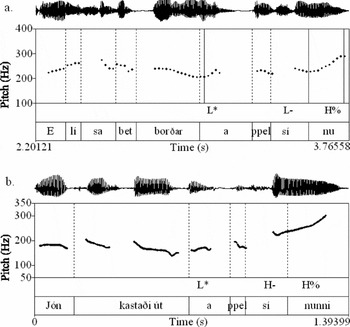
Recall (from section 1) that the regular stress pattern in Icelandic is Swsw. For example, the noun appelsína ‘orange’ has primary stress on the first syllable a-, and secondary stress on the third syllable, -sí-. The contour in figure 8a is repeated from figure 4 above, where the pitch accent was analysed as L* due to the timing of the pitch movement after the starred tone on the stressed syllable. After the low starred tone, there is another low tonal target on the secondary stressed syllable, -si-, which stretches to the beginning of the final syllable, where we observe a pitch rise towards a high boundary tone. This low target on -sí- can be analysed as an L- phrase accent. In figure 8b, on the other hand, the tonal target on the secondarily stressed syllable is a high one. Without the assumption of a phrase accent, the two contours in figure 8 would both be described as terminating in an L*H% sequence associated with appelsínu/appelsínunni. This would ignore the difference between the two contours which lies in the tonal target on the secondarily stressed syllable, -sí-. In other words, the phrase accent controls the F0 between the last pitch accent (L* in both contours) and the end of the IP (marked H% in both cases), such that there is a low tonal target in figure 8a, but a high tonal target in figure 8b. This tonal target associates to the syllable that carries secondary stress. The phrase accent thus captures the difference between the two contours.Footnote 7
Phrase accent. Panel a: Elísabet borðar appelsínu ‘Elísabet eats an apple’ (second part of a listing consisting of three parts); speaker S101, female; panel b: Jón kastaði út appelsínunni ‘Jón threw out the oranges’; speaker S207, female.

Similarly, the H* pitch accent can be argued to occur in combination with a high phrase accent (H-). As discussed in section 3.1 above, the object noun appelsínu in (19) carries an H* pitch accent. H* is followed by another high tonal target on the secondarily stressed syllable, -sí-, which stretches to the beginning of the final syllable, -nu and is followed by a fall towards the low boundary tone. This high target can be analysed as an H- phrase accent.Footnote 8
(19)
Looking at these data, the question presents itself whether we need bitonal pitch accents at all, or whether, for example, a H*L pitch accent would best be analysed as a H*L-(L%) sequence, to be distinguished from the H*H-L% sequence in (19) by the tonal target between starred syllable and domain edge. However, such an analysis would not be able to account for the timing difference in pitch movement after the starred tone. While a trailing tone must be completed at the end of the syllable immediately following the stressed one, the tonal target captured by the phrase accent is on the secondarily stressed syllable, which can never be adjacent to the primarily stressed one.
Future research will have to look more systematically at compounds and polysyllabic words in positions which would suggest the occurrence of a phrase accent, in order to see how phrase accents pattern, and if and how they are related to differences in interpretation. At this stage in the research, it seems that tonal contours in Icelandic utterances may be adequately described in a model that (i) makes a distinction between monotonal and bitonal pitch accents, (ii) includes the phrase accent T- (specified as H- and L-) associated with secondarily stressed syllables, and (iii) has final boundary tones (H% and L%).
3.5 Downstep and upstep
3.5.1 Downstep
As observed above, the most typical pattern in neutral declaratives is a downstepped sequence of H*L pitch accents, followed by a low boundary tone. In a downstepped sequence of tones, later pitch peaks are lower than preceding ones. According to Beckman & Pierrehumbert (Reference Beckman and Pierrehumbert1986), all bitonal accents trigger downstep of subsequent material.
For Icelandic, it has previously been argued that it has downstep such that in sentences with sequences of HL tones, later H peaks are lower than preceding ones (Árnason Reference Árnason and Werner1998, Dehé Reference Dehé, Bruce and Horne2006; see (20a–c) and also (15) and figure 3 above). Árnason (Reference Árnason and Werner1998:61) further notes that downstep is not limited to HL tones but may also occur in sequences of LH tones as they appear in what he calls ‘closed’ counts, illustrated in (20d), taken from his work.
(20)
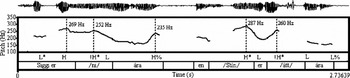
The data under investigation here illustrate that downstep also occurs in mixed sequences of LH and HL tones. In the example plotted in figure 9 (from the story Siggi og Stína), this is illustrated for an utterance-initial L*H H*L sequence, a frequent pattern in Icelandic. The relevant pitch peaks are marked by dashed vertical lines and corresponding Hertz values. The trailing tone of the initial L*H accent is higher than the peak of the following H*L accent, which in turn is higher than the high continuation-indicating boundary tone. Downstep of H* on níu also serves the function of setting the prominent (starred) material off from the preceding non-prominent material (i.e. from the H trailing tone).Footnote 9 The sequence of two H*L accents in the second part of the utterance also exhibits downstep.
Downstep: Siggi er níu ára en Stína er áttu ára ‘Siggi is nine years old and Stína is eight years old’; speaker S301, female.

The same example also suggests the Intonational Phrase as the domain for downstep. Within one IP, later pitch peaks are downstepped as compared to earlier ones, while an IP boundary triggers pitch reset. The IP boundary separating ára and en is indicated by the high boundary tone and a structure-related pause of 254 ms. Within the first IP, the peak on níu is downstepped relative to the preceding trailing tone, but it is in turn higher than the boundary tone terminating this IP. The beginning of the new IP is marked by pitch reset (see the peak on the first syllable of Stína), and downstep can again be observed in this domain. Similarly, in the contour in figure 2b (example (14b)) above, the two parts of the utterance (Siggi heitir auðvitað Sigurður and en Stína heitir Kristín, respectively) are separated by an IP boundary, indicated by the H% boundary tone at the end of the first part and a pause of 240 ms. Within the first part, the second pitch peak on the first syllable of Sigurður is downstepped relative to the first peak on Siggi. After the boundary, a pitch reset can be observed. The first peak on Stína is about as high as the peak on Siggi. The peak on Kristín is then downstepped, i.e. lower than the previous peak. Icelandic thus patterns with a number of related and unrelated languages, among them English and Dutch (see Gussenhoven Reference Gussenhoven2004 and references there) and Chicheŵa (Kanerva Reference Kanerva, Inkelas and Zec1990), in that reset typically occurs at IP boundaries.
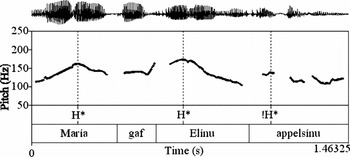
Given that focus is marked by pitch accents, it comes as no surprise that cases with narrow focus in mid- or end-position are exempted from downstep. An example for focus in mid-position is given in figure 10. The sentence was produced with narrow focus on the indirect object Elínu, which is marked by a nuclear H*L pitch accent. The subject is marked by the same accent type. The direct object appelsínu, which is assigned a separate intermediate phrase indicated by the glottal stop separating the two objects, also bears an audible H*L pitch accent. The final peak is downstepped relative to the preceding ones, but downstep is interrupted by the peak on the focused constituent. (Note that here, as in figure 7 above, given information fails to be deaccented. Both the subject and the post-nuclear indirect object are accented, while the focused object is most prominent.) The vertical lines in figure 10 mark the pitch peaks of the H*L pitch accents.
Downstep interrupted due to mid-focus position: María gaf [Elínu]Focappelsínu ‘María gave Elín an orange’; speaker S202, male (only pitch peaks are given).

Similarly, it has been shown for Icelandic that in cases of final focus, downstep typically excludes the final pitch accent (Dehé Reference Dehé, Bruce and Horne2006). This is in line with what has been observed for other languages, where downstep may exclude the (final) nuclear pitch accent. For German, Grice & Baumann (Reference Grice and Baumann2002:279) note that reset usually takes place at a phrase boundary, but can also occur within a phrase, typically immediately before the nucleus. More precisely, after a sequence of downstepped tones the peak on the nuclear syllable is higher than previous peaks (see also Ladd Reference Ladd1983 and Gussenhoven Reference Gussenhoven1984 for English and Dutch). Also for German, Féry (Reference Féry1993) argues that a later H tone which is at the same or a higher level than a preceding one is perceived as the focus. For English also, a final focused element has been found to have higher pitch than preceding downstepped peaks (Beckman & Pierrehumbert Reference Beckman and Pierrehumbert1986:298–299).
3.5.2 Upstep
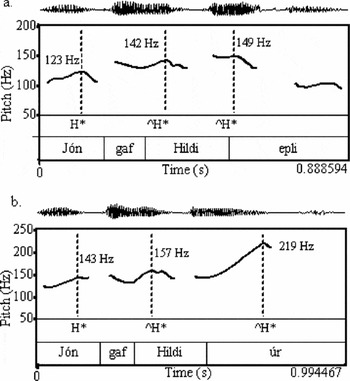
Based on the evidence from the data studied here, I suggest that along with downstep, there is also upstep in Icelandic, such that later pitch peaks in tone sequences are higher than preceding ones. This is reminiscent of what has been observed for German (e.g. Grice & Baumann Reference Grice and Baumann2002). Upstep is not to be confused with the absence of downstep in cases of final focus as just described. Rather, there are examples of continuous upstep, i.e. the second peak is higher than the first, and the third peak is higher than the second. This is illustrated in figure 11. Figure 11a is a case of narrow focus on the final constituent, i.e. the direct object epli, marked by an H*L pitch accent. (As above, only the F0 peaks are indicated in the figure.) The first peak (on Jón) is lower than the peak on the first syllable of Hildi, which in turn is lower than the third peak on the first syllable of focused epli. The annotation follows the German ToBI system (GToBI, e.g. Grice & Baumann Reference Grice and Baumann2002), which makes use of the diacritic ^ to mark upstep. The contour in figure 11b serves as an example of upstep in neutral declaratives. Pitch peaks rise towards the final peak on úr.
Upstep: Jón gaf Hildi epli/úr ‘Jón gave Hildi an apple/a watch’. Panel a: narrow focus on epli; panel b: neutral declarative; speaker S212, male.

In the data studied here, all cases of upstep occur either with final focus, as in figure 11a, or with neutral declaratives, as in figure 11b. The two cases have in common that the main prominence is sentence-final, either due to final focus, or due to the sentence stress rule which holds that under neutral focus, the rightmost constituent is the most prominent one (see (5) above). This suggests that upstep may span an Intonational Phrase, but that the last in a sequence of upstepped peaks is always the most prominent one.
3.6 Question intonation
In the present data, there is much variation regarding question intonation, which can only be briefly sketched here and will have to be further analysed in future work. One thing that clearly follows from the data is that the same pitch accents that we find in declaratives are also used in questions. Two examples for L*H in yes/no-questions were given in (9) in the introduction. According to Árnason (Reference Árnason and Werner1998:56), L*H in yes/no-questions combines with L% in a ‘matter of fact’ question, while together with H% it yields ‘friendly suggestions [calling for] an immediate reply’. For the purpose of the discussion in this section, question data were drawn both from the story Siggi og Stína and from the two reading studies.
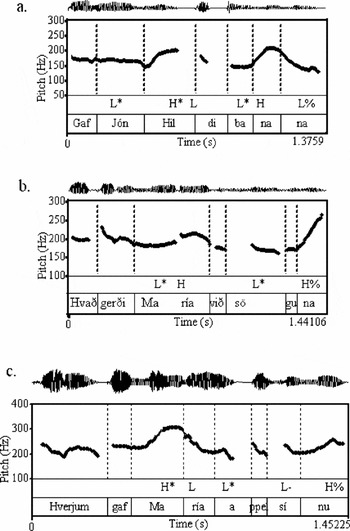
As in neutral declaratives, main prominence in neutral questions is final. In the data under investigation, patterns for yes/no-questions and wh-questions were identical. The preferred nuclear question contour is H*L L%. However, various combinations of pre-nuclear and nuclear pitch accents and edge tones can be found. Some attested examples are given in (21) for yes/no-questions, and in (22) for wh-questions; see also figure 12.
Selected patterns in yes/no-questions (panel a) and wh-questions (panels b and c). Panel a (= (21b)): pre-nuclear H*L, nuclear L*H L% (Gaf Jón Hildi banana? ‘Did Jón give Hildi a banana?’); speaker S209, female; panel b (= (22e)): pre-nuclear L*H, nuclear L* H% (Hvað gerði María við söguna? ‘What did María do with the story?’); speaker S205, female; panel c (= (22d)): pre-nuclear H*L, nuclear L*L-H% (Hverjum gaf María appelsínu? ‘To whom did María give an orange?’); speaker S204, female.

Unlike in declaratives, pitch peaks in questions are not usually downstepped. Instead, later pitch peaks are equally high or higher than earlier ones, regardless of whether they are trailing tones in a nuclear L*H or the starred tone in nuclear H*L. Having said that later peaks may be higher than earlier ones, this does not imply that we find upstep across IPs along the lines of figure 11.
The following examples provide an overview of the most frequent patterns observed in the data. (21) exemplifies yes/no-questions. (21a) is a sequence of (non-downstepped) pre-nuclear H*L accents followed by nuclear H*L L%. In (21b) (see also figure 12a), a pre-nuclear H*L accent is followed by nuclear L*H L%, a frequently found pattern. Both nuclear H*L and nuclear L*H may also be combined with H% (see (21c) and (21d), respectively). (22) illustrates a number of attested options in wh-questions. Comparing the frequently-used pitch accent sequences in neutral declaratives given in (15) above with (21) and (22), it may be noted that in neutral declaratives, L*(H) pitch accents tend to precede H*(L) pitch accents, while in questions, L*(H) tends to follow H*(L). Monotonal pitch accents are found in both pre-nuclear and nuclear position in questions; see, for example, figures 12b and 12c for nuclear L*.
The plotted pitch tracks in figure 12 also show the absence of downstep in questions. Undoubtedly, there is a lot of variation in the intonation of Icelandic questions. Future research will have to show how the various contours relate to meaning.
(21)
(22)
4. DISCUSSION AND OUTLOOK
From the analysis of the Icelandic tone inventory, the following conclusions can be drawn.
Along with the two bitonal pitch accents previously described by Árnason (Reference Árnason and Werner1998), Icelandic has the two monotonal pitch accents H* and L*. The difference lies in the timing of the pitch movement after the starred tone. In bitonal pitch accents, it is immediately followed by a trailing tone, specifically a rise after L* and a fall after H*, which is completed on the stressed or on the immediately adjacent syllable. While bitonal pitch accents are more frequent than monotonal ones, all pitch accent types occur across sentence types (neutral declaratives, declaratives with narrow focus, and questions) in pre-nuclear and nuclear position. This makes it difficult at this stage to establish a difference in intonational meaning.
Pitch accents are downstepped across declarative utterances, but usually not across interrogative utterances. As shown in section 3.5.1, the domain of downstep is the Intonational Phrase. Pitch accents marking narrow focus are exempted from downstep. Towards a final prominence, either due to neutral sentence stress or final focus, pitch peaks may also be upstepped across an Intonational Phrase.
Differences between Icelandic tunes can only be fully captured if the model includes a phrase accent T-, specified as L- or H-, between final pitch accent and boundary tone. Docking sites for Icelandic phrase accents are syllables bearing secondary stress. In the present data, these are secondarily stressed syllables in polysyllabic words. Phrase accents have been identified at the end of Intonational Phrases, before final boundary tones. Future research on Icelandic prosodic phrasing will show whether Icelandic phrase accents can also be found to mark the end of an Intermediate Phrase followed by another Intermediate Phrase in the same Intonational Phrase.
Another important finding is the behaviour of L*(H) accents in neutral declaratives and utterances with narrow focus (see section 3.2). While L*H in neutral declaratives triggers downstep and is typically followed by one or more H*L pitch accents including the nuclear one, L*H marking narrow focus is often followed by a high plateau in the pitch contour on post-nuclear material, reaching a high boundary tone, or staying high until a final fall towards a low boundary tone. The difference in the contours is thus related to a difference in interpretation such that the sustained high pitch level, along with the pitch accent, marks the pre-final narrow focus.
Looking at the sequences of pitch accents and edge tones discussed in this study, it is striking that sequences in which all tones have identical specification (e.g. L*L-L%) are not attested. Future research will have to show whether this is the result of the Obligatory Contour Principle (OCP; Leben Reference Leben1973, McCarthy Reference McCarthy1986) at work, which in intonational phonology militates against sequences of identical tones. It is well known that, generally speaking, the OCP is relevant to intonational phonology. Bengali, for instance, is known to strictly follow the OCP (Hayes & Lahiri Reference Hayes and Lahiri1991). In other languages, OCP violation is inevitable and thus occurs frequently. In the present data, at least one other phenomenon has been described which seems to obey the OCP: the downstepped H*L pitch accent after a high trailing tone (see the discussion of figure 9 in section 3.5.1 above). However, the following observations go against the assumption that the OCP is obligatorily obeyed. Firstly, T*T- sequences with identical specification seem to be allowed. In particular, L*L- is illustrated in figure 8a, followed by H%. Secondly, the trailing tone of a bitonal pitch accent may be identical to a following edge tone (e.g. figure 6a). Thirdly, T- T% sequences seem to be allowed with identical specification (e.g. H- H%, see figure 8b, but also note 7). Thus, the OCP is not strictly followed. Still, nuclear sequences in which all tones are identical are as yet unattested in Icelandic.
In Icelandic questions, speakers seem to have a choice between several available patterns. Future research on question intonation will have to show how meaning relates to intonation, not only regarding boundary tones (as discussed by Árnason Reference Árnason and Werner1998), but also the choice of pitch accents and combinations of pitch accents and edge tones.
Finally, a word is due on the nature of the data and the conclusions drawn for the tonal inventory of Icelandic. First, except for the focus contexts established in the experimental data, no discourse context was given in the data for the speakers to exploit. As a result, conclusions cannot be drawn as to intonational meaning other than the given/new distinction, or to speaker attitude or emotion. This is an obvious drawback related to the kind of data used here. In future research, a closer look is due at natural spoken language. It remains to be seen, for example, whether the phonetic distinction between monotonal and bitonal pitch accents is reflected in intonational meaning. Second, not only the material but also the actual task may be a downside in this respect. The reading task surely biased the speakers against a more natural way of producing utterances, despite the instructions, asking speakers to produce utterances in as natural a way as possible. Again, future studies will have to use more natural data, as elicited, for example, in different kinds of experimental tasks.
Despite this hedge, the present analysis has shed new light on Icelandic intonational phonology. Naturally, it also raises a number of interesting questions which will have to be addressed in future research on the topic. In particular, this concerns phonological contrasts between accent types identified on the basis of phonetic evidence alone. While the nature of the data investigated here does not reveal meaning-related differences, for example, between monotonal and bitonal pitch accents, insights in this respect will be gained from studies which systematically manipulate their target items with regard to shades of meaning beyond focus. What the present study does show is that all four pitch accent types are used to mark narrow focus.
Another important research question is that of the exact alignment and timing of tonal targets and their respective function. This concerns the timing of trailing tones used here to establish the phonetic difference between monotonal and bitonal pitch accents, but also the timing of starred tones and tonal targets preceding them. In particular, given that the timing of H* is fairly late in contours such as those plotted, for example, in figure 1 (see the peak on sö-), figure 2 (see the peaks on Si- and Stí-), and figure 3 (see the peak on Ma-), the question arises whether evidence can be found for a leading tone (e.g. L leading tone for H*). This would possibly result in an addition to the tonal inventory established here. Also, like elsewhere in intonation languages, the timing might be subject to various factors such as syllable type/structure, proximity and type of following prosodic boundaries, pre-nuclear vs. nuclear pitch accents, and intonational meaning.
Overall, while the paper provides new insights into the tonal grammar of Icelandic, a lot of research still needs to be done.
ACKNOWLEDGEMENTS
I would like to thank the following people who contributed in various ways and at various stages to the work presented here: Kristján Árnason, Thorhallur Eythorsson, Ragnheiður Guðmundsdottir, Carlos Gussenhoven, Jill House, Gunnar Hrafn Hrafnbjargarson, Jóhannes G. Jónsson, Aditi Lahiri, Tomas Riad, Moira Yip, and three anonymous reviewers for the Nordic Journal of Linguistics. Earlier versions of this paper were given in Konstanz in December 2006, and at the DGfS Annual Meeting in Siegen in February 2007. I wish to thank the audiences there for valuable feedback. I am particularly grateful to Aditi Lahiri and Frans Plank for giving me the opportunity to spend the winter term 2006/07 in Konstanz, where this paper was finally written up. The work presented here was in part supported by DFG individual research grant DE 876/1 to the author.