


Before the American Revolution, the governments of each British mainland colony issued ‘bills of credit’, a nascent paper currency which was issued in small denominations and designed to pass from hand to hand in everyday transactions. Colonial governments frequently made them a legal tender in private transactions as well as for payments to the issuer. What determined the value of colonial bills of credit has been hotly disputed since colonial times. In the Middle colonies, large increases in the quantities outstanding during the French and Indian War and large decreases afterwards had a negligible effect on their value, as measured by exchange rates, specie prices, or commodity price indices (Ernst Reference Ernst1973, pp. 8–9; West Reference West1978). In New England, however, steadily expanding supplies of bills of credit depreciated their value as a quantity theorist would predict (West Reference West1978; Smith Reference Smith1985a, p. 544; Officer Reference Officer2005). The challenge has been to explain the bills' stable values in the Middle colonies during and after the French and Indian War and to simultaneously explain why New England's experience was so different. In searching for an explanation, many economists have sought an answer in an institutional detail that distinguishes colonial bills of credit from modern fiat money: when colonial governments issued bills of credit, the legislation creating them included provisions for redeeming them at a future date.
Colonies often issued currency to pay current expenses, particularly during colonial wars, and treated currency issued this way as tax anticipation scrip (Ferguson Reference Ferguson1961, pp. 3–24). The same Act that issued the currency also levied taxes for calling it into the treasury over a period of years. Bills of credit created in this way were said to have been emitted on ‘tax funds’. The redemption provisions are best illustrated with a concrete example. In November 1734, for example, the colony of New York issued £12,000 ‘to fortify this Colony & make it Defencible against any attacks’. New York earmarked two taxes to redeem the bills over a ten-year period and instructed the colony's treasurer to take the revenue raised by those taxes and ‘on Every first Tuesday in the Month of October … in the presence of the Said Signers [of the bills] … to Sink cancel & Distroy a Like Value of the Said Bills of Credit’. The bills were to remain current until 25 March 1746 (NY Laws, vol. 2, c. 625; DRCHNY, vol. 6, p. 38).
Colonies also issued currency by creating land banks that printed bills of credit and lent them on the real or personal security of colonists. Repayment of the loan created a fund earmarked for redeeming the bills, making them a sort of repayment anticipation scrip (Schweitzer Reference Schweitzer1987, pp. 127–30). Bills of credit created in this way were said to have been emitted on ‘loan funds’. New York, for example, established a land bank in December 1737 to lend £40,000 to its inhabitants for 12 years at 5 percent interest. The Act required loan officers to inspect real estate offered for mortgage and ‘make due Enquiry into the Value thereof and … examine the Titles thereto’, to obtain security for all loans ‘of at Least Double the value in Lands Tenements and hereditaments & of at Least three times the Value in houses’, and to foreclose on borrowers in default. Borrowers had to pay the interest on the loan ‘yearly on the third Tuesday of April’ and repay the principal in four equal installments on the third Tuesday in April of 1747, 1748, 1749 and 1750. The Act required that bills be retired and destroyed as the principal was repaid and, as additional security, provided for a tax on any county whose loan repayments fell short of what was necessary to retire its share of the bills (NY Laws, vol. 2, c. 666).
This article argues that such redemption provisions were not what secured the value of bills of credit in the Middle colonies. Had redemption provisions been the key, the Middle colonies and New England should have had similar experiences, because the same redemption provisions existed in both regions. That redemption provisions were scrupulously honored in the Middle colonies but not in New England, which has been the common explanation for why New England's bills depreciated and those of the Middle colonies did not, is shown to be factually inaccurate. This article focuses principally on colonial New York, a colony redemption theorists generally neglect, and investigates how its administration compared to that in Massachusetts and other New England colonies.Footnote 1
I
Smith (Reference Smith1985a, Reference Smith1985b), Wicker (Reference Wicker1985), Calomiris (Reference Calomiris1988), Sumner (Reference Sumner1993), Grubb (Reference Grubb2012, Reference Grubb2014, Reference Grubb2015) and, more tenuously, Rousseau (Reference Rousseau2007) all believe that these redemption provisions explain the curiously negligible wartime inflation in the Middle colonies. All believe that linking redemption provisions to money creation influenced expectations – about future inflation, the future asset position of the colonial government, or the future value of the currency – and that this change in expectations forestalled any depreciation. These authors, however, differ on the precise manner in which expectations mattered.
Smith, Wicker and Rousseau point to theoretical models by Sargent and Smith (Reference Sargent and Smith1987) and Wallace (Reference Wallace1981) that link the net asset position of the issuing government to the value of money. ‘Just as the value of privately issued liabilities depends on the issuers’ balance sheet,’ writes Smith (1987b, p. 1187), ‘the same is true for government liabilities. Thus issues of money which are accompanied by increases in the (expected) discounted present value of the government's revenues need not be inflationary.’ Proponents of this view believe bills of credit retained their value because their creation had little effect on the perceived net asset position of colonial governments; the anticipated future revenues implied by the redemption provisions offset the obligation inherent in the bills themselves.Footnote 2
Calomiris (Reference Calomiris1988) and Grubb (Reference Grubb2012, Reference Grubb2014, Reference Grubb2015) also believe redemption provisions forestalled depreciation, but they propose a different mechanism. Because provincial taxes could generally be paid in bills of credit or in specie, they believe the terms on which bills and specie could be substituted at the treasury anchored the value of bills of credit when redeemed. For example, if the taxes redeeming an emission could be paid with four Spanish dollars in lieu of a pound in bills of credit, it anchored the future value to ‘one pound = 4 Spanish dollars’. Before the bills were redeemed, agents knew how the bills would be valued at redemption and valued them as discount bonds. That such provisions would suffice to anchor the value of currency, as Calomiris and Grubb contend, is doubtful. In the United States today both government-issued bullion coins and Federal Reserve notes are legal tender. Anyone may pay their taxes in silver at the rate of ‘one dollar = one silver eagle’. Because an ounce of silver is worth nearly 15 dollars, no sensible person would multiply his or her tax liability 15-fold by paying in silver eagles. The rate at which silver eagles can be substituted for Federal Reserve notes in tax payments does not anchor the value of Federal Reserve notes. Only a tax burden so large as to force some use of silver would guarantee that paper money could not be less valuable than the silver equivalent decreed by the tax authority, and in colonial times annual provincial taxes were a small fraction of the outstanding stock of paper money.
Should Calomiris and Grubb be correct in emphasizing the importance of how the bills were paid and received by colonial treasurers, the mystery would remain unresolved. Colonial statutes creating bills of credit often did not specify the terms on which bills of credit could be substituted for specie at the public treasury. New York and Pennsylvania, prime examples of Middle colonies whose bills held their value, enacted especially vague provisions. Pennsylvania's emissions between 1724 and 1764 were accepted in taxes as ‘current money’. New York's bills issued before 1724 were accepted ‘for any fund in the treasury’. New York's statutes emitting bills between 1724 and the beginning of the Revolution did not even contain this vague assurance. Grubb (Reference Grubb2012, appendix 1) concluded each emission was accepted at New York's treasury as ‘itself (?)’. New Jersey explicitly printed the specie value at which its bills were to circulate on the bills themselves, but not even New Jersey's treasury paid and received them at that value (Newman Reference Newman2008, pp. 249–58; McCusker Reference Mccusker1978, p. 169; Stevens Reference Stevens1867, pp. 151–2; NY Laws, vol. 5, c. 1654; Hutchins Reference Hutchins1774, p. 50; NJ Minutes, vol. 3, pp. 188, 197, 273; NJ Laws, p. 13). If the anticipated value at which the colonial treasury would accept bills in lieu of specie anchored the value of the bills, what anchored the anchor?
Sumner (Reference Sumner1993) took a different approach by examining the effect redemption provisions could have on expected inflation. If a colony doubled the money supply in one year, while simultaneously making a credible pledge to halve it the following year, the price level would rise in the first year but would not double. The expected deflation implied by the impending return to the old price level would increase the quantity of real balances demanded, preventing the doubling of the price level predicted by a primitive quantity-theory model. Sumner posits, in essence, that the price level in the Middle colonies was stable during the French and Indian War because residents, expecting a sizable postwar deflation, willingly increased their money holdings nearly fourfold in New York and more than fivefold in Pennsylvania. Smith (Reference Smith1985a, p. 562; 1985b, pp. 1192–3) anticipated this explanation and sensibly dismissed it as empirically implausible: ‘If colonists expected monetary reductions to produce significant deflation, they were badly disappointed.’ More could be written on this topic, but for brevity I shall simply set Sumner's theory aside for the reasons Smith did.
The argument which follows is based largely on historical and literary evidence, and some will question the use of qualitative evidence to address a literature that is essentially quantitative. Unfortunately, the quantitative literature on this subject rests on a weak foundation. Reliable data on such key variables as the money supply, prices, interest rates and income are unavailable; practitioners use whatever data are at hand. The best available tool to lay bare the shortcomings of the quantitative literature is qualitative evidence. For example, the quantitative literature often treats the quantity of bills of credit issued by a colony as if it measured that colony's money supply. Significant but highly variable quantities of gold and silver circulated alongside bills of credit in the Middle colonies. In Pennsylvania in the late 1740s, literary evidence suggests that for each pound of Pennsylvania bills of credit in circulation there were five pounds in specie (Michener and Wright Reference Michener and Wright2006a, pp. 14–20 and appendix 1; Michener Reference Michener2011). Neglecting specie is analogous to using Federal Reserve notes as a proxy for the modern money supply, neglecting other forms of high-powered money and deposits.
A second complication further limits the usefulness of colonial money supply data. The bills of credit issued by a colony can't be equated to the bills of credit circulating within a colony, because the bills of one colony often circulated freely within neighboring colonies. In the Middle colonies, Pennsylvania bills of credit circulated in New Jersey and Maryland; New York bills of credit circulated in New Jersey; and New Jersey bills of credit circulated in both New York and Pennsylvania. This was not an inconsequential phenomenon, akin to getting a Canadian penny in change. In 1731, New Jersey's colonial agent wrote that so much of New Jersey's currency was circulating in New York and Pennsylvania that scarcely a third of it remained in the province (Michener and Wright Reference Michener and Wright2006a, appendix 2). Neglecting both specie and cross-colony circulation of bills is analogous to using the quantity of Federal Reserve notes issued bearing the C3 designation under the left serial number – a mark signifying the bill was issued by the Philadelphia district bank – as a proxy for modern Pennsylvania's money supply.
Income is another challenging key variable that is poorly measured. It took Alice Hanson Jones (Reference Jones1980) a lifetime to produce an estimate of per capita income and wealth in the American colonies for a single year, 1774, and even that estimate has been questioned because it is derived from probate records (McCusker and Menard Reference Mccusker and Menard1985, pp. 262–5). The quantitative literature has sometimes dealt with the absence of income data by asserting that because technological change was slow one can reasonably abstract from changes in per capita income (e.g. Smith Reference Smith1985a, p. 561). The qualitative literature, however, suggests that fluctuations in the terms of trade for export staples and fluctuations in miscellaneous foreign exchange earnings, from sources such as British military spending and privateering, led to sizable short-run fluctuations in per capita income (NYAJ 18 Oct. 1764; Hemphill Reference Hemphill1985; Gottfried Reference Gottfried1936).
The quantitative literature has been driven to use dubious proxies for income. Rousseau (Reference Rousseau2007) believes the growth of Pennsylvania's economy helps explain the colony's monetary history, and he employs sophisticated econometric techniques using exports from Pennsylvania to England as a proxy for Pennsylvania's real income to make his point. The connection between Pennsylvania's income and its exports to England is questionable. Pennsylvania's export staples consisted of wheat and flour, products the colony sold chiefly to the West Indies and southern Europe. Hardly any of Pennsylvania's export trade was directed to England. Between 1768 and 1772, Great Britain purchased only about 4 percent of the grain products exported by the Middle colonies, and Pennsylvania routinely imported five to thirty times as much from England as the colony exported to England (Carter et al., series Eg 432, Eg. 439, pp. 5–710, 5–711; McCusker and Menard Reference Mccusker and Menard1985, pp. 194–9). Great Britain's Corn Laws imposed duties on the importation of wheat and wheat products that effectively prohibited imports in all but the times of greatest scarcity, during which Parliament would sometimes waive the duties entirely (Smith Reference Smith1776, vol. 1, p. 536; Statutes, 5 Geo. III c. 31). In a later paper, Rousseau and his coauthor (Rousseau and Stroup Reference Rousseau and Stroup2011, p. 606, fn. 18) argue against using data on colonial exports to England as an income proxy. Exports to England, they note, were heavily influenced by trade restrictions, and the data are contaminated by re-exports from the Caribbean and other colonies. Rousseau and Stroup (Reference Rousseau and Stroup2011) instead use England's exports to New England as a proxy for New England's income. These data are also unsatisfactory. As McCusker and Menard (1985, p. 282) note, ‘New England had from an early period acted as a transshipper of British imports.’ In addition, the colonies' limited ability to make returns for the goods they imported was what chiefly constrained colonial imports. Privateering, the flag of truce trade and British military expenditures on the continent all provided foreign exchange that made wartime financing of imports easier. Because colonial governments issued bills of credit to finance wartime expenditures, spurious correlations between imports and the money supply are likely. Quantitative techniques applied to the fragmentary data at hand without due regard for the limitations of those data are of doubtful value.
Better data, however desirable, will require the work of generations of scholars. Existing data establish that wartime currency finance in the Middle colonies during the French and Indian War did not dramatically and unmistakably destroy the value of bills of credit as wartime currency finance in New England during King George's War did. However, the data aren't adequate to establish much else. Qualitative history is the correct tool, because for the foreseeable future it is the best tool available.
II
The New England colonies issued their bills of credit in the same fashion the Middle colonies did, with essentially identical redemption provisions. If redemption provisions successfully forestalled depreciation in the Middle colonies, why did they fail in New England? Wicker, Rousseau and Grubb avoid the question by limiting their investigations to Middle colonies. Only Smith truly grapples with the question. Smith (Reference Smith1985a, p. 549) recognizes that ‘the monetary arrangements across colonies did not vary in any way crucial to our argument’. He argues that the redemption provisions failed to stabilize the value of New England bills because the New England colonies did not administer their tax and loan funds as scrupulously as the Middle colonies did. Calomiris (Reference Calomiris1988, p. 58) endorses Smith's explanation without adding to it. Officer (Reference Officer2005, p. 103), apparently based on his reading of Smith, writes that in New England ‘legislatures stopped imposing sufficient taxes to retire the outstanding paper on a steady schedule, and private borrowers likewise ceased paying the interest and repaying the principal on their outstanding loans', although this overstates what Smith asserted to be true.
Smith's investigation of New England's deficiencies in administration draws largely on a paper by Thayer (Reference Thayer1953) that praises the Middle colonies for having administered their land banks more successfully than other colonies did. Both Smith and Thayer, however, frequently resort to arguing that colonial currency depreciated because of poor administration, and that poor administration can be inferred whenever colonial currency depreciated. When Smith (Reference Smith1985a, pp. 550–1) quotes Thayer saying ‘One suspects … that in New England and the Carolinas … [loans] were made with very inadequate security’ and ‘One can be quite certain … that land outside of the middle colonies was not a very good security for any money …’, he is repeating passages that rest chiefly on the fact that Middle colony bills held their value better than those issued in New England. If redemption provisions are the reason why, and the redemption theory is more than a tautology, administration of tax and loan funds must have differed between the New England and Middle colonies in some tangible way.
III
Among the colonies that suffered depreciating currencies, Massachusetts' prominence and its well-preserved historical record have made it the premier example, and Thayer and Smith take Massachusetts to task on several counts. Thayer (Reference Thayer1953, p. 157) and Smith (Reference Smith1985a, p. 550) criticize Massachusetts' early land banks for lacking any provision for annual principal payments, so that when it came time to repay the loan, many borrowers were unable to do so. They also fault Massachusetts because instead of immediately foreclosing, it often extended the term of the loans to give borrowers more time, which meant that decades passed before some loans were repaid.
Tax and loan administration in New York and New Jersey receive scant attention from Thayer and none at all from Smith (Reference Smith1985a, p. 551), who observed that New Jersey and New York's bills of credit retained their value and inferred that both colonies managed their tax and loan funds well. New York, however, ran its loan office on the same principles that led Thayer and Smith to indict Massachusetts.
New York's land bank, established in 1737, also did not require borrowers to make annual principal payments on their loans. Originally, New York scheduled the repayment of the principal for 1747–50, but in December 1743 the repayment of the principal was put off until 1751–4 (NY Laws, vol. 2, c. 666; vol. 3 c. 745). In 1750, the assembly put it off again, this time until 1757–60 (NY Laws, vol. 3, c. 897). Beginning in 1756, the colony repeatedly used annual legislation to delay repayment of the principal by one year; the last such measure passed on 13 December 1763 and pushed back the repayment of principal until the years 1765–8 (NY Laws, vol. 4, c. 1036; c. 1055; c. 1074; c. 1133; c. 1158; c. 1190; c. 1214). The colony deferred repayment, Governor Hardy (DRCHNY, vol. 7, p. 204) explained, because it needed the revenue that the annual interest payments provided (NB New York did not use interest payments to redeem outstanding bills) and because the borrowers ‘would have been greatly distressed’ if required to repay their loans at the appointed time. New York would have continued to delay repayment of the principal had Parliament not passed the Currency Act of 1764, which prohibited extending the term of existing emissions. An advertisement appeared in the New York press in January 1765 warning that a fourth of the principal would be due in April and the remaining three-fourths in the three succeeding years. Borrowers were warned that it would ‘not be in the Power of the Loan Officers to shew any Lenity or Favour’ (New York Gazette and Weekly Post-boy, 10 Jan. 1765). Repaying those longstanding loans during the postwar depression proved difficult. When New York contemplated a new loan office in 1769, Lieutenant Governor Colden recommended that a tenth of the principal be paid in each year because ‘some of the Borrowers on the former Emission, suffer'd by their imprudence and had their Estates sold in Execution greatly under value’ (DRCHNY, vol. 8, pp. 189–90). As this is indistinguishable from what happened in Massachusetts, how can one condemn Massachusetts and not New York?
Thayer and Smith also believe that land in Massachusetts, unlike land in Pennsylvania and other Middle colonies, was of too little value to adequately secure loans. The argument that Massachusetts land was especially poor security, however, is mistaken. Thayer had observed that a particular Massachusetts loan office had not lent all of its funds; Smith (Reference Smith1985a, p. 551) seized on this as evidence that there was little demand for land in Massachusetts. Smith's reasoning seems backwards: if a borrower could get a loan from a Massachusetts land bank by offering unwanted land as collateral, it would increase the demand for such loans rather than lower it. In fact, the Massachusetts loan office had money in its possession because the term of the loan was up, and it was drawing in loans.Footnote 3 Nor was land an underperforming asset in colonial New England. Jonathan Belcher, Governor of Massachusetts, discussed New England land prices in a private letter: ‘Fine lands … will certainly go on to rise in value, as they have hitherto, while money at interest constantly sinks, and comes almost to nothing.’Footnote 4 When Belcher made these remarks in 1737, Massachusetts currency had already depreciated to less than a third of its value 25 years earlier and was still depreciating (Carter et al., series Eg315, p. 5–698).
Thayer (Reference Thayer1953, pp. 153–4) and Smith (Reference Smith1985a, p. 551) support their view that Pennsylvania land provided better security by reviewing Pennsylvania loan office foreclosures in 1762, which reveal that each piece of foreclosed property sold for more (and sometimes much more) than was required to repay the loan office. Thayer and Smith conclude, based on this one year's data, that Pennsylvania administrators scrupulously secured loans. In 1762, however, the Middle colonies were experiencing an unprecedented real estate boom. Ben Franklin returned from six years in England in November 1762 and was surprised by the appreciation that had occurred in his absence: ‘Rent of old Houses, and Value of Lands' had trebled in the last six years, he wrote, ‘in great measure owing to the enormous Plenty of Money among us.’Footnote 5 During the postwar depression, land prices slumped once again. In 1769, William Allen complained of the insolvency of Pennsylvania's debtors: ‘If we sell the estates of such as have any, there appear to be few or no buyers; and if they are sold, it is often at a third of what used to be thought the value.’Footnote 6 Historian Marc Egnal (Reference Egnal1988, p. 131) counted advertisements in the Philadelphia Gazette listing forced sales of property in the Philadelphia area, 1748–75. As Egnal noted, ‘There were few bankruptcies in the early 1760s, few forced sales of property, and comparatively favorable conditions in urban real estate markets.’ As real estate prices collapsed in the postwar period, forced sales of property increased dramatically, increasing nearly sixfold towards the end of the decade. Thayer, by accident or design, selected a highly unrepresentative year in the real estate annals of Pennsylvania. The properties being foreclosed upon in 1762 were mortgaged long before 1762; when the loans were made they were not nearly so well secured as they appeared to be ex-post. There were some instances among those listed by Thayer where the land, if sold at one-third its 1762 value (one-third being its approximate value when the loan was made), would not have extinguished the debt (Thayer 1953, p. 154).
Of all the colonies issuing paper money, ‘Pennsylvania was the most successful’ (Rousseau Reference Rousseau2007, p. 266), and both Thayer and Smith credit this success largely to the care with which Pennsylvania administered its loan offices. Pennsylvania's colonial loan office, however, achieved its success despite serious shortcomings in administration. On two separate occasions, managers of Pennsylvania's land bank were discovered to have misappropriated the funds under their care. The second case only came to light when the individual died. His executors discovered that he had intermingled the assets of the land bank with his own, that his estate was inadequate to reimburse the colony, and that the problem was longstanding, which suggests a serious laxness in internal controls (Horle 1991–2005, ‘William Fishbourne’, vol. 2, pp. 366–73; ‘John Kinsey’, vol. 2, pp. 591–606; Schweitzer Reference Schweitzer1987, pp. 213–15; Bronner Reference Bronner1951).
IV
Smith and Thayer's emphasis on land banks is actually unwarranted in light of how colonial governments usually issued paper money. The great majority of this paper money was issued on tax funds to finance military expenditures. Smith's (1985a, p. 551) only evidence pertaining to New England tax funds is his statement that ‘in 1740 64 per cent of the outstanding stock of paper currency in Massachusetts was overdue for retirement’. Three difficulties arise from that claim. First, Smith based this figure on a superseded estimate. The updated estimate shows only 37 percent of Massachusetts' bills were overdue in 1740.Footnote 7 Second, Smith does not provide any comparison between Massachusetts' performance and that of colonies whose bills held their value. New Jersey was such a colony and 59.4 percent of its bills were overdue for retirement, on average, between 1731 and 1736. In 1732, fully 89 percent of New Jersey's bills were overdue (Grubb 2015, p. 33, table A3).Footnote 8 Third, Smith cherry-picks the data to make a point (as I did). Examining the Massachusetts data shows that it had been slightly ahead of schedule in retiring its bills until 1728, and it was not until 1736 that significantly more than 10 percent of its bills were overdue for retirement. Between 1711 and 1728, however, the Massachusetts exchange rate on London had more than doubled, and between 1711 and 1736 it had increased nearly three-and-a-half-fold (Carter et al., series Eg315, p. 5–698). Massachusetts' currency had been depreciating for many years before the colony first fell behind in redeeming its bills. Parenthetically, readers might wonder why the exchange rate (strictly speaking, the price of bills of exchange on London) is being taken as the measure of depreciation. The principal reasons are convenience and the poor quality of other price indices. All colonial price indices are based on prices for a small number of traded goods; their deficiencies are well known (Brock Reference Brock1975, preface). The only prices available annually in Massachusetts beginning as early as 1711 are those of wheat, codfish and silver (Rousseau and Stroup Reference Rousseau and Stroup2011, p. 606; Brock Reference Brock1975, table III). The quantitative literature on colonial currency has concluded that it makes little difference whether one uses the available price indices or exchange rates (Rousseau and Stroup Reference Rousseau and Stroup2011, pp. 610–1). Perhaps precisely because the available price indices are based on sparse baskets of commonly traded goods, ‘the exchange rate experiences of various colonies against sterling’ reveals a pattern that ‘is quite similar to that for price levels’ (Smith Reference Smith1985a, p. 542). Officer (Reference Officer2005) took a different approach. Appealing to purchasing power parity, he converted British price indices to New England pounds using exchange rate data. However, because British prices were relatively stable, the correlation coefficient between Officer's price series and the exchange rate data he used is 0.996.
Redemption theorists also can't adequately explain why the bills issued by Massachusetts, Connecticut, Rhode Island and New Hampshire all depreciated in lockstep until 1750. This is an easy matter for a quantity theorist – Massachusetts, Rhode Island, Connecticut and New Hampshire each issued bills of credit, and their bills passed indiscriminately and interchangeably with one another throughout New England until Massachusetts went back on a specie standard in 1750 (Officer Reference Officer2005, p. 104). New England's paper money supply consisted of the sum of the bills of credit outstanding issued by each of the four New England colonies, and the price level throughout New England rose as the total quantity of bills of credit rose. Smith (Reference Smith1985a, p. 549) agrees and maintains that in the case of ‘unbacked’ currency, the quantity theory holds. He then treats all New England's currencies as ‘unbacked’, without any justification beyond his partial reflections on the tax and loan funds established in Massachusetts and Rhode Island. The indictment against Connecticut and New Hampshire rests solely on guilt by geographic association. Geographic proximity plays no role in any redemption theory, however, and redemption theorists are obliged to consider each New England colony separately. Each one had its own tax and loan funds, its own treasury, and its own fiscal policy. There was no revenue sharing agreement linking them, each was responsible for retiring its own bills, and they differed in how well they administered their funds. Historians generally credit Connecticut with having done an excellent job of administering tax and loan funds (Brock Reference Brock1975, pp. 43–7; Davis Reference Davis1900, vol. 1, pp. 357–65). Reviewing Connecticut's taxes for redeeming currency, Bronson (Reference Bronson1865, p. 37) found not a single Connecticut law before the Revolution ‘for their postponement, in the manner that was common in Massachusetts'. Connecticut is therefore a difficult case for all redemption theorists save Sumner. Why should Connecticut's bills have depreciated at all? Why did they do so precisely in lockstep with those issued by its more profligate neighbors? That the four colonies' bills were accepted without distinction in New England's everyday transactions almost certainly matters, but redemption theories (Sumner's excepted) imply this should be an irrelevant consideration provided redemption provisions are enforced. According to Smith (Reference Smith1985a, p. 534), ‘the value of paper money depends on who it is a claim against. This is true independently of what the prevailing “medium of exchange” is. Thus, this approach to monetary theory suggests that one needs consider only the valuation of the liabilities issued by each government unit separately from other circulating liabilities.’
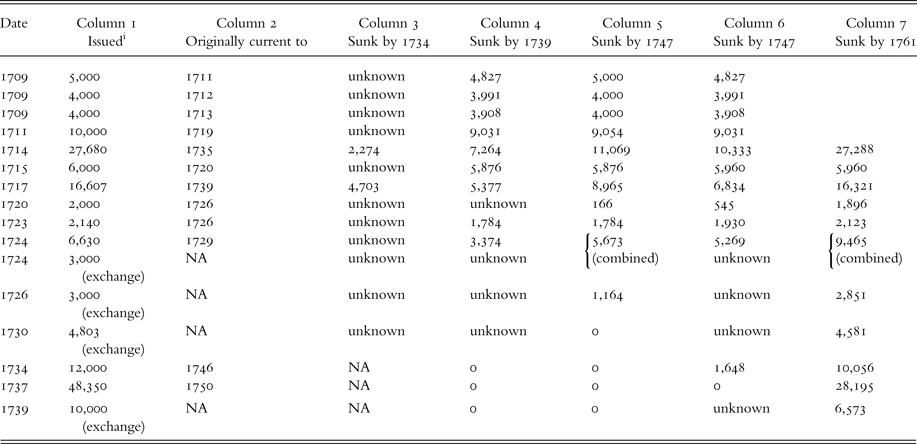
The history of New York's early emissions, detailed in Table 1, disproves the notion that all the Middle colonies scrupulously adhered to their scheduled redemptions.
New York's record in sinking its early bills of credit

Sources and notes:
iColumns 1–2: Dates, sums and original retirement dates from issuing Acts. NY Laws, vol. 1, c. 190; c. 204; c. 207; c. 231; c. 280; c. 292; c. 347; vol. 2, c. 396; c. 437; c. 447; c. 450; c. 492; c. 551; c. 625; c. 666; vol. 3, c. 676. The 1730 entry in column 2 is an exception. The colony authorized an exchange emission of £3,000 in 1730. A tally of the total destroyed in 1762, added to the remnant said to still be in circulation, comes to £4,803. The Act authorizing the emission passed 17 Oct. 1730, and the authorizing Act specifically called for the bills so emitted to be dated October 1730. Many of the bills were dated 29 Oct. 1730, in accordance with the Act. However, NYAJ, 13 Jan. 1773 contains a report of a burning committee that mentions destroying some bills of the 1730 emission dated 10 Dec. 1730. When the assembly was in adjournment, as it was after October in 1730, decision making power fell to the Council in executive session. While there is no mention of additional bills being authorized in the executive session minutes, the Council did meet on 3 Dec. 1730 – its only meeting between 29 Oct. and 4 Jan. of the next year. I conjecture that the £3,000 proved inadequate, and that the Council approved the printing of additional bills, dated Dec. 1730, but intentionally omitted the action in their records to avoid censure.
Column 3: Source: NYAJ, 5 Dec. 1754.
Column 4: Source: Amount sunk by 1739 from House of Lords Record Office, MS no. 160, counting only sums actually said to have been destroyed.
Column 5: Based on Brock (Reference Brock1975, table iv). Amount sunk by November 1761 obtained from the NYAJ, 11 March 1762, and then burnings between 1747 and 1761, as recorded in NYAJ, various entries, were subtracted. All numbers recomputed from original sources, which accounts for the small discrepancies between Brock's numbers and those presented here.
Column 6: ‘General Accompt or an Abstract of the whole Amount of the Bills of Credit which have from time to time been Emmitted in this His Majesty's Government in the Colony of New York Since the first Expedition to Canada which was in the Year of our Lord One thousand Seven Hundred & Nine Until the Year of our Lord One Thousand Seven hundred and Forty Seven together with the time of their Currency, the Funds Appropriated for Sinking the Same, what Bills have been Cancelled, and Remains still uncancelled’, PRO, CO 5/ 1096. These figures appear to conflict with those determined by working backwards from the assembly report that is the basis of column 5. Much of the discrepancy can be explained by the fact that the report in CO 5/ 1096 tracks funds, while the assembly report of 1762 tracks bills. If an individual took a damaged bill of the 1717 emission to be exchanged for a new bill of the 1730 exchange emission, for example, the treasurer would have written on the new bill that it was exchanged for one of the 1717 emission. Suppose then the 1717 bill was destroyed. Accounting by bills, as the assembly report does, this would count as the destruction of a 1717 bill, but accounting by funds, as done in the report in CO 5/ 1096 it would not. When the 1730 bill came back into the treasurer's office and was destroyed, it would be counted as the destruction of a 1717 bill when accounting by funds, but as the destruction of a 1730 bill when accounting by bills. The largest discrepancies in the report apparently arose in this way. For example, it appears that £8,965 of the bills issued in 1717 had been destroyed by 1747, but only £6,834 on the funds for these bills, the difference being £2,131 in exchange emissions handed out for the original 1717 bills and not yet destroyed.
Column 7: NYAJ, 11 March 1762. Regarding the 1730 emission, see notes on column 2. The additional £1,803 not mentioned in NYAJ, 11 March 1762, is treated as if it had been entirely retired by 1761. The amount emitted in 1715 is also understated in NYAJ, 11 March 1762, by £4,800. This sum is also treated as if it had been entirely retired by 1761.
The November 1734 emission to fortify the colony – the example used in the introduction – serves as an illustrative example. Although the Act decreed that the bills were to be called in by taxes over a ten-year period, and all were to have been destroyed no later than March 1746, scarcely any of these bills had been sunk by 1747, and in 1761 a sixth of the original emission remained in circulation. The two largest early emissions, those of 1714 and 1717, were scheduled for retirement in 1735 and 1739, respectively, but more than half remained in circulation in 1747. In 1740 Colden, then a Council member, held the Assembly responsible for having taken ‘management of the Excise into their own hands & letting it at under rates that thereby they might gratify their friends and Relations' (Michener 1987, p. 245). Governor Clinton pinpointed the role played by New York's treasurer, Abraham De Peyster, who was supposed to be burning these bills as they were collected in taxes: ‘After considerable sums are brought into the Treasury to be cancell'd,’ Clinton wrote his superiors, ‘the Treasurer has it in his power to send these Bills abroad again, for his own benefit, or the benefit of his friends. That he actually does this, is put out of question, by numbers of bills now passing current, which by the acts by which they are emitted, ought to have been cancelled several years since…’ (DRCHNY, vol. 6, pp. 533–4). Clinton's suspicions were belatedly confirmed when De Peyster died in September 1767. His executors discovered that De Peyster owed the colony treasury £50,000, which the deceased treasurer had appropriated to his own purposes (Ernst Reference Ernst1973, p. 258).
The sketchiness of the redemption funds ostensibly standing behind New York's bills of credit was hardly unknown to contemporaries. In 1733 Lewis Morris (1993, vol. 2, p. 64), then Chief Justice of the New York Supreme Court, wrote:
I Know no place (except this Province of New York) where paper bills have not fallen verry considerably from their first Vallue: – that they have not done so here, is not so much owing to the fund on which they were raised (that being Known to every body to be deficient to sink them within the time proposed) as to the Smallnesse of the quantity made, and the willingnesse of the Merchants & trading people here to recieve them in payment, and circulate them: which might have given them A credit without any fund at all.
The last of New York's legal tender currency was due to be retired in November 1768, and taxes earmarked for calling it in expired at the same time (DRCHNY, vol. 8, p. 72). The Currency Act of 1764 ordained that the bills ceased being a legal tender once their term expired and prohibited the assembly from extending their life.Footnote 9 When the tax funds expired in November 1768, however, New York still had £87,311 of these bills outstanding, and £81,555 remained in circulation two years later (Brock Reference Brock1992, table 5). Between November 1768 and February 1771, although all New York's bills of credit were overdue for retirement and circulated without the benefit of any tax funds, they did not depreciate (Carter et al., series Eg316, p. 5–698). Treasurer De Peyster's misappropriations were the chief reason the taxes levied proved inadequate, and New York seized his estate and sold it off in order to reimburse the colony insofar as that was possible (NY Laws, vol. 4, c. 1354; Ernst 1973, p. 258).
Abraham Lott succeeded De Peyster as New York's treasurer in 1768, and Lott proceeded to follow in De Peyster's footsteps, dipping into colony funds to divert upwards of £20,000 to his dry goods trade. When New York abandoned non-importation in 1770, Lott used colony funds to order dry goods on his own account, but the shipment was delayed. In the interim, his competitors flooded the market with dry goods, and Lott was forced to store his to wait for a less glutted market. When the House urged him to burn the bills presumed to be in his possession, Lott had to explain what had happened. He did so in a most extraordinary letter, which appeared verbatim in the Assembly's journal, a document routinely printed for public consumption. Lott, among other things, argued his salary was not adequate compensation, that his having diverted the funds was actually beneficial to New York's economy, and that De Peyster had routinely made use of £50,000–£70,000 for similar purposes and had never been reprimanded. Although warned to mend his ways, Lott was permitted to continue as treasurer (NYAJ, 14 Jan. 1772; 31 Jan. 1772; 19 Feb. 1772; 21 Feb. 1772). Small quantities of the orphaned bills of credit were burned each year as revenue trickled in from De Peyster's estate and as Lott sold his dry goods.
In February 1773, New York's assembly passed a bill designed to call in and cancel the remaining orphaned bills of credit, which had been circulating with ‘no other credit at present, but the common consent of the Country’ (DRCHNY, vol. 8, pp. 369–70). The bill directed the colony treasurer to place advertisements in the newspapers to instruct New Yorkers to bring them to the treasury where he was to redeem them using surplus funds in the treasury (CO 5/1104, fol. 268–8v.). When the council brought the bill to Governor Tryon for his signature, however, they were shocked at his reaction. Councilor William Smith (Reference Smith and Sabine1969, pp. 142–3) recorded the scene in his diary:
[Tryon] said [it] was repugnant to the Act of Parliament ag[ains]t. Paper Emissions and which he wondered at our passing unless we meant to degrade & disgrace him – [The council] were all astonished at his Heat – He rose from his Seat & complained much before they knew what he was at – It is strictly true I believe that not a Soul in either House imagined that the Bill was subject to this Objection.
Tryon reacted passionately because he feared running afoul of the Currency Act of 1764, which threatened stiff penalties for any governor who assented to an Act to extend the period of existing bills.Footnote 10
Tryon wrote to Lord Dartmouth explaining his reasons for refusing his assent. He admitted that ‘the public faith seems pledged to redeem [the bills], tho' the Laws for that purpose have expired’ and asked if he might have permission to approve a similar bill the next session (DRCHNY, vol. 8, pp. 369–70). Instead of giving Tryon the permission he sought, Lord Dartmouth commended him for not having signed the bill, promising only to bring the matter before the Board of Trade in the fall. His promise notwithstanding, Dartmouth then let the matter drop.Footnote 11 New York now had a large number of bills of credit outstanding outside their periods, unsupported by tax funds – bills the imperial authorities had announced it would be illegal for the treasury to redeem. If redemption provisions acting through expectations were an important determinant of the value of New York's bills of credit, surely this would have been a fatal blow, yet the news had no discernable effect on their value (Carter et al., series Eg316, p. 5–698).
V
New England and the Middle colonies had very different experiences with bills of credit because the Middle colonies had a concomitant circulation of specie. Specie coins, generally Spanish or Portuguese, circulated alongside paper money there according to fixed rules. For example, a Spanish dollar was treated as 8 shillings in New York and 7s. 6d. in Pennsylvania (McCusker Reference Mccusker1978, pp. 158, 177). These fixed rules were published in almanacs, and surviving merchant records suggest coins were commonly paid and received at the almanac ratings. Ratings such as these had once been set by colonial legislatures, but an Act of Parliament passed in 1708 decreed that no colonial legislature could, without Royal assent, set any value on silver coins higher than 6s. for a Spanish dollar. Since dollars were already passing at higher rates, and the colonists balked at deflating by adopting the rate permitted, colonial merchants used private agreements to subvert the law. One agreement, adopted in 1742, established the basis for Pennsylvania's coin ratings that survived with minor amendments until the end of the century, the Revolution excepted (Statutes, 6 Ann. c. 30; McCusker 1978, 176–7, Franklin 1959, vol. 14, p. 232). It is harder to trace the evolution of the New York merchants' agreements until they established a Chamber of Commerce in 1767. From that date, it becomes easy to track the debate and amendment of coin rating agreements in the Chamber's records (Stevens Reference Stevens1867, pp. 52, 56–7, 66–7, 69). Once an amendment appears in the Chamber's minutes, it is reflected in almanacs and in merchant records (Drinker Papers, box 1, Pigou and Booth to James and Drinker, 28 Aug. 1772; Hutchins Reference Hutchins1774, p. 20). These coin ratings and the continued circulation of specie at its rated value are what anchored the value of bills of credit in the Middle colonies. The New England colonies, however, issued so much currency during and after Queen Anne's War that specie was entirely displaced from circulation, and bills of credit became the only form of money circulating in New England (Brock Reference Brock1975, pp. 29–30; Michener 1987, pp. 290–4; Officer 2005, pp. 108, 116–17). Thomas Hutchinson (Reference Hutchinson and Davis1736, vol. 3, p. 159) said as much, when, as a young Massachusetts assemblyman, he declared that
The Bills of our Neighbours at New-York are on no better foundation than our's that are already extant, only as they have but very few, and not enough to carry on their Trade, Gold and Silver passing current with them, and at the rates fix'd by the Government, in a great measure supports their Credit.Footnote 12
This alternative explanation is set forth in more detail in Michener (Reference Michener1987, Reference Michener2011) and Michener and Wright (Reference Michener and Wright2006b).
The answer is simple, but it has encountered stiff resistance. It would mean that the appropriate measure of the money supply includes specie as well as bills of credit. Specie stocks are rarely measurable, so accepting such a conclusion would be a death knell for much cliometric work on the subject and a bitter pill for those who have published such work.
Economists are also skeptical that groups of merchants collaborated to stabilize the value of currency, despite explicit evidence of such deliberations at the New York Chamber of Commerce. The redemption theory and merchant agreements actually went head-to-head in a political battle in colonial New York. In 1739, the taxes earmarked to redeem the bills New York emitted in 1714 and 1717 were due to expire, and many of the bills were still in circulation. Lt Governor Clarke seized the opportunity to force the Assembly to grant him his salary for a five-year term, rather than year to year. He pledged to withhold his approval of an extension of the excise tax until his demands were met, warning the Assembly that if the excise tax wasn't continued the paper money would be ‘without any fund to sink it; its currency will cease, it will no longer pass, but become as waste paper and hundreds of people will then be losers by it’ (DRCHNY, vol. 6, pp. 111–12, 130, 135). The Assembly refused to comply, and instead unanimously vowed that it and every individual member would do everything in their power to preserve the credit of the colony's bills (NYAJ, 3 Oct. 1739). ‘Hereupon,’ Clarke explained in a letter to his superiors in London, ‘the Merchants combined to take [the paper money] whereby it would be current do what I could.’ Clarke capitulated (DRCHNY, vol. 6, pp. 150–1, 158). Merchant agreements had successfully trumped the redemption theory.
Colonial statistics on money, income, interest rates and prices are primitive and incomplete, and regrettably are likely to remain so. Theories derived from uncritical manipulation of such numbers are only speculative conjectures, which have their place, but useful conjectures need to be consistent with other kinds of historical evidence. Redemption theories fail this test. Redemption theorists who have confronted the strikingly different experiences of the New England and Middle colonies have argued that administrative efficiency and probity are the key variables explaining the difference. The argument does not hold up to close examination. Although a case can be made that Massachusetts suffered from poor administration and its bills depreciated, it is doubtful one could construct any measure by which New York, whose bills held their value, did a better job of administration than Massachusetts. Blatant and longstanding misappropriation of funds by New York's treasurers delayed scheduled redemptions for decades, until finally the imperial authorities blocked the colony's belated attempt to redeem its bills. Yet its bills continued to circulate without losing value. Connecticut, on the other hand, administered its currency well by all accounts, but its bills depreciated anyway. Some alternative explanation must be found. That there was a concurrent circulation of specie at rated values in the Middle colonies while specie ceased to circulate as a medium of exchange in colonial New England before 1750 seems like the most promising candidate.