In antiquity, clay oil lamps played an essential role in religious rituals performed in sacred spaces. They were left as votive offerings of symbolic light to deities in sanctuaries, buried beneath building foundations, deposited in graves, and dropped into caves, cisterns, and wells.Footnote 1 Not all cultic practices, however, left clay lamps intact. The intentional breakage of “picture” lamps, or Bildlampen, was a relatively common practice across the Roman empire. Such lamps typically exhibit a missing central discus. The extracted discus itself – called a lamp “medallion” – often survives too and represents further evidence for deliberate lamp breakage. The purpose of this article is to explore picture lamps with missing discuses and medallions as a distinct and identifiable artifact group. It identifies selected findspots where they were used in breakage rituals and examines the possible reasons behind their intentional mutilation. This study further shows that although deliberately broken picture lamps are commonly found at sites in Roman Palestine, finds from elsewhere in the Roman world indicate that lamp breaking for religious or practical purposes was not unique to that region.
The article focuses in particular on lychnological evidence recovered from the Shrine of Apollo in Tyre, Lebanon, as it hints at the use of picture lamps in a variety of cultic practices; for example, dropping them into the sanctuary's wells and basins, as well as intentionally burying them under the Shrine itself. Some lamps also exhibit deliberately broken central discuses. The numerous lamp fragments themselves found inside the sanctuary may also represent evidence for collective lamp breakage rituals. This, of course, is difficult to substantiate, depending on the context. That said, we should not exclude the sherds from our analysis and should at least attempt to glean as much information from them as we can. The Shrine additionally helps us understand whether there is a relationship between the meaning of the discus motifs and the cultic purpose of the sanctuary itself.
To better understand how Roman picture lamps were intentionally broken and their lamp medallions generated, I performed my own lamp breakage “rituals” using accurate British Museum-made replicas cast from an original Roman picture lamp.Footnote 2 Hammerstone, puncture, drop, and impact experiments were conducted on the replicas. The objective of the hammerstone and puncture tests was to create a picture lamp with a missing discus without destroying the lighting vessel and perhaps even to produce a lamp medallion. These represent the techniques most plausibly used to break the central discus. Because large numbers of lamp sherds are often recovered from sanctuaries, two additional breakage experiments – drop and impact – were conducted to accommodate the possibility that worshippers intentionally dropped or struck the lighting devices in some sort of “lamp-killing” ritual.
The experiments were also performed to observe how picture lamps break, including the quantity and types of fragments produced. This is helpful knowledge when applying Diedre Barrett's mean weight analysisFootnote 3 to determine the estimated quantity of complete lamps originally used inside a sanctuary and to aid in the reconstruction of lighting scenarios in sacred spaces, such as lararia, using 3D simulation.Footnote 4 This information is also essential for recreating the exact geographic coordinates of intact lamps, fragments, and medallions using GIS digitalization.Footnote 5 An additional goal of the tests was to gauge the degree of breakage suffered by a complete picture lamp when dropped, which parts of the lamp's morphology sustained the most significant damage, and which parts were best or fully preserved. Before presenting the results of the breakage experiments, the archaeological evidence for lamp breakage is explored, including the contexts of lamps with missing discuses and lamp medallions; the connection – if any – between the motifs pictured on the medallions and the findspots; and the reasons why ancient worshippers, among others, would break their lamps.
Picture lamp breakage: the evidence
“Picture” lamps – or Bildlampen as the type was first coined by Otto Fischbach in 1896 in recognition of the diverse motifs that often decorate their central discusesFootnote 6 – reigned supreme as the lamp type of choice for religious offertory rituals in the Roman period, as their widespread distribution and abundance confirm.Footnote 7 Nearly every region of the Roman world manufactured one or more versions of this group.Footnote 8 Picture lamps correspond to Broneer Types XXI–XXV and Loeschcke Gruppen I–VIII.Footnote 9 They are characterized by a round body with a central concave discus that typically contains a motif in high relief. The nozzle can be relatively long and spatulated, or short and rounded. Lamp-makers’ marks, names, or initials occur on many bases. Not only did picture lamps provide mobile artificial lighting, they also served as a medium via which Greco-Roman mythological themes were spread widely and had a “pollinating” effect across urban and rural populations.Footnote 10 In essence, their discus-scenes employed a pictorial language that could be understood by a mostly non-literate population.
It has been well established that the most common and identifiable archaeological evidence for intentional lamp breakage is (1) picture lamps with missing discuses and (2) lamp “medallions” (Fig. 1).Footnote 11 The central discus of the picture lamp made it ideal for ritual: not only might the image on it have held symbolic meaning for the lamp user, but its thinness also ensured easy destruction in breakage rituals. Given its special feature of carrying mythological imagery, this lamp type may have been manufactured exclusively for cultic rites. That picture lamps with missing discuses are found in various and mostly identifiable Roman religious cultic contexts suggests their role in religious offertory breakage rituals. The discus motifs on the medallions also generally belong to the standard repertoire of Roman religious cults. It is plausible that picture lamps were also used for magic in some contexts, but the overall absence of mirror-writing, retrograde inscriptions, or curses generally suggests otherwise.Footnote 12 Determining whether a picture lamp was intentionally broken as an act of religious cult or magic will depend on the artifact's archaeological context, any associated textual evidence, and the excavator's scholarly opinion on what constitutes “magic.”Footnote 13
Tarsus picture lamp with missing discus and its medallion showing Athena. Sinda (?), Cyprus. The Louvre, accession no. AM 1644. (Courtesy the Louvre.)

Picture lamps with missing discuses
The most widespread distribution and greatest quantity of picture lamps with missing discuses are found at sites in Roman Palestine. The majority of these lamps were manufactured in local workshops.Footnote 14 A deliberately broken picture lamp can typically be identified by a large, relatively circular hole with jagged edges located where the original discus once existed. A Palestinian discus lamp recovered from the Northern Cemetery at the Decapolis city of Beth Shean/Scythopolis, Israel, superbly exhibits these characteristics (Fig. 2).Footnote 15 The molded motif (indiscernible) on the central discus has been intentionally broken in characteristic fashion. One of the largest deposits of Palestinian picture lamps like the Beth Shean example – over 600 lamps in all – was exposed at the villa maritima and dumps at Apollonia-Arsuf.Footnote 16 Although Apollonia had a predominantly Samaritan and early Christian population,Footnote 17 it should not be ruled out that pagan residents of the city deliberately mutilated picture lamps, as their counterparts did at shrines outside Roman Palestine. Additional examples with intentionally broken discuses were unearthed in tabernae and a Roman house on the cardo at the coastal site of Antipatris/Tell Aphek and at Beth Shean/Scythopolis.Footnote 18 Other Palestinian picture lamps with missing discuses have been excavated at Tyre and as far west as Athens.Footnote 19 Many were recovered from Te'omim Cave, located in the southern hills of Jerusalem, and were probably deposited there by pagans as offerings to chthonic gods.Footnote 20 Picture lamp breaking appears to have been more common among rural communities than urban ones in Roman Palestine.Footnote 21
Palestinian picture lamp with intentionally broken and missing discus. Late 1st–3rd c. CE. Northern Cemetery. Beth Shean (Beison)/Scythopolis, Israel. Penn Museum no. 29-102-253. (Courtesy the Penn Museum.)

The central discuses of picture lamps were also deliberately broken in Jewish ritual contexts in Roman Palestine.Footnote 22 Several such lamps with missing discuses were recovered, for instance, from a Jewish burial cave at Qiryat Tiv'on in Galilee.Footnote 23 Additional examples were unearthed from cistern C-1068, located in the Jewish domestic area of the lower Galilean city of Sepphoris.Footnote 24 The lamps represent plausible evidence of a breakage ritual whereby the central discuses were intentionally broken and the lamps were tossed into the cistern, possibly by the residents of the city's Jewish quarter. More picture lamps with missing discuses were found in other contexts at the site.Footnote 25
A Palestinian picture lamp with a deliberately broken discus was also recovered from the fill of a cistern (Area C-6, locus 6001) at the ancient Meiron synagogue in Upper Galilee.Footnote 26 It is no coincidence that numerous complete lamps and lamp fragments were found in the cistern, more so than from any other such cavity at the site.Footnote 27 They likely represent evidence for lamp breakage rituals wherein the lighting vessels were intentionally broken and tossed into the cistern, perhaps as offerings of symbolic light to placate chthonic demons. Ancient literary sources mention ceremonial acts conducted in association with cisterns and eschatological links connecting cisterns and pits to the world beyond. Erwin Goodenough, for example, cites a rabbinic passage in which R. Jose observes that the cavity of the cistern reached down into Sheol, the “abyss.”Footnote 28 Rabbinic sources also mention regulations as they pertain to heave-offerings of wine or oil taken from cisterns.Footnote 29
Picture lamps with missing discuses have also been excavated at pagan findspots outside Roman Palestine. At Petra, for example, several locally made Nabataean picture lamps exhibit probable deliberate breakage.Footnote 30 In Cyprus, two picture lamps reportedly recovered from tombs are telling examples of probable intentional breakage. Remarkably, they were discovered with their actual extracted medallions, one showing Odysseus hiding under a ram,Footnote 31 and the other depicting Athena grasping a shield (see Fig. 1).Footnote 32 Lamps with missing discuses have also been discovered at Pergamon.Footnote 33 Two picture lamps (Loeschcke VIII) excavated at Ephesus in the 1860s exhibit deliberately broken discuses, too.Footnote 34 In southern France, intentionally extracted central discuses of picture lamps (Loeschcke I) were recovered from the cultic sites of Lachau and La Bâtie-Montsaléon in Hautes-Alpes.Footnote 35 Two picture lamps with broken discuses were reportedly found in Italy.Footnote 36 Another belonging to Broneer XXII/Loeschcke Ib was recovered from an infant's grave (XXXI) at Gerulata in Pannonia.Footnote 37 Several locally produced Pontic picture lamps with broken discuses were excavated in a Jewish context in the Crimea: the 5th–6th c. synagogue at Chersonesos.Footnote 38
Lamp medallions
Lamp medallions represent another common type of identifiable evidence for intentional picture lamp breakage. These are the concave discuses of picture lamps deliberately broken and removed by a lamp user. Although they are commonly referred to as discuses,Footnote 39 I prefer the nomenclature “medallion” adopted by other lychnologists to distinguish this artifact group from the actual part of the picture lamp called the discus.Footnote 40 Lamp medallions can be categorized into three types: (1) relatively round with jagged edges, resembling a conventional medallion, (2) an angular “chip” version, and (3) circular with rounded edges, suggesting separate manufacture using the concave part of the upper lamp mold.Footnote 41 The medallion extracted from the Tarsus-made picture lamp is a good example of Type 1, with round and jagged edges (see Fig. 1), as is an example depicting the winged horse, Pegasus, recovered from Area CC above the palace at Herod's harbor at Caesarea Maritima, Israel.Footnote 42 At Montans (Tarn), chip-type lamp medallions (Type 2) were discovered.Footnote 43 Lamp medallions serve as important clay documents of the various iconographic themes they portray and provide insight into which of those themes were most valued by lamp users. Popular motifs on picture lamps include deities, cupids, myths, daily and ritual objects, erotic scenes, gladiators, entertainment, animals, and a rosette and wreath.Footnote 44
Although lamp medallions are relatively common across the empire, the largest quantities by far have been uncovered in the Gallo-Roman Vocontian sanctuaries of Chastelard de Lardiers and Lachau in southern France.Footnote 45 A medallion depicting a Gaulish-style Dionysus, for example, was unearthed in the sanctuary at Chastelard de Lardiers (Fig. 3).Footnote 46 The rubbish deposit covering the Arles-Rhône 3 underwater barge also yielded decorated lamp medallions, which, as in the Vocontian sanctuaries, were deliberately extracted and, as the fine cuts indicate, carefully worked to preserve the central motifs.Footnote 47 Much of the rubbish covering the barge can certainly be accounted for by sailors dumping garbage into the river from the boats moored on the right bank of the Rhône. Laurent Chrzanovski has, however, been able to identify intentionally cut discuses among the rubbish, which, together with over 100 perfectly intact objects, are suggestive of a deliberate cult offering associated with rivers and navigation.Footnote 48 That over 80% of the motifs decorating the medallions left by the worshippers at the Vocontian sanctuaries and covering the Arles barge belong to the same iconographic repertoire may represent evidence for a Gallo-Roman ritual specific to the region.Footnote 49 The recurrence of lamp motifs associated with wine, theater (masks), and gladiators at these sites might suggest a regionally shared ritualistic meaning and purpose.Footnote 50
Lamp medallion with Gaulish-style Dionysus originating from a picture lamp. Chastelard de Lardiers, Drôme. (© Nicolas Rouzeau/Projet Collectif de recherches/DRAC-SRA-PACA.)

Pergamon has yielded additional lamp medallions depicting Medusa, erotic scenes, and animals, as well as angular, chip-type examples.Footnote 51 Medallions from Italy depict a variety of pagan deities (e.g., Fortuna, Jupiter, Mercury, Silenus, and Apollo).Footnote 52 A specimen with a grasshopper has been recovered from Antipatris in Roman Palestine, and a chip-type medallion showing a bovine was excavated at Sepphoris.Footnote 53 Medallions picturing the Three Graces, and others with three actors on a stage, have been excavated in Egypt.Footnote 54 Though less common, mold-pressed, circular, clay lamp lids can be confused for lamp medallions.Footnote 55
Discus motifs: meaning and context
Whether picture lamp motifs carry any meaning connected with their archaeological context has puzzled lychnologists for some time now. This is a vast topic, worthy of an in-depth treatment of discus themes from multiple sites in various regions that is beyond the scope of this essay. That said, some discussion is required here, as the discus scenes of Roman picture lamps may hold the key to why they were intentionally broken. The question is whether any motifs held a symbolic or apotropaic meaning that would help explain why this lamp group was commonly chosen for breakage and other rituals. We can surmise that, for example, a discus lamp picturing a specific god may possess and project the qualities attributed to that deity. A depiction of Apollo, for instance, might convey his association with power, music, shepherding, and animals. Do such discus images, then, occur on picture lamps recovered from shrines dedicated to this god, and consistently so?
Hella Eckardt has conducted an extensive analysis of the discus motifs on picture lamps excavated in Roman Britain and their association, if any, with their respective archaeological findspots. She concluded that only the discus images of an altar between two laurel trees, an eagle, and the goddess Victory were likely to have been related to the imagery of Augustan peace and victory.Footnote 56 In Roman Palestine, Renate Rosenthal-Heginbottom suggests that four discus lamp images have strong Egyptian associations: the griffin with a wheel, the heron and crab, dwarfs, and cinaidoi.Footnote 57 They are portrayed on locally manufactured Palestinian picture lamps excavated at the northern coastal city of Dora. Rosenthal-Heginbottom observes that individual lamp discuses with griffins might have been presented to competitors to help ensure victory in the agones (contests) that took place in the amphitheater, stadium, and hippodrome. She suggests that the griffin with wheel image relates to the cult of Nemesis and her patronage of athletic events. She points out that the heron found on the lamps represents the Egyptian benu bird, which symbolized the God Ra, the sun-god of Heliopolis, and Osiris, the god related to death, resurrection, eternal life, and fertility. Rosenthal-Heginbottom further notes that dwarfs are associated with Egyptian Nilotic inundation rituals that celebrated the Nile flood and the renewed fertility it delivered annually to Egypt, and that the cinaidoi had a related meaning. She concludes, however, that the images found on the Dora lamps cannot be linked to specific domestic cults and rituals, nor do their respective findspots shed any light on their original contexts.
In Roman Palestine, I would expect lamps bearing the heron-and-crab imagery – symbolizing Osiris and eternal life – and in Roman Britain, lamps portraying the Egyptian god Arubis, also signifying everlasting life, to be found in burial contexts. Such consistent discus imagery, associated with a specific type of context, would indicate cultic behavior suggestive of collective choice among members of the funeral party.Footnote 58 But this is not the case. A variety of random and unassociated lamp imagery prevails, suggesting individual choices made by participants of cults or members of funeral parties. Individual choice may also be evidenced by a picture lamp dropped into an infant's grave at Gerulata. Out of the nine picture lamps with mythological scenes recovered from the cemeteries there, only one has a relationship with its funerary findspot: a discus scene with the mask of Hercules on an altar, which can be associated with death and mortality.Footnote 59 Frecer cautions that the other discus-motifs are “not overtly connected to death” and therefore support the prevailing hypothesis that “lamp discus-motifs had little to do with their function as grave-goods or votive offerings.”Footnote 60 However, a picture lamp (Broneer Type XXII/Loeschcke I) recovered from a foundation offering (around 25–60 CE) beneath a wine storehouse at the Roman port of Lattara (Lattes, France) depicts a discus theme related to viticulture – a winged cupid picking and carrying grapes in buckets – reflecting the function of its context, the storage of wine.Footnote 61
In short, the meaning of motifs and symbols on lamps recovered from sacred spaces generally does not suggest any association between the lamp image and the function of the context.Footnote 62 In her exhaustive study on lighting in Roman Britain, Eckardt concludes that although variation existed, as evidenced in the archaeological record, there is “little proof for a systematic relationship between the images on a lamp and the context in which it was used.”Footnote 63 In Roman Palestine, too, the motifs on lamps generally do not show a consistent connection to the context in which they were found.Footnote 64 For example, the motifs appearing on the 31 lamps surrounding the altar of the Mithraeum at Caesarea Maritima do not indicate any relationship to the Mithras cult.Footnote 65 Two lamp fragments might depict Helios,Footnote 66 but not as conclusively as the example wearing the characteristic radiate crown from the Mithraeum of Santa Maria Capua Vetere in Campania.Footnote 67 The variety of images at the Caesarea Maritima Mithraeum suggests personal choices made by individual Mithraists there, not a collective decision. What is consistent, however, and therefore suggestive of collective behavior and thought, is the offering and use of lamplight – whether actual flame-light (lamps showing traces of burning) or symbolic light (unused lamps) – in association with the altar.
Several notable observations have been made regarding discus scenes occurring at sites in Roman Gaul. The Roman barge submerged in the Rhône River (AR3 site), for example, yielded lamp medallions with motifs that are consistently associated with entertainment: theatrical and Dionysian masks, gladiatorial equipment, and laurel wreaths.Footnote 68 There is, however, no obvious connection between these images and the ritual tossing of the medallions into the Rhône. At d'Allan (Drôme), deities (26.7%) and animals (26.7%) are the most common motifs on the picture lamps recovered from the sanctuary.Footnote 69 Additionally, Nuria Rovira and Lucie Chabal argue that the foundation offering (FS26221) of ceramic drinking vessels and the lamp picturing the cupid and grapes found beneath the wine storehouse at Lattara do reflect the function of their context – the storage of wine – and the significance of the beverage in ritual practices (libations).Footnote 70
Why were picture lamps intentionally broken?
Not unexpectedly, ancient literary, epigraphic, and papyrological sources are relatively silent as to the similar or different reasons why pagans and monotheists intentionally broke picture lamps.Footnote 71 Should we expect such specificity, though? As Fritz Graf observes, “ancient sources tend to record only the exceptional and aberrant rituals, not the familiar and ordinary ones of daily life.”Footnote 72 This general lack of textual data contributes to the difficulty of defining and interpreting rituals.Footnote 73 In a rare account, the 5th-c. monk Sozoman describes residual pagan rituals performed at the sanctuary of Mamre/Terebinthus (Israel), where contemporary worshippers placed burning lamps near the sacred well into which they also poured wine and dropped cakes, coins, myrrh, or incense. He writes nothing about breaking lamps. Also not mentioned in his account, however, are the many lamps that were intentionally dropped into the well, as substantiated by the archaeological evidence.Footnote 74 Additionally, Lee Levine points out the shortfalls of interpreting archaeological material culture using ancient texts.Footnote 75 Given the “silence” of the textual sources, we must depend largely upon the archaeological evidence and contexts where picture lamps with missing discuses and medallions occur to determine the meaning and purpose behind deliberate lamp breaking. So far, protection, iconoclasm, purity, and functionality have been posited as reasons explaining mutilation practices.
Protection
The abundant lamp medallions recovered from the sanctuaries of Chastelard de Lardiers and Lachau,Footnote 76 as well as those found at other cultic sites, indicate that picture lamps were intentionally broken to extract the discus scenes, potentially for use as offerings. But might have ancient worshippers believed that the image-bearing lamp medallions were imbued with amuletic powers? A blue faience medallion portraying Medusa, found among other amulets in a wooden box recovered at Pompeii, may provide a clue: images of Medusa, as well as other mythological characters, were perhaps removed from picture lamps for amuletic protection.Footnote 77 Medusa images were popular on small objects such as cameos, finger-rings, and gems. It is not surprising, then, that this mythological monster also bedecks lamp medallions. Several, for instance, have been recovered at Sepphoris, Beth Shean, Caesarea Maritima, and Antipatris in Roman Palestine;Footnote 78 others originate from picture lamps manufactured at Pergamon.Footnote 79
Lamp medallions are noticeably absent from findspots where numerous picture lamps with missing discuses occur (e.g., Apollonia and Teo'mim Cave), including Jewish tombs (e.g., Qir'at Tivon); here, lamps may have been intentionally broken during graveside rituals and the resulting medallions kept as souvenirs of the dead, or perhaps even for use as photoamulets to protect against darkness where impure evil spirits lurk.Footnote 80 Ancient Jewish magical texts and amulets,Footnote 81 and Jewish sacred art incorporating pagan imagery (see discussion below) lend support to this possibility that Jews used medallions with pagan motifs for amuletic purposes as well. Conceivably, lamp medallions were worn as pendant-photoamulets, as many examples preserve their filling-holes, through which a cord would have been easily inserted.Footnote 82 Miniature glass lamp-pendants from Italy and Egypt, for instance, probably served a similar amuletic purpose.Footnote 83
Iconoclasm
Jewish religious law hints at possible reasons why picture lamps were purposely broken by Jews and Samaritans in Roman Palestine but might not reflect practices in the Diaspora: it is surely not applicable to non-Jewish, pagan motivations behind deliberate discus breaking. One explanation suggests that Jews and Samaritans mutilated pagan discus-scenes in observance of the Second Commandment prohibition against graven images.Footnote 84 Oren Tal and Marcio Bastos observe that lamp breaking “was not merely a religious act shared by the three monotheistic religions [Judaism, Samaritanism, and Christianity] of Roman Palestine…but also an act used to assist in the desired victory of the Lord over His pagan counterparts.”Footnote 85 This is certainly plausible. Jewish textual sources reveal, however, that rabbinic attitudes toward pagan figurative imagery – whether strict or lenient – “varied considerably,”Footnote 86 an observation that is further substantiated by the archaeological record. For example, Jewish congregations accepted and incorporated pagan imagery into their religious art, as demonstrated by portrayals of the sun god Helios centered inside zodiac wheels on the synagogue mosaics at Beth Alpha, Hammath Tiberias, Na'aran, and Sepphoris.Footnote 87 Helios is, further, pictured on discus lamps recovered from the Nabratein synagogue and a Jewish tomb at Ti'von.Footnote 88 That the Jewish patriarch of Sepphoris may have owned the city's luxurious villa,Footnote 89 which contains a mosaic depicting the gods Heracles and Dionysus, and that the city's domestic area yielded Palestinian picture lamps decorated with standard Roman motifs (e.g., charioteer, Europa with the bull, Bacchus with chalice, erotic scenes, etc.), suggests that Jewish Sepphoreans were also not offended by pagan imagery. And, as Glen Bowersock elegantly observes, the mythological Amazons represented in the Nile Festival Building mosaic at Sepphoris are “another arresting illustration of a universalizing pagan mythology that so thoroughly Jewish a city absorbed with ease.”Footnote 90 Additionally, many picture lamps were plain, so breaking their discuses should not be explained by aniconic behavior.Footnote 91
Purity
Picture lamps recovered from Jewish burial contexts in Roman Palestine may reflect breakage rituals meant to satisfy the Mishnaic requirement that a lamp's filling-hole must be as large as a coin (perutah) for the oil to pass through to avoid impurity and “uncleanness.”Footnote 92 In Upper Galilee, for example, picture lamps exhibiting broken discuses have been recovered from Tomb T-29 associated with the ancient synagogue at Khirbet Shema’ and may represent evidence for this belief.Footnote 93 Additional picture lamps with missing discuses were recovered from the Akeldama tombs located in the Kidron Valley south of the Old City, Jerusalem. Of the nine discus lamps recovered from the tombs, six exhibited broken, missing discuses.Footnote 94 These loculus tombs were initially Second Temple-period Jewish burials, until around 70 c. CE. The lamps with missing discuses were recovered from Cave 1, Chamber A, and may indicate some sort of graveside, lamp-breakage purity ritual in the late 1st–3rd c. CE, when the Akeldama caves were used for Late Roman cremation burials during Phase B.Footnote 95 Picture lamps were not the only types to have been deliberately broken. In Catacomb 12 of the Jewish necropolis at Beth She'arim in Galilee, several Northern Stamped-type lamps dating to the 3rd c. CE also exhibit intentionally broken discuses.Footnote 96 Later Samaritan lamps with closed tops, too, were considered ritually pure and were “opened” only before use.Footnote 97
Functionality
Practical reasons may also account for deliberate picture-lamp breakage.Footnote 98 The small filling-hole of picture lamps may have made the introduction of oil difficult, and the central discus may have been intentionally broken to widen the aperture.Footnote 99 When I poured olive oil into the fuel chamber of Lamp E of this study, however, I encountered no such complications: the concave discus functioned quite effectively as a funnel and channeled the oil into the fuel chamber. In the case of overfilling, the concave discus prevented the loss of excess oil by allowing it to pool around the filling-hole. These observations indicate that picture lamp discuses did not need to be broken to facilitate filling. Other lamp types, however, did. A shortage of olive oil in the northern provinces, resulting from trade competition between Roman Italy and Hispania Baetica during the 2nd c. CE, for example, necessitated cutting out the discus part of “factory” lamps, or Firmalampen, and manufacturing new versions with large filling-holes, as reflected in the lychnological finds from the Roman cemeteries at Heidelberg.Footnote 100 This enabled lamps to be filled with the alternative, but thicker, talc-fuel.Footnote 101 Chemical analysis of picture and factory lamps from Cologne and Kaiseraugst similarly indicates that locally available oils were substituted for costly olive oil as alternative liquid fuels.Footnote 102 This “energy crisis”Footnote 103 may have extended to Pannonia as well, where, at Gerulata, several factory lamps exhibit comparable missing discuses.Footnote 104
The archaeological and limited textual evidence suggests that the reasons behind intentional lamp breakage depend on the primary use-context and the religious group – pagan or monotheistic – doing the breaking. That picture lamps with missing discuses predominantly occur in sanctuary and burial contexts suggests that lamp mutilation was a ritualistic practice in sacred spaces. Those extracting the medallions likely kept them for their imagery, which held some sort of meaning and perhaps even served an amuletic purpose. The medallions may have functioned as souvenirs, a reminder of participation in a breakage ritual at a burial or at a sanctuary, as they are generally absent from these contexts. Among Jews and Samaritans in Roman Palestine, the breakage of a lamp's discus may have been performed for purposes of purity and iconoclasm, though the latter is less probable. As utilitarian vessels, lamps needed to carry out their function of providing artificial light, too, so the breakage of the discus may have been required in certain circumstances simply to facilitate the introduction of fuel, especially the thicker talc-fuel used in Germania. Although intentional lamp breaking was performed by pagans and non-pagans throughout the Roman world, the meanings behind the practice were probably specific to local and perhaps regional sanctuaries, or different burial customs among diverse religious groups.
The Shrine of Apollo (Tyre, Lebanon): picture lamp rituals
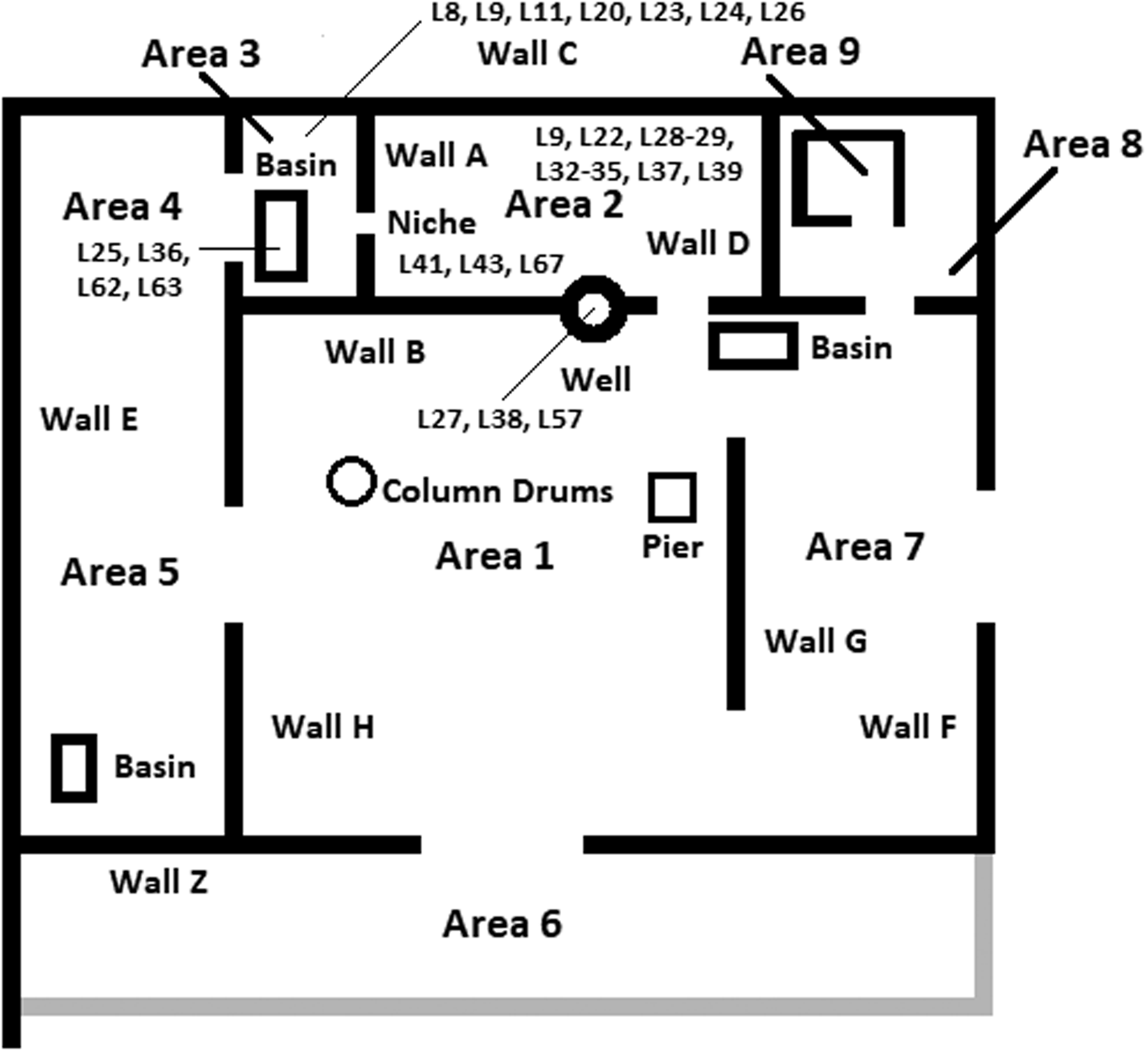
The Shrine of Apollo in Tyre provides a unique opportunity to examine several different cultic practices involving lamps, including intentional breakage. Eighty-eight clay lamps were recovered from the complex, 81 of which were related to the “Skene” (Fig. 4).Footnote 105 Most of the lamps date to the 1st and 2nd c. CE. Sixty-three of the 88 (72%) are picture lamps belonging to Broneer XXI, XXII, XXIII, and XXV,Footnote 106 suggesting that this was the preferred lamp type for cultic use in the sanctuary. Broneer Type XXIII picture lamps are the most common group. The replica lamps selected for the breakage experiments of this study (see below) also belong to this type. The clay lamps excavated from the western end of Area 2 of the Skene likely served as cult offerings.Footnote 107 The Shrine of Apollo reveals several important elements of cultic lamp usage: 1) a rare systematic relationship between the lamp discus-images and their archaeological use-context; 2) picture lamps with intentionally broken and missing discuses indicating individual-choice, lamp-breakage rituals; 3) lamp sherds possibly resulting from drop and/or impact breakage rituals; and 4) separate offertory lamp rituals in which lamps were tossed into water basins and a well, and were also buried beneath platforms and stones.
Plan of the Skene of the Shrine of Apollo, Tyre, Lebanon (Phase 2), showing findspots of lamp finds. (After Bikai et al. Reference Bikai, Fulco and Marchand1996, 7, fig. 28; redrawn by E. Lapp.)

Picture lamps with discus scenes linked to Apollo
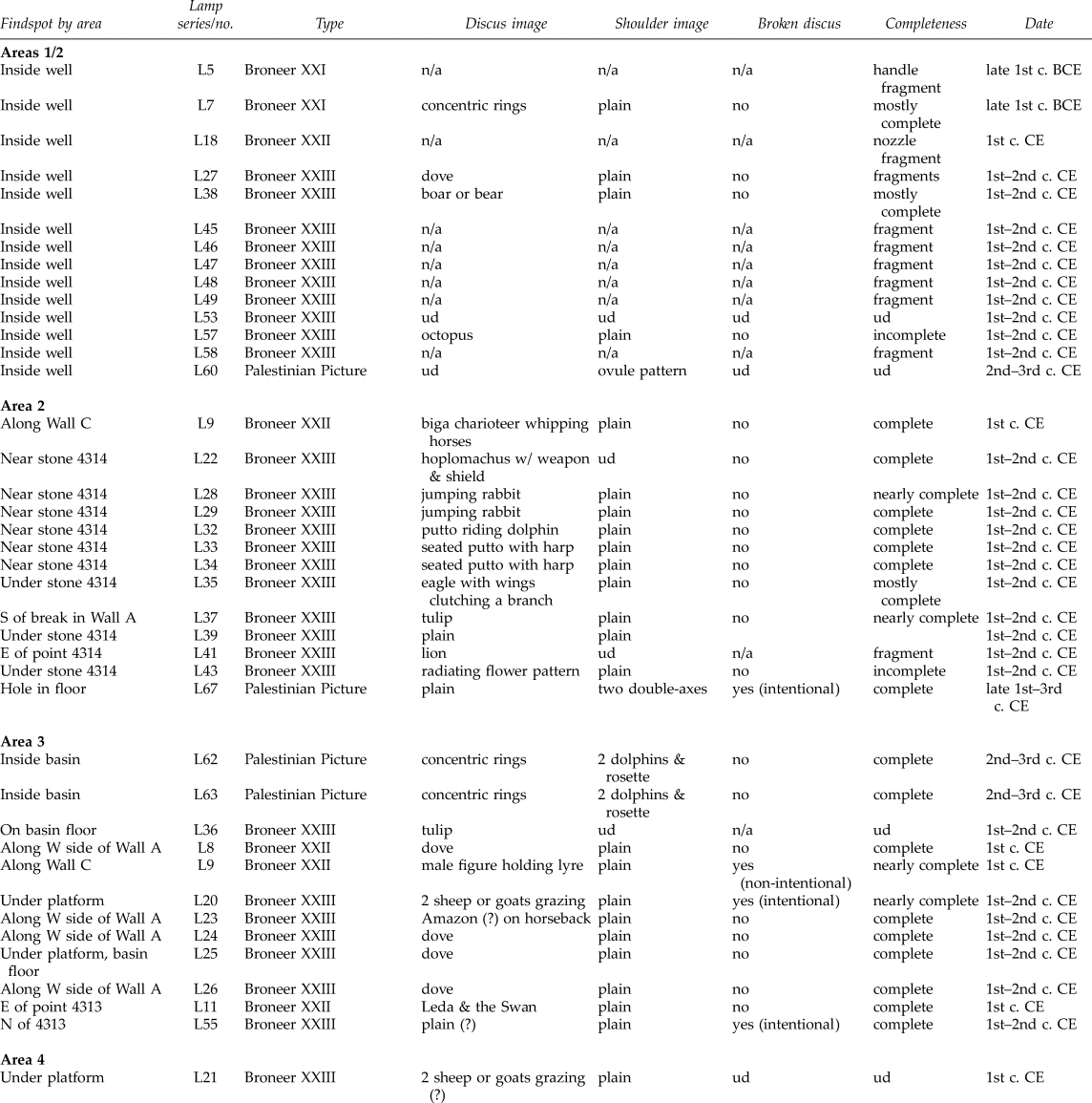
The picture lamps recovered from the shrine – particularly in Areas 2 and 3 – reveal a thematic link between discus image and use-context, specifically an association with the deity Apollo (Table 1).Footnote 108 Two picture lamps, for example, show grazing sheep or goats that allude to Apollo's role as a pastoral deity and the patron of the shepherds who protected flocks and herds. Certain animals and sea creatures were also dedicated to Apollo, including the dolphin,Footnote 109 which decorates the shoulders of two picture lamps found inside the basin in Area 3. A picture lamp with an octopus also occurs at the site, though I am unaware of any connection between the cephalopod and the god, except that it is a marine creature. Other discus images of animals on lamps from the shrine include a leopard, a lion, a boar (or bear), doves, and rabbits (see Table 1). Additionally, Apollo was the god of music, who favored the lyre.Footnote 110 A picture lamp showing a standing male figure holding a lyre suggests that whoever offered it likely selected the lamp with Apollo's connection to this instrument in mind. Although this discus scene could be interpreted as Apollo with a lyre, it is worth noting that the image is dissimilar to the representations of the god on other lamps, such as two examples excavated at Salamis or Kourion, Cyprus.Footnote 111 Eros playing the double-flute, as well as the harp occurring on other lamps recovered from the sanctuary, further relate to Apollo's role as the god of music. Granted, Eros is commonly connected to Aphrodite, but other gods often received offerings from dedicants in sanctuaries. A hoplomachus brandishing his weapon and shield appears on a picture lamp found in Area 2, where there was also another lamp showing a possible wounded Amazon. Both scenes are suggestive of Apollo's relationship to warrior-craft and his affection for the bow as a weapon. Apollo's father, Zeus, is symbolized by an eagle, with wings spread and clutching a branch in its beak, on a lamp discovered under a stone in Area 2, while a lamp from Area 3 depicts him as a swan seducing Leda.
Roman picture lamp findspots and various lychnological data. Shrine of Apollo. Tyre, Lebanon.

ud = undetermined; n/a - not applicable
Ultimately, one must reflect on what a lamp discus motif meant to a worshipper at Tyre's Shrine of Apollo: did he or she identify the motif with Roman mythology, or with pre-existing Phoenician mythology, or both?Footnote 112 In Roman Palestine, for example, the pagan sun god Helios held different meanings for different religionists: Jews may have identified Helios with Metatron (the divine super-angel), while Christians and pagans saw the god, in the guise of Sol Invictus, as Christ or the later Roman emperors, respectively.Footnote 113
Picture lamp breakage rituals
Three published picture lamps found in the Shrine of Apollo exhibit missing discuses that were intentionally extracted in breakage rituals: two belong to Broneer Type XXIII and the third to the Palestinian picture lamp group recovered from Area 2.Footnote 114 The broken discus of the Palestinian picture lamp closely parallels those of the intentionally broken lamps excavated from numerous sites in Israel (see above). That few other picture lamps recovered from the Apollo complex exhibit intentionally broken discuses suggests a ritual practiced on an individual and personal level rather than one reflecting collective behavior among the cult participants. The Palestinian picture lamps and coarsewares recovered from the shrine further suggest the presence of cult participants from Roman Palestine.Footnote 115
Lamp sherds possibly resulting from drop and/or impact breakage rituals
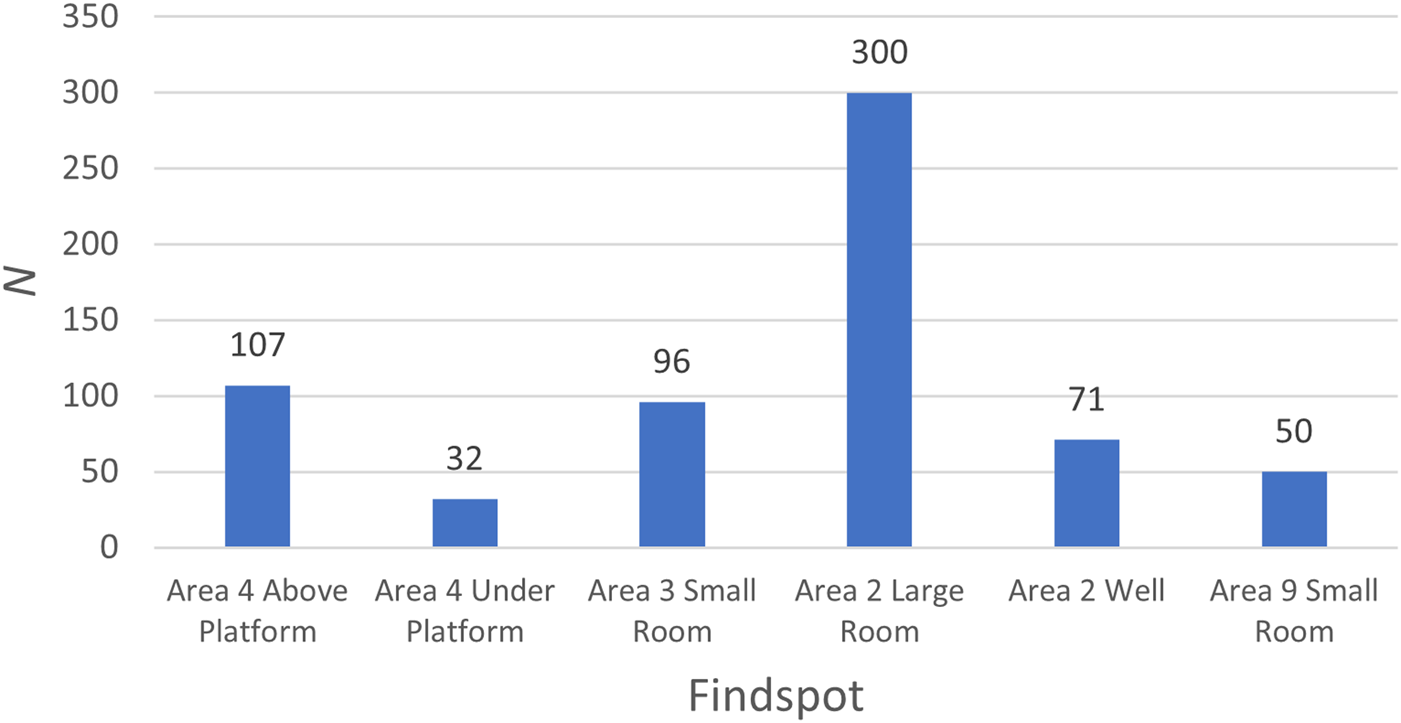
Most intriguing are the 1,071 lamp fragments that were found in association with the shrine: the largest quantity (300) was recovered from the Skene's main room, surrounded by benches, in Area 2 (Figs. 4 and 5; Table 1).Footnote 116 The abundance of lamp fragments found in the sanctuary may represent evidence for a lamp breakage ritual that involved dropping or impacting, which in turn would suggest collective cultic behavior. It is difficult to determine, though, whether the sherds resulted from intentional breakage or from natural depositional factors, such as earthquake tumble and mechanical weathering. We are in the earliest stages of lamp breakage analysis and must exercise caution when interpreting this type of evidence.
Lamp sherd quantity (N) by area. Shrine of Apollo. Tyre, Lebanon. (E. Lapp.)

A large number of lamp fragments were recovered from and around the basin in the small room (Area 3), suggesting that lamp offerings were made there. The lamp sherds may have resulted from intact votive lamps being dropped through the niche-opening in Wall A, causing them to break upon hitting the stone pavement. Alternatively, the fragments may have resulted from the intentional breaking of lamps by dropping or impacting them with an implement during a “killing” ritual performed in Area 2, after which they were gathered and deposited into the small room via the niche.Footnote 117 That earthquakes occurred in the region in 15, 130, and 306 CE may account for some of the lamp breakages. The lamp fragments could also have resulted from other post-use, depositional, mechanical factors, as discussed below in the experimental section of this article.
Lamp breakage rituals
The lamp offerings and large quantity of other objects found in (1) the western end of Area 2; (2) the well between Areas 1 and 2; and (3) the basin in Area 3, suggest this area was the focus of rituals associated with water.Footnote 118 Springs, wells, caves, pits, shafts, and other water sources were understood as possible entrances to the underworld.Footnote 119 The well located in the Skene was also likely perceived in this way. Additionally, lamp deposits attributed to pagan and pan-religious ritual practices associated with water and the underworld have been identified in Roman Palestine, including, for example, at the sacred well at the sanctuary of Mamre (Terebinthus), the ‘Ein Tzur spring, the Ḥammat Gader baths, the Te'omim Cave, and the sanctuary of Pan at Banias.Footnote 120 Lamp medallions were left as votive offerings at the Vocontian sanctuaries of Chastelard and Lachau, which were also associated with springs. That medallions with similar images were recovered from the Roman barge wreck at Arles suggests that they were tossed into the Rhône River in some kind of ritual associated again with water.
Fourteen clay lamps were found in the well located between Areas 1 and 2 (see Fig. 4) and may represent evidence for a lamp ritual whereby the lighting devices were deliberately tossed into the well as offerings of light to placate chthonic gods. Seven of the lamps belong to the Palestinian picture type (Broneer XXV), two to the Broneer XXIII group (like the British Museum replicas in this study), and five to the Northern Stamped group. None of the 14 lamps, though, shows evidence of intentional breakage. The practice of dropping clay lamps into the well, in general, indicates collective behavior. Seventy-one lamp sherds were also recovered from the well. We do not know if these were complete lamps that broke into fragments as a result of a ritual whereby the lamps were dropped or impacted with an implement on the shrine's stone pavement floor and then the fragments gathered and ceremoniously tossed into the well, or if the sherds simply represent depositional debris.
The excavators also report lamps buried beneath the shrine's various platforms, a practice evidenced at other sanctuaries in Lebanon as well.Footnote 121 Two grazing sheep or goats decorate the discus of a picture lamp (Broneer XXIII) found under the platform of the small basin room of the Skene in Area 3.Footnote 122 A similar picture lamp with possible grazing sheep portrayed on its discus was recovered from under the platform in Area 4.Footnote 123 Two Northern Stamped lamps had also been intentionally placed under the sarcophagus platform in Area 4.Footnote 124 Evidence for a similar lamp ritual was found at the Decapolis city of Gerasa (Jordan), where four unused, “new” lamps were buried beneath chamber W24 of the hippodrome as a foundation offering to placate the chthonic gods.Footnote 125 Two picture lamps recovered from the storehouse foundation offering at Roman Lattara were presumably deposited as photoamulets by the storehouse keepers in a ritual asking the gods, Lares or Penates, for protection.Footnote 126
In summary, the lychnological evidence from the Shrine of Apollo reveals several different rituals involving lamps. First, a number of picture lamps portray motifs associated with the cult of Apollo, thereby establishing a rare link between the sanctuary context and lamp-discus imagery. This suggests that worshippers chose their discus imagery carefully when purchasing lamps for use in the sanctuary. The connection between discus-image and context might further reflect cultic beliefs regarding lamp-light usage associated specifically with this shrine on a local level. Second, intentional lamp breakage is evidenced at the shrine by at least three picture lamps with missing discuses found in Area 2. Third, lamps were dropped into the well and one was placed under a platform in offertory rituals. Fourth, a portion of the hundreds of lamp sherds might reflect deliberate ritualistic lamp breaking by dropping or impacting, although natural causes and depositional factors may account for their breakage, too.
Drop, impact, puncture, and hammerstone experiments
Drop, impact, puncture, and hammerstone experiments were conducted on museum replicas of Broneer Type XXIII, the same picture lamp type that was most commonly found in the Shrine of Apollo at Tyre. As lamp fragments are typically excavated in greater quantities than complete lamps in sanctuary contexts, including Tyre's, it is important to conduct these experiments to better understand how picture lamps break, as well as to estimate perhaps the quantity and types of sherds that may have been generated in ancient breakage rituals.Footnote 127 The hammerstone test was performed with the intention of creating a picture lamp with a missing discus similar to the Palestinian example from Area 2 at Tyre, in addition to extracting a lamp medallion similar to those commonly found in the archaeological record. Sophisticated laboratory instrumentation was purposely not used for the breaking experiments because I wanted to more accurately recreate how in antiquity a clay picture lamp would break by cultic dropping or even by falling off a table in a Roman villa, for example, or being impacted by an actual stone tool and brick during a ritual.
Sample selection
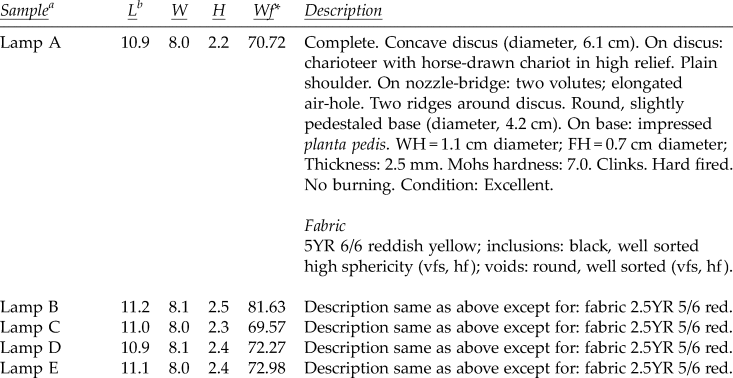
Five British Museum-produced, clay lamp replicas were selected for analysis (Fig. 6; Table 2). They were slip-cast in a plaster mold made from a plastic resin archetype of an original Roman lamp belonging to Broneer Type XXIII and Loeschcke Type IV.Footnote 128 The archetypal lamp was possibly manufactured between 40 and 70 CE in the Italian workshop of Caius Clodius, as suggested by the CCLOD Latin name positioned inside a planta pedis in relief on the base.Footnote 129 Unlike the original, the replicas used in the experiments are not slipped, and the same clay was not used for their manufacture. Examples of this lamp type have also been found in Israel and Jordan.Footnote 130
Replica picture lamp showing upper and lower halves and various body parts: d = discus; sh = shoulder; n = nozzle; n-b = nozzle-bridge; b = base; n u = nozzle underside; n-b u = nozzle-bridge underside; and u = underside. (E. Lapp.)

Macroscopic description of the picture lamp samples.

a British Museum replica of Broneer Type XXIII. 1st c. CE.
b Dimensions (in cm): L, length; W, width; H, height.
* Wf, total dry weight before breakage (in grams).
Macroscopic analysis
Before conducting the lamp breakage experiment, Lamps A–E were weighed separately using an Adam Equipment Core Series Compact Portable Balance Model CQT 202 with a 200 g capacity and a 0.01 g readability. This was necessary to determine how much weight loss occurred for each lamp after breakage. Following standard lychnological procedure, the macroscopic features of each lamp were then described (e.g., shape type, design, motifs, and fabric characteristics) (Table 2). The lamp fragments resulting from the breakage experiments, including the core bodies, were counted, weighed separately, and photographed. The respective morphological parts of the lamp from which they originated were identified. The complete assemblage of lamps and fragments was weighed to determine how much the lamp's weight was reduced due to breakage. Using estimated mean weight analysis, one can estimate the initial number of complete lamps at archaeological sites, such as at Aqaba, Jordan, where few intact lamps but numerous lamp sherds have been found.Footnote 131 When applied to large quantities of lamp sherds recovered from sanctuaries, including those from Tyre's Shrine of Apollo, mean weight analysis should provide a more accurate picture as to the number of lamps used in rituals.
Drop test
A drop test was conducted on Lamps A–C, applying the following methodology for each lamp. First, a complete lamp was placed onto a flat, marble table surface. Next, the lamp was gently slid off the table surface onto a glazed, terracotta tile floor. The hardness of the tile floor is Mohs 3.0. The surface of the table stands at a height of 76.0 cm from the floor. The sherds were placed into a small plastic container marked “Stage 1: Lamp Breakage,” and sealed for future reference. In Stage 2, the core body was placed again onto the table surface, then repeating the method above, was gently pushed off the table onto the floor. The findings were recorded again. The resulting sherds were placed into a small plastic container marked “Stage 2: Lamp Breakage.”
Impact test
An impact test was conducted on Lamp D using the following methodology. The lamp was placed onto a terracotta tile floor below the edge of the same tabletop used in the drop test. Simulating earthquake tumble, a brick was dropped on top of Lamp D from a height of 40.0 cm. The brick weighs 3.20 kg and has a Mohs hardness of 3.0. Its dimensions are length = 23.0 cm; width = 10.5 cm; height = 7.7 cm. It was made by hand following 18th-c. techniques in the brick workshop located at Colonial Williamsburg, Virginia, where it was purchased in the Prentis Store. The resulting sherds were recorded following the same procedure as for the drop test, above. They were placed into a small plastic container marked as “Stage 1: Impact Test.”
Puncture test
A puncture test was conducted on Lamp E. An elongated marble stone with a blunt head was selected for use as a puncture tool. Taking the stone into the right hand and holding the lamp firmly on a stable and horizontal surface with the other, firm pressure was applied against the edge of the filling-hole of the discus – presumably the weakest point of the discus. This procedure was repeated five times.
Hammerstone test
A hammerstone test was conducted on Lamp E. The lamp was held firmly on top of a hard tabletop surface, then its central concave discus was struck in the area of the filling-hole (presumably the weakest point) with two firm blows, using a large, well-rounded, smooth, elliptical-shaped, limestone river pebble (5.0 cm × 3.5 cm). Stone-pebbles were used as tools in the Roman period; for example, a stone-pebble polisher was recovered from the pottery workshop at Sagalassos.Footnote 132 For this reason, I selected a stone-pebble for this experiment, as it would have been a common and naturally occurring tool of the type that might have been used to break the central discuses of picture lamps.
Results of the experiments
On average, Lamps A–C generated seven sherds after the first drop experiment. By contrast, Lamp D yielded as many as 67 sherds after sustaining a single impact. Four types of lamp sherds were generated from the breakage experiments: 1) core (drop and impact); 2) angular “chips” (drop, impact, and hammerstone); 3) cubicles (drop and impact); and 4) flakes (drop and impact) (Fig. 7). The body core is typically the largest fragment, comprising part of the base and lower wall of the lamp and in some instances, also parts of the lighting vessel's upper half (e.g., shoulder, discus, and nozzle). Angular chips are the most common sherd type resulting from breakage and are characterized by sharp-edged and highly angular fragments. In some cases, enough of the discus motif is preserved on the chip to constitute a chip-type medallion. Cubicles are miniscule, thick, cube-shaped fragments that typically originate from the join between the upper and lower halves of the lamp. Flakes are paper-thin and miniscule fragments indicative of extreme force encountered by the lamp body. Four angular chip sherds resulted from the breaking of the discus of Lamp E.
Types of lamp sherds generated from drop and impact experiments. (E. Lapp.)

Drop test
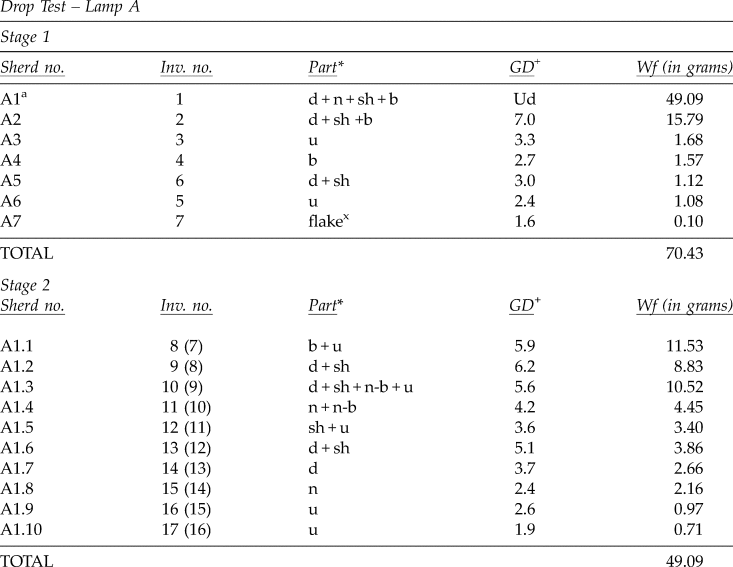
After two drops (Stages 1 and 2), Lamp A broke into 16 fragments (Fig. 8; Table 3). The weight of the lamp decreased from its initial 70.72 g to 70.43 g, a 0.29 g or 0.41% loss of weight. In Stage 1, 21.34 g of sherds were created (excluding the body core). In Stage 1, Lamp A sustained minimal damage to its body. Only six fragments broke away from the core (A2–A7): the largest fragment (approximately 15% preserved) included the upper back and lower shoulder with part of the discus, while the remaining smaller sherds were a discus/shoulder, base, and underside. Approximately 80% of the lamp's core body – all of the nozzle and most of the discus and base – was preserved. The nozzle survived fully intact. Most of the discus and base were also preserved. Upon hitting the floor, the lamp shattered immediately and made a loud and explosive “popping” sound. This sound may be explained as a quick release of air from the vessel's hollow fuel chamber when it hit the floor.
Lamp A sherd generation after Stage 1 (left) and Stage 2 (right) drop experiments. The sherds were arranged by the author for clarity. (E. Lapp.)

Drop test results, Lamp A sherd creation and weights.

*For a definition of abbreviations and location of lamp parts, see Fig. 6: a core sherd A1 not included in final total of A2-A1.10; x flake included in sherd count as it is large; initial total Wf of complete Lamp A: 70.72; total Wf of resulting fragments after Stages 1 & 2: 70.43; Wf loss of Lamp A after Stage 1 & 2 breakage: 0.29 (or 0.41%); Stage 1, Wf of Lamp A body core after breakage: 49.38; total Wf of resulting fragments after Stage 1: 70.43; Stage 2, Wf of Lamp A body core after breakage: 49.09.
In Stage 2, damage to Lamp A was substantially greater (Fig. 8; Table 3). The body core fractured into ten sherds totaling 49.09 g. Base sherd A1.1 (approximately 30% preserved) was the largest. Although it survived the Stage 1 drop fully intact, the nozzle fragmented into four sherds (A1.3, A1.4, A1.8, and A1.9) during the second-stage drop. It is important to note that no circular lamp medallions resulted from either of the two drops. However, a single lamp medallion of the “chip” variety (A1.7) was created in Stage 2, as were two additional angular discus fragments (A1.2 and A1.6), exhibiting a pair of lateral and parallel fractures. After both drops, most of the base diameter was preserved and the planta pedis survived completely. The three largest sherds included the base and discus fragments.
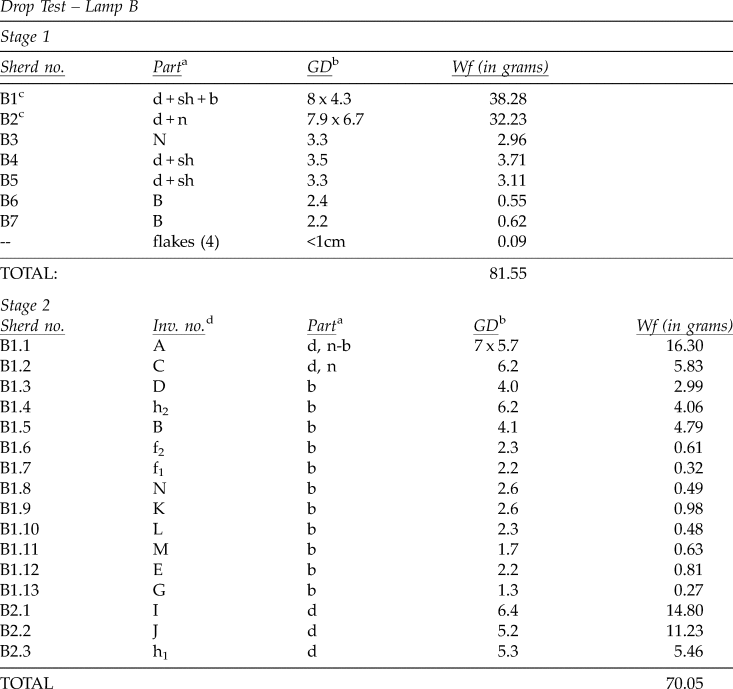
The drop test conducted on Lamp B resulted in the creation of 21 sherds (B3–B7, B1.1–B.13, and B2.1–B2.3; Fig. 9; Table 4). Similar to Lamp A, a body core fragment (B1) was generated after the first drop (Stage 1) and minimal damage to the morphology of the lamp occurred. Only six sherds broke away from the lamp's body in Stage 1 and four flakes were produced. However, as a result of the Stage 2 drop of fragments B1 and B2, 14 new sherds were created and the damage to the lamp's morphology was severe. A medallion of the angular “chip” variety resulted from the drop test conducted on Lamp B (Fig. 9, B2.3).
Lamp B sherd generation after Stage 1 (left) and Stage 2 (right) drop experiments. The sherds were arranged by the author for clarity. (E. Lapp.)

Drop test results, Lamp B sherd creation and weights.

aFor a definition of abbreviations and location of lamp parts, see Fig. 6; b greatest dimension (GD) in cm; c core sherd, not included in final total; ud, undetermined; d inventory number marked in pen on sherd during experiment; initial total Wf of complete Lamp B: 81.63; total Wf of resulting fragments after Stages 1: 81.55; total Wf of sherds resulting after Stage 2: 70.05; Wf loss of Lamp B after Stage 1: 0.08 (or 0.09%); Wf loss of Lamp B after Stage 2 breakage: 11.58 (or 14.19%); final total Wf of sherds resulting after Stages 1 and 2: 81.09; final total Wf loss of Lamp B after Stage 1 and 2 breakage: 0.54 (or 0.66%).
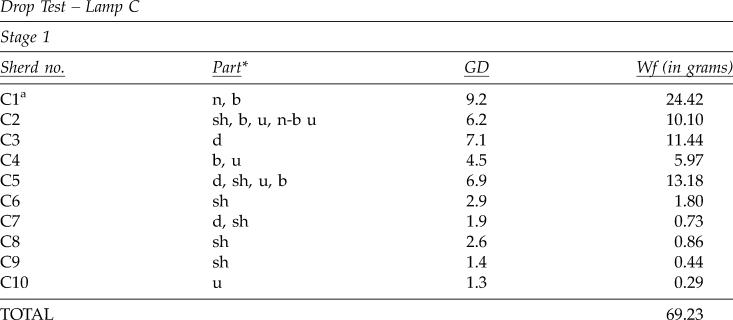
Only one drop test was performed on Lamp C, which generated ten sherds (C1–C10; Fig. 10; Table 5). Unlike Lamps A and B, Lamp C sustained slightly greater initial damage to its body in Stage 1. An identifiable core resulted. Cubicle-type sherds were also first encountered in Stage 1 (Fig. 10, C9–10). For all three lamps, the drop tests consistently produced a scattered sherd distribution pattern (Fig. 11).Footnote 133
Lamp C sherd generation after Stage 1 drop experiment. The sherds were arranged by the author for clarity. (E. Lapp.)

Sherd scatter pattern resulting from drop experiment (Stage 2) conducted on Lamp B. (E. Lapp.)

Drop test results, Lamp C sherd creation and weights.

*For a definition of abbreviations and location of lamp parts, see Fig. 6; a core sherd; initial total Wf of complete Lamp C: 69.57; total Wf of resulting fragments after Stage 1: 69.23; Wf loss of Lamp C after Stage 1 breakage: 0.34 (or 0.49%); Stage 1, Wf of Lamp C body core after breakage: 24.42; total Wf of resulting fragments after Stage 1: 69.23.
Impact test
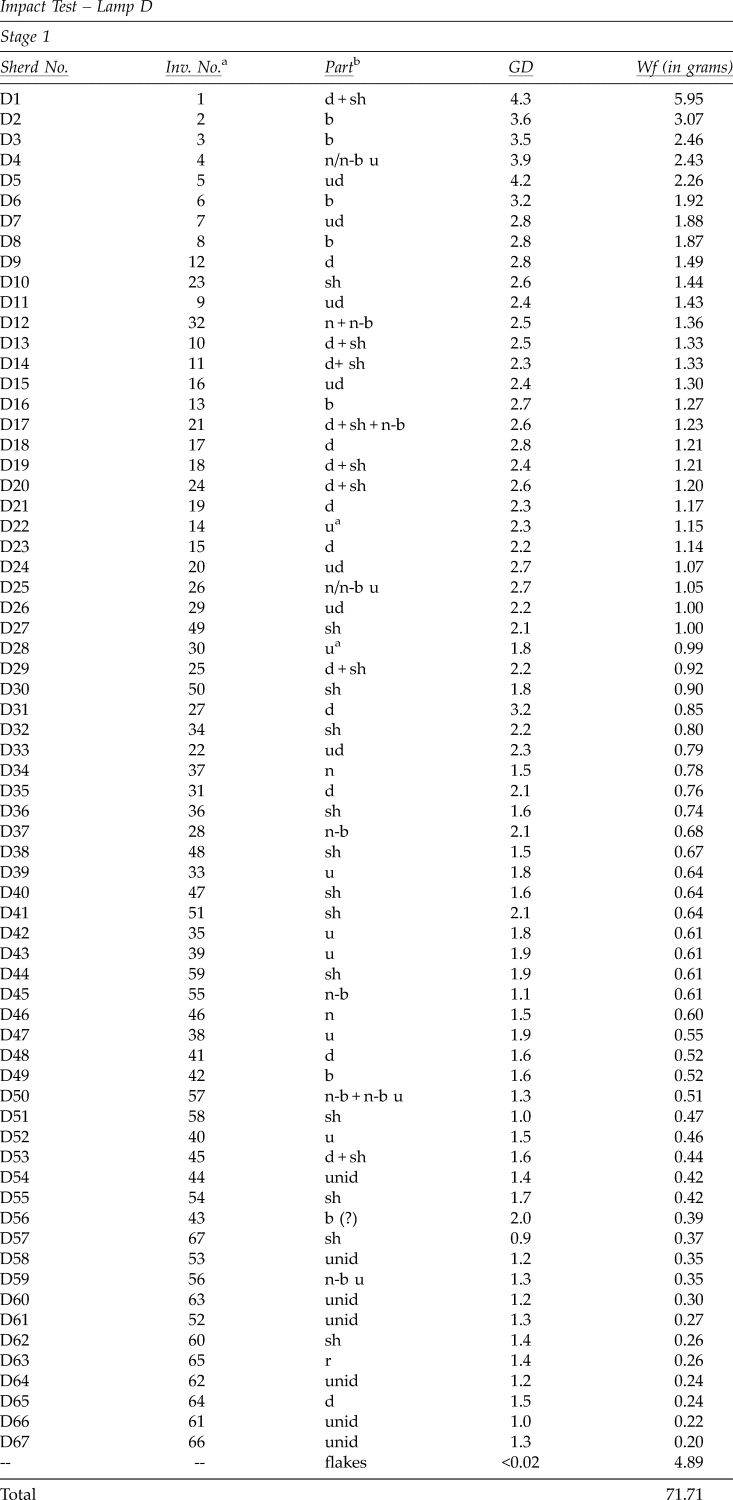
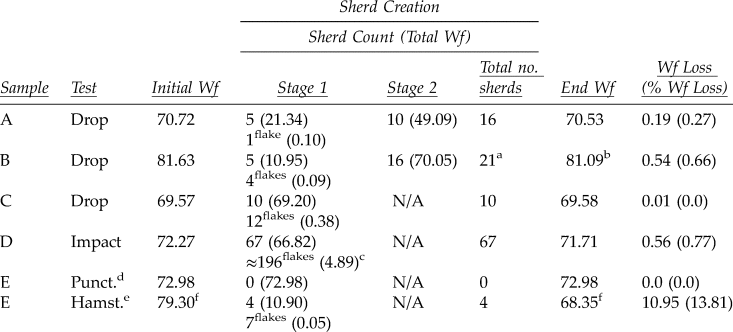
The impact test conducted on Lamp D resulted in the creation of 67 sherds (D1–D67) and at least 196 flakes, the highest generation of fragments and flakes among all the breakage methods tested (Fig. 12; Table 6). This finding underscores the highly destructive effect of a heavy object impacting a clay picture lamp.Footnote 134 The weight of the lamp decreased from its initial 72.27 g to 71.71 g, a 0.56 g or 0.77% loss. In Stage 1, 71.71 g of sherds were created (excluding the body core). Lamp D sustained substantial damage, so much so that morphologically it was no longer recognizable as a lamp. Destruction was considerably more pronounced than that resulting from the three drop tests, in which body cores were recognizable as lamps (A1, B1, B2, and C1). Lamp D broke into angular “chips,” cubicles, and flakes. Unlike the drop tests, however, no core fragments resulted from the brick impact. Cubicle-type sherds were more abundant (Fig. 12, e.g., D53, D55, D57), which is indicative of the extreme trauma caused by a heavy object striking the lighting device. Lamp medallions of the angular “chip” variety also resulted (Fig. 12, D12 and D15). The impact test generated a concentrated sherd distribution pattern (Fig. 13). Overall, a high percentage of the sherd weight of Lamps A–D was preserved after the drop and impact tests (an average 0.43% loss).
Lamp D sherd generation after impact experiment. (E. Lapp.)

Concentrated sherd pattern resulting from impact experiment conducted on Lamp D. (E. Lapp.)

Impact test results, Lamp D sherd creation and weights.

*For a definition of abbreviations and location of lamp parts, see Fig. 6; a inventory number marked in pen on sherd during experiment; b remnant of plain flat shoulder; r, ridges around discus only; unid = unidentifiable; initial total Wf of complete Lamp D: 72.27; total Wf of resulting fragments after Stage 1: 71.71; Wf loss of Lamp D after Stage 1 breakage: 0.56 (or 0.77%); Stage 1, Wf of Lamp D body core after breakage: 0.0, no body core created.
Puncture test
The puncture test conducted on Lamp E failed to produce any lamp sherds. After five attempts to apply considerable pressure against the edge of the filling-hole, the central discus failed to puncture or for that matter, even fracture. It became obvious that breaking out a discus-medallion with a puncturing implement required some expertise (if it was possible at all without smashing the entire lamp): the discus was simply too hard to puncture. To determine whether intense heat would somehow weaken the discus sufficiently for puncturing to be successful, Lamp E was lit and extinguished repeatedly over five days. A second puncture test was then carried out following the procedure outlined above. Again, no breakage resulted. Thus, the results of the test indicate that in antiquity, puncturing, at least with a stone tool, was probably not the method used to break out the discus to create medallions.
Hammerstone test
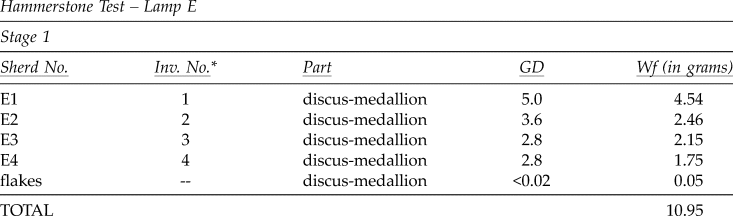
The hammerstone test conducted on Lamp E resulted in the creation of four lamp medallions of the angular “chip” variety (Figs. 14 and 15, E1–E4; Table 7). The weight of the lamp decreased from its initial 79.30 g to 68.35 g, a 10.95 g or 13.81% loss of weight. In Stage 1, 10.95 g of sherds were created. Except for a missing discus, Lamp E's morphology was fully preserved after the Stage 1 impacts, and it remained functional and recognizable as an oil lamp. As a result of the second strike, the discus shattered loudly as if made of glass, reflecting the hard firing of the lamp fabric. This test demonstrated that the most effective and controlled means of producing discus-medallion “chips” is the intentional breakage of the discus with a hammerstone tool. It suggests that such chip-medallions found in the archaeological record were created from the deliberate breakage of the discus by the ancient lamp user by dropping or impacting with a brick or hammerstone (Fig. 8, A1.7; Fig. 12, D12 and D15; Fig. 15, E1-4; Table 8).
Picture lamp replica intentionally broken using a hammerstone (lower right) and showing lamp medallions in situ (left). The white marble tool used for the puncture experiment is also shown (upper right). (E. Lapp.)

Picture lamp replica intentionally broken using a hammerstone and showing missing discus and resulting lamp chip-type medallions (arranged by author). (E. Lapp.)

Hammerstone test results, Lamp E lamp medallion-sherd creation and weights.

*Inventory number marked in pen on sherd during experiment; initial total Wf of complete Lamp E: 79.30; Wf of Lamp E after discus-medallion creation: 68.35; Wf loss of Sample E after Stage 1 breakage: 10.95 (or 13.81%). Note: weight of lamp and sherds includes olive oil saturated fabric. For images of discus-type medallions, see Figs. 14 and 15.
Comparison of lamp breakage experiment results.

aCore sherds B1 and B2 are not included in total number of sherds created, but the fragments resulting in their breakage in Stage 2 are included; b the end Wf excludes weights of Stage 1 core sherds B1 and B2 because they were further broken in Stage 2, where the weights of their respective resulting fragments are included in the final total Wf value; c average = 0.025 g per flake; d puncture; e hammerstone; f lamp fabric saturated with olive oil, see Table 7; N/A, not applicable because Stage 2 was not conducted.
Hammerstone impacts, however, failed to create round-type lamp medallions. So, if the drop, impact, puncture, and hammerstone methods failed to generate round discus-medallions, how then were they created? One plausible explanation is that some lamp medallions of the round variety were manufactured separately in a mold, as a detailed study of the pottery recovered from the Kerameikos has already demonstrated.Footnote 135 This method, however, does not explain the relatively common roundish medallions with jagged edges, which suggest the extraction of the lamps’ central discuses by deliberate breakage.
Metal instruments and tools may have been used to extract complete medallions from clay picture lamps. Medical surgical instruments are certainly precise, but they would have been accessible only to a few. Small metal shears were probably the most easily available tool among everyday folks for cutting and snipping the discus out of the lamp. The jagged, haphazard edges of several medallions found at the Vocontian sanctuaries and the Arles-Rhône indicate cutting,Footnote 136 as do the snipped edges exhibited by the Tarsus lamp medallion with Athena (Fig. 1) and the sharp and angular edges of the discus-openings of the Beth Shean and Qiryat Tiv'on lamps. An alternative method might have been the insertion of the tip of a small, finger-length saw into the filling-hole, where the cutting around the discus would begin. A small hammer and chisel might work, too, but one would have to be careful not to shatter the discus with the forceful pounding motion. A taut, back-and-forth motion with a metal wire or string inserted into the filling-hole could plausibly create a cut around the motif, depending on the softness of the lamp fabric, as a result of friction. The base of the lamp would need to be missing, though, to perform this arduous task.
Common tools recovered from the Roman-period pottery workshop excavations at Sagalassos, particularly iron hairpins, stylus point-tools, and fettling knives,Footnote 137 are the types of tools that could have been used to make incisions around the discus-motifs of picture lamps to extract medallions. These tools not only occur in pottery workshops, but are also common and available in domestic contexts, such as the Patrician House and Lintel House at Meiron.Footnote 138 The iron nails and hooks recovered from the sanctuary at Lachau have been interpreted as votive objectsFootnote 139 but would have been sufficiently sharp and pointed to cut around the discus for its extraction. In most cases, a discus image would be easier to extract from a picture lamp manufactured with a soft-fired calcium carbonate clay than with a hard-fired, brittle clay.
As the results of the hammerstone experiment substantiate, the central discus of a picture lamp can be easily broken without destroying the vessel's body using quick firm strikes with a large pebble. Medallion chips are also generated using this method, should the lamp-owner desire them. However, as I have explained, the extraction of a complete round medallion with the discus scene still intact poses a greater challenge. Did worshippers remove discuses in domestic settings before arriving at a cave sanctuary or sacred spring where they would toss the medallions during rituals? Or did they bring their tools with them to perform this procedure?
Conclusion
Picture lamps with missing discuses and lamp medallions represent the most common, usually identifiable archaeological evidence for intentional lamp breakage rituals in the Roman world. This “broken-discus” phenomenon is most prevalent in Roman Palestine but is by no means unique to that region, as, for example, the medallions recovered at the Vocontian sanctuaries and Arles-Rhône shipwreck in southern France indicate. Breakage rituals using picture lamps were practiced by both pagans and monotheists, but probably for different reasons, governed by religion, cult, regionalism, urban cosmopolitanism, or rural cultural norms. The decision to break the discus of a picture lamp reflects either an individual choice (Beth Shean, Qir'at Tivon, and the Shrine of Apollo at Tyre) or collective behavior (Apollonia and Lachau). The main incentive for lamp-breaking centered on the lamp discus, primarily its extraction or mutilation. The hammerstone experiment of this study confirms that a dedicant could break the discus with two quick strikes using a common, large pebble-stone tool. The mechanical drop and impact experiments of this study further demonstrate how picture lamps break, in addition to casting light on the quantity and the types of sherds created. Future breakage experiments should be conducted on replicas of different Roman-period lamp types to compare how they break, too, and to determine whether the types and quantities of sherds produced are specific to the respective lamp groups. The sherd dispersion patterns resulting from the experiments may aid lychnologists in identifying whether drop rituals were performed in sanctuaries, as reflected by scatter patterns, or impact rituals, as suggested by concentrated patterns. In light of the findings presented in this study, it is proposed that lamp fragments receive more analytical attention and be viewed through a new lens: namely, whether they result from drop and/or impact rituals, represent the residual sherds of intentional discus breaking and medallion extraction, or were simply caused by practical, post-depositional, or non-human factors.