INTRODUCTION
This article makes use of recently published graves to offer the first synthetic analysis of the typology and topography of Spartan burials in the Protogeometric to Hellenistic period that is founded on archaeological evidence rather than textual sources. The analysis offers new insights into the settlement organisation of Sparta, and it has significant ramifications for the current understanding of burial practices in both Sparta and other Greek communities.
Our knowledge of the typology and topography of Spartan burial practice in the Protogeometric to Hellenistic period has long been based almost entirely on a small collection of literary and epigraphic texts.Footnote 1 This collection of evidence suggests that the enactment of the so-called Lycurgan reforms, probably sometime in the seventh century, had a profound effect on Spartan burial practices.Footnote 2 More specifically, the textual sources suggest that after the Lycurgan reforms, Spartan burials were, in terms of typology, notably austere, in that grave-goods and grave-markers were largely proscribed and that, in terms of topography, Spartan burials were unusual because there was no prohibition on intracommunal graves for adults.Footnote 3 The absence of any excavated pre-Roman cemeteries led modern scholars to conclude that, as long as the Lycurgan customs were in effect, all burials in Sparta were intracommunal and that very few tombs had been found because they had been destroyed by later building activity, particularly during the Hellenistic and Roman periods.Footnote 4
Burial practice has, as a result, been seen as one of many ways in which Sparta was an outlier when compared with other Greek poleis. Indeed, Spartan burial practice has been portrayed as the structural inversion of that found in other Greek poleis, in which intracommunal burial for adults, ostensibly at least, ceased after the end of the Geometric period.Footnote 5
The aforementioned recently published graves offer a different picture of Spartan burial practices. It is now clear that there was at least one organised cemetery, which was located at the south-western edge of the city, in the Archaic, Classical and Hellenistic periods. What would normally be described as extramural burials did, therefore, take place, but intracommunal burials of adults continued to be made in Sparta throughout the Archaic, Classical and Hellenistic periods. The intracommunal burials in question were not distributed randomly throughout Sparta, but instead seem to have been concentrated along important roads through the city and on the slopes of a line of low hills that extend south-east from Palaiokastro hill.
The emergent understanding of Spartan burial practice takes on added significance when it is placed in a wider context. The most obvious comparanda are the poleis close to Sparta, Argos and Corinth, where the numerous excavations carried out by French, Greek and American archaeologists have yielded a considerable body of evidence bearing on funerary customs. As will become apparent, in any given period, burial practices in Sparta align closely with those found in Argos and Corinth. Indeed, the burial practices of Sparta, rather than being exceptional, are notably similar to those of its most important Peloponnesian neighbours.
One might well wonder how the issue of intracommunal burials fits into all of this, since the coexistence of both extracommunal and intracommunal adult burials in the Archaic, Classical and Hellenistic periods would seem to set Sparta apart from all other Greek communities. Recent scholarship on Argive burials has made it clear that there too adults were buried both extracommunally and intracommunally in the Archaic, Classical and Hellenistic periods, and that intracommunal burials were located along major roads. Sparta and Argos thus align well with Corinth, where intracommunal cemeteries continued in use throughout the Hellenistic period. Moreover, ongoing excavations in Attica have shown that intracommunal burials continued to take place in at least some demes throughout the Classical period (see below for further discussion).
The finding that adults were buried both extracommunally and intracommunally in Sparta, Argos, Corinth and some places in Attica after the Geometric period calls into question the standard narrative of the development of Greek burial practice in the post-Mycenaean period. While it remains true that there was throughout the Greek world a strong and noticeable shift toward extracommunal burial after the Geometric period, in some communities, including Sparta, the emergence of extracommunal cemeteries did not put an end to intracommunal burials for adults.
NEW EVIDENCE FROM SPARTA
This is a propitious time to examine Spartan burial practice because excavations carried out over the past 20 years have vastly increased the quantity and quality of relevant archaeological evidence. When Stephen Hodkinson published his seminal Property and Wealth in Classical Sparta in 2000, he included a catalogue of all the known, dated graves from the roughly nine centuries between the end of the Bronze Age and the Early Hellenistic period, and came up with a total of 12. None of these dozen graves came from the period between 550 and 200, and Hodkinson describes the complete absence of Late Archaic, Classical and Early Hellenistic graves in Sparta as an ‘astonishing archaeological lacuna whose full explanation is far from clear’ (Hodkinson Reference Hodkinson2000, 238–40, 243).
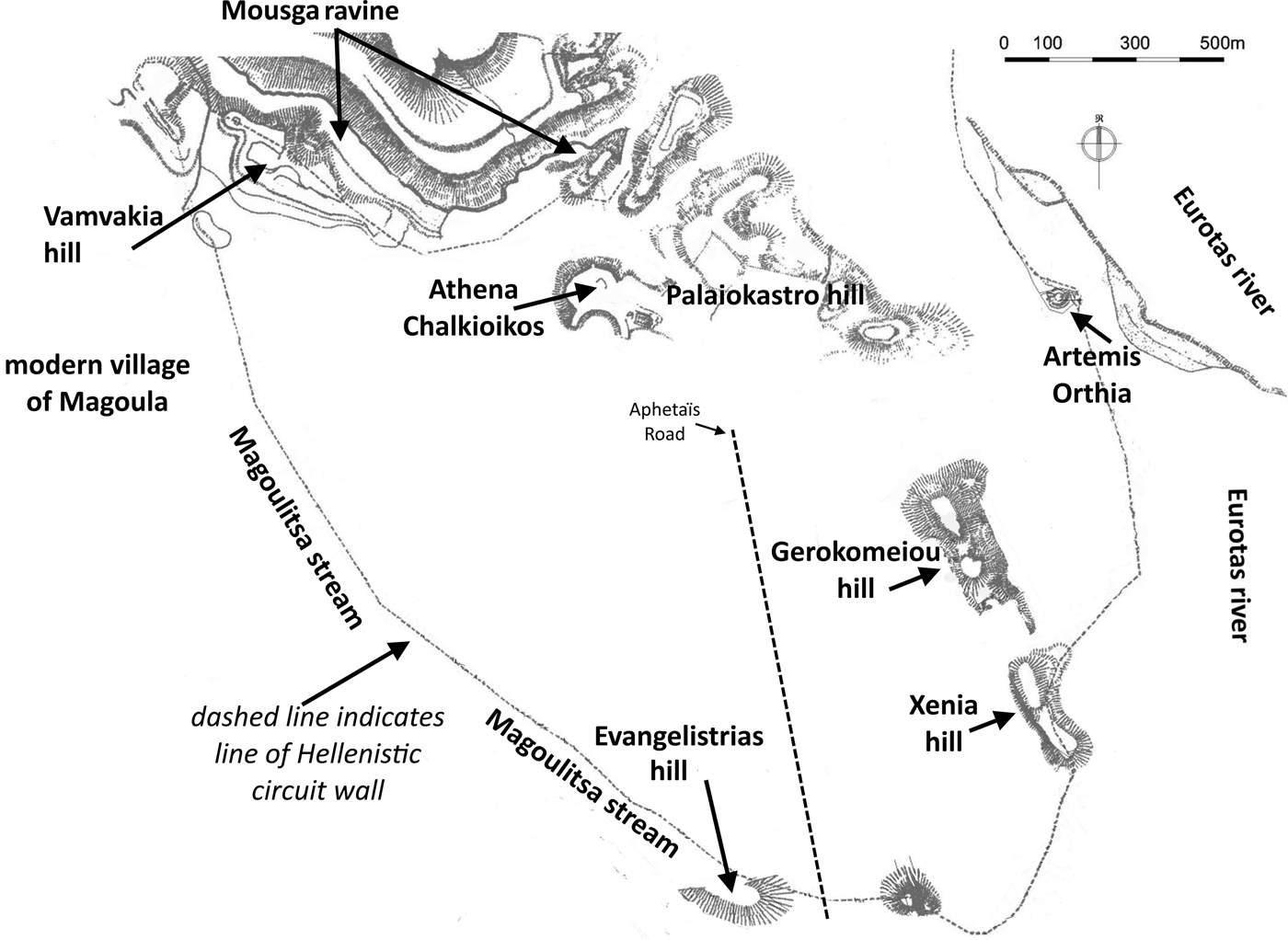
It is now evident that the lacuna in question was the product of the history of excavations in modern Sparta, which in 1834 was intentionally situated directly on top of the ancient city (Matalas Reference Matalas, Voutsaki and Cartledge2017, 48–9). A limited number of small digs were carried out in Sparta in the course of the nineteenth century, and in the first three decades of the twentieth century members of the British School at Athens spent ten seasons (1906–10, 1924–8) excavating in Sparta. The British archaeologists concentrated their efforts in three areas (Fig. 1): (1) Palaiokastro hill, the acropolis of ancient Sparta,Footnote 6 where they excavated a large stoa and theatre, both of Roman date, and the sanctuary of Sparta's patron deity, Athena Chalkioikos; (2) the western bank of the Eurotas river, where they excavated a string of cult sites, by far the most important of which is the Sanctuary of Artemis Orthia; and (3) the Sanctuary of Menelaos and Helen, to the south of Sparta, high above the eastern bank of the Eurotas. The British School sponsored further excavations at the Menelaion starting in 1973 and additional work on the Roman stoa and theatre starting in 1988 (on the work of the British School in Sparta, see Catling Reference Catling, Cavanagh and Walker1998).
Major topographical features of ancient Sparta.
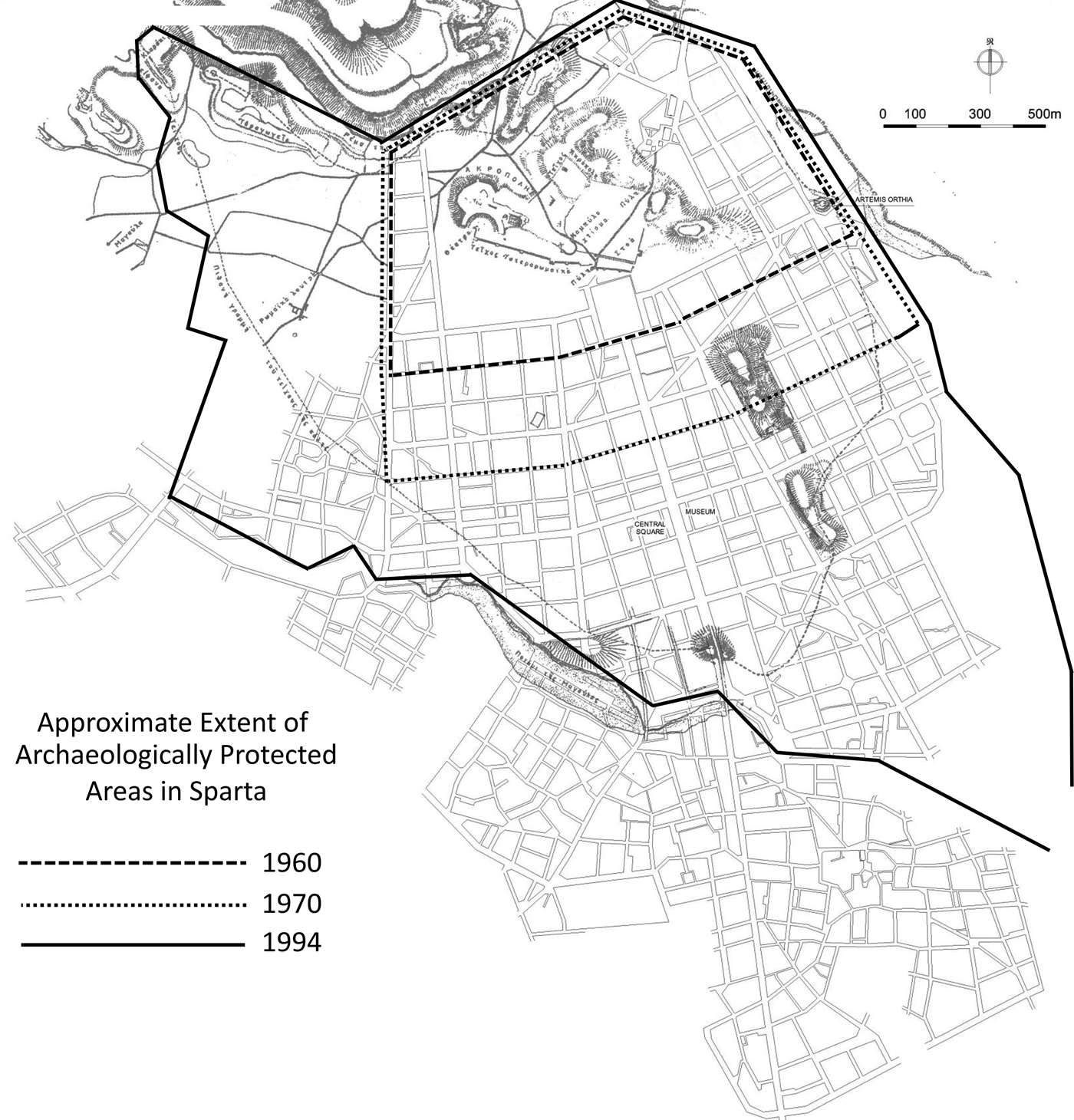
Since 1928 Greek archaeologists have undertaken the majority of the excavations that have been carried out in the city of Sparta, and most of their work has taken the form of rescue excavations (Raftopoulou Reference Raftopoulou and Zapheiropoulou2006b). Until quite recently the spatial dispersion of such excavations was sharply circumscribed by the fact that only a small portion of Sparta was classified as an archaeologically protected zone. The relevant series of decrees began in 1960 when the area within the Late Roman fortification wall on Palaiokastro hill and an area extending outward 500 m on all sides of that wall was designated as a protected site (Fig. 2). In 1970 that area was extended a few blocks further south. Finally, in 1994–5 decrees were issued that extended protection to the entire area of the ancient city of Sparta.Footnote 7
Development of archaeologically protected areas of Sparta (after Raftopoulou Reference Raftopoulou and Zapheiropoulou2006b, fig. 1).
Hence, despite its obvious importance in the Greek world, Sparta has never been the subject of a sustained, wide-ranging programme of excavation along the lines of those carried out in places such as Athens, Corinth, Delphi and Olympia. Moreover, their siting and the number of digs in Sparta were such as to reduce the likelihood of finding any significant numbers of graves. The chances that the British archaeologists would find graves were sharply curtailed by the fact that they focused their work on large public buildings and cult sites — not places where one would expect to find burials. The chances that the Greek archaeologists would find graves were sharply curtailed by the fact that their work took place mostly within the archaeologically protected zone on Palaiokastro hill (the site of the acropolis of ancient Sparta and not an obvious location for burials). Indeed, between 1979 and 1994 Greek archaeologists excavated only five plots in the entire area of Sparta outside the archaeologically protected zone (Raftopoulou Reference Raftopoulou and Zapheiropoulou2006b, 405; see also Pikoulas Reference Pikoulas1988).
Two cemeteries in Sparta were known prior to 1994. Part of a Roman cemetery, located in the Mousga ravine on the northern edge of the city, was excavated in the 1930s (Adamantiou Reference Adamantiou1931; Reference Adamantiou1934), and other graves belonging to that same cemetery have been uncovered more recently (see, e.g., Zavvou Reference Zavvou1994; Themos and Zavvou Reference Themos and Zavvou2001). An Early Christian cemetery in the centre of modern Sparta was located and excavated in the 1960s as the result of the construction of a vegetable market (Delivorrias Reference Delivorrias1969a; Bakourou Reference Bakourou1989–91).
Our knowledge of Spartan burial practice was immediately and dramatically increased as a result of the extension of archaeological protection to the entirety of the ancient city. A considerable amount of building activity was taking place in Sparta at that time, which, due to the aforementioned decrees of 1994–5, meant that rescue excavations had to be carried out on a regular basis. The result was that, for the first time, a substantial number of digs were undertaken across much of the area covered by the ancient city. In 1994 a rescue excavation near the Magoulitsa stream uncovered part of a Roman cemetery, and subsequent work in that area has revealed nearly 1,000 graves (Fig. 3).Footnote 8 In 2008 another rescue excavation in the area alongside the Magoulitsa brought to light part of a second cemetery, which came into use in the Archaic period and which, as it is preserved today, contains 69 graves dating to the Archaic, Classical and Early Hellenistic periods (preliminary reports can be found in Tsouli Reference Tsouli and Sporn2013; Reference Tsouli, Draycott and Stamatopoulou2016; see below for further discussion). (Both of these cemeteries are located in the south-western part of Sparta; in order to avoid confusion between the two cemeteries, the Roman-era cemetery is here referred to as the Southwest Cemetery, whereas the Archaic to Hellenistic cemetery, which is located quite close to the Olive Oil Museum, is referred to as the Olive Oil Cemetery.)
Locations of newly discovered cemeteries in Sparta.

Recent rescue excavations elsewhere in Sparta have regularly uncovered graves of all periods, both individually and in clusters. The number of graves from Sparta dating from the Protogeometric to the Hellenistic period now stands at over 200, and this total increases each time rescue excavations in Sparta are reported.Footnote 9 We are thus, for the first time, now in a position to draw on material evidence from Sparta to construct a picture of Spartan burial practice.
However, a considerable amount of effort is entailed in actualising the potential that resides in the new finds. Preliminary reports on the excavations in the two aforementioned cemeteries have appeared in print, and some finds have been summarised in published conference proceedings, but otherwise reports of the pertinent excavations have been dispersed among dozens of articles in the Archaiologikon Deltion that have appeared over the course of the past 20 years. The information contained in these articles needs to be assembled and organised in order to make it analytically useful. I have, therefore, undertaken to assemble and organise the relevant evidence, something that, to my knowledge, has not as yet been done in print.Footnote 10
TERMINOLOGY, SPATIAL AND TEMPORAL PARAMETERS, LIMITATIONS ON SUBJECT MATTER
Before proceeding further it will be helpful to establish some basic terminology, to outline the rationale behind the temporal and spatial limits of the study that follows and to note some limitations on the range of subject matter that will be discussed. The ancient terminology pertaining to the city of Sparta and the geographical region and political unit that encompassed it was complex and evolved over the course of time. It is common practice in the present day to use the term ‘Sparta’ in a broad sense, and hence, for example, to write about the ‘Spartan state’ or ‘Spartan warriors’. This usage is in many ways convenient, but it is also vague and potentially misleading, not least because it implicitly equates the entire state with the city of Sparta and the relatively small group of full citizens, Spartiates, who for the most part lived in the city of Sparta. In the interests of clarity, ‘Sparta’ is here given a more restricted meaning as the designation of an urban centre, rather than a state or ethnicity; the geographical region in which Sparta was located is here called Lakonia; the political unit of which Sparta was the capital city (a political unit that included Lakonia and the region of Messenia) is here called Lakedaimon.Footnote 11 As a result, ‘Spartans’ refers in what follows to the residents of Sparta. It is likely that after the Lycurgan reforms most of the residents of Sparta were Spartiates and that the majority of individuals who received formal burial in Sparta were Spartiates. The de jure and de facto social and political groupings among the residents of Sparta prior to the Lycurgan reforms are murky at best (see, e.g., Nafissi Reference Nafissi1991, 35–51; the articles collected in Luther, Meier and Thommen Reference Luther, Meier and Thommen2006).
The space occupied by the ancient city of Sparta was for the most part delimited by natural features: the Mousga ravine on the north, the Eurotas river on the east and the Magoulitsa stream, running diagonally from north-west to south-east, on the west and south (Fig. 1) (Polybius 5.22.1–5; Kourinou Reference Kourinou2000, 21–3). The existence of an expanse of relatively flat ground between Palaiokastro hill and the Magoulitsa stream meant that there was no natural border on the north-western side of the city.
The area delimited by these features was occupied by the four villages – Kynosoura, Limnai, Mesoa and Pitana – that made up the original core of the Lakedaimonian polis.Footnote 12 Sparta was unusual because it remained unfortified until the Hellenistic period and because, prior to the Late Hellenistic or Early Roman period, the four villages seem to have remained distinct physical units that were separated by open or at least less densely settled spaces. When a circuit wall was built in the second half of the third century it followed the general lines of the Mousga, Eurotas and Magoulitsa (Fig. 1). Some parts of the village of Pitana, which extended into the flat ground on the north-western side of the city, where the present-day village of Magoula is situated, were left outside the wall.
Sparta can, for present purposes, thus be defined from a spatial perspective as consisting of the area within the wall circuit as well as the area of the modern village of Magoula. The (physically quite separate) village of Amyklai, located approximately 5 km south of Sparta, was politically incorporated into the Lakedaimonian state at an early date (probably sometime in the first half of the eighth century), and its residents, unlike all the other inhabitants of the Lakedaimonian state, enjoyed the same rights and privileges as the residents of the original four villages of Sparta (Cartledge Reference Cartledge2002, 92–4). Excavated graves from Amyklai are included in the typological analysis provided below, but they are, for obvious reasons, not informative about the spatial distribution of graves in Sparta.
The chronological limits of this study are conditioned by traits of the new funerary material from Sparta and the state of publication of that material. While a considerable amount of material from the Neolithic period and the Bronze Age has been uncovered in recent excavations in and around Sparta (including, for example, a Mycenaean cemetery with cist graves and a tholos tomb at Polydendro, 3.5 km south-west of Sparta),Footnote 13 the vast majority of the Neolithic and Bronze Age material comes from the vicinity of Sparta (as defined here) but not Sparta itself. In addition, a substantial number of Bronze Age burials have been excavated at multiple sites in Lakonia and have been relatively well published and studied (see, for instance, Taylour and Janko Reference Taylour, Janko, Taylour and Janko2008), whereas until recently very few graves from the Protogeometric to the Hellenistic period have been uncovered anywhere in Lakonia. There is, as a result, relatively little new evidence for Bronze Age burials from Sparta, and a less pressing need to study that evidence than that from the later burials. At the other end of the temporal scale, in excess of 1,000 graves from the multiple Roman-era cemeteries have been discovered in Sparta in recent years, but only preliminary publications of these graves are available. Moreover, in the Late Hellenistic and Early Roman periods, Sparta underwent major changes that transformed it into a ‘city [that] resembled other provincial Greek communities in its political, cultural and socioeconomic organisation, displaying the characteristic features of the age from emperor-worship and benefactor-politicians to colonnaded streets and hot baths’ (Cartledge and Spawforth Reference Cartledge and Spawforth2002, 9). These changes included the creation of new, large and heavily used cemeteries on the outskirts of the urban centre. The Roman-era graves from Sparta are thus sufficiently numerous and sufficiently distinct from earlier burials as to merit separate study, which must wait until more information makes its way into print. Hence the focus in the analysis that follows is squarely on the Protogeometric to the Hellenistic period.
In terms of subject matter, what follows does not purport to be a comprehensive discussion of Lakedaimonian burial practice. Whereas recent excavations have greatly enhanced our knowledge of funerary practice in the city of Sparta, we continue to be badly informed about funerary practice elsewhere in Lakedaimon during the periods under consideration here. In addition, the emergence of the Lycurgan system, probably in the seventh century, created a distinct class of citizens, Spartiates, who resided in and around Sparta and whose socio-political institutions and practices set them apart from other inhabitants of Lakedaimon. This in turn likely contributed to the existence of divergences between burial practices in Sparta and those found in much of the rest of Lakedaimon, and so the exiguous evidence for burials from Lakedaimon ex Sparta needs to be separated from the evidence for burials from Sparta itself. As a result, the discussion that follows focuses on Sparta; a comparative study of burial customs in Sparta, on the one hand, and the remainder of Lakedaimon, on the other, remains, for the time being at least, an unfeasible desideratum.Footnote 14
Three further areas of inquiry are excluded. First, the literary, epigraphic and archaeological evidence for battlefield burials of Lakedaimonian soldiers is not treated here. Lakedaimonian soldiers were, after the middle of the sixth century, habitually interred on the battlefields where they fell, and hence Spartiates who died in battle were, barring a handful of highly exceptional cases, not buried in Sparta (Pritchett Reference Pritchett1974–91, 4.241–6). On these battlefields, Lakedaimonian soldiers seem to have been buried in polyandreia,Footnote 15 and hence in a fashion that is not attested in Sparta itself. Second, later religious activity at earlier grave sites is not discussed. There is a growing body of evidence that a small number of graves in Sparta became sites of cult activity long after the initial burial (the evidence is ably assembled and discussed in Pavlides Reference Pavlides, Cavanagh, Cavanagh and Roy2010; Reference Pavlides2011, 148–51, 153–4, 160). That activity represents an important facet of Spartan religion, but the long temporal gap between burial and cult means that the nature and history of the latter is not directly relevant to an exploration of the typology and topography of Spartan burial practice. Third, the subjects treated here are limited to those on which the newly available archaeological evidence from Sparta directly bears. So, for instance, neither the lamentations that formed part of Spartan burial practice (Plutarch, Moralia 238d; Lycurgus 27.2; Hodkinson Reference Hodkinson2000, 246–7) nor the burials of Spartan kings (Cartledge Reference Cartledge1987, 331–43) are addressed in the discussion that follows.
The relatively late date at which Sparta received its first circuit wall raises one further terminological issue, namely the distinction between what would typically be labelled ‘intramural’ and ‘extramural’ burials. In the absence of a city wall, it is, technically speaking, not possible to use the terms intramural and extramural with respect to Spartan burials from before the middle of the third century. In dealing with this issue, it is essential to bear in mind that there were significant differences in the locations of burials in Sparta. For example, the tombs in the Olive Oil Cemetery are situated at the western border of the city, on a hillside sloping down to the Magoulitsa ravine, whereas numerous contemporaneous tombs are situated directly south of Palaiokastro hill, in the heart of the city. It would be otiose to deny, because there was no fortification wall, that the location of burials within Sparta is irrelevant, and there is every reason to maintain the long-established distinction between burials that are placed on the margins of a community in spaces that are used largely if not solely for funerary purposes and burials that are intermingled with spaces used on an everyday basis for habitation, worship, etc.Footnote 16
It is, therefore, necessary to choose terminology that is convenient and applicable to the situation in Sparta. In many instances the terms ‘intramural’ and ‘extramural’ have been employed to make the aforementioned spatial distinction between burials in communities that almost certainly were not, at the time in question, surrounded by a wall. So, for example, there has been extensive discussion of intramural and extramural cemeteries in Athens in the eighth century despite the fact it is highly improbable that Athens was walled at that time.Footnote 17 In such instances, extramural cemeteries are understood as being located in areas at the margins of a community's living space, such that the burials are placed outside the spatial sphere of everyday activity. The existence of a wall separating the spaces set aside for the living and the dead makes the boundary between the two more immediately clear, but the absence of a wall does not mean that such a boundary did not exist.
An alternative approach can be found in the work of Rodney Young, who in Reference Young1951 published an article on graves from the area of Athens’ Classical Agora under the title ‘Sepulturae intra urbem’. Young's terminology follows that used by Servius Sulpicius, who, in a letter to Cicero, points to a long-standing Athenian prohibition on sepulturae intra urbem (Ad Familiares 4.12.3). However, as F.E. Winter notes, ‘in discussions of the relationship between city-walls and graves in ancient Athens, scholars have generally assumed, as Young did, that sepulturae intra urbem was synonymous with sepulturae intra muros’ (Winter Reference Winter1982, 199). Hence definitions of space that are not overtly based on the presence or absence of walls nonetheless tend to refer to them implicitly.
Even in situations where a fortification wall did exist, there is no guarantee that extra muros burials were separated from spaces used by the living on an everyday basis, for residential and other purposes. Winter points out that ‘the built-up and walled areas were probably seldom coterminous, and can certainly never have remained so for very long in periods of rapid growth and development’ (Winter Reference Winter1982, 199). François de Polignac has highlighted the extent to which the simple act of drawing the line of a fortification wall on a city plan creates a perception that there was a powerful differentiation between spaces inside and outside the wall. He notes that ‘the way in which we picture urban space is … strongly determined by the presence of a graphic sign of closure and by a very marked separation between the “outside” and the “inside”’. De Polignac also notes that such a separation is not universally evident and cites Miletus and Thasos as examples of Archaic Greek cities in which substantial residential clusters lay immediately outside a fortification wall (de Polignac Reference Polignac, Osborne and Cunliffe2005, 46–51, 55–60, quote at 46).
There are, therefore, problems of various sorts with the use of the terms ‘intramural’ and ‘extramural’ to describe burials in ancient Greek communities (see, e.g., Mazarakis Ainian Reference Mazarakis Ainian, Bartoloni and Benedettini2008, 365–6). It might be preferable to follow Young and use intra-urban and extra-urban instead. However, many Early Iron Age Greek communities – and Sparta prior to the Late Hellenistic period – consisted of dispersed residential clusters separated by open spaces. This, in turn, creates difficulties in defining what exactly is meant by intra- as opposed to extra-urban. Ian Morris argues that in these cases ‘it may be more productive to discuss spatial relationships in terms of the reservation of cemeteries, that is, the extent to which they were formal, bounded localities reserved exclusively for the disposal of the dead’ (Morris Reference Morris1987, 63; cf. Dickey Reference Dickey1992, 121–2). In an extended discussion of burials made in close association with habitation spaces in Early Iron Age communities, Alexandros Mazarakis Ainian acknowledges the terminological challenges involved and resolves the difficulty by describing such burials as intramural while putting scare quotes around every use of the word ‘intramural’ (Mazarakis Ainian Reference Mazarakis Ainian, Bartoloni and Benedettini2008, 365–6).
In view of these complexities, it is perhaps best to use the terms ‘intracommunal’ and ‘extracommunal’ in place of ‘intramural’ and ‘extramural’, respectively. It is the view of this author that, in the specific case of Sparta, burials that took place in spaces reserved exclusively for funerary use and located at or just beyond the geographical boundaries of the city (the Mousga, Eurotas and Magoulitsa) – regardless of whether or not they occurred prior to the construction of Sparta's first fortification wall – should be designated as extracommunal.Footnote 18 Burials that took place within these geographical boundaries and in spaces that were not reserved exclusively for funerary use should be designated as intracommunal. Even in Sparta's present, highly incomplete, state of excavation, it seems evident that many of the burials within the city's geographic limits took the form of small clusters of graves that were strung out along roadsides and across hillsides and mixed in among the spaces in which Sparta's residents lived and worked on a daily basis. Such burials would, by the definition proposed here, clearly count as intracommunal.
There is, at present, no evidence for what might be called intracommunal cemeteries – spaces at or near the centre of the city (i.e. not at the boundaries of the city) that were reserved exclusively for funerary use – in Sparta in the period under consideration. In some instances small numbers of intracommunal burials are located in close proximity to each other, but these burials did not take place in spaces reserved exclusively for funerary use, nor are they clearly demarcated from the everyday living spaces among which they are intermingled. They are, as a result, designated here as groups or clusters of burials, and the spaces in which these burials took place are not designated as cemeteries (see below for further discussion of this issue).
A SHORT DIACHRONIC HISTORY OF THE TYPOLOGY OF SPARTAN BURIALS
This section summarises what is currently known about the typology of Spartan burials between the end of the Mycenaean period and the beginning of the Roman period. The reports of the Fifth Ephorate in the Archaiologikon Deltion are by far the most important single source of information; at the time of writing this article, the available Deltion reports ended with the year 2012 (vol. 67). When it comes to interpreting the new material evidence for Spartan burial practices, a considerable degree of caution is in order. The number of published graves remains, when compared to other communities such as Athens, quite small; there are many significant lacunae in the information provided in the published sources and new finds could at any time alter the entire picture.
The details of each burial are presented in appendices available as online supplementary material to this article (see link at end of article). As will become apparent, the information on Spartan burials is almost entirely qualitative, and, for example, no attempt has been made to calculate age or sex ratios, the mean number of artefacts per intact burial or the inequality of distribution of these artefacts (for examples of such analyses, applied to graves from Athens, see Morris Reference Morris1992, 106–18). The state of preservation of the graves in question and the incomplete fashion in which many of them have been published, taken together, mean that the requisite data are not extant in a sufficiently large number of instances to make such calculations either possible or meaningful.
Tombs are sorted into a relatively limited number of categories: pit, cist, tile, pithos, pithos fragments (body covered by large sherds from a pithos), pot, built monument.Footnote 19 These categories reflect the terminology used in the Greek excavation reports. Graves described as όρυγμα or λάκκος are categorised as pit graves; graves described as κεραμοσκεπής or καλυβίτης are categorised as tile graves. Pithos burials are construed as a specific subcategory of pot burial, which can take place in terracotta vessels of any number of different shapes. All burials described as εγχυτρισμός without specification of the vase type are categorised under the ‘pot’ heading.
It should be noted that there are in many cases ambiguities in the published reports that require the exercise of judgment in order to classify specific tombs typologically or chronologically. In some instances ambiguities in the vocabulary used in excavation reports make classification of specific tombs difficult.Footnote 20 In addition, some excavation reports are vague as to chronological classifications, and, hence, for example, mention the find at a specific location of 24 tombs of Archaic, Classical, Hellenistic and Roman date without giving further details (Maltezou Reference Maltezou2010a). In order to provide approximate numbers of tombs of various periods, I have assigned tombs in such groups to different periods based on the assumption that tombs from later periods are likely to survive in larger numbers. All this goes to say that a certain amount of inference was necessary in assigning some graves to typological and chronological categories, and this is reflected in the notes on the supplementary material for the specific graves where such difficulties were encountered. In cases where the information needed to categorise a tomb typologically is not available, but the grave is still datable, the grave in question is included in the relevant appendix in the supplementary material but no tomb type is assigned. Graves that cannot be dated reliably have been excluded from consideration. It is likely that there are, as a result, a certain number of inaccuracies in the supplementary material, but they are, I believe, sufficiently limited as not to skew our understanding of the overall pattern of development in Spartan burial practice.
The detailed listing of graves found in the supplementary material supplies information about age as given in the relevant excavation reports. Some of those reports differentiate between infants and children, others do not. Hence, in the analysis that follows in the main text, both infants and children are categorised together as sub-adults.
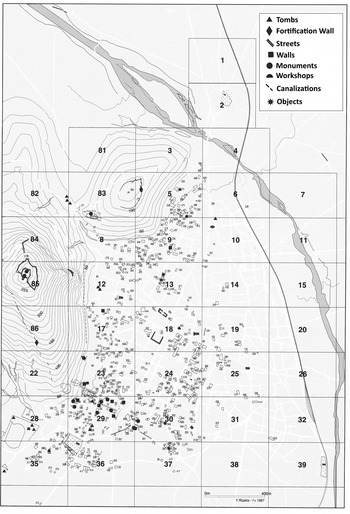
In examining the listings in the supplementary material, it is helpful to know something about how the location of specific burials is indicated. Modern-day Sparta is divided into numbered building blocks, and the Greek excavation reports typically locate excavations by the building-block number and the name of the owner of the plot (within that building block). That system was not in place when the British excavators worked in Sparta in the early part of the twentieth century, and they created a plan of the city with a grid system (Fig. 4).Footnote 21 Some of the areas plotted on the British grid are outside the numbered building blocks, and sites located in these areas have, where possible, traditionally been referenced on the basis of the British grid square. The same approach is adopted here, with the locations of graves specified with a prefix starting with BB (building block) or BG (British grid).
Building block numbers and the British grid.

The Protogeometric period
We begin with the Protogeometric period. Insofar as the Protogeometric and Geometric periods are defined largely on the basis of local pottery styles, and in view of the fact that the Lakonian pottery sequence does not align precisely with the much better-known sequence from Athens, Table 1 supplies the dates of each of the periods employed in the discussion that follows (see below for relevant bibliography and further discussion).
Chronological periods in Sparta.

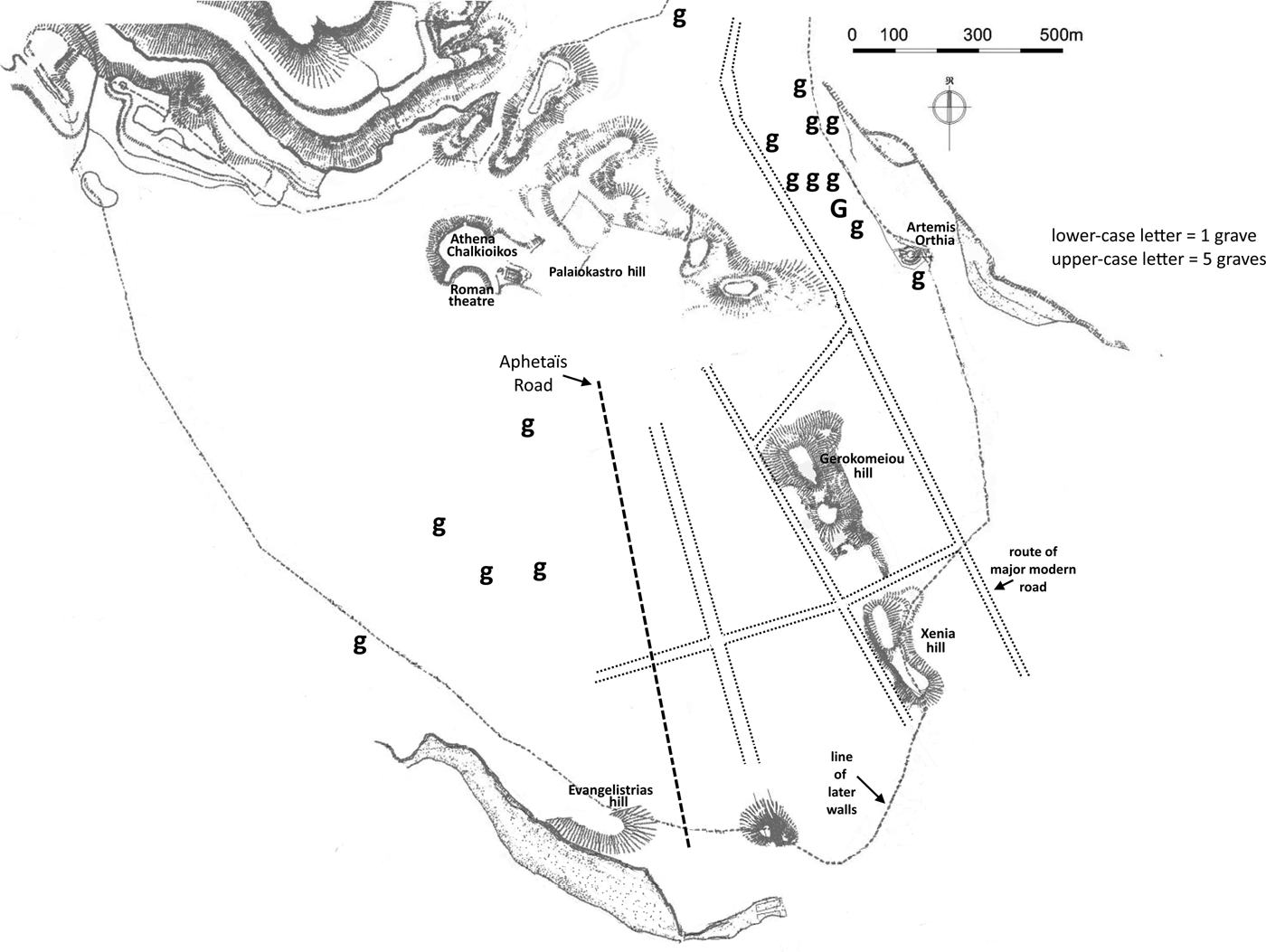
There are 12 Protogeometric graves from Sparta itself and a further 12 in Amyklai (see the supplementary material, Appendix 1, for the details). The tombs from Sparta come from eight distinct locations (Fig. 5),Footnote 22 whereas the tombs from Amyklai comprise a small cemetery located on the periphery of a settlement. The numerical breakdown of tomb types is given in Table 2.
Locations of Protogeometric burials in Sparta.

Tomb types of Protogeometric burials in Sparta and Amyklai.

In all of the cases where a determination can be made (18 out of 24 graves), the corpse was inhumed; there is no evidence for cremation. With one exception, all of the burials contain a single individual; Tomb 2 in Amyklai contains two skeletons. In 12 of the 24 graves the skeletons are sufficiently well preserved to show the disposition of remains, and in all 12 instances the corpse was buried in a contracted position. Insufficient information is provided in the relevant reports to say anything meaningful about the orientation either of graves or of corpses within graves.
Five of the 12 graves in Sparta contained sub-adults; no information is provided about the age of the occupants of the other seven graves (and no information is provided about cist/pit length so as to permit a determination of age by that means). Four of the 12 graves in Amyklai contained sub-adults; no information is provided about the age of the occupants of the other eight graves (and no information is provided about cist/pit length so as to permit a determination of age by that means). The nine graves that clearly contained sub-adults consist of six cists, one pit, one pot and one pithos fragments.
Eight of the 12 graves in Sparta contained grave-goods of some kind and three were without grave-goods; the contents of one grave were not reported. Precisely the same numbers apply to the graves in Amyklai. Grave-goods consist largely of pottery, bronze jewellery and iron pins; one of the graves at Amyklai contained a single bead of rock crystal, and a gold spiral and gold beads were found in two other graves at that site. There is no obvious correlation between the age of the individual interred and the presence/absence or quantity of grave-goods. No grave-markers were found, but two of the pit graves at Amyklai were delimited by a line of stones, situated at the contemporary ground level, on one or more sides. Pottery that was probably used in funerary rituals was found next to two of the graves from Amyklai (an oinochoe and drinking vessel outside Tomb 14 and an oinochoe outside Tomb 15).
The Geometric period
There are 22 graves from Sparta and Amyklai that can be definitely or probably dated to the Geometric period; these graves are scattered across more than a dozen different locations (Fig. 6 and see the supplementary material, Appendix 2, for the details).Footnote 23 The numerical breakdown of tomb types is given in Table 3.
Locations of Geometric burials in Sparta.
Tomb types of Geometric burials in Sparta.

In all of the ten cases where a determination was possible and put into print, the corpse was inhumed, and it seems probable that all of the cist and pit burials were inhumations. The situation with the pithos burials is rather more complicated. There are no significant extant skeletal remains present in any of the seven pithos burials; the British excavators of the early part of the twentieth century, who uncovered two of these pithos burials, believed that they were cremations, and that opinion has been repeated by some later scholars (Bosanquet Reference Bosanquet1905–6, 281–2, pl. VIII:1; Hodkinson Reference Hodkinson2000, 239). On the other hand, there is no published mention of traces of burning on either (the exiguous) osteological remains or grave-goods, and the recent Greek excavators have tended to see the pithos burials as inhumations (Themos and Zavvou Reference Themos, Zavvou, Guimier-Sorbets and Morizot2010, 229). Published reports provide information about the disposition of remains in eight instances, with all eight buried in a contracted position. There is no evidence for multiple burials in any of the graves; insufficient information is provided in the relevant reports to say anything meaningful about the orientation either of graves or of corpses within graves.
The published reports about these 22 graves offer little information about age or sex. One grave (a cist tomb from BB 148) is identified as that of an adult and another (a cist tomb from Amyklai) as that of a sub-adult. Three further graves (two pithoi and one cist) are identified as those of infants based on the absence of bones. One of the pithos burials is identified as that of a male (BB 99) and another as female (BB 125), based on the nature of the grave-goods found with those burials.
Twelve of the 22 burials included grave-goods of some kind, five are described as not having any grave-goods and no information is provided about the remaining five. There may be some association between the presence/absence of grave-goods and tomb type: five of the six cists and five of the seven pithos burials contained grave-goods, whereas just one of the five pits had grave-goods. Grave-goods, as in the Protogeometric period, consist largely of pottery, bronze jewellery and iron pins. Two burials, both in pithoi, stand out in this regard. One (in BB 99) contained an iron sword, three iron knives and a collection of bronze jewellery. Another (in BB 125) contained a large collection of bronze jewellery including at least six rings. Two of the pits and one cist were delimited by small stones, situated at the contemporary ground level, on one or more sides.
The earliest traces of activity in the area of the Olive Oil Cemetery in the south-western part of the city, in the form of pottery finds, date to the Geometric period, but the earliest extant burials in this cemetery date to the Archaic period (Tsouli Reference Tsouli and Sporn2013, 157). As a result, it is impossible to know if this cemetery, in which earlier burials were regularly destroyed to make space for new ones (see below), was used for burials in the Geometric period.
The Archaic period
The earliest extant burial in the Olive Oil Cemetery in the south-western part of the city took place in the Archaic period, but very few Archaic graves from this cemetery survive intact due to the construction of later tombs. The preliminary excavation report for the Olive Oil Cemetery provides details for just one Archaic burial, Tomb 21, which contained a single black-glazed lakaina that dates to the middle of the sixth century (Tsouli Reference Tsouli and Sporn2013, 157). As a result, detailed discussion of the Olive Oil Cemetery is supplied in the following section.
Before proceeding to discuss the Archaic burials, it is important to note the existence of a particularly problematic cluster of four inhumations in cist graves that was found in 1960 just to the south of Palaiokastro hill. These graves were distributed around a relief amphora and were situated next to a kiln. A stone plaque covering one of the graves extended over one of the handles of the amphora, so the amphora was probably put in place when the graves were built. The mouth of the amphora, which had been laid on its side when it was put in place among the graves, was sealed with a stone slab, but nothing was found inside, so it was not likely functioning as a burial container.Footnote 24
The excavator, Chrysanthos Christou, dates the graves to the end of the seventh century and draws a number of conclusions based on the nature of the burials and the date he assigns to them. He argues that the presence of the relief amphora shows that such vessels were used as grave-markers, much like the Dipylon vases from Athens. (None of the other relief amphorae found in Sparta before or since was closely associated with a burial; see the supplementary material, Appendix 8, for further discussion.) He also argues that the placement of the burial next to a kiln shows that the graves belonged to a family that owned and operated a pottery workshop. Insofar as the burials were located in the heart of Sparta, Christou concludes that the deceased must have been Spartiates, which in turn shows that Spartiates – contrary to the claims of Xenophon (Oeconomicus 4.2.3), Aristotle (Politics 1278a8–2) and Plutarch (Lycurgus 24.2; Agesilaus 26.4–5; Moralia 213f–14a) – were not in fact banned from productive activity (Christou Reference Christou1964b, 144–63).
It is not difficult to see why these burials received a considerable amount of attention when they were discovered and continue to be the subject of discussion.Footnote 25 There is, however, good reason to believe that Christou erred badly in dating the graves, which should be placed not in the Archaic but in the Byzantine period. The reasons why that is the case are discussed in detail in the supplementary material, Appendix 7.
There are approximately 31 graves from Sparta that can be definitely or probably dated to the Archaic period. The uncertainty springs from the publication of two separate grave groups, one in BB 53 containing eight cist graves of Archaic and Classical date (Maltezou Reference Maltezou2011d) and another in BB 58 containing 24 graves of Archaic to Roman date, without any specific breakdown of how many tombs belong to each period (Maltezou Reference Maltezou2010a).Footnote 26 For cataloguing purposes, four of the eight graves in BB 53 and four of the 24 graves in BB 58 are assumed to be of Archaic date.
Based on these assumptions, there are 31 tombs of Archaic date (Fig. 7 and see the supplementary material, Appendix 3, for further details), which come from across Sparta.Footnote 27 The numerical breakdown of tomb types is given in Table 4.
Locations of Archaic intracommunal burials in Sparta.

Tomb types of Archaic burials in Sparta.

Tile graves appear for the first time in this period, as does the first two-level built tomb. Tombs of the latter type became relatively common in Sparta in the Hellenistic period, and although only minimal details of the single known Archaic example have been published and the tomb in question is now backfilled, the excavator explicitly compares it to Hellenistic examples excavated by the British in 1907 in BB 124 (Wace and Dickins Reference Wace and Dickins1906–07; Raftopoulou Reference Raftopoulou, Cavanagh and Walker1998, 134–6). It is, therefore, possible to give some sense of the basic design.
The Archaic tomb was built into the northern slopes of Gerokomeiou hill (BB 117A), which is located just south of Palaiokastro hill (Fig. 1) (Raftopoulou Reference Raftopoulou, Cavanagh and Walker1998, 127, 134–5, fig. 12:18–19; Reference Raftopoulou and Kaltsas2006a; Tsouli Reference Tsouli, Draycott and Stamatopoulou2016, 361–2). It thus bears an immediate resemblance to what the British excavators labelled Tomb A, which was built against a sloping bank so that its back and sides were embedded in the hillside, leaving only the façade exposed (Fig. 8).Footnote 28 Tomb A was a rectangular built structure measuring approximately 3.2 by 1.6 m. Its walls were constructed largely and perhaps entirely from stone blocks, and it had a tile roof. On the western side, one of the short sides, there was a façade that was probably equipped with a pediment and akroteria. The interior had two vertically superimposed chambers. The lower chamber, approximately 0.5 m high and roofed with stone plaques, contained a single burial with the corpse resting directly on virgin soil; there were at least two skeletons in the upper chamber.
Section and plan of Hellenistic two-level tomb (Wace and Dickins Reference Wace and Dickins1906–7, pl. VI).
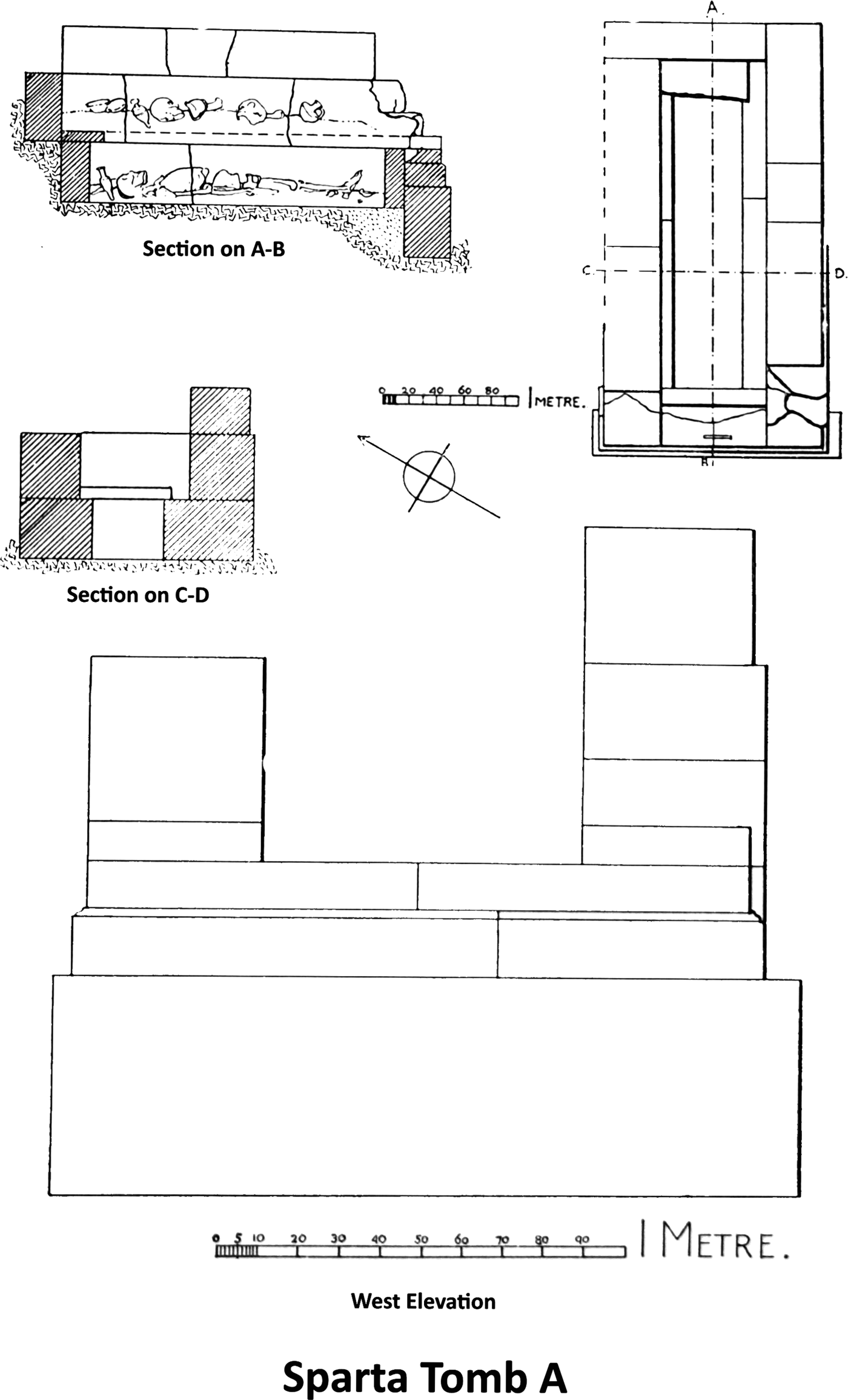
The Archaic tomb on Gerokomeiou seems to have been of the same basic design as Tomb A, though of simpler construction (the sole published photo seems to show rubble walls: Raftopoulou Reference Raftopoulou, Cavanagh and Walker1998, fig. 12:18). A burial was found in the lower chamber, and secondary burials and grave-goods in the upper chamber. No specific listing of grave-goods has been supplied, but the main burial (that in the lower chamber) evidently can be firmly dated to the second quarter of the sixth century based on the pottery associated with it. A series of channels around the tomb collected rainwater, and, in the Late Classical period, a conduit was built to control the flow of water in the area. The channels immediately around the tomb were made from roof tiles and were evidently constructed at the same time as the tomb itself; on one of the tiles was deposited a collection of 22 vases (all Lakonian III black-figure vases): one oinochoe, five lakainai, two deep cups, one skyphos, seven deep plates, one shallow dish, one ‘baby-feeder’ (a closed shape with a narrow spout) and four small stemmed cups. The excavator suggests that this collection of vases represents the vessels used in a funerary banquet for seven individuals (Raftopoulou Reference Raftopoulou, Cavanagh and Walker1998, 135). The vessels were all ‘cancelled’, in the sense that their bottoms had been pierced,Footnote 29 and they were deposited upside down.Footnote 30
When we turn our attention to the Archaic burials as a group, we find that in all of the 20 cases where a determination was possible and put into print, the corpse was inhumed, and it seems probable that all of the Archaic burials in Sparta were inhumations. Two of the cists contained multiple burials; one of these (in BB 53) was divided into two unequal parts and held the remains of an adult and a sub-adult. Published reports provide information about the disposition of remains in 12 instances, as indicated in Table 5.
Disposition of remains in Archaic burials in Sparta.

The orientations of six Archaic Spartan graves have been reported: east-north-east to west-south-west (with head at east); east to west (with head at east); east to west (with head at west); east to west (head position not reported); north-north-west to south-south-east (with head at south); north to south (head position not reported).
The published reports about the 31 Archaic graves from Sparta offer some information about age, none about sex. Eleven burials are identified as those of adults (five in cists, four in pits, one in a tile grave and one in an unspecified type of grave) and three burials are identified as those of sub-adults (two in cists, one in a tile grave). As noted above, in one instance, an adult and sub-adult were buried in the same cist.
Nineteen of the 31 graves are reported as containing no grave-goods; of the remaining 12 graves, seven had grave-goods (three cists, two tile graves, the two-level tomb and one grave of unreported type). All of the reported grave-goods consist of pottery. On the northern side of one of the pit graves (in BB 29), a nearly intact black-glazed hydria with a lid was found on the contemporary ground level. The excavators argue that it was a grave-marker (Zavvou and Themos Reference Zavvou, Themos, Cavanagh, Gallou and Georgiadis2009, 116), but it seems more likely that it was a vessel used for ritual purposes that was left on the grave (cf. the 22 vessels deposited outside the two-level tomb).
The Classical period
Arguably the biggest single change in our knowledge of Spartan burial practice has come about as the result of the discovery of the Olive Oil Cemetery, an organised extracommunal burial ground that was in use by the sixth century and continued to receive burials throughout the Hellenistic period.Footnote 31 As noted above, the finds from the site include Geometric pottery, but the earliest extant graves date to the Archaic period, and most date to the Classical and Hellenistic periods. Hence it is discussed in this section.
Before discussing the Olive Oil Cemetery, it is worth mentioning that there are indications of the existence of another extracommunal cemetery of Archaic to Classical date. As we have seen, it has been known since the 1930s that there was a Roman cemetery on the northern edge of Sparta, in the Mousga ravine. In the 1990s and early 2000s more tombs of Roman date belonging to that cemetery were found (see, e.g., Zavvou Reference Zavvou1994; Themos and Zavvou Reference Themos and Zavvou2001), and in 2000–1 the construction of a new road in the same area required excavations that revealed a tomb of the Late Archaic to Early Classical period. The excavators of the tomb expressed the opinion that it confirmed Eleni Kourinou's conjecture (Kourinou Reference Kourinou2000, 218) that the Roman cemetery in the Mousga ravine was the site of an earlier cemetery.Footnote 32
The discovery of the Olive Oil Cemetery came about as the result of a rescue excavation that was carried out in 2008–9 under the auspices of the Fifth Ephorate and directed by Maria Tsouli. A preliminary report of the excavation was published in 2013;Footnote 33 a final report is not expected to appear anytime in the near future. It is located in BB 151, in the south-western part of the ancient city, approximately 1.3 km south of the Roman theatre on the acropolis (Fig. 3). Although it is situated close to the centre of modern Sparta, the cemetery escaped detection for a long period of time because it is located on the slope of a hill that runs down to the Magoulitsa stream bed. The intensive use of the space, along with the erosion of material from further up the slope, created a rapid shift in the vertical level of the site; there is roughly a 3 m difference in elevation between the earliest and latest graves, and the lowest level of the cemetery lay under 4 m of fill (Tsouli Reference Tsouli and Sporn2013, 155, n. 31).
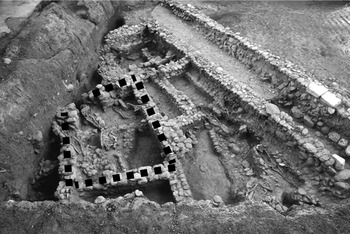
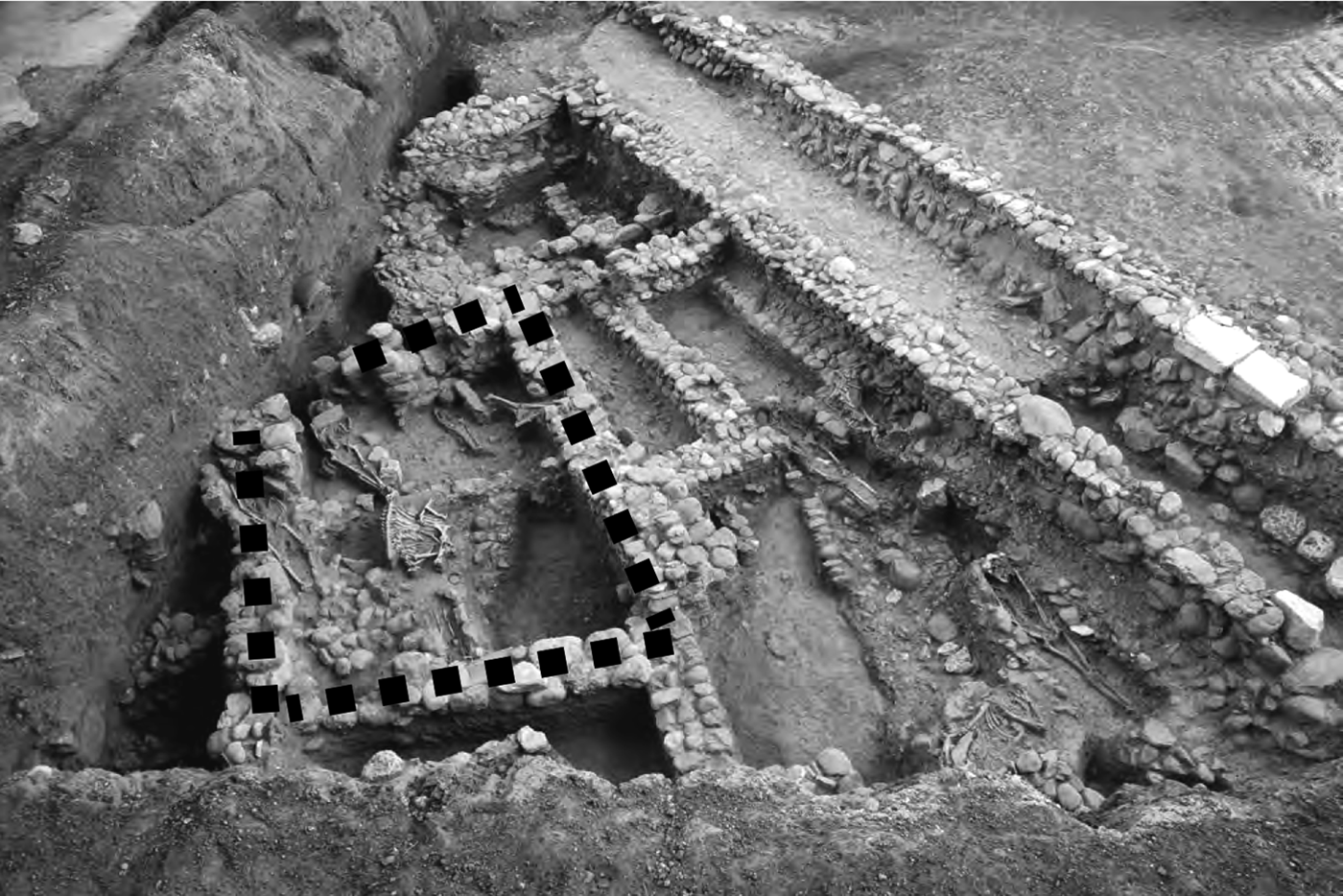
By the criteria specified above, this was clearly an extracommunal cemetery. In its original setting it was situated to the east of a 1.6 m-wide road that ran north-west to south-east along the eastern edge of the Magoulitsa (Fig. 9) (Tsouli Reference Tsouli and Sporn2013, 154–7; Reference Tsouli, Draycott and Stamatopoulou2016, 362). It was, therefore, located on the margins of Sparta, and the area occupied by the cemetery was used solely for funerary purposes. It is significant that when the wall circuit was built in the Hellenistic period, the cemetery fell outside the wall and hence was, literally, extramural after that point. One might also note that one of the two Roman cemeteries of Sparta was also built on the eastern edge of the Magoulitsa, approximately 450 m north-west of this cemetery (Tsouli Reference Tsouli and Sporn2013, 153–4).
Peribolos A in the Olive Oil Cemetery seen from the north. Peribolos A is outlined with a dotted line; the skeleton in the middle of Peribolos A is the remains of a horse (Tsouli Reference Tsouli and Sporn2013, fig. 1; Ephorate of Antiquities of Lakonia – Regional Office, © Hellenic Ministry of Culture and Sports/Archaeological Receipts Fund).
The Olive Oil Cemetery was intensively used; earlier graves were destroyed to make way for later ones and piles of bones, especially skulls, from earlier burials were collected outside newer ones. New graves were in some cases built directly on top of older ones; the cover stones of older graves sometimes served as the floors of new graves (Tsouli Reference Tsouli and Sporn2013, 160; Reference Tsouli, Draycott and Stamatopoulou2016, 366).
To date, 69 graves have been uncovered, but only the south-west corner of the cemetery has been excavated – it definitely extends further on both the northern and eastern sides.Footnote 34 In terms of typology, 62 of the 69 graves are simple pit graves, typically oval in shape, cut into soil or the conglomerate bedrock. They are covered by tiles, clay plaques, stone plaques and earth fill. There are, in addition, two cist graves and five pot burials. All of the burials are inhumations, and skeletal remains are (with one exception) disposed in a supine extended position with arms parallel to the body or, more rarely, on the pelvis or chest (the exception is Tomb 30, in which the skeleton was buried in a contracted position). Almost all of the graves contain single burials (Tsouli Reference Tsouli and Sporn2013, 157; Reference Tsouli, Draycott and Stamatopoulou2016, 366).
The preliminary excavation report does not provide a precise chronological breakdown of the 69 graves, but the vast majority of them are Classical or Hellenistic in date. The tombs take their orientation from the road, and almost all of them are aligned north-west to south-east, like the road, except in a few instances in which the orientation was changed to maximise available space. Heads are always located on the south-eastern side of the grave (Tsouli Reference Tsouli and Sporn2013, 160).
There is a clear differentiation between the earlier and later levels of the cemetery. The graves in the lower levels were relatively carefully built, typically arranged in clusters and demarcated by three or four rows (distributed horizontally) of middle-sized, unworked river stones set at the contemporary ground level. Some of the tombs in this level have stones placed under the head of the corpses. The graves in the upper level were shallower and simpler, and lack clear delimitation. The excavator suggests that these burials were made in a rush, perhaps during some sort of emergency (Tsouli Reference Tsouli and Sporn2013, 158).
All five of the pot burials were for sub-adults, but otherwise most of the deceased are adults. No information about sex ratios has been published. Eighteen of the 69 graves were supplied with grave-goods, primarily in the form of pottery and small numbers of bronze and iron objects. No grave contained more than four objects, and there are no precious metals or exotic materials among the grave-goods (Tsouli Reference Tsouli and Sporn2013, 158–9).
Five features of this cemetery merit further discussion: periboloi, horse burials, evidence for banqueting, finds of unusual kantharoid vases and the absence of grave-markers.
In the lower levels of the cemetery, many tombs are grouped in clusters and surrounded by rectangular periboloi made from medium-sized stones with mud as a binder (Fig. 9). Graves within periboloi do not differ substantially from those found outside periboloi except that less effort was invested in delimiting the former. The earliest of these periboloi seem to have been built in the sixth century, after which they were continually rebuilt and reconfigured, sometimes using materials from earlier structures. In the area excavated so far, two large periboloi have been uncovered and labelled by the excavators Periboloi A and B. Both periboloi were originally constructed in the Archaic period, but their configuration as excavated dates to the Classical period (Tsouli Reference Tsouli and Sporn2013, 159–60; Reference Tsouli, Draycott and Stamatopoulou2016, 366–9).
Only Peribolos A has been fully excavated. It measures 4.6 by 3.5 m, is oriented north-west to south-east, like the road alongside which it is situated, and has an entrance on the southern side. There are two distinct phases at different levels, with material from the earlier phase reused in the latter phase. Six graves were found in the lower level and eight in the upper level. The single most remarkable feature of Peribolos A is that it is centred around a horse burial, with the horse placed in a specially built grave made from river stones.
The horse burial from Peribolos A is, in fact, just one of five in the cemetery. All of the horses were interred either intact or carefully cut into pieces and then reconstructed in the grave (no details of age, sex, etc. of any of the horses are supplied in the excavation report). All bear slaughtering marks, and hence did not die of natural causes. No traces of fire were found on the bones, so they do not seem to have been sacrificed and eaten. In three instances (Peribolos A and Graves 28a and 29), a horse burial was not disturbed by later graves in the area, despite the fact that human burials were partially destroyed or removed to make way for new graves. Tsouli suggests that these horse burials served as an enduring focus for a set of family tombs (Tsouli Reference Tsouli, Draycott and Stamatopoulou2016, 370). In the nearby Roman cemetery, the heads of horses and dogs were found on top of a number of graves, and Pausanias (3.20.9) claims that Tyndareus sacrificed a horse as part of administering the oath to Helen's suitors (Themos Reference Themos2006a; Tsouli Reference Tsouli and Sporn2013, 160–1; Reference Tsouli, Draycott and Stamatopoulou2016, 369–71; a horse burial of unstated date has also been excavated in Magoula: see Tsiangouris Reference Tsiangouris2010a).
Evidence for banqueting in the cemetery was found in the form of large quantities of sherds collected from outside the graves. The pottery in question primarily consists of vessels for liquids (skyphoi, kantharoi, lakainai) along with a considerable number of shallow and deep dishes for food (this assemblage closely corresponds to that found outside the Archaic tomb in BB 117A). Many of the drinking vessels were pierced before firing, so they were clearly intended for funerary use. In addition to the pottery, two deposits of black, greasy earth were uncovered, both containing bones of birds and ovicaprids along with sherds with strong traces of burning. No human bones were found in these areas, so they were not related to cremation but rather to food preparation on site. It remains unclear whether the food and drink in question were used in burial or mourning ceremonies or whether they were consumed as some sort of post-depositional religious ritual (Tsouli Reference Tsouli, Draycott and Stamatopoulou2016, 371–7).
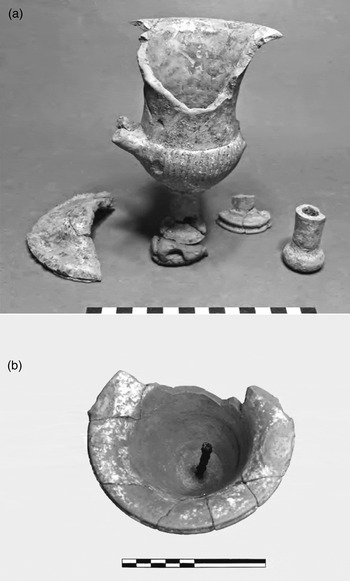
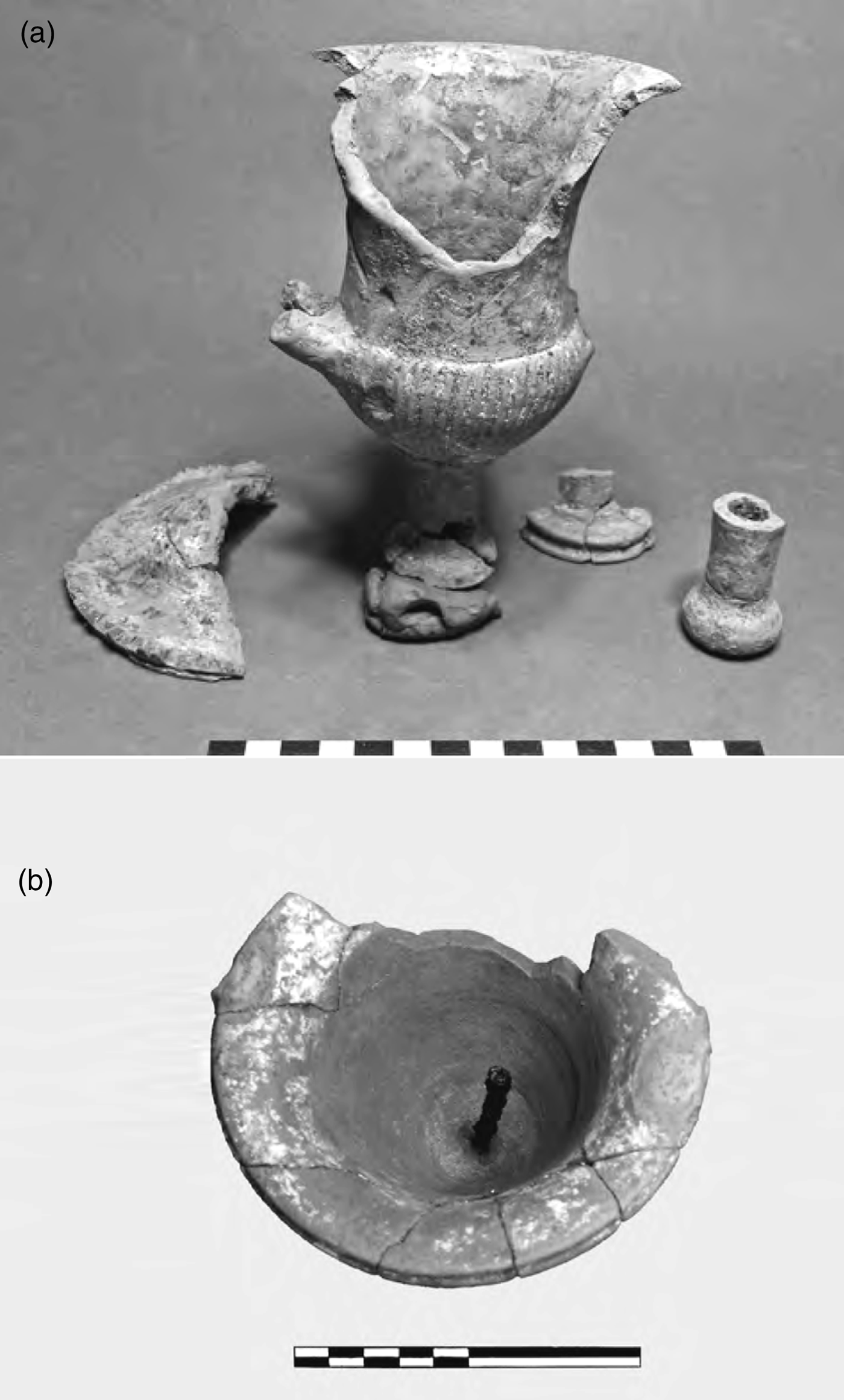
One of the most common offerings in this cemetery, found both inside and on top of graves, was what the excavator calls a complex kantharoid vessel, with a high foot, a calyx-shaped bowl, vertical strap-handles and a plain, out-turned rim (Fig. 10). These vessels have a separate lid with a denticulated rim. Both vase and lid have holes for the insertion of a vertical metal dowel that attaches the lid to the vase. Very similar vases have been found in the Tomb of the Lakedaimonians in the Kerameikos in Athens and a Hellenistic tomb in Sparta (Tsouli Reference Tsouli, Draycott and Stamatopoulou2016, 374). These seem to be ceremonial vessels used exclusively in funerary rites, possibly for the pouring of libations. Tsouli draws a connection between these vessels and the kantharoi depicted on many Lakedaimonian ‘hero reliefs’ (Tsouli Reference Tsouli and Sporn2013, 162–3; Reference Tsouli, Draycott and Stamatopoulou2016, 355–60, 373–7; see the supplementary material, Appendix 8, for further discussion of the hero reliefs).
Two complex kantharoid vessels from the Olive Oil Cemetery: (a) SM 16681 and (b) SM 16698, showing the metal dowel in the interior (Tsouli Reference Tsouli and Sporn2013, figs 5–6; Ephorate of Antiquities of Lakonia – Regional Office, © Hellenic Ministry of Culture and Sports/Archaeological Receipts Fund).
Finally, it is noteworthy that no grave-markers of any kind were found (Tsouli Reference Tsouli and Sporn2013, 157). This is probably significant in that the area was in continuous use for at least 300 years. It is unlikely that grave-markers would have been looted while the cemetery was still in use, and, due to the rapid rise in elevation, the lower levels of the cemetery were not accessible when the cemetery did go out of use. All of this suggests that there never were any grave-markers in this cemetery (beyond the periboloi).
In addition to the burials in the cemetery discussed above, approximately 16 intracommunal graves (from four different sites) dating to the Classical period have been found in Sparta (Fig. 11 and see the supplementary material, Appendix 4, for the details). The uncertainty springs from the publication of two separate grave groups, one in BB 53 containing eight cist graves of Archaic and Classical date (Maltezou Reference Maltezou2011d) and another in BB 58 containing 24 graves of Archaic to Roman date, without any specific breakdown of how many tombs belong to each period (Maltezou Reference Maltezou2010a).Footnote 35 In addition, the excavation report for the two-level tomb of Archaic date in BB 117A makes mention of a group of cist and pit graves ‘covered with fill of the late fifth–early fourth century bc’ (Raftopoulou Reference Raftopoulou, Cavanagh and Walker1998, 135). For cataloguing purposes, four of the eight graves in BB 53 and four of the 24 graves in BB 58 are assumed to be of Classical date. The cluster of graves in BB 117A is tentatively assigned to the Classical period (but it is possible that it is earlier) and assumed to consist of three cists and three pits.
Locations of Classical intracommunal burials in Sparta.

Based on these assumptions, the 16 intracommunal graves of Classical date consist of nine cists, four pits and three graves of unstated type; in all of the instances where the requisite information is supplied (five of the 16), the burials are inhumations; all appear to be single burials. In the sole instance in which the requisite information is supplied, the corpse was laid out in a supine extended fashion with the head resting on a stone. The age and sex of the occupants are not reported for any of the 16 tombs, but one can be tentatively identified as an adult based on the length of the pit (1.9 m). The orientation of just one grave is reported: north to south with the head of the corpse on the southern side. Twelve of the 16 graves are reported as containing no grave-goods; no information is supplied about the other four.
It should be noted that there are also three graves, likely of Classical date, found in what seems to be an extracommunal cemetery of Archaic to Classical date on the northern edge of the city, in the Mousga ravine (see sources cited n. 33 above).
The Hellenistic period
Sometime after the middle of the Hellenistic period, the Olive Oil Cemetery went out of use and, at roughly the same time or shortly thereafter, a new cemetery was laid out 450 m to the north-west. Burials continued to take place in the latter cemetery (what is here called the Southwest Cemetery) throughout the Roman period. The long period of time during which this cemetery was in use, the very large number of tombs excavated in it (likely close to 1,000)Footnote 36 and the highly preliminary state of publication make it impossible to supply detailed information about the Hellenistic graves found there, so it will not be discussed in detail here. The same goes for small numbers of Late Hellenistic burials that form parts of clusters of graves, found in other sections of the city, that for the most part date to the Roman period (Tsouli and Maltezou Reference Tsouli and Maltezouforthcoming).
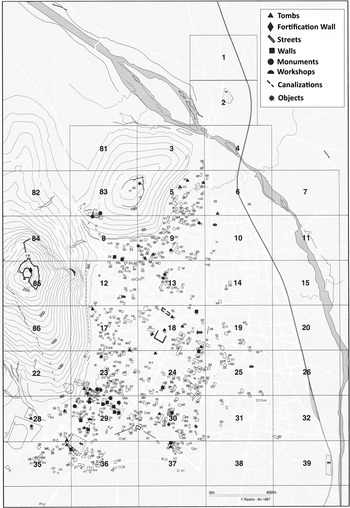
Throughout the Hellenistic period, burials continued to take place intracommunally, both in small clusters and singly. More than 60 intracommunal (i.e. located outside the Olive Oil Cemetery and Southwest Cemetery) Hellenistic burials are known from Sparta (Fig. 12 and see the supplementary material, Appendix 5, for the details).Footnote 37 The total number of tombs is approximate because one of the relevant excavation reports mentions two rows of simple cist and pit graves without giving specific numbers (Steinhauer Reference Steinhauer1972a). Another report mentions a group of ten tombs of Hellenistic and Roman dates (Maltezou Reference Maltezou2011b), three of which are specified as being Hellenistic (two tile, one two-level) and two Roman (both tile) – no information about tomb types or dates is supplied for the other five.Footnote 38 A third report mentions an unspecified number of built tombs of Hellenistic date (Vasilogambrou, Tsouli, and Maltezou Reference Vasilogambrou, Tsouli, Maltezou, Zumi, Karapanagiotou and Xanthopoulou2018, 334–5). A fourth report lists a group of 24 tombs ranging in date from the late second century bc to the second century ad, without providing details of numbers of different tomb types (Vlachachakos and Maltezou Reference Vlachachakos and Maltezou2011; see also Tsouli and Maltezou Reference Tsouli and Maltezouforthcoming). A fifth report mentions a group of Hellenistic and Roman tombs without giving any numbers (Themos and Zavvou Reference Themos, Zavvou, Guimier-Sorbets and Morizot2010: 228 n. 10, 229; see also Zavvou and Themos Reference Zavvou and Themos1999). Assuming that there were eight graves in all among the two rows of cist and pit graves mentioned in the first report, that there were six Hellenistic graves among the ten mentioned in the second report, that there were four graves in the group of built tombs mentioned in the third report, that there were four Hellenistic graves among the 24 mentioned in the fourth report and without counting the burials mentioned in the fifth report, the currently known total comes to 72.
Locations of Hellenistic intracommunal burials in Sparta.

The numerical breakdown of tomb types is supplied in Table 6.Footnote 39 The specific design of the five tombs catalogued here as ‘built’ is not clear from the excavation reports, and it possible that some of these five tombs were of the two-level type. Iron nails found in one of the cists and one of the pits suggest the presence of wooden coffins in some graves.
Tomb types of Hellenistic intracommunal burials in Sparta.

The popularity of two-level tombs is noteworthy, as is the appearance of a new type of burial: a marble urn (holding cremated remains). While just one such urn has been found in situ, a number of very similar urns have been found in Sparta, and all are likely to have been used for funerary purposes (though in some cases at least this was a secondary usage for a vessel that originally had domestic functions) (Poupaki Reference Poupaki, Cavanagh, Gallou and Georgiadis2009; cf. Piteros Reference Piteros2010). The urns in question were crafted locally and are all simple vases with roughly dressed outer surfaces and carefully smoothed interiors. The one example found in situ measures 0.44 m high with a maximum diameter of 0.37 m. It has a marble lid, and it is likely that this was standard practice.
The existence of these urns speaks to the appearance of cremation, not hitherto securely attested in Sparta, in the Hellenistic period. Beyond the single marble urn found in situ, four other Hellenistic burials with cremated remains are known from Sparta (one tile grave, one cist, one pit, one pot). That said, inhumation seems to have remained the dominant option.
In all eight cases in which the disposition of remains in inhumations is specified, the corpses were placed in a extended position. Four of the cists and (almost certainly) all of the two-level tombs were used for multiple burials. No consistent orientation is apparent in the Hellenistic burials from Sparta. The nine cists excavated at the former Chymofix site at BG O12 have four different orientations (north-east to south-west, north-west to south-east, north-north-west to south-south-east, east to west) and cists elsewhere in the city are oriented north-north-west to south-south-east, north-east to south-west, east to west and north to south. Similarly, three of the four two-level tombs excavated by the British in 1907 in BB 124 were sufficiently well preserved to show the orientations of the tombs: one ran east-north-east to west-south-west, whereas the other two ran east-south-east to west-north-west. One of the more recently excavated two-level tombs is oriented north-east to south-west (BB 123), whereas another is oriented north-west to south-east (BB 135).
Among the 25 cist burials, four held sub-adults and three held adults. Two of the seven tile graves held sub-adults, one held an adult. One of the pot burials held a sub-adult. In all other instances, the age of the occupant is unstated, and there is no significant information about sex ratios.
With respect to grave-goods, all of the two-level built tombs seem to have been very richly equipped. Two examples that were found intact (in BG P14 and BB 124) each contained more than 100 vessels of various kinds. The information about the presence/absence of grave-goods in the remaining tomb types is presented in Table 7.
Grave-goods in Hellenistic intracommunal burials in Sparta.

Almost all of the grave-goods consist of terracotta or glass vessels. Small amounts of silver, in the form of coins and earrings, were found, as was gold, in the form of coins (in the urn burial and one of the two-level tombs) and in the form of foil leaves that originally formed parts of wreaths (in two cists, two pits and one two-level tomb). Other finds include strigils, bronze coins and bone pins. There is a marked difference in the number of grave-goods associated with the two-level tombs, and that, along with the resources necessary to build such a tomb, strongly suggests that in Hellenistic Sparta socio-economic status was at least partially reflected in choice of tomb type (see below). One small cautionary note is that specific two-level tombs apparently remained in use for multiple burials over long periods of time (for example, the one in BB 135 seems to have received burials over the course of a century and a half), so there was a gradual accumulation of grave-goods in a way that was not possible with other types of burials (most of which received just one burial at one point in time).
TOPOGRAPHY
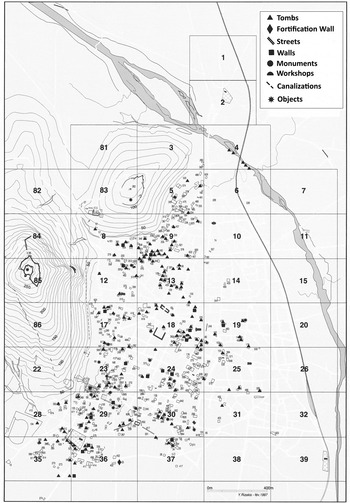
The spatial distribution of known intracommunal burials in Sparta from the Protogeometric to the Hellenistic period is represented in Fig. 13; the figure is largely self-explanatory and just a handful of notes is in order. First, the only graves included in Fig. 13 are those that are, in the relevant excavation reports, located either by reference to the grid laid out by the British excavators in the early part of the twentieth century or by reference to the numbered building blocks in the modern city. A certain number of graves found beyond the edges of the grid (e.g. in Magoula) have not been plotted because they are difficult to locate precisely and the cumulative inaccuracies of approximate placement could be misleading.
Locations of Protogeometric to Hellenistic intracommunal burials in Sparta.

Second, graves are plotted by the British grid or modern building block in which they were excavated, but the placement of symbols indicating the existence of graves of different periods does not reflect the exact location of any given grave within any individual grid square or building block. That level of precision is very difficult to achieve consistently, and so symbols are simply placed where convenient in the square or block in question.
Third, it is important to bear in mind that the area immediately around Palaiokastro hill has been much more heavily explored than the parts of the ancient and modern city further to the south. Hence the relative paucity of known graves in some sections of the city is likely, at least in part, a product of unevenly distributed excavation (see Pikoulas Reference Pikoulas1983; Reference Pikoulas1988 on patterns in the locations of excavations in Sparta).
Fourth, although burial practices in Roman Sparta are not discussed in this article, intracommunal graves from that period are plotted on the map (see the supplementary material, Appendix 6, for a listing). This is because, though the specific burial practices of Roman Sparta are beyond the scope of the issues discussed here, the spatial disposition of intracommunal Roman graves is potentially informative with respect to the positioning of earlier graves.
Fifth, starting in the Archaic period, many and perhaps most of the intracommunal graves in Sparta seem to have been located either (a) alongside major roads or (b) on the slopes of one of the low hills within Sparta. The close connection between the road network and grave placement is most immediately apparent with respect to the major north-south road through the ancient city, the Aphetaïs road. The precise route of this road has been much debated, but Kourinou, in her monograph on the topography of ancient Sparta, makes a convincing argument about its location (Kourinou Reference Kourinou2000, 131–9) and her conclusions are followed in Fig. 13.
The line of major roads in modern-day Sparta is included in Fig. 13 because, as is apparent from the nearly identical orientation of the Aphetaïs road and its modern equivalent, Odos Palaiologou, there is a considerable degree of continuity in terms of the location of streets. The road network in Sparta during the Late Hellenistic to Roman period is relatively well documented, but very few streets from earlier periods have been found (Tsouli Reference Tsouli and Sporn2013, 155 n. 28). However, Kourinou (Kourinou Reference Kourinou2000, 135, 153) persuasively argues that the orientation of the Late Hellenistic to Roman road network, in which streets run north-east to south-west or north-west to south-east, follows the orientation of earlier roads. Insofar as the topography of the site heavily influences the placement of streets and insofar as the modern city lies directly on top of the ancient one, the continuity between the routes of ancient and modern streets is not particularly surprising.
With the Aphetaïs road plotted on the map, it becomes apparent that an array of graves ranging from the Archaic to Roman period is disposed in a longitudinal fashion along the route of the road.Footnote 40 One should also note in this regard that Pausanias clearly states (3.12.8) that the graves of the Eurypontid kings were located at the southern end of the Aphetaïs road, close to the city wall. Given the limited number of excavations that have been conducted in the southern part of the city, it is not unreasonable to speculate that the line of tombs found on both sides of the northern half of the Aphetaïs road continued, though perhaps less densely, all the way down to the site of the Eurypontid graves.
The connection between roads and the siting of graves is also apparent in the north-eastern part of the city, near the modern bridge over the Eurotas. Although here too there has been some debate, the consensus is that the ancient bridge over the river was located very close to the site of the modern bridge, with the result that one of the primary routes leading into the city was located in this area (Kourinou Reference Kourinou2000, 78–84). In 1972 Steinhauer conducted an excavation just to the west of the modern bridge and uncovered a 4 m-wide road running roughly south-west to north-east; it seems to have been constructed in the fourth century and maintained for centuries thereafter.Footnote 41 He also found a series of Hellenistic graves, on both the northern and southern sides of that road.
In the same vein, one might note that there is a series of graves that runs north to south along the eastern edge of Palaiokastro and east to west along its southern edge. If the main ancient bridge over the Eurotas was indeed located more or less at the site of the modern one, it is highly probable that, as in the modern city, a major road ran south from the bridge, along the eastern edge of Palaiokastro and connected with another major road that ran west, along the southern edge of Palaiokastro. It thus seems likely that the graves in question were situated alongside (presumably on both sides of) these major roads.Footnote 42
The connection between burials and roads appears to emerge in the Archaic period. Whereas Protogeometric and Geometric burials (Figs 5, 6) seem to be scattered throughout what is here defined as Sparta, the Archaic to Hellenistic burials show a much closer connection to likely street routes (Figs 7, 11, 12). One might well suspect that, as Sparta developed into an important political centre and as its population increased, a stable network of streets developed and burials began to be situated alongside these streets.
Another factor in the location of graves seems to have been elevation, in that the slopes of low hills were used as burial sites. This is most immediately apparent in the area directly to the south of the south-eastern edge of Palaiokastro hill. This area is occupied by a low hill, now called Gerokomeiou (the ancient name is unknown), which runs north-north-west to south-south-east. Archaic, Classical and Hellenistic graves were found in significant numbers on both its northern and western slopes. Here too, however, roads may have been an influence. A series of Archaic and Classical graves has been found just to the south-west of the southern end of Gerokomeiou, and one might suspect that there was from an early period a road that ran along its western edge and hence roughly parallel to the Aphetaïs road. If this was indeed the case, the graves on the western slopes of Gerokomeiou would have been situated on the eastern edge of the road, and the graves to the southwest of Gerokomeiou would have been situated at the road's western edge. From this perspective, the graves on the northern slope of Gerokomeiou could be read as located on the southern edge of the aforementioned road running east to west along the southern edge of Palaiokastro.
In the same vein, a group of Hellenistic and Roman graves has been excavated on the western side of Xenia hill and hence directly to the south of the graves on Gerokomeiou (Maltezou Reference Maltezou2011e; Vasilogambrou, Tsouli and Maltezou Reference Vasilogambrou, Tsouli, Maltezou, Zumi, Karapanagiotou and Xanthopoulou2018, 334–5). The graves to the west of Xenia would have run on both sides of the same road that went past the western edge of Gerokomeiou. One might also note in this regard that, according to Pausanias (3.14.2), the tombs of the Agiads were located in the north-western part of the city. Kourinou persuasively argues that these tombs were in fact situated somewhere on Vamvakia hill, a low hill on the southern side of the Mousga ravine, about 500 m north-west of the Roman theatre (Fig. 1).Footnote 43
Both roads and hills also seem to have played important roles in the siting of extracommunal cemeteries in Sparta. We have seen that the Olive Oil Cemetery is located alongside a road running north-west to south-east along the Magoulitsa. It is also located just 180 m west of the Aphetaïs road and is cut into the south-western edge of Evangelistrias hill, the eastern edge of which lies quite near the Aphetaïs road (Tsouli Reference Tsouli and Sporn2013, 154). Insofar as the Olive Oil Cemetery is known to have extended further east from the currently excavated segment in BB 151, it is entirely possible that it ran eastwards along the length of Evangelistrias hill. Graves on the eastern edge of that hill would have been situated along the western edge of the Aphetaïs road. The likely site of another Archaic to Classical extracommunal cemetery in the Mousga ravine would mean that it was located along the ancient road leading from Sparta to Megalopolis (Zavvou and Themos Reference Zavvou, Themos, Cavanagh, Gallou and Georgiadis2009, 116).
The close relationship between roads and burial sites seen in Sparta is also apparent in other Greek communities. As we will see, the location of intracommunal burials along roads is clearly attested in Argos in the Archaic to Hellenistic period, and, as is well known from earlier scholarship, the extracommunal cemeteries of Athens and Corinth were situated along roadsides.Footnote 44
ANALYSIS
The preceding discussion has ramifications along multiple axes, including our understanding of the settlement organisation of Sparta, the long-standing perception of Spartan burial practice as being exceptional in comparison to that of most other Greek communities and the current understanding of Greek burial practice broadly construed.
The settlement organisation of Sparta
The ideal type of the Greek city with a single, carefully delineated centre and clearly differentiated spaces has long had a powerful hold on scholarly imaginations. De Polignac notes that there is an enduring tendency to picture the settlement organisation of Greek cities as defined by:
clear functional distinctions between different types of space. One such distinction is that between exterior space and urban space; the separation between them is sometimes given material form by a circuit wall and it marks also the boundary between the space of the living and the space of the dead. Another such distinction is between private and public space, the latter comprising both sanctuaries and the various institutions associated with collective life – agora, assembly-places, buildings housing magistrates. A third such distinction is that between living space and specialized working spaces, such as potters’ quarters. (de Polignac Reference Polignac, Osborne and Cunliffe2005, 45)
Much of the newer scholarship on Greek urbanism has warned against adopting a teleological view that sees unicentric, spatially differentiated cities as the inevitable endpoint of an orderly process of linear evolution. This scholarship suggests instead that many Greek communities, some quite large, were, well into the Classical period, polycentric and lacked a strong functional differentiation of spaces (see, for instance, Greco Reference Greco and Greco1999).
Sparta as we know it from the textual sources is an obvious example of a polycentric urban centre. The locus classicus for the settlement organisation of Sparta is Thucydides’ statement that ‘the city is neither built in a compact form nor adorned with magnificent temples and public edifices, but composed of villages after the old fashion of Hellas’ (1.10.2, translation Crawley Reference Crawley1996).Footnote 45 Thucydides’ characterisation of Sparta suggests that Sparta's four constituent villages had not in his time merged together to form a seamless urban fabric.Footnote 46 Indeed, Marcello Lupi makes the case that Sparta was even more polycentric than Thucydides would have us believe. He argues that just one village, Pitana, made up the entirety of what is here labelled Sparta and that the other villages were, in effect, suburbs located in the area immediately surrounding Pitana/Sparta (Lupi Reference Lupi, Hodkinson and Powell2006, 195–207; cf. Tosti Reference Tosti, Longo, Di Cesare and Privitera2016, 166 n. 4).
Despite the fact that Sparta does not fit the traditional model of the unicentric Greek urban centre, this model has exercised a strong influence on prior scholarship on Sparta in that the constituent villages are typically understood as consisting of nucleated settlements that had the same sort of spatial differentiation, particularly between the living and the dead, as the ideal type of the Greek polis. In other words, the settlement organisation of each of the four Spartan villages has been assumed to have replicated in many respects that of the ideal Greek city but on a smaller scale. Hence, Kourinou and others argue that there were from an early date four distinct cemeteries in Sparta, one for each of the constituent villages (Kourinou Reference Kourinou2000, 215–19) and Tsouli makes the case that the Olive Oil Cemetery was the burial ground for the village of Mesoa (Tsouli Reference Tsouli and Sporn2013, 153).Footnote 47
The recently published archaeological evidence suggests that Sparta fits the newer model of Greek cities, not only with respect to being polycentric, but also with respect to having a low degree of spatial differentiation. This is most immediately evident from the distribution of burials. Some burials are clumped together in marginal spaces that are functionally distinct in the sense that they are reserved exclusively for funerary use. Other burials, however, are strung out along roadsides and across hillsides in close proximity to residential and commercial spaces.
A particularly clear example of this intermingling can be found in the north-eastern part of the city, which was the site of a substantial number of rescue excavations that were carried out in close proximity to one another. The area in question, a rectangle c.300 m north to south by c.200 m east to west comprises BB 97–102 and BG O12, N12–14, and is situated in the circumscribed flat space between the eastern edge of Palaiokastro hill and the Eurotas.Footnote 48 As mentioned above, one of the main roads into the city ran through this area. Excavations have revealed a dense array of remains that includes: Protogeometric, Geometric, Archaic, Hellenistic and Roman graves; residential remains from the Geometric, Archaic, Classical, Hellenistic and Roman periods; Hellenistic workshops and shops; and multiple sanctuaries. One of these sanctuaries was a hero shrine centred on a Geometric grave, with Archaic and Classical architectural remains and votives, including 2,500+ fragments of clay plaques and 800+ figurines, dating from the Archaic to the Hellenistic period (Flouris Reference Flouris1996; Pavlides Reference Pavlides, Cavanagh, Cavanagh and Roy2010, 565–8; Reference Pavlides2011, 148–51; Tosti Reference Tosti2011). Another sanctuary was embellished with a long, narrow building that was in use from the Archaic to the Roman period (Dawkins Reference Dawkins1908–9, 3; Christou Reference Christou1964a, 136; Delivorrias Reference Delivorrias1968a; Reference Delivorrias1968b; Reference Delivorrias1969b; Spyropoulos Reference Spyropoulos1980; Stibbe Reference Stibbe1989, 89–92, figs 21–6; Reference Stibbe and Post1996, 29–31; Schörner Reference Schörner2007, 113, 291–2 A5; Salapata Reference Salapata2014, 331 n. 12).
It is worth noting that there is no obvious trend toward a higher degree of spatial differentiation with the passage of time. The persistent absence of functional differentiation of spaces in Sparta is evident elsewhere in the city. For example, the finds from the triangular area just to the south of the acropolis consisting of BB 120A, 122, 123, 123a–b and 124 (roughly 300 m north to south by 200 m east to west at its widest point) include residences from the Archaic, Hellenistic and Roman periods, two different ancient roads and graves of the Archaic, Hellenistic and Roman periods.Footnote 49 The area just to the north of BB 124 produced an array of finds, dating to the Archaic and Classical periods, characteristic of Lakonian sanctuaries (e.g. lead wreaths and miniature vases) (Raftopoulou Reference Raftopoulou1992a). In a similar vein, a Hellenistic house and a Hellenistic tomb were discovered in BB 117.Footnote 50 The finds from BB 125, the site of a pair of two-level Hellenistic tombs, also include material from a small shrine that was in use from the Archaic to the Hellenistic period (Steinhauer Reference Steinhauer1973–4a; Salapata Reference Salapata1992, 166 no. 27; Pavlides Reference Pavlides2011, 155–6). This material, both in terms of the individual components and the overall assemblage, is identical to that found in other sanctuaries in Sparta, and hence there is no reason to believe that it was specifically funerary in character. The spatial overlap between graves and sanctuaries in Sparta is something that is also mentioned in the relevant literary sources (see the supplementary material, Appendix 8).
A potentially useful comparandum can be found in Attica. In the fourth century, many Attic demes, for example those located along the western coast, had two or three settlement nuclei that were strung out at intervals of 600–700 m along main roads. Within each nucleus houses were interspersed with clusters of tombs and small sanctuaries (Steinhauer Reference Steinhauer and Vlachopoulos2017, 116; see also the discussion in Papadopoulou Reference Papadopoulou2016; Reference Papadopoulou2017). One might speculate that the settlement organisation of Sparta was roughly similar, though it is likely that the intervals between nuclei would have decreased over time. The spatial patterning of burials as seen in Fig. 13 could conceivably have originated in small clusters of tombs that formed parts of distinct settlement nuclei that gradually radiated outward along roadsides. From this perspective, one might think that what Thucydides (1.10.2) had in the back of his mind in making his comparison between the settlement organisation of Athens and that of Sparta is the physical layout of Attic demes with which he was familiar.
There is at present no evidence for the existence in Sparta of intracommunal cemeteries – spaces at or near the centre of the city (i.e. not at the boundaries of the city) that were reserved exclusively for funerary use – in the periods under consideration here. Burials seem to have taken place in small clusters that were strung out longitudinally along roadsides and within spaces used on an everyday basis for living and working, as was the case in the aforementioned Attic demes, rather than in large groupings in reserved areas that could be called cemeteries. There is, however, a certain degree of ambiguity in specifying precisely when an intracommunal cluster of graves becomes an intramural cemetery; the number of graves and the extent to which they occupy a space that is reserved for funerary use and clearly segregated from spaces used for everyday living are relevant factors that are difficult to quantify precisely.
The scattered nature of rescue excavations makes it impossible to state definitively that there were no intracommunal cemeteries in Sparta, and it is certainly conceivable that some intracommunal spaces came, over the course of time, to be used primarily for funerary purposes. A possibly illustrative example can be found in BB 49A and 55, on the western side of Xenia hill, where approximately 50 graves have been excavated (Vlachachakos and Maltezou Reference Vlachachakos and Maltezou2011; Tsouli and Maltezou Reference Tsouli and Maltezouforthcoming). The graves range in date from the end of the second century bc through to the third century ad; the earliest burials took place in BB 55 and, over the course of time, extended westward into BB 49A. The excavators refer to this area as a Roman cemetery, and the apparent absence of other finds of the Roman era (e.g. architectural remains) from the relevant excavations indicates that this appellation is justified. However, the presence of abundant ceramics from the Archaic and Classical periods in BB 49A and the siting of the initial nucleus of graves to the west of Xenia hill in BB 55 suggest that what was originally a typical cluster of graves situated on the edge of a hill (and probably alongside a road) gradually grew into an unplanned intracommunal cemetery. Continued excavations in Sparta may reveal that something similar happened elsewhere in earlier periods. The difference in scale between the number of burials known from BB 49A and 55 (less than 50) and the roughly contemporaneous Southwest Cemetery (close to 1,000) suggests that if there were indeed pre-Roman intracommunal cemeteries in Sparta, they were quite small.
Was Spartan burial practice exceptional?
The idea that Spartan burial practice diverged sharply from that elsewhere in the Greek world has roots that go back at least as far Plutarch, who traces what he portrays as unique Spartan funerary customs to Lycurgus:
Furthermore, Lycurgus made excellent arrangements for their burials. First, removing absolutely all superstition, he did not prevent them from burying the dead within the polis and having the mnemata near the sacred places, thus making the youth familiar with such sights and accustomed to them, so that they were not disturbed by them and had no horror of deaths as polluting those who touched a corpse or walked among graves. (Lycurgus 27.1; translation Hodkinson Reference Hodkinson2000, 244–5, slightly modified; see the supplementary material, Appendix 8, for further discussion of this passage)
This view has been picked up and amplified in modern scholarship; hence, for example, Paul Cartledge, in an article entitled ‘Spartan ways of death’, argues that, ‘the Spartans’ culturally generated and enforced attitudes to death and burial set them apart, not only from other Greeks in antiquity, but from pretty much any other human society that has ever existed’ (Cartledge Reference Cartledge, Cataldi, Bianco and Cuniberti2012, 23).
The question of the extent to which Spartan burial practice was exceptional can of course be properly addressed only by comparing it to the situation in other Greek communities. The baseline comparison has always been Athens; the importance of Athens in scholarly work on Greek funerary practices is reflected in the fact that fully half of Donna Kurtz and John Boardman's seminal Greek Burial Customs (Reference Kurtz and Boardman1971) is devoted solely to Athens. Funerary customs in Sparta do indeed show obvious divergences from those in Athens. For example, cremation was practised with varying degrees of frequency in Athens starting in the Protogeometric period and continuing thereafter, whereas there is no firm evidence of cremation in Sparta before the Hellenistic period. However, Athens in the periods under consideration here was exceptional in a variety of different ways, and it is far from apparent that one could reach any conclusions about Spartan exceptionalism with respect to burial practice by taking Athens as a proxy for the rest of the Greek world.
In the best of all possible worlds it would be possible to compare Spartan burial practices in the Protogeometric to the Hellenistic period with those in a large number of other Greek communities, but the requisite information either does not exist or is not easily accessible. It is, however, possible and productive to look at Argos and Corinth. These two poleis have been the focus of extended programmes of excavations that have been thoroughly published. In addition, as we will see, communities in an arc running from Thessaly to the north-eastern Peloponnese display a proclivity toward intracommunal burial in the Early Iron Age. As a result, communities from this area are particularly good places to test the degree to which Spartan burial practice was exceptional, in large part because the continuation of adult intracommunal burials in the post-Geometric period is typically seen as the single most important trait that sets Sparta apart from all other Greek communities. If intracommunal burial did indeed disappear in areas where it was unusually prominent in the Early Iron Age, its documented continuation in Sparta would be noteworthy. Furthermore, since particular burial customs – such as the aforementioned proclivity for intracommunal burial – are in some cases regional rather than local or Panhellenic, Spartan exceptionalism is perhaps best tested by looking at poleis located near it in the Peloponnese.
We begin with the issue of intracommunal burial. The current orthodoxy is that in almost all Greek communities other than Sparta, intracommunal burial of adults ceased at the end of the Geometric period, after which point in time burials of adults were concentrated in extracommunal cemeteries (see, e.g., Morris Reference Morris1987, 57–71, 171–210; summary in Snodgrass Reference Snodgrass, Owen and Preston2009, 100). Plutarch's mention of intracommunal burial in Sparta, the discovery of intracommunal burials there (in small numbers until quite recently; see the discussion above) and the ostensible absence of extracommunal cemeteries prior to the Roman period led some scholars to conclude that Spartan tolerance for intracommunal burial represented a structural inversion of the vast majority of other Greek communities in the Archaic, Classical and Hellenistic periods (see, e.g., Kurtz and Boardman Reference Kurtz and Boardman1971, 188; Sourvinou-Inwood Reference Sourvinou-Inwood1995, 438–9.)
The new archaeological evidence from Sparta shows that burials took place on both an extracommunal and intracommunal basis in the Archaic, Classical and Hellenistic periods. In and of itself, this does not necessarily affect our view of burial practices beyond Sparta, since it is possible that Sparta remains exceptional but in a different way than had been understood previously. That is, it is possible that what made Sparta exceptional was not the complete absence of extracommunal burials but rather the simultaneous practice of both extracommunal and intracommunal burials after the end of the Geometric period.
However, the archaeological evidence clearly shows that both extracommunal and intracommunal burial were practised in both Argos and Corinth in the Archaic, Classical and Hellenistic periods. The simultaneous existence of both extracommunal and intracommunal burials after the Geometric period does not, therefore, make Sparta particularly exceptional.
For Argos, we are fortunate to have at our disposal a series of invaluable plans in a volume edited by Anne Pariente and Gilles Touchais and published in 1998 (Pariente and Touchais Reference Pariente and Touchais1998). Those plans (Figs 14, 15, 16, 17) show the locations of known graves, workshops, roads, etc. for the Protogeometric and Geometric periods (combined into a single plan) as well as the Archaic, Classical and Hellenistic periods. Interpreting these plans is complicated by the fact that the precise line of the circuit wall of Argos has not been satisfactorily established (see Marchetti Reference Marchetti, Mulliez and Banaka-Dimaki2013 and the sources cited therein), but that does not represent an insuperable difficulty because it returns us to the terminological issues treated above. A glance at the plans in question shows beyond doubt that burials continued to take place in the heart of Argos’ urban fabric throughout the Archaic, Classical and Hellenistic periods.
Argos in the Protogeometric and Geometric periods (Pariente and Touchais Reference Pariente and Touchais1998, pl. IX; plan EfA, Y. Rizakis, 1997).
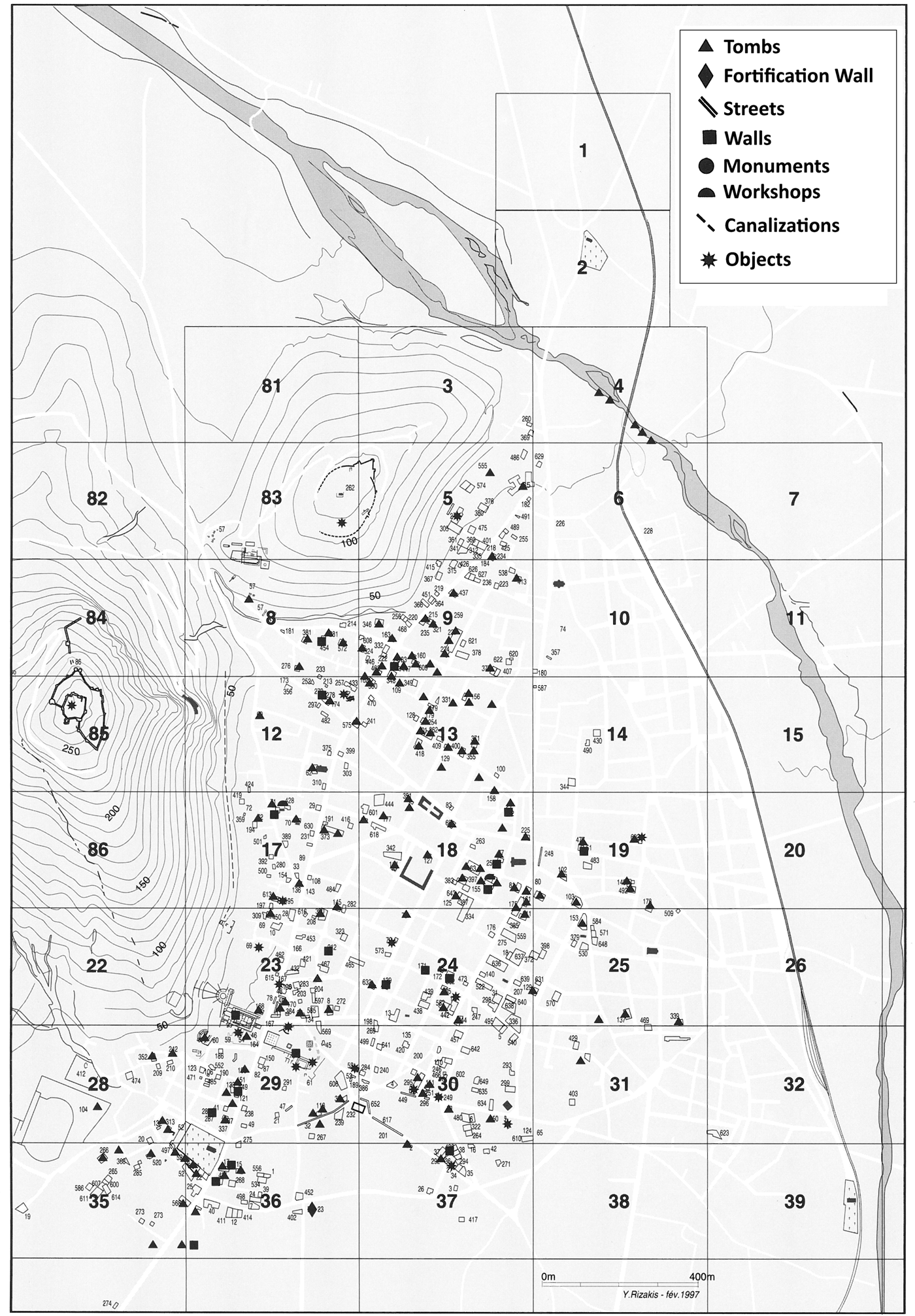
Argos in the Archaic period (Pariente and Touchais Reference Pariente and Touchais1998, pl. X; plan EfA, Y. Rizakis, 1997).

Argos in the Classical period (Pariente and Touchais Reference Pariente and Touchais1998, pl. XI; plan EfA, Y. Rizakis, 1997).

Argos in the Hellenistic period (Pariente and Touchais Reference Pariente and Touchais1998, pl. XII; plan EfA, Y. Rizakis, 1997).

Furthermore, the Classical and Hellenistic burials in Argos have recently been intensively studied by Nikolas Dimakis as part of his monograph (Reference Dimakis, Cavanagh, Cavanagh and Roy2016) on funerary evidence for social status in the northern Peloponnese. Dimakis’ work includes a plan (Fig. 18) that clearly indicates that intracommunal burials took place across the entirety of the urban core of Argos. Dimakis concludes that:
Although, certainly, the great majority of Classical and Hellenistic burials in the Peloponnese are placed outside settlements, there is sufficient archaeological evidence to argue for their intramural placement as well. Such burials have been brought to light in Corinth dating to the Classical period, in Argos in the Classical and Hellenistic periods, at Megalopolis in the Hellenistic [period] … The cemeteries of Argos appear to be rather extensive. Next however to extramural burials a respectable number has been unearthed within the fortified area among houses, public places, shrines, or cisterns as if there was no spatial distinction between the dead and the living. (Dimakis Reference Dimakis2016, 31)
The striking similarity between Sparta and Argos is reinforced by the fact – evident in Fig. 18 – that intracommunal burials in Argos are strung out along roadsides, just as seems to have been the case in Sparta (on the relationship between burials and roads in Argos, see also Barakari-Gleni Reference Barakari-Gleni1996–7, 512; Dimakis Reference Dimakis, Cavanagh, Cavanagh and Roy2010, 34).
Burials in Classical and Hellenistic Argos (after Dimakis Reference Dimakis2016, fig. 10; reproduced with the kind permission of the author).

The situation at Corinth presents instructive similarities and differences. In his study of Corinthian burials between 1100 and 550, Keith Dickey concludes that:
During the Geometric and Archaic periods burials were interred beside or within settlement areas, along roads leading to the settlements, and beginning in the early eighth century also in formal extramural cemeteries such as the North Cemetery and perhaps the Anaploga Cemetery. The practice of intramural burial did not cease, however, with the establishment of these more formal cemeteries. (Dickey Reference Dickey1992, 132)
Dimakis’ work focuses on the Classical and Hellenistic periods, which were not covered by Dickey, and he comes to the same conclusion, namely that intracommunal burials continued to take place in Corinth throughout the Hellenistic period. Dimakis also notes that, unlike Sparta and Argos, where intracommunal burials are widely dispersed throughout the urban fabric, the intracommunal burials in Corinth are concentrated in cemeteries (Fig. 19) (Dimakis Reference Dimakis2016, 31).
Classical and Hellenistic cemeteries in Corinth (Dimakis Reference Dimakis2016, fig. 13; reproduced with the kind permission of the author).

All that said, the existence of the aforementioned intracommunal graves in Sparta, Argos and Corinth would not be surprising if most or all of them held sub-adults.Footnote 51 However, the limited amount of available osteological evidence and the typology of intracommunal tombs in all of these places do not support the idea that they contained mostly sub-adults. In Sparta, as we have seen, there are 31 intracommunal graves of Archaic date, 11 of which are identified as those of adults (five in cists, four in pits, one in a tile grave and one in an unspecified type of grave) and three as those of sub-adults (two in cists, one in a tile grave). No information is provided about the ages of the occupants of the other graves.
Most of the 69 Classical and Hellenistic burials in the Olive Oil Cemetery in Sparta are those of adults, but there are five pot burials in the cemetery, all for sub-adults. This is significant because it suggests that, as was the case elsewhere in the Greek world, pot burials were the preferred form of interring sub-adults, and because most and possibly all of the 16 intracommunal graves from Classical Sparta are not pot burials (nine cists, four pits, three unspecified). With respect to the Hellenistic intracommunal graves from Sparta, of the 25 cist burials, three held adults and four held sub-adults. One of the four tile graves held an adult and two held sub-adults. One of the pot burials held a sub-adult. (In all other instances, the age of the occupant is unstated.)
Hence, the currently available information about intracommunal burials in Archaic, Classical and Hellenistic Sparta provides no warrant whatsoever for believing that most or all of them held sub-adults. Indeed, in a non-trivial number of instances, it is clear that these burials held adults.
The same holds true for Argos. There too incomplete information is available about the age of the occupants of most of the intracommunal tombs, and, due to the absence of clarity about the line of the circuit wall, separating intracommunal from extracommunal burials can be difficult. However, a group of 11 Hellenistic graves that are almost certainly intracommunal was excavated by Paul Courbin between 1953 and 1958, and published in detail by Philippe Bruneau in 1970 (Bruneau Reference Bruneau1970). The skeletal remains in many of these graves were studied by Robert Charles in the 1950s and 1960s (Charles Reference Charles1963), and, although the precise accuracy of Charles’ conclusions about age are open to question (Dimakis, personal communication), there is no reason to believe that he was incapable of distinguishing adults from sub-adults. When Philippe Charlier re-examined a considerable portion of all the skeletons from Argos studied by Charles, he provided broader age ranges for some individuals than those suggested by Charles, but there was no disagreement about whether specific individuals were adults or sub-adults (Charlier Reference Charlier, Mulliez and Banaka-Dimaki2013). The 11 graves in question include nine cists, one pit and one pot burial. There are two multiple burials, giving a total of 13 interred individuals: six are adults (all from the cists) and one is a sub-adult (from the pot burial). (No age is given for the other remains.) For obvious reasons, great caution is needed in extrapolating from a tiny sample, but, as is the case for Sparta, the limited evidence that is available indicates that many if not most of the intracommunal burials in Argos held adults.
For Corinth, Dickey catalogues 18 intracommunal burials from the Archaic period, all in sarcophagi.Footnote 52 Seven held adults and seven held sub-adults; the remains in four sarcophagi were too exiguous to suggest an age. For the Classical and Hellenistic periods, Dimakis catalogues 17 cist/pit/tile tombs and nine sarcophagi, all from intracommunal cemeteries (primarily that at Anaploga) for which the length of the tomb or sarcophagus is known. Determining age based on size of tomb or sarcophagus is a less than entirely straightforward process (see the cautionary notes in Liston Reference Liston1993, 133–4), but it is suggestive that 14 of the 17 cist/pit/tile tombs and five of the nine sarcophagi are longer than 1.5 m (a boundary that has been used in the past to separate sub-adult from adult burials: see Morris Reference Morris1987, 58–60; Houby-Nielsen Reference Houby-Nielsen1995, 177–8; Alexandridou Reference Alexandridou2016, 350 n. 173).
The cautions about sample sizes and incompleteness of information mentioned above apply here as well, but, once again, the available evidence strongly suggests that many if not most intracommunal burials in Archaic, Classical and Hellenistic Corinth held adults. Another way of looking at the same collection of material is that there is no positive evidence whatsoever that intracommunal burials from Archaic, Classical and Hellenistic Sparta, Argos or Corinth were limited to sub-adults.
The conclusion to be drawn from this is that the coexistence of extracommunal and intracommunal burial of adults in Sparta in the Archaic, Classical and Hellenistic periods does not, when compared to the situation in Argos and Corinth, seem particularly exceptional. The same conclusion holds true when we expand our focus from the location of burials to other factors. A complicating factor in comparing Sparta, Argos and Corinth is that the chronology of events in all three communities prior to the sixth century is dependent upon pottery sequences, which are not precisely aligned. Although the Protogeometric and Geometric periods in all three do overlap, there are some significant differences, as presented in Table 8.Footnote 53 The Protogeometric period starts later and ends later in Sparta than it does in Argos and Corinth, and the Geometric period is shorter and ends slightly later.
Chronology of periods in Sparta, Argos and Corinth.

With this caveat in mind, a glance at Table 9 – which summarises what is known about burial rites, tomb types, disposition of remains, the frequency of secondary burials and grave-goods in Sparta, Argos and Corinth from the Protogeometric to the Hellenistic period – shows that developments in Spartan burial practice closely tracked those in Argos and Corinth.Footnote 54 Some noteworthy overlaps are the near-complete absence of cremation prior to the Hellenistic period, the strikingly similar developmental trajectory of the disposition of remains (contracted in the Protogeometric and Geometric periods, a mix of contracted and extended in the Archaic period and extended in the Classical and Hellenistic periods) and strong similarities between the grave-goods found at all three sites in any given period. In all three communities, there is a tendency in the Archaic period for children to receive richer grave-goods than adults.
Comparison of burial practices in Sparta, Argos and Corinth from the Protogeometric to the Hellenistic period.

The match between Sparta and Argos is particularly close. In both Sparta and Argos some Classical graves in extracommunal cemeteries are surrounded by periboloi. The two-level tomb from BB 117A in Sparta dating to the second quarter of the sixth century finds a relatively close match in two elaborate tombs from Argos, both large rectangular structures built from limestone blocks, that date to the first quarter and the last quarter of the sixth century (Kritzas Reference Kritzas1973; Barakari-Gleni Reference Barakari-Gleni1996–7, 516–17). The limited number of such unusually lavish tombs suggests that in both Sparta and Argos a handful of individuals received special burials in the sixth century.
There is also evidence that suggests that horse burials, which prima facie appear to be quite an exotic element of Spartan burial practice, also took place in Argos. Excavations conducted in the south-eastern part of Argos in 1998–2000 uncovered, among other things, a burial dating to the Archaic period of a young male and, immediately adjacent, burials of an equid and a dog (Barakari-Gleni Reference Barakari-Gleni, Mulliez and Banaka-Dimaki2013). A rescue excavation in Argos in 1980 uncovered a collection of five horse skeletons. All the horses had been decapitated, and the heads were placed near the skeletons. Finds associated with the skeletons date them to the Archaic period. Unfortunately the context of the find is unclear; Mycenaean and Hellenistic graves were found in the area and some Hellenistic walls, but nothing else of Archaic date.Footnote 55
A particularly noteworthy similarity between Sparta, Argos and Corinth is a general lack of investment in marking graves prior to the middle of the Hellenistic period. The paucity of inscribed mnemeia from Sparta (see the supplementary material, Appendix 8) stands in stark contrast to Athens, where more than 10,000 inscribed epitaphs dating to the Classical period have been found (Morris Reference Morris1992, 138 n. 7, 156). However, in this respect, Sparta is typical of the situation throughout much of the Peloponnese. As John Papapostolou notes in his study of Classical and Hellenistic grave stelai, ‘[t]he surviving grave stelai in the Peloponnese as a whole are relatively few … Moreover they lack indicative inscriptions and [there] exist virtually no representations’.Footnote 56 Dimakis similarly observes that ‘[w]hat characterizes most of the grave stelai in the entire Classical and Hellenistic Peloponnese is their rarity’ (Dimakis Reference Dimakis2016, 44). In the same vein, Georgia Kokkorou-Alevras has shown that sculpted stone funerary monuments from the Archaic period are rare in the Peloponnese (Kokkorou-Alevras Reference Kokkorou-Alevras, Cavanagh, Cavanagh and Roy2010).
This pattern holds true in both Argos and Corinth throughout the time period covered in this article. In Argos, grave monuments of any kind are the exception rather than the rule before the middle of the Hellenistic period. For example, Courbin, in his study of Geometric graves in Argos, cites only one certain example of a grave-marker.Footnote 57 A very small number of sculptured grave monuments dating to the Archaic period have been found in Argos (Kokkorou-Alevras Reference Kokkorou-Alevras, Cavanagh, Cavanagh and Roy2010, 278–9). The earliest-known inscribed epitaphs from Argos appear to date to the Classical period (e.g. SEG XXIX 362, 364), but they are rare.Footnote 58 It is only in the Hellenistic period that they become at all numerous (e.g. SEG XI 343, XXVI 431, XXX 368, XLVIII 412–14, L 367, LIII 300, 303, LV 412, 418), and even then the numbers found do not in any way compare to those from Athens.Footnote 59 There are, in addition, a handful of fourth-century grave-markers in the shape of naiskoi from Argos (Papapostolou Reference Papapostolou1993, 65 n. 188).
Benjamin Millis, in the course of publishing an inscribed grave monument found at Corinth and dating to the Classical period, highlights ‘the remarkable paucity of grave monuments from pre-Roman Corinth, despite more than a century of archaeological investigation, including the excavation of a large cemetery area’. The entire collection of identifiable grave monuments from Corinth, which begin in the Geometric period, numbers 50–60. Most of these monuments took the form of squared stone blocks set directly on the ground or on a base. Some of the later examples are inscribed, carry relief decoration, a moulding or a stone lekythos on top. Millis concludes that the ‘Corinthians’ use of grave monuments was sporadic’ (Millis Reference Millis2007, 363, 364).
There are, as one would expect, also non-trivial divergences between Sparta, Argos and Corinth. For example, the dominance of burial in cylindrical pithoi in seventh-century Argos finds no parallel in either Sparta or Corinth, and the Corinthians’ predilection for stone sarcophagi starting in the Archaic period sets them apart from the Spartans and Argives.
The provision of grave-goods offers a particularly interesting and significant instance of convergence and divergence between Sparta, Argos and Corinth. The grave-goods in all three communities were largely the same in the Protogeometric and Geometric periods. Sometime around 750 grave-goods other than iron dress pins disappear from Corinth and do not reappear in significant numbers until c.600. Interment in cylindrical pithoi became the dominant form of burial in Argos in the seventh century, and very few of these burials have any grave-goods.
As we have seen, of the 31 known Archaic intracommunal burials in Sparta, 19 are reported as containing no grave-goods; of the remaining 12 graves, at least seven had grave-goods – all in the form of pottery. In the three instances where it is possible to supply a relatively precise date, the burials in question took place in the late seventh or first quarter of the sixth century. The single burial in the Olive Oil Cemetery that is clearly identified as Archaic in the preliminary excavation report contained one vase from the middle of the sixth century.Footnote 60 It is, therefore, possible that grave-goods were largely absent from all three communities for much of the seventh century.
However, a sharp divergence becomes noticeable over the course of the sixth century and into the Classical period. During this stretch of time, grave-goods seem to be rare to the point of being non-existent in Sparta, whereas in both Argos and Corinth they are common. Roughly half of the Classical burials in Argos contain grave-goods and virtually all of the Classical burials in Corinth include at least one vase (see the sources cited above in n. 54). It is only in the Hellenistic period that grave-goods reappear in any quantity in Sparta.
The near complete absence of grave-goods from Corinth for approximately 150 years has been attributed to the imposition of funerary legislation (Dickey Reference Dickey1992, 105–8), and passages from Plutarch's Instituta Laconica (Moralia 236f–40b) and Lycurgus (see the supplementary material, Appendix 8) make the plausible claim that this was true of Sparta as well. Indeed, burial practice in Sparta seems to show a degree of consistency that speaks to an unusually high level of state control. Hence, for instance, inscribed epitaphs are rare but extant in both Argos and Corinth throughout the Classical period, whereas the only certainly attested inscribed mnemeia in Sparta are associated with soldiers who died in war (see the supplementary material, Appendix 8). The Instituta Laconica states that these were the only permitted form of inscribed mnemeia, and this restriction of funerary behaviour appears to have been successfully enforced through the middle of the Hellenistic period. This is, of course, consistent with the general picture of Sparta found in much of the relevant ancient textual evidence, which portrays Sparta as an unusually collectivist society characterised by what was, by ancient Greek standards, a remarkably high degree of state control over individual behaviour.Footnote 61
One might, therefore, safely describe Spartan burial practices in many if not all periods as distinctive. At the same time, it is no longer apparent that Spartan burial practices were at any point in time so completely different from those found in other Greek communities as to make them truly exceptional. Indeed, the newly available archaeological evidence strongly suggests that from the Protogeometric through to the Hellenistic period Spartan burial practices were in many ways similar to those found in Argos and Corinth. The match between Sparta and Argos is sufficiently close as to suggest that one community influenced the other or perhaps that there was an ongoing mutual diffusion of customs.
It is, in fact, in many ways inherently misleading to compare Spartan burial practice with that of the ‘typical’ Greek polis because there was significant variation in the burial practices of Greek communities at any given point in time. This is as one would expect. The number and complexity of the customs that collectively make up burial practice – inhumation versus cremation, tomb types, tomb orientations, the prevalence of secondary burials, the presence/absence and nature of grave-goods, to name but a few – create a large array of possible combinations of customs and hence an equally large array of burial practices. As a result, the specific constellation of funerary customs in any given Greek community in a specific period of time is likely to be, if not unique, then certainly distinctive. Conceptions about ‘typical’ burial customs have been driven in large part by boldly extrapolating from the large and well-studied collection of evidence for Athens. However, as should now be clear, that process of extrapolation is problematic.Footnote 62
Indeed, it is becoming increasingly apparent that there were significant divergences in burial practices within Attica itself throughout the Classical period. In the present context, it is particularly important to note that ongoing excavations in many Attic demes have revealed what are here termed intracommunal burials. For example, in a recent treatment of new evidence from the deme of Acharnai, Chryssanthi Papadopoulou observes the following.
The archaeological evidence … shows that the dead were buried near the living in this deme in the Classical period … Structures, a well, and walls delimiting properties have been found next to some cemeteries. This shows that the latter were not located far from sites of habitation, as previously thought. Consequently, the locations of cemeteries should not be used as evidence of the extent of settlements … Clearly, the established notions of the dead being separated from the living in Classical Athens are not supported by the archaeological record. The dead in Acharnai, as in many other areas of Attica, were very close to the living – both those who were buried in cemeteries located amidst farmsteads and those buried within family plots. (Papadopoulou Reference Papadopoulou2017, 160–1)
After reviewing evidence for a Classical cemetery adjacent to the agora in the deme of Halai Aixonidai, Papadopoulou goes on to conclude that, ‘the placement of the dead next to the living in Athens [sc. Attica] up until the eighth century bc is not treated as unusual … It appears that it should not be treated as unusual when encountered in the Classical period either’ (Papadopoulou Reference Papadopoulou2017, 165).
CONCLUSION
The newly available evidence from Sparta, particularly when combined with the previously available material from Argos and Corinth, has significant ramifications for our understanding of Greek burial practice, broadly construed. It would, of course, be premature to draw sweeping conclusions about Greek burial practice on the basis of the evidence from just three communities. However, it seems safe to say that the current orthodoxy – namely that adult intracommunal burials in communities other than Sparta ceased after the end of the Geometric period – needs to be reconsidered. It is worth keeping in mind that in Morris’ Burial and Ancient Society, the most thorough scholarly treatment of current orthodoxy, Argos and Corinth feature prominently as examples of communities in which intracommunal burials ceased after the end of the Geometric period (Morris Reference Morris1987, 183–6). Morris acknowledges the existence of a small number of intracommunal burials in places such as Argos after c.700 but takes them to be exceptions made for individuals who had been heroised or otherwise granted unusual privileges by the community.Footnote 63 However, both the number and the completely unremarkable nature of many of the intracommunal graves from Sparta, Argos and Corinth – in terms of typology and grave-goods – make that position difficult to accept.
The now seemingly inescapable conclusion that Morris is wrong about the disappearance of intracommunal burials from both Argos and Corinth suggests that the current orthodoxy is fatally flawed. That is by no mean a novel conclusion. In an article published in 2009, Anthony Snodgrass points to evidence from Corinth and several sites in Crete and argues that ‘the ban on intramural adult burial was not universal’.Footnote 64 The continuing accumulation of evidence and analysis strongly supports Snodgrass’ argument.
It is important to acknowledge that recent work on Athenian graves has largely confirmed Morris’ characterisation of the situation in Athens in that post-Geometric intracommunal burials of adults continue to be rare.Footnote 65 Moreover, the general pattern highlighted by Morris remains in evidence, but it no longer appears as simple and clear-cut as it did before. What seems to have happened is that the coexistence of intracommunal and extracommunal burials (including those of adults) that characterised many Greek communities in the Protogeometric and Geometric periods continued into later periods even as an increasingly large percentage of burials took place in extracommunal cemeteries.
Intracommunal burial, either of children or adults, is not universally attested in Greek communities of the Early Iron Age, and a priori it seems likely that intracommunal burials tended to persist in those Greek communities that showed a relatively strong preference for intracommunal burials in the Early Iron Age. Mazarakis-Ainian has shown that in the Early Iron Age, intracommunal burials were prominent in ‘East Central Greece, from Thessaly down to Attica and the NE Peloponnese’ (Mazarakis Ainian Reference Mazarakis Ainian, Bartoloni and Benedettini2008, 385). The existence of post-Geometric intracommunal adult burials in Corinth, Argos, Sparta and demes in Attica is, from that perspective, not entirely surprising.
In contemplating further research on the subjects discussed in this article, a series of challenges presents itself. To begin with, acknowledging the coexistence of both extracommunal and intracommunal adult burials after the end of the Geometric period immediately raises the question of who was buried where and why.Footnote 66 Snodgrass has pointed out that in some periods of Greek history (e.g. the Middle Helladic and Classical) burials took place simultaneously in two different spatial contexts: on the edges of settlements in formal, communal cemeteries and in small family plots located on private land in rural areas. In these instances, different spatial contexts served different functions: burial in a formal, communal cemetery spoke to inclusion within the community, whereas burial on one's land served as a de facto claim to ownership of that land and hence a guarantee of sorts against future disputes.Footnote 67
This is an important example of the coexistence of different spatial contexts for burials in Greek communities, and one might suspect that extracommunal and intracommunal burials in Sparta were similar in that they served different functions. If burial in a formal, communal cemetery located on the edges of Sparta spoke to inclusion within the community, then burial within the urban fabric of Sparta may have indicated that the individuals in question enjoyed elevated social standing.Footnote 68 This is a difficult hypothesis to test because in the Archaic and Classical periods the vast majority of the extant intracommunal burials are in simple cist, pit and tile graves, and grave-goods are, for the most part, limited to small quantities of pottery. It is, therefore, impossible to perceive status differences based on grave type or grave-goods.
The situation is rather different in the Hellenistic period when relatively elaborate two-level tombs richly equipped with grave-goods appear in some number. It may well be significant that seven of the ten known examples of such tombs are located in a particularly conspicuous area of Sparta, at the northern end of the Aphetaïs road and just to the south of the likely location of the agora (Fig. 20).Footnote 69 On the other hand, intracommunal burials in simpler tomb types with much less costly grave-goods took place in more peripheral areas.Footnote 70
Types of Hellenistic intracommunal burials in Sparta.

The intracommunal burials in Sparta – like those in Argos – seem to be mixed in among shops, houses and sanctuaries. Emplacing an intracommunal burial would, therefore, have been simply a matter of purchasing land and using it for funerary purposes. Moreover, the epigraphic evidence from Athens shows that at least in the fourth century grave plots could be sold,Footnote 71 and, there is, therefore, no reason to believe that Spartiate families could not have acquired land, within the city itself, that either had or had not previously held burials and then put tombs on it. If this was indeed the case, affluent families may have been able to afford to purchase land in the city to use for graves, whereas less well-off families opted for burial on the periphery of the city (where land was either cheaper or freely available for funerary purposes). Amongst those affluent families, the richest could have purchased land in particularly prominent locations, such as the northern end of the Aphetaïs road, where property was presumably especially expensive.
It seems likely, therefore, that there was, in the Hellenistic period, some degree of differentiation between the locations of intracommunal burials based on status. One could, on that basis, speculate that throughout the Archaic, Classical and Hellenistic periods a similar status differentiation existed between extracommunal and intracommunal burials in Sparta, with the latter being the preserve of higher-status individuals. A potential piece of supporting evidence for this proposition might be found in the location of the only known, pre-Hellenistic two-level tomb in BB 117A, which is situated on the northern slope of Gerokomeiou hill and hence in a prominent spot just south of Palaiokastro hill.
It may well have been that, prior to the Hellenistic period at least, social status was conferred by something other than the possession of wealth. The literary and archaeological evidence leaves little doubt that Spartiates buried in battlefield polyandreia were divided up into groups and buried in different chambers. In the polyandreion at Plataia, priests seem to have been buried as a separate group and in the Lakedaimonian polyandreion in the Athenian Kerameikos it seems that high-ranking officers and an Olympic victor were buried together, in a special chamber, and that more care was taken in their interment (see Stroszeck Reference Stroszeck2006; Christesen Reference Christesen and Powellforthcoming). This may indicate that intracommunal burial in Sparta itself was reserved for individuals who, either by virtue of religious or military office or by virtue of athletic achievement, could lay claim to special status. This would remove any direct connection between status and wealth, and thus help explain why Archaic and Classical intracommunal burials show minimal variation amongst themselves with respect to the expenditure involved.
There are of course other possibilities about the identity of the Spartiates who received intracommunal burial. One obvious criterion – age – has already been eliminated in that both sub-adults and adults were buried intracommunally. Sex may well have been an issue, but the relative rarity of systematic examination of osteological remains of post-Bronze Age burials in Greece, and the major difficulties with assigning sex based on grave-goods (Liston Reference Liston, James and Dillon2012, 127–8; Alexandridou Reference Alexandridou2016, 348), means that we know next to nothing about sex ratios in extracommunal versus intracommunal burials. It is possible that the decision to bury intracommunally versus extracommunally boiled down to a matter of space, with some families having the requisite room available on their urban property and others not. Finally, in many cases it may have been simply a matter of personal choice without any immediate social significance.
Given the present state of evidence, all these explanations are largely speculative, and it is, at the moment, impossible to provide anything like a complete, satisfactory answer to the questions of who was buried intracommunally versus extracommunally and why. These questions should be a focus of future research.
Acknowledging the coexistence of both extracommunal and intracommunal adult burials after the end of the Geometric period also suggests a need to reconsider the question of why there was a shift toward extracommunal burial. Three basic explanations for that phenomenon have been offered: (1) a pervasive shift in religious practice that led to heightened fears about pollution from contact with the dead (Sourvinou-Inwood Reference Sourvinou-Inwood and Hågg1983; Reference Sourvinou-Inwood1995, 413–44), (2) socio-political developments tied to the rise of the polis (Morris Reference Morris1987; Houby-Nielsen Reference Houby-Nielsen1992; Reference Houby-Nielsen1995; Morris Reference Morris, Marchegay, Dinahet and Salles1998) and (3) the disappearance of suitable spaces due to population growth in urban centres (Blegen, Palmer and Young Reference Blegen, Palmer and Young1964, 13; Williams Reference Williams1982, 9–20; D'Onofrio Reference D'Onofrio, Charalambidou and Morgan2017, 260–1).
The continuing practice of intracommunal burial might suggest that the first explanation is less than entirely satisfactory, since it would seem a priori improbable that, in the face of pervasive fears about pollution, significant numbers of intracommunal burials remained acceptable. The location of intracommunal burials alongside major routes through the centres of Sparta and Argos would have made those burials an inescapable part of the urban fabric.
It remains possible that socio-political developments were a major factor, but, all things being equal, the third explanation now seems more likely than before. As the space within cities became more densely utilised, there would have been differential access to intracommunal space, so that some families may have been able, if they wished, to continue to bury intracommunally whereas others were compelled to make use of extracommunal cemeteries. The ferocious reuse of space in the Olive Oil Cemetery may indicate that finding room anywhere near the city centre for burials was indeed a non-trivial problem.
Finally, the entire collection of evidence for the developmental trajectory of intracommunal versus extracommunal burials requires careful re-examination. A broad-ranging, firmly grounded survey of burial practice in a geographically diverse array of Greek communities from the Protogeometric to the Hellenistic period is very much a desideratum. The invaluable survey produced by Kurtz and Boardman is now badly out of date, and it was always somewhat restricted in terms of its geographic scope.Footnote 72 A new and greatly expanded version of Kurtz and Boardman's work would represent an invaluable scholarly resource.
In conclusion, one might note that we now find ourselves in a situation with more than a hint of irony. Whereas Greek burial practice has long been reconstructed based largely on the evidence from Athens, with Sparta seen as an outlier that proved the rule, it now seems likely that in reality the situation was precisely the opposite. Sparta, at least with respect to its burial practices, was evidently much closer to the norm, to the extent that there ever was such a thing, than Athens.
ACKNOWLEDGEMENTS
I am grateful for the opportunity to present an earlier version of this paper in the Ancient History Seminar Series at Cambridge University, and to the participants in that seminar for their insightful and helpful comments. I would also like to thank Paul Cartledge, Jeremy Rutter and the anonymous readers for BSA for reading and commenting on an earlier draft of the written text.
SUPPLEMENTARY MATERIAL
Supplementary material is available online at: https://doi.org/10.1017/S0068245418000096