Introduction
Non-suicidal self-injury (NSSI) has received increasing recognition in recent years as a clinically significant phenomenon, conceptually distinct from suicidal behavior. Indeed, these two clinical phenomena appear to differ notably in their neurobiology, response to treatment, and long-term trajectory (Brent, Reference Brent2011; Mars et al., Reference Mars, Heron, Crane, Hawton, Lewis, Macleod and Gunnell2014). Furthermore, there is emerging evidence that NSSI is an even stronger predictor of prospective suicide attempts than is a past history of attempts (Ribeiro et al., Reference Ribeiro, Franklin, Fox, Bentley, Kleiman, Chang and Nock2016). Reflecting this growing appreciation of the empirical and clinical importance of NSSI, it was recently included in DSM-5 as a disorder warranting further consideration (American Psychiatric Association, 2013).
To advance the current understanding of NSSI, basic epidemiological data on its prevalence, sociodemographic and diagnostic correlates, and its associations with treatment use are needed. Although several prior studies have examined the prevalence of this behavior in specific demographic or regional subpopulations (Taliaferro, Muehlenkamp, Borowsky, McMorris, & Kugler, Reference Taliaferro, Muehlenkamp, Borowsky, McMorris and Kugler2012; Whitlock, Eckenrode, & Silverman, Reference Whitlock, Eckenrode and Silverman2006), nationally representative studies are necessary to arrive at generalizable estimates of its prevalence. To date, there have been relatively few population-based studies that have assessed this behavior in adults (e.g. Briere & Gil, Reference Briere and Gil1998; Keel, Jean Forney, Buchman-Schmitt, Kennedy, & Joiner, Reference Keel, Jean Forney, Buchman-Schmitt, Kennedy and Joiner2018; Klonsky, Reference Klonsky2011). Nationally representative studies are even rarer; these include studies of German adults (Plener et al., Reference Plener, Allroggen, Kapusta, Brähler, Fegert and Groschwitz2016), Danish young adults (Christoffersen, Møhl, DePanfilis, & Vammen, Reference Christoffersen, Møhl, DePanfilis and Vammen2015), and Belgian college students (Kiekens et al., Reference Kiekens, Hasking, Claes, Mortier, Auerbach, Boyes and Bruffaerts2018). Lifetime prevalence rates for NSSI ranged from 2.7% among Danish young adults (Christoffersen et al., Reference Christoffersen, Møhl, DePanfilis and Vammen2015) to 5.9% among American adults (Klonsky, Reference Klonsky2011).
Although these studies are important for characterizing the prevalence and functions of NSSI, several essential questions about its epidemiology remain unaddressed. In particular, there remains a need for large-scale, epidemiological studies that permit fine-grained analyses for determining associations between NSSI with clinical phenomena occurring at relatively low base rates in the general population, such as certain psychiatric disorders (Klonsky, Reference Klonsky2011). One nationally representative study has been conducted in this area, albeit with the sample limited to college students (Kiekens et al., Reference Kiekens, Hasking, Claes, Mortier, Auerbach, Boyes and Bruffaerts2018). Additionally, accurate epidemiological estimates of medical and mental health service utilization for NSSI are particularly needed for their potential to inform mental health policy. Indeed, to date, no epidemiological studies have been conducted to characterize patterns of treatment use specifically for NSSI.
The current study is uniquely able to address these needs by employing a substantially larger sample (n = 7403) than in prior epidemiological studies in this area (i.e. the largest sample from epidemiological studies of adults to date featured 4718 participants; Christoffersen et al., Reference Christoffersen, Møhl, DePanfilis and Vammen2015). It provides data on the lifetime prevalence of NSSI and its treatment in a nationally representative sample of adults residing in England, drawn from the Adult Psychiatric Morbidity Survey (APMS) 2007 (McManus, Meltzer, Brugha, & Bebbington, Reference McManus, Meltzer, Brugha and Bebbington2009). It is also the first epidemiological study to present (i) fine-grained data on sociodemographic and psychiatric correlates of NSSI, (ii) evaluations of NSSI in relation to suicidal ideation and suicide attempts, and (iii) correlates of medical and psychiatric treatment use specifically for NSSI.
Method
Sample
The APMS 2007 was conducted with 7403 (unweighted) respondents aged 16 and older, using a multi-stage stratified probability sampling design. This sampling strategy was designed to yield a sample representative of the population of England residing in private households. Complete details regarding the sampling strategy and design, as well as weighting procedures, have been previously reported (McManus et al., Reference McManus, Meltzer, Brugha and Bebbington2009). Given the focus of the current study on NSSI in adults, only respondents aged ≥18 years and answered queries regarding NSSI were included in analyses (unweighted n = 7192).
Respondent data were collected using a combination of face-to-face computer-assisted personal interviews (CAPIs) and computer-assisted self-completion interviews (CASIs). The CASI was used to supplement the CAPI in inquiring about personally sensitive experiences (e.g. NSSI and psychiatric illness). Respondents were informed beforehand that the interviewers would be blind to their responses on the CASI. The decision to adopt the CASI was based on prior findings that face-to-face inquiry of personally sensitive information can often lead to underreporting due to feelings of embarrassment and social desirability response biases (Tourangeau, Rips, & Rasinski, Reference Tourangeau, Rips and Rasinski2000; Tourangeau & Yan, Reference Tourangeau and Yan2007). Such computerized assessment techniques that ensure privacy in responding have been found to be effective in improving accuracy and result in greater reporting of personally sensitive information (Turner et al., Reference Turner, Ku, Rogers, Lindberg, Pleck and Sonenstein1998), as in the case of self-injurious behaviors (Evans, Hawton, Rodham, & Deeks, Reference Evans, Hawton, Rodham and Deeks2005; Nock et al., Reference Nock, Borges, Bromet, Cha, Kessler and Lee2008; Safer, Reference Safer1997).
Measures
Sociodemographic characteristics
The following eight sociodemographic characteristics were assessed: sex, race/ethnicity (White or racial/ethnic minority),Footnote †Footnote 1 age (stratified into four groups: 18–29, 30–39, 40–49, and ≥50), highest educational qualification (Bachelor's degree; teaching, Higher National Diploma, or nursing; A Level; general certificate or secondary education; others; or none), number of biological parents who lived with the respondent throughout childhood (none, 1, or 2), marital status (married or cohabiting; widowed, separated, or divorced; or never married), gross annual household income, before tax and National Insurance deductions (stratified by quintiles: ≤£10 574; £10 575–£16 194; £16 195–£24 699; £24 700–£40 383; and ≥£40 384), and the Overall Index of Multiple Deprivation (stratified by quintiles). Annual household income was adjusted using McClements equivalence weights (McManus et al., Reference McManus, Meltzer, Brugha and Bebbington2009) to account for the number, age, and the relationships of adults and children living in the household. The Overall Index of Multiple Deprivation 2004 (Noble et al., Reference Noble, Wright, Dibben, Smith, McLennan, Anttila and Lloyd2004) is a composite index of local poverty widely used in England. Individual-level data in seven domains (i.e. living environment, barriers to housing and services, education, skills and training, income, health deprivation and disability, and crime and disorder) were aggregated for small areas of ~1500 residents. Respondents' deprivation scores were determined by linking their household postcode address with the corresponding Super Output Area of residence (geographical regions developed after the 2001 UK census). Quintile groupings were based on the Index of Multiple Deprivation 2004 scores across all the Super Output Areas in England.
Current psychiatric disorders
ICD-10 depression and anxiety disorders were ascertained using the Revised Clinical Interview Schedule (CIS-R; Lewis, Pelosi, Araya, and Dunn, Reference Lewis, Pelosi, Araya and Dunn1992), a structured diagnostic interview, administered by trained lay interviewers (McManus et al., Reference McManus, Meltzer, Brugha and Bebbington2009). Disorders assessed with the CIS-R include the following: depression, generalized anxiety disorder (GAD), social phobia, specific phobia, panic disorder, agoraphobia, and obsessive–compulsive disorder (OCD). The CIS-R has previously been found to be reliable in direct comparisons between lay interviewers and psychiatrists (Lewis et al., Reference Lewis, Pelosi, Araya and Dunn1992). Probable attention-deficit/hyperactivity disorder (ADHD) was evaluated using the Adult ADHD Self-Report scale (World Health Organization, 2003), with scores ≥4 indicating the probable presence of ADHD (Faraone & Biederman, Reference Faraone and Biederman2005). This measure has been shown to have good sensitivity and specificity (McManus et al., Reference McManus, Meltzer, Brugha and Bebbington2009). For assessing probable post-traumatic stress disorder (PTSD), respondents were first queried about traumatic life events they had experienced since age 16. Those who had experienced a traumatic event were then asked to complete the Trauma Screening Questionnaire (TSQ; Brewin et al. Reference Brewin, Rose, Andrews, Green, Tata, McEvedy and Foa2002; Foa, Riggs, Dancu, & Rothbaum, Reference Foa, Riggs, Dancu and Rothbaum1993), with scores ≥6 indicating probable PTSD. The TSQ has been identified by the National Institute for Health and Clinical Excellence (NICE) as one of two screening measures with the greatest potential utility in primary care settings (National Institute for Health and Clinical Excellence, 2006), and was chosen specifically for use in the APMS because it has been previously employed in a large population-based study (Galea et al., Reference Galea, Brewin, Gruber, Jones, King, King and Kessler2007), and it has been well validated with different samples and different types of traumatic events (McManus et al., Reference McManus, Meltzer, Brugha and Bebbington2009). The TSQ has demonstrated high sensitivity and specificity (Brewin, Reference Brewin2005) when compared to the Clinician-administered PTSD Scale (Blake et al., Reference Blake, Weathers, Nagy, Kaloupek, Gusman, Charney and Keane1995). The presence of probable eating disorders was evaluated with the SCOFF screening schedule (Morgan, Reid, & Lacey, Reference Morgan, Reid and Lacey1999), with scores ≥6 indicating probable eating disorders. This measure has exhibited good sensitivity and specificity when compared to clinical diagnoses (McManus et al., Reference McManus, Meltzer, Brugha and Bebbington2009). According to NICE guidelines, the SCOFF is the preferred screening measure for identifying probable eating disorder cases in community samples (National Collaborating Centre for Mental Health, 2004).
The presence of alcohol dependence was measured using a two-stage process, with respondents first completing the Alcohol Use Disorders Identification Test (Saunders, Aasland, Babor, de la Fuente, and Grant, Reference Saunders, Aasland, Babor, de la Fuente and Grant1993). Those scoring ≥10 were then interviewed with the community version of the Severity of Alcohol Dependence Questionnaire (SADQ-C; Stockwell, Sitharthan, McGrath, and Lang, Reference Stockwell, Sitharthan, McGrath and Lang1994) with scores ≥4 indicating probable alcohol dependence. The Diagnostic Interview Schedule (Robins, Helzer, Croughan, & Ratcliff, Reference Robins, Helzer, Croughan and Ratcliff1981) was used to assess the presence of drug dependence in respondents who reported past-year use of eight drug types.
Lifetime NSSI and treatment
Lifetime occurrence of NSSI was first assessed in the CAPI with the question: ‘Have you ever deliberately harmed yourself in any way but not with the intention of killing yourself?’ Respondents with a positive history of NSSI on the CAPI were asked follow-up questions about NSSI methods (i.e. cutting, burning, swallowing hazardous objects, and other methods), as well as medical treatment (i.e. for physical injury from NSSI) and mental health treatment, respectively, specifically for NSSI. The query about lifetime occurrence of NSSI was repeated later in the interview with the CASI, this section first prefaced with a note that some questions from earlier in the interview would be repeated. An endorsement of lifetime occurrence of NSSI on either the CAPI or CASI was coded as a positive lifetime history of NSSI.
Lifetime suicidal ideation and behavior
As with NSSI, lifetime suicidal ideation (‘Have you ever wished that you were dead?’ and ‘Have you ever thought of taking your life, even if you would not really do it?’) and suicide attempts (‘Have you ever made an attempt to take your life, by taking an overdose of tablets or in some other way?’) were initially assessed with the CAPI. Queries about the lifetime occurrence of active suicidal ideation and suicide attempts were repeated subsequently in the interview with the CASI. Endorsement of relevant items on either the CAPI or CASI was coded as a positive history of suicidal ideation and suicide attempts, respectively.
Statistical analyses
Cross-tabulations were calculated to estimate the lifetime prevalence of NSSI, and medical and psychiatric treatment for NSSI for each relevant sociodemographic and psychiatric correlate. Similarly, cross-tabulations were used to produce lifetime prevalence estimates of suicidal ideation and suicide attempts, respectively, among respondents with lifetime NSSI. Frequency counts for NSSI methods were based on the subset of participants who endorsed a lifetime history of NSSI on the CAPI.
Bivariate logistic regression analyses with NSSI as the criterion variable were conducted to determine its associations with sociodemographic correlate and psychiatric disorders. For psychiatric disorders, a multivariate logistic regression analysis was also conducted with all disorders included in the model and adjusting for all eight sociodemographic factors examined at the bivariate level.
Bivariate and multivariate logistic regression analyses were conducted with suicidal ideation and suicide attempts, respectively, as the criterion variable and NSSI as the predictor of interest. In multivariate analyses, all sociodemographic factorsFootnote 2 and psychiatric disorders were included as covariates, as well as suicidal ideation in the case of suicide attempts as the outcome variable. For analyses with suicidal ideation as the criterion variable, respondents were excluded if they had a lifetime history of suicide attempts, so as to yield analyses of ‘pure’ suicidal ideation (i.e. cleanly evaluating the strength of the association between NSSI and suicidal ideation unconfounded by its association with suicide attempts; Klonsky & May, Reference Klonsky and May2014; Liu, Case, & Spirito, Reference Liu, Case and Spirito2014; Walsh, Sheehan, & Liu, Reference Walsh, Sheehan and Liu2021).
Analyses for lifetime medical treatment and mental health treatment for NSSI as criterion variables were conducted with the subset of participants who endorsed a lifetime history of NSSI on the CAPI. For these NSSI treatment utilization analyses, sex, age,Footnote 3 and the number of psychiatric disorders were evaluated separately and simultaneously as predictors in bivariate and multivariate logistic regression models, respectively.
For all regression analyses, results were presented as odds ratios (ORs) with 95% confidence intervals (CIs). All analyses were conducted in SPSS 23.0, using weighting procedures to accommodate the complex sampling frame of the survey and to generate nationally representative estimates.
Results
NSSI prevalence and characteristics
The lifetime prevalence of NSSI was 4.86% (s.e. = 0.28%; unweighted n = 325). The most frequent method specifically endorsed was cutting (60.13%, s.e. = 3.92%), followed by burning (13.11%, s.e. = 2.81%) and swallowing hazardous objects (11.19%, s.e. = 2.30%). Other methods of NSSI were endorsed by 28.82% (s.e. = 3.40%) of respondents with lifetime NSSI.
Sociodemographic correlates
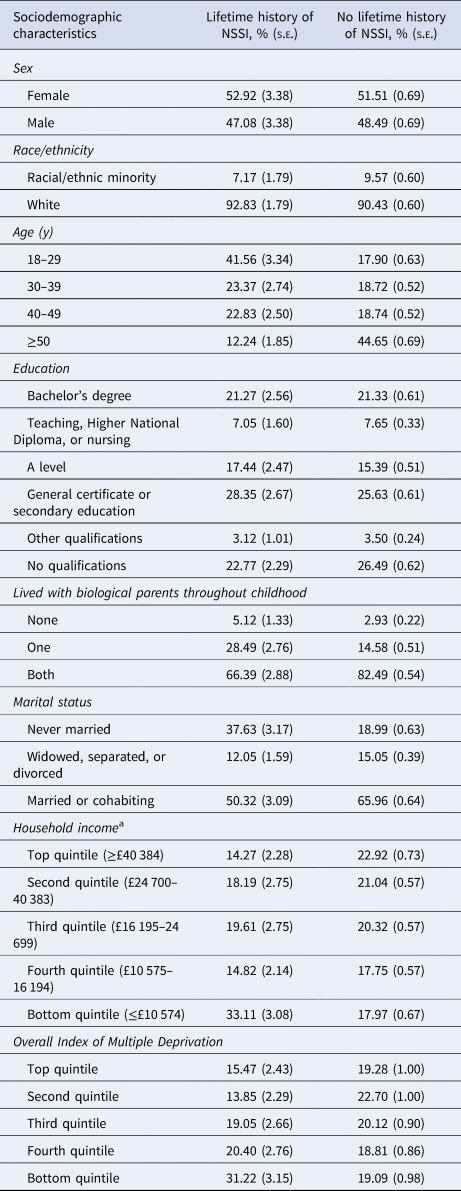
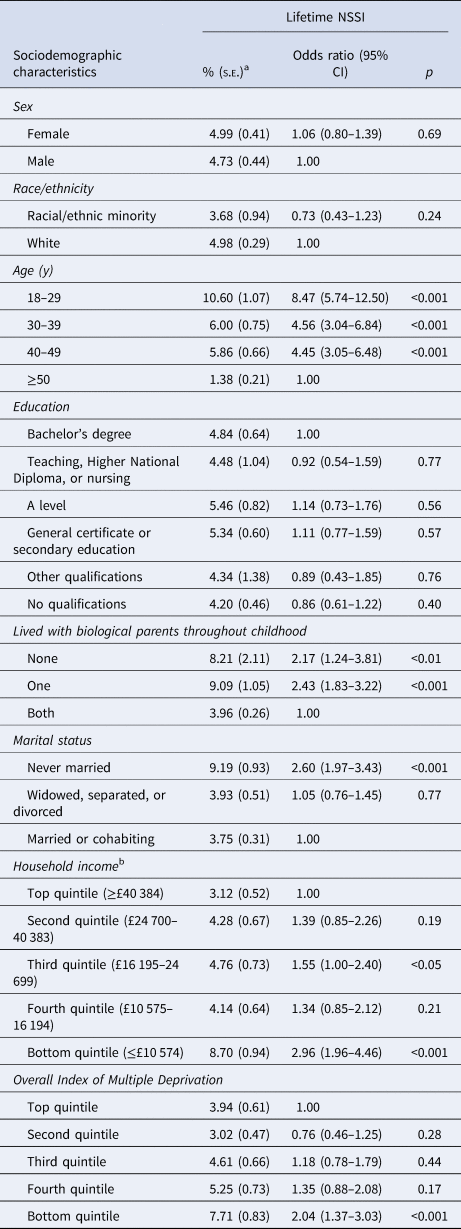
Sociodemographic composition by NSSI history is presented in Table 1. No differences in sex, race/ethnicity, or educational attainment were observed for lifetime NSSI (Table 2). Compared to the oldest age group (50 years and older), there was a pattern of increasing lifetime OR values of NSSI with younger age groups (ORs = 4.45–8.47), this difference in OR values being most pronounced for those aged 18–29 years (OR = 8.47, 95% CI = 5.74–12.50). OR values of NSSI were significantly greater for respondents who lived with one or no biological parents throughout childhood (ORs = 2.17–2.43). Respondents who never married were also at greater risk for NSSI when compared to currently married or cohabiting respondents (OR = 2.60, 95% CI = 1.97–3.43). Respondents at the bottom quintile for household income had the greatest OR values of NSSI when compared to those in the top quintile (OR = 2.96, 95% CI = 1.96–4.46). Similarly, those in the bottom quintile for overall Index of Multiple Deprivation had greater odds of lifetime NSSI when compared to those in the top quintile (OR = 2.04, 95% CI = 1.37–3.03).
Sociodemographic characteristics by the lifetime history of NSSI (unweighted n = 7192)

a Family income was weighted using McClements equivalence scores.
Sociodemographic correlates of non-suicidal self-injury (unweighted n = 7192)

a Weighted prevalence of non-suicidal self-injury is presented for each sociodemographic characteristic.
b Family income was weighted using McClements equivalence scores.
Psychiatric correlates
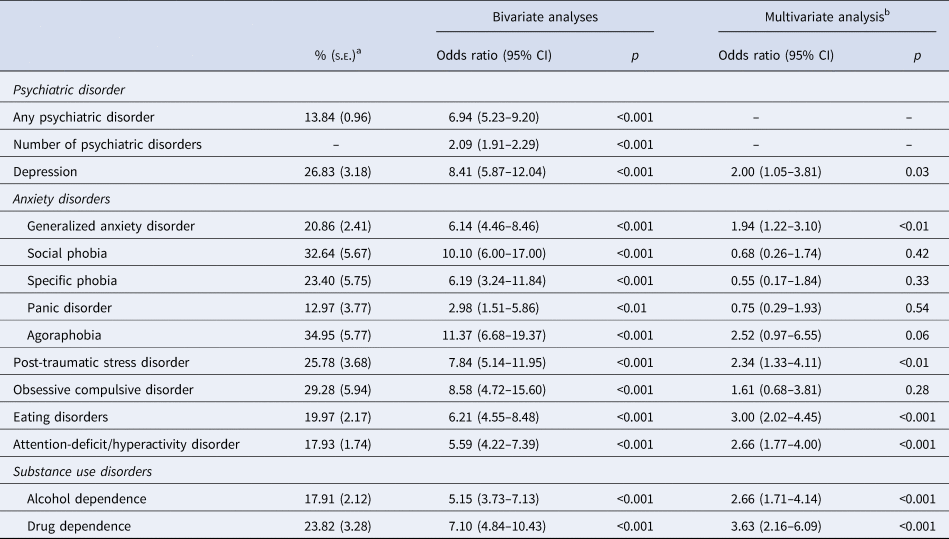
Among respondents with a lifetime history of NSSI, the majority (63.82%, s.e. = 3.24%) had at least one psychiatric disorder at the time of assessment. The prevalence of NSSI for each psychiatric disorder is displayed in Table 3, with 13.84% (s.e. = 0.96%) of respondents with at least one psychiatric disorder endorsing a history of NSSI. For individual psychiatric disorders, prevalence rates of NSSI ranged from 12.97% (s.e. = 3.77%) in the case of respondents with panic disorder to 34.95% (s.e. = 5.77%) in the case of those with agoraphobia.
Associations between psychiatric disorders and non-suicidal self-injury (unweighted n = 7192).

a Weighted prevalence of non-suicidal self-injury is presented for each psychiatric disorder.
b Adjusted for sex, race/ethnicity, age, education, number of parents in household throughout childhood, marital status, family income, and Overall Index of Multiple Deprivation.
Also presented in Table 3 is the association between psychiatric disorders and NSSI, with bivariate ORs, as well as multivariate ORs adjusting for all eight sociodemographic characteristics previously examined at the bivariate level. At the bivariate level, having any psychiatric condition was associated with greater odds of NSSI (OR = 6.94, 95% CI = 5.23–9.20), with the odds of NSSI increasing with a number of disorders (OR = 2.09, 95% CI = 1.91–2.29). When examined individually in bivariate analyses, all 12 psychiatric disorders were also significantly associated with greater odds of NSSI. After adjustments were made for psychiatric comorbidity and sociodemographic variables, the ORs were uniformly reduced for all psychiatric disorders, but remained significant, with the exceptions being OCD and most anxiety disorders. Among the psychiatric disorders that retained significant associations with NSSI in the multivariate model, ORs ranged from 1.94 in the case of GAD to 3.63 in the case of drug dependence.
Associations with suicidal ideation and behavior
The majority of respondents with the lifetime history of NSSI had also experienced suicidal ideation at some point in their lifetime (82.09%, s.e. = 2.54%). Just under half (49.29%, s.e. = 3.34%) of respondents who had engaged in NSSI in their lifetime also had a suicide attempt history. In bivariate analyses, NSSI was significantly associated with ‘pure’ suicidal ideation (OR = 13.00, 95% CI = 8.61–19.64) and suicide attempts (OR = 25.33, 95% CI = 19.05–33.67). In multivariate analyses, effect sizes were reduced but remained large for NSSI in relation to these outcomes (ORpure suicidal ideation = 8.71, 95% CI = 5.33–14.24; ORsuicide attempts = 6.32, 95% CI = 4.29–9.29).
Medical and mental health treatment for NSSI
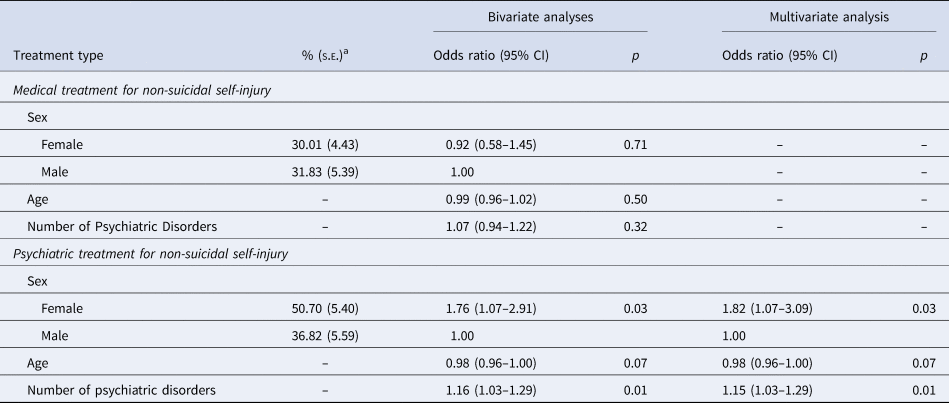
Regarding treatment use specifically for NSSI, 30.92% (s.e. = 3.55%) of respondents with lifetime NSSI had received medical attention and 43.80% (s.e. = 3.90%) had received mental health services for this behavior.Footnote 4 As detailed in Table 4, when sex, age, and the number of psychiatric disorders were evaluated at the bivariate level as predictors of lifetime medical treatment for NSSI among respondents with a history of this behavior, no significant associations were observed. Therefore, a multivariate analysis predicting medical treatment used for NSSI was not conducted. In the case of psychiatric care for NSSI among respondents who have engaged in this behavior, both female sex and number of psychiatric disorders were associated with greater odds of psychiatric treatment in bivariate analyses. When considered together with age in a multivariate model, both predictors remained significantly associated with psychiatric care (ORfemale sex = 1.82, 95% CI = 1.07–3.09; ORnumber of psychiatric disorders = 1.15, 95% CI = 1.03–1.29).
Lifetime medical and psychiatric treatment for non-suicidal self-injury among respondents with a history of this behavior (unweighted n = 216)

a Weighted prevalence of treatment for non-suicidal self-injury among individuals who have engaged in this behavior is presented for each sex.
Discussion
In addition to providing a nationally representative estimate of the lifetime prevalence of NSSI, the current study presented the first epidemiological assessment to date of this behavior in relation to sociodemographic and clinical characteristics, as well as mental health treatment utilization for NSSI, and it thus offers the most comprehensive epidemiological assessment of this behavior. The lifetime prevalence rate of NSSI was 4.86%, which is generally consistent with that reported in earlier studies with non-clinical adult samples (5.5%; Swannell, Martin, Page, Hasking, & St John, Reference Swannell, Martin, Page, Hasking and St John2014) as was the finding that cutting was the most common form of this behavior (Klonsky, Reference Klonsky2011). Furthermore, that NSSI occurred at a rate in the current study that falls within the range of prior epidemiological work with adults from different countries (2.7% among Danish young adults to 5.9% among American adults; Christoffersen et al., Reference Christoffersen, Møhl, DePanfilis and Vammen2015; Klonsky, Reference Klonsky2011), is preliminarily suggestive of the possibility that at least in its prevalence, NSSI may generalize across national populations. Given the few nationally representative studies conducted to date, however, more such studies are required before firm conclusions can be drawn regarding consistency in cross-national prevalence.
Among sociodemographic characteristics, younger age, in particular, was associated with elevated odds of NSSI. Interestingly, however, the lifetime prevalence of this behavior appeared to decrease with age, a finding also reported in two prior population-based studies of NSSI (Briere & Gil, Reference Briere and Gil1998; Klonsky, Reference Klonsky2011). This counterintuitive trend may be explained in part by the potential increase in NSSI among younger age groups, especially adolescents (Jacobson & Gould, Reference Jacobson and Gould2007; Rodham & Hawton, Reference Rodham, Hawton and Nock2009). This trend may also be partly accounted for by underreporting in older adults, due to either a greater sense of stigma or forgetting NSSI that may have occurred much earlier in life (Griffiths, Christensen, & Jorm, Reference Griffiths, Christensen and Jorm2008). In support of this latter possibility, rates of mental illness based on prospectively collected data have been found to be considerably higher than in retrospective data with the same individuals (Moffitt et al., Reference Moffitt, Caspi, Taylor, Kokaua, Milne, Polanczyk and Poulton2010; Wells & Horwood, Reference Wells and Horwood2004). Higher odds of NSSI was also noted among respondents who did not grow up with both parents in the household, and among those from socioeconomically impoverished households and neighborhoods, as indexed by household income and Overall Index of Multiple Deprivation. This pattern is important insofar as it indicates that those at greater risk for NSSI may also be exposed to chronically lower social support during childhood and greater socioeconomic adversity during adulthood. That is, such individuals may be at elevated risk from chronic exposure to stress in their environments, but may also be particularly limited in their resources for coping with this stress. This pattern suggests the need for greater investment of efforts to reduce potential unmet treatment needs and underlying barriers, particularly in the case of young adults, a population in which higher rates of NSSI indicate a greater need for care but which may also be challenged by fewer financial resources in accumulated wealth than older adults to receive treatment.
Also worth mentioning is the absence of a significant sex difference in the lifetime prevalence of NSSI. Although this behavior has traditionally been viewed as more characteristic of females (Bresin & Schoenleber, Reference Bresin and Schoenleber2015; Swannell et al., Reference Swannell, Martin, Page, Hasking and St John2014) and recent meta-analyses have found sex differences to exist in the prevalence of NSSI (Bresin & Schoenleber, Reference Bresin and Schoenleber2015), including as a prospective predictor of this outcome (Fox et al., Reference Fox, Franklin, Ribeiro, Kleiman, Bentley and Nock2015), the current findings are consistent with those of previous population-based studies of NSSI (Briere & Gil, Reference Briere and Gil1998; Klonsky, Reference Klonsky2011). Several considerations may be relevant here for interpreting these findings in the context of the broader literature. First, the perception that sex differences exist in NSSI may be in part a product of a confound, with commonly comorbid psychopathology also being more common among females (Swannell et al., Reference Swannell, Martin, Page, Hasking and St John2014). Specifically, early studies on this topic often focused on clinical samples, in which a greater representation may be expected of certain disorders closely associated with NSSI (e.g. borderline personality disorder) and themselves more prevalent among females. If this is the case, one should be more likely to observe sex differences in clinical samples than in large community ones. This is precisely what was found in the recent meta-analysis of sex differences in NSSI prevalence (Bresin & Schoenleber, Reference Bresin and Schoenleber2015). Furthermore, in a meta-analysis of the prevalence of NSSI (Swannell et al., Reference Swannell, Martin, Page, Hasking and St John2014), no sex differences were observed after accounting for methodological considerations.
Second, it has been hypothesized (Bresin & Schoenleber, Reference Bresin and Schoenleber2015) that greater sex differences in NSSI prevalence in clinical samples may in some measure be a function of males with this behavior being less likely than males with other mental health difficulties to receive treatment, and conversely, females with an NSSI history being more likely than females with other mental health problems to receive clinical care.Footnote 5 Although this hypothesis was not evaluated directly in the current study, the finding that females with NSSI were more likely than male counterparts to receive psychiatric treatment for this behavior is consistent with this possibility.
The current study also offers new insight into psychiatric correlates of NSSI. A notably high proportion of respondents with lifetime NSSI had at least one current psychiatric disorder (63.82%), and 13.84% of respondents with at least one psychiatric disorder had a history of NSSI, in contrast to an estimated lifetime NSSI prevalence rate of 4.86% in the general population. The pattern of findings in the multivariate analysis does not suggest any single Axis I disorder to be particularly characteristic of NSSI, as with the general exception of anxiety disorders and OCD, all disorders were associated with this behavior in multivariate analysis. Rather, when taken together with the finding of a positive dose-like association between the number of disorders and NSSI, along with prior observations that even a single incident of NSSI is tied to significant risk for negative mental health outcomes (Whitlock, Reference Whitlock2010; Whitlock et al., Reference Whitlock, Eckenrode and Silverman2006), these findings suggest that NSSI may to some degree be a broad marker of general severity of psychopathology. These findings are generally consistent with those of the one prior nationally representative study to evaluate diagnostic correlates (Kiekens et al., Reference Kiekens, Hasking, Claes, Mortier, Auerbach, Boyes and Bruffaerts2018), the main difference of note being that NSSI was significantly associated with all psychiatric disorders in the former study. The difference across studies with regards to the significance of associations with anxiety disorders may in part be due to the relevant analyses being conducted with NSSI disorder in the former study and with NSSI occurrence in the current one.
Additionally, lifetime prevalence rates for suicidal ideation and suicide attempts among respondents with NSSI were also particularly elevated (49.29–82.09%). That the effect size for NSSI in relation to ‘pure’ suicidal ideation and suicide attempts remained large even after accounting for the eight sociodemographic and 13 psychiatric covariates (and suicidal ideation in the case of suicide attempts as the outcome) is indicative of the robustness of these associations. Indeed, these findings are consistent with prior theoretical (Joiner, Ribeiro, & Silva, Reference Joiner, Ribeiro and Silva2012) and empirical support (Ribeiro et al., Reference Ribeiro, Franklin, Fox, Bentley, Kleiman, Chang and Nock2016) for a strong association between NSSI and suicidality. In the same manner that anxiety often precedes depression when co-morbidity between the two conditions exists (Cole, Peeke, Martin, Truglio, & Seroczynski, Reference Cole, Peeke, Martin, Truglio and Seroczynski1998; Costello, Mustillo, Erkanli, Keeler, & Angold, Reference Costello, Mustillo, Erkanli, Keeler and Angold2003), NSSI has been conceptualized as more often to precede suicidal behavior than vice versa (Joiner et al., Reference Joiner, Ribeiro and Silva2012; Whitlock et al., Reference Whitlock, Muehlenkamp, Eckenrode, Purington, Baral Abrams, Barreira and Kress2013). Empirically establishing the specificity in the temporal sequence of these often co-occurring phenomena in future research is of clinical importance.
As for receipt of clinical care for NSSI, a concerning proportion of respondents who had engaged in this behavior had experienced an injury of sufficient severity to warrant medical attention (30.92%). In light of sex differences in suicidal behavior, with females generally being more likely to attempt but males being more likely to die from their attempts (Nock et al., Reference Nock, Borges, Bromet, Cha, Kessler and Lee2008) because they are more likely to adopt highly lethal means (Ajdacic-Gross et al., Reference Ajdacic-Gross, Weiss, Ring, Hepp, Bopp, Gutzwiller and Rössler2008), an unexpected finding was that no sex differences emerged in medical treatment for NSSI injuries. To the extent that medical treatment for NSSI is a reflection of medical severity of the behavior, this finding may be congruent with the view that, despite substantial overlap in their underlying risk factors, NSSI and suicidal behavior are nevertheless distinct clinical phenomena (Brent, Reference Brent2011; Mars et al., Reference Mars, Heron, Crane, Hawton, Lewis, Macleod and Gunnell2014; Wichstrøm, Reference Wichstrøm2009). That is, in contrast to the aforementioned sex difference in medically severe suicidal behavior, when males engage in NSSI, they are no more likely than their female counterparts to adopt more medically severe means.
Although a substantial proportion of respondents with NSSI received psychiatric treatment for this behavior, the majority did not. This indicates a high rate of unmet treatment need, especially when considered together with the analyses indicating NSSI is associated with considerable psychiatric comorbidity. In contrast to findings on medical treatment for NSSI, certain parallels exist between NSSI and suicide with regards to psychiatric treatment. Specifically, low overall treatment utilization and higher use among females observed for NSSI in the current study have also been found for suicide in others (Ahmedani et al., Reference Ahmedani, Perron, Ilgen, Abdon, Vaughn and Epperson2012; Bruffaerts et al., Reference Bruffaerts, Demyttenaere, Hwang, Chiu, Sampson, Kessler and Nock2011).
Limitations of the current study should also be noted. Although the current study featured an older dataset, more recent publicly available data do not exist on a national scale similarly allowing for analyses of comorbid associations such as evaluated here. Additionally, there is no reason to expect the primary associations observed to differ as a function of time (e.g. most psychiatric conditions being associated with greater odds of lifetime NSSI). Second, and as touched upon above, the cross-sectional design of the current study precludes precise determinations of how NSSI is temporally related to psychiatric conditions, suicidal ideation and behaviors, and treatment use, particularly given that only lifetime, but not recent, NSSI was evaluated in association with these correlates and outcomes. Gathering such information in future research would be clinically informative. For example, if NSSI generally ceases following treatment for this behavior, greater effort should be devoted to reducing barriers to treatment. Alternatively, if NSSI persists after clinical care, such a finding would highlight the challenge of addressing NSSI. This latter possibility would be consistent with prior findings of modest empirical support for existing interventions for NSSI (Calati & Courtet, Reference Calati and Courtet2016; Ougrin, Tranah, Stahl, Moran, & Asarnow, Reference Ougrin, Tranah, Stahl, Moran and Asarnow2015), and that for a sizeable proportion of individuals, NSSI may follow a particularly chronic course (Liu, Reference Liu2017). Nonetheless, this study provides important new insight into the epidemiology of this phenomenon, which may serve as a basis for guiding future research.
Acknowledgements
The data in the current study were drawn from the Adult Psychiatric Morbidity Survey (APMS) 2007. The APMS 2007 was conducted by the National Centre for Social Research and the University of Leicester, and commissioned by the NHS Information Centre for Health and Social Care, with funding from the Department of Health. The data are held by the UK Data Archive.
Financial support
The preparation of this manuscript was supported in part by the National Institute of Mental Health of the National Institutes of Health under Award Number RF1MH120830, R01MH101138, and R01MH115905. The content is solely the responsibility of the author and does not necessarily represent the official views of the funding agency.
Conflict of interest
None.
Ethical standards
The author asserts that all procedures contributing to this work comply with the ethical standards of the relevant national and institutional committees on human experimentation and with the Helsinki Declaration of 1975, as revised in 2008.