


The fate and quality of liberal democracies can depend crucially on the ability of courts to protect citizens against the state. Through judicial review, judges can annul the acts of legislatures, executives, and other political institutions whose actions conflict with the constitutional and statutory legal order.Footnote 1 Whether courts exercise this power, however, depends on more than the de jure rules specifying the court's jurisdiction and function. For example, courts may temper their judgments to accommodate the interests of legislative or executive institutions that determine the promotion, tenure, and assignment of judges or the budgets and resources of the court (e.g., Helmke Reference Helmke2005; Ramsayer and Rasmusen Reference Ramsayer and Rasmusen2003).
In this paper we focus on two relatively permanent and potentially extremely powerful constraints on judicial review in democracies. Courts generally rely on executive bodies and the legislature to implement their rulings. Consequently, when a court hears a case involving the interests of those controlling the executive and legislative institutions, those interests can threaten to disrupt implementation. This disruption can take one of two general forms; legislatures can threaten to override the court's ruling by drafting new legislation, and executives can threaten to obstruct, ignore, or misapply court rulings.
Scholars have argued that these threats can influence judicial decision-making. Some argue that, by tempering their rulings in anticipation of a possible override, courts can secure better outcomes than if they act myopically (e.g., Bednar, Eskridge, and Ferejohn Reference Bednar, Eskridge, Ferejohn, Ferejohn, Rakove and Riley2001; Ferejohn and Shipan Reference Ferejohn and Shipan1990; Ferejohn and Weingast Reference Ferejohn and Weingast1992; Gely and Spiller Reference Gely and Spiller1990; Rogers Reference Rogers2001). Others argue that override and noncompliance can erode a court's public legitimacy, and thereby undermine its future influence on policy (e.g., Carrubba n.d.; Staton and Vanberg Reference Staton and Georg2008). Either way, as long as courts care about influencing policy, they have an incentive to anticipate legislative and executive reactions when making their rulings.
Empirical evidence that courts do in fact respond to these threats is limited. The typical empirical strategy for estimating the effects of political constraints on judicial decisions is to examine whether the presence of a political constraint is associated with court decisions that are (a) consistent with the interests of the actors controlling the constraints and (b) different from how the court would decide otherwise. But this approach is often difficult to implement because strategic incentives can confound interpretation of observable behavior. For instance, suppose we observe a court annulling multiple statutes through judicial review. One interpretation is that these statutes represent the preferred policy of the legislature and, thus, the annulments show judicial independence from political constraints. While this is prima facie plausible, Rogers (Reference Rogers2001) and Whittington (Reference Whittington2005) both demonstrate that particular institutional arrangements can lead legislative majorities to prefer the court to strike their legislation as unconstitutional or to interpret the legislation in a way inconsistent with original legislative intent. Observations of apparent judicial activism may therefore reflect the court doing the bidding of the legislature. Similarly, observations of ostensibly independent judicial behavior may be ambiguous. For example, Bailey (Reference Bailey2007) demonstrates that ideal point estimates almost always place the Supreme Court of the United States between the Congress and the President. At first blush, this would appear to indicate that the members of the Court have preferences that do not conflict with those of the legislature and executive. We would not expect political constraints to matter in that context. However, since the estimates of the justices’ ideal points are derived from their previous votes, this pattern of Court preferences instead may indicate that the Court has strategically adjusted its rulings to avoid legislative override and noncompliance.
In this study, we employ an original dataset designed to mitigate these methodological problems and thereby allow us to estimate the degree to which threats of override and noncompliance influence judicial decision-making in the European Court of Justice (ECJ). We focus on the ECJ for three reasons. First, the ECJ has the means, motive, and opportunity to rule counter to the interests of the member-state governments, which can threaten noncompliance and override. Indeed, for this reason, the ECJ and its rulings have attracted substantial scholarly attention. Second, the theoretical literature provides discriminating predictions that can be used to test the conditions under which the ECJ is responsive to these threats. Third, the ECJ records the information necessary for testing these predictions.
Our analysis makes two notable contributions to the study of judicial behavior in general. First, we develop a novel measurement strategy for coding court decisions. Decisions by the ECJ, like those by other courts, often consist of multiple legal issues over which the court may not always favor the same side. Summarizing the decision as pro-plaintiff or pro-defendant, which is common practice, therefore ignores potentially important variation in court behavior and, at a minimum, introduces measurement error. We avoid this problem by creating a dataset of decisions on within-case legal issues rather than cases themselves. Second, we examine both of these types of threats simultaneously and evaluate their relative influence on judicial behavior. While one recent paper has found evidence that threats of override matter (Harvey and Friedman Reference Harvey and Friedman2006) and two have found that threats of noncompliance matter (Staton Reference Vanberg2006; Vanberg Reference Vanberg2005), none have examined these two threats simultaneously.
To be clear, we are not arguing that evidence from the ECJ is typical of or generalizable to all national judicial settings. Although many scholars contend that the ECJ enjoys independent legal authority comparable to that of national high courts, others see it as fundamentally an international tribunal with little independent authority. Obviously, whether one sees our analysis as a set of demanding or easy tests of political constraints depends on whether one subscribes to the former or the latter view of the ECJ. Nevertheless, the ECJ setting is attractive because it affords an appropriate empirical evaluation of these two threats and of their separate effects. Furthermore, our empirical strategy provides one possible template for how to study these same questions in other judicial settings.
This study also contributes to one of the most important debates surrounding the ECJ and its role in the process of European integration: to what degree has the Court influenced the direction of social, economic, and political integration in the European Union (EU) independent of member-state government preferences? Central to this debate is the question of how strongly member-state governments influence ECJ rulings through threats of override and noncompliance. Extant evidence is equivocal on this question. Some scholars argue that observing governments taken to court regularly, ruled against regularly, and complying regularly is prima facie evidence that governments are constrained to obey adverse court rulings (e.g., Stone Sweet and Brunell Reference Stone Sweet and Brunell1998a, Reference Stone Sweet and Brunell1998b). However, Carrubba (Reference Carrubba2005) demonstrates that this evidence is in fact nondiscriminating; we would observe this behavior whether governments are constrained to obey court rulings, or courts are constrained to respect government preferences. Thus, much of the evidence that scholars employ to evaluate judicial influence is uninformative. This study will provide the first discriminating test of member-state government influence that avoids this observational equivalence problem.
Importantly, we depart from previous “large-N” studies of the ECJ in two ways. While previous works focus on quantitative trends in the types of cases heard by the Court and only consider cases arising from national courts through the preliminary ruling system, we analyze actual judicial decisions (e.g., Stone Sweet and Brunell Reference Stone Sweet and Brunell1998a, Reference Stone Sweet and Brunell1998b) and include both preliminary rulings and direct actions. In particular, including direct actions against member states or the Commission is critical for our purposes since they historically compose the majority of cases involving member-state governments as litigants.
THE EUROPEAN COURT OF JUSTICE
The European Court of Justice has developed a supranational legal order remarkable for an international tribunal or court. The formal role of the Court as defined in the EU treaties has changed little over time. Yet the Court has used its rulings to claim substantial authority over national courts, national law, and the interpretation of the EU treaties. In combination with unusual litigant access to the ECJ, this assumed authority provides the Court with the opportunity, means, and motive to advance an agenda independent of those of the member states and counter to their interests. Since the member states can threaten legislative override of or noncompliance with ECJ decisions, the ECJ setting is therefore appropriate for empirical study of these political constraints. In this section we briefly describe the Court's means, motive, and opportunity to act independent of the member states. This discussion also provides necessary background for the theoretical discussion in the subsequent section.
The ECJ hears cases from a variety of sources, providing it with the opportunity to rule counter to member-states' interests in contexts where legislative override and noncompliance are relevant threats. Unusually for an international regulatory regime, a variety of parties can challenge EU law and member-state compliance with it. Most international regulatory regimes hear only cases brought by member states against one another. In contrast, the European Commission is the primary source of direct actions against member states in the EU. In addition, member states and private parties can bring actions for annulment and actions for inactivity against the acts (or absence thereof) of EU institutions. Consequently, the ECJ has the opportunity to rule on a large number of cases where the compliance of member states and the interpretation of EU law are in question.
Furthermore, the Court answers questions of EU law raised in national courts. Preliminary references arise when a litigant brings a case to his/her national court, the national court determines that EU law is relevant to the case, and the national court asks the ECJ for an interpretation of EU law. Once that opinion is passed back down to the national court, the national court makes a final ruling. This further widens the opportunity for the ECJ to interpret statutes and treaty articles and to rule in cases where member-state compliance could be in question. In 2007, the ECJ decided 235 cases arising from a national court seeking a preliminary ruling and 241 cases involving direct actions brought by the Commission or a member state (Annual Report, 2007).Footnote 2
The EU legal order grants the ECJ the means to exercise judicial review and threaten member state interests. In particular, the ECJ has established two doctrines, “direct effect” and “supremacy,” that transformed the preliminary ruling procedure into one that allows private citizens to challenge national law based on EU law. Direct effect established that individual citizens of the EU can invoke the treaties and, to a lesser extent, secondary legislation as the basis for legal claims in national courts. Thus, even when national laws do not ensure rights established by the treaties, citizens can invoke these rights in national courts. Supremacy established that if national law and EU law are incompatible, it is EU law that should be applied. The supremacy of EU law holds even if the incompatible national law is passed subsequent to the EU law. Once accepted by national courts, these doctrines transformed the preliminary ruling system into one that protected citizen rights granted under EU law.Footnote 3 Thus, the ECJ's rulings have legal weight, independent of whether national law conflicts with its decisions (supremacy) or whether that interpretation is enshrined in national law (direct effect).
Many scholars believe that the Court also has the motive to advance an agenda for European integration that runs counter to many member states’ interests (e.g., Alter Reference Alter1996; Mattli and Slaughter Reference Mattli and Slaughter1998). These studies, loosely defined as “neo-functionalist” in character (Mattli and Slaughter Reference Mattli and Slaughter1998: 180), argue that the Court engaged litigants and national courts to expand the EU legal order and advance the economic integration of the EU beyond the desires of national governments. In particular, by developing EU law through the preliminary reference system, the ECJ was able to shield its interpretations of EU law behind the norms of “the rule of law” and judicial independence in the domestic arenas where the cases were ultimately decided (Mattli and Slaughter Reference Mattli and Slaughter1998: 181). Also, Burley and Mattli (Reference Burley and Mattli1993) claim that the technical nature of legal writing and Court opinion provided the judges with a mask behind which to hide their broader agenda for further integration. As a result, these scholars argue, the ECJ is able to issue and gain compliance with rulings that reflect its policy preferences and that substantially deviate from the interests of the member-state governments.
That the ECJ has the means, motive, and opportunity to rule counter to the interests of the member states is not to say that the Court in fact does so. As reviewed above, many scholars see the expansion of the EU legal order and the advancement of economic integration through Court decisions as evidence of weak political constraints. However, other scholars believe that the Court's ability to promote its own agenda is substantially constrained by the member-state governments (e.g., Garrett and Weingast Reference Garrett, Weingast, Goldstein and Keohane1993). In particular, these scholars argue that the Court must be concerned with two political constraints: the possibility of override through EU treaty revision or the EU legislative process, and the possibility of simple noncompliance by a member-state government. These studies claim that the Court will accommodate government interests in its rulings when these threats are credible. And, by implication, if the Court allows the governments’ interests to influence its rulings, its ability to pursue its own agenda independent of governments’ interests is equivalently constrained.
This potential for political constraints is generally recognized in the ECJ literature. Although proponents of ECJ influence still believe the most important constraints on the Court's power has been the need to maintain the allegiance of the legal community and national courts (e.g., through adherence to legal doctrine and legal reasoning), they also now acknowledge that the Court may be responsive to political constraints (Mattli and Slaughter Reference Mattli and Slaughter1998; but see Alter Reference Alter2008). Thus, while scholars diverge in their beliefs about the relative importance of these political constraints, they generally agree that they matter to some extent. Surprisingly, though, we have little or no systematic evidence of to what degree, if at all, political constraints actually influence ECJ decision-making. This is a crucial issue, since the weaker the constraints, the greater the latitude for the Court to execute an agenda distinct from those of the member states.
The remainder of this paper focuses on providing evidence to resolve this issue. First, we review the relevant theoretical literature to derive the conditions under which political constraints associated with noncompliance and override should influence ECJ rulings. These expectations will then be used as the basis for statistical tests of the influence of member-state governments on ECJ decision making.
THE ECJ AND THREATS OF OVERRIDE AND NONCOMPLIANCE
EU member-state governments have the power to revise the founding treaties and to adopt secondary legislation. These powers, at least in theory, can be used to override decisions by the ECJ that conflict with the member-state governments’ preferences about the correct interpretation of EU law.
Treaty revision is a fairly straightforward process. If enough member-state governments desire changes to the founding treaties, the governments convene an intergovernmental conference. At this conference, proposed revisions are adopted by unanimous consent. Once some set of revisions is agreed upon, the new treaty then must be ratified by each of the member states. This ratification process entails parliamentary approval and, in some cases, approval in popular referenda.
Importantly, revision does not have to entail a wholesale change to the relevant treaty article. Rather, governments can insert exceptions to treaty articles for specific member states through the adoption of “protocols.” For example, the current treaties include a protocol excluding Danish legislation restricting foreign property ownership from the general treaty provision on the free movement of capital. Thus, the override of an ECJ ruling via treaty reform can be quite targeted.
Unlike treaty revisions, secondary legislation is a product of bargaining among the three EU legislative institutions, the Commission, the European Parliament (EP), and the Council of Ministers. The Commission consists of a set of representatives appointed by the member-state governments (with the approval of the EP), the EP is a directly elected legislative chamber, and the Council consists of representatives of each of the member-state governments. The Commission is responsible for writing legislative proposals, while the EP and the Council amend and pass (or not) the Commission's proposals. The exact procedure by which the EP and the Council decide on legislation depends upon the substantive content of the law under consideration. For the EP, the procedure determines whether the chamber has the power to amend or veto legislation; for the Council, the procedure determines the chamber's voting rule, unanimity or qualified-majority.Footnote 4 Importantly, independent of the procedure, the Council is always free to amend any proposed legislation, and Council approval is always necessary for legislation to be adopted.
Some scholars argue that government threats of override through treaty revision and secondary law influence ECJ rulings (e.g., Garrett, Kelemen, and Shultz Reference Garrett, Kelemen and Schultz1998). In particular, they argue that governments can threaten to use these tools to change EU law if the Court interprets existing law counter to their preferences. Anticipating the member states’ reaction, the Court therefore simply interprets EU law in a way consistent with government preferences in the first place. For example, Garrett and Weingast write:
EC members maintain considerable control over the course of rulemaking through the Council of Ministers. More fundamentally, the continued legitimacy of the court and its rulings is contingent upon the support of governments of EC members. Put simply, the implicit threat of intervention by the member states, either through decisions in the Council of Ministers or through noncompliance with court decisions, ultimately constrains judicial activism in the EC. (Garrett and Weingast Reference Garrett, Weingast, Goldstein and Keohane1993: 178)
The credibility of these override threats is a matter of some debate. The unanimity requirement is often cited as a reason that treaty revision is a weak political constraint on the Court. As Pollack (Reference Pollack1997) concludes, “the threat of treaty revision is essentially the ‘nuclear option'—exceedingly effective, but difficult to use—and is therefore a relatively ineffective and non-credible means of Member State control.” Similarly, scholars argue that secondary legislation suffers from what Scharpf (Reference Scharpf1988) describes as the “joint decision trap.” Even when the Council is not operating under a unanimity requirement, it must vote by a supermajority rule (historically around 70% of votes cast). Further, as described above, governments are not the only actors involved in the legislative process. To the degree that the Commission and the EP support the Court's interpretation of EU law, they can make passage of secondary laws to override that decision more difficult (Tsebelis and Garrett Reference Tsebelis and Geoffrey2001).
How frequently credible threats can be made is, of course, an empirical issue. However, there is good reason to believe that meaningful threats of override may be less rare than the arguments above would suggest. A credible threat of treaty revision or legislative amendment does not require that all member states share a common preference for an alternative ruling on the specific case. Rather, it requires a government, or set of governments, opposed to the Court's preferred ruling to cobble together a logroll. Further, protocols can ease the logrolling process in treaty revision. By implication, while treaty revision and legislative override are certainly not simple procedures to engage in, they probably are not the almost insurmountable hurdles that some claim them to be. In sum, threats of override are potentially credible whenever a government, or set of governments, can produce a coalition sufficient to override the Court's decision. Hypothesis 1 characterizes this expectation.
Hyphothesis 1. The more credible the threat of override by the Council, the more likely the court is to rule in favor of the governments’ favored position.
Several recent studies also argue that the ECJ is constrained by member states because a litigant government can circumvent undesirable Court rulings (e.g., Garrett, Kelemen, and Schultz Reference Garrett, Kelemen and Schultz1998). Such evasion, at least in theory, can take many forms. Member states could blatantly ignore a decision. Or, they could adopt national legislation that appeared to be in compliance but that in fact ignored the substantive impact of the ruling. Whatever the particular form of noncompliance, a credible threat of noncompliance may influence how the Court rules on a case.
While several previous studies provide relevant theoretical models for deriving a set of testable predictions regarding threats of noncompliance, here we rely on the theoretical model presented by Carrubba (Reference Carrubba2005).Footnote 5 Carrubba argues that the EU member states have joined what amounts to a complex prisoner's dilemma game. Compliance with EU law is generally costly. For example, by agreeing not to subsidize domestic industries, governments commit themselves to deny assistance to those industries when they come calling. However, it is exactly that compliance with EU obligations that generates the economic benefit of belonging to the EU in the first place. Thus, as long as the benefits of others’ cooperation exceed the costs of your own, compliance with EU law looks much like a prisoner's dilemma. In general, every state benefits if every other state cooperates, but every state simultaneously has an incentive to cheat.
Carrubba models the EU legal system as a fire alarm mechanism. The formal model starts with the governments drawing a cost of complying with EU law and deciding whether to choose to comply or not. If the government does not comply, a potential litigant can choose to bring a case. Upon a case being brought, litigants make their arguments, and the facts of the case become common knowledge. Importantly, these facts include the actual cost of complying with EU law in that instance. Once the case is heard, the Court issues a ruling, the government decides whether to comply, and the cycle repeats.
In solving this model, Carrubba identifies the conditions under which governments will violate EU law, conditions under which governments will be taken to court, conditions under which governments will be ruled against, and conditions under which defending governments will obey the court's ruling. For our purposes the key insight is that, if governments have the ability to ignore adverse rulings, the Court can only expect compliance with its rulings when nonlitigating governments are willing to punish the defecting government for noncompliance. That is, the credibility of a litigant member state's threat of noncompliance should weaken as the likelihood of third-party (i.e., other member states) enforcement increases. And this implies that, if the Court values compliance with its rulings, the likelihood that the Court rules against the litigant government position will depend on the likelihood of this third-party enforcement. Hypothesis 2 follows from this discussion.Footnote 6
Hyphothesis 2. The more opposition a litigant government has from other member-state governments, the more likely the court is to rule against that litigant government.
One additional hypothesis can be generated with regard to the threat of noncompliance. Recall that cases arising through the preliminary reference process originate in, and are ultimately decided by, national courts. As such, some scholars argue that the ECJ may be less sensitive to threats of noncompliance on preliminary rulings than on direct actions. Specifically, because many member states have a tradition of judicial independence and the rule of law, one might expect that when governments are litigants in national courts they are less willing to ignore an adverse judicial ruling than when they are litigants before the ECJ (Pollack Reference Pollack2000: 191). This possibility leads to our third hypothesis:
Hyphothesis 3. The relationship defined in hypothesis 2 is weaker in preliminary ruling proceedings (Article 234 cases) than in direct actions.
EMPIRICAL ANALYSIS
Our data analysis is the first effort to bring systematic evidence to bear on these hypotheses.Footnote 7 We have created an original dataset of ECJ decisions by coding information on all cases decided by the court from January 1987 through the end of 1997. These years were selected for two reasons. First, by the late 1980s, most if not all member states had accepted the doctrines of supremacy and direct effect. This criterion minimizes the risk that differential acceptance of these doctrines by national courts might confound inference. Second, the selection of years straddles the Maastricht Treaty reforms and the 1995 enlargement. This criterion helps minimize the risk that findings are a product of a set of atypical cases that might arise in response to major changes in the EU or related changes in the culture of the ECJ (Dehousse Reference Dehousse1998).Footnote 8
Unlike typical studies of judicial decision-making, our unit of analysis is not the “case.” Rather, each observation in our dataset is a legal issue disposed of by the ECJ when it decided a case. If a case consisted of only one legal issue, we simply coded the case. This was generally true, due to procedural rules of the Court, of direct actions against member states. If a case consisted of multiple legal issues (e.g., two substantive issues and one question of admissibility), we recorded these as separate observations.
This coding scheme has at least two advantages. First, we can accurately depict the Court's ruling when, in the same case, its ruling favors one litigant on one set of issues but the other litigant on other issues. Second, we can map third-party briefs filed in a case to the particular issues the briefs discuss. Obviously, ECJ rulings on legal issues from the same case may have some inter-dependence, which would artificially deflate standard errors. We therefore estimate robust standard errors clustered by case in all of the analyses.
Our dataset consists of 3176 legal issues coded from the Annual Report of the European Court of Justice. In these 10 years, three types of procedures dominated the ECJ's docket: preliminary references (2048 legal issues), direct actions taken against a member state (479 legal issues), and actions for annulment of decisions by EU institutions (360 issues). To code legal rulings, we rely upon the enumeration of the Court's conclusions at the end of the decision. For each legal issue, we code the Court's decision as 1 if it favors the plaintiff, and as 0 otherwise.Footnote 9 This measure is the dependent variable in our analyses.
To measure the magnitude of political threats, we need an indicator of the expected behavior of the member states in response to the ECJ ruling. Recall that the threat of legislative override increases with the likelihood that a sufficiently large coalition of member states would pursue legislation or treaty revision in response to an ECJ ruling. The threat of noncompliance decreases with the likelihood that member states will punish a litigant government's noncompliance with an ECJ ruling.
One indicator of the expected response by member states to an ECJ ruling on a legal issue is the opinion of governments on that legal issue in that case. We are aware of no direct measure of these preferences for all member states on all legal issues. However, the record of each case does include a reasonable proxy. All EU institutions and member-state governments are entitled to submit briefs (called “observations”) on cases pending before the Court. Thus, if a government has an opinion on any particular legal issue raised in a case, that government can submit it to the Court for consideration.
In general, we expect that a government observation on behalf of the plaintiff (defendant) on a particular point of law supports the plaintiff's (defendant's) position.Footnote 10 Thus, we use these briefs to capture the balance of member-state preferences regarding the legal issue. This is consistent with Granger's (Reference Granger2005: 4) interpretation of observations on legal issues. She contends that governments “resort more and more to such participation in complement or even replacement of traditional external political means of ‘controlling’ the Court, as they wish to keep a grasp on legal integration by judicial fiat.” This measure is central to coding the key independent variables used to test the hypotheses.
Testing Hypotheses 1 and 2
Based upon this coding scheme, hypothesis 1 predicts a systematic and positive relationship between ECJ rulings and the balance of member-state observations. As the balance of member-state observations on the legal issue approaches the necessary coalition to enact legislation or revise the treaty, the Court should become more likely to rule in the direction of the member states. For treaty revision and legislation requiring unanimity, the override only succeeds if all governments support the action. Thus, for overrides requiring unanimity, we expect that as the net number of member-state observations in favor of the plaintiff (defendant) increases, the likelihood that the Court rules for the plaintiff (defendant) increases. For legislation requiring qualified-majority voting, the override succeeds if it receives approximately 70% of the votes cast (where larger member states have more votes to cast; e.g., France had 10 in 1987 while Luxembourg had two). Thus, to capture threats of override requiring only a qualified majority, we should weight government observations by national vote shares in the Council.
Unfortunately, we cannot easily distinguish which legal issues can be overridden by qualified-majority voting and which require unanimity support.Footnote 11 Because the qualified-majority rule has become increasingly the norm since the Single European Act in 1987, we report results where the net observations are weighted by the share of Council votes. Note that an analysis with unweighted observations renders very similar results. We report these supplemental results in the appendix.
Turning to hypothesis 2, we expect government observations to influence ECJ rulings when a member-state government is a litigant. Note that threats of override also generally apply in these settings, as described by the first hypothesis. Thus, hypothesis 2 predicts an additional effect of government observations when a member state is a litigant. This additional effect should obtain whether the threats of override and noncompliance are complements or substitutes. First, suppose these two threats are complementary: i.e., when a government is a litigant, the Court interprets observations as indicative of the combined threats of override and noncompliance. In this case, the Court should be more sensitive to government observations than when a government is not a litigant, because the Court has to anticipate that either threat might be executed. Second, if the Court considers these two threats as substitutes, then we would expect the Court to be more sensitive to the threat of noncompliance. Noncompliance is a threat that can be executed quickly and unilaterally, while override requires successful negotiation of a more lengthy and complex treaty revision or legislative process. In short, we expect the impact of government observations to be greater when a government is a litigant than when a government is not a litigant.
The credibility of a threat of noncompliance depends upon the magnitude of opposition to the litigant government. This magnitude is clearly increasing as the number of member-state observations against the litigant government increases. It is also likely decreasing in the number of observations in support of the litigant government. Why? An observation in favor of the government litigant provides potentially useful information about the total opposition to the government litigant. There are no legal issues in our dataset for which all of the member states provided an observation; in many cases only a small fraction file a brief. We expect the Court to consider governments filing against a litigant government to be the most likely to sanction noncompliance, governments that do not file a brief as less likely to sanction noncompliance, and governments that file a brief in support of the litigant government to be the least likely to sanction noncompliance. If we do not account for governments that file briefs in support, we cannot account for the difference the Court may see between the last two categories.
Of course, whether these observations for the government litigant carry as much weight in the eyes of the Court as observations against the litigant government is an empirical question. We explore this issue more in the next section. But for now we simply assume that the Court is sensitive to government observations on both sides of the legal issue in evaluating the threat of noncompliance. That is, we expect the Court to view the net number of observations for the plaintiff (defendant) as an indication of the threat of noncompliance with a ruling against the defendant (plaintiff). Thus, when a government is a litigant, net observations for the plaintiff should be positively related to the Court ruling for the plaintiff if the Court is sensitive to threats of noncompliance.
As in the discussion of override, we need to consider how to weight the observations. Member states can punish each other in a variety of ways: e.g., imposing nontariff barriers; obstructing EU legislative business favorable to the member state in noncompliance; or restricting economic exchange more generally. Obviously, member states with larger economies and more political power in the EU institutions wield a greater enforcement power than smaller member states. To summarize a country's relative influence, we again weight observations by the vote share under qualified-majority voting in the Council of Ministers.
As described above, these shares capture the relative power of the member states in the legislative process for a significant range of policy areas. Further, variation in these vote shares is highly correlated with measures of member-state economic characteristics that reflect their ability to impose costly economic sanctions for noncompliance. In general, those states with larger economies and those that trade more within the EU are in a stronger position to deny economic opportunities to other member states. These characteristics are highly correlated with relative national vote shares in the Council. Specifically, net observations weighted by share of qualified-majority votes in the Council correlate at 0.95 with net observations weighted by national share of EU gross domestic product (GDP) and at 0.97 with net observations weighted by national share of intra-EU trade. Not surprisingly, the choice of weighting variable has no effect on the inferences one draws from the ensuing analysis. The appendix reports the results for models with these alternative variables.
Model Specification
As an initial test for the override threat, we estimate the following model:

where i indexes legal issues and Net Obs is the net weighted observations in favor of the plaintiff. Z is the vector of control variables described below and ei is the error term. β0, β1, and Γ are parameters to be estimated, where we expect β1 > 0.
Next, to test for the override and noncompliance threats simultaneously, we estimate the same model with the addition of an interaction term composed of net weighted observations for the plaintiff and a dummy variable for the presence of national government as a litigant (GovLit):

The addition of the interaction term is the key to distinguishing between the override and noncompliance threats. We expect that (β1 + β3) > β1 > 0, indicating that net weighted observations have a positive effect on ECJ rulings when governments are litigants that is over and above the general effect of observations due to threats of override. This requires a positive and statistically significant β3 coefficient. This test is appropriate whether the Court sees the threats of override and noncompliance as substitutes or as complements.
We include control variables for factors that we have theoretical reasons to believe could influence both Court decisions and government observations. First, we include dummy variables for whether the Commission is a party (plaintiff or defendant) to the case, and for whether the Commission submitted a written observation on the legal issue in favor of the plaintiff or defendant. The Commission is an important source of cases for the Court. If we believe that judges on the Court have policy goals they would like to pursue through rulings, they have a vested interest in inducing the Commission to use the Court. Therefore the ECJ may, at least on the margin, favor the Commission. Also, past studies show that observations by the Commission are a strong determinant of ECJ decisions (Stone Sweet Reference Stone Sweet2004). Consequently, if the presence of the Commission as a litigant or of an observation by the Commission is correlated (positively or negatively) with observations by member states, then failing to include these control variables could cause omitted variable bias. Given that the Commission may be motivated to advance EU law counter to the member states’ interests, we feel these controls are warranted.
Second, we include the size of the judicial chamber hearing the case as a proxy for the political significance of the case. The ECJ divides its work among groups of judges sitting in chambers, which range in size from three to a full plenum. Typically larger chambers tend to hear cases involving national governments in particular (especially direct action cases against the governments) and more politically sensitive cases in general. That is, chamber size increases with political salience. Ignoring these factors could bias our estimates of the influence of government observations on rulings. For example, note that the Commission (the plaintiff) generally wins infringement proceedings it brings against member states. Due to the political sensitivity of these proceedings, they normally involve relatively large chambers and may attract an unusual number and mix of observations. Consequently, any observed relationship between observations and rulings for the plaintiff may simply reflect differences in the attributes of the case (e.g., political sensitivity or type of proceeding) that vary with chamber size. In our measure of chamber size, we adjust for enlargement of the Court from 13 in 1987 to 15 in 1995 by using the percentage of judges in the entire court that heard the legal issue as the control variable.
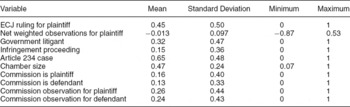
Table 1 presents descriptive statistics on the variables used in the analysis. Since our analysis focuses on ECJ rulings involving member-state litigants, we briefly describe how member-state litigants have historically performed in front of the court. First, member-state litigants faced close to even odds in the period of our study. For the 1002 legal issues involving a member-state litigant, 52.3% resulted in ECJ rulings against the member state. Second, the presence of government observations on a legal issue did not appear to affect the disposition of the ruling. The Court ruled against member states in 52.7% of the legal issues on which no government submitted an observation and in 50.3% of the legal issues with at least one such observation. Third, member-state litigants fared better in the pre-enlargement period, when they were ruled against on 49.2% of the legal issues, than in the postenlargement period, when that proportion rose to 58%. Thus, governments certainly do not win the bulk of their cases; if anything their chances of winning seem to be declining over time, and their chances of winning appear independent of the involvement of other governments. But does this mean that the court is free to rule against governments as it wishes?
Descriptive Statistics

Note: N = 3176.
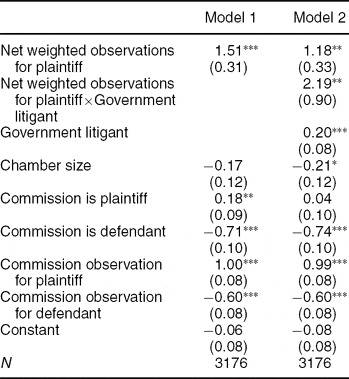
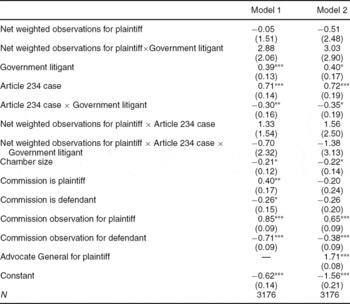
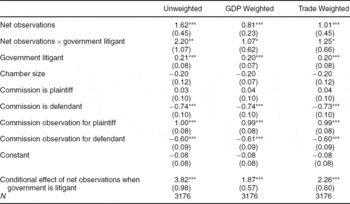
Table 2 presents the parameter estimates with robust standard errors clustered by case from probit models designed to test the first two hypotheses. Model 1 is consistent with the first hypothesis: the probability of a ruling for the plaintiff increases with the net number of weighted observations for the plaintiff. That is, as the likelihood rises that a coalition of member states could form to override a ruling in favor of the defendant, the Court is more likely to rule for the plaintiff. Model 2 estimates the interaction effect specified in equation (2). The results comport with the second hypothesis. The marginal effect of net weighted observations for the plaintiff is positive when a government is not a litigant and net weighted observations have an additional positive impact on ECJ rulings when a government is a litigant. Specifically, the conditional coefficient (β1 + β3) for a change in net weighted observations for the plaintiff when a government is a litigant is 3.37 with a standard error of .84.Footnote 12
Probit Analysis of ECJ Ruling for the Plaintiff (Robust Standard Errors)

* = Significant at the 0.10 level.
** = Significant at the 0.05 level.
*** = Significant at the 0.01 level.
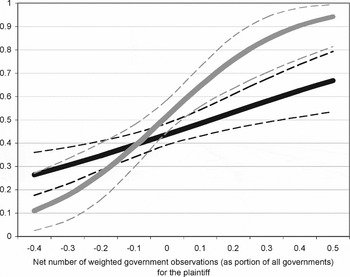
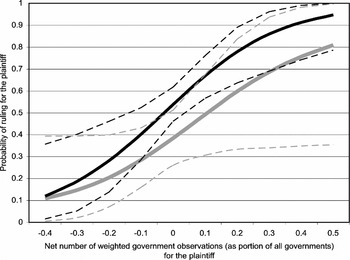
The substantive impact of observations is much greater when a government is a litigant than when it is not. A change from 0 to .10 net observations for the plaintiff is associated with a .05 increase in the probability of a ruling for the plaintiff when a government is not a litigant and with a .13 increase in the probability of a ruling for the plaintiff when a government is a litigant.Footnote 13 This change in net observations from 0 to .10 represents roughly one observation for the plaintiff from a larger member state. Figure 1 presents the predicted probability of a ruling for the plaintiff as the net number of weighted observations varies across the observable range of values under these two conditions. The additional effect of observations when a government is a litigant is apparent from the predicted probabilities presented in the figure. The substantive implication is that, on the average, threats of noncompliance have a greater impact on ECJ rulings than threats of override. This is not surprising, given that threats of noncompliance are easy to execute, relative to threats of override.
The Impact of Government Observations on ECJ Ruling With and Without a Government Litigant

As a further test of these two threats, we examined the effects of government observations in small subsets of legal issues where only one of the threats should be present. Recall that where the override threat is present, we expect government observations for both the plaintiff and the defendant to influence the Court's ruling. As a result, the magnitude (but not the direction) of the effect of an additional observation by any member state should be the same regardless of whether it is for the defendant or the plaintiff. In contrast, when a threat of noncompliance is present, we expect the observations against the government litigant to be of direct relevance and the observations for the government litigant to be of equal or lesser relevance to the Court. As we discussed above, the Court may take the latter type of observations into account, as they indicate the upper limit on how many member states would participate in enforcing compliance. But if the threat of noncompliance, not the threat of override, is at issue, we would expect the magnitude of the effect of observations for the government litigant on ECJ rulings to be never greater and possibly smaller than the magnitude of the effect of observations in favor of the government litigant.
To isolate legal issues where primarily noncompliance is at issue, we focus on infringement proceedings under Article 226. Infringement proceedings involve the Commission bringing a member state government before the ECJ for failure to comply with a treaty obligation. Obviously, this is a setting where the Court faces a threat of noncompliance should it rule against the defendant member state. In addition, the Court should not typically face threats of override in this setting. According to Conant (Reference Conant2002: 75), the Commission normally brings an infringement charge against a member state on questions where a clear legal principle has emerged based on a series of previous cases. In other words, the Commission's position is normally based on an interpretation of EU law that has survived multiple opportunities for member states to challenge or amend it via legislative override. We would therefore expect the likelihood that the Court rules for the plaintiff to be a function of the number of government observations for the plaintiff and, to an equal or lesser extent, observations for the defendant. Note that if override threats have an impact in this setting, they will reduce the likelihood that we find this difference in the effect of observations. We estimate the following equation for all legal issues due to infringement proceedings:
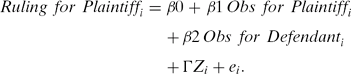
Obs for Plaintiff indicates the number of government observations for the defendant and Obs for Defendant indicates the number of government observations for the defendant. The government observations in both variables are weighted by national vote share in the Council of Ministers. All other notation is the same as in equations (1) and (2). However, we only include the subset of control variables defined above that vary in this sample of infringement cases. We expect β1 > 0, β2 ≤ 0, and β1 ≥ |β2|. Note that alternative weighting strategies to capture national political and economic power produce similar results to those presented here. Those results are presented in the appendix.
To isolate legal issues where a threat of override is primarily at issue, we focus on legal issues where neither the plaintiff nor the defendant is a member-state government and where the legal issue pertains to a question brought under Article 234, a request for a preliminary ruling from a national court. Obviously, without a government litigant, the most obvious noncompliance concern is absent in these cases. And, because a national court will ultimately decide the legal issue in a preliminary ruling, the enforcement powers of the national judicial and administrative institutions apply to these decisions. Consequently, rulings on these legal issues should be among the least affected by threats of noncompliance. This allows us to use government observations to isolate the effect of threats of override on ECJ rulings. Specifically, we would expect that observations for both the defendant and the plaintiff influence decisions and that their independent influence on the Court's rulings should be roughly comparable in magnitude. As before, we weight observations by national vote shares in the Council of Ministers. We estimate equation (3) for this subset of cases, with the expectation that β1 > 0, β2 < 0, and β1 + β2 = 0. Note that we include only the subset of controls described above that vary in this sample of legal issues from preliminary rulings.
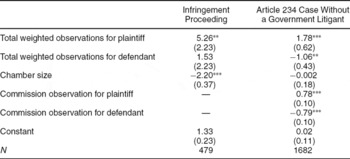
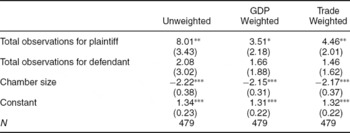
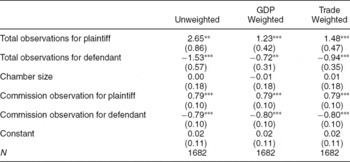
Table 3 reports the results of these probit models with robust standard errors clustered by case. The results are consistent with expectations. In the infringement proceedings, weighted observations for the plaintiff have a positive and statistically significant effect on the probability that the ECJ rules for the plaintiff. And weighted observations for the defendant have no statistically significant effect on ECJ rulings for the plaintiff. That is, we cannot reject the hypothesis that the effect is zero (p = .49). The results for the test of override threat also comport with our expectations. For legal issues from Article 234 cases with no government litigant, observations for the plaintiff and the defendant influence ECJ rulings in the expected directions. These effects are both statistically significant. Furthermore, the sum of these two coefficients (1.78 + −1.06 = .72) has a standard error of .78. Thus, we cannot reject the hypothesis that this sum is zero (i.e., these coefficients are the same in magnitude), which is what the theory predicts.
Probit Analysis of ECJ Ruling for the Plaintiff (Robust Standard Errors)

* = Significant at the 0.10 level.
** = Significant at the 0.05 level.
*** = Significant at the 0.01 level.
This more nuanced evidence from these two subsets of legal issues complements the findings from the first set of tests presented in Table 2. First, note that the 95% confidence intervals in Figure 1 show that the predicted probabilities traced out by the two lines are clearly different only in the positive range of net weighted observations. The results in Table 3 help account for this. When a government is a litigant, net observations for the plaintiff in the positive range include infringement proceedings with observations for the plaintiff, which are highly influential on the Court. But infringement proceedings with the net observations for the defendant primarily involve observations for the defendant, which are not influential on the Court's rulings. Not surprisingly, we are thus more confident about the differential effect of noncompliance threats on the positive side of the x-axis in Figure 1.
Second, like the results in Table 2, the results in Table 3 indicate that threats of noncompliance have a greater impact on ECJ rulings than threats of override. To see this, compare the effect of a change from 0 to .10 weighted observations for the plaintiff in the two subsets of legal issues. In the infringement proceedings, this change in observations is associated with an average increase in the probability that the ECJ rules for the plaintiffs of .21.Footnote 14 In the preliminary rulings, this change is associated with a much smaller change, .07, in the probability of an ECJ ruling for the plaintiff.Footnote 15 This is consistent with the comparisons based on the results in Table 2. Finally, we want to reiterate that these statistical results are robust to a variety of other weighting strategies for observations. In the appendix, we show the results with no national weights and with weights by share of EU GDP and share of intra-EU trade. These supplemental analyses support the same inferences drawn here about the threats of noncompliance and override.
Testing Hypothesis 3
Finally, we evaluate the third hypothesis, which asserts that the Court is less sensitive to threats of noncompliance for legal issues from preliminary reference cases (Article 234 cases) than for legal issues from other sources. To test this claim, we return to Model 2 in Table 2. In that model, we used the net weighted government observations when a government was a litigant as a measure of the threat of noncompliance. To test the third hypothesis, we will employ this same strategy but estimate separate effects for net observations when a government is a litigant in a preliminary ruling case and when a government is litigant but not in a preliminary ruling case. This requires a complicated set of interaction terms and the inclusion of a large number of controls for the component parts of the interaction terms.
This is a conservative estimation strategy, with an important cost: the resulting collinearity between interaction terms and component parts of the interaction terms inflates the standard errors on the interaction terms. But we cannot justify eliminating any of the interaction component parts based on the standard rules for exclusion (Kam and Franzese Reference Kam and Franzese2007: 100). Alternatively, we could split the sample of legal issues into preliminary ruling and not preliminary ruling cases. However, this strategy is generally inferior to the joint model for comparison of marginal effects, which is central to our interests here (Kam and Franzese Reference Kam and Franzese2007: 104). Hence, we estimate the following probit model:
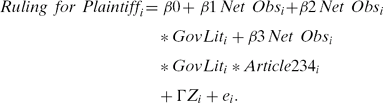
The notation follows the conventions in the previous equations and we include all controls described above as well as all component parts of the interaction terms. The variable Article234 is a dummy variable indicating that a legal issue is from a preliminary ruling case. According to hypothesis three, the net weighted observations for the plaintiff should be less influential with a government litigant when the legal issue is part of a preliminary reference. This means that (β1 + β2) > (β1 + β2 + β3).
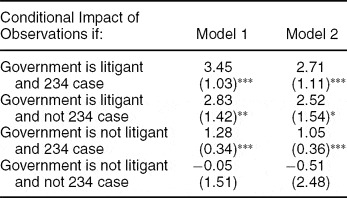
Model 1 in Table 4 presents the parameter estimates from this probit model with robust standard errors clustered by case. The number of interaction terms severely complicates interpretation of the results. Consequently, we calculated conditional coefficients with standard errors for the effects of net weighted government observations for the plaintiff under the conditions associated with the hypotheses. Model 1 in Table 5 presents these conditional coefficients.Footnote 16 The coefficients are inconsistent with expectations. The conditional coefficient for net weighted government observations when a government is a litigant (2.83) is smaller than the conditional coefficient for these same conditions when the legal issue is from an Article 234 proceeding (3.45). But the standard errors on these conditional coefficients are large enough so that we cannot identify a significant difference in the effect of observations in these two scenarios. As Figure 2 shows, the predicted probabilities associated with changes in net weighted observations are indistinguishable statistically under these two conditions.
Probit Analysis of ECJ Ruling for the Plaintiff (Robust Standard Errors)

* = Significant at the 0.10 level.
** = Significant at the 0.05 level.
*** = Significant at the 0.01 level.
Conditional Impact of Net Weighted Observations for Plaintiff (Robust Standard Errors)

* = Significant at the 0.10 level.
** = Significant at the 0.05 level.
*** = Significant at the 0.01 level.
The Impact of Government Observations on ECJ Rulings When a Government Is a Litigant

More generally, the results are consistent with the results presented in Table 2. First, compare the Article 234 scenarios in the first (top) and third rows. We see that net weighted government observations for the plaintiff have a positive relationship with ECJ rulings for the plaintiff and the impact is larger when a government is a litigant than when a government is not a litigant. Second, in direct actions involving member states (the second row of Table 5), we find a positive relationship as well. These types of legal issues represent the bulk of rulings outside of Article 234 cases. The conditional coefficient in the last row of Table 5 is provided for completeness. This category of legal issue is not of substantive interest here, as it includes a mix of cases (e.g., staff regulation hearings) where we would expect threats of override and noncompliance to be of little relevance.
Political Constraints, Legal Merits, and the Advocate General: A Final Test
Although the results indicate that political constraints systematically shape ECJ rulings, we consider one final alternative interpretation. If legal precedent, the quality of the legal argument, or the content of relevant treaty articles favor a particular litigant, we would expect the Court, all else equal, to favor that litigant. And, while government observations plausibly act as indicators of government preferences over legal issues, they may also signal the quality of each litigant's case on the merits (Granger Reference Granger2005: 29). If so, then the better the case on the merits for a litigant, the more likely it is that governments will submit observations agreeing with that litigant's position and that the Court will rule for that litigant. Consequently, we might find a positive correlation between government observations and Court rulings even if the Court is not responding to government threats of override or non-compliance.
That said, this story provides a poor account of the nuanced pattern of statistical results we have presented thus far. Recall that we do not find simply that ECJ rulings move in the direction of net government observations. Tables 2–5 show a complicated and systematic relationship between observations and rulings conditioned on several theoretically motivated characteristics of cases and the identity of litigants. The claim that observations convey information about the merits of the case does not account for these findings. That is, we have no reason to think that observations would be more informative on legal issues where a government was a litigant; that observations would only be informative when on the side of the plaintiff in infringement proceedings, but be informative when tabled on behalf of the plaintiff or defendant in Article 234 proceedings when no government was a litigant; and that the quality of information would be systematically positively correlated with our weighting of observations by national share of votes in the Council. Thus, we do not consider this informational story a compelling explanation for our findings.
However, we would be even more confident in the results if we could include a variable that could help control for how the court would rule based on the merits of the case. To that end, Model 2 in Table 4 presents a re-estimation of Model 1 in Table 4 with a control for the position of the Advocate General. In the period, 1987–1997, each case before the Court was assigned to an Advocate General (AG). The AG issues an advisory opinion to the Court prior to its deliberations. The opinion reflects all case material, including observations submitted by litigants and third parties, and indicates how the Court should resolve the case. According to the EC treaty, the AG is to act “with complete impartiality and independence, to make in open court, reasoned submissions on cases brought before the Court of Justice, in order to assist the Court in the performance of the task assigned to it . . .” [Article 166(2) EC]. Each of the nine AGs is appointed by a member state for a renewable six-year term.Footnote 17 AGs are typically drawn from the ranks of the national judiciaries, senior civil servants, and academics (Tridimas Reference Tridimas1997: 1352).
The AG opinion involves a full analysis of the relevant case law and treaty articles and is sometimes significantly longer than the judgment of the Court. Importantly, the AG prepares her opinion in isolation from the judges on the Court and does not participate in their deliberations (Rasmussen Reference Rasmussen1998: 68; Tridimas Reference Tridimas1997). To insulate them from even the appearance of national bias, AGs are not assigned to direct actions involving their member state (Rasmussen Reference Rasmussen1998: 68). AGs are also generally barred from preliminary references arising from their native courts (Tridimas Reference Tridimas1997: 1356). Rasmussen (Reference Rasmussen1998: 68) credits this independence for the fact that AG opinions generally feature “a greater internal cohesion than the decision of the Court which is often the result of collective writing and routine compromises.” The AGs’ opinions appear to be persuasive; the Court agreed with the AG's opinion on 79% of the legal issues in our data set.
Of course, the fact that AGs' opinions are of public record may expose them to political pressure from national governments. In particular, an AG who would like to be reappointed, would have an incentive to issue opinions consistent with his or her national government's interests. We doubt that such considerations strongly influence AG opinions, for two reasons. First, as stated above, AGs are not assigned to cases involving their governments. While this certainly does not eliminate the possibility that the AGs are assigned cases that their governments care about, it does eliminate the most obvious conflicts of interest. Second, given that AG terms of office generally do not coincide with those of the appointing government, even a highly political AG would find it difficult to anticipate the desired opinions of the government responsible for reappointment.
Still, we cannot rule out the possibility that AGs are at least occasionally responsive to political pressure from member states or are motivated by other goals that might correlate with member-state interests. Thus, while this proxy variable should help control for the legal merits of the litigants’ positions, it may also reflect political pressures related to member-state interests. If so, then the inclusion of this variable should bias our estimates of the political influence of government observations toward zero. Thus, we only expect this control variable to increase the difficulty of rejecting the null hypothesis that government observations are unrelated to ECJ decision.
In sum, if government briefs are simply informative as to the legal merits and do not signal political threats, we would expect them to shape the AG's position, which in turn should influence the Court. The inclusion of the AG's position in our statistical model would then eliminate the effect of government observations on ECJ decisions observed in Model 1, Tables 4 and 5. However, if these government briefs are signals of threats of override or noncompliance (and the AG variable does not absorb these effects), we would expect them to exert influence on ECJ decisions independent of the AG's position. We would therefore retain the effects of government observations revealed in Model 1 even with a control for the AG's position.
Model 2 in Table 4 presents the results. Even with this control variable added to the model, we find support for the political constraint hypotheses. As shown in Table 5, the conditional coefficients for government observations are slightly smaller in Model 2 than in Model 1. But the conditional coefficients remain statistically significant, in the expected direction, and in the same order of relative size as in Model 1.
In addition, the results are consistent with our expectations regarding the control variable. The AG's position has a systematic positive influence on ECJ decisions. Furthermore, this influence is substantively large. For example, consider a legal issue with a government litigant but no overt political pressure—no observations from governments or the Commission—and otherwise typical case characteristics.Footnote 18 The probability that the ECJ rules for the plaintiff is .20 if the AG position is for the defendant and is .80 if the AG position is for the plaintiff. That is, the AG's opinion shifts the likelihood of a pro-plaintiff ruling by 60 percentage points. This impact of the AG's opinion is comparable to the influence of a fairly large shift in the balance of government observations on a legal issue. In the context described above with the AG supporting the plaintiff, net weighted observations would need to move from zero to −.3 in order to bring the odds back to even. Furthermore, the 60% swing in the likelihood of a ruling for the plaintiff due to a change in the AG's opinion requires a shift from −.4 to .4 in net weighted government observations. That amounts roughly to four large member states shifting their support from the defendant to the plaintiff in their observations.
This AG effect raises a variety of interesting questions for future research. Our findings suggest that the Court is sensitive to the merits of the case, as reflected in the AG's position. But we cannot determine whether this is due to the presence of the AG's opinion. In principle, the Court could determine the merits on its own and incorporate the merits into its rulings without knowledge of the AG's opinion. Alternatively, the publication of the AG's opinion may create pressure on the Court to attend to the merits, particularly if the individual AG has a strong legal reputation. This might afford the Court a degree of insulation from political pressure.
Finally, it is worth noting that Commission observations for the plaintiff and defendant also systematically sway the Court's decisions. This effect is independent of the AG's position, so we cannot attribute it simply to an informational influence.
DISCUSSION
These results have general implications for the study of judicial politics. First, they provide novel empirical evidence of strategic behavior by judges in the face of political constraints. Extant theory—particularly separation-of-powers models—indicates that judicial decisions should respond systematically to the interests of the executive and legislative branches. Specifically, threats of noncompliance and legislative override induce courts to alter their decisions to mollify those political interests responsible for compliance and legislation. Yet, with a few recent exceptions (e.g., Vanberg Reference Vanberg2005), we have very little evidence that such constraints do indeed shape judicial behavior. Our analysis provides systematic evidence that judges at the European Court of Justice are sensitive to these two constraints. Moreover, these threats have a substantively large effect on judicial rulings.
Second, our analysis allows us to compare the impact of these two political constraints on judicial behavior. Harvey and Friedman (Reference Harvey and Friedman2006) have demonstrated that U.S. federal courts are sensitive to threats of legislative override and Vanberg (Reference Vanberg2005) and Staton (Reference Staton2006) find evidence that constitutional courts in Germany and Mexico are sensitive to threats of noncompliance. But we are aware of no study that considers both threats in the same judicial setting. Our findings indicate that threats of noncompliance are more influential on judicial rulings than threats of override. We suspect that this is due to the ease with which threats of noncompliance can be executed compared to threats of override.
The results of our analysis also have several important implications for our understanding of decision making by the European Court of Justice. First, and most obviously, they provide the first systematic evidence that political constraints substantially affect ECJ decision making. As stated previously, much of the evidence scholars point to in trying to evaluate judicial influence has proven uninformative because of the observational equivalence of their evidence. This study provides the first quantitative test that moves beyond this empirical impasse. Overall, the evidence is more consistent with the intergovernmentalist argument that political constraints should have large, systematic, and substantively significant effects on judicial decision making than with neofunctionalist arguments that, while these constraints might matter on the margin, the court has had the latitude to pursue an agenda independent of and contrary to member-state governments’ interests. Simply put, small shifts in the number of governments aligned on one side of a legal issue or another have large substantive effects on the ECJ's likely decision.
Second, our results speak directly to several past studies that have examined the relationship between third-party observations and ECJ rulings. For example, our evidence is consistent with conjectures of Granger (Reference Granger2005) that member-state observations influence ECJ rulings. And our results are consistent with the findings of Stone Sweet (Reference Stone Sweet2004) that Commission observations have a systematic positive effect on ECJ rulings. In all of our models, an observation by the Commission on behalf of the plaintiff or the defendant increases the likelihood that the Court rules in favor of that litigant. However, our results with respect to member-state observations are exactly the opposite of the findings in several chapters by Stone Sweet (Reference Stone Sweet2004), which conclude that government observations are not influential on ECJ rulings in the areas of free movement of goods and sex equality. In fact, Cichowski (Reference Cichowski and Sweet2004: 188) finds that net government observations are negatively associated with ECJ rulings. We can only speculate as to the reason for the discrepancy in our findings and these studies. Obviously, the difference may simply reflect the sample or statistical model employed. For example, our results are drawn from all cases, not specific issue areas. But we can imagine a variety of reasons that threats of override and noncompliance may vary by issue area—for example, the role of precedent or legal doctrine may vary—and consider this an interesting empirical question for future research.
Third, as mentioned above our results indicate that preliminary rulings do not, in a general sense, provide the Court with insulation against threats of noncompliance and override. This finding is inconsistent with the general story in the ECJ literature that the Court has used the preliminary reference system, not cases brought as direct actions, to advance its agenda. Clearly, the Court appears to have greater autonomy from member-state interests in the Article 234 cases with no government litigant than when a government is a litigant. But these results do not support the strong version of this claim that the Court escapes political constraints in the preliminary ruling system. We find that member-state observations have powerful effects in this setting.
Finally, it is important to note that one should not infer from these results that the Court is powerless or irrelevant to the process of European integration. By establishing the doctrine of direct effect and supremacy, the ECJ created a supranational legal order. Our findings simply point out that the Court's interpretation and development of that legal order as presented in its rulings are often influenced by the preferences of the member-state governments. Threats of override and especially noncompliance restrict the Court's ability to push an agenda contrary to the preferences of the member-state governments. However, our results are consistent with the theoretical account of Carrubba (Reference Carrubba2005), which demonstrates the Court is valuable to the integration process because it serves as a fire alarm mechanism for member-state policing of EU regulations. Thus, our findings should not be read as evidence for the irrelevance of the Court to European integration.
APPENDIX
Tables 6–8 present the results of the models estimated in Tables 2 and 3 with alternative weighting strategies to capture national political and economic power. We report the results for unweighted observations, which assumes that national influence is similar across countries. We also weight observations by the national share of EU Gross Domestic Product (GDP) and the national share of intra-EU trade. These measures are designed to capture the importance of each nation to economic relations in the EU. We expect higher national shares of EU GDP and intra-EU trade to reflect greater economic influence, which is particularly relevant to our hypotheses about threats of noncompliance.
Probit Analysis of ECJ Ruling for the Plaintiff With Alternative Weighting of Government Observations (Robust Standard Errors)

* = Significant at the 0.10 level.
** = Significant at the 0.05 level.
*** = Significant at the 0.01 level.
Probit Analysis of ECJ Ruling for the Plaintiff in Infringement Proceedings With Alternative Weighting of Government Observations (Robust Standard Errors)

* = Significant at the 0.10 level.
** = Significant at the 0.05 level.
*** = Significant at the 0.01 level.
Probit Analysis of ECJ Ruling for the Plaintiff in Article 234 Cases without a Government Litigant, Using Alternative Weighting of Government Observations (Robust Standard Errors)

* = Significant at the 0.10 level.
** = Significant at the 0.05 level.
*** = Significant at the 0.01 level.
The GDP data are from the United Nations Statistics Division and based on GDP by expenditure in nominal prices (http://unstats.un.org/unsd/). The intra-EU trade statistics are constructed from the trade data collected by the International Monetary Fund (2003).



Comments
No Comments have been published for this article.