Variation in the past tense forms of BE occurs throughout the English-speaking world. The historical record shows that usage has always been variable (Brunner, Reference Brunner1970; Forsström, Reference Forsström1948; Mossé, Reference Mossé1952; Visser, Reference Visser1963), perhaps even as far back as Old English (Tagliamonte, Reference Tagliamonte1998:157), and recent studies show that variation is still the norm. It is only in the standardized varieties that the forms have stabilized, with was used with first and third singular subjects and were elsewhere, though even here variation still exists with existential there subjects (Cheshire, Reference Cheshire, Bex and Watts1999; Hay & Schreier, Reference Hay and Schreier2004; Walker, Reference Walker2007).
Although variation is the norm, both the overall rates of variation and the dominant patterns differ from one location to another. There are two principal patterns, of which the most common across the English-speaking world is leveling to was across person, number, and polarity. Its frequency has led to this pattern being labeled a basic “vernacular primitive” (Chambers, Reference Chambers1995:242). Indeed, the basic nature of the pattern is supported by evidence from first language acquisition (Brown, Reference Brown1973), interlanguage in second language acquisition (Schumann, Reference Schumann1978), and decreolization, where according to Bickerton (Reference Bickerton1975:115), was occurs first (as an irregular lexical insertion) with were acquired later, in direct proportion to increasing overall acquisition of standard English features (Tagliamonte & Smith, Reference Tagliamonte and Smith1999:12). Chambers (Reference Chambers1995), in fact, argued that were only ever exists due to the pressure of standard English. Was leveling is a prime example of analogical change: BE is the only verb in contemporary English to make a person/number distinction in the past tense, so speakers might be expected to regularize the paradigm. As the third person singular form, the status of was in a hierarchy of basicness (Hock, Reference Hock1986:214ff) makes it a natural choice for the pivot in analogical leveling (Schilling-Estes & Wolfram, Reference Schilling-Estes and Wolfram1994:276).
The second pattern of variation, involving leveling to was in contexts of positive polarity and leveling to weren't in contexts of negative polarity, as in (1),Footnote 1 also responds to what can be seen as basic system-internal pressures.
(1) yeah the teachers weren't that good because they was always off and we had to have supply teachers in that didn't know anything. Jennifer J/S/A 6:20
Here was and weren't are transparent markers of polarity, meeting the functional need to distinguish clearly between negative and positive propositions. This time, the leveling pattern brings BE into line with other frequent English verbs that have distinct positive and negative forms. These include do/don't and will/won't, as well as present tense forms of BE in varieties that variably have ain't in negative contexts but am, are, is in positive contexts (Anderwald, Reference Anderwald2001:18; Schilling-Estes & Wolfram, Reference Schilling-Estes and Wolfram1994).Footnote 2 The was/weren't pattern is very frequent in present-day Britain, although elsewhere it is attested only in a range of relatively isolated communities within the Mid-Atlantic coastal region of the U.S.A. (Wolfram & Schilling-Estes, Reference Wolfram, Schilling-Estes, Britain and Cheshire2003:132). The dominance of the pattern in present-day England is clear from Anderwald's (2001) analysis of the British National Corpus, which indicated widespread leveling to was in positive polarity contexts and, except in the northwest Midlands, Scotland, and Ireland, parallel leveling to weren't in all areas for which there were sufficient data.Footnote 3Was/weren't leveling is seen most clearly in parts of the Southwest and East Anglia (Anderwald, Reference Anderwald2001:5, 6), and Britain (Reference Britain2002) confirmed that in the Fens, East Anglia, there has been a gradual shift over time from a wide range of variable paradigms and phonetically variant forms to a leveled was/weren't system. Levey's (2007) research in an eastern outer London suburb found a was/weren't system in the speech of children as young as 7 to 11 years (Levey, Reference Levey2007); and in the Corpus of London Teenage English, the patterns are clearer still, with nonstandard was occurring only in positive contexts and nonstandard were only in negative contexts (again, see Levey, Reference Levey2007).
Both leveling patterns derive from earlier dialects where nonstandard was and nonstandard were are both attested (Britain, Reference Britain2002; Schreier, Reference Schreier2002; Wolfram & Schilling-Estes, Reference Wolfram, Schilling-Estes, Britain and Cheshire2003), but the reasons leading speakers to choose one leveling pattern rather than another are unclear. In Tristan da Cunha, for example, the new variety of English that developed during the nineteenth century showed categorical leveling to was within four generations (Schreier, Reference Schreier2002). New Zealand English, however, which developed during roughly the same period, took a different course: although first generation New Zealanders used both generalized was and generalized were (Trudgill, Reference Trudgill2004:15), by the end of the nineteenth century the past BE system had almost completely standardized (Hay & Schreier, Reference Hay and Schreier2004). Hay and Schreier attribute this standardization to the dialect leveling that was part of the process of new dialect formation. Dialect leveling (and dialect contact more generally) can also explain developments in the Fens, East Anglia (Britain, Reference Britain2002); this time, however, the leveling was not to the standard English system, but to the was/weren't pattern. The same pattern has developed in eastern seaboard communities in the U.S.A., where, though, it apparently developed independently in communities that had little contact with each other (Wolfram & Schilling-Estes, Reference Wolfram, Schilling-Estes, Britain and Cheshire2003:147).
The role of literacy and formal institutionalized education in inhibiting leveling (whether to the first or the second of the dominant patterns) is equally unclear. Tagliamonte and Smith (Reference Tagliamonte and Smith1999:22) argued that the relative absence of prescriptive norms can explain the quasi-categorical rates of was leveling in Samaná, where literacy is minimal and “whatever variable system the ancestors of the Samaná people had prior to their migration, the system-internal analogical levelling process has simply continued unchecked by normative pressures.” Tagliamonte and Smith argued that in other communities, relative rates of leveled was can also be explained by the extent to which the community is marked off from the mainstream, whether in social, cultural, or economic terms, or in some other way. Tristan da Cunha is an important case in point: here, after the initial leveling process, variation was reinstated among younger, more mobile members of the community, who came into contact with standard English and now use were as well as was.
Chambers (Reference Chambers and Kortmann2004:118) argued that in large urban areas generally a trend toward the use of standard English is likely to disrupt the basic pattern of leveled was, but recent research in the U.K. indicates a more complex scenario. In both Birmingham and York (see, respectively, Khan, Reference Khan2006, and Tagliamonte, Reference Tagliamonte1998), there is a decline in nonstandard was, but no evidence of an overall trend toward the use of standard English forms of past BE. This is because in both cities a decline in leveled was goes hand in hand with an increase in leveled weren't. In Birmingham—the largest urban conurbation in the U.K. after London—adolescents used more nonstandard weren't overall than nonstandard was, whereas older speakers used more nonstandard was but no nonstandard weren't at all (Khan, Reference Khan2006). Tagliamonte observed a similar pattern in York, where although nonstandard was “appears to be fading away” (1998:184), nonstandard weren't is increasing. Similar trends are apparent in some of the coastal communities in the U.S.A. studied by Wolfram and Schilling-Estes. These investigators suggested that social stigmatization may contribute to the decline of nonstandard was, an “icon of prescriptivism” (Wolfram & Schilling-Estes, Reference Wolfram, Schilling-Estes, Britain and Cheshire2003:149), and that, by contrast, leveled weren't is relatively nonsalient perceptually, and so less subject to stigmatization. The independent development of weren't, they suggested, is reinforced by weren't being assigned social symbolic status as an indicator of island identity for Ocracoke speakers (Schilling-Estes & Wolfram, Reference Schilling-Estes and Wolfram1994:298) or of in-group identity for European Americans in Hyde County, marking their distinctiveness from African Americans in the same locality (Wolfram & Schilling-Estes, Reference Wolfram, Schilling-Estes, Britain and Cheshire2003:149). There are no reports of this kind with reference to the symbolic status of nonstandard weren't in Britain.
Tagliamonte and Smith (Reference Tagliamonte and Smith1999:21) pointed out that “the more we know about how different communities have responded to the antithetic pressures leading to levelling and standardisation, the more we will come to understand these processes themselves.” The focus on London English in this article, therefore, should allow us to better understand several of the issues raised by previous analyses of past forms of BE. First, there is the question of the extent to which we can equate proximity to an urban center with speakers’ use of standard English forms. As the largest urban center in the U.K., we might expect to find lower rates of both leveled was and leveled weren't in London than have been reported elsewhere. On the other hand, London has been claimed to be the source of some recent phonetic innovations in the U.K. (Foulkes & Docherty, Reference Foulkes and Docherty1999). Although morphosyntactic innovations in British English have been less studied, London may well play a similar role as a source of present-day changes in the grammatical system. This seems to have been the case in the past, when London was influential in promoting dialect mixtures and in spreading morphosyntactic innovations (Nevalainen & Raumolin-Brunberg, Reference Nevalainen and Raumolin-Brunberg2003:165)—though admittedly Nevalainen and Raumolin-Brunberg's evidence comes from the Tudor and Stuart periods, when English was only beginning to be standardized. If London is a source of morphosyntactic innovation, we might expect to find higher rates in London of the was/weren't pattern attested throughout Britain, rather than lower rates.
Second, an analysis of variation and change in present-day London English may help to tease out the effects of dialect contact and language contact on was/were variation. Leveling of the past BE paradigm is often explained as a consequence of dialect mixture, and even in situations where language contact might be thought to have a role, its effect is downplayed, denied, or ignored (see, for the early stages of New Zealand English, Trudgill [2004:5] and, for Tristan da Cunha English, Schreier [2002:80]; see further, Kerswill & Williams [Reference Kerswill and Williams2005:1024] for the general view that language contact plays a minimal role in situations of new dialect formation). Dialect mixture has been acknowledged as important in the development of London English (see, for example, Ellis, Reference Ellis1889:110), again with little or no mention of the role of language contact. We would argue, though, that the long history of London as a destination for immigration from overseas as well as for in-migration from other parts of the British Isles makes it difficult to ignore the possible effects of language contact. Our analysis therefore attempts to take some preliminary account of both language contact and dialect contact.
Despite its importance as a research site for the study of ongoing changes in Britain, London has not so far been the subject of a systematic sociolinguistic analysis, other than by Fox (Reference Fox2007) and Kerswill, Torgersen, and Fox (Reference Kerswill, Torgersen and Fox2008), both of which focus on phonological variation. We are currently analyzing a range of morphosyntactic variables, none of which has previously been analyzed systematically in London English. The analysis reported here is the first to be completed and is therefore the first sociolinguistic account of morphosyntactic variation and change in the capital. There are no earlier sociolinguistic studies on which we can draw. Although there is much variation in past forms of BE in our data, to date we have no evidence of variation in the present tense forms of BE (other than in existential contexts), and we focus only on past BE forms here.
We begin by briefly reviewing the effect of the internal linguistic factors that previous researchers have found to constrain was/were variation, to set the scene for our own analysis.
INTERNAL CONSTRAINTS ON WAS/WERE VARIATION
Polarity
Anderwald (Reference Anderwald2002:182) pointed out that any generalization strategy is strongly preferred in negative contexts. This is borne out by the increase in leveled weren't forms in British English, which is attested even in locations where leveled was is declining, as we have seen (see also Wolfram & Schilling-Estes, Reference Wolfram, Schilling-Estes, Britain and Cheshire2003). Schilling-Estes and Wolfram (Reference Schilling-Estes and Wolfram1994:289–290) explained this restructuring of the past BE paradigm as a remorphologization of both was and were as transparent markers of polarity. From a functional perspective, distinguishing positives from negatives is more important than distinguishing subject person and number, particularly as English clauses typically have overt subjects. Schilling-Estes and Wolfram further noted that the negativity expressed by the negative marker not becomes less transparent as not is transformed into the phonologically dependent –n't clitic; as a result weren't has emerged as a phonologically distinct negative allomorph that cannot be mistaken for the positive. They also point out that the development of weren't may be reinforced by natural phonological tendencies (1994:294). The encliticization of –n't to was places the final consonant of was, [z], in an intersonorant or intersyllabic environment that is favorable to weakening. In some varieties this, with assimilated rounding of vowels after [w], may result in wasn't and weren't converging phonetically and perceptually. Britain (Reference Britain2002:36) similarly argued that forms such as [wɔ:nt] or [wɒnʔ], which were commonly found in the Survey of English Dialects data (Orton & Tilling, Reference Orton and Tilling1971) but not in the Fens today, may derive from phonetic processes reducing [wɒznt], and that they have been reanalyzed as weren't and adjusted accordingly.
Tags provide an important context for leveling to weren't in England. In York, Tagliamonte found that leveling to weren't increased dramatically in tags across the generations, with weren't used predominantly when the subject of the tag was it (1998:179). Anderwald's survey of the British National Corpus data (2002:178) also reports nonstandard weren't as favored in tags in 9 out of 12 British dialect areas.Footnote 4
It seems likely that weren't generalization is a relatively recent phenomenon in the histories of English dialects. Nevalainen (Reference Nevalainen, Nevalainen, Klemola and Laitinen2006:360) found no difference in negative contexts between the use of was and were in the regional component of the Corpus of Early English Correspondence, which covers the period from 1410 to 1681 (although, as she pointed out, negative forms of past BE are not very frequent in her data). Hay and Schreier (Reference Hay and Schreier2004:228) reported was leveling in early New Zealand English (although this was later reduced), which suggested that it was present in the speech of early colonizers from Britain, but they found no evidence of weren't leveling. Ellis (Reference Ellis1889), however, indicated that weren't certainly existed in East Anglia and Wiltshire in the late nineteenth century, and Kökeritz (Reference Kökeritz1932) gave examples of weren't in Suffolk in the early twentieth century (see Britain, Reference Britain2002:21). The Survey of English Dialects confirms that by the 1950s, nonstandard weren't was clearly a dialect feature in England (Tagliamonte, Reference Tagliamonte1998:184). We cannot conclude from these early studies that a mixed was/weren't system necessarily existed, but such a system was attested for Reading, southwest England, in the late 1970s. Cheshire (Reference Cheshire1982:44–45) reported high rates of nonstandard was (83%) in adolescent speech in Reading, with nonstandard were used very rarely other than in negative contexts (where it occurred at a rate of 37%). If inner London is the source of innovations, then, we might expect our analysis to discover high rates of weren't, and perhaps also was, among young speakers in this location.
Grammatical subject
Tagliamonte (Reference Tagliamonte1998:158) noted that a synthesis of contemporary research on was leveling reveals a constraint hierarchy for the effect of the grammatical subject that is “surprisingly consistent across varieties,” namely NP existential > you > NP plural > we/they. Chambers (Reference Chambers and Kortmann2004:141) similarly refered to “the remarkable regular hierarchy of subject types,” though he proposed a slightly different constraint hierarchy (2004:133): NP existential > you > we > NP plural > they. There is agreement on the poles, then: they is thought to favor nonstandard was the least, and existential subjects the most, followed by you. Kortmann and Haser (in press) argue that this fits with a usage-based explanation based on the notion of entrenchment: the higher discourse frequency of they relative to we, they suggest, makes they were more entrenched and less likely to be replaced by the generalized was form.
Tagliamonte's more recent research, however, surveying was/were variation in 13 different communities, suggests that it is premature to generalize (Tagliamonte, Reference Tagliamonte, Filppula, Klemola and Paulasto2009). She finds no regular relationship between leveled was and different pronoun subjects, although in most of the communities, existential contexts clearly favor was leveling, and NP subjects tend to favor was leveling over third plural pronoun subjects.
The latter phenomenon is sometimes referred to as an aspect of the Northern Subject Rule. In contemporary varieties, it is seen at its most extreme in Buckie, Scotland, where was occurs after 81% of all plural NPs but never after they (Smith & Tagliamonte, Reference Smith and Tagliamonte1998:116). The pattern is commonly found in U.S. varieties too (Schilling-Estes & Wolfram, Reference Schilling-Estes and Wolfram1994:285). In southern England, though (which is only beginning to be explored), the effect appears to be reversed or nonexistent. In East Anglian varieties, for example, was occurs more frequently with they than with a plural NP (Britain, Reference Britain2002), a pattern that has been described as the Southern Subject Rule (Rupp, Britain, Fox, Bray, Baker, & Spurling, Reference Rupp, Britain, Fox, Bray, Baker and Spurling2005). In the Corpus of London Teenage English, both they and plural NPs have a roughly equal, slightly inhibiting effect on was (Levey, Reference Levey2007). The constraint hierarchy in the East Anglian Fens data was NP existential > you > we > they > NP plural (Britain, Reference Britain2002:26). Regional differences in the effect of plural NPs on the use of nonstandard was may relate to changes in the overall frequencies of this nonstandard form, with leveling to was occurring alongside leveling of a previously operative constraint (Britain, Reference Britain2002:38). Britain observes that although older speakers in the northwest Fens show higher rates of was with NP plural subjects than with they, the effect of these subjects is reversed for younger speakers, whose use of nonstandard was is dramatically higher than that of the older Fens speakers. Nevalainen's analyses (2006) indicate that a decline in was leveling rather than an increase may similarly overturn the effect of the constraint: during the period of 1440–1519, plural NP subjects favored was in the Corpus of Early English Correspondence, but the effect was lost alongside the gradual decline of was leveling between 1440 and 1681.
In many varieties, you seems to frequently occasion higher rates of nonstandard was (see, for example, Feagin, Reference Feagin1979; Labov, Cohen, Robins, & Lewis, Reference Labov, Cohen, Robins and Lewis1968; Schreier, Reference Schreier2002:84; Smith & Tagliamonte, Reference Smith and Tagliamonte1998) but, other than this, the main consistency lies in the repeated high frequencies of was with existential subjects. Thus an analysis of the effect of the grammatical subject on the use of nonstandard was in London English will provide further data to help decide on the extent to which there is a consistent grammatical subject hierarchy across different varieties of present-day English, and whether there is a frequency-based dimension to such a hierarchy.
Existential constructions and word order
Plural NP subjects in existential constructions consistently favor was, even in varieties where in other contexts nonstandard was is declining, or virtually nonexistent (see, for example, Britain & Sudbury, Reference Britain, Sudbury, Jones and Esch2002; Hay & Schreier, Reference Hay and Schreier2004; Khan, Reference Khan2006; Moore, Reference Moore2003; Tagliamonte, Reference Tagliamonte1998). The constraint often overrides other strong influences on the use of leveled was, such as collective nouns as subject (Tagliamonte, Reference Tagliamonte1998:167). This is not a new phenomenon. As Traugott (Reference Traugott1972:134) noted, agreement in English existentials has been relatively infrequent for centuries, perhaps as far back as Old English (Pietsch, Reference Pietsch2005:156; see also Visser, Reference Visser1963:62). Nevalainen's (2006) analyses showed minimal variation in the factor weights for the existential subject constraint over time.
Chambers (Reference Chambers2006) suggested that in existential constructions, where the thematic subject is postverbal, a “look-ahead” mechanism is required if the subject is to trigger agreement. It has also been argued that the prevalence of was with plural NP subjects in existential constructions reflects the ongoing lexicalization of there was (and present tense there's) into an invariant prefabricated expression used to introduce new topics into the discourse (Cheshire, Reference Cheshire, Bex and Watts1999; Crawford, Reference Crawford2005; Eisikovits, Reference Eisikovits and Cheshire1991). There is no reason why both explanations should not be possible. Existential constructions are frequent in speech, so the frequent collocation of there and was, whether or not the result of a failure to look ahead, could promote lexicalization.
Nonexistential contexts with postverbal subjects occur far less frequently in speech and are rarely included, therefore, in analyses of was/were variation. Where they have been taken into account, the results appear to confirm a failure to look ahead. For example, Tagliamonte (Reference Tagliamonte1998) noted some rare contexts with adverbial fronting followed by subject-verb inversion, as in (2), where agreement does not occur.
(2) and on that island was the cooling towers (Tagliamonte, Reference Tagliamonte1998:169)
In inner city Sydney English, interrogatives with subject-verb inversion similarly favor was, as in (3), though again the number of tokens was low.
(3) who was you with? (Eisikovits, Reference Eisikovits and Cheshire1991:250)
Further support for the need to assume a look-ahead mechanism to trigger agreement comes from studies showing that agreement is less likely to occur when the subject is preverbal but separated from the verb. Thus relative that favors nonstandard was in Buckie (Smith & Tagliamonte, Reference Smith and Tagliamonte1998:120) and Appalachia (Hazen, Reference Hazen1996), apparently continuing a Middle English tendency for relative markers to favor leveling to was (Forsström, Reference Forsström1948:207). In the Corpus of Early English Correspondence, too, leveled was occurred with relative pronouns, despite being infrequent overall with personal pronouns (Nevalainen, Reference Nevalainen, Nevalainen, Klemola and Laitinen2006:364). Collective NPs and coordinated NPs are also widely held to be usual sites for nonstandard was, perhaps, as Tagliamonte suggested, because in these cases, number interpretation is not straightforward (Tagliamonte, Reference Tagliamonte1998; see also Biber, Johansson, Leech, Conrad, & Finegan, Reference Biber, Johansson, Leech, Conrad and Finegan1991:189).
Tagliamonte (Reference Tagliamonte1998:173–174) analyzed separately the effect of proximity between the verb and the subject for both preverbal and postverbal third plural NP subjects, finding in each case that frequencies of nonstandard was increase with greater numbers of intervening words.Footnote 5 Another way of framing this might be to say that the further ahead one has to look, the less likely there is to be subject-verb agreement.
Thus the universal tendency for existential subjects to favor nonstandard was may reflect a basic processing constraint, such that the linear word order of spontaneous speech makes speakers resort to the “vernacular primitive” or basic default form was (Chambers, Reference Chambers2003:266; Schilling-Estes & Wolfram, Reference Schilling-Estes and Wolfram1994:276) in contexts where the subject is produced after the verb and cannot easily trigger agreement. We test this in our analysis by analyzing the effect of both existential contexts and interrogative contexts on was/were variation. However, we analyze existential contexts separately, because although the thematic subject is postverbal in both expletive there clauses and interrogative clauses, current formal syntactic models (such as the Minimalist program) hold that these two clause types differ in the position of the thematic subject relative to the structural subject. In expletive there clauses, the position of the thematic subject is lower than that of the structural subject. This is not so in interrogative clauses, despite the fact that the subject and verb are inverted in the surface structure such that the verb precedes the subject. Thus although an elaborate generative apparatus is needed to explain the structure of existential clauses (Meechan & Foley, Reference Meechan and Foley1994; Tagliamonte, Reference Tagliamonte1998:169, 185), the grammar of interrogative clauses does not differ from clauses where the subject takes the usual preverbal position. The distinctiveness of existential contexts is further confirmed by Moore's (2003) analysis of past BE forms in Bolton, Lancashire, a U.K. city where were leveling exists. In Moore's data, leveled was occurs in nonexistential contexts with a frequency of only 2% (n = 20 of 1035); in plural existentials, on the other hand, was is the favored form (58%; n = 38 of 66). Tagliamonte (Reference Tagliamonte1998:169), similarly, stated that “existential constructions are a special case when it comes to was/were variation,” and in New Zealand English, was/were variation has developed differently in existential and nonexistential contexts (Hay & Schreier, Reference Hay and Schreier2004). Existential constructions constitute a distinct syntactic context from the other contexts in which was/were variation occurs, then.
THE LONDON PROJECT
Our analysis forms part of the research project Linguistic Innovators: the English of Adolescents in London. This is a sociolinguistic investigation of the English spoken by adolescents in two different locations in London, one inner East London area (Hackney) and another further to the east (Havering). Most of the fieldwork involving the adolescents was carried out in a college of further education in each of the locations. The two sites are important in relation to the sociohistorical changes that have taken place in London, and we focus here on developments following the end of World War II.
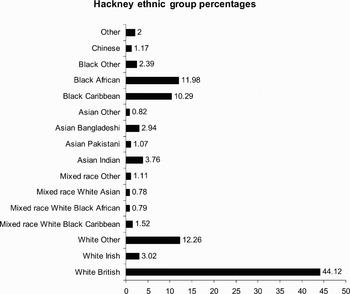
The inner London site is associated with the dense, social networks of the traditional white working class families who lived in this part of London, known somewhat globally as Cockneys, and who spoke the traditional dialect of the area, also known as Cockney. However, in the postwar slum clearance and reconstruction of London, many of the original inhabitants were transferred to new estates further east or to the new towns of Harlow and Basildon, both in Essex (for a fuller discussion see Fox, Reference Fox2007). This left an aging population in the inner London site until, with the arrival of foreign immigrants, the population started to increase. The proportion of immigrants to the total population rose from 105 per 1000 in 1951 to 192 in 1961 and 240 in 1966.Footnote 6 Many of the arriving immigrants were West Indian and this group today makes up 10.3% of the total population, but the area is multicultural in nature and home to many other minority ethnic groups including Black Africans, Asians, Chinese, Moroccan, Greek Cypriots, and Turks. Many of the children are bilingual, speaking at least one other home language in addition to English. Baker and Eversley (Reference Baker and Eversley2000) recorded 26 different languages spoken as a first language by schoolchildren in Hackney (a figure that does not take account of Creole languages).
Figure 1 shows the percentages of the different ethnic groups in the population of the borough of Hackney (the category “White Other” includes, we assume, members of the Turkish and Turkish and Greek Cypriot communities). Although the Asian Bangladeshi community constitutes just 2.9% of the population, the area where the fieldwork was carried out was on the border with a neighborhood in the adjoining borough where the Bangladeshi community makes up over 75% of the population, so there is a large Bangladeshi presence in the Hackney college where we carried out the fieldwork. Figure 1 shows that the White British population accounts for 44.1% of the total.
Population by ethnic group in Hackney. Data source: Census 2001.

The outer London site is an area to where many of the traditional white working class East London families migrated. It contains two large housing estates constructed to deal with the incoming population from the slum clearance program in London. It is an area that was once rural and firmly situated in the county of Essex but was transferred to Greater London from Essex by the London Government Act 1963, to become part of one of the outer London Boroughs created in 1965. Today it is no longer rural and is generally referred to as part of the East End of London, perhaps a reflection of the population movement. In contrast to the inner London site, the population is predominantly white—95.2% according to the 2001 Census figures. It is also predominantly monolingual.
These two sites provide us with the means to test the claim that inner London is the source of linguistic innovation as well as to begin to consider the effect of the complex urban dynamics of gender and ethnicity on the English spoken in London (see Harris, Leung, & Rampton, Reference Harris, Leung, Rampton, Block and Cameron2002:44). Our project focuses on the speech of adolescents in the two locations on the assumption that it is in adolescent speech that linguistic innovations are likely to occur (Chambers, Reference Chambers2003; Eckert, Reference Eckert2000).
The participants
The aim of the project was to obtain a selection of speakers aged 16–19 years, all of whom had been born and raised in the two locations studied. We wanted the speakers to reflect the ethnic makeup of the local population, but because we also aimed to take account of friendship groups, we could not determine in advance which ethnic groups would be represented in our sample. Ethnicity is notoriously difficult to define, and we assumed that although it may be highly salient within and between some friendship groups, for others it might be largely irrelevant. Thus we were less interested in the effect of ethnicity per se than in using it as a broad social variable to ensure that our sample reflected the multiculturalism of the local area, and as a potential indication of the multilingualism that is characteristic of inner London. Our usage has something in common, then, with the way that speaker sex is often used in variationist research, as a methodological, exploratory social variable. The variable is purposely broad and unrefined, as this allows it to be easily taken into account at the data collection stage (Milroy & Milroy, Reference Milroy, Milroy and Coulmas1997:53). However, by including it in our analysis, we did not wish to impose our own classifications on the speakers. Each individual was therefore asked to give a self-definition of “where they belong” in terms of their own identity, and these are the definitions we use for the minority ethnic groups.
In the event, we obtained two very different data sets. Our sample for inner London consists of 49 adolescent speakers, 27 male and 22 female. Half of the speakers have a “white London” background in that previous generations of their families have relatively local roots. We term this group of speakers “White Anglo.” The remaining half are the children or grandchildren of immigrants. Their self-classifications allowed us to divide them into four other main ethnic groups, with each group containing four or more speakers: Black Caribbean, Mixed race (White/Black Caribbean), Black African, and Bangladeshi. We placed together in a sixth group, “Other,” those speakers claiming to belong to an ethnic group for which our sample included just one or two speakers. This group consisted of individuals describing themselves as Moroccan, Chinese, Colombian, Portuguese, or Middle Eastern. The ethnic diversity of our sample reflects the diversity of the local population, then, though not necessarily in the same proportions as the 2001 Census figures.
Our sample for outer London consists of 36 adolescent speakers, 19 male and 17 female, predominantly of White British background, also reflecting the local population. All participants from both locations are in post-16 education, taking vocational courses such as bricklaying, painting and decorating, and catering, and are generally from working class backgrounds. In addition, we recorded conversations in each borough with 8 working-class Anglo adults aged 65–80 (4 women, 4 men) to act as a reference point for comparison with the speech of the adolescents. All of the elderly speakers in this sample were born during the period of 1918–1940, before the large movement of population from the East End of London to the suburbs further east and beyond.
The data
Our fieldwork yielded a corpus of approximately 110 hours of recorded conversations, each recording ranging in length from about 45 minutes to 3 hours. This amounts to over 1,000,000 words, which have been orthographically transcribed. All of the adolescent recordings, with the fieldworker present, took place in the colleges attended by the adolescents and were made after an initial observation period. Although some of the adolescents have been recorded individually, most of the recordings were with friendship pairs or small self-selected groups. The conversations were informal and mainly unstructured, with topics led by both the fieldworker and the participants. In addition, we have a small number of self-recordings made by the adolescents either in the college or off-site. The recordings for the elderly speakers were, in the main, conducted in the speakers’ homes.
METHODS
We began by analyzing the speech of a subsample of 32 adolescent speakers (16 from each site) and 12 elderly speakers (6 from each site). The 2769 tokens from these speakers revealed no use of were in standard was contexts of positive polarity, other than a small number of instances of as it were, which we assume to be a formulaic expression (and therefore exclude). It was decided therefore that in contexts of positive polarity, for the remaining speakers, only the use of was in standard were contexts would be coded. In negative polarity contexts, though, all tokens of wasn't and weren't were extracted and coded, for all speakers. In total, 5328 tokens of past tense BE were analyzed.
Coding and analysis
Each token from the recordings was coded for a number of linguistic and social constraints noted in the literature to be relevant to the use of nonstandard was or were. We discuss here the factors found to be significant: polarity, subject type, word order, and clause type (declarative, interrogative, or tag), as well as age, gender, and ethnicity. For the word order factor group, each token was coded according to whether it occurred (a) in preverbal position or (b) in interrogatives with postverbal subjects. The results are presented first for positive polarity contexts and then for negative polarity contexts. As explained earlier, there is no theoretically grounded reason for including expletive there clauses alongside other “subject” types; as these clauses were analyzed independently, we deal with them in a separate section.
RESULTS
Affirmative contexts
In this corpus of London English, nonstandard were never occurs in positive standard was contexts, making the following sentences impossible:Footnote 7
(4) *I were really angry.
(5) *She were running down the road.
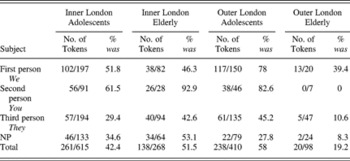
The analysis in this article, therefore, for affirmative contexts, is restricted to the use of nonstandard was in standard were contexts. Table 1 shows the use of this form for the adolescent and elderly groups in both inner London and outer London.
Use of WAS in standard WERE contexts of positive polarity

The first thing to note is the striking difference between the inner London and outer London elderly speakers. Overall, the inner London elderly speakers have 51.5% use of nonstandard was compared with only 19.2% among the outer London elderly speakers, a statistically significant difference (chi square = 36.1806, p < 0.001). As both sets of speakers are White Anglos and are of similar social backgrounds, this seems to suggest that these are regional differences. The elderly speakers in outer London tend to use more standard features generally, perhaps an indication of less contact with London speech patterns. The area was formerly rural in the county of Essex.
There is also a difference between the two sites among the adolescent speakers, but this time the situation is reversed. The use of nonstandard was among the outer London adolescents is considerably higher than among the inner London adolescents, 58% compared with 42.4%, again a statistically significant difference (chi square = 23.9932, p < 0.0001). The figures demonstrate that the outer London adolescents are closer in their use of nonstandard was to the inner London elderly speakers than to the outer London elderly speakers. The reason for this may be twofold. First, the sociohistorical changes again go some way to providing an explanation. Many families were transferred from East London during the postwar slum clearance program to newly built estates in the outer London borough, and this exodus has continued to such an extent that many families living there have their ancestral roots in the East End. The sheer volume of movement would seem to make it inconceivable that the London forms have not exerted an influence on the local variety. Second, leveling to was in positive polarity contexts has been noted as a phenomenon affecting British varieties more generally, including the Fens (Britain, Reference Britain2002). Interestingly, the Fenland area of eastern England parallels the outer London site in that it, too, was a region affected by the post-1945 overspill and New Town developments, and evidence suggests that leveling to was in the Fens has been brought about by diffusion from the south (Britain, Reference Britain2002:33). The use of nonstandard was by the young people in our outer London site, then, conforms to what would be predicted from the general pattern of dialect contact in southern England, which in turn mirrors what has been reported in England generally (Anderwald, Reference Anderwald2001).
In contrast to the outer London adolescents, the inner London adolescents appear to be reversing this trend. There is a significantly different distribution of was/were in positive contexts between both the inner London adolescents and the inner London elderly speakers (chi square = 6.1771, p < 0.025) as well as between the adolescents of inner London and the adolescents of outer London (chi square = 23.9932, p < 0.0001), indicating that the inner London adolescents are neither following patterns of previous generations from the same area nor following patterns of their peers in the southeast. We return to the possible reasons for this when we consider the social factors.
Linguistic constraints
Grammatical subject
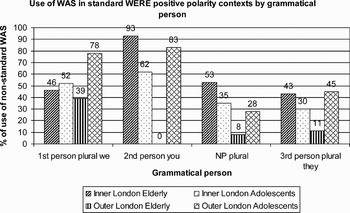
We saw earlier that the research findings to date reveal inconsistencies in the relative effects of the grammatical subject. Figure 2 (based on the figures in Table 1) demonstrates that we do not find a consistent pattern in our data sets, even between adjoining locations.
Distribution of nonstandard was in standard were positive polarity contexts by grammatical person.

In inner London, the pattern of use for nonstandard was with NP plural subjects and third person plural subjects among both the elderly and adolescent speakers conforms to what has been termed the Northern Subject Rule, with nonstandard was more frequent with NP plural subjects than with third person plural pronouns. For the outer London speakers, the pattern of use with these subjects is reversed, conforming instead to the so-called Southern Subject Rule. It is possible that regional differences account for the split, with the outer London speakers maintaining the patterns of the rest of south Essex. However, it should be noted that the differences between the uses of nonstandard was with third person plural pronouns and plural NPs by the two age groups are low in both inner and outer London, and what difference there is, is not statistically significant.
Perhaps the most interesting aspect of this part of the analysis relates to the use of nonstandard was with second person subjects. Figure 2 demonstrates that the highest users are the inner London elderly speakers, with, at 93%, almost categorical rates of nonstandard was, compared with the outer London elderly speakers who do not use nonstandard was at all in this context. Among the adolescents, however, it is the outer London speakers who are the higher users of you was at 83%. Inner London adolescents use you was with a rate of only 61%. The reasons why the outer London adolescents may have increased their overall use of nonstandard was relative to the elderly speakers in this area were already discussed. These figures, together with their high frequencies of nonstandard was in first person plural contexts (78%—the highest rate of all four groups of speakers), confirms that the outer London adolescents are patterning with speakers of other British varieties where high rates of leveling to was in positive contexts have been reported (see, for example, Britain, Reference Britain2002).
Nevertheless, all groups of speakers except the elderly outer Londoners use more nonstandard was with second person subjects, as reported by most other studies that have sufficient tokens for second person subjects to be included separately in the analyses. Furthermore, for all groups, first person plural pronouns also occasion nonstandard was. For the outer London elderly speakers, this is the context where the highest number of forms occur. They occasions comparatively low rates of leveling for all groups of speakers; furthermore, they occurs more frequently than we in the speech of the outer London elderly speakers (47 tokens of they, compared with 20 tokens of we), apparently confirming the view that more frequent forms are more resistant to leveling (Kortmann & Haser, in press). Yet the relative frequencies of we and they for the other groups do not confirm the relevance of frequency, because they are either reversed (for both adolescent groups)—in other words with we occurring more frequently than they—or broadly similar (for the inner London elderly). Thus in our data, the grammatical subject does not have a consistent effect of was/were variation.
Postverbal constructions
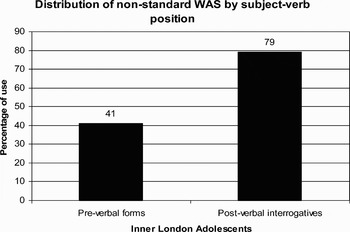
Was/were variation in existential clauses has been analyzed very often, reflecting, we assume, the relatively high rates of existential clauses in spontaneous speech. The frequency with which was occurs with a plural postverbal subject in these clauses has been explained as reflecting the influence of word order or, more generally, processing effects, as we noted earlier, such that a subject that is uttered after the verb or that is separated from the verb does not trigger agreement. One of the problems of analyzing the more general effect of subject-verb order is that most other relevant constructions do not occur with any great frequency in spontaneous speech. Nonetheless, interrogatives arise sufficiently frequently among the inner London adolescent speakers to enable us to report on the use of nonstandard was in these contexts. Figure 3 displays the use of nonstandard was according to whether the subject occurs in preverbal position (in declarative clauses) or in postverbal position in yes/no interrogatives such as (6) or wh-interrogatives such as (7).Footnote 8
(6) Was you with her? Chris C/D/S 19:30
(7) What was you saying? Zack A/Z 2 43:45Footnote 9
Distribution of nonstandard was by subject-verb position.

Figure 3 reveals that subject-verb order is indeed a strong constraint on the use of nonstandard was. In interrogatives where the subject is postverbal, nonstandard was is used 79% of the time. It is not only existential constructions, then, where the thematic subject is in postverbal position, that affect the use of nonstandard was. The pattern of occurrence may well be based on the underlying mechanism that operates for all postverbal subjects; that is, the requirement of a look-ahead mechanism (Chambers, Reference Chambers2006) means that there is less likelihood of subject-verb agreement when the subject is produced after the verb.
Social constraints
Gender
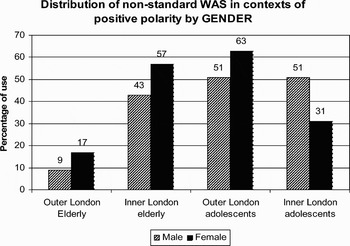
Figure 4 shows differentiation between male and female patterns of use of nonstandard was. For all except the inner London adolescents, female speakers use nonstandard was more frequently than male speakers. However, the gender differences were significant only for the inner London adolescents. Although for this group, the males’ use has increased in comparison to their elderly counterparts, the girls’ use has decreased and they seem to be moving toward the use of standard were. What possible explanation could there be for this pattern of use? Because the populations of the two areas are very different, with the inner London area highly multicultural in nature and the outer London site predominantly white, we turn to ethnicity as a potential social constraint among the inner London adolescents.
Distribution of nonstandard was in standard contexts of positive polarity by gender.

Ethnicity
The self-classifications given by the speakers allowed us to divide them into the six ethnic groups described earlier. Even though these classifications may not be entirely satisfactory, this system allows us to see whether a particular group is leading in, and by implication possibly influencing, the use of nonstandard was.
Figure 5 shows the frequency of use of nonstandard was in positive polarity contexts, for different grammatical subjects, by the different ethnic groups. For the different subject contexts, there is remarkable consistency across the ethnic groups, with the Black Caribbean speakers always the highest users of nonstandard was and the Bangladeshi speakers generally the lowest users. However, we saw in Figure 4 that the male speakers in inner London are higher users of nonstandard was than the females, so what happens when we cross-tabulate ethnicity with gender?
Distribution of nonstandard was in positive polarity contexts by ethnicity.

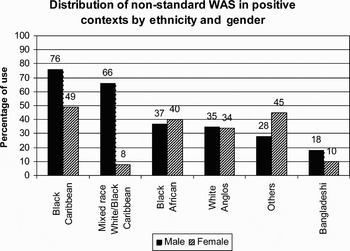
Figure 6 demonstrates that although the Black Caribbean speakers are the highest users of all the male and female speakers, there are clear gender differences within some of the minority ethnic groups. The highest users of nonstandard was in positive contexts are the Black Caribbean boys and the boys of White/Black Caribbean mixed race, and the girls in this latter group are actually the lowest users. This is the expected sociolinguistic gender pattern for nonstandard grammatical forms (Fasold, Reference Fasold1990:92; Labov, Reference Labov1990:210), and we assume that it reflects the high frequency of leveled was forms in these groups, indicating a relatively stable state of variation, albeit possibly a temporary one (Cheshire, Reference Cheshire, Chambers, Trudgill and Schilling-Estes2002:426). The other groups have lower overall frequencies of was leveling, so perhaps the gender pattern has not emerged in their usage. We will see later that the fact that the Black Caribbean males are leading in the use of nonstandard was is part of a general trend among these speakers toward leveled was in both positive and negative contexts, so their total rates of leveled was are very high. If these speakers are leading a change toward use of the was/wasn't pattern in inner London, we could expect the sociolinguistic gender pattern to emerge alongside increased frequencies of both was and wasn't for all speakers in later generations of Londoners.
Distribution of nonstandard was in positive polarity contexts by ethnicity and gender.

Why, though, are the Bangladeshi speakers the lowest users of nonstandard was? A possible explanation is that the Bangladeshis have been a somewhat insular group, with the main wave of immigrants arriving in East London in the late 1970s and throughout the 1980s, at a time when most of the indigenous white working class families had moved out to the suburbs of London or to purpose-built new towns. Pockets of the East End of London very quickly became densely populated with Bangladeshi families who had very little contact with the white community. The women and children were rarely seen in public (see Fox, Reference Fox2007, for more details). The children went to schools that also came to be dominated by Bangladeshi children: some of the secondary schools in East London today have a 99% Bangladeshi student population. These children spoke Sylheti or another community language at home and acquired their English mainly from school rather than from English-speaking peers, so they would have been more influenced by standard English norms associated with the school, unlike immigrants from most of the other minority ethnic groups. In their secondary schools, the mainly Bangladeshi peer groups would have consisted of speakers who had acquired English in a similar way. Although the Bangladeshi adolescents in our sample have become less insular as they got older, and now have ethnically mixed friendship networks, their English seems to reflect their earlier acquisition and socialization.
How do the White Anglo speakers fit into this pattern of use? Growing up in a highly multicultural area, they have been exposed to the speech of many different ethnic groups both through their schools and through their ethnically mixed friendship groups. This appears to have led to a situation where their overall rate of nonstandard was is significantly different both from that of the elderly speakers from the same area and from their peers in outer London.
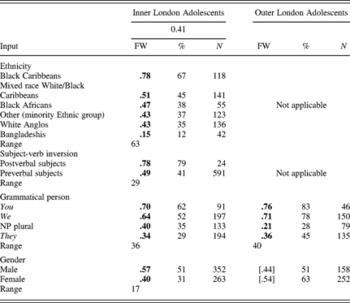
Table 2 shows the results of a multivariate analysis using Goldvarb X (Sankoff, Tagliamonte, & Smith, Reference Sankoff, Tagliamonte and Smith2005) of the constraints discussed on the use of leveled was by the adolescents. Table 2 simply confirms the patterns of variation described and demonstrates that ethnicity is far and away the strongest factor influencing nonstandard was, with a range of 63. Recall that we take ethnicity as a broad indicator of language background, rather than necessarily being a salient social variable in its own right. Gender is significant in inner London but not in outer London (though the female adolescents in outer London use nonstandard was more often than the male adolescents do).
Multivariate analysis of nonstandard was in standard were contexts of positive polarity—a comparison of inner London and outer London adolescents

Figures shown in bold type were selected as statistically significant by the program; factor weights (FW) above 0.5 favor nonstandard was whereas factor weights below 0.5 disfavor nonstandard was.
Negative contexts
Was/were variation in negative contexts is an equally complex phenomenon in London. There is a mixed pattern: first, the expected pattern of leveling to weren't, resulting in the was/weren't system typical of much of Britain today, and second, the leveled was/wasn't system not, so far, thought to be characteristic of urban areas in the southeast. We discuss each of these systems separately.
Weren'tin standard wasn't contexts
Table 3 shows the overall frequencies of weren't in standard wasn't contexts for different grammatical subjects.
Use of nonstandard WEREN'T in standard WASN'T contexts of negative polarity

The figures reveal low overall rates for the elderly speakers: 17% (inner London) and 14% (outer London). Closer inspection of the data revealed that nonstandard weren't occurs only in tags for these speakers,Footnote 10 a finding replicated in many other British dialects (Anderwald, Reference Anderwald2002:178). When tags are removed from the analysis, there is no evidence of leveling to weren't in this age group.
As in many other varieties of British English, leveling to weren't among the adolescents appears to have increased dramatically, with rates of 41% (inner London) and 69% (outer London). Although both areas seem to be following the general trend of leveling to weren't, once more we find a marked difference between the inner and outer London sites, with the outer London speakers allying themselves more with the general dialect pattern found in the southeast and East Anglia (see, for example, Britain, Reference Britain2002; Levey, Reference Levey2007). As in the Fens, leveling to weren't in outer London is higher than leveling to was, but in inner London, the rates are almost identical. In both locations, we find that tags are an important context for leveling to weren't, as in other studies. We report on was/were variation in negative tags later. For now, we simply note that their removal from the data presented in Table 3 does not alter the pattern of weren't usage between the inner and outer London adolescents: for the inner London young people, the rates are then 38%, and for the outer London adolescents, the rates are 61%. The grammatical subject had no significant effect on the use of weren't rather than wasn't (other than in tags, as we will show).
Social constraints on the use of levelled weren't
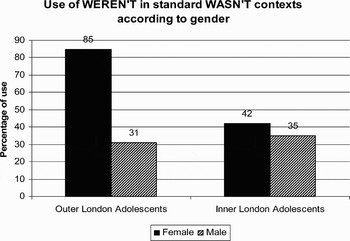
Figure 7 shows the effect of gender on the use of nonstandard weren't.
Distribution of weren't in standard wasn't contexts by gender.

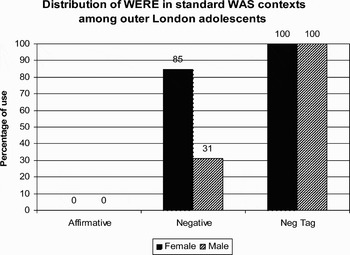
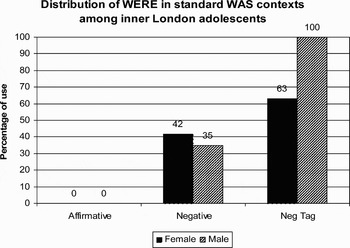
Among the outer London speakers, gender exhibits a significant effect, with females strongly favoring the use of nonstandard weren't (85%, FW: .77). We saw that female speakers in outer London also led in the use of leveled was (albeit with a frequency difference that was not statistically significant). This suggests that females are leading in the spread of the was/weren't system in this area of London. Among the inner London adolescents, females slightly favor the use of nonstandard weren't, with distribution rates at 35% for males and 42% for females, though again the effect is not statistically significant. Once again, however, ethnicity exhibits a significant effect in inner London. Figure 8 shows the effect of ethnicity on the use of nonstandard weren't.
Distribution of weren't in standard wasn't contexts by ethnicity.

Although the Black Caribbean and mixed race White/Black Caribbean speakers had the highest frequencies of levelled was, this time it is the White Anglos who highly favor the use of leveled weren't (62%, FW: .73) and the Black Caribbeans (17%, FW: .25), Black Africans (27%, FW: .38), and mixed race White/Black Caribbeans (26%, FW: .36) strongly disfavor the use of weren't. The distribution rate for the White Anglos in inner London, at 62%, puts them on an equal footing with their outer London peers. The Bangladeshi group, who had the lowest rates of leveled was, do not use nonstandard weren't at all. This would seem to support the argument that perhaps they have been more exposed to prescriptive norms through their early acquisition of English. Yet this is not the whole picture, as we will see when we consider the use of was in negative contexts.
Before that, let us consider the use of nonstandard weren't in tags.
Tags
Previous research suggests that tags have an important role in increasing the tendency toward weren't leveling generally (Anderwald, Reference Anderwald2002:178; Tagliamonte, Reference Tagliamonte1998:179). We have already seen that this was the only context where the elderly speakers in our sample used nonstandard weren't, a pattern also found in Birmingham (Khan, Reference Khan2006). Among the adolescents, the overall frequency differs between the two sites, with nonstandard weren't in negative tags representing 11% (n = 10 of 89) of all instances of nonstandard weren't in inner London but nearly three times as many—30% (n = 38 of 125)—in outer London.
We saw earlier that the female adolescents in this study lead in the overall use of weren't. If we consider tags separately, we once again find differences between the inner London and the outer London adolescents. In inner London, the weren't tags are divided evenly between males and females (though the number of tokens is low-just 10 total). In outer London, however, their use is highly favored by females—of the 38 instances of nonstandard weren't tags, 74% (n = 28) are used by females. The results are presented in Figures 9 and 10, which display graphically the differences between the two sites.
Distribution of were in standard was contexts among outer London adolescents.

Distribution of standard were in standard was contexts among inner London adolescents.

The most striking result displayed in Figure 9 is that nonstandard weren't is categorical in negative tag contexts in the outer London site, with a strong female lead toward nonstandard weren't in other negative contexts. In inner London (Figure 10), the trend is not so strong, although leveling to nonstandard weren't is well underway in tags, with the males using it categorically in this context (though the number of weren't tags is low in inner London).
Interestingly, with just two exceptions, all the tags with nonstandard weren't occur with it as the subject, as in (8). The exceptions were from inner London, where two tags occurred with third person pronoun he, as in (9).
(8) it was June or July weren't it? Danielle C/D 20:15
(9) he was gonna post it back to him weren't he? Mark T/M 2 18:35
Furthermore, in outer London weren't it does not always show agreement with the subject and verb in the previous clause, as examples (10), (11), and (12) illustrate.
(10) and it's about ten questions as well weren't it? Amber J/S/A 28:40
(11) that's a lot of good weren't it? Kelly K/H 41:20
(12) oh yeah cos I stopped bunning weren't it? Kieran K/D 14:30
We do not find examples of this type in inner London where, in any case, tags with past BE are less frequent. Schilling-Estes and Wolfram (Reference Schilling-Estes and Wolfram1994:292, 299–300) argued that weren't has been reanalyzed as a unit that cannot be separated into the component parts from which it derives—the negative clitic and the were form of finite BE. Our analysis suggests that in outer London, the frequent collocation of weren't and it in tags is carrying the process one step further in this context, resulting in an invariant weren't it form that functions as a single unanalyzable unit rather than as a decomposable form showing agreement with the verb and subject of the preceding clause.
Wasn't in standard weren't contexts
In the outer London data, we find just two tokens of nonstandard wasn't from the elderly speakers and one token, in a negative tag, from an adolescent speaker. Tokens in the outer London are too few in number to comment on.
In inner London, standard weren't contexts arise infrequently among our elderly speakers, but of the 20 tokens extracted from the data, 6 (30%) display nonstandard wasn't, as in examples (13) and (14):
(13) no they wasn't about. Edie 42:15
(14) I mean you wasn't to eat sweets. Joan J/J 45:55
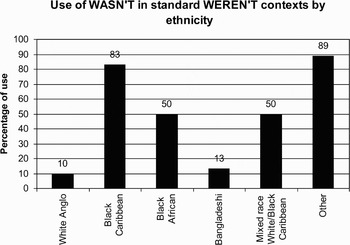
With the tide moving toward leveling to weren't in negative contexts, we might expect to find less use of nonstandard wasn't among the adolescents, but in fact we find that there is 46% (n = 18 of 39) leveling to wasn't in standard weren't contexts. What is more, just as for was in affirmative contexts, nonstandard wasn't in negative contexts is favored by males, with a distribution rate of 57% compared with the rate for females of 33%. A further parallel with the analysis of leveling to was in affirmative contexts is that our Goldvarb analysis revealed that although the numbers of tokens are low when broken down by speaker ethnicity, ethnicity nevertheless again has a statistically significant effect on the probability of nonstandard wasn't. Figure 11 displays the percentage use of nonstandard wasn't by ethnic group.
Distribution of wasn't in standard weren't contexts by ethnicity.

Black Caribbeans are shown to favor the use of nonstandard wasn't (83%, n = 5 of 6, FW: .86) as well as those from the other minority ethnic groups (89%, n = 8 of 9, FW: .91). Those likely to strongly disfavor the use of nonstandard wasn't are the White Anglos (10%, n = 1 of 10, FW: .12) and the Bangladeshis (13%, n = 1 of 8, FW: .15).
To summarize the analysis of past BE in negative contexts, we can say that in outer London there is a strong trend toward weren't leveling, to the extent that weren't it may even be grammaticalizing as an invariant negative tag. Our data suggest that in this location leveling to weren't is led by females, and that females may also be spearheading the leveling to was. Note that this is an unusual gender pattern for a morphosyntactic form that one might expect to be subject to social stigmatization. We saw earlier, however, that weren't may be relatively nonsalient perceptually. Furthermore, in our outer London data, we coded as weren't a small number of pronunciations as [wɒnt]. This suggests that nonstandard weren't may derive at least in part from a phonetic development and subsequent reanalysis of wasn't (see, again, Britain, Reference Britain2002), and this in turn may have made weren't less susceptible to social stigmatization. In inner London, though, there is a mixed pattern, with some divergence between different ethnic groups. In general, the Bangladeshis tend to conform to standard uses of past BE. The White Anglos, as a group, show patterns of use that parallel their outer London peers in that they favor weren't leveling and, therefore, the mixed was/weren't system, but recall that their overall frequencies of weren't leveling are lower than for the outer London adolescents, reflecting their exposure to the two patterns of leveling in negative contexts. The Black Caribbeans, as well as others from some minority ethnic groups, favor the use of leveling to was, not only in affirmative contexts but also in negative contexts. Two of the White Anglo boys also have the was/wasn't pattern (which accounts to some extent for the overall lower rates of weren't leveling among the White Anglos in inner London relative to adolescents in outer London).
Existential constructions
Finally, we turn to our analysis of past BE in existential clauses.
Singular subjects
As with nonexistential clauses, there is no use of were in positive contexts, so that the following sentence is ungrammatical in London English:
(15) * There were a dog in the garden.
Negative constructions with existential there occur infrequently. When they do occur, only wasn't is used with singular subjects by the elderly speakers in both locations, as well as by the adolescent speakers of inner London. The outer London adolescents, on the other hand, display leveling to weren't in negative existential contexts (n = 7 of 9), with weren't there used categorically in negative tags (n = 4). Again, this is in keeping with the generally more advanced pattern of leveling to weren't in the speech of the outer London adolescents.
Plural subjects
As with almost every other study of contemporary English (e.g., Britain, Reference Britain2002; Eisikovits, Reference Eisikovits and Cheshire1991; Tagliamonte, Reference Tagliamonte1998), our study highlights the fact that the use of nonstandard was in plural subject existential constructions is much higher than in other plural subject contexts. Even among the outer London elderly speakers, who have a general tendency toward the use of prescriptively standard forms, the rate of nonagreement in this context is higher than elsewhere, with an overall distribution rate of 25% compared with 19% in nonexistential contexts (see Table 1).
Figure 12 shows that the inner London elderly speakers, who use nonstandard was approximately 50% of the time in other contexts, have a high rate (80%) of nonstandard was usage in existential contexts. These high rates are unexceptional, given the long history of nonagreement in English existentials reported in the literature. The adolescents, though, have still higher rates of nonstandard was in plural subject existentials. Perhaps this partly reflects the general trend toward was leveling in positive contexts. Still, in inner London, nonstandard was in existential contexts is being adopted by speakers from all ethnic groups, unlike nonstandard was in other contexts. This is not surprising because the grammar of existentials is different from that of other clauses. It confirms, in our view, that a processing mechanism underlies was usage in existentials. As argued earlier, there is evidence to suggest that all speakers tend to resort to the default form was in contexts where they produce the subject after the verb.
Distribution of was in positive existential constructions with plural subjects.

Negative contexts with plural subject existentials occurred too infrequently for a detailed analysis. No examples were found in the speech of the outer London elderly speakers, and only two negative tokens were extracted from the inner London elderly speakers (both there wasn't). Three tokens were found in the speech of the inner London adolescents, of which two were nonstandard wasn't and one standard weren't. There were seven tokens extracted from the outer London adolescents, where there was a marginally higher use of weren't (n = 4 of 7). Perhaps this is in keeping with their higher tendency toward weren't leveling in negative contexts generally. Low numbers of tokens prevent us from investigating this aspect of was/were variation further.
DISCUSSION
Standardization, dialect contact, and language contact
We now return to the questions of the relative effects of standardization, dialect contact, and language contact on was/were variation in London. We begin by considering the relative effects of standardization and leveling in our data. Because London is reputed to be a source of innovations, it was possible that we would find high rates of the leveled was/weren't split that previous studies throughout Britain have reported. On the other hand, as the largest urban conurbation in the U.K., it could be expected that the influence of standard English would result in high rates of standard past BE forms.
We have seen that in the outer London site, both leveling to was and leveling to weren't are indeed well underway. As in the Fens (Britain, Reference Britain2002), the changes can be attributed to dialect leveling, which is caused in our outer London location by population movement from inner London areas. In inner London, however, both was leveling and weren't leveling were less in evidence; in fact, here the adolescents use nonstandard was less frequently than the elderly speakers. Furthermore, in negative polarity contexts, we found a mixed pattern of leveling both to weren't in standard was contexts, and to wasn't in standard were contexts. Inner London does not appear to be the source of the was/weren't pattern that is so widespread in other urban centers in the U.K.
We argue that this cannot be attributed to the pressure of standard English. For some adolescent groups, most notably the Bangladeshi speakers, there does seem to be a trend toward the use of standard English past BE forms, as Chambers (Reference Chambers and Kortmann2004) predicted for urban speakers who are in contact with prescriptive norms. Other ethnic groups, though, particularly male Black Caribbean speakers, show a strong trend in the opposite direction to leveled was in both positive and negative polarity contexts. The usage of the White Anglo “heritage London” speakers seems to be affected by both trends. We attribute these differences, in large part, to the linguistic heritage and language histories of the different ethnic groups. Even though all the adolescents spoke English fluently and have English as their dominant language, some acquired it as a second language when they started school. As we argued earlier, the Bangladeshis would have tended to use their school English within their predominantly Bangladeshi peer groups, and this has resulted in their lower use of nonstandard past BE forms in late adolescence. On the other hand, other adolescents with immigrant backgrounds in our sample, who also speak a language other than English at home, were socialized within more ethnically mixed friendship groups. For example, the speakers in our sample with parents from Colombia, Portugal, and North Africa had friends from different ethnic backgrounds whom they had known from an early age; the English they acquired when they began schooling, then, would have been influenced by the English of these friends as well as the English associated with the school. Nevertheless, they may have been more inclined to use both was and wasn't because of their early experience of acquiring English as a second language: leveled was is the default form in interlanguage varieties. In fact, all groups other than the White Anglos have more leveling to wasn't than leveling to weren't, as well as varying degrees of leveled was (even the Bangladeshis, who have no tokens of leveled weren't, have 13% leveled wasn't).
There is a different possible explanation for the preference of the Black Caribbean adolescents for the was/wasn't pattern, which perhaps also applies to the mixed race Caribbean/Anglo adolescents. The linguistic heritage of these speakers may include traces of an ancestral English-based Creole input that would have had was in mesolectal varieties and were only in the more acrolectal varieties. It is noteworthy that a pattern of overall was leveling is reported for other varieties that may have had some Creole ancestral input, such as African American Vernacular English (Labov et al., Reference Labov, Cohen, Robins and Lewis1968; Weldon, Reference Weldon1994:361) and Samaná English in the Dominican Republic (Tagliamonte & Smith, Reference Tagliamonte and Smith1999).
Thus although the overall frequencies of nonstandard past BE forms are lower in inner London than in outer London, it would be simplistic to attribute this merely to an overall influence of standard English norms. In any case, there is no reason to suppose that inner city adolescents would necessarily be influenced by standard English speakers. There is ample evidence in the research literature to show that the most important influence comes from the peer group, and that speakers who are more integrated into peer group friendship networks are more likely to use nonstandard morphosyntactic forms (see, for example, Cheshire, Reference Cheshire1982). It is relevant, therefore, to note that all the adolescents in the inner London sample have multiethnic friendship networks, even if, like the Bangladeshis, their earlier friendship groups were more homogeneous (see Cheshire, Fox, Kerswill, & Torgersen, Reference Cheshire, Fox, Kerswill and Torgersen2008). The patterns we find in inner London relate to the complex mix of variants that are used in the multiethnic friendship groups, which in turn reflect the different language backgrounds and linguistic inheritances of the adolescents. Our division into the different ethnic groups has given some preliminary insight into these factors. It is noteworthy, for example, that the overall figure for was leveling in positive contexts for the Black Caribbean speakers (67%; see Table 2) is higher than for the outer London adolescents (58%; see Table 1).
We assume that the contradictory findings of previous studies of the early stages of dialect contact can be explained in a similar way. The fact that nonstandard was declined in early New Zealand English but increased in early Tristan da Cunha English must be due to patterns of interaction between different groups of early English-speaking settlers and perhaps, in the case of New Zealand, the indigenous inhabitants. In London, just as in New Zealand or Tristan da Cunha, ecological and sociohistorical factors are all implicated, so that even within a single location, such as our inner London research site, these factors produce different patterns of variation.
Internal constraints on variation
Our analysis does not provide strong support for previous claims that there is a consistent constraint hierarchy for the effect of the grammatical subject. We expected to find consistency between at least the elderly inner London speakers and the adolescent speakers in outer London, given their shared sociodemographic origins, but the only clearly shared constraint was the strong effect of second person subjects. The so-called Northern Subject Rule applied to was/were variation for the inner London elderly speakers, and the Southern Subject Rule to was/were variation for the outer London adolescents. Nor do our findings provide support for the idea that changes in the overall frequencies of was leveling result in changes in the effect of plural NPs, as suggested by Britain (Reference Britain2002) and Nevalainen (Reference Nevalainen, Nevalainen, Klemola and Laitinen2006). The highest frequencies of was leveling were found among the outer London adolescents and the inner London elderly speakers, both of whom have rates above 50% (as in Table 1), yet these have opposite patterns of variation with third person plural subjects. The two groups whose frequency of was leveling is below 50% (the inner London adolescents and the outer London elderly speakers) show similarly reverse patterns of variation. In all cases, though, the variation was not statistically significant. Perhaps more data would have allowed significant patterns of variation with grammatical subject to emerge, but there seems to be no linguistic basis for assuming that there might be a consistent hierarchy of grammatical subjects.
Nevertheless, the preference among all four groups of speakers for was with second person subjects does fit with the results of previous studies—or, at least, those studies that take this context into account. Although this is a widespread phenomenon, it is not easy to explain. For present-day varieties of northern English or varieties previously influenced by northern English, a preference for you was can be seen as a retention of an earlier pattern; in Middle English, was is reported as most frequent in second person singular contexts in the north (Forsström, Reference Forsström1948; Mossé, Reference Mossé1952; as reported by Smith & Tagliamonte, Reference Smith and Tagliamonte1998:117). Perhaps, then, southern varieties were influenced by northern you was, alongside other northern morphosyntactic forms (Milroy, Reference Milroy2002:4–5). An alternative—or additional—factor may be the distinction between singular you was and plural you were that is said to have developed in the south in the late sixteenth century, as a consequence of the loss of the number distinction between thou and you (Pyles & Algeo, Reference Pyles and Algeo1993; see also Petyt, Reference Petyt1985). Tagliamonte and Smith (Reference Tagliamonte, Smith and Poplack2000:165) claimed that this southern use was restricted and that, because it correlates with specific writers, it is best seen as a stylistic device. It is likely, however, that its use by certain writers must have reflected spoken usage, and perhaps the legacy is seen in the present-day high rates of you was. Footnote 11
Our analysis has shed light on the apparently universal effect of existential constructions on the use of was. We saw that there was with plural subjects is favored even by the Bangladeshi adolescents who rarely use nonstandard was in other contexts. The fact that was is favored by the inner London adolescents in other contexts with a postverbal subject confirms, in our view, that processing is an important factor, such that agreement is unlikely when speakers utter the verb before the thematic subject. In these cases, the subject does not trigger agreement. Of course, speakers can look ahead to the thematic subject in existential clauses when they want to, as, presumably, do speakers who tend to conform to prescriptive norms, such as the elderly speakers in outer London. For many speakers of present-day English, whether or not they otherwise use prescriptively standard English forms, there was (like present tense there's) is often an invariant form in spontaneous speech, presumably as a result of lexicalization (Cheshire, Reference Cheshire, Bex and Watts1999; Crawford, Reference Crawford2005; Walker, Reference Walker2007). This would perhaps explain why the Bangladeshi adolescents used nonstandard was in positive existential contexts 100% of the time (n = 5) but not in positive nonexistential contexts. Moore (Reference Moore2003) reported a somewhat similar situation in the U.K. town of Bolton, where were leveling exists but where was is nonetheless favored in existential contexts.
Lexicalization may also account for the effect of tags on the use of nonstandard weren't in our data (and in the York corpus; see Tagliamonte, Reference Tagliamonte1998). Tags are interactionally salient features, occurring at points in the discourse when speakers wish to explicitly involve their addressees, for a range of pragmatic reasons (for discussion of some of these, see Holmes, Reference Holmes1995). At these discourse points, the communicative demands on speakers are more pressing than the syntactic demands of marking agreement between the subject and verb in the tag and the subject and verb in the preceding clause. The range of tags used in different varieties of English show a tendency for speakers to use invariant tags for pragmatic purposes. They include, for example, eh in New Zealand (Meyerhoff, Reference Meyerhoff1994), isn't it in Wales (Trudgill & Hannah, Reference Trudgill and Hannah1994:35), is it in Botswana (Arua, Reference Arua2004:260) and many other African English varieties (Schmeid, Reference Schmeid1991:73–74), and, more recently, innit for some young speakers of British English (Andersen, Reference Andersen2001). Stenström and Andersen (Reference Stenström, Andersen, Percy, Meyer and Lancashire1996) identified the use of invariant tag questions in general as a prominent linguistic innovation in the speech of U.K. teenagers (see Tagliamonte, Reference Tagliamonte1998:165). The use of weren't it by the adolescents in outer London fits with this innovative pattern. We have suggested that weren't it is becoming an invariant tag form and that, by extension, this may help accelerate the spread of were in negative polarity contexts more generally. Although we have not analyzed the pragmatic functions of the weren't it tags in outer London, it is possible that such an analysis would help explain the female lead in the use of weren't in tags (and, by analogy, in negative contexts generally).
It is not clear why adolescents in inner London use weren't it tags less frequently than those in outer London. One possibility may relate to their use of innit tags. These are frequent in adolescent speech in both the research sites, but it is noteworthy that in inner London, innit occurs in contexts where standard wasn't or nonstandard weren't would normally be expected, as in examples (16) and (17).
(16) last year I was opening the bowling innit? Chris C/D 10:00
(17) in the car I was drinking tequila innit? Kim K/C/G 14:15
This explanation seems plausible because it would be expected that as innit becomes further lexicalized it would occur in past tense contexts as well as present tense contexts. Subsequent analyses of the uses of innit in both data sets will allow us to explore this possibility.
CONCLUSIONS
The analysis has shown that was/were variation in London is a complex phenomenon, subject to a range of external and internal constraints that can be explained in terms of different patterns of social integration, friendship networks, and founder effects, as well as dialect contact and, indirectly, language contact. We are left with a set of further questions that now need to be researched in our data sets, such as the functions of weren't it and other tags in the adolescent discourse.
There are more general and more challenging questions, too, for future research on variation in multicultural and multilingual cities like London. Traditional definitions of the speech community as a group of speakers who share a set of evaluative norms governing social and stylistic variation (see Labov, Reference Labov1966) are unhelpful in understanding the complex system of variation we have described in inner London. Here some groups of adolescents may even have different grammars—the patterns of was/were variation for the Bangladeshi and the Afro-Caribbean speakers indicate this possibility—yet there is a net effect on language change. The White Anglo adolescents, for example, have different patterns of was/were variation both from the elderly speakers in the same area and from their peers in outer London, which we attribute to their ethnically mixed friendship groups. Conceptualizing the variation in terms of more microlevel communities such as, perhaps, communities of practice, may help explain the inter-relationship between variation and change in a large metropolis like London. Fox (Reference Fox2007) represented a step in this direction. Although we cannot explore them here, factors more often considered in language contact settings are also likely to be useful. We made brief appeal, albeit indirectly, to founder effects (Mufwene, Reference Mufwene2001, Reference Mufwene2002), and we mentioned the potential influence of second language acquisition for adolescents in some ethnic groups. Thomason's (Reference Thomason2001) concept of “negotiation” in communities where there are groups of language learners as well as members of the “host” community is very relevant to the inner London situation, though we have not been able to explore this in the article. Immigration and the resulting urban multilingualism and multiculturalism is typical of the past as well as the present, so analyses of present-day variation and change in a metropolis should inform our understanding of historical language changes as well as ongoing innovation and change. The challenge for future studies of language variation and change in our large multicultural urban cities is how best to incorporate linguistic diversity into a coherent account of language use that takes full account of the different language histories, language ecologies, and social dynamics of urban speakers.