In 2011, a number of urban intellectuals in the Brazilian speech community got involved in a heated nationwide sociolinguistic debate triggered by TV Globo, the principal national television network, on Jornal Nacional, its main nightly news program. This prestigious broadcast has a wide audience and is directed toward a diversified range of adult viewers. The starting point of this resounding clash was a textbook approved by the Ministry of Education and intended for the Educação de Jovens e Adultos (EJA) Education of Youth and Adults program. Titled Por uma vida melhor ‘Towards a Better Life’ (Ramos, Reference Ramos2011), the book is part of the Viver e Aprender ‘Live and Learn’ series, published by Global Editora. It constitutes volume 2 of the series and is intended for the seventh year of the second part of Ensino Fundamental ‘Fundamental Education’, when most students are about 18 years old. It contains a chapter titled Escrever é diferente de falar ‘Writing Is Different from Speaking’ that caused the controversy.
This chapter mentions three constructions without number concord, or with variable concord, and classifies them as natural (Ramos, Reference Ramos2011:14–16) in the norma popular ‘vernacular norm’. The standard forms of the constructions cited in the textbook, with explicit plural marking shown in CAPITAL LETTERS, are given in (1), (2), and (3), while the corresponding nonstandard forms are in (1′), (2′), and (3′), with words lacking explicit marking in bold.
STANDARD constructions with OVERT PLURAL concord:
(1) oS livroS ilustradoS mais interessanteS estÃO emprestadoS
‘The(pl) most interesting(pl) illustrated(pl) books(pl) are(pl) lent(pl) out’
(2) NÓS pegaMOS o peixe
‘We(1st pl) catch (1rd pl) the fish’
(3) oS meninoS pegaM o peixe
‘The(pl) boys(pl) catch(pl) the fish’
Nonstandard constructions cited in the textbook:
(1′) oS livro ilustrado mais interessante estÃO emprestado
‘The(pl) most interesting(sg) illustrated(sg) book(sg) are(pl) lent(sg) out’
(2′) NóS pega o peixe
‘We(1st pl) catches(3rd sg) the fish’
(3′) oS menino pega o peixe
‘The(pl) boy(sg) catches(3rd sg) the fish’
Lack of overt plural agreement in Brazilian Portuguese is subject to social stigma, under strongly negative evaluation, and is generally considered a sign of “not knowing how to speak Portuguese.”Footnote 1 For this reason, many people who participated in the debate, and even some linguists, were of the opinion that the inclusion of such examples was not appropriate for a textbook. Nonetheless, it should be borne in mind that the objective of this particular chapter of the book, intended for young people and adults with little or no schooling, is to talk about the differences between speech and writing, in accord with requirements established in the Plano Nacional do Livro Didático (PNLD) ‘National Plan for School Books’ (cf. Guia dos Livros Didáticos ‘Guide for School Books’, 2010) and, since 1996, in the Parâmetros Curriculares Nacionais (PCNs) ‘Parameters for National Curricula’ (1977).Footnote 2 The official government position is that all forms of discrimination should be discussed in the school system. Furthermore, the committees that evaluate school textbooks are instructed to reject any book that exhibits any form of prejudice.
One of the most salient differences between speech and writing in Brazilian Portuguese is the virtually categorical use in standard writing of explicit plural agreement marking, as in other Romance languages. The students in the Education of Youth and Adults program tend to use less concord in their speech, although it is usually present at least to a certain extent (Naro, Reference Naro1981). As noted in Naro and Scherre (Reference Naro and Scherre2013), examples of prejudiced opinions posted on the Internet in 2011 are: Cartilha aprovada pelo MEC ensina português errado para crianças, para “incluir” os ignorantes Footnote 3 ‘Primer approved by the Department of Education teaches wrong Portuguese to children in order to “include” the ignorant’ or Livro usado pelo MEC ensina aluno a falar errado Footnote 4 ‘book used by the Department of Education teaches students to speak wrong’. At the time, electronic and print media contained hundreds of similar texts expressing explicit prejudice. The whole debate was amply discussed by several Brazilian researchers (see Almeida's website).Footnote 5
OBJECTIVE SOCIOLINGUISTIC CORRELATES TO SUBJECTIVE NEGATIVE EVALUATION
Preliminaries
Education is an important component of social class (Labov, Reference Labov2006:129–136), a concept difficult to measure objectively in many communities. This is especially true of Brazilian society, where social frontiers are not so rigidly delimited (Bortoni-Ricardo, Reference Bortoni-Ricardo2011:21–37), even though in daily reality social differences take their toll in extremely harsh ways. In Brazil, most researchers try to measure social class indirectly by using the number of years a speaker has spent in school. In this paper, we analyze the effect of years of schooling at two points in time in order to evaluate changing patterns of distribution of linguistic forms along class lines.
The results discussed here are taken from two random samples of the Rio de Janeiro community carried out by the Programa de Estudos sobre o Uso da Língua (PEUL)—‘Program for the Study of Language Use’. Significant characteristics of the samples we are using are as follows:
1. The 1980 sample (Oliveira e Silva, Reference Oliveira e Silva, Oliveira e Silva and Scherre1996:67–81): 64 hours recorded at the beginning of the 1980s with 64 speakers, stratified for:
a. gender, feminine and masculine;
b. years of schooling, subdivided into three levels of years of schooling in accord with the Brazilian school system: 1 to 4 years of school, 5 to 8 years of school, 9 to 11 years of school (the sample excludes speakers with more than 11 years of school—university level, as well as illiterate speakers);
c. age, subdivided into four levels: 7 to 14 years, 15 to 25 years, 26 to 49 years, more than 49 years.
2. The 2000 sample (Paiva & Duarte, Reference Paiva, Duarte, Paiva and Duarte2003:24–25): 32 hours recorded in 1999/2000 with 32 speakers from the same community as 1980 sample, with the same characteristics and subdivided in the same way.Footnote 6
The phenomena analyzed in these two samples involve use of variable third-person plural forms similar to those cited in (1′) and (3′) from Ramos (Reference Ramos2011:115). Thus, the examples in (4) through (8) are typical of the real variable data we analyze for subject/verb concord (S/VC), with pronoun, lexical noun phrase, and zero subjects, and internal noun phrase concord (NPC). In the case of S/VC, we examine relationships between the subject noun phrase and its associated verb as well as properties of the subject and verb. Our analysis of NPC is based on structural relationships within the noun phrase and characteristics of its constituent elements. Among the structural aspects considered in both cases is saliency, or the degree of phonic differentiation between the singular and plural forms, as will be discussed in detail when we analyze the three examples in the textbook.
The elements involved in the variable processes are shown in bold in examples (4) through (8). The notations (pl) and (sg) for plural and singular, respectively, are strictly morphological as all of the lexical items examined in our examples are semantically plural, whatever their surface marking may be. In Portuguese, the singular, as well as the absence of formal concord, are realized by the absence of one or more verbal or nominal morphemes.
(4) Os(pl) filhos (pl) abaixo de quinze anos (pl) não pagavam (pl)
‘Children below 15 years old did not pay’
(5) Os(pl) filho (sg) dela pelo menos tá (sg) passando bem
‘At least her children are well’
(6) Essas(pl) novela (sg) que acontece (sg) no Rio e São Paulo geralmente é (sg) levada (sg) para todo lugar do Brasil
‘These soap operas set in Rio and São Paulo are usually broadcast throughout Brazil’
(7) . . . purque elas (pl) dão (pl) os (pl) livros (pl), né?
‘Because they give the books, right?’
(8) Aí eu já cumecei ler os (pl) livro (sg).
‘Then I began to read the books’
In (4), all plural marking, both in the subject noun phrase and in the corresponding verb, is explicit, but neither (5) nor (6) exhibit full plural marking. The fully marked forms corresponding to these two examples would be: os(pl) filhos (pl) dela pelo menos tão (pl) passando bem ‘At least her children are well’ and essas(pl) novelas (pl) que acontecem (pl) no Rio e São Paulo geralmente são (pl) levadas (pl) para todo lugar do Brasil ‘These soap operas set in Rio and São Paulo are usually broadcast throughout Brazil’. The item levada (sg) ‘broadcast’ illustrates variable concord between the adjective or passive participle in the verb phrase and the subject (predicate phrase concord).Footnote 7 In (7), we see explicit concord between the verb dão ‘they give’ (dá [sg] ‘he gives’ / dão [pl] ‘they give’) and the plural subject pronoun elas ‘they’ as well as between the constituents of the direct object noun phrase os(pl) livros (pl) ‘the books’. In (8), we see lack of concord within the noun phrase object os(pl) livro (sg) ‘the books’.
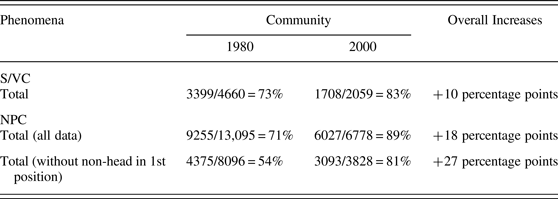
For S/VC, we analyze 4660 tokens from 1980 and 2059 tokens from 2000 with 73% and 83% explicit concord, respectively. For NPC, we analyze 13,095 tokens from 1980 and 6778 tokens from 2000 with 71% and 89% of explicit concord. In terms of frequencies, we see an increase of 10 percentage points in S/VC and 18 percentage points in NPC, as shown in Table 1. Not including near categorical data at the far left of the noun phrase, in first position, which constitute about 40% of the total and exhibit almost 97% explicit plural marking at both points in time, the increase in use of NPC concord is about 27 percentage points.
Overall use of marked forms for S/VC and NPC in 1980 and 2000 for two random samples of the community

Inclusion of the data from the first position has very little impact on the results in terms of relative weights generated by GoldVarb X (Sankoff, Tagliamonte, & Smith, Reference Sankoff, Tagliamonte and Smith2005) for all of the other variables because relative position within the noun phrase, along with salience, is one of the most important variables (Scherre, Reference Scherre1988, Reference Scherre, Groβe and Zimmermann1998, Reference Scherre, Finazzi and Tornaghi2001a). Relative weights, and the differences between them, presented in all of the tables in this paper are derived from data with all nominal elements (including nonhead in initial position).
On the effect of years of schooling on number concord
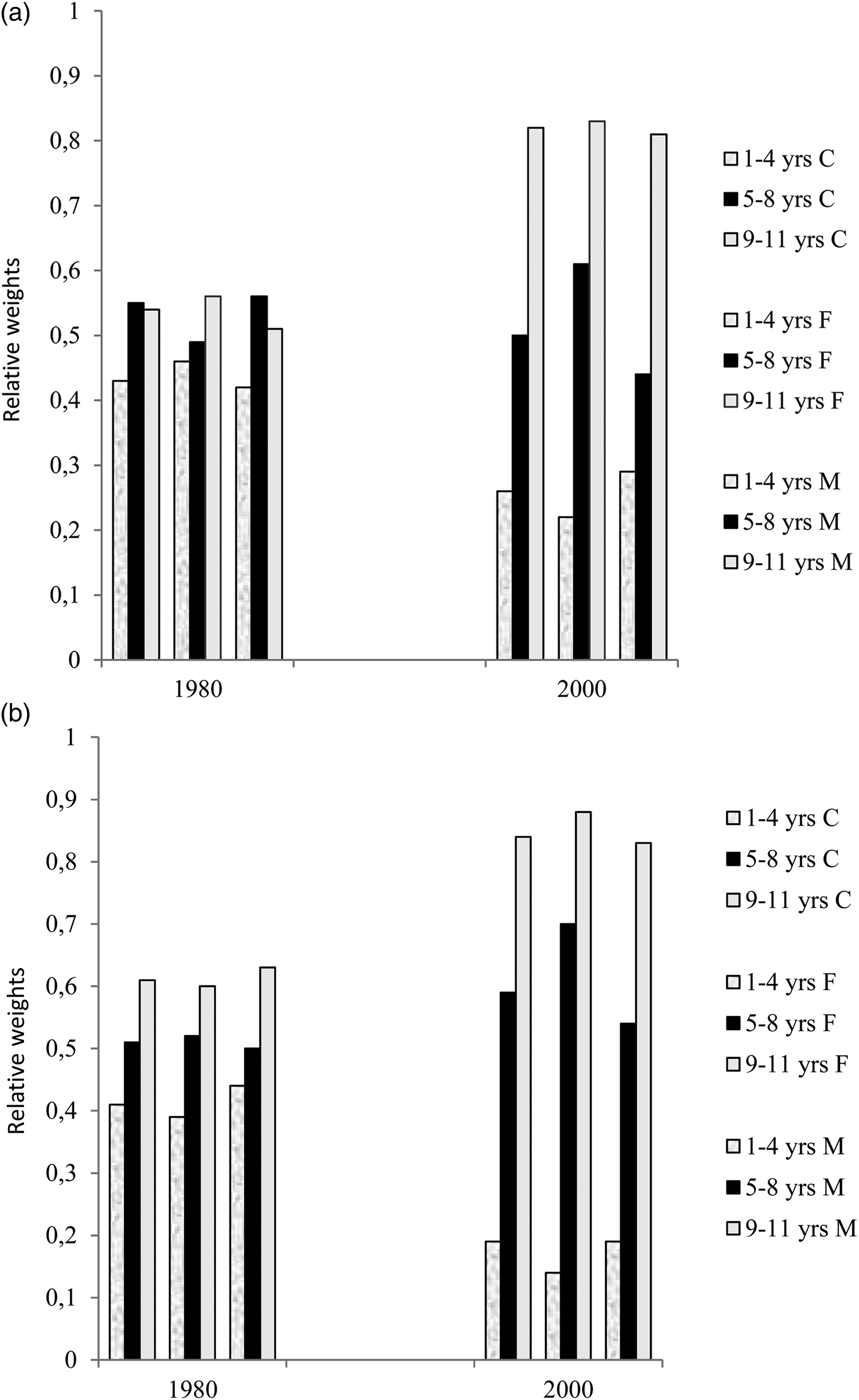
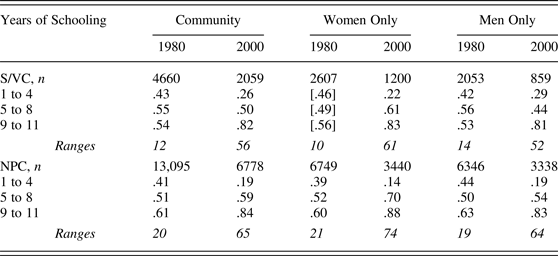
Close examination of relative weights and their corresponding ranges (Poplack & Tagliamonte, Reference Poplack and Taliamonte2001:92–94; Tagliamonte, Reference Tagliamonte2006:242) in our analyses involving all relevant social and structural dimensions reveals that the distance between the effects of each level of education has increased both for the community in general and in subgroups based on sex/gender for both types of concord. Results are presented in Table 2 and Figures 1A and 1B.
Relative weights for years of schooling for S/VC in 1980 and 2000 for two random samples of the community (C) and subsamples according to sex/gender (F and M). (b) Relative weights for years of schooling for NPC in 1980 and 2000 for two random samples of the community (C) and subsamples according to sex/gender (F and M).
Relative weights for years of schooling for S/VC and NPC in 1980 and 2000 for two random samples of the community and subsamples according to sex/gender
Note: Variables included in the analysis (cf. details in Appendix 1): for S/VC—verbal phonic salience, distance and relative position of the subject, discourse level parallelism, clause level parallelism, animacy of the subject, presence/absence of pause between subject and verb, presence/absence of relativizer que, number of elements of the subject (not coded in 2000 sample), years of schooling, sex/gender, age, and contact with media; for NPC—nominal phonic salience, linear and relative position within the noun phrase, phrase level parallelism, following phonological context, years of schooling, sex/gender, age, and contact with media.
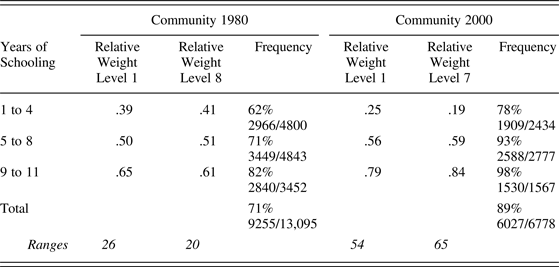
Polarization of the education variable in 1980 was moderate, with relative weights around .40 for the lowest 1 to 4 year level and around .50/.60 for the highest 9 to 11 year level. In 2000, polarization becomes extreme, with relative weights around .20 for the lowest level and around .80 for the highest level, in a clear trend toward an increasingly uneven social distribution of marked forms. For subject/verb agreement, schooling was not selected as a statistically significant variable for women at the earlier point in time.
The increased strength of the effect of schooling over the period between our two samples becomes clear when we compare the ranking of variables in terms of magnitude of internal ranges across variables as well as the order of selection of variables in the step-up procedure of the GoldVarb X program, as we can see in Appendix 1.
For the community as a whole in 1980, in the case of S/VC, the magnitude of the range associated with schooling (12) comes in at 11th place among the ranges associated with 12 selected variables; in 2000, it reaches first place among the ranges of 11 selected variables, exhibiting the greatest range of all variables (at 56). In the case of NPC, in 1980, the range of schooling (20) comes in at sixth place among the ranges associated with eight selected variables; in 2000, it reaches second place among the ranges of seven selected variables (at 65).
Exactly the same phenomenon is found for the subuniverses consisting of male and female speakers.
For S/VC in men in 1980, schooling exhibits a range of 14, the lowest range of all, in a set of eight selected variables. In 2000, on the other hand, schooling shows the highest range (52), in a set of eight selected variables. For NPC among men, range of schooling (19) comes in at fourth place in 1980 in a set of seven selected variables. In 2000, schooling has the second largest range (64), and was also the second variable to be selected in the VARBRUL step-up procedure, in a set of six selected variables.
In the case S/VC for women in 1980, schooling was not even included in a set of 10 variables selected as statistically significant, but in 2000, it was not only selected in first place, it also shows the greatest range (61) in a set of 8 selected variables. For NPC in 1980, schooling exhibits the second smallest range (21), in a set of seven selected variables, but in 2000, schooling exhibits the second highest range (74) of five selected variables. In both samples, schooling is the second variable selected.Footnote 8
Let us examine now the relative strength of magnitude of effect of schooling and media at the two points in time we are investigating.
On the effect of years of schooling and media on number concord
The point we are emphasizing in this paper is the increased strength of the effect of formal schooling on the acquisition of standard forms of concord in the urban center of Rio de Janeiro in the period under study. But contact with media is another source of experience with standard forms, especially relevant for less privileged people who have less contact in real life with formal education or with speakers who have higher average rates of usage of standard forms. In fact, the very first study of concord in Rio was carried out in the early 1970s with functionally illiterate speakers who had little or no contact with either the school system or with standard language speakers in their daily activities (Naro, Reference Naro1981). Yet some of these speakers showed exceptionally high rates of standard concord forms, rivaling or exceeding typical middle-class rates. It was shown in the early work that there was a tight correlation for these illiterate speakers between standard usage and contact with mass media, especially television soap operas. For these people, media seemed to be providing a vicarious path into the life experience of more privileged social classes that was unavailable to them in real life. For them, an indirect connection via media showed itself to be more viable than direct instruction in school as a way to achieve contact with standard forms. It was more open, more accessible for those motivated to penetrate socially prestigious forms of behavior.
In Naro and Scherre (Reference Naro and Scherre1996a:225–228), we presented a detailed analysis of the effect of media in the 1980 sample for three concord phenomena, namely, the two we are dealing with here, as well as a third phenomenon, subject/predicate concord (Eles [pl] estavam [pl] perdidos [pl] ‘They were lost’; Os [pl] vizinho [sg] fica [sg] doido [sg] ‘The neighbors go crazy’). We repeat here our criteria for levels of contact:
Our classification of contact with media is hierarchical. The lowest level consists of speakers who have no appreciable contact with any form of media in their daily lives, while the highest level contains those people who not only interact with and absorb the content of the media but who also adopt a critical attitude toward its message. In the middle levels we distinguish two subclasses: a) people who do have some contact with different forms of the media, but who do not absorb its content and are, for example, unable to recount the plot of a movie or television soap opera or to give a brief summary of the daýs news or the content of a magazine article; b) people who are able to perform such exercises, but who do not adopt a critical attitude. (Naro & Scherre, Reference Naro and Scherre1996a:225–226)
In 1996, we set up four levels of media contact, but because results for the second intermediary level are very similar to those of the highest level, we used only three levels of media contact in the present investigation: (i) no appreciable media contact; (ii) some media contact, but not able to recount or summarize content; (iii) media contact, and able to discuss content, with or without a critical attitude.
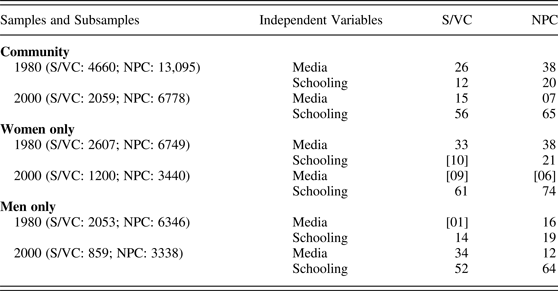
We focus on the range associated with the media variable, as well as with years of education, because both of these competing variables are relevant to the understanding of the flows and counterflows that shaped S/VC and NPC in 1980 and 2000. The ranges associated with these two concord variables are given in Table 3.
Competition among the effects of years of schooling and media on concord in 1980 and 2000 in terms of ranges, for the community and for sex/gender subsamples
Note: Variables included in the analysis (cf. details in Appendix 1): for S/VC—verbal phonic salience, distance and relative position of the subject, discourse level parallelism, clause level parallelism, animacy of the subject, presence/absence of pause between subject and verb, presence/absence of relativizer que, number of elements of the subject (not coded in 2000 sample), years of schooling, sex/gender, age, and contact with media; for NPC—nominal phonic salience, linear and relative position within the noun phrase, phrase level parallelism, following phonological context, years of schooling, sex/gender, age, and contact with media.
Our results show that education is increasing its effectiveness in comparison to media contact. In Table 3, we can see that ranges for schooling increase and those for media decrease for both concord phenomena between 1980 and 2000 for the community as a whole as well as for women. The only exception is for the subgroup of male speakers, for whom schooling assumed a marginally leading role already in the early period, continuing in this leading role with more polarization in the second period. In 2000, media increases in polarization for men, but schooling increases more strongly.
In our previous work (Scherre & Naro, Reference Scherre and Naro2010) on S/VC, we interpret gender differences in changes of the effects of media and schooling as showing that male speakers as a group succeeded in extracting linguistic gains from the school system earlier than female speakers did. Female speakers relied principally on media for standard language contact in the earlier period. However, female speakers later joined in the education-based movement, corresponding to their ascension in the workplace, politics, and other areas formerly more difficult for them to conquer. In the same time frame, both genders shifted away from reliance on the more accessible media-based process toward the school system, with more intensity in the case of women.
On the effect of age and years of education
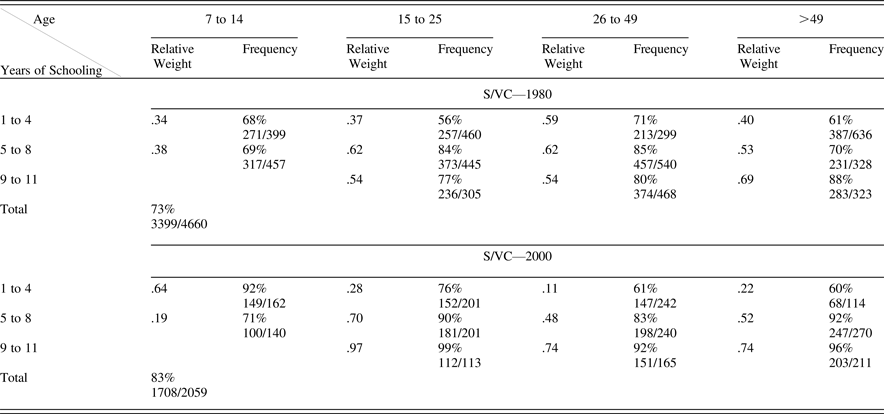
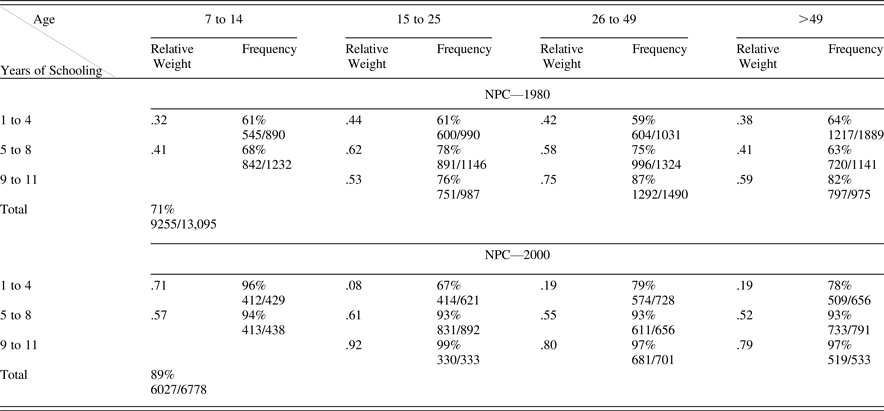
In principle, it is possible that the apparent effect of schooling might be a simple reflection of age in the sense that younger speakers in 2000 might have higher rates of concord simply by virtue of being on the forefront of change rather than because of an increased effect of education. Note, however, that our analysis takes into account age and schooling on an equal footing. Both variables are statistically significant in our two samples and are included in all calculations. In Naro and Scherre (Reference Naro and Scherre2013), we turned our attention specifically to the age variable and found that there is indeed an ongoing process of change, affecting mainly speakers from the youngest age groups in 2000, part of a more highly literate community, whereas speakers from the 1980 sample reveal stable age grading or even change in the opposite direction, loss of concord. In order to show that the exacerbation of the education variable in 2000 does not merely reflect the effect of the ongoing flow of change in the next generation, we present results for the effect of education in all of our age groups in Tables 4A and 4B.
Frequencies and relative weights for years of schooling and age for S/VC in 1980 and 2000: Two random samples of the community
Note: Variables included in the analysis (cf. details in Appendix 1): verbal phonic salience, distance and relative position of the subject, discourse level parallelism, clause level parallelism, animacy of the subject, presence/absence of pause between subject and verb, presence/absence of relativizer que, number of elements of the subject (not coded in 2000 sample), years of schooling, sex/gender, age, and contact with media.
Frequencies and relative weights for years of schooling and age for NPC in 1980 and 2000: Two random samples of the community
Note: Variables included in the analysis (cf. details in Appendix 1): nominal phonic salience, linear and relative position within the noun phrase, phrase level parallelism, following phonological context, years of schooling, sex/gender, age, and contact with media.
The results in Tables 4A and 4B reveal a much greater degree of differentiation of the effect of education in 2000 than in 1980 on S/VC in the 15 to 25, 26 to 49, and greater than 49 years age groups. Nonetheless, in 2000, we find incongruous results in the 7 to 14 year group for the 5 to 8 level of education, who exhibit a lower level of concord than the 1 to 4 level of education for the same age group. We are not able to account for this exceptional behavior, although we note that the sample has only two speakers in each of these cells. The fact of the matter is that the youngest speaker in our sample, a girl of nine years, is included in the 1 to 4 years of schooling group.Footnote 9 As can also be seen in Table 4B, the results for both types of concord, including the behavior of the youngest group, are parallel.
LINGUISTIC ANALYSIS OF THE THREE EXAMPLES IN THE TEXT BOOK
To better understand the examples of variable number concord considered natural in the textbook, let us examine them in some detail taking into consideration the present state of knowledge on the use of language in the real world. The facts of variable concord usage in Rio de Janeiro have been studied in detail on both the structural and social levels and the results have been presented in various publications (e.g., Guy, Reference Guy1981a, Reference Guy, Sankoff and Cedergren1981b; Naro, Reference Naro1981; Naro & Scherre, Reference Naro and Scherre1996a, Reference Naro and Scherre1996b, Reference Naro, Scherre and McWhorter2000; Scherre, Reference Scherre, Sankoff and Cedergren1981, Reference Scherre, Finazzi and Tornaghi2001a, Reference Scherre2001b; Scherre & Naro, Reference Scherre and Naro1991, Reference Scherre and Naro1992, Reference Scherre and Naro1998, Reference Scherre and Naro2010).Footnote 10 Recall that the principal structural linguistic variables analyzed for NPC are linear and relative position within the noun phrase, phrase level parallelism, and nominal phonic salience; for third-person S/VC, the principal structural variables are distance and relative position of the subject, clause level and discourse level parallelism, and verbal phonic salience (Naro & Scherre, Reference Naro and Scherre1996b; Scherre, Reference Scherre, Groβe and Zimmermann1998, Reference Scherre, Finazzi and Tornaghi2001a, Reference Scherre2001b; Scherre & Naro, Reference Scherre and Naro1991, Reference Scherre and Naro1992, Reference Scherre and Naro1998, Reference Scherre and Naro2010); and for first-person plural concord, tense opposition and phonic salience (Naro, Görski, & Fernandes, Reference Naro, Görski and Fernandes1999).
In example (1′), (oS livro ilustrado mais interessante estÃO emprestado ‘the [pl] most interesting [sg] illustrated [sg] book [sg] are [pl] lent [sg] out’), Ramos (Reference Ramos2011) cited a construction with partial agreement.
In subject position, there is a noun phrase explicitly marked for plural only in its left-most constituent, the definite article oS ‘the (pl)’. We know that nonhead constituents in this position in the noun phrase exhibit near categorical explicit marking, with 97% (4880 of 4999) in the 1980 sample and 99% (2934 of 2950) in the 2000 sample.
The remaining nominal elements livro ilustrado interessante ‘interesting (sg) illustrated (sg) books (sg)’ have no explicit plural mark and are all low saliency on the singular/plural opposition hierarchy because they are stressed on the penultimate syllable and form the plural by simple addition of the -s morpheme to the unstressed final syllable, without any further changes in the root or anywhere else. This type of lexical item normally shows a lower rate of marking than do lexical items that are higher on the saliency hierarchy, involving either additional segments in the plural (mês/mesES ‘month/months’ mulher/mulherES ‘woman/women’) or changes in stressed segments (avião/aviÕES ‘plane/planes’). The lower saliency items, which involve only the addition of the -s morpheme in an unstressed syllable, exhibit 46% marking in 1980 (2960 of 6416) and 76% in 2000 (2216 of 2910); the higher saliency items show 80% marking (978 of 1215) in 1980 and 94% in 2000 (538 of 572).
The verb phrase in example (1′), for its part, is presented by the author of the textbook with explicit plural marking (está/estÃO ‘is/are’). It is high on the verbal phonic saliency hierarchy because the plural is located in a stressed syllable and requires diphthongization.Footnote 11 Note that low phonic saliency verbs such as come/comeM ‘eats/eat’, which often show only nasalization of the unstressed vowel in the plural form, exhibited 44% explicit plural marking (202 of 463) in 1980 and 71% (149 of 210) in 2000, whereas high saliency verbs of the type está/estÃO ‘is/are’; vai/vÃO ‘go/go’; or dá/dÃO ‘give/give’ had 82% plural marking (590 of 721) in 1980 and 89% (287 of 322) in 2000.
As we have already mentioned, the low saliency predicate emprestado ‘lent(sg) out’ in example (1′) also has no explicit plural mark. This is indeed a very natural structure in Brazilian Portuguese, even in the speech of educated people. Nonetheless, the cultured norm would require the fully marked plural form as in example (1). Scherre and Naro (Reference Scherre and Naro1998:515) presented results for this particular phenomenon based on the 1980 data showing that even speakers with 9 to 11 years of schooling exhibit a frequency of 83% of agreement with more salient predicates (24 of 29) and 65% with less salient predicates (116 of 179), corresponding to relative weights of .85 and .43, respectively.
In example (2′), Ramos (Reference Ramos2011) noted a case of a first-person plural subject NÓS‘we’ in a structure without plural agreement. This is also a natural occurrence in popular speech, especially in rural or so-called rurban areas (a place that has a relatively rural setting on the outskirts of an urban environment; see Bortoni-Ricardo, Reference Bortoni-Ricardo1985). Naro, Görski, and Fernandes (Reference Naro, Görski and Fernandes1999) presented evidence that in rurban speech in Rio de Janeiro the standard form NÓS pegaMOS o peixe ‘we catch or caught the fish’ tends to be avoided in present-tense environments, whereas in the standard language it occurs in both the present and the preterit. They recall that in Brazilian Portuguese the present and the preterit tenses are neutralized in the first-person plural for regular verbs in all three conjugations. Avoiding the agreeing form in the present tense tends to decrease ambiguity in real communication.
In example (3′), Ramos (Reference Ramos2011) noted another construction without agreement. This is beyond doubt a natural structure in the speech of most speakers of Brazilian Portuguese in unmonitored conditions. The constituents that could be explicitly marked for plural in more formal speech (the noun menino ‘boy’ and the verb pega ‘catches’) are low saliency for the singular/plural opposition. Furthermore, subjects without a plural mark on the last element tend to trigger unmarked plural verbs (Scherre & Naro, Reference Scherre and Naro1991:29).
The fact is that Ramos (Reference Ramos2011) showed great linguistic sensitivity and presented structures that are genuinely natural in Brazilian Portuguese and indisputably representative of differences between speech and writing, in accordance with her explicitly stated aim as well as with official government policy for school textbooks. Nonetheless, her examples triggered livid reactions from the most diverse users on the Internet and other sectors of the community. More highly educated levels of the urban speech community, as well as the wider community in general, and especially the printed and televised media, view lack of concord as complete boorishness, along the same lines as spitting on the floor or burping at the table (for further discussion, see Bagno, Reference Bagno2000, Reference Bagno2011; Leite, Reference Leite2008; Scherre, Reference Scherre2008, Reference Scherre2013).
There can be no doubt that, among the examples cited, (2′) is the most strongly rejected by standard speakers in urban and rurban areas. But there can also be no doubt that, beside the above-mentioned neutralization between present and preterit forms in regular verbs, other factors enter into the picture, revealing the intricate interplay of variation in this phenomenon. One such factor is the strong disfavoring of first plural subject/verb concord in the imperfect tense (Bortoni-Ricardo, Reference Bortoni-Ricardo1985:213, Reference Bortoni-Ricardo2011:237; Mattos, Reference Mattos2013:87; Prandi, Reference Prandi2005; Rubio, Reference Rubio2012:271; Tamanine, Reference Tamanine2010:135-136; Zilles, Maya, & Silva, Reference Zilles, Maya and Silva2000:207–208), in which the nonagreeing form with penultimate stress, that is, NÓS pegava ‘we used to catch’ (3rd sg), is favored over the agreeing form with antepenultimate stress, that is, NÓS pegávaMOS ‘we used to catch’ (1st pl). This is in accordance with a general phonological tendency in spoken Brazilian Portuguese to avoid antepenultimate stress by eliminating a syllable. Typical examples are arve for árvore ‘tree’ and abobra for abóbora ‘squash’. Thus, lack of agreement with nós ‘we’ extends much further than the present-tense forms mentioned in the text.
We turn now to objective sociolinguistic correlates to subjective negative evaluation. Specifically, we draw conclusions from the increasingly extreme polarization over time of GoldVarb X relative weights associated with “years of schooling” in our trend study Rio de Janeiro speech from 1980 and 2000.
REFLECTIONS
Our results show that education has a much stronger statistical effect on use of standard concord in Rio de Janeiro in 2000 than it did in 1980. However, the meaning of our results in the real world is in need of closer examination. What we have studied is the strength of the correlation between level of education and use of standard forms, not its cause.
Future studies will no doubt examine in detail the role of grammatical tradition and community norm in variation and change in Brazil along lines similar to the work of Poplack and her colleagues on Canadian French (Poplack, forthcoming; Poplack & Dion, Reference Poplack and Dion2009; Poplack, Lealess, & Dion, Reference Poplack, Lealess and Dion2013). In Brazil, there is ample evidence that variable phenomena that are not associated with literacy, social class, or formal style thoroughly penetrate everyday speech without regard to their traditional grammatical acceptability and can even slip unceremoniously into monitored writing. The imperative is a good and well-documented example of an area where prescriptive grammar has almost no consequences in practice (Scherre, Reference Scherre2008:115–148). Scherre (Reference Scherre2012) presented a real-time study of the imperative in speech and written language used in published comic books. Yacovenco, Tesch, Scherre, and Berbert (Reference Yacovenco, Tesch, Scherre and Berbert2014) examined several macro areas of strongly embedded variation with varying degrees of social stigmatization: the use of future tense, imperative, first-person plural (nós or a gente for ‘we’), and anaphoric direct objects. The authors conclude that linguistic variants that are not stigmatized by the speech community are virtually immune to the dictates of prescriptive grammar in Brazil, despite being actively taught in the school system. An example is the construction prescriptive grammar considers the correct way to express the future: the synthetic form viajarei ‘I will travel’ or the present form viajo ‘I travel’, as opposed to the periphrastic form vou viajar ‘I am going to travel’. In practice, the form not even noted explicitly by prescriptive grammar, that is, vou viajar ‘I am going to travel’, is usually not noticed by speakers and is predominant in spoken language (Oliveira, Reference Oliveira2006, Reference Oliveira2013; Poplack & Malvar, Reference Poplack and Malvar2007). In the case of anaphoric direct object pronouns, as Yacovenco et al. (Reference Yacovenco, Tesch, Scherre and Berbert2014) noted, the clitic pronoun is preferred in prescriptive grammar, as opposed to the stressed pronoun. The nonpreferred structure is highly salient and even slightly stigmatized, but despite these circumstances, the use of the preferred clitic structure is practically extinct in speech. In fact, in both speech and writing, the use of the stigmatized stressed form ele(s)/ela(s) exhibits low frequency. An alternative unstigmatized empty category, with low perceptibility, is often used instead in speech. In writing, according to Yacovenco et al. (Reference Yacovenco, Tesch, Scherre and Berbert2014), repetition of the noun phrase, a mechanism usually not noticed by language users and not mentioned in prescriptive grammar, is vigorously infiltrating monitored styles. In (9a to 9d), we present some intuitive examples of clitic pronoun, stressed pronoun, empty category, and repetition of noun phrase, in bold, respectively:
(9) a. Aquele garoto ali? Eu não o convidei.
‘That boy over there? I didn't invite him’
b. Aquele garoto ali? Eu não convidei ele.
‘That boy over there? I didn't invite him’
c. Aquele garoto ali? Eu não convideiØ.
‘That boy over there? I didn't invite him’
d. Aquele garoto ali? Eu não convidei aquele garoto.
‘That boy over there? I didn't invite that boy’
One possible interpretation of our results is that education has been improving and becoming more effective over the years and school has therefore become more successful in transmitting standard nominal and verbal concord, both of which are subject to strong stigmatization. Students now appear to benefit more from their years spent at school than they used to in relation to the use of standard concord. But at least in principle another interpretation is possible: perhaps students who are unable to absorb the standard are now more effectively excluded or expelled from the school system as the years progress, creating the illusion that schools are working more efficiently (Oliveira e Silva & Paiva, Reference Oliveira e Silva, Paiva, Oliveira e Silva and Scherre1996:337–356). We feel that this second line of interpretation is unlikely because enrollment at school is increasing, not decreasing, and with the creation, during the governorship of Leonel Brizola in the 1980s and 1990s, of new full-time schools known as Centros Integrados de Educação Pública ‘Integrated Centers for Public Education’, students can now spend more time each day at school.
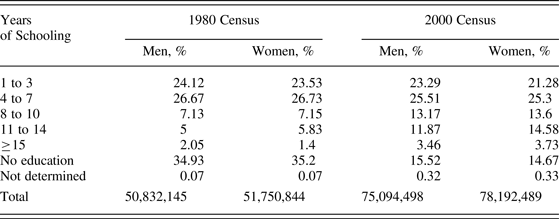
In the present paper we have shown that the statistical effect of schooling is stronger around 2000 than it was approximately 20 years prior, especially in our group with 9 to 11 years of schooling. Comparison of data from the Census of 1980 with that of 2000 provides some interesting insight in this respect. According to Table 5, there was a significant expansion of the percentage of the overall population with 8 to 10 and 11 to 14 years of schooling between these two points in time. The group with 1 to 3 years of school remained stable at more or less 20% of the population, whereas that with 4 to 7 years remained at the 25% level. The group with 8 to 10 years of school, however, increased from 7% to 13% and that with 11 to 14 years from 5% to 14%. These two census groups cover the 9 to 11 years of schooling group of the present paper. These are exactly the groups where our 2000 sample shows the greatest increase in use of concord.
Percentage of population five years of age or older, according to level of schooling attained in 1980 and 2000
However this may be, the fact is that formal education is creating more profound linguistic divisions in urban society than before. Speakers with higher levels of education now appropriate a greater proportion of the linguistic standard than those with less education, creating a widening gap between citizens who have less versus more schooling.
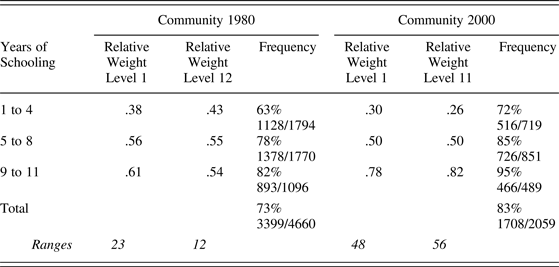
It is important to emphasize that in terms of raw frequencies, the community of speakers recorded in 2000 as a whole increased its level of use of concord compared to the community in 1980. This is true on the level of the individual as well, at least for PEUL's panel of 16 speakers first recorded in 1980 and recontacted in 2000 (Naro & Scherre, Reference Naro, Scherre, Paiva and Duarte2003; forthcoming). As can be seen in Tables 6 and 7, differences between effects of schooling in the two samples appear greater in terms of relative weights than in terms of raw frequencies. Relative weights are more realistic (Sankoff, Reference Sankoff, Ammon, Dittmar and Mattheir1988b; Tagliamonte, Reference Tagliamonte2006:140–157) because they are calculated as differences in relation to the mean (or input), correcting for the simultaneous effect of other relevant variables, including both structural variables and other social variables, such as sex/gender, age, and media.
Frequencies and relative weights for years of schooling for S/VC in 1980 and 2000: Two random samples of the community
Note: Variables included in the analysis (cf. details in Appendix 1): verbal phonic salience, distance and relative position of the subject, discourse level parallelism, clause level parallelism, animacy of the subject, presence/absence of pause between subject and verb, number of elements of the subject (not coded in 2000 sample), presence/absence of relativizer que, years of schooling, sex/gender, age, contact with media.
Frequencies and relative weights for years of schooling for NPC in 1980 and 2000: Two random samples of the community
Note: Variables included in the analysis (cf. details in Appendix 1): nominal phonic salience, linear and relative position within the noun phrase, phrase level parallelism, following phonological context, years of schooling, sex/gender, age, contact with media.
These variables show partially different behavior in the two samples, as we have already seen. Even so, in the very first level of the relative weight calculation, when variables are considered simply in relation to the mean itself, without taking into account the simultaneous effect of other variables, the ranges of the 2000 sample are much larger than those of the 1980 sample for both phenomena, S/VC and NPC.
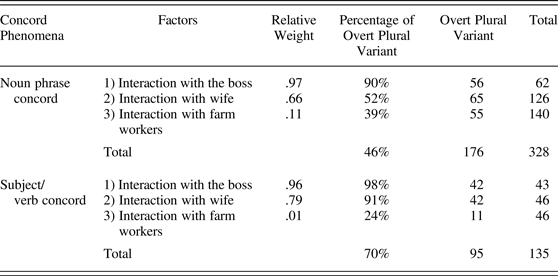
The data analyzed in the previous tables here from the 1980 and 2000 samples of Rio de Janeiro are drawn from the entire interview, without distinguishing between careful speech and casual speech in the terminology of Labov (Reference Labov1975:94–96). However, it is important to bear in mind that the behavior of concord in true casual speech has not yet been studied to a great extent in Brazilian Portuguese. Even so, Pereira and Scherre (Reference Pereira and Scherre1995) showed that under more natural conditions a speaker with more than 11 years of schooling may vary between 24% and 98% for S/VC and 46% to 90% for NPC, depending on interlocutor (Pereira & Scherre, Reference Pereira and Scherre1995), as shown in Table 8.
Effect of interactional environment on two number concord phenomena: Casual speech only of a speaker with more than 11 years of schooling
These results come from a study of a male upper-middle-class speaker who holds a master's degree in animal artificial insemination and is a farm administrator. He was recorded in three different interactional situations: talking to the farm workers, talking to his wife, and talking to his boss. Even though there are relatively few tokens, the GoldVarb X relative weights were selected as statistically significant and the regularity of the results is impressive.Footnote 12
CONCLUSION
Returning to our main point, we wish to emphasize once again that Ramos (Reference Ramos2011) showed great linguistic sensitivity and presented structures that are genuinely natural in Brazilian Portuguese. Nonetheless, her examples triggered outraged reactions. Anyone with a wider or more democratic view of the phenomenon of language, even if a layperson, would find it hard to even take seriously such irate proclamations. We recognize nonetheless that even people who are fully sensitive to the harmful and unjust nature of other forms of inequality treat derision of lower-class language diversity as natural.
The strong reactions of life-long teachers of “how to speak and write correctly” can be considered only natural, given the effort expended over the years, but for the sake of the common good, it is urgent that linguistic prejudice be publicly debated in the same way as society now discusses and sets legal consequences for prejudice with respect to sexual orientation, ethnicity, gender, religion, poverty, and lower-class professions.
People in the days of slavery, for example, could hardly have imagined that today descendants of these same slaves would possess the right to recourse to the courts against anyone who exhibits racial or other prejudice against them.
Despite these signs of social and legal progress in Brazil, there was negative reaction to the textbook mentioned at the outset even on the legal level. Nascimento (Reference Nascimento2012:10), a journalist writing in Revista Via Legal, published by the Federal Department of Justice, reported that “the supposed errors caused a polemic and motivated a group of lawyers to bring a court case with the aim of blocking further use of the book.”Footnote 13 For reasons independent of the actual linguistic structures cited in the textbook, according to Nascimento (Reference Nascimento2012:10), at the end of 2011, a judge on the 13th Federal Circuit of São Paulo “decided in a preliminary injunction that interruption of the use of the textbook would not be a solution since the students were about to complete the school year.”Footnote 14 Nonetheless, as a consequence of all the bad publicity surrounding the public controversy, the book became highly stigmatized and is now hardly ever adopted by Educação de Jovens e Adultos (EJA) ‘Education of Youth and Adult’ staff.Footnote 15
In closing, we cite and adopt as our own the words of David Sankoff (Reference Sankoff and Newmeyer1988a:144):
It is in engaging in this conflict of ideologies that linguistics may have a socially emancipatory role. Notions that the technical scientific aspects of linguistics may themselves be instrumentally relevant specifically to the workers class or minorities are fundamentally mistaken . . . the importance contribution of linguistics . . . resides less in its direct effect on particular material or institutional outcomes, and more in its role through national public discussion in awakening and changing consciousness in the issue.
APPENDIX 1
The tables present a listing of all variables that we coded and analyzed by means of the VARBRUL program. We note those variables that were selected as statistically significant and their order in terms of range for S/VC and NPC, in data from 1980 and 2000, for the community as a whole as well as for subgroups of women and men.
Ranking of variables for S/VC by range in the community as a whole
Ranking of variables for NPC by range in the community as a whole
Ranking of variables for S/VC by range: Men only
Ranking of variables for NPC by range: Men only
Ranking of variables for S/VC by range: Women only
Ranking of variables for NPC by range: Women only