INTRODUCTION
The social construction of racial and ethnic categorization varies around the world, but we seldom observe the ways in which categories are constructed and imposed, because most people live all of their life within one system of categorization (with perhaps brief exposure to other systems while traveling, for example). Immigrants, however, do not; they experience a shift from one country’s racialized system to another. Do they adopt the new racialized categories in their newly adopted country, or do they resist them? Do they apply them in ways that are consistent with how they are perceived in the new context, or choose labels that are more consistent with how they were classified in their context of origin? How are the social cues of the new context employed?
This study uses the large, nationally representative sample of the 2003 New Immigrant Survey (NIS) to test the relationship between skin tone and racial/ethnic self-identification shortly after gaining lawful permanent resident status in the United States, controlling for the country of origin. Immigrants to the United States are assigned by outside observers to panethnic/racial categories that often make little sense in an international context or are actively resisted by new arrivals to the U.S. (e.g. Waters Reference Waters1994). This study tests how skin color constrains that resistance: do individuals with dark skin color, for example, refuse to choose a racial identification more often in the United States? Do they choose an African American (or Asian or LatinxFootnote 1) identity at a high rate compared to others from the same national origin but with lighter skin tone? How is the skin tone of recent immigrants associated with the construction of their racial identities in the U.S. context, and are these patterns explained by other social disparities that are also associated with skin tone?
In the United States, skin tone is the most important social cue used to assign immigrants and native-born alike to racial categories (Feliciano Reference Feliciano2016; Stepanova and Strube, Reference Stepanova and Strube2012), as well as a source of inequality within and between groups (Hersch Reference Hersch2008a; Monk Reference Monk2015; Rondilla and Spickard, Reference Rondilla and Spickard2007; Rosenblum et al., Reference Rosenblum, Darity, Harris and Hamilton2016). Because observers in the United States focus so much on skin color, the color of new immigrants’ skin likely has immediate and far-reaching effects on how they are treated (e.g. Joseph Reference Joseph2015). Recent immigrants to the United States are an ideal test case for questions about how skin color shapes experiences with racialization for people throughout the United States because immigrants have recently transitioned to the U.S. racial schema (Roth Reference Roth2012), which uses both national origin and skin color in its logic.
RACIAL IDENTIFICATION ACROSS NATIONAL BORDERS
Immigrants’ ability to assert a racial or ethnic identification that is validated by others is constrained by U.S. residents’ ideas about the “legitimate” range of skin colors within an ethnic or racial category (Waters Reference Waters2001). Migrants to the United States often note that the U.S. is particularly preoccupied with categorizing people into racial groups, with strict boundaries around who is permitted to be in each category (and especially rigid and exclusionary boundaries around Whiteness). For example, in Tiffany D. Joseph’s (Reference Joseph2015) study of Brazilians who had migrated to the United States and then returned to Brazil, she explains that migrants from Brazil frequently comment on the pervasiveness of racial categorization in the U.S. and the rejection of “White” classification for most light-skinned Brazilians. She found that less than half of the migrants who thought of themselves as White (branco) in Brazil self-identified as White when in the United States.
As Wendy D. Roth (Reference Roth2012) describes in her book on migrants to the mainland U.S. from Puerto Rico and the Dominican Republic, different parts of the world have different “racial schema” that govern how people think about race and classify people racially. You do not necessarily have to live in a place to know its schema; racial schema travel through social networks, migration streams, and transnational media. Roth (Reference Roth2012) found that even people who had never left the Dominican Republic or Puerto Rico knew how race is described in the mainland United States, and are familiar with terms like “Hispanic/Latino” that are not used there. Those who cross national boundaries often hold multiple schema in their heads at once, understanding themselves as part of multiple social contexts that perceive and classify them in different ways, creating a “transnational racial optic” in which their own racial identity is shaped by an understanding of multiple, sometimes contradictory, racial categorization schema (Joseph Reference Joseph2015).
Immigrants to the United States do not, of course, simply accept the racial categories imposed on them by observers. Self-identification choices are part of a complex process based on these multiple racial schema and an individual’s beliefs about their own social position and the meaning of the categories. For example, less than a third of the Brazilian migrants who identified as White in the U.S. in Joseph’s (Reference Joseph2015) study thought that other Americans saw them as White (but all of the migrants who identified as Black in the U.S. thought that others saw them as Black). Faced with the ubiquity of racial categorization in the United States, immigrants are pressured to claim some racial self-identification, and there is social pressure to identify in ways that make sense to residents born in the U.S. (Waters Reference Waters2001), but resistance can take many forms. Some may claim identities that are not validated by observers, and others may refuse to claim any of the standard U.S. racial categories. For example, Latinx immigrants who are more integrated into the United States are more likely to reject all of the racial categories in the U.S. in favor of asserting an “other race” identification than those who are less integrated (Frank et al., Reference Frank, Akresh and Lu2010), suggesting resistance might even grow as immigrants gain more understanding of the U.S. racial schema.
SKIN TONE AND RACIAL AND ETHNIC IDENTIFICATION AMONG IMMIGRANTS
Skin tone may limit the forms of resistance that are available to immigrants who wish to choose a racial identification that does not match the category assigned by American observers. Dark-skinned migrants may find it exhausting to try to claim a White identity in the United States, for example, because of the likelihood of facing constant skepticism or questions. We know the most about the relationship between skin tone and the racial identification patterns of Latinx immigrants. Many Latinx respondents, especially those with low socioeconomic status (SES), who identified as White (even those with light skin) reported that others did not classify them as White (Vargas Reference Vargas2015). This might encourage other forms of resistance like claiming a national identity instead (Waters Reference Waters2001). Using a large representative dataset of the largest Latinx groups in 1989 (including both immigrants and later generations), Tanya Golash-Boza (Reference Golash-Boza2006) found that lighter skin tone predicted identifying as “American” while darker skin was associated with choosing a national-origin identification. Those with darker skin were significantly less likely to identify as White (Golash-Boza and Darity, Reference Golash-Boza and Darity2008).
Light skin is not necessarily tied to racial identification in a straightforward manner, however. For example, Julie A. Dowling (Reference Dowling2014) found that identification as “White” among Texas immigrant and native-born Latinxs was most related to racial ideology and feelings of belonging rather than skin tone. Evidence from national surveys supports this. While Latinx respondents with very dark skin are less likely to identify as White than those with very light skin, about one-third of Latinx respondents in 1989 who had “very dark” skin according to their interviewer still identified as White, and about 15% with “very light” skin did not identify as White (Golash-Boza and Darity, Reference Golash-Boza and Darity2008). No respondents with light skin identified as Black. For many respondents in a later 2002 survey, identifying as “Hispanic/Latino” replaced both White and Black as popular options (Golash-Boza and Darity, Reference Golash-Boza and Darity2008), showing that this panethnic category is becoming a popular option for racial identification for the group. This may encourage more respondents to identify as “other race” instead of choosing either a White or Black label.
Identification preferences likely vary by country of origin, because of differences in racial schema and because of the ways that region of origin is connected to U.S. categories (Benson Reference Benson2006). Some countries in Latin America and the Caribbean have a close link between skin tone and racial identification, while others do not, so immigrants from different areas likely conceptualize racial categories differently (Cornell and Hartmann, Reference Cornell and Hartmann2007; Telles and Paschel, Reference Telles and Paschel2014). Some countries emphasize a connection between nationality and racial identity (Itzigsohn and Dore-Cabral, Reference Itzigsohn and Dore-Cabral2000). Studies of immigrants who are racialized as Black have found that while they know that others see them as Black (Itzigsohn et al., Reference Itzigsohn, Giorguli and Vazquez2005; Waters Reference Waters1994), their responses to that classification vary by national origin and amount of time in the United States (Benson Reference Benson2006). Their “transnational racial optic” (Joseph Reference Joseph2015), then, will vary by country of origin and other personal experiences such as experience with higher education.
Most U.S. surveys consider identifying as Hispanic or Latinx to be an “ethnic” rather than a racial identification and measure ethnic and racial identification in separate questions. Data from the 1990s on migrants and immigrants showed that skin color was not connected to identification as Hispanic or Latina/o; Puerto Rican migrants were equally likely to claim a panethnic Latinx identity across the skin color spectrum, and the labels chosen by Mexican-origin children did not vary by skin color (Derlan et al., Reference Derlan, Umaña-Taylor, Updegraff and Jahromi2017; Landale and Oropesa, Reference Landale and Oropesa2002). Many studies have shown that large numbers of Latinx respondents choose “other race” when asked to identify their “racial” category and write in a panethnic (Hispanic/Latinx) or national origin response (e.g. Dowling Reference Dowling2014; Rodríguez Reference Rodríguez2000; Stokes-Brown Reference Stokes-Brown2012). This is especially true among immigrants, those with darker skin color, and those who are proficient in English (Frank et al., Reference Frank, Akresh and Lu2010; Golash-Boza and Darity, Reference Golash-Boza and Darity2008; Stokes-Brown Reference Stokes-Brown2012). Latinx panethnic identification might be avoided by some immigrant groups, however, the way that Helen Marrow (Reference Marrow2003) found that children of Brazilian immigrants described themselves as non-Hispanic to avoid connections to a stigmatized group.
HOW DOES SKIN TONE RELATE TO INEQUALITY IN THE UNITED STATES?
Skin tone might also relate to identification patterns because of its relationships with socioeconomic status, which is also connected to self-identification and categorization by observers. There are well-documented relationships between skin tone and a variety of outcomes for African Americans and Latinxs (e.g. Frank et al., Reference Frank, Akresh and Lu2010; Gomez Reference Gomez2000; Monk Reference Monk2014, Reference Monk2015). Blacks and Latinxs are perceived and treated more negatively by both in-group and out-group members if they have darker skin tones, which has been linked to health, occupational, and socioeconomic disadvantages (Maddox Reference Maddox2004; Monk Reference Monk2015; Visser Reference Visser2017; Wassink et al., Reference Wassink, Perreira and Harris2017). Research in the 1990s showed that lighter skin tone was associated with advantages in educational and socioeconomic status for Blacks, controlling for class origins and individual characteristics (Keith and Herring, Reference Keith and Herring1991), as well as a greater likelihood of marrying a spouse with higher socioeconomic status (Hughes and Hertel, Reference Hughes and Hertel1990). Later work expanded on these ideas, showing that skin tone is related to advantage in many different sectors of society, although with occasionally mixed or gendered results. For example, Whites find darker-skinned Blacks more threatening than lighter-skinned Blacks in a crime news story (Dixon and Maddox, Reference Dixon and Maddox2005) and evaluate them more negatively in experimental settings simulating hiring decisions (Wade et al., Reference Wade, Romano and Blue2004) or asking them to describe stereotypes of dark- and light-skinned Blacks (Maddox and Gray, Reference Maddox and Gray2002). Black men also describe darker-skinned Black women as less physically attractive than lighter-skinned Black women (Hill Reference Hill2002). Black women with lighter skin have higher educational attainment, earnings, and spouses with higher status than darker-skinned peers (Hunter Reference Hunter2002).Footnote 2 Darker skin is also associated with poorer mental and physical health, and is a strong predictor of perceived discrimination (Monk Reference Monk2015).
The evidence for Latinxs shows a similar pattern, with discrimination and negative effects of darker skin tone for multiple Latinx groups, both for individuals born in the United States (Montalvo and Codina, Reference Montalvo and Codina2001) and for Latinx immigrants (Rosenblum et al., Reference Rosenblum, Darity, Harris and Hamilton2016; Telzer and Vazquez Garcia, Reference Telzer and Garcia2009). Mexican Americans with dark skin, for example, have lower earnings than those with light skin (Mason Reference Mason2004). Latinas with lighter skin have higher earnings and educational attainment (Hunter Reference Hunter2002) and Latinos with lighter skin earn higher wages than Latinos with darker skin living in the Northeast United States (Gomez Reference Gomez2000). Darker-skinned Latinx respondents are more likely to face stereotypes such as being perceived as less intelligent (Hannon Reference Hannon2014). For Latinxs who immigrated from Mexico, however, depression and self-esteem were not related to skin tone in the way they were for native-born Mexican Americans, suggesting that this relationship with skin tone is a U.S. phenomenon from which immigrants might be at least temporarily shielded (Montalvo and Codina, Reference Montalvo and Codina2001).
There is less evidence testing the relationship between skin color and stratification outcomes for other groups, although several recent theoretical arguments have made the case that the importance of skin tone is growing for every group (e.g. Bonilla-Silva Reference Bonilla-Silva2004). For example, interviews with Asian immigrants and Asian Americans in California show a preference for light skin, which is associated with beauty and higher social class, especially among the immigrant generation (Rondilla and Spickard, Reference Rondilla and Spickard2007). Asian Americans with light skin also experience educational advantages over their darker-skinned peers, even when comparing sibling pairs (Ryabov Reference Ryabov2016). We would expect skin tone differentials to be important for both South Asian and East Asian groups, since both areas of the world have norms giving preference to light skin (Keith and Monroe, Reference Keith and Monroe2016; Utley and Darity, Reference Utley and Darity2016). Dark-skinned Asian immigrants in the United States have lower wealth, suggesting the unequal treatment has important implications for Asian immigrants in the United States (Painter et al., Reference Painter, Holmes and Bateman2016).
Research specific to recent immigrants (including some using the same data that I use here) shows that those with lighter skin tone earn significantly higher wages than those with darker skin tone, controlling for an impressive array of job market variables, including education, family background, English ability, occupation in the country of origin, racial identification, and country of birth (Frank et al., Reference Frank, Akresh and Lu2010; Hersch Reference Hersch2008a, Reference Hersch and Hallb).Footnote 3 This suggests that even relative newcomers to the United States are affected by the skin color stratification system, although this relationship is strong only for immigrants from Latin America (Rosenblum et al., Reference Rosenblum, Darity, Harris and Hamilton2016). As Joni Hersch (Reference Hersch and Hall2008b) points out, differences in wages by skin tone before controls are introduced may also originate in skin tone bias in the immigrants’ countries of origin, although controlling for measures of human and social capital achieved before migration should account for these effects. The robust relationship between skin tone and socioeconomic status means that studies of the connection between skin tone and identification must also account for these differences in socioeconomic status.
CONTRIBUTIONS OF THIS PROJECT
In this study, I advance the growing literature on the relationship between skin tone and the racialization experiences of immigrants to the United States. Using nationally-representative data collected at an important time in an immigrant’s life course (the period when they are becoming a lawful permanent resident), I investigate ideas that have been advanced largely based on racial identification data specific to a particular location. I test the relationship between skin tone and self-identification with standard U.S. racial and ethnic categories, to determine whether adoption of (or resistance to) these categories is tied to skin color. Although dark skin has a consistently negative relationship with socioeconomic outcomes, it also is positively tied to perceptions of “authenticity” or “legitimacy” for people of color; that is, dark-skinned people are less likely to need to defend their membership in the group (Hunter Reference Hunter2007; Mason Reference Mason2004). This might mean that light-skinned immigrants have a different pattern of identification with the standard U.S. racial categories than dark-skinned immigrants with similar backgrounds.
DATA AND METHODS
The 2003 New Immigrant Survey is a nationally representative sample of immigrants who have recently become lawful permanent residents. The adult sample includes respondents who are 18 years of age or older, interviewed in their language of choice during 2003 or 2004. The sample is stratified by type of visa (family visas, employment-based visas, etc.), and sample weights are used throughout the analysis to adjust for the oversampling of small visa categories. 8573 adults completed interviews.Footnote 4
Dependent Variables
The dependent variables for this analysis are the ethnic and racial self-identification that the respondent chose when asked questions that mirror the questions found on federal data collection efforts such as the Census:
Surveys of American citizens typically ask questions on ethnicity and race. How would you answer these questions?
Do you consider yourself to be Hispanic or Latino? [yes, no, don’t know, refused]
What race do you consider yourself to be? Select one or more of the following. [American Indian or Alaska Native, Asian, Black, Negro or African American, Native Hawaiian or Other Pacific Islander, White, don’t know, refused] Footnote 5
In all, 8517 respondents answered the Latinx identification question, twenty-seven said they did not know, and twenty-seven refused to answer. Far more respondents rejected the standard racial identification categories in the second question; 7898 adults chose a single racial identification, eighty-two chose a multiracial identification, 462 responded that they did not know, and 129 refused to answer the race question. For this study, nonresponse is as important as valid responses, because nonresponse is a method of rejecting the racial categories used in the United States. Undoubtedly more people resist the racial identification question than the Latinx ethnic identification question in part because only the latter includes a “no” option, allowing respondents to reject the category without having to refuse the question.
Skin Tone
An important strength of these data is that interviewers were trained to consistently code their observations of the respondents’ skin color, the key independent variable for this analysis. Interviewers were trained using a chart that displayed ten pictures of hands with a range of skin tones, and were told to code respondents on a scale from 0 (“the lightest possible skin color (such as that of an albino)”) to 10 (“the darkest possible skin color”) (see Massey and Martin, Reference Massey and Martin2003). Interviewers were told to “become familiar with the scale” and use it without ever showing it to a respondent. There is no perfect measure of subjective observed skin tone, since every measure is susceptible to perception biases.Footnote 6 Nonetheless, unlike many survey measures, the NIS measure involved interviewer training and supplied the interviewers with photographs to encourage greater consistency in the interviewers’ minds about what each number represented, in an attempt to create more reliability across raters. Hersch’s (Reference Hersch2008a) discussion of the measure and its validation shows that this measure correlates well with “objective” measures of light reflection used in other studies. The skin tone measure was only collected for interviews conducted in person (not phone interviews). Even interviews conducted partly over the phone are sometimes missing the skin tone measure (Hersch Reference Hersch2008a), so missing data from this key measure reduces my sample to N=4652.Footnote 7 Models with and without an adjustment for clustering by interviewer (adjusting the standard errors upward to account for the fact that different respondents coded by the same interviewer are not completely independent observations) show the same significant relationships shown here; adjusted models available on request.
Control Variables
The models include controls for age, gender, highest educational degree attained,Footnote 8 how many years of schooling were completed in the United States, the respondent’s report about how well they speak English, and the country of nationality.Footnote 9 Collinearity tests confirm that these controls have low enough correlations to be included in the same model. Country of nationality was grouped into categories for the public release of the data, and I recoded it into geographic regions, except for the countries with the largest numbers of immigrants. The categories are: Latin America,Footnote 10 the Caribbean,Footnote 11 sub-Saharan Africa,Footnote 12 India, East Asia,Footnote 13 Mexico, Europe,Footnote 14 Middle East,Footnote 15 and other (e.g. Canada and Oceania). I used country of birth for thirty respondents with missing nationality. As we would expect, national origin is highly related to identification choices; a descriptive crosstabulation of racial identification by national origin is shown in the Appendix table.
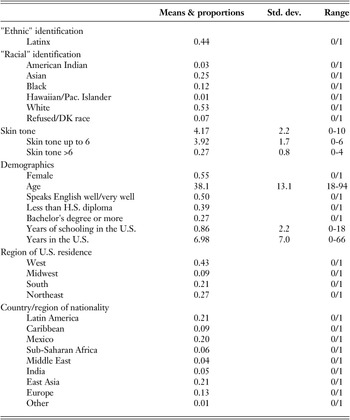
The descriptive statistics for all of the variables can be found in Table 1. After using listwise deletion to remove missing data,Footnote 16 the final sample was N=4179.
Weighted descriptive statistics, N=4,179

Source: NIS 2003
RESULTS
Descriptive Patterns of Ethnic and Racial Identification
Figure 1 shows the distribution of skin tone by self-identified racial and ethnic categories. (These categories are not mutually exclusive; respondents could choose more than one.) This figure shows that most racial and ethnic identifications are associated with a wide range of skin tone, but those with the very darkest skin tones have extremely high likelihoods of identifying as Black, and those with the lightest skin tones are very unlikely to identify as Black. For all other groups, including the group that refuses to answer the racial identification question, there is a wide range of skin tones from the lightest to around a value of seven, on a ten-point scale.
Skin Tone by Racial/Ethnic Identification.

This figure suggests that even among recent immigrants, the very darkest skin tones are so broadly interpreted as Black in the United States that individuals with the darkest skin color are largely unanimous about their (Black) identification. Refusal to answer the race question is most common in the middle of the scale, on the other hand. Based on this, I speculate that individuals who have mid-range skin tones either receive the least clear external signals about what their racial and ethnic identification is “supposed” to be (leading to confusion about the available choices), are most uncomfortable answering the question, or they are most likely to both want to reject these racialized categories and feel able to do so.
Predicting Hispanic/Latina/o Identification
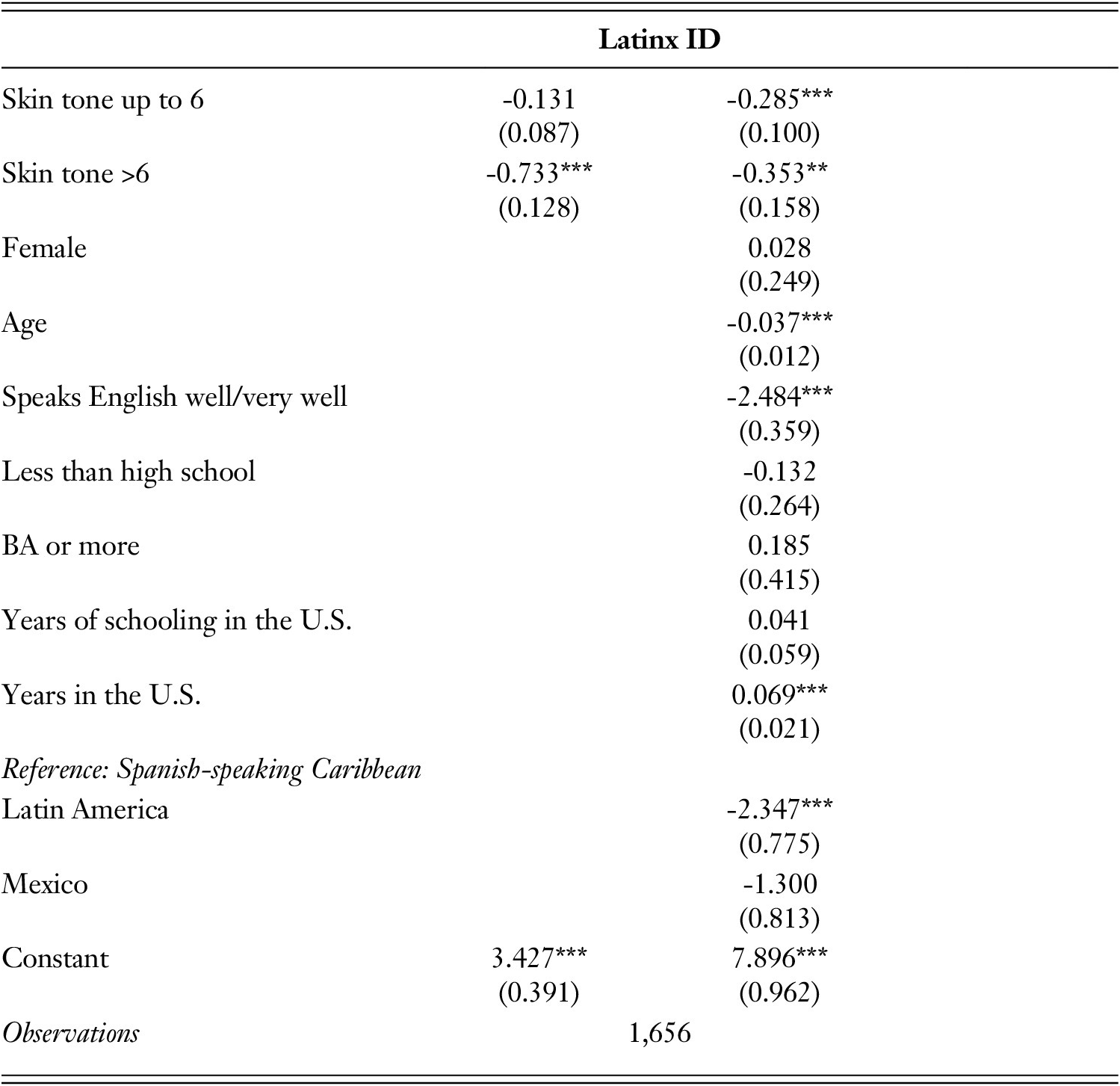
Table 2 tests how skin tone and demographic characteristics relate to the probability that an immigrant identifies as Hispanic or Latinx. This analysis is limited to immigrants from Central or South America or the Spanish-speaking Caribbean,Footnote 17 since they are the groups most likely to be seen as “eligible” to claim a Hispanic/Latinx identity. The relationship between ethnic identification and skin tone is nonlinear; tests of different modeling strategies suggested a spline with a knot at 6 (on the skin tone scale from 0-10) gave the best fit, and more knots does not change the nature of the relationship shown here. Thus, the first variable in the model is interpreted as the effect of a one-unit increase in the darkness of the respondent’s skin tone for those individuals with skin tones between 0 and 6, and the second variable is the effect of a one-unit increase for those with a skin tone greater than 6.Footnote 18
Logit models of Latinx ethnic identification for Latin American and Spanish-speaking Caribbean origin respondents

Standard errors in parentheses
*** p<0.01, ** p<0.05, * p<0.1
Note: All models control for region of residence.
Model includes all respondents who report their national origin from a country in Central America, a country in South America, Cuba, or the Dominican Republic.
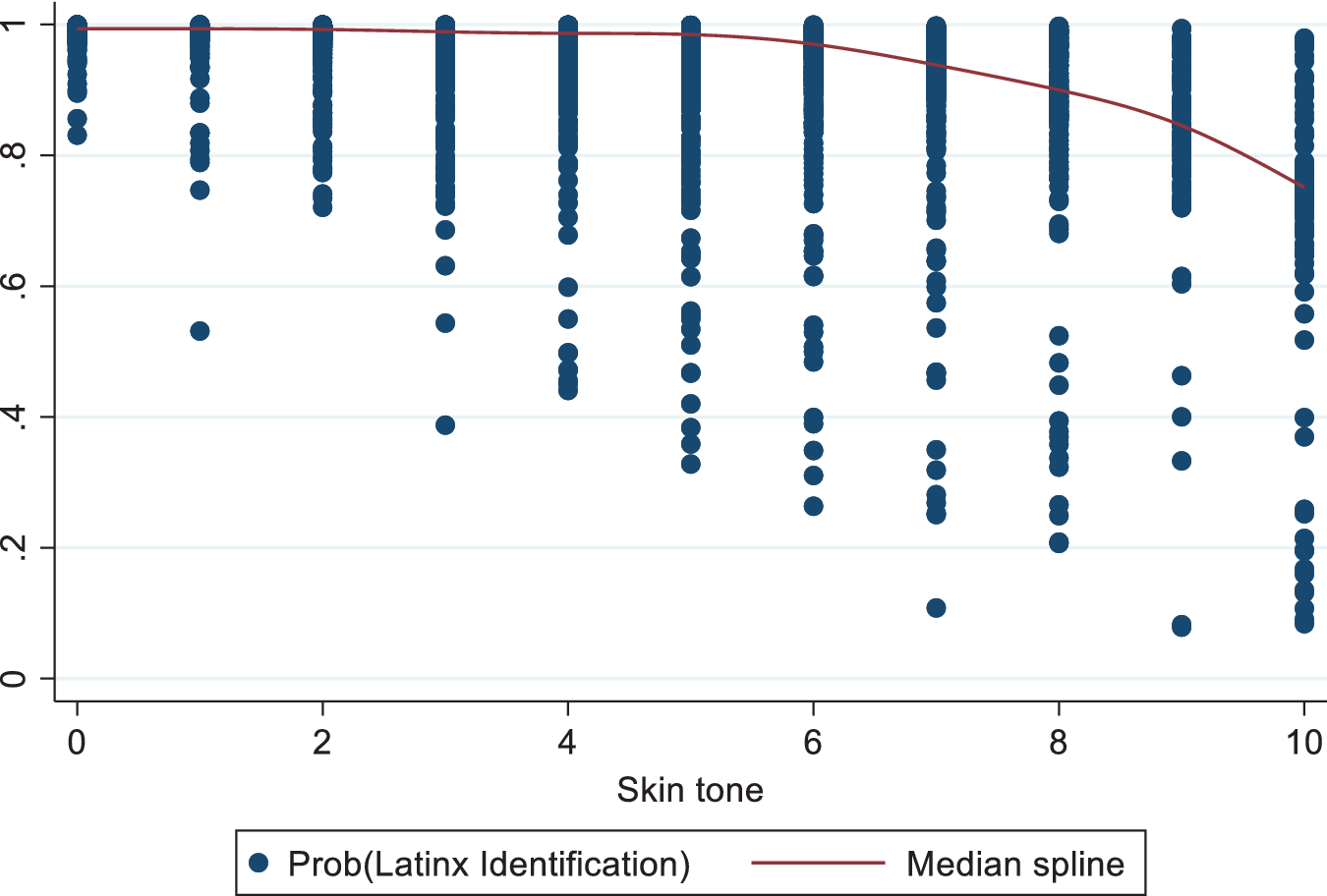
Those with darker skin are significantly less likely to identify as Hispanic or Latinx, as are older respondents, those who report speaking English well, and those who have spent less time in the United States. Compared to those from the Spanish-speaking Caribbean or Mexico, respondents from other parts of Latin America were less likely to identify as Hispanic/Latinx. Overall rates of Latinx identification were very high among this group (over 97% for many of the countries), as we would expect, but rates of Latinx identification drop significantly for the darkest-skinned respondents from Latin America and the Spanish-speaking Caribbean. The average predicted probability of Latinx identification for respondents with the lightest skin tone was 0.98, and it drops to 0.71 for the darkest-skinned respondents.
Predicting Racial Identification
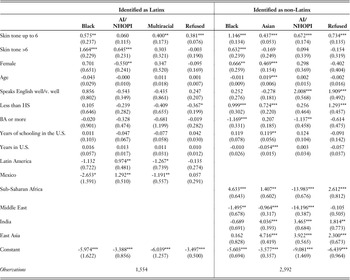
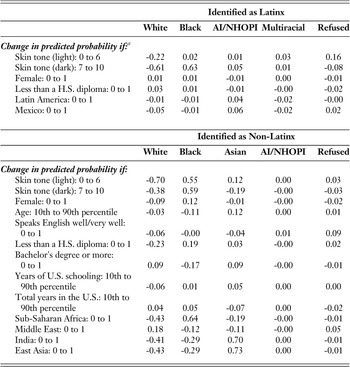
Next, I tested how skin tone relates to which racial category immigrants select, using multinomial logit models and the full sample of immigrants from all regions of the world (Table 3). These models are split by whether or not the respondent also identified as Latinx, a question that helps to shape our interpretation of the “race” responses (e.g., identifying as Latinx and White is not the same as identifying as non-Latinx and White). Those who identify as Latinx are more likely to refuse to answer the racial identification question (as we would expect, given that these respondents have already provided an “ethnic” identification that is often racialized in the U.S. context), and those who choose both a Latinx identification and a racial identification are expressing two identities that should be considered in tandem rather than separately. There is little change in the skin tone coefficients after controls are introduced (models without controls available on request), suggesting that the relationship between skin tone and identification is largely independent of variation in individual characteristics or region of origin. Because it is difficult to directly interpret the many coefficients from multinomial logit models, Table 4 shows predicted probabilities calculated from the models.
Multinomial logit regression of racial identification on race question (reference=White)

Standard errors in parentheses
*** p<0.01, ** p<0.05, * p<0.1
Note: All models control for region of residence. Dropped Asian for the Latinx sample and multiracial for the non-Latinx sample due to small sample size.
Predicted probabilities of changes in racial identification, by Latinx identification

a Independent variables are not included here if there were no significant relationships for that model.
Latinx-identified Respondents
Controlling for other characteristics, recent immigrants who identify as Latinx are 22% less likely to also identify as White if their skin tone is near the middle of the skin tone range (6) instead of the lightest category, and 16% more likely to refuse to answer. If instead we compare the change from the middle of the range to the darkest category, both White identification and refusal are significantly less common (61% and 8% respectively) and Black identification is much more likely (63%). The effects of other individual characteristics are relatively small for immigrants who identify as Latinx. Even large shifts in ability with the English language and years of education result in changes in the predicted probabilities of 5% or smaller. Comparing countries of origin also results in very small differences in the predicted probability of selecting a given identification category, with the largest difference being a 6% increase in the probability of identifying as American Indian/Native American for those from Mexico.
From these results, we see that linear increases in skin tone for those at the lighter (0-6) end of the skin tone scale are associated with greater likelihood of refusing to answer the race question at all, while linear increases in skin tone for the darker end (7-10) of the scale are not. This means that Latinx respondents in the middle of the skin tone distribution are most likely to reject all of the standard U.S. racial categories. Descriptively (before controls), there are higher rates of refusal (over 10%) for immigrants from many of the Latin American countries (e.g. Colombia, El Salvador, Guatemala, Mexico, Peru, and the Dominican Republic). This is consistent with research that points out the great inconsistency between U.S. and Latin American ideas about the meaning and social construction of race (e.g. Montalvo and Codina, Reference Montalvo and Codina2001; Rodríguez Reference Rodríguez2000), leading many immigrants from Latin American to reject the U.S. standard racial options.
Non-Latinx Respondents
For immigrants who identify as non-Latinx, a shift from the lightest skin tone category to near the middle of the range is associated with a 70% drop in identification as White, a corresponding 55% increase in the likelihood of identifying as Black and a 12% increase in identifying as Asian, even controlling for country of origin. Darker skin tone for the darker end of the skin tone scale is associated with much lower probabilities of identifying as White (38%) and Asian (19%) and much greater probability of identifying as Black (59%). For non-Latinx, then, changes in skin tone are not associated nearly as dramatically with changes in the probability of refusing to racially identify, and instead are associated with greater shifts in Asian identification along with the choice of White or Black. Changes in refusal are statistically significant for this group, but the impact remains small in absolute terms because non-Latinx immigrants are significantly less likely to refuse to answer than Latinx immigrants.
A large increase in age (from the tenth to the ninetieth percentile) is also associated with a considerable increase in identifying as Asian and a decrease in identifying as Black, even after controls for country of origin. Those with the lowest level of education are much less likely to identify as White and much more likely to identify as Black, while the inverse is true for those who have a college degree. Region of origin also has sizable relationships with identification for non-Latinx respondents, especially the strong association of Sub-Saharan Africa with a Black identification, India and East Asia with an Asian identification, and, to a lesser extent, the Middle East with a White identification and refusal to answer. Years of education in the United States and gender, while significantly related, have weaker relationships with selecting a racial category.
Those who speak English well or very well are significantly more likely to refuse to answer. Thus, the patterns of rejection we see in this model are probably not due to a failure to understand the question or the meaning of the labels. The higher rates of refusal among immigrants from the Middle East makes sense, as this region has ethnic groups that are not explicitly included anywhere in the “standard” racial identification question (e.g. Arab, Persian, etc.), perhaps increasing resistance to the question because it lacks descriptions of ethnicity common in the countries of origin. Immigrants from the Middle East are typically told they should identify as White, but they often experience being racialized as not White (e.g. Zopf Reference Zopf2018). Even after including controls for country of origin, having skin tone in the middle of the range continues to predict rejecting standard racial categories. Those who come from Latin America or Mexico and do not self-identify as Latinx are particularly likely to reject the U.S. racial categories.
Overall, then, among those who do not identify as Latinx, very dark skin is associated only with Black identification. Among Latinx immigrants, it is positively associated with identifying with all groups of color, suggesting that dark skin is interpreted as less constraining among Latinx immigrants when choosing self-identification, despite its still strong association with Blackness. Refusal to racially identify is most common for individuals with medium skin color (especially if they identify as Latinx), those who speak English very well, and those from the Middle East.
CONCLUSION
Among immigrants who could expect to have a Latinx “ethnic” identity validated by others based on their country of origin, those with light skin tones are the most likely to adopt the “Hispanic/Latina/o” self-identification. As you can see from Figure 2 (calculated from the full model in Table 2), the predicted probability of identifying as Latinx for all sample respondents from Latin America and the Spanish-speaking Caribbean drops significantly for those in the darkest half of the skin tone scale (although note that even among the very darkest respondents, most still have a very high predicted probability of identifying as Latinx). Since the survey used the two-question format, this is not because respondents had to choose between identifying as Black or Latinx—they could identify as both if they chose to. Thus, the pattern we are seeing here suggests that dark-skinned immigrants from Latin America and the Caribbean are more likely to distance themselves from Latinx identity. Perhaps this is because they are more likely to live and work in contexts that are very segregated from Whites and very integrated with African Americans and other dark-skinned immigrant groups. Although this is not something that we can test with these data, other studies have suggested that darker-skinned Latinas are more likely to live in neighborhoods with more residents of color and light-skinned Latinas are more likely to live with Whites (Uzogara Reference Uzogara2019). If dark-skinned Latinxs are more likely to live and work with groups like Caribbean-born Black immigrants, their segregation from Whites and into neighborhoods with lower SES (Tesfai Reference Tesfai2019) might shape how they think about their identification. Future work should explore these possibilities.
Predicted probability of Latinx ID by skin tone.

Turning to racial identification, the results show that those who have skin tones at the middle of the skin tone range are most likely to reject the standard U.S. racial categories (as are those who are confident in their ability to speak English well). Individuals near the middle of the skin tone scale—those with the least clear phenotypical connection to the historically binary extremes of “White” and “Black” in the United States—likely have the most freedom to reject the “standard” categories, but it is still surprising that those with the darkest skin tones are not the most likely to reject the standard categories or be uncomfortable answering the “race” question, given that other research has shown that dark-skinned immigrants often resist being categorized as U.S. Blacks by focusing on their ethnic, rather than racial, identification (Waters Reference Waters2001). This research suggests that similar, and even more common, mechanisms of resistance may be operating for other immigrant groups who are not necessarily perceived by outsiders as unambiguously “Black.”
Little research has identified specific motivations for individuals in the middle of the skin tone spectrum rejecting U.S. racial categorization, although it could be related to the mechanism that Clara E. Rodríguez (Reference Rodríguez2000) described for Latinx immigrants, who reported that the race question in the Census did not fit their understanding of themselves 2000. Perhaps people with medium skin tones are less likely to have been considered White or Black in their country of origin, making the U.S. racial categories more likely to exclude the racial labels they chose in the past (for example, labels that emphasize shades of skin color between Whiteness and Blackness). This effect remains after controlling for region of origin, so it is not only immigrants from Latin America who are more likely to reject the standard categories, and these findings suggest that the match between background and identification is mediated by appearance.
Refusing to select any of the given racial categories, or saying that you “don’t know” when asked the racial identification question, could mean many different things. Respondents could be uncomfortable answering the question, the categories could make little sense to the respondent, or the respondent could be actively resisting the hegemonic racial categorization. There is no way to separate these different possibilities with these data. Past work has shown that U.S. racial categories are becoming more familiar to immigrants even before they arrive in the United States, because of the ubiquity of U.S. mainstream media and the far-flung networks of migrants around the world who share their transnational understanding of race with non-migrants and migrants alike (Roth Reference Roth2012). For example, many migrants from countries where the designation “Latinx” has no real utility in day-to-day life (because the category includes virtually everyone in the country) have already heard about Latinx identification and discuss international rights struggles in terms of pan-Latin American categories like “Hispanic” or “Latinx” (Roth Reference Roth2012) because of their exposure to other migrants who have lived in the U.S. and media outlets that frame civil rights struggles using those terms. For those who do understand the categories used in the United States before arrival, then, it is more likely that those who refuse to answer do not like the options presented to them. This interpretation is also consistent with the fact that those who are confident in their English-speaking skills are more likely to reject the standard categories; that suggests not a lack of an understanding but rather that understanding the categories well increases the likelihood of rejecting them.
The relationships between skin tone and identification are often nonlinear, with more identification flexibility for those in the middle of the color spectrum, and less flexibility at the ends of the scale, where White and Black identification are dominant. This shows us that those in the middle of the skin color spectrum may have more opportunities to exercise the choices provided by their transnational racial schema (Roth Reference Roth2012). This is also consistent with more rejection of the categories by those from regions of the world that have had a more ambiguous history with “fitting” into U.S. racial categories, such as immigrants from the Middle East who have simultaneously been racialized as both White and not White (Zopf Reference Zopf2018). Leveraging this moment of life-course transition from one national context to another gives us an important window into how the relationships between skin tone and identification are created and sustained, which can help us understand how these same constraints likely work for everyone.
ACKNOWLEDGEMENT
I would like to thank International Programs, the Stanley-UI Support Organization, and the Obermann Center at the University of Iowa for their support of this work, and Vanessa Gonlin and Angelica Menchaca for their help.
Appendix Ethnic and racial identification by national origin

Note the columns sum to more than 1. Latinx identification and racial identification are asked in two different questions, and individuals can identify with multiple races. Proportions for each racial category are the proportion of those who chose any racial identification in that category.