In Aaron Antonovsky's classic Reference Antonovsky1967 article, “Social Class, Life Expectancy and Overall Mortality,” Antonovsky systematically reviewed studies that explored the relationship between social class and health, finding “despite the variegated populations surveyed, the inescapable conclusion is that class influences one's chance of staying alive” (Antonovsky Reference Antonovsky1967, p. 66). Social scientists and public health researchers continue to cite Antonovsky's review to support the widespread understanding of a robust relationship between socioeconomic status (SES) and health, whereby persons at average or median levels of SES have better health compared to those at lower levels—with a detectable, if diminishing, gradient at even higher levels of SES (Syme et al., Reference Syme, Oakes, Friedman, Feldman, Siegelaub and Collen1974; Marmot et al., Reference Marmot, Shipley and Rose1984, Reference Marmot, Smith, Stansfeld, Patel, North, Head, White, Brunner and Feeney1991; Kaplan and Keil, Reference Kaplan and Keil1993; Backlund et al., Reference Backlund, Sorlie and Johnson1996; Smith et al., Reference Smith, Hart, Blane, Gillis and Hawthorne1997; Adler et al., Reference Adler, Epel, Castellazzo and Ickovics2000; House and Williams, Reference House, Williams, Smedley and Syme2000). In addition, as Michael Marmot (Reference Marmot1999) notes, “Researchers interested in inequalities in health are wont to quote data from the Titanic disaster” (Marmot Reference Marmot1999, p. 16). This ritual, too, stems from Antonovsky (Reference Antonovsky1967), who opened his classic paper with an illustration based on data from the Titanic, highlighting the higher survival rate of the first- and second-class passengers, versus the second- and third-class passengers, to demonstrate that social class influences mortality.
Although Antonovsky (Reference Antonovsky1967) systematically reviewed forty-six earlier studies that explored the relationship between social class and health, he rarely acknowledged race. Antonovsky did note that in a 1950 Baltimore study, Matthew Tayback excluded the non-White population from his findings. Lolagene Coombs, in a 1928 Chicago-based study, placed non-Whites into an undefined category for which she reported no findings. Overall, the studies reviewed were primarily from Scandinavia, Great Britain, and the United States, and the findings were clearest for men. The reason for ignoring race, Antonovsky explained, was “because, after World War I, Chicago witnessed a tremendous influx of Negroes, most of whom were lower class, the available data for Whites only has been presented” (Antonovsky Reference Antonovsky1967, p. 35). Yet, Antonovsky did not qualify, as I argue he should have, what became his much-repeated conclusion, and thus failed to acknowledge that his findings established social class as an important health determinant specifically for White men of Northern European descent.
Many contemporary studies as well either undersample or do not sample racially and ethnically diverse populations, or they poorly categorize them (Backlund et al., Reference Backlund, Sorlie and Johnson1996; Marmot et al., Reference Marmot, Shipley and Rose1984; Keil et al., Reference Keil, Sutherland, Knapp and Tyroler1992; Ostrove et al., Reference Ostrove, Adler, Kupperman and Washington2000). Often data constraints require such slights and omissions. For example, when examining the relationship between income and mortality, Eric Backlund et al. (Reference Backlund, Sorlie and Johnson1996) note, “Separate models were not estimated for the different races because the small number of observed deaths in these groups does not provide adequate power to determine whether or not differences in the observed shape among races are statistically significant” (Backlund et al., Reference Backlund, Sorlie and Johnson1996, p. 21). Yet they and others who face such data constraints do not modify the titles of their papers to acknowledge that their analyses pertain only to Whites, nor do they appropriately emphasize such constraints in their conclusions.
One result of these omissions is researchers' inability to integrate the range of findings on social characteristics and health across racial/ethnic groups. Other recent research in the United States suggests that the relationship between health and conventional indicators of SES—usually measures of income, education, or occupation—varies considerably across racially or ethnically identified groups. Social epidemiologists in the United Kingdom have also found evidence of variation by ethnicity in the strength of the association between conventional SES indicators and health (Nazroo Reference Nazroo2001, Reference Nazroo2003; Smith et al., Reference Smith, Charsley, Lambert, Paul, Fenton, Ahmad and Graham2001).
While researchers continue to explore the full contribution of conventional socioeconomic factors to racial/ethnic health disparities, extant findings suggest their impact varies by race/ethnicity, gender, national origin, geographic location, and according to whether the outcome is morbidity or mortality (James et al., Reference James, Strogatz, Wing and Ramsey1987; Fang et al., Reference Fang, Madhavan and Alderman1996; Geronimus et al., Reference Geronimus, Bound, Waidmann, Hillemeier and Burns1996; Cooper et al., Reference Cooper, Rotimi, Ataman, McGee, Osotimehin, Kadiri and Muna1997; Williams Reference Williams, Smelser, Wilson and Mitchell2001a; Karlsen and Nazroo, Reference Karlsen and Nazroo2002). The differing results for morbidity outcomes (e.g., low birth weight, chronic disease, or functional limitation) are particularly suggestive compared to those for mortality outcomes (e.g., infant mortality, excess mortality, or life expectancy). Generally among African Americans, higher SES is more likely to reduce mortality rates than morbidity rates, suggesting that higher levels of income, education, and occupation may buy access to technology to forestall death, but they do less to reduce the incidence of disease or to lengthen healthy life expectancy (Geronimus et al., Reference Geronimus, Bound, Waidmann, Colen and Steffick2001; Williams Reference Williams1999; Hayward et al., Reference Hayward, Crimmins, Miles and Yang2000). Put another way, having greater socioeconomic resources does not always improve health. As described later, for some racial/ethnic groups, higher levels of SES as conventionally measured are sometimes associated with decreases in health.
Findings such as these engage a vibrant discourse both on the unequal distribution of socioeconomic resources in a race-conscious society, and on how the disadvantaged use sociocultural resources to mitigate the effects of this unequal distribution (Dressler et al., Reference Dressler, Bindon and Neggers1998; House and Williams, Reference House, Williams, Smedley and Syme2000; Geronimus Reference Geronimus, Sen and Snow1994, Reference Geronimus2000; James et al., Reference James, Strogatz, Wing and Ramsey1987; James Reference James1993; Collins et al., Reference Collins, Papacek, Schulte and Drolet2001; Cooper Reference Cooper1993; Kaufman et al., Reference Kaufman, Long, Liao, Cooper and McGee1998; Krieger et al., Reference Krieger, Rowley, Herman, Avery and Phillips1993). From this literature, one learns, for example, that Black Americans face discrimination in educational, occupational, and financial attainment and receive diminishing returns in these areas (Williams Reference Williams1990; Williams et al., Reference Williams, Yu, Jackson and Anderson1997; Peterson et al., Reference Peterson, Shaw, DeLong, Pryor, Califf and Mark1997; Schulman et al., Reference Schulman, Berlin, Harless, Kerner, Sistrunk, Gersh and Dubé1999; Bertrand and Mullainathan, Reference Bertrand and Mullainathan2003). In the United States, David Williams and Chiquita Collins (Reference Williams and Collins1995) find:
SES measures are not equivalent across racial groups. That is, there are racial differences in income returns for a given level of education, the quality of education, the level of wealth associated with a given level of income, the purchasing power of income, the stability of employment and the health risks associated with working in particular occupations
(Williams and Collins, Reference Williams and Collins1995, p. 337).In the U.K., George Davey Smith et al. (Reference Smith, Chaturvedi, Harding, Nazroo and Williams2000) found that employers did not recognize the professional qualifications of some adult migrants. These migrants failed to reap the benefits of their human-capital investments, whereas others with similar levels of educational attainment benefited with high-status employment.
Though social epidemiological research increasingly examines how reported episodes of interpersonal racial discrimination contribute to health disparities (Williams and Collins, Reference Williams and Collins1995; Krieger and Sidney, Reference Krieger and Sidney1996; Karlsen and Nazroo, Reference Karlsen and Nazroo2004; Gee et al., Reference Gee, Ryan, Laflamme and Holt2006b, Reference Gee, Spencer, Chen and Takeuchi2007), it tends less to examine how marginalized populations contend with pervasive or institutionalized racism and the influence on their health from doing so (James et al., Reference James, Strogatz, Wing and Ramsey1987; Geronimus Reference Geronimus2000; Airhihenbuwa et al., Reference Airhihenbuwa, Kumanyika, TenHave and Morssink2000). Some qualitative investigations suggest that in response to discrimination and blocked opportunity, Black Americans develop resistant social-behavioral practices by utilizing alternate resources to improve their well-being. For example, research suggests that many impoverished Blacks rely upon extended kin networks, alternate economies, and other often ignored social mechanisms to ensure their well-being and survival (Hannerz Reference Hannerz1969; Stack Reference Stack1974, Reference Stack1996; Stack and Burton, Reference Stack and Burton1993; Edin Reference Edin1995; Rankin and Quane, Reference Rankin and Quane2002; Wickrama et al., Reference Wickrama, Noh and Bryant2005; Colen et al., Reference Colen, Geronimus and Phipps2006b). Additionally, Blacks determine their social position and status by utilizing standards and criteria different from the majority population (Dressler et al., Reference Dressler, Bindon and Neggers1998; Ostrove et al., Reference Ostrove, Adler, Kupperman and Washington2000). These phenomena are not well captured by conventional socioeconomic measures. Yet, these alternate resources may be more readily attainable, hold greater value, or offer greater security for members of marginalized groups in specific situations than do income, education, or occupation, per se. This raises the related theoretical questions: (1) Would standard measures of socioeconomic characteristics be expected to have the same salutary effects for descendents of African slaves as they have for descendents of European colonizers and more recent European immigrants? And (2) are there health consequences either to working to obtain these conventional resources in the face of blocked opportunity or to utilizing alternative resources that are not validated by the larger society?
However, such discourse and the questions it raises run parallel to the unqualified acceptance of a robust relationship between SES and health, when they might instead challenge or at least problemize it. This disconnect would be more understandable if research consistently showed the relationship between SES and health to be in the same direction across groups, if not of the same magnitude. However, this is not the case. For example, the literature pertaining to racial/ethnic disparities in birth outcome includes many examples suggesting that conventional socioeconomic measures are not always associated with health outcomes in the way we have come to expect. For example, Jeffrey Gould et al. (Reference Gould, Madan, Qin and Chavez2003) reported in their multiethnic study of birth outcome that foreign-born South Asian Indian mothers had outcomes as poor as those of low-income Blacks, although the Indian mothers had favorable socioeconomic and individual-risk profiles that were comparable to Whites. Yet, Whites fared far better. Recently, Cynthia Colen et al. (Reference Colen, Geronimus, Bound and James2006a) found evidence that upward socioeconomic mobility improved birth outcomes for White women who were poor in early life, but did not improve birth outcomes for upwardly mobile Black women.
Numerous studies find that contrary to expectations, low-SES Latinos do not experience poor birth outcomes (Hazuda et al., Reference Hazuda, Haffner, Stern and Eifler1988; Scribner and Dwyer, Reference Scribner and Dwyer1989; Sorlie et al., Reference Sorlie, Backlund, Johnson and Rogot1993; Wei et al., Reference Wei, Valdez, Mitchell, Haffner, Stern and Hazuda1996; Abraído-Lanza et al., Reference Abraído-Lanza, Dohrenwend, Ng-Mak and Turner1999; Gould et al., Reference Gould, Madan, Qin and Chavez2003; Lara et al., Reference Lara, Gamboa, Kahramanian, Morales and Bautista2005; Cho et al., Reference Cho, Frisbie, Hummer and Rogers2004). Described as a paradoxical and an interesting dilemma (Franzini et al., Reference Franzini, Ribble and Keddie2001), this phenomenon is documented most consistently for Mexican-born immigrants in the United States, and has been observed among Central and South Americans. A second “paradoxical” phenomenon observed among Latinos is that increased income, education, or occupational status for first-generation Latino Americans is correlated with relatively poorer health, compared to their immigrant forebears (Collins et al., Reference Collins, Papacek, Schulte and Drolet2001).
In an investigation of birth weight and gestational age among infants born in California during 2000–2002, Diane Lauderdale (Reference Lauderdale2006) employed an innovative design to compare birth outcomes within racial/ethnic group in two time periods: births occurring during the six-month period following the events of September 11, 2001, the “post-9/11” period, and births occurring during the same six calendar months one year earlier, that is, the “pre-9/11” period. After adjusting for a number of known predictors of birth outcome, including the SES indicator of maternal education, Lauderdale (Reference Lauderdale2006) reports no difference in birth outcome between the pre-9/11 and post-9/11 periods for Black, White, Asian/Pacific Islander, Native American, or Latina mothers. However, Arabic-named mothers had a significantly increased risk of preterm delivery and low birth weight in the post-9/11 period compared to the pre-9/11 period. What is more, infants of Arabic-named mothers who had ethnically distinctive first names were at the greatest risk. Lauderdale (Reference Lauderdale2006) hypothesizes that ethnicity-related stress or discrimination during pregnancy, reflecting anti-Arabic sentiment in the post-9/11 period, may have compromised birth outcomes among Arabic-named mothers, with little regard for socioeconomic distinctions among them.
Recent findings also show that while Mexican immigrants are healthier upon arrival than U.S.-born Mexican Americans or non-Hispanic Whites, their health advantage disappears after they have resided in the United States for a long period. This suggests that other social factors may be more important to the health of marginalized populations than conventional socioeconomic ones are among middle-aged adults. This is true even when the socioeconomic profile of those residing in the United States for longer was more advantaged than the socioeconomic profile of more recently arrived immigrants, and it was true even after accounting for differences in individual behaviors that are widely accepted as influencing health, such as smoking, diet, physical activity, or medical care utilization (Kaestner et al., Reference Kaestner, Pearson, Keene and Geronimus2007).
Despite the range of evidence to the contrary, social epidemiologists generally accept that the relationship between SES and health is robust and fundamental. They deem findings inconsistent with this pattern as “paradoxical” exceptions (Wei et al., Reference Wei, Valdez, Mitchell, Haffner, Stern and Hazuda1996; Abraído-Lanza et al., Reference Abraído-Lanza, Dohrenwend, Ng-Mak and Turner1999; Franzini et al., Reference Franzini, Ribble and Keddie2001), or use such findings to raise questions about how to improve measurement of socioeconomic characteristics (Kaufman et al., Reference Kaufman, Cooper and McGee1997; Smith et al., Reference Smith, Charsley, Lambert, Paul, Fenton, Ahmad and Graham2001), avoiding dialogue on the fundamental relationship itself. Failing to integrate inconsistent findings impedes a clear understanding of what underlies racial/ethnic disparities in health. Indeed, social epidemiologists have normalized the importance of resources most reliably available and culturally salient to White men, such as wealth, income, education, and (high status) employment, while ignoring the alternative resources that may be as or more critical to the well-being of others. By doing so, they also ignore the physical price that may be exacted of members of some racial/ethnic groups who work to attain conventional socioeconomic resources or call upon alternate economic resources, such as kin networks, when these are not recognized as valid forms of social organization nor supported by the larger society (James Reference James1993; Geronimus Reference Geronimus, Sen and Snow1994, Reference Geronimus2000; Geronimus and Thompson, Reference Geronimus and Thompson2004).
Yet, conceptually, if race/ethnicity does influence either access to conventional socioeconomic resources or the purchasing power of these resources, it must be considered prior to any relationship between socioeconomic resources and health, even among White men. If this conceptual model is valid, then the entire enterprise of estimating models of socioeconomic resources and health may be misspecified, and progress in gleaning insights from the findings on other populations will remain stymied at the intellectual impasse of their being deemed “paradoxical.”
Based on this assessment, researchers interested in the social dimensions of population health differentials face two distinct challenges. First, we must acknowledge that for many segments of the population the relationship between SES and health remains an empirical question. Therefore, the universality of the “robust” relationship is open to reconsideration. The work done to date on socioeconomic position and health should be recast as being primarily, though not exclusively, an in-depth investigation of White men and should be reread with a critical eye to discern the extent to which specific studies may also have something to say about members of other groups. Second, other groups warrant their own in-depth investigation. As we explore the social realities of each group's existence, we must develop broader, more comprehensive, and dynamic theoretical frameworks, thinking well beyond income, education, and occupation as we attempt to model these realities. Toward this end, new conceptual models are needed. Without the prejudice of either Antonovsky's (Reference Antonovsky1967) conclusions or those of more recent investigators of SES and health among White men, it is important to ask as a first step: What different conceptual perspectives might arise if we were able to consider the full array of research findings we now have for diverse populations? To begin to build an alternate conceptual model, we return to the Titanic.
THE TIP OF THE ICEBERG
Numerous sociologists and public health researchers have utilized the Titanic example to illustrate how social class influences mortality, but none offer information on the presence of racially or ethnically diverse peoples aboard the ship. Based on available information we can conclude that all of the passengers and employees aboard the Titanic were White. This is indeed the case as there were no Black staff, and Jack Johnson—the world heavyweight boxing champion and the only Black known to have applied to take the maiden voyage—was denied passage presumably because of his race.
Despite the fact that no Blacks were on the Titanic, Black Americans have devised a series of entertaining stories about mythical passengers aboard the ship (Moore Reference Moore2004; Harvey Reference Harvey2000). The most popular of these stories involves a boiler room worker named Shine who is the first to notice the ship leaking. Shine warns the captain of impending peril, but is told not to worry because the mighty Titanic has sufficient pumps to successfully remove any water that might cause problems and is therefore unsinkable. Despite the reassurances of the captain, Shine clearly sees that the Titanic is going to sink. Consequently, he devises a plan of escape.
In different versions of the story, Shine uses a table as a rescue boat, kitchen utensils as paddles, a napkin as a sail, and a cork placed in a strategic location on his body to convert himself into his own human life preserver (Abrahams Reference Abrahams1964; Jackson Reference Jackson1974; Parks Reference Parks1990). Once the ship begins to sink, the captain offers Shine money and liquor while the captain's wife and daughter offer sexual favors in exchange for his assistance. Shine prefers instead to concentrate on saving his own life and declines each offer with a witty retort, poking fun at how ineptly the White passengers respond to an unfamiliar difficulty while highlighting the ingenuity of his planned escape.
During the course of Shine's journey to land, he has several harrowing experiences, not the least of which are attacks by a shark and a whale, all of which he successfully overcomes. When news of the Titanic's sinking reaches the mainland, the story concludes, Shine is standing on a street corner intoxicated as he attempts to cope with the aftereffects of his ordeal.
The story of Shine's survival is Negro folklore. But even though it is not based on reality, it suggests several lessons which may apply to life, just as they applied aboard the Titanic. Shine's physical location on the ship makes him the first to be aware of and affected by important changes in the environment, but also the least likely to have his warnings heeded. Additionally, Shine's social position on the ship prevents him from accessing resources such as lifeboats, money, and influential social relationships, which the White passengers have access to and utilize to escape death. Instead, Shine relies upon an alternate set of resources and utilizes mechanisms different from those of the other passengers to assure his survival. Shine foregoes a number of possible enticing rewards (money, alcohol, and sex) proposed by the White passengers and successfully fends off unforeseen dangers on his journey toward safety. Interestingly, none of the stories about Shine mention his drinking aboard the ship. By all accounts Shine was a dependable and loyal worker who immediately reported the danger he noticed and turned to drinking as a coping mechanism only after struggling to survive.
Though the tale of Shine aboard the Titanic was devised for entertainment, as folklore it holds insights into the historical and current social reality experienced by Black Americans vis-à-vis White Americans. Like Shine, Black Americans are the first to feel the impact of threatening social and environmental forces because of their low socioeconomic position in a race- and class-conscious society (Torres and Guinier, Reference Torres and Guinier2003). Also like Shine, their constrained access to traditional financial and material resources presses them to be creative in drawing on alternate resources and mechanisms to offset the institutional and structural impediments to success and survival brought to bear by White Americans (Hannerz Reference Hannerz1969; Stack Reference Stack1974, Reference Stack1996; Kornhauser Reference Kornhauser1978; James Reference James1993; Edin Reference Edin1995; Geronimus Reference Geronimus2000).
Additionally, while Shine was creative and ultimately successful in using alternate resources to devise a plan of escape, doing so required high-effort coping. Evidence suggests that Black Americans persistently engage in high-effort coping in response to social, material, and environmental challenges, paying a price in their physical and mental health by doing so (James et al., Reference James, Strogatz, Wing and Ramsey1987; Geronimus Reference Geronimus, Sen and Snow1994; Mullings Reference Mullings, Schulz and Mullings2006). And, like Shine's drinking on land, unhealthy behaviors can be coping responses sometimes adopted to help ease the pain of harrowing experiences or the mental toll of sustained cognitive and emotional engagement when addressing stressors.
THE DYNAMIC QUALITY OF RACE
Shine's story highlights that when thinking about differentials in health, race is best conceptualized not as an individual or even group characteristic, but as a relational one among groups located within a given social hierarchy. In this context, Arline Geronimus (Reference Geronimus2000) defined race as first:
A set of social relationships between majority and minority populations that have been institutionalized over time, that privilege the majority population, and that are prior to the poverty that is associated with race.
And secondly:
A set of autonomous institutions within the minority population that are developed and maintained even in the face of burdensome obligations or costs to individuals because, on balance, they mitigate, resist or undo the adverse effects imposed by institutionalized discrimination
(Geronimus Reference Geronimus2000, p. 868).Based on this conceptualization of race, in discussing the health of the Black urban poor, Geronimus further noted:
Without taking poverty and race/ethnicity into account, public health professionals who hope to redress the health problems of urban life risk exaggerating the returns that can be expected of narrow or conventional public health campaigns or overlooking important approaches for mounting successful interventions
(Geronimus Reference Geronimus2000, p. 867).However, it is not only among the Black, urban poor that public health professionals would do well to take both material resources and race/ethnicity into account. This must be done universally, including for the White and the wealthy. I am positing that economically better-off men in the studies reviewed by Antonovsky (Reference Antonovsky1967), as well as in many more recent studies, had relatively high levels of health not only because they were affluent but also because they were affluent and White. As a thought experiment, consider that Shine's informed perceptions failed to persuade the captain to respect or heed Shine's warnings. Also, consider this question: If Shine had offered payment in the amount of first-class passage for a place on a lifeboat, would he have been likely to secure such a place? Even ahead of a second- or third-class White passenger?
Thus, without taking both the socioeconomic resources and race/ethnicity of Whites into account, social epidemiologists risk exaggerating the importance of material resources or human-capital investment to health. Indeed, White men are the most likely group to have conventional economic resources and the most likely to receive the greatest payoff from them. Likewise, White men are the least likely to expend psychological resources or to employ high-effort coping strategies in order to attain such payoffs. This lack of resource expenditure confers a social and health advantage on Whites that is rarely acknowledged or conceptualized, and certainly not measured. The stronger statistical relationships between conventional socioeconomic indicators and health outcomes among Whites compared to other racial/ethnic groups may reflect this omitted construct, as well as the true effect of having material resources. The inability of current models to account for these factors highlights the need for developing new models informed by the dynamic relationships among race, ethnicity, socioeconomic resources, cultural orientations, persistent high-effort coping, and health.
Another reason it is important for researchers to start accounting for both race/ethnicity and material resources when considering the health advantages of Whites, is that otherwise researchers risk interpreting the racial/ethnic variations in accessing conventional material resources too narrowly. Researchers may simply call for incremental improvement in the measurement of socioeconomic indicators—perhaps even arriving at a unique metric for every racial/ethnic group—without acknowledging the historical sources of these discrepancies or making any distinction between mainstream material resources and alternative material resources that were developed to contend with discrimination and blocked access to mainstream resources.
A MATTER OF MEASUREMENT?
One interpretation of variations across racial/ethnic groups in socioeconomic indicators and health suggests the differences are a function of measurement error (Kaufman et al., Reference Kaufman, Cooper and McGee1997; Smith et al., Reference Smith, Chaturvedi, Harding, Nazroo and Williams2000). Certainly, there is ample evidence that cross-sectional measures of income suffer from such error (Bound et al., Reference Bound, Brown, Mathiowetz, Leamer and Heckman2001; Smith et al., Reference Smith, Hatcher-Ross, Wertheimer and Kahn2005; Makuc et al., Reference Makuc, Breen and Freid1999; Solon Reference Solon1992, Reference Solon, Ashenfelter and Card1999). There are also additional, generally unmeasured, indicators, such as wealth, access to bank credit, occupational or economic returns to education, and purchasing power, that are not usually included in socioeconomic measures, but that vary among populations and plausibly affect population health (Altonji et al., Reference Altonji, Doraszelski and Segal2000; Colen et al., Reference Colen, Geronimus, Bound and James2006a). If socioeconomic measures were improved to reflect differences in such indicators, then the estimated size of the relationship between socioeconomic position and health might be more comparable across groups.
Improving measurement of economic contributors to socioeconomic position is an important goal; yet it will not address the conceptual concerns being raised here. Improved measurements are unlikely to explain the “paradoxical” relationship between conventional measures of socioeconomic factors and health seen in some low-income Latino populations, as members of these populations are very unlikely to have, for example, stores of wealth that could explain their favorable outcomes in the absence of high income or education.
For other groups, such as Black Americans, the addition of a wealth variable might mechanistically explain differences between Blacks and Whites in the relationship between socioeconomic characteristics and health. For example, on average, a Black household in the United States has about six times the income of the White household with the same level of wealth (Eller Reference Eller1994). As Jay Kaufman et al. (Reference Kaufman, Cooper and McGee1997) show, if the values of the socioeconomic indicators for Blacks in a health-outcome equation were inflated to account for this, the statistical disparity observed in excess Black prevalence of many health and quality-of-life outcomes would likely be erased entirely. While accounting for wealth differences in health-outcome equations may make Blacks and Whites more statistically comparable, this occurs not only because this practice improves measurement or specification of material resource variables, but also because it acknowledges that racial differences in wealth in the United States reflect substantial racial inequalities in access to wealth, resulting from historical and ongoing power differentials between Whites and Blacks. White wealth is derived, in part, from the wealth created for Whites through Black slave labor (Thompson Reference Thompson1998; Stuckey Reference Stuckey1995; Scholz and Levine, Reference Scholz, Levine and Neckerman2004); from the broad range of policies in the 1950s and 1960s that precluded Blacks from buying suburban homes, which have since vastly appreciated in value to contribute importantly to current White wealth (Oliver and Shapiro, Reference Oliver and Shapiro1995; Geronimus Reference Geronimus2000); from laws protecting inherited wealth from generation to generation of the same family; and from the continued, if illegal, practice of discrimination in housing, education, and employment (Hamilton Reference Hamilton2003; Bertrand and Mullainathan, Reference Bertrand and Mullainathan2003). Thus, introducing a wealth variable into the equation may be an excellent way to statistically account for institutionalized racism because it may be a proxy measure that encompasses both historical and present-day racist practices. According to currently pervasive social epidemiological paradigms, however, a wealth variable is likely to be interpreted instead as supporting the importance of (better measured) material resources to health.
Similar arguments apply to other uses of new information on variations across racial/ethnic groups in socioeconomic indicators. For example, changing the measure of socioeconomic position of highly educated immigrants to the U.K. away from an education measure—to reflect the fact that their credentials do not enable them the same access to employment as others with equivalent credentials—to perhaps measures of income or occupation instead, may mechanically result in a more expected relationship between SES and health for this population. However, doing so obviates the discriminatory social process that results from having their human-capital investments and previous professional experience devalued. If a highly educated immigrant had the health profile of a native with the same lower-class occupation, rather than the profile of a native with the same high educational credentials, would that imply that occupation was the better socioeconomic measure and that the contribution of material resources to health explains the lower health profile of the immigrant compared to his equivalently educated native counterpart? Or might coping with the psychosocial stressor of being so devalued explain the immigrant's compromised health status compared to what his educational attainment would predict? Each of these is a worthy hypothesis. They are not mutually exclusive, of course, but only the former is likely to be considered if so-called paradoxical findings are viewed primarily as a result of poor socioeconomic measurement.
RACE/ETHNICITY AND HEALTH RECONSIDERED
The failure to qualify the relationship between conventional measures of SES and health as a relationship that applies specifically to White men has led to confusion, vagueness, oversimplification, and an apparent discomfort with discussing race by some social epidemiologists. For example, Michael Oakes and Peter Rossi (Reference Oakes and Rossi2003) note that current SES measures were not developed psychometrically. Despite this important observation, Oakes and Rossi appear unwilling to discuss how race may influence the distribution of socioeconomic resources and health, asserting that “there is no easy way to measure race and ethnicity. Incorporating politically charged, error prone and evolving items into an SES scale would only further complicate things.” They continue, “A humanistic and congenial meta-message is sent by excluding direct measures of race/ethnicity … from an SES measure … such components should not be a factor in one's SES” (Oakes and Rossi, Reference Oakes and Rossi2003, p. 777). Other researchers echo these sentiments. For example, rather than accept the challenge of how to fully conceptualize race, Richard Wilkinson suggests that “in the United States work like that of Julian Keil et al. has established that the bogey of racial differences in health is an expression of the underlying differences in SES” (Wilkinson Reference Wilkinson1992, p. 1083; emphasis added). Unfortunately, neither racial differences in health nor the Keil et al. (Reference Keil, Sutherland, Knapp and Tyroler1992) study is so conveniently summarized.
While the arguments of Oakes and Rossi (Reference Oakes and Rossi2003) may send a “humanistic and congenial meta-message,” and the work of Keil et al. (Reference Keil, Sutherland, Knapp and Tyroler1992) suggests that SES influences health within racial category, neither of them address the influence of race or racism on the distribution and application of socioeconomic and other resources. Moving beyond congenial metamessages, the goal of social epidemiologists now should be to develop coherent, integrated conceptual frameworks that are consistent with the full range of extant findings, such as the examples reviewed, and then to test the hypotheses that follow from these new models. An apt conceptual framework should address all of the “paradoxes” that arise from the evidence reviewed:
• Why might low-income Blacks have worse health outcomes than low-income Latinos?
• Why might U.S.-born Latinos with higher levels of education and income have worse health outcomes than foreign-born, less-educated, and poorer Latinos?
• Why might the health of Mexican immigrants be worse in middle age if they have resided in the United States for a long period, even if their statuses, according to conventional measures, are higher than more recently arrived Mexican immigrants and after accounting for individual health behaviors?
• Why might higher-SES Blacks be unable to use those mainstream resources to improve their health, not just extend the length of their (unhealthy) life?
• Why might South Asian Indian immigrants who are highly educated and economically well-off experience poor birth outcomes at rates similar to poor Blacks and so much below Whites with a similar socioeconomic profile?
• Why would Arabic-surnamed mothers have poorer birth outcomes after the events of September 11, 2001, compared to their outcomes before this event?
Although they help to explain why low-income Whites have worse outcomes than higher-income Whites, not one of the common theories for explaining racial/ethnic disparities is consistent with this full range of examples. (I am highlighting theories related to SES and health here, but this observation also applies to other theories to explain racial/ethnic health disparities, including those that point to healthy migrant bias, genetic difference, health behaviors, or medical care.) To close, I provide one attempt to introduce such a conceptual framework.
TOWARD A NEW CONCEPTUAL FRAMEWORK
The foundation of this new and dynamic conceptualization is the distinction between two aspects of racial/ethnic identification in the United States, which Karen Brodkin (Reference Brodkin1998) refers to as “ethno-racial assignment” and “ethno-racial identity.” Ethnoracial assignment is prior to access to material resources and influences whether and to what degree persistent, high-effort coping, with its attendant health impacts (James et al., Reference James, Strogatz, Wing and Ramsey1987; Geronimus Reference Geronimus, Sen and Snow1994; Geronimus and Thompson, Reference Geronimus and Thompson2004), must be engaged to negotiate everyday life:
Assignment is about popularly held classifications and their deployment by those with national power to make them matter economically, politically and socially to the individuals classified. We construct ethno-racial identities ourselves, but we do it within the context of ethno-racial assignment
(Brodkin Reference Brodkin1998, p. 3).Drawing on work by Robert Miles (Reference Miles1989) and Chris Smaje (Reference Smaje1996), James Nazroo refers to the production of ethnicity in a similar vein, commenting that “ethnicity needs to be considered as both identity and structure” (Nazroo Reference Nazroo1998, p. 722). Racial assignment (the structural pole of this dialectic represented in Table 1, column 1) involves the practice of utilizing sociopolitical processes and mechanisms to attribute undesirable characteristics to groups with different origins. These “undesirable” characteristics are utilized to justify poor treatment. Negative outcomes associated with the targeted group are then cited as proof of inherent inferiority. For example, in the case of Shine, even though one can imagine the stress of his ordeal would have direct adverse effects on his health—indeed, we know it prompted his alcohol use—based on his racial assignment, his poor health is not attributed to stress but to an inherent defect in his character, culture, or genes.
Shine Sociocultural and Structural Framework of Race/Ethnicity and Health
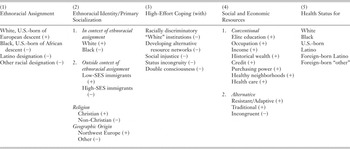
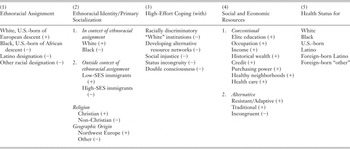
Note: The model proceeds from left to right with simple health status valences (positive or negative) accruing across the continuum. A final health status value is “totaled” in the last column for the population of interest.
Ethnoracial identity (agency), on the other hand, entails self-determined beliefs, values, practices, and behaviors constituting alternative cultural orientations away from the dominant culture that is marginalizing. In this conceptualization, Black American ethnic identity involves a dynamic process of working to resist and offset the constraints imposed by Black racial assignment. As examples of such behaviors, consider Shine's creative and ultimately successful use of alternate resources to escape drowning, and also his witty retorts to White passengers as they attempted to belittle him and sabotage his attempts at escape.
With both distinctions and connections between ethnoracial assignment and ethnoracial identity in mind, the proposed conceptual framework (represented in Table 1) begins with the dominant sociocultural system that determines ethnoracial assignment. This system provides the classification scheme for racial assignment to either the dominant group or to a marginal group based on phenotypic characteristics, national origin, or religion. The framework also covers major domains that can only be interpreted in the context of initial ethnoracial assignment (column 1); the context in which ethnoracial identity or primary socialization occurs (column 2); whether and the degree to which persistent, active, effortful coping is required to negotiate everyday life or dominant social institutions (column 3); and access to social and economic resources (column 4). Within each domain, different contexts and racial/ethnic groups are associated with positive or negative valences indicating whether health is expected to be promoted (+) or harmed (−). These valences make no presumptions regarding whether models are additive or multiplicative, or about the strength of different enhancers of or detractors from health—these are empirical questions. Instead, the framework should be seen as a departure generating hypotheses and empirical analysis meant to capture factors, characteristics, and dynamics that may contribute to racial/ethnic inequalities in health. They include, but cannot be reduced to, conventional measures of SES.
For example, U.S.-born Whites are classified White race, which, because it confers a range of privileges, has a positive (+) contribution toward health. The ethnoracial identity/primary socialization of members of this broad group varies, however, according to whether they are of Northwestern European descent (+), and whether they are Christian (+). U.S.-born, Christian Whites of Northwestern European descent have the highest purchasing power, the least fettered access to mainstream resources, and the least need to engage in high-effort psychological coping to obtain mainstream resources. These conventional socioeconomic resources also have a direct positive relationship to health (+). All U.S.-born Whites benefit healthwise from their ethnoracial assignment, their health statuses still vary based on these additional domains of ethnic identity and SES. (Clearly, other factors that are beyond the scope of this initial attempt at a conceptualized framework also matter, not the least of which is gender.)
Marginalized groups carry a variety of ethnoracial identities based on their primary socialization, ethnoracial assignment, and sociocultural orientation that I classify in this conceptual model as (1) a resistant/adaptive sociocultural response; (2) a traditional sociocultural orientation; or (3) an incongruent sociocultural orientation. These classifications are located in column 4, category 2.
Resistant Sociocultural Response
Black American ethnoracial identity is constructed within the context of Black ethnoracial assignment (−). The historical ideology of race-based minority status utilized to justify slavery (Smedley Reference Smedley1998) confers a fundamental negative influence on health (−). Blacks actively engage high-effort coping strategies (−) (James et al., Reference James, Strogatz, Wing and Ramsey1987) when negotiating discriminatory White institutions (−) to access mainstream socioeconomic resources. Additionally, racial discrimination associated with other institutions, including housing and health care, for example, diminishes purchasing power and the rewards of acquiring socioeconomic resources (−) (Williams and Collins, Reference Williams and Collins1995). In this context, Black American ethnoracial identity manifests as a resistant sociocultural response (+). By employing an alternative orientation, Black Americans access alternative resources which include dynamic and affirming social and cultural portrayals in contrast to the racial identity assigned by White Americans (+).
Ethnographic investigations suggest that extended family networks, barter exchange systems, use of social welfare programs, membership in communities of faith, and alternative economic enterprises are but a few of these innovative responses (Stack Reference Stack1974; Stack and Burton, Reference Stack and Burton1993; Hannerz Reference Hannerz1969; Kornhauser Reference Kornhauser1978; Airhihenbuwa et al., Reference Airhihenbuwa, Kumanyika, TenHave and Morssink2000; Rankin and Quane, Reference Rankin and Quane2002; Wickrama et al., Reference Wickrama, Noh and Bryant2005; Colen et al., Reference Colen, Geronimus, Bound and James2006a). While the importance of faith and religion in the Black American community is well documented and generally accepted (Aaron et al., Reference Aaron, Levine and Burstin2003; Van Olphen et al., Reference Van Olphen, Schulz, Israel, Chatters, Klem, Parker and Williams2003), other resistant behavioral responses are described as deviant, aberrant, or pathological (Lewis Reference Lewis1965; Wilson Reference Wilson1978, Reference Wilson1987, Reference Wilson1996; Welch et al., Reference Welch, Casper and Rith-Najarian2002; Levitt and Dubner, Reference Levitt and Dubner2005), with little appreciation of or critical thought given to their structural necessity, or their adaptive or health-promoting functions.
Many Black American behaviors characterized as pathological and associated with poor health may instead be innovative, adaptive responses to resist and offset various forms of racism (Geronimus and Thompson, Reference Geronimus and Thompson2004). Racial and ethnic health disparities could conceivably be more striking than they are if these adaptive responses did not exist. For example, although, as noted earlier, Colen et al. (Reference Colen, Geronimus, Bound and James2006a) found that upward economic mobility did not translate into improved birth outcomes for Black mothers who were poor in youth, having a grandmother present in their household did. One interpretation is that engaging extended, multigenerational networks to provide social support in childbearing is consistent with the affirming aspects of the primary socialization of Black American ethnic identity.
The conundrum for Black Americans here is that their primary socialization includes both acceptance of and resistance to the precepts of the American Dream. Whichever aspect of their primary socialization they tap into, Blacks pay a physical price. If they follow the American Dream, they find their opportunities blocked to a greater or lesser degree. If they invest in their resistant cultural response, they find themselves denigrated, vilified, and further marginalized by the broader society.
Traditional Sociocultural Orientation
Immigrants to the United States of African descent, whether from the continent, the Caribbean, or Latin America, are born outside the direct imposition of ethnoracial assignment (+). Their primary ethnoracial identity is constructed and developed without competing negative characterizations of its components (+). This ethnoracial identity also grants access to alternative indigenous sociocultural resources (+). However, upon arrival in the United States, they are classified into a racially marginal group, according to their phenotypic characteristics, by Whites who socialize these immigrants into a Black ethnoracial assignment (−). Additionally, efforts to acquire mainstream socioeconomic resources in the United States may lead many Black immigrants to contend with institutionalized racism which they previously never encountered. These immigrants may be particularly vulnerable because they have not developed resistant responses (−). Consequently, high-effort coping employed by these immigrants may be exceedingly taxing (−).
Similarly, Latin American immigrants to the United States benefit from a primary ethnoracial identity largely free of negative racial stereotypes (+). Arriving with intact traditional sociocultural orientations (+), they have greater access to alternate resource networks (+). This phenomenon manifests in the form of kinship and community affiliations considered beneficial to health. This sense of collective effort and well-being focuses on the health of the social unit as opposed to the individual (Gee et al., Reference Gee, Chen, Spencer, See, Kuester, Tran and Takeuchi2006a). For example, Sherman James (Reference James1993) speculates that one explanation for the salutary birth outcomes experienced by low-income Mexican-born Latinas may be that “through face to face interactions with keepers of their most cherished cultural traditions, these women, with the help of kith and kin, can create supportive communities within which the most vulnerable members can be nurtured, affirmed and strengthened” (James Reference James1993, p. 134).
These relationships may change over time as Mexican immigrants are increasingly socialized toward broader U.S. ideals of individualism (−). Simultaneously, their growing awareness of conventional U.S. standards of success and their aspirations to such success demand high-effort coping (−) as they increasingly engage and negotiate racist social institutions. Ironically, the very aspect of the Latino health advantage most frequently considered paradoxical, being low SES, may on balance be health protective if being low-SES results in fewer disconfirming experiences and greater access to affirming ones.
This framework offers a novel, yet consistent explanation for both Latino health “paradoxes.” Recently arrived immigrants of color with low levels of mainstream socioeconomic resources maintain their traditional cultural orientations. However, as they or their children access greater mainstream socioeconomic resources by engaging the educational system, job market, and lending institutions, they learn not only what it means to be a U.S. citizen but also the harsh reality of what it means to be a U.S. citizen of color. While they will rank higher on conventional measures of SES, their health may be compromised.
Incongruent Sociocultural Orientation
Indian immigrants to the United States also arrive with a primary socialization and ethnoracial identity constructed outside the context of their ethnoracial assignment (+). They often arrive with more advanced formal education and go on to hold more prestigious occupations than Mexicans or Blacks (whether native- or foreign-born). Despite their favorable socioeconomic profile and relative success, their “otherness” places them at a distinct racialized disadvantage relative to White Americans. Their immigrant status, skin color, and primary socialization outside of the United States place them outside of populations that can expect to be socialized into “White” racial status (−). Simultaneously, their educational and professional profiles require them to actively engage racist social institutions immediately. Like Black and Mexican immigrants, encounters with discrimination associated with these institutions require high-effort coping (−). Because they are a recently arrived population of color with limited social experience in the United States, Indian immigrants have not developed resistant social-cultural responses and are ill prepared to effectively cope with racial discrimination (−).
For example, the highly educated Indian immigrants in the Gould et al. (Reference Gould, Madan, Qin and Chavez2003) study have been disadvantaged because of discrimination. Their skin color or religious and traditional cultural practices placed them lower in the social hierarchy than they expected based on their professional expertise or economic resources. Consequently, they expend psychological resources coping with this new reality. At the same time, they may have had difficulty accessing affirming social support from their traditional cultural institutions, owing to the distances involved, both geographic and social. In this particular example, Indian immigrants may have forsaken key aspects of their traditional sociocultural orientation in exchange for access to socioeconomic resources in the broader U.S. context. Despite successfully achieving access to economic resources, they are neither accepted by nor affirmed within the context of broader White America. They, like Black Americans, are socially marginalized. Having relinquished one set of beneficial resources—those associated with their traditional social-cultural orientation—but unable to attain the full range of beneficial resources associated with educational attainment and occupational status of the mainstream, they need to cope with a lack of respect, a respect that by all rights should be theirs. In all of these cases—White, Latino, Black, and South Asian Indian—it is health promoting when primary socialization and life experience are affirmed, and harmful for health when they are not.
Overall, being a member of the dominant group is associated with relatively good health, while being a member of the marginalized group is associated with relatively poor health. Dominant group members are able to apply material resources directly to the improvement of their health. They also benefit from White racial privilege that positively reinforces their expectations of rewards (earned and unearned), rewards obtained without expending energy on coping with marginalization.
This ideology underpins the ethnoracial identity of the dominant group. It is highly affirming for the majority population, as Whiteness is a prerequisite for membership, and greater access to material resources is interpreted as their earned and just reward. This ideology also interprets marginalization and socioeconomic disadvantage as the just results of poor efforts by individuals and groups who are erroneously presumed to have equal access to attaining economic and material resources (Geronimus and Thompson, Reference Geronimus and Thompson2004). Their relatively inferior social status and resultant poor health are characterized as essentially their own fault.
The health of poor Whites, however, may be harmed, not only by their meager resources but also because their poverty may be disconfirming for them by limiting the rewards they expect from being White. Consider the consternation that third-class White passengers aboard the Titanic might have experienced as they were systematically denied access to lifeboats. Additionally these passengers, unlike Shine, were at a loss for how to most appropriately respond to their marginalized status. Whites who are poor during their youth, but become economically better off in adulthood, may benefit healthwise, not only from their increased access to material resources but also from their relief at having fulfilled a cultural aspiration for wealth and from finding the rewards consistent with their expectations. For some marginalized populations, having a traditional sociocultural orientation or a resistant sociocultural response can improve health beyond what would be expected of a group with little access to mainstream material resources, while having an incongruent sociocultural orientation will reduce population health below what would be expected of a group with greater access to these resources.
The above, of course, are speculations. And they are speculations outlined in broad strokes, with much room to fill in details, nuances, and additional examples as others participate in explicating this or another new conceptual framework. However, unlike the hegemonic view that the positive relationship between SES and health is robust, fundamental, and broadly generalizable, this framework takes into account the varied experiences of and empirical findings related to diverse populations. That is, it neither explicitly nullifies these experiences as “paradoxical” nor implicitly nullifies these experiences by using them only as building blocks to construct new socioeconomic variables that bypass the structural dynamics required of marginalized populations to find alternate means of social and economic support when they are blocked from mainstream support. Both of these nullification processes leave intact the prevailing social epidemiological paradigm by, in effect, rendering unfalsifiable its central proposition that material resources fundamentally explain social disparities in health.
CONCLUSION
New conceptual frameworks provide greater insight into how race/ethnicity, nativity status, and sociocultural orientations interact with socioeconomic resources to impact health, and may ultimately reveal unanticipated findings across a range of ethnically and racially diverse populations to warrant additional investigation. New theories benefit by taking into consideration how members of marginal racial/ethnic groups who aspire to the American Dream face blocked opportunities and White privilege and never fully benefit from their efforts, yet pay a high price physically.
Conversely, White Americans benefit from a primary socialization that informs their identity development and reflects positively on them. They also benefit from a social reality that is consistent with this primary socialization by having their behavior and expectations for reward consistently affirmed. Similarly, and speaking generally, members of racial/ethnic minority groups may improve their health the more they can tap into practices and ideologies that provide meaning to them and resonate with affirming aspects of their primary socialization. Racial/ethnic minorities face a challenge, however, in that the practices and ideologies they find affirming are often not those valued by the majority population or its institutions. They are simply not allowed to shine.