Introduction
Late-life suicide is an important public health concern in many parts of the developed world, and New Zealand is no exception (Cheung and Casey, Reference Cheung and Casey2014; Shah et al., Reference Shah, Bhat, Zarate-Escudero, De Leo and Erlangsen2015). A past history of self-harm is considered the most important risk factor for suicide in older people (Hawton and Harriss, Reference Hawton and Harriss2006; Murphy et al., Reference Murphy2012). In the USA, an older person is treated in an emergency department (ED) for self-harm related injury every 23 minutes (Carter and Reymann, Reference Carter and Reymann2014). In New Zealand, the intentional self-harm hospitalization rate in older people (age 65+ years) is lower than the general population (26.9 vs. 61.1 per 100,000 people), while the female-to-male self-harm ratio approaches equivalence with increasing age (1.1 in age 65+ years vs. 1.8 in the general population) (Ministry of Health, 2012). The lower rate of self-harm and female-to-male ratio in older people has also been observed internationally (De Leo et al., Reference De Leo2001; Chan et al., Reference Chan, Draper and Banerjee2007; Corcoran et al., Reference Corcoran, Reulbach, Perry and Arensman2010; Kim et al., Reference Kim2011). However, older people who self-harm have a stronger wish to die, use more lethal methods, and have a higher risk of subsequent suicide than their younger counterparts (Hawton and Harriss, Reference Hawton and Harriss2006; Dennis et al., Reference Dennis, Wakefield, Molloy, Andrews and Friedman2007; Sisask et al., Reference Sisask, Kolves and Varnik2009; Murphy et al., Reference Murphy2012; Kato et al., Reference Kato2013). In addition, they have a higher mortality rate from both natural causes and suicide than the general population (Hepple and Quinton, Reference Hepple and Quinton1997; Lebret et al., Reference Lebret, Perret-Vaille, Mulliez, Gerbaud and Jalenques2006; Wiktorsson et al., Reference Wiktorsson, Marlow, Runeson, Skoog and Waern2011). For example, Wiktorsson et al. (Reference Wiktorsson, Marlow, Runeson, Skoog and Waern2011) reported that the all cause one-year mortality for older suicide attempters (age 75+ years) was 15.8%, as compared to the expected one-year mortality (6.3%) for the general population.
Mood disorder is commonly associated with self-harm in older people, with about two-thirds of them receiving a diagnosis of depression (Frierson, Reference Frierson1991; Draper, Reference Draper1996; Lebret et al., Reference Lebret, Perret-Vaille, Mulliez, Gerbaud and Jalenques2006; Chan et al., Reference Chan, Draper and Banerjee2007; Wiktorsson et al., Reference Wiktorsson, Marlow, Runeson, Skoog and Waern2011; Kato et al., Reference Kato2013; Minayo and Cavalcante, Reference Minayo and Cavalcante2015). Other risk factors related to self-harm among older people include male gender (Frierson, Reference Frierson1991), solitary living arrangements/social isolation (Frierson, Reference Frierson1991; Hawton and Harriss, Reference Hawton and Harriss2006; Lebret et al., Reference Lebret, Perret-Vaille, Mulliez, Gerbaud and Jalenques2006; Dennis et al., Reference Dennis, Wakefield, Molloy, Andrews and Friedman2007), executive dysfunction (Gujral et al., Reference Gujral, Dombrovski, Butters, Clark, Reynolds and Szanto2014), cerebrovascular risk factors (Chan et al., Reference Chan, Chiu, Lam, Wong and Conwell2013), pain (Kim, Reference Kim2016), functional limitations (Kim, Reference Kim2016), and physical illness (Frierson, Reference Frierson1991; Hawton and Harriss, Reference Hawton and Harriss2006; Dennis et al., Reference Dennis, Wakefield, Molloy, Andrews and Friedman2007; Kim et al., Reference Kim2011; Minayo and Cavalcante, Reference Minayo and Cavalcante2015; Kim, Reference Kim2016).
A UK study suggested that there are three major pathways leading to suicide attempt in older people: experiencing life as a struggle when growing older; losing control over life; and feeling invisible or disconnected from others (Crocker et al., Reference Crocker, Clare and Evans2006). When older people in Belgium reflected on the process preceding their suicide attempt, four main themes emerged: life and the self as being disrupted by loss; loneliness; loss of control; and unwillingness to continue living the current life (Bonnewyn et al., Reference Bonnewyn2014). Van Orden et al. (Reference Van Orden, Wiktorsson, Duberstein, Berg, Fässberg and Waern2015) explored the self-reported causes of attempted suicide in older Swedish people and found seven themes: escape; somatic problems and pain; functioning and autonomy; burden to others; social problems (thwarted belongingness or family conflict); psychological problems; and lack of meaning in life.
Draper (Reference Draper1996) reported in his literature review that 9–18% of older people who had made a suicide attempt would make further attempt(s) within 12 months. The risk factors for repeat self-harm in older people reported in the literature include previous self-harm, previous psychiatric treatment, female with memory disorders, and younger age group (60–74 years) (Lebret et al., Reference Lebret, Perret-Vaille, Mulliez, Gerbaud and Jalenques2006; Murphy et al., Reference Murphy2012).
The aims of this study are to (i) characterize older people who self-harm presenting to seven EDs in New Zealand; and (ii) determine the predictors for repeating self-harm/suicide within 12 months. There is only one previous study on suicide attempts among older people (age 55+ years) in New Zealand (Beautrais, Reference Beautrais2002). A better understanding of this phenomenon can inform the development of clinical services and suicide prevention strategies for older people who are at risk. In addition, identifying the factors associated with repeat self-harm can improve the clinical management for this group of individuals.
Methods
Setting
This was a retrospective study of older people (age 65+ years), who presented to the ED at seven teaching hospitals following an index episode of self-harm: Auckland City, North Shore, Waitakere, Middlemore, Waikato, Wellington, and Christchurch Hospitals. These seven EDs covered a mixed urban–rural catchment area of 324,297 older people (age 65+ years) constituting 53.4% of the total older population in New Zealand (Statistics New Zealand, 2014). Self-harm was defined as “an act of intentional self-poisoning or injury irrespective of the apparent purpose of the act” (Hawton et al., Reference Hawton, Harriss, Hall, Simkin, Bale and Bond2003); and an index episode of self-harm was defined as the first self-harm presentation to an ED between 1st July 2010 and 30th June 2013.
Ethics approval was obtained from the New Zealand Ministry of Health's Health & Disability Ethics Committee. (Ethics Ref: 14/STH/71)
Identification of self-harm presentations
Each hospital has a system of recording self-harm presentations. The first author worked closely with local clinicians (co-authors) and their coding departments to determine the system that would capture the most complete set of self-harm presentations in each of the hospitals. Two main existing methods were used are as follows:
-
(i) The Consultation-Liaison Psychiatry Service referral database for older people referred by ED for a psychiatric assessment following an episode of self-harm.
-
(ii) ICD-10 codes X60-X84 “intentional self-harm”.
In addition to the ICD-10 codes X60-X84, Wellington Hospital used the ICD codes Y10-Y34 “Event of undetermined intent” and ED Presenting Problems of “self-harm,” “poisoning” and “overdose,” and “possible self-harm.” ICD-10 codes were not routinely used in Christchurch Hospital. Therefore, in addition to the ICD-10 codes X60-X84, the ED Arrival Complaints of “suicide” and “overdose,” and the following ED diagnosis codes were used to identify self-harm: DGABUSE – Drug/Substance Abuse Recreational (Unspecified); DSH – Deliberate Self Harm (Wound); DSP – Deliberate Self Poisoning (Unspecified); PSD – Poisoning Self Deliberate (Unspecified); SAD – Suspected Alcohol/Recreational Drug Involvement; TOXOTH – Toxicology Other – Not Drug Abuse/Acid Overdose.
We excluded cases of accidental self-injury/overdose (e.g. took the wrong medication purely by mistake) and those index self-harm episodes that resulted in death in the immediate period (i.e. these cases were considered as suicide).
Data collection
Four categories of data were collected from the hospital medical and psychiatric records of subjects identified by the above method.
-
(1) Socio-demographic factors: Age, gender, ethnicity, marital status, and living alone.
-
(2) Information about the self-harm: Location where self-harm occurred, date of self-harm, methods used, and acute stressors (death of first degree relative, perceived disability and/or suffering from physical illness, terminal illness in a first degree relative or carer, family discord, changed relationship/death of friend, relationship separation, financial trouble, employment change, and legal difficulties) (Conwell et al., Reference Conwell, Rotenberg and Caine1990). Each self-harm presentation was classified using three of the suicidal behavior categories described in the Colombia Classification Algorithm of Suicide Assessment (C-CASA) (Posner et al., Reference Posner, Oquendo, Gould, Stanley and Davies2007): (i) suicide attempt (i.e. with an intention to commit suicide), (ii) self-injurious behavior with no suicide intent, and (iii) self-injurious behavior where the suicide intent was unknown (i.e. when the suicide intent was not able to be determined from the medical/psychiatric records).
-
(3) Assessment and diagnosis: psychiatric diagnosis (depression, bipolar disorder, and schizophrenia), co-existent physical illnesses (malignancy, terminal illnesses, and dementia), antidepressant prescription at the time of self-harm, blood alcohol level, with mental health service at the time of self-harm, past history of self-harm, non-psychiatric hospital admission in the past 12-months, and follow-up by mental health service after self-harm.
-
(4) Longitudinal data 12-months after an index self-harm episode: Repeat self-harm and suicide as a binary outcome (Yes vs. No).
Statistical analysis
The Statistical Package for the Social Sciences (SPSS) Version 22 was used for data analysis. Independent t-tests (2-sided) were used for continuous variables and χ 2 tests (2-sided) for discrete variables when comparing differences in people who repeated self-harm/completed suicide within 12 months and those who did not. Fisher exact tests were used for discrete variables when the cells contained less than five expected cases. Adjusted residuals were calculated to identify those specific cells making the greatest contribution (applying the ±2 criteria) to the χ 2 test results (Sharpe, Reference Sharpe2015). Binary logistic regression was used to determine the predictive variables of repeat self-harm/suicide within 12 months. Statistical significance was set at 5%. Odds ratios (ORs) and 95% confidence intervals (95% CIs) were calculated as measures of association.
Results
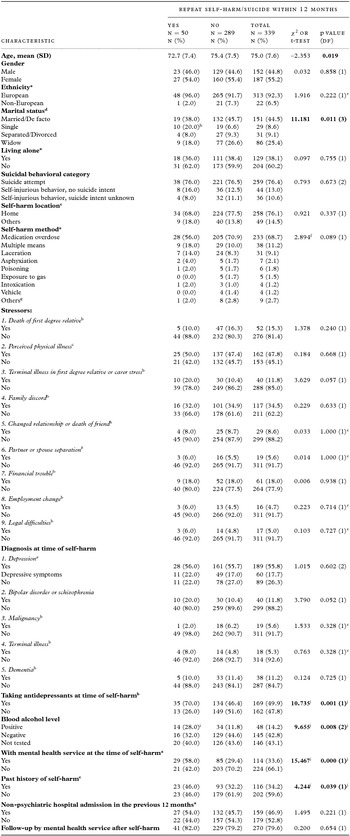
A total of 357 older people presented to ED with self-harm in the three-year period. In 18 (5%) cases, we could not determine whether or not the person had self-harmed again within the 12 months following an index presentation and they were excluded from subsequent analysis. The final sample included 339 older people (55.2% female) with an age range of 65–96 years (mean age = 75.0; SD = 7.6). Overdose (68.7%) was the most common method of self-harm. Most (76.4%) of the self-harm cases were classified as suicide attempts, while 13.0% had no suicide intent and 10.6% where the suicide intent was unknown. Perceived physical illness (47.8%) and family discord (34.5%) were the most common stressors that precipitated self-harm. Additional characteristics of the sample are shown in Table 1.
Characteristics of older people who repeated self-harm or suicide within 12 months and those who did not

Missing data: aless than 2%; b2–5%; c5–10%; d12.4%.
eFisher's exact test.
fOverdose versus other methods.
gOther self-harm methods included drowning, burning, hanging and jumping.
hAdjusted residual = 3.3.
iAdjusted residual = 3.0.
i5% significance level.
A total of 43 (12.7%) people repeated self-harm (all had one further self-harm within 12 months) and another seven (2.1%) people died by suicide within 12 months. Older people who repeated self-harm or died by suicide within 12 months were significantly younger than those who did not (mean age: 72.7 years vs. 75.4 years, p = 0.019). Table 1 shows the results of the bivariate analyses and the variables more frequently associated with repeating self-harm/suicide (p < 0.05) are: (i) being single; (ii) already with mental health services at the time of index self-harm; (iii) past history of self-harm; (iv) positive blood alcohol reading at index self-harm; and (v) antidepressant prescription at index self-harm. These variables were then entered into a logistic regression model controlled for age, gender, and marital status. The regression model was significant (χ 2 = 29.81, p = 0.001, df = 10) and explained 19.0% of the variance (as measured by R2 Nagelkerke) in predicting repeat self-harm/suicide. Two variables, already with mental health services and positive blood alcohol reading at time of index self-harm, remained significant in this model with an odds ratio of 2.73 (95% Cl=1.20–6.25, p = 0.017) and 3.87 (95% Cl = 1.35–11.12, p = 0.012), respectively.
Discussion
In this study, we found most (76.4%) older people who presented to EDs with self-harm had attempted suicide (i.e. had intended to die). Over the 12 months following their index presentation 12.7% of them repeated self-harm and 2.1% died by suicide. This equates to a suicide risk of 2,100 per 100,000 people. The general suicide rate for the older population (age 65+ years) in New Zealand is 8.5 per 100,000 people (New Zealand Ministry of Health, 2015). Therefore, the rate of suicide in our self-harm sample is over 200 times higher than the general older people population. Our findings are consistent with the international literature that self-harm among older people is significant and should be taken seriously as an unsuccessful suicide (Salib et al., Reference Salib, Tadros and Cawley2001; Hawton and Harriss, Reference Hawton and Harriss2006; Dennis et al., Reference Dennis, Wakefield, Molloy, Andrews and Friedman2007; Sisask et al, Reference Sisask, Kolves and Varnik2009; Kato et al., Reference Kato2013). Unfortunately, the recently published Royal Australian and New Zealand College of Psychiatrists clinical practice guideline for the management of deliberate self-harm concluded that research on interventions for self-harm among older people is very limited and older people presenting to mental health services following self-harm are likely to require multi-modal and multi-faceted approaches (e.g. local government leadership, public education and awareness, gatekeeper training) to reduce the risk of repeat self-harm or suicide behavior (Carter et al., Reference Carter2016).
The 12-month self-harm repetition rate found in our study falls within the 9–18% reported in a previous literature review (Draper, Reference Draper1996). Our findings are very similar to a more recent UK study of six general hospitals that found 12.8% of older people repeated self-harm within 12 months, and 1.5% died by suicide within 12 months (Murphy et al., Reference Murphy2012). A similar repetition rate (11.1%) within 12 months but a much higher suicide rate (12.7%) was found in another European study (De Leo et al., Reference De Leo2002). The much higher suicide rate in that study may be due to methodological issues, including small sample size, low recruitment rate, and low follow-up rate.
The finding that older people who repeated self-harm or suicide were more likely to have been with mental health services is consistent with other international studies, which found older people who attempted suicide/self-harm had a past psychiatric history and contact with mental health services (Draper, Reference Draper1996; Hepple and Quinton, Reference Hepple and Quinton1997; Chan et al., Reference Chan, Draper and Banerjee2007; Murphy et al., Reference Murphy2012). These findings are likely to be a result of selection bias that people who are of high risk of suicide are more likely to be referred and treated by mental health services. Given that most (79.6%) of our sample had mental health follow-up after an index self-harm event, it is a good reminder for mental health clinicians to review risk assessment and management on a regular basis when working with older people who have a history of self-harm.
The rate (14.2%) of positive blood alcohol measures in our sample was in line with findings from a review of the literature on attempted suicide in old age in which the prevalence of alcohol use before a suicide attempt ranged from 13% to 23% (Draper, Reference Draper1996). A wider prevalence range of alcohol use at the time of suicide attempt was reported in more recent studies with higher rates in those studies that included younger age groups (age 55–65) in their sample: 13.5% (US, age 65+ years) (Carter and Reymann, Reference Carter and Reymann2014), 18.3% (Japan, age 65+ years) (Kato et al., Reference Kato2013), 26% (UK, age 65+ years) (Dennis et al., Reference Dennis, Wakefield, Molloy, Andrews and Friedman2007), 34.4–45.9% (Ireland, age 60+ years) (Corcoran et al., Reference Corcoran, Reulbach, Perry and Arensman2010), 43% (UK, age 55+ years) (Oude Voshaar et al., Reference Oude Voshaar, Cooper, Murphy, Steeg, Kapur and Purandare2011), and 55% (Finland, age 60+ years) (Suominen et al., Reference Suominen, Isometsä and Lönnqvist2004). The importance of substance use was highlighted in a recent US national study where nearly half of all suicide-related visits to the ED by older people involved alcohol, drugs, or both; and the authors recommended additional suicide prevention efforts should include a better understanding of substance misuse in older people (Carter and Reymann, Reference Carter and Reymann2014). Murphy et al. (Reference Murphy2012) found that alcohol use at the time of index self-harm did not predict repeat self-harm; however, drug and alcohol problems were significant risk factors found in that study. In a previous New Zealand case-control study of suicide and near fatal suicide attempts of older people (age 55+ years), lifetime history of substance misuse disorder was significantly elevated (Beautrais, Reference Beautrais2002).
Based on their clinical judgment, ED clinicians did not test blood alcohol level in 43.1% of our sample (a similar rate in those who repeated self-harm/died by suicide and those who did not, refer to Table 1). Some positive cases might have been missed. We were also not able to determine whether older people in our sample had a co-morbid substance use disorder because assessment for substance use disorder was not routinely performed and/or documented by mental health clinicians. Given the emerging literature on the significance of substance use associated with self-harm among older people and our finding that older people with a positive blood alcohol reading are at higher risk of repeat self-harm/suicide within 12 months, further research is warranted. In the meantime, better screening and assessment for alcohol and substance use should be encouraged as part of the psychosocial assessment following an episode of self-harm.
In this study, overdose was the most common self-harm method. This is consistent with previous studies (Ruths et al., Reference Ruths, Tobiansky and Blanchard2005; Oude Voshaar et al., Reference Oude Voshaar, Cooper, Murphy, Steeg, Kapur and Purandare2011; Murphy et al., Reference Murphy2012; Carter and Reymann, Reference Carter and Reymann2014). Similarly, the finding of perceived physical illness and family discord as the most common precipitating stressors is consistent with other studies. For example, A UK study found that relationship (37%) and physical health (29%) problems are the most common precipitants of self-harm in older people (age 55+ years) (Oude Voshaar et al., Reference Oude Voshaar, Cooper, Murphy, Steeg, Kapur and Purandare2011). Another UK study found the most common problems preceding self-harm in older people were physical illness (46.1%), social isolation (33.5%), relationship problems with family (29.4%) or partner (25.9%), and bereavement or loss (16.7%) (Hawton and Harriss, Reference Hawton and Harriss2006). A Korean study found interpersonal problems (40.4%) and physical illness (26.3%) were the most common reasons for suicide attempt in older people (Kim et al., Reference Kim2011).
The association between physical factors and suicidal behavior in older people has been confirmed in a systematic review, which found a consistent link between functional disability and suicidal behavior (Fässberg et al., Reference Fässberg2016). Cheung and Sundram (Reference Cheung and Sundram2016) have recently developed a conceptual model illustrating the progression of physical illness to suicidal behavior in older people. This model provides a framework for clinicians to understand the risk and protective factors, and highlights a number of intervention points, where clinicians can address suicide prevention by reducing their risk while enhancing their protective factors (including community and familial resilience resources, such as the quantity and quality of support from family and friends, community resources, religious affiliations, and cultural influences).
The literature on interventions for older people following self-harm is very limited. Chan et al. (Reference Chan2011) reported a two-tiered multifaceted program for older Chinese (age 65+ years) suicide attempters. The first tier involved a gatekeeper (e.g. primary care physicians, social workers, frontline healthcare workers and volunteers in elderly services, and non-psychiatric specialists in tertiary care) identifying an at-risk case and making an urgent referral to psychogeriatric services. The second tier involved allocation of a psychogeriatric nurse case manager, urgent psychogeriatric assessment, active follow up, and psychoeducation by the case manager in the first 6 months. After 6 months of intensive intervention, participants had follow up with a psychogeriatrician as clinically indicated. The 2-year completed suicide rates was 7.6% in the pre-intervention group and 2.0% in the post-intervention group. However, no difference in re-attempts was found.
Interpersonal psychotherapy (IPT) was adapted for older people with current suicide/death ideation and/or recent self-harm and tested in a single-arm trial with a small sample (N = 17) (Heisel et al., Reference Heisel, Talbot, King, Tu and Duberstein2015). They found participants experienced significant reductions in suicide ideation, death ideation, and depressive symptom severity, and significant improvement in perceived meaning in life, social adjustment, and perceived social support. Although not specifically tested for older people with recent self-harm, problem solving therapy (PST) was found to reduce suicidal ideation in older people (Gustavson et al., Reference Gustavson, Alexopoulos, Niu, McCulloch, Meade and Arean2016; Choi et al., Reference Choi, Marti and Conwell2016). In addition, IPT and PST was part of the PROSPECT and IMPACT collaborative primary care management of late-life depression trials that have been shown to reduce depression and suicidal ideation in older people (Unützer et al., Reference Unützer2006; Alexopoulos et al., Reference Alexopoulos2009).
Strength and limitations
We examined self-harm presentations to seven EDs that cover a catchment area of half of the older population in New Zealand. Due to this sampling method, older people who attempted self-harm but did not present to ED were not included in the study. Each hospital coded self-harm differently, and we addressed this by expanding the ICD codes to accommodate the breadth of coding to capture the maximum number of cases, who were then carefully screened to ensure compatibility with our inclusion criteria. A similar challenge was encountered in a previous UK study where there was no consistent diagnostic label given to patients seen in ED after self-harm in one hospital (Ruths et al., Reference Ruths, Tobiansky and Blanchard2005). We believe the New Zealand Ministry of Health could address this coding issue so there is uniformity across the country and also more consistent data reporting and monitoring of self-harm at a national level. This would also aid other countries in a similar position whereby coding affects diagnostic accuracy. Due to the retrospective nature of this study, clinical data in hospital records have their limitations. For example, clinical diagnoses were based on clinical judgment, rather than a standardized diagnostic process or structured clinical interview. Other than the diagnoses of depression, bipolar disorder, and schizophrenia, we did not record other psychiatric disorders, such as anxiety disorder and substance use disorder because they were not consistently assessed by clinicians. A prospective design can address some of these inherent limitations. The outcome of repeat self-harm within 12 months was determined from hospital records and people who attempted self-harm but without presenting to hospital services or treated in a different hospital would have not been captured. Therefore, we may have under-estimated the 12-month self-harm repetition rate in the current study. Despite these limitations, most of our findings (e.g. self-harm repetition rate, self-harm methods, stressors associated with self-harm) are consistent with the international literature.
In conclusion, older people who self-harm represent a group at very high risk of future self-harm and suicide. Our study found those who were with mental health services and those who had a positive blood alcohol screen at the time of self-harm were more likely to repeat self-harm/suicide within 12 months. The literature on suicide prevention for older people following self-harm is very limited. Clinicians can consider using structured psychological treatment, such as IPT and PST as an adjunct to pharmacological treatment for depression and providing interventions to improve the person's community and familial resilience resources. There is an urgent need to evaluate these potential interventions for this very vulnerable group.
Conflict of interest
None.
Description of authors’ roles
G. Cheung, S. Merry, and F. Sundram designed the study. G. Cheung, W. de Beer, S. Gee, T. Hawkes, S. Rimkeit, and Y.M. Tan contributed to data collection. G. Cheung and G. Foster performed data analysis and drafted the paper. All authors revised the draft and read the final version of the paper.