


Introduction
Vietnam and China are two coffee producers that are diametrically opposed: in 2017, the former was the world's second-largest producer of coffee, whereas the latter was ranked only seventeenth in cultivated areas. Vietnam produces Robusta coffee of rather mediocre quality, while China cultivates renowned Arabica coffee. Though highly contrasting, these activities occur in similar spatial contexts: both countries grow coffee in tropical mountainous areas representing less than ten per cent of their total surfaces. The presence of minorities in these peripheral areas and their similar historical trajectories (colonial presence, integration in a broader political context, communist-inspired economic policies, and successful opening of the market economy) make the provinces of Dak Lak in Vietnam and Yunnan in China two interesting areas of production to compare. Furthermore, the countries’ venues for coffee consumption follow a sort of urban cultural hybridisation based on the Western model. Although both elements (production and consumption) are usually separated for analytical purposes, this paper compares them to understand better the construction of territories around coffee (i.e., agriculture and food systems). Therefore, this paper contributes to a cultural approach by exploring the construction of both coffee cultivation and coffee culture.
We propose comparing these two spheres (China/Vietnam, production/consumption) insofar as they contribute to production and food systems. How do the Vietnamese and Chinese spaces of production and consumption develop the quality of their respective coffees? This investigation questions the territorial organisation of the production spaces and how stakeholders adapt their coffees’ qualities in terms of the raw materials and final products. Significantly, this perspective assumes a link between the historical forms of production and consumption since recent studies on the interconnection between agricultural production and food systems (Gasselin Reference Gasselin, Sylvie and Claire2021) have revisited the geography of quality that Frayssignes (Reference Frayssignes2008) proposed. Our paper aims to understand how production and consumption interact in these territories and identify the lessons learnt through quality construction.
Numerous theoretical approaches address the issue of quality, although we will review only a few here. Economists often use the ‘convention approach’ (Arfini Reference Arfini and Bellassen2019; Boltanski Reference Boltanski and Laurent1991;), with one oriented towards the relationship between institutions and consumers. These conventions are structured around the information asymmetry of stakeholders, which organises the market according to the attributes of research, experience, and trust (Daviron Reference Daviron and Montagnon2004). The territory falls within the latter category, as the objectification of the ‘qualities’ guaranteed in the final product is uncertain and, thus, based on trust. As a common good, the territory can turn into a ‘club’ if its quality is officially recognised through its affiliation to a commercial label or compliance with certain specifications such as geographical indications (Torre Reference Torre2002).
Regarding management, other quality approaches have developed from the perspective of standardising and mastering production processes (Guillaume Reference Guillaume2018). In the humanities and social sciences, quality is often a social process that brings together stakeholders around a product. Fourcade (Reference Fourcade, Muchnik and Treillon2010), for instance, investigates the territorial qualification of products and food from the standpoint of collective organisations. Henson's (Reference Henson and T.2000) proposal complements this approach, for it integrates broader societal and historical issues into his analysis. In his view, quality can be divided into three distinct aspects: the first orients towards the physical composition and material characteristics of the products and territories, the second towards the social processes underlying the construction of quality, and the third towards the quality that consumers perceive.
These three aspects have inspired contrasting studies. The first is defined by approaches relating to the ‘production basin,’ where specific types of production are located in line with physical, technical, or economic constraints (Sarrazin Reference Sarrazin2016). This approach aims to understand the localisation effects of agricultural production. It views space as an explanatory agent of the product's qualities. In the Chinese and Vietnamese cases, their mountainous and peripheral locations with a similar cultural melting pot contribute to the emergence of similar political issues (Bruneau Reference Bruneau2006). Their shared tradition, which is both historically constituted (Chinese civilisation) and spatially situated (a mountainous region in the Himalayan foothills with rich ferralitic soils), creates a similar logic of territorial construction. Therefore, this approach views quality as a tradition centred around material and immaterial resources that cannot be relocated (Rastoin Reference Rastoin, Augustin-Jean, Ilbert and Saavedra-Rivano2012).
The second approach focuses on what Sylvander (Reference Sylvander, Nicolas and Valceschini1995) calls the conventions of quality. It involves coordinating actors and actions aimed at the construction of quality, most often to organise a sector. Geographers, for example, have analysed labels and other officially recognised signs that identify quality and origin. This axis promotes an understanding of how a product's quality gets transmitted both symbolically and materially. Thus, numerous studies refer to ‘terroir,’ which denotes the interactions between human societies, soils, and territories (Bérard and Marchenay Reference Berard and Philippe2004; Delfosse Reference Delfosse2011;). The central point of contemporary notions of terroir appears in the localised dimension of production since the product's spatial anchorage determines a large part of its specificity, typicity, and territoriality, whether material or merely perceived. In both China and Vietnam, the social construction of products depends on the transformation of economic systems. This approach corresponds to the idea of “quality as an institution” (Allaire Reference Allaire, Augustin-Jean, Ilbert and Saavedra-Rivano2012), which itself forms part of the perspective of convention theory (Arfini Reference Arfini and Bellassen2019).
The third approach is anthropological and addresses the geography of food. Beyond the purely functional aspects, the symbolic issues are crucial. Among these existing approaches, Bell (Reference Bell and Gill1997) highlights those derived from sociology in relation to consumers’ perception of quality. This vision corresponds to Allaire's description of quality as judgement and quality in markets (Allaire Reference Allaire, Augustin-Jean, Ilbert and Saavedra-Rivano2012). Questioning the dynamics of consumption makes two key contributions in our view by analysing the construction of food product representations and elucidating how these very representations influence spaces. How populations consume or reject coffee tells us not only about the product's status but also about others’ perceptions of it, for food cultures are viewed as symbolic systems (Cardon et al. Reference Cardon, Depecker and Marie2019). Parott (Reference Parrot, Natasha and Jonathan2002) believes that although the geography of consumption – itself a subcategory of the geography of food – highlights consumer changes and preferences, it barely considers the issue of quality (Gill Reference Gill1999; Grigg Reference Grigg2002). Belsky then expands notions of quality to encompass a broader set of relative material and immaterial positions, viewing it not as a single feature but as a larger bundle that includes the market (Belsky Reference Belsky2020).
In our opinion, all three approaches are valuable because they shed light on a distinct lens of the same reality. Quality links these three essential axes by allowing us to grasp how the territory actively contributes to a product's characteristics.
The comparative method we have used here observes the evolution of two coffee cultures in both time and space. We employ the term ‘coffee cultures’ in the dual sense: the cultivation of the coffee plant and the art of consumption. For clarity, we pluralise the expression ‘coffee cultures’ to retain its dual signification.
A comparison of these two cultures of coffee requires us to consider their differences and similarities. The Vietnamese highlands (Tây Nguyen) are seven times smaller than the surface of Yunnan province but fifteen times more productive. Nevertheless, the two zones represent 90% of coffee cultivation in their respective countries. To ensure a coherent comparative approach, we use the three aforementioned axes as indicators to compare the quality of coffee in China and Vietnam.
This study's methodology draws on fieldwork undertaken in China and Vietnam in 2016 and 2018, coupled with detailed documentary research. During the fieldwork, we conducted approximately fifty semi-structured interviews at different sites (Pu'er, Dehong, Baoshan, and Buon Ma Thuot) with diverse stakeholders ranging from public authorities to producers and distributors. We supplemented this qualitative research with the analysis of quantitative data collected at the local level and compared with global databases, and then put it into perspective via the existing body of knowledge. Previous fieldwork conducted in Paksong (Fortunel Reference Fortunel2007) also provides some intermediate points of comparison.
The second part of this paper explores coffee cultivation's spatial and social histories by analysing the routes used for the plant's diffusion and expansion. The third part focuses on recent changes impacting these two provinces in terms of coffee cultivation, the collective construction of quality, and the consumption of the beverage. Finally, the conclusion provides a comparative overview of the findings and contributes to existing approaches relating to quality.
Politics before Quality: The Colonial Importation of Coffee into the Mountains
Shared features of the mountainous zones
Altitude differences and ethnic cleavages
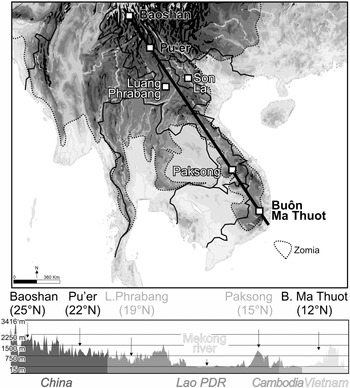
At first glance, Yunnan province in southern China and Dak Lak province in Vietnam appear to have little in common. Nevertheless, the axis connecting these two provinces on the map (Figure 1) shows a continuum between the Himalayan foothills of Baoshan, situated at around 2000 m altitude, and the highlands of Buon Ma Thuot that dominate the South China Sea at an altitude of only 500 m. The different altitudes can be combined with their latitude: Buon Ma Thuot is quite close to the equator, whereas Pu'er is just above the Tropic of Cancer. Between Baoshan and Buon Ma Thuot, the Laotian coffee capital of Paksong and the provinces of Luang Phrabang and Son La act as intermediate places between these two extremes. The coffee cultivated here ranges from Arabica (and its varieties of Catimor, Bourbon, and Typica, to cite only the most famous) to Robusta. As Arabica prefers cooler temperatures, it grows in higher altitude zones, whereas Robusta, resistant in hot and humid climates, prospers in lower altitudes. For this reason, there is a gradient between the poles of the axis shown in Figure 1.
Altitudinal cross-section showing Baoshan and Buon Ma Thuot within the zomia.
The “zomia” zoning represented here is per James C. Scott (Reference Scott2013).

The altitudinal gradient is also sociocultural. Indeed, sociolinguistic groups categorised as minorities populate the mountainous zones of mainland Southeast Asia. In essence, these populations were progressively pushed back into the mountainous areas as pre- and post-colonial powers expanded their influence (Gainsborough Reference Gainsborough2009). Peoples of great ethnolinguistic diversity inhabit the mountains of this part of Southeast Asia, located along the axis shown in Figure 1, contrary to the plains, where the current political majority corresponds to the numerical majority. In 2010, minorities represented around 30% of the population in Yunnan and Tây Nguyen (UNFPA Reference Weiyi and Hong2011).
Through the notion of ‘zomia,’ James C. Scott analyses these foothills’ social dynamics and political contexts (Scott Reference Scott2013), from the Chinese Himalayan foothills to the provinces of Ratanakiri. The mountain range's name highlights its populations’ autonomy concerning their singularity and diversity. The zomia also recalls the specific status of these territories, which contested the central state's establishment. The local populations’ resistance to national political authorities is a striking feature of Scott's analysis. The zomia goes beyond purely state-centric approaches by splitting the analysis into multiple singularities in China and Vietnam. In both countries, colonial and national powers attempted to restrict the territories’ cultural and social diversity, often in an illusory manner, by ethnogenesis through forced acculturation (Michaud Reference Michaud2000). Moreover, these populations, which are culturally distinct from the majority groups, were the first to come into direct contact with coffee.
Routes of the establishment of plants
Coffee first arrived in Asia in the seventeenth century via the Ottomans in South India and Muslim traders in Sri Lanka (Tucker Reference Tucker2011). In the eighteenth and nineteenth centuries, Western trading settlements and colonialism led to the introduction of coffee cultivation elsewhere in Southeast Asia. The Spanish in the Philippines, the Dutch in Java and then Malabar (India), the Portuguese in Timor, the French in Indochina, and the British in Myanmar and Thailand were the main vectors of coffee's expansion from its original Ethiopian source (Gervase Reference Gervase and Stephen2003; Gunder Franck Reference Gunder Frank1998; Reid Reference Reid and Reid1997).
Historical documents regarding the arrival of coffee in Vietnam point to its introduction from varieties found in present-day Indonesia, which French settlers then imported to Cochinchine, in 1857 (Fortunel Reference Fortunel2000). Therefore, the coffee in Vietnam is essentially the Robusta type of Southeast Asian origin, which today represents 97% of the nation's production. The remainder of production – Arabica – became established in the north of the country. In contrast, the cultivation of Arabica (Catimor) is much more widespread in nearby China, where the proportion of Robusta is the opposite of its Vietnamese neighbour. Aside from Taiwan in 1884 and Hainan in 1898, Yunnan's first coffee plants came from the district of Ruili in Myanmar in the first decade of the twentieth century before spreading around Dehong. Recent research successfully located the first coffee plantation in the province, established by a Frenchman in 1895 in the district of Pu'er (Lancang), where the local population still remembers the “old foreigner” (Chen Reference Chen2016). It is unknown whether he was the same French missionary who introduced coffee plants in 1902, according to Fu Jia (Reference Jia, Jonathan and Morgen2015). What is certain is that, whether via Myanmar or Vietnam, coffee plants in China logically spread from the south to the north, and their diffusion from one country to another possibly links to the railways that the two colonial powers built. The Hanoi-Kunming rail route potentially circulated Arabica coffee at the time from North Vietnam to this southern part of China. However, to our knowledge, academic studies on the subject have not yet confirmed this seductive hypothesis (Chang Reference Chang1942; Hulot Reference Hulot1990).
Coffee cultivation at the service of a territorial political model of the state
China's and Vietnam's mountainous spaces followed similar post-colonial trajectories concerning agricultural valorisation. Both before and after the arrival of communism in each country (1949 for China; 1954 for North Vietnam, and 1975 for South Vietnam), they conceived and constructed territories around the idea that agricultural production in the mountains should primarily constitute a political act of control to impose a new political order (De Koninck Reference De Koninck1996; Fortunel Reference Fortunel2003).
The two countries’ similarities link to their shared political vision and the same cultural model for the territorial expansion and integration of peripheral areas derived from Confucian valuesFootnote 1 (Bruneau Reference Bruneau2006; Yang Reference Yang2008; Yang and Mei Reference Yang, Wu, Daya Kisha, Burgh and Shi2017). In this context, coffee is special in the two mountainous zones. In the Vietnamese Tây Nguyen, the South Vietnamese regime inherited and then took over colonial plantations, perpetuating this well-mastered and profitable venture. This coffee-growing tradition, which successive political powers reclaimed and reinvested throughout the twentieth century, has turned coffee plants into the flagship product of the Central Highlands of Vietnam.
Coffee played a different role in southwest China's agricultural history. It had to find its place between the rapidly evolving tea industry on the one hand — in Yunnan in 1965, tea plantations occupied 42,000 ha or at least ten times more than coffee (Etherington Reference Etherington and Keith1993) — and new rubber cultivation on the other (Chapman Reference Chapman1991), which was especially strong from the 1950s until the mid-1980s. During the Korean war, the American embargo, and Chinese-Soviet cooperation, rubber cultivation became one of the local agro-industrial pillars, particularly in the Xishuangbanna region. Indeed, the country founded and then exploited the majority of state farms for rubber (Duan Reference Duan2015). Coffee was certainly present but secondary, confined to a few valleys in the foothills of the Gaoligong mountains (Baoshan).
Coffee: A means of territorial appropriation by the state
Many state farms emerged in Yunnan from 1950 to 1970 and in Dak Lak from 1975 to 1985. They became the emblem of the new socialist social and economic game undertaken on a large scale on pioneer fronts (De Koninck Reference De Koninck1996; Duan Reference Duan2015). Following the model of border zones, state farms functioned in China and Vietnam as a twofold unit of agricultural and political production, serving as a material marker of a national political policy. Vietnam, more than China, used coffee as one of the main tools for this territorial affirmation.
At the height of Vietnamese collectivisation, Dak Lak founded over thirty state farms for coffee cultivation (Fortunel Reference Fortunel2003). In Yunnan, the first state farms, notably in the sensitive border area of Xishuangbanna Dai Autonomous Prefecture, date from 1955 (Donnithorne Reference Donnithorne2013: 110). At that time, forty Chinese state farms employed 290,000 workers (Duan Reference Duan2015) and cultivated primarily rubber and, secondarily, coffee. In the Dehong region, Carin (Reference Carin1962: 109) reported the plantation of 20,000 coffee plants and some projects with up to 600,000 plants; other unreliable sources estimate a total production area ranging from 1500 ha (Stessels Reference Stessels1986) to 3,600 ha (with 60% concentrated in the Dehong and Baoshan areas) in the 1960s (Chen Reference Chen2016).
In Vietnam after 1975, the popularity of the coffee plant took off with the massive arrival of migrants from the north following the petition of the central state with the avowed aim of socialising the zomia populations. Farms that became poles of excellence in coffee production employed them, and economic activity spread out towards the provincial borders (Hardy Reference Hardy2003). Beyond these farms, the migrants who spontaneously arrived around 1985 continued to expand the coffee plantations, which today occupy more than 300,000 ha in the entire Tây Nguyen province.
This migration strategy follows the Chinese model and philosophy. Mao helped make Yunnan a limes with hundreds of thousands of displaced young people in the service of the communist regime (Carin Reference Carin1962; Duan Reference Duan2015; Sturgeon Reference Sturgeon2013). In Yunnan, as elsewhere in China, the migration policy of “up to the mountains, down to the countryside” that existed from the mid-1950s until the mid-1970s drove this project (Bernstein Reference Bernstein1977; Weiyi, Reference Weiyi and Hongn.d.). Urban migrants established new agricultural land in Yunnan and worked in state farms, and those who decided to stay there attest to the movement's vigour. In Baoshan, people explain that “the priority was given to feeding people; coffee only came later” (fieldwork, 2018). In 1975, a quarter of the 400,000 urban youths sent to Yunnan were still on the farms (Bernstein Reference Bernstein1977). The remains of the former coffee plantations in the district of Dehong, which later became private companies, attest to this patriotic movement.
Coffee: An imported beverage
A colonial invention
The colonial history of introducing the coffee plant is closely linked to its consumption but in separate territories. In China and Vietnam, the culture of coffee consumption was initially limited to Western colonialists. Shanghai and Saigon recreated Europe's material and symbolic metropolitan landscapes in cafés (Peters Reference Peters2014). In both cities at the end of the nineteenth century, Westerners introduced this urban form of consumption while reserving tea for the rest of the native population. Thus, coffee became a means to distinguish the native inhabitants from the colonialists and, later, the Americans. Through acculturation, social distinction aroused a taste for the beverage among the Vietnamese upper class (Tanetsakulwatana Reference Tanetsakulwatana2009). However, the increasing popularity of Western tastes from the late nineteenth century to the mid-twentieth century rendered coffee as common a beverage as tea. The popular urban culture of masculine sociability, epitomised by men consuming coffee in cafés, is a striking feature in Vietnam: in the early 1900s, outside observers noted that even the modest local populations were milk coffee adepts (Ferreira and Ferreira, Reference Ferreira and Carlos2018; Peters Reference Peters2011).
Notably, in China, the relationship with foreigners was much more fleeting. The foreign enclaves in Shanghai from 1842 to 1945 were centres of interaction between Chinese and Western cultures (Shuo Win Reference Chen2016). Coffee entered China between 1796 and 1820, while the first café that Westerners frequented and managed did not open in Shanghai until 1886 (Chen Reference Chen2016; Wang Reference Wang and Felton2019). As a sign of the relatively high consumption of the beverage, the first Chinese coffee processing factory opened in Shanghai in 1935. As a place of culture and entertainment, the café heightened the attraction of the “Paris of the Orient,” the name given to the French concession at the time. Let us not forget that these foreign concessions also recruited Chinese coolies to work in colonial plantations throughout the empire and especially in the Vietnamese coffee plantations of Buon Ma Thuot (Fortunel Reference Fortunel2000).
The end of socialist agricultural experiments and the revival of coffee
In Vietnam and China, the enthusiasm for coffee plantations ended in failure in the late 1970s. Three common factors contributed to this situation.
Firstly, the geopolitical contexts were hostile to the development of coffee cultivation. The deterioration of diplomatic relations with the Soviet bloc and the American embargo limited China's trade until the mid-1970s. In Vietnam, the open war between its North and South territories decimated its agricultural production (from 25,000 ha in 1964 to only 7000 ha in 1971). Therefore, export markets dried up completely.
Secondly, changing agricultural policies favouring subsistence crops limited the interest in this stimulant plant, which found an insufficient local market in both countries. In China, Pu'er tea's anteriority and renown further limited the introduction of coffee in the region.
Thirdly, workers’ skills did not match people's perceptions of the plant or management capacities. China felt the effects of the Cultural Revolution throughout, viewing coffee as a “capitalist” product and thus detestable (Chen Reference Chen2016: 230; fieldwork 2018). Subsequently, cafés vanished from fields and cities alike (Wang Reference Wang and Felton2019). Vietnam's population highly regarded and appreciated coffee but lacked the necessary technical skills to cultivate it. As a result, multiple large-scale attempts at coffee production did not come to fruition, and agricultural engineers from the Red River Delta failed to find the appropriate techniques.
These factors demonstrate that in 1978, both countries had low levels of cultivated land surfaces. In Vietnam, the ravages of war were still evident, whereas China was beginning to open its doors to foreign countries. As the junction between points A and B in Figure 2 shows (FAO 2015), each had almost 8,000 ha of coffee production. If both countries were set at a base of 100 today, Vietnam would be 7659 and China 495!
Evolution of land surfaces planted with coffee in Vietnam and China from 1961 to 2020.
The comparison is somewhat unflattering for China, as its surface scale is ten times smaller than its southern neighbour. Note the distinct temporal profiles in the two areas of coffee cultivation. Until the mid-1970s, both countries had small cultivation areas, mainly inherited from the former Vietnamese colonial plantations and the first Chinese state farms (A). Vietnam began to stand out in the 1990s following the country's economic reforms, whereas China had to wait until the 2000s to initiate a growth cycle (B). The final period (C) corresponds to the dynamics of the Vietnamese pioneer front, which peaked only recently. In parallel, mainland China's traditional production basins have densified and expanded. We should mention our strong concerns about the Chinese data in periods A and B, particularly in the 1980s. Indeed, when comparing surface and yield, an inconsistency emerges: the surfaces increase substantially, but production does not follow the same trend. We can assume that the statistics reflected the plans on paper more than reality or that plantations rapidly failed. Sources: FAO, AgriStat, 2021.

Thus, the 1980s initiated a new period when China's and Vietnam's production crossed paths. While the latter followed a steep upward curve, the former oscillated between growth and decline (-Figure 2). In reality, however, the sector stagnated due to difficulties finding new collaborations.
The (re)naissance of consumption
China's and Vietnam's consumption during the late 1970s and 1980s began a new era of modernising green coffee processing and developing a consumption culture. People no longer viewed coffee as the beverage of colonialists but of urbanised tea drinkers. Freeze-dried coffee – invented in 1881 but industrialised by Nestlé in the 1930s – was ideal for providing the product to consumers after the Second World War. On the outskirts of Hô Chi Minh City, a Frenchman opened the first soluble coffee factory in 1968 that was ready for the local market ten years later. By 1985, Vinacafé conquered the domestic market, filling supermarket aisles with three-in-one instant coffee.Footnote 2 This new era of soluble coffee to be consumed at home complemented the traditional “phin”Footnote 3 coffee, which remained the preferred urban experience. Various coffee preparations were available, each with a specific social setting. Whether on a folding table in an alleyway or on the streets of Hanoi, Buon Ma Thuot, or even small rural towns, it was not uncommon to encounter different forms of coffee consumption. For example, a blend of coffee, egg, concentrated milk, and ice created an original local cultural blend (Featherstone Reference Featherstone2016).
China witnessed a double dynamic in the 1970s: the acceleration of consumption and the establishment of soluble coffee processing factories due to foreign influences. Even though China had imported Brazilian coffee (around 100,000 bags) since 1957, this relationship changed with the re-establishment of diplomatic relations in 1974. From the early 1970s until the mid-1980s, the state called on Brazilian and Colombian companies to set up soluble coffee production units, notably in Shanghai (Café, cacao, thé 1972, 1984), to process grains imported from Africa and South America (Café, cacao, thé 1973, 1984). The birth of the Chinese coffee industry took place via a joint venture with a Brazilian company to package and commercialise soluble coffee, with Chinese supermarkets featuring Brazilian “cacique” from 1985 (Café, cacao, thé 1985). Chinese soluble coffee also gained in popularity: in 1988, it inaugurated the first soluble coffee production unit in Hainan (Chen Reference Chen2016).
Meanwhile, eight years after its arrival in Guangdong, Nestlé established the first of twenty-one factories in the country (Fu Jia Reference Jia, Jonathan and Morgen2015). In 1988, Shanghai alone consumed 500 tonnes of coffee. The soluble market grew rapidly in China. By the late 1980s, Maxell House, Nestlé, and Lishen shared the domestic market for 3-in-1 instant coffee. Nestlé's marketing strategy in the early 1990s commercialised its instant coffee and contributed to its enormous popularity (Allen Reference Allen2009). Nescafé gained commercial success in China by presenting itself as a luxury object. Its red box, containing a golden spoon, two mugs, Coffee-Mate creamer, and a jar of soluble coffee, made – and continues to make –Nescafé prosperous in China. Moreover, it now accounts for three-quarters of the market. Wei recounts how coffee became fashionable in the mid-1990s thanks to well-orchestrated publicity campaigns, and Nescafé instilled its name and drink in urban consumers’ minds (He Reference He2021; Wei Reference Wei2018;) while democratising a mostly-imported product previously deemed too expensive.
The colonial legacy and the political struggle for territorial control meant coffee cultivation in Vietnam and China developed under external influences. Coffee as a foreign product was at the service of foreign projects and symbolised neither the local populations’ identity constructions nor their collective projects. As a result, the quality of coffee reflected that of the Western powers. Beyond the so-called vacant land it occupied, coffee was a material symbol, embodying the world powers of the time. The commercial ships transporting it from Ethiopia and the cups of colonial enclaves brought to light how coffee represented the domination of empires. The coolies recruited in Chinese ports to cultivate the plantations and the minorities expelled from their lands symbolise just one of the production system's many facets.
In contrast, the terraces of urban cafés highlighted the cheerful façade of consumption. Both production and consumption were hierarchical, reproducing the existing dominations and replicating social and spatial characteristics. Colonial-era coffee production exemplified domination, while drinking coffee illustrated distinction and social superiority.
National Reappropriations of Coffee
After the structural reforms of the national economies in China (1979) and Vietnam (1986) and particularly their agricultural reforms (1992 and 1995, respectively), coffee moved from a planned centralised logic to a liberal market economy with the involvement of numerous private stakeholders (producers and buyers). The sector was spatially reorganised, with production basins progressively structured following their acquisition by farmers, increasing possibilities for development. Regional and national bodies emerged to implement global industrial and economic strategies, promote agricultural research and extension institutions, and form groups to steer the sector strategically. In parallel, consumption trends evolved on both sides of the border as urbanisation and marketing overwhelmed the societal sphere of the two countries.
Given this similar political and historical background, the two coffee sectors followed the same path regarding their production dynamics. Their interest in the plant was undeniable after the reopening of foreign and domestic markets. In Vietnam, coffee lies at the centre of a social game in the highlands: local inhabitants plant it in the hope of becoming rich, thus making coffee a lever of acculturation for minorities. In China, the plant is rarely the principal activity, often accompanying tea and providing a complementary opportunity for income security. In both countries, local authorities help boost these dynamics. Today, all social classes and age groups consume coffee. In Vietnam and China, cafés provide places for young people to meet each other and participate in new forms of consumption. While these urban shops aimed at the upper social classes are attractive because they promote the modern model, soluble coffee remains limited to home consumption.
Unique paths to market expansion
Around the 1980s, China and Vietnam adopted the same strategy of liberal openness but diverged in how they implemented it. While China called on an international leader in the coffee sector to develop cultivation in Pu'er, Vietnam opted for a national strategy favouring local companies redeveloping farms. This approach persists in Vietnam since it bans foreign companies from buying coffee directly from local producers (Ipsos 2013). Regarding consumption, China's commercial space is filled with Western companies. In contrast, Vietnam's more established coffee culture has protected itself from outside influences by creating business models such as Highland Coffee and Trung Nguyen.
China and coffee: Three prefectures and two systems
In China, 1981 represents year zero in coffee production in Yunnan, with statistics indicating a harvest of only 43 ha. In 1986, of the 39 state farms in Yunnan, 27 produced coffee (Stessels Reference Stessels1986), but on tiny surfaces. The values then increase rapidly since the same author indicates that the harvested surfaces in 1984 covered 1,500 ha in Yunnan (Stessels Reference Stessels1986), including zero output in Pu'er (Pu'er local government Reference Government2015). Hainan maintained another 1500 ha (Muller Reference Muller1996).
The late 1980s represented a strategic period on several levels. Globally, the system of coffee quotas ended, providing opportunities for new low-cost actors like China and Vietnam to enter the market. Nationally, the Chinese authorities initiated reforms that had positive effects. From the “open up to the West” policy (Goodman Reference Goodman2004) to the “Bridgehead” policy of the 2000s, coffee cultivation profited from a buoyant environment by setting new records. Between 1990 and 2000, China doubled its coffee production (from 6,000 to 12,000 tonnes) and then multiplied this figure by ten just fourteen years later (118,000 tonnes; FAO 2015).
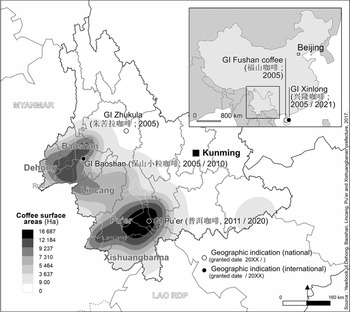
Spatially, one may divide Yunnan's production system into two distinct types. Firstly, the production areas of Dehong and Pu'er are structured around large companies that bring together local producers, often for their benefit (- Figure 3). Such is the case with the Chinese company Hogood and the Swiss company Nestlé, which arrived in the first half of the 1990s. Both companies have similar territorial and commercial strategies (a production basin regrouping most of their resources and a multisector position ranging from freeze-dried to premium coffee). However, they diverge substantially in their internal organisation. Hogood has a complete production monopoly, while Nestlé shares its network of producers via an open market with competitors. Despite being competitors in the national market, the companies have vastly different impacts. Nescafé represents 72% of the market share of coffee (mainly instant coffee) compared to less than 3% for Hogood (Nan Reference Nan2014; Neilson Reference Neilson and Wang2019).
Two basins of coffee production in Yunnan: Pu'er and Baoshan-Dehong in 2017.
The importance of the Pu'er production basin for Nestlé is evident, while Dehong and Baoshan are secondary places of production.

Secondly, the prefecture of Baoshan, on the margins of the two main production basins of Dehong and Pu'er, is distinctive for its geography and structure. Unlike in Pu'er, the absence of a major industry in Baoshan contributes to its harmonious and integrated ecosystem.Footnote 4 Coffee spread throughout the area at the village level, where small harvesting and processing companies developed with varying degrees of success to ensure the sale of local coffee brands. Baoshan coffee also partly contributes to Starbucks and Nestlé's harvesting networks sold for export or on social media networks in coastal cities (Galtier and Jacquet Reference Galtier and Jacquet2011).
Vietnamese coffee and the expansion of the “limitless” pioneer front
Significant differences characterise the organisation of coffee cultivation in Vietnam and China, and not only because of their different sizes. Unlike China, the construction of Vietnam's coffee production zones is in continuity with the past without any major ruptures, with a specific organisation now managing the sector from the national capital. The state farms later transformed into private companies that invest, harvest, and export on a massive scale. These companies feed into the networks of independent producers and traders who travel throughout the country searching for a few kilograms of coffee to sell on the market. Overall, 88% of green coffee is transported to Ho Chi Minh City for export (versus 62% for China in 2019).
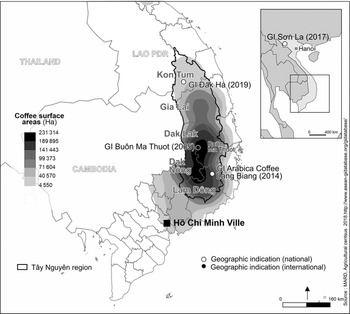
Coffee cultivation gradually spread throughout every province in Tây Nguyen (Figure 4) and developed its production basin within the territory's history of political and social construction. The pattern is always identical: private companies locate themselves at the centre, with myriad farmers gravitating around them. The province of Dak Lak undoubtedly lies at the core of the national coffee policy, as it represented 90% of the national coffee production in 2019 and houses the only coffee research institute in the southern part of the country. The provinces of Gia Lai and Kon Tum, which are agriculturally more diverse, extend the main coffee production basin.
Coffee production basin in the Tây Nguyen in 2017.
The province of Dak Lak regroups 90% of the national coffee production. Dak Nong and Lam Dong are extensions of this main basin. The first Vietnamese geographical indication appeared in Dak Lak, with a desire to protect the territory's coffee on the international market, unlike in other localities primarily oriented towards the domestic consumption of speciality coffee.

Moving southwards, the province of Lam Dong is unique. In some respects, it resembles the coffee cultivation in the north of the country: Arabica is more common, allowing differentiation strategies, notably concerning coffee specialities.Footnote 5 The entire production basin corresponded to 571,000 ha in 2011. Such is the paradox with Vietnam: as the second global producer of coffee driven by low-cost Robusta cultivation, the country has focussed on the volume produced and the expansion of cultivated areas without considering associated environmental issues and its products’ value enhancement. In many ways, the construction of quality is not even a subject of consideration.
The collective construction of coffee's emerging qualities
In Vietnam, the intermingling of populations facilitated the spread of urban coffee culture in the countryside, thereby linking production and consumption zones. Both spaces connect and mutually benefit each other. The Vietnamese are self-sufficient coffee producers and exporters who identify their favourite beverage with the area of Tây Nguyen, famed for its contribution to the national economy. By contrast, China's limitations on internal travel in the late 1950s (hukou), followed by the rural exodus since the 1980s, have accentuated the rupture between the coast and the countryside (Dumont Reference Dumont2014). As a result, urban dwellers know almost nothing about the coffee they drink. Apart from its soluble variety, coffee remains an expensive product reserved for the elite. These opposing forms of coffee's social appropriation paradoxically lead to a common challenge regarding quality, where Chinese and Vietnamese coffees share a common challenge: creating a salient and significant identity that adds value to their territory. Giving these products a territorial identity to products signifies recognition of their quality, allowing coffee producers to benefit from their products’ symbolic and economic capital. In Vietnam and China, two types of dynamics play out concerning the social construction of quality. Commercial brands that impose their environmental and ethical standards drive the first, while the second relates to state-regulated quality specifications that aim to construct a relationship between producers and consumers.
Constructing a collective destiny around the identity of coffee
The commercial logos and labels that private companies developed exist in both countries: UTZ, Rainforest Alliance, and Fairtrade (Nguyen and Sarker Reference Nguyen and Sarker2018; Rainforest alliance Reference Rainforest2021). Additionally, Nestlé and Starbucks use the labels 4CFootnote 6 and C.A.F.E., respectively.Footnote 7 The broad and consensual eligibility criteria to obtain these labels sufficiently encompass diverse realities on the ground. Moreover, they satisfy most social demands relating to ethics (i.e., a fair economic return for farmers), respect for the environment, and grain quality control. Independent bodies certify the specifications without endorsements from public authorities. This certification method has been quite successful with consumers, who secure product traceability and guaranteed standards, with producers who benefit from (admittedly unsystematic) training, monitoring, and somewhat high prices, and with the brands that position themselves as indispensable intermediaries concerned about their products.
The territorial definition of quality as a form of professional recognition
Geographical indications – inspired by the French IGP (indication géographique protegée) and now recognised in European law – are certification programmes that the World Trade Organisation adopted in 2005 within the framework of intellectual property agreements that public authorities administer (Rastoin Reference Rastoin, Augustin-Jean, Ilbert and Saavedra-Rivano2012). The number of geographical indications relating to coffee around the world currently stands at 129, with 42% in Asia. Most are in Indonesia (31), followed by Thailand (7) and, secondarily, China (5), Vietnam (4), Laos (1), and Malaysia (1) (Origin-gi 2021). These indications must first enter a national register before they achieve international registration (Figure 3 and 4). The two most emblematic geographical indications – Buon Ma Thuot (recognised nationally in 2005) and Baoshan (2005) – encounter the same problem: neither consumers nor producers appreciate their value. Consumers more easily identify large companies’ brands in retail outlets, bolstered by major publicity campaigns, while geographical indications benefit from only small promotional budgets. For producers, public authorities weakly support geographical indications given the absence of organised collective efforts to increase the products’ financial value. According to the Prefectural Bureau of Agriculture, Baoshan's geographical indication was a self-promotional strategy responding to provincial demands to add value to a sector competing against the Prefecture of Pu'er for the title of “coffee capital” in Yunnan (fieldwork 2018). Baoshan has a long history of coffee: in the 1950s, its coffee won a prize in London that the area still stresses today to illustrate its longstanding tradition of local coffee (Etherington Reference Etherington and Keith1993). Indeed, Baoshan's Arabica coffee has had a geographical indication since 2005, whereas Pu'er did not obtain its label until 2020 before receiving state protection in 2021. The Prefectural Bureau of Agriculture in Baoshan's objective as the co-manager of the geographical indicationFootnote 8 was, in its words, to “standardise technical approaches, increase production, and create local employment.” This modernising vision is also evident in Vietnam and Indonesia (Durand and Fournier Reference Durand and Fournier2017; Pick Reference Pick, Marie-Vivien, Kim, Calboli and Ng-Loy2017), where coffee with a protected geographical indication is mainly destined for domestic markets (Hoang and Nguyen Reference Hoang, An, Arfini and Bellassen2019). Beyond the primary purpose of formalising and modernising technical approaches, these two geographical indications are essentially marketing tools targeting the national public and instruments for international protection, as in the case of Buôn Ma Thuot's geographical indication when it appeared in China (People Army Newspaper 2011).
Our fieldwork in both countries confirms that marketing is fundamental to territorial constructions of quality. Their collective constructions of quality are inadequate because Chinese and Vietnamese coffee is essentially an export product destined for Europe and North America. Between the territory's brand and the distributor/roaster's brand, the latter usually predominates, given its proximity to the end consumer. Thus, the Chinese Shangri-La and the ethnic minorities of the Vietnamese highlands are much more evocative than the names of their respective cities. Significantly, territorial perceptions of the product explain why Westerners did not develop an image of Asia as a coffee producer, contrary to South America.
Consequently, increasing the value of these territories in foreign markets is challenging if their differentiating features are unimportant: such is the paradox of coffee (Ponte and Daviron Reference Ponte and Daviron2007). For example, as Vietnamese Robusta coffee generally features in low-cost blends, there is little value in promoting its territorialisation to Westerners. However, doing so would help decommodify the product while supporting its sustainability (Galtier et al. Reference Galtier, Giovanni and Andrea2013). China promotes organoleptically superior Arabica internationally through global distribution channels such as Starbucks.
The construction of coffee cultures
In the twenty-first century, Asia is as much a producer as a consumer of coffee. The continent has witnessed strong growth in both production and consumption. Although the geography of coffee production is still tropical, consumption has profoundly changed: In 2020, Vietnam and China consumed 1 and 0.47 kg/person/year, respectively, lagging behind Japan with 1.5 kg and the United Kingdom with 1.7 kg (ICO 2014).Footnote 9 This low-level consumption has nevertheless evolved rapidly: annual growth has been 2% in Vietnam (ICO 2019) and 15% for the last decade in China (Mattingly Reference Mattingly2016). Indeed, Vietnam, as the leader in Robusta coffee, occupies a significant place in terms of units of coffee sold to emerging markets in Asia. Instant coffee has an annual growth rate of 5%, and ready-to-drink canned beverages (blends of coffee with ginseng, açai, taurine, and guarana)Footnote 10 of 8% (Nan Reference Nan2014). Unlike the trend in Western countries, which relegates instant coffee to occasional consumption through vending machines, powdered coffee represents more than 70% of consumption in the two Asian countries, particularly at home (Ipsos 2013). Coffee grains are reserved for the two extremes of the social spectrum. Vietnam's working class consumes highly roasted coffee in grains, which has a particularly strong body (Spiegel Reference Spiegel2017), while China's and Vietnam's upper classes prefer subtle aromas, opting for Arabica coffees prepared by baristas (Grant Reference Grant, Finis, Remmert and Westendorp2020). Between these extremes, the middle classes often consume coffee in large urban chains outside their homes. These chains dot the streets of major cities: for example, Starbucks opened in China in 1999 and in Vietnam in 2013. The companies employ the same strategy tested in Japan in the 1960s and 1970s (Grinshpun Reference Grinshpun2021), providing an upmarket service in a place for work and socialising and using urban youth's stylish design codes that turn coffee into a lifestyle (Wang Reference Wang and Felton2019).
Additionally, most consumer surveys conducted in Vietnam and China (Ipsos 2013; Mattingly Reference Mattingly2016) show that drinkers frequently consume coffee with sugar and milk products. Consequently, it is easy to understand why the quality of coffee has struggled to make an impact in both countries. Lacking experience, the consumer cannot perceive differences in the initial product, as it is mixed with other ingredients that significantly alter the taste. Furthermore, coffee is only a pretext for a broader consumption experience that includes music, decor, companionship, and conviviality. In Vietnam, for example, the Highlands Coffee franchise founded in 1999 has long played on the theme of the Central Highlands (via a jungle forest decor) to affirm the national identity of its coffee.
Nevertheless, the two countries are constructing a coffee culture, notably with young adults across Asia. This process involves acquiring a diverse taste palette, learning eating habits, and creating material and immaterial spaces (Grinshpun Reference Grinshpun2021). Beyond specific places of consumption like cafés, the production zones in China and Vietnam now include tourist sites dedicated to coffee culture, thereby providing the link between production basins and consumption places in a symbolic act of territorialisation. For example, the Museum of Coffee (opened in 2018), the Trung Nguyen Coffee Village (2016), the Co Thon Village in Buon Ma Thuot,Footnote 11 the Xinzhai Coffee Manor in Baoshan, and the Hogood Coffee Museum in Dehong (cafés, restaurants, and hotels) reinforce the “culture of coffee” (Cunningham Reference Cunningham2010; Lin Pang and Li Reference Pang and Li2018; Puel et al. Reference Puel, Jin and Blandine2006) embedded in a given territory and providing meaning for tourists and visitors. These places are associated with events such as the “Coffee Festival” in Dak Lak, “Vietnam Coffee Day” across Vietnam, “Specialty Coffee Culture Festival” (Lincang), “Huashen Coffee Culture Festival,” and “Jing'an World Coffee Culture Festival” (Shanghai). Besides promoting trade, these tourist sites and festivities provide opportunities to build a multifaceted and positive image of coffee by anchoring the product in the fields and people's minds.
Conclusion
To conclude, we put forward two general considerations. The first relates to the three axes that define quality. The historical legacies of coffee cultivation, the construction of collective projects for the territory, and the topic of consumption constitute the lens through which we analysed the Chinese and Vietnamese cases of coffee production and consumption. The political strategies implemented from the 1950s to 1970s, which kept coffee cultivation under tight control, severely impeded the development of collective constructions and modes of consumption. Since the 1990s, however, the logic has responded to market forces that are primarily international and, secondarily, domestic.
Nevertheless, the collective initiatives undertaken for the construction of quality have not had the expected outcomes, as they respond less to consumers’ expectations and more to management's concerns or the protection of commercial brands. Marketing and commercial imagination tend to drive local consumption instead of the product's intrinsic relation to its territory. Similarly, markets are powerful forces for understanding local dynamics and situations. Vietnam is too dependent on global exports to focus on speciality coffees. In contrast, though lacking land, China has all the necessary qualities to develop gourmet coffee even though its consumers prefer the inferior Robusta variety. Therefore, one should speak of quality in the plural form, as it is the consequence of unique agrarian histories in similar territories.
The second, more general consideration relates to the vital link between agriculture and food systems. Exploring the connection between these two issues using the same themes of analysis sheds light on an agricultural product intended for consumption. While this subject is not new, countries long considered to be only producers have long since become consumers. Thus, considering tropical regions to be mere suppliers of raw materials for northern consumers highlights an oversimplification that we can no longer ignore within current global dynamics. By focussing on the dual perspective of production and consumption, we demonstrate how territories of production are also inversely territories of consumption.
Acknowledgements
We thank the people who gave us their time to do this research. Several scientific projects have enabled the collection of numerous materials: the programmes “Découverte Chine” in 2016 and “Xu Guangxi” in 2018. They were financed by the scientific cooperation department of the French Embassy in China. In Vietnam, fieldwork conducted in 2011 and 2018, along with various compiled documents, constitute the bulk of the elements we used for this article. The Pays de la Loire region also contributed financially via the CPER DI2L2S program in 2018: Développement et Internationalisation des Lettres, Langues, Sciences humaines et sociale en Pays de la Loire.