Implications
The description of the normal immunological variations in rabbit does from three very common commercial genetic lines during their reproductive life entails an important and basic step in order to perform further comprehensive studies on how these animals may develop different strategies to successfully overcome productive and reproductive challenges. Moreover, the assignment of an appropriate nutrition is a critical issue in the rabbit industry and major efforts and resources are currently focused on this field. Therefore, finding out if different energy sources influence the ability of these animals to organize effective immunological responses is of great interest for farmers and researchers.
Introduction
Relevant advances in genetic selection, reproductive management and feeding systems (Pascual, Reference Pascual2010) have allowed the rabbitry industry to evolve greatly in the last few decades. Genetic selection by productive longevity has resulted in an effective increase in the number of long-living animals, able to maintain high reproductive performance throughout their productive life. However, a long life for these animals is burdened with challenges and their ability to survive is grounded on the maintenance of a reliable and stable health and accurate management of body resources in constant, unpredictable variation. Indeed, the evolutionary success achieved by genetic types founded by productive longevity is mainly attributable to their ability to successfully overcome productive, environmental and immunological challenges (Pascual et al., Reference Pascual, Savietto, Cervera and Baselga2013). So, animals from these genetic lines have been considered more robust than the rest (García-Quirós et al., Reference García-Quirós, Arnau-Bonachera, Penadés, Cervera, Martínez-Paredes, Ródenas, Selva, Viana and Corpa2014), understanding the concept of robustness in farm animals as defined by Knap (Reference Knap2005): ‘The ability to combine a high production potential with resilience to stressors, allowing for unproblematic expression of a high production potential in a wide variety of environmental conditions’. In fact, these animals are not only able to adapt to short-term challenges, but can also integrate their adaptations over time to adapt to long-term patterns (e.g. temperature stress, intense reproductive rhythm or recurring pathogens). However, it is uncertain what the mechanisms are that evolution has reached in these animals to address their disparate needs. Previous studies point to the metabolism (Savietto et al., Reference Savietto, Friggens and Pascual2015) and immunity (Guerrero et al., Reference Guerrero, Ferrian, Blas, Pascual, Cano and Corpa2011; Ferrian et al., Reference Ferrian, Guerrero, Blas, García-Diego, Viana, Pascual and Corpa2012) as the main factors responsible for organizing effective responses that allow them to maintain high reproductive performance during successive lactations.
Notwithstanding the evidenced impact of genetic selection on the robustness of the animal, it has also been suggested that the use of a fat-enriched lactation diet could contribute to improving the maturity of the immune system of young rabbits at weaning (García-Quirós et al., Reference García-Quirós, Arnau-Bonachera, Penadés, Cervera, Martínez-Paredes, Ródenas, Selva, Viana and Corpa2014) and, therefore, their general health status towards the growing period. In this conceptual framework, this is the second of three consecutive papers (see companion papers Arnau-Bonachera et al., Reference Arnau-Bonachera, Cervera, Blas, Larsen, Martínez-Paredes, Ródenas and Pascual2017a and Reference Arnau-Bonachera, Savietto and Pascual2017b) that were designed to provide a context in which animals from three different genetic types and fed with two distinct diets – but housed and bred in the same conditions – could be systematically studied and compared throughout their reproductive life (from the first artificial insemination (AI) to the sixth parturition). In that context, this paper is mainly focused on the study of the immunological status of the animals. Therefore, the specific aims of this work were to (1) characterize and describe blood leucocyte populations and their evolution during the above-mentioned reproductive period of three lines of rabbit does differing greatly in animal type; and (2) study the possible influence of two different experimental diets, promoting major differences in the energy source (fat or starch), on the leucocyte populations in peripheral blood.
Material and methods
Animals
The Committee of Ethics and Animal Welfare of the Universitat Politècnica de València (UPV) approved this study. All animals were handled according to the principles of animal care published by Spanish Royal Decree 1201/2005 (BOE, 2005; BOE=Official Spanish State Gazette). The experiment involved a total of 203 female rabbits (Oryctolagus cuniculus) which were used from their first AI until their fifth weaning (from December 2012 to April 2013). Rabbit does belonged to three genetic types developed at the Institute for Animal Science and Technology of the UPV, differing greatly in breeding goals. Line H (n=66), founded and selected by hyper-prolific criteria (Cifre et al., Reference Cifre, Baselga, García-Ximénez and Vicente1998); line LP (n=67), characterized by a high robustness (Sánchez et al., Reference Sánchez, Theilgaard, Mínguez and Baselga2008; Pascual et al., Reference Pascual, Savietto, Cervera and Baselga2013); and line R (n=70), selected for growth rate during the fattening period (Estany et al., Reference Estany, Camacho, Baselga and Blasco1992).
Diets
Two experimental diets were formulated and pelleted, according to the recommendations of De Blas and Mateos (Reference De Blas and Mateos2010) for reproductive rabbit does, promoting major differences in energy source. CS diet was prepared using cereal starch (237 g of starch and 21 g of ether extract (EE) per kg dry matter (DM)), whereas in the AF diet, part of the starch was replaced by animal fat (105 g of starch and 86 g of EE per kg DM). Nevertheless, both diets were isoenergetic and isoproteic (~11.3 MJ of digestible energy and 126 g of digestible protein per kg of DM). Further details of the diets and the methodology used to characterize them can be found in Arnau-Bonachera et al. (Reference Arnau-Bonachera, Cervera, Blas, Larsen, Martínez-Paredes, Ródenas and Pascual2017a).
Experimental procedure
Animals were housed under conventional environmental conditions (average daily temperatures varying from 13.3°C to 26.1°C), with an alternating cycle of 16 h of light and 8 h of darkness. At 19 weeks of age, all the rabbit females were inseminated (with pooled semen from their respective line) and housed in individual cages (700×500×320 mm) provided with a nest for litters from 28th day of gestation. After the first parturition, all animals from the three genetic types were randomly assigned to one of the reproductive diets. Until this point, all the animals had received the same commercial diet for reproductive rabbit does. Both experimental diets were provided ad libitum and the animals were alternately allocated from within genetic type and reproduction diet throughout the experimental farm. Litters were standardized to eight to nine kits at first parturition and nine to 11 onwards. Females were inseminated at 11 days postpartum (dpp) and weaned at 30 dpp. Non-pregnant females were re-inseminated 21 days afterwards, up to a maximum of three times. Blood samples were taken from females at different physiological stages: first AI (1AI, at the start of the reproductive life), first weaning (1W, potential immunological risk moment), second parturition (2P, a moment described as immunologically critical, Ferrian et al., Reference Ferrian, Guerrero, Blas, García-Diego, Viana, Pascual and Corpa2012) and fifth weaning (5W, same stage as first weaning but an ulterior reproductive cycle). Diurnal variations in haematological parameters were minimized by collecting blood at approximately the same time (0900 to 1000 h).
Flow cytometry analysis
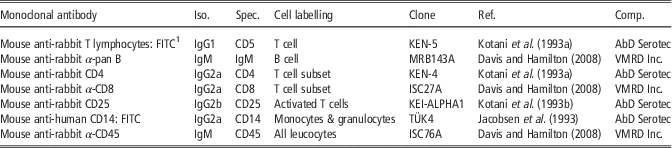
Flow cytometry analysis was performed 1 h after sampling using 1 ml of peripheral blood drawn from the median artery of the ear, using vacuum tubes with EDTA. Before any other procedure, the white blood cell (WBC) count was determined using a haematology analyser (MEK-6410; Nihon Kohden, Tokyo, Japan). Then, blood was transferred to a 50 ml tube, in which 40 ml of ammonium chloride lysing solution at 4°C was added to isolate WBC. After 6 min of incubation in the dark, samples were centrifuged at 400×g for 5 min at room temperature. The supernatant was eliminated and the pellet was carefully resuspended in 1 ml of phosphate-buffered saline 1× (PBS). The density of the suspension was adjusted to 106 cells/ml by counting with Neubauer chamber. Primary monoclonal antibodies were added (Table 1), and incubated for 20 min at room temperature in the dark. Then, the pellet was washed with 1 ml of PBS, and centrifuged again in the same conditions mentioned above. Thereafter, secondary antibodies (Rat anti-mouse IgG 2a+b Phycoerythrin (VMRD, Inc. Exalpha Biologicals, Shirley, MA, USA) and Goat anti-mouse IgM: R-Phycoerythrin-human adsorbed (AbDSerotec)) were added, and incubated for 20 min at room temperature in the dark; 1 ml of PBS was added before running the flow cytometer. The outcome WBC suspensions were analysed in a Cytomics FC500 flow cytometer (Beckman Coulter, Brea, CA, USA). The common leucocyte antigen CD14 and CD45 expression was used for the ‘lymphogate’ setup as previously described (Jeklova et al., Reference Jeklova, Leva and Faldyna2007; Guerrero et al., Reference Guerrero, Ferrian, Blas, Pascual, Cano and Corpa2011). Calculation of total lymphocyte and respective subsets counts were performed as the product of WBC count and specific populations percentages, as described by Hulstaert et al. (Reference Hulstaert, Hannet, Deneys, Munhyeshyli, Reichert, De Bruyere and Strauss1994) and Guerrero et al. (Reference Guerrero, Ferrian, Blas, Pascual, Cano and Corpa2011).
Monoclonal antibodies used for the flow cytometry analysis of this study

Iso.=isotype; Spec.=specificity; Ref.=references; Comp.=company.
1 Clon KEN-5 recognizes rabbit T lymphocytes and immunoprecipitates. This antibody recognizes rabbit CD5, but does not bind to rabbit CD5 transfectants. Known rabbit CD5 antibodies also show binding to most B lymphocytes, which are not labelled by this clone (information obtained from datasheet).
Statistical analysis
The asymmetrical distribution of the original data led to the logarithmic transformation of data from all variables, except from the ratios G/L and CD4+/CD8+, which were directly obtained from the counts (without logarithmic transformation). Data from transformed variables were then analysed using a mixed model (SAS Institute, 2009) including genetic type (H, LP, R), diet (AF, CS), physiological stages (1AI, 1W, 2P, 5W) and their interactions as fixed effects, and the permanent effect of each rabbit female (p) and the error term (e) as random effects. Random effects were assumed to have an average of zero and a variance of σ p 2 for permanent, and σ e 2 for the error term. This way, it is possible to model variance among animals by using a compound symmetric structure for the variance-covariance matrix of the residuals (R), when a repeated measure experiment is performed. As diets were offered from the first parturition on, when the effect of the diet was studied, first insemination data (previous control to diet offering) was removed from the analysis.
Results
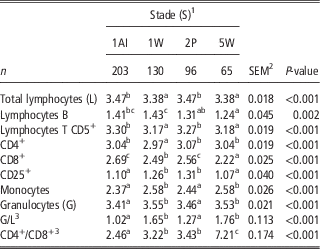
Table 2 shows the blood leucocyte population counts of all rabbit does, at the different physiological stages controlled from the first insemination to the fifth weaning. Lymphocyte populations at both weanings were characterized by lower counts of total, CD5+ and CD8+ (−19.8, −21.7 and −44.6%; P<0.05) and higher counts of monocytes and granulocytes (−49.2 and −26.2%; P<0.05) than in the other controls. Females had higher blood counts of lymphocytes B, CD8+ and CD25+ and lower of CD4+ at first than at fifth weaning (+55.6, +85.8, +57.5, −14.5%; P<0.05). Although no great differences were found for leucocyte counts between first AI and second parturition, CD25+ was higher for the latter (+64.8%; P<0.05). With reference to ratio G/L, it was higher at both weanings (on average 1.71 v. 1.15 for the other controls; P<0.05), and the ratio CD4+/CD8+ was progressively increasing from the 1IA to the 5W (P<0.001).
Evolution of the leucocyte counts in the blood of rabbit females (least square mean; log10 106/l)

n=Number of records per trait.
a,b,cMeans in a row not sharing superscripts significantly differ at P<0.05.
1 Stade (S): 1AI: at the first artificial insemination; 1W: at the weaning of the first lactation; 2P: at the second parturition; 5W: at the weaning of the fifth lactation.
2 Pooled standard error of means.
3 G/L and CD4+/CD8+ ratios were directly obtained from the counts (no logarithmic transformation).
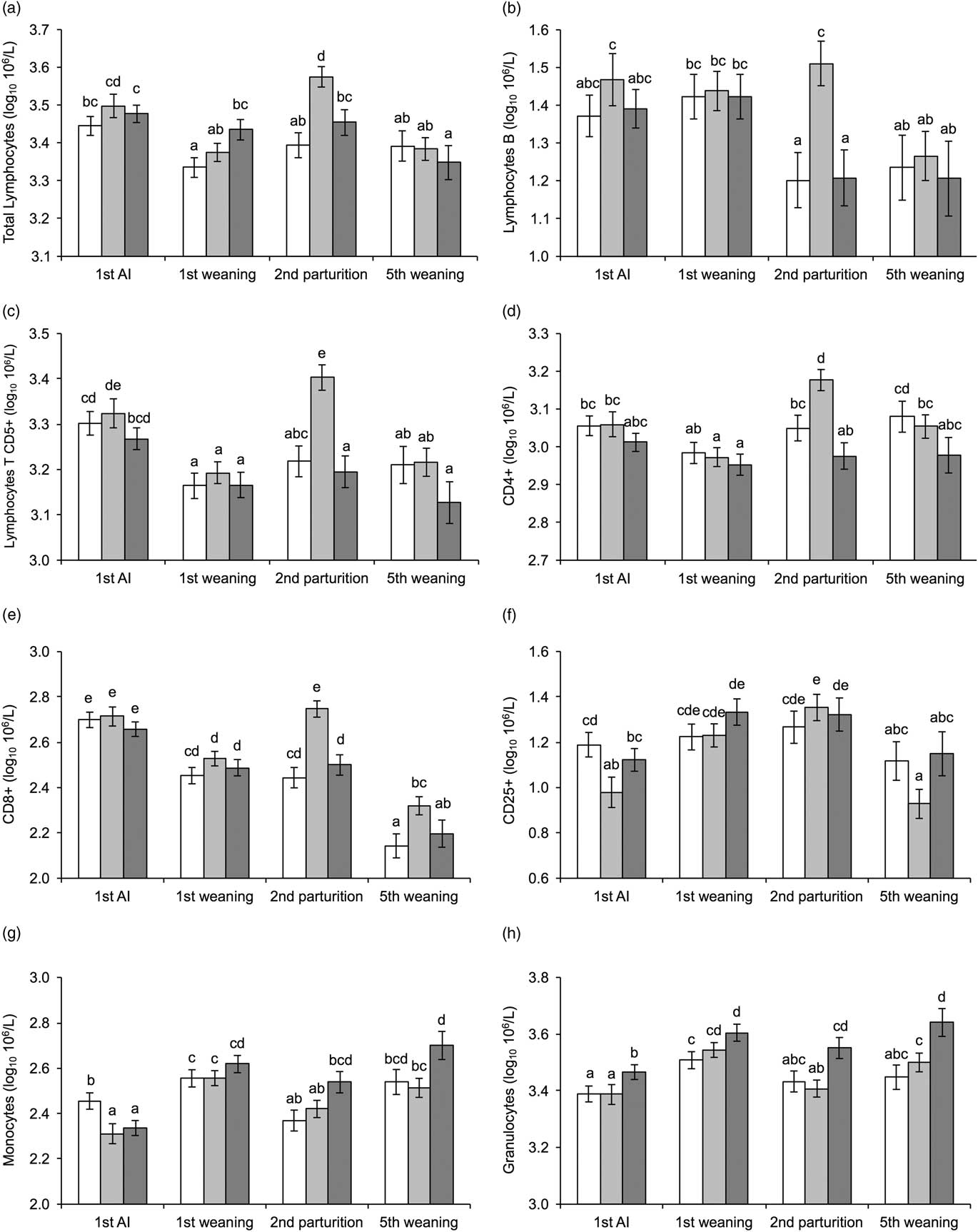
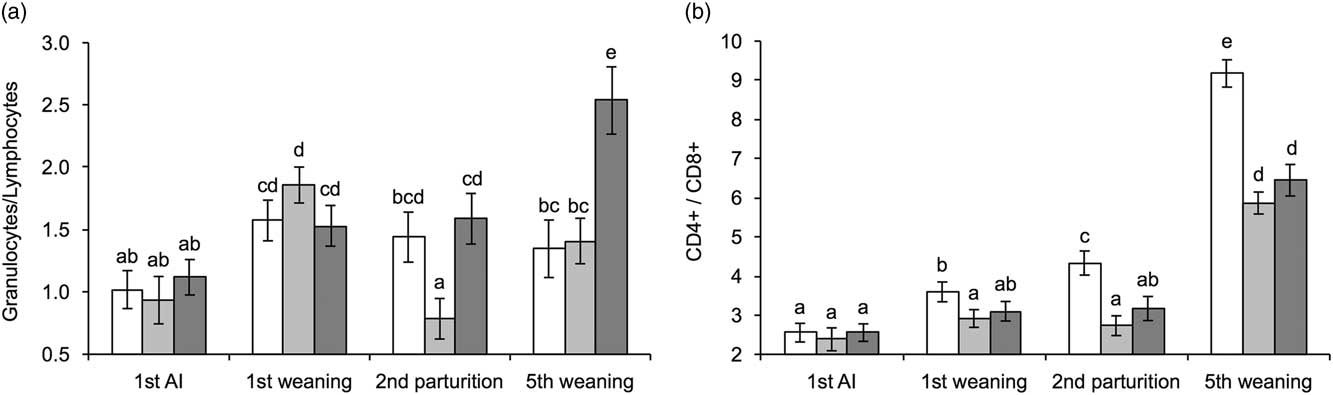
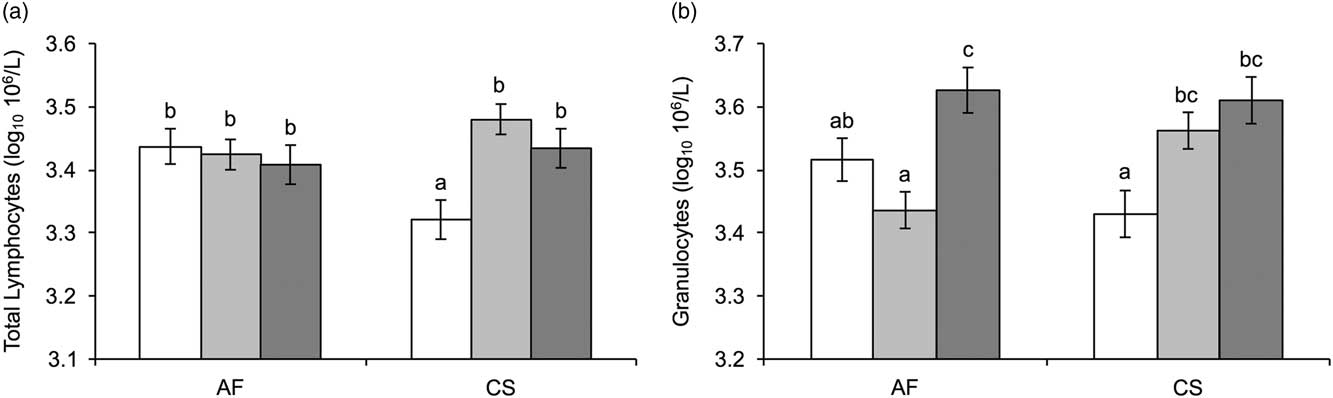
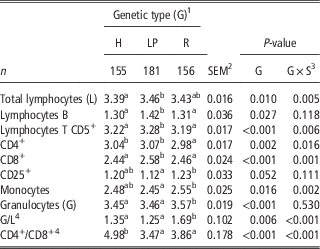
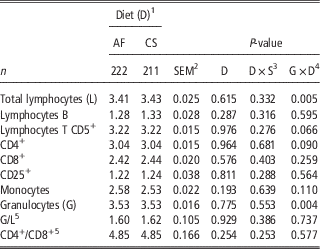
Regarding effect of genetic type in blood leucocyte counts (Table 3), LP rabbit does presented the average highest counts for total, B, CD5+ and CD8+ (+16.7, +31.8, +24.5 and +38.7, respectively; P<0.05). This scenario relates mainly to the higher count of these lymphocyte populations at the second parturition of LP females (Figure 1a, b, c and e). However, R rabbit does showed the highest counts for granulocytes (+27.6%; P<0.05). Granulocyte counts were always the highest for R females (Figure 1h), and although H females showed a higher monocyte count at 1AI, values for R females were greater from first to fifth weaning (Figure 1g). Moreover, R animals showed the highest G/L ratio, due to their greater G/L value at the 5W (2.54 v. 1.38 on average for the other genotypes; P<0.05) (Figure 2a). In addition, H females presented the highest CD4+/CD8+ ratio at 5th weaning. Although no differences were observed at 1AI (Figure 2b), the CD4+/CD8+ ratio of H females increased progressively throughout the period of study, reaching the highest differences at 5W (9.17 v. 6.16 for the other genotypes; P<0.05). Table 4 shows that the type of diet given during the reproductive life did not affect the leucocyte population counts. However, two interactions between the genetic type and the diet for total lymphocytes and granulocytes were observed. Genetic type did not affect total lymphocyte counts when fed with AF diet, but H rabbit does showed significantly lower counts when fed with CS diet (Figure 3a). Regarding the granulocyte counts, the lowest values were obtained for LP females when animals were fed with AF and for H females when fed with CS (Figure 3b).
Interaction genetic type×control for the (a) total lymphocytes, (b) lymphocytes B, (c) lymphocytes T CD5+, (d) CD4+, (e) CD8+, (f) CD25+, (g) monocytes and (h) granulocytes counts in blood of reproductive rabbit females. Genetic type: ( line H, characterized by hyper-prolificacy;
 line LP, characterized by functional hyper-longevity, and
 line R, characterized by daily gain). a,b,c,d,eMeans for a genetic type within a stade not sharing superscripts significantly differ at P<0.05.

Interaction genetic type×control for the (a) ratio granulocytes/lymphocytes and (b) ratio CD4+/CD8+ in the blood of reproductive rabbit females. Genetic type: ( line H, characterized by hyper-prolificacy; line LP, characterized by functional hyper-longevity, and line R, characterized by daily gain). a,b,c,dMeans for a genetic type within a stade not sharing superscripts significantly differ at P<0.05.

Interaction genetic type×diet for the (a) total lymphocytes and (b) granulocytes counts in blood of reproductive rabbit females. Genetic type: ( line H, characterized by hyper-prolificacy; line LP, characterized by functional hyper-longevity, and line R, characterized by daily gain). Diet: CS, mainly based on cereal starch; AF, mainly based on animal fat. a,b,cMeans for a genetic type within a diet type not sharing superscripts significantly differ at P<0.05.

Effect of genetic type on the leucocyte counts in the blood of rabbit females (least square mean; log10 106/l)

n=Number of records per trait.
a,b,cMeans in a row not sharing superscripts significantly differ at P<0.05.
1 Genetic type (G): line H, founded by litter size at birth and selected by litter size at weaning during 17 generations; line LP, founded by reproductive longevity criteria by selecting females from commercial farms that had a minimum of 25 parturitions with more than 7.5 kits born alive per parity and then selected by litter size at weaning for seven generations; line R, founded and selected during 25 generations by average daily gain from the 4th to the 9th week of life.
2 Pooled standard error of means.
3 S: Stade (see Table 2).
4 G/L and CD4+/CD8+ ratios were directly obtained from the counts (no logarithmic transformation).
Effect of diet on the leucocyte counts in the blood of rabbit females (least square mean; log10 106/l)

n=Number of records per trait.
1 Diet (D): CS, mainly based on cereal starch (247 g of starch and 21 g of ether extract (EE) per kg dry matter (DM)); AF, mainly based on animal fat (104 g of starch and 85 g of EE per kg DM).
2 Pooled standard error of means.
3 S: Stade (see Table 2).
4 G: Genetic type (see Table 3).
5 G/L and CD4+/CD8+ ratios were directly obtained from the counts (no logarithmic transformation).
Discussion
The study of haematological parameters and lymphocyte subsets through flow cytometry analyses has been widely used to determine the physiological and pathological changes in the peripheral blood leucocyte subpopulations in different species. Specifically, in rabbits, there are several studies reporting these parameters as adequate indicators for the immunological state of animals of diverse ages and conditions: conventional or SPF animals, neonatal to pubescent rabbits, primiparous rabbit does and adult rabbits (Jeklova et al., Reference Jeklova, Leva and Faldyna2007 and Reference Jeklova, Leva, Knotigova and Faldyna2009; Guerrero et al., Reference Guerrero, Ferrian, Blas, Pascual, Cano and Corpa2011).
It is well established that leucocyte subpopulations vary with ageing. At early stages, newborns start their life with a competent, but still naïve immune system, in which protection provided by the immune mechanisms and by transferred maternal antibodies plays an important role (Kampen et al., Reference Kampen, Olsen, Tollersrud, Storset and Lund2006). In rabbitry, the moment of first mating has frequently been identified as a crucial point in development of the young females. This is the last item of ‘pure’ data on the animal, a sign of the animal soma that is probably related to their productive potential. From this moment on, all their productive records will be conditioned by their reproductive history (Pascual et al., Reference Pascual, Savietto, Cervera and Baselga2013), and specific immune responses will be developed over time against different infectious, environmental or productive challenges. Therefore, all results obtained in this study at 1W, 2P and 5W are compared with a reference sampling control set at the age of first mating (1AI). This scenario allows us to compare the evolution of animals throughout their reproductive life (from 1AI to 5W), housed, fed and bred in the same conditions, aiming to obtain specific, measurable information about the immunological and productive traits of the same group of animals in certain crucial stages. Studies on the evolution of the immune system indicate that stress responses, immunity and inflammation are deeply interconnected and constitute an integrated defence network capable of coping with most stressors (Franceschi et al., Reference Franceschi, Valensin, Bonafe, Paolisso, Yashin, Monti and De Benedictis2000; Larbi et al., Reference Larbi, Francheschi, Mazzatti, Solana, Wikby and Pawelec2008). Even further, previous studies suggest that immune ageing profiles described in laboratory and domestic mammals may generalize to more complex consequences and could develop fitness costs under natural conditions (Nussey et al., Reference Nussey, Watt, Pilkington, Zamoyska and McNeilly2012).
As previously reported (Wells et al., Reference Wells, Decobecq, Decouvelaere, Justice and Guittin1999; Guerrero et al., Reference Guerrero, Ferrian, Blas, Pascual, Cano and Corpa2011; Ferrian et al., Reference Ferrian, Guerrero, Blas, García-Diego, Viana, Pascual and Corpa2012), the present study evidences that leucocyte populations varied throughout the rabbit does’ productive cycle, reaching different levels at the four distinct control moments sampled. Therefore, it is worth discussing them one by one. First, it is interesting to analyse the productive and reproductive conditions characterizing each sampling moment. In that sense, animals at first weaning are influenced by great challenging needs for the production of milk and to be able to cope with their gestation, as they overlap both stages (milking and gestation). As a consequence, they increase their feed intake, and show a moderate level of mobilization, similar to the observed in 1AI but lower than in 2P (see results shown in the first paper of this same series, by Arnau-Bonachera et al., Reference Arnau-Bonachera, Cervera, Blas, Larsen, Martínez-Paredes, Ródenas and Pascual2017a). In rabbit does, the risk of culling peaks during the two first lactations, especially at the end of pregnancy (Rosell and de la Fuente, Reference Rosell and de la Fuente2009). This period includes two of our moments of sampling: first weaning and second parturition. Other species, such as dairy cows, are also more vulnerable to infectious diseases around calving due to immune suppression during this period (Meglia et al., Reference Meglia, Johannisson, Agenäs, Holtenius and Persson Waller2005).
In this sense, second parturition has been specifically described as a physiological state that is especially challenging for rabbit does during their reproductive life (Ferrian et al., Reference Ferrian, Guerrero, Blas, García-Diego, Viana, Pascual and Corpa2012), as it is not only a reproductive challenge but also a crucial period of risk of infections and cellular and tissue damage. However, at this point LP females show higher counts for most lymphocyte populations (total, B, CD5+, CD4+ and CD8+), the significant increase in CD25+ (+64.8%) being especially notable. All these changes may be related with the immune system being more capable of adapting to the challenges of the productive cycle in LP animals than in the other genetic types.
Particularly, CD4+CD25+ is a population of regulatory T cells (Tregs) which are considered as T-activated cells, although there is still no clear consensus on the definition of Tregs. It is known that these cells are essential for maintaining peripheral tolerance, preventing autoimmune diseases and limiting chronic inflammatory diseases (Chen et al., Reference Chen, Du, Lin, Qian, Zhou and Huang2016). These traits favour successfully confronting different challenging physiological stages. However, regulatory activity has also been described in T cells with low expression of CD25, which means that high expression of CD25 itself is not enough to characterize all Tregs (Dejaco et al., Reference Dejaco, Duftner, Grubeck‐Loebenstein and Schirmer2006). Therefore, other specific markers are being used to identify Tregs. In the last few years, FOXP3 has been established to be the most specific marker of Tregs (Sakaguchi, Reference Sakaguchi2005). Unfortunately, in this study Tregs counts were determined by marking positive for CD25 T cells population, but FOXP3 should have been used for a more specific determination of Tregs prevalence. This fact is due to the limiting availability of commercial antibodies against FOXP3 suitable to be used in rabbits’ flow cytometry.
Following with the comparison between genetic lines at second parturition, it is worth to mention that, due to the increase in the number of lymphocytes but not of granulocytes, the G/L ratio was lower for LP animals. As numbers of neutrophils and lymphocytes oscillate in opposite directions under stressful conditions, researchers have often considered the ratio of one to the other as a composite measure of the stress response (Davis et al., Reference Davis, Maney and Maerz2008). G/L ratio is a stress indicator that is known to increase in the presence of various stressors, diseases or infections (Davis et al., Reference Davis, Maney and Maerz2008). In other species, and even in birds, it has also been shown that parents that make intense reproductive effort have high G/L values (Horak et al., Reference Horak, Ots and Murumägi1998). Moreover, high G/L ratios have been associated in birds with susceptibility to infection (Al-Murrani et al., Reference Al-Murrani, Al-Rawi and Raof2002) or low survival to the next breeding season (Kilgas et al., Reference Kilgas, Tilgar and Mänd2006). These associations can make G/L ratios valuable for predicting future problems in both populations and individuals. Although leucocyte profiles do not indicate the number of granulocytes or lymphocytes that are available in reserve in other body compartments, or how many would be released or redistributed in response to a stress or infectious agent (Davis et al., Reference Davis, Maney and Maerz2008), the fact that seems clear is that rabbit does from LP line reach the 2P in an immunologically less stressful situation than the other lines.
Arnau-Bonachera et al. (Reference Arnau-Bonachera, Cervera, Blas, Larsen, Martínez-Paredes, Ródenas and Pascual2017a) reported in the first paper of this series a higher mobilization throughout the first reproductive cycle, reaching the 2P in better conditions and suffering less stress during the following cycle. In the same sense, the immunological data described in this work back up the hypothesis that animals from LP lines are more robust than the other genetic types, as they are able to adapt to reproductive challenges by using their body reserves more accurately. Moreover, they seem to be able to manage their body reserves as if they were predicting future needs. In that sense, the metabolic profile of LP line in 2P is characterized by a higher level of glucose and a lower level of NEFAs, showing great differences in the ratio glucose/NEFAs when compared with H and R females at 2P. In fact, T lymphocytes specifically require glucose uptake for cell survival, size, activation and cytokine production, and they consume it at high rates in a function-dependent manner (Maclaver et al., Reference Maclaver, Jacobs, Wieman, Wofford, Coloff and Rathmell2008). The close association between glucose metabolism and lymphocyte function has been suggested to introduce the possibility of several pathologies resulting from the inability of these cells to meet their nutrient demands under a given condition (Wasinki et al., Reference Wasinki, Gregnani, Ornellas, Bacurau, Câmara, Araujo and Bacurau2014). In this group of animals, the direct correlation between the level of glucose (Arnau-Bonachera et al., Reference Arnau-Bonachera, Cervera, Blas, Larsen, Martínez-Paredes, Ródenas and Pascual2017a) and the number of lymphocytes is observed regardless of the genotype and the temperature (+0.23±0.11; P<0.05). Therefore, higher counts of total, CD5+ and CD8+ lymphocytes in LP females at 2P seems to be associated to the peak of glucose shown at that moment and not to any of the other factors included in Arnau-Bonachera et al. (Reference Arnau-Bonachera, Cervera, Blas, Larsen, Martínez-Paredes, Ródenas and Pascual2017a). In other words, LP rabbit does managed to have higher levels of glucose available at the most challenging time of their reproductive life, which implies a guaranteed supply of nutrients for the activation and function of lymphocytes. This mechanism of adaptation may be suggested as one of the factors contributing to increase the robustness of these animals, which may consequently be likely to live longer, although longevity is not their criteria of selection. Our data reinforce the hypothesis that the animals from a line founded by screening for reproductive longevity (LP line), under normal favourable breeding conditions, develop a greater immunological ability to confront reproductive challenges and to confer animals a more robust nature (Ferrian et al., Reference Ferrian, Guerrero, Blas, García-Diego, Viana, Pascual and Corpa2012; García-Quirós et al., Reference García-Quirós, Arnau-Bonachera, Penadés, Cervera, Martínez-Paredes, Ródenas, Selva, Viana and Corpa2014).
Regarding weaning, differences between lymphocyte populations from the first and the fifth weaning were detected. Taking into account that both sampling moments represent the same type of reproductive challenge (weaning), we hypothesized that the effect of the ageing may be one of the main factors that caused these variations. Some changes regarding aging in the leucocyte populations have been described in other species. One of the most reported data items is the CD4+/CD8+ ratio, which in our study is decreased in animals at fifth weaning compared with first weaning, as it has been described as a normal effect of aging in other species (e.g. mice, Callahan et al., Reference Callahan, Kappler and Marrack1993; cattle, Ayoub and Yang, Reference Ayoub and Yang1996; humans, Castelo-Branco and Soveral, Reference Castelo-Branco and Soveral2014). In this work, the H line showed the highest increase in the CD4+/CD8+ ratio at 2P, which can be considered as one of the signs related with an earlier ageing of their immune system (see also the third paper of this same series, by Arnau-Bonachera et al., Reference Arnau-Bonachera, Savietto and Pascual2017b).
In reference to the interaction between genetic type-diet and leucocyte populations, few remarkable data were found. The only statistically significant data observed were the decrease of total lymphocyte in H animals with CS diet, and the increase of granulocytes in LP females fed with CS diet. Both facts are probably related to the way of managing their body resources. H rabbit does are very dependent of their body condition, as they need to be able to feed very large litters. However, excessive fat deposits can also be counterproductive, as they diminish fertility and increase mortality (Arnau-Bonachera et al., Reference Arnau-Bonachera, Cervera, Blas, Larsen, Martínez-Paredes, Ródenas and Pascual2017a and Reference Arnau-Bonachera, Savietto and Pascual2017b). On the contrary, LP animals do not depend on their body condition as much as H animals, mainly because they have developed several different mechanisms to modulate their responses and keep the energy homeostasis balance without reducing their fertility, while being able to maintain most of their litter alive until weaning.
Despite the significant statistical nature of our data from the study, we are aware that sometimes the variation in the values of health and immunological traits combined with productive and reproductive parameters are difficult to interpret, as the meaningfulness of the changes in particular values is largely unknown. Moreover, it must be taken into account that ageing is a complex and multi-factorial process, and defective immune responses in aged and multiparous animals are likely to be caused by the interaction of accumulated weaknesses throughout the immune system rather than to one individual aspect of a single immune cell type function (Plowden et al., Reference Plowden, Renshaw-Hoelscher, Engleman, Katz and Sambhara2004a and Reference Plowden, Renshaw-Hoelscher, Gangappa, Engleman, Katz and Sambhara2004b). However, the observed relationships, though suggestive, are not able to firmly indicate a causal link between some aspects of the immunological condition during the reproductive life of animals from three different genetic types. Therefore, further research would be important in order to establish a correlation between this type of data and future survival probability. In fact, similar hypotheses have been previously considered, suggesting that age-dependent differences in immunity may become targets for natural selection in other species of mammals (Nussey et al., Reference Nussey, Watt, Pilkington, Zamoyska and McNeilly2012).
Conclusions
The present study has evidenced that leucocyte populations vary throughout the rabbit doe’s productive cycle. According to our results, oscillations were different depending on the genetic line and the stage of the reproductive cycle. However, the interaction between genetic type and diet did not cause important changes in leucocyte populations. Animals founded for high robustness (LP line) showed greater ability to adapt immunologically to the reproductive challenges than those selected by hyper-prolificacy (H line) or by growth rate (R line). Differences among lines were especially remarkable at a critical physiological moment such as the second parturition. Although genetic, management and nutritional strategies developed over the last few decades have brought valuable advances in the rabbit industry, it seems that they have also caused undesired consequences affecting, among other factors, the ability of the animals to maintain a stable and competent immunological status throughout their productive life.
Acknowledgements
This study was supported by the Interministerial Commission for Science and Technology (CICYT) of the Spanish Government (AGL2014-53405-C2-1-P; AGL2014-53405-C2-2-P). The authors thank Juan Carlos Moreno for his technical support. Grants for Ana García-Quirós from Universidad CEU-Cardenal Herrera, and Mariola Penadés and Alberto Arnau from the Ministerio de Educación, Cultura y Deporte (AP2010-3907 and BES-2012-052345, respectively) are also gratefully acknowledged.