A widespread scholarly consensus holds that the functioning of representative democracy requires a politically sophisticated citizenry.Footnote 1 As the much-used quote from Berelson et al. (1954: 308) puts it, the democratic citizen should show interest in politics and be well informed about it. To address this normative statement empirically, numerous studies have been devoted to examining the socioeconomic and demographic determinants of citizens’ political sophistication. Middle-aged men with high education and income have typically been found to be positively related to general political knowledge2 (e.g. Delli Carpini and Keeter Reference *Delli Carpini and Keeter1996; Fraile Reference Fraile2011; Verba et al. Reference Verba, Burns and Schlozman1997; see also Rapeli Reference Rapeli2013 for review).
Recent advances have made this overall picture sharper. A growing body of evidence suggests that various types of issue-publics exist. These are groups of people who are very attentive to and knowledgeable about some aspect of politics but relatively oblivious to other aspects (Converse Reference Converse1964; Henderson Reference Henderson2014; Hutchings Reference Hutchings2001; Sides and Karch Reference Sides and Karch2008). For example, several studies have shown that although men are generally more knowledgeable than women, the gender gap diminishes or even disappears when knowledge about issues that are closer to the life experiences of women is measured (Dolan Reference Dolan2011; Stolle and Gidengil Reference Stolle and Gidengil2010). A similar pattern has recently been discovered in regard to the gap between the Latino minority and the White majority in the US (Pérez Reference Pérez2015). Moreover, young people, who have been branded as a particularly ignorant group, are at least as knowledgeable about the European Union as older age cohorts (Rapeli Reference Rapeli2014). The conventional measures of general political knowledge therefore seem to suffer from a certain degree of bias that underestimates the sophistication of certain sociodemographic groups. When digging a little deeper, well-educated and well-to-do middle-aged males no longer appear to be the undisputed champions of political knowledge. In addition to mapping out the sociodemographic landscape of political knowledge, scholarship has found many links between knowledge and political opinions.
While the individual determinants of political behaviour and attitudes provide valuable insight into how representative democracy functions, representative democracy ultimately rests on election results. This raises the crucial question of whether the public’s political sophistication also affects electoral behaviour and outcomes. If it does not, the meaningfulness of the entire research field is greatly reduced.
To better understand the significance of citizen competence for democracy, scholars have increasingly begun to shift their focus from studying the socioeconomic predictors of political knowledge to studying its electoral consequences. This article is a research inventory and critical examination of studies which have examined whether and how electoral behaviour and election results look different depending on what people know about politics. It seeks to answer three closely related questions:
-
1. Would citizens be able to cast votes which better correspond with their personal preferences if they were more knowledgeable about politics?
-
2. Which political parties and candidates, if any, would benefit if citizens were able to cast more informed votes?
-
3. Would changes in vote choices which are attributable to increased knowledge levels lead to dramatically different electoral results?
The first question addresses the importance of increased information for the quality of vote choice. The second question examines the possible direction of change in electoral results due to an increase in information levels; the third question examines whether that change would be substantial enough to affect the outcome of the democratic process. By providing answers to these questions, this article presents the current state of knowledge concerning the significance of political knowledge for elections.
ENLIGHTENMENT OR LOW-INFORMATION RATIONALITY?
Although scholars acknowledge that some degree of sophistication is needed for political action, there is no scholarly consensus in regard to how much. The true significance of political sophistication among democratic publics is a question that divides the researchers who study it. Althaus (Reference Althaus2006) has contended that the call for an enlightened public has in fact resulted from a careless reading of classic democratic theorists. According to his persuasive account, democratic theory does not make nearly as stringent demands about citizen competence as depicted by the modern empirical literature on the topic.
Even if the theoretical foundations were off the mark, empirical questions about citizen competence remain. Referring to survey findings, one group of scholars has typically painted a very pessimistic picture of citizen competence, while others have offered various reasons explaining why this is not a problem. Perhaps the most influential, or at least the most debated, argument relies on the ‘low-information rationality’ principle. Developed most notably by Popkin (Reference Popkin1991) and Lupia and MacCubbins (Reference Lupia and MacCubbins1998; see also Erikson Reference Erikson2007), proponents of this view argue that although survey measures make them look ignorant, citizens skilfully and efficiently utilize various shortcut techniques to make sense of politics and to arrive at decisions of the same quality they would have, had they been more politically knowledgeable. While citizens undoubtedly make use of various shortcuts, such as party identification, empirical accounts provide little support for the idea that low-information rationality makes people equally informed (but see Lupia Reference *Lupia1994). Arnold (Reference *Arnold2012: 797) has argued that the model only tends to get support in laboratory experiments which are designed to model US presidential elections. Restricted to a specific context which is by no means representative of other electoral contexts, such experiments are unable to produce generalizable results. The problem is that the least knowledgeable people, who are in most need of information shortcuts, are also the least able to use them effectively (Lau and Redlawsk 2001). A recent study by Dusso (Reference *Dusso2015: 59) concludes that ‘high knowledge voters do not need cues at all, while the stronger low-information voters identify with a party, the more likely they are to vote incorrectly’. According to Dusso, party identification therefore has the opposite impact on the quality of voting among the low-sophistication stratum, as it reduces their ability to find the right candidate.
Another account relies on the Condorcet jury theorem. It claims that although individuals may not live up to the expectations, an electorate as a whole nevertheless has stable preferences which it effectively communicates through elections because sub-optimal choices cancel each other out in a large crowd (Page and Shapiro 1992). But research does not convincingly support the idea that aggregation of opinion miraculously saves democracy from ignorance. The problem is that there is systematic variance in public opinion and electoral behaviour which is related to citizen competence. Certain types of individuals and groups are less knowledgeable than others and they also participate in different ways than more knowledgeable people. Sturgis (Reference Sturgis2003) concludes that while the effects of knowledge differences might cancel out each other in many instances, in at least as many other cases they do not; the assumed self-correcting mechanism of public opinion is neither predictable nor reliable.
A third set of studies has criticized the survey measures which have produced the image of an ignorant public. Many scholars have argued against the use of questions that measure encyclopedic knowledge about politics, such as the names of key office-holders (e.g. Lupia Reference Lupia2006: 219; Norris Reference Norris2000: 227–8). According to critics, such questions bear little significance to actual political behaviour and fail to reveal the range of knowledge people actually might have about politics. The survey method itself also seems to depress knowledge scores. Prior and Lupia (Reference Prior and Lupia2008) have shown experimentally that providing a monetary incentive to make a real effort to answer questions correctly raises the number of correct responses up to 24 per cent. The most recent critique by Prior (Reference Prior2014) suggests that in addition to the verbally expressed knowledge measured in surveys, we should also measure visual political knowledge. Most of the political information citizens nowadays receive is in visual format, and the human memory is very effective in storing things visually. A related possibility suggests that political preferences that underlie vote choices are based on a continuous process of online processing (e.g. Lodge et al. Reference Lodge, MacGraw and Stroh1989; Zaller Reference Zaller1992): new information becomes incorporated into the existing stock of information. Although many pieces of information thereby may affect political attitudes and behaviour, they may not be retrievable from memory. Due to these several possibilities, survey measures are likely to fail to capture the entire breadth of knowledge that citizens actually possess.
Despite these serious methodological concerns, knowledge seems to be related to attitudes and behaviours that are important for the functioning of democracy. Politically knowledgeable individuals are particularly supportive of a representative conception of democracy which emphasizes voting as the primary means of political action (Bengtsson and Christensen Reference Bengtsson and Christensen2016). Summarizing previous research, Visser et al. (Reference Visser, Holbrook and Krosnick2008: 133) conclude that ‘a good deal of evidence suggests that people who possess a large store of political knowledge are better able to recognize links between particular policies and their own material interests or other core predispositions, and they are better able to identify political candidates who are likely to share their views and work to enact laws that they support’. They refer to the body of literature which has found, for example, that the opinions of knowledgeable people are better attuned to their preferences or ideology (Bennett Reference Bennett1995; Delli Carpini and Keeter Reference *Delli Carpini and Keeter1996; Federico and Hunt Reference Federico and Hunt2013; Zaller Reference Zaller1992) and that knowledgeable people hold more stable opinions (Feldman Reference Feldman1989; Sciarini and Kriesi Reference Sciarini and Kriesi2003). These individual-level findings seem to have collective consequences. In his seminal study, Althaus (Reference Althaus1998) showed that the public’s policy preferences would be different approximately 20 per cent of the time if the public was fully informed about politics. Although policy preferences would therefore remain unaffected by knowledge gains in most cases, Althaus considers the distortions caused by public ignorance to be significant. Gilens (Reference Gilens2001) found that policy-specific knowledge considerably affects citizens’ political decisions and that gaps in knowledge cause serious distortions in collective preferences.
To summarize, the evidence suggests that political sophistication affects the democratic process by influencing opinion formation. The formal expression of opinions in a democracy occurs through elections, and it is therefore arguably in elections that we must look for the true significance of citizen competence for democracy.
SOPHISTICATION AND ELECTIONS
It is commonly understood that the democratic citizen needs to be informed about politics in order to be able to cast a meaningful vote (see e.g. Delli Carpini and Keeter Reference *Delli Carpini and Keeter1996: 14; Downs Reference Downs1957: 215; Weissberg Reference Weissberg1974: 71). Although it is unclear precisely how much information is enough for an informed vote in any given institutional setting, it is at least implicitly assumed that, generally speaking, more information leads to better vote choice and therefore to better government responsiveness to citizen preferences.
This attractive reasoning has produced a set of studies which originate from the pioneering work by Lau and Redlawsk (Reference *Lau and Redlawsk1997). They developed the concept and measurement of ‘correct voting’ in order to analyse the extent to which citizens are able to vote according to their own preferences. It builds on the directional theory of issue voting by Rabinowitz and Macdonald (Reference Rabinowitz and Macdonald1989), which assumes that people’s vote choices are based on preferences along a (left–right) continuum which corresponds to the positions of candidates who stand for election. By measuring how well people can match themselves with candidates on a preference continuum – and vote for the most suitable candidate – Lau and Redlawsk provided a metric that has inspired many other scholars. They do not, however, claim to say anything about how ‘good’ a vote is in terms of the interests of the society. Instead, they define the goodness of a vote as being ‘based on the values and beliefs of the individual voter’ and ‘that [it] is the same as the choice which would have been made under conditions of full information. Ideally, this determination can best be made subjectively, by the voter, on an individual basis’ (Lau and Redlawsk Reference *Lau and Redlawsk1997: 586). Defined in this manner, the correctness of a vote ultimately rests on the subjective judgement of the voter. The authors also measured correct voting based on expert judgements of the actual positions of parties/candidates on issues. The two measures correlated strongly, but given that the first measure requires an experimental design, the second one has been more widely used in subsequent literature which has relied on survey data. Thus, correct voting has typically been operationalized either as a measure of whether a person votes for the option that best matches personal preferences or as a function of party identification and satisfaction with politicians’ performances. In this literature, political knowledge has been employed as a predictor of correct voting.
Another set of studies that are of interest to the research questions has addressed sophistication in terms of how it affects actual election results. This literature is also dominated by a method developed in the US during the mid-1990s. In what quickly became a landmark study in the field, Bartels (Reference *Bartels1996) undertook the task of examining what the electoral consequences (if any) would be if voters in US presidential elections had more political knowledge. He created a counterfactual method where a hypothetical fully informed electorate is created from survey data. Although admittedly artificial in many ways, the method allows the researcher to compare reported voting behaviour with simulated ‘fully informed’ voting behaviour. The Bartels method has been used in practically all studies examining the impact of sophistication on electoral outcomes since 1996, which offers comparability across studies.
The following section reviews studies published since the study by Bartels in 1996 which marks the starting point of the recent wave of empirical analyses concerning the electoral consequences of citizen competence.3 Attempting to evaluate the current state of the discipline, the analysis is restricted to studies that focus explicitly on the consequences of political knowledge on the quality of vote choice and election results. The dependent variable in the reviewed studies is either a measure of correct voting or an election result, and all studies include a measure of political sophistication as an independent variable.
ANALYSIS
The body of literature to be reviewed was searched for in two complementing ways. First, following the example of Smets and Van Ham (Reference Smets and van Ham2013), 12 leading political science journals that regularly publish studies on political knowledge were scrutinized.4 Second, the literature reviews and references in the articles found in these journals were searched for more studies. The resulting 32 studies represent the most significant contributions to this particular research agenda from the past 20 years. Because the analysis only includes studies that have undergone rigorous peer review in prominent journals, some commendable conference papers, for instance, fall outside the scope.5
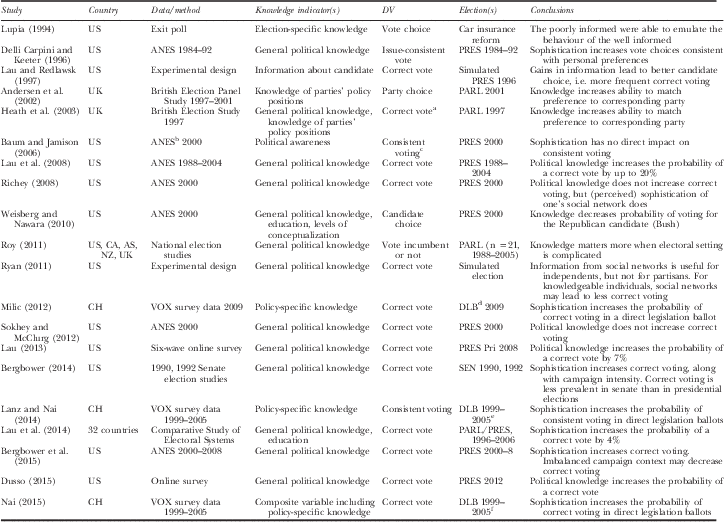
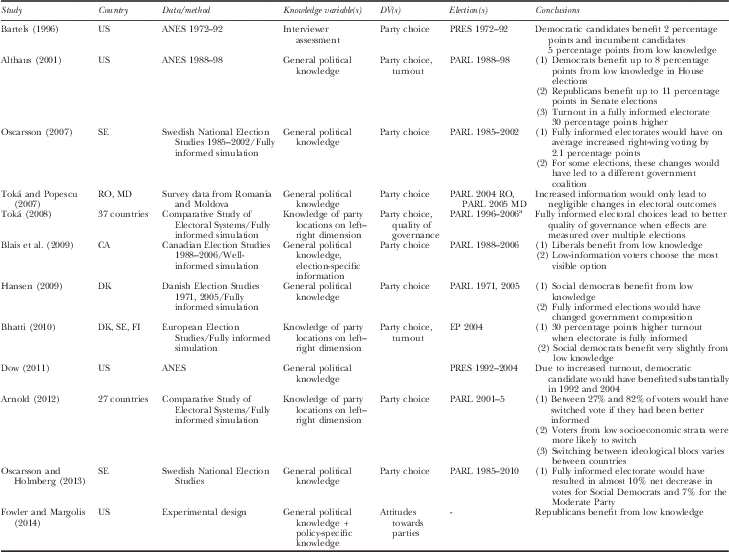
The results are presented in Tables 1 and 2. The tables report the type of data and method the studies have used, and the countries included in the analyses. They also report what elections the studies cover, what knowledge indicator has been used and what the main findings of each study are. A reported finding means that the study in question has found a statistically significant (at 0.05 level or more significant) relationship between the examined variables. The column marked ‘DV’ reports the dependent variable. Let us begin with Table 1, which primarily answers the first research question: Would voters be better able to cast informed votes if they were more knowledgeable about politics?
Consequences of Political Knowledge on Vote Choice

Notes: aDefined simply through one-dimensional policy positions.
bANES = American National Election Studies.
cSame as correct voting, although authors use the term consistent voting.
dDLB = for direct legislation ballot.
eIn total 51 ballots during this period.
fIn total 75 ballots during this period.
Consequences of Political Knowledge on Electoral Results

Note: a The time frame is for the Comparative Study of Electoral Systems data. For some countries, elections for which individual turnout is measured may extend further back than 1996.
The answer to the question of whether voters would be able to cast better quality votes if they were more knowledgeable about politics is a cautious ‘yes’. Taken as a whole, the analysed studies much more often than not find that sophistication increases voting according to a person’s preferences. The reviewed studies are, however, dominated by the US and therefore by a majoritarian electoral context with only a very few competitive parties. Apart from the comparative study by Lau et al. (Reference *Lau, Patel, Fahmy and Kaufman2014), proportional, multiparty systems are largely absent among the reviewed studies. Considering the finding by Roy Reference *Roy(2011) that sophistication matters even more when the electoral setting is complicated, the lack of studies from more complex electoral environments is troubling. In terms of methods, data, key variables and election coverage the findings seem more robust and comparable. Most studies rely on national election studies with similar political knowledge items and measures for policy preferences and voting behaviour.
While the other studies examine voting in parliamentary or presidential elections, three recent studies from Switzerland (Lanz and Nai Reference *Lanz and Nai2014; Milic Reference *Milic2012; Nai Reference *Nai2015) provide unique evidence of correct voting in direct legislation ballots. They find that sophistication also increases the likelihood of correct voting in the context of choosing between policy proposals. The Swiss studies show that the quality of direct democracy is also enhanced if the citizenry is informed.
When the general pattern is fairly uniform, the details can be revealing. Several studies have examined correct voting in the 2000 US presidential elections with the American National Election Studies (ANES) 2000 data – but reached different conclusions: Baum and Jamison (Reference *Baum and Jamison2006), Richey (Reference *Richey2008) and Sokhey and McClurg (Reference *Sokhey and McClurg2012) did not find that sophistication increases correct voting, while Bergbower et al. (Reference *Bergbower, McClurg and Holbrook2015) did. Baum and Jamison created a political awareness index from several variables, political knowledge among them. However, it seems that the potential impact of knowledge on voting disappears in this composite variable. Richey and Sokhey and McClurg both include a measure of the self-assessed sophistication of one’s social network, Bergbower et al. do not. It seems that including the network sophistication variable in the equation overrules the impact of political knowledge. This is possibly symptomatic of an endogeneity problem: a person’s own level of knowledgeability is probably related to that of one’s social network and – at least in the 2000 ANES data – the latter has more statistical power than the former in explaining correct voting. Richey speculates that the statistical insignificance of political knowledge is due to the presence of education in the model, which is similarly insignificant. This explanation does not seem particularly likely since Sokhey and McClurg also include the same variables and find education to be statistically significant. In addition to the possible confounding effect of network sophistication, it seems possible that minuscule differences in the coding and operationalization of closely related variables can lead to slightly different results even when using the same data. Given these uncertainties, it is currently very difficult to draw sound conclusions about the impact of network sophistication on correct voting. It is to be hoped that future contributions to this particular agenda will try to disentangle this confusing set of interrelated factors.
Excluding these perplexing cases, which are potentially quite problematic analytically, the existing research overwhelmingly suggests that sophistication helps people vote according to their personal wishes and attitudes. Table 2 provides answers to the two remaining research questions: who benefits from increased sophistication, and would that sophistication cause substantial shifts in political power?
There is more variation in terms of national and electoral contexts among these 12 studies than among those in Table 1. Party choice, which is used to calculate aggregate election results, is the most typical dependent variable. There are two exceptions. Fowler and Margolis (Reference *Fowler and Margolis2014), who unlike the other studies rely on experimental data, use party evaluations as the dependent variable.6 Toká (Reference *Toká2008) also uses quality of governance as a dependent variable in addition to party choice to model the effects of information on the democratic output. Although most studies examine knowledge effects in parliamentary elections, Bartels (Reference *Bartels1996) studies presidential elections and Bhatti (Reference *Bhatti2010) elections to the European Parliament. The time span, the years from 1971 to 2006, is extensive.
The underlying hypothesis, explicitly stated by Arnold (Reference *Arnold2012) and Fowler and Margolis (Reference *Fowler and Margolis2014), is that increased information would benefit parties and candidates on the political left, for which the poorly informed and socially disadvantaged segments constitute a ‘natural constituency’. Using the counterfactual method for simulating fully informed electoral behaviour, the existing research offers little support for the natural constituency hypothesis. In fact, the political right would more often benefit from higher voter sophistication. This holds across different countries and political systems which are relatively well represented among the studies. Findings from the majoritarian systems in the US and Canada and from the proportional, multiparty systems of Scandinavia both suggest that right-wing parties would often gain several percentage points in votes if electorates were more informed about politics. In many, but not all, cases the vote shifts would also have led to government formations different to those that actually materialized.
There are, however, enough exceptions to confuse this overall pattern. Interestingly, one study that contradicts this finding is also the only study to use experimental rather than survey data. According to Fowler and Margolis, knowledge increases would lead the low socioeconomic strata to better identify the (US) Democratic Party as the defender of their interests. Dow (Reference *Dow2011) argues that the Democratic presidential candidate would have received substantially more votes in the 1992 and 2004 elections because turnout would have been so much higher in a fully informed electorate. Offering much-needed comparative analysis of information effects in different types of political systems, Arnold (Reference *Arnold2012) finds several instances where the left would gain from increased sophistication. According to his analysis, the net increases of leftist voting were considerable (>10 per cent) in Brazil, France, Finland, Israel, Mexico, the Netherlands, Switzerland, Taiwan and the UK. There were, however, significant net losses in almost as many countries: Bulgaria, Canada, the Czech Republic, Denmark, Hungary, New Zealand, Poland and Sweden. As Arnold (Reference *Arnold2012: 810) also concludes, the pattern is inconsistent and there is no clear reason why the countries differ from each other. The answer of who would benefit if popular knowledge levels were higher is therefore mixed. While research suggests that someone would in most cases benefit, and that it would be the political right slightly more often, no general rule of thumb can be established based on existing knowledge.
Additionally, Toká and Popescu (Reference *Toká and Popescu2007) make an interesting contribution by analysing two newly democratized nations, Romania and Moldova. As the authors explain, informational shortcuts through widely familiar political stances of parties and politicians are not as readily available to voters in new democracies as they are in old democracies. While this could supposedly open up the possibility of larger information effects in elections, Toká and Popescu do not find the effects of increased sophistication on election results to be particularly convincing.
The answer to the third and final question concerning the extent of change in electoral results due to information gains among voters is similarly mixed. Moreover, only a handful of studies provide an assessment of this crucial question. Although Arnold (Reference *Arnold2012) does not explicitly calculate the real-life consequences, the magnitude of vote switching in his findings – which varies between 27 and 82 per cent of voters in the analysed countries – is so large that fully informed elections would most likely have produced different governments in many, if not most, cases. Hansen (Reference *Hansen2009) and Oscarsson (Reference *Oscarsson2007) conclude that for Denmark and Sweden, respectively, the effects of fully informed voting would in some elections have resulted in other government coalitions than the ones they actually produced. For the US the effects are more modest, which suggests that information effects may be more significant in multiparty contexts with less clear lines of political responsibility.
CONCLUSIONS
According to the majority of existing research, sophistication increases the ability to cast a vote which agrees with one’s political attitudes. With a good amount of hesitation, it can be concluded that the political right, rather than the left, would slightly benefit from a more sophisticated electorate. In some cases, the votes from more sophisticated voters would have resulted in a different government or president, but the available evidence does not suggest major electoral shifts would routinely occur due to increased sophistication. There is, however, great diversity between countries and elections.
These conclusions come with several important restrictions. What we know about people’s ability to vote correctly depends entirely on the assumption that people make a directional, left–right dimensional calculation when they decide how to vote – and that the candidates can also be positioned along the same dimension. Recent advances from other fields cause some discomfort with this approach. There is some degree of consensus from various countries that the left–right dimension is now accompanied by another, cross-cutting dimension, often termed the cultural dimension (e.g. Mattila and Raunio Reference Mattila and Raunio2006, Reference Mattila and Raunio2012; Thomassen Reference Thomassen2012; van der Brug and van Spanje Reference van der Brug and van Spanje2009). This has profound consequences for the formation of voter preferences and party positions and makes determining ‘a correct vote’ a good deal more complicated. Moreover, the correct voting literature is almost invariably restricted to analyses from the US and the UK, which are not representative of all political systems. Both are examples of majoritarian electoral systems, with very few effective parties, sharing many features common to the Anglo-American (political) culture.
The only comparative study which breaks this pattern shows that voters are better able to cast informed votes in political systems that are simple to understand – systems with clear lines of government responsibility and only a few, ideologically distinct, parties competing for power. Although being knowledgeable increases the probability of a correct vote across all systems, it is still unclear how knowledge interacts with system-level differences to predict correct voting – that is, whether knowledge is a stronger individual-level predictor of correct voting in systems that are complicated, as would seem intuitive (see also Gordon and Segura Reference Gordon and Segura1997). The impact of knowledge on correct voting under different systemic circumstances can thus be identified as a gap to be filled by future research.
Contrary to what might have been expected, evidence from both majoritarian and proportional electoral systems and various types of elections suggests that parties of the political right would at least as often as the political left benefit from a better-informed electorate. The unified front is broken by two studies. Unlike all others, Fowler and Margolis (Reference *Fowler and Margolis2014) do not rely on the statistical imputation of a ‘fully informed electorate’ from survey data. Their experimental evidence suggests precisely the opposite, namely that information gains would benefit the political left. Arnold’s (Reference *Arnold2012) cross-national study also indicates slightly higher benefits of information gains for the political left. There is, thus, an obvious conflict, which calls for more attention. If the results are consistently contradictory depending on the method that is being used, it seems obvious that the choice of method is driving the results.
Moreover, the counterfactual method itself, on which this body of research almost exclusively relies, has been questioned. In their persuasive study, King and Zeng (Reference King and Zeng2007), argue that counterfactual analyses tend to extend the limits of the empirical data being used to a point where the results can no longer be trusted. Such analyses rely on cross-sectional survey data, which causes much concern among scholars. Levendusky (2011) points out that panel data would be optimal for examinations of information effects on voting. According to Levendusky, the analyses such as those reviewed in this study suffer from serious omitted variable bias which can at least partly be dealt with through the use of matching techniques. His analysis showed substantially smaller information effects on elections when matching instead of statistical imputation was used. In similar fashion, Pierce (2015) has suggested that the driver behind what has been interpreted as information effects is actually psychological differences between high- and low-information individuals. Casting further doubt over the use of cross-sectional survey data, Fowler and Margolis (Reference *Fowler and Margolis2014) make the simple yet powerful point that it is hardly surprising that the behaviour of people on the left often shows more change due to increased information, because they tend to come from those sections of society where political knowledge is lower. Consequently, in their view, experimental research can more reliably isolate the true impact of information despite suffering from the ever-present problems of external validity (Fowler and Margolis Reference *Fowler and Margolis2014: 109). MacGregor (Reference MacGregor2013) adds another potential worry. His analysis with Canadian data shows that rates of correct voting are much lower when the correctness of a vote is calculated from parties’ policy positions using the Comparative Manifestos Project data instead of relying only on survey data or expert opinion. Although he does not control for the impact of sophistication for the estimates of correct voting, MacGregor’s results suggest that alternative measures of correct voting may lead to very different findings. The case against the nearly total reliance on cross-sectional survey evidence for understanding information effects is quite compelling. In order to offer a counterweight to the current dominance of observational studies, it is to be hoped that future research will produce more experimental research.
The studies concerning information effects on aggregate election results also suffer from an analytical weakness. They are based on the behaviour of hypothetical ‘fully informed electorates’; that is, on counterfactual analysis where all voters are made equally, fully informed. But increased information levels could affect voters differently, depending on: (1) how informed they were to begin with; and Reference Althaus(2) how strong partisan beliefs they hold. Added information would presumably be more valuable and helpful to people who know very little, while largely redundant to people who already know a lot. Consequently, instead of bringing everyone up to a ‘fully informed’ state, it could be useful to assess information effects if everyone was made more knowledgeable by an equal amount (see also Toká and Popescu Reference *Toká and Popescu2007). This could greatly enhance our understanding, because there is reason to believe that different types of people are affected differently by increased information (as Pierce and Levendusky have also suggested). The literature on motivated reasoning (see e.g. Hartman and Newmark 2012; Kunda Reference Kunda1990), for instance, suggests that strong partisan beliefs make voters immune to added information. If this is the case, future studies on information effects should pay much more attention to the strength of partisanship as an explanatory variable which conditions the impact of information on electoral behaviour.
All things considered, the review nevertheless brings an encouraging message to students of citizen competence. The existing literature predominantly shows that the political sophistication of citizens affects the electoral behaviour of individuals as well as the aggregated outcomes of elections. But it is yet another question whether different, counterfactual electoral results would change democratic societies through substantially different policy outputs and the distribution of resources. Toká (Reference *Toká2008) is the only study that makes an effort to go beyond examining information effects on elections and to see whether the quality of government output is affected by fully informed electoral choices. His conclusion is tentatively positive. According to Toká, a single election does not seem to have much of an effect on the quality of democratic governance, but there is an impact over multiple elections. Findings from the field of health policy offer another perspective and more conclusive support. In an extensive analysis of OECD countries over a 50-year period, Navarro et al. (Reference Navarro, Muntaner, Borrell, Benach, Quiroga, Rodríguez-Sanz, Vergés and Pasarín2006) found that leftist (or ‘social democratic’ as the authors call them) parties adopted more redistributive policies than their rightist counterparts, and that the policy impacts led to diminished social and health-related inequalities. The findings by Navarro et al. strongly suggest that, at least in terms of social spending and public health, it matters who wins elections.
Considering the reviewed literature, we should follow Toká (Reference *Toká2008) and devote more future research to determine the impact of citizen competence on policy output and the quality of democratic governance. This strategy would extend the current research agenda on correct voting to assessing the concrete consequences of more informed voting on democracy. Secondly, much more scholarly attention is needed in addressing methodological issues. Several scholars have expressed serious doubts over the use of cross-sectional survey data and counterfactual analysis and instead called for more experimental research in order to get more reliable estimates of the impact of information, without obfuscation from other factors, on voting behaviour.
In addition to methodological concerns, there are also unexplored topics which deserve attention. As already mentioned, more comparative work is needed to cover existing variation in political institutions and different types of elections. What is also lacking is an understanding of whether the quality of voting, measured as a function of citizen competence, has changed over time. Although political ideologies, party systems and electoral contexts are fairly stable, they are nevertheless not static, and when they change, the difficulty of casting an informed vote also changes. Unfortunately, existing literature offers no insight into temporal fluctuations in correct voting, for example. Despite the methodological issues, future research has a solid ground to build on to attempt to resolve these and other themes which have thus far remained outside scholarly focus.
ACKNOWLEDGEMENTS
The author wishes to thank the two anonymous reviewers for valuable comments. A special thank you goes to Professor Gabor Toká, whose meticulous commenting made an earlier draft worth publishing.