


Introduction
The power of judicial reviewFootnote 1 allows courts to annul legislative acts that contravene the statutory and constitutional order. Lacking the power of the purse and sword, however, courts are frequently reliant on legislatures to implement their rulings. This reliance is particularly troublesome when legislators have an interest in these rulings, as their willingness to implement rulings that are adverse to their policy preferences is not guaranteed. They may, for example, threaten to propose bills to override such unfavorable rulings. In response, courts may adjust their rulings or even uphold legally questionable statutes to avoid direct confrontation (e.g., Carrubba, Gabel and Hankla Reference Carrubba, Gabel and Hankla2008; Schroeder Reference Schroeder2022; Staton and Vanberg Reference Staton and Vanberg2008). Nonetheless, for most legislators, assembling a sufficient coalition to pass legislation is a difficult task, undermining the viability of such threats (e.g., Stone Sweet and Brunell Reference Stone Sweet and Brunell2012). Under what conditions are courts responsive to threats of legislative override?
I argue that one such condition is when a legislator threatening override also holds agenda-setting power. While wielding such power to determine the item(s) that lawmakers can consider, a legislator can prioritize, bring attention to, and call for a vote on override legislation. This ability to accelerate consideration of acts that may otherwise languish in the legislative queue presents a distinct threat to courts that may prefer a ruling against the legislator’s preferences. Previewing my argument, when agenda-setting has a temporal component, I posit that courts will act strategically to minimize this threat by delaying their rulings until the legislator no longer controls the agenda. I test my theory by leveraging the six-month rotating Presidency of the Council of the European Union (hereafter “the Council”) and provide evidence that the Court of Justice of the European Union (CJEU) will wait until the Presidency rotates to issue its decision in a case when the incumbent Council President signals its interest in the case’s outcome.Footnote 2 This effect disappears following a 2007 reform forcing member states to coordinate the Council Presidency in groups of three, reducing the ability of any one member state to unilaterally affect the agenda.
I organize this article as follows. First, I discuss legislative agenda-setting and contextualize it within the existing comparative judicial politics scholarship. Second, I describe the legislative process of the EU and how the Council Presidency’s agenda control serves as a credible threat of override to the CJEU. Third, I present empirical evidence leveraging the Council Presidency’s rotating terms and member states’ amici curiae briefs sent to the CJEU. Lastly, I conclude by discussing this article’s implications for the study of the separation of powers and propose avenues for future research.
When is legislative override a systematic constraint?
A fundamental puzzle for the study of judicial politics is the conditions under which judges behave strategically. Given courts’ inability to implement their decisions, judges must evaluate the political environment in which they are making rulings and behave strategically in order to increase the efficacy of judicial review (e.g., Vanberg Reference Vanberg2015) – especially when the government responsible for implementing these rulings has an interest in their outcomes. Such strategic behavior may include issuing rulings that allow behavior incompatible with the legal order to continue (e.g., Helmke Reference Helmke2005; Ramseyer and Rasmusen Reference Ramseyer and Rasmusen2001), crafting the content of rulings to provide more discretion as to what constitutes compliance (e.g., Rosenberg Reference Rosenberg1991; Staton and Vanberg Reference Staton and Vanberg2008), or increasing public awareness of rulings to spur electoral backlash against policymakers (e.g., Krehbiel Reference Krehbiel2016; Staton Reference Staton2010; Vanberg Reference Vanberg2005). While domestic courts with substantial public support may leverage it as a means to defend themselves from such threats (Gibson, Caldeira and Baird Reference Gibson, Caldeira and Baird1998), international courts are much less likely to have such support and may be particularly vulnerable to policymakers’ ignoring their decisions (Gibson and Caldeira Reference Gibson and Caldeira1995; Krehbiel Reference Krehbiel2021a). In sum, a common thread is explicit in these models of strategic judicial behavior: courts view the threat of overt government defiance and, potentially, retaliation as credible.
One such form of defiance is legislative override, or the legislature overturning or amending a court’s ruling by drafting new legislation. Scholars argue that threats of legislative override should influence judicial decision-making, either because courts can secure better long-term outcomes when taking it into account (e.g., Ferejohn and Weingast Reference Ferejohn and Weingast1992; Rogers Reference Rogers2001) or because open defiance may serve to erode a court’s public legitimacy and be deleterious to its ability to influence policy moving forward (e.g., Carrubba Reference Carrubba2009; Gibson, Caldeira and Baird Reference Gibson, Caldeira and Baird1998). As long as courts care about their influence over policy and ability to constrain the government, they have reason to anticipate legislative reactions to their behavior.
Nonetheless, courts should only behave strategically when they believe such a threat is credible. Scholars provide a few explanations for when this may be the case. The mere proposal of bills that, for example, “never earn so much as a committee hearing” (Clark Reference Clark2009, 974) may reflect public preferences that are turning against the court and – even if not an imminent threat – may portend citizens’ electing legislators in the future who may override unfavorable decisions (e.g., Bartels and Johnston Reference Bartels and Johnston2020; Ura and Wohlfarth Reference Ura and Wohlfarth2010). Furthermore, a court may perceive the legislature as ideologically distant from its own preferences and, generally, may exercise caution (e.g., Hettinger and Zorn Reference Hettinger and Zorn2005; Segal, Westerland and Lindquist Reference Segal, Westerland and Lindquist2011). Additionally, following conventional legislative politics theories (e.g., Krehbiel Reference Krehbiel1998), the threat of override may be credible when court decisions are adverse to the preferences of pivotal legislators (e.g., Uribe, Spriggs II and Hansford Reference Uribe, Spriggs and Hansford2014).
Building upon this scholarship, I argue that override is a credible threat when a legislative agenda-setter – that is, in the positive sense, the individual(s) who have the power to initiate a proposal on which others will vote (e.g., Romer and Rosenthal Reference Romer and Rosenthal1978) or, in the negative sense, restrict the subset of items for which institutional action (e.g., voting, deliberation) can occur (e.g., Carpenter Reference Carpenter2023) – has preferences that deviate from those of the court in a given case. In this article, I restrict my focus to positive agenda-setting power. With limited time and resources, one of a legislature’s most important tasks is to decide the proper allocation of attention to a wide variety of potential legislative acts (e.g., Ballard Reference Ballard2022). The prioritization of this time ultimately affects which bills policymakers enact into law (e.g., Baumgartner and Jones Reference Baumgartner and Jones2010). To accomplish this task, legislatures frequently delegate this power in various ways, such as through the election of leadership or the appointment of committee chairs (e.g., Fortunato, Martin and Vanberg Reference Fortunato, Martin and Vanberg2019), which, in effect, monopolize agenda-setting in the hands of a few actors (e.g., Cox and McCubbins Reference Cox and McCubbins2005; Döring Reference Döring2001). As a result, even if legislators publicly express their desire for override (e.g., Schroeder Reference Schroeder2022) and, moreover, even if a sufficient number in the chamber would support override if put to a vote (e.g., Lane Reference Lane2022; Uribe, Spriggs II and Hansford Reference Uribe, Spriggs and Hansford2014), whether such a bill garners consideration at all is a function of who controls the agenda.
This impediment to potential override is mitigated, however, when a legislator interested in the outcome of a court case has agenda-setting power. When majority parties have “widespread agreement […] that a particular bill is desirable, the party will want enough positive agenda power to be delegated to its officeholders so that they can push such a bill to the floor” (Cox and McCubbins Reference Cox and McCubbins2005, 214). In such instances, the legislator can substantially influence the prioritization of items and enable debate of override legislation. Agenda-setting power, thus, may affect a court’s decision-making, as a legislator’s ability to affect the conversation and call for a vote on a bill increases the probability of override. Taking the agenda-setter’s preferences into account for a given case, a strategic court would act to limit the likelihood of override.
A court’s specific action, nonetheless, is conditional on the nature of the agenda-setting power and the tools that a court has at its disposal. For example, if a sufficient coalition exists in the legislature irrespective of who holds agenda-setting power, a court may have no option other than issuing a ruling in line with the legislature’s preferences to avoid override (e.g., Carrubba, Gabel and Hankla Reference Carrubba, Gabel and Hankla2008; Larsson and Naurin Reference Larsson and Naurin2016). In other instances, the threat of override may have a temporal component. A court that posits that a legislature will be less hostile following an election may leverage legal tools to delay resolving a potential case (e.g., Arguelhes and Hartmann Reference Arguelhes and Hartmann2017; Krehbiel Reference Krehbiel2021b).
Some legislatures feature procedures that allocate short-term proposal power to legislators. In parliaments such as those of the United Kingdom, New Zealand (e.g., Morelli, Osnabrügge and Vannoni Reference Morelli, Osnabrügge and Vannoni2020), and Canada (e.g., Green and Sevi Reference Green and Sevi2023), for example, a lottery randomly provides legislators the opportunity to introduce bills to the parliamentary floor. In Canada, parliamentarians appear in an “Order of Precedence” document, which details when they can bring their legislation to the floor for debate and (potentially) a vote (e.g., Loewen et al. Reference Loewen, Koop, Settle and Fowler2014). The Council of the European Union also has a temporal component to its agenda-setting power, as member states have a six-month period in which they serve as President and control the agenda. In this instance, if a parliamentarian (or member state) favoring override of a particular court ruling has the ability to control the agenda – but only at a specific point in time – a court may delay its decision until after the legislator’s bill-proposal power has ended to avoid confrontation. Such a delay, simply put, would prevent the legislator from having the opportunity to override a court ruling.Footnote 3 In other words, courts do not have to alter their decisions in order to avoid override (Carrubba, Gabel and Hankla Reference Carrubba, Gabel and Hankla2008; Larsson and Naurin Reference Larsson and Naurin2016); they simply can reach their preferred ruling at a later date.
Analyzing whether courts delay rulings to avoid override also provides a solution to an observational problem. Although a principal critique of this scholarship is that overrides are relatively rare events,Footnote 4 separation-of-powers models predict that a court properly assessing the threat would not put itself in a position to be vulnerable to override in the first place (e.g., Clark Reference Clark2009). Scholars make inferences about the credibility of override threats by analyzing either a court’s rulings (e.g., Segal and Spaeth Reference Segal and Spaeth2002) or a legislature’s override bills (e.g., Nelson and Uribe-McGuire Reference Nelson and Uribe-McGuire2017). As Segal, Westerland and Lindquist (Reference Segal, Westerland and Lindquist2011, 91) argue, “While the rational anticipation model is straightforward, supporting empirical evidence is far from conclusive” because it is difficult to “distinguish sincere from sophisticated behavior.” In other words, observing a court making a ruling in line with the legislature’s preferences could be evidence of strategic decision-making avoiding legislative override, sincere decision-making according to its own ideological preferences, or sincere decision-making regarding the “correct” legal interpretation in a case. While scholars attempt to control for a court’s preferences (e.g., Hall Reference Hall2014) and a case’s legal merits in empirical analyses (e.g., Carrubba and Gabel Reference Carrubba and Gabel2015; Larsson and Naurin Reference Larsson and Naurin2016), such proxies are imperfect as they often require strong assumptions regarding which judges are pivotal (e.g., Carrubba et al. Reference Carrubba, Friedman, Martin and Vanberg2012; Lauderdale and Clark Reference Lauderdale and Clark2012), the consistency of ideological estimates over time (e.g., Martin and Quinn Reference Martin and Quinn2002), and whether third-party legal actors – such as advocates-general at the CJEU – are truly impartial (e.g., Frankenreiter Reference Frankenreiter2018).
Leveraging exogenous variation in agenda-setting power to examine whether courts strategically delay their decisions in anticipation of legislative override circumvents this issue. The counterfactual is a ruling’s timing as opposed to its merits. Empirically, thus, assumptions regarding the court’s preferred ruling – or which judges have the largest influence over the outcome – are not required. It does, however, require a measure of an agenda-setter’s interest in a case, which, below, I argue that a legislator sending an amicus curiae brief to a court in a given case is a credible signal of interest. In sum, the content of a court’s decision may appear as if it were immune to override threats, but the decision’s timing may provide alternative evidence, suggesting a more subtle way in which courts act strategically.
While strategically delaying issuing a ruling may seem innocuous, it is a systematic constraint, as the entire judiciary can incur costs such as increased noncompliance and nonuniformity of the law. First, a case may arrive at the court because a given area of the law is sufficiently vague, or because the court’s previous rulings (e.g., Beim, Clark and Patty Reference Beim, Clark and Patty2017) are sufficiently vague. Scholars argue and provide evidence that vague laws encourage noncompliance (e.g., Baum Reference Baum1976; Spriggs Reference Spriggs1997) by providing policymakers discretion over implementation (e.g., Gauri, Staton and Cullell Reference Gauri, Staton and Cullell2015). In federal systems where multiple levels of government are creating policy, such vagueness may spur additional noncompliance (e.g., Rosenberg Reference Rosenberg1991) and create greater pressure for override if a case is not resolved in a timely manner.
Additionally, in judicial hierarchies, an apex court’s delay in particular may have ripple effects throughout the system. Lower courts may be adjudicating similar disputes on the same substantive legal issue, for example, and reach different outcomes because the apex court delayed clarifying the law. Such divergence creates nonuniformity within the law (e.g., Beim and Rader Reference Beim and Rader2019), undermines the normative principle of the law’s equal application across litigants, and creates economic inefficiencies. In preliminary reference systems such as those of the CJEU and the Andean Tribunal of Justice, in which the apex court hears cases when a domestic member state court refers them (e.g., Alter and Helfer Reference Alter and Helfer2010), domestic courts may decline to refer cases at all if strategic delay by the high court – in addition to the normal time for a decision following a referral – makes referrals more costly on average than rulings without a referral (e.g., Krehbiel and Cheruvu Reference Krehbiel and Cheruvu2022).
The Council Presidency, the CJEU, and override
The CJEU provides an ideal setting to assess whether legislative agenda-setters affect judicial decision-making. It is the EU’s highest court and adjudicates disputes regarding the application of, and compliance with, EU law. Relative to other international courts, it has substantially expanded its competences over time to incorporate a power of judicial review, making it a distinct threat to member states’ policy interests. Member states, however, maintain the ability to legislatively override its decisions through the power they wield in the EU Council. In particular, the Council’s Presidency awards a member state the ability to set the agenda. Specifically, since the Presidency occupies a short and predictable six-month interval, the CJEU can strategically anticipate these changes in agenda-setting power and, thus, can act strategically in response.Footnote 5 Below I describe the CJEU’s decision-making under the Council President’s shadow of legislative override and derive empirically testable hypotheses.
The CJEU can hear cases from a variety of litigants across the member states, as disputes arrive at the Court through multiple mechanisms. A domestic court, for example, can ask the CJEU for a ruling on a case through the preliminary reference procedure if a party (private or public) challenges the legality of EU law or a member state’s compliance with the law (e.g., Alter Reference Alter1998; Cheruvu and Krehbiel Reference Cheruvu and Krehbiel2024; Pavone Reference Pavone2018). Alternatively, the European Commission – the executive body of the European Union – can bring cases against member states it believes are not properly applying EU law to the CJEU through the infringement procedure (e.g., Fjelstul and Carrubba Reference Fjelstul and Carrubba2018; König and Mäder Reference König and Mäder2014). Such cases’ outcomes have considerable implications for member states, as they can affect their gains from trade (e.g., Gabel et al. Reference Gabel, Carrubba, Ainsley and Beaudette2012) and discretion over policymaking (e.g., Schroeder Reference Schroeder2024).
The preliminary reference procedure in particular exerts a substantial influence over the development of EU law. The CJEU leveraged the procedure in order to develop doctrines such as direct effect (Van Gend en Loos) and supremacy (Costa v. Enel). The former allowed national courts to apply EU law even if such statutes did not exist in member state law, while the latter established that EU law takes precedence over national law when they conflict with one another. By allowing individual litigants to have standing in their national courts and assert their rights under EU law, the CJEU could use these cases to create new legal protections to supplement the EU treaties. Furthermore, Weiler (Reference Weiler1991, 2426) argues that the preliminary reference procedure gave lower courts “the facility to engage with the highest jurisdiction in the Community and thus to have de facto judicial review of legislation,” with accounts emphasizing domestic interests and entrepreneurial lawyers taking advantage of the procedure to achieve policy victories (e.g., Pavone Reference Pavone2022).
With cases available to establish expansive doctrine, the CJEU has long preferred to push forward a pro-European integration agenda (e.g., Ovádek Reference Ovádek2021). Scholars argue that the CJEU strategically engaged domestic litigants and judges through the preliminary reference procedure to advance economic integration, even if member state governments resisted this expansion of EU law (e.g., Burley and Mattli Reference Burley and Mattli1993; Mattli and Slaughter Reference Mattli and Slaughter1998). Although the extent of national governments’ partnership in this expansion is the subject of an extensive debate (e.g., Alter Reference Alter2000; Garrett Reference Garrett1995; Moravcsik Reference Moravcsik1997), “there is virtual consensus, among otherwise diverse disciplines and otherwise hostile schools of thought, that the Court […] [has a] consistent, decades-long preference for European integration” (Pollack Reference Pollack2012, 1265).
Member states, thus, have strong incentives to influence the CJEU’s decision-making to obtain favorable rulings. In addition to treaty revision (e.g., Castro-Montero et al. Reference Castro-Montero, Alblas, Dyevre and Lampach2018) and noncompliance (e.g., Martinsen Reference Martinsen2015; Peritz Reference Peritz2018), scholars argue that member states can also threaten the CJEU with legislative override in the Council (e.g., Carrubba, Gabel and Hankla Reference Carrubba, Gabel and Hankla2008; Larsson and Naurin Reference Larsson and Naurin2016). The EU legislative process includes three bodies: the European Commission (consisting of individual Commissioners from each member state with portfolio power over different policy areas), the Council (one representative from each member state),Footnote 6 and the European Parliament (the legislative chamber that EU citizens directly elect). Although the Commission has the power to initiate proposals, the Council has the ability to amend any proposal under a qualified majority vote (QMV) – or unanimity for certain policy areas – with the Parliament’s ability to amend a proposal dependent on the policy area. Legislation requires approval across all three institutions under the ordinary legislative procedure, whereas it only requires the Council and the Commission under the special legislative procedure. As a result, at times, multiple veto points exist that could make passing override legislation difficult (e.g., Tsebelis and Garrett Reference Tsebelis and Garrett2000).
Carrubba, Gabel and Hankla (Reference Carrubba, Gabel and Hankla2008, 438) argue that, despite these hurdles, legislative overrides can be credible threats as “it requires a government, or set of governments, opposed to the Court’s preferred ruling to cobble together a logroll.” Indeed, they provide empirical evidence demonstrating that the CJEU is sensitive to threats of legislative override, with Larsson and Naurin (Reference Larsson and Naurin2016) supplementing these findings with evidence that the Court’s sensitivity is heightened when override in the Council requires QMV as opposed to unanimity. Conversely, others argue, “for any important and controversial ruling of the court, [member state governments] are likely to be divided and unable to muster the votes required to overturn it” (Stone Sweet and Brunell Reference Stone Sweet and Brunell2012, 205), and, furthermore, “the EU’s ‘joint decision trap’ (Scharpf Reference Scharpf1988) insulate[s] the [CJEU] against threats of legislative or constitutional override” (Kelemen Reference Kelemen2012, 44). An additional critique is that the process by which member states put together a logroll is unspecified (Stone Sweet and Brunell Reference Stone Sweet and Brunell2012, 208).Footnote 7
Despite these objections, scholars provide evidence of legislative overrides of CJEU decisions (Larsson Reference Larsson2021). One notable example is the CJEU’s ruling in Bidar (C-209/03), which concerned the rights of EU students residing in other member states. In Bidar, seven governments (Austria, Denmark, Finland, France, Germany, the Netherlands, and the United Kingdom) submitted observations arguing that assistance with students’ maintenance costs falls outside the scope of the Treaty’s prohibition on nationality discrimination (Larsson et al. Reference Larsson, Lindholm, Naurin, Moberg, Schroeder, Ghavanini, Björnberg, Coster, Näsström, Otero, Lindholm, Naurin, Šadl, Ghavanini, Brekke, Fjelstul, Hermansen, Larsson, Moberg, Näsström, Ovádek, Pavone and Schroeder2022). The CJEU rejected this position, instead ruling that such restrictions of support to only domestic students were discriminatory against nationals of other member states. In Directive 2004/38/EC, however, “an exemption from the rules against discrimination [was] inserted through article 24(2) in regards to students who do not have a permanent right of residence,” such that the directive “is thus a clear nullification of […] Bidar” (Larsson Reference Larsson2021, 1941). As such, governments in the Council were able to shepherd this directive through the cumbersome EU legislative process to override the CJEU’s ruling.
Building upon this scholarship, I argue that a member state government has a greater opportunity to set override legislation in motion when it holds the Council Presidency. The Presidency rotates every six months among the member states, with rotations taking place in January and July of each year. While existing scholarship does not emphasize the role of the Presidency when examining legislative-judicial relations in the EU (Carrubba, Gabel and Hankla Reference Carrubba, Gabel and Hankla2008; Carrubba and Gabel Reference Carrubba and Gabel2015; Larsson Reference Larsson2021; Larsson and Naurin Reference Larsson and Naurin2016; Stone Sweet and Brunell Reference Stone Sweet and Brunell2012), I draw insights from the EU legislative literature to provide novel evidence for the Presidency’s role in the CJEU’s strategic decision-making.
Broadly, the Council Presidency takes on the role of agenda-setter, broker, and mediator within the Council, as well as negotiator on behalf of the Council to the other EU institutions.Footnote 8 The Presidency has three procedural tools – as Tallberg (Reference Tallberg2006) identifies – at its disposal to control and prioritize the agenda that put it in a privileged position to advance, and potentially pass, override legislation: the ability to create a political program to frame the six-month period, the ability to develop concrete proposals for action through its special relationship with the European Commission, and the ability to determine actual meeting agendas.
First, the Council’s political program allows it to directly prioritize the issues that are on the EU agenda. The future holder of the Presidency designs the program in tandem with national ministries, taking stock of domestic interests in the future of European policy, and designing a series of action plans and priority proposals (Elgström Reference Elgström2014). The member state, then, presents the program shortly before its Presidency commences to set the docket of policy proposals and topics for the Council to address over the following six months. As Tallberg (Reference Tallberg2006, 84) states, the program is not “neutral to the interests of the Presidency government or other member states. Some themes are given a more prominent position than others, and the more specific goals developed under each theme mark the prioritization of some policy concerns before others. New issues are included that would not have been part of another government’s program.” Corroborating this description, Cross and Vaznonytė (Reference Cross and Vaznonytė2020) provide empirical evidence that when the President prioritizes an issue area in its political program, legislation advances more quickly in that issue area relative to others. Presidents, thus, have substantial discretion and control to frame the issues the Council focuses on during their six-month stint.
Second, as a result of this relatively broader prioritization of policy agenda items, a framework exists for concrete proposals for action. Although the Commission enjoys a monopoly on policy-proposal power, it works closely with the Council when developing policy (e.g., Franchino Reference Franchino2004). Member states, while equally able to lobby the Commission, take a back seat to the Council President, who is recognized as “first among equals” (Tallberg Reference Tallberg2006, 85). The Presidency’s support “is essential for the Commission’s ability to reach its own objectives. It is therefore easier for the Presidency to plant issues on the agenda through the Commission, than for other member states.” As a result, “the Presidency has developed into the dominant producer of proposals […] and its initiatives stand a better chance of success” (Tallberg Reference Tallberg2006, 85). Scholars provide empirical evidence that EU legislative outcomes are significantly more favorable to the Council President relative to other member states (e.g., Schalk et al. Reference Schalk, Torenvlied, Weesie and Stokman2007; Thomson Reference Thomson2008). Simply put, the President has an advantage relative to other member states when navigating the EU legislative process.
Third, the President’s creation of the political program and close work with the Commission manifest themselves most tangibly through its ability to shape the agendas for individual Council meetings. These tasks directly involve “organizing meetings, distributing relevant documents and revising draft texts in accordance with previous meetings” (Thomson Reference Thomson2008, 597), in addition to ordering the priorities of items that ministers will discuss. Furthermore, the Presidency sets the overall meeting schedule for six months. As Tallberg (Reference Tallberg2006, 86) describes, “To determine the number of opportunities for governments to consider an issue is a very concrete way of shaping priorities in EU decision-making.” Additionally, the Presidency’s gathering of informal meetings in its home country also serves an agenda function: “Since these meetings take place at the initiative of the Presidency, and are funded by this state, the host government is at complete liberty to determine the theme. Up to 100 such meetings may be held during a Presidency. These meetings are regularly used to raise the awareness among EU governments and institutions of concerns dear to the Presidency” (Tallberg Reference Tallberg2006, 87). Empirically supporting the relevance of scheduling with a dataset on Council meetings, Häge (Reference Häge2017) provides evidence that the President exerts substantial influence over the topics ministers discuss, when they discuss these topics, and the amount of time for discussion. These tools of the Presidency, taken together, allow it to disproportionately influence the legislative agenda. Although the time it may take for a proposal’s adoption is usually longer than the six-month Presidency term, holding the Presidency allows a member state to bring such a proposal for consideration (e.g., Van Gruisen Reference Van Gruisen2019), which would otherwise be more difficult when it does not hold the Presidency.
Importantly, however, a Council Presidency cannot unilaterally override the Court. The Commission retains formal initiative; override typically requires agreement among other Council members and, under the ordinary legislative procedure, the European Parliament; and legislation often outlasts any single six-month term. The theorized mechanism, nonetheless, does not require that override be completed during the Presidency itself. Rather, I argue that the Presidency heightens the credibility of an override threat, as it enables a member state that has signaled interest in a case to prioritize and accelerate consideration of override-relevant proposals. Specifically, the President’s privileged relationship with the Commission (Tallberg Reference Tallberg2006) and its bargaining advantage in the final stages of Council decision-making, where scholars provide evidence that Presidencies are most influential (e.g., Schalk et al. Reference Schalk, Torenvlied, Weesie and Stokman2007; Thomson Reference Thomson2008; Warntjen Reference Warntjen2008), place the President in a uniquely powerful position. Put differently, the Court does not need to believe that a hostile Presidency will finish override legislation in six months. It simply needs to anticipate that issuing an adverse ruling while that member state chairs the Council increases the opportunity for override to be set in motion.
Therefore, if the President has preferences that differ from those of the CJEU in a case, the CJEU should act with caution, as the threat of override is considerably more credible relative to a similar threat from any other member state. Since the Presidency has a temporal component, however, the CJEU has a simple solution: wait until the Presidency rotates to another member state to decide the case. Unlike the United States Supreme Court – or other courts that operate on terms requiring them to issue rulings on all cases on the docket by a certain date – the CJEU’s judges have relative freedom over when they issue a ruling. The Court, as a result, can simply reduce the probability of legislative override by waiting until the Presidency rotates to another member state that may not have an interest in a case’s outcome. This theorizing leads to the following hypothesis:
Hypothesis 1 Before Trios, when the Council President expresses their interest in the outcome of a case, the CJEU is more likely to wait until after the President completes their term to issue its ruling.
Given the importance of the Council Presidency to the EU’s legislative process and the desire for continuity in decision-making across Presidencies, the Council introduced the Trio Presidency in January 2007, which the EU member states formalized in the Lisbon Treaty. The Trio is three Council Presidencies grouped together over an 18-month period that coordinate an agenda in tandem with the other EU institutions. For example, the first Trio consisted of the Presidencies of Germany, Portugal, and Slovenia, lasting from January 2007 to June 2008. Together they produced an 18-month political program (e.g., Batory and Puetter Reference Batory and Puetter2013), a practice that subsequent Trios maintained.
The Trio gave member states the advantage of having some form of input for a longer period of time but the disadvantage of “policies set during their own Presidencies [being] worse for them than the policies they would set in the absence of Trios” (Van Gruisen, Vangerven and Crombez Reference Van Gruisen, Vangerven and Crombez2019, 494). Although debate exists as to whether Trios are successful at achieving the goals the Lisbon Treaty set out – specifically whether Trios lead to greater continuity and efficiency in the legislative process across Presidencies (e.g., Van Gruisen Reference Van Gruisen2019) or an additional administrative burden that may make the process more inefficient (e.g., Warntjen Reference Warntjen2013) – they “substantially limited [each individual] rotating Presidency’s powers in introducing new issues on the Council agenda” (Vaznonytė Reference Vaznonytė2020, 500). The CJEU, thus, should be less concerned about the Council President’s putting forward override legislation, as the barrier to doing so is now higher with its positive agenda-setting power curtailed. A smaller effect after the start of Trios helps rule out other explanations, such as the additional media coverage given to member states holding the Presidency (e.g., Eisele et al. Reference Eisele, Heidenreich, Kriegler, Ali and Boomgaarden2022) making the CJEU wary of making potentially unpopular decisions (e.g., Blauberger et al. Reference Blauberger, Heindlmaier, Kramer, Martinsen, Thierry, Schenk and Werner2018; Krehbiel Reference Krehbiel2021a). This logic leads to the following hypothesis:
Hypothesis 2 The relationship defined in Hypothesis 1 is weaker under Trios.
Strategically delaying cases to avoid legislative override is a systematic constraint for the CJEU, as it affects compliance with EU law and national courts’ willingness to send it cases through the preliminary reference procedure. Scholars of European integration, drawing on management-school theories of compliance with international law, point to vague laws and subsequent barriers to proper rule interpretation as a cause of noncompliance (e.g., Börzel Reference Börzel, Börzel and Cichowski2003; Hille and Knill Reference Hille and Knill2006). The CJEU’s role, for these scholars, is to provide authoritative rule interpretation and to settle any errors or disagreements about the law (e.g., Chayes and Chayes Reference Chayes and Chayes1993; Tallberg Reference Tallberg2002). By delaying a case to avoid override and not resolving it in a timely manner, the CJEU may enable more noncompliance with the law and, subsequently, encounter greater domestic resistance to its decision-making.
The CJEU’s strategic delay may also affect national courts’ likelihood of referring cases. Given that their productivity may correlate with their likelihood of promotion (e.g., Voigt Reference Voigt2016), judges are already reluctant to refer cases to the CJEU due to the amount of time and effort they must invest (e.g., Pavone Reference Pavone2018). As a German lower court judge explains, “it takes a long time to prepare a referral […] and while you wait, the case is in your register, it becomes two years old! Everybody asks you: ‘Why has the case been there two years?’” (Pavone Reference Pavone2022, 70). As the CJEU delays cases to avoid override, it adds to the amount of time it takes for a lower court judge to resolve cases. This delay further disincentivizes lower court judges from referring cases (e.g., Hübner Reference Hübner2016), which, consequently, decreases the CJEU’s ability to influence EU law’s development.
Data and empirical methods
In order to empirically test the hypotheses, I first require data on CJEU cases and Council Presidencies. I use data from the IUROPA CJEU database platform (Brekke et al. Reference Brekke, Fjelstul, Hermansen and Naurin2023), which includes all of the Court’s 13,794 judgments from 1954 to 2022. Importantly these data include each case’s start and end date, among other relevant descriptive features that I operationalize as control variables below. Second, I collect data on the dates of each Presidency from the Council’s website and create a unique identifier for each Presidency, with each Trio Presidency counting as one Presidency (Presidency ID). I then combine these data by whether a case was on the docket during a Council Presidency – that is, whether a Council Presidency took place from the date a case started to the date its judgment was issued – resulting in a dataset of 30,252 observations in which the unit of analysis is case-presidency.
Nonetheless, a considerable amount of time in which a case is on the docket is spent on administrative tasks, such as translating and preparing the case materials, deciding which formation of the CJEU will hear the case, and (sometimes) oral arguments. While it is unclear within these data when each of these procedural steps takes place, all relevant case materials are available when the advocate general (AG) delivers their opinion on the case, the date of which is available in these data. After a case’s oral procedure (if applicable), the AG issues a non-binding legal opinion for the judges to consider in their deliberations.Footnote 9
To ensure that these data are capturing the time in which all requisite material is available for judges’ deliberations – in other words, when judges have control over when to issue their judgmentFootnote 10 – I restrict these data to case-presidency units in which a Council Presidency took place between the date of the AG’s opinion and the date of the CJEU’s judgment. The resulting dataset has 15,421 case-presidency observations, with the average case overlapping 1.53 Presidencies between the date of the AG opinion and the date of the judgment. Starting in 2001, the Court retained discretion over whether it would require an AG’s opinion in a case. In particular, “If the Judge-Rapporteur, after having consulted the AG, considers that the case raises no new points of law, they may propose that the Court issue a decision without an opinion from the AG in order to speed up the judicial process” (Brekke et al. Reference Brekke, Fjelstul, Hermansen and Naurin2023, 396). Cases with AG opinions, thus, tend to be more salient cases.
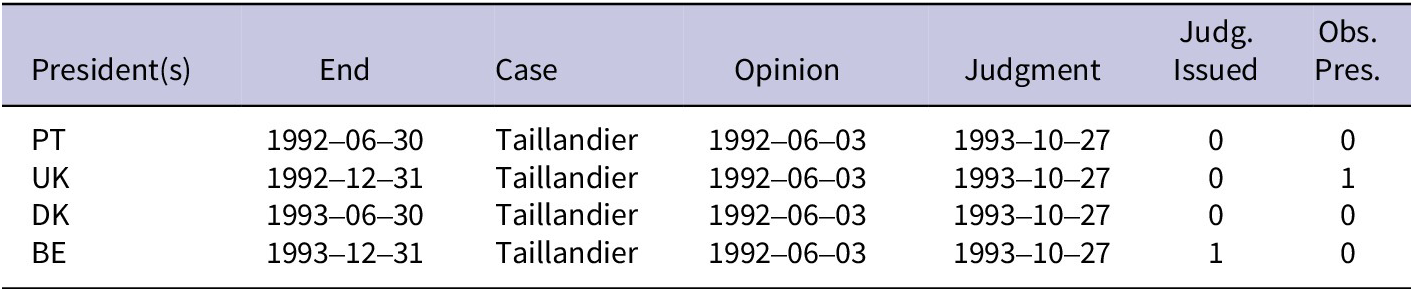
My primary dependent variable of interest is Judgment Issued, which is a binary indicator of whether the CJEU issued its judgment during the Presidency. For example, the case Taillandier Footnote 11 started on March 13, 1991 and ended on October 27, 1993. The AG issued their opinion for the case on June 6, 1992. Between the AG opinion and final judgment, the case overlapped four Council Presidency terms – Portugal (January to June 1992), UK (June to December 1992), Denmark (January to June 1993), and Belgium (July to December 1993). In Taillandier, Judgment Issued would take the value of 0 for Portugal, the UK, and Denmark’s Presidencies, while it would take the value of 1 for Belgium’s Presidency, as the Court issued the case’s judgment during that Presidency.
Second, I require a measure of member states’ interest in a case’s outcome, as my theory predicts that if the President expresses their interest in the outcome of a case, the CJEU should wait until after the Presidency is over to issue its judgment. One means by which member states express their interest in a case is through submitting observations (amici curiae briefs) directly to the Court. All EU member states and institutions have the ability to submit observations on any pending case before the CJEU. Member states use these observations to express their beliefs on how the Court should rule in a particular case (e.g., Dederke and Naurin Reference Dederke and Naurin2018; Stein Reference Stein1981). Scholars leverage these observations as informative signals of the likelihood that a group of member states may legislatively override an adverse decision (e.g., Carrubba and Gabel Reference Carrubba and Gabel2015; Larsson and Naurin Reference Larsson and Naurin2016).
My primary independent variable of interest is Observer President, which takes the value of 1 if the President sent an observation to the Court for a given Presidency-case observation. Returning to the Taillandier case, the UK and France sent observations to the CJEU. Observer President would take the value of 1 for the UK Presidency, while it would take the value of 0 for the Portugal, Denmark, and Belgium Presidencies. Table 1 provides an illustration of how the Taillandier case appears in the dataset. When the AG issued their opinion on June 3, 1992, there were 211 days until the end of the UK’s Presidency. While the CJEU renders judgments on average 154 days after an AG’s opinion, the Court issued a judgment in this case after 511 days. Consistent with the theory, the Court may have delayed this case to avoid issuing its judgment during the UK’s Presidency. Additionally, I create a variable for the number of days from the date of the AG’s opinion until the end of a Presidency (Time Left).
Pre-Trio Example from Unmatched Dataset

Table 1. Long description
The table consists of seven columns and five rows including the header.
Columns from left to right are:
1. President(s)
2. End
3. Case
4. Opinion
5. Judgment
6. Judg. Issued
7. Obs. Pres.
Data rows are as follows:
* Row 1: P T; 1992-06-30; Taillandier; 1992-06-03; 1993-10-27; 0; 0.
* Row 2: U K; 1992-12-31; Taillandier; 1992-06-03; 1993-10-27; 0; 1.
* Row 3: D K; 1993-06-30; Taillandier; 1992-06-03; 1993-10-27; 0; 0.
* Row 4: B E; 1993-12-31; Taillandier; 1992-06-03; 1993-10-27; 1; 0.
Importantly, we should expect Observer President to affect the likelihood the CJEU delays issuing its judgment only if the Council President’s, other member states’, and Commission’s preferences for the case outcome differ from the CJEU’s. In other words, the CJEU should only strategically delay its decision if it fears that the Council President and the other member states in the Council will override it, which also requires the Commission’s support. While member states’, as well as the Commission’s, positions are not available for all of the cases in these data, they are available for a subset of cases between 1995 and 2011 through the Issues and Positions Component of the IUROPA CJEU Database (Larsson et al. Reference Larsson, Lindholm, Naurin, Moberg, Schroeder, Ghavanini, Björnberg, Coster, Näsström, Otero, Lindholm, Naurin, Šadl, Ghavanini, Brekke, Fjelstul, Hermansen, Larsson, Moberg, Näsström, Ovádek, Pavone and Schroeder2022).Footnote 12 Within this time frame, the CJEU’s eventual judgment deviated from 63.84% of member states’ observations, meaning approximately two out of every three member state observations were at-odds with the CJEU. As such, although the full IUROPA data include Observer President throughout, they do not include precise information on member states’ positions for every case; assuming the 1995–2011 sample is broadly representative, member state observations frequently support different positions than the CJEU’s eventual ruling.Footnote 13
Notably, the Taillandier case occurred before the Trio Presidency. Table 2 provides an example from the Dickinger case that occurred post-Trio.Footnote 14 Between the AG opinion and the judgment, the case overlapped two Trio Presidencies. The first Trio consisted of Spain, Belgium and Hungary, while the second Trio consisted of Poland, Denmark, and Cyprus. Furthermore, Austria, Belgium, Greece, Malta, and Portugal sent observations to the CJEU. Since Belgium sent an observation to the court, Observer President would take the value of 1 for the Spain, Belgium and Hungary Trio Presidency, while it would take the value of 0 for the Poland, Denmark, and Cyprus Trio Presidency. Given that three member states hold the Trio Presidency, it is possible that one, two, or all three submit observations to the CJEU on a given case. If all three were to submit an observation supporting the same outcome in a case, it may be functionally equivalent to pre-Trios when a single member state controlled agenda-setting power. Within these data, only two instances exist in which all three Trio members sent an observation to the CJEU, and 63 instances exist in which two out of three Trio members sent an observation to the CJEU, without considering whether they agreed on the policy position. In 681 instances, one out of three Trio members sent an observation to the CJEU. Thus, in the vast majority of case-presidency units post-Trio, the burden for setting override legislation into motion using the Presidency’s agenda-setting power is higher.
Post-Trio Example from Unmatched Dataset

Table 2. Long description
The table consists of seven columns and three rows including the header.
Columns from left to right are:
1. President(s)
2. End
3. Case
4. Opinion
5. Judgment
6. Judg. Issued
7. Obs. Pres.
Row 1 (Data):
President(s): E S, B E, H U.
End: 2011-06-30.
Case: Dickinger.
Opinion: 2011-03-31.
Judgment: 2011-09-15.
Judg. Issued: 0.
Obs. Pres.: 1.
Row 2 (Data):
President(s): P L, D K, C Y.
End: 2012-12-31.
Case: Dickinger.
Opinion: 2011-03-31.
Judgment: 2011-09-15.
Judg. Issued: 1.
Obs. Pres.: 0.
Although this research design leverages the rotation of Presidencies for inference, systematic differences may exist between cases in which member states send an observation compared to cases in which they do not. I, thus, conceptualize the “treatment” of Observer President as conditionally as-if-random on whether member states send an observation. To control for this conditional relationship, I create a variable that is a count of all the observations that the Court receives from other member states that do not hold the Presidency. Since two member states sent observations in the Taillandier case, for example, Count Member State Observers takes the value of 2 for the units in which Observer President equals 0 (Portugal, Denmark, Belgium) and takes the value of 1 for the units in which Observer President equals 1 (UK). In the Dickinger case, alternatively, five member states sent observations to the CJEU. As such, Count Member State Observers takes the value of 5 for the units in which Observer President equals 0 (Poland, Denmark, and Cyprus Trio Presidency) and takes the value of 4 for the units in which Observer President equals 1 (Spain, Belgium and Hungary Trio Presidency). This variable also accounts for threats of override that may arise because a sufficient coalition already exists irrespective of who holds the Council Presidency (e.g., Larsson and Naurin Reference Larsson and Naurin2016). I also create a variable for whether the Commission submitted an observation in the case, as scholars provide evidence the Commission influences CJEU decision-making (e.g., Stone Sweet and Brunell Reference Stone Sweet and Brunell1998).
Next, I create a series of control variables for case characteristics that may affect the amount of time a case takes to complete and, additionally, whether a member state sends an observation to the Court. Following Fjelstul, Gabel and Carrubba (Reference Fjelstul, Gabel and Carrubba2023), I include variables for whether a case deals with principles of law, the number of sources of law, legal order, the number of policy areas, the number of authentic languages, whether the Court joined the proceeding, the number of judges hearing the case, and whether the advocate-general (AG) issued an opinion in the case. If a case deals with general principles of law, the law may be decidedly less complex and, thus, take the Court less time to complete. Simply put, “Judges are more likely to be applying existing legal rules than developing new ones” (Fjelstul, Gabel and Carrubba Reference Fjelstul, Gabel and Carrubba2023, 2651). Second, as the number of sources of law increases – i.e., treaty law, legislation, and case law – the Court’s task in resolving a case is more complex, leading to a longer case time. Third, legal order is a binary variable for whether a case deals with conflicts between EU law and member state law. Such cases are more likely to be complex and politically sensitive, also leading to longer case times. Fourth, as the number of policy areas increases, cases are more complex and time consuming to resolve. Fifth, given cases arrive at the Court in the languages of the different member states, as the number of languages in a case increases, the more documents will need to be translated (e.g., McAuliffe Reference McAuliffe2008), subsequently increasing case time. Sixth, the Court occasionally joins similar cases together. Such joined proceedings should take more time for the Court to process. Seventh, the Court frequently sends more complex and politically salient cases to larger panels of judges (e.g., Kelemen Reference Kelemen2012). Such cases, thus, should take a longer time to complete.
Exact matching
To compare similar case-presidency units, I pre-process these data using exact matching (Iacus, King and Porro Reference Iacus, King and Porro2012). The probability that the CJEU issues a judgment during a given Council Presidency term is strongly correlated with how much time is left in the term. The fewer days remaining in the term, the more likely it is that the judges will issue their judgment after the term is over, purely as a function of the time it takes for deliberations and writing the judgment. Second, I argue that Observer President is as-if-random conditional on Count Member State Observers, as cases in which more member states send observations are systematically more likely to receive the treatment. In order to have empirically valid counterfactuals, thus, I need to compare case-presidency units that had the same amount of time left until the end of the Presidency, and the same number of member state observations.
To that end, I use exact matching to match “treatment” (Observer President
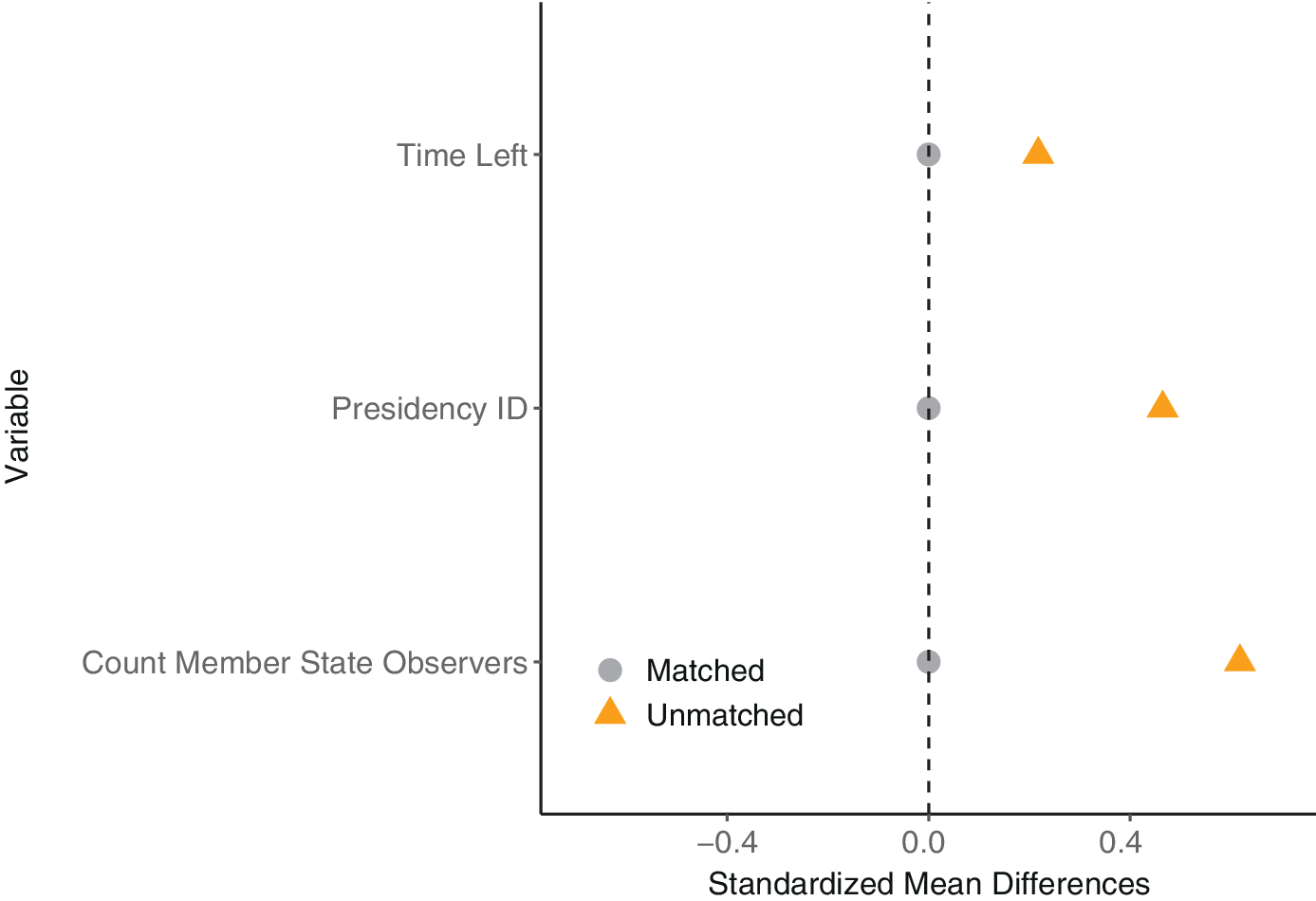
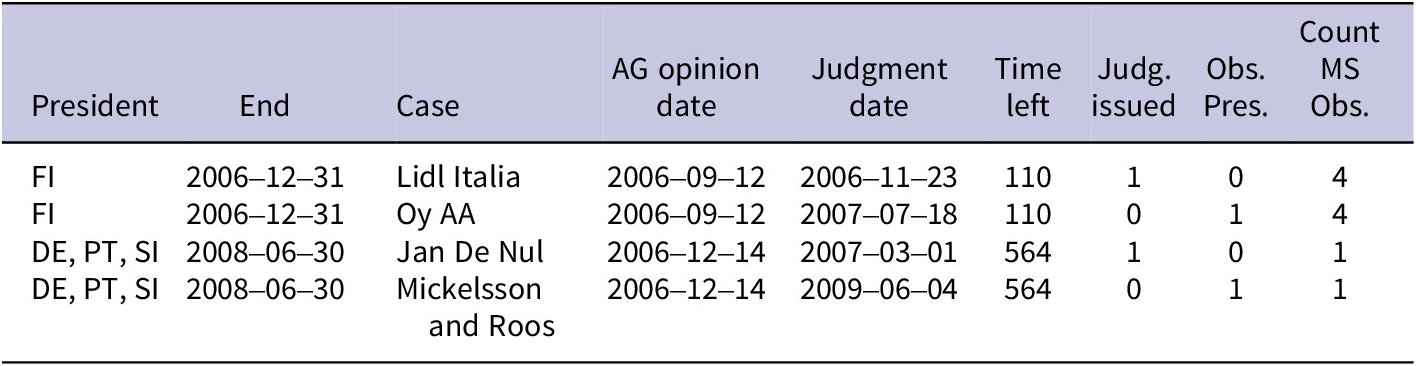
 ) and control case-presidency units to one another conditional on Time Left, Count Member State Observers and Presidency ID. This procedure matched 822 control units (13,029 were unmatched) to 527 treatment units, creating an exact-matched dataset of 1,349 observations. Figure 1 illustrates standardized mean differences for these covariates before and after matching. The figure demonstrates that treated units tend to have more time left until the end of a Presidency, tend to occur in later Presidencies, and tend to have more member state observers than control units. After matching, however, these differences are exactly 0. Table 3 provides a snapshot of four data points in two matched pairs of these data. The first two cases are a matched pair that overlapped the Finland Council Presidency, had the exact same amount of time left until the end of the Presidency and the same number of Count Member State Observers, with the Oy AA case as the “treated” unit and the Lidl Italia case as the “control” unit. The third and fourth cases are a matched pair that overlapped the Trio Presidency of Germany, Portugal, and Slovenia, and are also exactly matched on the aforementioned covariates with the Mickelsson and Roos case as the treated unit and the Jan De Nul case as the control unit.
This plot illustrates the balance for Time Left, Count Member State Observers, and Presidency ID before and after matching.

Example of Matched Data

Table 3. Long description
The table consists of nine columns: President, End, Case, A G opinion date, Judgment date, Time left, Judg. issued, Obs. Pres., and Count M S Obs.
* Row 1: President F I, End 2006-12-31, Case Lidl Italia, A G opinion date 2006-09-12, Judgment date 2006-11-23, Time left 110, Judg. issued 1, Obs. Pres. 0, Count M S Obs. 4.
* Row 2: President F I, End 2006-12-31, Case Oy A A, A G opinion date 2006-09-12, Judgment date 2007-07-18, Time left 110, Judg. issued 0, Obs. Pres. 1, Count M S Obs. 4.
* Row 3: President D E, P T, S I, End 2008-06-30, Case Jan De Nul, A G opinion date 2006-12-14, Judgment date 2007-03-01, Time left 564, Judg. issued 1, Obs. Pres. 0, Count M S Obs. 1.
* Row 4: President D E, P T, S I, End 2008-06-30, Case Mickelsson and Roos, A G opinion date 2006-12-14, Judgment date 2009-06-04, Time left 564, Judg. issued 0, Obs. Pres. 1, Count M S Obs. 1.
Difference-in-differences specification
To test my hypotheses, I estimate a difference-in-differences (DiD) specification on the matched data set (e.g., Daw and Hatfield Reference Daw and Hatfield2018) examining the probability of Judgment Issued for units with an Observer President before and after the introduction of the Trio Presidency. The variable Trio is a binary variable indicating whether a case-presidency unit was before or after the introduction of the Trio Presidency in 2007. Table 4 provides descriptive statistics for the dependent variable and all control variables before and after the Trio Presidency. Given that the duration of Council Presidencies tripled after Trios, the average case-presidency unit has 202 more days of Time Left after Trios. As such, on average, the cost of delay for the CJEU is higher after Trios than before. This may confound inference, as it would be unclear whether it is the reduction in agenda-setting power of the Council President or the increase in costs affecting the probability of the CJEU issuing a judgment. As such, I control for Time Left in the primary model specification. Other notable differences include that Count Member State Observers is higher on average post-Trios as is the number of judges hearing a case.
Descriptive Statistics for Variables Pre and Post Trio

Table 4. Long description
The table consists of seven columns: Variable Name, Pre-Trio Mean, Pre-Trio Std. Dev., Post-Trio Mean, Post-Trio Std. Dev., Diff. in Means, and Std. Error.
* Judgment Issued: Pre-Trio Mean 0.536, Post-Trio Mean 0.786, Diff. 0.250.
* Observer President: Pre-Trio Mean 0.380, Post-Trio Mean 0.402, Diff. 0.023.
* Principles of law: Pre-Trio Mean 0.032, Post-Trio Mean 0.038, Diff. 0.006.
* Legal Order: Pre-Trio Mean 0.091, Post-Trio Mean 0.178, Diff. 0.087.
* Policy Areas: Pre-Trio Mean 0.639, Post-Trio Mean 0.380, Diff. minus 0.260.
* Judges: Pre-Trio Mean 5.677, Post-Trio Mean 6.633, Diff. 0.955.
* Joined Proceedings: Pre-Trio Mean 1.185, Post-Trio Mean 1.167, Diff. minus 0.018.
* Languages: Pre-Trio Mean 1.012, Post-Trio Mean 1.005, Diff. minus 0.007.
* Count Member State Observers: Pre-Trio Mean 0.806, Post-Trio Mean 1.357, Diff. 0.551.
* Commission Observer: Pre-Trio Mean 0.724, Post-Trio Mean 0.824, Diff. 0.100.
* Time Left: Pre-Trio Mean 146.528, Post-Trio Mean 348.652, Diff. 202.124.
Additionally, the institutional powers of the Council, the probability of any one member state holding the Council Presidency, and the internal procedures and case load of the CJEU have changed substantially over time. As a result, it is not immediately obvious how much of the pre-Trio data to include in this DiD model as a pre-trend. For full transparency, and to demonstrate the findings’ robustness, I run the DiD specification separately on four subsets of these data: all case-presidency units from the start of the European Communities (full dataset), all units after the accession of the UK, Denmark, and Ireland in 1973, all units after the Maastricht Treaty forming the EU from 1994 onwards (the treaty took effect in November of 1993), and all units after the eastern enlargement from June 2004 onwards in which ten additional member states acceded to the EU. Since the weights in the matching procedure are calculated within each individual Presidency, the results are the same irrespective of whether I exact match before or after subsetting these data.
I estimate a weighted ordinary least squares for case i during Presidency t of the following form:

where
 is a vector of controls (Time Left, Count Member State Observers, Principles of Law, Legal Order, Policy Areas, Judges, Joined Proceedings, Languages, Commission Observer),
 standard errors clustered at the classification level generated by the matching algorithm (substantively, each individual Council Presidency), and the exact matching generated weights for each unit. A negative and statistically significant coefficient for Observer President before the introduction of Trios would be evidence in support of Hypothesis 1. A positive and statistically significant
 alongside a weaker marginal effect for Observer President following Trios would be evidence for Hypothesis 2.
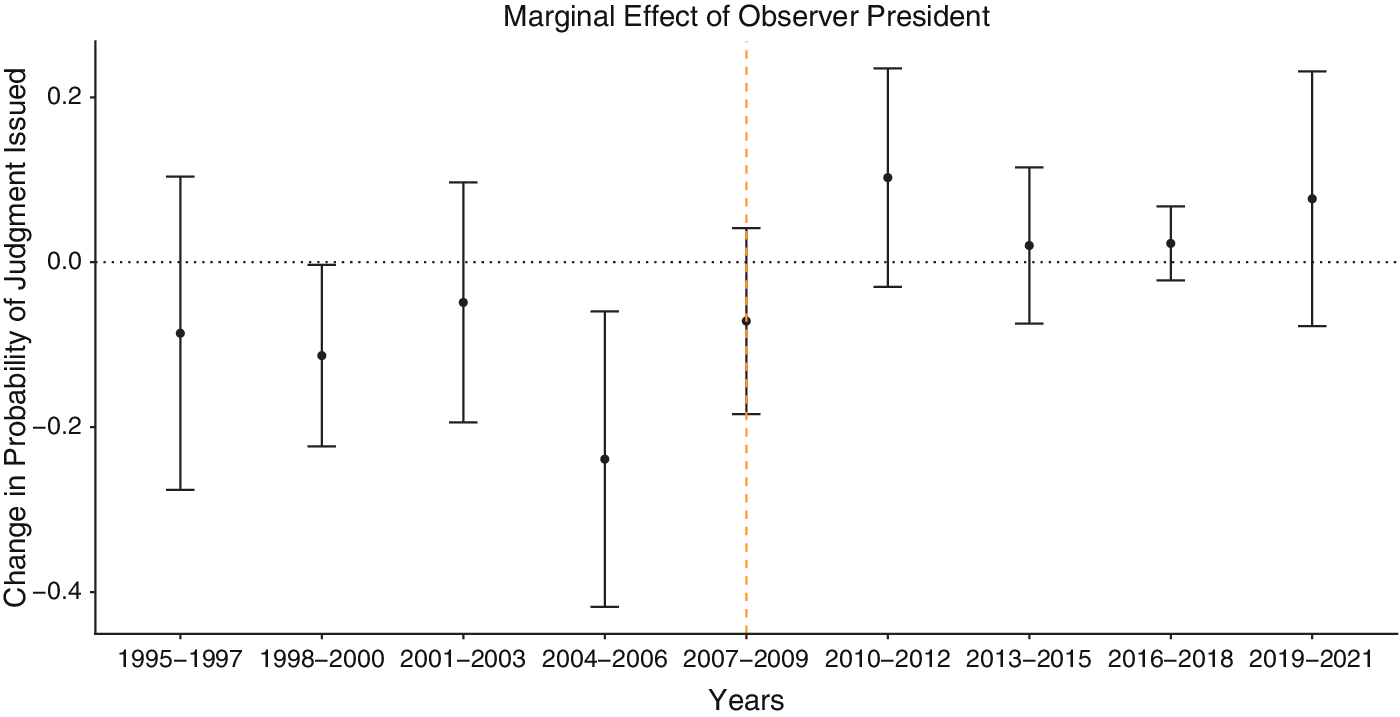
Figure 2 provides an event study plot examining the marginal effect of Observer President in three-year intervals before and after Trios. While event-study plots are conventionally used to illustrate that statistically significant differences do not exist in the pre-treatment periods in order to validate the DiD parallel trends assumption (e.g., Roth et al. Reference Roth, Pedro, Bilinski and Poe2023), in this application, I should observe negative and statistically significant marginal effects before Trios, and should be less likely to observe negative and statistically significant coefficients after Trios. As Figure 2 demonstrates, following the introduction of Trios, the marginal effect of Observer President is positive and statistically insignificant, providing some descriptive evidence for my hypotheses. The results in the following section demonstrate that these marginal effects before and after Trios are significantly different from one another.
This plot illustrates the marginal effect of Observer President in three-year intervals before and after Trios with 95% confidence intervals clustered at the matching subclassification level. The dashed vertical line indicates the beginning of the Trio Presidency.

Figure 2. Long description
The y-axis is labeled Change in Probability of Judgment Issued, ranging from negative 0.4 to 0.2. The x-axis is labeled Years, divided into nine intervals. A horizontal dotted line marks the 0.0 baseline. A vertical dashed orange line between 2004-2006 and 2007-2009 marks the start of the Trio Presidency.
Data points with vertical error bars representing 95 percent confidence intervals are plotted as follows:
* 1995-1997: Point at approximately negative 0.1 with wide error bars from negative 0.28 to 0.1.
* 1998-2000: Point at approximately negative 0.12 with error bars from negative 0.22 to 0.0.
* 2001-2003: Point at approximately negative 0.05 with error bars from negative 0.2 to 0.1.
* 2004-2006: Point at approximately negative 0.24 with error bars from negative 0.42 to negative 0.06.
* 2007-2009: Point at approximately negative 0.07 with error bars from negative 0.18 to 0.04.
* 2010-2012: Point at approximately 0.1 with error bars from negative 0.03 to 0.23.
* 2013-2015: Point at approximately 0.02 with error bars from negative 0.08 to 0.12.
* 2016-2018: Point at approximately 0.02 with narrow error bars from negative 0.02 to 0.07.
* 2019-2021: Point at approximately 0.08 with error bars from negative 0.08 to 0.23.
Results
Table 5 displays the results. For each subset of these data I run the DiD model both with and without controls. Across all model specifications the coefficient for Observer President is negative and statistically significant, providing evidence for Hypothesis 1. The results become stronger in each subset of the data, with particularly large results in the Post-2004 data (
 , p
 0.01). This amounts to the CJEU delaying a case on average by approximately 21 days.
Results

Table 5. Long description
The table is organized into 8 columns under the primary heading Judgment issued. These are grouped into four pairs: Full data (1 and 2), Post-1973 (3 and 4), Post-1994 (5 and 6), and Post-2004 (7 and 8).
Key variables and their coefficients include:
* Constant: Values range from 0.4034 to 0.5939, all significant at p < 0.01.
* Observer President: Negative coefficients across all models, ranging from -0.0662 to -0.2917, with increasing significance in later periods.
* Trio: Positive significant coefficients in odd-numbered columns (e.g., 0.2183 in column 1) and negative or non-significant values in even-numbered columns.
* Observer President times Trio: Positive coefficients, becoming highly significant in the Post-2004 group (0.2549 and 0.2753).
* Legal Order: Consistently negative and significant coefficients ranging from -0.0806 to -0.0965.
* Count Member State Observers: Negative significant coefficients in the Full data and Post-1973 models (-0.0340 and -0.0323).
* Time Left: Small positive coefficients (0.0017 or 0.0014) significant at p < 0.01 across all applicable models.
Summary statistics at the bottom show R super 2 values increasing from approximately 0.07 in odd columns to over 0.40 in even columns. The number of observations decreases chronologically from 1,349 (Full data) to 761 (Post-2004). Standard errors are provided in parentheses below each coefficient.
Standard errors clustered at the exact matching subclassification level
 p
 0.1;
 p
 0.05;
 p
 0.01.
Table 6 divides Council Presidency terms into when the AG issued their opinion: either in months 1 to 2, 3 to 4, or 5 to 6. Substantively, cases in which the AG delivered their opinion in months 3–4 are 23 days longer and are 6 percentage points more likely to have the court issue its ruling after the Presidency is over when the Council President submits an observation to the CJEU. Cases in which the AG issued their opinion in months 1–2 of a Council Presidency are likely to be about 14 days longer, but are 9 percentage points more likely to have the CJEU wait until the next Presidency to rule on them. As the average case in the matched data in which the Council President did not submit an observation takes approximately 149 days from AG opinion to final judgment, and given the President’s term is about 183 days, delays do not have to be unusually long relative to the baseline time it takes to deliver a judgment to outlast a Presidency. Likewise, when the AG issues their opinion in months 5–6 of a Presidency, the differences between cases in which the Council President sent an observation and those in which it did not are considerably smaller, as the normal time it takes to write a judgment is likely to take the case to the next Presidency without any strategic delay.
Marginal Effect of Observer President by time of AG Opinion Within Presidency

Table 6. Long description
The table consists of three columns and three data rows.
Column headers from left to right are: Time of A G opinion within Presidency, Change in days (Observer President), and Change in Probability of Delay (Observer President).
Row 1: Months 1 to 2. Change in days is 13.62. Change in Probability of Delay is 0.09.
Row 2: Months 3 to 4. Change in days is 23.24. Change in Probability of Delay is 0.06.
Row 3: Months 5 to 6. Change in days is 6.69. Change in Probability of Delay is 0.02.
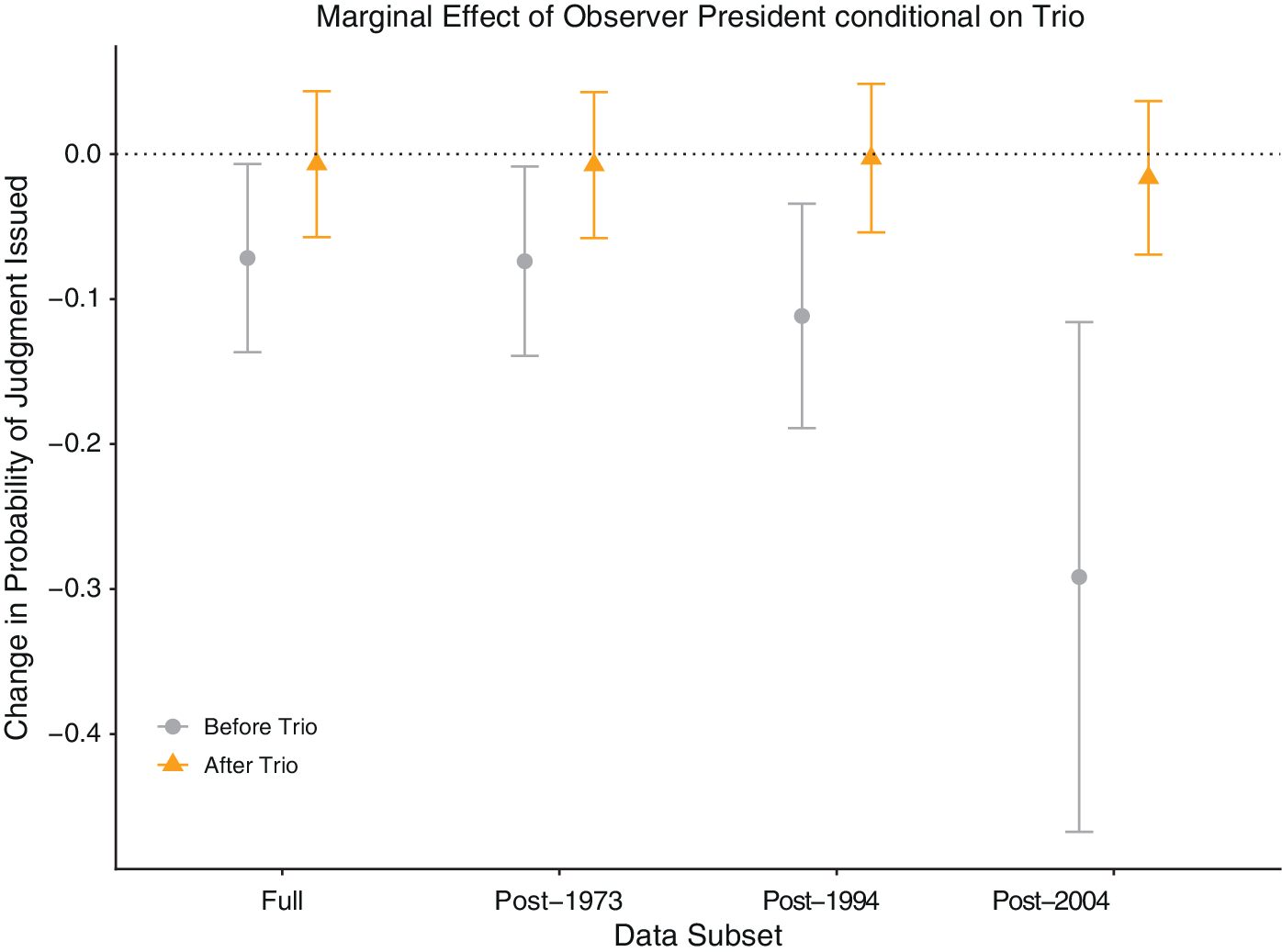
Similarly, across all model specifications, the marginal effect of Observer President is weaker after the introduction of Trios, as demonstrated by Figure 3, and indistinguishable from 0. Furthermore, as the Observer President
 Trio specification indicates, the difference between the marginal effects for Observer President before and after Trios is statistically significant for all models except models 1 and 3, indicating that the probability that the CJEU issues a judgment when a member state that sends an observation to the CJEU holds the Council Presidency increases after the introduction of the Trio Presidency. That is, under Trios, the Court is less likely to strategically delay resolving a case until after a member state’s Presidency term is complete, providing evidence for Hypothesis 2. Table A1 in the Supplemental Appendix demonstrates that these results are also robust to running the DiD specification on the unmatched data.
Based on Table 5 models 2, 4, 6, and 8. This plot illustrates the marginal effect of Observer President with all other variables held at their means within the given subset of data before and after Trios with 95% confidence intervals clustered at the matching subclassification level.

Figure 3. Long description
A coefficient plot with a horizontal dotted line at 0.0 on the Y axis. The Y axis is labeled Change in Probability of Judgment Issued, ranging from negative 0.4 to 0.0. The X axis is labeled Data Subset and contains four categories from left to right: Full, Post-1973, Post-1994, and Post-2004.
Legend:
* Grey circles represent Before Trio.
* Orange triangles represent After Trio.
Data Trends:
* Full: Before Trio is at approximately negative 0.07 with a wide confidence interval; After Trio is near 0.0 with a narrower interval.
* Post-1973: Before Trio is at approximately negative 0.07; After Trio is near 0.0.
* Post-1994: Before Trio drops to approximately negative 0.11; After Trio remains near 0.0.
* Post-2004: Before Trio shows a significant drop to approximately negative 0.29 with a very large confidence interval extending to negative 0.47; After Trio remains near 0.0.
In all subsets, the After Trio effect is consistently closer to zero and more precise than the Before Trio effect.
Conclusion
Under what conditions are courts responsive to threats of legislative override? In this article, I argue that when an agenda-setting legislator has an interest in the outcome of a case, a court will believe that the threat of legislative override is heightened. In response, if the legislator only holds agenda-setting power for a period of time, the Court will wait until the legislator no longer holds agenda-setting power to issue its decision in a case. I provide evidence by leveraging the rotating Presidency of the Council of the European Union as an exogenous determinant of member state agenda-setting power and demonstrate that the CJEU strategically delays its decisions until the Presidency rotates when the President signals its interest in a case through an amicus curiae brief. These results disappear after the introduction of the Trio Presidency, which reduced each individual member state’s agenda-setting power.
These findings have implications for the separation of powers and judicial behavior. First, building upon the robust scholarship that explores the nature and extent of strategic judicial behavior (e.g., Carrubba Reference Carrubba2009; Clark Reference Clark2011; Engst Reference Engst2021; Helmke Reference Helmke2005; Krehbiel Reference Krehbiel2016; Staton Reference Staton2010; Vanberg Reference Vanberg2005), this article further combines these insights with canonical insights on legislative agenda-setting (e.g., Cox and McCubbins Reference Cox and McCubbins2005; Romer and Rosenthal Reference Romer and Rosenthal1978). By leveraging institutional features of legislatures, scholars may produce fruitful insights on the viability of threats to courts’ efficacy. Additionally, through exploring other more subtle means by which courts reduce override threats, scholars may be better able to distinguish between competing theoretical explanations for courts’ behavior.
Second, judicial politics scholars can expand what they consider a systematic constraint on courts’ behavior. Most scholars view override as a constraint insofar as it affects a case’s outcome. Such a view, however, requires researchers to have an appropriate proxy for a court’s counterfactual decision-making that may require in-depth knowledge about a case’s legal merits or a judge’s ideology (Cheruvu Reference Cheruvu2024, Reference Cheruvu2025). Nonetheless, because a clean counterfactual rarely exists, it is hard to distinguish between explanations of a court’s behavior. As an alternative to case outcomes, analyzing courts’ other observable behaviors, such as whether to hear cases in the first place (e.g., Lane Reference Lane2022), the timing of decisions (e.g., Arguelhes and Hartmann Reference Arguelhes and Hartmann2017; Krehbiel Reference Krehbiel2021a), or increasing public awareness of cases (e.g., Staton Reference Staton2010), requires fewer assumptions when developing a counterfactual. Furthermore, scholars must also establish why such behavior may be costly for courts. Declining to hear cases may encourage more noncompliance, as relevant actors are unclear as to the law’s meaning (e.g., Beim and Rader Reference Beim and Rader2019). Employing staff to publicize court decisions may take away budget lines that may be better spent on hiring additional clerks. Delineating courts’ choices that are not directly related to case outcomes in terms of their opportunity costs provides a clear path to understanding the systematic constraints courts face when making such alternative choices (e.g., Strayhorn, Carrubba and Giles Reference Strayhorn, Carrubba and Giles2016).
Lastly, this article heeds the call of Staton and Moore (Reference Staton and Moore2011) by combining insights from the American, comparative, and international relations scholarship on judicial behavior. By engaging across subfields, scholars can contribute to a more comprehensive understanding of the dynamics that fundamentally constrain judicial institutions. This article’s incorporation of insights from the domestic courts scholarship on legislative-judicial relations to explain behavior of an international court is one such example of the benefits of this approach. Future research on international courts can similarly draw from scholarship on domestic separation of powers to explain their strategic behavior.
Supplementary material
The supplementary material for this article can be found at http://doi.org/10.1017/jlc.2026.10032.
Data availability statement
Data and supporting materials necessary to reproduce the numerical results in this article can be found in the Journal of Law and Courts Dataverse at https://dataverse.harvard.edu/dataverse/jlc.
Acknowledgments
I would like to thank Aniket Kesari, Curtis Bram, Lauren Santoro, participants at the University of Texas at Dallas political science working paper series, the Emory judicial politics group, the 2023 MPSA Conference, and the 2024 Texas Comparative Circle Conference for their helpful comments and suggestions.






 Open access

